
Only Bad lawyers and the Certifiably Insane wind up in Congress
Posted: December 15, 2010 Filed under: We are so F'd | Tags: Federal Reserve Bank, Financial Crisis of 2007, Obama-McConnell tax breaks extention, Politicians are Crazy, Ron Paul and other Flat earthers, Spencer Bachus, START 61 Comments I went to Memorandum today to see what was up with the votes on the DADT repeal, the Tax Giveaways to Billionaires Act, and the START treaty. It’s one of the first places I go in the day because it usually groups the day’s relevant economic and political topics and it covers blog reactions from all sides of the political spectrum. I just wanted to know when the votes would be. What I saw was a bunch of headlines that lead to the thought you see above. I don’t even know where to start with this conglomeration of links, but they all seem connected to my hypothesis above.
It’s not that all of us outside the Beltway don’t recognize that there’s very few real people with functional brains in Congress. The proof for that is right there in the middle of the Memorandum page too.
From Gallup Polls:
Congress’ Job Approval Rating Worst in Gallup History :
Thirteen percent approve of the way Congress is handling its job
That headline is coupled with this one from WAPO: Washington Post-ABC poll: Public is not yet sold on GOP
From The Hill: DeMint will force readings of START Treaty and omnibus bill
For some reason, the 2000 pages of the Tax Bonuses for Billionaires plan isn’t germane to discussions of deficits and national security but the START treaty and the ominibus spending bill are fodder for ideological temper tantrums.
From TPM: Kyl: Reid Disrespecting Christians By Suggesting Post-Christmas Senate Votes
(Psst Kyl: the Reason for the Season is Mithros’ the Bull God’s birthday. Read your Roman History. The reason for Sunday services is The Sun God. Read your Roman History. You were had a long time ago by Constantine and the Nicene Council. Read the historical records of the Council set up by Constantine to establish a Roman religion and get off your friggin, butt and do your job!)
Oh, speaking of mythology, try THIS one on for size from the NYTimes: G.O.P. Panelists Dissent on Cause of Crisis. I’m going to spend some time on this because it’s just the best example of what is wrong with POLITICIANS. Congress was completely duplicitous in the crisis and yet, all the want to do is blame Federal Regulators.
Democrats have emphasized factors like fraudulent practices by mortgage lenders and reckless risk-taking by Wall Street banks and other financial institutions, while Republicans have focused on poor oversight of Fannie Mae and Freddie Mac, the entities that supported the secondary market for mortgages, and decades of government efforts to encourage homeownership.
“While the housing bubble, the financial crisis, and the recession are surely interrelated events, we do not believe that the housing bubble was a sufficient condition for the financial crisis,” the document states. “The unprecedented number of subprime and other weak mortgages in this bubble set it and its effect apart from others in the past.”
Unbelievable. Yes, that happened. Yes, it was a problem. But what drove the demand for subprime and weak mortgages was the demand for those wacky unregulated credit derivatives. It was all part of the same pattern of negligence and wishful thinking. You can’t unlink the systemic problems and the symptoms. Fannie and Freddie got into those things and drowned, but it wasn’t exactly their idea to begin with. Congress should’ve stopped them from going there. But the driving factor was still the demand for credit derivatives. Every institution was churning those things out in this country and in others. The delusion is worse than I thought.
From Yves at Naked Capitalism:
This whole line of thinking is garbage, the financial policy equivalent of arguing that the sun revolves around the earth. Yes, the US and other countries provide overly generous subsidies to housing, and curtailing them over time would not be a bad idea. But that’s been our policy for decades. Calling that a major, let alone primary, cause of the crisis, is simply a highly coded “blame the poor” strategy, In reality, both the runup to the crisis and its aftermath were on of the greatest wealth transfers from the citizenry at large to a comparatively small group of rentiers in the history of man. (If you want to read the long form debunking of this thesis, go straight to Barry Ritholtz, a Republican who has shredded this brand of class warfare, or as he calls it, “one giant clusterfuck of imbecility,” repeatedly on his blog.)
The intent is pretty transparent: to discredit an effort at fact finding into the roots of the crisis, what was hoped to be a Pecora Commission, by making it appear partisan and launching an alternative narrative to muddy the waters. And the reason is clear. Even though FCIC is certain not to have the same effect that the Pecora Commission did, of discrediting major financial services industry figures and exposing various forms of chicanery, it appears that even lesser forms of criticism of the banksters must be sandbagged (the bizarre part of this drama is that at least some Democrats and very selectively, Republicans in office are willing to call out the predatory, extractive behavior of the large banks. But no one has the guts to buck an industry that is a major paymaster in a very serious way).
Experts agree that while Fannie and Freddie and the federal government’s push to encourage homeownership played a significant role in causing the crisis, actions by Wall Street magnified the fallout and caused a crisis that led to the Great Recession. Economists from the Federal Reserve, as well as bank regulators first appointed by Republicans, agree that the Community Reinvestment Act played virtually no role in causing the financial crisis.
But the Republicans’ report will largely focus on the role played by the federal government. It will note that a crisis was averted after the government bailed out Bear Stearns and facilitated its absorption by JPMorgan Chase, according to people familiar with the matter. The crisis roared back after the government allowed Lehman Brothers to fail, scaring nervous investors. A bigger and more protracted downturn was avoided when policy makers essentially bailed out the entire financial system.
Exactly. It’s never EVER been the Community Reinvestment Act and to even insert it into the report is odious and false. I never got how the CRA got connected to the Fannie/Freddie mess from the outset other than through political memes. I remember getting blog wacked by some from the left because I said Fannie and Freddie were part of the problem. I never ONCE mentioned the CRA; only that Frannie and Freddie did what all the financial instituions did except on a much larger scale. They packaged and sold poorly underwritten mortgages that were eventually going to make some one homeless sooner or later. Fannie and Freddie’s roll was complicit and huge only because of their size and importance in the mortgage market. They’d have never dreamed of doing what they did if it wasn’t for the fact they could package and sell the things–just like Countrywide and a bunch of other now defunct private entities–to stupid investors who were mislead by high ratings and the belief that due diligence was done on mortgage underwriting. The deal is that Congress could’ve stopped all of that–especially Fannie and Freddie–but they did nothing. They could’ve prevented the underwriting of many of those predator loans.
Couple that with this travesty via the Birmingham News and AL.com.
Bachus, in an interview Wednesday night, said he brings a “main street” perspective to the committee, as opposed to Wall Street.
“In Washington, the view is that the banks are to be regulated, and my view is that Washington and the regulators are there to serve the banks,” he said.
…
In his quiet campaign for the chairmanship, Bachus promoted an agenda to end taxpayer subsidies for mortgage giants Fannie Mae and Freddie Mac, repeal those parts of the Wall Street reforms that he thinks still leave the door open for taxpayer bailouts of financial institutions or their creditors, and increase oversight of President Barack Obama’s administration.
Then, we have Congressman Out-of-touch-with-reality Ron Paul who will be in charge of the subcommittee in Congress that deals with the FED. This is another example of putting some one in charge of oversight that want’s to just plain abolish the reality. He’ll be so stuck in ideologue land that oversight will just go by the way side. It’s like putting a Flat Earther in charge of NASA.
In a move that may seem to some like putting the fox in charge of the hen house, Rep. Ron Paul (R-Texas) has been named to head the House subcommittee that oversees the Federal Reserve.
Paul, 75, is a longtime critic of the central bank and, as Bloomberg pointed out, has even written a book called “End the Fed.” He will lead the domestic monetary policy subcommittee of the House Financial Services panel.
In announcing Paul’s appointment Thursday, chairman-elect Spencer Bachus (R-Ala.) said the Texan would add to the team that “crafted the first comprehensive financial reform bill to put an end to the bailouts, wind down the taxpayer funding of Fannie Mae and Freddie Mac, and enforce a strong audit of the Federal Reserve.”
Paul told Bloomberg last week he plans to call for hearings on U.S. monetary policy and will continue to press for a full accounting of the Fed’s functions. In the past, Paul has introduced legislation to abolish the central bank.
There are a lot of people realizing that Congress is not acting in the interest of the American people. The American Interest journal has a series of articles–including an important one on Income Inequality by Tyler Cowen–on  inequality and democracy. The front page of the Magazine–featured and linked to on the right–asks the most relevant question I can think of today. “Are Plutocrats Drowning our Republic?” A subsidiary question could well be “Why is every one in Congress intent on helping them do it?”
Congress did not get the message from this election. Here’s a clue from another link at that AI site. They just seem intent and recreating the same scenarios and the same problems over and over and over again.
Many Americans are still furious that their government helped the rich and politically connected few while leaving the rest hung out to dry. The government bailed out Wall Street financiers who live in the top tenth of the top hundredth of the income distribution. Meanwhile, almost one quarter of families with mortgages remains stuck with negative equity in their homes.
Let’s return to that bit on the Republicans on the crisis panel. I’ll borrow some analysis from Paul Krugman in his blog thread: ‘Invincible Ignorance’.
So Republican members of the Financial Crisis Inquiry Commission are going to issue their own report, placing primary blame on the government — because it’s always the government’s fault.
And according to reporting at the Huffington Post,
all four Republicans voted in favor of banning the phrases “Wall Street” and “shadow banking” and the words “interconnection” and “deregulation” from the panel’s final report, according to a person familiar with the matter and confirmed by Brooksley E. Born, one of the six commissioners who voted against the proposal.
Yep. It was all Fannie and Freddie, which somehow managed to cause housing bubbles in Ireland, Iceland, Latvia, and Spain as well as the United States; and the repo market had nothing to do with it.
And bear in mind that this wasn’t one Republican; it was all of them.
We consistently get people in congress that appear to live in a reality of their own making. They ignore science. They ignore history. They ignore economics. They ignore nearly everything to push partisan power, curry favor with the donor and the bonus class, and spin tails to deluded followers that have no basis in fact, evidence, or theory. They even run campaigns based on denying scientific theories that are well prove–like evolution–and promoting failed hypothesis–like all of Reaganomics–even when the majority of people who would know try to give them the facts.
What is it about our political process that seems to put policy in the hands of complete whack jobs and unemployable lawyers? My one dash at the Nebraska Unicameral convinced me that only pathological narcissists and liars and ideologues capable of denying reality can get through the process. Those folks are surrounded and supported by equally pathological narcissists, liars, and ideologues and they’re all bought up by a plutocracy that pays to play.
We are so F’d. I am so frightened for and disheartened about the future of this country. How is it that Congress can get such low approval numbers but go right back to ruining the country in the same manner post-elections? Both parties have their on unique style that achieves the same end. What can we do to stop this? It has to be the gerrymandered districts and the money. But, how can we change the laws when the foxes are in charge of all the hen houses?
UPDATE: Senate approves tax cut deal; House Dems weigh amending estate tax
The Senate on Wednesday approved a sweeping tax package negotiated by the White House and congressional Republicans, and House leaders – who were looking to amend the measure in a way that would satisfy liberals without unraveling the deal altogether – said a House vote could follow as soon as Thursday.
The Senate passed the package by a vote of 81 to 19.
Before senators began debating the $858 billion package in late morning, President Obama urged lawmakers in both houses to pass it “as swiftly as possible.” He called the plan “an essential ingredient in spurring economic growth over the short run.”
Speaking before a meeting with business leaders, Obama said: “I am absolutely convinced that this tax cut plan, while not perfect, will help grow our economy and create jobs in the private sector.” He acknowledged that lawmakers of both parties object to different aspects of the plan but said, “That’s the nature of compromise.” He added that “we can’t afford to let it fall victim to either delay or defeat.”
In other news: Obama announces his Faith Based VooDoo economics initiative based on advice from the ghost of Ronald Reagan … We are still so F’d.
that is all.
Feel the Bern!
Posted: August 25, 2009 Filed under: Bailout Blues, Equity Markets, Global Financial Crisis, U.S. Economy | Tags: Ben Bernanke, Federal Reserve Bank, Larry Summers Comments Off on Feel the Bern!While I stuck the announcement into the morning links, you had to know that I’d front page this announcement some time today. So you also probably knew that I breathed a quiet sigh of relief last night when I found out we were not getting La La Summers for Fed Chief. President 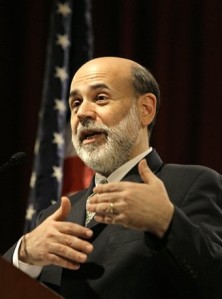 Obama has decided to re-appoint Fed Chairman Ben Bernanke to another term.
I awakened this morning to the bleating of the bloggies on this move. Of course, I have this tendency to look at folks’ credentials before I decide to take their opinions seriously. It also helps to know their political agendas and frames. Chairman Bernanke has probably had the most challenging time at that job since Paul Volcker took over the Fed helm back in the days of rampant inflation and Carter malaise. So many blogs have come to criticize Bernanke, but I’m just glad we’re not here to bury him. He may not be perfect, but he’s a damn sight better than just about everything else out there. Ben Bernanke is an economist’s economist.
Wall Street and academic economists in recent weeks showed enthusiasm for giving Mr. Bernanke a second term, and some administration insiders felt similarly even though Mr. Bernanke was appointed by — and served in the White House of — President George W. Bush. Appointing a Democrat such as Janet Yellen, president of the Federal Reserve Bank of San Francisco, or Alan Blinder, former Fed vice chairman — both former advisers to President Bill Clinton — would have been popular with many Democrats. But a move by Mr. Obama to install his own person at the Fed might have have rattled markets and unsettled the foreign investors.
Phil Izza at the WSJ has a pretty good line up of comments from both political and financial folks on the Bernanke appointment. Some of the performance the financial markets today(so far, all up) could be linked to the decision as the Fed Chair heads up the Federal Open Market Committee and sets its agenda. It is a rare FOMC that will go against the recommendations of their chair when setting monetary policy(primarily levels of interest rates, exchange rates, and bond offerings) although there is usually a healthy amount of debate and exchange or so I’ve heard since the meetings are top secret.
- I think it’s good news for the Federal Reserve. It’s good news for the country. It’s a great choice. Chairman Bernanke has done a terrific job in bringing openness to the Fed. He has been bold and creative in dealing with the financial crisis… It was not clear to most people that the crisis was going to be as broad-based, and that the excesses in the financial markets and in lending were as broadly based as they turned out to be. Even at the start, he was willing to consider all options to deal with what appeared to be more a liquidity than a solvency crisis. As it began to become more clear that it was a crisis of solvency and leverage and a classic credit crunch, he didn’t flinch in bringing enormous creativity to bear in mitigating the problem –Richard Berner, Morgan Stanley
- Having a new chairman come in at this late date would put the Fed engineered solution to both the recovery and the exit strategy at risk. The Federal Reserve made a hasty exit from easy money stimulus in the 1930s and we know how that worked out… Mistakes have been made at many regulatory institutions during this crisis, but all the Fed’s mistakes would have been made by any man according to the prudent man rule. Bernanke is a true prudent man who calls them as he sees them, and knows the ins and outs of policymaking… If he can pull off this recovery that still needs nurturing, he could well go down as one of the greatest Fed Chairmen in history. –Christopher Rupkey, an economist with Bank of Tokyo-Mitsubishi
All Eyes on Ben
Posted: July 27, 2009 Filed under: Bailout Blues, Global Financial Crisis, The Great Recession, U.S. Economy | Tags: Ben Bernanke, Dennis Kucinich, Federal Reserve Bank, Nouriel Roubini, PBS News Hour, Regulating the FED, Ron Paul, ZIRP Comments Off on All Eyes on Ben I’ve been Fed watching again. That’s something of both an occupational hazard and a weirdish hobby for me. Usually, Fed chairs stay off the lecture circuit until they retire and write their biographies. Ben Bernanke, however, is not your usual Fed Chair and these are not usual times. I think you may recall that part of his observations with being in charge of monetary policy when there’s no room drop interest rates (ZIRP) has to do with communicating future Fed actions to a nervous public. This continues.
Bernanke was in Kansas City over the weekend speaking to normal people and Jim Lehr of the PBS program News Hour. There were several things from this exchange worth mentioning. The first is a response to the meme circulating around the libertarian circuit that there is no accountability between the FED and any one in Washington. That is untrue for several reasons. First, because the majority of appointments (including the Fed Chair) to the FOMC are made by POTUS and approved by the Senate. Second, the Fed Chair makes biannual trips to the Hill to speak with both houses of Congress and take questions. Third, they publish their internal records as well as their research continually. It’s a matter of public record. The only thing Congress doesn’t get to see is the rationale behind monetary policy which is perfectly in keeping with the idea of independence supported overwhelmingly by evidence and theory. They have to the right to see the Fed balance sheet and items now. What they do not have is the right to ‘audit’ monetary policy. Something that would be a disaster.
“The Federal Reserve, in collaboration with the giant banks, has created the greatest financial crisis the world has ever seen,” Representative Ron Paul, Republican of Texas, said at a House hearing last week in which Mr. Bernanke testified about the state of the economy.
Republican lawmakers portray the Fed as the embodiment of heavy-handed big government, and have called for scaling back the central bank’s regulatory powers. But liberal Democrats, like Representative Dennis J. Kucinich of Ohio, have accused the Federal Reserve of caving in to demands by banks for huge bailouts, for failing to protect consumers against dangerous financial products and for being too secretive about its emergency rescue programs.
More than 250 lawmakers have signed a bill sponsored by Mr. Paul that would allow the Government Accountability Office to “audit” the Fed’s decisions on monetary policy — a move that Fed officials see as a direct threat to their political independence in carrying out their central mission of setting interest rates.
A lot of the complaints at the appearance came from the audience who basically aired Kucinich’s view that the Fed appeared all too willing to bail out the reckless big guys while letting the little guys go belly under. Bernanke did not shy away from the questions at all.
When a small-business owner asked Mr. Bernanke why the Fed helped rescue big banks while “short-changing” small companies, Mr. Bernanke answered that he had decided to “hold my nose” because he was afraid the entire financial system would collapse.
“I’m as disgusted by it as you are,” he told the audience of 190 people. “Nothing made me more angry than having to intervene, particularly in a few cases where companies took wild bets.”
He used a most interesting metaphor when explaining why he had to hold his nose and bail out the gamblers. He basically said, if an elephant falls it crushes the grass beneath it. Wow, a zen moment from a Fed Chair. Who’d have thought that was possible? He also said that the main reason he did it was because he didn’t not want to be the Fed Chair at the time of the second Great Depression. I’d say that was succinct enough.
The Devil in the Details
Posted: June 17, 2009 Filed under: Bailout Blues, Equity Markets, Global Financial Crisis, Team Obama, U.S. Economy | Tags: banking regulation, Federal Reserve Bank, White paper on Financial reform Comments Off on The Devil in the DetailsA blueprint of the Obama administration plan to extend Federal Reserve Role in the markets was released last night. I  have to agree with Felix Salmon at Reuters about the increased density of DC alphabet soup. If you want to wade through 85 pages of sleep inducing regulatory policy, knock yourself out here. Frankly, this sort’ve stuff is my job and I had to run for another cup of coffee. Then again, you can rely on some of the folks that get paid to suffer through that kind of torture, like Salmon.
Do you know a FHC from a BCBS? If not, you’re going to have a hard time wading through the government’s white paper on financial reform, which is full of such things. (An FHC is a financial holding company; the BCBS is the Basel Committee on Banking Supervision. The link is to the WaPo leak of the paper, there might be minor changes in the final document.) This, for instance, is a real sentence from the paper:
The United States will work to implement the updated ICRG peer review process and work with partners in the FATF to address jurisdictions not complying with international AML/CFT standards.
But never fear! Your tireless blogger has waded through all 85 pages, and I’m pretty sure I’ve got the gist of it at this point.
In a nutshell: If you thought this was going to make the current horribly-complicated system of financial regulation less complicated, think again.

 peej
peej Carissa
 bostonboomer
 dakinikat
 ecocatwoman
 jjlo
jjlo mablue2
 Mama Lopez
 peggysue22
 quixote
 skydancingguestblogger
 Mona (aka Wonk the Vote)



 Sky Dancing
Recent Comments