










By Tuesday afternoon Trump called one person close to him with the message, “He’s done. It’s over. I killed him.”
Lazy Caturday Reads
Posted: March 16, 2024 Filed under: 2024 Elections, 2024 presidential Campaign, cat art, Cats, caturday, Donald Trump | Tags: "absolute immunity", Alvin Bragg, Benjamin Netanyahu, Chuck Schumer, E. Jean Carroll, Elon Musk, Fani Willis, Gaza, israel, Jared Kushner, Judge Scott McAfee, Letitia James, Mike Pence, SpaceX, Stormy Daniels, Supreme Court, Tommy Tuberville 2 CommentsGood Afternoon!!

Walter Chandoha plays with one of his subjects at his home studio in 1955.
Today I’m featuring cat photos by Walter Chandoha. Chandoha was a famous photographer of animals–mostly cats. You can read about him and see more photos in this 2019 New York Times obituary by Richard Sandomir: Walter Chandoha, Photographer Whose Specialty Was Cats, Dies at 98.
Taking pictures of cats soon began to look like a more fulfilling career path than the one in advertising that Mr. Chandoha had planned while attending New York University, after serving in World War II. So, after graduating, he turned to freelance photography for a living — and, by the mid-1950s, he had begun a long period as the dominant commercial cat photographer of his era.
“Walter Chandoha’s cat models, shown on this page, must be alert, graceful and beautiful,” read a newspaper ad in 1956 for a cat food brand that featured his photos. “To keep them that way, Mr. Chandoha feeds them Puss ‘n Boots because Puss ‘n Boots is good nutrition.”
On a winter’s evening in 1949, Walter Chandoha was walking to his three-room apartment in Astoria, Queens, when he spotted an abandoned gray kitten shivering in the snow. He put it in a pocket of his Army coat and brought it home to his wife, Maria.
The kitten’s antics — racing through the apartment each night as if possessed, shadowboxing with his image in a mirror — inspired the couple to name him Loco. Mr. Chandoha (pronounced shan-DOE-uh) was moved to photograph Loco and quickly sold the pictures to newspapers and magazines around the world.
By the time he died, on Jan. 11, Mr. Chandoha had taken some 90,000 cat photos, nearly all before cats had become viral darlings of social media. He was 98.
Now, on to the day’s news:
It’s becoming very clear that the courts are not going to protect us from a possible Trump dictatorship. Thank goodness for E. Jean Carroll and NY AG Letitia James. At least two New York courts have hit Trump where it hurts–his finances. But the two federal cases seem stalled and the Georgia case just took a bit hit. Those three prosecutions of Trump are unlikely to take place before the election now. We are going to have to defeat him at the ballot box.
At The New Republic, Michael Tomasky writes: We Have to Beat Donald Trump. Clearly, the Broken Legal System Won’t.
Judge Scott McAfee has ruled that Fulton County District Attorney Fani Willis can stay on the case against Donald Trump in that jurisdiction, provided that Nathan Wade, the prosecutor on the case with whom she had a relationship, withdraws. I guess we count that a win, although to be honest, Willis has so damaged herself by her colossally terrible judgment that it probably would have been better if she were out of the picture.
Cats play together in 1962.
The other problem with Willis’s scandal is how it slowed the case down, giving Trump’s lawyers a chance to make this not about the defendant but about her—and another chance to delay, delay, delay.
Meanwhile, Thursday, down in Florida, we saw Trumpy Judge Aileen Cannon issue yet another ruling in the classified documents case that helps Trump. She didn’t support Trump’s lawyers’ motion to dismiss the case, but she kicked the can down the road in a way that’s very helpful to Trump. MSNBC analyst Andrew Weissmann even called it the “worst possible outcome” for the government. “If the judge had simply said, ‘I agree with Donald Trump, and I find that this is vague, and I’m dismissing it,’ the government could have appealed it to the Court of Appeals for the Eleventh Circuit, as they have done twice before and won twice before,” Weissmann said. “But she also did not want to rule in favor of the government. So what she did is said, ‘Why don’t you bring this up later? I think there’s some real issues here.’”
Also this week, in the Stormy Daniels hush-money case against Trump, Manhattan District Attorney Alvin Bragg shocked us all by asking for a 30-day delay in the trial, which was scheduled to start March 25. Trump’s lawyers had requested a 90-day delay. Bragg conceded that some delay was appropriate.
Why? It looks like it’s the fault of federal prosecutors. Bragg’s office requested certain documents a while ago from the Southern District of New York, and it shared them with Trump’s lawyers during the discovery process. Trump’s lawyers suspected there was more, especially relating to Trump’s former lawyer Michael Cohen, so they subpoenaed the SDNY. That happened in January. It was only earlier this month that the Southern District turned over all the documents….
It’s more than fair to ask: Why did the Southern District take so long to produce these documents? And we must also ask this: Did Merrick Garland know his prosecutors were taking so long to hand over documents, and thus playing into Trump’s hands? And if he knew, did he do anything about it?
And then there’s the most significant case of all–the one about Trump’s efforts to overturn the 2020 election.
Finally, let’s recall the status of the fourth criminal case against Trump, the biggest one, at least to my mind—the January 6 insurrection case. On that one, we’re basically waiting on the Supreme Court, which announced on February 28 that it would hear arguments in Trump’s claim of complete immunity but set the argument date for April 25. The high court could easily take another month—or even two—to hand down its decision after that, meaning that this crucial trial, about whether a sitting president initiated an insurrection against the government of the United States, may not happen before Election Day.
How in the world did all this happen? A few weeks ago, it looked like the wheels of justice were finally turning, catching up on a man who has flouted and broken laws not only during his presidency but for his entire adult life,
going back to when he and his father wouldn’t rent apartments to Black people in Queens. There was the judgment in the E. Jean Carroll case. And then the whopping penalty in the New York attorney general’s case against the Trump Organization.
But this week, it looks like everything is falling apart.

An American shorthair in 1966.
We can’t count on the courts. They move slowly and they favor the rich and powerful. We can’t count on the media either. They seem to favor another Trump presidency because the bosses believe the insanity and chaos would be good for their bottom line.
CNN on the Fani Willis case:
Another problem comes from MAGA threats. MSBNC’s Kyle Griffin wrote on Twitter that
“Judge Scott McAfee had written his order on Willis and Wade early last week, according to NBC News, but because he had been receiving threats, he waited until today to make it public in order to allow for proper security to be in place for him and his family.”
At NBC, , and Trump hush money trial postponed until mid-April, judge rules.
The trial in the New York hush money case against former President Donald Trump has been delayed until the middle of April, Judge Juan Merchan ruled Friday.
Merchan said the trial — originally scheduled to begin March 25 — would be pushed back 30 days from Friday.
He also scheduled a hearing for the trial’s initial start date, to discuss a motion filed by Trump’s attorneys regarding document production in the case.
Merchan said he will set a new trial date “if necessary” when he rules on that motion, meaning it’s possible the trial proceedings could be delayed beyond the middle of next month.
Manhattan District Attorney Alvin Bragg had previously said he would support the trial being delayed at least 30 days, into late April. Trump’s legal team requested that it be postponed 90 days.
Bragg said Thursday that Trump’s request to delay the trial was the result of the U.S. Attorney in Manhattan providing over 100,000 pages of discovery, which Bragg said were “largely irrelevant to the subject matter of this case.” The U.S. Attorney’s Office provided an additional 15,000 pages of discovery on Friday, which Bragg’s office said were also “likely to be unrelated to the subject matter of this case.”
The documents relate to Michael Cohen’s guilty plea in 2018 to numerous criminal charges, including making secret payments to women who claimed they had affairs with Trump, lying to Congress about Trump’s business dealings with Russia and failing to report millions of dollars in income.
Echoing MIchael Tomasky, WTF is going on with the Southern District and the DOJ. Are there MAGA people still in place that are helping Trump delay justice?

This 1955 photo is one of Walter Chandoha’s most famous shots. “My daughter Paula and the kitten both ‘smiled’ for the camera at the same time. … But the cat’s not smiling, he’s meowing.”
Speaking of the rich and powerful, why is Elon Musk still getting federal contracts after his support for Nazis and white supremacists and his support for Russia’s war against Ukraine?
Joey Roulette and Marisa Taylor at Reuters: Exclusive: Musk’s SpaceX is building spy satellite network for US intelligence agency, sources say.
SpaceX is building a network of hundreds of spy satellites under a classified contract with a U.S. intelligence agency, five sources familiar with the program said, demonstrating deepening ties between billionaire entrepreneur Elon Musk’s space company and national security agencies.
The network is being built by SpaceX’s Starshield business unit under a $1.8 billion contract signed in 2021 with the National Reconnaissance Office (NRO), an intelligence agency that manages spy satellites, the sources said.
The plans show the extent of SpaceX’s involvement in U.S. intelligence and military projects and illustrate a deeper Pentagon investment into vast, low-Earth orbiting satellite systems aimed at supporting ground forces.
If successful, the sources said the program would significantly advance the ability of the U.S. government and military to quickly spot potential targets almost anywhere on the globe.
The contract signals growing trust by the intelligence establishment of a company whose owner has clashed with the Biden administration and sparked controversy, opens new tab over the use of Starlink satellite connectivity in the Ukraine war, the sources said.
The Wall Street Journal reported, opens new tab in February the existence of a $1.8 billion classified Starshield contract with an unknown intelligence agency without detailing the purposes of the program.
Reuters reporting discloses for the first time that the SpaceX contract is for a powerful new spy system with hundreds of satellites bearing Earth-imaging capabilities that can operate as a swarm in low orbits, and that the spy agency that Musk’s company is working with is the NRO.
Will Musk have access to this program, as he does with Starlink? How do we know he won’t share information with Russia? Am I an idiot to ask that?

Chandoha’s backlighting technique dramatizes the defensive posture of a kitten seeing a dog in 1957.
Another tale of the rich and powerful from Eric Lipton, Jonathan Swan, and Maggie Haberman at The New York Times: Kushner Developing Deals Overseas Even as His Father-in-Law Runs for President.
Jared Kushner, the son-in-law of Donald J. Trump, confirmed on Friday that he was closing in on major real estate deals in Albania and Serbia, the latest example of the former president’s family doing business abroad even as Mr. Trump seeks to return to the White House.
Mr. Kushner’s plans in the Balkans appear to have come about in part through relationships built while Mr. Trump was in office. Mr. Kushner, who was a senior White House official, said he had been working on the deals with Richard Grenell, who served briefly as acting director of national intelligence under Mr. Trump and also as ambassador to Germany and special envoy to the Balkans.
One of the proposed projects would be the development of an island off the coast of Albania into a luxury tourist destination.
A second — with a planned luxury hotel and 1,500 residential units and a museum — is in Belgrade, the capital of Serbia, at the site of the long-vacant former headquarters of the Yugoslav Army destroyed in 1999 by the NATO bombings, according to a member of Parliament in Serbia and Mr. Kushner’s company.
These first two projects both involve land now controlled by the governments, meaning a deal would have to be finalized with foreign governments.
A third project, also in Albania, would be built on the Zvërnec peninsula, a 1,000-acre coastal area in the south of Albania that is part of the resort community known as Vlorë, where several hotels and hundreds of villas would be built, according to the plan.
Mr. Kushner’s participation would be through his investment firm, Affinity Partners, which has $2 billion in funding from Saudi Arabia’s Public Investment Fund, among other foreign investors. In a statement, an official with Affinity Partners said it had not been determined whether the Saudi funds might be a part of any project Mr. Kushner is considering in the Balkans.
How does Kushner get away with this? Why aren’t Congressional Democrats investigating him, even if the DOJ is too busy or corrupt? I don’t get it.
Commentary from Carl Gibson at Raw Story:
Former President Donald Trump’s son-in-law Jared Kushner (who was also a senior adviser in his White House) has been ramping up his overseas business dealings undeterred by the optics of doing so in the midst of his father-in-law’s presidential campaign.
A Friday report in the New York Times scrutinized Kushner’s real estate deals in Balkan countries of Albania and Serbia, in which he stands to reap significant financial benefits once they’re completed. The Times reported that Kushner has been working with Richard Grenell, who was Trump’s former acting Director of National Intelligence who also served as German ambassador and a special envoy to the Balkans.
An American shorthair squeezes into a glass in 1960.
Notably, two of the three projects Kushner is aiming to finalize this year involve the transfer of land currently owned by Albania and Serbia, meaning a member of the president’s immediate family (Kushner is married to Trump’s daughter, Ivanka) stands to receive money directly from foreign governments. According to the Times, the first project involves redeveloping an island off the Albanian coast into a high-end luxury resort, and the second would be a 1,500-unit apartment building, museum and luxury hotel in the Serbian capital city of Belgrade. The third — which doesn’t involve a direct land acquisition from a foreign government — is a planned resort development in coastal southern Albania.
Kushner has been capitalizing on his foreign connections since leaving the White House. After Kushner’s departure became official, he launched his investment firm, Affinity Partners, which received a $2 billion investment from Saudi Arabia’s Public Investment Fund as well as from other foreign business interests in the United Arab Emirates and Qatar.
The former president’s son-in-law worked closely with Saudi Crown Prince Mohammed bin-Salman while he was in the White House, as Trump frequently put him in the driver’s seat in negotiations with Middle Eastern countries. In 2018, bin-Salman was accused of playing a direct role in the dismemberment and murder of Washington Post journalist Jamal Khashoggi (President Joe Biden made it clear in 2022 that the Saudi crown prince was immune from any legal action in relation to Khashoggi’s assassination)….
Meanwhile, Republicans continue to investigate Biden’s son, Hunter, for his own foreign business deals even as Kushner plows ahead in the Balkans. House Oversight Committee chairman Rep. James Comer (R-Kentucky) and House Judiciary Committee chairman Rep. Jim Jordan (R-Ohio) both maintain that the president improperly influenced foreign governments in his son’s favor, though their respective investigations have yet to yield any smoking gun evidence.
In Israel-Hamas war news, Senator Chuck Schumer spoke out this week about Israel’s conduct in Gaza. Jonathan Weisman at The New York Times: A Watershed Moment for the Politics of Israel, Courtesy of Chuck Schumer.
Over 44 painstakingly scripted minutes on the floor of the Senate on Thursday, the majority leader, Chuck Schumer, spoke of his Jewish identity, his love for the State of Israel, his horror at the wanton slaughter of Israelis on Oct. 7 and his views on the apportionment of blame for the carnage in Gaza, saying that it first and foremost lay with the terrorists of Hamas.
Then Mr. Schumer, a New York Democrat and the highest-ranking elected Jew in American history, said Israel’s prime minister, Benjamin Netanyahu, was an impediment to peace, and called for new elections in the world’s only Jewish state.
The opposition was not nearly so painstaking.
Within minutes, the House Republican leadership demanded an apology. The Senate Republican leader, Mitch McConnell of Kentucky, using Mr. Netanyahu’s nickname, declared: “Make no mistake — the Democratic Party doesn’t have an anti-Bibi problem. It has an anti-Israel problem.” And the Republican Jewish Coalition proclaimed that “the most powerful Democrat in Congress knifed the Jewish state in the back.”
Walter Chandoha, 1962
The months that have followed the slaughter of Oct. 7 and the ensuing, calamitously deadly war in Gaza have been excruciating for American Jews, caught between a tradition of liberalism that has dominated much of Jewish politics and an anti-Israel response from the political left that has left many feeling isolated and, at times, persecuted.
But Mr. Schumer’s speech was potentially a watershed moment in a much longer political process, pursued initially by Republicans but joined recently by left-wing Democrats — to turn Israel into a partisan issue. Republicans, as they see it, would be the party of Israeli supporters. Democrats, as the rising left would have it, would be the party of Palestine
At the root of that divide is a fundamental question: Is support for the Jewish State separable from the support of Israel’s democratically elected government? For years, Republicans have said no. Increasingly, the Democratic left agrees but from a different perspective: Israel is bad, regardless of who governs it.
“The pressure — electoral, social, cultural — on American Jews right now to declare themselves” on the justice of the war in Gaza and on the legitimacy of the Israeli prime minister has been “unrelenting, unforgiving and sometimes downright vicious,” said David Wolpe, a prominent rabbi in Los Angeles and a visiting scholar at Harvard Divinity School.
Mr. Schumer’s speech and the ensuing partisan response have made that pressure even more intense.
“It’s impossible to understate the seismic event this was,” said Matthew Brooks, the longtime chief executive of the Republican Jewish Coalition, who made it clear that the group would use the speech to drive Jewish voters to the G.O.P.
Read more at the NYT.
A couple more stories of note:
This should be shocking news, but the NYT didn’t even run a story on it. CNN: Pence says he ‘cannot in good conscience’ endorse Trump.
Former Vice President Mike Pence on Friday said he “cannot in good conscience” endorse presumptive GOP nominee Donald Trump, a stunning repudiation of his former running mate and the president he served with.
“Donald Trump is pursuing and articulating an agenda that is at odds with the conservative agenda that we governed on during our four years. That’s why I cannot in good conscience endorse Donald Trump in this campaign,” Pence said on Fox News.
A cat cozies up to a dog, 1968
The former vice president, after ending his own presidential bid in October, withheld an endorsement in the 2024 Republican primary, but he previously vowed to back the eventual GOP nominee. Trump had said after Pence dropped out that his former vice president should endorse him, saying, “I chose him, made him vice president. But … people in politics can be very disloyal.”
While he said he is “incredibly proud” of the record of the Trump-Pence administration, Pence argued that the former president has walked away from conservative issues, pointing to Trump’s stance on abortion and US national debt and his reversal on TikTok.
“During my presidential campaign, I made it clear there were profound differences between me and President Trump on a range of issues. And not just our difference on my constitutional duties that I exercised January 6th,” Pence said on “The Story with Martha MacCallum.”
“As I have watched his candidacy unfold, I’ve seen him walking away from our commitment to confronting the national debt. I’ve seen him starting to shy away from a commitment to the sanctity of human life. And this last week, his reversal on getting tough on China and supporting our administration’s efforts to force a sale of ByteDance’s TikTok,” he added.
Many other former members of Trump’s administration have also said they won’t vote for him. Yesterday Ron Filipkowski posted this list on Twitter:
The Republican 43rd President won’t endorse Trump.
His VP won’t endorse Trump.
The 2012 Republican nominee won’t endorse Trump.
His running mate won’t endorse Trump.
Trump’s own VP won’t endorse him.
His last AG won’t.
His last Sec Defense won’t.
Wake up, America!
One more from Brian Schott at The Salt Lake Tribune: ‘We are losing our kids to a satanic cult,’ Sen. Tommy Tuberville warns during Utah campaign stop.
Alabama Republican U.S. Sen. Tommy Tuberville had a stark warning for the approximately 100 Utah GOP delegates who crowded into a Bluffdale warehouse to hear him speak on Friday afternoon: Malevolent supernatural forces are working to undermine America.
“I’ve traveled all over the country — all 50 states — I’ve been in good places and bad places. The one thing I saw, we are losing our kids to a satanic cult,” Tuberville, who traveled to Utah to campaign for GOP U.S. Senate candidate Trent Staggs, warned.
The former college football coach and ardent Donald Trump supporter gave his full endorsement to Staggs, one of 11 Republicans vying for the GOP nomination to succeed Sen. Mitt Romney in Washington.
Brandishing an upside-down pocket Constitution, Tuberville said the 2024 election wasn’t Republican vs. Democrat but “anti-American vs. American.”
“We’ve lost our moral values across the country. We’ve got to get back to the Constitution, and we have got to get back to the Bible. We’ve got to get God back in our country,” Tuberville said. “There’s not one Democrat that can tell you they stand up for God.”
What exactly is he talking about? Is he saying the Democratic Party is a satanic cult or is he referring to the Mormon Church? Probably the former, I know.
Republican delegates ate it up as he careened from anti-transgender statements to discussion of immigration and chaos at the border to a prediction left-wing mobs are set to wreak chaos across the country this summer to help Joe Biden win reelection.
Tuberville even went so far as to claim the federal government has been corrupted to go after conservatives instead of criminals, which was seemingly an indirect reference to the hundreds of Trump supporters who were charged after attacking the Capitol on Jan. 6, 2021.
“We’ve lost our Department of Justice. In most of the country, we don’t have a criminal justice system anymore. Nobody goes to jail, unless you’re an innocent person that really loves this country, then they’ll put you in jail,” Tuberville said. “We have never overcome a cult like we’re dealing with right now.”
The loudest boos from the GOP delegates on hand came when Tuberville and Staggs took swipes at Sen. Mitt Romney, who was the party’s presidential nominee just a dozen years ago.
What a wacko.
That’s all I have for you today. I hope you all are having a nice weekend!
Lazy Caturday Reads
Posted: March 2, 2024 Filed under: "presidential immunity", cat art, caturday, Corrupt and Political SCOTUS, Donald Trump, just because, SCOTUS | Tags: Charlie Kirk, Clarence Thomas, Crystal Clanton, Fani Willis, Gini Thomas, January 6 cases, Turning Point, Ukraine 3 CommentsHappy Caturday!!

Camilla Dickerson, Christabel with Cat
I have mostly legal news for you today. I’ll begin with some reactions to the Fani Willis witch hunt down in Georgia.
George Chidi at The Guardian: Is appearance of impropriety enough to oust Fani Willis from Trump case?
Is the appearance of impropriety enough to change the trajectory of the Donald Trump trial in Georgia?
That’s one legal question Scott McAfee, the Fulton county superior court judge, will wrestle with as he contemplates whether to throw the Fulton county district attorney Fani Willis and special prosecutor Nathan Wade off the trial of the former president and co-defendants in the sprawling racketeering and election interference case.
The stakes are high. If Willis is disqualified, it will plunge the prosecution against Trump, and others, into chaos, likely triggering delays that could go beyond the November election. If Willis remains, the prosecution of the former US president for seeking to undermine Georgia’s 2020 election will continue – though it will be badly damaged in terms of political optics.
Defense attorneys argued early in the hearing Friday on the defense motion to remove Willis and her office from the case that the standard for disqualifying Willis requires only that the defense prove the appearance of conflict of interest.
“She is supposed to be disinterested under the sixth amendment, and she has been anything but that,” argued attorney John Merchant, who is representing Michael Roman, a former Trump campaign official and co-defendant in the trial. “If this court allows this kind of behavior to go on … public confidence in the system will be shot.”
Willis’s team countered that the legal standard isn’t an appearance of a conflict, but an actual conflict, and that it’s a high burden that the defense hasn’t met. If Willis had concocted a scheme of self-enrichment with Wade, she would not have approached two other people to lead the prosecution first, nor would she have been pushing for the earliest-possible date to begin the trial, said Adam Abbate, an assistant district attorney for Fulton County.
McAfee expressed a sense of ambiguity in case law related to prosecutorial disqualification, noting that there was no clear-cut previous example resembling the issue before him.
“There are a number of cases that appear to exclusively rely on an appearance of impropriety,” McAfee said. “They acknowledge that there is some ambiguity here.”
Click the link for more discussion of the case. This whole “scandal” seems so silly to me. And why is a defendant in the case given so much credence by the justice system? I question whether this would be happening if Fani Willis were a white man.
At Esquire, Charles Pierce writes: The Fani Willis Evidentiary Hearing Was a Joke.
Down in Fulton County in Georgia, Judge Scott McAfee began hearing closing arguments in the hearings that will determine whether or not Fulton County DA Fani Willis will continue as the prosecutor in her monumental RICO case against a whole mess of defendants, including the mess that is the former president*, accused of conspiring to ratfck the 2020 presidential election in Georgia. Judge McAfee already has said he will need at least two weeks to render the decision. And the stall-ball strategy reaches another judicial arena. Christ, I’d hate to be waiting for some of these judges to make our lunch order. We’d starve.
By Vincenzo Calli
The case is a joke. It literally is a product of one of the people under indictment, a career Republican operative named Michael Roman. It tangled the case all up in Willis’s romance with prosecutor Nathan Wade, which, in turn, tangled the case up in Wade’s divorce proceedings. From the Guardian:
“This was a disqualification hearing that quickly denigrated into a daytime soap opera,” said J Tom Morgan, a former district attorney in DeKalb county, a Fulton county neighbor. “Have they proven a conflict of interest, where this all started, absolutely not.”…It’s not exactly clear what the standard Scott McAfee, the judge overseeing the case, will use to determine whether Willis should be disqualified. Georgia law allows for a prosecutor to be disqualified if there is an actual conflict of interest. Experts say state law has long established this high bar to clear and the defendants in the case have not done so. But McAfee has suggested that defense lawyers may not need to prove an actual conflict, but merely the appearance of one. “I think it’s clear that disqualification can occur if evidence is produced demonstrating an actual conflict or the appearance of one,” he said at a recent hearing.
Oh, I love the sound of that. Judge McAfee needs two weeks to decide whether he feels like Willis has a conflict of interest? Between this, and the Supreme Court’s punting the can down the road and into the Potomac, and Judge Aileen Cannon down in Florida slow-talking everything in the purloined documents case, it is now my considered opinion that the American judicial system needs a damn shot clock.
Now here’s a real legal scandal for you.
Jane Mayer at The New Yorker: The Scandal of Clarence Thomas’s New Clerk.
Last week, Supreme Court Justice Clarence Thomas shocked the legal community when the news broke that one of his new law clerks will be Crystal Clanton—who became notorious in 2015 for apparently sending texts that said, “I HATE BLACK PEOPLE. Like fuck them all . . . I hate blacks. End of story.” For most young lawyers, sending such a text would indeed have been the “end of story.” Instead, Clanton is on the cusp of clinching one of the most coveted prizes in the American legal system. In the past several years, as Clanton has risen through the ranks of conservative legal circles, the story of her alleged racist outburst has been curiously transformed into a tale of victimhood. The new narrative is that Clanton was somehow framed by an unnamed enemy who—for motives that remain unclear—fabricated the racist texts to defame her.
This new account has been greeted with suspicion by many. If the revised story is a lie, then it threatens to implicate not just Justice Thomas, who has endorsed it, but several lower-court federal judges and the leader of a major political group aligned with former President Donald Trump. Indeed, the whole affair may prove one of the most shopworn axioms of political reporting—that the coverup is worse than the crime.
Loe Saalborn Woman with a Cat 1950
When the vile texts were sent, Clanton was the second-in-command and field director of the hard-right youth group Turning Point USA. The organization, a nonprofit advocacy group closely allied with Donald Trump’s Presidential aspirations in 2024, is well known for poisonous rhetoric: its leader, Charlie Kirk, has recently denigrated Martin Luther King, Jr., as “awful,” questioned whether Black pilots are capable of flying planes, and argued that televised public executions, perhaps by guillotine, should be held in America, with young people watching. Yet, even within Turning Point, colleagues were so shocked by the bluntness of Clanton’s alleged texts that they preserved screenshots of the messages, which were shared in 2017 with The New Yorker. At the time, multiple Turning Point employees told me that Clanton was the author of the messages.
In 2017, Clanton told me, via e-mail, that she didn’t recall sending the texts, and that they seemed out of character. But when she was asked directly if she denied sending them she declined to answer. The screenshots of the messages bore her cell-phone number. Another former Turning Point employee, John Ryan O’Rourke, who was the recipient of the texts, said at the time that he preferred not to discuss them. Several other Turning Point colleagues had also seen and circulated the screenshots. And there was more evidence. In addition to the racist comments, the screenshots show Clanton asking, “Can I come to Starbucks in 5?”; she showed up at one, on cue, a few minutes later. (In 2018, the online platform Mediaite revealed another offensive statement by Clanton, sent on Snapchat. The post featured a photograph of a man who appeared to be Arab, accompanied by a caption that she had added: “Just thinking about ways to do another 9/11.”)
Clanton was kicked out Turning Point because of the texts. The Gini Thomas came to the rescue.
The story would likely be long forgotten, were it not for an extremely strange plot twist. After the texting scandal, Ginni Thomas, the lobbyist and politically active wife of Clarence Thomas, who had worked closely with Clanton as an adviser to Turning Point, unofficially adopted Clanton as the couple’s protégée. The Thomases harbor deep anger at the mainstream media, stemming in part from the Justice’s embattled 1991 confirmation hearing, and evidently saw in Clanton a fellow-victim. Soon after leaving Turning Point, Clanton started working for Ginni Thomas. Remarkably, the Thomases then invited Clanton to live with them at their home in exurban Virginia, for the better part of the next year. The couple encouraged Clanton to go to law school, and Justice Thomas himself recommended her when she successfully applied to the Antonin Scalia Law School, at George Mason University. Justice Thomas also helped Clanton, who graduated in 2022, line up a prestigious judicial clerkship with Chief Judge William H. Pryor, Jr., of the U.S. Court of Appeals for the Eleventh Circuit. Pryor is one of the most conservative members of the federal bench, and a well-known “feeder” of clerks to Justice Thomas’s chambers.
Supreme Court clerkships, which last for a year, are extremely valuable in both professional and financial terms. It’s common for former clerks to receive half-a-million-dollar bonuses when they sign on for their first law-firm jobs, and the credential eases the path to coveted academic and political positions. An extraordinary number of Thomas clerks—twenty-two, according to the Associated Press in 2018—populated the high ranks of the Trump Administration or were nominated by Trump for judgeships; others have fanned out across the nation to other prominent posts.
There’s much more at the New Yorker link.
And then there’s the Supreme Court, which appears to be trying to help Trump postpone his federal criminal cases.
Sonja West at Slate: SCOTUS Is Slow-Walking for Trump.
On Wednesday, the Supreme Court announced that it would hear the case in which former President Donald Trump claims a virtually king-like right of absolute immunity from criminal prosecution. The court’s two-paragraph statement grants the case and sets the argument date at the end of April, without explanation. The announcement came with little fanfare, appearing on the court’s website (if you knew where to look) under the yawn-inducing heading of “Miscellaneous Order.”
But while the justices may be attempting to disguise their decision as the normal workings of a court of law, we need to be clear: This was an extraordinarily political act. They had before them a menu of options on how to handle this unprecedented case, and from those options, they chose one of the most beneficial for Trump’s chances of reelection. This is a big deal, and the court should not be allowed to hide its deliberate decisionmaking behind a smokescreen of generic legal maneuvering.
Berény Róbert (Budapest, 1887 – Budapest, 1953)
In fact, at every point in this process, the court has acted exactly as Trump’s legal team wished they would. First, the justices denied a mid-December request to take the question on an expedited basis, forcing it instead to go through a burdensome and predictably meaningless hearing in a lower court. Once the case returned to them, they then stayed silent for a bewildering two weeks before eventually announcing they would take the case. And, finally, they once again refused to act quickly and instead scheduled the oral argument a full seven weeks away, in late April. While technically they could have stalled even longer and refused to hear the case until next fall (and for all we know the late-April date was some sort of compromise position), the result of their judicial foot-dragging is the same: It very likely delays Trump’s election obstruction trial until after the election.
By camouflaging their actions in the banality of court procedure, the justices are obscuring the extent of the power they are exercising. Scholars and journalists who cover the court are left struggling over how to explain to the public the momentousness of what is really happening. “The thing that I find most challenging about covering this Supreme Court is that I have a ‘this is an exceptionally alarming decision’ voice that I try to use very sparingly, so as not to diminish its effectiveness with overuse,” Vox Supreme Court correspondent Ian Millhiser wrote on Threads following the court’s decision on Wednesday. “But I don’t know how to accurately convey what happens in this Court without using it often….
…[S]pecial prosecutor Jack Smith suspected the justices would want the final say on the question, so in mid-December he asked them to please bypass federal appellate court review and instead take the case as quickly as possible. Resolving this issue speedily, Smith told the justices, was of “imperative public importance.” Indeed, public polling shows that whether Trump is charged criminally for these events is one of the things that voters have said would affect their decision in November.
Yet the court refused this request, sending the case to the U.S. Court of Appeals for the D.C. Circuit, where a panel of judges did expedite their review and unanimously upheld Chutkan’s ruling. Trump immediately appealed to the Supreme Court, and Smith once again asked the court to either uphold the lower court’s ruling or decide the case as soon as possible.
More at the link.
David Rothkopf at The Daily Beast: Supreme Court Picks Up Where the Jan. 6 Mob Left Off.
I don’t think most Americans realize how close we are to losing everything we most value about our system of government.
It is not just that the leader of one of our two political parties has declared that if reelected he will assume the powers of a dictator. It is not just that he and his followers actively support enemies of the United States. It is not just that he and members of his party in the U.S. Congress seek to strip away more fundamental rights from American women and men, or that they have already demonstrated they are willing to tolerate egregious abuses of presidential power, or that they will abet efforts to steal election results with which they disagree.
It is all these things. But as we saw again this week, while opponents of fundamental American values control the House of Representatives, have a significant voice in the U.S. Senate, and aspire to reclaim the White House, the branch of government that has been most corrupted by the American right remains the United States Supreme Court.
The Court—through its decision to hear the ludicrous, anti-constitutional arguments of Donald Trump’s lawyers that his actions to steal a presidential election were protected by so-called “presidential immunity”—reminded us that throughout this century the right wing on the court has done grave damage to our country and the judicial system whose oversight has been entrusted to them.
By Joan Barber
Cases like Citizens United (granting the rich more influence in elections), Shelby County (undermining voting rights), Heller (expanding gun rights), Bruen (striking down sensible gun controls), Dobbs (overturning Roe v. Wade), and Students for Fair Admissions (gutting affirmative action) are just a few of the notable examples of their service to their benefactors and their political agenda.
The Court’s decision to hear the Trump immunity case was outrageous, legally indefensible, and handled procedurally in a way that made it clear they were no longer acting as a court, but rather as the judicial arm of the Republican Party.
They took a case they should not have accepted, agreeing to hear arguments that were already rejected in an expertly argued appeals court decision. Just as damagingly, they did so in a way that—regardless of their final ruling—would mean American voters would likely not hear a verdict before November’s election.
It is a dark irony. They have chosen to hear the Department of Justice’s case against Donald Trump for election interference in a way that is itself election interference.
Read the rest at The Daily Beast.
The DC appeals court has upended a large number of January 6 cases that have already been decided.
The Washington Post: Appeals court ruling means over 100 Jan. 6 rioters may be resentenced.
More than 100 people convicted of participation in the Jan. 6, 2021, riot at the Capitol may have to be resentenced after a federal appeals court Friday overturned a sentencing enhancement used to help determine their punishments.
The decision from the U.S. Court of Appeals for the D.C. Circuit came in the case of retired Air Force Lt. Col. Larry R. Brock Jr., who had appealed his felony conviction of obstructing the work of Congress that day. Former president Donald Trump faces the same charge.
The court, a panel of three Democratic appointees, did not overturn the conviction. But it said that a lower court judge erred in deciding that Brock should face a stiffer sentence for “substantial interference with the administration of justice,” ruling that the penalty does not apply to crimes committed at the Capitol.
At least 100 people convicted in connection with the Jan. 6 attack have had their punishments shaped by that enhancement, and they could now ask to be sentenced anew. That does not mean they would necessarily face lighter terms. Sentencing enhancements raise the suggested range of prison time that a judge must consider. But in D.C., judges have generally imposed penalties below those recommended ranges, and they have often said their punishments would be the same regardless of what enhancements they applied.
Resentencing can also be dangerous for defendants. One participant in the riot who succeeded in undoing his 60-day misdemeanor sentence on technical grounds was given another 60 days behind bars by a judge who cited the man’s lack of remorse. (That ruling is now on appeal.)
Still, many will surely ask for lower punishments. Edward Ungvarsky, a defense attorney involved in several Jan. 6 cases, said there is “great potential” for some defendants to win earlier release. “Even if a judge suggested their sentence would be the same regardless of application of any enhancements,” he said, that judge “still has to meaningfully reconsider that sentence.” The ruling could also have an impact in plea negotiations, eliminating a bargaining chip used by prosecutors to encourage defendants to plead guilty without a trial.
Read more at the WaPo.
Finally, I want to recommend this piece by Anne Applebaum at The Atlantic: Why Is Trump Trying to Make Ukraine Lose? The former president isn’t in office—but is still dictating U.S. policy.
Nearly half a year has passed since the White House asked Congress for another round of American aid for Ukraine. Since that time, at least three different legislative efforts to provide weapons, ammunition, and support for the Ukrainian army have failed.
Kevin McCarthy, the former House speaker, was supposed to make sure that the money was made available. But in the course of trying, he lost his job.
BySuzanne Clements
The Senate negotiated a border compromise (including measures border guards said were urgently needed) that was supposed to pass alongside aid to Ukraine. But Senate Republicans who had supported that effort suddenly changed their minds and blocked the legislation.
Finally, the Senate passed another bill, including aid for Ukraine, Taiwan, Israel, and the civilians of Gaza, and sent it to the House. But in order to avoid having to vote on that legislation, the current House speaker, Mike Johnson, sent the House on vacation for two weeks. That bill still hangs in limbo. A majority is prepared to pass it, and would do so if a vote were held. Johnson is maneuvering to prevent that from happening.
Maybe the extraordinary nature of the current moment is hard to see from inside the United States, where so many other stories are competing for attention. But from the outside—from Warsaw, where I live part-time; from Munich, where I attended a major annual security conference earlier this month; from London, Berlin, and other allied capitals—nobody doubts that these circumstances are unprecedented. Donald Trump, who is not the president, is using a minority of Republicans to block aid to Ukraine, to undermine the actual president’s foreign policy, and to weaken American power and credibility.
For outsiders, this reality is mind-boggling, difficult to comprehend and impossible to understand. In the week that the border compromise failed, I happened to meet a senior European Union official visiting Washington. He asked me if congressional Republicans realized that a Russian victory in Ukraine would discredit the United States, weaken American alliances in Europe and Asia, embolden China, encourage Iran, and increase the likelihood of invasions of South Korea or Taiwan. Don’t they realize? Yes, I told him, they realize. Johnson himself said, in February 2022, that a failure to respond to the Russian invasion of Ukraine “empowers other dictators, other terrorists and tyrants around the world … If they perceive that America is weak or unable to act decisively, then it invites aggression in many different ways.” But now the speaker is so frightened by Trump that he no longer cares. Or perhaps he is so afraid of losing his seat that he can’t afford to care. My European colleague shook his head, not because he didn’t believe me, but because it was so hard for him to hear.
Since then, I’ve had a version of that conversation with many other Europeans, in Munich and elsewhere, and indeed many Americans. Intellectually, they understand that the Republican minority is blocking this money on behalf of Trump. They watched first McCarthy, then Johnson, fly to Mar-a-Lago to take instructions. They know that Senator Lindsey Graham, a prominent figure at the Munich Security Conference for decades, backed out abruptly this year after talking with Trump. They see that Donald Trump Jr. routinely attacks legislators who vote for aid to Ukraine, suggesting that they be primaried. The ex-president’s son has also said the U.S. should “cut off the money” to Ukrainians, because “it’s the only way to get them to the table.” In other words, it’s the only way to make Ukraine lose.
Read the rest at The Atlantic. It’s not that long. There is a paywall, but you can usually get one free article.
That’s it for me today. What do think? What other stories have captured your interest?
Finally Friday Reads: Is it possible to be Overwhelmed and Underwhelmed at the same time?
Posted: February 16, 2024 Filed under: just because | Tags: "presidential immunity", Fani Willis, Fulton County DA Fani Willis, John Clifford Floyd III, Trump Fraud Case, Trump trials 5 Comments
“Republicans, any minute now… ” John Buss @repeat1968
Good Day, Sky Dancers!
I’ve been blogging long enough to remember Fridays as a quiet news day. We’re facing President’s Day on Monday. We can’t talk about Presidents these days without the overwhelming need for lawyers. This is crazy. I feel like I’m watching a TV Lawyer Drama. My mother loved them, so I remember everyone from Perry Mason to the Law and Order series. Real-life court drama is far whackier than I ever thought. Just think, I was called for jury duty this month. I can think of a few states that are probably running out of jurors by now.
I’m watching the Fulton County District Attorney’s father testifying why Black Americans keep cash on hand. He’s retelling a story about the time he had a Fellowship at Harvard, and a restaurant nearby would not take any of his credit cards. The store even displayed an AmEx sign, but they would not take his. This happened when Fanni was 3. This is another story from Black America that Wipipo must see.
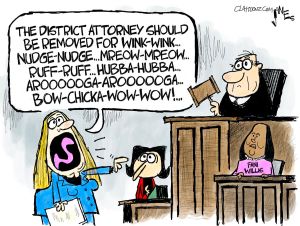
I’m not sure you watched her yesterday, but she left her accusers looking pretty bad. This is from Talking Points Memo. “Fani Willis Endures Disrespect, Racist Tropes, And Public Humiliation.” It’s written by David Kurtz.
The smoldering confrontation in an Atlanta courtroom between District Attorney Fani Willis and the coterie of Trump co-defendants had so many layers of gender, race, and power dynamics that it felt like a theatrical production in which the playwright got a little too exuberant and ended up with an over-the-top script.
Any playwright would die for Willis’ meme-a-minute dialogue, throwing off lines so memorable and original that it was hard to keep up:
“A man is not a plan.”
“I’m not going to emasculate a black man.” (Oh, but she did.)
“I’m not a hand holder.”
The hearing was ostensibly about whether her romantic relationship with the special prosecutor she hired to manage the RICO election interference case was disqualifying. But that was a thin veil over the roiling cauldron of disrespect, racist tropes, and public humiliation that the defendants were indulging in.
Willis came in red hot, literally running from her office to the courtroom when it was her time to testify. She took over the room. She raised and waived objections from the witness chair. She refused to be led down primrose paths by defense counsel. She talked over everyone: defense counsel, the judge, and her own team. I couldn’t help but think that Trump himself would secretly admire her command and bravura.
But it wasn’t the performative high dudgeon that Bill Clinton patented and every politican since has doubled down with. It was the seething, barely controlled anger of a Black woman put in a position none of her white male counterparts have had to endure, at the hands of a criminal defendant no less. White prosecutors have used the power of the law to torment Black people for centuries, but a Black woman becomes prosecutor and finds herself tormented by white criminal defendants.
The author concludes thusly.
Most of the news coverage elided the racial and gender power dynamics at play. But Black people recognize this modern day spectacle of demeaning and dehumanizing treatment: Willis’ personal life scrutinized, her sex life exposed to public ridicule, her ways of handling money and relationships treated not as a difference of culture or social class but as unethical and disqualifying. And racists recognize it, too! Fox News was beside itself with the spectacle. To take one example, actually just one word: “pedigree.”
I think that when young women see this, they will have their Anita Hill Moment. We still have a long way to go before women, and black women, in particular, are not singled out for things that white men basically do all the time. It’s only a problem when anyone else does it.
All of this is part and parcel of the Legal Clowns around Trump and his criminal and insurrectionist cronies. We all have to watch people get sullied so that Donald Trump looks like he’s not alone with his inappropriate, criminal, and traitorous behaviors. As I said, yesterday was a display of Law and Republican Disorder. Hunter Biden should consider a large number of civil suits over this one. The headline and story are from the AP. “FBI informant charged with lying about Joe and Hunter Biden’s ties to Ukrainian energy company. This guy was the center of attention for right-wing media for weeks and months. Sean Hannity considered his testimony to be the smoking that would lead to the impeachment of Joe. Well, their guy’s a bigger liar than Trump, and he’s in trouble.
An FBI informant has been charged with fabricating a multimillion-dollar bribery scheme involving President Joe Biden, his son Hunter and a Ukrainian energy company, a claim that is central to the Republican impeachment inquiry in Congress.
Alexander Smirnov falsely reported to the FBI in June 2020 that executives associated with the Ukrainian energy company Burisma paid Hunter and Joe Biden $5 million each in 2015 or 2016, prosecutors said in an indictment. Smirnov told his handler that an executive claimed to have hired Hunter Biden to “protect us, through his dad, from all kinds of problems,” according to court documents.
Prosecutors say Smirnov in fact had only routine business dealings with the company in 2017 and made the bribery allegations after he “expressed bias” against Joe Biden while he was a presidential candidate.
Smirnov, 43, appeared in court in Las Vegas briefly Thursday after being charged with making a false statement and creating a false and fictitious record. He did not enter a plea. The judge ordered the courtroom cleared after federal public defender Margaret Wightman Lambrose requested a closed hearing for arguments about sealing court documents. She declined to comment on the case.
 This headline from NBC explains the Trump Legal Team’s decision to not take his residential immunity charges to the Supreme Court last night. I guess he can delay things more, but here’s the analysis by Lawrence Hurley. “Trump opts against Supreme Court appeal on civil immunity claim over Jan. 6 lawsuits. The decision not to seek high court review means cases brought against Trump over Jan. 6 can move forward in district court, although he can still mount an immunity defense.” In other words, we still get to hear his whiny, irritating voice say they took A-WAY my prezidental immunity.
Lawsuits seeking to hold Donald Trump personally accountable for his role in the Jan. 6 attack on the Capitol can move forward after the former president chose not to take his broad immunity claim to the Supreme Court.
Trump had a Thursday deadline to file a petition at the Supreme Court contesting an appeals court decision from December that rejected his immunity arguments, but he did not do so.
The appeals court made it clear that Trump could still claim immunity later in the proceedings in three cases brought by Capitol Police officers and members of Congress.
“President Trump will continue to fight for presidential immunity all across the spectrum,” said Steven Cheung, a Trump spokesman.
The civil lawsuits against Trump are separate from the criminal case against him that also arose from Jan. 6. On Monday, Trump asked the justices to put that case on hold on immunity grounds.
Trump’s lawyers argued that any actions he took on Jan. 6 fall under the scope of his responsibilities as president, thereby granting him immunity from civil liability. The U.S. Circuit Court of Appeals for the District of Columbia rejected that argument, ruling that Trump was acting in his role as a political candidate running for office, not as president.
 We’re expecting today’s ruling on the civil Fraud case in New York State’s District Court. This is from The Guardian. “Ruling expected in Donald Trump’s $370m New York fraud trial. Judge delayed ruling to set fine in trial over Trump’s New York business dealings after late-breaking information came to light.” Live updates to the site are ongoing.
A judge is expected to rule on whether Donald Trump should pay a $370m fine in his New York fraud trial and face a lifetime ban from the New York real estate industry.
The New York attorney general’s office sued Trump for inflating the value of his assets on government financial statements. Trump’s adult sons, Donald Trump Jr and Eric Trump, and two former Trump Organization executives, Allen Weisselberg and Jeff McConney, are also defendants in the case.
The New York AG’s office initially asked for $250m in disgorgement, or the amount of money that was wrongfully profited after Trump fudged his net worth. In their written closing arguments in January, prosecutors ended up bumping up their disgorgement figure to $370m.
Prosecutors are also asking the judge, Arthur Engoron, to ban Trump from the New York real estate industry. It’s a similar punishment to that which a New York federal court meted out to “pharma bro” Martin Shkreli after he was found guilty of price-gouging a life-saving drug. Prosecutors in the Trump case cited the Shkreli ruling as an example of what they see as a fitting punishment for Trump.
The fine and a ban would be on top of the punishment Engoron instructed in his September pre-trial ruling, when he ordered the cancellation of Trump’s business licenses. Trump, who has denied any wrongdoing, has appealed that ruling and will undoubtedly appeal a second guilty verdict.

Lara Trump won’t back down as she debuts her latest hit! John Buss @repeat1968
Tick Tock, Mother Fucker! There are some other related Trump drama/trauma. Headlines include Lara Trump as RNC chair.
- Washington Post: Inside Trump’s ouster of Ronna McDaniel as RNC chair
- Neil Baron at The Hill: The law is clear: The Supreme Court must not allow Trump on the 2024 ballot
- Ellie Quinlan Houghtaling of the New Republic: Judge Cannon—Yes, Judge Cannon!—Just Shot Down a Trump Delay Tactic
- New York Times: Trump Privately Expresses Support for a 16-Week Abortion Ban
I think we all can agree that we’ve just had enough of him and want him to go away no matter what it takes!
Just one last sad note today. This is from Jim Heintz, writing at the Associated Press. “Alexei Navalny, the fiercest foe of Russia’s Putin, has died, Russian authorities say.”
Alexei Navalny, who crusaded against official corruption and staged massive anti-Kremlin protests as President Vladimir Putin’s fiercest foe, died Friday in the Arctic penal colony where he was serving a 19-year sentence, Russia’s prison agency said. He was 47.
The stunning news — less than a month before an election that will give Putin another six years in power — brought renewed criticism and outrage directed at the Kremlin leader who has cracked down on all opposition at home.
Putin may have killed him, but Navalny’s memory will live on in the hearts and minds of many.
What’s on your reading and blogging list today?
Wednesday Reads: Allies Turning on Trump, and A MAGA Speaker Candidate
Posted: October 25, 2023 Filed under: 2020 Elections, 2024 Elections, Donald Trump | Tags: 5th Amendment, Fani Willis, Georgia election interference case, grand jury, Jenna Ellis, Mark Meadows, Mike Johnson, Republicans, Speaker of the House search, Tom Emmer, use immunity, witness tampering 4 CommentsGood Afternoon!!

Vase of Flowers, by Paul Gauguin
Yesterday, another shoe dropped in the Georgia election interference case when former Trump attorney Jenna Ellis accepted a plea deal.
CNN: Former Trump campaign lawyer Jenna Ellis pleads guilty in Georgia case.
Former Trump campaign lawyer Jenna Ellis pleaded guilty Tuesday in the Georgia election subversion case and will cooperate with Fulton County prosecutors – the third guilty plea in the past week.
At an unscheduled hearing in Atlanta, Ellis pleaded guilty to one count of aiding and abetting false statements, a felony stemming from the election lies that Ellis and other Donald Trump lawyers peddled to Georgia lawmakers in December 2020.
She was sentenced to five years of probation and ordered to pay $5,000 in restitution.
Ellis delivered a tearful statement to the judge Tuesday while pleading guilty, disavowing her participation in Trump’s unprecedented attempts to overturn the 2020 election.
“If I knew then what I knew now, I would have declined to represent Donald Trump in these post-election challenges. I look back on this experience with deep remorse,” Ellis said, her voice breaking at times.
The development comes after back-to-back guilty pleas last week in the sprawling case from former Trump campaign lawyer Sidney Powell and Kenneth Chesebro, who helped devise the fake electors plot.
These three plea deals are a monumental step forward for Fulton County District Attorney Fani Willis, who charged the case in August and is preparing for trials against Trump, his former attorney Rudy Giuliani, his chief of staff Mark Meadows and other top figures. (They have all pleaded not guilty.)
Ellis, Chesebro and Powell all agreed to testify on behalf of the prosecution at future trials. By flipping, these onetime Trump insiders are now on track to become major Trump nemeses. They are all lawyers and can shed light on what was happening behind the scenes in 2020.
The New York Times: With Plea Deals in Georgia Trump Case, Fani Willis Is Building Momentum.
Fani T. Willis, the district attorney of Fulton County, Ga., had no shortage of doubters when she brought an ambitious racketeering case in August against former president Donald J. Trump and 18 of his allies. It was too broad, they said, and too complicated, with so many defendants and multiple, crisscrossing plot lines for jurors to follow.
But the power of Georgia’s racketeering statute in Ms. Willis’s hands has become apparent over the last six days. Her office is riding a wave of momentum that started with a guilty plea last Thursday from Sidney K. Powell, the pro-Trump lawyer who had promised in November 2020 to “release the kraken” by exposing election fraud, but never did.
Maple Tree Listening, by Kazuko Shiihashi
Then, in rapid succession, came two more guilty pleas — and promises to cooperate with the prosecution and testify — from other Trump-aligned lawyers, Kenneth Chesebro and Jenna Ellis. While Ms. Powell pleaded guilty only to misdemeanor charges, both Mr. Chesebro and Ms. Ellis accepted a felony charge as part of their plea agreements.
A fourth defendant, a Georgia bail bondsman named Scott Hall, pleaded guilty last month to five misdemeanor charges.
With Mr. Trump and 14 of his co-defendants still facing trial in the case, the question of the moment is who else will flip, and how soon. But the victories notched thus far by Ms. Willis and her team demonstrate the extraordinary legal danger that the Georgia case poses for the former president.
And the plea deals illustrate Ms. Willis’s methodology, wielding her state’s racketeering law to pressure smaller-fry defendants to roll over, take plea deals, and apply pressure to defendants higher up the pyramids of power.
The strategy is by no means unique to Ms. Willis. “This is how it works,” said Kay L. Levine, a law professor at Emory University in Atlanta, referring to large-scale racketeering and conspiracy prosecutions. “People at the lower rungs are typically offered a good deal in order to help get the big fish at the top.”
Later yesterday, ABC News published a scoop about former chief of staff Mark Meadows: Ex-Chief of Staff Mark Meadows granted immunity, tells special counsel he warned Trump about 2020 claims: Sources.
Former President Donald Trump’s final chief of staff in the White House, Mark Meadows, has spoken with special counsel Jack Smith’s team at least three times this year, including once before a federal grand jury, which came only after Smith granted Meadows immunity to testify under oath, according to sources familiar with the matter.
According to the sources, Meadows also told the federal investigators Trump was being “dishonest” with the public when he first claimed to have won the election only hours after polls closed on Nov. 3, 2020, before final results were in.
“Obviously we didn’t win,” a source quoted Meadows as telling Smith’s team in hindsight.
Trump has called Meadows, one of the former president’s closest and highest-ranking aides in the White House, a “special friend” and “a great chief of staff — as good as it gets.”
The descriptions of what Meadows allegedly told investigators shed further light on the evidence Smith’s team has amassed as it prosecutes Trump for allegedly trying to unlawfully retain power and “spread lies” about the 2020 election. The descriptions also expose how far Trump loyalists like Meadows have gone to support and defend Trump.
Sources told ABC News that Smith’s investigators were keenly interested in questioning Meadows about election-related conversations he had with Trump during his final months in office, and whether Meadows actually believed some of the claims he included in a book he published after Trump left office — a book that promised to “correct the record” on Trump.

Peonies and Irises, by Emil Nolde
ABC news found several passages in the book that differ from Meadows’ reported testimony. See examples at the link. People are claiming that Meadows “flipped” on Trump, but that’s not what this sounds like:
Under the immunity order from Smith’s team, the information Meadows provided to the grand jury earlier this year can’t be used against him in a federal prosecution.
That immunity came after a lawyer for Meadows requested that his client be immunized to testify before the grand jury, sources familiar with the matter said. A senior Justice Department official signed off on the request and an immunity order was then issued by U.S. District Court Judge James Boasberg, the chief judge at the federal court in Washington, D.C., days before Meadows appeared before the grand jury in March, sources said.
Had Meadows not been granted immunity, prosecutors expected him to invoke his Fifth Amendment rights against self-incrimination, sources said.
It sounds like Meadows was given “use immunity” in order to force him to testify without taking the Fifth. That’s not “flipping.” It just means that he cannot be prosecuted for truthful testimony he gave to the grand jury. He may end up cooperating with the government, but he hasn’t done it yet.
The Guardian’s Hugo Lowell agrees: Trump chief Mark Meadows testified in 2020 election case after immunity order.
Donald Trump’s former White House chief of staff Mark Meadows testified to a federal grand jury earlier this year about efforts by the former president to overturn the 2020 election results pursuant to a court order that granted him limited immunity, according to two people familiar with the matter.
The immunity – which forces witnesses to testify on the promise that they will not be charged on their statements or information derived from their statements – came after a legal battle in March with special counsel prosecutors, who had subpoenaed Meadows.
Trump’s lawyers attempted to block Meadows’ testimony partially on executive privilege grounds. However, the outgoing chief US district judge Beryl Howell ruled that executive privilege was inapplicable and compelled Meadows to appear before the grand jury in Washington, the people said.
The precise details of what happened next are unclear, but prosecutors sought and received an order from the incoming chief judge James Boasberg granting limited-use immunity to Meadows to overcome his concerns about self-incrimination, the people familiar with the matter said.
That Meadows testified pursuant to a court order suggests prosecutors in the office of special counsel Jack Smith were determined to learn what information he was afraid to share because of self-incrimination concerns – but it does not mean he became a cooperator.
Typically, under limited-use immunity orders, witnesses provide limited statements. With the payoff potentially small and with the increased difficulty that comes from charging immunity recipients in the future, the justice department is broadly averse to seeking such orders.
The approval must also come from the top echelons of the justice department, according to guidelines, and the preferred method for federal prosecutors to obtain testimony is to have defendants plead guilty, and then have them offer cooperation for a reduced sentence.
Nevertheless, I think it’s unlikely that Meadows will be willing to go to prison for Trump; so he may end up cooperating. He just hasn’t done it yet.

Anemones, Edvard Munch
Last night in a Truth Social post, Trump blatantly attempted to witness tamper Mark Meadows.
From an analysis post by Stephen Collinson at CNN: Trump rages as former acolytes turn against him under legal heat.
In a rage-filled stream of consciousness on his Truth Social network on Tuesday night, Trump lashed out at the ABC report about Meadows.
“I don’t think Mark Meadows would lie about the Rigged and Stollen 2020 Presidential Election merely for getting IMMUNITY against Prosecution (PERSECUTION!),” the former president wrote.
“Some people would make that deal, but they are weaklings and cowards, and so bad for the future our Failing Nation. I don’t think that Mark Meadows is one of them, but who really knows? MAKE AMERICA GREAT AGAIN!!!”
The other big story today is House Republicans’ endless search for a Speaker candidate they can agree on. The latest candidate is Rep. Mike Johnson, an ultra-MAGA guy, after Trump put the kibosh on previous candidate Tom Emmer, who supported the transition of power in 2020.
Politico: ‘I killed him’: How Trump torpedoed Tom Emmer’s speaker bid.
Just hours after Rep. Tom Emmer (R-Minn.) won the Republican Conference’s nomination to be House speaker on Tuesday, former President Donald Trump took to Truth Social to deride the congressman as “totally out-of-touch with Republican Voters” and a “Globalist RINO.”
He then got on the phone with members to express his aversion for Emmer and his bid for speaker.
Just minutes later, Emmer officially dropped out of the race.
His withdrawal made Emmer the third nominee for speaker to have his hopes dashed for the most cursed job in politics. And it showed that while Trump may not be able to elevate someone to the post — his earlier choice for the job, Rep. Jim Jordan (R-Ohio), also flopped — he can very well ensure that a person doesn’t get it….
Trump had signaled to aides last week that he did not support Emmer’s bid for the speakership. The former president complained that Emmer had criticized him following the Trump-inspired Jan. 6 Capitol riot and, among other things, had not forcefully enough defended him against his multiple indictments.
The House will supposedly vote on Johnson for Speaker today. So who is Mike Johnson?
The Washington Post: 5 things to know about Mike Johnson, the GOP’s latest House speaker nominee.
It remains unclear whether Johnson has enough support to win the gavel. But after he was nominated in a Republican closed-door vote on Tuesday, Johnson, flanked by his colleagues, projected confidence, promising to restore voters’ trust in government and to govern effectively if he is elected speaker.
Red Roses with Blue, by Alex Katz
Here are five things to know about Mike Johnson and his political views.
He opposed certifying the 2020 election.
Johnson, 51, contested the results of the 2020 election — urging President Donald Trump to “stay strong and keep fighting” as he tried to overturn his loss to Joe Biden in the presidential race.
Johnson also objected to certifying Biden’s electoral win and was one of the architects of a legal attack on the election that consisted of arguing that states’ voting accommodations during the pandemic were unconstitutional. He led a group of 126 Republican lawmakers in filing an amicus brief to the Supreme Court alleging that authorities in Georgia, Pennsylvania, Wisconsin and Michigan “usurped” the constitutional authority of state legislatures when they loosened voting restrictions because of the pandemic. The court rejected the underlying complaint — filed by the state of Texas — due to lack of standing, and dismissed all other related motions, including the amicus brief.
He voted against further Ukraine aid.
Johnson, who serves on the House Armed Services Committee, was one of 57 lawmakers — all of them Republicans — who voted against a $39.8 billion aid package for Ukraine in May.
According to the Shreveport Times, Johnson explained his opposition to the bill by saying that the United States “should not be sending another $40 billion abroad when our own border is in chaos, American mothers are struggling to find baby formula, gas prices are at record highs, and American families are struggling to make ends meet, without sufficient oversight over where the money will go.”
Johnson has also called for more oversight of the aid sent to Ukraine — totaling more than $60 billion to date. In February, following a House Armed Services Committee hearing on the topic, he tweeted that American taxpayers “deserve to know if the Ukrainian government is being entirely forthcoming and transparent about the use of this massive sum of taxpayer resources.” [….]
He is anti-abortion.
Johnson, a constitutional lawyer who identifies as a Christian, opposes abortion and has celebrated the Supreme Court’s decision to overturn Roe v. Wade, the landmark 1973 ruling that established constitutional protections for abortions nationwide.
“There is no right to abortion in the Constitution; there never was,” Johnson told Fox News on the day the decision was announced, calling it “a great, joyous occasion.”
The antiabortion nonprofit Susan B. Anthony Pro-Life America gives Johnson an A+ ranking on this issue, stating that he “has voted consistently to defend the lives of the unborn and infants,” including by “stopping hard-earned tax dollars from paying for abortion, whether domestically or internationally.”
He is a close ally of Donald Trump
Johnson is a close ally of Trump, having served on the former president’s legal defense team during his two impeachment trials in the Senate.
He has called charges against Trump — which include a federal case relating to his attempts to overturn the 2020 election — “bogus,” and has said the legal and political systems have treated Trump unfairly.
He supports LGBTQ restrictions.
Johnson has positioned himself on the far right of the political spectrum on several social issues, even within the current conservative Republican conference. Notably, he introduced legislation last year — modeled after Florida’s “don’t say gay” bill — that would have prohibited discussion of sexual orientation and gender identity, as well as related subjects, at any institution that received federal funds. The Human Rights Campaign, a pro-LGBTQ civil rights organization, gave Johnson a score of 0 in its latest congressional scorecard.
Johnson also opposes gender-affirming care for minors and led a hearing on the subject in July. In a statement, he described gender-affirming care — meaning medical care that affirms or recognizes the gender identity of the person receiving the care, and which can include giving puberty or hormone blockers to minors under close monitoring from a doctor — as “adults inflicting harm on helpless children to affirm their world view.”


Roses, by Vincent Van Gogh
NBC News: GOP speaker nominee Mike Johnson played a key role in efforts to overturn the 2020 election.
Well before he secured the GOP nomination for House speaker, Rep. Mike Johnson, R-La., played a key role in efforts by then-President Donald Trump and his allies to overturn Joe Biden’s electoral victory in the 2020 election.
Johnson, who currently serves as the GOP caucus vice chair and is an ally of Trump, led the amicus brief signed by more than 100 House Republicans in support of a Texas lawsuit seeking to invalidate the 2020 election results in four swing states won by Biden: Georgia, Michigan, Pennsylvania and Wisconsin.
The lawsuit, filed by Texas Attorney General Ken Paxton, a Republican, called on the Supreme Court to delay the electoral vote in the four states in order for investigations on voting issues to continue amid Trump’s refusal to concede his loss. It alleged that the four states changed voting rules without their legislatures’ express approval before the 2020 election.
Johnson at the time sought support from his GOP colleagues for the lawsuit, sending them an email with the subject line “Time-sensitive request from President Trump.”
“President Trump called me this morning to express his great appreciation for our effort to file an amicus brief in the Texas case on behalf of concerned Members of Congress,” Johnson wrote in the December 2020 email, which was obtained by NBC News….
The lawsuit swiftly drew backlash from battleground state attorneys general, who decried it as a “publicity stunt” full of “false and irresponsible” allegations. Legal experts also pointed to a series of hurdles the lawsuit had faced, saying that Texas lacked the authority to claim that officials in other states failed to follow the rules set by their legislatures….
Johnson’s role in pursuing efforts to overturn the 2020 election results has regained attention recently amid his speakership bid. On Tuesday, the political team of former Republican Rep. Liz Cheney of Wyoming — who broke with Trump over his baseless claims of a stolen election — circulated a New York Times article that called him “the most important architect of the Electoral College objections” on Jan. 6, 2021, aimed at keeping then-President Trump in office even after he lost.
The Times reported last year that many Republicans who voted to discount pro-Biden electors cited an argument crafted by Johnson, which was to ignore the false claims about mass fraud in the election and instead hang the objection on the claim that certain states’ voting changes during the Covid-19 pandemic were unconstitutional.
The Supreme Court ultimately rejected Texas’ effort to overturn the election results.
This guy is MAGA all the way. As speaker, he would likely try to find a way for the House to decide the 2025 election. We’ll find out later today if House Republicans can get together enough votes to elect him.
That’s all I have for you today. No war news. I’m really burned out on that. Feel free to post on anything in the comment thread.
Tuesday Reads: Trump Indictment #4
Posted: August 15, 2023 Filed under: 2020 Elections, 2024 presidential Campaign, Crime, Criminal Justice System, Donald Trump | Tags: conspiracy, Fani Willis, Georgia grand jury, Mark Meadows, racketeering, RICO laws, Trump 4th indictment 7 CommentsGood Afternoon!!
As you know, the Georgia grand jury handed down multiple indictments of Trump and many of his cronies for a conspiracy to overturn the state’s 2020 presidential election. He has now been indicted 4 times for a total of 91 criminal charges. I tried to stay up until the bitter end last night, but I fell asleep before Fani Willis finally made her announcement.
David Kurtz at Talking Points Memo: Fani Willis Lowers The Boom On Donald Trump In Massive Indictment.
After a marathon session Monday, a Georgia grand jury returned a monster 41-felony-count, 97-page indictment against a total of 19 defendants, including former President Donald Trump; Trump White House Chief of Staff Mark Meadows; Trump lawyers Rudy Giuliani, Sidney Powell, John Eastman, Kenneth Chesebro, and Jenna Ellis; and Trump DOJ official Jeff Clark.
It was a strange day of uncertainty and expectation, with moment-by-moment reporting from the Fulton County courthouse. The duty judge would poke his head into the courtroom of waiting reporters to do check-ins. Grand jury witnesses scheduled to testify today made public that they had been called in a day early and offered regular updates as to where they stood in the line of witnesses paraded before the grand jury. The presentation of the indictment to the duty judge was televised live. Reporters were taking photographs from the inside of the clerk of court’s office as they waited an agonizing couple of hours for the paperwork to be processed and the indictment made public.
The day was punctuated by what appeared to be the accidental posting then quick takedown from the clerk’s website of a document seemingly related to the case that listed Trump as a defendant. That sparked an initial round of excitement and panic, then confusion. The clerk’s office later issued a statement calling the document “fictitious.” But it remained unclear exactly what had happened and why.
As the drama stretched deep into the evening, it became increasingly clear that District Attorney Fani Will was pushing to finish the indictment the same day. The duty judge kept the courtroom open late to accept the indictment, should it come. It finally did, just before 9 p.m. ET. The indictment became public just before 11 p.m. ET.
Read more of the basic facts at the TPM link.
From Aaron Rupar’s Public Notice, Lisa Needham breaks down the charges: Trump’s Fulton County indictment, unpacked.
The latest Trump indictment is out, and it’s a blockbuster. Let’s start with the numbers, shall we? A grand jury in Fulton County, Georgia, returned an indictment that has:
- 19 defendants, including the former president of the United States and 6 lawyers in his orbit
- 41 criminal counts across all defendants
- 13 criminal counts against the former president himself
- 8 types of manners and methods used to further a criminal enterprise
- 161 overt acts of racketeering activity
Many of the defendants are already familiar. Rudy Guiliani, John Eastman, Jeffrey Clark, and Sidney Powell are all attorneys who are likely some of the unindicted co-conspirators in the federal January 6 case. Others are people whose names have surfaced repeatedly during the various 2020 election investigations, such as Trump’s former chief of staff Mark Meadows, former Trump attorney Jenna Ellis, and attorney Ken Chesebro, who wrote the first memo suggesting the fake elector scheme. Others, like fake electors Shawn Still and David Shafer, aren’t household names….
If you’ve ever watched a mob movie set after 1970, when the law was first passed, you’ve probably heard of the federal RICO Act. It was designed to charge people for acting in concert with one another in furtherance of a criminal act. This was a big breakthrough because in sprawling criminal enterprises, people at the top — gang leaders, mob capos, etc. — could insulate themselves from criminal liability by having other people do their dirty work. But the advent of RICO meant that if you helped mastermind the heist but didn’t do the burglary, for example, you could still be held liable. The law isn’t just used against the Mafia but has also formed the basis for prosecuting people who run Ponzi schemes and gangs, among other things….
According to the indictment, Trump and his co-defendants used at least eight methods to try to undermine the election: (1) Making false statements to members of state legislatures, including Florida, Arizona, Michigan, Pennsylvania, and Georgia; (2) Making false statements to high-ranking state officials in Georgia, such as the secretary of state and the governor; (3) creating a slate of fake electoral voters; (4) harassing and intimidating a Fulton County election worker; (5) soliciting high-ranking members of the United States Department of Justice to make false statements to government officials in Georgia; (6) soliciting Mike Pence to reject electoral college votes properly cast by Georgia’s electors; (7) unlawfully accessing voter equipment and voter data; and (8) making false statements and committing perjury to cover up the conspiracy.
The first public act in furtherance of the conspiracy started the day after the election when Trump gave a speech falsely declaring victory. Trump had discussed a draft speech to that effect three days before the election, in which he planned to declare victory and claim voter fraud. In other words, Trump was already prepared to attempt to overturn the election before election night even happened.
Read the rest at Public Notice. It’s a very good summary of the case.
For a quick summary of the various kinds of charges in the indictment, check out this uncharacteristically short post by Marcy Wheeler at Emptywheel: The Various Kinds of Georgia Crimes in the RICO indictment.
I was very happy to see that Mark Meadows was among the Trump allies who were indicted. Insider: Mark Meadows, Trump’s former White House chief of staff, will face his first post-2020 election-related indictment in Georgia.
Mark Meadows, a Freedom Caucus conservative who rose to become Donald Trump’s final chief of staff, will face a criminal indictment in Georgia alongside former president.
Fulton County District Attorney Fanni Willis unveiled her sprawling indictment late Monday evening, ending Meadows’ run thus far of successfully ducking some of the legal serious legal liability that others in Trump’s orbit have faced stemming from their actions that took place during the waning weeks of his presidency.
It means Meadows may soon join HR Haldeman, Nixon’s self-dubbed “son of a bitch,” in infamy among those who held one of the most powerful posts in the federal government, Chief of Staff. Haldeman, of course, faced prison time over his role in trying to cover up the Watergate break-in.
According to the indictment, Meadows, like each one of his fellow co-defendants, is facing a violation of Georgia’s RICO law. He is also facing an additional count related to his participation in Trump’s January 2, 2021 call with George Secretary of State Brad Raffensperger during which Trump pressured Raffensperger to “find” enough votes so he could win.
Meadows’ other conduct is mentioned throughout the indictment. In particular, Willis zeroed in on Meadows’ efforts to reach state lawmakers in Pennsylvania. Willis later told reporters that the grand jury believed conduct outside of her jurisdiction helped furthered the conspiracy she alleged.
Meadows was not one of the unindicted co-conspirators in special counsel Jack Smith’s indictment related to conduct after the election, leading to speculation that the former chief of staff could be assisting the federal investigation.
Of course, Trump can’t keep his big mouth shut. He announced on Truth Social that he has proof of election fraud in Georgia which he will announce next Monday.
It’s not clear why he didn’t reveal this information before he was indicted.
One more article on Trump’s obvious first delay tactic in the Georgia case:
Kyle Cheney at Politico: An early test for Georgia prosecutors: Trump’s likely bid to take the case to federal court.
One of the first big battles in the new racketeering case against Donald Trump is likely imminent: Should the former president face a jury in state or federal court?
Although the charges were filed in state court in Fulton County, Ga., Trump is sure to attempt to “remove” the case to federal court, where he would potentially have a friendlier jury pool and the chance of drawing a judge whom he appointed to the bench.
To try to get the case into federal court, Trump is expected to argue that much of the conduct he’s been charged with was undertaken in his capacity as an officer of the federal government, because he was still president during the critical period when he and his allies attempted to subvert the 2020 election results. A federal law, known as a “removal statute,” generally allows any “officer of the United States” who is prosecuted or sued in state court to transfer the case to federal court if the case stems from the officer’s governmental duties.
Trump has already attempted to make this move in New York, where he’s facing state charges for falsifying business records to cover up an affair with a porn star. A federal judge there rejected the effort and directed the case back to state court, noting that the charges there didn’t really implicate Trump’s powers as president.
“There is an ‘outer perimeter’ to a President’s authority and responsibilities beyond which he engages in private conduct,” U.S. District Judge Alvin Hellerstein ruled, sending the case back to New York state court. Trump is appealing the ruling.
But Georgia could be different: Most of the charges Trump is facing — sweeping allegations of using his office to corrupt the 2020 election — involve his presidential authorities and his efforts to manipulate the federal processes he was charged with overseeing. That makes removal a more viable option in Georgia than New York.
The judge in the case has even less experience than Aileen Cannon.
Those are the basics on the Georgia indictments. We will learn much more in the days ahead.

 peej
peej Carissa
 bostonboomer
 dakinikat
 ecocatwoman
 mablue2
 Mama Lopez
 peggysue22
 quixote
 skydancingguestblogger
 Mona (aka Wonk the Vote)



 Sky Dancing
Recent Comments