“I’m actually surprised MAGA didn’t put on an alternative Oscar Award Show this year.” John Buss, @repeat1968
Good Day, Sky Dancers!
I’d just like to gripe about one thing today. Humor me. Is it just me, or does everything seem messed up in this country? I’m starting to have visions of us in a Dystopian SyFy movie where the AI in computers decides the best way for financial institutions to make money and gets some sort of cosmic jolly out of making sure something shipped with a commercial deliverer as late as fuck. Also, all inventory systems appear to have certain items that are always gone, even when the company, like Amazon or Walmart, has traditionally had a super inventory system. I’m pretty sure the DOGE thing has messed up student loan and Social Security functions. And wow, now we are completely screwed when it comes to anything that needs petroleum products. It’s like Artificial Intelligence and The Trump Regime Dysfunction have joined together to make our lives miserable.
I’d like to highlight this Substack of Dr. Paul Krugman this morning. “No, America is Not Respected. Thanks to Trump, we’re held in contempt even by our closest allies.” Trump is actually making China great again. They are the obvious winner of all this.
There’s a real Baghdad Bob feel to pronouncements from the Trump administration these days. The war is going great! We’ve been totally victorious! Also, other countries — including China! — must immediately send ships to escort oil tankers through the Strait of Hormuz, which the U.S. Navy isn’t doing because it’s too dangerous.
But this has been the pattern ever since Trump returned to power. Despite repeated failures to deliver on his campaign promises — remember how he was going to cut energy prices in half? — he and his minions have continually insisted that everything is wonderful, that everything they do is a triumphant success story. And he’s still doing it. On Thursday, he told a rally that
Inflation is plummeting, incomes are rising, the economy is roaring back and America is respected again.
As I and others have documented ad nauseam, none of those economic assertions are true. Today, however, I want to focus on the bolded claim. Trump constantly insists, in speeches and social media posts, that he took over a weak, despised nation and restored its international reputation. This is clearly something that matters a lot to him and his sense of self-worth.
It’s also the total opposite of the truth.
A stunning poll from Politico — just released, but taken last month — confirms what I and other observers strongly suspected: America is now widely despised, despised like nobody has ever been despised before.
I don’t mean that we’re disliked, although that too. But this isn’t a case of oderint dum metuant — let them hate so long as they fear. Instead, the world increasingly holds America in contempt.
And they no longer believe that being a U.S. ally offers protection, that a good relationship with America will deter potential enemies from attacking them.
At this point, a plurality of the population in every one of our erstwhile allies considers China a more reliable partner than the United States.
Check the graphs and more at the link. Jonathan V. Last, writing at The Bulwark, has this analysis today.
If you want to understand the difference in the quality of strategic thinking between Washington and Tehran, consider the messages being sent out over the last three days:
Tehran: We will continue to resist, however we are open to allowing oil transport in the strait that we control provided the product is sold in yuan and not dollars.
I have been saying since the beginning that America is playing checkers while Iran plays chess, but it’s worse than that. American leadership is utterly incoherent: We won, but we need help. We hate our allies; but will our adversaries please come bail us out?
Meanwhile Iranian leadership survived a transition of power in the midst of war, achieved its strategic objective in closing the strait, and is now looking to leverage China’s rising economic ambitions against the United States.
I cannot overstate how significant it would be if Iran and China reached an agreement to allow oil transport under condition of a switch from the dollar to the yuan,1 so here’s European Business:
The condition, if formalised, would represent the most significant challenge to the petrodollar system in its fifty-two-year history, striking at the financial architecture that underpins American global power rather than at US military assets. . . .
To understand why the yuan condition matters, it is necessary to understand what the petrodollar system actually is. Born from the Nixon shock of 1971 and formalised in 1974, the arrangement under which Saudi Arabia and the broader Gulf agreed to denominate all oil sales in US dollars created a self-reinforcing loop that has governed global finance ever since. Because oil—the world’s most traded commodity—must be purchased in dollars, every nation that imports energy must first acquire dollars. Every central bank holds dollar reserves for precisely this reason. The dollar’s status as the world’s primary reserve currency is not an abstract achievement; it flows directly and mechanically from oil. . . .
[Iran] is proposing that access to the world’s most critical energy chokepoint be conditional on currency denomination.
The practical consequence, if even partially adopted, would be a bifurcated global oil market: yuan-denominated barrels flowing through Hormuz for those willing to pay in China’s currency, dollar-denominated barrels rerouted at significant additional cost and time for those who are not. The war premium that Western energy importers are already absorbing would become structural rather than temporary.
I don’t know how to make people care about this except to say that if Iran and China made this deal it would absolutely be the beginning of the end of the dollar backstopping the global financial order. The long-term cost to America would be incalculable.
As I said, he’s making China great again. As for NATO, I think Orange Caligula has managed to blow it up. This is from Reuters. It’s the news behind all that analysis. “US allies rebuff Trump’s request for support in Strait of Hormuz.”
BERLIN/BRUSSELS/LONDON, March 16 (Reuters) – Several U.S. allies said on Monday they had no immediate plans to send ships to unblock the Strait of Hormuz, rebuffing a request by President Donald Trump for military support to keep the vital waterway open.
Trump called on nations to help police the strait after Iran responded to U.S.-Israeli attacks by using drones, missiles and mines to effectively close the channel for tankers that normally transport a fifth of global oil and liquefied natural gas.
Politico’s Nette Nosslinger has more details. “Germany to Trump: We won’t help you reopen the Strait of Hormuz. Berlin says Iran is “not NATO’s war.”
Germany’s government rejected U.S. President Donald Trump’s demand that NATO allies help secure the Strait of Hormuz, declaring that the alliance had no place in the war.
“This war has nothing to do with NATO. It’s not NATO’s war,” Stefan Kornelius, a spokesperson for German Chancellor Friedrich Merz, told reporters in Berlin on Monday. “NATO is a defensive alliance, an alliance for the defense of its territory,” he added.
Trump had warned NATO allies on Sunday they face a “very bad future” if they refuse to help secure the Strait of Hormuz, pressing Europe to support an American effort to reopen the key maritime corridor.
The German government said it would not assist in that effort as long as the war rages on.
“As long as this war continues, there will be no involvement, not even in an option to keep the Strait of Hormuz open by military means,” Kornelius said, adding that he was not aware of an official request by the U.S. government to Germany to take part in such a mission.
“I would also like to remind you that the U.S. and Israel did not consult us before the war, and that Washington explicitly stated at the start of the war that European assistance was neither necessary nor desired,” Kornelius said.
Heather Cox Richardson puts it into perspective at her SubStack “Letters from an American.” We had quite the Ides of March yesterday; however, the Roman version was a bit more successful in ridding themselves of the bad guy.
Today, as the country enters its third week of war against Iran, President Donald J. Trump was on the golf course, illustrating the observation of journalist E.J. Dionne in the New York Times that “from the very beginning of this war, we got a sense that there wasn’t a great deal of serious thought put into it by the president of the United States about how it might end, what our objectives were, what needed to be done to protect Americans who are in the Middle East, what might happen to oil in the Strait of Hormuz.”
Although the administration appears to be trying to convince Americans that the U.S. military’s destruction of the Iranian military means the U.S. has won the war, Iranian leadership needed simply to continue in power to declare victory. Then, blocking the 20% of the world’s oil that flows through the Strait of Hormuz would give them leverage over the war’s outcome.
On March 10, Helene Cooper and Eric Schmitt of the New York Times reported that senior defense officials told them the Iranian military is adjusting its tactics to strike at the communications and defense systems protecting U.S. troops. Those tactics include drone strikes. The same day, Marc Caputo, Barak Ravid, and Colin Demarest of Axios reported that Ukrainian officials had tried several months ago to sell the U.S. anti-drone technology for downing Iran-made drones as a sign of thanks for U.S. support and as a way to strengthen ties between the U.S. and Ukraine, but the U.S. did not pursue the offer.
White House spokesperson Anna Kelly responded: “This characterization made by these cowardly unnamed sources is not accurate and proves that they are simply outside looking in. [Defense] Secretary [Pete] Hegseth and the armed forces did an incredible job planning for all possible responses by the Iranian regime, and the undisputed success of Operation Epic Fury speaks for itself.”
And yet the fallout from the strikes on Iran by the U.S. and Israel appears to have caught the administration by surprise. Trump told Kristen Welker and Alexandra Marquez of NBC News yesterday that he was “surprised” that Iran attacked other countries after the U.S. and Israeli strikes. He also said strikes on Saturday on Kharg Island, which is about fifteen miles off the Iranian coast and is home to Iran’s primary oil export terminal, “totally demolished” most of the island but that “we may hit it a few more times just for fun.”
President Donald J. Trump posted on social media Saturday morning: “Many Countries, especially those who are affected by Iran’s attempted closure of the Hormuz Strait, will be sending War Ships, in conjunction with the United States of America, to keep the Strait open and safe. We have already destroyed 100% of Iran’s Military capability, but it’s easy for them to send a drone or two, drop a mine, or deliver a close range missile somewhere along, or in, this Waterway, no matter how badly defeated they are.”
Well, that didn’t happen, did it? China is full-speed ahead in transitioning away from its fossil-fuel-based energy grid. Trump still shakes his fist at windmills. I did enjoy Kyle Cheney’s take at Politico. “Trump is losing one battle after another. Cue the posts. The president’s Sunday night diatribe was most notable for his attacks on the highest court in the land.”
President Donald Trump is increasingly at the mercy of forces he unleashed but can’t control — so he’s taking aim at the umpires.
So it was, in a fit of Sunday night fury that set Washington’s armchair psychoanalysts ablaze, that the president channeled his rage at the few functioning checks on his power: the media, independent regulators and — most pointedly — the federal judiciary.
Trump’s Sunday night outburst took on all of them, but it was most notable for how he cast the Supreme Court — one that has staved off the destruction of his agenda and even his own criminal prosecution — as “a weaponized, and unjust Political Organization.”
“This completely inept and embarrassing Court was not what the Supreme Court of the United States was set up by our wonderful Founders to be,” the president blared on Truth Social. “They are hurting our Country, and will continue to do so.”
It was a remarkable attack. Until the Feb. 20 tariff ruling, the Trump administration had been touting its winning streak at the Supreme Court. The justices have salvaged Trump’s broadest efforts to end legal protections for hundreds of thousands of noncitizens in the United States, allowed him to assert unprecedented control of once-independent agencies and unilaterally slash congressionally authorized spending.
The court, as Trump knows, is arguably responsible for his return to power in the first place: The justices blocked an effort by some blue states to keep Trump off the 2024 ballot by labeling him an insurrectionist responsible for the Jan. 6, 2021 attack on the Capitol. And the court’s decision to adopt a sweeping view of presidential immunity helped stave off special counsel Jack Smith’s most potent criminal case against Trump.
But to Trump, that’s ancient history.
The core of the attack is the frustration that Trump often exhibits when he brushes up against the limits of his power. He spent Sunday lashing out at the news media, cheering on FCC Chair Brendan Carr’s threat to revoke broadcast licenses for stations that report unfavorably on the war in Iran, and lamenting his inability to control the independent Federal Reserve’s interest rate decisions.
Trump describes the high court’s recent rejection of his unfettered ability to levy tariffs against American trading partners as a deeply personal affront — one that contradicted the ethos of his entire decade in public life.
Since the stinging tariffs decision last month, Trump has seemed fixated on the ruling, weighing in against the high court every few days.
“Our Country was unnecessarily RANSACKED by the United States Supreme Court,” he wrote Sunday.
I’m not sure I’d call this a Come-to-Jesus moment for the Supreme Court. Maybe Roberts doesn’t want to go down as the worst Chief in history. Your guess is as good as mine. And once more, we have more Epstein stories. Basically, you have to chase them down to read about them. Here’s something from The Guardian. “‘Attention will swing back’: Epstein outrage unlikely to subside despite Trump’s Iran war. Advocates say 24/7 coverage of US attacks will not last for ever – and spotlight will return to Epstein and his crimes.”
As the US woke to news that Donald Trump had bombed Iran, domestic discord was fast simmering.
There was unrelenting outrage over ICE raids. There was frustration with the rising cost of living. There was fear over rocketing healthcare prices, mounting household debt, not to mention many Americans’ nagging sense of desperation in a country, some warned, where democracy itself was under threat.
During his third presidential run, Trump promised to release investigative files involving someone Trump had once called a “terrific guy”. This pledge served as ideological catnip to the far-right flank of Trump’s base, many of whom believe that a cabal of elite figures participated in Epstein’s trafficking of teenage girls.
Trump’s administration botched the initial release, however, with his justice department disseminating documents in dribs and drabs before announcing in July that there would be no more disclosures – spurring backlash among longtime supporters. In a rare display of bipartisanship, members of Congress took matters into their own hands, conducting their own investigations and passing the Epstein Files Transparency Act in November.
Trump, despite repeatedly calling the Epstein files a “hoax”, signed the bill into law. His justice department had 30 days to disclose publicly all Epstein files, with rare exceptions.
Trump’s DoJ did not meet Congress’s deadline, disseminating one tranche at the 30-day mark and several others days and weeks later – including a 3 million document disclosure on 30 January – prompting still more ire from opponents and some diehard supporters who believe more files remain.
But now US headlines are dominated by the US-Israel attack on Iran – and the economic and diplomatic chaos it has unleashed. Yet advocates and observers say that Epstein-related outrage is still unlikely to die down.
Gretchen Carlson and Julie Roginsky, who pursued sexual harassment claims against former Fox News chief executive Roger Ailes and started the non-profit Lift Our Voices, told the Guardian that the Iran war can draw attention from the Epstein files – but not in perpetuity.
“We all know that the Trump administration is very good at flooding the news market with a lot of different stories every single day, and so it’s very difficult in the news media to keep up with all of them and give them what they all deserve, as far as time [is concerned],” Carlson said.
“The way the news media works, especially on 24/7 cable news, is that you are covering the biggest story of the moment. Right now that appears to be Iran.”
Carlson said she is still seeing Epstein stories – including news that authorities never searched his New Mexico ranch – and said conservative figures’ opposition to the war portends prolonged attention over Epstein.
“Influencers, especially on the right, criticize the Iranian war and the reasons that the United States got involved,” Carlson said. “I believe that will bring us right back to Epstein.”
So, I’ll quit and just say we’re coming apart at the seams in this country. Tech Bros and Bankers and Pedophiles! Oh My!
What’s on your Reading, Action, and Blogging list today?
Did you like this post? Please share it with your friends:
Where to begin? Once again, there’s just too much news to deal with in a blog post. Today’s top stories, as I see it: Trump’s Iran war continues and threatens to spin out of control; Hegseth and some military leaders are pushing an appalling Christian nationalist agenda to our troops; there were important primary elections yesterday in Texas, North Carolina, and Arkansas; and the Epstein files story is still alive and well. I can’t get to everything, but here are the stories that caught my attention this morning.
The Shuaiba Port in Al-Shu’aybah, Kuwait on Nov. 4, 2022. (Spc. Ryan Scribner, U.S. Army National Guard)
The six U.S. service members killed in an Iranian drone attack over the weekend were working in a tactical operations center in Kuwait that offered little protection from overhead strikes, according to imagery, experts and officials….
The slain troops were part of a logistical support unit working at the Shuaiba port, a civilian port on the Persian Gulf. The attack occurred on Sunday, officials said. By 11 a.m. that morning, thick smoke was spewing from a building in a complex east of the waterfront, satellite imagery shows.
The building that was struck — a prefabricated, triple-wide trailer-style structure — was flanked by tall concrete barriers to protect against ground threats, said Sean O’Connor, a satellite imagery analyst with Janes. But it “possessed limited defenses able to protect it from a ballistic missile or drone strike,” lacking overhead protection to defend against the main threats to U.S. bases in the Middle East, he said.
The Army’s counter-drone manual, updated last year, makes clear that troops and commanders should assess which sites are likely to be attacked and build overhead protection, which often includes steel reinforced roofs and coverings. Protecting important structures like operations centers helps shield from enemy observation and limits “the damaging effects of an aerial attack,” the manual says. Images show that the building struck in the attack was not protected by such structures.
A 2021 photo of the building struck Sunday shows it had what looks like a thin metal rooftop. It is unclear what if any additional layers of materials or reinforcement existed underneath. The building does not appear to have meaningfully changed since at least 2009, and no additional fortifications appear to have beenadded after President Donald Trump announcedin January that he intended to send U.S. forces to the region, according to a Post review of archival imagery and analysts.
The six U.S. service members confirmed dead in the U.S.-Iran conflict were killed while inside a triple-wide trailer that Defense Secretary Pete Hegseth had described as “fortified.”
This undated photo provided by Joey Amor shows Nicole Amor, left, and Joey Amor smiling for a photo. (Joey Amor via AP) Nicole was one of the sex soldiers killed in the drone strike.
The trailer, which served as a makeshift operations center, took a direct hit amid Iran’s retaliatory strikes on Kuwait just after 9 a.m. local time Sunday morning, CNN reported. U.S. Central Command said 18 troops have also been seriously wounded, with others suffering minor shrapnel wounds and concussions.
Military officials had questioned the safety of the operations center even before the strike, according to CBS News. The fortifications used to protect the facility only covered the walls but did nothing to shield the top of the building from an overhead strike, which is what apparently killed the six service members.
A source told CNN there was no warning of the attack that struck the port in Kuwait, and no siren was activated to alert troops to evacuate amid the incoming projectile. There were dozens of people inside the building at the time.
The walls of the building were blown outwards in the blast, according to pictures of the site, with a fire still burning hours afterward.
Early on Monday, before the bodies of two service members were recovered, Hegseth had said that “one” projectile made it through air defenses and hit a “tactical operation center that was fortified.”
This makes me sick. Trump doesn’t care about our troops, and I guess Hegseth doesn’t either.
The UK has been flying their people out of the Middle East, but the U.S. government helping it’s citizens.
American citizens across the Middle East are attempting to follow official advice and evacuate as conflict escalates in the region following US and Israeli attacks on Iran on Saturday.
But multiple US embassies have said they are unable to help citizens trying to leave.
“The US Embassy is not in a position at this time to evacuate or directly assist Americans in departing Israel,” the US Embassy in Jerusalem said in a post on X on Tuesday.
The embassy shared that the Israeli Ministry of Tourism was operating shuttles to a border crossing between Egypt and Israel at the town of Taba.”If you choose to avail yourself of this option to depart, the US government cannot guarantee your safety,” said the US embassy, adding that they were sharing the information “as a courtesy to those wishing to leave Israel.”President Donald Trump was asked in the Oval Office on Tuesday why evacuations hadn’t been planned beforehand, and whether he would charter planes to evacuate Americans from the region.Trump largely didn’t address the question, other than to note how quickly the conflict broke out.”It happened all very quickly,” Trump said. “I thought we were going to have a situation where we were going to be attacked.”
They’ve been preparing for this war for months, with a huge military buildup in the region. Maybe it wasn’t such a good idea for DOGE to fire all those people from the State Department.
Dakinikat called my attention to this story. JJ also posted about it in a comment yesterday. I knew that the military has been infected with right wing Christian propaganda, I still found this shocking.
A combat-unit commander told non-commissioned officers at a briefing Monday that the Iran war is part of God’s plan and that Pres. Donald Trump was “anointed by Jesus to light the signal fire in Iran to cause Armageddon and mark his return to Earth,” according to a complaint by a non-commissioned officer.
From Saturday morning through Monday night, more than 110 similar complaints about commanders in every branch of the military had been logged by the Military Religious Freedom Foundation (MRFF).
Iran war and Christian nationalist armageddon?
The complaints came from more than 40 different units spread across at least 30 military installations, the MRFF told me Monday night.
The MRFF is keeping the complainants anonymous to prevent retribution by the Defense Department. The Pentagon did not immediately respond to my request for comment.
One complainant identified themselves as a non-commissioned officer (NCO) in a unit currently outside the Iran combat zone but in Ready-Support status, deployable at any time. The NCO said they were Christian and emailed the MRFF on behalf of 15 troops, including at least 11 Christians, one Muslim, and one Jew. (Full email printed below.)
The NCO wrote to the MRFF that their commander “urged us to tell our troops that this was ‘all part of God’s divine plan’ and he specifically referenced numerous citations out of the Book of Revelation referring to Armageddon and the imminent return of Jesus Christ.”
One complainant identified themselves as a non-commissioned officer (NCO) in a unit currently outside the Iran combat zone but in Ready-Support status, deployable at any time. The NCO said they were Christian and emailed the MRFF on behalf of 15 troops, including at least 11 Christians, one Muslim, and one Jew. (Full email printed below.)
The NCO wrote to the MRFF that their commander “urged us to tell our troops that this was ‘all part of God’s divine plan’ and he specifically referenced numerous citations out of the Book of Revelation referring to Armageddon and the imminent return of Jesus Christ.”
US military commanders have been invoking extremist Christian rhetoric about biblical “end times” to justify involvement in the Iran war to troops, according to complaints made to a watchdog group.
The Military Religious Freedom Foundation (MRFF) says it has received more than 200 complaints from service members across all branches of the armed forces, including the marines, air force and space force.
One complainant, identified as a noncommissioned officer (NCO) in a unit that could be deployed “at any moment to join” operations against Iran, told MRFF in a complaint viewed by the Guardian that their commander had “urged us to tell our troops that this was ‘all part of God’s divine plan’ and he specifically referenced numerous citations out of the Book of Revelation referring to Armageddon and the imminent return of Jesus Christ”.
“He said that ‘President Trump has been anointed by Jesus to light the signal “He said that ‘President Trump has been anointed by Jesus to light the signal fire in Iran to cause Armageddon and mark his return to Earth’”, the NCO added.
The Guardian credited the story by Jonathan Larson above.
LONDON — The Iranian regime is warning it will attack European cities in any country that joins Donald Trump’s military operation and governments across the region are stepping up security in response.
So far, Iranian drones have already targeted Cyprus, with one striking a British Royal Air Force base on the island, and others shot down before they could hit. That prompted the U.K., France and Greece to send jets, warships and helicopters to Cyprus to protect the country from further drone attacks.
A UK Ministry of Defence handout of an RAF F-35B Typhoon preparing for operations from Akrotiri, Cyprus. Tehran has threatened its retaliation for action in the Middle East could be attacks on European soil. via Getty Ima
But with the British, French and German leaders saying they are ready to launch defensive military action in the Middle East, Tehran threatened to retaliate against these countries with attacks on European soil.
“It would be an act of war. Any such act against Iran would be regarded as complicity with the aggressors. It would be regarded as an act of war against Iran,” Esmail Baghaei, Iran’s foreign ministry spokesperson, told Iranian state media.
Mark Rutte, the former Dutch Prime Minister who now leads NATO, warned on Tuesday that Tehran posed a threat that reached deep into Europe.
“Let’s be absolutely clear-eyed to what’s happening here,” Rutte said. “Iran is close to getting its hands on a nuclear capability and on a ballistic missile capability, which is posing a threat not only to the region — the Middle East, including posing an existential threat to Israel — it is also posing a huge threat to us here in Europe.” Iran is “an exporter of chaos” responsible over decades for terrorist plots and assassination attempts, including against people living on European soil, he said.
The senior clerics responsible for selecting Iran’s next supreme leader met on Tuesday to deliberate, and the son of the slain former leader, Ayatollah Ali Khamenei, emerged as the clear front-runner, according to three Iranian officials familiar with the deliberations.
Mojtaba Khamenei, son of the leader of Iran, in Tehran in 2019.Credit…Morteza Nikoubazl NurPhoto, via Associated Press
The officials said that the clerics were considering announcing that the son, Mojtaba Khamenei, would be his father’s successor as early as Wednesday morning but that some had expressed reservations, fearing that it could expose him as a target for the United States and Israel. They spoke on the condition of anonymity to discuss sensitive internal deliberations.
The clerics, known as the Assembly of Experts, held two virtual meetings, one in the morning and one in the evening, according to the officials. Israel struck a building in Qum, one of Shiite Islam’s main seats of power, where the assembly was scheduled to meet and elect the new supreme leader, but the building was empty, according to the Fars News agency, which is affiliated with the Islamic Revolutionary Guards Corps.
Vali Nasr, an expert of Iran and Shiite Islam at Johns Hopkins University, said that Mr. Khamenei would be a surprising choice — and a potentially telling one.
“He was slated to become the successor for a long time,” Mr. Nasr said, “but for the past two years, it seemed to have dropped off from the radar. If he is elected, it suggests it is a much more hard-line Revolutionary Guard side of the regime that is now in charge.”
That doesn’t sound good.
In other news, Democrats did well in the primary elections last night.
Maybe, just maybe, this is the year Texas really matters.
While the outcome wasn’t shocking, the confirmation of a May 26 runoff between Sen. John Cornyn (R-Texas) and state Attorney General Ken Paxton confirmed the fears of many Republicans who now face a likely scorched-earth campaign that could seriously hobble the victor in November’s general election and drain resources from tough races in places like North Carolina and Maine.
Democrats, meanwhile, are seeing their dream scenario play out: State Rep. James Talarico has defeated Rep. Jasmine Crockett outright in the Democratic primary, giving the candidate many strategists see as the party’s best chance to finally turn the Lone Star State blue a clear path to November.
Tuesday’s results showed some surprising strength for Cornyn after he trailed Paxton, a MAGA firebrand, in most polls. The veteran senator is about a point ahead of the AG in the latest returns.
But for national Republicans, keeping Cornyn afloat will be expensive and will risk damaging Paxton if he ends up being their nominee. In the absence of a Trump endorsement for any candidate, Cornyn and his allies have already spent more than $100 million to take out Paxton….
Cornyn-Paxton wasn’t the only high-stakes drama in the Lone Star State. A quick round-up of the latest results from other races:
— Embattled GOP Rep. Tony Gonzales was forced into a runoff against gun influencer Brandon Herrera.
— State Rep. Steve Toth ousted GOP Rep. Dan Crenshaw from the seat he’s held for four terms.
— GOP Rep. Chip Roy is heading into a runoff with state Sen. Mayes Middleton for attorney general.
— Rep. Christian Menefee is less than 2,000 votes ahead in his uncalled race against Rep. Al Green, who has served in Congress for more than 20 years.
— Former Rep. Colin Allred is more than 10 points ahead against incumbent Democrat Julie Johnson in another uncalled Dallas-area race.
In North Carolina, Roy Cooper won the Senate primary easily. Same with Tom Cotton in Arkansas.
There is some Epstein files news, even though the Iran war has pushed it from the fron pages. The Wall Street Journal broke another story on the Epstein files. It’s behind the paywall, but here are some articles based on the WSJ piece.
The Department of Justice has withheld from the public nearly 48,000 files stemming from investigations into Jeffrey Epstein, after publishing more than 2 million pages of documents under the Epstein Files Transparency Act.
A spokesperson for the Justice Department told the outlets that “47,635 files were offline for further review and should be ready for re-production by the end of the week.”
“Our team is working around the clock to address victim concerns, redact personally identifiable information and any images of a sexual nature,” according to Justice Department spokesperson Natalie Baldassarre. “All responsive documents will be repopulated online once proper redactions are made.” [….]
DOJ told The Independent last week that it is “currently reviewing” documents that detail unverified allegations against the president. Those documents include summaries of FBI interviews stemming from unverified claims made by a woman who came forward after Epstein’s arrest in 2019, who alleged, according to the files released by the DOJ, that she was sexually assaulted by both Epstein and Trump decades earlier, when she was a minor.
In a statement in January, the Justice Department noted that “some of the documents contain untrue and sensationalist claims against President Trump that were submitted to the FBI right before the 2020 election.
Those claims are “unfounded and false,” the statement said.
Read the rest at the link.
This is from “The Epstein Files” Substack, authored by Julie K. Brown, the reporter whose work for The Miami Herald led to Epstein’s prosecution: The Epstein Files are Now Offline.
The Wall Street Journal is reporting that tens of thousands of the Justice Department’s Epstein files are now offline for review.
This comes as more mainstream media confirms earlier reports by independent journalists that some of the files concerning allegations against President Trump have been withheld.
Julie K. Brown
From the WSJ: “The withheld files included Federal Bureau of Investigation notes documenting a series of interviews the woman gave to agents in 2019 in which she alleged sexual misconduct by Trump and Jeffrey Epstein when she was a minor in the 1980s, according to copies of the documents reviewed by the Journal. Trump has denied wrongdoing and said the Epstein files ‘totally exonerated’ him.”
I have written about this woman’s unverified allegation over the past two weeks, as have other journalists.
I have questioned why the Justice Department didn’t reveal whether it had investigated claims by this woman — as well as another woman who filed a lawsuit against Trump and Epstein in 2016.
The latest allegation involves a Vancouver woman who is named in a lawsuit as Jane Doe #4. She was interviewed by the FBI four times. Yet three of those reports have not been made public. To be clear, it’s not known what the FBI concluded from their interviews.
The other woman, who filed a lawsuit in 2016 against Trump and Epstein under the name “Katie Johnson” and later, “Jane Doe,” told a somewhat similar story about Trump. She abruptly withdrew her lawsuit days before the 2016 election. One of her lawyers, however, did file a report with the FBI in 2016. It’s not known whether the DOJ ever investigated her story. The lawyer’s report is in the Epstein Files. Her account has also not been substantiated.
Again, there’s more at the link.
I’m going to end there, because it’s getting late. I’ll add a couple more stories in the comment thread. Take care everyone.
Did you like this post? Please share it with your friends:
Judge Loose Cannon has done it again. The Epstein Files are getting harder for Orange Caligula’s Cabinet of the Woefully Incompetent and Corrupt to handle. Many people are already feeling the impact of the Supreme Court’s Tariff Decision. Then, there’s more fallout from the Epstein Files. In other words, it’s just another day for Trump Mania to ruin the country, and it’s only Monday.
The most current headline is on Cannon. This is from Politico. “Judge Cannon permanently blocks release of Jack Smith report. The Trump-appointed judge said releasing the classified docs report now would “contravene basic notions of fairness and justice.” Kyle Cheney and Josh Gerstein report on the decision.
U.S. District Judge Aileen Cannon permanently barred the Justice Department from releasing special counsel Jack Smith’s final report describing President Donald Trump’s stockpiling of classified documents at Mar-a-Lago and allegations that he obstructed government efforts to reclaim them.
Cannon lit into Smith for a “brazen stratagem”: compiling the detailed report even after she ruled in July 2024 his appointment as special counsel was unconstitutional and dismissed the case against Trump and two co-defendants. The Justice Department had appealed Cannon’s decision but dropped the case altogether after Trump’s election.
“Special Counsel Smith and his team went ahead for months, undeterred, preparing [the classified documents report] using discovery collected in connection with this proceeding and expending government funds in the process,” Cannon wrote in a 15-page ruling issued Monday. “To say this chronology represents, at a minimum, a concerning breach of the spirit of the Dismissal Order is an understatement, if not an outright violation of it.”
The Trump-appointed judge said releasing the report now would “contravene basic notions of fairness and justice” and amount to a “manifest injustice” because the case never reached a jury. It could also risk revealing information protected by attorney-client privilege and grand jury secrecy, she said.
“While it is true that former special counsels have released final reports at the conclusion of their work,” Cannon wrote, “it appears they have done so either after electing not to bring charges at all or after adjudications of guilt by plea or trial. The Court strains to find a situation in which a former special counsel has released a report after initiating criminal charges that did not result in a finding of guilt.”
Aides to Smith, who is now an attorney in private practice, did not immediately respond to a request for comment.
“Judge Cannon’s courage and judicial resolve on these important due process issues should be recognized and taught in law school classrooms across America,” Trump’s lawyer Kendra Wharton said in response to the ruling.
Cannon has drawn scrutiny for rulings that favor Trump and cut against longstanding practice and precedent. She delayed the classified documents case for months when she installed an independent overseer to review materials seized from Mar-a-Lago — until a federal appeals court overturned her decision.
“Crime is at an all-time low.” John Buss, @repeat1968
The next set of headlines concerns the upcoming State of the Union Speech. We all know that the State of our Union is weaker now than at any point since at least the Civil War. Aaron Parnas, writing at his Substack Parnas Report, has a list of “bombshells” that will definitely impact the week. I’m going to highlight a few of them. The big grifter this week is our Crazy-eyed FBI Chief, who is partying with the US Olympic Hockey Team in Italy. There is also more breaking news on the Epstein files, which is undoubtedly causing some heartburn for FARTUS.
We are kicking off an absolutely packed and consequential week. Major new developments in the Epstein case have emerged, including revelations that he maintained storage units that were never searched by the FBI. At the same time, FBI Director Patel is facing mounting calls to resign after spending thousands of taxpayer dollars on a trip to Italy where he appeared to celebrate with Olympians, even as serious crises unfolded at home. All of this comes as Trump heads into the State of the Union with his approval rating at its lowest point yet.
A quick heads up about tomorrow night. The State of the Union is coming, and here is what you can expect from me. First, I will watch the speech so you do not have to, and bring you a clear, direct breakdown afterward. Second, I will be on the ground covering the People’s State of the Union, the alternative address taking place during Trump’s speech. Third, I will be standing with Epstein survivors to ensure that justice remains front and center, even as some try to move on from the files.
Even with the pending State of the Union Address, the news on the Epstein story is wild.
A new Telegraph report reveals that Jeffrey Epstein secretly rented at least six storage units across the United States between 2003 and 2019, where he stored computers, CDs, photographs, furniture, and other equipment removed from his various properties, including materials from his private island, Little Saint James.
Financial records and internal emails show he paid private investigators tens of thousands of dollars to move and conceal these materials, sometimes ahead of anticipated search warrants. Some computer drives in storage were reportedly “cloned,” though the fate of the copies remains unknown. Emails suggest Epstein may have been tipped off about law enforcement raids in the mid-2000s and instructed associates to remove and possibly wipe digital evidence.
Importantly, search warrant records from the Justice Department’s release of millions of Epstein-related documents indicate authorities may never have searched these storage units, raising the possibility that they could still contain previously undisclosed evidence related to his sex trafficking case.
The Telegraphstory on Andrew is just as wild as you can imagine. You can read more about his horrid behavior at the link. Meanwhile, FARTUS is protecting the fossil fuel industry. He’s definitely valuing it over the country, its natural resources, its wildlife, and its people. This is from the AP. “Trump administration eases limits on coal plants for emitting mercury, other toxins.”
The Environmental Protection Agency on Friday weakened limits on mercury and other toxic emissions from coal-fired power plants, the Trump administration’s latest effort to boost the fossil fuel industry by paring back clean air and water rules.
Toxic emissions from coal- and oil-fired plants can harm the brain development of young children and contribute to heart attacks and other problems in adults. The plants are also a major source of greenhouse gas emissions that drive climate change. The EPA announced the repeal of the tightened Mercury and Air Toxics Standards rule, or MATS, at a massive coal plant next to the Ohio River in Louisville, Kentucky.
“EPA’s actions today rights the wrongs of the last administration’s rule and will return the industry to the highly effective original MATS standards that helped pave the way for American energy dominance,” said EPA Deputy Administrator David Fotouhi. The agency said the change should save hundreds of millions of dollars.
The final rule reverts the industry to standards first established in 2012 by the Obama administration that have reduced mercury emissions by nearly 90%. The Biden administration had sought to tighten those standards even further after the first Trump administration had moved to undermine them.
An armed man was shot down by the Secret Service at Mar-a-Lago last week. The profile of the dead man is proving interesting. This is from TMZ. “Mar-A-Lago Armed Gunman. Fixated On Epstein Files Week Before Shooting.”
The armed man shot and killed by Secret Service agents outside President Donald Trump‘s Mar-a-Lago property Sunday had grown increasingly obsessed with the Epstein files and was also a vocal supporter of Trump … TMZ has learned.
Austin Tucker Martin sent a text message, obtained by TMZ, to a co-worker on February 15, 2026, that read, “I don’t know if you read up on the Epstein Files, but evil is real and unmistakable.” He continued, “The best people like you and I can do is use what little influence we have. Tell other people about what you hear about the Epstein files and what the government is doing about it. Raise awareness.”
Sources who worked with Austin at Pine Needles Lodge & Golf Club in North Carolina tell TMZ … he became fixated on Epstein following the latest release of information tied to the files. Co-workers tell us he was deeply disturbed by what he believed was a government cover-up and often talked about powerful people “getting away with it.”
At the same time, Austin was outspoken about his Christian faith and political views. We’re told he regularly expressed support for Trump, telling colleagues as recently as late last year he believed Trump was a strong leader.
Polls point to a break with Trump since the Epstein Files were released; however, it’s tough to say if or if not this guy’s opinions are reflective of the overall MAGA cult. One more Epstein story for you today. This is from the BBC. “Lord Mandelson arrested on suspicion of misconduct in public office.” Chris Mason reports that “From the glamour of DC to a London police station in a matter of months. “ At least the Brits are enraged and active.
A year ago Mandelson was just a few weeks into one of the marquee jobs the British state has to offer – His Majesty’s Ambassador to the United States.
He was sent there by the prime minister as the best point man to Donald Trump.
I went to the British Embassy in Washington around then and Mandelson was clearly revelling in being at the centre of things – the splendour, the glamour.
And where is he tonight? In a police station.
Mandelson is a huge figure in the contemporary history of the Labour Party, having worked for former leader Lord Kinnock, served as a cabinet minister under Sir Tony Blair, and been Gordon Brown’s first secretary of state.
And now, as you read this, he could be sitting opposite police officers in a police station interview room, answering questions under arrest as part of a criminal inquiry.
We should repeat that Mandelson has not commented publicly in recent weeks on the Epstein files but I understand his consistent position is he has not acted criminally and was not motivated by financial gain.
One more item of interest on that account from the same source.
The ex-US ambassador had been under investigation over allegations he shared market-sensitive government information with Jeffrey Epstein while a government minister
Three days ago, New Mexico announced an investigation into Epstein and his ranch there. “New Mexico reopens investigation into alleged illegal activity at Epstein’s former Zorro Ranch. Meanwhile, lawyers for Epstein accusers said they’ve reached a proposed settlement in a class action lawsuit against his estate.” This place sounds as horrific as the island. San Diego’s NBC affiliate reports.
New Mexico’s attorney general has reopened an investigation into Jeffrey Epstein ’s former Zorro Ranch, as allegations swirl about what role the secluded spot played in sexual abuse or sex trafficking of underage girls and young women.
Attorney General Raúl Torrez’s office said Thursday that the decision was made after reviewing information recently released by the U.S. Justice Department.
Although New Mexico’s initial case was closed in 2019 at the request of federal prosecutors in New York, state prosecutors say now that “revelations outlined in the previously sealed FBI files warrant further examination.”
The New Mexico Department of Justice said special agents and prosecutors at the agency will be seeking immediate access to the complete, unredacted federal case file and intend to work with other law enforcement partners as well as a new truth commission established by state lawmakers to look into activities at the ranch.
“As with any potential criminal matter, we will follow the facts wherever they lead, carefully evaluate jurisdictional considerations, and take appropriate investigative action, including the collection and preservation of any relevant evidence that remains available,” the New Mexico Department of Justice said in a statement.
The most terrible thing about this is the disappearance of two very young girls. This is from the U.S. Sun. Katie Davis reports “DEN OF SIN. Inside Epstein’s ‘last refuge’ ranch with ‘buried bodies’ and celeb guests, as full scale of horror is yet to be revealed.” This is a slightly right-leaning source.
Hector Balderas, the state’s ex-attorney general whose 2019 probe into the ranch was halted, told The Sun: “There will be missed opportunities for accountability where victims will have ultimately paid the price.
“Prosecutors are barely learning to understand today how heinous and how much violence and exploitation took place throughout decades.”
Bodies of young women being buried on the grounds, sex abuse and concealing evidence are among the allegations plaguing the shady ranch.
Curiously, two renowned lawyers for victims of the twisted paedophile had no information on the farm when asked by The Sun.
Known to locals as Playboy Ranch, victims have previously told how the ranch has been overlooked throughout the scandal.
Testimonies from several women detail how Epstein was able to abuse teenage girls and young women at the ranch – without any consequence.
Despite Epstein’s properties in Palm Beach and New York being combed by investigators, Zorro Ranch has never been formally searched.
Bombshell claims uncovered in the latest drop of Epstein files from the US government have thrust the huge 7,500-acre estate firmly into the spotlight.
I think that’s enough to horrify us today!
What’s on your reading and blogging list?
Did you like this post? Please share it with your friends:
Yesterday was quite a day. The Supreme Court actually decided against Trump’s insane tariffs instead of bowing down once again to the man who thinks he’s a king. Predictably, Trump threw a gigantic tantrum and then decided to more or less ignore the SCOTUS decision.
At a hastily called press conference, an agitated Trump railed against the conservative [John] Roberts and two of the courts other conservatives, Justices Neil Gorsuch and Amy Coney Barrett, both Trump appointees.
“They’re just being fools and lapdogs for the RINOs and the radical left Democrats,” Trump said, using the apparently derisive acronym for “Republicans in name only.”
And that was hardly all. Trump called the three conservatives “disloyal, unpatriotic,” and at one point he launched into a rant about how the court should have invalidated the election results in 2020, which Trump lost to Joe Biden….
Writing for a hefty 6-to-3 majority, Chief Justice Roberts said that the nation’s founders deliberately and explicitly placed the power to impose taxes, including tariffs, with Congress, not with the president.
As the Chief Justice put it, “Having just fought a revolution motivated in large part by taxes imposed on them” by the King of England without their consent, the Framers wrote a Constitution that gives Congress the taxing power because the members of the legislature would be more accountable to the people.
Nonetheless Trump asserted at his press conference that he will go ahead with his tariffs, using alternative statutes that allow him to act without the consent of Congress.
A bit more:
There are, in fact, several statutes that allow him to impose some tariffs on his own, but they are limited. For example, one of the key statutes he cited Friday does allow him to impose certain tariffs on his own, but only for six months, and after that he must get approval from Congress. The other statutes he cited have other provisions that make it far more difficult to act unilaterally.
The other problem that Trump faces is that the billions of dollars already collected in tariffs were supposed to offset the tax cuts that the Republican-dominated Congress adopted last year at Trump’s behest. Now, however, the money isn’t there.
The federal government has been collecting about $30 billion a month in tariffs, about half of which will be eliminated by Friday’s court ruling. So it’s a big deal for U.S. businesses that have been paying the lion’s share of these tariffs. That said, tariffs are still a fairly small slice of overall government revenues; about 5%. So if half that tariff money goes away, that will mean a larger, but not crippling federal deficit.
In contrast to the stock market’s plunge when the tariffs were first put in place, the market reaction on Friday was fairly stable. That could be because investors believe the White House will try to make good on that threat to replace the outlawed tariffs with other taxes, using different statutes where the president’s claims his authority is more clear. Even those statutes, however, have more strings attached. None give Trump the power he claimed to have to impose unlimited tariffs on goods from any country for any reason….
Unresolved by the Supreme Court’s decision was the question of whether U.S. businesses that paid the tariffs for the last year can get their money back. Chief Justice Roberts did not address how refunds might work, so a lower court will have to figure that out.
Donald Trump on Friday attacked the Supreme Court majority that ruled against him in a landmark decision on tariffs with a venom and ferocity he has never directed against America’s foreign enemies. He suggested they were disloyal to the country, under the sway of other nations. The entire performance was unhinged, an old man’s tantrum about an affront to his manhood. He called the three Republican appointed justices who voted against him “fools and lapdogs.” [….]
The president seemed to miss the entire point of the Supreme Court ruling—that the power to levy tariffs lay with the Congress—as well as the nuance in the majority opinion, such as a footnote by Chief Justice John Roberts that suggested while there were may be other ways by which he could seek to put tariffs in place, those “contain various combinations of procedural prerequisites, required agency determinations and limits on the duration, amount and scope of the tariffs they authorize.”
By Kazuaki Horitomo Kitamura
In other words, he could not behave like a king. He could no longer go around the world threatening other leaders whenever it suited him. He could no longer ignore the law, existing U.S. treaties, or the role Congress is assigned by the Constitution. He said he could—he said he didn’t need Congress to impose the new types of tariffs he mentioned during his press conference. But that was either denial or ignorance or a special Trumpian combination of both.
Because it will be very difficult for Trump to recreate the tariffs of the past year. Should he attempt to put some in place, and should he get the Congress and government agencies to work with him on this, the process is going to be more complex, require periodic renewals, and be far more limited in scope.
But watching Trump, it was clear that the thrust of his remarks had nothing to do with the letter of the law. With him, it seldom does. His feelings were hurt. Someone told him “no.” And he was going to lash out until he felt better.
The outburst was notable, then, because it revealed just how battered, exhausted, and at wits’ end the president is after weeks and weeks of similar experiences, of serial defeats and embarrassments, and of the prospect of many more such humiliations in the months ahead in a world that is finally learning how to say “no” to him.
With pressure building on him because of a soft economy, public anger at his immigration policies, fears of spiking healthcare costs for millions of Americans, the Epstein scandal and a looming massive defeat in the November midterms, Trump has returned regularly to the authoritarian playbook in the hopes that it would make him feel more powerful, less enfeebled by age, more like the kind of leader the slavering courtiers in his daily retinue say he is.
Go read more and enjoy the schadenfreude.
Naturally, reacted immediately with a new round of tariffs. He could have decided to work with Congress on rational trade policy, but he’d rather be a king.
President Donald Trump signed an executive order imposing a new “temporary” 10 percent global tariff following the Supreme Court’s decision Friday striking down many of the global tariffs he raised last year.
“It is my Great Honor to have just signed, from the Oval Office, a Global 10% Tariff on all Countries, which will be effective almost immediately. Thank you for your attention to this matter!,” Trump wrote on Truth Social.
Trump is invoking Section 122 of the Trade Act of 1974, which allows the president to impose tariffs of up to 15 percent to address a “large and serious balance-of-payments deficit,” according to a White House fact sheet. Tariffs imposed under the authority may remain in effect for no more than 150 days unless Congress passes legislation extending them….
The announcement seeks to keep many of his tariff policies intact even after the court’s ruling.
Tama the Cat, Woodblock Print by Hiroaki Takahashi, 1926
“Effective immediately, all national security tariffs under Section 232, and existing Section 301 tariffs — they’re existing, they’re there — remain in place, fully in place, and in full force and effect,” Trump told reporters at a White House press conference Friday afternoon. “Today, I will sign an order to impose a 10 percent global tariff under Section 122, over and above our normal tariffs already being charged. And we’re also initiating several Section 301, and other investigations, to protect our country from unfair trading practices of other countries and companies.”
The duties are set to take effect Feb. 24 at 12:01 a.m.
The White House fact sheet lists exemptions that are similar to the ones included with the tariffs that were invalidated Friday, carving out specific products within sectors such as energy, pharmaceuticals, autos, and aerospace, and shielding goods from North American neighbors compliant with U.S.-Mexico-Canada Agreement, a trade pact Trump signed in his first term.
Yet, it won’t allow the president the kind of flexibility he has wielded under the emergency powers law. By statute, the tariff must be “nondiscriminatory,” meaning the U.S. can’t give breaks to certain trading partners and not others.
Today, Trump decided to increase the newly announced tariffs to 15 percent.
President Trump announced Saturday that he would raise his new, global tariff to 15 percent, a day after he took steps to replicate some of the punishing duties that had been struck down by the Supreme Court.
Mr. Trump announced the change in a post on social media, and said the tariff would take effect immediately, as he signaled anew that he would press ahead with his trade war despite the stunning legal setback.
On Friday night, Mr. Trump had set that tariff at 10 percent, using a provision in a law that allows him to impose an across-the-board tariff for 150 days unless Congress agrees to extend it.
“I, as President of the United States of America, will be, effective immediately, raising the 10% Worldwide Tariff on Countries, many of which have been “ripping” the U.S. off for decades, without retribution (until I came along!), to the fully allowed, and legally tested, 15% level,” the president wrote on Truth Social. “During the next short number of months, the Trump Administration will determine and issue the new and legally permissible Tariffs, which will continue our extraordinarily successful process of Making America Great Again — GREATER THAN EVER BEFORE!!!”
This man is looney tunes and he controls our nuclear arsenal.
The U.S. military said that it struck an alleged drug trafficking boat in the eastern Pacific on Friday, killing three people.
U.S. Southern Command said the strike in the eastern Pacific was against a boat that was traveling along a drug trafficking route.
“Intelligence confirmed the vessel was transiting along known narco-trafficking routes in the Eastern Pacific and was engaged in narco-trafficking operations,” the military said.
U.S. Southern Command said earlier this week that the military hit three boats on Monday, killing 11 people, in the Pacific and Caribbean.
Since September, the military has conducted strikes against boats in the Caribbean and Pacific that it alleges are involved in drug trafficking, which has been criticized by some members of Congress as legally questionable.
Before the strike Friday, there had been at least 41 boat strikes that have killed at least 134 people, according to statements from the Department of Defense tracked by NBC News.
We still have seen no evidence that these murdered people were actually transporting drugs to the U.S. and even there was such evidence, the U.S. government would have no right to kill them.
New satellite imagery and flight tracking data show a base in central Jordan has become a key hub for the U.S. military’s planning for possible strikes on Iran.
Imagery captured on Friday shows more than 60 attack aircraft parked at the base, known as Muwaffaq Salti, roughly tripling the number of jets that are normally there. And at least 68 cargo planes have landed at the base since Sunday, according to flight tracking data. More fighter jets could be parked under shelters.
The satellite images also show more modern aircraft, including F-35 stealth jets, compared to the aircraft normally seen there. Several drones and helicopters are also seen.
Soldiers also installed new air defenses to protect the base from incoming Iranian missiles.
Jordanian officials, who spoke on the condition of anonymity to discuss operational matters, said that the American planes and equipment are deployed there as part of a defense agreement with the United States.
The changes at the base in Jordan are part of a large U.S. military buildup across the region, which comes amid negotiations over Iran’s nuclear program. On Friday, President Trump told reporters he was considering a limited military strike to pressure Iran into a deal.
One benefit for Trump of the tariff decision has been the Epstein story has temporarily faded in U.S. news, so here are some Epstein files updates:
The Department of Justice’s release of millions of Jeffrey Epstein files has not only prompted questions about his crimes – but renewed attention on authorities’ failure to stop him after an accuser reported him in 1996.
By Kazuaki Horitomo Kitamura
This new cache of Epstein files has provided more insight into authorities’ familiarity with allegations against him in the years that followed, including time between his sweetheart plea deal in 2008 and federal arrest nearly six years ago.
While it’s known that accuser Virginia Giuffre’s attorneys met with federal prosecutors in 2016 about Epstein to no avail, recently disclosed files indicate that detailed information was provided to federal authorities years before that sit-down. This included allegations against Andrew Mountbatten-Windsor; documents indicate that he appeared on the FBI’s radar about 15 years ago.
A woman, whose name is redacted from these documents, gave an interview to FBI agents about Epstein and Maxwell in 2011, with a federal prosecutor in attendance by phone; her account echoes Giuffre’s public and legal allegations against the sex traffickers.
The US embassy in Australia told the country’s national police: “The Federal Bureau of Investigation Miami Field Office (FBI Miami) is assisting the Palm Beach Police Department in Florida with an ongoing investigation into JEFFREY EPSTEIN, a US citizen.”
The accuser, who was told in late 2008 about Epstein’s plea deal as she was found to be one of his victims, contacted federal authorities in south Florida three years later. Federal agents questioned her at the US consulate in Sydney on 17 March 2011.
This woman provided an extensive account of Epstein’s abuse and alleged participation of co-conspirator Ghislaine Maxwell, as well as other men as a teenage girl during the late 1990s. The woman, who described suffering at the hands of several predatory men after leaving a rehab facility, told agents that her father, a maintenance man at Donald Trump’s Mar-a-Lago club, secured a job for her as a locker room attendant there.
That woman was Virginia Giuffre. There are other examples of FBI reports in the article. Why didn’t the government act?
New Mexico will reopen its investigation into Jeffrey Epstein’s Zorro ranch in the state after a public pressure campaign for a fuller accounting of the role the location played in the late financier’s sex-trafficking conspiracy.
The New Mexico department of justice’s announcement came less than two weeks after the Guardian reported that federal agents did not appear to have ever searched Zorro Ranch.
The Guardian’s reporting also revealed that there appeared to be no active criminal investigations into Zorro Ranch at that time.
New Mexico’s department of justice said at the time that it was working with lawmakers on launching something it styled as a truth commission. That commission was given the green light several days ago.
“Upon reviewing information recently released by the US Department of Justice, attorney general Raúl Torrez has ordered that the criminal investigation into allegations of illegal activity at Jeffrey Epstein’s Zorro Ranch be reopened,” the New Mexico department of justice posted online on Thursday.
“Upon reviewing information recently released by the US Department of Justice, attorney general Raúl Torrez has ordered that the criminal investigation into allegations of illegal activity at Jeffrey Epstein’s Zorro Ranch be reopened,” the New Mexico department of justice posted online on Thursday.
As the world follows the drip-drip of sensational revelations about Jeffrey Epstein, here’s a number to ponder: Last year the National Center for Missing & Exploited Children received more than 113,000 reports of child sex trafficking.
Yiota Souras, the center’s chief legal officer, says that while no one knows the actual number of children trafficked annually in the United States alone, “the real number is absolutely higher” than that. Most of the victims reported to her organization are 15, 16 or 17, she said, but some are as young as 11 or 12.
By Toshiwo Katsuma
“This is happening in every community, in every city and state,” she added.
I’ve been speaking in the past few days with survivors of sex trafficking and those who work with them, and they’re thrilled that the Epstein files are bringing more attention to trafficking. But they’re also frustrated that the focus has been tightly on Epstein and his circle — and not on the victims or on the way we as a society enable the abuse.
We rightly condemn powerful associates of Epstein’s for their indifference to young girls being sexually assaulted. But collectively we show the same indifference, in a way that I fear leaves us complicit.
“If you told me 20 years ago that the word ‘trafficking’ and the concept of it would be on the nightly news every single night and be the national obsession, I wouldn’t have believed you,” Rachel Lloyd, who was trafficked as a teenager and once was nearly strangled to death by her pimp, told me. “But it’s bizarre to me that we’re having a national conversation about trafficking and yet it hasn’t made any difference.”
Lloyd, who now runs GEMS, an outstanding program for trafficked young women and girls, said of the increased attention: “It’s not elevating the lives of my young women. It’s not shining a light on their vulnerabilities and the things that they go through or the gaps in the systems. It’s not doing any of that.”
It’s terrific to see the scrutiny of Epstein’s world, and I hope that there’ll be investigations of allegations made against President Trump and many others, even as we acknowledge that, for now, they are lacking in evidence. If Britain can arrest the former Prince Andrew and Norway can charge a former prime minister, how is it that the United States has barely taken action?
Lloyd says she is not surprised that Epstein’s friends appear to have gotten away with raping children: In her experience and that of the girls she has worked with, she said, predators almost always get away with their abuse.
I’ll end this post on that powerful note.
Those are recommended reads for today. What else is on your mind?
Did you like this post? Please share it with your friends:
“The Attorney General of the United States showed her true colors.” John Buss, @repeat1968
Good Day, Sky Dancers!
Just when you think the Circus of Incompetence and Evil has wound down, another one of the players finds a way to the stage to make a hash of reality. The Epstein files and the illegal ICE raids have pretty much taken center stage, but other atrocities are happening within the Trump Regime. I’m going to focus on the Testimony given by Pam Bondi and the entire Epstein mess that has alerted us to exactly how many people with money and power have ruined the lives and the innocence of children.
I must issue trigger warnings here because none of this is easy to see or read.
I will start with this analysis by Dahlia Lithwick at Slate. “Pam Bondi Is Not Practicing Law. The attorney general’s testimony before Congress revealed what a farce this is.”
The release of the Epstein files—the slow-drip revelations of a web of privileged (mostly) men trading gifts, access, favors, and sickening child predation as casually as Pokémon cards—has been deliberately parsed out through 2026 as to both be buried itself and bury other horrific news coming out of the Trump administration. But this misses a critical point: The Epstein file dump is not simply playing out as a backdrop against which other acts of American lawlessness are occurring. The Epstein story is also the template and the proof text for all that is happening in Minnesota; at dangerous detention centers; in efforts to punish members of Congress for lawful speech; for crypto scams; and for measles outbreaks. It is an ongoing road map for an administration that lives out the reality that they are rich and powerful and famous enough to be above the law each day, and wishes for the rest of us to ultimately learn and accept that fact.
And it is equally true that Commerce Secretary Howard Lutnick could bring his children and their nannies to a bespoke lunch on Epstein’s island in 2012, long after he allegedly broke off contact with the sex predator, precisely because Lutnick’s children and their nannies were not the types of children or women who would be abandoned there to be raped and threatened. He is also a walking infomercial about whom the law protects and whom it leaves broken and invisible, behind. Lutnick’s testimony this past week, like Bondi’s, is thus operating as a still life in what happens when the law becomes inert. On the one hand, it is not relevant as a restraint to those who need not rely on it; on the other, it is not protective for those who do.
Liz Plank, on her Substack, describes the nausea and disorientation felt by women realizing this past week that we had all been gaslit yet again. Those of us who cannot even begin to imagine a permission structure that allowed and encouraged passing young girls around, trading insults and articles about them (“your littlest girl was a little naughty”), and bonding over the hysteria of #MeToo can barely comprehend why it was that this class of men always took the gift and the freebie and the shitty watch and the plane trip, because access to yet more of the same somehow became the coin of the realm. What Plank describes as “trust bias”—the psychological tendency to assume that others are operating within the same moral and ethical universe as yourself—means that we are all, once again, annihilated by the fact that America’s shared moral universe is a collective fiction, one that constrains one class of people and merely titillates another.
We err when we call what is being done by ICE officials to citizens and noncitizens on the streets of American cities “law,” just as we err when we call what has thus far been afforded the Epstein survivors “justice.” Indeed, the word law is too generous to contain the plea deals and the willing ignorance and the prison transfers that were granted to Jeffrey Epstein and his co-conspirators at every turn. And the word injustice is far too small to describe the spectacle of hundreds of survivors who have still not been given a reckoning or a measure of genuine accountability, whose unredacted names appeared in public documents and who had never been contacted by the Department of Justice.
Pam Bondi may be in charge of many officials and many investigations and many legal things at the DOJ, but what she is protecting is neither justice nor law. And that means that what Plank describes as a trust bias is also an exquisitely American “law bias,” and we should dispense with the notion that we are all in some group compact to protect and preserve the same things. The law is neither protecting the vulnerable nor constraining the Epstein class. And perhaps we should stop referencing that word to mean either project, much less deploying it to describe both.
One of Maria Farmer’s works of art was released from the Epstein Files.
Continue to read this excellent piece at the link. Meanwhile, a friend of mine sent this link to a site with a Link to the Justice Department. The link provides a window into the artwork from Jeffrey Epstein survivor Maria Farmer, found in the Epstein files. CNN reported on Farmer during the first wave of releases. This is from December 19,2025. “Epstein files vindicate a survivor who reported him in the 1990s, but others are still seeking answers.” Everyone is still seeking answers, and all we get are performances like Bondi’s and distractions.
The Justice Department’s partial release of its files related to Jeffrey Epstein on Friday marked a moment of triumph for Epstein survivor Maria Farmer and her sister Annie, who have said for years that Maria had filed one of the first complaints against Epstein in the 1990s.
An FBI document released Friday included a 1996 description of a criminal complaint against Epstein related to child pornography.
While the name of the complainant is redacted in the document, Maria Farmer’s lawyer, Jennifer Freeman, confirmed on CNN that the complaint was in fact made by her client.
The “facts of complaint” part of the document says that the woman — who describes herself as a professional artist — had taken photos of her underage sisters for her own personal artwork.
“Epstein stole the photos and negatives and is believed to have sold the pictures to potential buyers,” the document reads. “Epstein at one time requested (redacted) to take pictures of young girls at swimming pools.” It continued: “Epstein is now threatening (redacted) that if she tells anyone about the photos he will burn her house down.”
Examining these photos is difficult. It is, however, one way we can give voice to these survivors. These paintings have returned to the conversation about who exactly should be brought to justice for this massive child sex trafficking travesty.
Maria’s painting shows many familiar faces. Take a look.
It appears that DHS will shut down this weekend. This is from the AP. “What to know about the Homeland Security shutdown starting this weekend.”
Another shutdown for parts of the federal government is expected this weekend as lawmakers debate new restrictions on President Donald Trump’s immigration enforcement agenda.
Funding for the Department of Homeland Security is set to expire Saturday. Democrats say they won’t help approve more funding until new restrictions are placed on federal immigration operations after the fatal shooting of Alex Pretti and Renee Good in Minneapolis last month.
The White House has been negotiating with the Democrats, but the two sides failed to reach a deal by the end of the week, guaranteeing that funding for the department will lapse.
Unlike the record 43-day shutdown last fall, the closures will be narrowly confined, as only agencies under the DHS umbrella — like Immigration and Customs Enforcement and Customs and Border Protection — will be affected. Still, depending on how long the shutdown lasts, some federal workers could begin to miss paychecks.
Services like airport screening could also suffer if the shutdown drags on for weeks.
At the Transportation Security Administration, about 95% of employees are deemed essential. They will continue to scan passengers and their bags at the nation’s commercial airports. But they will work without pay until the funding lapse is resolved, raising the possibility that workers will being calling out or taking unscheduled leave. Many TSA workers already faced financial stress last year.
“Some are just now recovering from the financial impact of the 43-day shutdown” said Ha Nguyen McNeill, a senior official performing the duties of TSA administrator. “Many are still reeling from it.”
This is breaking news from theWashington Post. “Much of DHS set to shut down as Democrats demand new restraints on ICE. Democrats are pushing for new policies requiring agents to wear body cameras and get judicial warrants for raids.”
The Department of Homeland Security is expected to shut down early Saturday as congressional Democrats and the White House remain at an impasse over new restrictions on federal immigration agents.
The shutdown beginning at 12:01 a.m. Saturday would impact about 13 percent of the federal civilian workforce, including the Transportation Security Administration, the Federal Emergency Management Agency and the Coast Guard.
But Immigration and Customs Enforcement and Customs and Border Protection — the main targets of Democrats’ outrage — would be able to continue immigration enforcement efforts due to an influx of funding from the Republican tax and spending law passed this past summer.
Despite the stalemate, both chambers of Congress have already left Washington and do not plan to return until Feb. 23 after a scheduled week-long recess that includes, for some senators, a trip to the Munich Security Conference in Germany.
State governments are fighting to keep the Election Clause of the U.S. Constitution real. This is from Democracy Docket‘s Matt Cohen.
The Democratic chief election officials of six states are denouncing two new voter suppression bills making their way through Congress — underscoring how the legislation would place a huge burden on voters and election administrators just as midterm election season kicks off.
“These bills would place a massive burden on American eligible voters, require unfeasible overhauls of state systems while preparations for the 2026 midterm elections are well underway, and create unfunded mandates for already under-resourced states and municipalities,” the secretaries wrote. “American voters will be the ones paying for this — by paying more in taxes, spending more time jumping through bureaucratic hoops, or losing access to the ballot box altogether.”
The House passed the SAVE America Act late Wednesday evening in a 218-213 vote, with every present Republican — along with one Democrat, Rep. Henry Cuellar of Texas — voting in favor of the sweeping voter suppression bill. The bill — along with the MEGA Act, which was introduced earlier this week — stands to disenfranchise millions by imposing strict requirements for voters to show proof of citizenship when they register to vote, and to provide photo ID when casting ballots.
While the secretaries highlight that both bills “would make it harder for eligible voters to both register and cast their ballots,” they also call attention to the reality that GOP lawmakers have yet to address: Making such extensive changes to the voting process so close to an election would create chaos for election administrators.
Some states, like North Carolina, have already started with early voting, and any attempt to overhaul requirements for voters to register and cast ballots would be extremely costly to both states and voters, according to the secretaries.
“A series of sweeping overhauls to the nation’s voter registration and election administration laws, when some states are weeks or months away from conducting their primary elections, is not a serious effort at improving the democratic process,” the letter said. “Election administrators already face significant challenges in educating voters on registration requirements, especially considering the significant mis- and dis-information on the issue coming out of Washington, D.C.”
Democracy backsliding is real. One more surreal headline from about the HHS Secretary who admits to snorting coke from bathroom toilets. This is from The Hill’s Joseph Choi. “HHS shaking up top personnel to push Trump, MAHA priorities ahead of midterms.”
Health and Human Services (HHS) Secretary Robert F. Kennedy Jr. on Thursday announced a reshuffling of top staffers in his department as the Trump administration looks to shore up health wins that can boost GOP success in the upcoming midterms.
Centers for Medicare and Medicaid Services (CMS) Deputy Administrator Chris Klomp will be chief counselor at the HHS.
John Brooks, CMS deputy administrator and the chief policy and regulatory officer, will now be CMS senior counselor. Kyle Diamantas, deputy commissioner for human foods at the Food and Drug Administration (FDA), and Grace Graham, FDA deputy commissioner for policy, legislation, and international affairs, have been named as senior counselors for the FDA.
As CNN reported, current HHS chief of staff Matt Buckham will also move to a senior counselor role. Administration officials who spoke with the outlet said the changes came as a result of conversation between the HHS and the White House.
“In just over a year, we have driven historic progress on President Trump’s health care priorities and delivered real, measurable change,” Kennedy said in a statement.
“We are restoring accountability, challenging entrenched interests, and putting the health of the American people first. I am proud to elevate battle-tested, principled leaders onto my immediate team—individuals with the courage and experience to help us move faster and go further as we work to Make America Healthy Again.”
Kennedy’s support for President Trump helped deliver a bloc of voters long critical and suspicious of the medical establishment. But many observers have noted this support is tenuous.
As Jeff Hutt, a spokesperson for the MAHA PAC, recently told The Hill “Make America Health Again” voters aren’t necessarily those who show up strongly for the GOP during midterms.
Can you believe anyone still believes this guy?
Anyway, with that , I have to get ready to go get a mammogram. Have a great weekend! It’s total Mardi Gras Crazy down here! It’s also Friday the 13th.
What’s on your Reading, Action, and Blogging list today?
Did you like this post? Please share it with your friends:
The Sky Dancing banner headline uses a snippet from a work by artist Tashi Mannox called 'Rainbow Study'. The work is described as a" study of typical Tibetan rainbow clouds, that feature in Thanka painting, temple decoration and silk brocades". dakinikat was immediately drawn to the image when trying to find stylized Tibetan Clouds to represent Sky Dancing. It is probably because Tashi's practice is similar to her own. His updated take on the clouds that fill the collection of traditional thankas is quite special.
You can find his work at his website by clicking on his logo below. He is also a calligraphy artist that uses important vajrayana syllables. We encourage you to visit his on line studio.


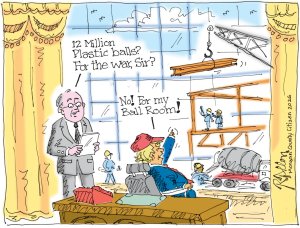 Check the graphs and more at the link. Jonathan V. Last, writing at
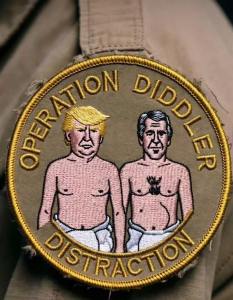 As I said, he’s making China great again. As for NATO, I think Orange Caligula has managed to blow it up. This is from Reuters. It’s the news behind all that analysis. “US allies rebuff Trump’s request for support in Strait of Hormuz.”
 Heather Cox Richardson puts it into perspective at her
 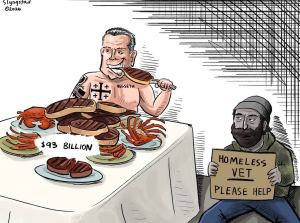 Well, that didn’t happen, did it? China is full-speed ahead in transitioning away from its fossil-fuel-based energy grid. Trump still shakes his fist at windmills. I did enjoy


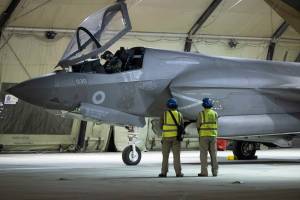


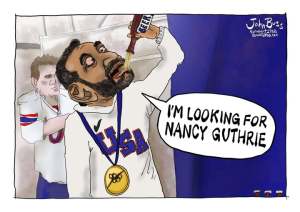
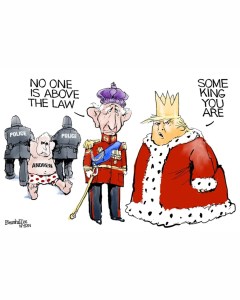 Even with the pending State of the Union Address, the news on the Epstein story is wild.
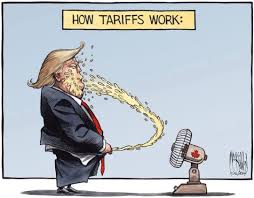 The Telegraph
 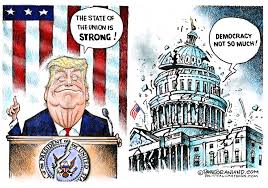 An armed man was shot down by the Secret Service at Mar-a-Lago last week. The profile of the dead man is proving interesting. This is from TMZ. “
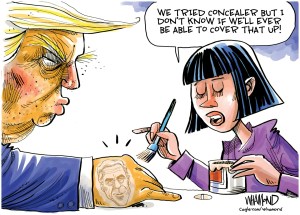 Polls point to a break with Trump since the Epstein Files were released; however, it’s tough to say if or if not this guy’s opinions are reflective of the overall MAGA cult. One more Epstein story for you today. This is from the BBC. “Lord Mandelson arrested on suspicion of misconduct in public office.”
 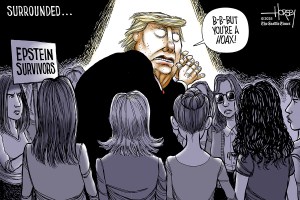 The most terrible thing about this is the disappearance of two very young girls.





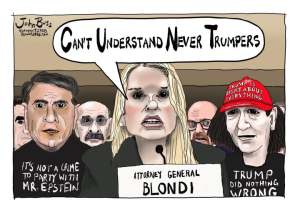

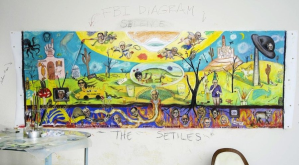
 Another shutdown for
  This is breaking news from the
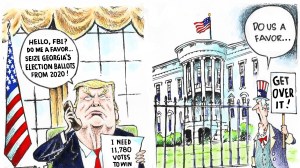 State governments are fighting to keep the Election Clause of the U.S. Constitution real. This is from
 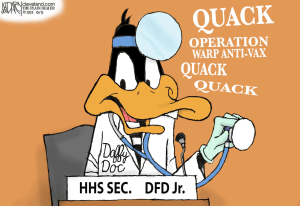 Democracy backsliding is real. One more surreal headline from about the HHS Secretary who admits to snorting
 peej
peej Carissa
 bostonboomer
 dakinikat
 ecocatwoman
 mablue2
 Mama Lopez
 peggysue22
 quixote
 skydancingguestblogger
 Mona (aka Wonk the Vote)



 Sky Dancing
Recent Comments