
Elizabeth Warren for Senate? MA Dems Not On Board So Far
Posted: July 18, 2011 Filed under: Barack Obama, Democratic Politics, The DNC, U.S. Economy, U.S. Politics | Tags: 2012 elections, Barack Obama, Blogosphere, Democratic party, DSCC, Elizabeth Warren, John Kerry, Massachusetts Democratic Party, Scott Brown, Senate, Setti Warren 44 Comments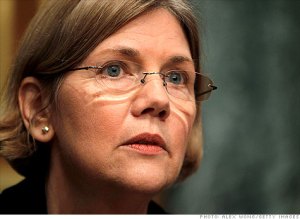
The blogosphere is all a-flutter over the possibility of Elizabeth Warren running for the Senate from Massachusetts.
The Progressive Change Campaign has begun a petition drive to draft Warren.
Taylor Marsh is reporting that Warren told Andrea Mitchell that she will think about the Senate after she gets back to Harvard.
Greg Sargent has posted a list of reasons why national Democrats want Warren to run.
So how do Massachusetts Democrats feel about all this? A few days ago, The Boston Globe’s Joan Vennochi wrote that President Obama was afraid to unlikely to appoint Elizabeth Warren as head of the new Consumer Protection Agency that she fought for and then built, so now her supporters are pushing a Senate run against Republican Scott Brown as a “consolation prize.” According to Vennochi, this initiative isn’t being received all that well here in Massachusetts.
On paper, her candidacy would attract women, liberals, and money from both constituencies, locally and nationally. “She’s tough as nails . . . She’s smart as hell and she could wrap Scott Brown around her little finger in a debate,’’ said Philip Johnston, [John] Walsh’s predecessor as state party chairman.
But Warren isn’t well-known, beyond a small circle of elite Democrats. She has never run for office or built a grassroots organization. And a handful of candidates already in the race won’t be happy about being big-footed, leaving current supporters in an awkward spot.
Massachusetts Democrats aren’t too pleased with the DSCC these days after they and Obama chose not to support Martha Coakley against Scott Brown. State party chairman Walsh told Vennochi that he probably wouldn’t support Warren’s candidacy, since he is backing John Kerry’s chosen candidate Setti Warren. Vennochi:
The idea of Washington Democrats imposing their will on Massachusetts Democrats is distasteful. The DSCC, especially, is not popular here after its tactics largely backfired in the special election that Brown stunningly won. A lack of initial support for Democrat Martha Coakley was followed up by a belated barrage of negative ads that hurt rather than helped Coakley.
The DSCC can also come off as bullies.
Last month, when Kerry was hosting a fundraiser for the DSCC at his Beacon Hill home, he wanted to invite Setti Warren to the event. But the DSCC said no to inviting only one candidate because the group didn’t want to look like it is taking sides – unless, of course, it’s Elizabeth Warren’s side.
Besides, would Obama pitch in to support Warren for Senate? Somehow I doubt it.
Elizabeth Warren: Fighter or Pinata?
Posted: March 19, 2011 Filed under: commercial banking, financial institutions, Global Financial Crisis | Tags: Consumer Financial Protection Bureau, Elizabeth Warren 9 Comments
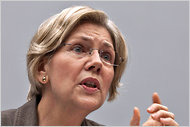 I’m never quite happy when a major media outlet like the New York Times refers to a woman as an inanimate object. Even if the article is flattering, the metaphor still stings. The caption below her picture reads “President Obama’s adviser on the Consumer Financial Protection Bureau” too. Obama may own her appointment but he doesn’t own the woman who has been on the side of consumers of banking services for a very long time. If Elizabeth Warren is an object of loathing for both bankers and Republicans, it’s because she’s a fighter. She’s not a passive thing and she certainly wasn’t passive during recent hearings. A person doesn’t become a tenured professor at a competitive place like Harvard’s law school by being passive.
And thus the real purpose of the hearing: to allow the Republicans who now run the House to box Ms. Warren about the ears. The big banks loathe Ms. Warren, who has made a career out of pointing out all the ways they gouge financial consumers — and whose primary goal is to make such gouging more difficult. So, naturally, the Republicans loathe her too. That she might someday run this bureau terrifies the banks. So, naturally, it terrifies the Republicans.
The banks and their Congressional allies have another, more recent gripe. Rather than waiting until July to start helping financial consumers, Ms. Warren has been trying to help them now. Can you believe the nerve of that woman?
At the request of the states’ attorneys general, all 50 of whom have banded together to investigate the mortgage servicing industry in the wake of the foreclosure crisis, she has fed them ideas that have become part of a settlement proposal they are putting together. Recently, a 27-page outline of the settlement terms was given to banks — terms that included basic rules about how mortgage servicers must treat defaulting homeowners, as well as a requirement that banks look to modify mortgages before they begin foreclosure proceedings. The modifications would be paid for with $20 billion or so in penalties that would be levied on the big banks.
So, am I the only one that even finds the tongue and cheek use of “the nerve of this woman” as being particularly patronizing vision of some one who has been such a consistent, articulate, fighting voice for beleaguered consumers in a tough environment built for big time lobbyists with big time money? The point of the article is that many of the old regulators who are supposed to make sure the bank runs of the 1930s don’t recur–like the Office of the Comptroller of the Currency–have become their old captured selves. This is in firm contrast to the article’s objectified pinata.
It’s not just the House Republicans either. Already the Office of the Comptroller of the Currency has reverted to form, becoming once again a captive of the banks it is supposed to regulate. (It has strenuously opposed the efforts of the A.G.’s to penalize the banks and reform the mortgage modification process, for instance.) The banks themselves act as if they have a God-given right to the profit they made precrisis, and owe the country nothing for the trouble they’ve put us all through. The Justice Department has essentially given up trying to make anyone accountable for the crisis.
So, yes, thank goodness for Ms. Warren and her fighting spirit. We’re on to the next big thing. There’s a fresh hell called Libya and a worry for all those invested in energy company with ownership of nuclear assets. So, bankers, you know, will be bankers.
During the subprime boom, many states tried to stop the worst lending abuses, only to be blocked by federal banking regulators. Now that the country is dealing with the aftermath of those abuses — the rising tide of defaults and foreclosures — it is the attorneys general who are, once again, put in the position of trying to stamp out abuses, this time of the foreclosure process itself.
I dare to guess that the president’s spent more time on his march madness brackets than what’s up in Warren’s office. When Warren’s time in her interim position expires, Obama will undoubtedly let his banker friends find an acceptable banker potted plant to fill her spot.
Their leverage comes from the fact that the banks and their servicing divisions have, in the words of the University of Minnesota law professor Prentiss Cox, “routinely violated basic legal process” by, for instance, not transferring the note after the sale of a home. But in addition to assessing a financial penalty on the banks, the A.G.’s are trying to use the threat of litigation to force the banks to finally deal with defaulting homeowners more fairly and humanely. That is the essence of the settlement proposal that has been floating around. That — and a big push to finally come up with a modification plan that works.
Their leverage comes from the fact that the banks and their servicing divisions have, in the words of the University of Minnesota law professor Prentiss Cox, “routinely violated basic legal process” by, for instance, not transferring the note after the sale of a home. But in addition to assessing a financial penalty on the banks, the A.G.’s are trying to use the threat of litigation to force the banks to finally deal with defaulting homeowners more fairly and humanely. That is the essence of the settlement proposal that has been floating around. That — and a big push to finally come up with a modification plan that works.
Author Joe Nocera is clearly in awe of her too. He states that she’s by far the most qualified person for the position. She understands the ins and outs of the processes very well.
As I listened to her on Wednesday, I was struck anew at how clearly she articulates the need for the new bureau. “If there had been a cop on the beat to hold mortgage servicers accountable a half dozen years ago,” she said at one point, “the problems in mortgage servicing would have been found early and fixed while they were still small, long before they became a national scandal.”
Senate Republicans have vowed to block her appointment if President Obama nominates her. Yet even if her nomination goes down in flames, Senate confirmation hearings would be clarifying. Americans would get to hear Ms. Warren explain why the Consumer Financial Protection Bureau has the potential to help Americans. And they would get to hear Republicans explain why the status quo — including the everyday horror of the foreclosure mess — is just fine.
It has been much noted in recent months that President Obama seems unwilling to start a fight with Republicans. Maybe that’s why he has shied away from nominating Ms. Warren to a job for which she is so clearly suited. But if protecting financial consumers — and helping the millions of Americans struggling to hold onto their homes — isn’t worth fighting for, then what is?
The woman hardly qualifies as a noun. She is a verb. Elizabeth Warren fights for us. Who will fight for her?
New Year’s Eve Reads
Posted: December 31, 2010 Filed under: Global Financial Crisis, Gulf Oil Spill, health hazard, morning reads, the blogosphere, The Little Blog that could, The Media SUCKS, U.S. Economy, U.S. Politics, Wikileaks, Women's Rights | Tags: Brazil's first woman president, Consumer Financial Protection Bureau, Dilma Rousseff, Elizabeth Warren, Filibuster, Marine mammals struggle with oil, New Media Report, oil spill, oiled marshes, Oily beaches, Pew Research, Reform, Senate, Tom Udall, Transocean 28 Comments
Good morning!
Today we begin to say good bye to 2010 and the first decade of the millennium and century! What a decade and what a year it has been! I don’t know about you, but just the last five years alone have turned my life upside down. (Think Hurricane Katrina, BP Oil Tsunami, and the financial crisis that has empowered thugs like Governexorcist Jindal to enforce absolute budget austerity on Louisiana and higher education.) Despite all that, we’re going to have an Airing of the Gratitude thread as part of the-Little-Blog-That-Could’s New Year’s Celebration. I’ve bought my black eyed peas and cabbage. Now, I’m making my list of things that I resolve to appreciate for the thread. I’d like to invite you to think about yours too and join in. A lot of my gratitude comes under the heading of my daughters, dad and sister, and my friends. That includes you ! We’re a blogging community that was forged from some really tough political times.
Meanwhile, here are some headlines to gear you up for the coming year and decade. May things improve for the better!! May peace and sanity prevail!! May every one’s health and circumstances improve tremendously! Many, many blessings to each and every one of you!
Are you pessimistic or optimistic about the coming year? A CNN poll shows a lot of people are optimistic about the the world outlook, but less so about their personal situation. Men are much more optimistic than women. Where do you fit in?
The Senate appears to have reached its limit on perpetually trying to find 60 votes for cloture and taking every ‘threat’ of a filibuster seriously. Brian Beutler at TPM is following the reform movement and the possible hurdles it faces.
The consensus package will aim to put an end to “secret holds” (anonymous filibuster threats) and disallow the minority from blocking debate on an issue altogether. Those two reforms are fairly straightforward. The third is a bit more complex. Udall, along with Sen. Jeff Merkley (D-OR), say there’s broad agreement on the idea to force old-school filibusters. If members want to keep debating a bill, they’ll have to actually talk. No more lazy filibusters.
But how would that actually work? In an interview Wednesday, Udall explained the ins and outs of that particular proposal.
“What we seem to have the most consensus on, is what I would call… a talking filibuster,” Udall told me. “Rather than a filibuster which is about obstruction.”
As things currently stand, the onus is on the majority to put together 60 votes to break a filibuster. Until that happens, it’s a “filibuster,” but it’s little more than a series of quorum calls, votes on procedural motions, and floor speeches. The people who oppose the underlying issue don’t have to do much of anything if they don’t want to.
Here’s how they propose to change that. Under this plan, if 41 or more senators voted against the cloture motion to end debate, “then you would go into a period of extended debate, and dilatory motions would not be allowed,” Udall explained.
As long as a member is on hand to keep talking, that period of debate continues. But if they lapse, it’s over — cloture is invoked and, eventually, the issue gets an up-or-down majority vote.
DDay at FDL has a thread up that offers a more detailed explanation. This includes a bit on what is being called ‘continuous debate’ which sounds a lot like that Jimmy Stewart movie “Mr. Smith goes to Washington” or what every one was hoping for when Bernie Sanders started talking a few weeks ago.
After 41 Senators or more successfully maintain a filibuster by voting against cloture, they would have to hold the floor and go into a period of extended debate. Without someone filibustering holding the floor, cloture is automatically invoked, and the legislation moves to an eventual up-or-down vote, under this rule change.
This would institute the actual filibuster. The Majority Leader would have the capacity, which Harry Reid says he doesn’t have now, to force the minority to keep talking to block legislation. It becomes a test of wills at this point – whether the minority wants to hold out for days, or whether the majority wants to move to other legislation.
Here’s hoping we can fix our broken government that is driven by corporate cash and interests and railroaded by imperious Senators. I’m not very hopeful that congress can actually fix itself, but I guess we’ll see. I will say that I do think Tom Udall is a good man. He’s one of the people that is fighting for an improved process.
I still have Louisiana and New Orleans on my mind right now. We have a new headline in our ongoing BP Oil Gusher Saga. This is from Raw Story. It appears the company that owns the rig–Transocean–is refusing to co-operate with the federal oil spill probe. I just want to find out what went wrong so we don’t ever repeat it. I’m sure all they are thinking about is the upcoming lawsuits.
Transocean said the U.S. Chemical Safety Board does not have jurisdiction in the probe, so it doesn’t have a right to the documents and other items it seeks. The board told The Associated Press late Wednesday that it does have jurisdiction and it has asked the Justice Department to intervene to enforce the subpoenas.
Last week, the board demanded that the testing of the failed blowout preventer stop until Transocean and Cameron International are removed from any hands-on role in the examination. It said it’s a conflict of interest. The request is pending.
Our economy is in sad shape down here and a good part of it is due to Transocean’s role in destroying livelihoods and life around the Gulf of Mexico. Human lives aren’t the only thing still struggling from the gulf gusher. Here’s some local news on that.
Scientists at the institute of Marine Mammal Studies in Gulfport are studying why two endangered manatees died near the Gulf Coast in the past two weeks.
According to the Institute’s Executive Director Dr. Moby Solangi, cold water killed the manatees, but they should have migrated to warmer water.
Scientists are finding an unusually large number of Gulf of Mexico animals out of place since the BP oil spill began.
“It is no different than having a forest fire,” Dr. Solangi said Thursday. “The oil spill expanded, it went thousands of square miles and as their habitat shrunk, these animals moved to areas that were not affected.”
The problem, according to Dr. Solangi, is those unaffected areas were also unfamiliar to the animals.
Too many turtles, for instance, wound up in waters off the Mississippi coast, where they didn’t understand the food supply.
300 turtles died in Mississippi.
Many more were caught by fishermen.
“In the past years, we would get one or two or maybe three animals, this year we had 57,” Dr. Solangi said.
He and his staff at the Institute for Marine Mammal Studies are now caring for dozens of sea turtles.
Of course, turtles in distress have to be swimming through some pretty nasty stuff in their environment. The shores along the Gulf are still oiled. Here’s a story about 168 miles of coast in Louisiana alone. This is from New Orleans own Times Picayune. Yes, folks, every single story I’m linking to on this is no more than a day old. We’re still living this nightmare down here.
Louisiana’s coastline continues to be smeared with significant amounts of oil and oiled material from the BP Deepwater Horizon disaster, with cleanup teams struggling to remove as much as possible of the toxic material by the time migratory birds arrive at the end of February, said the program manager of the Shoreline Cleanup and Assessment Teams, which are working for BP and the federal government.
There are 113 miles of Louisiana coastline under active cleanup, with another 55 miles awaiting approval to start the cleanup process, according to SCAT statistics. Teams have finished cleaning almost 72 miles to levels where oil is no longer observable or where no further treatment is necessary.
But that’s not the whole story for the state’s coastline. According to SCAT statistics, there’s another 2,846 miles of beach and wetland areas where oil was once found but is no longer observable or is not treatable.
Gary Hayward, the Newfields Environmental Planning and Compliance contractor who oversees the SCAT program, said that large area will be placed into a new “monitor and maintenance” category, once Louisiana state and local officials agree to the procedures to be used for that category.
“With rare exceptions, most of the marshes still have a bathtub ring that we have all collectively decided we aren’t going to clean any more than we already have because we’d be doing more harm to the marshes than the oil is going to be doing to them,” Hayward said.
Raise your hand if you heard any thing about any of this on your local newspaper or the national TV stations. We’re so out of sight and out of mind down here that some times I wonder if we’re even considered part of the country. You do realize that a majority of water-related commerce and a majority of oil comes through our state, don’t you?
The South American country of Brazil is looking forward to incoming-President Dilma Rousseff. The Nation has an article that spotlights the country’s first female elected head of state. I only hope to see a day like that for our country. I’d also like to end the Reagan legacy and get a real Democrat back in the White House. Yes, I’m clapping for Tinkerbelle.
When the confetti was still falling after her victory at the polls on October 31, Dilma Rousseff, Brazil’s first female president-elect, said, “I want to state my first commitment after the elections: to honor Brazil’s women so that today’s unprecedented result becomes a normal event and may be repeated and enlarged in companies, civil institutions and representative entities of our entire society.”
In a country where women have typically played a limited role in politics, the election of a woman to Brazil’s highest office signals a major break from the past. But Rousseff’s term will likely be marked by continuity with her predecessor, Luiz Inácio Lula da Silva. Lula, a member of the Workers’ Party (PT), is leaving office with 87 percent support in the polls. An economist, PT bureaucrat, chief of staff under Lula and former guerrilla in the anti-dictatorship movements of the 1960s and ’70s, Rousseff was handpicked by Lula to follow his lead as president. When she is sworn in on January 1, she will inherit Lula’s popular legacy and will be further empowered by the fact that her party and allied parties won a majority of seats in the Senate and Congress. Not even Lula counted on this much support.
Well, at least somewhere, women are getting their due. I’m getting tired of living through stories where women in the U.S. watch jobs they should have go to less qualified people. Then, they get to do all the work without the title. What’s worse is when the boyz club in power make you participate in the charade of celebration and finding the royal heir. Like that legitimizes their malfeasance! Here’s yet another example in a WSJ story about Elizabeth Warren searching for a person for the job she would hold if the world weren’t so upside down. It seems less and less about qualifications and knowledge these days and more and more about appearances and appeasing the old boyz. Money screams!
White House adviser Elizabeth Warren and a top lieutenant are quietly asking business and consumer groups for names of people who might run the new Consumer Financial Protection Bureau, people familiar with the matter said.
The hunt suggests that Ms. Warren, a lightning rod for some bankers, might not be selected to lead the bureau, a centerpiece of the Dodd-Frank financial overhaul bill that passed this summer. Still, many liberal groups will push to get her in the post.
President Barack Obama’s choice could signal how he intends to deal with resurgent Republicans in Congress. The feelers to business groups serve as a reminder that any nominee would likely need support from at least seven Republicans in the Senate to win confirmation.
Among the names being discussed are Iowa’s attorney general, Tom Miller; New York state bank regulator Richard Neiman; and former Office of Thrift Supervision director Ellen Seidman.
The reality is Obama fights for nothing but Obama. I know there are other Obama appointments coming up shortly and I’m trying to get a grasp on what I want to discuss with you on the proposed replacements for Larry Summers. Well, I know what I want to discuss but it’s more like trying to figure out how to describe what I see as the problem. As some one who rides both sides of the finance and economics line, I have some insight that many don’t have. Finance is where you make the money and it’s really based on chimera. I know the details and the proofs behind asset pricing models and it’s simply smoke and mirrors. Economics is where the brains and the real insight exists. There is going to most likely be a bland, uninspired replacement for Larry Summers. A finance person will undoubtedly win that appointment. Hence, we will get smoke and mirrors and meaningless numbers.
Once again, it’s the vision thing. All these appointments seem to reek of employing micromanaging corporate bureaucrats that are part of the problem. They can crank through the data but they can’t put it into perspective. As old President Bush used to say, no one seems to be good at the “vision thing”. No one is crafting a blue print that incorporates a better big picture based on what we already know. The Great Depression and the inflationary 70s–and definitely the failures of Reagan’s voodoo economics–are full of lessons that every one seems to be ignoring. We’re seeing the appointment of types that just muck around in the already mucked up bureaucracy decimated by Dubya Bush whose only inspiration appeared to be blowing things up like a psychopathic third grade with a bunch of firecrackers and a pond full of frogs.
Finance people have tons of numbers in search of a theory. They crunch that data until they come up with a hypothesis that fits their storyline. Macroeconomists have a broader sense of what the system needs to look like in order to really change things. Economics has theory proved endlessly by empiricists. Finance people have run amok since the 1980s and really, it’s time to end overt data mining and look to bigger principles.
This White House seems really short on values, vision, and a blueprint to carry our country forward into this new decade. We need an economic strategy that includes real job creation; not imaginary ‘saved’ jobs. We need to unwind any thing that’s too big too fail and empower small, facile, and agile companies. Our money needs to be concentrated on developing strategies and resources that we can nurture and renew. (No, corn ethanol is not the answer. Making higher education more expensive and less accessible to all is not the answer either.) We need to find a way to fulfill our promises to the weakest among us. Current income inequality is not only immoral but it’s at levels approaching the powder keg of revolutions. (Have you listened to a Teabot recently?) We can no longer be railroaded by the interests of the few just because they can afford to fund political campaigns. No government law should incent a business to leave its community in need to search out obscene profits elsewhere because government policy encourages it. We should not accommodate any country that buggers growth from us by proffering trinkets on credit. Vision is not a difficult thing. Fighting for what’s right should not be a difficult thing either unless you’re in the fight with the wrong motivation.
Compromise seems to come so easy these days because there’s nothing proffered but compromise. The original positions are badly compromised from the get-go. Law making is based on political victory and not victory for the country. No one is shifting real strategies due to midterm elections because there’s never been an overarching plan to begin with. Moving pieces around a chess board is not playing chess. Government at the highest levels has just gotten to be a muddled process with no guiding principles. The White House is intently putting mid-level bureaucrats from corporations and the Clinton administration in charge of making tasteless sausage. It’s just making things even more muddled and more muddled is not the type of change people want. No bold vision could ever include the likes Timothy Geithner, Joe Biden, or Bill Richardson in positions that require vision. Instead, we have people of vision–like Elizabeth Warren–hunting for acceptable seat warmers.
Meh.
I would just like to say that the last two months of being more than a file cabinet has brought a lot of intriguing things to Sky Dancing. We have a growing number of readers and front pagers and I find that all very exciting. So, must other parts of the blogosphere. WonktheVote’ s excellent piece ‘What if this is as good as the Obama administration gets? ‘ made Mike’s Blog Round up at Crooks and Liars. Another surprise showed up last night from Pew Research Center and the Pew Research Center’s Project for Excellence in Journalism. This time a reference and quote come from BostonBoomer on Julian Assange and the Wikileaks. Here’s their story and how we fit in.
Espousing a unique mix of politics, technology, free speech and transparency, WikiLeaks has captured the attention from bloggers in a way few stories ever do. It has been a focus of social media conversation for three weeks this month alone, with a discussion that moved from one dimension to the next. After centering on political blame, the value of exposing government secrets, and the importance of a free press, the debate took on yet a new angle last week.For the week of December 20-24, more than a third (35%) of the news links on blogs were about the controversy, making it the No. 1 subject, according to the New Media Index from the Pew Research Center’s Project for Excellence in Journalism.
…
“It should go without saying that I do not approve of Assange’s behavior if the allegations against him are true. Nevertheless, I still believe the allegations are very convenient for the powers that be,” declared Sky Dancing.
The Center produces something that’s called the New Media Report. Here’s the description.
The New Media Index is a weekly report that captures the leading commentary of blogs and social media sites focused on news and compares those subjects to that of the mainstream press.
PEJ’s New Media Index is a companion to its weekly News Coverage Index. Blogs and other new media are an important part of creating today’s news information narrative and in shaping the way Americans interact with the news. The expansion of online blogs and other social media sites has allowed news-consumers and others outside the mainstream press to have more of a role in agenda setting, dissemination and interpretation. PEJ aims to find out what subjects in the national news the online sites focus on, and how that compared with the narrative in the traditional press.
In similar news, Technorati just gave us a new badge early this morning. It’s a nice little green rectangle that says TOP 100 US POLITICS. We’re currently 95. Not so bad for a blog that was just a file cabinet 2 months ago.
Our goals here include becoming part of the bigger conversation as well as providing more links and information to news items than we get via traditional main stream media outlets dominated by the concerns of advertisers and sources. We complement that with our commentary and explanations and yours. Yes. They hear us now.
So what’s on your reading, blogging and celebration lists today?
Black Friday Reads
Posted: November 26, 2010 Filed under: morning reads | Tags: DADT, Elizabeth Warren, net neutrality, PCE inflation numbers October, Robosigning, thankful progressives, U.N. Food crisis 63 CommentsGood Morning!

Well, be thankful for the food in your belly!!! Did you move a size up this morning? According to the U.N. and the NYT the ‘World is “Dangerously close” to a Food Crisis’.
Global grain production will tumble by 63 million metric tons this year, or 2 percent over all, mainly because of weather-related calamities like the Russian heat wave and the floods in Pakistan, the United Nations estimates in its most recent report on the world food supply. The United Nations had previously projected that grain yields would grow 1.2 percent this year.
The fall in production puts the world “dangerously close” to a new food crisis, Abdolreza Abbassian, an economist with the United Nations Food and Agriculture Organization, said at a news conference last week.
Rising demand and lower-than-expected yields caused stocks of some grains to fall sharply and generated high volatility in world food markets in the latter half of the year. Prices for some commodities are approaching levels not seen since 2007 and 2008, when food shortages prompted riots around the world.
Got that backyard farm started yet?
At the moment, the only prices that appear to be rising on the national level are gas prices. The Dallas Fed breaks down inflation as measured by the PCE for you.
Apart from yet another sharp increase in the price of gasoline, inflationary pressures in October were as muted as we’ve seen in quite some time. Both the core PCE price index and the trimmed mean registered essentially zero inflation rates in October, each posting annualized rates of just 0.1 percent.
The 12-month core rate fell 0.3 percentage points to 0.9 percent, and the 12-month trimmed mean rate, which had been fairly stable around 1 percent for the past six months, ticked down to 0.8 percent.
To be sure, the headline PCE price index did increase at a 2.0 percent annualized rate in October, but about 90 percent of that gain is accounted for by the price index for gasoline, which jumped 4.7 percent from September to October (or about a 73 percent annualized rate of increase).
So, gasoline aside, are we seeing a downshift in the underlying trend in consumer price inflation? While today’s release certainly points in that direction, one never wants to make too much out of any one month’s numbers. In inflation updates over the past few months, we’ve stated our view that the underlying trend in inflation was stable, albeit at an extremely low level. That view evolved only with the accumulation of several months worth of data. Going forward, we’ll again be looking for patterns that are sustained over multiple months worth of data.
They have a list of things that “leading progressives” are thankful for over at New Deal 2.0. You just have to go look. Really. I mean REALLY. I’m going to stick with Dean Baker Bill Black, and James K. Galbraith because economists have to stick together. You can figure out what to do with the media personalities on your own.
“I’m grateful that we won’t have Larry Summers to kick around anymore.” – James K. Galbraith, author of The Predator State and Professor of Government, University of Texas at Austin
…
“I am grateful to Social Security, which made it possible for our family to avoid economic disaster when my father died of a second heart attack when he was 41. I am grateful to a nation in which I could be a serial whistle blower, exposing the misconduct of two presidential employees, the Speaker of the House James Wright, and the ‘Keating Five’ — and survive. And I am grateful to the Ancients, who faced a vastly crueler world and recognized that the key was for each of us to try to repair it, and whose advice has led generations to make those repairs, rather than accepting cruelty, greed, exploitation, and indifference as the natural state. I am thankful for all who came before and worked to make things better.” – Bill Black, Associate Professor of Economics and Law at the University of Missouri-Kansas City and white-collar criminologist
…
“I am thankful for the Web. It is an enormous potential equalizer in giving progressives without money comparable input into public debate as the right-wingers with lots of money. In this vein, the Huffington Post’s webhits are going up. The Washington Post’s circulation is going down.” – Dean Baker, co-director of the Center for Economic and Policy Research
Here’s some interesting news on Net Neutrality from The Hill.
Seeking to weaken potential regulations, AT&T is actively working to complicate the Federal Communications Commission’s (FCC) renewed effort to broker a compromise on net neutrality.
Industry and Hill sources said that an AT&T official made public last week that the agency has quietly undertaken a new round of negotiation. The sources stressed that they had obtained this information through AT&T channels.
The delicate FCC effort is aimed at resolving one of the most fractious issues in tech policy. The hope was to quietly consult with industry and public interest stakeholders while insulating the negotiations from the noisy politicking the question stirs on both sides.
FCC Chairman Julius Genachowski invited industry and public interest sources to help shape a possible compromise, giving AT&T a major seat at the table. Public advocates are concerned about how much Genachowski appears to be listening to AT&T, with one saying he has practically given them “veto powers.”
Ex parte filings show that AT&T officials consulted frequently with the agency this month. Policy executive Jim Cicconi met with Genachowski’s office the day before the new net neutrality effort became public.
Politico had a story up about lesbian Air Force Major Margaret Witt who was discharged under DADT. This is another incidence involving the Obama administration’s legal stance on DADT which appears at odds with what the President says. The Air Force may seek stay of order to block Witt’s reinstatement. Her case is being followed by the ACLU.
“We foresee no problem about Major Witt getting reinstated,” Doug Honig of the ACLU’s Washington state chapter said Wednesday. “Once we discuss this with the Air Force, present evidence meeting the nursing hours requirements, and Major Witt passes the physical – all of which will happen – we would be shocked if the Air Force were suddenly to seek to stay her reinstatement.”
The Obama administration’s legal stance is likely to come as a disappointment to gay rights advocates, who took the decision not to seek a stay as an indication that the administration may no longer be mounting a full-court press to uphold the “don’t ask, don’t tell” policy written into law by Congress in 1993. Obama has pledged to repeal the law, but the Justice Department has continued to defend it, citing a tradition of Executive Branch defense of most Congressional enactments.
Regardless of whether a stay is sought, the Justice Department is appealing Leighton’s ruling, just as it is appealing another judge’s recent order that the “don’t ask” policy is unconstitutional on its face.
The decisive way in which she labored behind the scenes to stymie a bill that would have eased requirements for documentation in the foreclosure process underscores how her arrival has altered the administration’s relationship with major banks.
The bill, which passed both houses of Congress and awaited President Obama’s signature to become law, essentially would have compelled notaries to accept out-of-state notarizations, regardless of the rules in those states.
State officials across the country–who have been pursuing probes looking into wrongdoing within the foreclosure process– feared that those jurisdictions with lax standards could have become hotbeds for foreclosure documentation fraud. Lenders and mortgage companies could have used those states as central clearing houses to produce bogus foreclosure paperwork, and then export those documents to other states with more stringent regulations–an expedient bypass around the strictures.
Despite warnings from North Korea that any new provocation would be met with more attacks, Washington and Seoul pushed ahead with plans for military drills starting Sunday involving a nuclear-powered U.S. aircraft carrier in waters south of this week’s skirmish.
The exercises will likely anger the North — the regime cited South Korean drills this week as the impetus behind its attack — but the president said the South could little afford to abandon such preparation now.
“We should not ease our sense of crisis in preparation for the possibility of another provocation by North Korea,” spokesman Hong Sang-pyo quoted President Lee Myung-bak as saying. “A provocation like this can recur any time.”
At an emergency meeting in Seoul, Lee ordered reinforcements for about 4,000 troops on the tense Yellow Sea islands, along with top-level weaponry and upgraded rules of engagement that would create a new category of response when civilian areas are targeted.
Great! Yet another excuse for more military spending!
I’m still trying to recover from three plus days of not having potable water. If you hear a scream emanating from a laundry room some where south of you, it’s undoubtedly me. Thank goodness I decided to eat out for Turkey Day!!
What’s on your reading and blogging list today?
Batten down the Hatches
Posted: March 3, 2010 Filed under: Bailout Blues, Equity Markets, Global Financial Crisis, The Great Recession, U.S. Economy | Tags: bubble economies, Doomsday cycle, Elizabeth Warren, financial innovations, joseph stiglitz 1 Comment Most economists are saying what most Americans have been saying for some time. This doesn’t feeling like a recovering economy. But is it just another calm before yet another storm? I earlier reported on a new thesis called “The Doomsday Cycle” and the attention that it had been receiving in academic circles. The idea is that the Fed and other central banks have just been increasingly feeding private sector debt to grow bubble economies and that despite several downturns that have been not so severe (the dot com or tech bubble) and severe (the housing or sub prime bubble), we continue offering easy credit that’s not supporting real growth in the world economy. There is now a report coming from some of my favorite Cassandras that suggests we’ve yet to work out on the problems of the last few years and it’s likely to get worse. This would include Nobel prize winning economist Joseph Stiglitz, Public Watchdog of Bailout Funds Elizabeth Warren, and Rob Johnson of the United Nations Commission of Experts on Finance. The report argues that a down turn is coming that will be much worse than the recent one. The central cause of these continuing blow outs are those banks that continually speculate rather than lend to businesses that actually produce and do something which are being continually enabled by Federal governments everywhere.
The report warns that the country is now immersed in a “doomsday cycle” wherein banks use borrowed money to take massive risks in an attempt to pay big dividends to shareholders and big bonuses to management – and when the risks go wrong, the banks receive taxpayer bailouts from the government.
“Risk-taking at banks,” the report cautions, “will soon be larger than ever.”
Again, financial innovations are at the center of the maelstrom.
“While manufacturers have developed iPods and flat-screen televisions, the financial industry has perfected the art of offering mortgages, credit cards and check overdrafts laden with hidden terms that obscure price and risk,” Warren writes. “Good products are mixed with dangerous products, and consumers are left on their own to try to sort out which is which. The consequences can be disastrous.”
Frank Partnoy, a panelist from the University of San Diego, claims that “the balance sheets of most Wall Street banks are fiction.” Another panelist, Raj Date of the Cambridge Winter Center for Financial Institutions Policy, argues that government-backed mortgage giants Fannie Mae and Freddie Mac have become “needlessly complex and irretrievably flawed” and should be eliminated. The report also calls for greater competition among credit rating agencies and increased regulation of the derivatives market, including requiring that credit-default swaps be traded on regulated exchanges.
At the same time, we’re seeing the reform bill that was intended to stop a repeat of the 2008 global financial crisis being watered down to the point of uselessness by congress and the FIRE lobby. You can watch at Bloomberg which is livestreaming the conference here at the Roosevelt Institute. It’s called Make Markets Better. I know it’s finance and economics, but you’re better off knowing, believe me.

 peej
peej Carissa
 bostonboomer
 dakinikat
 ecocatwoman
 mablue2
 Mama Lopez
 peggysue22
 quixote
 skydancingguestblogger
 Mona (aka Wonk the Vote)



 Sky Dancing
Recent Comments