
Terrible Tuesday Reads: Illness, Death, and Art
Posted: March 31, 2020 Filed under: morning reads, U.S. Politics | Tags: Anthony Fauci, art, coronavirus, death, Deborah Birx, Edvard Munch, Egon Schiele, Frank Figliuzzi, Gustav Klimt, illness, Spanish flu 34 Comments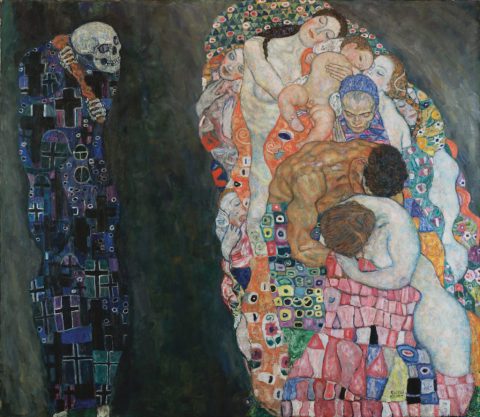
Gustav Klimt Death and Life
Good Morning Sky Dancers!
Today’s post is illustrated with paintings by two artists who died of the Spanish flu in 1918, Gustav Klimt and Egon Schiele, and one who survived his terrible bout with the disease, Edvard Munch.
BBC Culture: Klimt and Schiele, the Artists Who Shocked Europe.
At first glance there is little to suggest a connection between Gustav Klimt and Egon Schiele. Klimt was the archetypical sensualist who portrayed Vienna’s elite in gilded finery whilst Schiele, almost three decades his junior, was a tortured egoist whose twisted depictions of the human body shocked and scandalised contemporary audiences. And yet the two men shared a lifelong mutual appreciation and friendship, determined to follow their own artistic visions whatever the cost, until the flu epidemic of 1918 claimed both their lives.
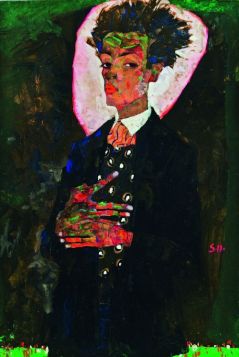
Egon Schiele, Self-Portrait
Klimt turned his back on the conventions of academic painting. Disillusioned with the stifling restraints of the Künstlerhaus, the artists’ society which all Viennese artists felt obliged to belong to, he and a number of other artists broke away to form the art movement known as the Vienna Secession.
His new attitude was provocatively outlined in the 1899 work Nuda Veritas, which Sandra Tretter of the Klimt Foundation sums up as “the Künstlerhaus versus the Secession.” A naked woman holds up the mirror of truth while the snake of falsehood lies dead at her feet. Above her in gilded letters is a quotation from the German dramatist Schiller: “If you cannot please everyone with your deeds and your art, please a few. To please many is bad.” […..]
Klimt’s uncompromising attitude appealed to the young Schiele, who sought out the artist in 1907 when he was still a student at the Academy of Fine Arts and finding the academic discipline frustrating.
A precociously gifted artist, Schiele had revealed his talent as an adolescent by sketching his younger sister in the nude, much to his parents’ horror. For Leopold, also a trained psychotherapist, this fascination with adolescent girls was in part a reaction to his ambivalent relationship with his mother, and would go on to cause great scandal.
Schiele’s undoubted talent appealed to Klimt and he took the young man under his wing, providing models and inviting him to exhibit at the 1909 Kunstchau, although Schiele’s four paintings, all very much in the style of his master, failed to make much impact….
Seeking new means of expression Schiele turned to his own body for inspiration in a manner unprecedented in the history of art. In his first nude self portrait from 1907, based on the notorious female figure in Medicine, he had portrayed himself as helpless and fragile, isolated from the rest of humanity.
Read much more about these artists at the BBC link.
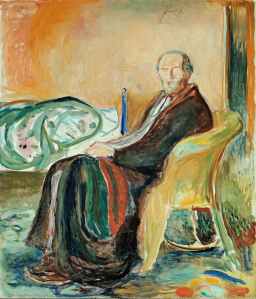
Edvard Munch, Self-Portrait with Spanish Flu
Edvard Munch (1863-1944) was another great artist who contracted influenza. He was a contemporary of Klimt and a leader of the modernist school and is best known for his painting(s), The Scream. His patron was Dr Linke, an ophthalmologist who lived in the Northern German city of Lubeck, which now has UNICEF World Heritage listing. Munch visited Lubeck on at least 17 occasions and painted pictures of the gardens of the Linke home and the Linke children, and perhaps these visits helped in Munch’s lifelong battle with depression. In 1919, Munch contracted the “Spanish Flu,” and although he was very ill, he survived. He painted a self-portrait of himself with influenza (now in Oslo) and another of himself recovering from influenza, which hangs in Lubeck in the Behnhaus Museum. As you stand in front of this portrait you see a man suffering from profound depression, perhaps due to a post viral syndrome compounding his long-standing disease. He later wrote that he was fortunate to survive the infection.
This article at Wellcome Collection provides more background on Schiele, Klimt, and Munch as well as other artists who were impacted by the 1918 flu pandemic: Spanish flu and the depiction of disease. It’s quite interesting. This bit about Schiele is heartbreaking:
In 1918, Austrian artist Egon Schiele was at work on a painting of his family. [The painting appears at the top of this post] With his unflinching attention to the human form, he completed the three figures: Schiele himself is at the far back, his sinewy nude body hunched behind his wife, Edith, who looks off to the side, while a child is curled between her feet.
Egon Schiele, Family
Earlier that year, the rising young art star had been featured in a solo show with the Vienna Secession artists’ association, and, even better, his works had actually sold. That new financial security was particularly important, as Edith was pregnant.
The only thing that disrupts the harmony of the 1918 painting ‘The Family’ is Schiele’s melancholic gaze directed at the viewer. Its sombreness seems in contrast to this scene of domestic tranquillity.
The painting would never be finished. By the end of that autumn, both Edith and Egon were dead; their child was never born. They were two among millions who succumbed to the Spanish flu pandemic. The incomplete painting was transformed into a portrait of loss.

And on Munch:
Among the artists who caught the flu and survived was Norwegian painter Edvard Munch, whose lifelong self-portraiture found a harrowing match in the disease. While many of his early self-portraits have morbid fantasies of his mortality, including the 1895 ‘Self-portrait with Skeleton Arm’ or the 1902–3 ‘Self-portrait on the Operating Table’, his Spanish flu series plainly confronted his frailty and vulnerability.
His 1919 ‘Self-Portrait with the Spanish Flu’ has Munch wrapped in a gown and blanket, sitting in a cane chair, his tousled bed in the background. Hues of a sickly yellow surround him; his mouth gapes open like a corpse. There’s a feeling of isolation in this personal struggle. Later that year he painted its sequel, ‘Self-Portrait after the Spanish Flu’, in which he leans toward the viewer, swirls of paint creating circles around his eyes, but colour returning to his sallow face.
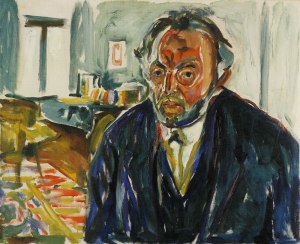
Edvard Munch – Self Portrait after the Spanish Flu
More than 100 years later, we are in the midst of another terrible pandemic, and we have no idea yet how many people will die. Yesterday, Coronavirus Response Coordinator Dr. Deborah Birx said that 100,000 to 200,000 deaths in the U.S. would be the best case scenario. CNBC: Dr. Birx predicts up to 200,000 U.S. coronavirus deaths ‘if we do things almost perfectly.’
The White House coronavirus response coordinator said Monday that she is “very worried about every city in the United States” and projects 100,000 to 200,000 American deaths as a best case scenario.
In an interview on “TODAY,” Dr. Deborah Birx painted a grim message about the expected fatalities, echoing that without doing any measures they could hit as high as 2.2 million, as coronavirus cases continue to climb throughout the U.S.
“I think everyone understands now that you can go from five to 50 to 500 to 5000 cases very quickly,” Birx said.
Somehow Birx and Anthony Fauci and advisers bearing poll results managed to convince Trump that he couldn’t loosen government recommendations without killing thousands of people. The New York Times: Behind Trump’s Reversal on Reopening the Country: 2 Sets of Numbers.
The numbers the health officials showed President Trump were overwhelming. With the peak of the coronavirus pandemic still weeks away, he was told, hundreds of thousands of Americans could face death if the country reopened too soon.
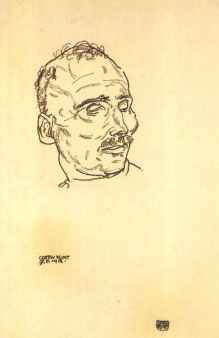
Egon Schiele, Gustav Klimt on his death bed, 1918.
But there was another set of numbers that also helped persuade Mr. Trump to shift gears on Sunday and abandon his goal of restoring normal life by Easter. Political advisers described for him polling that showed that voters overwhelmingly preferred to keep containment measures in place over sending people back to work prematurely.
Those two realities — the dire threat to the country and the caution of the American public — proved decisive at a critical juncture in the response to the pandemic, his advisers said. The first of those two realities, the deadly arc of the virus, has been known for weeks even if disregarded by the president when he set his Easter target. But the second of the two upended Mr. Trump’s assumptions about the politics of the situation and restrained, for a moment at least, his eagerness to get back to business as usual.
The president’s reversal may prove to be an important pivot point in the effort to curb the pandemic, one that in the view of public health officials averted a greater catastrophe.
Right now Trump needs Fauci and Birx to provide some credibility to his public health policies. But how long before he turns on them? Former Assistant Director for Counterintelligence at the FBI Frank Figliuzzi has some advice for them at Vanity Fair: Hostage Survival Tips for Drs. Fauci and Birx.
Kidnappers can quickly come to regret taking hostages because, quite honestly, their care and feeding becomes almost unbearable. That’s when some hostages find themselves dumped alongside a road or come to an even worse fate. So, you must avoid upsetting the president to the point that he neutralizes you. You’ve already had success in convincing the president to back off the indefensible assertion that the nation can return to normal on Easter Sunday. Dr. Fauci, your minimizing of Trump’s nonsensical notion as simply “aspirational” was masterful in that it helped him to save face and to view you as less of a threat. Bravo. Similarly, Dr. Birx’s praise of the president as “attentive to the scientific literature and the details and the data” may have stroked the president’s planet-sized ego to buy you some time.
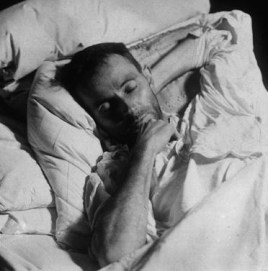
Photo of Egon Schiele on his deathbed.
Second, hostage negotiators must prepare for the abductor’s initial ransom call. Maybe that’s already happened. Maybe that first demand was to reopen the economy by Easter. If so, you handled it well. But more demands are coming. In fact, expect to see that first demand repeated. That’s why successful negotiators select a primary communicator to engage the captor. Two physicians coming at the president at once won’t work. The communicator must present a previously agreed upon message but maintain limited authority. In other words, let’s say you select Dr. Birx (the president seems to view her as less of a threat). Dr. Birx should already secretly know what Dr. Fauci’s position on things is, but when negotiating with the president, should always say, “Let me make sure we have Dr. Fauci’s opinion,” or, “I’ll have to get back to you after I consult the team.” This allows for the negotiator to establish a requirement for what hostage negotiators call a reasonable delay. In life or death hostage crises, reasonable delays can make the difference between the abductor doing something rash and emotional, or doing the right thing.
Third, a real hostage communicator is never a debater but more of an influencer and persuader. Hostage communicators maintain some control by scheduling set times to speak with the abductor. This also allows them to develop their objectives and rehearse responses with their larger team. Hostage negotiators work from a quiet, tucked away negotiation operations center. They plot out anticipated demands and scripted responses on white boards around the room. They have a plan even when the captor doesn’t. Got it? Drs. Fauci and Birx, we need you to have a plan. Our survival may depend on your survival. In a sense, we’re all being held hostage, and you are negotiating for our safe release. Hostages sometimes develop Stockholm syndrome when they start identifying with their captor and his causes as a survival mechanism. Don’t let that happen to you. Don’t let that happen to us.

Edvard Munch, The Smell of Death
Links to more Reads:
Must Read at Vox: Trump is mishandling coronavirus the way Reagan botched the AIDS epidemic.
The Washington Post: The National Security Council sounded early alarms about the coronavirus.
The New York Times: The Medical News Site That Saw the Coronavirus Coming Months Ago.
The New York Times: They Survived the Spanish Flu, the Depression and the Holocaust.
Jewish Journal: 101-Year-Old Holocaust And Spanish Flu Survivor Just Beat COVID-19.
The Local: Italian 101-year-old leaves hospital after recovering from coronavirus.
The New York Times: For Autocrats, and Others, Coronavirus Is a Chance to Grab Even More Power.
ProPublica: He Was Ordered to Self-Isolate. He Didn’t. Now He’s Facing Criminal Charges.
The Guardian: Astrophysicist gets magnets stuck up nose while inventing coronavirus device.
The Daily Beast: Rodney Howard-Browne, Megachurch Pastor Who Flouted Virus Rules, Arrested.
Thursday Reads
Posted: May 3, 2012 Filed under: 2012 presidential campaign, Barack Obama, China, Foreign Affairs, Hillary Clinton, just because, Mitt Romney, morning reads, U.S. Economy, U.S. Politics, War on Women | Tags: creativity and mental illness, defense mechanisms, Edvard Munch, gay Republcan men, psychology, reaction formation, roots of homophobia 61 Comments
Good Morning!!
Last night JJ posted about the sale of Edvard Munch’s The Scream for nearly $120 million. Even Mitt Romney probably couldn’t have afforded it! Somehow I don’t see him as much of an art lover though…
I’ve always been fascinated by the connections between creativity and mental illness. When I took Cognitive Psychology as an undergraduate my professor talked about Munch, saying that the artist felt his mental illness was the source of his creativity and so never wanted to be treated for it. The professor said that once Munch was treated, he did lose much of his creative gift. After seeing the Munch painting in the news last night, I decided to find out a little about Munch’s life.
It turns out my professor’s story was a bit of an oversimplification. Munch did link his artistic talent to his emotional problems, but I’m not sure that he ever really overcame his illness. This fascinating 2006 article from Smithsonian Magazine gives a brief account of Munch’s life and sufferings. The source of Munch’s most famous painting, The Scream, was a hallucination he experienced while walking with some friends.
Munch’s The Scream is an icon of modern art, a Mona Lisa for our time. As Leonardo da Vinci evoked a Renaissance ideal of serenity and self-control, Munch defined how we see our own age—wracked with anxiety and uncertainty. His painting of a sexless, twisted, fetal-faced creature, with mouth and eyes open wide in a shriek of horror, re-created a vision that had seized him as he walked one evening in his youth with two friends at sunset. As he later described it, the “air turned to blood” and the “faces of my comrades became a garish yellow-white.” Vibrating in his ears he heard “a huge endless scream course through nature.”
Munch was a
restless innovator whose personal tragedies, sicknesses and failures fed his creative work. “My fear of life is necessary to me, as is my illness,” he once wrote. “Without anxiety and illness, I am a ship without a rudder….My sufferings are part of my self and my art. They are indistinguishable from me, and their destruction would destroy my art.” Munch believed that a painter mustn’t merely transcribe external reality but should record the impact a remembered scene had on his own sensibility.
That much of what my professor said was correct. He did make an explicit connection between creativity and his emotional demons. And Munch did suffer. His mother died of Tuberculosis when he was only 5 years old. He adored his sister Sophie who was a year older than he was, and she too died of TB at age 15. Munch’s father was much older then his wife and sounds very authoritarian and forbidding. He was “a doctor imbued with a religiosity that often darkened into gloomy fanaticism.” Munch also had a sister who spent most of her life in a mental institution and a brother who died suddenly when he was only 30.
Munch once wrote in his journal: “I inherited two of mankind’s most frightful enemies—the heritage of consumption and insanity—illness and madness and death were the black angels that stood at my cradle,” It’s easy to see where that iconic scream painting came from.
As a young man, Munch had a love affair with a dominating older woman, whom he depicted in his painting Vampire

After his father died of a stroke, Munch’s mental illness seems to have grown worse; but in the next few years he produced some of his best work. During this time, he got involved in another difficult romantic relationship with a woman who pursued him relentlessly while he relentlessly resisted.
Munch had been drinking heavily for years and eventually he became an alcoholic. He was most likely trying to self-medicate with alcohol, since he seems to have experienced auditory and visual hallucinations throughout his life. Finally he entered a sanitarium, where he cut back on his drinking and began to feel more mentally stable. This was in 1909. When he was released, he was about 40 years old and would live for 40 more years–he died in 1944.
Munch continued to paint and produced a great deal of work, but critics agree that his best work had been produced prior to his treatment. I’m not sure you could say that his mental illness was cured, though. It seems that he just dealt with it differently. In his later years he isolated himself in his home and avoided going out in public and being part of “the dance of life,” in his words.
And now, moving from the sublime to the ridiculous, let’s look at some current news.
Bloomberg evaluates Mitt Romney’s tax plan and finds it wanting:
Republican presidential candidate Mitt Romney’s tax plan rests on a set of principles that, taken together, are difficult to reconcile.
Romney wants to reduce individual income tax rates by 20 percent, keep preferential rates for capital gains and dividends, broaden the tax base to limit revenue loss, and retain the tax-burden distribution across income groups.
Those goals are in conflict and will require that Romney consider limiting or eliminating the tax breaks for charitable deductions and home mortgage interest, said Martin Sullivan, contributing editor at Tax Analysts in Falls Church, Virginia.
“As soon as he gets in, he’s going to have to start backpedaling big-time on all of his promises,” Sullivan said. “It’s just not doable under any conceivable, realistic scenario.”
Well, Romney has a lot of experience with backpedaling, so that shouldn’t be a problem for him. It’s a lengthy article and you may feel like Munch’s The Scream while reading it. I hope no one experiences visual or auditory hallucinations, but Romney’s ideas may have the potential to trigger them in vulnerable people.
Bloomberg also finds Romney is deficient at evocative storytelling, and says this deficiency could explain why the Romney bot can’t seem to connect that well with normal humans. Here’s a “story” Romney tried to tell in Wisconsin:
“I met a guy who worked for the city and he was working, I think, in the landscape division for the city,” the presumptive Republican presidential nominee said at an April 2 town-hall meeting at an oil company in Milwaukee.
Romney never did get around to giving the name of the man or mention what city he had worked for, or identify the company he said the man founded after leaving his municipal job or say how much gasoline his trucks were burning.
“In today’s politics, it’s all about the narrative,” said Tobe Berkovitz, a communications professor and longtime Romney watcher at Boston University. “This has never been part of Romney’s wheelhouse. It’s just not his style.”
Story-telling is an age-old technique in politics. The two modern presidential candidates best-known for mastering the art tailored it to their political times and defeated incumbents. Ronald Reagan, a onetime movie actor, invoked a sense of patriotism and heroism amid economic distress and the Iranian hostage crisis, while Bill Clinton used personal narrative from his modest Arkansas upbringing to show empathy for Americans recovering from the recession of the early 1990s.
Unlike Edvard Munch, Romney lacks both imagination and creativity, and for those reasons, he probably could never even develop a mental illness.
Yesterday a Missouri legislator suddenly came out to his colleagues and begged them to withdraw the “don’t say gay” bill.
A Republican lawmaker in Missouri on Wednesday announced that he was gay and called on his colleagues to revoke their support for a “horrible” bill that would prevent the discussion of homosexuality in schools.
“I will not lie to myself anymore about my own sexuality,” state Rep. Zachary Wyatt said during a press conference at the State Capitol. “It has probably been the hardest thing to come to terms with. I have always ignored it, didn’t even think about it or want to talk about it. I’ve not been immune to it. I hear the comments — usually snide ones — about me.”
“I’m not the first or last Republican to come out. I’ve just gotten tired of the bigotry being shown from both sides of the aisle on gay issues. Being gay has never been a Republican or Democrat issue.”
Wyatt warned that Missouri’s so-called “Don’t Say Gay” bill would make it impossible for LGBT students to speak with teachers and counselors when they were being bullied.
Someone needs to do a psychological study on why there are so many gay Republicans (like Richard Grenell, who just had to resign from the Romney campaign) and at the same time so many Republicans who hate homosexuals.
Maybe this could shed a little light on the problem: A recent study suggested that people who are homophobic are more likely to be repressing attraction to the same sex and to have grown up in authoritarian homes.
Study subjects — four groups of about 160 college students each, in the USA and Germany — also rated the attractiveness of people in same-sex or opposite-sex photos and answered questions about the type of parenting they experienced growing up, from authoritarian to democratic, as well as homophobia at home.
Researchers also measured homophobia — both overt, as expressed in questionnaires on social policy and beliefs, and unconscious, as revealed in word-completion tasks.
The findings suggest participants with accepting parents were more in touch with their innate sexual orientation. But, Ryan says, “if you come from a controlling home where your parents do have negative attitudes toward gays and lesbians, you’re even more likely to suppress same-sex attraction and more likely to have this discrepancy that leads to having homophobia and feeling threatened.”
Ryan says the study may help explain the personal dynamics behind some bullying and hate crimes directed at gays and sheds light on high-profile cases in which public figures who have expressed anti-gay views have been caught engaging in same-sex sexual acts.
In other words these people may be using the defense mechanism Freud called reaction formation, which I’ve written about previously in a post about Michelle Bachmann.
Freud theorized that the ego unconsciously uses defense mechanisms to protect itself from being overwhelmed by anxiety-producing thoughts, feelings, and situations. This is one of Freud’s ideas that has been supported by extensive empirical research.
Reaction formation is a highly neurotic defense mechanism in which a person appears to others to be “protesting too much”–for example, exaggerating how much she loves or hates something to the point that observers wonder if this behavior is a cover for the opposite feeling.
This isn’t the first study that has found a correlation between homophobia and homosexual attraction. In a previous study, some researchers actually measured arousal in homophobic and non-homophobic men.
The men viewed homosexual and heterosexual soft core porn videos and their level of arousal was measured by means of a device attached to their penises. Interviews and psychological tests were used to identify homophobic and non-homophobic men.
Results showed that men who scored as homophobic on the tests and also admitted to having negative feelings toward homosexuals were more likely to be aroused by homosexual stimuli. Not only that, the men rated their own arousal levels as low when they watched homosexual videos. They were denying their own arousal levels. From the abstract:
These data are consistent with response discordance where verbal judgments are not consistent with physiological reactivity, as in the case of homophobic individuals viewing homosexual stimuli. Lang (1994) has noted that the most dramatic response discordance occurs with reports of feeling and physiologic responses. Another possible explanation is found in various psychoanalytic theories, which have generally explained homophobia as a threat to an individual’s own homosexual impulses causing repression, denial, or reaction formation (or all three; West, 1977 ).
That’s got to be a big part of what’s happening with Republicans. Now someone needs to study their woman-hating. It probably has something to do with how they feel about their mothers as well as the kinds of behaviors they observed between their parents.
I’m rambling today, aren’t I? I’d better wrap this up. Just a few more links.
Bill Clinton reviewed the new Robert Caro book on LBJ for the NYT Book Review.
Vanity Fair has an excerpt from a new biography of Barack Obama by David Maraniss (who also wrote a biography of Bill Clinton).
Finally, here are two stories about Hillary’s ongoing adventures in China. I sure hope she can work things out. Right now it doesn’t look good.
From the WaPo: Chinese activist Chen leaves U.S. Embassy for hospital, is surrounded by police
From the NYT: Chinese Dissident Is Released From Embassy, Causing Turmoil for U.S.
What’s on your reading list today?

 peej
peej Carissa
 bostonboomer
 dakinikat
 ecocatwoman
 mablue2
 Mama Lopez
 peggysue22
 quixote
 skydancingguestblogger
 Mona (aka Wonk the Vote)



 Sky Dancing
.jpg)
Recent Comments