
What Does it Mean to Have a Speaker that Knows Nothing about Economics?
Posted: June 22, 2013 Filed under: John Birch Society in Charge | Tags: Boehner, economics, Hoovernomics 65 Comments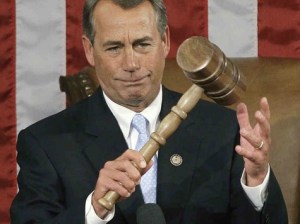 Speaker John Boehner is bad at a lot of things. His speakership has been marred by so many mishaps and embarrassing moments that it’s easy just to try to laugh at him and the entire House of Representatives. They seem to do nothing but try to repeal the impossible and stand for the unfathomable. However, the country is struggling to come out of an extremely horrible financial crisis with deep, lasting and dangerous unemployment. The Fed chair–a republican and republican appointee–points out exactly how bad this has been for our economy. What does it mean when the third in line to the presidency is clueless about one of the most important functions of modern government and appears to get all of his knowledge from a bad Ayn Rand novel?
Bernanke spoke to the press after the release of the Federal Open Market Committee minutes.
If the recovery continues, the Fed plans to taper off mortgage-backed securities purchases once the unemployment rate hits 7%, the Fed Chair suggested. And while reporters grilled Bernanke about inflationary risks and the impact of MBS purchases, he remained cautiously optimistic.
The Fed Chair’s more optimistic tone stemmed from improving market fundamentals, with Bernake highlighting increases in household wealth and fewer large scale layoffs. State and local governments also are improving somewhat financially, he said.
The only major drag is federal fiscal policy.
It is difficult to understand why the portion of US government designed to be the most accountable to the masses seems least concerned with jobs and economic growth. It is undoubtedly due to the significant misunderstanding and willful ignorance of economics recently demonstrated by the speaker and many–if not most– in his party. Paul Krugman speaks sincerely to this problem.
John Boehner’s remarks on recent financial events have attracted a lot of unfavorable comment, and they should. Actually, I think even the stuff most commentators have shied away from — he talks about the Fed “deflating” when I think he means either inflating or debasing, or possibly is doing a Sarah Palin and merging the two — is significant. I mean, he’s the Speaker of the House at a time when economic issues are paramount; shouldn’t he have basic familiarity with simple economic terms?
But the main thing is that he’s clinging to a story about monetary policy that has been refuted by experience about as thoroughly as any economic doctrine of the past century. Ever since the Fed began trying to respond to the financial crisis, we’ve had dire warnings about looming inflationary disaster. When the GOP took the House, it promptly called Bernanke in to lecture him about debasing the dollar. Yet inflation has stayed low, and the dollar has remained strong — just as Keynesians said would happen.
Yet there hasn’t been a hint of rethinking from leading Republicans; as far as anyone can tell, they still get their monetary ideas from Atlas Shrugged.
Oh, and this is another reminder to the “market monetarists”, who think that they can be good conservatives while advocating aggressive monetary expansion to fight a depressed economy: sorry, but you have no political home. In fact, not only aren’t you making any headway with the politicians, even mainstream conservative economists like Taylor and Feldstein are finding ways to advocate tighter money despite low inflation and high unemployment. And if reality hasn’t dented this dingbat orthodoxy yet, it never will.
It is rather obvious and rather sad that nearly all the economic ideas of the Speaker and his party come from a bad piece of fiction and ignore every lesson of economics learned from even libertarian-leaning economists like the late Milton Friedman. The result has been damaging to many Americans and the underlying economy.
SPEAKER JOHN BOEHNER: Well,it certainly could because you know, people open their 401(k) statements you know, at the end of every quarter and for most people it’s an indication of their wealth. And the value of their home would be another indication,how well homes are selling in their neighborhoods.
But sell off is in large part due to the policies that we’ve had coming’ out of the Federal Reserve. You know, you can’t continue to deflate our money and deflate it and deflate it– have equity markets go– without some change, yeah. Bernanke has made it clear he’s doing these policies in the absence of the government doing its part to help improve our economy.
That’s why Democrats and Republicans here on Capitol Hill and the president need to deal with– fix our tax code that would help us promote more economic growth and deal with our long term spending problem. We’ve spent more money than what we’ve brought in for 55 of the last 60 years. That ought to scare the hell out of every American.
We need to deal with this problem openly and honestly. Because if we do, investors around the country, business owners are going to look up and go, “Gee, they’re actually dealing with the issues that I’m most concerned about.” Then they’ll begin to invest.
MARIA BARTIROMO: But how likely is that over the next year? I mean, Bernanke made it clear yesterday that if the data continues as it is then they could be out of the bonds buying business by next year this time. So that’s one year. Will we see fiscal policy in terms of tax reform, in terms of regulatory clarity? Will we see that in the next 12 months?
SPEAKER JOHN BOEHNER: Listen,hope springs eternal in my heart. And while we have big differences over what tax reform might look like, what entitlement reform might look like we have to — we have to come together and deal with these things. Because if we want our economy to grow, we want to create jobs– we’ve got to deal with the issues that are affecting it.
You know, Republicans– we’ve got our jobs plan. We’ve had it now for literally the last three or four years. We’ve updated this effort and it’s our number one focus here. And while, you know, we’ve got other obligations under the constitution that provides oversight of the Executive Branch we’re trying to stay focused on those things that would improve our economy– help the American people’s wages increase and have more jobs available.
Fixing the tax code is not fiscal policy. It’s not anything that will create any kind of job growth or economic well being. What is this man thinking?
To quote Matthew O’Brien at The Atlantic, Boehner is “dangerously clueless” about economics and economic policy required of the Federal Government in challenging times. It is rather pathetic and deluded. O’Brien points out the facts about that quote from Boehner above.
Bookmark this, print it out, and put it in a time capsule, because this is about as wrong as anybody could possibly be about economics (excluding Don Luskin, of course). Now, Boehner doesn’t put it very clearly, but when he says markets are going down because Bernanke is “deflating the dollar”, he means markets are in the red because the Fed is weakening the dollar. The opposite is true. Markets sold off not because the Fed is doing too much, but because markets worry it won’t do enough. As you can see below from Bloomberg, the dollar went up during the recent sell-off on Wednesday and Thursday after Bernanke explained how and when the Fed expects to wind down QE3. That’s what happens when the Fed tightens policy.
For all the talk of “currency debasement” from conservatives who fancy themselves monetary experts, the dollar is actually stronger today than it was when the Great Recession began. Core PCE inflation, the Fed’s preferred measure, just hit a 50-year low at 1.05 percent. And no, stripping out food and energy prices isn’t hiding the inflation monster: headline PCE inflation was a meager 0.74 percent in April. Weimar we are not.
Boehner was no more coherent on fiscal policy. Now, it’s true that Bernanke would like to see some kind of budget deal that reins in long-term deficits, but he wishes we were doing less to try to rein in short-term deficits. In other words, he wants less austerity now, and more austerity later. Here’s what Bernanke said about about our cutting-spending problem in his press conference on Wednesday:The main drag or the main headwind to growth this year is, as you know, is the federal fiscal policy, which the CBO estimates is something on the order of 1.5 percentage points of growth.That’s not exactly the clarion call for future spending cuts that Boehner imagines. It’s a plea, in the understated lexicon of central bankers, to stop maiming the recovery with pointless and premature austerity. But Boehner either isn’t listening or doesn’t understand. He somehow thinks it’s scary that the government has run deficits for 55 of the last 60 years (though not so scary that he didn’t vote for many of those budgets). This is nonsense. As Josh Barro points out, there’s no better proof that we shouldn’t be scared of deficits than the fact that we have run them for 55 of the past 60 years without any problem. As long as the economy grows faster than the debt, there’s no reason we can’t run deficits forever.We tried Hoovernomics. It failed. So we’re … trying it again?

Yes. Republicans are completely in love with failed policies of the past and they’re not about to change anything now. It’s unbelievable that we could have a Speaker of the House that can be so completely ignorant about economic policy this day and age. It’s pathetic and it’s sad. It is also dangerous.
New Stage in Eurozone Crisis: Cyprus Forced to Cover Bailout from Individual Bank Deposits
Posted: March 17, 2013 Filed under: Foreign Affairs, U.S. Economy | Tags: bail-in, bailout, Cyprus financial crisis, economics, eurozone crisis 18 Comments
Lines formed at ATMs in Cyprus after news of bank levy broke
This is a topic on which I know very little, but I thought we should have a thread on it anyway.
On Saturday morning, news broke that the terms of a bailout of banks in Cyprus would require a levy on individual depositors–including those holding small accounts. People immediately rushed to ATMs to withdraw as much cash as possible before the deal was voted on. The most accessible article I found on this is by Edward Harrison of Credit Writedowns blog, posted at Alternet: Hell Breaks Loose in Europe as Banking Crisis Unfolds: Depositors’ Money May Be Seized.
Saturday morning we learned that after hours of tense negotiation, Europe has hammered out a 10bn euro “bailout” of Cyprus. I put the term bailout in quotes because the key feature of this deal is the bail-in of Cypriot depositors to the tune of 5.8bn euros, about a third of Cyprus’ GDP. This means that depositors went to sleep on Friday night and woke up Saturday to find that their money, deposited safely in Cypriot banks, had been seized and used to “bail out” the country. While the bail-in became official EU bank rescue policy during the Spanish crisis last summer, bank depositors were never mentioned at that time. I see this as an extreme measure which, if the European banking crisis continues elsewhere, will have very negative implications for bank depositor confidence in other European periphery countries.
There has since been a revision in the amounts to be deducted–I’ll get to that later on.
Back to Harrison:
Cyprus’ finance minister Michalis Sarris said large deposit withdrawals would be banned. Jörg Asmussen, a German member of the ECB board and a key ally of Angela Merkel, added that the part of the deposit base equivalent to the actual bail-in levies would be frozen immediately so the funds could be used to pay for the “bailout”….
Some of the bailout lenders like the IMF had actually been calling for Cyprus to seize all deposits larger than 100,000 euros. So this falls well short of those demands. Nonetheless, a rubicon has been crossed. Not only are senior bank debt lenders now on the hook before a single penny of European Union loans or guarantees flow to busted eurozone countries, but so are subordinated debt holders and so are even depositors. As an EU citizen, you must now believe that any lending exposure you have to a bank whether as a bond lender or deposit lender can be seized and confiscated by government, no matter how small the exposure. The FT notes that “[e]ven Ireland, whose banking sector was about as large relative to its economy as Cyprus’ when it was forced into a bailout in 2010, never considered such a measure.
Read much more at the Alternet link.
Here’s an FAQ on the crisis published at Fortune earlier tonight. The scary introductory paragraphs after the jump:
Friday Reads: Dismal Scientist Edition
Posted: January 18, 2013 Filed under: morning reads | Tags: Debt, deficit, economics, Economists 46 CommentsGood Morning!
I’ve got a few reads for you from economists on some of today’s economic policy questions. I always complain that we never hear from economists and always hear from politicians, journalists, and lawyers. So, here’s the take on the austerity fetish in the beltway from an economists’ perspective.
Economist Dean Baker thinks there’s a cut Social Security on the Horizon.
According to inside Washington gossip, Congress and the president are going to do exactly what voters elected them to do; they are going to cut Social Security by 3 percent. You don’t remember anyone running on that platform? Yeah, well, they probably forgot to mention it.
Of course some people may have heard Vice President Joe Biden when he told an audience in Virginia that there would be no cuts to Social Security if President Obama got reelected. Biden said: “I guarantee you, flat guarantee you, there will be no changes in Social Security. I flat guarantee you.”
But that’s the way things work in Washington. You can’t expect the politicians who run for office to share their policy agenda with voters. After all, we might not like it. That’s why they say things like they will fight for the middle class and make the rich pay their fair share. These ideas have lots of appeal among voters. Cutting Social Security doesn’t.
While the politics of cutting Social Security are bad, it also doesn’t make much sense as policy. In Washington, the gang who couldn’t see an $8 trillion housing bubble until its collapse sank the economy, has now decided that deficit reduction has to be the preeminent goal.
They don’t care that we are still down more than 9 million jobs from our growth trend; deficit reduction must take priority. These whiz kids apparently also don’t care that the cuts that have already been made are slowing growth and costing us jobs.
Meanwhile, economist Paul Krugman shows–once again–that the deficit isn’t really that big of problem and is dwindling. Oh, just a reminder, Social Security has nothing to do with the Federal Budget, debt or deficit other than than the trust fund is invested in US Treasuries.
Recently the nonpartisan Center on Budget and Policy Priorities took Congressional Budget Office projections for the next decade and updated them to take account of two major deficit-reduction actions: the spending cuts agreed to in 2011, amounting to almost $1.5 trillion over the next decade; and the roughly $600 billion in tax increases on the affluent agreed to at the beginning of this year. What the center finds is a budget outlook that, as I said, isn’t great but isn’t terrible: It projects that the ratio of debt to G.D.P., the standard measure of America’s debt position, will be only modestly higher in 2022 than it is now.
The center calls for another $1.4 trillion in deficit reduction, which would completely stabilize the debt ratio; President Obama has called for roughly the same amount. Even without such actions, however, the budget outlook for the next 10 years doesn’t look at all alarming.
Now, projections that run further into the future do suggest trouble, as an aging population and rising health care costs continue to push federal spending higher. But here’s a question you almost never see seriously addressed: Why, exactly, should we believe that it’s necessary, or even possible, to decide right now how we will eventually address the budget issues of the 2030s?
Consider, for example, the case of Social Security. There was a case for paying down debt before the baby boomers began to retire, making it easier to pay full benefits later. But George W. Bush squandered the Clinton surplus on tax cuts and wars, and that window has closed. At this point, “reform” proposals are all about things like raising the retirement age or changing the inflation adjustment, moves that would gradually reduce benefits relative to current law. What problem is this supposed to solve?
Well, it’s probable (although not certain) that, within two or three decades, the Social Security trust fund will be exhausted, leaving the system unable to pay the full benefits specified by current law. So the plan is to avoid cuts in future benefits by committing right now to … cuts in future benefits. Huh?
In today’s Wall Street Journal, Alan Blinder points out that running into the debt ceiling would provoke a severe fiscal contraction.
“At current rates of spending and taxation, federal receipts cover less than 74% of federal outlays. So if the government hits the debt ceiling at full speed, total outlays—which includes everything from Social Security benefits to soldiers’ pay to interest on the national debt—will have to be trimmed by more than 26% immediately. That amounts to more than 6% of GDP, far more than the fiscal cliff we just avoided,” Blinder writes.
The fiscal cliff, by contrast, would have erased 4.5 percent of GDP.
Any sustained captivity below the debt ceiling, in other words, means that the economy will enter a severe recession. This recession will be made far worse because the so-called automatic stabilizers that kick in when the economy slumps—think unemployment insurance—will not be able to function because of the budget constraint. So unemployment will grow while unemployment insurance contracts. This will not only pose a hardship on the people out of work, it will mean that the spending power of the American consumer will shrink rapidly.
Where the fiscal cliff might have led to a recession, this is downward spiral toward depression. The shrinking economy will shrink the government’s tax revenues. And since the budget deficit cannot increase, the spiral will go unchecked. Falling taxes will trigger falling spending. “Downward spiral” may be too mild. Economic black hole better fits the bill.
“In short, the consequences of hitting the debt ceiling are too awful to contemplate—worse even than going over the fiscal cliff. A sane Congress wouldn’t even think about it,” Blinder writes. He’s absolutely correct.
Blinder goes on to propose a plan to avoid a crises based on the assumption that Congress is sane. Let’s hope that assumption is correct.
Meanwhile, the House Republicans are discussing another short term fix to the debt ceiling.
House Republicans are discussing a short-term debt ceiling increase to buy time for broader deficit reduction negotiations with Democrats, Rep. Paul Ryan (R-Wis.) told reporters Thursday.
“We’re discussing the possible virtue of a short-term debt limit extension so that we have a better chance of getting the Senate and the White House involved in discussions in March,” Ryan told reporters gathered at the pricey Kingsmill resort in Williamsburg, where the House GOP is holding its annual retreat.
“All of those things are the kinds of things we’re discussing,” said Ryan, the party’s budget chief and 2012 vice presidential candidate.
A small hike in the $16.4 trillion debt ceiling would give the government more time to make payments on its responsibilities as lawmakers and the White House haggle over federal spending. A GOP leadership aide said there was no consensus on the size of a debt limit hike, and that it would have to be coupled with entitlement reforms or spending cuts.
Treasury Secretary Timothy Geithner has told Speaker John Boehner (R-Ohio) that the nation hit its borrowing limit at the end of 2012 and will run out of ways to avoid a first-ever default sometime between mid-February and early March. $85 billion in across-the-board 2013 cuts to defense and domestic spending are set to begin taking effect in March, and the government will run out of funding a month later.
Formulating a good metaphor for Obama’s second term is itself a task for intuitive creative thought that entails rethinking what he will propose in his second term. A good metaphor might embody the idea of an “inclusive economy.” The word “inclusive” resonates strongly: Americans do not want more government per se; rather, they want the government to get more people involved in the market economy. Opinion polls show that, above all, what Americans want are jobs – the beginning of inclusion.
The parallel to Chase’s book today is the 2012 bestseller Why Nations Fail by the economist Daron Acemoglu and the political scientist James Robinson. Acemoglu and Robinson argue that in the broad sweep of history, political orders that include everyone in the economic process are more likely to succeed in the long term.
The time seems ripe for that idea, and it fits with the triumph of inclusiveness symbolized by Obama himself. But another step in metaphor-building is needed to encapsulate the idea of economic inclusion.
The biggest successes of Obama’s first term concerned economic inclusion. The Affordable Care Act (“Obamacare”) is providing more people with access to health care – and bringing more people to privately-issued insurance – than ever before in the United States. The Dodd-Frank financial reforms created the Consumer Financial Protection Bureau, so that privately issued financial products would serve the public better, and created incentives for derivatives to be traded on public markets. And he signed the JOBS Act, proposed by his Republican opponents, which aims to create crowdfunding Web sites that allow small investors to participate in start-up ventures.
We have not reached the pinnacle of economic inclusion. There are hundreds of other possibilities, including improved investor education and financial advice, more flexible mortgages, better kinds of securitization, more insurance for a broader array of life’s risks, and better management of career risks. Much more progress toward comprehensive public futures and derivatives markets would help, as would policies to encourage the emerging world to participate more in the US economy. (Indeed, the inclusion metaphor is essentially global in spirit; had Obama used it in the past, his economic policies might have been less protectionist.)
The right metaphor would spin some of these ideas, or others like them, into a vision for America’s future that, like the New Deal, would gain coherence as it is transformed into reality. On January 29, Obama will give the first State of the Union address of his new term. He should be thinking about how to express – vividly and compellingly – the principles that have guided his choices so far, and that set a path for America’s future.
Thursday Reads: Romney’s Lies, Debt Ceiling Showdown, and Dimonfreude
Posted: May 17, 2012 Filed under: Barack Obama, Corporate Crime, corporate greed, Economy, House of Representatives, Mitt Romney, morning reads, Surreality, The Media SUCKS, U.S. Economy, U.S. Politics, unemployment, voodoo economics, Voter Ignorance | Tags: Bill Clinton, Bill Moyers, economics, J.P. Morgan, Jamie Dimon, Mary Kennedy, Peter G. Peterson, Robert F. Kennedy Jr., Romney's lies, Simon Johnson 22 Comments
Good Morning!
On Tuesday night I wrote a brief post about the bizarre speech Mitt Romney gave in Des Moines, Iowa earlier that day. I was struck by Romney’s childish effort to get at President Obama by talking about Bill Clinton’s economic policies and claiming that Obama must have ignored those policies because he has some kind of grudge against both Clintons. It was so strange and off key that I thought Romney sounded like a crotchety old busybody gossiping over the backyard fence.
I didn’t really even go into the many baldfaced lies Romney told in the speech–I guess I’ve become so accustomed to his total refusal to confine himself to reality as it is that I almost don’t notice it anymore. Basically, Romney attacked Obama the deficit that was primarily created by Bush, and made his usual claims that he (Romney) will be able to cut taxes by 20 percent, increase defense spending, and at the same time magically balance the budget and dramatically reduce unemployment. Only a moron would buy what he’s selling.
Yesterday, a number of bloggers commented on that speech, so I thought I’d share some of those reactions in this morning’s reads.
Steve Benen at Maddowblog: A peek into an alternate reality.
Mitt Romney delivered a curious speech in Iowa yesterday, presenting his thoughts on the budget deficit, the debt and debt reduction, which is worth reading if you missed it. We often talk about the problem of the left and right working from entirely different sets of facts, and how the discourse breaks down when there’s no shared foundation of reality, and the Republican’s remarks offered a timely peek into an alternate reality where facts have no meaning.
Even the topic itself is a strange choice for Romney. If the former governor is elected, he’ll inherit a $1 trillion deficit and a $15 [trillion] debt, which he’ll respond to by approving massive new tax cuts and increasing Pentagon spending. How will he pay for this? No one has the foggiest idea.
In other words, the guy who intends to add trillions to the debt gave a speech yesterday on the dangers of adding trillions to the debt.
Benen says he doesn’t believe Romney is “stupid,” but he must be “operating from the assumption that voters are stupid.” I’d say that’s true. I think Romney believes that he’s much smarter and more worthy than just about anyone and that poor and middle-class people are beneath contempt.
Jonathan Cohn at The New Republic: Romney’s Make-Believe Story on the Economy. Cohn writes about Romney’s claims that Obama’s failure to reduce the deficit is the cause of the “tepid recovery,” unemployment, and the struggles of seniors to get by on fixed incomes.
Note the way Romney establishes cause and effect here: Obama’s contribution to higher deficits are the reason more people can’t get work and more seniors can’t make ends meet right now. This is an audacious claim and, while I’m no economist, I’m pretty sure it places Romney on the outer edges of the debate among mainstream scholars.
I know of serious conservatives who think the Recovery Act, which has increased deficits temporarily, didn’t ultimately do much to create jobs in the near term. And I know of serious conservatives who think that creating jobs now wasn’t worth the long-term downside of adding to the federal debt, however incrementally. Both viewpoints seem to represent minority views, if a recent University of Chicago survey of leading economists is indicative. But the arguments have at least some logic to them.
But Romney’s suggestion that unemployment today is a consequence of Obama’s contribution to the deficit (real or imagined) requires further leaps of logic. You’d have to argue, for example, that extensions of unemployment benefits have reduced incentives to work (despite research to the contrary) and that such negative effects substantially outweigh the positive effects of traditional stimulus measures. It’s not impossible to make this case. I think Casey Mulligan, also of the University of Chicago, has written things along these lines for the New York Times. But, unless I’m missing something, that argument is even more marginal than suggestions the Recovery Act didn’t help at all.
I suspect that even Cohn’s effort to make sense of Romney’s fantasy economic theory will have Dr. Dakinikat pulling her hair out.
Jonathan Chait at New York Magazine: Romney’s Budget Fairy Tale.
In the real world, the following things are true: The budget deficit was projected to top $1 trillion even before President Obama took office, and that was when forecasters were still radically underestimating the depth of the 2008 crash. Obama did propose temporary deficit-increasing measures, an economic approach endorsed in its general contours, if not its particulars, by Romney’s economists. These measures contributed a relatively small proportion to the deficit, and their effect is short-lived. Obama instead focused on longer-term measures to reduce the deficit, including comprehensive health-care reform projected to reduce deficits by a trillion dollars in its second decade. Obama put forward a budget plan that would stabilize the debt as a percentage of the economy. Obama has hoped to achieve deeper long-term deficit reduction by striking bipartisan deals with Congress, and he has tried to achieve this goal by openly endorsing a bipartisan deficit plan in the Senate and privately agreeing to a more conservative plan with John Boehner, both of which were killed by Republican opposition to any higher revenue.
But Romney doesn’t seem to live in the real world, and Chait suggests that Romney either doesn’t understand how deficits work or doesn’t care if what he says makes any sense at all.
In Romney’s telling, the terms debt and spending are essentially interchangeable. When presented with Obama’s position — that the solution to the debt ought to include both higher taxes and lower spending — he rejects it out of hand. Naturally, Romney has admitted before that his budget plan “can’t be scored.” It’s an expression of conservative moral beliefs about the role of government. While loosely couched in budgetary terms, Romney is expressing an analysis that resides outside of, and completely at odds with, mainstream macroeconomic forecasting and scoring assumptions.
At the Plum Line, Greg Sargent discusses How Mitt Romney gets away with his lying.
If you scan through all the media attention Romney’s speech received, you are hard-pressed to find any news accounts that tell readers the following rather relevant points:
1) Nonpartisan experts believe Romney’s plans would increase the deficit far more than Obama’s would.
2) George W. Bush’s policies arguably are more responsible for increasing the deficit than Obama’s are.
Oh, sure, many of the news accounts contain the Obama campaign’s response to Romney’s speech; the Obama campaign put out a widely-reprinted statement arguing that Romney’s plans would increase the deficit and that he’d return to policies that created it in the first place.
But this shouldn’t be a matter of partisan opinion. On the first point, independent experts think an actual set of facts exists that can be used to determine what the impact of Romney’s policies on the deficit would be. And according to those experts, based on what we know now, Romney’s policies would explode the deficit far more than Obama’s would.
Obviously, the problem is the obsequious corporate media. But the Romney campaign makes it impossible for even the few remaining serious reporters to question his policies by keeping the candidate completely insulated from the press except for occasional appearances on Fox News and lightweight network morning shows like Good Morning America. Yesterday, Politico reprinted tweets from several reporters who were “physically” blocked from talking to Romney on a rope line.
Speaking of Republican ignorance of basic economics, House Republicans are gearing up for another pitched battle on increasing the debt ceiling. Speaker John Boehner met with President Obama at the White House today and they “clash[ed] over” increasing the debt limit, according to The Hill.
The president convened the meeting of the bipartisan congressional leadership to discuss his “to-do list” for Congress, but an aide to the Speaker said the bulk of the meeting was spent on other issues, including a pile-up of expiring tax provisions and the next increase in the federal debt limit.
Boehner asked Obama if he was proposing that Congress increase the debt limit without corresponding spending cuts, according to a readout of the meeting from the Speaker’s office. The president replied, “Yes.” At that point, Boehner told Obama, “As long as I’m around here, I’m not going to allow a debt-ceiling increase without doing something serious about the debt.”
Shortly after the meeting, White House press secretary Jay Carney told reporters that the president warned the leadership that he would not allow a repeat of last August’s debt-ceiling “debacle,” which led to a downgrade in the U.S. credit rating.
Sigh……
In a related story, there’s this piece at Wonkblog about the Pete Peterson summit and how Democrats talked long-windedly about cutting “entitlements,” and Republican refused to talk about tax increases. Read it and weep. I’m not even going to quote from it, because it’s too damn depressing.
So far Jamie Dimon seems to have survived the $2 billion loss recently suffered by J.P. Morgan.
The CEO of JPMorgan Chase survived a shareholder push Tuesday to strip him of the title of chairman of the board, five days after he disclosed a $2 billion trading loss by the bank.
CEO Jamie Dimon also won a shareholder endorsement of his pay package from last year, which totaled $23 million, according to an Associated Press analysis of regulatory filings.
Dimon, unusually subdued, told shareholders at the JPMorgan annual meeting that the company’s mistakes were “self-inflicted.” Speaking with reporters later, he added: “The buck always stops with me.”
Yeah, right. The buck will stop with the taxpayers if Dimon’s bank ultimately crashes and burns. Bill Moyers asked economist Simon Johnson about that.
Moyers: I was just looking at an interview I did with you in February of 2009, soon after the collapse of 2008 and you said, and I’m quoting, “The signs that I see… the body language, the words, the op-eds, the testimony, the way these bankers are treated by certain congressional committees, it makes me feel very worried. I have a feeling in my stomach that is what I had in other countries, much poorer countries, countries that were headed into really difficult economic situations. When there’s a small group of people who got you into a disaster and who are still powerful, you know you need to come in and break that power and you can’t. You’re stuck.” How do you feel about that insight now?
Johnson: I’m still nervous, and I think that the losses that JPMorgan reported — that CEO Jamie Dimon reported — and the way in which they’re presented, the fact that they’re surprised by it and the fact that they didn’t know they were taking these kinds of risks, the fact that they lost so much money in a relatively benign moment compared to what we’ve seen in the past and what we’re likely to see in the future — all of this suggests that we are absolutely on the path towards another financial crisis of the same order of magnitude as the last one.
A number of shareholders have sued Dimon over the losses, according to Bloomberg (via the SF Chroncle). And of course lots of people are gloating over Dimon’s getting temporarily knocked off his pedestal. Jena McGregor writes in the WaPo:
It’s being called Dimonfreude.
There are barely disguised smirks emanating from the canyons of Wall Street and the business press over the fact that Jamie Dimon has had to admit a mistake — and a whale of one, for that matter.
For years, the JPMorgan CEO (and America’s least-hated banker, as he was known) has worn a halo over those pinstripes. Dimon has been called President Obama’s “favorite banker”. Institutional Investor magazine has called him the country’s best CEO for two years running. And his actions during the financial crisis have been painted in patriotic terms: Press reports said he “answered the call” from then-FDIC chairman Sheila Bair to buy Washington Mutual, one of two banks he scooped up during the financial meltdown, and he has cited a patriotic duty to a country in crisis as why he took in $25 billion in government aid.
Yet now, Dimon is in the hot seat as JPMorgan confronts a $2 billion trading loss and the early stages of a criminal probe by the Justice Department.
Finally, some sad news: Estranged Wife of Robert F. Kennedy Jr. Is Found Dead at Home in Westchester
Mary R. Kennedy, the estranged wife of Robert F. Kennedy Jr., was found dead on Wednesday at the family’s home in Bedford, N.Y. She was 52.
Ms. Kennedy’s death was confirmed in a statement from her family, who did not comment on the circumstances. The Bedford Police Department said only that it had investigated a “possible unattended death” in an outbuilding at the home.
Her lawyer, Kerry A. Lawrence, would not say whether foul play was suspected. Kieran O’Leary, a spokesman for Westchester County, said an autopsy was scheduled for Thursday morning.
Born Mary Richardson, Ms. Kennedy joined one of America’s foremost political families in 1994, in a marriage ceremony aboard a boat on the Hudson River, near Stony Point, N.Y. At the time, she was an architectural designer at Parish-Hadley Associates in New York.
Those are my suggested reads for today. What are you reading and blogging about?
Tuesday Reads
Posted: November 1, 2011 Filed under: abortion rights, Barack Obama, birth control, morning reads, PLUB Pro-Life-Until-Birth, The Media SUCKS, U.S. Politics, Women's Rights | Tags: anti-abortion, Barack Obama, biased news, East coast snowstorm, economics, Halloween, Herman Cain, irresponsible journalism, Lori Montgomery, Mississippi, Nancy Pelosi, personhood movement, Racism, Rush Limbaugh, Washington Post, weather, zombies 30 Comments
Coffee and Morning News, by Tim Nyberg
Good Morning!! I am sooooo exhausted. Last Wednesday, I got back home after two months in Indiana. Normally, I would crash for a couple of days and be on the way to recovery from the long drive. But this time my Mom came back with me. She has been staying at my brother’s house, and I’ve had to drive over there nearly every day since I got home.
Yesterday I spent the day with my Mom and my nearly-9-year-old nephew, who was home sick and hung around for the trick-or-treating. My Mom is flying back home this morning at 8:30, and I was dreading having to get up at 5:30 in the morning to take her to the airport. But my brother volunteered to take her–halleluja! Finally I can spend a couple of days vegetating at home! I just hope I don’t get my nephew’s cold!
Anyway, here are some news links I found for you. I’ve been a bit out of touch, so I hope I won’t duplicate anything that has already been posted.
The freaky early snowstorm has left millions of people without power, which also means no heat. Even if you have gas or oil heat, the on-off mechanism still relies on electricity. So there are lots of people living in houses with temperatures around 50 degrees. I was really fortunate that my electricity was only off for several hours, mostly while I was sleeping.
Joanelle mentioned in comments last night that in her part of NJ, there is so much damage that trick or treating has been put off until Friday. The Christian Science Monitor had a story about this happening up and down the East coast.
Until hard-pressed utility crews get the lines restrung, many residents from North Carolina to Maine are living in homes that are barely 50 degrees, and in some cases, they’re unable to heat food. School systems are closed because, among other reasons, it’s not safe for children to walk on sidewalks that may still have live power lines on them. And many businesses aren’t open because they’re still in the midst of power outages.
“Electricity is the most fundamental of utilities. Most everything depends on electric power,” says Kathleen Tierney, director of the Natural Hazards Center at the University of Colorado at Boulder. “This has many of the earmarks of a disaster.”
In some states, governors are warning residents they may have to grin and bear it for days or even another week since the heavy snow did extensive damage to the electric grid. For example, in Connecticut and Pennsylvania, the snow knocked out some of the lines that get power from the generating plants to substations, where it then goes into a local distribution network. Connecticut Gov. Dannel Malloy (D) has asked President Obama to declare the state a federal disaster area, which would help with cleanup and recovery costs.
Herman Cain is still trying to explain away the story about his sexually harassing women in the 1990s. Now he’s calling it a witch hunt. But Rush Limbaugh, of all people, claims it’s racism.
RUSH: You know, I guess I shouldn’t be surprised, folks. After all of these years, none of us should be surprised, but I still am. Look at how quickly what is known as the mainstream media goes for the ugliest racial stereotypes they can to attack a black conservative. You know who’s laughing himself silly today is Bill Clinton. (imitating Clinton) “Yeah, I really did it. Ha-ha. They praised me and they went as far out of their way as they could. Even my old buddy Carville is out there and he’s saying, ‘Look what happens when you drag a dollar bill through a trailer park, you get Paula Jones.’ I have everybody defending me and they’re going after this black guy, and they’re going after him with some of the ugliest racial stereotypes I have ever seen. That’s how our side does it; we get away with it. I just love it. I love watching it.”
What’s next, folks? A cartoon on MSNBC showing Herman Cain with huge lips eating a watermelon? What are they gonna do next? No, Snerdley, I’m not kidding. The racial stereotypes that these people are using to go after Herman Cain, what is the one thing that it tells us? It tells us who the real racists are, yeah, but it tells us that Herman Cain is somebody. Something’s going on out there. Herman Cain obviously is making some people nervous for this kind of thing to happen.
When did sexual harassment become a racial stereotype? WTF is he talking about?
But at the National Review, Kevin D. Williamson says this may signal the end of Herman Cain’s campaign.
Here is what troubles me. Mr. Cain says: “If the Restaurant Association did a settlement, I wasn’t even aware of it, and I hope it wasn’t for much, because nothing happened. So if there was a settlement, it was handled by some of the other offices that worked for me at the association, so the answer is absolutely not.”
Okay, so if I’m reading that quote right, then:
1. Herman Cain, in his role as head of a major trade association, did not bother to learn how a complaint or complaints of sexual harassment against him was resolved.
2. Herman Cain, not bothering to have learned how a complaint or complaints of sexual harassment against him was resolved, decided to run for president without bothering to learn.
I got a lot of grief for writing that, based on my interaction with Mr. Cain, I would have hesitated to hire him to run a pizza company. I am feeling more comfortable in that judgment.
I wonder if Rush will condemn this: some Republicans in Virginia sent out a Halloween e-mail containing an image of President Obama shot through the head.
The Republican Party of Virginia on Monday strongly condemned an e-mail sent by Loudoun County’s GOP committee that shows President Obama as a zombie with part of his skull missing and a bullet through his head.
The e-mail, first reported on the blog Too Conservative, has “Halloween 2011” in the subject line and has several other images, including one of House Minority Leader Nancy Pelosi (D-Calif.), whose face has been made to look deformed with one eye bulging from its socket….
The e-mail, sent a week before local and state elections, invites supporters to a Halloween parade. “LCRC members and Republican candidates: We are going to vanquish the zombies with clear thinking conservative principles and a truckload of Republican candy. . . . It’s fun and a great way to represent our candidates to a ton of voters (and their kids) just before the election.”
Talk about ugly and wildly inappropriate! If anyone listens to Rush, let me know if he condemns this. I won’t be holding my breath though….
We’ve been talking about the irresponsible “journalism” of WaPo “reporter” Lori Montgomery, so I was interested to learn from Raw Story that a new website debuted yesterday with the goal of holding mainstream journalists accountable for what they write and don’t write. From Raw Story:
A Wikipedia-style website launched on Monday which provides information about the journalists behind the bylines.
News Transparency is a creation of Ira Stoll, the founder of another website called FutureOfCapitalism.com and the former managing editor of the now defunct New York Sun.
In a statement on its home page, newstransparency.com, the website said its goal is to help users “find out more about the people who produce the news” and “hold them accountable, the same way that journalists hold other powerful institutions accountable, by posting reviews and sharing information.”
News Transparency features an alphabetical list of hundreds of journalists and invites users to edit their profiles, which include basic biographical information such as age, education, current employer and work history.
Lori Montgomery is listed on the site, but so far there’s no information on her background. Does this woman even have a college degree? I’m waiting with bated breath to find out.
On my way home last night, I listened to the NPR program “On Point.” They were debating the Mississippi “personhood” for zygotes initiative, the goal of which seems to be to turn women into breeders with no freedom of choice and no rights over their own bodies. I highly recommend listening to the program. Hearing what the insane theocratic sponsors of this constitutional amendment have to say is truly frightening, but at the same time very important.
The New York Times has an op-ed about the proposed amendent: Mississippi’s Ambiguous ‘Personhood’ Amendment. The authors identify two main ambiguities in the amendment as written:
First, what does “fertilization” mean? As embryologists recognize, fertilization is a process, a continuum, rather than a fixed point. The term “fertilization” — which is sometimes considered synonymous with “conception” — could mean at least four different things: penetration of the egg by a sperm, assembly of the new embryonic genome, successful activation of that genome, and implantation of the embryo in the uterus. The first occurs immediately; the last occurs approximately two weeks after insemination (or, in the case of embryos created through in vitro fertilization that do not get implanted, never). Thus, on some reasonable readings of the amendment, certain forms of birth control, stem cell derivation and the destruction of embryos created through in vitro fertilization would seem impermissible, while on other equally reasonable readings they are not.
Second, the proposed amendment does not clearly indicate what the immediate legal impact would be. Would the amendment be “self-executing” — that is, effectuate a change to Mississippi law on its own — or would it require enabling legislation to set that change in motion?
Under existing doctrine, constitutional provisions or amendments that only set forth “first principles” or “policies” are not treated as self-executing, because they need laws enacted to further the stated principles or policies. In this case it’s not clear whether the amendment would, for example, immediately redefine thousands of references to “human beings” or “persons,” including those in provisions governing criminal homicide, or whether additional legislation would be necessary. Because of this uncertainty, voters considering this amendment cannot tell what actions would and would not immediately be subject to prosecutorial investigation were the amendment to pass.
I just hope this abomination doesn’t get enough votes!
That’s all I’ve got this morning. What are you reading and blogging about today?

 peej
peej Carissa
 bostonboomer
 dakinikat
 ecocatwoman
 mablue2
 Mama Lopez
 peggysue22
 quixote
 skydancingguestblogger
 Mona (aka Wonk the Vote)



 Sky Dancing
Recent Comments