

On Thursday, ahead of a Trump news conference in New Jersey, her campaign issued an “advisory” warning: “Donald Trump To Ramble Incoherently and Spread Dangerous Lies in Public, but at Different Home.”
Lazy Caturday Reads: Campaign News and Cats Stealing Food
Posted: August 17, 2024 Filed under: 2024 presidential Campaign, cat art, caturday, Donald Trump, Kamala Harris 2024 | Tags: Chicago, debates, Democratic National Convention 1968, Democratic National Convention 2024, Economic policy, medal of honor, political snark, polls, Veterans of Foreign Wars 6 Comments
Alexandre-Francois Desportes, Still Life with Cat, 1705
Happy Caturday!!
Some folks in the media are trying to convince us that the excitement generated by the Harris-Walz campaign is fizzling out. I don’t think so. Harris gave a speech on her economic policies yesterday, tomorrow they will take a bus tour of Pennsylvania beginning in Pittsburgh, and on Monday the Democratic National Convention will begin in Chicago. So there is lots happening. Harris is also moving up in the polls. Here’s the latest on the campaign.
Mediaite: Polls Find Kamala Harris Taking Lead From Trump in States He Was Running Away with Just Weeks Ago.
New surveys from The New York Times/Siena College show Vice President Kamala Harris has put four Sun Belt states in contention, taking the lead in two.
Harris has edged ahead of Donald Trump in Arizona and North Carolina and tightened the margin in Nevada and Georgia compared to when President Joe Biden was still running for reelection. The polls, conducted August 8-15, show Harris and Trump averaging a tie of 48% across the four states.
According to Times/Siena data taken when Biden was still running, Trump was leading the president 50% to 41% in Arizona, Georgia, and Nevada. North Carolina was not included in those surveys, but Trump won the state in both 2016 and 2020. Harris has closed some of these gaps with the vice president pulling 50% to Trump’s 45% in Arizona and 49% compared to Trump’s 47% in North Carolina.
In Georgia, Trump still holds the lead with 50% compared to Harris’s 46% and in Nevada he leads by one point, pulling 48% compared to Harris’s 47%. The margin of error for the Times poll is 4.4% for Arizona, Georgia, and Nevada and 4.2% for North Carolina results….
Harris has also grown in favorability, according to the new data with 48% saying they have a very or somewhat favorable opinion of the vice president. In a February survey, Harris’s unfavorable score was ahead by 19% while now she’s running even. Trump has remained unchanged in this department, pulling a 48% favorable rating compared to 50% unfavorable.
Voters who were polled were also asked who could “unify” the country as president and 46% backed Harris compared to 42% who backed Trump.
Sahil Kapur of NBC News on Harris’s economic speech in Raleigh, North Carolina yesterday afternoon: Harris pitches plans to tackle food, housing, medicine and child care costs in N.C. speech.
At a campaign speech Friday in North Carolina, Vice President Kamala Harris promised to “make it a top priority to bring down costs” if elected president and touted her new plans to tackle food and housing costs, slash prescription drug prices and expand the child tax credit.
Harris said the Biden administration has made progress, given the Covid economy it inherited from former President Donald Trump, but that it isn’t enough as “many Americans don’t yet feel that progress in their daily lives.”
Still Life with Cat and a Mackerel, by Giovanni Rivalta, 1760
“Costs are still too high. And on a deeper level, for too many people, no matter how much they work, it feels so hard to just be able to get ahead,” she told the crowd. “As president, I will take on the high costs that matter most to most Americans, like the cost of food. We all know that prices went up during the pandemic, when the supply chains shut down and failed, but our supply chains have now improved and prices are still too high.”
The Harris campaign outlined her proposals prior to the speech. She said she’d work with Congress to impose a “federal ban on price gouging on food and groceries,” setting rules “to make clear that big corporations can’t unfairly exploit consumers” to boost their profits. She would also seek new powers for the Federal Trade Commission and state prosecutors to slap “strict new penalties on companies that break the rules,” her campaign said….
Harris noted in her Raleigh remarks: “Look, I know most businesses are creating jobs, contributing to our economy and playing by the rules, but some are not, and that’s just not right, and we need to take action when that is the case.”
She touted her plans to create a tax break for homebuilders who construct starter homes for first-time buyers and said she will provide a $25,000 subsidy for first-time homeowners buying a house. She vowed to cut “needless bureaucracy and unnecessary regulatory red tape” as part of that and said she’ll promote “innovative technologies while protecting consumers.” She vowed to set “a stable business environment with consistent and transparent rules of the road.”
The vice president pitched her plan to expand the child tax credit and offer “$6,000 in tax relief to families during the first year of a child’s life.” She said she’ll seek to extend Medicare’s $35-per-month insulin out-of-pocket cap to everyone and expand the administration’s Medicare drug price negotiation program.
Read more at NBC News.
And from CNN: Harris has a plan to fix one of America’s biggest economic problems. Here’s what it means for you.
Americans across the political spectrum can agree on this: Rent is expensive, and buying a home can feel nearly impossible.
America’s housing affordability crisis has a number of origins, but it largely stems from two key factors that you learned in Econ 101: supply and demand. The supply of homes on the market is extraordinarily low, as sellers hang onto their houses, waiting on the sidelines out of fear that historically high mortgage rates will make their next place to live too expensive. Demand exploded during the pandemic and it never slowed down, despite high prices and rates.
Although there are signs that the worst of the housing affordability nightmare may be over, the market remains tight. That’s why housing a top issue for voters in the 2024 presidential election.
Vice President Kamala Harris on Friday unveiled her plan to help make homes more affordable. Although analysts cheered some of her plans to assist buyers, some feared that parts of Harris’ plan may exacerbate the problems in the market.
The plan, which builds on proposals that President Joe Biden has already announced, promises:
- Up to $25,000 in down-payment support for first-time homebuyers.
- To provide a $10,000 tax credit for first-time homebuyers.
- Tax incentives for builders that build starter homes sold to first-time buyers.
- An expansion of a tax incentive for building affordable rental housing.
- A new $40 billion innovation fund to spur innovative housing construction.
- To repurpose some federal land for affordable housing.
- A ban on algorithm-driven price-setting tools for landlords to set rents.
- To remove tax benefits for investors who buy large numbers of single-family rental homes.
Adding more homes to the market through incentives would certainly help, multiple economists agreed. Adding housing to the market will increase inventory and should help drive prices down. But capping rent was met with skepticism.
“What I’ve seen is three parts substance and one part symbolism,” said Joe Brusuelas, principal and chief economist at RSM US, “The substance is increasing or focusing on supply conditions via the financial channel. It’s a good, solid proposal that’s forward-looking and can actually be accomplished. The symbolism is more organized around price caps on rents.”
Read more analysis at the CNN link.

Still life with Cat. Sebastiano Lazzari, 1728
Oldsters like me remember the last time the Democrats met in Chicago in the chaotic year 1968. What will happen this time?
David Smith at The Guardian: ‘The world is watching’: 1968 protests set stage for Democratic convention.
Sean Wilentz was in the convention hall when someone handed out copies of a news wire report. “I remember the first line,” he says. “It said, ‘The lid blew off of this convention city tonight.’” The article went on to describe chaos and bloodshed in Chicago as police clashed with protesters against the Vietnam war.
Just 17 at the time, Wilentz and a couple of friends raced to the scene in downtown Chicago. “It was horrible. The cops were angry and didn’t like the kids and the kids were angry and didn’t like the cops. I saw a motorcycle cop go on a sidewalk and pin a kid against the wall. I was very scared.”
More than half a century has passed since a police riot scarred the Democratic national convention of 1968. On Monday Democrats return to Chicago with a spring in their step as they prepare to anoint Kamala Harris their presidential candidate. Yet some comparisons with the events of 56 years ago are irresistible.
Just as in 1968, a would-be assassin has sought to change the course of political history. Just as in 1968, an incumbent president has stepped aside and a vice-president will gain the Democratic nomination without winning a single primary vote. And just as in 1968, protesters will gather to demonstrate their anger over US involvement in an unpopular war.
Democrats are praying that the similarities end there. When the teargas cleared in Chicago, Hubert Humphrey, a self-styled “happy warrior”, emerged as the standard-bearer of a bitterly divided party. He went on to lose the election to Richard Nixon who, like fellow Republican Donald Trump, pushed a “law and order” message to exploit white voters’ fears and prejudices.
Of course there’s really no comparison between this year and the horrifying violence of 1968–riots in many cities, the assassinations of Martin Luther King and Bobby Kennedy, the war in Vietnam and the antiwar protests all over the country. Back to the Guardian article:
Much has changed since Trump secured the Republican nomination at the party’s own convention in Milwaukee last month. With 81-year-old Joe Biden fading in opinion polls, the Democratic campaign had come to resemble a death march. But his decision to quit the race and throw his weight behind Harris triggered an explosion of relief, self-belief and surging enthusiasm.
Next week’s Democratic convention will put the capstone on the dramatic turnaround. Harris and running mate Tim Walz, who have been drawing huge crowds at rallies and millions of dollars in donations, will be formally nominated and deliver the most important speeches of their careers – probably resulting in a further polling bump.
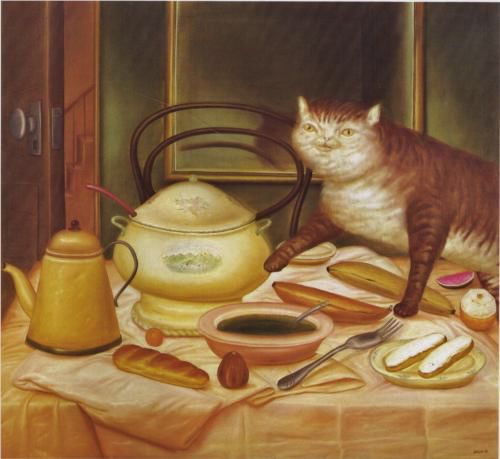
Still Life with Soup, Fernando Botero, 1972
But the carefully stage-managed event – also featuring Biden, Barack Obama, Bill Clinton and A-list celebrities – could yet go off script. Thousands of pro-Palestinian protesters are expected to gather outside to demand that the US end military aid to Israel amid the ongoing war in Gaza, where the death toll has surpassed 40,000, according to the healthy ministry there.
The March on the DNC, a coalition of more than 200 organisations from all over the US, plans to hold demonstrations on Monday and Thursday, the days when Biden and Harris are due to speak. Its website brands the president “Genocide Joe Biden” and warns: “Democratic party leadership switching out their presidential nominee does not wash the blood of over 50,000 Palestinians off their hands.”
Although a sprawling security plan has been drawn up by federal, state and city governments, some activists have vowed a replay of 1968, when years of unrest over the American misadventure in Vietnam came to a head in Chicago. Then, as now, students took up the anti-war cause with campus protests, including at Columbia University in New York, where Hamilton Hall was occupied in both 1968 and 2024.
Read the rest at The Guardian.
ABC News: As Chicago braces for Democratic National Convention, concerns over safety mount.
With more than 50,000 people estimated to descend on Chicago next week for the Democratic National Convention, the city said it is prepared to make sure the week is a success, not just for visitors, but for city residents themselves.
“Our plan is to make sure we keep everyone within the city safe. We want this to be successful,” Chicago Police Superintendent Larry Snelling told an audience at the City Club of Chicago.
While thousands of protestors are expected in Chicago, Snelling said the city is better prepared than it was in 2020, when street protests following the murder of George Floyd in Minneapolis led to arsons, looting, and rioting downtown.
Officers and police leadership have been engaged in extra training for more than a year to prepare for civil disobedience, he said. Hundreds of extra law enforcement from across the state will also be on hand, not just to strengthen security around the United Center on Chicago’s west side, but also to make sure 50 neighborhoods in the city are protected.
“We have a city to protect. The Chicago Police Department will be in every single neighborhood protecting the neighborhoods so we will not deplete resources from our neighborhoods,” he said….
Meanwhile, activists have been battling the city of Chicago in federal court over permitting rights. The Coalition to March on the DNC, which represents 200 social justice organizations from throughout the Midwest, filed for permits in 2023, however, they sued the city for violating its First Amendment right to protest.
While permits for the coalition are approved, the organization said the city, citing safety reasons, is unfairly restricting them by preventing the organization from constructing stages, connecting sound equipment and having portable toilets at Union Park.
During an emergency hearing on Friday, however, the city agreed to allow for the stage and speaker system for both rallies. U.S. District Judge Andrea Wood also ruled last week that activists must follow a protest route outlined by the city which is shorter and a further distance from the United Center.
More details on the planned protests at ABC.

Jean Baptiste Simeon Chardin, Still Life with Cat and Fish, 1631
Dakinikat wrote about Trump’s so-called “news conference” yesterday, but I just want to touch on it briefly. I actually watched it, and it was a disaster. Trump read from sheets of paper in a monotone, interspersed with his usual insane diatribes like the one about birds being massacred by wind turbines, angry denunciations of Harris, Walz, Biden, and his many other “enemies”–and of course a few of his “sir stories.” This went on for close to an hour, and then he took about 5 questions. Why any reporter would show up for his dog and pony shows is a mystery.
But one of his remarks was particularly egregious. As Daknikat wrote, he denigrated the Medal of Honor that is awarded to military service members “who have distinguished themselves with acts of valor.” Here Some military organizations have responded.
From Military Times: Trump belittles Medal of Honor award in campaign speech.
Former President Donald Trump on Thursday said the Presidential Medal of Freedom is a “better” award than the Defense Department’s Medal of Honor because service members have to sacrifice their lives or health to receive the military’s highest honor, the latest in a series of controversial campaign comments from the Republican presidential candidate….
Trump…compared the civilian medal to the Medal of Honor, the highest military award for battlefield valor, which has been awarded to just 3,517 troops out of the 41 million who have served their nation.
“It’s the equivalent of the congressional Medal of Honor,” Trump said of the Presidential Medal of Freedom. “But the civilian version, it’s actually much better because everyone that gets the Congressional Medal of Honor, they’re soldiers.”
“They’re either in very bad shape because they’ve been hit so many times by bullets or they’re dead,” he said….
According to Defense Department rules, the Medal of Honor is awarded to servicemembers who distinguish themselves “through conspicuous gallantry and intrepidity at the risk of life above and beyond the call of duty.”
That list includes Sgt. 1st Class Alwyn Cashe, awarded the honor in posthumously in 2021. Cashe died from burn wounds suffered in 2005 attempting to save six fellow soldiers trapped in a burning vehicle following a roadside bomb attack in Iraq.
Army Sgt. 1st Class Leroy Petry received the honor in 2011 for valor in Afghanistan. He lost his hand in a enemy grenade blast after picking up the explosive and hurling it away from two fellow soldiers, saving their lives.
Individuals recognized for honor often have to wait years for military reviews and reports to validate their bravery. Since the start of the Vietnam War, 264 individuals have received the honor for battlefield valor. Only 60 are still living.
From The Veterans of Foreign Wars: VFW Admonishes Former President for Medal of Honor Remarks.
“On Thursday, former President Donald Trump spoke at an event where he made some flippant remarks about the Medal of Honor and the heroes who have received it. In the video that has circulated online and in the media, the former president was recognizing Miriam Adelson in the audience who he awarded the Presidential Medal of Freedom during his time in office. As he described the medal as the civilian version of the Medal of Honor, he went on to opine that the Medal of Freedom was “much better” than the military’s top award, because those awarded the latter are, in his words, “ … either in very bad shape because they’ve been hit so many times by bullets or they’re dead.” He continued by comparing Miriam to MoH recipients saying, “She gets it and she’s a healthy beautiful woman. They are rated equal.”
These asinine comments not only diminish the significance of our nation’s highest award for valor, but also crassly characterizes the sacrifices of those who have risked their lives above and beyond the call of duty.
When a candidate to serve as our military’s commander-in-chief so brazenly dismisses the valor and reverence symbolized by the Medal of Honor and those who have earned it, I must question whether they would discharge their responsibilities to our men and women in uniform with the seriousness and discernment necessary for such a powerful position. It is even more disappointing when these comments come from a man who already served in this noble office and should frankly already know better….
We would like to remind Mr. Trump that the 12 times he had the honor of awarding the Medal of Honor as president of the United States, those were heroes not of his own choosing. He bestowed those medals on behalf of Congress, representing all Americans of a grateful nation. We hold the donation of their lives in service to our country in the highest esteem, and so should he.”
Trump is such an asshole.
 Supposedly, Harris and Trump agreed to a debate schedule that was released yesterday, but Paige Oamek of The New Republic writes that Trump is still wavering: Trump Is Pissed at Harris for Trapping Him in Two Debates.
Is Donald Trump really trying to get out of debating Kamala Harris again? Or is it the opposite?
On Thursday, it seemed like the dust had finally settled. “The debate about debates is over,” said Michael Tyler, the Harris campaign communications director, in a statement. “Donald Trump’s campaign accepted our proposal for three debates—two presidential and a vice presidential debate.”
“Assuming Donald Trump actually shows up on September 10 to debate Vice President Harris, then Governor Walz will see JD Vance on October 1 and the American people will have another opportunity to see the vice president and Donald Trump on the debate stage in October,” the Harris campaign continued.
But now, Trump’s team claims that the Democrat lied when she said the two sides reached a debate agreement. At the moment, there is only one confirmed debate between the presidential nominees, to be held September 10 by ABC News.
Nevertheless, the Trump campaign’s press secretary Karoline Leavitt told the Daily Caller Friday that Trump will be doing three debates and Vance will be doing two.
Huh? Apparently, Trump is still claiming there will be a debate on Fox News.
“Let’s be clear: President Trump will be on the debate stage THREE times with Fox News, ABC, and NBC/Telemundo. Likewise, Senator Vance will show up to debate Tim Walz on TWO occasions, on September 18 with CNN and October 1 with CBS. If Harris and Walz don’t show up, an empty podium can stand in their place, proving to the American people just how weak they are,” Leavitt told the Caller.
Trump had waffled for months on whether he would debate Harris, finally announcing he wanted to debate her three times on ABC, CBS, and Fox News. Harris accepted the invitations for the ABC and CBS debates but not for the one hosted by the Trump-adoring Fox.
Vance, confusingly, proposed two vice presidential debates as opposed to the traditional one. One of his proposed dates is the same day Trump is due to be sentenced for his hush-money trial.
Okay, well, I guess they will work it out eventually. Frankly I don’t care if there are debates or not.

It’s no use crying over spilt milk, by Frank Paton, 1880
The Harris campaign has got Trump’s number. I just love the way they are trolling him and getting under his skin. Irie Sentner of Politico has a piece about it: ‘When they go low, we go with the flow’: Dems ramp up attacks on Trump.
If Democrats in 2016 rallied around Michelle Obama’s mantra that “when they go low, we go high,” today they’re burying that ambition under a hill of insults, memes and snark.
In recent weeks, they’ve taken to the cable circuit to call former President Donald Trump and his running mate Sen. JD Vance “creepy” and “weird.” During his first speech as a vice presidential candidate, Minnesota Gov. Tim Walz referenced a false viral meme about Vance having intimate relations with a couch. And in a stream of official communications, Vice President Kamala Harris’ campaign has taken on a voice less Oval Office than extremely online provocateur.
The jabs attack a former president who has exhibited almost no boundaries in hurling his own, crude insults at Harris. Trump has questioned her racial identity and her intelligence, calling her “low IQ” and “dumb.”
And the posture is not entirely new for Democrats, who began sharpening their edges after Trump won in 2016 — and “we go high” didn’t work. But less than three months before the election, it marks an all-out abandonment of the old rules of political politesse.
“We saw what happened when we let them define us. Now, we define their messaging about us,” said Democratic strategist Antjuan Seawright. “We went from ‘when they go low, we go high,’ to ‘when they go low, we go with the flow.’ That’s what’s happening.” [….]
As Trump adheres to his standard campaign playbook — including name calling and attacks on the vice president’s race and gender — Harris has rarely responded directly. When asked about a litany of criticisms Trump made about her at a news conference last week, Harris told reporters: “I was too busy talking to voters, I didn’t hear them.”
Read more examples of Democratic snark at the Politico link.
Those are my recommended reads for today. What’s on your mind?
Unemployment Details
Posted: March 4, 2011 Filed under: jobs, U.S. Economy, unemployment | Tags: BLS, Economic policy, Job Market, jobs, unemployment 12 Comments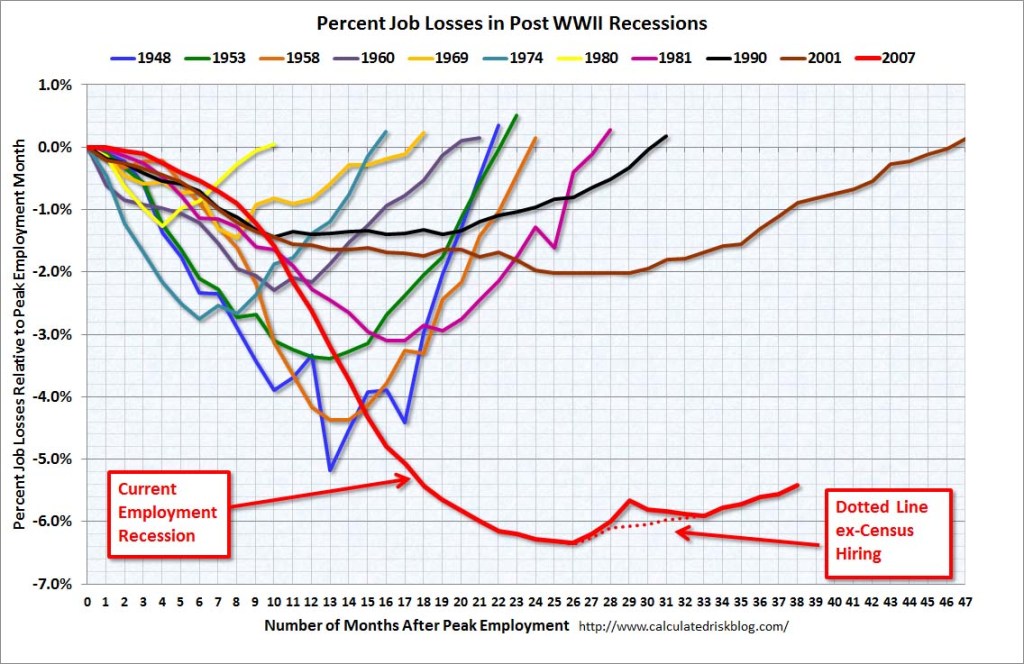
Here’s the details on the current BLS job survey for February. It came in pretty much as anticipated. The nifty graph and the following analysis come via Calculated Risk. We can say definitively that this is the worst job market since World War 2. The recovery path has created far few jobs than any of the previous post WW2 recessions. You can’t judge a jobs market by the unemployment rate alone. The devil is definitely in the details so let’s get into the report’s finer points.
This wasn’t a great report. Heck, it wasn’t a “good” report. But it was a little better than most recent reports.
If we average the last two months together, the 63,000 payroll jobs added in January and the 192,000 payroll jobs in February, that gives 127,500 payroll jobs per month. And that is a barely enough to keep up with the growth in the labor force. Private payrolls were a little better at an average of 145,000 per month, as state and local governments continued to lay off workers (something we expect all year).
The decline in the unemployment rate from 9.0% to 8.9%, was good news, especially since the participation rate was unchanged at 64.2%. Note: This is the percentage of the working age population in the labor force.
The decreases for the long term unemployed, and for the number of part time workers for economic reasons, and the decline in U-6 to 15.9% is all welcome news – although the levels are still very high.
The average workweek was unchanged at 34.2 hours, and average hourly earnings ticked up 1 cent. Both disappointing.
You can see the details here at the BLS site. The details that are most overlooked by people that don’t know how to view unemployment statistics representing people that have become so discouraged they either leave the labor force or become what is known as ‘marginally attached’. Another tell tale sign of problems are the underemployed, workers who can only find part time jobs when they really want to work full time, and workers that are stuck working as temporary workers.
The number of persons employed part time for economic reasons (sometimes referred to as involuntary part-time workers) was essentially unchanged at 8.3 million in February. These individuals were working part time because their hours had been cut back or because they were unable to find a full-time job. (See table A-8.)
In February, 2.7 million persons were marginally attached to the labor force, up from 2.5 million a year earlier. (These data are not seasonally adjusted.) These individuals were not in the labor force, wanted and were available for work, and had looked for a job sometime in the prior 12 months. They were not counted as unemployed because they had not searched for work in the 4 weeks preceding the survey. (See table A-16.)
Among the marginally attached, there were 1.0 million discouraged workers in February, a decrease of 184,000 from a year earlier. (These data are not seasonally adjusted.) Discouraged workers are persons not currently looking for work because they believe no jobs are available for them. The remaining 1.7 million persons marginally attached to the labor force in February had not searched for work in the 4 weeks preceding the survey for reasons such as school attendance or family responsibilities. (See table A-16.)
This is a very sluggish recovery that suggests policymakers are just letting the recession take its ‘natural path’ to recovery. We definitely have do-nothing economic policy right now. What really frightens me is the forthcoming do-damage austerity policy coming from states and the federal government. We wouldn’t have the size of budget deficits that we know have if the government had spent last time healing the capital positions of Wall Street shadow banks and more time healing the jobs and household situation. After all, the real wealth and well-being in an economy comes from actual goods and services produced that add-value. There is a lot more economic well-being derived from better roads, households with modern cars and appliances, and more thriving small businesses than paperwork mills that stand between buyers and sellers of goods and services and financial gambling that drives prices of things unrealistically high through speculation.
What we need is some real leadership with knowledge of economic policy. It’s obvious from these sluggish numbers that we don’t have that at all.
There’s a good article up at Truth Out that you may want to check out. It’s called “How the Rich Soaked the Rest of Us”. It’s got some nifty graphs too. It basically explains how hoarding of money in the hands of a very few has cut off the kind of growth in industries, jobs, and commerce that would allow every one to share in a robust economy.
Over the last half-century, the richest Americans have shifted the burden of the federal individual income tax off themselves and onto everybody else. The three convenient and accurate Wikipedia graphs below show the details. The first graph compares the official tax rates paid by the top and bottom income earners. Note especially that from the end of the Second World War into the early 1960s, the highest income earners paid a tax rate over 90 percent for many years. Today, the top earners pay a rate of only 35 percent. Note, also, how the gap between the rates paid by the richest and the poorest has narrowed. If we take into account the many loopholes the rich can and do use far more than the poor, the gap narrows even more.
One conclusion is clear and obvious: the richest Americans have dramatically lowered their income tax burden since 1945, both absolutely and relative to the tax burdens of the middle income groups and the poor.
It’s obvious this tax policy has contributed to this horrible middle class against middle class anger that is contributing to the current war on teachers, firefighters, and police. The wealth accumulated from the last few decades of economic growth has shifted to the top while the burden of taking care of everything has shifted to the middle and bottom. This has fueled this dangerous resentment. Many people are clearly mad at the wrong folks. The old conservative adage is that these rich people create businesses and jobs. Evidence shows that this clearly isn’t the case.
How do the rich justify and excuse this record? They claim that they can invest the money they save from taxes and thereby create jobs etc. But do they? In fact, cutting rich people’s taxes is often very bad for the rest of us (beyond the worsening inequality and hobbled government it produces).
Several examples show this. First, a good part of the money the rich save from taxes is then lent by them to the government (in the form of buying US Treasury securities for their personal investment portfolios). It would obviously be better for the government to tax the rich to maintain its expenditures, and thereby avoid deficits and debts. Then, the government would not need to tax the rest of us to pay interest on those debts to the rich.
Second, the richest Americans take the money they save from taxes and invest big parts of it in China, India, and elsewhere. That often produces more jobs over there, fewer jobs here, and more imports of goods produced abroad. US dollars flow out to pay for those imports and so accumulate in the hands of foreign banks and foreign governments. They, in turn, lend from that wealth to the US government because it does not tax our rich, and so we get taxed to pay for the interest Washington has to give those foreign banks and governments. The largest single recipient of such interest payments today is the People’s Republic of China.
Third, the richest Americans take the money they don’t pay in taxes and invest it in hedge funds and with stockbrokers to make profitable investments. These days, that often means speculating in oil and food, which drives up their prices, undermines economic recovery for the mass of Americans and produces acute suffering around the globe. Those hedge funds and brokers likewise use part of the money rich people save from taxes to speculate in the US stock markets. That has recently driven stock prices higher: hence, the stock market recovery. And that mostly helps – you guessed it – the richest Americans who own most of the stocks.
It’s obvious that we’ve basically slowed the US jobs and growth machine down with policy that siphons off economic growth to wealth hoarding instead of job-creating businesses and infrastructure. It’s time to find some leaders that realize this and will do what it takes to get us off the ‘natural’ sluggish path and on the path to a better future for every one. Until we actually have real commerce producing real goods and services being serviced by people with real jobs, we’re not going to see much of a change. Shuffling paper, creating exotic financial instruments and bubbles, and devastating people’s home values and savings through speculative quagmires isn’t getting the majority of us anywhere. It’s time for the majority of us to stand up and demand that our tax dollars and policies represent improvements for all. It’s time to end privatization schemes, excessive speculation, and captured regulators and move back to the days of when our economy benefited more than just the privileged few.
update: You may want to check out this study at Brookings Institute: Have Earnings Actually Declined?
This analysis suggests that earnings have not stagnated but have declined sharply. The median wage of the American male has declined by almost $13,000 after accounting for inflation in the four decades since 1969. This is a reduction of 28 percent!
McCainonomics: Red faces, voters who Whine, and Blue homeowners
Posted: July 11, 2008 Filed under: U.S. Economy | Tags: Economic policy, energy policy, global economics, Gramm, mccain, whining US Voters 9 CommentsWhile John McCain is calling the U.S. economy a shambles, Economic Adviser Phil Gram says buck up 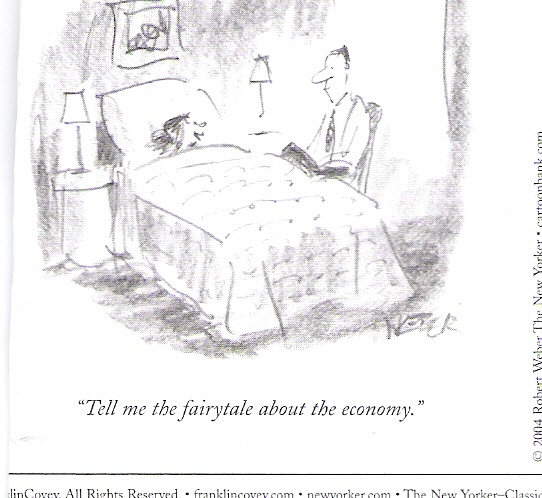 America and quit whining. He says it’s ALL in our head.
So which of these guys has the correct answer? Well, on the one hand there’s this guy trying to get elected president, so what else is he going to say? Then on the other hand, we’re really not technically in a recession yet so Phil has a point. They are both right and they are both wrong which is something only an economist could say and I couldn’t resist living up to the old joke. Okay, I’ll break it down into a few more stylized facts.
Our growth rates is somewhere between 0 and 1, our unemployment rate is pretty much where it should be, and most of the economic indicators are mixed, at best. We’re in a very slugglish growth period, but there still some major economic indicators that are showing neutral or positive. That doesn’t mean that all of us are living the same reality, however. The real answer to the question depends on WHO you are and WHERE you live. The economy is stagnant at the moment, and we’re in for a period of time where Americans are going to have to get use to making some tough choices and not seeing forward momentum. We’re basically all working and staying pretty much in the same place. Our clothing is costing us a lot less. We’ve got electronic gadgets galore and they are all really cheap. Have you priced computers, dvd players, or stereos recently? They’re all pretty cheap and just about any one can get to them. However, health care, driving, and eating are going from cheap to pricey.
The question of high energy prices and the segments of America that aren’t doing so well come mostly from globalization of the world economy that brings both good developments and bad. This is not going to reverse. As the economy adjusts, all buyers will win from global trade but those whose jobs go abroad will loose, and some will loose big time. We buy cheap stuff from the Chinese, they turn around and buy cars and they want gas. This increased demand for gas means higher gas prices. The Chinese also take jobs away from the manufacturing sector because Chinese labor comes extremely cheap and doesn’t require a pension or health plan. Those folks working for those companies that are outsourcing to other countries are miserable. While the USA has a relatively low unemployment rate of around 5%, places like Michigan and Pennsylvania have 10% unemployment rates. They are suffering. So, if you’re in the medical sector, you’re going to be happy as a clam. If you’re in manufacturing, prepare for a new career. Also, the government has grants out there to retrain folks loosing jobs from NAFTA. If you can prove it’s from NAFTA, go get it now!
438,000 jobs have been lost bringing unemployment to 5.5 percent. This is not a bad situation now, but if it continues, chances are we will be looking more like recession. Economists consider this rate to be close to the rate that represents what it should be if we are operating at capacity. The big question is: WILL IT GO UP?
So what about the financial crisis? How widespread is the mortgage problem? The housing crunch is wrecking the construction industry in places like Miami, Las Vegas, and Los Angeles. However, down here in New Orleans, the construction industry can’t find enough workers and is booming like never before. So Housing Foreclosures are a major problem in places like California, Nevada, and Florida. Many of these foreclosures are for house flippers. These folks are speculators and can whine all they want but that’s business and that’s what you get when the market moves against you. However, folks that were suckered into bad loans by mortgage brokers are a different matter. These folks are loosing their homes for banks that were looking for high fee income and basically put people into mortgages they couldn’t handle. Government regulation and help is required here. We’re not likely to get that as long as Dubya is in office. He’s threatening to veto the current bill. (All of the sudden our prez (the BIG spender) goes fiscally responsible on us!) I’m waiting for both McCain or Obama to come up with specific plans here. Hillary Clinton was the only one who spoke to this situation and her answer was a moratorium on rates. I think we’re going to need some federal bonds to fund some of these folks. It’s something similiar to what we did during the Great Depression to keep families in their homes and off the street.
So there are several markets that are a huge mess. The automobile industry and some sectors of manufacturing and the financial industry which has spilled into the housing industry, But again, most of the impact from these sectors is hitting some states hard and other states not so much at all.
Unfortunately, a lot of the higher prices are due to those high food and gas prices which are not a function of a bad U.S. economy, they are a function of problems in the global economy. There is also a continuing pattern since the 1980s that has left the rich getting richer and the poor and middle class getting poorer. The income inequality problem is worsening in this country and it looks as though it will continue. This is why it is essential that everyone has access to quality education at all levels. We should consider allowing more students attend university on the taxpayer’s dollar. Aid should definitely be mean income tested. It is much cheaper to send a teenager to school than it is to house him in a jail for the rest of his life.
These are some steps we can take to solve some of these things. First, as long as U.S. business has to pick up the tab for worker’s health insurance, the U.S. worker will not be competitive. We need universal health care paid for by individuals/taxpayers on an ability-to-pay basis. Second, all agriculture price supports, set aside programs, and subsidies, especially to ethanol, should be halted. Third, we all need to conserve energy and switch to other fuels sources (with the exception of ethanol made from things that are food). If we are making biofuels, then we need to use garbage or chicken fat or some byproduct, not food itself.
So, which of the candidates are up to the challenge? I don’t think either of them are, but I’m waiting.

 peej
peej Carissa
 bostonboomer
 dakinikat
 ecocatwoman
 mablue2
 Mama Lopez
 peggysue22
 quixote
 skydancingguestblogger
 Mona (aka Wonk the Vote)



 Sky Dancing
Recent Comments