
Hernández, 57, was released Monday from U.S. Penitentiary Hazelton in West Virginia, according to the Federal Bureau of Prisons website and a BOP spokesperson.
Wednesday Reads: Trump’s Mental and Physical Health and Other News
Posted: December 3, 2025 Filed under: just because | Tags: Alejandro Carranza Medina, Colombia, Donald Trump, Dr. Sean P. Barbabella, Former Honduran president Juan Orlando Hernández, Gaza, Ilhan Omar, Jared Kushner, Minnesota, Pete Hegseth, Saudi Arabia, Signalgate, Somali immigrants, Trump MRI, Trump's health, Ukraine 9 CommentsGood Day!!
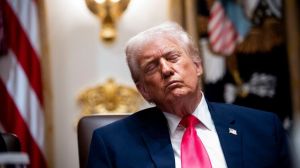
Trump sleeps during yesterday’s cabinet meeting.
Nothing is normal in the U.S. anymore. The government is run by incompetent and corrupt people. Most concerning of all is that the “president is not only ignorant and incompetent, but also physically and mentally unstable. In addition, he lacks any sense of morality or empathy for other people.
Yesterday, historian Garrett Graff wrote about this for the second time at his Substack Doomsday Scenario: It’s time to talk about Donald Trump’s health (again).
Back in September, after Donald Trump disappeared from view for days and the internet went wild with rumors he was dead or hospitalized, I wrote about how the press needed to be leading a more serious conversation about Trump’s health and fitness for the presidency than it was having.
In the months since, the evidence has only grown that something serious is afflicting Trump.
And then last night happened.
Overnight, the President of the United States went on what can only be described as an unhinged social media fever dream. He posted on his social media site Truth Social hundreds of times in a short span — somewhere north of 150 times overnight, a wild mix of conspiracy theories, videos, and memes. It was extreme even for him.
During that end-of-August episode, the major questions were about the president’s physical health — his bruised hands and his swollen ankles — and in the months since, there have been more reasons and evidence that some part of the president is not well:
- He is stumbling, physically, through more of his events. Since August, he appears to be regularly dragging the right side of his body and struggles to walk in a straight line. Just watch this recent video of Trump boarding Marine One, where he appears to be leaning heavily on Melania Trump to stand. And then there was Trump’s Asia trip, where he seemed so lost, wandering aimlessly through a Japanese press event, that the late night shows set it to music.
- He appears to have fallen asleep in meetings on multiple recent occasions, including at an Oval Office meeting.
- And then there’s the MRI. In October, he went to Walter Reed for his “annual medical exam,” even though it was barely six months after his last “annual medical exam” at Walter Reed, and had a wide range of tests done, including an MRI. In recent days, Trump has gotten into a high-profile tiff with Minnesota Gov. Tim Walz, who pressed him to release the results of that MRI. When asked, Trump couldn’t explain why he had the test. Finally, yesterday the White House released information saying it was a chest MRI for his cardiovascular and abdominal systems and that, as the White House always says he is, the tests showed everything was “perfectly normal” and in “excellent health.” (Gavin Newsom mocked Trump about the results.)
But that’s not the reason worth having a conversation about Trump’s health today.
Today, we should be having a conversation about Trump’s increasingly clear diminished mental capacity. This is a man, after all, with the sole launch authority for the nation’s nuclear weapons who, on a daily basis, seems increasingly more disconnected from reality, beholden to conspiracy thinking, and — most simply — absent-minded. It is not a recipe for global stability — and deserves more serious conversation than its getting.
Please go read Graff’s specific arguments in support of his claims. It’s not long.
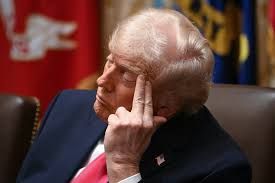
Yesterday Trump held a cabinet meeting on video. He could barely stay awake most of the time. Of course, he had been up most of the night posting insane garbage on Truth Social, but still…
Zolan Kanno-Youngs at The New York Times: Trump Appears to Fight Sleep During Cabinet Meeting.
President Trump appeared to be fighting sleep on Tuesday during a cabinet meeting at the White House, closing his eyes and at times seeming to nod off, after he criticized media coverage about him facing the realities of aging in office.
Over the course of two hours and 18 minutes, the president, who is 79, sometimes appeared to struggle to keep his eyes open as cabinet officials went around the room describing their work and heaping praise on him….
Mr. Trump does appear frequently before the news media, and he takes questions far more often than his predecessor, President Joseph R. Biden Jr., did. He is a regular, outsize presence in public life.
But Mr. Trump also appeared to have had a late night. He shared or posted dozens of times on social media on Monday night until nearly midnight.
Early in the meeting, Mr. Trump had complained that he was getting unfair scrutiny compared to Mr. Biden, who dropped out of the presidential race last year amid concerns in his own party about his age, mental acuity and ability to beat Mr. Trump.
“I’ll let you know when there’s something wrong. There will be someday,” Mr. Trump said. “That’s going to happen to all of us. But right now I think I’m sharper than I was 25 years ago. But who the hell knows?”
A bit more:
Mr. Trump then claimed he got “all A’s” on his physical.
But as Tuesday’s meeting went on, Mr. Trump seemed to grow tired.
About 50 minutes in, as Brooke L. Rollins, the agriculture secretary, spoke, Mr. Trump struggled to keep his eyes open before he leaned back and forth in his chair. More than an hour and a half into the meeting, while Linda McMahon, the education secretary, spoke, he closed his eyes for five seconds before leaning back and looking at the ceiling. Roughly 20 minutes later, as Secretary of State Marco Rubio spoke, the president leaned forward and appeared to close his eyes again.
It was the second time in less than a month that Mr. Trump appeared to doze off in public. During an Oval Office event on Nov. 6, the president’s eyes grew heavy and closed for several seconds.
Trump recently announced that he had had an MRI scan at his latest physical exam, but claimed he had no idea what it was for. Experts have questioned that, and finally his doctor released some confusing details.
Gina Kolata at The New York Times: Memo From Trump’s Doctor Cites ‘Excellent’ Scan but Offers Little Clarity.
The White House released a letter from President Trump’s physician on Monday about the results of “advanced imaging tests.” The statement, by Dr. Sean P. Barbabella, said the tests on his cardiovascular system and abdominal region showed the president “remains in excellent overall health.”
Trump in yesterday’s cabinet meeting.
Some medical experts said it was unclear what tests doctors conducted, why they were done or what the results mean. And, they said, a person without symptoms would not have imaging tests as part of a routine medical exam under ordinary medical circumstances.
Mr. Trump, the oldest president ever sworn into his office, had M.R.I. scans in October as part of a semiannual physical exam. His annual physical was done in April.
On Sunday, during an appearance on “Meet the Press” on NBC News, Governor Tim Walz of Minnesota called on the president to release the results after Mr. Trump had impugned Mr. Walz’s intelligence. Asked by a reporter on Sunday what part of his body was scanned, Mr. Trump said aboard Air Force One, “I have no idea — it was just an M.R.I.” He then said it was not a scan of his brain.
But Dr. Barbabella’s memo did not specify that Mr. Trump had a M.R.I. scan, which uses a magnetic field to produce images of soft tissues that do not show up on X-rays. Instead, the memo describes “advanced imaging” that it said was carried out “because men in his age group benefit from a thorough evaluation of cardiovascular and abdominal health.”
The imaging was part of Mr. Trump’s “comprehensive executive physical,” Dr. Barbabella explained, referring to a detailed medical exam often offered to executives. Such exams can include tests that are not normally done when people have no symptoms of disease.
The memo said Mr. Trump’s cardiovascular imaging is “perfectly normal” with no signs that his arteries are narrowed. His “cardiovascular system shows excellent health,” the statement said.
It added that, “his abdominal imaging is also perfectly normal,” and said, “this level of detailed assessment is standard for an executive physical at President Trump’s age and confirms that he remains in excellent overall health.”
They are obviously hiding something.
Dan Vergano at Scientific American: Trump’s MRI Is Not Standard ‘Preventive’ Care, Say Experts.
Medical experts are questioning the White House’s explanation for President Donald Trump’s MRI tests as “preventive.”
A Monday memo released by presidential physician Sean Barbabella described the results of “a thorough evaluation of cardiovascular and abdominal health” as normal. “This level of detailed assessment is standard for an executive physical at President Trump’s age,” Barbabella said.
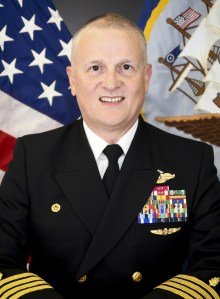
Dr. Sean P. Barbabella, Trump’s doctor
But imaging experts who spoke to Scientific American expressed doubts as to Barbabella’s assertion that magnetic resonance imaging (MRI) screening is typical preventive care. American Heart Association guidelines, for example, note that a cardiac MRI is usually requested because of existing heart conditions and often only after other tests.
“No, it is certainly not standard medical practice to perform screening MRIs of the heart and abdomen,” says radiologist and MRI expert Thomas Kwee of the University of Groningen in the Netherlands. Such imaging is typically only performed in the case of underlying disease, he says, or if there is suspicion of an underlying disease based on the patient’s medical history and physical examination. Barbabella’s memo said the imaging showed Trump was in “excellent health.”
Kwee’s comment echoed those of Medpage Today’s editor in chief, physician Jeremy Faust, who told CNN on Monday that “there’s really no such thing as routine prevention using an MRI.” Faust on Tuesday told Scientific American that the White House memo reference to “advanced imaging” left open questions as to exactly what tests Trump underwent. It could even possibly refer to a CT scan, for example, which is different than MRI. “If we knew exactly what imaging he received, it would give us a better idea of what conditions they are worried about,” Faust says.
More opinions:
“An assessment of a heart MRI and abdominal MRI is not ‘standard for an executive physical,’” says former White House physician Jeffrey Kuhlman, author of the book Transforming Presidential Healthcare. Though it’s not uncommon for physicians who have concierge-type practices to use total or partial body scans on their clients, “this is not evidence-based,” he adds….
Questions around Trump’s health have surfaced repeatedly in recent months. In July the White House reported that the president has chronic venous insufficiency, a blood vessel disease that affects circulation and can cause ankle swelling. And noticeable bruises on the back of Trump’s hands seen in February were attributed to “shaking hands all day” by Leavitt.
There is no solid evidence that executive MRI scans help people, Kwee says, either by diagnosing disease or extending their lifespan. “These scans can also lead to unexpected incidental findings and give false reassurance that there is no underlying disease.”
At least big media is beginning to talk about Trump’s obvious mental and physical health issues. We need them to start focusing on Trump’s age as much as they did Biden’s.
More important stories:
Judd Legum at Popular Information: Kushner’s Moscow mission wasn’t just corrupt. It was unconstitutional.
Jared Kushner, President Trump’s son-in-law, has been traveling the world to participate in high-stakes foreign policy negotiations on behalf of the president. On Tuesday, Kushner traveled to Moscow and sat across the table from Russian President Vladimir Putin to discuss a peace deal to end the war in Ukraine. The entire United States delegation consisted only of Kushner and Special Envoy Steve Witkoff. Kushner and Witkoff were joined at the table by an interpreter.
Kushner’s participation in the Moscow meeting — and the similar role he played in the Gaza negotiations — likely violates the law.
Representing the Trump administration in high-level foreign policy negotiations makes Kushner, at a minimum, a Special Government Employee (SGE). Under the law, an SGE is someone “who is retained, designated, appointed, or employed to perform, with or without compensation, for not to exceed one hundred and thirty days during any period of three hundred and sixty-five consecutive days, temporary duties either on a full-time or intermittent basis.”
Trump has not named Kushner an SGE. But a seminal 1977 opinion by the Department of Justice’s Office of Legal Counsel (OLC) found “an identifiable act of appointment may not be absolutely essential for an individual to be regarded as an officer or employee in a particular case where the parties omitted it for the purpose of avoiding the application of the conflict-of-interest laws.” In that opinion, the OLC considered the status of an individual who had not been named to any role by the president but “assumed considerable responsibility for coordinating the Administration’s activities in [a] particular area.” The OLC concluded that since the individual was “quite clearly engaging in a governmental function” and is “working under the direction or supervision of the President,” he should be considered an SGE.
Here, Kushner is engaged in activities that can only be conducted by government officials. The Logan Act bars private citizens from engaging in negotiations with foreign governments without authorization. Kushner is acting in an authorized capacity, under Trump’s direction, and that creates a host of legal issues.
A the same time, Kushner is receiving payments from foreign governments.
Since leaving the White House in 2021, Kushner has raised at least $4.8 billion for Affinity Partners, his private equity firm. Nearly 99% of Affinity Partners’ funding comes from foreign sources. The largest investment, $2 billion, came from the Public Investment Fund of Saudi Arabia (PIF).
The Saudi government pays Kushner 1.25% of its investment, or $25 million annually. Other investors, including the governments of Qatar and the United Arab Emirates (UAE), pay annual fees of up to 2%. As of September 2024, Affinity Partners had collected $157 million in fees, mainly from Middle Eastern governments.
Kushner is continuing to collect these fees as he serves in a top foreign policy role for the Trump administration. This is precisely the kind of behavior the Foreign Emoluments Clause was designed to prevent. Kushner was one of two Americans on Tuesday engaged in high-stakes negotiations with Putin. But as the private equity manager for billions of foreign capital, Kushner has a fiduciary duty to advance the financial interests of Saudi Arabia, Qatar, and other foreign governments.
The Washington Post: Ex-Honduras president, convicted of drug trafficking, freed on Trump pardon.
Former Honduran president Juan Orlando Hernández, convicted by a U.S. court last year on charges that he ran the Central American nation as a “narco-state” that helped send South American cocaine to the United States, has been released from federal prison after receiving a “full and unconditional” pardon from President Donald Trump.
Hernández, who was president of Honduras from 2014 to 2022, was serving 45 years in prison on importation and weapons charges. U.S. prosecutors said he built his political career on millions of dollars in bribes from traffickers in Honduras and Mexico, and as president helped to move at least 400 tons of cocaine to the United States while protecting traffickers from extradition and prosecution.
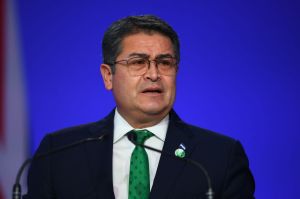
Juan Orlando Hernández
The Trump administration is waging what it says is a counternarcotics campaign off Venezuela. U.S. forces have destroyed at least 21 boats in the Caribbean Sea and Pacific Ocean, killing more than 80 people, that officials say were carrying drugs to the U.S., and U.S. troops and warships are massing in the region. Trump has accused Venezuelan President Nicolás Maduro of sending violent criminals and drugs to the U.S.
But on Friday, Trump said that Hernández had been “treated very harshly and unfairly” and that he would grant him a “Full and Complete Pardon.”
“CONGRATULATIONS TO JUAN ORLANDO HERNANDEZ ON YOUR UPCOMING PARDON,” Trump wrote on Truth Social. “MAKE HONDURAS GREAT AGAIN!”
Trump’s decision to pardon an official who, a federal court found, helped flood the United States with cocaine angered congressional Democrats.
“Hernandez’s conviction last year finally held him accountable for all the Honduran and American blood on his hands and sent an unequivocal message: No drug trafficker is above the law, not even former presidents,” said Sen. Jeanne Shaheen (New Hampshire), the top Democrat on the Senate Foreign Relations Committee. “That is precisely why all Americans should be outraged by President Trump’s pardoning of former president Hernandez.”
I wonder how much Trump was paid for this pardon.
NBC News: Pentagon inspector general investigation into ‘Signalgate’ is complete.
Defense Secretary Pete Hegseth on Tuesday was given a final copy of the completed Defense Department Inspector General report that examined his sharing sensitive military information on a Signal group chat back in March, according to two people familiar with the investigation.
The much-anticipated report is expected to become public as early as this week, these people said.
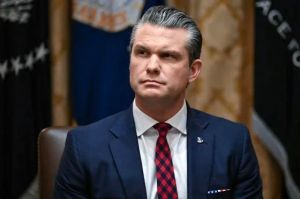
Pete Hegseth
The report outlines the findings of a more than eight-month investigation into Hegseth’s use of Signal, an encrypted but unclassified messaging app, to share details of planned U.S. military strikes in Yemen before they had begun.
Hegseth has maintained that he shared no classified information on the group chat….
The two people familiar with the inspector general investigation would not say what its conclusions are. The report was requested by the chairman of the Senate Armed Services Committee, Sen. Roger Wicker, R-Miss., and the committee’s ranking member, Sen. Jack Reed, D-R.I., on March 27.
The group chat, which included other top members of President Donald Trump’s national security team, became public after an editor for The Atlantic magazine was inadvertently added.
Let’s hope it’s not a whitewash.
Aram Roston at The Guardian: Family of victim in alleged Trump ‘drug boat’ killings files first formal complaint.
A family in Colombia filed a petition on Tuesday with the Washington DC-based Inter-American Commission on Human Rights, alleging that the Colombian citizen Alejandro Carranza Medina was illegally killed in a US airstrike on 15 September.
The petition marks the first formal complaint over the airstrikes by the Trump administration against suspected drug boats, attacks that the White House says are justified under a novel interpretation of law.
Alejandro Carranza Medina and his son. Photograph Courtesy of Carranza family
The IACHR, part of the Organization of American States, is designed to “promote and protect human rights in the Western Hemisphere”. The US is a member, and in March the Trump administration’s state department wrote: “The United States is pleased to be a strong supporter of the IACHR and is committed to continuing support for the Commission’s work and its independence. Preserving the IACHR’s autonomy is a pillar of our human rights policy in the region.”
The complaint was filed by Pittsburgh-based human rights lawyer Dan Kovalik. “On September 15, 2025, the United States military bombed the boat of Alejandro Andres Carranza Medina,” the filing says, “which Mr Carranza was sailing in the Caribbean off the coast of Colombia. Mr Carranza was killed in the process of this bombing.”
Kovalik identified Pete Hegseth, the US defense secretary, as the perpetrator, based on Hegseth’s own statements. “From numerous news reports, we know that Pete Hegseth, US Secretary of Defense, was responsible for ordering the bombing of boats like those of Alejandro Carranza Medina and the murder of all those on such boats. Secretary Hegseth has admitted that he gave such orders despite the fact that he did not know the identity of those being targeted for these bombings and extra-judicial killings,” the filing goes on.
The complaint adds: “US President Donald Trump has ratified the conduct of Secretary Hegseth described herein.”

NBC News: Trump administration pauses immigration applications from nationals of 19 countries.


 peej
peej Carissa
 bostonboomer
 dakinikat
 ecocatwoman
 mablue2
 Mama Lopez
 peggysue22
 quixote
 skydancingguestblogger
 Mona (aka Wonk the Vote)



 Sky Dancing
Recent Comments