
Thursday Reads: The Tide Has Turned
Posted: October 6, 2016 Filed under: morning reads, U.S. Politics | Tags: demographic data, Donald Trump, Hillary Clinton, Mike Pence, Mitt Romney, poll data, Tim Kaine 17 Comments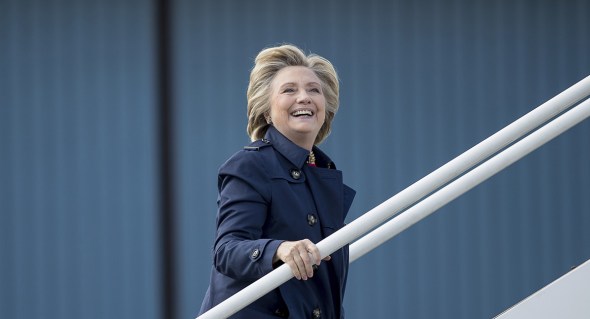
Good Morning!!
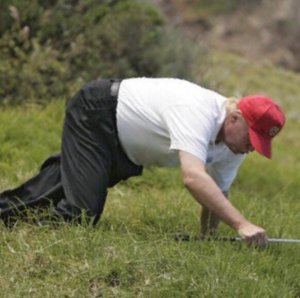
Following the first presidential debate last week, Hillary is flying high in the polls and many in the media seem to have turned against Donald Trump. I’m reminded of what happened in 2012 after Romney’s “47%” gaffe was revealed. Once you become a laughing stock, it’s hard to change people’s minds. Trump’s loss in that debate may turn out to be his downfall, and now his running mate has his own horrendous gaffe–“That Mexican thing.”
Daily Kos has a great summary of the latest poll data: Daily Kos Elections 2016 forecast: Hillary Clinton’s victory odds now back up to 83 percent.
What a difference a week makes! When we looked at the model on Monday, September 26 (the day of the first presidential debate), Hillary Clinton’s odds of winning were 64 percent. There had been some subtle improvements in the previous week in Clinton’s national polling numbers (as Pneumonia-ghazi started to fade from view) but that hadn’t really trickled down into the state-level polls, which is what our model is based on. By Thursday, September 29, that improvement was starting to filter into the state polls, and our model ticked up to 68 percent … but that was still based only on polls with a pre-debate field period.
On the morning Monday, October 3, we had a few post-debate polls under our belt … and Clinton’s overall odds were up to 72 percent … but we were still left wondering why everything was so quiet on the polling front. By the end of Monday, though, the deluge had arrived, and with one exception (Quinnipiac’s Ohio poll), everything was very good news for Clinton: among others, a Clinton +11 poll from Monmouth in Colorado,another Clinton +11 poll in Colorado from Keating Research, polls from Quinnipiac with Clinton +5 in Florida and +3 in North Carolina, a Clinton +9 poll in Pennsylvania from Franklin & Marshall, a Clinton +3 poll in Nevada from Hart Research, and a Clinton +7 poll in Virginia from Christopher Newport Univ.
Ooops!
It may well have been her single best polling day of the cycle, and by Tuesday her odds had jumped to 82 percent, a one-day gain of 10. That matches the largest single-day gain our model has seen since we started running. That other gain of 10 happened between August 8th and 9th; in case you’re wondering what was happening then, that was the Monday after the Democratic convention ended, when the post-DNC polls started to show up. So you could say that the debate was one of the most momentous events of the campaign: if your metric is the effect it had on our model, she got a convention-sized bounce out of it.
The subsequent days have seen even more strong poll results, most notably two different polls on Wednesday (from Monmouth and Anzalone Liszt) giving Clinton a 2-point lead in Ohio, which isn’t a lot but serves to counteract the Quinnipiac poll that had her down 5. The subsequent polls weren’t enough to really move the model much higher; it currently places Clinton’s odds at 83 percent. But they do continue an impressive little winning streak: out of the several dozen polls of swing states released since the debate, only one of that entire stack had Donald Trump leading (again, that Quinnipiac Ohio poll). And that stack covers every major swing state except Iowa (and Wisconsin, if you even consider that a swing state in the first place).
More details at the link.
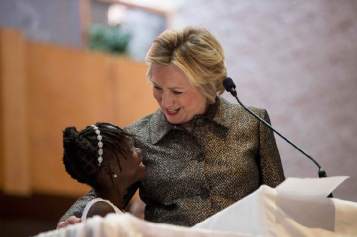
Democratic presidential candidate Hillary Clinton speaks with Zianna Oliphant onstage after speaking at the Little Rock AME Zion Church in Charlotte, N.C., Sunday, Oct. 2, 2016. (AP Photo/Andrew Harnik)
What about demographic data?
Harry Enten at FiveThirtyEight: Trump’s Doing Worse Than Romney Did Among White Voters.
Donald Trump’s strategy in this campaign has been fairly clear from the beginning: Drive up Republican support among white voters in order to compensate for the GOP’s shrinking share among the growing nonwhite portion of the electorate. And Trump has succeeded in overperforming among a certain slice of white voters, those without a college degree. But overall, the strategy isn’t working. Trump has a smaller lead among white voters than Mitt Romney did in 2012, and Trump’s margin seems to be falling from where it was when the general election began.
Four years ago, Romney beat President Obama among white voters by 17 percentage points, according to pre-election polls. That was the largest winning margin among white voters for any losing presidential candidate since at least 1948. Of course, even if Trump did just as well as Romney did, it would help him less, given that the 2016 electorate will probably be more diverse that 2012’s. And to win — even if the electorate remained as white as it was four years ago — Trump would need a margin of 22 percentage points or more among white voters.
But Trump isn’t even doing as well as Romney. Trump is winning white voters by just 13 percentage points, according to an average of the last five live-interviewer national surveys.1 He doesn’t reach the magic 22 percentage point margin in a single one of these polls.

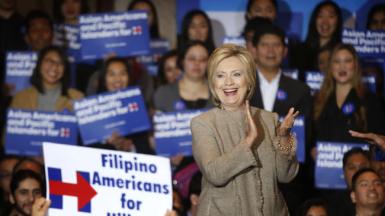
NBC News: Clinton Holds 41-Point Lead Over Trump Among Asian-American Voters: Survey.
The Fall 2016 National Asian American Survey, taken between Aug. 10 and Sept. 29 in 11 different languages, found that 55 percent of registered voters intended to vote for Clinton compared to 14 percent for Trump. Eight percent intended to vote for a different candidate, and 16 percent had not yet decided, according to the survey. Seven percent of registered voters declined to give an answer.
When taking into account voters leaning one way or the other, Clinton’s lead grows to 43 points, with 59 percent of registered voters intending to or leaning toward voting for Clinton compared to 16 percent for Trump and 16 percent who were undecided or refused to answer.
“The big takeaway is a continuation of what we saw in the Spring 2016 survey— an Asian-American population that was become more Democratic over time,” Karthick Ramakrishnan, the survey’s director, told NBC News. “We see that Trump is likely a significant reason for that shift. Trump’s unfavorables are like nothing we’ve seen before.”
Marc Caputo at Politico: Clinton dominating Trump among Florida Hispanics in new poll.
Hillary Clinton leads Donald Trump by 24 points among likely Hispanic voters in Florida, according to a new poll that shows a significant number of Republican Latinos are unsure of their nominee for the White House.
Clinton’s 54-30 percent lead over Trump with Hispanic voters stands in marked contrast to the U.S. Senate race, where bilingual Republican incumbent Marco Rubio is ahead of Democratic U.S. Rep Patrick Murphy by 48-39 percent, a TelOpinion Research survey conducted for the conservative-leaning Associated Industries of Florida business group shows.
Clinton’s huge advantage over Trump is buoyed by strong support among Democrats (whom she carries 75-13 percent) and independents (among whom she wins 61-20 percent) in the poll of 600 likely Latino voters. Trump’s 63-19 percent lead over Clinton among Republican Hispanics could be much bigger, but 14 percent are undecided. That’s double the number of undecided Latino Democrats.
Those numbers worry Republicans because the polls show Trump is already under-performing 2012 Republican nominee Mitt Romney’s final margins with Florida Hispanics — yet there’s a month of campaigning left and Clinton is outgunning Trump in paid Spanish-language TV ads that are playing in heavy rotation in the Miami area.
What about the fallout from the vice presidential debate? Immediately after it ended, cable talking heads pronounced Mike Pence the winner because he was able to lie repeatedly in a calm voice. By yesterday his performance wasn’t looking so good.
Abby Phillip at The Washington Post: Clinton debate prep is focused on what happens once the debate is done.
Sen. Tim Kaine may have awakened Wednesday to poor reviews after the first and only vice-presidential debate, but his acerbic performance in Farmville, Va., revealed that the Clinton campaign’s strategy for these debates extends far beyond the stage.
Armed with pre-planned Web videos, television ads and tweets, the campaign has used key debate moments this week and last as a cudgel against the Republican ticket, showing a level of discipline and organization largely absent from Donald Trump and Indiana Gov. Mike Pence’s campaign.
“Kaine had a very clear and simple plan for the debate: remind a national televised audience of all of the offensive things Trump has said and done in this campaign,” said Dan Pfeiffer, a former senior adviser to President Obama. “The Clinton campaign was smart enough to know that who ‘wins’ or ‘loses’ the VP debate doesn’t move votes. Instead it’s an opportunity to communicate a message to a very large audience.”
“I don’t see a single thing that Pence did that moved the needle for Trump in any way,” he added.
And then there was that awful Pence gaffe that many outside of the Latino community didn’t pick up on right away.
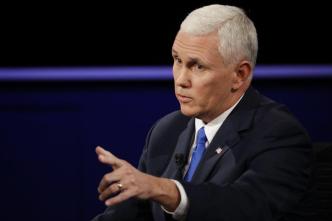
Vox: How the Clinton campaign is making #ThatMexicanThing a thing, explained.
Sen. Tim Kaine made a point during the vice presidential debate of reminding the American public of that time Donald Trump called Mexican immigrants rapists and drug dealers.
“He started his campaign with a speech where he called Mexicans rapists and criminals,” Kaine said, listing Trump’s most controversial campaign statements. “I cannot imagine how Gov. Pence can defend Donald Trump.”
At first, Indiana Gov. Mike Pence responded with a laugh and a shrug — a seemingly implicit defense of Trump implying Kaine’s attack was unfounded (despite the fact that Trump really has said these things). But Pence’s initial lack of response didn’t stop Kaine. He used the same line four times Tuesday night. And by the fourth time, Pence had had enough.
“Senator, you whipped out that Mexican thing again,” Pence retorted. “There are criminal aliens who have come into this country illegally, who are perpetrating violence. He also said, ‘and many of them are good people.’ Sen. Kaine, you keep leaving them out of your quote.”
And then Twitter exploded.
The Clinton campaign also seized on it quickly: www.thatMexicanthing.com now redirects to Hillary Clinton’s campaign website, and Clinton’s campaign is doing its darnedest to make the hashtag #ThatMexicanThing the takeaway from Tuesday’s debate.
It’s an illustration of just how savvy campaigns can be in the face of a losing performance, but it is also a reflection of what Kaine was trying do all night: sink Pence down to Trump’s level.
Vox isn’t so sure the strategy worked, but that’s not what Latino leaders are saying.
You’ve probably seen several videos from Clinton and groups supporting her with clips of Pence denying that Trump said the things he said, but this morning CNN put one out.
I really do think the tide has turned in Hillary’s favor, and the final blow could come in the second presidential debate on Sunday night.
What else is happening? What stories are you following today?

 peej
peej Carissa
 bostonboomer
 dakinikat
 ecocatwoman
 mablue2
 Mama Lopez
 peggysue22
 quixote
 skydancingguestblogger
 Mona (aka Wonk the Vote)



 Sky Dancing
Recent Comments