
The Latest Stupid Republican Tricks: The “Default Deniers”
Posted: May 19, 2011 Filed under: China, Economy, Federal Budget, Foreign Affairs, Global Financial Crisis, Psychopaths in charge, Republican politics, Social Security, Surreality, U.S. Economy, U.S. Military, U.S. Politics, We are so F'd | Tags: Alan S. Blinder, Debt Ceiling, Federal Debt, Republican crazies, social safety net, Social Security, Timothy Geithner 9 Comments
GOP Leadership
{Sigh….} Is there any way to be rid of these crazies? The latest Republican nutty meme is that it will be much much better for all concerned if Congress doesn’t raise the debt ceiling and the U.S. has to either cut trillions in spending or default on its debts. From Politico:
They are the newest breed of government skeptics, the swelling ranks of Republicans who don’t believe the Obama administration when it says a failure to raise the debt limit will prove catastrophic.
And they stand ready to make negotiations over raising the cap on debt as grueling as possible, making Treasury officials and Wall Street more nervous than ever that the country could suffer an unprecedented default with consequences no one can predict.
The suspicion, which once flourished on only the conservative outskirts of economic circles, has seeped into the mainstream in recent weeks, gaining broader acceptance among establishment Republicans, even as the administration issues increasingly dire warnings.
House Speaker John Boehner (R-Ohio) validated the default deniers Sunday, saying, “I understand the doubts.” Jim Nussle, a budget director under former President George W. Bush, argued last week that “no one’s going to default” if Congress misses the Aug. 2 deadline. And Alabama Sen. Jeff Sessions, the top Republican on the Budget Committee, accused the White House of scare tactics similar to those used by the previous administration to win quick approval of the 2008 bank bailout after the markets crashed.
Via Think Progress, Rush Limbaugh yesterday responded to the Politico article by leaping aboard the GOP elephant just as it began to topple off the cliff. Limbaugh announced on his radio program that refusing to raise the debt ceiling will help the country’s credit rating.
LIMBAUGH: Today I claim the mantle. I proudly and honestly come to you today as the Mr. Big of the default deniers. We will not default on anything. And moreover, it is more likely that the country’s creditworthiness would go up around the world since we would finally be doing something to address our out-of-control spending and indebtedness if we were not to raise the debt limit. We would be perceived around the world as serious for a change, and responsible for a change. Otherwise we are headed for junk bond status.
I’m no economist, but according to Dakinikat Alan S. Blinder is a really good one, and he wrote an op-ed for the Wall Street Journal today. Here is his analysis of what could happen if the Republicans get their way on the debt ceiling.
What happens if we crash into the debt ceiling? Nobody really knows, but it’s not likely to be pretty. Inflows and outflows of cash to and from the Treasury jump around from day to day as bills are paid and revenues arrive. But at average fiscal 2011 rates, receipts cover only about 60% of expenditures. So if we hit the borrowing wall traveling at full speed, the U.S. government’s total outlays—a complex amalgam that includes everything from Social Security benefits to soldiers’ pay to interest on the national debt—will have to drop by about 40% immediately.
The bottom line is that Timmy Geithner will have to decide whether to pay soldiers and old folks or pay China other foreign creditors. I guess that’s what the Republicans are hoping for–that it will spell the end of the entire social safety net. But they don’t seem to be thinking very long-term. Do they really believe Americans will passively allow that to happen? Back to Blinder:
If and when the time comes, Mr. Geithner and his boss will have to decide. But here’s one prediction: Defaulting on the national debt will not be their first choice. After all, the statue of Alexander Hamilton at the Treasury entrance reminds Mr. Geithner every day of the importance of maintaining the nation’s creditworthiness. Even if we hit the debt ceiling, maturing obligations still can be rolled over. And I’ll bet he will bend every effort to make the interest payments, too. Unfortunately, however, when you’re 40% short, not much can be ruled out.
Exactly. Geithner is going to choose to pay China, not the elderly and disabled–that’s what the Republicans are counting on. But that will be a choice between chaos in the world economy and mass uprisings on the domestic front–or we might get both. According to Blinder a contraction in the U.S. economy like the one the Republicans are pushing us toward could lead to world-wide financial panic. According to Blinder:
…suppose the federal government actually does reduce its expenditures by 40% overnight. That translates to roughly $1.5 trillion at annual rates, or about 10% of GDP. That’s an enormous fiscal contraction for any economy to withstand, never mind one in a sluggish recovery with 9% unemployment. Even contemplating such a possibility is evidence of a dark, self-destructive impulse.
Second, markets now assign essentially zero probability to the U.S. losing its fiscal mind. They’d be caught flat-footed if the threat of default suddenly started to look real, possibly triggering a world-wide financial panic. Remember how markets reacted to the Lehman Brothers surprise? As Mr. Geithner pointed out in New York on Tuesday, “As we saw in the fall of 2008, when confidence turns, it can turn with brutal force and with a momentum that is very difficult and costly to arrest.”
And Blinder isn’t even considering what the reaction would be among ordinary Americans here at home when the economy completely tanks and there is no social safety net whatsoever.
Monday Reads
Posted: May 16, 2011 Filed under: 2012 presidential campaign, Economy, Federal Budget and Budget deficit, fundamentalist Christians, Global Financial Crisis, income inequality, Medicare, religion, religious extremists, Republican politics, Republican presidential politics, Team Obama, The Bonus Class, The Great Recession, U.S. Economy, U.S. Politics | Tags: Debt Ceiling, End Times, evangelical Christians, Harold Campaign, Mark Thoma, Newt Gingrich, Rapture, the plutocracy, Timothy Giethner 52 Comments Good Morning!
Are you reading for the end of the world next Saturday? Nope, it’s not 2012 yet and we’re not talking about the Mayan Prophecy. Harold Campaign has convinced a group of evangelicals that the date is May 21, 2011. I wonder if any of them would like me to take care of their left behind pets for all their money? You can read more about the man and his end of days wishes at Salon.
The self-appointed harbingers are not tied to any particular church — they claim organized religion has been corrupted by the devil — but rather to Internet- and radio-based ministries. And their lone mission is to tell anyone and everyone that the end of days is May 21. That’s when, they insist, God’s true believers will be lifted into heaven and saved, during a biblical event widely referred to as the Rapture.
The finer points of Christian eschatology have long been the subject of dispute (not to mention the inspiration for movies and books, like the blockbuster “Left Behind” series). Though mainstream churches reject the the notion that doomsday can be predicted by any man, fringe scholars continue to work feverishly pinpointing the moment of the final, divine revelation. And one such man — 89-year-old radio host Harold Camping — has been at the game for decades.
In the early ’90s, Camping published a book titled “1994?,” which claimed judgment day would arrive in September of that year. When confronted with such a staggering anticlimax — the world, after all, kept on spinning — Camping chose not to be discouraged, but to learn from his mistakes. (He hadn’t considered the Book of Jeremiah, he says.) A civil engineer by trade, Camping went back to the drawing board and continued to crunch the numbers, before arriving at the adamant determination that Rapture would come on May 21, 2011. He began to spread the word through his broadcasting network, Family Radio, in 2009, and quickly built up a fervid following.
I guess it takes all kinds. That’s what my mother used to tell me when she was alive, anyway. Speaking of that, MoJo has a great list of Newtisms that will take you a trip back in time with Gingrich’s greatest tongue trips. Here’s some of his earliest hits.
1978 In an address to College Republicans before he was elected to the House, Gingrich says: “I think one of the great problems we have in the Republican party is that we don’t encourage you to be nasty. We encourage you to be neat, obedient, and loyal and faithful and all those Boy Scout words.” He added, “Richard Nixon…Gerald Ford…They have done a terrible job, a pathetic job. In my lifetime, in my lifetime—I was born in 1943—we have not had a competent national Republican leader. Not ever.”
1980 On the House floor, Gingrich states, “The reality is that this country is in greater danger than at any time since 1939.”
1980 Gingrich says: “We need a military four times the size of our present defense system.” (See 1984.)
1983 A major milestone: Gingrich cites former British Prime Minister Neville Chamberlain on the House floor: “If in fact we are to follow the Chamberlain liberal Democratic line of withdrawal from the planet,” he explains, “we would truly have tyranny everywhere, and we in America could experience the joys of Soviet-style brutality and murdering of women and children.”
What is it that Republicans put in their formula that turns out people like this? Newt was on Meet the Press yesterday where he mouthed off on a number of subject’s including Paul Ryan’s Medicare pogrome. This is the National Review’s take so read with caution.
Newt Gingrich’s appearance on “Meet the Press” today could leave some wondering which party’s nomination he is running for. The former speaker had some harsh words for Paul Ryan’s (and by extension, nearly every House Republican’s) plan to reform Medicare, calling it “radical.”
“I don’t think right-wing social engineering is any more desirable than left-wing social engineering,” he said when asked about Ryan’s plan to transition to a “premium support” model for Medicare. “I don’t think imposing radical change from the right or the left is a very good way for a free society to operate.”
As far as an alternative, Gingrich trotted out the same appeal employed by Obama/Reid/Pelosi — for a “national conversation” on how to “improve” Medicare, and promised to eliminate ‘waste, fraud and abuse,’ etc.
“I think what you want to have is a system where people voluntarily migrate to better outcomes, better solutions, better options,” Gingrich said. Ryan’s plan was simply “too big a jump.”
He even went so far as to compare it the Obama health-care plan.”I’m against Obamacare, which is imposing radical change, and I would be against a conservative imposing radical change.”
I have to say that having Trump, Gingrich, Santorum and Paul all debating each other on one stage would probably be highly entertaining. They could have a contest for who would make the craziest old uncle.
The White House is out on the road trying to head off problems with the national debt ceiling. Timothy Geithner says that the economy will double-dip if the Republicans don’t raise the ceiling.
In a heavily-anticipated response to Sen. Michael Bennet, D-Colo., who asked Geithner to document the economic and fiscal impacts of failing to lift the statutory debt limit, the Treasury secretary detailed a chain reaction that would cripple the economy, costing jobs and income.
“A default would inflict catastrophic far-reaching damage on our nation’s economy, significantly reducing growth and increasing unemployment,” said Geithner in the letter to Bennet which was dated May 13. “Even a short-term default could cause irrevocable damage to the economy.”
Geithner has imposed an August deadline for Congress to lift the $14.3 trillion debt ceiling, but lawmakers are still negotiating over Republican demands to tie the move to spending cuts. And a portion of the GOP still remains skeptical about the need to act by the deadline at all, arguing that the consequences have been overstates.
Economist Mark Thoma has a better explanation of how the refusal to increase the debt ceiling would impact the economy on CBS Money Watch. This explanation is much more precise.
If politicians fail to reach a deal to increase the debt ceiling, there would be a large fall in federal spending. The decline in federal purchases of private sector goods and services would reduce aggregate demand, and this could slow or even reverse the recovery (it could also threaten the delivery of critical services that some people depend upon). In addition, the failure to pay wages to federal workers would disrupt household finances and cause a further decline in demand, as would the failure of the government to pay its bills for the goods and services it has already purchased from the private sector (and it could even threaten some households and businesses with bankruptcy should the problem persist). There may be some room for the Treasury to use accounting tricks to avoid the worst problems, at least for a time, but it is not at all clear how well this would work to insulate the economy from problems and eventually this strategy will come to an end.
That’s potentially bad enough, but it’s far from the end of the problems that could occur. Failure to raise the debt ceiling could also undermine faith in the safety of US Treasury bills. If we default on bond payments, or appear willing to do so even if it doesn’t actually occur and investors lose faith in US Treasury Bills, they will begin demanding higher interest rates to cover the increased perception of risk. This could be very costly. We depend upon the rest of the world to finance our debt at extremely low interest rates. If the willingness of other countries to do this diminishes, then the cost of financing our debt would rise substantially. And that’s not all. In addition to increased debt servicing costs, an increase in interest rates would also choke off business investment potentially lowering economic growth, and the consumption of durable goods by households would fall as well. Rising interest rates would also be bad for the housing recovery (such as it is). Thus, failure to reach an agreement could be very costly.
The Economist‘s Blog on American Politics: Democracy in America has an interesting post right now on ‘The Road to 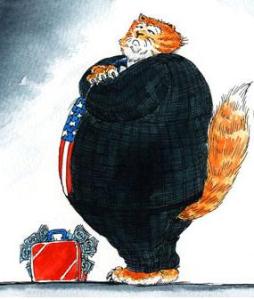 Plutocracy’. It’s an interesting read with a lot of quotes from other pundits.
THE word “plutocracy” is in the air these days. Some say the era of the de facto rule of the mighty top 10%, or top 1%, or whatever insidious sliver of the income distribution is thought to constitute the moneyed power elite, is upon us, or nearly so. I’m not so sure. I am sold on the proposition that there’s something deeply whacked about the American financial system, and that whatever that’s whacked about it is significantly responsible for the top 1% pulling so far away from the rest of the income distribution. This needs to be fixed, whatever its other consequences. It’s not clear to me, however, what exactly is whacked. I don’t know whether to sign up for Tyler Cowen’s “going short on volatility” story, Daron Acemoglu’s “financial-sector lobbying and campaign contributions ‘bought’ an enriching (and destabilising) regulatory structure” story, or some other story. No doubt the truth is in some subtle combination of stories. In any case, accounts such as Mr Acemoglu’s, according to which big players in certain sectors over time manage to rig the regulatory climate to their advantage, are quite compelling for reasons both theoretical and empirical
Newsweek has an interesting article up on why the megarich manage to have such a sweet tax deal. Even if we raise their income taxes, it really doesn’t hit them where it counts. Here’s why.
It drives economist Bruce Bartlett crazy every time he hears another bazillionaire announce he’s in favor of paying higher taxes. Most recently it was Mark Zuckerberg who got Bartlett’s blood boiling when the Facebook founder declared himself “cool” with paying more in federal taxes, joining such tycoons as Bill Gates, Warren Buffett, Ted Turner, and even a stray hedge-fund manager or two.
Bartlett, a former member of the Reagan White House, isn’t against the wealthy paying higher taxes. He’s that rare conservative who thinks higher taxes need to be part of the deficit debate. His beef? It’s a hollow gesture to say the federal government should raise the tax rate on the country’s top wage earners when the likes of Zuckerberg have most of their wealth tied up in stock. Many of the super-rich see virtually all their income as capital gains, and capital gains are taxed at a much lower rate—15 percent—than ordinary income. When Warren Buffett talks about paying a lower tax rate than his secretary, that’s because she sees most of her pay through a paycheck, while the bulk of his compensation comes in the form of capital gains and dividends. In 2006, for instance, Buffett paid 17.7 percent in taxes on the $46 million he booked that year, while his secretary lost 30 percent of her $60,000 salary to the government.
“It’s easy to say ‘Raise taxes’ when you know you’re not going to have to pay those taxes,” Bartlett says. “What I don’t hear is ‘Let’s raise the capital-gains tax.’” Instead the focus has been on the federal tax rate paid by those with an annual income of $250,000 or more—the top 3 percent of earners. Bartlett argues that while raising taxes on the country’s richest individuals would go a long way in easing the debt crisis, it makes no sense to treat the professional making a few hundred thousand dollars a year the same as the Richie Rich set. Maybe it’s hard to muster sympathy for an executive pulling down $1 million a year. But ours is a tax system where a person in the top tax bracket (those earning more than $374,000 in 2010) pays a tax rate of 35 percent on the upper portions of his or her income (37.9 percent if you include Medicare), whereas a hedge-fund manager or mogul earning 10 or 100 times that amount pays less than half that tax rate.
Well, now I’m thinking we’re all just so f’ked that I might as well stop while I’m ahead. What’s on your reading and blogging list today?
Moody’s Plays the Market
Posted: December 14, 2010 Filed under: Catfood Commission, Equity Markets, Global Financial Crisis, legislation, The Great Recession | Tags: Debt Ceiling, Moody's, Obama-McConnell Tax plan, Steven Hess, US soverign debt ratings 22 Comments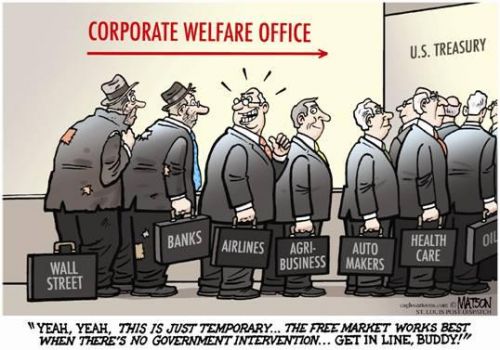 I mentioned in my thread on Tax Pandering last night that the rating company Moody’s is threatening to downgrade the U.S.’s credit rating over the Obama-McConnell Tax plan. Well, it seems a few folks have noticed a very interesting situation. Richard Smith at Naked Capitalism and Jane Hamsher at FDL notice a distinct change in message from Moody’s based on prior statement a week before. Also, Scarecrow at FDL has a related post up now.
It basically looks like they were for it before they were against it. This is odd and can only come under the heading of something’s rotten in Wall Street.
I’ve been down on Moody’s since they played such a major contributing role to the Financial Crisis by rating mortgage investment trash AAA. I’ve believe that it is only through lobbying and influence that they have managed to avoid legal and financial responsibility for their role in the entire debacle. Both Moody’s and Standard and Poor’s put their AAA+ ratings on trash. High ratings indicated to the market that the investments were safe so that many pension plans invested in what was essentially a junk bond level investment. They even highly rated subprime tranches. I’ve always felt there was a massive fraud investigation out there or at the very least a class action law suit but it’s never happened. My guess is they are highly connected to the current White House.
So, this week’s actions of note is that they seemed to have changed their tune from what they were saying prior to the cloture vote this week. On December 7th–via Scarecrow’s link to Jane–we can see Moody’s approach to reckless tax policy was simply “No Problem”. This comes from Bloomberg.
“The extension of the current tax rates is for a temporary period of two years and we think that if that’s all there is to it — it does not have ratings implications,” Steven Hess, senior credit officer at Moody’s in New York, said in an interview today. “We have a stable outlook. We don’t feel it will get changed downward in the next year or two.”
A week later, the same Steven Hess puts out a completely different vibe to The Hill. This is the message I read when I wrote my post last night.
“From a credit perspective, the negative effects on government finance are likely to outweigh the positive effects of higher economic growth. Unless there are offsetting measures, the package will be credit negative for the US and increase the likelihood of a negative outlook on the US government’s Aaa rating during the next two years,” Moody’s analyst Steven Hess writes.
So, reasonable minds would like to know what changed Mr. Hess’ mind so quickly? Was it that he was greasing the vote before the cloture vote and now he’s setting us up for something else since this horrible tax plan looks like it will pass? Richard Smith snarks in the affirmative.
A cynic might think that the Dec 7th report was Moody’s putting all its credibility behind the deal to extend the tax cuts, while the Dec 12th report was Moody’s putting all its credibility behind a move to ensure Obama got no political credit for it, once the deal, that they had implicitly supported a week earlier, was looking much more certain. That type of maneuver will have a familiar feel to the bedraggled Obama, one suspects.
Scarecrow talks about how these ‘impermanent’ tax cuts shouldn’t rattle any markets. The analysis is spot on so actual financial/economic analysis can’t possibly be the reason for the announcements and the change of heart.
For the umpteenth time, the US, unlike the suffering Ireland, Portugal, Spain, etc in the Euro zone, has its own currency and fiat money. It can’t be forced to default. Unless the people who run the country are complete idiots [insert news stories here], and refuse to use the tools and powers they have, the US is not at any risk of defaulting on its debt.
Moreover, the tax package is for two years. If one assumes that’s it, then there is no long-term structural deficit to cause us problems in the long run.
Richard Smith goes into some detail and argues that Moody’s can’t possibly be taken seriously by any one in the market any more because of the aforementioned subprime market crisis. Moody’s had tingling legs aplenty during the lead up time for both Countrywide and Bank of America who wouldn’t even exist today if it weren’t for congressional and white house largess using tax payer money.
Moody’s words can still probably move some markets. But, I think more importantly, it can move Congress Critterz and enable them to do all kinds of things.
So, what is the deal here? Well, this is the hypothesis of both Bostonboomer and me. It’s future cover for the upcoming Obama Tax ‘simplification’ plan and his plan to slash the budget–make that the part that impacts you and me and not Halliburton–when government gets shut down by the Republicans. My guess is the Hess statement will be brought up during the sturm and drang over increasing the debt ceiling once we bump into it early next year.
I’m pretty convinced of this. I’ll point to a CSM op ed for some back up on that.
Obama tax deal could start an era like Reagan’s
The Obama tax plan, if passed, would build trust between Republicans and Democrats. The next step could be tax simplification. The Reagan-era reforms provided helpful lessons.When it comes to tax reform, is Barack Obama another Ronald Reagan?
That seems to be the way President Obama is painting his political role over the next two years.
Like Reagan in the 1980s, Mr. Obama hopes to find a bipartisan consensus with Congress for simplifying the tax code.
His first big step toward that goal was to negotiate a deal with the newly empowered Republicans on extending the Bush-era tax rates. He also endorsed some ideas from his deficit-cutting commission, especially those aimed at eliminating most tax deductions, credits, and exemptions. And he has instructed aides to prepare tax-reform proposals.
The Republicans have already shown that they are willing to shut down government over the pending debt ceiling issue. This despite the fact we’ve basically got wars going on on four fronts: Iraq, Afghanistan, Pakistan and Yeman.
It’s all about who’s in the White House. One of the last bills the 110th Congress passed under the Bush Administration contained an increase in the debt, and 33 Republicans voted for it. Just a few months later, right after the Obama Administration took power, only 2 Republicans voted in favor of a bill raising the debt limit. Now, in these two examples, the debt limit provisions were attached to larger bills — TARP and the Stimulus Act — but, take a look at the historical data and the trend is borne out.
Speaking with unusual candor after the most recent debt limit vote, Rep. Michael Simpson [R, ID-2] said that it wasn’t the minority party’s responsibility to vote for raising the debt limit and called such votes “the burden of the majority.” It’s not clear how the Democratic majority will pull this off next session over what will likely be unanimous Republican opposition. David Waldman at Congress Matters suggests that the Democrats take up filibuster reform first, possibly in the lame duck session, so they can do it with 51 votes.
Obama appears to dislike conflict and taking Democratic-principled stands. I can only imagine what concessions are being planned at this very moment to deal with how the Congress will deal with raising the debt limit. Obama caved in on inheritance taxes, caved in on extending tax breaks to millionaires and billionaires, and he’s added pork goodies to the Dubya tax extensions like ‘grants’ to ethanol growers and equipment write off benefits for some one. I say some one because it’s sure not due to our current Industrial Production Capacity or the lack of corporate profits right now. We’re being bribed with 13 months of extended unemployment benefits and a social security payroll holiday that every one appears to dislike and find suspicious. The question is, for what?
We may truly be on the verge of another era of Reagan’s VooDoo economics пятилетка. This is a folly that we cannot afford. Even David Stockman and Bruce Bartlett–architects of Reaganomics–know these policies are detrimental to the U.S. economy and will be detrimental to all but the very rich among us. All this tax crap is pandering and manipulation. It has no basis in economic theory or past economic data. This has to be more of the Starve the Beast Republican Holy Grail enabled by a President who would rather go to a party hosted by Michelle than stick around and deal with questions of policy. I am sure this will be used to foist the nonsense from the Cat Food Commission on us all. I am simply bereft of hope for the future of this country.
update: A few minutes after I posted this, DDay at FDL has another germane post up: ‘Corker Assembles Debt Limit Shock Doctrine Team’. He must be thinking what BB and I are thinking. Corker is demanding cuts to ALL social programs in exchange for a yes vote to lift the debt ceiling.
The single most important thing that House Democrats could demand, in exchange for the tax cut bill’s passage, is an increase of the debt limit inside the package. It would in effect protect whatever stimulus you might get out of the bill, and deny Republicans another hostage-taking event.

 peej
peej Carissa
 bostonboomer
 dakinikat
 ecocatwoman
 mablue2
 Mama Lopez
 peggysue22
 quixote
 skydancingguestblogger
 Mona (aka Wonk the Vote)



 Sky Dancing
Recent Comments