Posted: May 8, 2024 | Author: bostonboomer | Filed under: Art, Donald Trump, just because | Tags: Access Hollywood tape, classified documents case, date rape, Georgia election interference case, Indiana primary, Joe Kahn, Judge Aileen Cannon, Master of the Blue Jeans artist, misogyny, origin of blue jeans, Robert F. Kennedy Jr., Stormy Daniels, trauma, Trump Hush Money Case |
Good Day!!
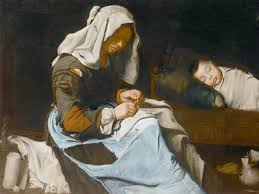
A woman sewing blue denim pants, by “Master of the Blue Jeans.”
I’m going to begin today with a story that has nothing to do with politics or current events–just because I think it’s interesting. Did you know that people wore blue jeans way back in the 16th century? I didn’t. An art exhibit will soon open in Paris that will focus on a mysterious artist, known only as “Master of the Blue Jeans.”
Sonja Anderson at Smithsonian Magazine: When Were Blue Jeans Invented? These Paintings Suggest the Fashion Trend Dates Back to the 1600s.
An exhibition centered on the “Master of the Blue Jeans” is opening in Paris this month—and the work on display is not that of Levi Strauss, founder of the eponymous clothing company, but rather a 17th-century Italian painter.
The upcoming show at Galerie Canesso features two paintings by the mysterious artist, who was active in northern Italy in the 1600s and is known only by his “master” moniker. The painter’s oil canvases depict early iterations of the stiff blue fabric beloved today, as worn by Italian peasants. According to a statement, the pieces have proved to be important artifacts in garment history, “pushing back [blue jeans’] provenance by centuries.”
Speaking with Artnet’s Vittoria Benzine, Maurizio Canesso, an art collector and the gallery’s founder, says, “People are still not very familiar with the true history of blue jeans, as they confuse it with the material made by Levi Strauss.”
In truth, Canesso argues, when the American businessman behind Levi’s jeans started selling denim work pants in the late 1800s, he merely added metal rivets and structure to a fabric that already boasted a storied European past.
“Jeans come from Genoa, while denim comes from the French city of Nîmes,” says Canesso. Blue jeans were made with perpendicular stitches in northwest Italy, while denim was woven in chevron patterns in southern France. But the key component of the fabric’s history is its coloration.
“Until the 11th century, no one could wear blue fabric because they didn’t know how to make blue color adhere,” Canesso says. “Only in the year 1000 did this begin to happen using woad leaves, and at a very high cost. The genius of the Genoese was to find the indigo stone in India and make this an industrial and therefore low-cost process.”
The ten denim-themed paintings attributed to the master were previously thought to be the work of several different artists. But in 2004, curator Gerlinde Gruber reattributed the group of artworks to a single unnamed painter then dubbed the Master of the Blue Jeans. By 2010, Canesso had acquired all of the master’s works, and he presented them in an exhibition at his Paris gallery that same year.
“Unfortunately, we have no new theories about who the Master of the Blue Jeans was,” Véronique Damian, an art historian at Galerie Canesso, tells the Observer’s Vanessa Thorpe. Evidence indicates the artist spent the bulk of his career in Italy’s northern region of Lombardy, though he may trained elsewhere.
I’m including some of the artist’s work in this post, just because.
In the more painful world of politics, Trump had a bad day in New York yesterday, and he got some bad news in India; but he got some gifts from judges in Florida and Georgia.
As I’m sure you’re aware, Stormy Daniels testified in Trump’s hush money case yesterday.
The Washington Post: Stormy Daniels testifies, Trump curses in an angry day in court.
Stormy Daniels, the adult-film actress at the center of Donald Trump’s hush money trial, testified Tuesday about a disturbing sexual encounter she says she had with him, leading to angry, profane muttering from the former president that alarmed the judge.
New York Supreme Court Justice Juan Merchan called Trump’s lawyer Todd Blanche to a sidebar during a midday break to say that Trump was “cursing audibly” and possibly intimidating Daniels, who had begun testifying, according to a trial transcript.
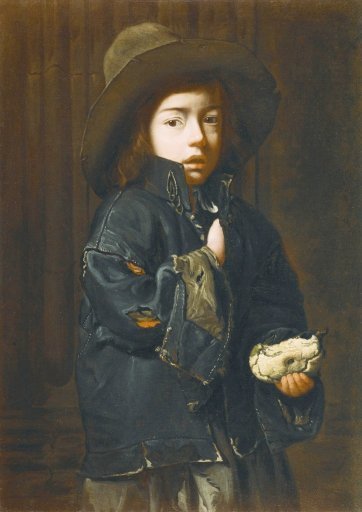
Beggar Boy with a Piece of Pie (wearing a denim jacket)
“I understand that your client is upset at this point,” Merchan said to the defense attorney, according to the transcript, “but he is cursing audibly and he is shaking his head visually and that’s contemptuous. It has the potential to intimidate the witness and the jury can see that.”
Blanche assured the judge he would speak to Trump.
“I am speaking to you here at the bench because I don’t want to embarrass him,” Merchan said. “You need to speak to him. I won’t tolerate that.”
The exchange punctuated a day of rage — sometimes whispered from the defense table, sometimes declared loudly by Daniels from the witness stand.
It was one of several surreal moments on the 13th day of the first criminal trial of a former U.S. president, including descriptions by Daniels of their alleged sexual encounter in 2006 that were so detailed that defense attorneys demanded a mistrial.
While Merchan rejected their request, Daniels at times seemed to be describing nonconsensual sex that could be considered highly prejudicial for the jury, which in turn could give Trump — the presumptive Republican presidential nominee — solid grounds to appeal if he is found guilty.
It sounds like the sex actually was nonconsensual though. Daniels’ description of what happened sounds very much like a date rape situation in which she was taken advantage of by a much older and more powerful man. She was 27. He was 60. He was much taller and stronger. She was invited for dinner, but there was no dinner. When she was ready to leave, she went to the bathroom. When she came back, he was on the bed in boxers. She tried to leave, but he blocked the door. This description is from Harry Litman on Twitter:
thought time to go. when opened the bathroom door, Trump had come in and was on the bed, in boxer shirts and a t-shirt. she was startled. felt like room spun in full motion. blood leaves my hands and feet. “ohmygod — what did I miss to get here?” she laughed nervously
The next thing I knew I was on the bed. opposite side of bed. missionary position. objection – sustained
I blacked out. but I was not drugged in any way, no alcohol. didn’t feel threatened physically “There was an imbalance of power for sure. but I was not threatened verbally or physically”
Had sex with him on the bed. Merchan sustaining objections to details. Staring at ceiling didn’t know how I got there. sustained. stricken touch his skin? objection sustained. he wasn’t wearing a condom. concerning to her but didn’t say anything.
sex was brief. remembers getting dressed. sitting on edge of bed, noticed completely dark outside. hard to get shoes on, hands shaking so hard. DJT: “oh it’s great, let’s get together again honey bunch.” I just wanted to leave. DVD she signed was on nightstand.
DJT: “We have to get together again soon” “we were so fantastic together. talked about the show” I just left as fast as I could. Didn’t express any concern about Melania. or mention her. didn’t have dinner. took cab back to hotel.
I felt ashamed I didn’t stop the sex so I didn’t tell many people about it. Remembered some additional details later. Merchan very stern about level of detail — wants to keep it spare.
It’s pretty clear from Daniels’ description that she was traumatized. I doubt if the judge understands that, but maybe some jurors will. Just because she is a porn actress doesn’t mean she can’t be raped. Her description is also reminiscent of E. Jean Carroll’s experience–Trump lifted her up against the wall and grabbed her genitals before she realized what was happening. It’s also reminisce of his own description in the Access Hollywood tape–how he can grab women “by the pussy. If you’re a star they let you do it.”
Amanda Marcotte at Salon: “He was bigger and blocking the way”: Stormy Daniels takes the stand and reminds people who Trump is.
Daniels matters for reasons outside of the courtroom and the specifics of this hush-money trial. Daniels’ story is yet another reminder of what may prove to be Trump’s electoral downfall: His bottomless misogyny.
On the witness stand, Daniels reportedly spoke quickly and was apparently quite nervous. Initially, her story of meeting Trump sounded funny. She painted him as a pathetic older man trying — and failing — to impress the younger woman. When he first asked her to dinner, she replied “no,” but with an expletive. Her publicist eventually talked her into it, hoping Daniels could leverage the connection into a spot on “The Apprentice.” In his hotel room, she described him wearing “silk or satin” pajamas and asked him to put on real clothes. He allegedly used the “don’t even sleep in the same room” line when she asked about his wife, Melania, who had recently had a baby. Daniels described Trump as “pompous” and “arrogant.” She recounted how she jokingly spanked him with a magazine, hoping to tease him into being less of a jerk.
Then the tone of her story changed, as she described how they came to have sex. Trump waited until she was in the bathroom, Daniels said, and then he stripped down to boxer shorts and a T-shirt. “The room spun in slow motion,” she recalled on the witness stand. When she made for the door, “he was bigger and blocking the way,” she said of Trump. She denied it was sexual assault, however, because “I was not threatened either verbally or physically.” [….]
Whether or not Trump’s sexual encounter with Daniels was consensual in the legal sense, she describes it as unwanted.
“I didn’t say anything at all,” she told the court repeatedly. Claiming that she “blacked out” during the encounter, afterward, Daniels said, “my hands were shaking so hard” and “I felt ashamed that I didn’t stop it and that I didn’t say ‘No.'”

Another painting by Master of the Blue Jeans
A person doesn’t have to be threatened in order for sex to be nonconsensual. Back to Marcotte’s piece:
Following Daniels’ testimony on Tuesday, I was struck by how much it has in common with what E. Jean Carroll described in her two recent civil trials, where both juries found that Trump had sexually assaulted her in the 90s. Carroll, too, told of a random encounter with Trump she initially thought to be flirty but not sexual. Like Daniels, Carroll describes teasing Trump, who famously has no sense of humor about himself. In both cases, the women describe Trump becoming aggressive after the light mockery. In Carroll’s case, the judge described what happened after as what “many people commonly understand the word ‘rape.'” Daniels, to be clear, frames her encounter with Trump differently.
Since the release of the “Access Hollywood” video in 2016, in which Trump can be heard bragging about sexual assault, the Beltway media has repeatedly tried to move on from the story of Trump’s legion of issues with women. Indeed, when Carroll’s accusations first came out in 2019, the press barely paid any mind. But the story of his rampant misogyny has never fully gone away. There was the Women’s March that overshadowed his 2017 inauguration. Then the over two dozen women who stepped forward with stories of being subject to the sexual harassment and assault Trump himself described so vividly. Trump, of course, is more responsible than any other person on the planet for the overturn of Roe v. Wade and the stampede of Republican state legislators banning abortion. He promised to stack the Supreme Court with anti-choice justices, and his three appointees provided the votes necessary in Dobbs v. Jackson Women’s Health, which ended the legal right to abortion. While Trump has tried to make moderate-sounding noises on this issue, he keeps inadvertently revealing his anti-choice radicalism. In a recent Time interview, for instance, he indicated that he’s fine if states “monitor women’s pregnancies so they can know if they’ve gotten an abortion.”
Noah Berlansky at Public Notice: Stormy Daniels details Trump’s sleazy contempt for women.
On the stand, Daniels provided ugly details about how Trump treated her, and about how Trump treats, and views, women. These insights are notable, but they’re not new. In 2016, leaked audio of Trump making grotesque and sexist comments about women to Access Hollywood host Billy Bush almost derailed his presidential campaign. Last year, Trump was held liable for sexual assaulting and then repeatedly defaming advice columnist E. Jean Carroll.
But Daniels’s testimony is a reminder that contempt and mistreatment of women is a core theme of Trump’s life and politics. Both the press and Democratic opponents have struggled to make this issue central to 2024, even though abortion rights and women’s health care are the key issues of the campaign. It’s unclear whether the trial will spark more reporting and discussion of Trump’s treatment of and attitudes about women. But it should….
Daniels’s testimony is intended to establish the background facts of the payment. It also, though, paints Trump as a liar, a bully, and a sexual manipulator. Daniels said while she was in Trump’s hotel room, she went to the bathroom, and when he came out he was in his boxer shorts, a moment Daniels describes as “like a jump scare.” She said, “the room spun in slow motion” and she realized “I’ve put myself in this bad situation.”
Daniels is careful to emphasize that Trump did not physically coerce her. He did, however, according to Daniels, suggest that if she cooperated with him he could help her career through his connections and a possible appearance on the Celebrity Apprentice reality show, where Trump was the star. She eventually agreed to have sex even though Trump did not use a condom — she was adamant about using condoms in her adult film shoots.

By Master of the Blue Jeans.
She testified that during sex she stared at the ceiling and tried to think of something else, and afterwards she had trouble dressing because her hands were shaking. She said, “I felt ashamed that I didn’t stop it and that I didn’t say no.”
Daniels kept in touch with Trump for some time because he was still offering her the chance to appear on Celebrity Apprentice, which would have been a huge mainstream boost to her career. She met with Trump once more in Los Angeles, at which point “he kept trying to make sexual advances, putting his hand on my leg, scooting closer.” She rebuffed him, and in a later phone call he admitted he was not going to put her on his television show. At that point she ceased communicating with him.
Again, Daniels has not accused Trump of sexual harassment or violence, and she says their encounter was consensual. Her testimony makes clear, though, that Trump was pressuring her for sex in return for business opportunities — a variation on the ugly tradition of the Hollywood casting couch. We don’t know if Trump ever had any intention of keeping his promises or of helping Daniels. But whether he did or not, his actions as she describes them were sleazy at best, and she found the experience painful and traumatic enough to leave her literally shaking.
The encounter doesn’t sound consensual to me. As I said above, it sounds like date rape.
More Trump legal news, and it’s not good.
Kyle Cheney at Politico: Judge Cannon indefinitely postpones Trump’s classified docs trial.
The judge presiding over Donald Trump’s criminal case in Florida — on charges that he hoarded classified secrets at his Mar-a-Lago estate after his presidency — has indefinitely postponed the trial, once scheduled for May 20.
The date had been widely expected to move amid a tangle of pretrial conflicts between special counsel Jack Smith and Trump’s attorneys. Smith had urged Judge Aileen Cannon to reschedule the trial to begin on July 8, but an order from the judge on Tuesday afternoon suggested that she is unlikely to even decide on a new trial date before late July.
Cannon, a Trump appointee who took the bench in late 2020, indicated in the order that, before setting a new trial date, she intends to resolve the backlog of other issues in the case that have piled up on her plate. Smith’s defenders have criticized Cannon for what they see as a plodding pace in resolving pretrial matters, and tensions between the special counsel and the judge have flared in recent months over a series of puzzling rulings that threatened to derail the case.
“[F]inalization of a trial date at this juncture — before resolution of the myriad and interconnected pre-trial and [classified evidence] issues … would be imprudent and inconsistent with the Court’s duty to fully and fairly consider the various pending pre-trial motions,” Cannon wrote in the five-page order.
That reshuffling further clouds the picture for Smith, who is also awaiting a Supreme Court ruling on presidential immunity that could determine whether his other case against Trump — charges in Washington D.C. for attempting to subvert the 2020 election — can move forward this year….
Trump has sought to delay all of his criminal cases until after this year’s election. If he wins, he could shut down the two federal cases brought by Smith, and the state cases in New York and Georgia also might have to be frozen.
And from The Atlanta Journal-Constitution: Court of Appeals agrees to consider DA removal in Trump election case.
The Georgia Court of Appeals on Wednesday decided to hear an appeal of a judge’s ruling allowing District Attorney Fani Willis to remain at the helm of Fulton County’s election interference case against former President Donald Trump.
The court’s decision almost certainly means a significant delay of a trial here for Trump and his 14 co-defendants and signals that Willis’ leadership role isn’t guaranteed. It is unclear how long the appeals court will take to decide the issue but they are not known for moving swiftly.
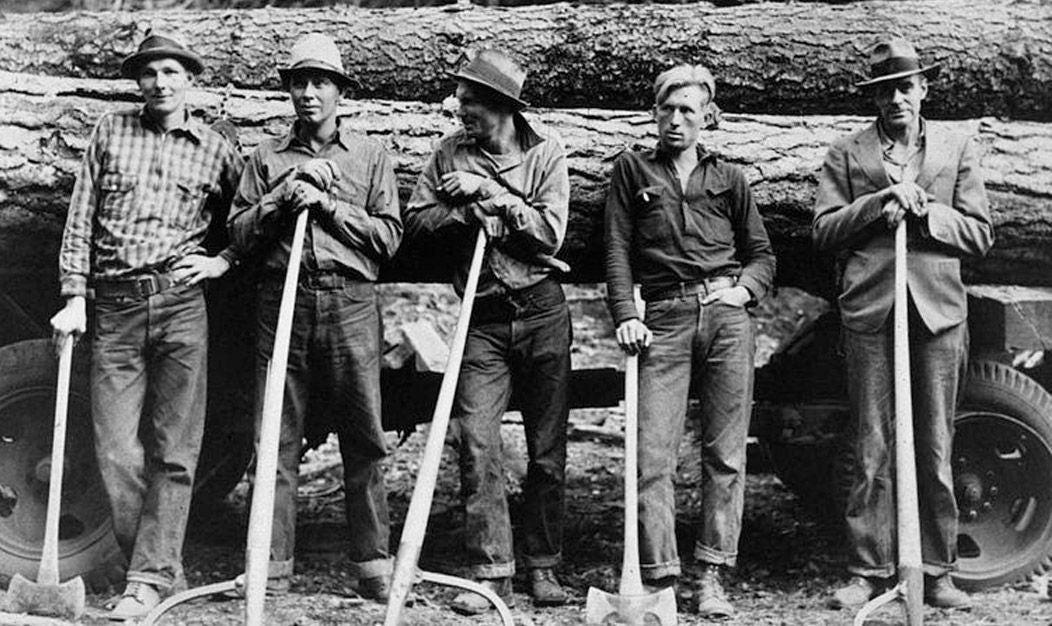
Farmers wearing jeans, 1930s
“There’s no way this case gets to trial this year,” said Atlanta defense attorney Andrew Fleischman, who is closing following the case. “I would expect the appeals court to issue its opinion some time next year.”
On March 29, Superior Court Judge Scott McAfee issued a “certificate of immediate review,” which allowed the defendants to appeal his ruling to the Georgia Court of Appeals before a trial begins.
Under Appeals Court rules, such a pretrial — or interlocutory — appeal is typically assigned to a three-judge screening panel. And all it takes is for one of those judges to decide whether the court accepts the appeal. The court’s order one-page order did not divulge which judge voted to grant the application.
In his order granting the pre-trial review, McAfee said he will continue working on the case, resolving pending motions, while the appeals court takes up the removal issue.
The bad news for Trump is that he is losing a significant percentage of Republican voters in the primaries, which are still going on. Niki Haley is still getting votes. Adam Wren and Madison Fernandez at Politico: Unexpected warning signs for Trump in busy Indiana primary.
In 2016, Indiana put Donald Trump on the doorstep of the GOP presidential nomination. But eight years later, the state he called “Importantville” delivered his campaign some flashing red warning signs as Nikki Haley cleaned up in the suburbs.
By virtue of its late-in-the-nominating-calendar primary, the Hoosier state has always occupied a unique and occasionally powerful perch to make or break candidacies: Sen. Ted Cruz and then-Ohio Gov. John Kasich dropped out immediately after Trump’s victory that year. But the barn-red state also often acts as a pace car for Republicans nationally.
And in a primary that saw a record-breaking $98 million splash across the state, according to AdImpact, Tuesday was no exception.
A zombie Haley candidacy continued to punch above its weight in the Trumpiest of states: The former South Carolina governor is on track to break 20 percent for the first time since she dropped out of the race two months ago.
Read more at the link.
I don’t know if you’ve been following the reporting about New York Times editor Joe Kahn and his pathetic explanations for why his paper seems to be rooting for another Trump presidency.
Dan Froomkin at Press Watch: New York Times editor Joe Kahn says defending democracy is a partisan act and he won’t do it.
Joe Kahn, after two years in charge of the New York Times newsroom, has learned nothing.
He had an extraordinary opportunity, upon taking over from Dean Baquet, to right the ship: to recognize that the Times was not warning sufficiently of the threat to democracy presented by a second Trump presidency.
But to Kahn, democracy is a partisan issue and he’s not taking sides. He made that clear in an interview with obsequious former employee Ben Smith, now the editor of Semafor.
Kahn accused those of us asking the Times to do better of wanting it to be a house organ of the Democratic party:
To say that the threats of democracy are so great that the media is going to abandon its central role as a source of impartial information to help people vote — that’s essentially saying that the news media should become a propaganda arm for a single candidate, because we prefer that candidate’s agenda.
But critics like me aren’t asking the Times to abandon its independence. We’re asking the Times to recognize that it isn’t living up to its own standards of truth-telling and independence when it obfuscates the stakes of the 2024 election, covers up for Trump’s derangement, and goes out of its way to make Biden look weak.

Marlon Brando wearing jeans in The Wild One
Kahn’s position is, not coincidentally, identical to that of his boss, publisher A.G. Sulzberger, who I recently wrote about in my post, “Why is New York Times campaign coverage so bad? Because that’s what the publisher wants.”
And to the extent that Kahn has changed anything in the Times newsroom since Baquet left, it’s to double down on a form of objectivity that favors the comfortable-white-male perspective and considers anything else little more than hysteria.
Throwing Baquet under the bus, Kahn called the summer of the Black Lives Matter protests “an extreme moment” during which the Times lost its way.
“I think we’ve learned from it. I think we found our footing after that,” he said.
I translate that to mean that the old guard has reasserted total control over the rabble.
Read the rest at Press Watch.
I’ll wrap this up with a couple of creepy stories about Robert Kennedy Jr.
The New York Times: R.F.K. Jr. Says Doctors Found a Dead Worm in His Brain.
In 2010, Robert F. Kennedy Jr. was experiencing memory loss and mental fogginess so severe that a friend grew concerned he might have a brain tumor. Mr. Kennedy said he consulted several of the country’s top neurologists, many of whom had either treated or spoken to his uncle, Senator Edward M. Kennedy, before his death the previous year of brain cancer.
Several doctors noticed a dark spot on the younger Mr. Kennedy’s brain scans and concluded that he had a tumor, he said in a 2012 deposition reviewed by The New York Times. Mr. Kennedy was immediately scheduled for a procedure at Duke University Medical Center by the same surgeon who had operated on his uncle, he said.
While packing for the trip, he said, he received a call from a doctor at NewYork-Presbyterian Hospital who had a different opinion: Mr. Kennedy, he believed, had a dead parasite in his head.
The doctor believed that the abnormality seen on his scans “was caused by a worm that got into my brain and ate a portion of it and then died,” Mr. Kennedy said in the deposition.
Gross. Maybe that explains some of his weird ideas?
NBC News: RFK Jr.’s new hire who downplayed Jan. 6 appears to have been at the Capitol during the attack.
A right-wing social media influencer hired by Robert F. Kennedy Jr.’s presidential campaign who previously said Jan. 6 was “Democrat misdirection” appears to have himself been on the restricted grounds of the U.S. Capitol during the attack.

Marilyn Monroe in blue jeans
NBC News first reported that Kennedy’s campaign hired Zach Henry’s firm, Total Virality, for “influencer engagement” in March. Henry had worked as deputy communications director for Republican Vivek Ramaswamy’s presidential campaign, as well as for Blake Masters during his Senate run in Arizona.
Henry, as NBC News reported, had posted that Jan. 6 was “no MAGA insurrection Just more Democrat misdirection” and appears to have embraced conspiracy theories about the Capitol attack, including posting that “antifa” was behind it, which is false.
But photos and videos uncovered by NBC News and online “sedition hunters,” who have aided the FBI in hundreds of cases against Capitol rioters, appear to show Henry among the mob outside the Capitol on Jan. 6, 2021, beyond the previously established police lines, although it is unclear whether any of the barricades and “restricted” signs remained by the time he arrived.
There is no indication that Henry entered the Capitol or that he engaged in assaults on police officers or in destruction of property. Federal prosecutors have almost entirely focused their resources on Jan. 6 participants who either went inside the building or committed violence or destruction outside it, so there is little chance that Henry would be charged; the few nonviolent Jan. 6 defendants who were charged solely for going on restricted Capitol grounds were generally charged with misdemeanors.
But Henry’s presence on Capitol grounds would be significant given his previous social media posts about Jan. 6 and his new position on Kennedy’s campaign as Kennedy runs for president as an independent against former President Donald Trump.
That’s it for me today. What stories have you been following?
Did you like this post? Please share it with your friends:
Posted: November 20, 2014 | Author: bostonboomer | Filed under: education, morning reads, Violence against women, War on Women, Women's Rights | Tags: culture of cover-up, date rape, frat parties, fraternities, gang rape, Nicole Eramo, Phi Kappa Psi fraternity, rape, sexual assault on college campuses, Teresa Sullivan, University of Virginia |

Francoise in a round-backed chair reading, Mary Cassatt
Good Morning!!
I stayed up late last night reading the stunning Rolling Stone article on the culture of sexual assault and official cover-up at the University of Virginia. After I finished it, I had quite a bit of difficulty getting to sleep. The story was reported and written by investigative journalist Sabrina Rubin Erdely. The headline is A Rape on Campus: A Brutal Assault and Struggle for Justice at UVA. Before I begin, I want to warn everyone that the article includes explicit descriptions of sexual assault and a shocking culture of indifference to victims. I’m not going to excerpt explicit descriptions of rapes, but I do want to quote some of the reactions to them by students and administrators.
The article opens with a graphic description of a violent gang rape of 18-year-old incoming freshman “Jackie” that took place at the Phi Kappa Psi fraternity house during a party. Hours later, beaten and bloody, Jackie called “friends” for help, but instead of taking her to a hospital they talked her out of reporting the assault because it would ruin her “reputation,” and they as her friends would be ostracized and would no longer be invited to frat parties.
So Jackie hid in her room and sank into a deep depression. She received no support from her “friends” and acquaintances. The man who had taken her to the party and set up her rape by 7 men behaved as if nothing abnormal had happened, and asked her why she was ignoring him. Erdely on the friends’ reactions:
She was having an especially difficult time figuring out how to process that awful night, because her small social circle seemed so underwhelmed. For the first month of school, Jackie had latched onto a crew of lighthearted social strivers, and her pals were now impatient for Jackie to rejoin the merriment. “You’re still upset about that?” Andy asked one Friday night when Jackie was crying. Cindy, a self-declared hookup queen, said she didn’t see why Jackie was so bent out of shape. “Why didn’t you have fun with it?” Cindy asked. “A bunch of hot Phi Psi guys?” One of Jackie’s friends told her, unconcerned, “Andy said you had a bad experience at a frat, and you’ve been a baby ever since.”
That type of response to sexual assaults is apparently common at UVA.
That reaction of dismissal, downgrading and doubt is a common theme UVA rape survivors hear, including from women. “Some of my hallmates were skeptical,” recalls recent grad Emily Renda, who says that weeks into her first year she was raped after a party. “They were silent and avoided me afterwards. It made me doubt myself.” Other students encounter more overt hostility, as when a first-year student confided her assault to a friend. “She said she thought I was just looking for attention,” says the undergrad. Shrugging off a rape or pointing fingers at the victim can be a self-protective maneuver for women, a form of wishful thinking to reassure themselves they could never be so vulnerable to violence. For men, skepticism is a form of self-protection too. For much of their lives, they’ve looked forward to the hedonistic fun of college, bearing every expectation of booze and no-strings sex. A rape heralds the uncomfortable idea that all that harmless mayhem may not be so harmless after all. Easier, then, to assume the girl is lying, even though studies indicate that false rape reports account for, at most, eight percent of reports.
And so at UVA, where social status is paramount, outing oneself as a rape victim can be a form of social suicide. “I don’t know many people who are engrossed in the party scene and have spoken out about their sexual assaults,” says third-year student Sara Surface. After all, no one climbs the social ladder only to cast themselves back down. Emily Renda, for one, quickly figured out that few classmates were sympathetic to her plight, and instead channeled her despair into hard partying. “My drinking didn’t stand out,” says Renda, who often ended her nights passed out on a bathroom floor. “It does make you wonder how many others are doing what I did: drinking to self-medicate.”
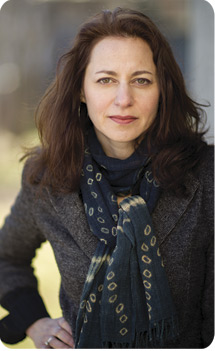
Investigative journalist Sabrina Rubin Erdely of Rolling Stone
Erdely talked to a number of survivors, and she found a history of gang rapes at Phi Kappa Psi fraternity stretching back at least 30 years. She describes a culture in which male upperclassmen target freshmen girls and deliberately take advantage of their lack of sophistication about the danger of sexual violence on college campuses.
A year later, Jackie did report the rape to a UVA administrator. She was sent to Dean Nicole Eramo, who heads the “Sexual Misconduct Board.” Eramo subtly discouraged Jackie from reporting the rape.
When Jackie finished talking, Eramo comforted her, then calmly laid out her options. If Jackie wished, she could file a criminal complaint with police. Or, if Jackie preferred to keep the matter within the university, she had two choices. She could file a complaint with the school’s Sexual Misconduct Board, to be decided in a “formal resolution” with a jury of students and faculty, and a dean as judge. Or Jackie could choose an “informal resolution,” in which Jackie could simply face her attackers in Eramo’s presence and tell them how she felt; Eramo could then issue a directive to the men, such as suggesting counseling. Eramo presented each option to Jackie neutrally, giving each equal weight. She assured Jackie there was no pressure – whatever happened next was entirely her choice.
Like many schools, UVA has taken to emphasizing that in matters of sexual assault, it caters to victim choice. “If students feel that we are forcing them into a criminal or disciplinary process that they don’t want to be part of, frankly, we’d be concerned that we would get fewer reports,” says associate VP for student affairs Susan Davis. Which in theory makes sense: Being forced into an unwanted choice is a sensitive point for the victims. But in practice, that utter lack of guidance can be counterproductive to a 19-year-old so traumatized as Jackie was that she was contemplating suicide. Setting aside for a moment the absurdity of a school offering to handle the investigation and adjudication of a felony sex crime – something Title IX requires, but which no university on Earth is equipped to do – the sheer menu of choices, paired with the reassurance that any choice is the right one, often has the end result of coddling the victim into doing nothing.
“This is an alarming trend that I’m seeing on campuses,” says Laura Dunn of the advocacy group SurvJustice. “Schools are assigning people to victims who are pretending, or even thinking, they’re on the victim’s side, when they’re actually discouraging and silencing them.
The culture of cover-up at UVA is shocking to me, but it is probably typical of many colleges and universities, according to Erdely. However UVA is among a select group of 86 schools that is under investigation by the federal Office of Civil Rights because of their failure to deal with the problem. In September UVA held a two-hour trustees meeting to discuss sexual assault on campus.
Those two hours, however, were devoted entirely to upbeat explanations of UVA’s new prevention and response strategies, and to self-congratulations to UVA for being a “model” among schools in this arena. Only once did the room darken with concern, when a trustee in UVA colors – blue sport coat, orange bow tie – interrupted to ask, “Are we under any federal investigation with regard to sexual assault?”
Dean of students Allen Groves, in a blue suit and orange necktie of his own, swooped in with a smooth answer. He affirmed that while like many of its peers UVA was under investigation, it was merely a “standard compliance review.” He mentioned that a student’s complaint from the 2010-11 academic year had been folded into that “routine compliance review.” Having downplayed the significance of a Title IX compliance review – which is neither routine nor standard – he then elaborated upon the lengths to which UVA has cooperated with the Office of Civil Rights’ investigation, his tone and manner so reassuring that the room relaxed.
Told of the meeting, Office of Civil Rights’ Catherine Lhamon calls Groves’ mischaracterization “deliberate and irresponsible.” “Nothing annoys me more than a school not taking seriously their review from the federal government about their civil rights obligations,” she says.
Jackie eventually became involved with a UVA rape survivors group, but even among these women who were trying to deal with their traumatic experiences and reaching out to recent victims, the culture was one of not reporting their rapes to police.

UVA Dean of Students Nicole Eramo
You’ll recall that it was at UVA that 18-year-old Hannah Graham was abducted and murdered, allegedly by 32-year-old Jesse Matthew, who had been previously accused of rape at two different Virginia colleges in 2002 and 2003. He was not charged in either case, and he apparently went on to become a smoothly professional sexual predator. The news reports say that the victims did not want to press charges, but the truth is that colleges and universities regularly discourage young women from reporting rapes in order to protect their institutional reputations. Erdely addresses this issue at length in her article on UVA.
Matthew’s DNA was found under the fingernails of Virginia Tech student Morgan Harrington, who disappeared after she was locked out of a Metallica concert on the UVA campus in 2009. Harrington’s body was later found a few miles from where Hannah Graham’s body was recovered. Matthew’s DNA has also been connected to a violent rape and attempted murder that took place in Fairfax in 2005.
In her article, Erdely discusses the research done by psychologist David Lisak on campus rapists. He discovered that a small percentage of college men commit rapes, and they tend to be repeat offenders (PDF). That last link is to a peer-reviewed journal article by Lisak, “Repeat Rape and Multiple Offending by Undetected Rapists.” Erdely writes:
Lisak’s 2002 groundbreaking study of more than 1,800 college men found that roughly nine out of 10 rapes are committed by serial offenders, who are responsible for an astonishing average of six rapes each. None of the offenders in Lisak’s study had ever been reported. Lisak’s findings upended general presumptions about campus sexual assault: It implied that most incidents are not bumbling, he-said-she-said miscommunications, but rather deliberate crimes by serial sex offenders.
In his study, Lisak’s subjects described the ways in which they used the camouflage of college as fruitful rape-hunting grounds. They told Lisak they target freshmen for being the most naïve and the least-experienced drinkers. One offender described how his party-hearty friends would help incapacitate his victims: “We always had some kind of punch. . . . We’d make it with a real sweet juice. It was really powerful stuff. The girls wouldn’t know what hit them.” Presumably, the friends mixing the drinks did so without realizing the offender’s plot, just as when they probably high-fived him the next morning, they didn’t realize the behavior they’d just endorsed. That’s because the serial rapist’s behavior can look ordinary at college. “They’re not acting in a vacuum,” observes Lisak of predators. “They’re echoing that message and that culture that’s around them: the objectification and degradation of women.”
I won’t quote any more from the article, but I do recommend reading it if you can handle it.
After the Rolling Stone article came out, UVA’s president suddenly decided maybe she should something about Jackie’s rape. From The Daily Progress, UVa calls for investigation into rape allegation in Rolling Stone article.
UVa President Teresa A. Sullivan released a statement Wednesday night, stating the university’s commitment to preventing sexual assault.
“The University takes seriously the issue of sexual misconduct, a significant problem that colleges and universities are grappling with across the nation,” Sullivan said in the statement. “Our goal is to provide an environment that is as safe as possible for our students and the entire University community.”
Erdely said UVa reinforced one of her major arguments in her article — that UVa administration focuses on prestige and appearance over student safety — with Sullivan’s statement….
“I am writing in response to a Rolling Stone magazine article that negatively depicts the University of Virginia and its handling of sexual misconduct cases,” Sullivan said at the beginning of the statement.
“It goes to show what their priorities are here — the fact that she would go out of her way to say I negatively depicted the university — this is the first thing on their minds,” Erdely said. “They need to be putting student safety first.”

UVA President Teresa Sullivan
Here’s the full statement:
Date: Wed, Nov 19, 2014 at 6:17 PM
Subject: An Important Message from President Sullivan
To the University community:
I am writing in response to a Rolling Stone magazine article that negatively depicts the University of Virginia and its handling of sexual misconduct cases. Because of federal and state privacy laws, and out of respect for sexual assault survivors, we are very limited in what we can say about any of the cases mentioned in this article.
The article describes an alleged sexual assault of a female student at a fraternity house in September 2012, including many details that were previously not disclosed to University officials. I have asked the Charlottesville Police Department to formally investigate this incident, and the University will cooperate fully with the investigation.
The University takes seriously the issue of sexual misconduct, a significant problem that colleges and universities are grappling with across the nation. Our goal is to provide an environment that is as safe as possible for our students and the entire University community.
We have recently adopted several new initiatives and policies aimed at fostering a culture of reporting and raising awareness of the issues.
We want our students to feel comfortable coming forward with information when there are problems in the community and cooperating with local law enforcement and the student disciplinary process. We also want them to feel empowered to take action and to lead efforts to make our Grounds and our community a better place to live and learn.
We have been taking a leadership role on issues regarding sexual misconduct and violence. U.Va. hosted a national conference on this topic in February 2014. “Dialogue at U.Va.: Sexual Misconduct Among College Students” brought together national experts and professionals from approximately 60 colleges and universities to discuss best practices and strategies for prevention and response.
The HoosGotYourBack initiative, part of the Not On Our Grounds awareness campaign, was developed and launched in collaboration with students and with local Corner Merchants to increase active bystander behavior.
A number of other initiatives are also planned for the spring. Among them are the implementation of a new student sexual misconduct policy and a related training program, a campus climate survey, and an in-depth bystander intervention program that will include students, faculty, and staff.
More information about sexual violence education and resources is available on the University’s website at http://www.virginia.edu/sexualviolence/
Finally, I want to underscore our commitment to marshaling all available resources to assist our students who confront issues related to sexual misconduct. Our dedicated Student Affairs staff devote countless hours to educating and counseling our students on issues regarding their health and safety, and they stand ready to assist whenever students need help.
Teresa A. Sullivan
President
President Sullivan approved distribution of this message.
I’ll let you judge the sincerity of Sullivan’s statement.
I know there is plenty of other news going on, but this was all I could think about this morning. Please post your links on any topic in the comment thread, and feel free to discuss this post or not. I realize this is a very difficult subject, but it is also a vitally important one.
Did you like this post? Please share it with your friends:
Posted: July 20, 2011 | Author: bostonboomer | Filed under: U.S. Politics, Violence against women, Women's Rights | Tags: bipolar disorder, court system, date rape, juries, prosecutors, psychological disorders, rape, violence against women |

How do prosecutors decide which rapes to take to court? Is the deck already stacked against some rape victims? These are two of the questions Anna North tries to answer in her fine two-part article at Jezabel about a young graduate student at the University of Iowa. Rebecca Epstein turned to North to tell her story, because a prosecutor refused to give her a chance to face her rapist in court. Epstein insisted that her real name be used in the article.
Warning: Please be aware that some of the material discussed below may be disturbing to some.
In part 1, “How a Rape Case Went Off the Rails,” describes the crime and its consequences:
Epstein…told me she was violently anally raped on the night of February 16, by a man she had been on a date with, in his apartment. She stayed at the apartment for about an hour afterward, fearful that he might hurt her further if she left. During this time, she had vaginal intercourse with him, which she describes as nonconsensual but nonviolent. When she felt it was safe to leave, she went to a hospital and had a rape kit done. The next day, she filed a police report. She says detectives were largely respectful in their treatment of the case.
Now here comes the really creepy part. The man who raped Epstein wrote a letter to her not long after the crime. The letter is in some ways even more disturbing than the violent crime the writer committed. In the letter, he tries to justify what he did by implying that he’s really a nice guy who respects women. He says that Epstein should have told him ahead of time that if she said no it really meant NO. He tells her she didn’t fight hard enough, so he didn’t realize she didn’t want it. You can read lengthy quotes from this disturbing letter at the link, but here’s one shocking quote:
Of the alleged rape, he writes, “Clearly, you did not enjoy it […] But you must believe that I believed with all my heart and soul at the time that you were overcoming your reluctance, and trying to get into it.” He adds,
I hope intensely that this letter has made you see that I am not malicious or misogynistic, and that I’ve strived earnestly to respond to your needs and desires. It may be too late for me, but I hope that in the future, when playing rough with a guy, these explanations might guide better behavior. For example, we should have agreed at the very beginning upon a safety word that would mean explicitly: “this no does not mean you can keep trying or that I’m reluctant, it means you better shut it the fuck down.” If we had such a word, and you used it, there would be no confusion and I would never, ever have violated it.
WTF?! I wonder how many times this guy pulled this with women? He even suggests the possibility that they could get together and “play again.”
Epstein says this man “choked” her and “pinned [her] down.” In addition, she said “my ribs are all fucked up, possibly broken, my ankle is sprained, i hurt all over, i’m bloody.”
But a month after the attack, Epstein was told by Asst. County Attorney Anne Lahey that she was not going to have the rapist arrested or prosecuted. There is disagreement between Epstein and Lahey as to why and how this decision was reached. Epstein has bipolar disorder and she claims that was one factor. The fact that she stayed in the rapist’s apartment afterward was another.
Says Epstein,
She said that an Iowa jury would see my behavior as too promiscuous and crazy, and they would judge me and side with the defendant. She also said she didn’t think there was a very good chance I would win, so she was trying to protect me by not putting me through it, and I indicated that I would rather go through it and lose than not be able to face him in court.
Lahey was unconvinced. Epstein says she finally asked, “so you’re saying that because I have a mental illness, anyone who rapes me basically gets a free pass?” She says Lahey replied, “Yes.”
Lahey claims that Epstein’s psychological disorder was not a factor in the decision, but would not say what the alternative reasons were.
In part 2 of the Jezabel article, North investigated whether in fact women with psychological disorders were less likely to receive justice after being raped.
A number of experts confirmed that this may be the case. For example:
I talked to Karla Miller, Executive Director of the Rape Victim Advocacy Program. She told me that county attorneys can be reluctant to prosecute rape cases in which the victim has mental illness, due to concerns that the jury won’t see the victim as credible. If that’s the case, she said that victims can be “revictimized” by defense attorneys who make their illness — and any other vulnerabilities they can think of — an issue in the trial. Miller explained that if an attorney felt such revictimization might occur, it could be a good decision not to prosecute, but that this decision was “case-dependent.” She added that it was “absolutely not” fair that people with mental illnesses had a harder time getting justice.
Miller also noted, chillingly, that some rapists actually target people with mental illnesses or other disabilities, because they know victims with these conditions will have a harder time taking them to court.
It is definitely true that rapists, who are predators, choose potential victims who are vulnerable. They tend to attack smaller, weaker women and women they sense are psychologically troubled.
I just want to say that I don’t like the terms “mental illness” and “mentally ill.” In the field, the term is “psychological disorder.” There is no illness that is strictly physical or “mental,” including cancer and heart disease.
Some psychological disorders are very serious–like schizophrenia, some don’t interfere that much with a person’s life once she gets help from medication and/or therapy. Bipolar disorder is a very manageable issue, and people with this disorder usually are not out of touch with reality. They simply have wider mood swings than a typical person.
Juries need to be educated about rape and about psychological disorders. I realize that defense attorneys will use anything to discredit a victim, but Rebecca Epstein wanted to face her attacker in court and tell her story. I think it’s very likely that the prosecutor in this case was fearful that a jury would be biased against Epstein not only because this was a date rape, but also because she suffers from bipolar disorder.
That is just plain wrong. Now the man who raped Epstein will continue to behave as he did with Epstein. He now knows he can get away with rape, especially if he chooses a victim with psychological issues. He will rape more women. Every women who comes in contact with him is in danger. And his name is a secret so far.
Did you like this post? Please share it with your friends:


 peej
peej Carissa
 bostonboomer
 dakinikat
 ecocatwoman
 mablue2
 Mama Lopez
 peggysue22
 quixote
 skydancingguestblogger
 Mona (aka Wonk the Vote)



 Sky Dancing
Recent Comments