
Thursday Reads: Agency and Communion in the 2016 Race for President
Posted: May 12, 2016 Filed under: morning reads, U.S. Politics | Tags: Bernie Sanders, Dan McAdams, Donald Trump, Erik Erikson, generativity, Hillary Clinton, life stories, love and kindness, narrative research, personality psychology 53 Comments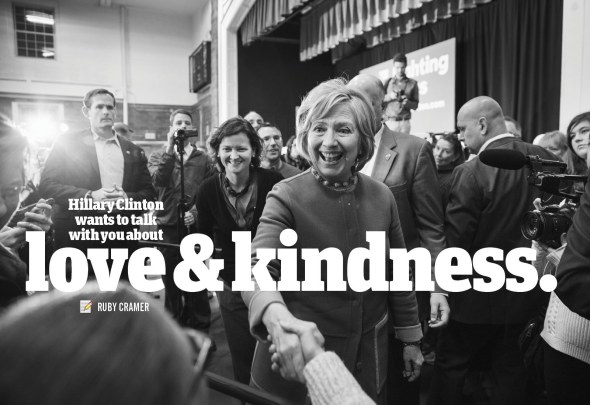
Good Morning!!
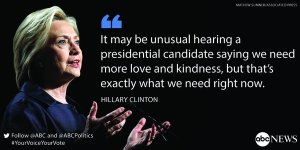
Hillary Clinton has been making “love and kindness” a theme of her campaign for President of the U.S. In my opinion, that is not only an inspiring message, but it is also an interesting and exciting one for a political campaign.
To me, this slogan is much more inspiring than “hope and change.” Love and kindness are about reaching out to others who are in distress and helping them. It signals caring about people and relationships. But I think “love and kindness” appeals more to women than men.
And why not? After all, we’ve had more than two centuries as a country led by male presidents. Isn’t it about time that the citizens who make up the majority of the electorate had the opportunity to vote for a woman to hold the highest office in the land?
I’ve mentioned before that my focus in graduate school was on language development and specifically on the development and function of narratives across the lifespan and how they affect personality. One of the approaches that my mentor emphasized was pioneered by Dan McAdams, a professor of psychology and presently chair of the Department of Psychology at Northwestern University.
McAdams studied the life stories of men and women and found significant differences in the ways males and females view the world and their lives. He referred to this dichotomy as “agency and communion.” Males tend to be more focused on agency, “getting ahead” and Females tend to be more interested in communion, “getting along.” In other words women are more interested in relationships than in advancing themselves and dominating others.
Of course each individual personality contains both of these characteristics. Interestingly, communion tends to increase with age in males and older women often show more agency in their personalities. This is a generalization, but there is definitely a statistically significant difference in these personality characteristics in the life stories of men and women. Whether it’s based on nature or nurture–personality is a combination of both–females and males tend to see the world and their own lives in differing ways.
Historically, personality psychologists have tried to diagram personality traits using the “interpersonal circumplex” concept. Here’s a diagram using agency and communion:
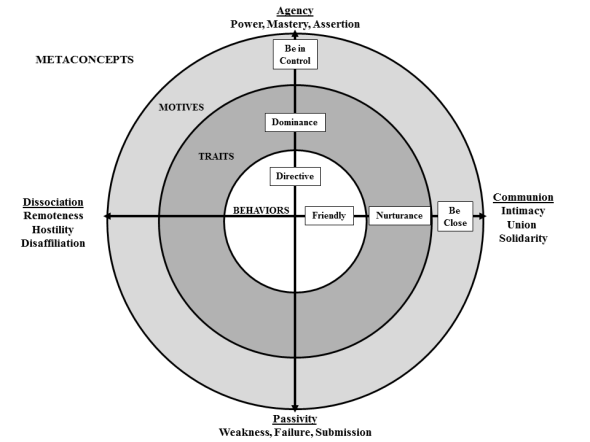
The idea is to demonstrate the various personality trait combinations that make people unique and at the same time similar to each other according to other characteristics like gender and age.
McAdams also incorporated Erik Erikson’s personality theories into his work. If you took Psychology 101, you know about Erikson’s theory of lifespan development. He argued that as people go through life, they pass through eight stages. Here’s Erickson’s final diagram of the stages he observed in people he studied:

I won’t go into this too deeply, but the ages listed on the diagram are fluid. I don’t think 65 is really “old age” anymore. McAdams has focuses quite a bit of his research on Erikson’s concept of Generativity. He has found that even very young children can experience generativity. What we’re talking about here is basically empathy for the feelings of others and taking action to reach out to and help other people.
Hillary is currently in the Generativity stage. In terms of her personality and behavior, she is nowhere near old age. She demonstrates generativity in the way she obviously cares about others and wants to help them. She especially cares about children and young people. During the campaign, she has reached out to the mayor and the people of Flint, Michigan and to mothers of young black men who were murdered. When young people have derided her at town hall meetings, she has famously said to them (paraphrasing) “You don’t have to be for me, but I will be for you.” Can you imagine Bernie Sanders or Donald Trump being capable of that kind of selflessness?
My point is that we are seeing these basic personality differences based on psychological research being clearly demonstrated in the current presidential campaign. Bernie Sanders and Donald Trump are focused on themselves as leaders of “movements” that are all about them and what they want to do. Hillary Clinton also shows a great deal of agency, of course; but the focus of her campaign has been on what she wants to do for other people and for her country as a whole. I personally find this inspiring and it makes me feel very enthusiastic about voting for Hillary.
Unfortunately, many of the people in our terrible media think “love and kindness” and caring for others are stupid, corny ideas and they mostly discount what Hillary is saying and doing and project their own ideas about “the Clintons” onto her. No matter how hard she tries, no matter how often she speaks in such positive ways about the future of our country, the media in general doesn’t believe her or care a bit about her desire to do good.
So that’s where we are today. We always knew that electing a woman president would be hard–much harder than electing a black man. Goddess only knows how long it could take to elect a black woman. But we are making progress, and if Hillary wins the presidency, we will very likely see both gradual and sudden changes in our national consciousness.
Women and people of color have learned that progress is slow; change doesn’t happen overnight, as Bernie Sanders wishes it would. But Sanders is irrelevant now; we must focus on helping Hillary defeat Donald Trump. The possibility that this ignorant, dangerous man could become president should motivate both Democrats and Republicans to work as hard as they can to defeat him.
Women, people of color, and other marginalized citizens like LGBT and disabled people can understand Hillary’s message better than the the privileged white men who presently control most of the levers of power in our country. We are the ones who will help Hillary save the country from Donald Trump. Privileged white men have a choice: they can join us or they can remain irrelevant.
Now a few reads to check out:

This piece by Charlies Pierce made me very angry yesterday, but today I see Pierce in the context of many white male journalists who simply don’t understand that white males and what excites them will not decide the 2016 election. The election will be decided by women and people of color.
I Am Not Convinced Hillary Clinton Is the Right Candidate to Take on Trump.
Let us stipulate a few things at the start. Hillary Rodham Clinton is still odds-on to be the next president of the United States. Only George H.W. Bush among modern presidents had anything close to her CV, and he never was a senator from a major state. She has been the victim of incredible abuse and the subject of fantastical lies ever since she first stepped onto the public stage in Arkansas. She is as tough and durable a political figure as any we’ve seen with the possible exception of the guy she married and the guy that has the job now. Electing a woman to be president of the United States is a genuinely big honking historic deal. Electing this particular woman president of the United States is the only sane and plausible choice available….
I would also stipulate the following—as a presidential candidate, as a seeker of votes, as an applicant for the world’s most powerful temp position, for the second time in a row, she’s proving to be something of a mediocrity….
HRC is a plodder. There’s nothing wrong with that. Many great politicians have been plodders; it can be argued that—his ability to galvanize an audience aside—the current president is something of a plodder. What is what he memorably called “the hard, necessary work of self-government” in his acceptance speech at the 2012 Democratic National Convention in Charlotte, if not an appeal for people to understand that progress does not come like thunderclaps and lightning. But the problem, as I see it, anyway, is the problem of horses-for-courses. A pure plodder is not the best candidate to put in a race against someone who is completely unmoored from consequence, who makes up policy positions on the fly, an improv act for whom the truth is whatever he decides to say next. Against this, HRC can look slow and stolid.
Read the rest at the link if you wish. In my opinion, what Charles Pierce thinks about Hillary is irrelevant. Older white men like him are not the voters who will elect her. I hope he decides to convince other men like him to support her too, but we can probably do without a lot of them. We are the future; they can join us or continue to be irrelevant.

Melissa McEwan at Blue Nation Review: When I Was a Little Girl I Memorized a List of Male Presidents.
When I was in fifth grade, I had to memorize the list of US presidents. At that time, there were 40 of them. To help me remember them, I looked at a series of their portraits contained in my parents’ set of encyclopedias, as I sat cross-legged on the orange shag carpeting of our living room while a re-run of “Barney Miller” played on the telly.
To this day, I can conjure the cross stare of Millard Fillmore and the Ichabodian visage of William Henry Harrison.
There was something about all those faces, first rendered in oil and then reprinted for my perusal, that made me ask my teacher how a person became president.
Something about the way I asked made her think I was asking what I might do if I wanted to be president someday. That was not what I was asking. I am criminally shy and despise being the center of attention; a position as visible as the presidency would be my worst nightmare. But I also wasn’t really asking what it took to become president, either.
I was asking, without saying it, what it would take—was it even possible—for a woman to be president.
Please read the rest–it’s great. I went through the same thing as a young girl–and I’m a lot older than McEwan. I wondered why women were rarely doctors or college professors or lawyers or much of anything other than schoolteachers, nurses, or secretaries. And even women who did those jobs were looked down on–they should have gotten married, had children, and spent their days cleaning house and cooking. Today we are on the cusp of electing a woman president!
Peter Daou at Blue Nation Review: Hillary’s Long Game Is Why Bernie and Trump Can’t Defeat Her. Daou says he observed Hillary’s campaign as similar to a game of chess.
From Hillary’s admirers we hear about Hillary’s discipline, resilience, compassion, experience and knowledge. From her detractors, we hear she is robotic, calculating, and dishonest.
What we rarely hear about from either side is her uncanny ability to play the long game, to see through the fog of news cycles, to hear through the cacophony of opinions, and to make decisions that are many steps ahead of her opponents.
Hillary understands that Bernie Sanders will win more races on his way to defeat, that Trump will keep attacking her marriage on his way to defeat, that the media will jump at the catnip, that pundits will make grave prognostications, that social media will light up with hourly trends.
What Hillary also knows is that her voters are profoundly invested in her campaign and that their support gives her the capacity to withstand intense attacks and weather the most turbulent news cycles.
She is playing the long game, knowing that media hype is just that: hype.
What seems like an earth-shattering issue today is a hazy memory tomorrow. What feels like a crushing defeat one night is forgotten the next. What seems like an insurmountable obstacle on the road ahead is quickly lost in the rear view mirror.
I loved that.
Finally, two pieces about Bernie Sanders that demonstrate where he falls on the agency-communion axis:
David Wade at Politico: Bernie Sanders, the Zombie Candidate. It’s already over, and now he’s just causing havoc. I’ve seen firsthand how much damage this kind of candidacy can do.
When he first decided to run for president, Bernie Sanders had a goal in mind: to start a political revolution by getting big money out of politics.
If he wants to do it—if Sanders wants to build a lasting movement to fight money’s outsize influence—he has to close one door to open another. The transition from contender to gracious supporter of the nominee isn’t easy for any presidential candidate, but he needs to make it, and soon.
We already know Sanders isn’t going to win the Democratic Party’s nomination; Hillary Clinton has amassed more than 92 percent of the delegates needed to secure the nomination, and she’ll easily pick up the rest. So right now, Sanders’ campaign is the walking dead: a zombie. And having worked for John Kerry during the slugfest of the 2004 primaries, I’ve seen up close how much damage this sort of prolonged “zombie” candidacy can inflict on the eventual nominee—and what’s ultimately at stake for the country.
I don’t claim that the dragged-out primary made the difference in November 2004; the race came down to the wire, and big forces—including post-9/11 anxiety and “Swift Boat” smears—loomed large. But in presidential campaigns, the one resource that’s never renewable is time. Zombie candidates can’t win the nomination, but they squander vast amounts of time and slowly chip away at the prohibitive front-runner. Some of the damage is obvious—the endless series of public dents in the candidate’s reputation; some are subtle, noticeable in ways that perhaps only political operatives can appreciate.
Read more at the link.

Jon Reinish at The Observer: Bernie Sanders Only Cares About Bernie Sanders.
Each election has what become its accepted narratives: themes that, over time, gel into what are considered reliable facts that are no longer vetted or questioned. As the Democratic campaign finally wraps up, it’s time to put two persistent ones to bed: Hillary Clinton is unpopular and limping to a finish, and Bernie Sanders is a progressive from way outside the system.
Neither could be farther from the truth….let’s look at the overall race and break it down by the numbers: Hillary Clinton is ahead of her primary opponent by over three million votes. In the Democratic primary, she’s still ahead by about 300 pledged delegates. America knows her. Which is probably in no small part why she’s so far ahead and why the country is saying a resounding yes to her in such massive numbers.
Call it what you want, but acknowledge she’s ahead.
It’s simply inaccurate to say that a campaign putting those kinds of numbers on the board is limping. They are sprinting. Yet the theme persists it’s one dead-cat bounce after another and she should be “doing better.” But what does that mean? That she should win every state? Even the best campaigns have good and bad days. That she should have sewn it up by now? Well, newsflash, she actually does have it sewn up by now. Every national campaign has certain good states and certain bad states. The Democratic Party, thank God, isn’t monolithic.
She’s unpopular? Well, first of all that’s sexist, as is the consistent devaluing and snide parsing of every success she has, which the media does. But tell me this: how is she unpopular? That she doesn’t draw 20,000 hipsters to a rally? Those are optics. And they don’t vote in the same number as Hillary Clinton’s core demographics (if I was running for office? I’d ignore the whole Flight of the Conchords crowd and focus on older voters, college educated whites, middle aged women, African Americans and rising new American communities including Latinos and Asians: they vote). How can somebody who, according to accepted wisdom is so unpopular, be winning by so much? Voters support their candidate because they want to. Not because they are forced to. And it’s clear by polls and votes that Hillary Clinton is vastly preferred.
Ergo, a winning candidate.

On Bernie:
As for being a progressive—other than saying how progressive he is ad nauseum—frankly, I just don’t see it. Senator, you’re no Ted Kennedy. There’s no solid legislative record of liberal lawmaking; and I don’t see him leading a single movement until he decided to run for President.
Bernie Sanders is a fighter for Bernie Sanders.
His record points to a career—with the exception of his mind boggling and shameful record on guns—as a reliable left-wing backbencher. Fair enough, and we need the votes and I hope he continues that trend when he’s back in the Senate next year. Congress is full, by the hundreds, in both chambers and on both sides of the aisle, of said rank-and-file backbenchers. But the idea that he has been a liberal crusader with an enviable quiver full of results is hogwash. Voters haven’t seen Mr. Sanders out in front on healthcare, on choice, on climate change and sustainability, in a meaningful way—backed up by the decades-long track record of results that, by the way, he should have by now if he’s a serious person—any more than they’ve seen him at the Met Gala in Alexander Wang. He occupied a vague niche in the mind of the American public until about ten political minutes ago.
This article is a must read!
Now that I’ve gone on for so long, I’ll turn the floor over to you. Please share your thoughts and links in the comment thread. As always, this is an open thread.

 peej
peej Carissa
 bostonboomer
 dakinikat
 ecocatwoman
 mablue2
 Mama Lopez
 peggysue22
 quixote
 skydancingguestblogger
 Mona (aka Wonk the Vote)



 Sky Dancing
Recent Comments