
Defense Department Study Shows Few Problems with Ending DADT
Posted: November 30, 2010 Filed under: Civil Rights, GLBT Rights, Human Rights | Tags: Barack Obama, DADT, Defense Department, John McCain, LGBT rights, Robert Gates 58 Comments
Here is a summary of the report at DOD Live:
U.S. Army Gen. Carter Ham, commander of U.S. Army Europe, said the study found that 50 to 55 percent of people surveyed said there would be no major effect if the repeal passed, while 15 to 20 percent said they’d expect a positive change. Only 30 percent said repeal would have a negative impact.
Ham indicated that he doesn’t think repeal would be harmful, if handled properly and performed deliberately. He said the leadership today has the ability to implement a new policy and maintain unit cohesion.
There is still a lot of discussion required, Ham said, but the military should begin planning now. “The best way for us to think about this is as a contingency plan,” Ham said. “Our report lays out the groundwork for actions that we recommend, if repeal does come.”
You can read the full report here.
From The Boston Globe: Pentagon study finds overturning “don’t ask, don’t tell” will do little long-term harm.
A long-awaited Pentagon report released today concluded that overturning the military’s “don’t ask, don’t tell” policy would do little long-term harm to morale or military effectiveness, dispelling chief arguments opponents have had with allowing gay and lesbian service members to serve openly.
The report’s release shifts the focus on the issue to moderate members of the Senate, including Scott Brown of Massachusetts, who had said they wanted to read the report before voting on whether to end the policy.
The House has passed a bill overturning the policy, but a Republican-led threat of a filibuster halted a similar effort in the Senate in the fall….
The study, conducted over ten months, found that 70 percent of troops surveyed believed that repealing the law would have mixed, positive, or no impact. The other 30 percent felt there would be negative consequences if gays were allowed to serve openly, with opposition strongest among combat troops.
Secretary Gates is strongly recommending that Congress and the President complete the repeal of the law before the end of this year. He held a long press conference earlier today. Lynn Sweet at the Chicago Sun-Times published the transcript. Here is an excerpt:
Earlier this year, the House of Representatives passed legislation that would repeal Don’t Ask Don’t Tell after a number of steps take place – the last being certification by the President, the Secretary of Defense, and the Chairman that the new policies and regulations were consistent with the U.S. military’s standards of readiness, effectiveness, unit cohesion, and recruiting and retention. Now that we have completed this review, I strongly urge the Senate to pass this legislation and send it to the president for signature before the end of this year.
I believe this is a matter of some urgency because, as we have seen this past year, the federal courts are increasingly becoming involved in this issue. Just a few weeks ago, one lower-court ruling forced the Department into an abrupt series of changes that were no doubt confusing and distracting to men and women in the ranks. It is only a matter of time before the federal courts are drawn once more into the fray, with the very real possibility that this change would be imposed immediately by judicial fiat – by far the most disruptive and damaging scenario I can imagine, and the one most hazardous to military morale, readiness and battlefield performance.
Therefore, it is important that this change come via legislative means – that is, legislation informed by the review just completed. What is needed is a process that allows for a well-prepared and well-considered implementation. Above all, a process that carries the imprimatur of the elected representatives of the people of the United States. Given the present circumstances, those that choose not to act legislatively are rolling the dice that this policy will not be abruptly overturned by the courts.
At the San Francisco Chronicle, that was seen as a thinly veiled “warning to John McCain.”
[MABlue here]
BostonBoomer was much faster with her post. I wanted to add this video showing McCain bizarre behavior on DADT. What a creep!
Meanwhile, opponents of repeal are shifting their arguments.
The ball is now in the Congress’s court. What will President Obama do now to prevent gays from serving openly in the military? Or will he actually support repeal of this discriminatory and unjust law?
Stay tuned.
Monday Reads
Posted: November 29, 2010 Filed under: morning reads | Tags: Barack Obama, Claire McCaskill, DADT, DHS, Health care reform, hypocrisy, ICE, Julian Assange, Lindsey Graham, Wikileaks 129 Comments
Good Morning!! The long holiday weekend is officially over. Of course the big story is still the latest Wikileaks release.
This McClatchy story at the Miami Herald points out that despite hysterical warnings from U.S. officials there is “no evidence that WikiLeaks releases have hurt anyone”
American officials in recent days have warned repeatedly that the release of documents by WikiLeaks could put people’s lives in danger.
But despite similar warnings before the previous two releases of classified U.S. intelligence reports by the website, U.S. officials concede that they have no evidence to date that the documents led to anyone’s death.
Before Sunday’s release, news organizations given access to the documents and WikiLeaks took the greatest care to date to ensure no one would be put in danger. In statements accompanying stories about the documents, several newspapers said they voluntarily withheld information and that they cooperated with the State Department and the Obama administration to ensure nothing released could endanger lives or national security.
The newspapers “established lists in common of people to protect, notably in countries ruled by dictators, controlled by criminals or at war,” according to an account by Le Monde, a French newspaper that was among the five news organizations that were given access to the documents. “All the identities of people the journalists believed would be threatened were redacted,” the newspaper said in what would be an unusual act of self censorship by journalists toward government documents.
I see no reason to believe this release will be any different. Yes, there will be embarrassment for various world leaders–so what? We have a right to know what our government is doing. I say more power to whistleblowers the world over.
The New York Times posted an exchange of letters between Julian Assange and the U.S. government. The letter show that Wikileaks was very open to withholding information if it would really cause harm to anyone.
In other news, Claire McCaskill is attempting to distance herself from Obama, now that he’s no longer seen as the messiah. Will wonders never cease? You’d think McCaskill would go down with the ship, but I guess she’d rather hang onto her job in the Senate than continue her worshipful attitude toward the President.
Appearing on “Fox News Sunday,” McCaskill said that she’d voted against the president on cap-and-trade, the second round of cash-for-clunkers, comprehensive immigration reform and every omnibus bill.
McCaskill said she’d also sometimes disagreed with Obama when he was a senator.
“My record of independence, frankly, stretches back for a long period of time,” she said.
When asked to name an issue where Obama had fallen short, the senator said his move into healthcare legislation at a time when he should have been focusing on job creation was “very difficult,” and therefore economic issues “didn’t get the attention they needed.”
The Obots continue to drop like flies. It would be nice if Nancy Pelosi would get the message and start standing up for Democratic principles for a change.
I’m not sure what to think about this next story. The DHS and ICE have summarily shut down more than 70 websites. Supposedly these sites were involved in counterfeiting products or encouraging theft of intellectual property, but what is the recourse for a site that is wrongly shut down?
From the Wall Street Journal: Website Closures Escalate U.S. War on Piracy
A federal crackdown that shut more than 70 websites last week is the latest sign of an escalating war against counterfeit and pirated products, using legal tactics that may be closely scrutinized by civil-liberties groups.
Domain names of the affected sites—which offered such diverse goods as scarves, golf gear and rap music—were seized by U.S. Immigration and Customs Enforcement, part of the Department of Homeland Security, under court-approved warrants.
This is controversial because civil actions are generally used in piracy cases.
ICE’s latest crackdown is based on procedures used in criminal cases, including seizing domains and assets of suspect websites without prior notification of their owners, lawyers tracking the case said.
“It’s time to stop playing games,” said Chris Castle, a Los Angeles attorney who has represented copyright holders as well as technology companies involved in digital music.
Here a two different reactions to the government shutting down websites.
From Stephen J. Vaughn-Nichols at ZDnet: The Rise of Web Censorship
Back in 1964, U.S. Supreme Court Justice Potter Stewart of famously wrote on what was, and wasn’t “hard-core pornography” that, “I know it when I see it.” Today, free speech on the Web is impeded by far more restrictions than just what is, or isn’t, pornographic. On the Web in 2010, even the appearance of enabling file-sharing of copyright materials seems to be enough for the Department of Homeland Security’s Immigration and Customs Enforcement (ICE) to shut down Web-sites without notice.
But here’s the problem, according to Vaughn-Nichols:
I have no use for sites that traffic in counterfeit goods such as fake autographed sports jerseys or designer purses. I do, on the other hand, worry when a site like Torrent-Finder is shut down.
You see, Torrent-Finder, which is back up under a new domain name, Torrent-Finder.info doesn’t host Torrent file or even BitTorrent file trackers. It’s just a search engine dedicated to file torrents such as movies, TV shows, or software programs. You can find the same file torrents with Google if you know what you’re doing. Torrent-Finder, and sites like it, just makes specific kinds of file searches easier.
I think its fine for the government to try to block the sales of fake LeBron James Miami Heat jerseys and the like. It’s when we start moving into the murkier land of intellectual property and the “right” to block searches, that I start getting worried.
From Elliot’s blog, which is devoted to “domain name investing news and tips”: Why I Am Not Worried About Domain Name Seizures
I will preface this by saying that I don’t like the idea of the government acting as judge and juror, while not seeming to give the website and/or domain name owners the opportunity to defend their actions. It’s scary that the government can simply take over some websites at it’s whim without the owner’s chance to defend his or her actions.
However, if the companies that own the websites are or were doing something illegal while violating the rights of people in the US (whom ICE is responsible to protect), this seizure is not such a huge deal as some might make it out to be….
Eventually, these website operates should have their day in court, but taking away their platform is a way to temporarily stop them from doing what the government believes is an illegal act (although it seems pretty simple to move to another domain name). I don’t know where to draw the line when it comes to seizures such as this, but if a company happens to be brazenly flouting the law, I am not opposed to government intervention. If these website operators are in the right, then they will certainly have their day in court.
I don’t know, this whole thing makes me uneasy, especially with the TSA being permitted to violate the 4th amendment rights of airline passengers. To me this feels like an attempt to begin censoring the internet.
Here’s an interesting story on possible effects on the health care law if Congress makes serious attempts to cut the deficit: Deficit battle threatens job-based health care
Budget proposals from leaders in both parties have urged shrinking or eliminating tax breaks that help make employer health insurance the leading source of coverage in the nation and a middle-class mainstay.
The idea isn’t to just raise revenue, economists say, but finally to turn Americans into frugal health care consumers by having them face the full costs of their medical decisions.
Such a re-engineering was rejected by Democrats only a few months ago, at the height of the health care overhaul debate. But Washington has changed, with Republicans back in power and widespread fears that the burden of government debt may drag down the economy.
Death panels, anyone?
Hypocrisy watch? Senator Lindsey Graham says DADT won’t be repealed.
The South Carolina Republican, a proponent of the law banning openly gay service in the armed forces, said definitively that there was no support for repeal on the Republican side of the aisle. He called for an additional study to determine whether the military itself favored overturning the 17-year-old legislation.
“This is a political promise made by Senator Obama when he was running for president,” said Graham, during an appearance on Fox News Sunday. “There is no groundswell of opposition to Don’t Ask, Don’t Tell coming from our military. This is all politics. I don’t believe there is anywhere near the votes to repeal Don’t Ask, Don’t Tell. On the Republican side, I think we will be united in the lame duck [session] and the study I would be looking for is asking military members: Should it be repealed, not how to implement it once you as a politician decide to repeal it. So I think in a lame duck setting Don’t Ask, Don’t Tell is not going anywhere.”
Please, someone, snap some pics of Lindsey Graham next time he hits a gay bar. I wonder what his pals McCain and Lieberman would say then?
According to interviews with the Daily Beast, the Taliban is laughing at the U.S., Britain, and NATO, because they negotiated with a fake Taliban leader for months.
Taliban commanders in Afghanistan reacted with amusement this weekend to news of an impostor who, by claiming he was a senior Taliban leader, managed to fool NATO officials and get invited to high-level peace talks.
The man pretending to be insurgent leader Mullah Akhtar Muhammad Mansour was in fact a shopkeeper from Quetta in Western Pakistan, they said.
“Imagine,” Mohammad Hafiz, a senior Taliban commander, told The Daily Beast, “if a shopkeeper from Quetta can make a fool of them and keep them engaged in talks for months, how do they believe they can defeat the Taliban?”
Hafiz, himself a close aide to the insurgent leader Mansour, said Taliban commanders were laughing at the fact that American and British officials could be so easily deceived. But he and other insurgent leaders denied the shopkeeper was a plant; in fact, they said, they wouldn’t mind finding him and having a chat.
That is pretty pathetic. It’s time to get out of Afghanistan. Iraq too.
What stories are you following today?
Black Friday Reads
Posted: November 26, 2010 Filed under: morning reads | Tags: DADT, Elizabeth Warren, net neutrality, PCE inflation numbers October, Robosigning, thankful progressives, U.N. Food crisis 63 CommentsGood Morning!

Well, be thankful for the food in your belly!!! Did you move a size up this morning? According to the U.N. and the NYT the ‘World is “Dangerously close” to a Food Crisis’.
Global grain production will tumble by 63 million metric tons this year, or 2 percent over all, mainly because of weather-related calamities like the Russian heat wave and the floods in Pakistan, the United Nations estimates in its most recent report on the world food supply. The United Nations had previously projected that grain yields would grow 1.2 percent this year.
The fall in production puts the world “dangerously close” to a new food crisis, Abdolreza Abbassian, an economist with the United Nations Food and Agriculture Organization, said at a news conference last week.
Rising demand and lower-than-expected yields caused stocks of some grains to fall sharply and generated high volatility in world food markets in the latter half of the year. Prices for some commodities are approaching levels not seen since 2007 and 2008, when food shortages prompted riots around the world.
Got that backyard farm started yet?
At the moment, the only prices that appear to be rising on the national level are gas prices. The Dallas Fed breaks down inflation as measured by the PCE for you.
Apart from yet another sharp increase in the price of gasoline, inflationary pressures in October were as muted as we’ve seen in quite some time. Both the core PCE price index and the trimmed mean registered essentially zero inflation rates in October, each posting annualized rates of just 0.1 percent.
The 12-month core rate fell 0.3 percentage points to 0.9 percent, and the 12-month trimmed mean rate, which had been fairly stable around 1 percent for the past six months, ticked down to 0.8 percent.
To be sure, the headline PCE price index did increase at a 2.0 percent annualized rate in October, but about 90 percent of that gain is accounted for by the price index for gasoline, which jumped 4.7 percent from September to October (or about a 73 percent annualized rate of increase).
So, gasoline aside, are we seeing a downshift in the underlying trend in consumer price inflation? While today’s release certainly points in that direction, one never wants to make too much out of any one month’s numbers. In inflation updates over the past few months, we’ve stated our view that the underlying trend in inflation was stable, albeit at an extremely low level. That view evolved only with the accumulation of several months worth of data. Going forward, we’ll again be looking for patterns that are sustained over multiple months worth of data.
They have a list of things that “leading progressives” are thankful for over at New Deal 2.0. You just have to go look. Really. I mean REALLY. I’m going to stick with Dean Baker Bill Black, and James K. Galbraith because economists have to stick together. You can figure out what to do with the media personalities on your own.
“I’m grateful that we won’t have Larry Summers to kick around anymore.” – James K. Galbraith, author of The Predator State and Professor of Government, University of Texas at Austin
…
“I am grateful to Social Security, which made it possible for our family to avoid economic disaster when my father died of a second heart attack when he was 41. I am grateful to a nation in which I could be a serial whistle blower, exposing the misconduct of two presidential employees, the Speaker of the House James Wright, and the ‘Keating Five’ — and survive. And I am grateful to the Ancients, who faced a vastly crueler world and recognized that the key was for each of us to try to repair it, and whose advice has led generations to make those repairs, rather than accepting cruelty, greed, exploitation, and indifference as the natural state. I am thankful for all who came before and worked to make things better.” – Bill Black, Associate Professor of Economics and Law at the University of Missouri-Kansas City and white-collar criminologist
…
“I am thankful for the Web. It is an enormous potential equalizer in giving progressives without money comparable input into public debate as the right-wingers with lots of money. In this vein, the Huffington Post’s webhits are going up. The Washington Post’s circulation is going down.” – Dean Baker, co-director of the Center for Economic and Policy Research
Here’s some interesting news on Net Neutrality from The Hill.
Seeking to weaken potential regulations, AT&T is actively working to complicate the Federal Communications Commission’s (FCC) renewed effort to broker a compromise on net neutrality.
Industry and Hill sources said that an AT&T official made public last week that the agency has quietly undertaken a new round of negotiation. The sources stressed that they had obtained this information through AT&T channels.
The delicate FCC effort is aimed at resolving one of the most fractious issues in tech policy. The hope was to quietly consult with industry and public interest stakeholders while insulating the negotiations from the noisy politicking the question stirs on both sides.
FCC Chairman Julius Genachowski invited industry and public interest sources to help shape a possible compromise, giving AT&T a major seat at the table. Public advocates are concerned about how much Genachowski appears to be listening to AT&T, with one saying he has practically given them “veto powers.”
Ex parte filings show that AT&T officials consulted frequently with the agency this month. Policy executive Jim Cicconi met with Genachowski’s office the day before the new net neutrality effort became public.
Politico had a story up about lesbian Air Force Major Margaret Witt who was discharged under DADT. This is another incidence involving the Obama administration’s legal stance on DADT which appears at odds with what the President says. The Air Force may seek stay of order to block Witt’s reinstatement. Her case is being followed by the ACLU.
“We foresee no problem about Major Witt getting reinstated,” Doug Honig of the ACLU’s Washington state chapter said Wednesday. “Once we discuss this with the Air Force, present evidence meeting the nursing hours requirements, and Major Witt passes the physical – all of which will happen – we would be shocked if the Air Force were suddenly to seek to stay her reinstatement.”
The Obama administration’s legal stance is likely to come as a disappointment to gay rights advocates, who took the decision not to seek a stay as an indication that the administration may no longer be mounting a full-court press to uphold the “don’t ask, don’t tell” policy written into law by Congress in 1993. Obama has pledged to repeal the law, but the Justice Department has continued to defend it, citing a tradition of Executive Branch defense of most Congressional enactments.
Regardless of whether a stay is sought, the Justice Department is appealing Leighton’s ruling, just as it is appealing another judge’s recent order that the “don’t ask” policy is unconstitutional on its face.
The decisive way in which she labored behind the scenes to stymie a bill that would have eased requirements for documentation in the foreclosure process underscores how her arrival has altered the administration’s relationship with major banks.
The bill, which passed both houses of Congress and awaited President Obama’s signature to become law, essentially would have compelled notaries to accept out-of-state notarizations, regardless of the rules in those states.
State officials across the country–who have been pursuing probes looking into wrongdoing within the foreclosure process– feared that those jurisdictions with lax standards could have become hotbeds for foreclosure documentation fraud. Lenders and mortgage companies could have used those states as central clearing houses to produce bogus foreclosure paperwork, and then export those documents to other states with more stringent regulations–an expedient bypass around the strictures.
Despite warnings from North Korea that any new provocation would be met with more attacks, Washington and Seoul pushed ahead with plans for military drills starting Sunday involving a nuclear-powered U.S. aircraft carrier in waters south of this week’s skirmish.
The exercises will likely anger the North — the regime cited South Korean drills this week as the impetus behind its attack — but the president said the South could little afford to abandon such preparation now.
“We should not ease our sense of crisis in preparation for the possibility of another provocation by North Korea,” spokesman Hong Sang-pyo quoted President Lee Myung-bak as saying. “A provocation like this can recur any time.”
At an emergency meeting in Seoul, Lee ordered reinforcements for about 4,000 troops on the tense Yellow Sea islands, along with top-level weaponry and upgraded rules of engagement that would create a new category of response when civilian areas are targeted.
Great! Yet another excuse for more military spending!
I’m still trying to recover from three plus days of not having potable water. If you hear a scream emanating from a laundry room some where south of you, it’s undoubtedly me. Thank goodness I decided to eat out for Turkey Day!!
What’s on your reading and blogging list today?
Monday Reads
Posted: November 22, 2010 Filed under: Diplomacy Nightmares, Hillary Clinton: Her Campaign for All of Us, Human Rights, just because, morning reads | Tags: DADT, GLBT rights, internet freedom of speech, monetary policy, quantitative easing, Web neutrality 88 Comments Good Morning!
First up is something that is one huge step back for civil rights and humankind. I can’t believe this outrageous motion was adopted by the UN. The US and its allies need to object vigorously.
The UN has removed a reference to sexual orientation from a resolution condemning arbitrary and unjustified executions.
The UN General Assembly resolution, which is renewed every two years, contained a reference opposing the execution of LBGT people in its 2008 version. But this year’s version passed without any reference to gay rights after a group of mostly African and Asian countries, led by Mali and Morocco, voted to remove it.
Gay rights groups fear the move — which passed in a narrow 79 to 70 vote — will act as a signal that persecuting people for their sexual orientation is internationally acceptable.
“This vote is a dangerous and disturbing development,” Cary Alan Johnson, executive director of the International Gay and Lesbian Human Rights Commission, said in a statement. “It essentially removes the important recognition of the particular vulnerability faced by lesbian, gay, bisexual and transgender people — a recognition that is crucial at a time when 76 countries around the world criminalize homosexuality, five consider it a capital crime, and countries like Uganda are considering adding the death penalty to their laws criminalizing homosexuality.”
Johnson was referring to a bill introduced in Uganda’s legislature last year that would mandate the death penalty for multiple acts of gay sex or for any gay person carrying HIV. Though the bill appeared to be shelved after an international outcry, its principal supporter said last month the bill would be law “soon.”
Thankfully, we’re moving closer to repealing DADT. The Marines have stated that they stand ready to remove enforcement of the provision. Semper Fi!!!
The head of the U.S. Marine Corps will fully cooperate with a repeal of the “don’t ask, don’t tell” policy barring openly gay and lesbian soldiers from the military, Joint Chiefs of Staff Chairman Adm. Mike Mullen said Sunday.
In an interview on CNN’s “State of the Union,” Mullen said there was “no question” that Marine Commandant Gen. James Amos, an opponent of repealing the “don’t ask, don’t tell” policy at this time, would implement all necessary changes to allow openly gay Marines to serve if Congress passes a repeal measure.
“He basically said that if this law changes, we are going to implement it, and we are going to implement it better than anybody else,” Mullen said of comments Amos recently made at a townhall-style meeting with Marines.
The U.S. Senate is expected to vote on repealing the policy in coming weeks. The House already has passed a repeal measure, and President Barack Obama says he supports repeal under a process worked out with Mullen and Defense Secretary Robert Gates that includes a review of what the change would entail for the military.
Secretary of State Hillary Clinton appeared on Fox News on Sunday . Clinton told Chris Wallace that she believed the  ‘vast majority’ of Gitmo detainees should be tried in civilian courts.
We do believe that what are called Article Three trials, in other words in our civilian courts, are appropriate for the vast majority of detainees,” Clinton told Fox News’ Chris Wallace.
This week, a civilian trial convicted Guantanamo Bay detainee Ahmed Ghailani on one count and acquitted him of more than 280 other counts.
“The question is do you have any choice now except to hold all of the terror detainees at Gitmo or either give them military trials or hold them indefinitely?” Wallace asked Clinton.
“The sentence for what he was convicted of is 20 years to life,” Clinton replied. “That is a significant sentence. Secondly, some of the challenges in the courtroom would be the very same challenges before a military commission about whether or not certain evidence could be used.”
Clinton also appeared on Meet the Press. She expressed reservations about the intrusive pat down procedures adopted by the TSA.
The Secretary of State also branded the procedure as ‘offensive’ and called for officials to make the new airport security measures less intrusive.
Speaking on CBS’ Face the Nation and NBC’s Meet the Press, Mrs Clinton said she recognised the need for tighter security but said there was a need to ‘strike the right balance’ and ‘get it better and less intrusive and more precise.’
When asked if she would submit to a pat-down, she replied ‘Not if I could avoid it. No. I mean, who would?’
Mrs Clinton added she understood ‘how offensive it must be’ for passengers forced to endure the measures.
Another economist–Professor James Hamilton–is incensed about that stupid bunny cartoon with it’s outrageous lies on QE. There’s some more take down of the stupid thing on Econbrowser. Hamilton explains why ‘the Goldman Sachs’ is one of the agents used by the Fed when it does Open Market Operations. Basically, it’s the law and this is true if it’s in the name of QE or just regular monetary policy. He also takes down some of the other ones so that I don’t have to do it. He tackles the inflation fallacy as well as the stupid comment about QE being the equivalent of printing money.
Goldman Sachs is one of 16 different dealers from which the Federal Reserve Bank of New York solicits competitive bids. That’s the way it’s been done for a century, and it would be illegal for the Fed to do as the bunnies propose. From U.S. Monetary Policy and Financial Markets, 1998, Chapter 7:
The Federal Reserve makes all additions to its portfolio through purchases of securities that are already outstanding. The Federal Reserve Act [of 1913] does not give the [Federal Reserve] System the authority to purchase new Treasury issues for cash. Over the years, a variety of provisions had permitted the Treasury to borrow limited amounts directly from the Federal Reserve. Options for such loans existed until 1935. Temporary provisions for direct loans were reintroduced in 1942 and renewed with varying restrictions a number of times thereafter. Authority for any kind of direct loans to the Treasury lapsed in 1981 and has not been renewed.
The reason that the Fed has always been required to buy bonds from private dealers rather than the U.S. Treasury is that the process of money creation needs to be institutionally separated from the process of financing the public debt. In fact, the potential blurring of those boundaries is one of the most important legitimate criticisms of quantitative easing.
Another topic that confuses a lot of people is the Social Security Trust Fund. Does it exist or not? John Holbo at Crooked Timber takes on Matt Yglesias and a Planet Money podcast. He explains it in terms of a parent (the government) borrowing a future allowance from a child (Social Security).
If the US government completely and unrecoverably collapses, as a going economic concern, then the Social Security Trust Fund will be bust – and there will be no United States, too! (The latter is the more consequential concern, I should think.)
If the US government falls on seriously hard times, economically, there may need to be belt-tightening. Maybe the US government will have to break the deal it made, not making good on the IOU’s in the Social Security Trust Fund. Likewise, if our family falls on hard times, I may be driven to spend my daughter’s back allowance money on food for our table, in the sense that I may never pay her that money. (Hope not!) But if that happens I won’t describe the logic of the situation in terms of my daughter’s back allowance having turned out not to have been ‘real’, all along. If I don’t pay her, it won’t be because I don’t owe her – nor because that specific money ‘doesn’t exist’, whereas the money to put food on the table ‘does exist’. Talking that way just takes the minor accounting fiction that starts us out, and inflates it into a major fiction.
If the US government doesn’t fall on seriously hard times, but just finds financial life a bit tight – as it often is – the same point applies, only more so.
Scientific American has an important piece up on the Web with an important call for continued Open Standards and Net Neutrality. They also have taken a strong stand against snooping and protecting free speech on the web. You can see in this article just how far ahead our European cousins are in protecting individual rights over corporate rights on the Web and the internet. They even quote Secretary of State Hillary Clinton’s firm stand on internet freedom.
Free speech should be protected, too. The Web should be like a white sheet of paper: ready to be written on, with no control over what is written. Earlier this year Google accused the Chinese government of hacking into its databases to retrieve the e-mails of dissidents. The alleged break-ins occurred after Google resisted the government’s demand that the company censor certain documents on its Chinese-language search engine.
Totalitarian governments aren’t the only ones violating the network rights of their citizens. In France a law created in 2009, named Hadopi, allowed a new agency by the same name to disconnect a household from the Internet for a year if someone in the household was alleged by a media company to have ripped off music or video. After much opposition, in October the Constitutional Council of France required a judge to review a case before access was revoked, but if approved, the household could be disconnected without due process. In the U.K., the Digital Economy Act, hastily passed in April, allows the government to order an ISP to terminate the Internet connection of anyone who appears on a list of individuals suspected of copyright infringement. In September the U.S. Senate introduced the Combating Online Infringement and Counterfeits Act, which would allow the government to create a blacklist of Web sites—hosted on or off U.S. soil—that are accused of infringement and to pressure or require all ISPs to block access to those sites.
In these cases, no due process of law protects people before they are disconnected or their sites are blocked. Given the many ways the Web is crucial to our lives and our work, disconnection is a form of deprivation of liberty. Looking back to the Magna Carta, we should perhaps now affirm: “No person or organization shall be deprived of the ability to connect to others without due process of law and the presumption of innocence.”
When your network rights are violated, public outcry is crucial. Citizens worldwide objected to China’s demands on Google, so much so that Secretary of State Hillary Clinton said the U.S. government supported Google’s defiance and that Internet freedom—and with it, Web freedom—should become a formal plank in American foreign policy. In October, Finland made broadband access, at 1 Mbps, a legal right for all its citizens.
What’s on your reading and blogging list today?
Friday Reads
Posted: November 19, 2010 Filed under: morning reads | Tags: Antimatter breakthrough, Ben Bernanke, Bobby Jindal the Terrible, China, Closure Votes, Conservatives attack FED, Coporate Governance, Currency Manipulation, DADT, incentive pay, Lucian Bebchuk, Luigi Zingales, Middle Class Tax Cuts, moral hazard, NPR funding, Pew Quiz on political and economic knowledge, starships, Steny Hoyer, Trade Deficits, University of New Orleans 50 Comments Good Morning!

So, this first item I dug up is kind’ve bothersome. It’s a Pew Poll with a self quiz attached on economic and other news. You can go take it yourself if you’d like!
Nearly eight-in-ten (77%) say correctly that the federal budget deficit is larger than it was in the 1990s and 64% know that in recent years the United States has bought more foreign goods than it has sold overseas. As in recent knowledge surveys, about half (53%) estimate the current unemployment rate at about 10%.But the public continues to struggle with questions about the Troubled Asset Relief Program known as TARP: Just 16% say, correctly, that more than half of the loans made to banks under TARP have been paid back; an identical percentage says that none has been paid back. In Pew Research’s previous knowledge survey in July, just 34% knew that the TARP was enacted under the Bush administration. (See “Well Known: Twitter; Little Known: John Roberts,” July 15, 2010
The new survey finds that an overwhelming percentage (88%) identify BP as the company that operated the oil well that exploded in the Gulf of Mexico earlier this year. But as in the past, the public shows little awareness of international developments: 41% say that relations between India and Pakistan are generally considered to be unfriendly; 12% say relations between the two long-time rivals are friendly, 20% say they are neutral and 27% do not know.
Steny Hoyer is promising congressional Dems that they will have a chance to vote to extend the middle class tax cuts. I wonder if he’s spoken to the President who is already indicating he’ll negotiate with the Republicans.
The move indicates that House Dems are growing more resolved to draw a hard line on the Bush tax cuts, forcing Republicans to choose between supporting Obama’s tax plan and opposing a tax cut for the middle class. However, the way forward still remains murky. Even if such a measure were to pass in the House, it’s unclear whether the Senate will agree to such a vote, and the White House has not endorsed the approach.
What’s more, the vote could conceivably go down, or alternatively, Republicans might successfully mount a procedural response, known as a “motion to recommit,” that could also force a House vote on the high end cuts. I have not been able to determine how House Dems might respond to such a move.
For all these reasons, this House move does not preclude a deal being reached in the end on a temporary extension of all the cuts. And plans could still change: The House Dem leadership has yet to publicly endorse this plan
The House failed us on pay equity, extension of unemployment benefits, and the food bill that Sima wrote about yesterday. One bright spot is that NPR will still get federal funding.
House Democrats on Thursday shot down a G.O.P. attempt to roll back federal funding to NPR, a move that many Republicans have called for since the public radio network fired the analyst Juan Williams last month.
Republicans in the House tried to advance the defunding measure as part of their “YouCut” initiative, which allows the public to vote on which spending cuts the G.O.P. should pursue. But their push was blocked, 239 to 171, with only three Democrats voting with a united bloc of Republicans.
Representative Eric Cantor of Virginia, the No. 2 House Republican who is set to become majority leader in the next Congress, said the vote showed Democrats had failed to learn the lessons of this month’s midterm elections.
“Today’s vote was just the latest common sense YouCut to cut spending and save taxpayer dollars, and again Democrats showed that they just don’t get it,” Mr. Cantor said in a statement.
It’s beginning to look like Congress may get rid of DADT. Boxer and Feinstein will be pushing for the effort during the lame duck session. Lisa Murkowski has indicated she will support the effort. Lieberman told The Advocate that the Senate has the required 60 votes for closure.
Sen. Joe Lieberman said Thursday that repealing “don’t ask, don’t tell” as part of the National Defense Authorization Act is no longer a question of votes; it’s a question of process.
“I am confident that we have more than 60 votes prepared to take up the defense authorization with the repeal of ‘don’t ask, don’t tell’ if only there will be a guarantee of a fair and open amendment process, in other words, whether we’ll take enough time to do it,” Lieberman told reporters at a press conference, naming GOP senators Susan Collins and Richard Lugar as yes votes. “Time is an inexcusable reason not to get this done.”
Lieberman, an independent, was flanked by 12 of his Democratic colleagues — a core group that seemed intent on urging the Democratic leadership to allow enough room in the Senate schedule for a debate that would be acceptable to Republicans. The senators talked about working over the weekends, and Sen. Mark Udall offered to go straight through until Christmas Eve.
There is supposedly an Antimatter Breakthrough that could lead to Starships. All the Trekkers out there will sure to be excited.
Scientists at CERN, the research facility that’s home to the Large Hadron Collider, claim to have successfully created and stored antimatter in greater quantities and for longer times than ever before.
Researchers created 38 atoms of antihydrogen – more than ever has been produced at one time before and were able to keep the atoms stable enough to last one tenth of a second before they annihilated themselves (antimatter and matter destroy each other the moment they come into contact with each other). Since those first experiments, the team claims to have held antiatoms for even longer, though they weren’t specific of the duration.
While scientists have been able to create particles of antimatter for decades, they had previously only been able to produce a few particles that would almost instantly destroy themselves.
“This is the first major step in a long journey,” Michio Kaku, physicist and author of Physics of the Impossible, told PCMag. “Eventually, we may go to the stars.”
For now, scientists are interested in producing antimatter in these relatively large quantities because it could lend insight into fundamental physical laws. It’s generally believed in the scientific community that at the universe’s creation, both matter and antimatter existed but not in the same quantity, so when the two annihilated each other, only matter remained. That could be because antimatter behaves differently than the regular variety.
“It’s a fundamental tenet of physics that antimatter and matter behave very similarly although not exactly,” said Lawrence Krauss, physicist and author of The Physics of Star Trek, in an interview. “And in order to really test that, you need anti-atoms. Being able to test the properties of antimatter at a whole new level of precision is obviously important.”
Further into the future, Kaku believes we may be able to use antimatter as the “ultimate rocket fuel,” since it’s 100 percent efficient – all of the mass is converted to energy. By contrast, thermonuclear bombs only use about 1 percent.
“One of the main uses of antimatter would be a starship,” said Kaku “Because you want concentrated energy. And you can’t get more concentrated than antimatter.”
Sarah Palin has fallen directly into the trap I spoke about yesterday in my thread on inflation. I guess she thinks that a few home economics courses are enough to qualify someone to talk on the country’s economy. TNR has a great article up about how conservative Republicans are going after the FED with fallacies and ideology instead of facts. If you read me yesterday, you will know how woefully wrong this is.
Last week, in between leading a graduate seminar on Proust and delivering a long-scheduled lecture on mass spectrometry, former Alaska Governor Sarah Palin ventured a few ticks beyond her acknowledged area of expertise and reflected on monetary policy at a convention in Phoenix. The occasion for her unexpected soliloquy—I’m actually serious about the economics speech—was the Fed’s decision to buy some $600 billion in long-term government securities, a practice known as quantitative easing. “We shouldn’t be playing around with inflation,” Palin said, in a typically Delphic pronouncement. She helpfully added that “everyone who ever goes out shopping for groceries knows that prices have risen significantly over the past year or so.”
There’s a great series called The Rules of the Game over on Project Syndicate by two superheroes of economics and finance –specifically corporate governance–Lucian Bebchuk and Luigi Zingales. They leap out with a great series of questions and answers for reform for Wall Street and big public corporations.
Were over-compensated and unaccountable bosses to blame for the Great Recession? Are bankers and financial managers overpaid? Which reforms must be adopted to save capitalism – above all from its practitioners?
The series is updated ever-so-often and if you get a chance to read any of them, you should. One of my favorites is ‘How to Pay a Banker’ by Bebchuk.
Insulating executives from losses to stakeholders other than shareholders can be expected to encourage them to make investments and take on obligations that increase the likelihood and severity of losses that exceed the shareholders’ capital. In addition, such insulation discourages the raising of additional capital, inducing executives to run banks with a capital level that provides an inadequate cushion for bondholders and depositors. The more thinly capitalized banks are, the more severe these distortions – and the larger the expected costs rising from insulating executives from potential losses to non-shareholder stakeholders.
Compensation schemes for executives should provide disincentives to moral hazard. What we have now is nothing but encouragement. Here’s another quote from ‘Politics and Corporate Money’, from the same author and series.
In expanding corporations’ rights to spend money on politics, the US Supreme Court relied on “the processes of corporate democracy” to ensure that such spending does not deviate from shareholder interests. Clearly, however, such processes can have little effect if political spending is not transparent to public investors.
For such disclosure to be effective, it must include robust rules with respect to political spending via intermediaries. In the US, for example, organizations that seek to speak for the business sector, or for specific industries, raise funds from corporations and spend more than $1 billion annually on efforts to influence politics and policymaking. While the targets of these organizations’ spending are disclosed, there is no public disclosure that enables investors in any public corporation to know whether their corporation contributes to such organizations and how much. Investors deserve to know.
Moreover, a public company’s political spending decisions should not be solely the province of management, as they often are. Independent directors should have an important oversight role, as they do on other sensitive issues that may involve a divergence of interest between insiders and public investors. And these directors should provide an annual report explaining their choices during the preceding year.
Fed Chair Ben Bernanke criticized China’s currency manipulation in what seems to be a ramped up U.S. effort to stop trade deficits through rhetoric. He actually didn’t say China, but the implication is really there in his words.
While Bernanke didn’t identify China, he took aim at “large, systemically important countries with persistent current-account surpluses.” Bernanke’s comments come a week after leaders of the Group of 20 developed and emerging nations meeting in South Korea failed to agree on a remedy for trade and investment distortions. At the summit, President Barack Obama attacked China’s policy of undervaluing its currency.
Bernanke said that the “sense of common purpose has waned” after officials around the world united to fight the financial crisis. “Tensions among nations over economic policies have emerged and intensified, potentially threatening our ability to find global solutions to global problems,” he said.
China has tied the yuan to the dollar to promote exports that helped produce the fastest gains in gross domestic product of any major economy. China, which surpassed Japan’s GDP to become world No. 2 in the second quarter, recorded 9.6 percent annual growth in the three months through September. It holds about $2.6 trillion in foreign reserves, the most in the world.
So, it appears that the pending Thanksgiving weekend has slowed things down a bit. I did want to share something with you concerning my University here in New Orleans and what Jindal the terrible has left to our students here. (You know he was actually on Scarborough this week bragging how he’d cut taxes and balanced the state budget.) This is a University with around 15,000 students and quite a good sized campus with many buildings.
Students at the University of New Orleans did their part on Thursday to help clean up what they believe is a broken funding system for higher education.
Before Hurricane Katrina, there were 87 members of the custodial staff at UNO. There are currently only 31 due to a combination of layoffs and positions that were never filled as people left or retired.
Students said they’re tired of the dirt, and they’re doing something about it.
“It means when we have trash in between classrooms, dust, even roaches, it becomes noticeable (and) very distracting,” said UNO Student Government President John Mineo. “To be honest, I don’t want to go to a classroom like that and sit down.”
Since 2009, UNO has lost $16 million in state support and 150 positions. The move has sparked protests schools across the state, like one at UNO in September, when what was supposed to be a peaceful rally turned violent.
Last week, hundreds of students from around the state rallied on the state capitol, and earlier this week at Louisiana State University, some questioned where the funding for higher education was going by throwing fake money with a picture of Gov. Bobby Jindal on it.
However, Thursday night was the first time that students literally cleaned up the mess they said state leaders have left behind by not prioritizing education.
About 50 students showed up at Thursday’s clean up at Milneberg Hall. They said they chose the building because it’s used for freshmen orientation, and they said dirty classrooms are an embarrassing way to introduce new students to the school.
Louisiana public colleges and universities have had about $300 million in budget cuts since 2008.
There are two janitors left in the 4 story CBA building. It opened just after Katrina and now a good portion of it reminds me of a ghost town. There are plenty of students so that’s not the problem. Our governor is really. really bad news. He shouldn’t be in charge of anything that could impact any living, breathing being. He’s ruthless and cruel and every decision he makes has to do with moving him up the next step on the ladder.
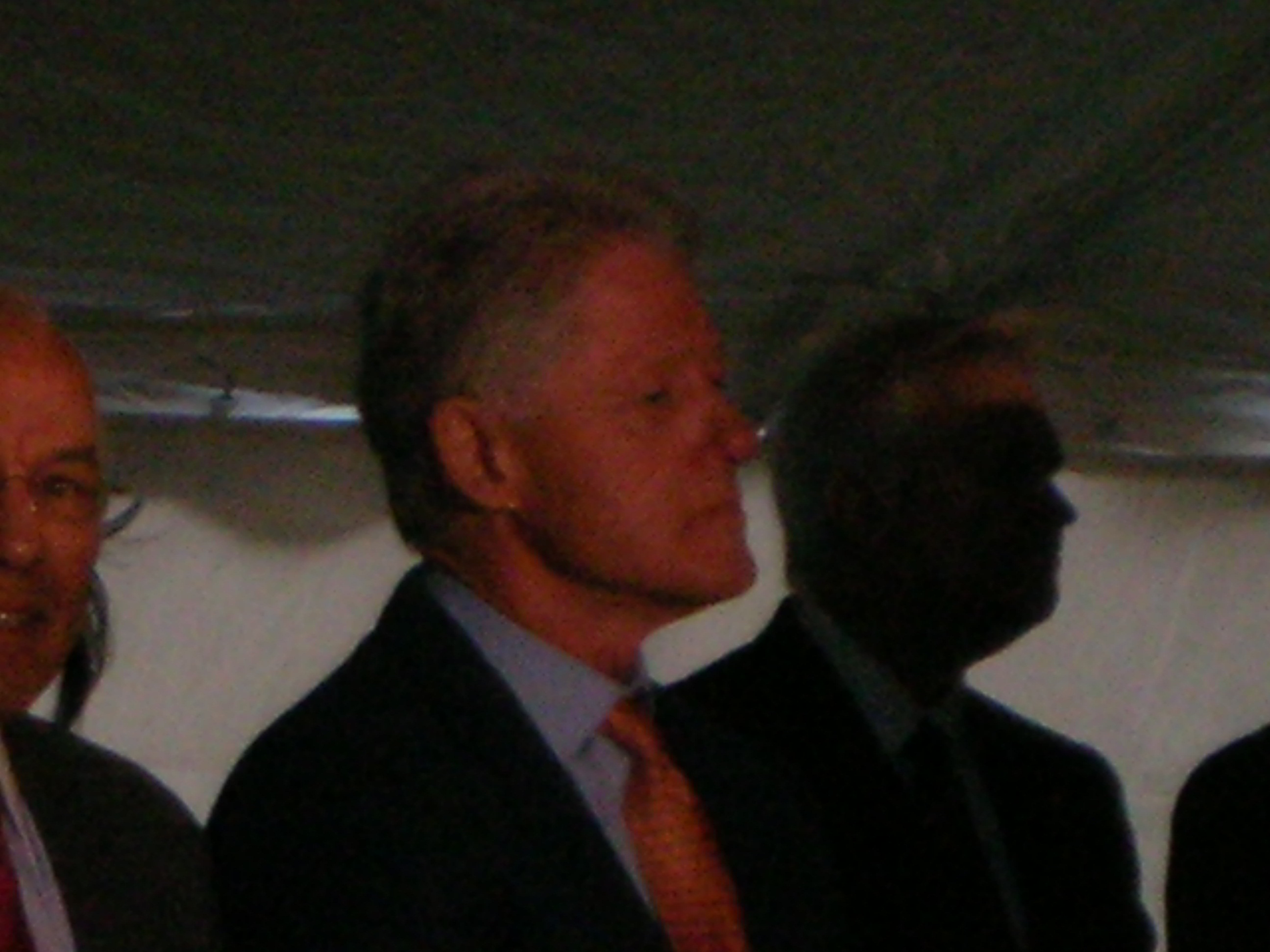
This is a picture of President Clinton that I took at UNO a few months after Hurricane Katrina. I was the only person teaching on the main campus at that time and had 5 students in my class. Clinton's listening to the first President Bush. They came to present the universities here with checks to help us get through the Hurricane damage. Who will help us overcome the damage wrought by Jindal the Terrible?

 peej
peej Carissa
 bostonboomer
 dakinikat
 ecocatwoman
 mablue2
 Mama Lopez
 peggysue22
 quixote
 skydancingguestblogger
 Mona (aka Wonk the Vote)



 Sky Dancing
Recent Comments