

Denali’s name has long been seen as one such slight, regarded as an example of cultural imperialism in which a Native American name with historical roots was replaced by an American one having little to do with the place.
The central Alaska mountain has officially been called Mount McKinley for almost a century. In announcing that Sally Jewell, the secretary of the interior, had used her power to rename it, Mr. Obama was paying tribute to the state’s Native population, which has referred to the site for generations as Denali, meaning “the high one” or “the great one.”
The peak, at more than 20,000 feet, plays a central role in the creation story of the Koyukon Athabascans, a group that has lived in Alaska for thousands of years.
Mr. Obama, freed from the political constraints of an impending election in the latter half of his second term, was also moving to put to rest a years long fight over the name of the mountain that has pit Alaska against electorally powerful Ohio, the birthplace of President William McKinley, for whom it was christened in 1896.
The government formally recognized the name in 1917, and efforts to reverse the move began in Alaska in 1975. In an awkward compromise struck in 1980, the national park surrounding it was named Denali National Park and Preserve, but the mountain continued to be called Mount McKinley.
Senator Lisa Murkowski, Republican of Alaska, introduced legislation in January to rename the peak, but Ohio lawmakers sought to block the move. In June, an Interior Department official said in testimony before Congress that the administration had “no objection” to Ms. Murkowski’s proposed change.
Monday Reads
Posted: August 28, 2017 Filed under: Afternoon Reads | Tags: Climate change, FEMA, flooding, Houston, Hurricane Harvey, Texas 22 Comments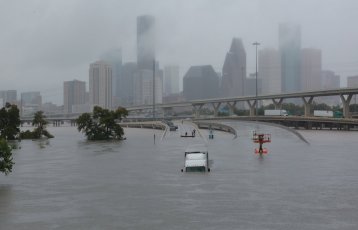 Good Afternoon!
The unfolding drama of the flooding of Houston and surrounding areas takes me back 12 years ago to Katrina when my community was surrounded by a similar hell realm full of water, the stench of death, and mass destruction. Right now, Houston is relying on skilled first responders, its local government, and neighbors. Soon, it will be a test of our country’s ability to help our own as well as the test of the charity of nations around the world.
What is it going to take for Republican decision makers to understand that some things are too big and too important to be left to the for-profit-motivated private sector of carpet baggers? When will they realize their constant denial of science and sycophantic support of the fossil fuel industry is driving us to epic catastrophe?
Twelve years ago I was hunkered down on a pink futon with my two yellow labs–Karma and Honey–and Miles in between the beds of a grad student from Macau and one from Japan. My cell phone could receive but not make calls. We were watching TV with the families of two other grad students that I had earlier told to get the hell out of dodge while they could still get a hotel room. One family from Turkey. The other from Jordan. I know what it’s like to be homeless, scared, broke, and confused. A day later, I discovered I had to go some place and that my university had failed to pay me. I was totally reliant on the goodness of others and much of that goodness came from the people of Texas and Nebraska and the American Tax Payer. There were a few local businesses that helped but the majority of help came from people and the Federal Government.
This is the kind of event that tests our character as a country and we have a soulless narcissist at its helm. I laugh at the ChristoFascist preachers who blame liberal political views for Gawd’s wrath as seen in these natural disasters. It seems more likely that their Gawd keeps testing Republican Presidents and finds their governing ways come short of dealing with hell and high water. The Republican Bushs and now a Trump have faced historic hurricanes. While the Clinton and Obama administrations have tried to rebuild our ability to respond through FEMA and other agencies, it took no time for this latest Republican disaster to seek to gut our ability to help our neighbors in need. It always amazes me that tax cuts for the wealthy come before helping our neighbors in harm’s way.
This destruction is a window into the future of climate change. This is what happens when humanity fails to either meaningfully restrict greenhouse gas emissions or prepare for the damage that is certainly coming.
Now, before the inevitable pedant brigade pounces in, that doesn’t mean Harvey was definitely caused by climate change. Global temperatures have only markedly increased for a few decades, and extreme weather events are rare and random by definition. It will take many more years for enough data to be collected to be able to establish causality.
But what we can say is that climate science predicts with high confidence that increased temperatures will increase the likelihood of extreme weather.
It will make hurricanes that do form stronger. It may also increase the number of hurricanes, though that’s harder to predict with certainty. It’s also besides the point. A storm doesn’t need to qualify as a hurricane to pose many of the same dangers. Simple big storms can still have high winds, tornadoes, and especially flooding, which is the major danger along the Gulf Coast.
 I’m calling real estate agents and getting out of here. I am too old to exist in red state beholden to oil and gas industries where people refuse to see that science is right. I’m too tired to live in areas where suburban sprawl and concrete provides run off for massive rain creating risks that all too often fall on the heads and homes of people like me. Climate change is likely responsible for the kinds of stalled, training storms like Harvey. Human destruction of nature’s ways of dealing with water exacerbates it.
Persistent episodes of extreme weather in the Northern Hemisphere summer have been shown to be associated with the presence of high-amplitude quasi-stationary atmospheric Rossby waves within a particular wavelength range (zonal wavenumber 6–8). The underlying mechanistic relationship involves the phenomenon of quasi-resonant amplification (QRA) of synoptic-scale waves with that wavenumber range becoming trapped within an effective mid-latitude atmospheric waveguide. Recent work suggests an increase in recent decades in the occurrence of QRA-favorable conditions and associated extreme weather, possibly linked to amplified Arctic warming and thus a climate change influence. Here, we isolate a specific fingerprint in the zonal mean surface temperature profile that is associated with QRA-favorable conditions. State-of-the-art (“CMIP5”) historical climate model simulations subject to anthropogenic forcing display an increase in the projection of this fingerprint that is mirrored in multiple observational surface temperature datasets. Both the models and observations suggest this signal has only recently emerged from the background noise of natural variability.
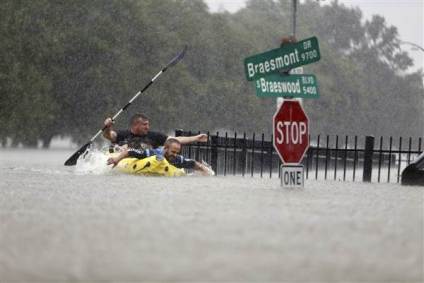 The increase in the occurrences of 100, 300 and 500 year events in my backyard is statistically significant. It also is positively correlated to Climate Change. That’s the science. Sea level rises have a lot to do with the destruction of the natural barriers to storm surge that are particularly a side product of things that the oil and gas industry do. This is the risk of that business forced onto humanity, nature, and the tax payer.
But Ojeda is watching the Atlantic hurricane season that begins on June 1 with more concern than usual. The retired Coast Guard employee worries that rising sea levels could make the next hurricane more destructive than those he’s lived through.
“That’s really scary to me,” the 70-year-old said.
A study released in May shows that rising sea levels threaten to make storm surges more dangerous, seemingly reinforcing Texas officials’ push for federal funding for a storm-surge barrier, or Ike Dike, to protect Galveston.
“Every storm surge today reaches higher because it starts from a higher level, because sea level is higher,” said study co-author Ben Strauss, a scientist who is vice president for sea level and climate impacts for Climate Central, a group of scientists and journalists dedicated to climate change awareness. “A small amount of sea-level rise can lead to an unexpectedly large increase in damages to most kinds of structures.”
Brian Streck, 62, a retired Galveston firefighter, has watched high tides creep into the streets around the house at the edge of West Galveston Bay, where he has lived for 37 years.
He has no patience for climate-change deniers who doubt seas are rising.
“I’ve witnessed it,” Streck said.
High tides once flooded the streets around his home about twice a year; the flooding in the last decade has increased to a dozen times a year.
“I’ve considered selling this place because eventually I’m going to have a lake house,” he said.
Scientific studies have established an acceleration in sea-level rise because of a warming atmosphere. Coal and oil burning and the destruction of tropical forests have increased heat-trapping gases that have warmed the planet by 1.8 degrees since 1880. Earth has been losing 13,500 square miles of ice annually since 1979, according to the National Oceanic and Atmospheric Administration.
Sea levels are generally rising faster along the Texas Gulf Coast and the western Gulf than the average globally, according to a January study by NOAA.
“The western Gulf is experiencing some of the highest rates of relative levels of sea-level rise in the country,” said NOAA oceanographer William Sweet, lead author of the study. “The ocean is not rising like water would in a bathtub.”
Sea-level rise is making storm surges larger, said John Nielsen-Gammon, Texas state climatologist at Texas A&M University in College Station.
“Compared to a storm that would have hit, say, 30 years ago, the additional storm surge we are talking about is on the order of … about 7 inches,” Nielsen-Gammon said.
The NOAA study found sea levels rising at more than double the rate estimated during the 20th century, increasing to more than 0.13 inch annually. NOAA made six projections of sea-level rise, from low to extreme, and found the global mean level under the lowest projection could rise 2.3 inches by 2020 and 3.5 inches by 2030. The extreme projection shows a 4.3-inch rise by 2020 and a 9.4-inch rise by 2030.
The rate of sea-level rise even under the lowest projection would increase the chances of severe flooding on the Texas Gulf Coast from storm surges or other causes from once every five years to once every two years by 2030 under the extreme projection, and 2060 under the low prediction.
“We’re not talking much longer than a mortgage cycle,” Sweet said. “I just bought a house, I’ve got a 30-year note. That’s 2047.”
By 2100, sea level is expected to rise between 1.3 feet and 31 feet, the NOAA study predicts; Galveston Island and most of the Texas coast would be swallowed up under the latter scenario.
 Scientist Michael Mann keeps doing compelling science and making cogent arguments that are being ignored by policy makers. He’s the scientist behind the research on the “rain bombs”. That’s a term with a lot of click bait appeal. But, how do you get anyone to listen when you discuss things like this? What happens when a hurricane parks itself over you home or an intense thunderstorm sits over you city and just does nothing but dump rain for days on end in biblical amounts?
So Harvey was almost certainly more intense than it would have been in the absence of human- caused warming, which means stronger winds, more wind damage, and a larger storm surge (as an example of how this works, we have shown that climate change has led to a dramatic increase in storm surge risk in New York City, making devastating events like Superstorm #Sandy more likely (http://www.pnas.org/content/112/41/12610.full).
Finally, the more tenuous but potentially relevant climate factors: part of what has made Harvey such a devastating storm is the way it has stalled right near the coast, continuing to pummel Houston and surrounding regions with a seemingly endless deluge which will likely top out at nearly 4 feet of rainfall over a several days-long period before it is done.
The stalling is due to very weak prevailing winds which are failing to steer the storm off to sea, allowing it to spin around and wobble back and forth like a top with no direction. This pattern, in turn, is associated with a greatly expanded subtropical high pressure system over much of the U.S. right now, with the jet stream pushed well to the north. This pattern of subtropical expansion is predicted in model simulations of human-caused climate change.
More tenuous, but possibly relevant still, is the fact that very persistent, nearly ‘stationary’ summer weather patterns of this sort, where weather anomalies (both high pressure dry hot regions and low-pressure stormy/rainy regions) stay locked in place for many days at a time, appears to be favored by human-caused climate change.
How will the Texas Representatives and Senators respond to the disaster in their own back yards? Will they fight funding they way they fought it for those impacted by Super Storm Sandy? Will Kremlin Caligula with his 2 second attention span be able to rise to the occasion of saving lives and help people rebuild and heal? What about threats to shut down the Federal Government over funds for the Wall?
The catastrophic floods brought by Hurricane Harvey to southeastern Texas will pose an immediate test for the White House and Congress, pressing policymakers to approve billions of dollars in recovery funds even though they haven’t agreed on much else this year.
White House officials and GOP leaders were already taking stock of the challenge on Sunday, even as the floodwaters in Texas — and the eventual cost of recovery — were still rising. One senior White House official and GOP aides on Capitol Hill said late Sunday they expected to begin discussing an “emergency” package of funding soon to help with relief and rebuilding efforts, even if agreement as to the size of such a package remained premature.
Harvey’s devastation poses President Trump’s first test in emergency assistance, potentially revealing whether he can overcome Congress’s deep divisions over spending and the budget to prioritize aid. It will also test whether Trump can suspend his adversarial governing style and even postpone his own agenda, notably an overhaul of the tax code, to assemble a major — and costly — package that could be directed to law enforcement, emergency relief, schools, infrastructure, hospitals, food banks and several other entities.
The storm comes as Washington was gripped with a budget battle and little time to resolve differences. Many government operations are funded through only the end of September, and Trump has threatened to partially shut down the government if lawmakers don’t approve $1.6 billion in funding to construct parts of a wall along the U.S.-Mexico border.
Harvey could upend that budget fight, pressuring politicians to reach a quick resolution. That is because a government shutdown could sideline agencies involved in a rescue and relief effort that officials are predicting will last years.
 This battle starts after the battle first responders and volunteers are making to save lives ends. This is still an ongoing disaster. There is still very much potential, additional for flooding the next few days. It is still happening now. Two Reservoirs are being opened that will contribute to flooding. Resources will undoutedly be running short as well be tempers.
In Houston, reservoirs swollen by rain from Hurricane Harvey were opened early Monday, a move that was expected to flood more homes — but one that the Army Corps of Engineers says is needed to limit the scope of the disaster that’s threatening lives and property in Texas.
“If we don’t begin releasing now, the volume of uncontrolled water around the dams will be higher and have a greater impact on the surrounding communities,” said Col. Lars Zetterstrom, commander of the U.S. Army Corps of Engineers Galveston District. He warned residents to stay vigilant as water levels rise.
Around midday Monday, Gov. Greg Abbott activated the entire Texas National Guard to support communities cope with the flooding. Thousands of guard members were already deployed in the effort; the number now stands at roughly 12,000.
Gates to Houston’s reservoirs were opened as emergency crews and residents scramble to deal with the intense rains brought by Harvey, which became a tropical storm after making landfall as a Category 4 storm late Friday.
Houston set a new daily rainfall record Sunday, with 16.07 inches reported at the city’s international airport, the National Weather Service says. On Saturday and Sunday, more than 2 feet of rain (24.44 inches) fell.
Scientific American reminds us that Harvey had some disturbing features that has caused it to be so destructive. Is this our future? If so, will our policy makers rise to the challenge of disrupting our contribution to climate change and providing adequate federal funding and systems to support our neighbors in need because they failed to act when they could?
I have to admit that my Katrina PTSD is full force between the images on my TV, its 12th anniversary, and the knowledge that Harvey could still do irrational things like move back in to the Gulf to strengthen. It’s path and timing is still so uncertain. Now is the time we need heroes and leadership. The heroes are on the ground. We have to wait and see when it comes to the leadership.
What’s on your reading and blogging list today? Also, please Texas Sky Dancers! Let us know if we can help!!! Let us know if you’re okay!! We’re here for you!!!
Monday Reads
Posted: December 14, 2015 Filed under: Afternoon Reads, morning reads | Tags: Climate change, coast erosion, Louisiana, Miami floods 21 CommentsGood Morning!
I thought I’d provide some links and information on the climate change negotiations in Paris. This was something I planned to blog on earlier but so much crazy is going on that it’s distracted me. Rather than open up with the details, I’m starting with a New Yorker article about how predictable the flooding has gotten in Miami and how an elderly Florida professor believes the surrounding area has less than 50 years to go before its completely submerged. That’s a pretty astounding hypothesis and I speak as New Orleanian on one of the few strips of land that sits comfortably above current sea level knowing we’re not that far behind. New York City should be concerned too. But, for right now, back to becoming a disaster tourist where it’s actually possible to schedule your viewing of Miami floods. They are now that predictable.

The city of Miami Beach floods on such a predictable basis that if, out of curiosity or sheer perversity, a person wants to she can plan a visit to coincide with an inundation. Knowing the tides would be high around the time of the “super blood moon,” in late September, I arranged to meet up with Hal Wanless, the chairman of the University of Miami’s geological-sciences department. Wanless, who is seventy-three, has spent nearly half a century studying how South Florida came into being. From this, he’s concluded that much of the region may have less than half a century more to go.
We had breakfast at a greasy spoon not far from Wanless’s office, then set off across the MacArthur Causeway. (Out-of-towners often assume that Miami Beach is part of Miami, but it’s situated on a separate island, a few miles off the coast.) It was a hot, breathless day, with a brilliant blue sky. Wanless turned onto a side street, and soon we were confronting a pond-sized puddle. Water gushed down the road and into an underground garage. We stopped in front of a four-story apartment building, which was surrounded by a groomed lawn. Water seemed to be bubbling out of the turf. Wanless took off his shoes and socks and pulled on a pair of polypropylene booties. As he stepped out of the car, a woman rushed over. She asked if he worked for the city. He said he did not, an answer that seemed to disappoint but not deter her. She gestured at a palm tree that was sticking out of the drowned grass.
“Look at our yard, at the landscaping,” she said. “That palm tree was super-expensive.” She went on, “It’s crazy—this is saltwater.”“Welcome to rising sea levels,” Wanless told her.
According to the Intergovernmental Panel on Climate Change, sea levels could rise by more than three feet by the end of this century. The United States Army Corps of Engineers projects that they could rise by as much as five feet; the National Oceanic and Atmospheric Administration predicts up to six and a half feet. According to Wanless, all these projections are probably low. In his office, Wanless keeps a jar of meltwater he collected from the Greenland ice sheet. He likes to point out that there is plenty more where that came from.
“Many geologists, we’re looking at the possibility of a ten-to-thirty-foot range by the end of the century,” he told me.
We got back into the car. Driving with one hand, Wanless shot pictures out the window with the other. “Look at that,” he said. “Oh, my gosh!” We’d come to a neighborhood of multimillion-dollar homes where the water was creeping under the security gates and up the driveways. Porsches and Mercedeses sat flooded up to their chassis.
“This is today, you know,” Wanless said. “This isn’t with two feet of sea-level rise.” He wanted to get better photos, and pulled over onto another side street. He handed me the camera so that I could take a picture of him standing in the middle of the submerged road. Wanless stretched out his arms, like a magician who’d just conjured a rabbit.
In the Miami area, the daily high-water mark has been rising almost an inch a year.
CREDIT ILLUSTRATION BY JACOB ESCOBED
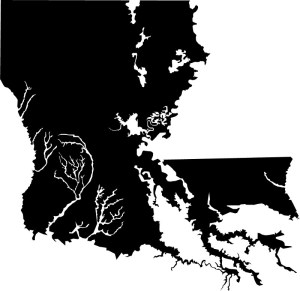 I guess the bottom line is to go short on real estate in Southern Florida and don’t expect your private supplemental flood insurance to come cheap.
Louisiana has already lost its boot. There is significant land loss here and the National Climate Change report has put Louisiana and New Orleans as one of the country’s most vulnerable locations behind Southern Florida.
Louisiana will see billions of dollars in increased disaster costs as early as 2030 resulting from the combined effects of global warming and natural processes, according to a new National Climate Assessment report released by the White House on Tuesday (May 6).
The report also warns that sea level rise – combined with naturally-occurring subsidence – continues to threaten wetlandsand land bordering the state’s most populated areas, increasing their risk from storm surges; and that sea level rise driven by human-induced global warming also threatens interstate highways, railroads, ports, airports, oil and gas facilities and water supplies.
“The southeastern region is exceptionally vulnerable to sea level rise, extreme heat events and decreased water availability,” said Kirsten Dow, a geography professor at the University of South Carolina and one of the authors of chapters in the report, during a telephonic news conference on the report.
The state’s agriculture also is threatened by sea level rise that could contaminate shallow groundwater tables, the report said.
Louisiana’s residents also will see a significant increase in the number of days when the temperature reaches 95 degrees Fahrenheit, and a significant reduction in the days when temperatures drop below 32 degrees, according to the report. The temperature changes are likely to pose a threat to the health of at-risk populations, including those who are chronically ill or elderly.
We’re also getting an unseasonably warm December. I’m trying to be sympathetic with my NYC friends who are complaining about needing AC and shorts. This weather might be taken as an outlier if the average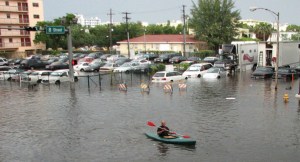 temperatures over an extended period of time haven’t trended upward by such a statistically significant amount.
It’s beginning to look a lot like — September? While retailers may be hitting their full holiday shopping season stride, Mother Nature is not doing her part to put people in the Christmas spirit.
Unseasonably mild temperatures are spreading over the eastern half of the country and about 75% of the U.S. population will see the temperature climb over 60°F by the end of the weekend, hardly a winter wonderland. Don’t be surprised to find holiday shoppers wearing shorts while strolling along Michigan Avenue in Chicago this weekend, as temperatures in the low 60s will make it feel more like late September or early October.
Many folks are asking if the relatively successful Paris agreements on Climate Change are our last best hope for the planet? Rebecca Leber–writing for The New Republic—suggests they may help prevent doom.
These negotiations essentially determined the future course of the world. For a long time we’ve needed an agreement that covers the vast majority of carbon emissions and lays out in no uncertain terms that they are on a long-term downward trajectory. But to get there, 195 countries had a decision to make: Would they allow individual disagreements to lock the planet into a future of unrestrained warming, or would they make the hard choices necessary to chart a safer path?
While the Paris agreement is far from perfect, the text as a whole makes a convincing case for hope. The world is a little less doomed now.
Based on the domestic pledges made by 187 countries, covering some 95 percent of global emissions, the Earth’s average temperature could now rise by somewhere between 2.7 to 3.5 degrees Celsius over the course of the century. That’s still far too high, and shows how much work remains, but it is an improvement over the path of unrestrained pollution we were on before Paris.

A woman wearing a mask walk through a street covered by dense smog in Harbin, northern China, Monday, Oct. 21, 2013. Visibility shrank to less than half a football field and small-particle pollution soared to a record 40 times higher than an international safety standard in one northern Chinese city as the region entered its high-smog season. (AP Photo/Kyodo News) JAPAN OUT, MANDATORY CREDIT
Beijing and Delhi are two of the worst polluted cities in the world. How the two of them deal with that pollution is important to the success of any strategy dealing with carbon emissions hoping to stem climate change. Beijng has smog emergency days frequently. I remember these from L.A. in the late 1960s when I visited my grandparents who retired there. An rusty colored cloud hung over that city and was the first thing I remember seeing when we would drive over the mountains and get a glimpse. Things have changed since Nixon’s EPA-related laws, but not enough. However, even the worst smog days in old L.A. have nothing on New Delhi and Beijing. These cities are also the ones begging for mercy on an pollution control mandates coming from the Paris negotiations.
When Beijing’s air was forecast to reach hazardous levels for three straight days earlier in December, the government issued a smog red alert. The result: Half the city’s cars were off the roads within hours, schools were closed and construction sites shut down. Less than three days later, pollution levels had dropped by 30 per cent.When New Delhi’s winter air grew so bad that High Court warned that “it seems like we are living in a gas chamber,” the city’s top official declared that cars would be restricted starting January 1, with odd and even license plates taking turns on the roads. But police officials quickly announced they hadn’t been consulted, and said they’d have trouble enforcing the rule. Plus, no one could fully explain how the already overstretched public transit system could absorb millions of additional commuters overnight.So, well, maybe the whole plan will be scrapped.”If there are too many problems, it will be stopped,” Delhi Chief Minister Arvind Kejriwal said in a speech a couple days after his announcement. “We will not do anything which will cause inconvenience to the public.”Long famous for its toxic air, Beijing is struggling to lose that reputation, bowing to pressure from a growing middle class to keep pollution under control. Traffic is regularly restricted in the city, factories have been moved and the Central Government is anxious to ratchet down the country’s use of coal-burning power plants.And New Delhi, which by many measures now has far more polluted air than Beijing? So far, the green panel has ordered that no diesel cars be registered in the city for the next few weeks, and has discouraged the government from buying diesels for government fleets. Officials, meanwhile, have suggested everything from car-free days to planting more trees to dedicated bus lanes.
Here is a short outline on the key points of the accords and the impact on India. Developing nations were given a lot of leeway. Getting this kind of agreement was difficult given the many agendas of the various countries.
The Paris accord builds upon the bottom up approach of voluntary commitments or Intended Nationally Determined Commitments(INDCs) from both developed and developing countries. The accord urges parties to enhance their pre-2020 emission cuts and acknowledges the significant gap between current pledges and what is needed to be consistent with holding temperature rise to 1.5 degrees. Countries are expected to submit revised INDCs by 2020, and every five years thereafter. Modi in his opening speech at the negotiations highlighted the need to operationalise the principle of equity and fair distribution of the remaining carbon space (i.e. the amount of carbon we can further emit before breaching average temperature threshold).
Modi in his opening speech at the negotiations highlighted the need to operationalise the principle of equity and fair distribution of the remaining carbon space (i.e. the amount of carbon we can further emit before breaching average temperature threshold).
But by deferring ambitious carbon reductions from the developed countries post 2020, which will still remain voluntary, India has effectively accepted a scenario where a fair carbon budgeting is a distant dream. India, it appears, will instead push hard for greater financing and capacity building for a renewable energy transition.
The one thing the December 12th agreement has is a commitment to phase out the use of fossil fuels. This is something the EU has been working on aggressively.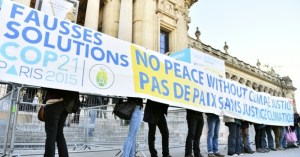
The agreement commits its signatories to a wonky goal: A “balance between anthropogenic emissions by sources and removals by sinks of greenhouse gases” before the end of the century. In practice, that means an economy with net zero emissions as soon as possible, paving the way for a massive uptake in renewable energy and the careful preservation of the world’s forests. It also includes a global temperature target of “well below” a rise of 2 degrees Celsius above pre-industrial levels and instructs them to “pursue efforts” to keep the increase to just 1.5 degrees, amajor victory for the small island countries that formed the moral heart of the negotiations.
Negotiators worked throughout the two weeks—plus an extra day—on delivering a bold compromise, arriving with legally binding language on financial and technical support to developing countries and a novel “ratchet” mechanism that commits all nations to return to the negotiating table and increase their ambition every five years.
Shipping and air travel, which account for about 8 percent of global emissions, were excluded from the agreement due to the quirk of their international nature, though even those sources are scheduled to be part of separate agreements next year.
It’s by no means a perfect deal, but the final wording of the agreement reflects major achievements in science and diplomacy that have been in the works for decades. Small island countries, in particular, played a critical role at bridging differencesbetween the major developed countries, like the U.S. and Europe, and major developing countries, like India and China. This is an agreement that’s designed to last a century, and will shape the trajectory of both threatened ecosystems and the global economy for the foreseeable future.
As you read links, you will see that this is a very slow and incremental process. It is probably too slow to save both the Louisiana Coast and Southern Florida. Here’s the most comprehensive information on the negotiations and accords.
Here are key resources on the Paris Agreement and events leading up to it.
Summary of the Paris Agreement
Parties to the U.N. Framework Convention on Climate Change (UNFCCC) reached a landmark agreement on December 12 in Paris, charting a fundamentally new course in the two-decade-old global climate effort.
The agreement reached in Paris at the conclusion of COP 21 seeks to address rising emissions and climate imapcts with tools to hold countries accountable and build ambition over time.
Essential Elements of a Paris Climate Agreement
A concise, comprehensive guide to what Paris needs to deliver: a legal agreement that ensures strong accountability and spurs rising ambition. Issues include long-term direction, mitigation, adaptation, finance, transparency and updating of national contributions.
A Primer on the Paris Climate Talks
Questions and answers on the history of the U.N. climate talks, key issues under negotiation, the legal nature of the agreement, implications for U.S. acceptance, and what happens after Paris.
Business Support for the Paris Agreement
Fourteen major companies joined a statement organized by C2ES calling for an agreement that provides clearer long-term direction, strengthens transparency, promotes greater comparability of effort, and facilitates the global carbon market.
Read a seminal report from the co-chairs of C2ES’s Toward 2015 dialogue, which brought together top negotiators from two dozen countries for a series of candid, in-depth discussions that forged common ground on key issues for Paris.
Legal Options for U.S. Acceptance
This C2ES legal analysis examines whether the Paris climate agreement can be accepted by the president under executive authority or must be approved by Congress.
So, this is a bonus, creepy crime-ridden tale of swampy Louisiana and it involves one of my favorite topics. There’s an abandoned pet cemetery with a complex and dark history that was featured by a photographer shooting during the Katrina 10 year anniversary. It’s actually got violent history back to about 1854 when it was still part of a vast plantation and hosted a duel. It seems an odd way to end a climate change post but just think how creepy it’s going to be when a whole lot of today’s real estate is an abandoned, swampy ghost town. That’s where we’re headed.
The duel may have marked the first of many bloodspills involving the Toca pet cemetery property’s once and future owners, as well as those intangibly associated with what is now an overgrown, bayou-side graveyard and the axis of a recently exhumed 27-year-old murder investigation. The probe has opened a crack in an ageless odyssey of killings, betrayal, buried treasure and intrigue, all tied to a 14-acre tract in tiny Toca, Louisiana.
Today, the property consists of a derelict but once classic Edwardian manor encircled by overgrown animal tombstones on the right bank of Bayou Terre-aux-Boeufs, just below Poydras in rural St. Bernard Parish, about four miles from the Mississippi River.
Last month, authorities claimed to have solved the most recent crime on this killing field of south Louisiana when the St. Bernard Sheriff’s Office booked Brandon Nodier, a former groundskeeper at the cemetery, with the 1985 murder of Dorothy Thompson, an heiress whose own legacy is splattered with bloodshed. But many intrigues, such as the whereabouts of a missing half million dollar fortune, perhaps will linger forever, lost with those now dead and gone.
Historic court records, police reports, newspaper clippings, biographies, interviews, marriage, divorce and death records reveal a bizarre history of the pet cemetery that for three decades attracted animal lovers from throughout the South.
So, that’s it from me on a gloomy New Orleans Monday.
What’s on your reading and blogging list today?
Tuesday Reads: September Heat Wave
Posted: September 8, 2015 Filed under: morning reads, U.S. Politics | Tags: Climate change, global warming, heat wave, Hillary Clinton, Senate 45 CommentsGood Morning!!
It’s September, but it feels like July here in Boston. We’re having another heat wave, and the same is true in many other parts of the country. Fortunately, most of us will get some relief later in the week.
From Weather.com: Pattern Change to Bring Heat Relief to Midwest, Plains, East; West Coast Heats Up.
Hot temperatures have dominated parts of the Midwest, Plains and East during the first week of September, with highs topping out well into the 80s and 90s at times. While some might be enjoying this late-summer heat and humidity, others are probably ready for the air to have more of a fall feel east of the Rockies. For those in the latterI’ camp, we do have some good news on the horizon thanks to a rearrangement of the jet stream pattern.
For the Midwest and parts of the East, temperatures will drop to near-average or even below-average levels as the week progresses. In fact, some cities in the Midwest may see high temperatures fall 20 degrees or more from early week into mid or late week. Even more impressive is the temperature drop from highs early this week to lows later in the week. For example, Chicago had a high of 92 degrees on Sunday but will see lows in the 50s late in the week, a drop of more than 30 degrees.
Before the cooler air arrives in the Northeast, daily record high temperatures will be threatened in multiple locations, including New York City, Philadelphia, Hartford and Boston on Tuesday.
Meanwhile, the West Coast will see the opposite impact from this pattern change with temperatures soaring above average all the way into the Pacific Northwest.
Read all the details at the link.

People cool off at fountains on Rose Kennedy Greenway, Boston
From the Weather Wisdom column at The Boston Globe: September heat wave begins today and continues through Wednesday.
Back in 1881, the mercury rose to a stifling 102 degrees in Boston for the hottest temperature in the record books during the month of September. This was also one of the hottest days ever in Boston.
Typically our highs would be in the 70s closing out the first week of September, during a cool year we might stay in the 60s while other warmer years would reach the 80s. Today marks only the 5th time since records began in Boston we have reached 90 degrees on September 7th.
Heat Wave Number 2
Having already eclipsed the 90 mark, it’s almost a sure bet we are beginning a 3 day heat wave. Remember, heat waves are 3 days or more in a row when the high temperature reaches at least 90 degrees. Tomorrow and Wednesday are even hotter and as the humidity slowly climbs the heat indices could get near 100 degrees for a few hours either or both days.The map below shows highs in the mid-90s tomorrow. This would be the 9th time Boston has reached 90 on the 8th of September. The record for tomorrow is 95 and there is a chance would could tie that record.
Another 90 degree day on Wednesday will make it an official heat wave. There are only 3 days where it’s reached 90 on the 9th and this year should make 4. The record Wednesday is 91 and we would likely set a new record.
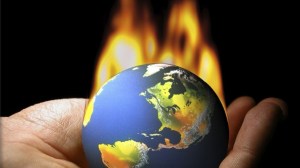
On days like this, I can’t help thinking about our changing climate and how it will affect future generations. This is another reason why we must elect a Democratic president next year. President Obama has been able to make some progress on this issue through executive orders; to build on his efforts, we desperately need to elect Hillary Clinton president and hope that she can bring along enough Democrats to regain the Senate.
From The Hill: Democrats pin hopes on Hillary for winning back the Senate.
The battle for control of the Senate rests on the outcome of the presidential race, strategists in both parties say.
Since 1860, no party has been able to climb out of the minority to capture the Senate during a presidential election year without also winning the White House….
Democrats appear well positioned to knock off two Republican incumbents, but whether they can stretch the number of Senate pick-ups to the necessary four or five while defending two of their own vulnerable seats remains to be seen.
The election map favors Democrats. They are defending only 10 Senate seats, while Republicans are protecting 24, including seven in states carried by President Obama in 2012.
But Democrats are running against the grain of history by trying to keep the White House for three consecutive terms — a feat last accomplished by Republicans in 1988, when Ronald Reagan left office with a 53-percent approval rating. Obama’s approval rating, by comparison, stands at 45 percent, according to Gallup.
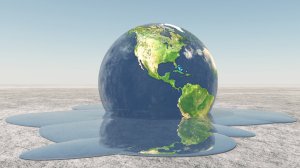
Just one more reason why we need to support Hillary. “The article quotes “Steve Elmendorf, a Democratic strategist, lobbyist and fundraiser.”
“Ted Strickland can beat Rob Portman if Hillary Clinton is winning Ohio. Pat Toomey, no matter how good he looks on paper and the problems we’re having with the primary, I think if you get to November and Democrats are winning Pennsylvania by a huge number, Toomey’s in a lot of trouble,” he said
“If Democrats don’t win the presidential race, I don’t think we’ll win the Senate,” he added.
The map of key Senate races largely matches up with the map of presidential battlegrounds.
Aside from Wisconsin and Illinois, where Republican incumbent Sens. Ron Johnson (Wis.) and Mark Kirk (Ill.) are fighting for their political lives in blue states, the most competitive Senate contests are in presidential swing states.
Johnson trails former Democratic Sen. Russ Feingold in Wisconsin by five points, according to a mid-August Marquette Law School poll, and Democrats predict Feingold will raise more money.
Kirk, meanwhile, lagged six points behind Rep. Tammy Duckworth (D-Ill.) in a late-July survey by Public Policy Polling, a Democratic firm.
More details at the link.
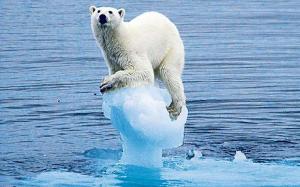
Getting back to climate change, The Washington Post had an important article yesterday: New studies deepen concerns about a climate-change ‘wild card.’
Two new studies are adding to concerns about one of the most troubling scenarios for future climate change: the possibility that global warming could slow or shut down the Atlantic’s great ocean circulation systems, with dramatic implications for North America and Europe.
The research, by separate teams of scientists, bolsters predictions of disruptions to global ocean currents — such as the Gulf Stream — that transfer tropical warmth from the equator to northern latitudes, as well as a larger conveyor system that cycles colder water into the ocean’s depths. Both systems help ensure relatively mild conditions in parts of Northern Europe that would otherwise be much colder.
The papers offer new insight into how rapidly melting Arctic ice could slow or even temporarily halt the ocean’s normal circulation, with possible effects ranging from plunging temperatures in northern latitudes to centuries-long droughts in Southeast Asia….
One study, by three scientists from Germany’s Alfred Wegener Institute, uses computers to model how Greenland’s rapid thawing could affect the Atlantic meridional overturning circulation, the system that pushes cold, dense saltwater into the deep ocean and helps transport warm water northward, helping to warm Europe’s climate.
Their report, in the journal Geophysical Research Letters, says previous research may have underestimated changes to the ocean from the huge influx of fresh, cold water from melting ice sheets. Using new methods, the German scientists were able to estimate more precisely how much ice would melt and how all that added freshwater would affect ocean circulation. In the ocean, colder water normally tends to sink, but cold freshwater — less dense than saltwater — stays near the surface, disrupting the normal flow.
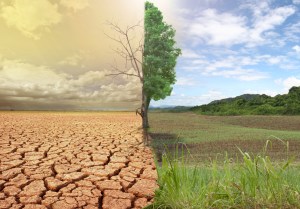
The researchers concluded that we’ve already gone pretty far down the road on climate change, but there are still things society can do the prevent the worst scenarios from coming to pass.
A second paper, by a team of Texas scientists, sheds new light on how the Earth’s climate responded during a similar thaw from the planet’s geological past. About 12,000 years ago, rising temperatures at the end of the last ice age released huge volumes of cold freshwater, disrupting the ocean’s circulation systems and sending parts of the Northern Hemisphere back in to the freezer. Scientists refer to the era as the Younger Dryas period.
The study in the journal Nature Climate found a wide range of impacts, some of which lingered for centuries. While the far-northern latitudes experienced rapid changes — including an 18-degree Fahrenheit temperature drop in Greenland in less than a decade — droughts and other weather anomalies in the southern Pacific persisted for 1,000 years.
Read the rest at the WaPo.
Is it possible we’ve reached a turning point? Jonathan Chait thinks so: This is the year humans finally got serious about saving themselves from themselves.
Here on planet Earth, things could be going better. The rise in atmospheric temperatures from greenhouse gases poses the most dire threat to humanity, measured on a scale of potential suffering, since Imperial Japan and Nazi Germany launched near-simultaneous wars of conquest. And the problem has turned out to be much harder to solve. It’s not the money. The cost of transitioning away from fossil fuels, measured as a share of the economy, may amount to a fraction of the cost of defeating the Axis powers. Rather, it is the politics that have proved so fiendish. Fighting a war is relatively straightforward: You spend all the money you can to build a giant military and send it off to do battle. Climate change is a problem that politics is almost designed not to solve. Its costs lie mostly in the distant future, whereas politics is built to respond to immediate conditions. (And of the wonders the internet has brought us, a lengthening of mental time horizons is not among them.) Its solution requires coordination not of a handful of allies but of scores of countries with wildly disparate economies and political structures. There has not yet been a galvanizing Pearl Harbor moment, when the urgency of action becomes instantly clear and isolationists melt away. Instead, it breeds counterproductive mental reactions: denial, fatalism, and depression.
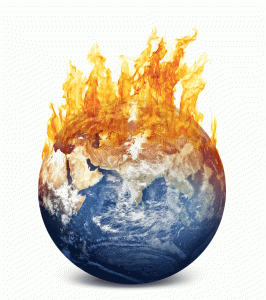
It’s a long read. Chait covers the history of efforts to reverse climate change and then offers hope.
For human to wean ourselves off carbon-emitting fossil fuel, we will have to use some combination of edict and invention — there is no other plausible way around it. The task before the world is best envisioned not as a singular event but as two distinct but interrelated revolutions, one in political willpower and the other in technological innovation. It has taken a long time for each to materialize, in part because the absence of one has compounded the difficulty of the other. It is extremely hard to force a shift to clean energy when dirty energy is much cheaper, and it is extremely hard to achieve economies of scale in new energy technologies when the political system has not yet nudged you to do so.
And yet, if you formed a viewpoint about the cost effectiveness of green energy a generation ago (when, for instance, Ronald Reagan tore the costly solar panels installed by his predecessor off the White House roof), or even just a few years ago, your beliefs are out of date. That technological revolution is well under way.
For one thing, the price of solar is falling, and rapidly. In a March 2011post for Scientific American’s website, Ramez Naam, a computer scientist and technological enthusiast, compared the rapid progress of solar power to Moore’s Law, the famous dictum that described the process by which microchips grew steadily more useful over time, doubling in efficiency every two years. The price of solar power had fallen in two decades from nearly $10 a watt to about $3. By 2030, he predicted, the price could drop to just 50 cents a watt.
Read the whole thing at New York Magazine.
Those are my offerings for today. I’m going to turn was feeling sick on Sunday and Monday and I’m still a little wobbly today. Take, care, Sky Dancers and I hope the floor over to you now, because I’m recovering from a nasty stomach virus. I hope you have an enjoyable day.
Monday Reads
Posted: August 31, 2015 Filed under: morning reads | Tags: Climate change, Denali, glaciers, Obama visit to Alaska 23 Comments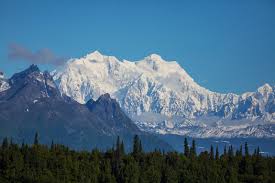 Good Afternoon!
In the latest binge of white privilege hissy fits, Republicans and Fox News are up in arms about changing the official name of the tallest mountain in the country back to the name that it was known by historically. It’s also the preferred name of the mountain for the folks that live in Alaska. Denali National Park has been in existence for some time. Denali mountain was renamed Mt McKinley in 1896 in a commonly done thing to do when privileged white men discover or climb natural wonders and regions that the folks living there have done, known, and named for thousands of years. I never knew the backstory on this event. It’s a typical story of appropriation.
Here’s the history of the name Denali and what caused it to be renamed.
Numerous native peoples of the area had their own names for this prominent peak. The local Koyukon Athabaskan name for the mountain, the name used by the Native Americans with access to the flanks of the mountain (living in the Yukon, Tanana and Kuskokwim basins), is Dinale or Denali /dɨˈnæli/or /dɨˈnɑːli/).[2] To the South the Dena’ina people in the Susitna River valley used the name Dghelay Ka’a (anglicized as Doleika or Traleika in Traleika Glacier), meaning “the big mountain”.[3][4]
The historical first European sighting of Denali took place on May 6, 1794, when George Vancouver was surveying the Knik Arm of the Cook Inlet and mentioned “distant stupendous mountains” in his journal. However, he uncharacteristically left the mountain unnamed. The mountain is first named on a map by Ferdinand von Wrangel in 1839; the names Tschigmit and Tenada correspond to the locations of Mount Foraker and Denali, respectively. Von Wrangell had been chief administrator of the Russian settlements in North America from 1829–1835.[4]
During the Russian ownership of Alaska, the common name for the mountain was Bolshaya Gora (Большая Гора, “big mountain” in Russian), which is the Russian translation of Denali.[5] The first English name applied to the peak was Densmore’s Mountain or Densmore’s Peak, for the gold prospector Frank Densmore who in 1889 had fervently praised the mountain’s majesty; however, the name persevered only locally and informally.[2]
The name Mount McKinley was chosen by William Dickey, a New Hampshire-born Seattleite who led four gold prospectors digging the sands of the Susitna River in June 1896. An account written on his return to the lower 48 appeared in The New York Sun on January 24, 1897, under the title Discoveries in Alaska (1896).[6][7] Dickey wrote, “We named our great peak Mount McKinley, after William McKinley of Ohio, who had been nominated for the Presidency, and that fact was the first news we received on our way out of that wonderful wilderness.”[7][6] By most accounts, the naming was politically driven; Dickey had met many silver miners who zealously promoted Democratic presidential candidate William Jennings Bryan‘s ideal of a silver standard, inspiring him to retaliate by naming the mountain after a strong proponent of the gold standard.[7]
In the 1900 report of the US Geological Survey (USGS), Josiah Edward Spurr refers to “the giant mountain variously known to Americans as Mount Allen, Mount McKinley, or Bulshaia, the latter being a corruption of the Russian adjective meaning big”.[8] The 1900 report otherwise calls it Mount McKinley,[8] as does the 1911 USGS report The Mount McKinley Region, Alaska.[9]
McKinley was assassinated early in his second term, shot by Leon Czolgosz on September 6, 1901, and dying of his wounds on September 14. This led to sentiment favoring commemoration of his memory. The Federal government officially adopted the name Mount McKinley in 1917 when Congress passed and President Woodrow Wilson signed into law “An Act to establish the Mount McKinley National Park in the territory of Alaska”, which singled out the area in the Mount McKinley region.[10]
So, originally, some crazy gold bug from Seattle via New Hampshire decided to make a political statement by renaming the big mountain and it stuck. I guess it’s the Ohio delegation that’s stopped the Alaskan’s delegation’s annual attempt to put the name of the mountain back to the one given it by its indigenous peoples. So, of course, Boehner’s orange face has gone a slight shade of red with the announcement. Well, it’s just another excuse for a Republican and Fox News hate and anger fest. How dare the President do something that so many folks–mostly Alaskans–have asked him to do for so long?
It’s official: Denali is now the mountain formerly known as Mount McKinley.
With the approval of President Barack Obama, Interior Secretary Sally Jewell has signed a “secretarial order” to officially change the name, the White House and Interior Department announced Sunday. The announcement comes roughly 24 hours before Obama touches down in Anchorage for a whirlwind tour of Alaska.
Talk of the name change has swirled in Alaska this year since the National Park Service officially registered no objection in a congressional hearing in Washington, D.C.
The tallest mountain in North America has long been known to Alaskans as Denali, its Koyukon Athabascan name, but its official name was not changed with the creation of Denali National Park and Preserve in 1980, 6 million acres carved out for federal protection under the Alaska National Interest Lands Conservation Act. The state changed the name of the park’s tallest mountain to Denali at that time, but the federal government did not.
Jewell’s authority stems from a 1947 federal law that allows her to make changes to geographic names through the U.S. Board on Geographic Names, according to the department.
“I think for people like myself that have known the mountain as Denali for years and certainly for Alaskans, it’s something that’s been a long time coming,” Jewell told Alaska Dispatch News Sunday.
Every year, the same story plays out in Washington, D.C.: Alaska legislators sometimes file bills to change the name from Mount McKinley to Denali, and every year, someone in the Ohio congressional delegation — the home state of the 25th President William McKinley — files legislation to block a name change.
Members of Alaska’s congressional delegation said they were happy with the action.
“I’d like to thank the president for working with us to achieve this significant change to show honor, respect, and gratitude to the Athabascan people of Alaska,” Sen. Lisa Murkowski, R-Alaska, said in a video statement recorded on the Ruth Glacier below the mountain.
Sen. Dan Sullivan, R-Alaska, said in an email that “Denali belongs to Alaska and its citizens. The naming rights already went to ancestors of the Alaska Native people, like those of my wife’s family. For decades, Alaskans and members of our congressional delegation have been fighting for Denali to be recognized by the federal government by its true name. I’m gratified that the president respected this.”

Alaska. The George Parks highway looking south to Mt McKinley (20,320 ft) in autumn.
It seems McKinley never even visited Alaska or showed any interest in the place. Most of the National Parks and historic sites that have Presidential names actually have some relationship to that president. Like I said, I never even knew any of this before but I know it now and it’s amazing to me it’s taken this long.
House Speaker John Boehner (R-OH) said on Monday morning he was “deeply disappointed” by President Barack Obama’s decision to rename North America’s tallest peak.
Here’s his statement in full:
There is a reason President McKinley’s name has served atop the highest peak in North America for more than 100 years, and that is because it is a testament to his great legacy. McKinley served our country with distinction during the Civil War as a member of the Army. He made a difference for his constituents and his state as a member of the House of Representatives and as Governor of the great state of Ohio. And he led this nation to prosperity and victory in the Spanish-American War as the 25th President of the United States. I’m deeply disappointed in this decision.
Obama announced Sunday ahead of a historic visit to Alaska that the mountain’s name will revert back to Denali, its traditional Alaska Native name.
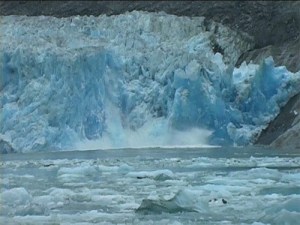 Frankly, McKinley isn’t one of the Presidents whose name routinely comes up with “great legacy”. He also has nothing to do with Alaska and Alaskans basically wanted the name returned to Denali.
It is the latest bid by the president to fulfill his 2008 campaign promise to improve relations between the federal government and the nation’s Native American tribes, an important political constituency that has a long history of grievances against the government.
There’s more interesting, record breaking news that’s undoubtedly associated with climate change. That’s something the President will speak about

Polar Bear (Ursus maritimus) mother and cubs. Churchill, Manitoba, Canada
in Alaska on his visit. There are 4 category 4 hurricanes in the Pacific.
NASA’s Terra satellite just released this August 29 image of Hurricanes Kilo, Ignacio, and Jimena, all Category Four Hurricanes. According to the Weather Channel:
This is the first recorded occurrence of three Category 4 hurricanes in the central and eastern Pacific basins at the same time. In addition, it’s also the first time with three major hurricanes (Category 3 or stronger) in those basins simultaneously, according to hurricane specialist Eric Blake of the National Hurricane Center.
The Central Pacific Hurricane Center (CPHC) in Honolulu Hawaii is issuing advisories on all of the hurricanes. On Sunday, August 30, from west to east, Hurricane Kilo was located 1,210 miles west-southwest of Honolulu, Hawaii, Hurricane Ignacio was located 515 miles east-southeast of Hilo, Hawaii, and Hurricane Jimena was located 1,815 miles east-southeast of Hilo, Hawaii.
Obama will be visiting many folks in Alaska just shortly after visiting folks here in New Orleans. His focus will be on how much lives have been changed by climate change. His trip to Lousiana focused on the amount of wetlands and Louisiana itself, lost to the Gulf and how that played into the destruction around the Gulf. Loss of Glaciers is one noticeable climate change in Alaska. I’m really confused, however, why Shell gets to drill in the Arctic when the President has visited two states whose oil and gas industry has ruined the environment while enriching oil interests. Here’s another thing I never knew. President Obama will be the first sitting president to visit Alaska.
The trip to the Alaskan Arctic — the first by a sitting president — is the culmination of an increasingly forceful climate change policy push over the past two years by the Obama administration.
The White House has honed in on climate change as a core policy priority with a domestic and international approach that has met with mixed response among both liberals and conservatives. This week alone he invoked the perils of climate change during visits to the National Clean Energy Summit in Las Vegas and New Orleans’ storm ravaged Lower Ninth Ward to commemorate the tenth anniversary of Hurricane Katrina.
“No challenge poses a greater threat to our future than climate change,” the president told a crowd in Las Vegas.
With these trips, along with his trek to Alaska where he will speak at a State Department-sponsored conference on the Arctic, Obama is attempting to set the stage for a major international climate change agreement he hopes will come from a summit in Paris in December.
That agreement could help secure his legacy as the first sitting president to address global climate change in a substantive way, environmental policy experts said.
“The president has from the beginning recognized that climate change is an existential challenge to the country and the world. It may be the issue that is the most important long-term issue of his presidency,” said Paul Bledsoe, a former adviser to the Clinton White House on climate policy. “Future generations will look back at him as the first global leader to take decisive action on climate change.”
The Obama administration’s work of lifting the issue of climate change from the periphery to the fore began in a series of fits and starts.
There will be a Climate Change Conference in Paris this coming November. The President hopes to move the United States more into line with other countries seeking to reverse the damage caused by overuse of fossil fuels. Obama has announced his desire to reduce US carbon emissions. Both Hillary Clinton and Bernie Sanders are committed to the cause.
Obama’s announcement of a final rule to reduce carbon emissions on Monday (03.08.2015) drew international attention to the United States. The administration appears to have responded to a growing desire for politicians to take the fight against climate change more seriously. The American public has been demanding more government action as severe droughts and forest fires ravage the western US.
The 21st Conference of Parties in Paris this December will be the real test for this seemingly renewed American environmental consciousness. World leaders will be hoping to sign a new, legally binding international agreement on reducing emissions.
Although momentum toward taking action on climate change does appear to be building in the US, whether the US can truly lead in these negotiations remains uncertain.
On the one side, Obama’s new legislation is only one sign of mounting political will on tackling climate change. Environmental discussions are taking center stage in the Democrat nominee race.
Candidate Hillary Clinton has promised that 33 percent of the country’s electricity will come from renewables by 2027. Senator Bernie Sanders, Clinton’s opponent with a strong environmental record, has called climate change “the single biggest threat to our planet.”
For Philip Wallach, a policy analyst at the Brookings Institute, this green surge is a strategy to appease public opinion ahead of elections in November 2016.
“[Democrats] think [climate] puts Republican candidates in an awkward position, where in order to satisfy some of their voter base, they’re pressured to reject [climate] science,” Wallach told DW.
Candidates for the Republican nomination were quick to criticize Obama’s new regulations – but remained mum about plans to tackle climate change during recent debates.
Hopefully, this will start a conversation on what seems like more years of excessive heat, land loss, extreme weather, drought, and fires ahead.
What’s on your reading and blogging list today?
Thursday Reads: Wild Weather, Climate Change, and Other News
Posted: May 28, 2015 Filed under: morning reads, U.S. Politics | Tags: Bobby Jindal, child porn, child sexual abuse, Climate change, climate change denial, GOP Clown Car, incest, Jim Bob Duggar, Joseph Hutchens, Josh Duggar, Rand Paul, Ted Cruz, Texas floods, weather 21 Comments  Good Morning!!
It has been close to 90 degrees here for the past several days, and it’s technically still spring. I’m beginning to wonder if we are going to have a summer from hell as a follow-up to the worst winter in the half-century I’ve lived in Boston.
In addition to the unusually hot weather, the pollen is so bad that every morning when I wake up it takes a few hours for my scratchy, watery eyes to clear up enough for me to read comfortably.
I’m on a regimen of Flonase, Allegra, and Mucinex; but I still feel stuffed up most of the time. Sometimes I feel itchy and even dizzy and nauseated; and I think it’s from allergies. The itchy skin would be unbearable without the Allegra.
Is anyone else noticing worse-than-usual allergies this year? Last year’s spring allergy season was very bad; this year is far worse. Anyone who actually claims to believe that there isn’t something dramatic happening with our weather is either deluded or lying. I wonder if we will manage to do something about climate change before it’s too late.
What about all that awful weather down in Texas?
Here’s a story from the Texas Tribune, via KXON: Climate change, a factor in Texas floods, largely ignored.
“We have observed an increase of heavy rain events, at least in the South-Central United States, including Texas,” said Nielsen-Gammon, who was appointed by former Gov. George W. Bush in 2000. “And it’s consistent with what we would expect from climate change.”
But the state’s Republican leaders are deeply skeptical of the scientific consensus that human activity is changing the climate, with top environmental regulators in Texas questioning whether the planet is warming at all. And attempts by Democratic lawmakers during the 2015 legislative session to discuss the issue have come up short.
“In part, it’s ideologically driven and intellectually lazy,” said state Rep. Rafael Anchia, D-Dallas, who earlier this year invited national security experts to the state Capitol to testify at a hearing on the risks of climate change. “My question is: What are people scared of? Are they scared of the truth?”
Asked about the role of climate change in the floods, U.S. Sen. Ted Cruz declined to weigh in Wednesday. “At a time of tragedy, I think it’s wrong to try to politicize a natural disaster,” the Republican presidential candidate said during a news conference in San Marcos after surveying damage.
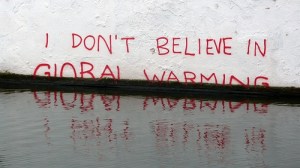
How does discussing scientific research on climate constitute “politicizing a natural disaster?”
Extreme weather events, and more of them, are among the most agreed-upon effects of global warming in all the scientific literature on the subject, said Nielsen-Gammon, who is also a professor at Texas A&M University. Part of the explanation is that ocean temperatures are rising, bringing more moist air into the state that can create storm systems. In the past century, precipitation in Texas is up 7 to 10 percent, and the frequency of two-day heavy rainfall spells has nearly doubled.
The scientific consensus is much stronger on this point than on whether climate change can directly cause droughts. Nielsen-Gammon’s own research has shown that warmer temperatures due to global warming did make the drought in Texas measurably worse than it otherwise would have been.
But for the last several years, legislation calling for climate-change studies has not succeeded in the Capitol.
It’s a pretty long article, and very interesting. I hope you’ll go read the whole thing.

Hypocrisy personified
More on Ted Cruz’s remarks from CNN: Texas flooding puts Cruz, GOP in bind on climate change.
The Republican presidential contender has held two press conferences over the past two days to address the flooding and the government’s response. At each one, he was asked about the impact of climate change on natural disasters like the Texas flooding, and at each one, he dodged the question….
“I think the focus now is on caring for those who have lost their lives and lost their homes,” he said.
At least 31 people have died in Mexico, Texas and Oklahoma from the storm since this weekend, while another 11 remain missing in Texas. Cruz promised to do all he could to ensure that Texans get access to the resources they need during the recovery.
Wait a minute. Anti-government Ted Cruz wants the Feds to help Texas? Didn’t he oppose aid to survivors of Hurricane Sandy?

Politicus USA: Ted Cruz Demands Federal Money For Texas Floods After Blocking Hurricane Sandy Relief.
During a press conference on the deadly flooding in Texas, Cruz said, “The federal government’s role, once the Governor declares a disaster area and makes a request, I am confident that the Texas congressional delegation, Sen. Cornyn and I, and the members of Congress both Republicans and Democrats will stand united as Texans in support of the federal government fulfilling its statutory obligations, and stepping in to respond to this natural disaster.
Sen. Cruz sang a completely different tune in 2013 when he called federal aid for the victims of Hurricane Sandy wasteful:
Two-thirds of this spending is not remotely “emergency”; the Congressional Budget Office estimates that only 30% of the authorized funds would be spent in the next 20 months, and over a billion dollars will be spent as late as 2021.
This bill is symptomatic of a larger problem in Washington – an addiction to spending money we do not have. The United States Senate should not be in the business of exploiting victims of natural disasters to fund pork projects that further expand our debt.

Back to the CNN article for more Cruz climate change philosophy:
“It used to be [that] it is accepted scientific wisdom the Earth is flat, and this heretic named Galileo was branded a denier,” he said in an interview with the Texas Tribune.
Cruz also argued that “global warming alarmists” aren’t basing their arguments on facts, because “the satellite data demonstrate that there has been no significant warming whatsoever for 17 years.”
Oh really? The point of the article is that Cruz and other Republicans may be leaning toward more moderate attitudes toward climate change research. I’ll believe that when I see it.
More interesting recent articles on climate change:
Think Progress: If You’ve Wondered Why So Many Politicians Deny Climate Change, Science Has Your Answer.
Washington Post: Climate change could shrink Mount Everest’s glaciers by 70 percent, study finds.
Dallas Morning News: Exxon CEO holds line on climate change at annual meeting.
Mother Jones Exclusive: The CIA Is Shuttering a Secretive Climate Research Program.

In other news . . .
Bobby Jindal got some attention in Politico for attacking another member of the GOP clown car: Bobby Jindal slams Rand Paul as unfit to be commander in chief.
Louisiana Gov. Bobby Jindal lashed out at Sen. Rand Paul for his recent comments about the Islamic State, saying the presidential contender is unfit to be commander in chief and is taking the “weakest, most liberal Democrat position” when it comes to fighting the militant group.
Using unusually harsh rhetoric and an unusual forum, Jindal posted a statement condemning Paul on Wednesday on his “office of the governor” website.
Story Continued Below
“This is a perfect example of why Senator Paul is unsuited to be Commander-in-Chief,” Jindal said. “We have men and women in the military who are in the field trying to fight ISIS right now, and Senator Paul is taking the weakest, most liberal Democrat position. It’s one thing for Senator Paul to take an outlandish position as a Senator at Washington cocktail parties, but being Commander-in-Chief is an entirely different job. We should all be clear that evil and Radical Islam are at fault for the rise of ISIS, and people like President Obama and Hillary Clinton exacerbate it.”
The statement from Jindal, who is also a likely GOP presidential contender, came after the Kentucky Republican suggested Wednesday morning that hawkish members of his party were to blame for the rise of the Islamic State, also called ISIL or ISIS.
Paul said on MSNBC’s “Morning Joe” that “ISIS exists and grew stronger because of the hawks in our party who gave arms indiscriminately and most of those arms were snatched up by ISIS.”

Joseph Hutchens
In Touch Weekly has more breaking Duggar news.
DISGRACED COP WHO DIDN’T REPORT MOLESTATION SHOOTS DOWN JIM BOB’S STORY
In 2006, Jim Bob told Springdale police that he took Josh to see State Trooper Joseph Hutchens and that Josh “admitted to Hutchens what [Josh, redacted] had done,” according to the police report, obtained exclusively by In Touch through the Freedom of Information Act. At this point, there were five victims and multiple molestations by Josh….
Hutchens is serving 56 years in prison for child pornography and admits his “reputation is shot.” He was interviewed by a representative of a local law firm at In Touch‘s request and promised nothing in return for his recollections.
Hutchens’ failure to report the abuse caused the police to halt their 2006 investigation because the statute of limitations ran out.
In the new interview from prison, Hutchens said he was told by Jim Bob and Josh that “Josh had inappropriately touched [redacted] during the time she was asleep. He said he touched her through her clothing and he said it only happened one time.”
He said the fact that it was a one-time incident influenced his decision not to report it. “I did what I thought was right and obviously it wasn’t,” he says. “If I had to do it over again, I would have told him immediately I am going to call the hotline and contacted the trooper that worked those cases and have a full report made. I thought I could handle it myself.
The Duggar family is so corrupt that I expect there could be new revelations about them for months to come.
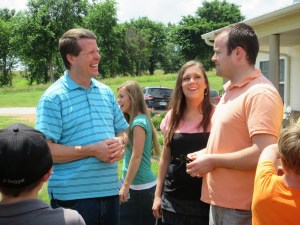
Here’s a little tidbit that Allie Jones of Gawker Defamer found: Duggar Dad’s Political Platform: Incest Should Be Punishable by Death.
[W]hat does Jim Bob think of his own response to his son’s familial abuse? In a brief statement to People, Jim Bob and Michelle said last week that “that dark and difficult time caused us to seek God like never before.” Maybe that’s because Jim Bob publicly stated during his 2002 campaign for U.S. Senate that he thinks incest should be punishable by death.
Jim Bob’s platform on his campaign website—preserved via web cache—states that he believes “rape and incest represent heinous crimes and as such should be treated as capital crimes.” Jim Bob offered this belief to explain his position on abortion (only acceptable if both the mother and the baby were going to die anyway, of course)
See the screen shot at the link.
Other stories worth checking out, links only
A story from Politico that will make you–if not Charles Pierce–want to drink antifreeze: Dems view Sanders as bigger threat than O’Malley.
Since O’Malley is no threat at all, how worried could Dems really be?
Ezra Klein pontificates at length about why the SCOTUS anti-Obamacare case is total B.S.: The New York Times blows a hole in the case against Obamacare.
A poll from Qunnipac University: May 28, 2015 – Five Leaders In 2016 Republican White House Race, Quinnipiac University National Poll Finds; Rubio, Paul Are Only Republicans Even Close To Clinton.
I haven’t read this story from the NYT yet, but I’ll bet it’s hilarious: What George PatakiWould Need to Do to Win. One more clown for the clown car.
NYT reports Climate news from India: Indians Scramble for Heat Relief, but Many Must Still Work.
Washington Post: Breakthrough HIV study could change course of treatment for millions.
BBC News: ‘New species’ of ancient human found.
What stories are you following today? Please post your thoughts and links in the comment thread and have a tremendous Thursday!

 peej
peej Carissa
 bostonboomer
 dakinikat
 ecocatwoman
 mablue2
 Mama Lopez
 peggysue22
 quixote
 skydancingguestblogger
 Mona (aka Wonk the Vote)



 Sky Dancing
Recent Comments