
Finally Friday Reads: The Republican Plans to Deny your Vote
Posted: August 9, 2024 Filed under: 2024 presidential Campaign, Voter Suppression drive by Donald | Tags: Citizen's United, Georgia voter suppression, Keep Our Democracy, Michigan Voter Suppression, Trump's Stealing the Vote 5 CommentsGood Day, Sky Dancers!

“The Mar a Lago Presser was one for the ages. Donald found his way out of his basement to assure the masses he was sharp as ever as he didn’t even nod off once.” John Buss. Repeat 1968
Today, I’m sharing the incredible number of actions being taken to ensure your vote does not count. One of the incredible recent patterns in national Presidential Elections is that Republican candidates cannot get the majority of the vote. This is why a few swing states get all the attention.
My undergraduate degree was your basic liberal arts degree with a Major in History and minors in Political Science and Economics. All three areas are essential to know what it means to be an American, to vote, and to recognize that a lot of our history, governance, and wealth distribution was built on protecting slavery, stealing land and lives from our Indigenous, and ensuring that entitled White Men are in charge. Some may be technically illegal now, but their impact and the dynamics remain.
I want to share some of the past to understand the immense wealth and effort put into play by billionaires Elton Musk, Harlin Crowe, and Paul Weyrick, which concentrates on political power by getting what they want through strategies that don’t include getting votes. This includes wining and dining the two most despicable Associate Justices sitting on the Supreme Court.
The Presidency is determined by a few states that move the Electoral Vote in one direction. I’ve written about this a lot. There are a lot of movements that would either reform or eliminate the Electoral College, which is a vestige of Slave owners making sure the primarily rural, unpopulated states could not be forced to free their slaves. It played a key role in the Adams/Jefferson election. This is a brief history of its impact from the Brennen Center. It was originally published in The Atlantic in 2020. The analysis of its historical importance is provided by
Right from the get-go, the Electoral College has produced no shortage of lessons about the impact of racial entitlement in selecting the president. History buffs and Hamilton fans are aware that in its first major failure, the Electoral College produced a tie between Thomas Jefferson and his putative running mate, Aaron Burr. What’s less known about the election of 1800 is the way the Electoral College succeeded, which is to say that it operated as one might have expected, based on its embrace of the three-fifths compromise. The South’s baked-in advantages—the bonus electoral votes it received for maintaining slaves, all while not allowing those slaves to vote—made the difference in the election outcome. It gave the slaveholder Jefferson an edge over his opponent, the incumbent president and abolitionist John Adams. To quote Yale Law’s Akhil Reed Amar, the third president “metaphorically rode into the executive mansion on the backs of slaves.” That election continued an almost uninterrupted trend of southern slaveholders and their doughfaced sympathizers winning the White House that lasted until Abraham Lincoln’s victory in 1860.
In 1803, the Twelfth Amendment modified the Electoral College to prevent another Jefferson-Burr–type debacle. Six decades later, the Thirteenth Amendment outlawed slavery, thus ridding the South of its windfall electors. Nevertheless, the shoddy system continued to cleave the American democratic ideal along racial lines. In the 1876 presidential election, the Democrat Samuel Tilden won the popular vote, but some electoral votes were in dispute, including those in—wait for it—Florida. An ad hoc commission of lawmakers and Supreme Court justices was empaneled to resolve the matter. Ultimately, they awarded the contested electoral votes to Republican Rutherford B. Hayes, who had lost the popular vote. As a part of the agreement, known as the Compromise of 1877, the federal government removed the troops that were stationed in the South after the Civil War to maintain order and protect black voters.
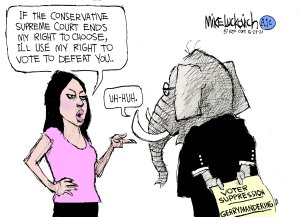 That compromise was basically the one that ended the reconstruction. We all remember the crowning of Dubya Bush by the Supreme Court in 2000. All of these current movements are firmly rooted in what was called the Reagan Revolution. He was the first of modern Republican presidents unsuitable for the job. Reagan, however, won the popular vote.
The last republican President to win the popular vote was George W. Bush in 2004. He undoubtedly got a boost from his misguided war. The Electoral College has created some complex history and, at times, threatened our concept of being a democratic Republic. Okay, enough of history. 50 years ago, Nixon quit the job of the Presidency after his re-election effort was riddled with criminal activities. He was at least a crook capable of governing.
Let’s look at the goal of manipulating the election results put into play by right-wing Republicans who recognize that those swing states have to stay in their column for them to maintain power. I will rely heavily on information from Democracy Docket, although I will supplement it with current media coverage. Marc Elias is a lawyer who has fought in court to stop all voter suppression actions since 2020. You may have seen him on news programs.
Marc Elias is the Firm Chair of Elias Law Group, a mission-driven firm committed to helping Democrats win, citizens vote, and progressives make change. Marc is a nationally recognized authority and expert in campaign finance, voting rights, redistricting law, and litigation.
As a litigator, Marc has handled hundreds of cases involving politics, voting rights, and redistricting. He has successfully argued and won four cases in the U.S. Supreme Court, as well as dozens of cases in state supreme courts and U.S. courts of appeal.
He has represented the Democratic Senatorial and Congressional Campaign Committees, several presidential campaigns, as well as dozens of U.S. senators, governors, representatives, campaigns, and other Democratic and progressive organizations.
When Trump contested the outcome of the 2020 election, Marc met every futile challenge at the courthouse, notching over 60 legal victories against the former president and his allies during the post-election period, alone. He has also successfully represented several House and Senate candidates in post-election litigation, recounts and challenges. In 2024, Marc was named to Forbes’ inaugural list of America’s top 200 lawyers.
Marc is also the founder of Democracy Docket, the leading digital news platform dedicated to information, analysis and opinion about voting rights and elections in the courts.
Marc is an alumnus of Hamilton College, Duke Law School and Duke Graduate School. He is a proud owner of a Portuguese Water Dog named Bode.
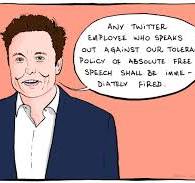 Okay, here we go. This is from Public Notice and written by Lisa Needham. The dateline is today. “Elon Musk tries to dismantle the foundations of US democracy’ From blatant election interference to ending the NLRB, he’s doing all kinds of damage.”
Let’s start with the NLRB.
It’s no surprise that Musk is no friend to labor. He doesn’t believe in unions, saying that they create “a lords and peasants sort of thing,” whatever that means. When workers at his Fremont, California, plant began an organizing campaign, he tweeted that they would lose their stock options if they joined the union. This sort of threat is extremely illegal, and the NLRB sided with the workers who brought multiple unfair labor practices charges against Tesla.
Tesla also prohibited workers from wearing t-shirts with union insignias, even though the right to wear pro-union clothing at work has been a legally protected activity for several decades. Then, of course, there’s the class-action lawsuit in California state court, where almost 6,000 Black workers at the Fremont factory recently got the right to sue Tesla for ignoring massive racism at that plant. How massive? Nooses at the workstations of Black workers massive.
Of course, why follow the law when the lower federal courts are now stuffed with anti-worker Federalist Society denizens and the Supreme Court just gutted the regulatory state? After the NLRB filed a formal complaint against SpaceX over its firing of several employees who wrote an internal letter critical of Musk, SpaceX made sure to find a friendly Trump-appointed judge in Texas, Alan Albright, to entertain its theory that the NLRB itself is unconstitutional.
In late July, Albright issued an injunction blocking the NLRB from proceeding against SpaceX, saying that it is likely the company would prevail in showing that the NLRB, which was created by Congress nearly 90 years ago, impermissibly infringes on the president’s power. Members of the NLRB board and the Administrative Law Judges (ALJ) cannot be removed by the president. That insulation from removal, of course, is critical, as otherwise the NLRB would basically cease to exist every time a Republican president takes power.
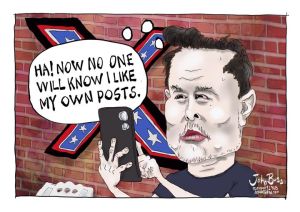
“Some Twitter humor as Elmo hides likes on his platform.” @repeat1968, John Buss
You can read more about that one at the link. There is also this at the same link.
America PAC purports to help people register to vote. If you live in a state that isn’t a swing state, that’s what the PAC’s website does — sends you over to your state’s voter registration page. But if you live somewhere in play this November, the America PAC website asks you for detailed personal information, including things utterly unrelated to voter eligibility, like your cellphone number.
After all that is entered, the PAC doesn’t register you at all. It doesn’t even send the user to their state registration website. It just displays a “thank you” page.
So, swing state voters may think they’re registering, but they’re not. Instead, they’ve handed over their data to a PAC that is coordinating with the Trump campaign. While PACs are generally not allowed to work directly with campaigns, America PAC is a door-to-door canvassing group, and those, inexplicably, can work hand in hand with a candidate. However, pretending to register people to vote is probably a bridge too far.
The Michigan Secretary of State’s office is in the early stages of an investigation of the PAC. So is the North Carolina Attorney General’s Office, as in North Carolina, it’s an actual crime to say you’re submitting someone’s voter registration form and then not do so, which is pretty close to what Musk’s PAC is doing.
The problem here is the relative toothlessness and extreme slowness of American jurisprudence when it comes to election violations.
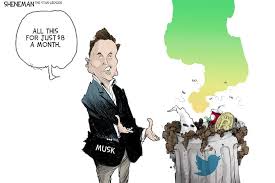 Here we are, 90ish days before the election, and the investigations are just starting. Sweet Lady Liberty, help us! Here’s a Max Boot editorial on the Washington Post. It’s from March of this year. I like this because Boot reminds us that Musk is a defense contractor and rakes in billions of dollars from U.S. taxpayers.”Musk is a MAGA megaphone and a federal contractor. That’s a problem.” And he’s writing a biography on Ronald Reagan which is the last thing we need to read. But he’s also the broken clock on this one.
Like a lot of other people, I don’t use my X account much anymore. I prefer to post on Threads, because X (formerly Twitter) has become such a cesspool of hate speech and conspiracy-mongering. The problem became especially acute following Hamas’s Oct. 7 attack on Israel when the platform was flooded with antisemitic and anti-Muslim misinformation. It’s like watching a once-nice neighborhood go to seed, with well-maintained houses turning into ramshackle drug dens.
What galls me is that, as a taxpayer, I wind up subsidizing X’s megalomaniacal and capricious owner, Elon Musk. His privately held company SpaceX is a major contractor — to the tune of many billions of dollars — for the Defense Department, NASA and the U.S. intelligence community. He is also chief executive of Tesla, which benefits from generous government subsidies and tax credits to the electric-vehicle industry.
Musk needs to decide whether he wants to be the next Donald Trump Jr. (i.e., a major MAGA influencer) or the next James D. Taiclet (the little-known CEO of Lockheed Martin, the country’s largest defense contractor). Currently, Musk is trying to do both, and that’s not sustainable. He is presiding over a fire hose of falsehoods on X about familiar right-wing targets, from undocumented immigrants to “the woke mind virus” to President Biden … while reaping billions from Biden’s administration!
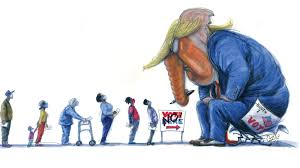 Now, we move to the complex legal landscape of voter suppression. First, I just want to list all the legal litigation that’s going on in Marc Elias’ work load. Five headline lines here, all in different states but all crucial to the election.
A new rule in Georgia could allow some local election boards to refuse to certify results, raising concerns ahead of November’s election in the crucial swing state.
It’s the latest partisan flashpoint in a battleground state over certification — a step in the election process that’s usually ministerial and routine.
Local boards confirm the number of voters who cast ballots matches up with the total votes. Legal challenges to results are heard in the courts.
But when it came to certifying the May primary in Fulton County, which includes Atlanta, one board member refused.
“It’s time to fix the problems in our elections by ensuring compliance with the law, transparency in elections conduct and accuracy in results,” Republican Julie Adams said before abstaining from the vote.
Adams said she didn’t have access to enough underlying election records to verify the vote herself. Adams’ colleagues overruled her and the May certification went ahead.
But for some, it signaled a worrying trend. Adams is one of several local officials in Georgia who declined to certify results this year — and that number could grow.
The new state rule allows local boards to conduct “reasonable inquiry” before certifying results. The measure passed 3-2, backed by Republicans with the sole Democrat and nonpartisan chair opposed.
“If I’m going to ask a county election worker to sign their name on a legal document saying this is accurate, when in fact they may see there is some discrepancy, then we’re setting them up for failure,” says Janelle King, a Republican on the state board who voted for the rule.
But some election experts worry a local board member, driven by unsupported claims of election fraud, might refuse to certify if they argue they could not conduct that inquiry or say it turned up problems.
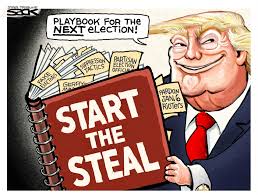 So, finally, I will bring Marc Elias into the discussion. “Georgia Election Deniers Deliver for Trump.”
At his rally last Saturday night, Donald Trump praised three members of the Georgia State Election Board. Calling them “pit bulls fighting for honesty, transparency, and victory,” Trump lavished praise and attention on these members of the obscure state agency — by name.
The odd exchange raised more than a few eyebrows. When I wrote about it earlier this week, I suggested that the least damning explanation was that the “three who Trump mentioned from the stage: Janice Johnston, Rick Jeffares and Janelle King have refused to acknowledge that Joe Biden won Georgia in 2020.” We now know that the real reason for Trump’s support for the election officials was far more sinister.
Late yesterday, the board approved a new rule that seeks to expand the role and authority of county boards of election in the certification process. This new rule redefines the certification process to include “reasonable inquiry” into whether the results are “complete and accurate.”
The vote to adopt this new rule was 3-2, with the Trump-endorsed members commanding the majority. It seems that Trump was prescient when he said these three members would fight for his “victory.”
That this violates state law seems clear. The obligation of county boards to certify elections is mandatory and ministerial. Nothing in Georgia law permits individual members to interpose their own investigations or judgment into a largely ceremonial function involving basic math.
For Trump, these legal niceties are beside the point. He wants to be able to pick and choose which election results are accepted based solely on the outcome. This rule is a step in that direction.
If the new rule survives the inevitable court challenge, Trump will have another powerful tool in his election subversion arsenal. If it is struck down, which seems more likely, he will claim to be the victim of biased judges and an unspecified conspiracy.
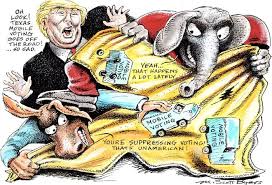 And a final one here from Matt Cohen writing at Democracy Docket. These are the people who ultimately want to replace the 14th and other Amendments concerning who votes with something more agreeable for rich old right-wing white men. “Meet the Trump-Linked Think Tank Waging a Legal War on Elections.”
By all accounts, the May presidential primary election in Georgia went as smoothly as it could have. There were no reports of long lines or malfunctioning voting machines. “Virtually none, nothing I really can report on,” Secretary of State Brad Raffensperger (R) told reporters when asked if there were any irregularities in the election. “So it’s been very, very quiet. So we’re pleased with that.”
But Julie Adams, an election board member in Fulton County — the state’s most populated county — wasn’t satisfied with the election process and refused to certify the county’s election results. Adams, who is a member of the controversial right-wing Election Integrity Network, said she wouldn’t certify because she was denied access to data and “key election information” that she claimed was necessary to see to sign off on the county’s election results. Her abstention didn’t matter, the other four board members voted to certify the election. But Adams soon filed a lawsuit against the board’s director, Nadine Williams, over the election certification process.
The lawsuit was filed on Adams’ behalf by America First Policy Institute (AFPI), a conservative think tank founded in 2021 by a handful of prominent Republicans with ties to former President Donald Trump. Although AFPI’s work spans the spectrum of right-wing policies and issues — like promoting free enterprise, immigration policy, foreign policy and other policies championed by the Trump administration — the Georgia litigation is one of several recent voting-related lawsuits that the group is involved with.
AFPI is hardly the first right-wing think-tank to get involved in election litigation. Groups like the Public Interest Legal Fund, America First Legal and Judicial Watch have made a name for themselves in the past few years for their legal assault on voting rights. But AFPI’s recent pivot to election litigation is part of a larger right-wing focus on rolling back voting rights and sowing discord in elections through the courts.
Given AFPI’s leadership ties to the Trump administration, it’s no secret that their litigation efforts in Arizona, Georgia and Texas are strategic legal moves that, should they prove successful, could have far-reaching implications in the 2024 election.
You may read more at the link. I recommend you make the site one of your daily visits. Also, you may support them and subscribe. This is one of those places where democracy matters and something is being done about it.
So, now that I’ve gone way longer than usual, I will turn the comments over to you.
What’s on your reading and blogging list today?
Monday Reads: We Do Not Welcome our Corporate Overlords
Posted: February 9, 2015 Filed under: Bobby Jindal, morning reads, Republican politics, U.S. Politics, Voter Ignorance | Tags: Bobby Jindal, Citizen's United, fascism, Kansas, Koch Brothers, Louisiana, Sam Brownback, Scott Walker, University of Wisconsin 25 Comments Good Morning!
The Krewe of Chewbacchus rolled through my neighborhood Saturday night. I decided to post some of the photos I took of the participants to liven up the thread today. The parade is a celebration of Fantasy and SF books, movies, games, and TV series. More professional pictures can be found here. See if you can recognize them! I only wish the celebration of fantasy was limited to movies and books. Unfortunately, it isn’t and the Koch Brothers fantasy economics plans are ruining states around the country.
I keep having conversations with people who are either politically active or politically knowledgeable about finding a way out of our current mess. There are several key problems that seem out of the hands of voters to solve. At least, those voters that actually vote.
Things have been on the down slope since the Reagan administration but have really picked up steam with the final fifth vote locked into the Supreme Court. The Citizen’s United Decision is throttling American Democracy which is why we really need to bring back the Fairness Doctrine among other things. It seems odd that Brian Williams can be hounded out of journalism for one mistaken memory when at least 60%–if not more–of what Fox broadcasts daily is an out and out lie. Is Facism on the rise in America and what can we do to stop it?
As the American Heritage Dictionary noted, fascism is: “A system of government that exercises a dictatorship of the extreme right, typically through the merging of state and business leadership, together with belligerent nationalism.”
Well, it it may well on our doorstep. And the oligarchs are plotting their final takeover by using their economic dominance to capture governmental power – specifically, the governmental power which sets the rules for the very marketplace that provides the oligarchs with such massive wealth.
Once the American corporate barons own the institutions that are meant to regulate them, it’s game-over for both rational capitalism (including competition) and for democracy.
Last week, at David and Charles Koch’s annual winter meeting near Palm Springs, California, it was announced that the Koch Brothers’ political organization would spend close to $900 million on the 2016 election. If this goal is met, the group of corporate leaders will spend far more than the Republican Party and its congressional campaign committees spent, combined, in the 2012 campaign.
Once upon a time, it would have been illegal for the Koch Brothers and their fellow oligarchs to buy an election. Of course, that time was before the Citizens United Supreme Court decision.
In 2010, Citizens United v. Federal Election Commission, presented the best opportunity for the Roberts Court to use its five vote majority to totally re-write the face of politics in America, rolling us back to the pre-1907 era of the Robber Barons.
As Jeffrey Toobin wrote in The New Yorker (“No More Mr. Nice Guy”): “In every major case since he became the nation’s seventeenth Chief Justice, Roberts has sided with the prosecution over the defendant, the state over the condemned, the executive branch over the legislative, and the corporate defendant over the individual plaintiff.
You can see the influence of the Koch Brothers money in the states that have Republican Governors. It is  especially true of those Republican Governors with presidential aspirations who want the promised $1 billion the Kochs have pledged for the next campaign cycle. I want to cover Bobby Jindal, Louisiana, and the horrible budget problems that we have from Jindal’s campaign to please the Kochs. But first, I’d like to tell you what Scott Walker is doing to one of the nation’s premier public universities.
One of the major things the Kochs hate is people that aren’t miseducated or trained to be working zombies. This fits right in with their agenda.This is similar to what’s going on with the destruction of public education and universities in Louisiana and similar issues in Kansas, both of which have Koch sucking Governors.
More than 35,000 public employees would be removed from state government rolls if Gov. Scott Walker’s budget proposal stays intact through the legislative process.
Walker’s 2015-17 budget proposal, which was introduced Tuesday, makes major changes to the operation of the state’s University of Wisconsin System. The second-term governor’s plan would split off the system into its own public entity.
By creating a separate authority for the University of Wisconsin System, it would no longer be under the direct management of the state.
According to Walker, University of Wisconsin System supporters have been asking for more autonomy for years, claiming it would help cut costs and better serve students. The Republican governor’s plan also includes a $150 million funding cut in each year of his biennial budget in exchange for the greater autonomy.
The annual reduction is equivalent to a 2.5 percent cut in total public funding. Opponents of Walker’s reform have claimed aid is being cut by 13 percent. That, however, only takes into consideration general fund spending from the state.
He also tried to actually change the mission of the University.
You might think that changing the mission of a flagship public university would be an issue put up for public discussion. Not in Wisconsin.
Wisconsin Gov. Scott Walker submitted a budget proposal that included language that would have changed the century-old mission of the University of Wisconsin system — known as the Wisconsin Idea and embedded in the state code — by removing words that commanded the university to “search for truth” and “improve the human condition” and replacing them with “meet the state’s workforce needs.”
Walker, in a budget speech given earlier this week, didn’t bother to mention the change, which is more than a simple issue of semantics. There is a national debate about what the role of colleges and universities should be. One group, including Walker, see higher education in big part as a training ground for workers in the American workplace; another sees college education as a way to broaden the minds of young people and teach them how to be active, productive citizens of the country.
 He earlier tried to tell University faculty and staff that they needed to work harder and not include “service” in their list of duties. This is all part of the privatization craze that attempts to put union workers and public servants into the parasite category. However, when privatized, the same workers suddenly are doing something valuable with lower compensation so that management and stockholders can skim profits from the actual work being done.
Governor Scott Walker–whom Charlie Pierce refers to as “the goggle-eyed homunculus hired by Koch Industries to run their Midwest subsidiary formerly known as the state of Wisconsin”–plans to unveil a budget on Tuesday evening that will reportedly “slash hundreds of millions of dollars from the state’s public universities over the next two years.” Alice Ollstein of ThinkProgress said that students, professors and state lawmakers “are already blasting the plan — the deepest cut in state history…” They told ThinkProgress that they are “organizing to block its passage.”
Even a Gannet owned newspaper complained about the cuts and the entire attitude towards faculty and higher education in general. Oh, and he’s calling for nearly $500 million tax dollars for a new stadium for the Milwaukee Bucks.
The Gannett Central Wisconsin Media Editorial Board thinks that Walker’s proposed cuts to the university go too deep. With regard to economics, the board wrote “the more educated our workforce, the higher our state’s overall standard of living will be. And in all sorts of intangible ways the university system improves our quality of life — injecting culture into communities, offering broad-based liberal education, helping define our sense of Badger identity.” The board added that “Gov. Scott Walker’s proposed Draconian cuts to the system will undermine those values and hobble future economic growth.”
Gannett Central Wisconsin Media Editorial Board:
Walker compounded the sense that cuts are driven by political animus when, on Wednesday, he told a conservative radio host that faculty and staff should simply increase their workload to make up the difference. It was a condescending, somewhat nasty thing to say, and it was not based in fact. UW-Madison professors, a February study showed, work on average 63 hours a week; we see no reason to assume profs on stretched-thin regional campuses work less…
Taking a chainsaw to the UW budget now is no way to make smart, lasting reforms. Insulting UW faculty is no way to demonstrate an interest in positive reform.
And $300 million in new cuts is too much to swallow.
In a commentary published in the Milwaukee Journal Sentinel on Friday, members of the University of Wisconsin-Milwaukee Faculty Senate Executive Committee said that news reports had confirmed that the “UW System campuses are slated to take a combined $150 million base budget cut (over two years, so $300 million total) in his upcoming 2015-’17 biennial budget proposal.” The Journal Sentinel claimed that the numbers were “staggering.” This will reportedly be “the largest cut in the 45-year history of the system.
Well, Wisconson, welcome to the world of Governors owned by the Koch Brothers. Here’s our reality down here in Lousyana. We’re on our 8th of year the same kind of BS. We’re sending tax dollars to Chinese  corporations, Arkansas Corporations, and Hollywood, but taking money away from every school but the religious madrassas and for-profits preferred by Jindal and the Kochs.
Widespread layoffs, hundreds of classes eliminated, academic programs jettisoned and a flagship university that can’t compete with its peers around the nation — those are among the grim scenarios LSU leaders outlined in internal documents as the threat of budget cuts loom.
Gov. Bobby Jindal’s administration is considering deep budget slashing to higher education for the fiscal year that begins July 1 to help close a $1.6 billion shortfall.
LSU campuses from Shreveport to New Orleans were asked to explain how a reduction between 35 percent and 40 percent in state financing — about $141.5 million to the university system — would affect their operations. The documents, compiled for LSU System President F. King Alexander, were obtained by The Associated Press through a public records request.
The potential implications of such hefty cuts were summed up in stark terms: 1,433 faculty and staff jobs eliminated; 1,572 courses cut; 28 academic programs shut down across campuses; and 6 institutions declaring some form of financial emergency.
At the system’s flagship university in Baton Rouge, the documents say 27 percent of faculty positions would have to be cut, along with 1,400 classes, jeopardizing the accreditation of the engineering and business colleges. Some campus buildings would be closed.
“These severe cuts would change LSU’s mission as a public research and land-grant university. It will no longer be capable of competing with America’s significant public universities and will find itself dramatically behind the rest of the nation,” the documents say.
 One of the first things these folks want to do is to dumb up the population and get rid of faculty and schools that won’t teach the crap they want to continue to force their economic fairy tale. No amount of peer review is ever going to make the trickle down economics crap do anything but float in septic tanks. But, they’re sure doing a great job of forcing it into things by owning politicians. Both Kansas and Louisiana are in freaking budget nightmares.
The country is full of examples illustrating the failure of Republican economic policies. Scott Walker’s Wisconsin and Sam Brownback’s Kansas have become poster children for the job killing, budget busting, folly of pursuing supply side economics. Were it not for the damage that right-wing policies inflict upon working families, the Laffer curve would be simply laughable.
Yet, Grover Norquist’s army of tax-hating Governors continues to run roughshod over red state budgets promising a fiscal utopia. The fact that the utopia never materializes apparently doesn’t matter. Red state voters re-elect them anyway. The words “tax cut”, like an elixir, cures their fears, even if the people whose taxes are being cut are not the ordinary voters, but rather the ultra wealthy.
Joining Brownback and Walker on the list of Governor’s facing serious budget problems, is Louisiana Governor Bobby Jindal. On Friday, The New York Times reported that Louisiana is anticipating a 1.6 billion dollar budget shortfall for next year, and that the deficit will remain in that range for years to come. When Jindal took office in 2008, the state had a 900 million dollar surplus, and the unemployment rate was just 3.8 percent. Now, in addition to having a gaping budget shortfall, Louisiana’s unemployment rate is at 6.7 percent, above the national average.Despite the state’s budget woes, Jindal has continued to resist any tax increases. He has depleted the state’s reserve funds to fill budget holes and is still coming up short on the needed revenue. Louisiana has one of the lowest tax burdens in the nation, and as a consequence, the state ranks near dead last in quality of education and health care. Nevertheless, the supply side dogmatism of Governor Jindal virtually guarantees that the state will continue on its current path to economic perdition.
Jindal is often mentioned as a possible Republican candidate for President. However, Jindal’s fiscal mismanagement has made him deeply unpopular even in his own state. A November 2014 Public Policy Polling survey found that only a third of Louisiana voters approved of the Governor’s job performance while 56 percent disapproved. Supply side economics has been a nightmare to the residents of Louisiana.
Notice the similar policies? Kill the Universities or warp them into places to train the zombie drone workers of the future? Anyway, I really hope that the 2016 voters change some of this. I can’t wait for Hillary to tackle the Republican that tries to mainstream this crap.
What’s on your reading and blogging list today?
Friday Reads
Posted: November 7, 2014 Filed under: court rulings, morning reads, U.S. Politics | Tags: Citizen's United, dark money, disinformation, elections, FCC, Greg Abbott, propaganda, public interest programming, Ronald Reagan, Texas, Voter ID laws, voter suppression, Wendy Davis, white privilege 26 CommentsGood Morning!
I thought I’d try to get off the topic of the midterm elections specifically and get on to some general things about why the U.S. Political System seems so completely screwed up right now. What exactly has led us to the point where the Republicans seem to be a combination of the John Birch  Society and Theocrats and the Democratic Party sits idly by and twiddles its thumbs hoping the process works like it used to?
William Pfaff has a few things to say about this in an article titled “How Ronald Reagan and the Supreme Court Turned American Politics Into a Cesspool”. One of the things that does completely amaze me is how the entire Reagan Presidency has turned into a narrative that’s more saga and drama than reality. There’s some really interesting points here. How did this election get so removed from reality in that people voted for one set of priorities when it came to issues like marijuana legalization and the minimum wage but then sent people to the District diametrically opposed to these policies?
The second significance of this election has been the debasement of debate to a level of vulgarity, misinformation and ignorance that, while not unprecedented in American political history, certainly attained new depths and extent.
This disastrous state of affairs is the product of two Supreme Court decisions and before that, of the repeal under the Reagan Administration, of the provision in the Federal Communications Act of 1934, stipulating the public service obligations of radio (and subsequently, of television) broadcasters in exchange for the government’s concession to them of free use in their businesses of the public airways.
These rules required broadcasters to provide “public interest” programming, including the coverage of electoral campaigns for public office and the independent examination of public issues. The termination of these requirements made possible the wave of demagogic and partisan right-wing “talk radio” that since has plagued American broadcasting and muddied American electoral politics.
Those readers old enough to remember the radio and early television broadcasting of pre-Reagan America will recall the non-partisan news reports and summaries provided by the national networks and by local stations in the United States. There were, of course, popular news commentators professing strong or idiosyncratic views as well, but the industry assured that a variety of responsible opinions were expressed, and that blatant falsehood was banned or corrected.
The two Supreme Court decisions were “Buckley v. Valeo” in 1976 and “Citizens United v. the Federal Election Commission” in 2010. Jointly, they have transformed the nature of the American political campaign, and indeed the nature of American national politics. This resulted from the nature and characteristics of mass communications in the United States and the fact that broadcasting has from the beginning been all but totally a commercial undertaking (unlike the state broadcasters in Canada and Britain, and nearly all of Europe).
The two decisions turned political contests into competitions in campaign advertising expenditure on television and radio. The election just ended caused every American linked to the internet to be bombarded by thousands (or what seemed tens of thousands) of political messages pleading for campaign money and listing the enormous (naturally) sums pouring into the coffers of the enemy.
Previously the American campaign first concerned the candidate and the nature of his or her political platform. Friends and supporters could, of course, contribute to campaign funds and expenditures, but these contributions were limited by law in scale and nature. No overt connection was allowed between businesses or industries and major political candidates, since this would have implied that the candidate represented “special interests” rather than the general interest.
The Citizens United v. Federal Election Commission verdict is well known and remains highly controversial since it rendered impossible the imposition of legal limits on political campaign spending, ruling that electoral spending is an exercise in constitutionally-protected free speech. Moreover, it adjudged commercial corporations as legal citizens, in electoral matters the equivalent of persons.
 What role has Citizen’s United played in our elections?
Don’t think Citizens United made a difference for the GOP in Tuesday’s midterms? The plaintiff in the landmark Supreme Court case thinks so.
“Citizens United, our Supreme Court case, leveled the playing field, and we’re very proud of the impact that had in last night’s election,” said David Bossie, chairman of the conservative advocacy organization.
He complained that Democratic lawmakers were trying to “gut the First Amendment” with their proposed constitutional amendment to overturn the 2010 ruling, reported Right Wing Watch, which allowed corporations to pour cash into campaigns without disclosing their contributions.
Bossie said this so-called “dark money” was crucial to Republicans gaining control of the U.S. Senate and strengthening their grip on the U.S. House of Representatives.
“A robust conversation, which is what a level playing field allows, really creates an opportunity for the American people to get information and make good decisions,” Bossie said.
Voters across the country trying to cast votes in Tuesday’s elections ran into hurdles erected by Republican legislatures, governors and secretaries of state. Along with mechanical glitches and human error — which occurred in states with leaders on both sides of the political spectrum — voters faced new laws and policies that made it harder to vote.
In Alabama, a last-minute decision by the attorney general barred people from using public housing IDs to vote. Voter ID laws in North Carolina and Texas sowed confusion. Georgia lost 40,000 voter registrations, mostly from minorities. In all, the group Election Protection reported receiving 18,000 calls on Election Day, many of them having to do with voter ID laws. The group noted that the flurry of calls represented “a nearly 40 percent increase from 13,000 calls received in 2010.”
In the presidential election year of 2016, it looks unlikely that those problems will subside — especially if Congress fails to restore the Voting Rights Act. The two states that had the closest vote tallies in the last presidential election — Florida and Ohio — will go into the presidential election year with Republicans controlling the offices of governor and secretary of state and holding majorities in their state legislatures.
In Florida, Republican Gov. Rick Scott, who won reelection yesterday, will be able to appoint a secretary of state and will enjoy the support of a veto-proof Republican majority in the state House.
In Ohio, controversial Republican Secretary of State Jon Husted won reelection on Tuesday, along with Gov. John Kasich. They’ll be able to work with a strengthened GOP majority in the state legislature.
In North Carolina, where a Republican legislature and governor have cracked down on voting rights, the GOP held onto its majority. Republican secretary of state candidates in the swing states of Colorado, Iowa and Nevada also won elections yesterday.
Two influential elections for voting rights also took place in states unlikely to be presidential swing states. Kansas Secretary of State Kris Kobach, a national ringleader for advocates of restrictive voting laws, won reelection. In Arizona, which has been working with Kansas to defend their states’ respective tough voting requirements, Republican candidate Michele Reagan also won her contest.
Suppression of voting rights and purposeful spread of lies, propaganda, and disinformation are likely to continue as the 2016 Presidential Political season begins.Will the Democratic Party learn anything from the last two disastrous mid term elections? 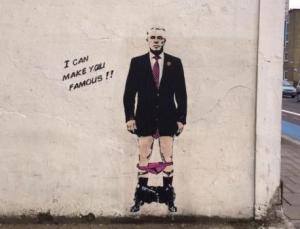
This fall, Democrats ran like they were afraid of losing. Consider the issues that most Democrats think really matter: Climate change, which a United Nations report just warned will have “severe, pervasive and irreversible impacts” across the globe. The expansion of Medicaid, so millions of poor families have health coverage. Our immoral and incoherent immigration system. Our epidemic of gun violence, which produces a mini-Sandy Hook every few weeks. The rigging of America’s political and economic system by the 1 percent.
For the most part, Democratic candidates shied away from these issues because they were too controversial. Instead they stuck to topics that were safe, familiar, and broadly popular: the minimum wage, outsourcing, and the “war on women.” The result, for the most part, was homogenized, inauthentic, forgettable campaigns. Think about the Democrats who ran in contested seats Tuesday night: Grimes, Nunn, Hagan, Pryor, Hagan, Shaheen, Landrieu, Braley, Udall, Begich, Warner. During the entire campaign, did a single one of them have what Joe Klein once called a “Turnip Day moment”—a bold, spontaneous outbreak of genuine conviction? Did a single one unfetter himself or herself from the consultants and take a political risk to support something he or she passionately believed was right?
I’m not claiming that such displays would have changed the outcome. Given President Obama’s unpopularity, Democratic victories, especially in red states, may have been impossible.
But there is a crucial lesson here for 2016. In recent years, some Democrats have convinced themselves they can turn out African Americans, Latinos, single women, the poor, and the young merely by employing fancy computer systems and exploiting Republican extremism. But technologically, Republicans are catching up, and they’re getting shrewder about blunting, or at least masking, the harshness of their views.
We saw the consequences on Tuesday. According to exit polls, voters under 30 constituted only 13 percent of the electorate, down from 19 percent in 2012. In Florida, the Latino share of the electorate dropped from 17 to 13 percent. In North Carolina, the African-American share dropped from 23 to 21 percent.
If Hillary Clinton wants to reverse those numbers, she’s going to have to inspire people—people who, more than their Republican counterparts, are inclined toward disconnection and despair. And her gender alone won’t be enough. She lost to Obama in 2008 in part because she could not overcome her penchant for ultra-cautious, hyper-sanitized, consultant-speak. Yet on the stump this year, she was as deadening as the candidates she campaigned for. As Molly Ball put it in September, “Everywhere Hillary Clinton goes, a thousand cameras follow. Then she opens her mouth, and nothing happens.”
Then, there is this: Former Republican Committeemen Claim Election Judges Coerced Into Voting GOP. 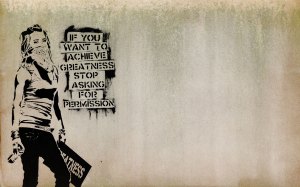
A day after the election, officials are still counting ballots and the investigation into who made robocalls that allegedly persuaded many judges not to show up Tuesday is heating up.
Two former Republican committeemen are telling 2 Investigator Pam Zekman they were removed because they objected to those tactics.
Judges of election are appointed by their respective parties and they look at a judge’s primary voting records as part of the vetting process. But in these cases the former committeemen we talked to said that vetting crossed a line when judges were told who they had to vote for in the Tuesdays’ election.
One says it happened at a temporary campaign headquarters at 8140 S. Western Ave, which we’ve confirmed it was rented by the Republican Party where election judges reported they were falsely told they had to appear for additional training.
And a former 7th ward committeewoman says she witnessed the same thing at 511. E. 79th Street campaign workers calling judges to come in for additional training. She says there wasn’t any training.
“They were calling election judges, telling them to come in so they could get specific orders to vote for the Republican Party,” said Charon Bryson.
She says she is a Republican but objected to the tactic used on the judges.
“They should not be be pressured or coerced into voting for someone to get a job, or to get an appointment,” said Bryson.
Bryson says she thinks it is like “buying a vote.”
“If you don’t vote Republican you will not be an Republican judge, which pays $170,” she said.
The Board of Elections is now investigating whether calls to judges assigned citywide resulted in a shortage that infuriated the mayor.
“What happened with the robocalls was intentional. As far as we can tell somebody got a list, a list with names and numbers, called them, not to educate, not to promote the democratic process, but to sew confusion,” Emanuel said.
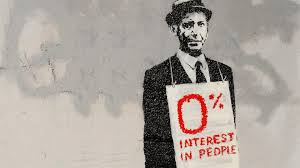 Scared by polls that show that people do not want Republican policies and by changes in demographics, Republicans have been pulling out the stops to turn back the tide. However, none of these fundamentals seem to be driving voting trends or turnout. WTF is wrong with people? As a member of the White Women Constituency who seem to be one of the groups that continues to vote against their own interest, I can agree that we should all get our acts together now. Nowhere was this more evident than in the Wendy Davis campaign.
Once more, with feeling: Greg Abbott and the Republican Party did not win women. They won white women. Time and time again, people of color have stood up for reproductive rights, for affordable health care, for immigrant communities while white folks vote a straight “I got mine” party ticket—even when they haven’t, really, gotten theirs.
The trend is echoed in national politics; we saw it play out across the country last night. To be sure, there are many factors that contributed to America’s rightward dive over the cliff: In a post-Citizens United electoral landscape, racist gerrymandering and voter ID laws appear to have had their intended effects of dividing and disenfranchising already marginalized voters.
But there’s another factor at play that Democrats fail to grapple with, and the Republican Party capitalizes on, time and time again: the historical crisis of empathy in the white community, one much older than gerrymandered congressional districts or poll taxes.
Let’s talk about what a vote for Wendy Davis meant: It meant a vote for strong public school funding, for Texas Medicaid expansion, for affordable family planning care, for environmental reforms, for access to a full spectrum of reproductive health-care options.
On the flip side, a vote for Greg Abbott meant a vote for the status quo, for empowering big industry and big political donors, for cutting public school funds and dismantling the Affordable Care Act, for overturning Roe v. Wade.
White women chose Greg Abbott Tuesday night. We did not choose empathy. Texas has been red for two decades. We do not choose empathy. We choose the fact that our children will always have access to education, that our daughters will always be able to fly to California or New York for abortion care, that our mothers will always be able to get that crucial Pap smear.
We chose a future where maternal mortality—but not our maternal mortality—rates will rise. We chose a future where preventable deaths from cervical cancer—but not our deaths—will rise. We chose a future where deaths from illegal, back-alley abortions—but not our illegal, back-alley abortions—will rise. We chose ourselves, and only ourselves.
Is white privilege such an enticing thing to us that we’ll sell ourselves out just to protect what scraps we’re thrown?
Anyway, between dark money, voter suppression, and the number of voters willing to vote against their policy beliefs and interests, we’re in trouble as a nation. The Democratic Party just bailed on Mary Landrieu and I’m about to get a Senator that wants to raise Social Security eligibility to age 70, privatize Medicare with vouchers, and defund student loans. This doesn’t even count that he voted no to hurricane relief for his own constituents after Hurricane Isaac. At this rate, every white person in the country should get a tube of astrolube with their ballot. Bend over folks, cause you’ve done it to yourselves!
What’s on your reading and blogging list?
Thursday Reads
Posted: April 3, 2014 Filed under: morning reads, U.S. Politics | Tags: Afghanistan War, amateur archaeologist, atomic bomb testing, Bill Clinton, Charles Koch, Chief Justice John Roberts, Citizen's United, Don Miller, FBI Raids, Fort Hood Texas, historical artifacts, Iraq War, Ivan Lopez, mass shootings, Rush County IN, space aliens, US Supreme Court, Vietnam War, Waldron IN 35 Comments
Good Morning!!
The news that bleeds this morning is the shooting at Fort Hood.
So here’s the most recent article on that from the Boston Globe: Fort Hood gunman sought mental health treatment.
FORT HOOD, Texas (AP) — An Iraq War veteran being treated for mental illness was the gunman who opened fire at Fort Hood, killing three people and wounding 16 others before committing suicide, in an attack on the same Texas military base where more than a dozen people were slain in 2009, authorities said.
Within hours of the Wednesday attack, investigators started looking into whether the man’s combat experience had caused lingering psychological trauma. Fort Hood’s senior officer, Lt. Gen. Mark Milley, said the gunman had sought help for depression, anxiety and other problems.
How is that even a question? I’ve written for years that we’ll pay a terrible price for these pointless wars and the way the men and women sent to fight in them. Massive numbers of Vietnam vets suffered from PTSD, Agent Orange exposure, drug addiction, and unemployment; and those guys mostly just went for one two-year deployment. But we didn’t have a draft when Bush decided he just had to act out his daddy issues and go back into Iraq and kill Saddam Hussein like his father failed to do. Talk about psychological problems!
The volunteer army wasn’t big enough for that, and they redeployed men and women to Iraq and Afghanistan again and again even when they were obviously had head injuries or PTSD. Now we’re all going to keep paying the price for Bush and Cheney’s folly, and the way they treated human beings like cannon fodder.
Back to the Globe article on the latest shooting:
The shooter was identified as Ivan Lopez by Texas Rep. Michael McCaul, chairman of the House Homeland Security Committee. But the congressman offered no other details, and the military declined to identify the gunman until his family members had been notified.
Lopez apparently walked into a building Wednesday afternoon and began firing a .45-caliber semi-automatic pistol. He then got into a vehicle and continued firing before entering another building, but he was eventually confronted by military police in a parking lot, according to Milley, senior officer on the base.
As he came within 20 feet of an officer, the gunman put his hands up but then reached under his jacket and pulled out his gun. The officer drew her own weapon, and the suspect put his gun to his head and pulled the trigger a final time, Milley said.
The gunman, who served in Iraq for four months in 2011, had been undergoing an assessment before the attack to determine if he had post-traumatic stress disorder, Milley said.
He arrived at Fort Hood in February from another base in Texas. He was taking medication, and there were reports that he had complained after returning from Iraq about suffering a traumatic brain injury, Milley said. The commander did not elaborate.
One more from the Washington Post: Pentagon grapples to understand how yet another insider threat went undeterred.
Wednesday’s mass shooting by an Army specialist in Fort Hood, Tex., put the Pentagon on a dreaded, if increasingly familiar, footing as officials grappled to understand how yet another insider threat went undeterred.
It unfolded just two weeks after the Defense Department unveiled the findings of threeinvestigations into last year’s fatal shooting at a Navy Yard building in Washington, D.C., by a contractor and four years after a similarly extensive inquiry into a massacre at Fort Hood by an Army psychiatrist led to vows of sweeping reforms.
“We do not yet know how or why this tragedy occurred, but nearly five years after the Nidal Hasan shooting at Fort Hood in 2009, it is clear that we must do far more to ensure that our troops are safe when they are at home on base,” Rep. Thomas J. Rooney (R-Fla.), a former Army lawyer who was based at Fort Hood, said in a statement. “We must thoroughly investigate what happened today so that we can take whatever action is necessary to prevent something like this from ever occurring again.”
Yeah right. Keep on telling yourself that. To use an old military expression, “Situation Normal, All Fu*cked Up” (SNAFU).
Now let’s move on to the latest outrage from our right-wing, “religious” Supreme Court.
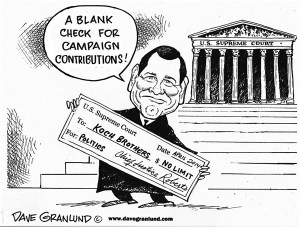
From Adam Liptak at the NYT: Supreme Court Strikes Down Overall Political Donation Cap
The Supreme Court on Wednesday continued its abolition of limits on election spending, striking down a decades-old cap on the total amount any individual can contribute to federal candidates in a two-year election cycle….
The 5-to-4 decision, with the court’s more conservative members in the majority, echoed Citizens United, the 2010 decision that struck down limits on independent campaign spending by corporations and unions.
Wednesday’s decision seemed to alter campaign finance law in subtle but important ways, notably by limiting how the government can justify laws said to restrict the exercise of First Amendment rights in the form of campaign contributions.
Follow me below the fold . . . Read the rest of this entry »
Tuesday Reads: Are Women People?
Posted: March 25, 2014 Filed under: morning reads, Real Life Horror, religion, religious extremists, Reproductive Health, Reproductive Rights, SCOTUS, U.S. Politics, War on Women, Women's Healthcare, Women's Rights, worker rights | Tags: abortion, Affordable Care Act, Antonin Scalia, Are Women Human?, Are Women People?, Birth Control, Citizen's United, contraception, Hobby Lobby, Manhattan Declaration, Obamacare, religious freedom, Sandra Fluke, U.S. Constitution 47 Comments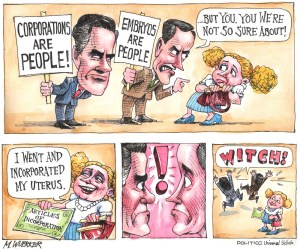
Good Morning!!
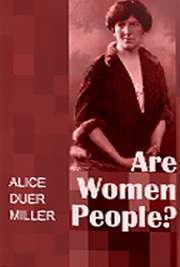
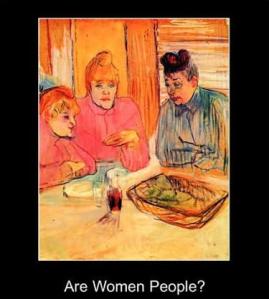
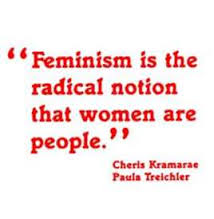
Question for today: Are women human? Are we people in the eyes of our government? We’ve been told that corporations are people. We know that white men are people–that was established by the U.S. Constitution when it was ratified in 1789. Since that time, there have been amendments that granted some rights to non-white men and to women. We can vote now. Does that mean our government recognizes our humanity?
Today our ultra-conservative, mostly Catholic Supreme Court will hear two cases that bring this question to the forefront, and the Court’s decisions may give us some answers to the question of whether American women are officially people with individual rights.
From MSNBC: Supreme Court to hear birth control case
Depending on whom you ask, Tuesday morning’s oral argument at the Supreme Court is about whether Obamacare can keep treading on religious liberty – or it’s about a woman’s right to access contraception on her employee insurance plan, no matter what her employer thinks of it. Either way, it is the first time the Affordable Care Act will be at the nation’s highest Court since it was first largely upheld as constitutional. The same two men as in that case, current Solicitor General Don Verrilli and former Bush administration solicitor general Paul Clement, are facing off to argue over a narrower provision.
Before the Supreme Court decides whether the contraceptive coverage required of insurance plans under the Affordable Care Act violates a 1993 law governing religious liberty, it has to settle the threshold question: Does a corporation even have religious liberty?

I think the question about the rights of women is far broader than that. Without access to birth control and abortion, a woman has no real autonomy as a human being. If she becomes pregnant–even through rape–she loses the ability to make choices about her future life. It has been a relatively short period of time since women have had the power to make those choices. But that power has led to other advances for women–such as the right to prosecute a rapist or an abusive boyfriend or husband, the right to have credit in her own name, the right to an education, and entry into careers from which women were previously blocked. We can only hope that the justices see clearly what their decisions will mean for women’s lives and women’s personhood.
Back to the MSNBC article:
Hobby Lobby Stores, an Oklahoma-based, evangelical-owned craft chain with about 13,000 employees, and Conestoga Wood Specialties, a small Mennonite-owned cabinet maker in Pennsylvania, sued the administration and got two very different answers from the lower courts. The Tenth Circuit Court of Appeals declared of Hobby Lobby that “such corporations can be ‘persons’ exercising religion.” In ruling on Conestoga’s bid for exemption from the requirement, the Third Circuit disagreed: “For-profit secular corporations cannot exercise in religious exercise.”
The companies are among the 47 for-profit corporations that have objected to their company plans complying with the minimum coverage requirements under the Affordable Care Act. Under those regulations, contraception is covered fully, without a co-pay, as preventive care. Hobby Lobby and Conestoga Wood object to a handful of contraceptives that they speculate can block a fertilized egg, which is neither documented in the science nor the medical definition of abortion. Other for-profit plaintiffs object to any birth control coverage at all….
The Obama administration says that the government has a compelling interest in women’s health and in gender equality. The Department of Health and Human Services agreed to classify contraceptives as preventive care after considering testimony from medical experts, who cited the country’s high rate of unintended pregnancy and the persistence cost barriers to accessing effective birth control.
Some legal experts argue that to rule for Hobby Lobby would be imposing religion on others, by forcing the women who work for such companies to pay the cost of their employers’ religion. Frederick Gedicks, a law professor at Brigham Young, has even argued in a brief before the Court that doing so would violate the establishment clause of the First Amendment.
What will SCOTUS decide?
At NPR, Nina Totenberg offers some scary quotes from Steve Green, the president of Hobby Lobby:
“We believe that the principles that are taught scripturally is what we should operate our lives by … and so we cannot be a part of taking life,” explains Hobby Lobby President Steve Green.
“It’s our rights that are being infringed upon to require us to do something against our conscience,” adds CEO and founder David Green.
Using birth control is “taking a life?” Apparently one of the arguments Hobby Lobby is using that–contrary to scientific facts–some forms of birth control are equal to abortion. So is every sperm is sacred too? Should men be prosecuted for masturbating? But those questions are not likely to be asked, because it is already legally established that men are people.
At the WaPo, Sandra Fluke writes: At the Supreme Court, a potential catastrophe for women’s rights.
Unlike my congressional testimony in 2012, which was about Georgetown University — a Catholic-affiliated university — refusing to include contraception in student insurance because it was a religiously affiliated school, the institutions arguing before the Supreme Court are not houses of worship or religious non-profits. The Affordable Care Act already includes special arrangements for those types of organizations. These are private, for-profit corporations — a craft store and a cabinet manufacturer — that want to be excluded from health insurance and employment laws because of bosses’ personal views.
Laws that include religious protection have never given corporations the right to have religious views, and it would be a terrible idea to make such an enormous change to our legal precedent now. Our laws protect individuals’ private religious beliefs, but when you cross over into the public sphere to become a corporation and make a profit off of the public, you must abide by the public’s laws.
Depending on the court’s rulings, the cases’ outcomes could deny millions of women coverage of any or all forms of birth control, limiting women’s ability to control their reproductive health, plan their pregnancies and manage their lives. As I testified, women also need birth control for many other medical reasons, including relief of painful health problems like endometriosis.
And, Fluke argues, recognizing a right for corporations to hold religious views will open the door to
Allowing any private employer to dictate which laws fit inside its religious beliefs could upset the necessary balance of both religious liberty and employee health and safety laws. Depending on the exact ruling, any for-profit corporation could cut off its employees’ insurance coverage for blood transfusions, vaccinations or HIV treatment — all of which some Americans have religious objections to. Any critical health coverage the boss doesn’t agree with could be eliminated.
Furthermore, SCOTUS could not limit these proposed “religious freedoms” to Christians.
Although this country predominantly descends from a Judeo-Christian tradition, our valuable religious protection laws ensure that anyone is free to practice any religion they want, including religions whose belief systems and practices many of us would disagree with vehemently. In fact, far-ranging beliefs that are not associated with any organized religion could be used to justify a corporation’s practices as well.
Sahil Kapur of TPM points out that Justice Scalia, who might be expected to vote in favor of a corporate “right to religious freedom,” will have to deal with one of his previous rulings: Justice Scalia’s Past Comes Back To Haunt Him On Birth Control.
In 1990, Scalia wrote the majority opinion in Employment Division v. Smith, concluding that the First Amendment “does not require” the government to grant “religious exemptions” from generally applicable laws or civic obligations. The case was brought by two men in Oregon who sued the state for denying them unemployment benefits after they were fired from their jobs for ingesting peyote, which they said they did because of their Native American religious beliefs.
“[T]he right of free exercise does not relieve an individual of the obligation to comply with a valid and neutral law of general applicability,” Scalia wrote in the 6-3 majority decision, going on to aggressively argue that such exemptions could be a slippery slope to lawlessness and that “[a]ny society adopting such a system would be courting anarchy.”
“The rule respondents favor would open the prospect of constitutionally required religious exemptions from civic obligations of almost every conceivable kind,” he wrote, “ranging from compulsory military service, to the payment of taxes, to health and safety regulation such as manslaughter and child neglect laws, compulsory vaccination laws, drug laws, and traffic laws; to social welfare legislation such as minimum wage laws, child labor laws, animal cruelty laws, environmental protection laws, and laws providing for equality of opportunity for the races.”
That opinion could haunt the jurist if he seeks to invalidate the birth control rule.
“Scalia will have to reckon with his own concern in Smith about the lawlessness and chaos created by liberal exemptions to generally applicable law,” said Adam Winkler, a constitutional law professor at UCLA. “For him to uphold an exemption now is to invite more of the lawlessness that he warned about.”
At Think Progress, Ian Millhiser addresses the right wing organizations that have waged a concerted war against women’s rights during the past several years: Read This One Document To Understand What The Christian Right Hopes To Gain From Hobby Lobby.
2009 was a grim year for social conservatives. Barack Obama was an ambitious and popular new president. Republicans, and their conservative philosophy, were largely discredited in the public eye by a failed war and a massive recession. And the GOP’s effort to reshape its message was still in its awkward adolescence. If the conservative movement had a mascot, it would have been a white man dressed as Paul Revere and waving a misspelled sign.
Amidst this wreckage, more than two hundred of the nation’s leading Christian conservatives joined together in a statement expressing their dismay at the state of the nation. “Many in the present administration want to make abortions legal at any stage of fetal development,” their statement claimed, while “[m]ajorities in both houses of Congress hold pro-abortion views.” Meanwhile, they feared that the liberals who now controlled the country “are very often in the vanguard of those who would trample upon the freedom of others to express their religious and moral commitments to the sanctity of life and to the dignity of marriage as the conjugal union of husband and wife.”
The signatories to this statement, which they named the “Manhattan Declaration,” included many of America’s most prominent Catholic bishops and clergy of similar prominence in other Christian sects. It included leaders oftop anti-gay organizations like the National Organization for Marriage, and of more broadly focused conservative advocacy shops such as the Family Research Council. It included university presidents and deans from Christian conservative colleges. And it included the top editors from many of the Christian right’s leading publications.
Perhaps most significantly, however, the document’s signatories includes Alan Sears, the head of one of the two conservative legal groups litigating what are likely to be the two most important cases decided by the Supreme Court this term. Indeed, the Manhattan Declaration offers a virtual roadmap to understanding what religious conservatives hope to gain from Sebelius v. Hobby Lobby and Conestoga Wood v. Sebelius, two cases the justices will hear Tuesday which present the question whether a business owner’s religious objections to birth control trump their legal obligation to include it in their employee’s health plan.
Read the gory details at the link.
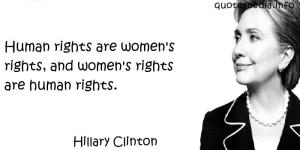
Finally, I ask that everyone read this year-old article at Time Magazine by Jessica Winter, Subject for Debate: Are Women People? It is both darkly humorous and deadly serious.
All my adult life, I’ve been pretty sure I’m a sentient, even semi-competent human being. I have a job and an apartment; I know how to read and vote; I make regular, mostly autonomous decisions about what to eat for lunch and which cat videos I will watch whilst eating my lunch. But in the past couple of months, certain powerful figures in media and politics have cracked open that certitude.
You see, like most women, I was born with the chromosome abnormality known as “XX,” a deviation of the normative “XY” pattern. Symptoms of XX, which affects slightly more than half of the American population, include breasts, ovaries, a uterus, a menstrual cycle, and the potential to bear and nurse children. Now, many would argue even today that the lack of a Y chromosome should not affect my ability to make informed choices about what health care options and lunchtime cat videos are right for me. But others have posited, with increasing volume and intensity, that XX is a disability, even a roadblock on the evolutionary highway. This debate has reached critical mass, and leaves me uncertain of my legal and moral status. Am I a person? An object? A ward of the state? A “prostitute”? (And if I’m the last of these, where do I drop off my W-2?)
Please go read the whole thing. It’s not long.
So . . . those are my recommended reads for today. What stories are you following? Please post your links on any topic in the comment thread.

 peej
peej Carissa
 bostonboomer
 dakinikat
 ecocatwoman
 mablue2
 Mama Lopez
 peggysue22
 quixote
 skydancingguestblogger
 Mona (aka Wonk the Vote)



 Sky Dancing
Recent Comments