Val Kilmer, a homegrown Hollywood actor who tasted leading-man stardom as Jim Morrison and Batman, but whose protean gifts and elusive personality also made him a high-profile supporting player, died on Tuesday in Los Angeles. He was 65.
The cause was pneumonia, said his daughter, Mercedes Kilmer. Mr. Kilmer was diagnosed with throat cancer in 2014 but later recovered, she said.
Youthful Val Kilmer
Tall and handsome in a rock-star sort of way, Mr. Kilmer was in fact cast as a rocker a handful of times early in his career, when he seemed destined for blockbuster success. He made his feature debut in the slapstick Cold War spy-movie spoof “Top Secret!” (1984), in which he starred as a crowd-pleasing, hip-shaking American singer in Berlin unwittingly involved in an East German plot to reunify the country.
He gave a vividly stylized performance as Jim Morrison, the emblem of psychedelic sensuality, in Oliver Stone’s “The Doors” (1991), and he played the cameo role of Mentor — an advice-giving Elvis as imagined by the film’s antiheroic protagonist, played by Christian Slater — in “True Romance” (1993), a violent drug-chase caper written by Quentin Tarantino and directed by Tony Scott.
Mr. Kilmer had top billing (ahead of Sam Shepard) in “Thunderheart” (1992), in which he played an unseasoned F.B.I. agent investigating a murder on a South Dakota Indian reservation, and in “The Saint” (1997), a thriller about a debonair, resourceful thief playing cat-and-mouse with the Russian mob. Most famously, perhaps, between Michael Keaton and George Clooney he inhabited the title role (and the batsuit) in “Batman Forever” (1995), doing battle in Gotham City with Two-Face (Tommy Lee Jones) and the Riddler (Jim Carrey), though neither Mr. Kilmer nor the film were viewed as stellar representatives of the Batman franchise….
But by then another, perhaps more interesting, strain of Mr. Kilmer’s career had developed. In 1986, Mr. Scott cast him in his first big-budget film, “Top Gun” (1986), the testosterone-fueled adventure drama about Navy fighter pilots in training, in which Mr. Kilmer played the cool, cocky rival to the film’s star, Tom Cruise. It was a role that set a precedent for several of Mr. Kilmer’s other prominent appearances as a co-star or a member of a starry ensemble. He reprised it in a brief cameo in the film’s 2022 sequel, “Top Gun: Maverick.”
He played the urbane, profligate gunslinger Doc Holliday in “Tombstone” (1993), a bloody western, alongside Kurt Russell, Sam Elliott and Bill Paxton as Wyatt, Virgil and Morgan Earp. He was part of a robbery gang in “Heat” (1995), a contemporary urban “High Noon”-ish tale that was a vehicle for Robert De Niro as the mastermind of a heist and Al Pacino as the cop who chases him down. He was a co-star, billed beneath Michael Douglas, in “The Ghost and the Darkness” (1996), a period piece about lion hunting set in late 19th century Africa. In “Pollock” (2000), starring Ed Harris as the painter Jackson Pollock, he was a fellow artist, Willem de Kooning. He played Philip of Macedon, the father of Alexander the Great (Colin Farrell), in Oliver Stone’s grandiose epic “Alexander” (2004).
Val Kilmer had such intense magnetism that he could make a flyboy villain charming. He could make a smug young genius endearing. He could make a frontier gunman dying from tuberculosis not just tragically romantic but somehow sexy. In a career spanning four decades, the actor both embraced and shattered the expectations of a Hollywood leading man. Even after years battling throat cancer, which robbed him of his voice and heartthrob physique, Kilmer still managed to deliver one more emotional performance that bookended his adventurous onscreen life.
That was Top Gun: Maverick in 2022, in which Kilmer reprised his role as Tom “Iceman” Kazansky, the fighter pilot who serves as the chief rival to Tom Cruise’s naval aviator in the blockbuster 1986 original. Both men were still just starting out as actors at that point. Kilmer had broken through as a spoof of Elvis Presley in the 1984 spy farce Top Secret! and was the high-IQ slacker in 1985’s Real Genius when he took on the role of the hotshot antagonist. In the sequel, set decades later, Iceman is an admiral in charge of the Navy’s Pacific Fleet, and he and Maverick have long patched over their youthful clashes to become not just friends but brothers in arms. Kilmer was several years into his cancer treatments in real life, and no longer able to act full time, but Cruise went to great lengths to incorporate him in the story, making Kilmer’s declining condition a part of the character. It brought an emotional closure to a pop culture story that had already resonated with millions around the world, and was the last time moviegoers saw Kilmer onscreen. It was not just a goodbye to Iceman, but a goodbye to the actor as well.
Kilmer succumbed to pneumonia and died on Tuesday at the age of 65.
He never tried to hide his health struggles, and in 2021 participated in the documentary Val, which chronicled his day-to-day activities recovering from various treatments that left his voice a raspy whisper and drained his strength. His son, Jack Kilmer, narrated the story by reading his father’s words. “I have behaved poorly, I have behaved bravely, I have behaved bizarrely to some,” read one self-reflective line. The movie included old VHS footage Kilmer recorded of himself and his friends, documenting his life on movie sets and his wild-child approach to creativity. It was that willingness to take risks and challenge himself that made him unpredictable and surprising as a performer. Kilmer was many things in his life, and those watching him never knew what to expect.
Read the rest at Vanity Fair.
Democrats had a good day yesterday. Senator Cory Booker inspired with a record-breaking filibuster, and Democratic candidates overperformed in special elections in Florida and won control of Wisconsin Supreme Court with the election of liberal judge Susan Crawford.
Sen. Cory Booker, D-N.J., wanted to do something extraordinary. He knew Democratic voters were desperate for it.
So he took to the Senate floor with little fanfare and went on to deliver a marathon speech — excoriating the Trump administration for lawlessness and undermining American values and in the process breaking the record for longest Senate speech ever, yielding Tuesday after 25 hours and 5 minutes.
It was a cathartic moment for a vast swath of demoralized voters across the country, who tuned in amid hunger for some action by the opposition party beyond the traditions of business as usual.
And for a Democratic Party that has been lost in the wilderness since its bruising defeat to Donald Trump last fall, it offered a rare moment of hope to pursue what may be its only chance of slowing Trump down: inspiring a mass popular uprising against him.
“There’s a lot of people out there asking Democrats to do more and to take risks and do things differently,” an exhausted Booker told reporters after he walked off the floor. “This seemed like the right thing to do. And from what my staff is telling me, a lot of people watched. And so we’ll see what it is. I just think a lot of us have to do a lot more, including myself.”
Throughout Tuesday afternoon, Booker was trending across social media, including on TikTok, BlueSky and even Elon Musk’s X.
The speech got over 350 million “likes” on Booker’s TikTok livestream of his remarks, according to his office, including more than 300,000 people viewing them across his platform at once. It prompted over 200 stories from New Jerseyans and Americans in response. And it drew over 28,000 voicemails of encouragement on Booker’s office phone line, along with public accolades from Democratic luminaries like former Vice President Kamala Harris and Rep. Nancy Pelosi, D-Calif., the former House speaker.
Heather Cox Richardson at Letters from an American: April 1, 2025.
For more than 25 hours he held the floor of the Senate, not reading from the phone book or children’s literature, as some of his predecessors have done, but delivering a coherent, powerful speech about the meaning of America and the ways in which the Trump regime is destroying our democracy.
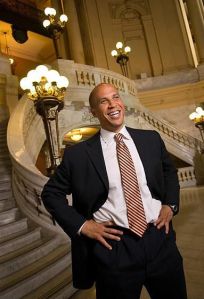
Senator Cory Booker
On the same day that John Hudson of the Washington Post reported that members of Donald Trump’s National Security Council, including national security advisor Michael Waltz, have been skirting presidential records laws and exposing national security by using Gmail accounts to conduct government business, and the same day that mass layoffs at the Department of Health and Human Services gutted the Centers for Disease Control and Prevention (CDC), the National Institutes of Health (NIH), and the Food and Drug Administration (FDA), Booker launched a full-throated defense of the United States of America.
Booker began his marathon speech at 7:00 on the evening of March 31 with little fanfare. In a video recorded before he began, he said that he had “been hearing from people from all over my state and indeed all over the nation calling upon folks in Congress to do more, to do things that recognize the urgency—the crisis—of the moment. And so we all have a responsibility, I believe to do something different to cause, as John Lewis said, good trouble, and that includes me.”
On the floor of the Senate, Booker again invoked the late Representative John Lewis of Georgia, who had been one of the original Freedom Riders challenging racial segregation in 1961 and whose skull law enforcement officers fractured on the Edmund Pettus Bridge in Selma, Alabama, in 1965 as Lewis joined the marchers on their way to Montgomery to demand their voting rights be protected.
Booker reminded listeners that Lewis was famous for telling people to “get in good trouble, necessary trouble. Help redeem the soul of America.” Booker said that in the years since Trump took office, he has been asking himself, “[H]ow am I living up to his words?”
“Tonight I rise with the intention of getting in some good trouble. I rise with the intention of disrupting the normal business of the United States Senate for as long as I am physically able. I rise tonight because I believe sincerely that our country is in crisis and I believe that not in a partisan sense,” he said, “because so many of the people that have been reaching out to my office in pain, in fear, having their lives upended—so many of them identify themselves as Republicans.”
A trio of elections on Tuesday provided early warning signs to Republicans and President Donald Trump at the beginning of an ambitious term, as Democrats rallied against his efforts to slash the federal government and the outsize role being played by billionaire Elon Musk.
In the marquee race for a Wisconsin Supreme Court seat, the conservative judge endorsed by Trump and backed by Musk and his groups to the tune of $21 million lost by a significant margin in a state Trump won in November. And while Florida Republicans held two of the most pro-Trump House districts in the country, both candidates also underperformed Trump’s November margins.
The elections — the first major contests since Trump’s return to power — were seen as an early measure of voter sentiment as Trump works with unprecedented speed to dramatically upend the federal government, clashing with the courts and seeking revenge as he tests the bounds of presidential power.
The party that loses the presidency in November typically picks up seats in the next midterm elections, and Tuesday’s results provided hope for Democrats — who have faced a barrage of internal and external criticism about their response to Trump — that they can follow that trend.
On the Wisconsin Supreme Court race:
Trump won Wisconsin in November by 0.8 percentage points, or fewer than 30,000 votes. In the first major test since he took office, the perennial battleground state shifted significantly to the left.
Sauk County, northwest of the state capital of Madison, is a state bellwether. Trump won it in November by 626 votes. Sauk shifted 14 points in the direction of Judge Susan Crawford, the liberal favorite backed by national Democrats and billionaire donors like George Soros.
Besides strong turnout in Democratic-heavy areas, Crawford did measurably better in the suburban Milwaukee counties that Republicans rely on to run up their margins statewide.
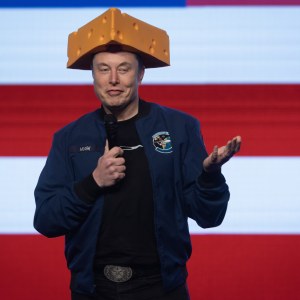
Elon Musk in Green Bay, Wisconsin pretending to be a Cheeshead
Crawford won Kenosha and Racine counties, both of which went for Trump over Democratic nominee Kamala Harris. She was on pace to win by 9 percentage points.
In interviews with more than 20 voters in Waunakee, a politically mixed town north of Madison, several Democrats suggested without prompting that their vote was as much if not more of a repudiation of Trump’s first months in office as it was a decision on the direction of the state high court….
Others disliked the richest man in the world playing such a prominent role.
“I don’t like Elon Musk spending money for an election he should have no involvement in,” said Antonio Gray, a 38-year-old Milwaukee security guard. “They should let the voters vote for who they want to vote for instead of inserting themselves like they have.”
Elon Musk went all out trying to win Republican control of the Wisconsin Supreme Court.
Musk and his related groups dropped more than $20 million on boosting the conservative candidate, a former state attorney general, Brad Schimel. (Those $1 million sweepstakes giveaways were especially shameless.) Musk held a town hall/rally in Green Bay on Sunday, where he urged folks to back Schimel, and he pitched the race as “one of those things that may not seem that it’s going to affect the entire destiny of humanity, but I think it will.”
In helping make this probably the most expensive court contest of all time, Musk also turned it into a referendum on himself and his role in the Trump administration. Schimel, bless his heart, could have been the greatest candidate in the history of democracy — he wasn’t — and it wouldn’t have mattered. This became all about Elon, with a dash of Donald Trump thrown in.
Wisconsinites’ response: No, thanks, bruh. Despite Musk’s hysterical warnings and cheesehead preening, Schimel’s opponent, Susan Crawford, won by about 10 points, securing the court’s liberal majority.
Cottle says that anxious Republicans should grasp this opportunity to get rid of the unlikeable multi-billionaire.
Musk has his money-drenched tentacles wrapped tightly around the president. To start disentangling him and moving him toward the door, Republican lawmakers need to make the case that he is hurting Trump’s popularity — and threatening the G.O.P.’s unified control of Washington. Musk’s expensive Wisconsin flop is a big, red warning flag for Republican members to wave. They’d be wise to seize the moment while this failure is raw, missing no opportunity to remind the president what a political loser his buddy is turning out to be.
Waiting will only make the situation worse. DOGE is just getting warmed up. There’s no telling how much more damage Musk will do — to the nation and to the Republican Party — by the time a smattering of elections are decided this November. The mass layoffs of federal workers are already expected to damage Republicans’ fortunes in the Virginia governor’s race, seen as a key political bellwether.
And by next year’s midterms? Let’s just say voters can go to bloodthirsty from adoring in a flash when people start messing with their Social Security and Medicaid.
“I don’t know when it was signed, because I didn’t sign it,” President Trump told reporters on March 22. In the span of a week, the president “forgot” that he invoked the Alien Enemies Act to summarily deport hundreds of people to a Salvadoran gulag.
“Other people handled it, but Marco Rubio has done a great job and he wanted them out and we go along with that,” he mumbled vaguely.
The media framed the debacle as a clever effort to “downplay his involvement” in the ugly episode, rather than evidence that the president is totally checked out and letting other people run the government.
And yet, just five days before his own memory lapse, Trump “declared” his predecessor’s pardons of the January 6 Committee “VOID, VACANT, AND OF NO FURTHER FORCE OR EFFECT” because Biden was too senile to understand them….
The post is part of an ongoing campaign to undo Biden’s presidency by claiming that he was too incompetent by the end to exercise actual power, and some unnamed, shadowy figure was running the White House instead. It’s shockingly inappropriate, of course. But the juxtaposition is even more jarring as we are daily confronted with a president who is disengaged from the details of his job, preferring to outsource most of his authority to an unelected billionaire….
Undoing pardons is not a thing. Not even if Biden used an autopen. As the Supreme Court made clear in Trump v. US, the president’s exercise of his “core” powers, specifically the pardon, is unreviewable. But Trump is captured by internet memes, and so he’s thrilled to amplify the “autopen” conspiracy currently flooding the rightwing media ecosystem.
Old Man Trump
“The person that operated the autopen, I think we ought to find out who that was because I guess that was the real president,” Trump said in the Oval Office on March 20.
Read the whole thing if you have time, but here’s the meat of it:
Trump, who, at 78, is just three years younger than Biden, is clearly decompensating before our eyes. And yet, even as he free associates on live television, back-formulating justifications for orders he’s obviously never read, the right leans ever harder into the story of Biden’s supposed incompetence….
Trump doesn’t know what he’s signed when it comes to pardons, executive orders, or anything else. He’s outsourced the job to an unelected billionaire who is currently slashing through the government, bragging on social media about feeding entire federal agencies “to the woodchipper.” Elon Musk leads cabinet meetings, dispatches his henchcoders to take over agency after agency, and purports to cancel federal contracts at will. He has no statutory authority, but claims only to be acting as an extension of the president….
In short, Musk is the autopen, illegitimately usurping executive power while claiming to be a mere extension of the president, mechanically recording his wishes and codifying his orders. And so, to compensate, Trump leans into the old, familiar foil.
It’s not the Trump kids who are trading on their father’s position to enrich themselves. It’s Hunter Biden. It’s not the Trump administration storing classified information on unsecured devices. It’s Hillary Clinton. And it’s not Donald Trump who signs whatever his aides put in front of him, no matter how corrupt. It’s Joe Biden.
I think she’s right. Trump is spending most of his time posting on Truth Social, playing golf, and fantasizing about annexing Greenland.
The White House is preparing an estimate of what it would cost the federal government to control Greenland as a territory, according to three people with knowledge of the matter, the most concrete effort yet to turn President Donald Trump’s desire to acquire the Danish island into actionable policy.
While Trump’s demands elicited international outrage and a rebuke from Denmark, White House officials have in recent weeks taken steps to determine the financial ramifications of Greenland becoming a U.S. territory, including the cost of providing government services for its 58,000 residents, the people said.
At the White House budget office, staff have sought to understand the potential cost to maintain Greenland if it were acquired, two of the people said. They are also attempting to estimate what revenue to the U.S. Treasury could be gained from Greenland’s natural resources.
One option under analysis is to offer a sweeter deal to the government of Greenland than the Danes, who currently subsidize services on the island at a rate of about $600 million every year.
“This is a lot higher than that,” said one official familiar with the plans, who like others spoke on the condition of anonymity to discuss plans that remain in the works. “The point is, ‘We’ll pay you more than Denmark does.’”
Trump has said repeatedly that the United States will “get” Greenland.
“100 percent,” he told NBC News on Saturday. Asked whether it would involve force, he said that there is a “good possibility that we could do it without military force” but that “I don’t take anything off the table.”
If only the Democrats could take the House and Senate in 2026, they could impeach this insane monster.
I know this is getting long, but I need to include one more outrage: the decimation of public health infrastructure.
The Trump administrationgutted federal health agencies on Tuesday morning, as thousands of employees received layoff notices, following Health and Human Services Secretary Robert F. Kennedy Jr.’s announcement last week he was planning to lay off nearly 10,000 workers.
More than 7,000 workers at the Centers for Disease Control and Prevention, the National Institutes of Health, the Food and Drug Administration, and the Centers for Medicare and Medicaid Services were cut. Staffers with decades of experience received emails at 5 a.m. on Tuesday that they were being placed on administrative leave and would no longer have access to their buildings, effective immediately. In the Washington D.C. area, thousands of federal workers lined up outside office buildings to see if their badges worked, as they hugged each other in tears.
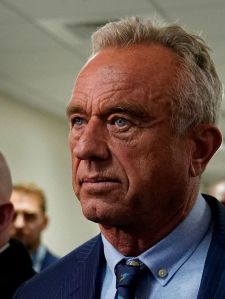
Robert F. Kennedy, Jr.
Kennedy, a vaccine skeptic, is attempting to gut the agencies and remake them in his image. These cuts will allow HHS to consolidate not only authority but messaging, as many of the departments affected involve communications departments. The massive layoffs are part of Donald Trump’s broader purge of the federal workforce, and parallel what Elon Musk is doing with his so-called Department of Government Efficiency (DOGE), which claims to be streamlining the federal government, but is gutting entire agencies. Musk’s DOGE has celebrated the cancellations of NIH grants, something Senator Cory Booker decried during his record-breaking filibuster on Tuesday.
On Tuesday, entire divisions were completely obliterated in a move that shocked HHS staffers. Hundreds of researchers studying diseases like HIV and other sexually transmitted diseases were laid off. “I cannot think of a worse idea than firing the people who help keep us healthy and safe from disease,” Senator Raphael Warnock said on X. This comes at a time when the U.S. is suffering from a nationwide measles outbreak….
“It’s so chaotic,” says a CDC employee who received notice Tuesday morning that she was being placed on administrative leave and would be terminated in June. (She asked to remain anonymous for fear of legal retribution, so she’ll be referred to by the pseudonym Samantha.) “The amount of knowledge that is being purged today at CDC is just tragic.” [….]
Samantha, who worked at the CDC’s Division of Environmental Health and Science Practice (DEHSP), says her entire division was eliminated. That includes the Asthma and Air Quality Branch, the Lead Poisoning Prevention and Surveillance Branch, the Climate and Health Activity branch, and the Water Food and Environmental Health Services, among others. Approximately 2,400 employees have been impacted in the CDC.
“They are firing whole organizational units,” says Samantha. “These are people that have 30 years of service, people with children, veterans, there was no thought put into trying to retain people that have institutional knowledge.”
Several top scientists charged with overseeing research into disease prevention and cures at the National Institutes of Health (NIH) were notified that they were subject to a reduction in force on Tuesday as part of a devastating purge of federal employees carried out by US Health and Human Services secretary Robert Kennedy Jr., WIRED has learned.
Multiple sources at the NIH, granted anonymity because they were not authorized to talk to the media, confirmed Tuesday afternoon that at least 10 principal investigators who were leading and directing medical research at the agency had been fired. Among them is Dr. Richard Youle, a leading researcher in the field of neurodegenerative disorders previously awarded the Breakthrough Prize in Life Sciences for his groundbreaking research identifying mechanisms behind Parkinson’s disease.
The Breakthrough Prize ceremony, often referred to as the “Oscars of Science,” was last year attended by Elon Musk, whose Department of Government Efficiency (DOGE) has served as the tip of the spear in President Donald Trump’s campaign to eliminate large swaths of the federal workforce….
Multiple NIH sources tell WIRED the layoffs include—in addition to labor, IT, and human resources personnel—several accomplished senior investigators at the National Institute of Neurological Disorders and Stroke (NINDS), top scientists at the National Institute on Aging, and several researchers noted for their work in HIV, emerging infectious diseases, and child brain and neural disorders.
At an NINDS town hall meeting on Tuesday, leadership at that institute expressed confusion about the cuts, saying they were blindsided by firings of principal investigators, or PIs, who lead research teams. NIH has approximately 1,200 PIs across its 27 centers and institutes. “To get rid of 11 of our senior PIs … we’re hoping that’s a mistake, because we can’t figure out why they would want to do that,” said Walter Koroshetz, director of the NINDS, according to a source present at the meeting.
The labs affected by the layoffs include those involved in clinical trials as well as preclinical studies. It is unclear, NIH staff said, what the plans are for the data they’ve accumulated or what will happen to patients involved in ongoing trials.
I’ll end there. What do you think? What’s on your mind today?
Did you like this post? Please share it with your friends:
Thanks to the Delta variant, and people refusing to be vaccinated, Covid-19 cases are rising around the country, particularly in Florida, Texas, Mississippi, and Louisiana. At least Louisiana’s Democratic Governor John Bel Edwards is trying to get the situation under control. But in the other three states, governors are working against public health.
When Gov. John Bel Edwards lifted Louisiana’s mask mandate at the end of April, he warned that loosening restrictions wasn’t a “one way street” and that he would reimpose the rules if COVID-19 came roaring back.
On Monday, as hospitals statewide buckled under an unprecedented surge in patients, Edwards followed through on his word.
Schools, businesses, universities, churches, and any other indoor public settings in Louisiana will require a face mask for entry beginning on Wednesday, under a proclamation Edwards signed that expires September 1.
“It has become extremely clear that our current recommendations on their own are not strong enough to deal with Louisiana’s fourth surge of COVID. In fact, nobody should be laboring under the misapprehension that this just another surge,” Edwards told reporters Monday in announcing the order he had already signed. “This is the worst one we’ve had thus far.”
The return to restrictions comes as the pandemic enters a new stage defined by the delta variant, a highly contagious strain of COVID-19 first identified in India that now accounts for most new cases in Louisiana. On Monday, the state reported 11,109 new confirmed and probable infections of COVID-19. More than 2,000 of those cases were among children.
One-third of all US Covid-19 cases reported in the past week were in just two states – Florida and Texas – according to White House Covid-19 response coordinator Jeff Zients.
The cases are mainly in areas where vaccination rates remain low, Zients said at a briefing Monday.
“In fact, seven states with the lowest vaccination rates represent just about 8- 1/2% of the US population, but account for more than 17% of cases, and one in three cases nationwide occurred in Florida and Texas, this past week,” Zients said.
In the past two weeks, daily case rates have gone up fourfold, according to Dr. Francis Collins, director of the National Institutes of Health.
The increase comes as the Delta variant spreads and the percentage of fully vaccinated Americans hovers around 49.7%, according to the US Centers for Disease Control and Prevention. Hospitals are once again filling up with patients as the virus tears through the unvaccinated population.
“There are still about 90 million eligible Americans who are unvaccinated,” Zients said. “And we need them to do their part, roll up their sleeves and get vaccinated. Each and every shot matters.”
It doesn’t seem to matter to some Republican Governors.
On Saturday, Florida recorded 21,683 new cases of COVID-19, breaking its one-day record for new cases. But even as the state swells with fresh infections, Republican Gov. Ron DeSantis remains hellbent on his war against mask mandates. He even recently barred school districts from instituting mask mandates when classes reconvene in August.
The Sick Child, 1907, by Edvard Munch
DeSantis feels so good about his war on masks, he’s even laughing about it. “Did you not get the CDC’s memo?” DeSantis joked to a largely maskless crowd at a conference for the American Legislative Exchange Council in Utah last week, referring to the Centers for Disease Control and Prevention’s updated guidelines recommending mask-wearing amid the surge of the Delta variant. “I don’t see you complying.”
He continued, prompting applause, “I think it’s very important that we say unequivocally, ‘No to lockdowns, no to school closures, no to restrictions, and no mandates.’ Floridians are free to choose and all Americans should be free to choose how they govern their affairs, how they take care of themselves and our families.”
The governor, who is reportedly eyeing a bid for president in 2024, has spent most of the pandemic fiercely opposing COVID safety measures—a stance public health officials say has allowed the virus to run rampant across the state and has now made Florida the epicenter of the pandemic in this country. To DeSantis’ sort-of credit, he has made recent efforts to boost vaccinations, though at the same time he’s selling anti-Anthony Fauci merchandise on his website.
In Mississippi:
In Mississippi, where ICU beds are nearing capacity with a surge of unvaccinated individuals, Republican Gov. Tate Reeves blasted the CDC’s mask guidelines as “foolish” and claimed that it reeked of “political panic.”
“It has nothing, let me say that again: It has nothing to do with rational science,” Reeves said on Thursday.
Except that it does. As Dr. Fauci warned on Sunday, “Things are going to get worse.” The country’s top expert on infectious diseases told ABC’s This Week, “You want them to wear a mask so that if in fact they do get infected, they don’t spread it to vulnerable people, perhaps in their own household, children, or people with underlying conditions.”
In an executive order issued on Thursday, Gov. Greg Abbott, the Republican governor of the nation’s second-largest state, prohibited local governments and state agencies from mandating vaccines, saying that protection against the virus should be a matter of personal responsibility, not forced by a government edict.
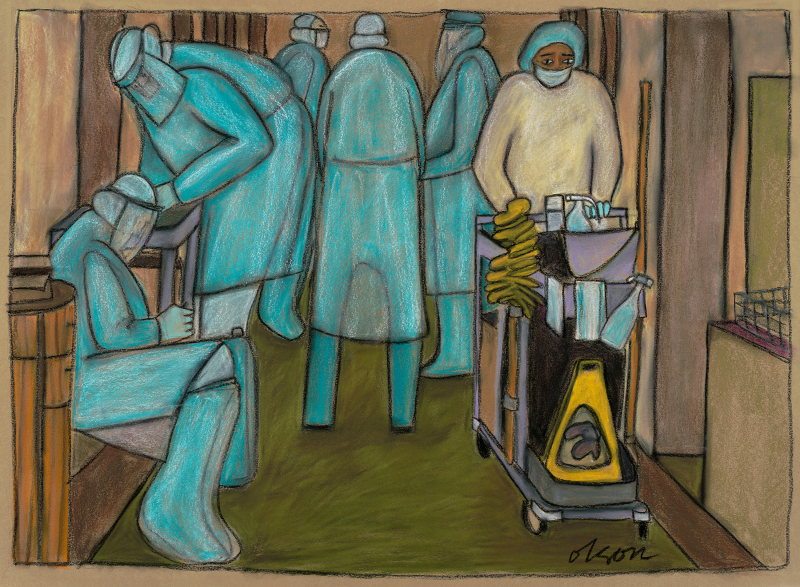
Hospital Workers, by Carolyn Olson
The order also reinforced his prior directive prohibiting local officials from requiring face masks, despite growing calls from city leaders for greater flexibility to reverse the renewed spread of Covid.
The daily average of cases in Texas as of Friday was 8,820, according to a New York Times database, a 209 percent increase over the past 14 days. Cities across the state are facing a surge in hospitalizations reminiscent of the alarming spikes that occurred before Covid cases began nosing downward with the arrival of vaccines.
With 56 percent of the state’s population unvaccinated — including nearly five million children under 12 who are not eligible — health officials have expressed concern about the state’s vulnerability.
In May, when the CDC said fully vaccinated people could ditch masks and social distancing, it seemed to signal a return to normalcy. But epidemiologists cautioned at the time that the move wasn’t likely to be permanent, and shouldn’t be interpreted as the end of Covid-19 as a daily concern. Colder weather or a right hook in the virus’s evolution could bring restrictions right back.
Still, Americans seem shocked by the recent turn of events. Last week, the Centers for Disease Control and Prevention advised everyone — even those who’ve gotten Covid-19 shots — to go back to indoor masking, a decision driven by new data showing the hyper-contagious Delta variant colonizes the nose and throat of some vaccinated people just as well as the unvaccinated, meaning they may just as easily spread this new version of the virus, while stilling being protected against the worst manifestations of the disease.
The prospect of contending with a prolonged outbreak phase — and adjusting again to a constantly evolving roster of restrictions — has brought back another feature of pandemic living in America: anger.
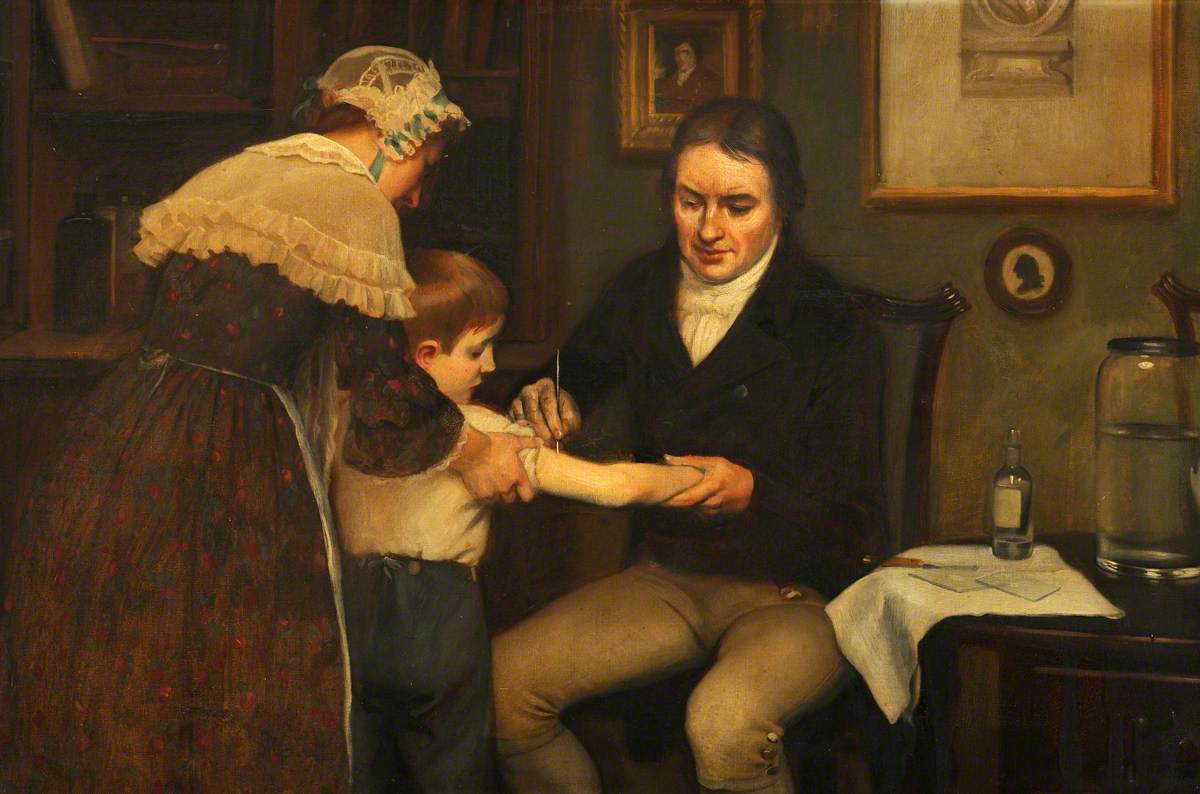
Board, Ernest; Vaccination: Dr Jenner Performing His First Vaccination, 1796
This time it’s not just the mostly Republican anti-masking refrain rearing its defiant head (though fights over school mask mandates have returnedwith a vengeance). Coast to coast, and across the political spectrum, contempt for unvaccinated people is rising. “It’s the unvaccinated folks that are letting us down,” Alabama Governor Kay Ivey, a Republican, said on July 22, as her state, with one of the lowest vaccination rates in the country, reeled from a 530% rise in Covid-19 hospitalizations in just three weeks.
Among the vaccinated, there’s a sense that the freedoms they gained by getting the shots — travel, eating out, concerts, sports, school, seeing friends — are now being jeopardized by those who are still holding out.
Though this new flavor of outrage might look and sound like righteous indignation, mental health professionals say that what’s behind it is fear.
“It’s scary to admit that somebody else has power over you and you’re at their mercy and you’re afraid of them, but showing that is not a very American ideal,” said David Rosmarin, an associate professor of psychiatry at Harvard Medical School and a clinician at McLean Hospital. “Instead of expressing that fear, it’s a lot more comfortable to blame somebody else.”
Anger is what people in his profession refer to as a “secondary emotion.” It’s a feeling that arises in response to a more primal emotion, like fear and anxiety over having some aspect of your life threatened. “The reality is that there are millions of people who are miseducated about something, they’re making a big mistake that will have massive consequences that might affect you and your family and that makes you scared,” Rosmarin said. “But nobody is saying that.”
Unfortunately, there’s another looming disaster caused by the pandemic: the CDC eviction ban is expiring, and in Washington everyone is accusing everyone else of being responsible for dealing with the situation. And it’s complicated by a Supreme Court ruling.
The White House said Monday that it was unable to find a legal means to extend the eviction moratorium, despite the fact that millions of Americans could soon lose their homes even as the Delta variant of COVID-19 continues to spread.
The Centers for Disease Control and Prevention has “been unable to find legal authority for a new, targeted eviction moratorium,” White House press secretary Jen Psaki said in a statement. “Our team is redoubling efforts to identify all available legal authorities to provide necessary protections.”
The Garden of Death, Hugo Simberg, 1897
Citing a Supreme Court decision issued in late June, the White House said it was unable to unilaterally extend the moratorium for evictions. Late last week, Psaki issued a statement pressuring Congress to act, but the House went into recess before a vote could be held. Were it to pass the House, it is unclear if an extension of the moratorium would be able to pass the Senate.
The federal eviction moratorium expired over the weekend, yet more than 6.5 million U.S. households are currently behind in rental payments totaling more than $20 billion, according to a study by the Aspen Institute and the COVID-19 Eviction Defense Project. Without federal protections in place, many renters will now need to pay months of back rent.
“On this particular issue, the president has not only kicked the tires, he has double, triple, quadruple checked,” Gene Sperling, the White House COVID-19 economic relief coordinator, said at a briefing on Monday, adding, “The rise off the Delta variant is particularly harmful for those who are most likely to face evictions, and as that reality became more clear going into the end of last week, I think all of us started asking what more can we do.”
On July 31, the federal government’s eviction moratorium expired, potentially forcing millions of Americans out of their homes during yet another COVID surge. In the days before the eviction cliff, House Democrats attempted to extend the moratorium, but Republicans easily blocked their measure. Democratic lawmakers then spent the weekend arguing over who was to blame for the looming catastrophe.
Curiously, most Democrats chose not to focus on the primary culprit: the Supreme Court. In late June, five conservative justices signaled that they would not let the White House extend the eviction ban beyond July 31 absent further congressional authorization. These Republican-appointed justices set the terms of the debate, yet were largely absent from Democrats’ blame game. As a result, most vulnerable Americans will likely not understand they face homelessness in a pandemic because of SCOTUS. This strange dynamic is symptomatic of a deeper pathology in contemporary American politics: Democrats appear incapable of explaining how the Supreme Court stymies their own agenda—and the resulting confusion shields the court from criticism, consequences, and accountability when its decisions wreak havoc.
Vaccination by Adolfo Flores
When House Speaker Nancy Pelosi urged Biden to extend the eviction moratorium on his own, she framed the issue as a matter of morality. But the president’s inaction was almost certainly a legal calculation. To understand his hesitation, it’s key to remember that the recently expired moratorium was not the same policy that had been in effect since the start of the pandemic. Congress passed its first eviction ban in March 2020, explicitly prohibiting landlords from kicking out tenants who could not afford rent because of the pandemic. After this provision expired that August, Donald Trump issued an executive order asking the CDC to take action. The CDC responded in September with its own eviction moratorium set to run through the end of 2020. It was rooted in a federal law that allows the agency “to make and enforce such regulations” that are “necessary to prevent” the “spread of communicable diseases” between states. In December, Congress passed legislation that explicitly extended the CDC’s moratorium through Jan. 31, 2021. The agency then extended the ban several more times.
While the CDC kept the moratorium in place, a group of landlords sued to block it, claiming it exceeded the agency’s authority. On May 5, U.S. District Judge Dabney Friedrich sided with the plaintiffs against the ban but stayed her order. One month later, the U.S. Court of Appeals for the District of Columbia Circuit court refused to block the ban. The plaintiffs then appealed to SCOTUS, which came within an inch of ending the moratorium. Five justices—Clarence Thomas, Sam Alito, Neil Gorsuch, Brett Kavanaugh, and Amy Coney Barrett—believed it violated the law. But Kavanaugh, who cast the decisive fifth vote, wrote separately to explain that although he believed the CDC had “exceeded its existing statutory authority,” he would not invalidate the ban. Instead, weighing the “balance of equities,” he would allow it to remain for “a few weeks.”
“In my view,” the justice declared, “clear and specific congressional authorization (via new legislation) would be necessary for the CDC to extend the moratorium past July 31.”
Kavanaugh’s analysis is dubious at best. (Maybe that’s why Chief Justice John Roberts didn’t join it, instead quietly voting to keep the moratorium in place.) Congress already gave the CDC expansive powers to fight the “spread of communicable diseases” between states. The agency acted pursuant to this law when it determined that mass evictions would force many Americans to live unhoused or crammed together in close quarters, transmitting the virus more widely. Crucially, when Congress chose to extend the moratorium, it simply passed a law extending the CDC’s own ban. By doing so, lawmakers chose “to embrace” the agency’s action and “expressly recognized” that it had the authority to issue the ban, in the words of the D.C. Circuit. It would not make a lick of sense for Congress to extend the CDC’s moratorium if it did not believe the CDC had authority to issue it.
More eviction reads:
The Washington Post Editorial Board: Opinion: There’s plenty of money to avoid evictions. States just have to spend it.
Real estate brokerage Estately Inc. published an analysis this week ranking each state by its vulnerability in the event of an undead epidemic. The company looked at four criteria, according to spokesman Reid Wegley:
– Is the state’s population knowledgeable about zombies?
– Are they physically capable of evading them?
– Have they been trained to fight them? and
– Do they have guns and shooting skills?
….
Mr. Wegley said each state was ranked 1-50 based on data from several sources: U.S. Census figures on military personnel and veterans; Facebook Inc. searches of interest in martial arts, survival skills, zombies, laser tag, paintball and Ironman triathlons; gun ownership and physical health and obesity rates by state. The ranks were then totaled for each state—the lower the figure, the better-prepared the state.
Okay, so zombies aren’t real. But Ebola has arrived in Texas, and already there have been screw-ups. We have to rely on the CDC to protect the country–the same CDC that just recently was involved in three serious security lapses involving bird flu, smallpox, and anthrax. And did you know that last year a biolab in Texas *lost* a deadly virus from Venezuela? I didn’t. From ABC News, March 25, 2013:
The Galveston National Laboratory lost one of five vials containing a deadly Venezuelan virus, according to the University of Texas Medical Branch, which owns the $174 million facility designed with the strictest security measures to hold the deadliest viruses in the country.
“This is clearly an incident that is very discomforting and embarrassing to the University of Texas Medical Center and their national biosecurity lab that they have there,” said Dr. William Schaffner, chairman of preventive medicine at Vanderbilt University Medical Center in Nashville, Tenn. “You can be sure there are a lot of sweating people down the chain at that institution.”
These are the folks we are dependent on to protect the country from a major disease epidemic. I’m not ready to panic yet, but I’m sure going to be paying attention from now on.
State and local health officials sought to quiet fears in Dallas after disclosing Wednesday that they are monitoring more than a dozen people, including five schoolchildren, who had close contact with the nation’s first Ebola-stricken victim.
The patient, identified in media reports as Thomas Eric Duncan, a 42-year-old resident of Monrovia, Liberia, remained in Texas Health Presbyterian Hospital as authorities tried to patch together his activities after he became ill here while visiting family members.
Among other key developments in a fast-moving day: Hospital officials said they erred in sending Duncan home when he first sought treatment a week ago; paramedics who later transported him to the hospital tested negative for the virus; and Dallas plans to begin an extensive cleaning of the schools the students attended.
None of those who came into contact with Duncan when he was experiencing active symptoms — meaning the disease was contagious — have shown signs of being infected.
“We’re confident that it’s isolated and it’s being contained, but everyone is working tirelessly to double- and triple- and quadruple-check their work, to make sure that we’ve done an absolutely thorough job of identifying anyone who might be at any risk,” Dallas County Judge Clay Jenkins said.
Rick Perry chimed in:
Gov. Rick Perry said the patient was receiving “the very best care” there. Duncan, who is in isolation, was said to be in serious but stable condition. A day earlier, he was described as critically ill. Health officials have declined to disclose his name, citing privacy laws.
Perry praised the hospital and health workers.
“This case is serious, but rest assured that our system is working as it should,” he said. “There are few places in the world better-equipped to meet the challenge this patient poses. The public should have every confidence.”
DALLAS – Two days after he was sent home from a Dallas hospital, the man who is the first person to be diagnosed with Ebola in the United States was seen vomiting on the ground outside an apartment complex as he was bundled into an ambulance.
“His whole family was screaming. He got outside and he was throwing up all over the place,” resident Mesud Osmanovic, 21, said on Wednesday, describing the chaotic scene before the man was admitted to Texas Health Presbyterian Hospital on Sunday where he is in serious condition.
Officials ordered everyone who had been in the apartment with Duncan to stay there for 21 days in quarantine. Which was fine, but no one removed the sheets the man had slept on or made provisions for the people inside to have food and other supplies. From CNN: Frustrated woman quarantined with sheets, towels soiled by Ebola patient.
The sweat-stained sheets of Thomas Eric Duncan, the first person diagnosed with Ebola in the United States, still on her bed, a woman quarantined in a Dallas apartment said Thursday that she desperately wants her family’s nightmare to end.
“We can’t wait to be over with everything,” the woman, who asked to be identified only by her first name, Louise, told CNN’s Anderson Cooper. “We can’t wait.”
While Duncan is in isolation at Texas Health Presbyterian Hospital, his partner and three others have been stuck in a Dallas apartment since his diagnosis this week. Louise told CNN that authorities had her sign paperwork stating “if we step outside, they are going to take us … to court (because) we’ll have committed a crime.”
So there she has stayed, along with her 13-year-old son and two nephews in their 20s. But it hasn’t been easy.
She said no one brought food Thursday to four people who can’t leave to get it themselves, at least until later in the day. There was also the matter of their power going out, which was likely related to strong storms that rolled through the area. Then, of course, there’s the idea of living in a place that — just a few days ago — was home to an Ebola sufferer.
Her 35-year-old daughter brought over Clorox to help clean the house, and she sealed up Duncan’s dirty clothes and towels in a bag.
“But (authorities) said we shouldn’t throw anything away until they can get back with me,” Louise said.
That hadn’t happened as of Thursday evening. Men in trucks from Cleaning Guys, a company that specializes in hazmat and biohazard cleaning services, was turned away for lack of the necessary permit to transport hazardous waste on Texas highways, it said.
According to the article, after CNN reported the horrible conditions in the apartment, some local officials are discussing relocating the family to someplace less contaminated.
Here’s the latest on the Ebola story as of this morning.
DALLAS (AP) — A woman who has been confined to her Dallas apartment under armed guard after a man infected with Ebola stayed at her home, said she never imagined this could happen to her so far from disease-ravaged West Africa.
Louise Troh said Thursday that she is tired of being locked up and wants health authorities to decontaminate her home.
Authorities say the circle of people in the U.S. possibly exposed to Ebola widened after the man, who arrived from Liberia last month, was discharged from a hospital without being tested for the deadly virus.
The confinement order, which also bans visitors, was imposed after the family failed to comply with a request to stay home, according to Dallas County Judge Clay Jenkins. Texas State Health Commissioner David Lakey said the order would ensure Troh, her 13-year-old son and two nephews can be closely monitored for signs of the disease.
The network reported the freelancer, identified as Ashoka Mukpo, was just hired Tuesday to be a second cameraman for its medical editor, Nancy Snyderman, a physician. It said the freelancer, who has been working in Liberia for some time, showed symptoms Wednesday, and was feeling “tired and achy” before being tested.
The network said the 33-year old cameraman, who is also a writer, was taken to a Doctors Without Borders treatment center and that the positive result came back 12 hours later.
“Obviously he is scared and worried,” Mukpo’s father Dr. Mitchell Levytold the Today show on Friday. Mukpo’s time in Liberia meant that he was “seeing the death and tragedy and now it’s really hit home for him.” he added, “But his spirits are better today.”
Mukpo’s mother Diane Mukpo said that her son will leave Sunday for the US. “I believe they’re doing things as quickly as they can but that doesn’t take away from the fact that we know he’s going to be in Liberia until Sunday, and I really can only hope and pray that his symptoms don’t worsen too quickly,” she said.
He is the fourth American known to have contracted Ebola in Liberia, according to NBC. Another physician, reportedly American and working for the World Health Organization, was flown back to the United States after testing positive in Sierra Leone.
Now that the horses are out of the barn, so to speak, hospitals will review their procedures for dealing with contagious diseases–in Boston at least. From The Boston Globe, After Ebola error, hospitals review procedures.
The emergence this week of the first Ebola case in the United States — and the mistakes made by a Texas hospital that led to a delayed diagnosis — prompted Boston hospitals and primary care practices to review their emergency plans over the past two days and strengthen weak spots.
“The news in Texas didn’t change our planning, but it got our staff’s attention,” said Dr. Paul Biddinger, vice chairman and medical director for preparedness at Massachusetts General Hospital.
The reassessment of emergency measures comes even as disease trackers emphasize that the likelihood of Ebola striking Boston remains low.
Still, nurses, doctors, and physician’s assistants in Mass. General’s emergency department and clinics have been asking for information about symptoms and for a list of western Africa countries that have experienced more than 7,100 Ebola cases and 3,300 deaths since the outbreak was first reported in March. Some health workers at the hospital have practiced putting protective gear on and off.
Texas Health Presbyterian Hospital
Presumably hospitals around the country will take similar precautions. However, at the Texas hospital responsible for the “error,” excuse-making is still the order of the day. CBS News: Hospital blames tech glitch for Ebola patient error.
Texas Health Presbyterian Hospital officials said a flaw in the way the electronic records interacted between the nurse who questioned Thomas Eric Duncan and the doctor who treated him led to the mis-communication that enabled Duncan to go home after his first visit to the emergency room last week.
They said that flaw has now been fixed.
But the fallout from that mistake is far from over.
CBS reports that the apartment has now been “decontaminated by hazmat crews,” and food and other supplies have been provided for the people trapped inside the apartment. But so far, other residents of the apartment complex have not been screened for Ebola infection.
Early this morning, Tom Frieden, the CDC chief, told MSNBC that the only way to stop an Ebola epidemic is to deal with it in West Africa. Politico reports:
CDC Director Tom Frieden on Friday said restricting travel between the U.S. and West Africa would likely “backfire” and put Americans more at risk of contracting Ebola.
Appearing on MSNBC, Frieden was asked about potentially prohibiting air travel between the U.S. and West Africa, where the Ebola outbreak is most widespread. He said that such a restriction would likely be ineffective and would make it harder for health officials to root out the virus.
“The only way we’re going to get to zero risk is by stopping the outbreak at the source” in West Africa, Frieden said.
“Even if we tried to close the border, it wouldn’t work,” the top health official added. “People have a right to return. People transiting through could come in. And it would backfire, because by isolating these countries, it’ll make it harder to help them, it will spread more there and we’d be more likely to be exposed here.”
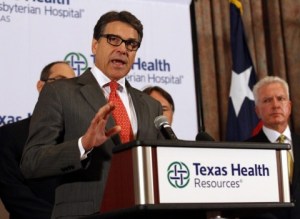
At a press conference Wednesday announcing the details of the case, Perry was front and center — playing the dual role of information provider and, maybe more importantly, calmer of nerves. “This case is serious,” Perry said. “Rest assured, our system is working as it should.”
For Perry, it’s a return to the national spotlight that he left with a whimper in January 2012 when he ended a disastrously bad presidential bid. That candidacy, which began in August 2011 to much fanfare, collapsed, largely, because of Perry’s inadequacies as a candidate. While his “oops” moment during a presidential debate came to epitomize his flailing bid, there were any number of other off — or downright odd — moments during his five months as a candidate.
Perry has spent virtually every minute since he dropped out of the race working to rehab his image. He got glasses. He started traveling to early caucus and primary states (again). He floated the possibility that he would run for president (again). All of it was met, generally, with a collective eye roll by the professional political class who viewed him as yesterday’s news. Donors, activists and the media tend to want new blood in presidential races, not folks who are viewed as having had their chance and blown it. Perry was forever battling the “oh yeah, you’re the guy who forgot the third federal agency you wanted to get rid of” narrative. And it was a fight he wasn’t going to win.
Until, maybe, now. Being at the forefront of the fight against Ebola — the first-ever case in the United States — affords Perry an opportunity to bend the story about him heading into the 2016 presidential election. Rather than Perry as fumbling dunderhead, there is now a chance for a Perry as competent chief executive narrative to emerge. (Before I go any further, let me note: Perry’s high profile on Ebola is not because of 2016 calculations. But, it absolutely impacts how he is perceived — whether he intends it to or not.) There are very few moments that can draw the attention of the entire country anymore — outside of the SuperBowl is there any regularly scheduled event that can? — but this Ebola story can. Fear is a powerful driver.
Bla bla bla . . . F$$k you, Cillizza.
Now, what else is going on in the world? Please post your thoughts and links on any topic in the comment thread.
Did you like this post? Please share it with your friends:
The Sky Dancing banner headline uses a snippet from a work by artist Tashi Mannox called 'Rainbow Study'. The work is described as a" study of typical Tibetan rainbow clouds, that feature in Thanka painting, temple decoration and silk brocades". dakinikat was immediately drawn to the image when trying to find stylized Tibetan Clouds to represent Sky Dancing. It is probably because Tashi's practice is similar to her own. His updated take on the clouds that fill the collection of traditional thankas is quite special.
You can find his work at his website by clicking on his logo below. He is also a calligraphy artist that uses important vajrayana syllables. We encourage you to visit his on line studio.













 peej
peej Carissa
 bostonboomer
 dakinikat
 ecocatwoman
 mablue2
 Mama Lopez
 peggysue22
 quixote
 skydancingguestblogger
 Mona (aka Wonk the Vote)



 Sky Dancing
Recent Comments