
Thursday Reads
Posted: May 24, 2012 Filed under: Catfood Commission, Democratic Politics, morning reads, U.S. Economy, U.S. Military, U.S. Politics | Tags: Alan Simpson, austerity, Barack Obama, Bush tax cuts, CBO, Charles P. Pierce, CIA leak case, Corey Booker, education policy, Emptywheel, eurozone crisis, fiscal cliff, Iraq War, Joe Wilson, John Maynard Keynes, Mark Halperin, Massachusetts public schools, Mitt Romney, Patrick Fitzgerald, Scooter Libby, Social Security, unemployment, Valerie Plame 55 Comments
Good Morning!! I’ve got a potpourri of interesting links for you today, so I’ll get right to it.
Yesterday Mitt Romney gave an interview to Mark {Gag!} Halperin of Time. Halperin asked the putative Republican nominee to say specifically what the unemployment rate would be after his first year as POTUS. You may recall that not long ago, Romney stated that unemployment should be below 4 percent and that anything higher than that is unacceptable. But now he’s singing a different tune.
Romney: I can’t possibly predict precisely what the unemployment rate will be at the end of one year. I can tell you that over a period of four years, by virtue of the policies that we’d put in place, we’d get the unemployment rate down to 6%, and perhaps a little lower. It depends in part upon the rate of growth of the globe, as well as what we’re seeing here in the United States, but we’d get the rate down quite substantially, and frankly, the key is we’re going to show such job growth that there will be competition for employees again. And wages – we’ll see the end of this decline we’re having. The median income in America is down 10% in just the last four years. That’s got to stop. We’ve got to start seeing rising wages and job growth.
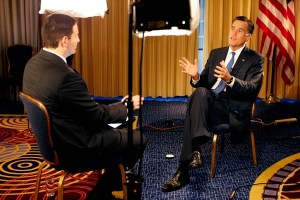
Romney gave no specifics about how he would achieve this with the policies he has been promoting–cutting taxes on the rich, raising them on people with lower incomes, and cutting everything except defense spending, which he would increase substantially. Halperin did ask for more specifics, but Romney just babbled a bunch of nonsense:
Halperin: One more question generally about jobs. For people out there, for voters who want to know what you’re about in terms of job creation, is there some new idea, some original idea, that hasn’t been part of the debate in American politics before, that you have that you think would lead to a lot of new jobs?
Romney: Well the wonderful thing about the economy is that there’s not just one element that somehow makes the whole economy turn around, or everybody in the world would have figured that out and said there’s just one little thing we have to do – you know, Greece is settled, and France and Italy are all back and well again. No, it’s a whole series of things. It’s a system of factors that come together to make an economy work. What is it that makes America’s economy the strongest in the world, the most robust, over a century? It’s a whole series of things – everything from our financial service sector, to the cost of our inputs, our natural resources, to the productivity of our workforce, to our labor and management rules and how they work together, to our appreciation for fair trade and free trade around the world, and negotiating trade arrangements that are favorable to us. It is a whole passel of elements that come together to create a strong economy, and for someone who spent their life in the economy, they understand how that works. And it’s very clear, by virtue of the President’s record, that he does not, and he is struggling. Look at him right now. He just doesn’t have a clue what to do to get this economy going. I do. I laid out a 59-step plan that encompasses a whole series of efforts that will together get this economy going and put people back to work.
But from what I could make out in wading through all the blather, it really comes down to the confidence that will wash through all of us once we know that Mr. Fixit, Willard Mitt Romney is going to save us.
Romney: Well actually if I’m lucky enough to be elected the consumers and the small-business people in this country will realize that they have a friend in the White House, who is actively going to encourage economic growth, and there will be a resurgence in confidence in this country and a willingness to take risks, to invest, to add employees. I think it will be very positive news to the American economy. Will I be able to get done between January 1 and January 20 the things that I’d like to do? Of course not, I’m not in office. But I believe that we will be able to have a grace period, which allows us to tackle these issues one by one and put in place a structure, which is very much designed to get America working again.
Romney also gave a speech about education policy in which he proposed to further privatize America’s education system:
Mitt Romney proposed a series of steps to overhaul the public education system, reigniting the debate over school choice as his campaign intensifies its effort to introduce the presumptive Republican presidential nominee to a general-election audience.
The education plan, detailed in a speech today in Washington, would create a voucher-like system to give low- income and disabled students federal funds to attend charter schools, private institutions and public schools outside their district.
“I don’t like the direction of American education, and as president, I will do everything in my power to get education on track for the kids of this great land,” Romney told a gathering of Latino business owners at the U.S. Chamber of Commerce.
No new ideas there. To be perfectly honest, I strongly doubt that Romney knows the first thing about American public schools. But let me refer you to an expert on Willard’s past history in dealing with public education, the one and only Charles P. Pierce. Pierce writes about what Romney did to the public education system of Massachusetts during his one term as Governor:
Read the rest of this entry »
The Realities of Market Failure
Posted: July 26, 2009 Filed under: Health care reform | Tags: CBO, health insurance, HMOs, Kenneth Arrow, Paul Krugman, Peter Orzag, welfare economics Comments Off on The Realities of Market Failure Paul Krugman jumped further in to the health care reform debate today just as the CBO announced that the Obama Plan, billed as a cost-saver, continues to be anything but cost saving. Krugman rightly points out that in a land of third party payers, you are not going to find a free market solution. This is simply true by definition so why is there so much confusion?
Krugman borrows heavily from an earlier treatise by Kenneth Arrow, one of the early pioneers of modern economics in a 1963 treatise called Uncertainty and the Welfare economics of health Care. (Note: The link on Krugman’s blog is bad so use mine.) Let me just mention here that Welfare in economics means you’re looking for allocative efficiency within an economy given that economy’s income distribution. Since so few folks in this country have the majority of income and resources, for example, the U.S. is a considered about average on allocative efficiency. Our resources are not distributed based on the aggregate welfare of society. We have a system where there are winners and losers because most of our goods are distributed by ability to pay and most of that ability to pay comes from accident of birth.
So, Krugman updates the Arrow treatise and argues that healthcare is not what you would refer to as a standard market that would thrive under free market conditions. He points to two very distinct characteristics that takes it out of contention for a completely free market solution which borrow heavily from Arrow.
There are two strongly distinctive aspects of health care. One is that you don’t know when or whether you’ll need care — but if you do, the care can be extremely expensive. The big bucks are in triple coronary bypass surgery, not routine visits to the doctor’s office; and very, very few people can afford to pay major medical costs out of pocket.
…
The second thing about health care is that it’s complicated, and you can’t rely on experience or comparison shopping. (”I hear they’ve got a real deal on stents over at St. Mary’s!”) That’s why doctors are supposed to follow an ethical code, why we expect more from them than from bakers or grocery store owners.
If you’ve followed any of my blogging carefully, you will recognize two underlying themes that we’ve frequently talked about throughout Krugman’s assessment. That would be that the health care market has the two nasty frictions of moral hazard and information asymmetry. Insurance companies, theoretically, should provide cost effective remedies to both. However, there are things unique to health insurance and the underlying risk of getting catastrophic illnesses that make huge risk pools the most cost effective. This is the primary economic argument for universal healthcare. Putting every one (the healthy and the unhealthy) into one HUGE risk pool, minimizes the cost to everyone, thereby maximizing allocative efficiency and economic welfare. Insurance companies that cherry pick, and healthy folks that self opt-out of risk pools, violate these principles and make it more expensive and less efficient for every one.
When Will They Ever Learn?
Posted: July 17, 2009 Filed under: Bailout Blues, Equity Markets, Global Financial Crisis, The Great Recession, The Media SUCKS, U.S. Economy | Tags: AIG, Arbitrage profits, CBO, CNBC, Director of the CBO, Doug Elmendorf, Goldman Sachs, Matt Taibbi, Nouriel Roubini, Paul Krugman Comments Off on When Will They Ever Learn?The Blogging Econ heads are still news makers today as we have more and more reports of record profits at Goldman pigs-playing-poker1Sachs and examples of blatant corportist propaganda at CNBC. I learned yesterday that many folks are listening, it just isn’t necessarily the ones shaping and setting policy. We also see a completely unsustainable budget coming down the pipe per the Director of the CBO. Why is it that policy makers seem to want us in dire straights? Are their sources of campaign funds so sacred that they’re willing to bring down the U.S. economy? Where does a Cassandra start?
Matt Taibbi and Paul Krugman focus in on the GS profits. So, I’m all for making a decent rate of return, that’s necessary to keep a company in business and it’s required to attract capital to grow a market. However, record setting, extraordinary profits are symptoms of a market out-of-whack. In the most simplest of analysis it could mean there are minimally too few providers of a service which can also lead to some form of market manipulation, information hiding, or information asymmetry allowing them to reap extraordinary profits. I basically think we’re seeing GS game the market based on raiding underpriced AIG assets with a free source of capital. This means the profits are straight from taxpayer funding. No wonder these guys don’t want to pony up any equity to us based on profitability and want to dump TARP funds (with their compensation restrictions) as quickly as possible. How can Washington miss that they’re back at their same old games?
This is from Taibbi who basically lays it out. They’re taking our tax dollars and buying assets with tax dollar in government-selected subsidized fire sales, creating arbitrage profits (some through their own huge market shares now that much of their competition is gone) and churning themselves some nice bonuses. In music, that’s called riding the gravy train. It’s a no risk, no brainer, no lose situation. Why would that require bonuses? [You can mark my words on this. They looted (with government enabling) AIG and the next one up will be CIT.]
So what’s wrong with Goldman posting $3.44 billion in second-quarter profits, what’s wrong with the company so far earmarking $11.4 billion in compensation for its employees? What’s wrong is that this is not free-market earnings but an almost pure state subsidy.
Krugman, a microeconomist with specializations in trade theory, sees it too.
The American economy remains in dire straits, with one worker in six unemployed or underemployed. Yet Goldman Sachs just reported record quarterly profits — and it’s preparing to hand out huge bonuses, comparable to what it was paying before the crisis. What does this contrast tell us?
First, it tells us that Goldman is very good at what it does. Unfortunately, what it does is bad for America.
Second, it shows that Wall Street’s bad habits — above all, the system of compensation that helped cause the financial crisis — have not gone away.
Third, it shows that by rescuing the financial system without reforming it, Washington has done nothing to protect us from a new crisis, and, in fact, has made another crisis more likely.
Meanwhile, back in the Main Stream Media, also known as the Wall Street and K Street propaganda factory, CNBC has tired to rosy up Dr. Doom’s forecasts to enable its masters arbitrage profits. Roubini made it clear that his views on the economy have remained unchanged despite the attempts to make it look otherwise.
Nouriel Roubini, the economist whose dire forecasts earned him the nickname “Doctor Doom,” said after markets closed Thursday that earlier reports claiming he sees an end to the recession this year were “taken out of context.”
“It has been widely reported today that I have stated that the recession will be over ‘this year’ and that I have ‘improved’ my economic outlook,” Roubini said in a prepared statement. “Despite those reports … my views expressed today are no different than the views I have expressed previously. If anything my views were taken out of context.”
Several business news outlets, picking up on a report initially from Reuters, earlier Thursday cited Roubini as saying that the worst of the economic financial crisis may be over.
The New York University professor was quoted by Reuters as saying that the economy would emerge from the recession toward the end of 2009.
Reports of his comments helped trigger a late rally in the stock market.
Did you read that bit about triggering a late rally in the stock market? Pity the poor suckers that believed CNBC and of course, watch the deposits grow of the folks that placed the offsetting market transactions. And, let’s see, which market insiders would probably know that was BS? I don’t think you have to be Ms. Marple or an SEC investigator to figure that one out. It was just a simple mistake, wasn’t it?
Factors Explaining Future Federal Spending on Medicare, Medicaid, and Social Security (Percentage of GDP)
Factors Explaining Future Federal Spending on Medicare, Medicaid, and Social Security (Percentage of GDP)
Another thing that really has sugared my cookies is this report coming out of the Congressional Budget Office (CBO) one of the few bastions of economic thought in the beltway that tries to look out for the real constituents of Washington D.C.. The Director of the CBO,Doug Elmendorf, had this to say to a Senate Committee followed by a post to his blog.
The current recession and policy responses have little effect on long-term projections of noninterest spending and revenues. But CBO estimates that in fiscal years 2009 and 2010, the federal government will record its largest budget deficits as a share of GDP since shortly after World War II. As a result of those deficits, federal debt held by the public will soar from 41 percent of GDP at the end of fiscal year 2008 to 60 percent at the end of fiscal year 2010. This higher debt results in permanently higher spending to pay interest on that debt. Federal interest payments already amount to more than 1 percent of GDP; unless current law changes, that share would rise to 2.5 percent by 2020.
There’s also his bottom line.
Under current law, the federal budget is on an unsustainable path, because federal debt will continue to grow much faster than the economy over the long run. Although great uncertainty surrounds long-term fiscal projections, rising costs for health care and the aging of the population will cause federal spending to increase rapidly under any plausible scenario for current law. Unless revenues increase just as rapidly, the rise in spending will produce growing budget deficits. Large budget deficits would reduce national saving, leading to more borrowing from abroad and less domestic investment, which in turn would depress economic growth in the United States. Over time, accumulating debt would cause substantial harm to the economy.
Okay, am I just being a little too wonky here or are these three things perfectly clear to any one who has the audacity to be informed?
Norway, anyone?
Digg!!! Tweet!!! Share!!!
Add to FacebookAdd to NewsvineAdd to DiggAdd to Del.icio.usAdd to StumbleuponAdd to RedditAdd to BlinklistAdd to TwitterAdd to TechnoratiAdd to Furl
Add to: Facebook | Digg | Del.icio.us | Stumbleupon | Reddit | Blinklist | Twitter | Technorati | Furl | Newsvine

 peej
peej Carissa
 bostonboomer
 dakinikat
 ecocatwoman
 mablue2
 Mama Lopez
 peggysue22
 quixote
 skydancingguestblogger
 Mona (aka Wonk the Vote)



 Sky Dancing
Recent Comments