
Krugman Debunks Republican Fairy Tales
Posted: July 30, 2011 Filed under: Economy | Tags: Bush tax cuts, Paul Krugman, Ronald Reagan Fairy Tales 11 Comments As we inch closer to purposeful default on our debt and spending policies destined to send us into recession, Nobel Prize winning Economist Paul Krugman comes out blasting with some nifty graphs. Stylized facts are an economist’s best friend. We continue to see this unending push of thoroughly trounced bad hypotheses spew out of Republicans and even the President. The vast degree of economic illiteracy in this country astounds me.
First, I’ll repeat one set of facts I mentioned in my post yesterday. Ronald Reagan was responsible for the largest tax increases in history and Barrack Obama was responsible for the largest tax cuts through his stimulus plan. This doesn’t even include his extension of the Dubya tax cuts. Discussion during TEFRA of 1982 resembles the discussion going on today. However, Reagan did tax increases. This particular ridiculousness is enough to make a data junkie scream. If you look at deficit numbers, former President Jimmy Carter was moving towards a budget balanced by the end of his term in office. Reagan blew government spending out of the water. However, Dubya remains the biggest spender of all since World War 2. If you want to blame the spending on any one, blame it on Reagan and George W, Bush. More on that in a bit.
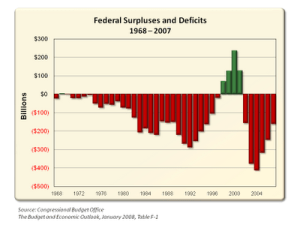
Paul Krugman covers another Reagan Bedtime Story. He also points out that even conservative economists have started spewing the notion that Reagan was responsible for an era of “unprecedented growth”. This is also not true.
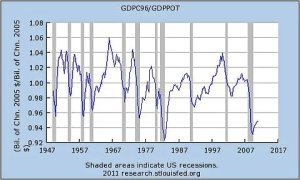
This shows what everyone was supposed to know: we had an awesome performance in the generation following the war (despite very high tax rates on the rich and a very strong union movement); we had a long period of poor productivity performance that spanned the Ford, Carter, Reagan, and Bush I administrations; we then had a revival during the Clinton administration, but even so not up to postwar standards. By the way, I don’t give Clinton credit for that revival; it was about learning to use technology. But in any case, there is no hint of a Reagan miracle in the data.
Now, back to stylized facts on federal spending. This is also from Krugman. There is this huge meme out there right now that some how, President Obama has gone on some kind of spending spree. This couldn’t be further from the truth. It appears that Rush Limbaugh is not only a big fat liar, but he is also incapable of doing the math on simple fractions. He is joined by nearly every Republican in the House today.
The fact is that federal spending rose from 19.6% of GDP in fiscal 2007 to 23.8% of GDP in fiscal 2010. So isn’t that a huge spending spree? Well, no.
First of all, the size of a ratio depends on the denominator as well as the numerator. GDP has fallen sharply relative to the economy’s potential; here’s the ratio of real GDP to the CBO’s estimate of potential GDP:
A 6 percent fall in GDP relative to trend, all by itself, would have raised the ratio of spending to GDP from 19.6 to 20.8, or about 30 percent of the actual rise.
That still leaves a rise in spending; but most of that is safety-net programs, which spend more in hard times because more people are in distress.
Beginning in 2005, the CBPP showed how George W. Bush’s excessive tax cuts played the largest part in federal deficits. Simply allowing these to expire last December would have gone farther in pushing a balanced budget than nearly anything done to date. In May of this year, they continued their analysis of how the Bush Policies were the ones driving the budget deficit.
Some lawmakers, pundits, and others continue to say that President George W. Bush’s policies did not drive the projected federal deficits of the coming decade — that, instead, it was the policies of President Obama and Congress in 2009 and 2010. But, the fact remains: the economic downturn, President Bush’s tax cuts and the wars in Afghanistan and Iraq explain virtually the entire deficit over the next ten years (see Figure 1).
The deficit for fiscal year 2009 — which began more than three months before President Obama’s inauguration — was $1.4 trillion and, at 10 percent of Gross Domestic Product (GDP), the largest deficit relative to the economy since the end of World War II. At $1.3 trillion and nearly 9 percent of GDP, the deficit in 2010 was only slightly lower. If current policies remain in place, deficits will likely resemble those figures in 2011 and hover near $1 trillion a year for the next decade.
The events and policies that pushed deficits to these high levels in the
near term were, for the most part, not of President Obama’s making. If not for the Bush tax cuts, the deficit-financed wars in Iraq and Afghanistan, and the effects of the worst recession since the Great Depression (including the cost of policymakers’ actions to combat it), we would not be facing these huge deficits in the near term. By themselves, in fact, the Bush tax cuts and the wars in Iraq and Afghanistan will account for almost half of the $20 trillion in debt that, under current policies, the nation will owe by 2019. The stimulus law and financial rescues will account for less than 10 percent of the debt at that time.
Other drives of the current deficit are extremely short-lived. These would be all the financial rescue spending delivered to financial institutions and the recession which brings in loss of revenues and increased expenditures. The other big expenditures are the two unfunded wars that having been running for over 10 years. These are the first wars that we have ever run that were not funded by tax increases.
However, these Republican Fairy Tales do not let the current President off the hook. He seems as hell bent as the Republicans in many ways to repeat their sins. He also seems woefully short on economic knowledge and incapable of listening to his economics advisers–now frustrated and gone–on what to do with the economy. The simplest way to shut down the deficit would be to eliminate preferential treatment of capital gains income and let the Bush tax cuts expire. I’d prefer they expire for folks over $200,000 a year, but letting them expire altogether is better than setting the stage for all these falsehoods spewing from Limbaugh and the like. Obama should’ve let the tax cuts expire when he had the chance. However, his ability to negotiate a position that proposes a Democratic alternative policy has never been present. People can’t figure out if he is just has the world’s worst negotiating skills or he wants what the Republicans want. My belief is that the outcome could matter less to him as long as he gets some ego strokes from it.
We have gotten to the point that complete insanity and adherence to fairy tales is putting our economy in serious jeopardy. We simply cannot afford to listen to the voices of ignorance any more. I cannot even believe we’re being held hostage now to a balanced budget amendment. That is one of the most flagrantly wrong policies any one could ever think about. I’m going to take that on this week since I can’t believe that zombie canard is back haunting the halls of Congress again.
We seriously need experienced economic stewardship of the economy right now. We have a tremendous jobs deficit that will only get worse if any of these seriously flawed budget initiatives pass. We couldn’t have gotten a worse group of leaders at a more crucial point in time. Their mistakes will hurt this country for a very long time.
Architect of Bush Torture and Spy Policies is Tea Party Point man at Heritage Foundation
Posted: July 27, 2011 Filed under: Republican politics, Surreality, U.S. Economy, U.S. Politics, unemployment, voodoo economics | Tags: Barack Obama, Bush tax cuts, David Addington, Dick Cheney, Federal debt ceiling, George W. Bush, Heritage Foundation, John Boehner, Smoot-Hawley Tarriff Act, taxes, Tea Party Caucus, voodoo economics 7 Comments
David Addington
Wow, these ultra-right-wingers are like zombies. They never stop, they never die. They just keep popping up again and again where you least expect them.
Remember David Addington? He was the secretive, publicity-shy legal counsel to Vice President Dick Cheney from 2001-2005. Later, after Scooter Libby was forced to step down because of his involvement in the Valerie Plame outing, Addington replaced him as Cheney’s Chief of Staff from 2005-2009.
Addington was heavily involved in designing the Bush administration’s torture and NSA wiretapping policies. In addition, his was the legal mind behind Bush’s hundreds of signing statements and generally was a powerful force in the Bush administration’s efforts to expand executive power.
You’d think someone who had been involved in such execrable behavior would have the good grace to slink away and never be heard from again, but that’s not how it works with these psychopathic types. Today, according to The National Journal,
Addington has taken on a new role as enforcer of tea party dogma during the intensifying partisan bickering over the debt ceiling. From his perch as the Heritage Foundation’s vice president for domestic and economic policy, Addington is throwing verbal thunderbolts at House Speaker John Boehner’s current debt-ceiling proposal, which he argues will pave the way to tax increases.
The merits of Addington’s arguments about the need to oppose Boehner’s proposals are in some ways less interesting than the simple fact that Addington is the one publicly making them. Addington kept a low profile during the Bush years, granting no interviews and largely shunning lawmakers from either party. But he wielded enormous power behind the scenes, helping Cheney craft the Bush administration’s warrantless eavesdropping program and most of its detention initiatives.
Critics of those policies say they’re horrified by Addington’s reemergence onto the public stage.
“To see this person who led the country into legal and moral disaster resurface as a respected commentator is somewhat galling,” said Ben Wizner, the litigation director of the American Civil Liberties Union’s National Security Project. “Addington was as responsible as anyone else for the U.S. becoming a torturing nation. He has done damage to the U.S. that will take decades to reverse.”
Indeed. Especially because we’ll have to wait until President Obama leaves office before much reversing takes place–if it ever does. But I digress. Addington’s new role is to help keep the Tea Party Caucus in line while undercutting House Speaker Boehner. How very very interesting. At the New Republic, Jonathan Chait called it “Hot Republican-On-Republican Action.”
The internecine fighting among conservatives over the Boehner plan has much of the same ideological and stylistic feel of a late 1960’s feud pitting left-wing factions that favor immediate violence against those seeking more time to radicalize the masses. The less-extreme faction clearly has the better of the argument, yet the overwhelming impression is the sheer fanaticism of the whole political subculture.
Is it possible this GOP infighting could be helpful to our side? Addington’s greatest concern about the Boehner plan is that it includes the “committee” that we have been calling “Catfood Commission II.” Addington fears that because this group will have the power to write legislation that cannot be amended and must be voted on up or down, they might end up proposing new taxes. Now I never thought of that possibility! Here’s Addington blogging at the Heritage Foundation website on Monday:
The second step in the [Boehner] plan is a set of recommendations from a new dozen-member joint select committee of Congress. The committee’s recommendations to Congress would not be subject to amendments and would get a straight up-or-down vote. The plan directs the committee to propose reductions in the deficit by at least $1.8 trillion over 10 years. The government runs a deficit when it spends more than it takes in from Americans as taxes, and the government has run deficits in most years for decades. As always, there are two ways to reduce a bloated government’s deficit — the right way of cutting spending and the wrong way of hiking taxes. While the second step of the Boehner plan may produce some useful spending cuts, the second step also allows the Committee to propose raising taxes as part of its unamendable, fast-track legislative package. Thus, the second step greases the way for tax hikes.
As you can imagine, taxes are anathema to Addington.
Tax hikes in a weak economy slow economic growth and kill jobs. As students of American history (or the movie “Ferris Bueller’s Day Off”) know, enactment of the tax hike known as the Smoot-Hawley Tariff Act during the Great Depression hurt the already weak economy and made unemployment worse. Job-killing tax hikes in the current weak economy, as millions of Americans go without jobs and the unemployment hovers above 9 percent, will have a similar effect. However good the intentions of the drafters of the Boehner plan may have been, the plan sets up America for higher taxes and fewer jobs. Conservatives should continue to fight plans that either hike taxes now or set America up for tax hikes in the future.
Now wait a minute. I know Dakinikat will have plenty to say about that last paragraph–if she can get away from all the student exams and papers she’s grading. But I’ll take a crack at it even though I am not an economist.
Tarriffs are not equivalent to income taxes. The Smoot-Hawley Tarriff Act was raised tarriffs so high that our trading partners retaliated with their own tarriffs, leading to dramatic decreases in U.S. imports and exports. Now that is a job-killing tax. That is not the same thing as restoring the tax rates on the rich to Clinton administration levels and perhaps making the children of the super-rich pay a little more in estate taxes. As Dakinikat is fond of saying, if cutting taxes led to job creation, we wouldn’t be in the mess we’re in now. The Bush tax cuts would have taken care of everything.
Addington summed up his insane economic theories in another post, written in response to President Obama’s speech on Monday night.
Americans sent a message in the election of 2010 — cut the size and cost of government. Conservatives must act now to drive down spending on the way to a balanced budget, while protecting America, and without raising taxes. Forget the McConnell, McConnell-Reid, Coburn, Gang-of-Six, Boehner, and Reid plans. Go with the American plan — cut government spending, deeply and right now, for the good of the country.
Man, he’s looney-tunes!
Anyway, I think it’s just fascinating that Addington is leading the charge against the Boehner plan and pushing for an even crazier one. Addington has a history of accomplishing a great deal. What he accomplished was evil, of course, but he showed himself to be highly competent and efficient, unlike President Pushover. This battle could be really entertaining. I’m hoping for a major Republican meltdown.
The DC Disconnect
Posted: May 31, 2011 Filed under: Economy, Federal Budget and Budget deficit | Tags: Bush tax cuts, U.S. Economy 12 Comments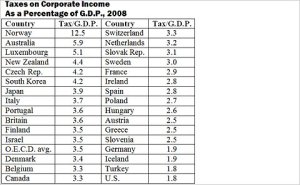 The disconnect between reality and beltway rhetoric has never been more obvious when it comes to the economy. The NYT editorial page has an op-ed up today– ‘The Numbers are Grim’–in which they call for more attention to the unemployment crisis. As I mentioned when these numbers came out, a decrease in domestic household consumption is a troublesome signal in an economy where nearly 68% of production usually goes to domestic consumption.
When consumers are constrained, so is hiring, because without customers, employers are hard pressed to retain workers or make new hires. A recent Labor Department report showed a greater-than-expected rise in the number of people claiming jobless benefits even as private-sector economic forecasts are being revised downward — both very bad omens for continued job growth.
Republican lawmakers have responded to renewed signs of weakness with a jobs plan that prescribes more of the same “fixes” that Republicans always recommend no matter the problem: mainly high-end tax cuts, deregulation, more domestic oil drilling and federal spending cuts.
The White House has offered sounder ideas, including job retraining, plans to boost educational achievement and tax increases to help cover needed spending. But its economic team is mainly focused on negotiations to raise the debt limit, presumably parrying Republican demands for deep spending cuts that could weaken the economy further while still reaching an agreement on the necessary increase.
The grim numbers tell an unavoidable truth: The economy is not growing nearly fast enough to dent unemployment. Unfortunately, no one in Washington is pushing policies to promote stronger growth now.
Even the Wall Street Journal recognizes the challenges our economy faces. Many corporate economists see similar indications of a permanent growth problem. This should not be happening. We know how to correct this. We have nearly 70 years of economy theory and empirical data that have provided a guide to every administration except the last two.
Manufacturing is cooling, the housing market is struggling and consumers are keeping a close eye on spending, meaning the U.S. economy might be on a slower path to full health than expected.
“It’s very hard to generate a rapid recovery when rapid recoveries are historically driven by housing and the consumer,” said Nigel Gault, an economist at IHS Global Insight. He expects an annualized, inflation-adjusted growth rate of less than 3% in coming quarters—better than the first-quarter’s 1.8% rate, but too slow to make a meaningful dent in unemployment.
A growing number of forecasters are downgrading their second-quarter growth predictions. JPMorgan Chase & Co. economists revised down their estimate to a 2.5% rate from 3%, while Bank of America Merrill Lynch economists cut theirs to 2% from 2.8%. Deutsche Bank cut its forecast to 3.2% from 3.7%.
Companies are similarly cautious. Applied Materials Inc., the largest maker of machines used in producing computer chips, said it expected growth in its semiconductor and solar markets to slow following one of its best quarters ever. Hewlett-Packard Co. cut its fiscal-year outlook amid weak computer sales and negative effects from the disaster in Japan. Clorox Co. offered a more guarded outlook for its household goods business as executives noted that higher prices may hurt sales.
As stated by the NYT, most Republicans put a plan forward that calls for “high-end tax cuts, deregulation, more domestic oil drilling and federal spending cuts”. This is exactly the opposite of what needs to be done. The mantra of ‘too high’ taxes strangling business which dampens unemployment is simply not true. It’s never been true. It’s a fallacy! Bruce Bartlett has done an excellent job–see the nifty graph above–in using facts to put down that meme. Not only are effective tax rates on corporations already exceedingly low, but tax revenues from wealthy individuals are so low that most of us probably have higher effective marginal tax rates. This has been the case now for nearly 7 years and for about that same time we’ve experienced some of the worst job creation and economic growth ever.
The economic importance of statutory tax rates is blown far out of proportion by Republicans looking for ways to make taxes look high when they are quite low. And they almost never note that the statutory tax rate applies only to the last dollar earned or that the effective tax rate is substantially lower even for the richest taxpayers and largest corporations because of tax exclusions, deductions, credits and the 15 percent top rate on dividends and capital gains.
The many adjustments to income permitted by the tax code, plus alternative tax rates on the largest sources of income of the wealthy, explain why the average federal income tax rate on the 400 richest people in America was 18.11 percent in 2008, according to the Internal Revenue Service, down from 26.38 percent when these data were first calculated in 1992. Among the top 400, 7.5 percent had an average tax rate of less than 10 percent, 25 percent paid between 10 and 15 percent, and 28 percent paid between 15 and 20 percent.
The truth of the matter is that federal taxes in the United States are very low. There is no reason to believe that reducing them further will do anything to raise growth or reduce unemployment.
Meanwhile, the complete disconnect between spending and cutting priorities in Congress and the White House and the American people grows. As mentioned by BostonBoomer this morning in a reference to a Paul Rosenberg peice at Alternet, Americans want none of what is being dished up in the beltway. It is true that the current spending path for the general budget, social security, and medicare are not sustainable at current levels. What is not true is that we need to accept the current path and Republican policy priorities as the solution. There is no evidence that anything they’ve suggested will remotely help our jobs and growth problem which would take care of much of the deficit problems. The rest could be solved by simply returning tax policy back to the Reagan or Clinton levels.
It’s obvious from the last set of economic numbers that the current problem stems from lack of consumer demand which is rooted in a lack of income, confidence, and wealth in the majority of US Households. People simply do not have the wherewithal to purchase homes or sustain household budgets. This is because we have an unacceptably high level of unemployment, we have let the pathway to home ownership completely collapse, and we’re allowing basic government services to collapse to fund unrealistically low tax rates for corporations and wealthy individuals. Don’t even get me started on funding never-ending wars. There is mounting evidence that these funds aren’t even staying in the country any more but are being used to fund jobs, investment, and growth in other places. This is unacceptable policy under our current economic situation. American treasury should not be used to chase profits abroad.
The President has gotten away with extending tax cuts for the wealthiest individuals. He appears ready to go to the table and accept draconian cuts to federal spending which will impact all levels of government provision of goods and services. This basically means that he has signed on to a prescription for slow economic growth. He undoubtedly does so with no worries about the upcoming election. The Republicans offer up potential candidates that have absolutely no grasp of reality or come with a facile lack of morality to deny it. Even George F. Will believes one of the front runners to be so incapable of holding office that the thought of giving the ability to launch nuclear weapons to some of the candidates bothers him. Is handing over the ability to tank our economy any less problematic?
This is beyond disheartening. It is evident that the plutocracy is doing everything it can to silence any one that could run a narrative contrary to these current fallacies. I don’t believe for one moment that Congressman Wiener’s hacker isn’t part of tearing down any one that appears to be stepping away from the abyss of Washington group think. Meanwhile, the media speak is about pushing the economy to the precipice by focusing on the debt ceiling. It’s looking like we’re being prepped for that. This will make the market demand extremely high rates of return for federal borrowing which will only increase our interest payments on the debt which are already a huge portion of the budget. How much sense does that make?
Early proposals for whittling down spending include a plan to drop federal agriculture subsidies and to require larger employee contributions to the pension system for non-military federal workers.
“Those talks, which actually we’ve been meeting for over three weeks now, they have been all positive. Everything is on the table,” House Majority Leader Eric Cantor (R-Va.) said Sunday on CBS’s “Face the Nation.” “We’ve said, as Republicans, we’re not going to go for tax increases. I think the administration gets that. But we’ve also put everything on the table as far as cuts.”
Oh, and if you think the Republicans are all about small businesses and start-ups because they create jobs, check this nifty 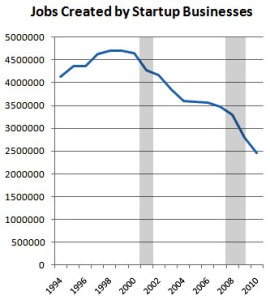 graph out from MoJo. The Dubya years basically killed that phenomenon too so it wasn’t about lowering tax rates, was it?
As this chart from the BLS shows, the number of jobs created by new businesses peaked in 2000, began declining at the start of the Bush administration, and has been plummeting ever since …
So much for that Republican meme. Facts are stubborn things, aren’t they?
This problem is basically due to the inability to govern and make prudent decisions. They’d much rather pump out lies and continue on the same path to destruction. These people ran up tons of debt to fund wars for which they found no funds. This is all about the irresponsible Bush tax cuts that Congress and the Obama administration returned to law in December. The pain for these horrible decisions are about to be extracted on middle and working class Americans who have done absolutely nothing to bring on the recent economic problems and fiscal problems. There has been no bail out or special tax breaks for us. It should be obvious by now that the policies of the last five years have done nothing but improved the situation for the very rich and the very large corporation. Shame on all of those elected officials that go along with this. It is as if they are purposefully setting out to destroy our economy and our way of life. I have no idea why they hold so many of us in contempt but it is obvious that that they prefer the donor class to voters. They seem to want a repeat of the Great Depression. At this rate, that is exactly what they will have.
Monday Reads
Posted: April 18, 2011 Filed under: jobs, Labor unions, morning reads, Reproductive Rights, Women's Rights, worker rights | Tags: Attacks on Social Security, Bush tax cuts, Gang of Six, global job crisis, HBO, International Monetary Fund, New Orleans, Pete Seeger, Peter Yarrow, Planned Parenthood, Senator Mark Warner, songs of protest, taxes, Treme 43 Comments Good Morning!
I’ve almost gotten shy about going out to search for links these days. Most of the political and economic news is disheartening so I thought I’d try to mix it up today with some good stuff and disheartening stuff. Hopefully, you can find some things to share with us too.
You may want to start out your day arming yourself with “Five Myths about Planned Parenthood” in case any one in your sphere of influence starts spewing some of the ridiculous memes passed around by the right wing. This was in WAPO over the weekend and was written by Clare Coleman worked for America’s best known provider of family planning and health services. I liked number five.
Three million patients each year visit Planned Parenthood’s more than 800 health centers in every state, in big cities and small towns. In some areas, Planned Parenthood and the Title X-funded system are the only sexual health providers for hundreds of miles.
We screen people for high blood pressure, anemia and diabetes; we counsel them about smoking cessation and obesity; we connect them to other primary-care providers and social services. The huge response to the attack on family planning and on Planned Parenthood — hundreds of thousands of Americans signing petitions, showing up at rallies, calling Congress – is extraordinary. But it doesn’t surprise me. One in five American women has gone to Planned Parenthood at some point in her life, for respectful, compassionate, quality care. And now those Americans are going to have our back.
I feel like I’ve turned into an IMF groupie by putting up yet another link to them shortly after featuring one of their studies on the dominance of the finance sector, but here I go again. I do spend time gleaning data from their site so maybe it’s just that I keep bumping into things. The IMF says we have a Global Job Crisis.
At the end of his magnum opus, The General Theory, Keynes stated the following: “The outstanding faults of the economic society in which we live are its failure to provide for full employment and its arbitrary and inequitable distribution of wealth and incomes”.
Not everyone will agree with the entirety of this statement. But what we have learnt over time is that unemployment and inequality can undermine the very achievements of the market economy, by sowing the seeds of instability. In too many countries, the lack of economic opportunity can lead to unproductive activities, political instability, and even conflict. Just look at how the dangerous cocktail of unemployment and inequality—combined with political tension—is playing out in the Middle East and North Africa.
Because growth beset by social tensions is not conducive to economic and financial stability, the IMF cannot be indifferent to distribution issues. And when I look around today, I am concerned in this regard. For while recovery is here, growth—at least in the advanced economies—is not creating jobs and is not being shared broadly. Many people in many countries are facing a social crisis that is every bit as serious as the financial crisis.
Unemployment is at record levels. The crisis threw 30 million people out of work. And over 200 million people are looking for jobs all across the world today.
The jobs crisis is hitting the young especially hard. And what should have been a brief spell in unemployment is turning into a life sentence, possibly for a whole lost generation.
In too many countries, inequality is at record highs.
As we face these challenges, remember what we have accomplished. Under the umbrella of the G20, policymakers came together to avoid a financial freefall and probably a second Great Depression.
Today, we need a similar full force forward response in ensuring that we get the recovery we need. And that means not only a recovery that is sustainable and balanced among countries, but also one that brings employment and fair distribution.
This is part of a speech given by Dominique Strauss-Kahn, Managing Director, International Monetary Fund. He argues that financial sector reform is central to the problem of getting back on track. It’s worth reading the entire thing or you can watch the video here. Occasionally, I remember why I thought it was important to study economics. This is one of those times.
The so-called “Gang of Six” is still anxious to put social security on the bargaining table. I still can’t figure out why every time some politician wants to talk about the Federal Deficit--in this case Senator Mark Warner–they mistakenly include the stand-alone program.
Including Social Security in the Gang of Six package appears to be a concession by Democrats made in exchange for agreement to raise some revenue by Republicans. But liberals in the Senate and House have made clear they will not stand for any cuts to benefits.
The 2012 budget passed by the House on Friday does not include reforms for Social Security. House Budget Committee Chairman Paul Ryan (R-Wis.) instead called for a trigger in the budget whereby the president and Congress would have to propose solutions once the Board of Trustees certifies the program is in trouble. Presidet Obama in his 2012 budget and in a speech last week did not lay out plans to reform Social Security.
Warner said the Gang is “very close” to an agreement that includes spending cuts and tax increases such as be eliminating the home mortgage tax deduction.
“We are going to make everybody mad with our approach,” he said.
Warner made clear he is opposed to the House Republican 2012 budget’s reliance on cuts to Medicare—he called it a “massive transfer of responsibility onto our seniors”– but he did not say how the Gang of Six will approach the massive entitlement program.
Please join me as I scream. How stupid do they think we are?
Ninety-one year old Pete Seeger will be joined by David Amram, 80, and Peter Yarrow, 73 on the stage to inspire young people to be active in political and social justice movements. Yarrow had just returned from a series of rallies in Wisconsin.
The three artist-activists say they are fired up by recent protests — from Egypt to Wisconsin — and by the enthusiasm of their youthful kin, who will join them onstage.
“I do have the feeling that the kind of energy we felt in the ’60s is in the air now,” Mr. Yarrow said. “That energy seems to be reigniting itself.”
That concert should be a treat. It’s nice to see these guys seem to never tire of singing songs of justice. It’s important that a new generation hear these truly American songs. I was interested in reading that many kids and grandkids of these folk singers are now in the family business and may show up on stage with them now and then.
Okay, this is something that kinda surprised me from the WSJ: “Greenspan Steps Up Call to End Bush-Era Tax Cuts”. I still haven’t figure out why any one thinks he’s still relevant, but oh, well. At least, he’s on the right side of this one.
Former Fed Chairman Alan Greenspan is stepping up his call for Congress to let the Bush-era tax cuts lapse.
In an appearance Sunday on ABC’s “Meet the Press,” Mr. Greenspan used his strongest words yet to urge lawmakers to let them expire. The risk of a U.S. debt crisis, he said, is just too big. Mr. Greenspan, who retired from the Federal Reserve in 2006, had endorsed the cuts back in 2001 championed by then-President George W. Bush.“This crisis is so imminent and so difficult that I think we have to allow the so-called Bush tax cuts all to expire. That is a very big number,” he said, referring to how much the U.S. government could save from letting income taxes go back up to levels last seen under former President Bill Clinton.
Mr. Greenspan was talking about re-imposing the taxes for all Americans. The Treasury has estimated that a permanent extension of all the Bush tax cuts would cost $3.6 trillion over the next decade. Allowing taxes to increase on those in the top income brackets would take the cost to the government down to $2.9 trillion, according to White House estimates.
CBS news has done some data gathering on taxes as part of its Tax Day coverage: Wealthy Americans see drop in federal taxes; High-earning Americans pay less in taxes than in previous years; nearly half of U.S. households will pay no income taxes at all.
The Internal Revenue Service tracks the tax returns with the 400 highest adjusted gross incomes each year. The average income on those returns in 2007, the latest year for IRS data, was nearly $345 million. Their average federal income tax rate was 17 percent, down from 26 percent in 1992.
Over the same period, the average federal income tax rate for all taxpayers declined to 9.3 percent from 9.9 percent.
The top income tax rate is 35 percent, so how can people who make so much pay so little in taxes? The nation’s tax laws are packed with breaks for people at every income level. There are breaks for having children, paying a mortgage, going to college, and even for paying other taxes. Plus, the top rate on capital gains is only 15 percent.
There are so many breaks that 45 percent of U.S. households will pay no federal income tax for 2010, according to estimates by the Tax Policy Center, a Washington think tank.
The sheer volume of credits, deductions and exemptions has both Democrats and Republicans calling for tax laws to be overhauled. House Republicans want to eliminate breaks to pay for lower overall rates, reducing the top tax rate from 35 percent to 25 percent. Republicans oppose raising taxes, but they argue that a more efficient tax code would increase economic activity, generating additional tax revenue.

The row of shotguns featured on the first season DVD set of Treme are set to be demolished as blight.
New Orleans is abuzz with the second season of Treme about to start up on HBO. I have to admit that I have not watched it since I’m still working through my dose of PTS from Katrina and the aftermath. However, for those of you that are fans of the show, you can get it now on DVD and you can get a bit of a taste in what’s in store for you in season two from this story from the TP. The show evidently ended last season with the city’s evacuation. That’s something I will NEVER forget. The show has been great for the city, overall and it’s producers have taken on a lot of causes around here including a fight to save some historic properties featured in the series’ promotions. Just thought I’d add some insight into what the production brings to the city including its musicians. Here’s a little drama from Hollywood South.
… production money is being spent daily in New Orleans for locations, for equipment, material, labor and talent. In the first two seasons, for example, about $2 million in music licensing money was paid for the rights to songs by New Orleans artists, alone. Such expenditures — with or without any charity component — are the crux of the real economic relationship between a film company and the community in which it works. It is a straight-up transaction. We come here to shoot a movie. We pay a variety of local vendors, government fees and individuals to do it. And for virtually every other movie shot in Louisiana, that is it — end of story.
Thought I’d end with a treat from Pete Seeger to get you through your coffee:
What’s on your reading and blogging list today?
Breaking…House leaders pull tax cut bill from the floor
Posted: December 16, 2010 Filed under: Democratic Politics, U.S. Politics | Tags: Bush tax cuts, frustrated Democrats, House leadership 19 CommentsAs the debate over how the tax cut bill will be brought to the floor and voted on was wrapping up, House Democratic leaders abruptly PULLED the “rule” from the floor because they don’t know if they have enough votes to even bring the tax bill to the floor, according to a senior Democratic leadership aide.
Before the debate on the tax bill starts, the House first needs to pass the rule on how the debate and votes will go, with a simple majority vote. Because Republicans will all vote against the rule set by Democratic leaders – Pelosi and Democratic leaders need to pass the rule just with Democratic votes.
Apparently many Reps are still really unhappy with the bill, so we should all call, e-mail, or fax our reps and let them know how we feel.
Many liberals in the Democratic caucus are upset at the bill’s provision on estate taxes and want to amend the measure and send it back to the Senate. The problem is that Democrats would have to vote on the Senate-passed bill if they want to change the estate tax provision.
[….]
A deal is being worked out, according to DeFazio, that would allow liberals to offer an amendment that would change the estate-tax provision so that estates up to $7 million would be tax free for couples, with anything above that amount taxed at 45%.
That amendment also would include a plan by Rep. Anthony Weiner, D-N.Y., to get rid of the 2% cut in payroll taxes in the bill, which some opponents believe would undermine Social Security. It would be replaced by a new infusion of the “Making Work Pay” tax credit of up to $400 for individuals and $800 for families that Obama included in last year’s massive economic stimulus package. Also, liberal Democrats want to include a $250 relief payment to seniors.
A little more detail from the Wall Street Journal:
A procedural motion setting rules for debate on the bill was scotched due to objections from Rep. Gene Taylor (D., Miss.) and other Democrats, lawmakers and aides said.
“There have been a number of issues raised. We need time to work it out,” said Rep. Jim McGovern (D., Mass.), after the procedural motion was pulled from the floor.
Mr. McGovern said he believes the vote will still happen at some point Thursday, after leaders have time to consult with Democratic lawmakers on the way forward. “It’s a bump, I think it’ll be taken care of,” said Mr. McGovern.
Democrats who objected to the procedural motion said they wanted a chance to vote to change estate-tax provisions in the Senate bill, without having to vote in support of the rest of the Senate bill’s provisions.
I’ll post updates as I learn more. I wish this meant a real uprising by liberal reps, but I hate to get my hopes up only to have them dashed once again.

 peej
peej Carissa
 bostonboomer
 dakinikat
 ecocatwoman
 mablue2
 Mama Lopez
 peggysue22
 quixote
 skydancingguestblogger
 Mona (aka Wonk the Vote)



 Sky Dancing
Recent Comments