
Tuesday Morning Reads: BP Goes on Trial over 2010 Deepwater Horizon Oil Spill
Posted: February 26, 2013 Filed under: Environment, morning reads, New Orleans, open thread, U.S. Politics | Tags: BP oil spill, British Petroleum, Deepwater Horizon, Halliburton, Transocean 9 Comments
Fire boat response crews battle the blazing remnants of the off shore oil rig Deepwater Horizon on April 21, 2010. The blowout in the Gulf of Mexico killed 11 people and sent 4.9 million barrels of oil gushing from the sea floor into the Gulf (Houston Chronicle).
See more photos of the Gulf oil disaster at the Houston Chronicle.
Good Morning Sky Dancers!!
BP went on trial over the 2010 Deepwater Horizon disaster on Monday, after the failure of efforts to reach a last-minute settlement.
US district judge Carl Barbier opened proceedings in New Orleans with a warning that it would be a “lengthy trial”….
The trial is designed to identify the causes of BP’s well blowout and assign percentages of fault to the companies. That will help determine how much more each has to pay for their roles in the environmental catastrophe.
Months of negotiations have failed to produce a settlement that could have averted the trial.BP has said it already has racked up more than $24bn in spill-related expenses and has estimated it will pay a total of $42bn to fully resolve its liability for the disaster that killed 11 workers and spewed millions of gallons of oil.
But the trial attorneys for the federal government and Gulf states and private plaintiffs hope to convince the judge that the company is liable for much more.
The Guardian quotes Columbia law professor John Coffee as saying that there could still be a settlement, because BP obviously does not want to deal with the adverse publicity that would go along with a month’s long trial with damaging information about the company in the headlines day after day.
Read live tweets from the trial by Dominic Rush of the Guardian here.
Bloomberg Businessweek reports: BP, Transocean Accused of ‘Reckless’ Actions in Spill.
The mishandling of an oil-rig safety test by BP Plc (BP/) and Transocean Ltd. (RIG) officials was a major cause of an explosion that led to the 2010 Gulf of Mexico oil spill, lawyers for the U.S. and spill victims said at a trial.
BP and Transocean supervisors’ failure to properly interpret results of a pressure test on the Macondo well off the coast of Louisiana cost 11 rig workers their lives and sent millions of gallons of oil spewing into the Gulf, Michael Underhill, a U.S. Justice Department lawyer, and Jim Roy, an attorney for plaintiffs suing the companies, told a judge yesterday.
“BP put profits before people, profits before safety and profits before the environment,” Underhill said in opening statements that began this morning [Monday] in New Orleans in a trial before U.S. District Judge Carl Barbier, who is overseeing litigation over the spill….
BP executives’ “missteps and reckless decisions” about the safety test were prompted by pressure to generate billions in profits regardless of the costs, Underhill said in his statement.
Read the entire Bloomberg article for an excellent summary of the issues in the case.
Through their attorneys, BP, Transocean, and Halliburton pointed fingers at each other. NOLA.com:
Opening day at the long-awaited civil trial against BP and its partners in the ill-fated Macondo oil well at times sounded like a group of youngsters blaming everyone but themselves for a bad deed. That’s not an unexpected beginning in the first phase of a federal trial aimed at determining each of the companies’ financial liability for the accident.
The trial at the federal courthouse in New Orleans began Monday morning with opening arguments by Plaintiff Steering Committee attorneys, representing private parties who sued BP and its partners for damages; the U.S. Justice Department; and the states of Louisiana and Alabama, whose attorneys outlined their views of how the accident occurred and whether BP or any of its partners were guilty of gross negligence or willful misconduct, which could result in an eventual four-fold increase in fines under the Clean Water Act and the awarding of punitive damages for the private plaintiffs….
The federal, state and private party attorneys took aim at BP, which owned the drilling lease for the Macondo well; Transocean, which owned and staffed the ill-fated Deepwater Horizon drilling rig; and Halliburton, which provided an unusual, lightweight cement that was used to block the flow of oil in the well.
Among the recurring story lines and accusations:
That BP made the ultimate decisions for drilling operations on the Deepwater Horizon rig, was more concerned with profits than safety as it ran behind schedule and over-budget on the well, and that BP rig supervisors botched a crucial safety test before the April 2010 drilling-platform explosion;
That Transocean had not properly trained its crew, which missed clear signals that a blowout was about to occur;
That Halliburton’s use of a cement made lightweight with nitrogen bubbles was known to be risky, and the mixture did not succeed in sealing the well.
Other takes on the opening of the trial:
Wall Street Journal: Accusations Fly as Trial Over Gulf Oil Spill Begins
Transocean, which owned the drilling rig, failed to train its crews properly and didn’t maintain key safety equipment, said Jim Roy, a lawyer for hundreds of businesses suing the energy companies that were drilling the ill-fated well.
Brad Brian, a lawyer for Transocean, said that wasn’t true, noting that the Coast Guard, federal safety regulators and BP’s own management considered the Deepwater Horizon rig “what ‘good’ looked like.”
Michael Underhill, the Justice Department’s lead civil attorney, focused on a last-minute conversation between BP engineers on the rig and onshore that he said showed that the oil giant acted with gross negligence. The rig was not reviewed by hydraulic engineer to ensure that everything is safe.
But BP attorney Mike Brock argued the accident was caused by many mistakes made by all the parties aboard the rig, which exploded in April 2010, killing 11 workers and unleashing the worst offshore oil spill in U.S. history. “There were a number of mistakes and errors in judgment that were made by BP, Transocean and Halliburton,” Mr. Brock said.
LA Times: Greed caused BP’s gulf oil spill, lawyers argue
Energy giant BP, behind schedule and $50 million over budget drilling a deep-water well, emphasized cost-cutting over safety, causing the largest offshore oil spill in U.S. history, lawyers said Monday as the company’s high-stakes civil trial began.
Lawyers used PowerPoint presentations to provide a dramatic recounting of the April 20, 2010, explosion and fire in the Gulf of Mexico that killed 11 crew members. Workers were preparing to temporarily cap the Macondo well 4,100 feet underwater when it blew up. The 30-story drilling vessel about 50 miles offshore burned for two days before crumpling into the gulf.
The resulting spill of more than 4 million barrels of oil damaged the waters and economies of five states. And the responsible party was BP, according to the lawyers representing the federal government, Gulf Coast states and private parties.
Washington Post: Billions of dollars at stake for BP, other companies as trial opens for Gulf oil spill
One of the biggest questions facing U.S. District Judge Carl Barbier, who is hearing the case without a jury, is whether BP acted with gross negligence.
Under the Clean Water Act, a polluter can be forced to pay a minimum of $1,100 per barrel of spilled oil; the fines nearly quadruple to about $4,300 a barrel for companies found grossly negligent, meaning BP could be on the hook for nearly $18 billion.
The judge plans to hold the trial in at least two phases. The first phase, which could last three months, is designed to determine what caused the blowout and assign percentages of blame to the companies involved. The second phase will determine how much crude spilled into the Gulf.
The issues in the case are “massive” and “complex.”
Hundreds of attorneys have worked on the case, generating roughly 90 million pages of documents, logging nearly 9,000 docket entries and taking more than 300 depositions from witnesses who could testify at trial.
“In terms of sheer dollar amounts and public attention, this is one of the most complex and massive disputes ever faced by the courts,” said Fordham University law professor Howard Erichson, an expert in complex litigation.
The trial continues today.
AP via the Houston Chronicle: 1st witness to testify in Gulf oil spill trial
A University of California-Berkeley engineer who played a prominent role in investigating levee breeches in New Orleans after Hurricane Katrina is scheduled to be the first witness Tuesday at a trial involving another Gulf Coast catastrophe: the worst offshore oil spill in U.S. history.
Robert Bea, an expert witness for the plaintiffs who sued BP PLC and other companies involved in the Deepwater Horizon disaster, will share his theories about what caused BP’s Macondo well to blow out on April 20, 2010, provoking an explosion on the Horizon rig that killed 11 workers and spewed an estimated 172 millions of gallons of crude into the Gulf.
Bea’s testimony was scheduled for the second day of a civil trial that could result in the oil company and its partners being forced to pay billions of dollars more in damages. The case went to trial Monday after attempts to reach an 11th-hour settlement failed.
The second witness scheduled is BP America president Lamar McKay.
The high-ranking executive is likely to discuss corporate decisions that were made during the disaster. It was not clear if there would be time for his testimony Tuesday. Other BP officials were expected to give videotaped testimony.
In pretrial depositions and in a report, Bea argued along with another consultant that BP showed a disregard for safety throughout the company and was reckless — the same arguments made in opening statements Monday by attorneys for the U.S. government and individuals and businesses hurt by the spill.
Attorneys for BP tried to block Bea’s testimony, accusing him of analyzing documents and evidence “spoon-fed” to him by plaintiffs lawyers. BP accused Bea and another expert, William Gale, a California-based fire and explosion investigator and consultant, of ignoring the “safety culture of the other parties” involved in the spill, in particular Transocean Ltd., the drilling company running operations aboard the Deepwater Horizon.
It should be fascinating to follow this case, and I’m really hoping there won’t be a settlement. A trial could bring out valuable information that we haven’t heard about so far.
I thought the BP trial deserved its own post, but please consider this an open thread and post freely about any topic in the comments.
Saturday: Big Easy Reads
Posted: May 7, 2011 Filed under: morning reads | Tags: BP oil spill, Climate change, disaster capitalism, dispersants, Gulf coast, Louisiana, New Orleans 28 CommentsMorning, news junkies.
I’m going to start this Saturday with my history pick first:
La Nouvelle-Orléans (New Orleans) was founded May 7, 1718, by the French Mississippi Company, under the direction of Jean-Baptiste Le Moyne de Bienville, on land inhabited by the Chitimacha.








Click thumbnails for HQ views at pompo.com. Photography by Alfonso Bresciani.
I know we’ve had the perfunctory “Gulf oil spill: one year later” press coverage over the last few weeks, but since today marks the anniversary of New Orleans’ founding, I thought it would be prudent to take time out to dig deeper and get beyond the soundbytes. So this Saturday’s link dump is going to focus exclusively on the Gulf.
So how are NOLA and the Gulf Coast really doing?
Vanity Fair has posted a web exclusive from New Orleans-based photographer and CBS-affiliate videographer Jackson Fager, documenting the faces of shrimpers, fisherman, and oysterman along LA’s coastline, many of whom had their livelihoods snatched from them when the oil spill struck. Please check out Fager’s observations, thoughts, and photos. Here are the faces of the two women included in his slideshow (click for HQ and descriptions at the VF site):


Next up, from an interview (posted April 27th) with an environmental justice organizer with the Sierra Club:
BETWEEN THE LINES: And the Vessels of Opportunity, that was what BP set up to hire local fisher folks to clean up the spill, right?
DARRYL MALEK-WILEY: Right, that was funded by BP to hire people to go out and do clean-up work. A number of problems with that…No. 1, the Louisiana Environmental Action Network actually purchased safety gear and gave it to a number of fishermen to wear — respirators and things like that — because the environmental community knew about the dangers of the health impacts. And BP basically told fishermen and Vessels of Opportunity that if they wore the protective gear, they would no longer be working for BP.
In the interview, Malek-Wiley discusses a new organization called GO FISH (Gulf-Organized Fisheries in Solidarity and Hope), which is mobilizing fishermen and their families all the way from Alabama to Texas to fight for fair compensation from BP. Here’s what Malek-Wiley says these fishermen on the frontlines have to say about the official government spin that the oil has mostly disappeared:
DARRYL MALEK-WILEY: Yeah, what they say is that the oil is still here. We see it daily…tar balls are washing up all along the Gulf Coast. Just the way the winds blow…in the wintertime, the wind blows offshore so it’s blowing out into the Gulf; in the summertime we start getting southern winds blowing stuff back on shore. So we’re starting seeing tar balls come in; some of the oil come in. Because all the dispersant did was put it on the bottom of the Gulf, and so we’re starting to see some of that oil and dispersant coming back up and impacting a number of different coastal areas.
And, on dispersant:
DARRYL MALEK-WILEY: There is still a wide range of opinion. You know, the environmental community and fishermen basically agree that the use of dispersants without the needed scientific data on the long-term impacts of the stuff was not a smart thing. One point eight million gallons of dispersants into the Gulf of Mexico — nobody’s ever put that amount of dispersant anywhere in the world, so we don’t know what the impact of that is going to be. Some of the people who are sick, they’re taking samples of their blood and they’re finding the chemicals that make up the dispersants in their blood, as well as Louisiana sweet crude, and having serious health impacts.
Check out the rest of the interview to read more about those serious health impacts. It’s rather alarming, especially when you consider we’re talking about a population that has been out of work and lost their health insurance.
Dispersants: Questions remain
Last week the FDA declared seafood safe in Barataria, the coastal area hardest hit by the BP oil spill. The Miami Herald/AP article at the link says that means 99% of LA’s waters are open for fishing. The only meat I eat is seafood, and down along the Gulf we’ve gotten repeated “assurances” that our food supply isn’t tainted, but even all the way here in Houston a local chef who serves seafood still has unresolved concerns about dispersants:
“The thing that scares me the most about the oil situation is the dispersants, and from everybody that I talked to — from scientists to fisherman that’s the one thing that sit there and they hold onto,” he said.
Government scientists say their tests show no trace of any oil or dispersant in any seafood. They say the dispersant breaks down faster than oil in the water. NOAA says dispersant is simply not a concern, and for now, Caswell says he believes them.
“I eat it,” he said.
I eat it too, though I have cut back and still find myself wondering whether our public and private institutions are leveling with us on just how much they don’t know about the long-term impact of having these chemicals in our ecosystem and food supply and how far the reach of these effects might be. How many people have to get sick before they’ll admit anything?
Take for example this report out of Raceland, LA on fisherman Brandon Cassanova, who has mysteriously fallen ill, possibly due to exposure to dispersants. For months, Cassanova has been experiencing seizures, abdominal pain, memory loss, racing heartbeat, and elevated blood sugar, and his symptoms appear to be getting more acute. His lifelong primary-care physician, Dr. Mike Robichaux, believes Cassanova’s illness matches a “bizarre cluster” of symptoms experienced by people who say they have been exposed to dispersants and other toxins related to the oil spill. Robichaux, a former state senator and longtime advocate for locals exposed to pollutants, has written to Sen. Landrieu and others demanding the government for answers. He isn’t buying the line that the Gulf seafood is safe to eat, either.
While formal data collection by the LA Dept. of Health & Hospitals and long-term NIEHS research are underway, the task of proving causality between exposure and symptoms remains a hurdle. According to Tulane’s Dr. Luann White, most of the cases being reported are of a short-term and mild nature and dilution by the Gulf waters makes detecting chemicals and pathway of exposure to the public difficult. Anecdotally, however, Lafayette-based toxicologist Wilma Subra–who researched the chemistry of dispersants and came up with a list of possible effects–says she’s seen 600-700 people exhibiting this cluster of symptoms after being exposed to dispersants and crude, and that each of these cases seems to know of yet others going through the same thing.
A Thought Experiment on the Gulf Coast
This next one is interesting food for thought. Via geekosystem: What if the Gulf Oil Spill Never Happened? It’s a 2-minute animation clip by Chris Harmon, entitled Oil’d…please give it a look if you haven’t seen it yet:
Vodpod videos no longer available.
The Gulf Coast Oil Spill and Climate Change
I want to touch on the impact of the spill in terms of the broader environmental challenges for the Gulf…it seems like disaster capitalism struck this region and went into overdrive right at the time when it was most vulnerable and needed improvements in infrastructure and conservationist attention more than ever. Funny timing, that.
Over at Greenanswers.com, Chelsea Cooley paints a bleak picture with this headline… Last Days of Louisiana’s Bayous:
The 2010 BP Oil spill in the Gulf of Mexico harmed Louisiana’s coastal eco-system in some obvious ways and in many other ways yet undiscovered. One unsettling truth is that the diminishing state of the wetlands actually aided the widespread effects of the oil spill, as the wetlands might otherwise have provided a protective barrier, preventing oil seepage into the bayous’ central regions. Barataria Bay, for example, a popular nesting ground for Louisiana’s pelicans, was one of the areas most polluted by the spill. The crisis compounded problems faced by an already delicate ecosystem.
However, the wetlands are also suffering due to a dramatic rise in sea-level associated with Global Warming. According to one professor of earth science from Tulane University, the sea-level rise in the Gulf Coast is occurring at a rate five times faster than it did in the 1000 years preceding the Industrial Revolution. The implications of human activity are on the table for all to see.
Also take a look at this SciAm/Reuters headline the other day that Dakinikat passed along to me… Seas Could Rise Up to 1.6 meters by 2100:
OSLO (Reuters) – Quickening climate change in the Arctic including a thaw of Greenland’s ice could raise world sea levels by up to 1.6 meters by 2100, an international report showed on Tuesday.
Such a rise — above most past scientific estimates — would add to threats to coasts from Bangladesh to Florida, low-lying Pacific islands and cities from London to Shanghai. It would also, for instance, raise costs of building tsunami barriers in Japan.
“The past six years (until 2010) have been the warmest period ever recorded in the Arctic,” according to the Oslo-based Arctic Monitoring and Assessment Programme (AMAP), which is backed by the eight-nation Arctic Council.
And, this piece at Huffpo brings it altogether. Pre-Spill, Coastal Threats Cannot Be Ignored, Environmentalists Say…It’s breathtaking to read the entire piece and the extent of the challenges the Gulf region is up against. I’m just going to quote a few snippets:
Dr. Virginia Burkett, senior science advisor for Climate and Land Use Change at the U.S. Geological Survey, said the spill contributed to Louisiana’s wetlands loss, which was already well underway because of multiple stressors. And, she said, a year after BP’s rig explosion, cumulative effects of climate change and the spill are still poorly understood. Climate change itself, however, has been well studied.
[…]
Louisiana is in the grip of global, environmental change. “Temperatures and ocean waters are rising because of increased greenhouse or heat-trapping gases, like carbon monoxide, in the atmosphere,” Burkett said. “Glacial mass and annual snowcover are declining more rapidly than many scientists had predicted.” Ocean temperatures and acidity are increasing, and rainfall volume has grown. But spacing between rain events has expanded so droughts are more frequent in some regions of the world, she said. And in several ocean basins around the globe, hurricanes have become more intense.
As much as our government tries to pretend like the oil that gushed out into the Gulf last year just disappeared, they cannot wipe away the consequences of the larger pattern of environmental destruction that the BP oil spill has contributed to in the area. The spill last year wasn’t the first domino to fall, and it won’t be the last:
Burkett said events that hastened coastal erosion in recent decades won’t be the last.”When I was a child, Hurricane Camille was the big benchmark event, then it was Katrina.” And in the current decade, the Gulf oil spill is the gorilla.
What can we do?
Burkett offers these suggestions:
“Barrier islands and wetlands can be restored for hurricane protection,” Burkett said. “River sediment can be used to build marsh, instead of letting sediment wash out to sea.” Preparations can be made for more intense drought and wildfires.
“Home owners and communities can elevate houses, and cities can adapt infrastructure to the rising sea. In some areas, however, retreat may be the most effective option.” Her parents, for example, moved inland when they lost their home in Biloxi, MS to Hurricane Katrina.
So how much ‘ruin there is left in a nation’ may very well depend on just how much ‘retreat’ there is in it.
And, our ability to retreat depends on us even knowing we’re in danger in the first place. We saw the failures to get people out in time during Katrina and the several weeks it took for the current Administration to really respond to the BP oil spill, but what about the mini-disasters that build up cumulative damage yet go virtually unnoticed, leaving people unaware of the true extent of the daily threat they’re up against and how unsustainable their living spaces are becoming. Wired.com had a really interesting read recently on what can be done to better track crude leaking into the Gulf using satellite imagery… Gulf Oil Shouldn’t Spill Beneath the Radar:
A year after the Deepwater Horizon blowout sent 200 million gallons of crude oil into the Gulf of Mexico, smaller leaks still bubble across the Gulf — but unlike big spills, they’re largely ignored.
A nonprofit organization called SkyTruth, which uses public and commercial satellite imagery to assess environmental damage, recently added airplanes and ships to its Gulf monitoring. But the group can still investigate just a tiny fraction of spills and leaks that may be reported, underreported or not reported at all by oil companies.
SkyTruth founder John Amos, a geologist and a former oil-company research scientist, thinks roughly $3 million per year could buy the necessary data and provide the first continuous, accurate assessment of Gulf oil pollution.
“The oil industry has done a great job convincing the public that modern drilling pollution is nonexistent. But we’ve discovered wells damaged by hurricanes in 2005 that are still leaking,” said Amos, who may have caught an oil company grossly under-reporting one of its leaks. “We have some tools available to do investigations, but in many cases it’s just not enough. For smaller spills, we need an up-close look from satellite imagery.”
On the proactive side of things, over here at Houston’s Reliant Center, the Offshore Technology Conference this past week has yielded some interesting results:
A possible tool for preventing oil spills like last year’s Gulf disaster arrived on the floor of Houston’s Reliant Center this week, courtesy of an auto industry refugee and a jackknife can opener.
The Latest Threat
As mentioned earlier, the BP oil spill isn’t the first or last threat the area is facing. Here’s the latest trouble, via the Daily Comet… Flood will deal blow to struggling oystermen.
Via the Sun Herald… Another slam for the Gulf:
GULFPORT — The U.S. Army Corps of Engineers plans to open the Bonnet Carre Spillway on Monday, sending a flood of fresh water through Lake Pontchartrain, through a strait and into the Gulf.
It’s something officials don’t do often, because of the effect it has on the marine life and the Mississippi Sound.
But the Mississippi River — already high at 1.6 million cubic feet per second flowing past Natchez — is expected to increase to 2.45 million cubic feet per second by May 22.
Knowing that volume is coming down the river, opening the Bonnet Carre is an attempt to divert some of it before it gets to New Orleans.
But scientists who study marine life in the Gulf cringe.
“It will change things, that’s for sure,” said Bill Hawkins, director of USM’s Gulf Coast Research Lab. But how much change depends on the volume and duration of the diversion.
Jay Alford has more — The Coming Waters (h/t Dakinikat):
There’s more water on the upper Mississippi River right now than any time in history, period, in any time in history,” said Garrett Graves, chairman of the Coastal Protection and Restoration Authority. “This overwhelms the volume of water that was in the river in 1927, 1937, 1997, 2008. An extraordinary flow is coming down the river.”
That water levels are expected to be above crest for seven to 10 days doesn’t inspire much confidence. Graves said there are “vulnerabilities everywhere from the levees in Baton Rouge to the levees in south Louisiana.”
Final Thought
I’ll close with the WSJ’s review this Saturday, of Rowan Jacobsen’s Shadows on the Gulf: A Journey Through Our Last Great Wetland.
The headline says a lot in itself… A Gulf Requiem:
Click to view on Amazon.
“Most of the Gulf Coast has not been touched by the oil spill,” Mr. Jacobsen reports, “and is beautiful and vital as ever.”
Yet these early avowals of glass-half-fullism notwithstanding, it’s hard not to hear the mournful sounds of a pipe organ on nearly every page. And you have to wonder why all the people—oystermen, oilmen, shrimpers, tourists—are so grim-faced, as if shuffling past what appears to be a Gulf-sized casket.

It’s a true shame that we’d let an area that is one of our national treasures become a laboratory for climate change and disaster capitalism in this fashion. Take a good look, because what’s happening to the Southern Louisiana area and the rest of the Gulf is foreshadowing of the rest of our country’s future, if the interests of profit continue to be put before people, unabated, and people get pushed off further to the margins of the margins.
Wouldn’t it have been nice if our president would have responded to the death of OBL by using the new presidential force behind the bully pulpit to restore our attention to the Gulf Coast and all that has been neglected over the past decade… too bad any reminder of the Gulf and the struggles of ordinary people conflicts with the fierce urgency of Obama’s permanent campaign.
[originally posted at Let Them Listen; crossposted at Taylor Marsh and Liberal Rapture]
Tuesday Reads
Posted: February 22, 2011 Filed under: collective bargaining, Food, Gulf Oil Spill, hunger, income inequality, morning reads, worker rights | Tags: BP oil spill, export restrictions, hunger, Scott Walker's John Birch Society ties, Wisconsin, world food prices 26 Comments Good Morning!!!
By the time you start reading this, I’ll be headed back down to Grand Isle to check on the new ‘old’ oil that just surfaced and hit Grand Isle and Elmer’s Island. The Federal Government and BP are about to leave us since they consider the beaches clean. Too bad they’re not cleaning up the marshes and the bottom of the Gulf too. I thought I’d start with some of the latest Gulf Gusher news this morning. This one is from the BBC. It’s on the impact on animals living at the bottom of the Gulf.
In places the layer of oil and dead animals is 10cm thick
The 2010 Deepwater Horizon oil spill “devastated” life on and near the seafloor, a marine scientist has said.
Studies using a submersible found a layer, as much as 10cm thick in places, of dead animals and oil, said Samantha Joye of the University of Georgia.
Knocking these animals out of the food chain will, in time, affect species relevant to fisheries.
She disputed an assessment by BP’s compensation fund that the Gulf of Mexico will recover by the end of 2012.
Millions of barrels of oil spewed into the sea after a BP deepwater well ruptured in April 2010.
Professor Joye told the American Association for the Advancement of Science conference in Washington that it may be a decade before the full effects on the Gulf are apparent.
She said they concluded the layers had been deposited between June and September 2010 after it was discovered that no sign of sealife from samples taken in May remained.
Professor Joye and her colleagues used the Alvin submersible to explore the bottom-most layer of the water around the well head, known as the benthos.
“The impact on the benthos was devastating,” she told BBC News.
Meanwhile, the BP oil spill claim process has been nearly as devastating to people whose livelihoods depend on the Gulf. The number of complaints has been tremendous. Another set of ‘final rules’ for damage reimbursement has come out. Head of the process, Obama appointee Kenneth Feinberg, asked for input from every one for the final criteria.
The final rules also promise to give claimants more data about the status of their claims, including how any payments were calculated and why.
They’ll be bad news to local boat operators who helped with clean-up efforts, though; the final rules say boats used as part of a “Vessels of Opportunity” program can’t get paid for any resulting property damage via the claims facility.
Under the new rules, oyster processors will now be eligible for four times their 2010 documented losses as a lump-sum payment. In earlier versions, only oyster harvesters could get that much.
Although the Facility’s experts predict that the region will fully recover from the spill in 2012 (so claimants in most other fields are being offered a one-time check for double their documented 2010 losses), they estimate it will take oyster beds longer to return to normal.
The final methodology also offers to pay “reasonable costs” of claimants who work with an independent accountant on their claims, and to treat them as part of their losses. That offer should help claimants submit proper documentation to back up their claims; less than 17% had submitted completed 2010 documentation as of Friday, the GCCF said.
…
BP, for one, submitted a 24-page letter saying that the proposed methodology overstates the region’s losses and that payments were too generous.
More and more information is coming to the surface about the connections between Tea Party politicians, organizers and the John Birch Society. I’m not sure how many people were aware of their new governors’ associations and campaign contributors when they voted for him but they should have some awareness now. You always have to follow the money. No where is this more true than in Wisconsin.
Much of Walker’s critical political support can be credited to a network of right-wing fronts and astroturf groups in Wisconsin supported largely by a single foundation in Milwaukee: the Lynde and Harry Bradley Foundation, a $460 million conservative honey pot dedicated to crushing the labor movement.
Walker has deeply entwined his administration with the Bradley Foundation. The Bradley Foundation’s CEO, former state GOP chairman Michele Grebe, chaired Walker’s campaign and headed his transition. But more importantly, the organizations lining up to support Walker are financed by Bradley cash:
– The MacIver Institute is a conservative nonprofit that has provided rapid-response attacks on those opposed to Walker’s power grab. MacIver staffers produced a series of videos attacking anti-Walker protesters, including one mocking children. Naturally, the videos have become grist for Fox News and conservative bloggers. In addition, MacIver created studies claiming that Wisconsin teachers and nurses are paid too “generously” and other reports claiming that collective bargaining rights hurt taxpayers. The Bradley Foundation has supported MacIver with over $300,000 in grantsover the last three years alone.
– The Wisconsin Policy Research Institute is a major conservative think tank helping Walker win support from the media. The Institute has funded polls to bolster Walker’s position, and like MacIver, produced a flurry of attack videos against Walker’s political adversaries and a series of pieces supporting his drive against the state’s labor movement. Over the weekend, the Institute secured a pro-Walker item in the New York Times. The Wisconsin Policy Research Institute is supported with over $10 million in grantsfrom the Bradley Foundation.
– As ThinkProgress has reported, the powerful astroturf group Americans for Prosperity not only helped to elect Walker, but bused in Tea Party supporters to hold a pro-Walker demonstration on Saturday. In 2005, the Bradley Foundation earmarked funds to help Koch Industries establish the Americans for Prosperity office in Wisconsin. From 2005-2009, the Bradley Foundation has givenabout$300,000 to Americans for Prosperity Wisconsin (also called Fight Back Wisconsin).
It should be no surprise that Walker’s radicalism is boosted by Bradley money. Today, the Bradley Foundation is controlled by a group of establishment Republicans, along with Washington Post columnist George Will.
I’m not sure if you’ve gotten a chance to check out Yves’ excellent analysis of public vs. private pay scales in Wisconsin from Sunday, but if you haven’t, you’ll see that the private sector clearly pays more. One thing that the right wing frequently does when it explores this issue is to throw all public sector and all private sector employees into an average. This is comparing apples to oranges because public sector jobs frequently take higher levels of education than the overall economy. Think scientists, teachers, engineers, etc. Yve’s also point out the roll of the Koch brothers PAC in Walker’s campaign.
First, let’s debunk a couple of issues thrown out by Wisconsin governor Walker’s camp before turning to the real culprit in state budget’s supposed tsuris. The state budget is not in any kind of real peril. The Wisconsin Legislative Fiscal Bureau estimated that the state would end fiscal year 2011 with a gross positive balance of $121. 4 million and a net balance (after mandated reserves) of $56.4 million. Walker asserts there is actually a $137 million deficit. But where did that change come from? Lee Sheppard of Forbes estimated that Walker’s tax cuts for businesses would cost at the bare minimum $100 million over the state’s biennial budget cycle. Other sources put a firmer stake in the ground and estimate the costs at at $140 million. Viola! Being nice to your best buddies means you need to go after someone else.
The second major canard is that Wisconsin state employees are overpaid. If any are, it sure isn’t the teachers, nurses, or white collar worker.
There’s a nifty chart there via Menzie Chin at Econbrowser that breaks it down nicely.I’m really getting tired of hearing distorted stories from the right wing on this. Wisconsin right winger Congressman Paul Ryan is among the seriously confused. He’s supposed to be the Republican bright bulb on economics too. You can also add an article at the rather conservative The Economist to those with data showing how public sector employees do not receive better than private sector wages and benefits with an article called ‘Don’t join the government to get rich’.
But the Economic Policy Institute tells us that, in Wisconsin, public-sector workers are not in fact paid more than their private-sector counterparts. They’re paid less. You can only make it appear that public-sector workers earn more by ignoring the fact that “both nationally and within Wisconsin, public sector workers are significantly more educated than their private sector counterparts.”
Nationally, 54% of full-time state and local public sector workers hold at least a four-year college degree, compared with 35% of full-time private sector workers. In Wisconsin, the difference is even greater: 59% of full-time Wisconsin public sector workers hold at least a four-year college degree, compared with 30% of full-time private sector workers.
…Public employees receive substantially lower wages, but much better benefits than their private sector counterparts. Wisconsin state and local governments pay public employees 14.2% lower annual wages than comparable private sector employees. On an hourly basis, they earn 10.7% less in wages. College-educated employees earn on average 28% less in wages and 25% less in total compensation in the public sector than in the private sector.
The EPI study does find there’s a class of public-sector workers who earn a bit more than their private-sector counterparts: those without high-school degrees. In other words, district attorneys earn less than corporate lawyers, but janitors at the district attorney’s office may earn more than janitors at a corporate law office—provided the government hasn’t outsourced its facilities staff to the same private company the law office uses, which it may have, since governments have been targeting low-skilled workers for outsourcing precisely because that’s how they can save money.
The article also talks about Republican efforts to let state’s escape their pension obligations through bankruptcy. I can only imagine how many elderly workers would be impacted by this. Interestingly enough, Wall Street is against this too since many firms make money managing huge state pension plans and any state bankruptcy would impact bonds issued by states. It’ll be interesting to see how this unfolds.
It turns out, however, that state governments won’t have the money to pay a lot of those pensions. They’re likely to renege on their promises, and Republicans in Congress want to allow them to declare bankruptcy in order to do so. (Funnily enough, this may be the one area in which labour unions and Wall Street are in alliance: neither one wants states to be allowed to declare bankruptcy.) In other words, as Ezra Klein points out, the public-sector employees got rooked: they accepted lower pay in exchange for retirement benefits, and now the retirement benefits look unlikely to come through.
Pascal Lamy, Director-General of the World Trade Organization has written an article at Project Syndicate indicating that high food prices might be due to protectionist trade policies and a relative small amount of global trade in wheat and other grains. Can the world work together to stop food insecurity?
Export restrictions, for example, play a direct role in aggravating food crises. Indeed, some analysts believe that such restrictions were a principal cause of food-price rises in 2008. According to the United Nations Food and Agriculture Organization, they were the single most important reason behind the skyrocketing price of rice in 2008, when international trade in rice declined by about 7% (to two million tons) from its record 2007. Similarly, the 2010-2011 price rise for cereals is closely linked to the export restrictions imposed by Russia and Ukraine after both countries were hit by severe drought.
Most people are surprised to learn how shallow international grain markets truly are. Only 7% of global rice production is traded internationally, while only 18% of wheat production and 13% of maize is exported. Additional restraints on trade are a serious threat to net-food-importing countries, where governments worry that such measures could lead to starvation.
Those who impose these restrictions follow a shared logic: they do not wish to see their own populations starve. So the question is: which alternative policies could allow them to meet this goal? The answer to that question consists in more food production globally, more and stronger social safety nets, more food aid, and, possibly, larger food reserves.
A conclusion to the Doha Round of global trade negotiations could constitute part of the medium- to long-term response to food-price crises, by removing many of the restrictions and distortions that have muddied the supply-side picture. A Doha agreement would greatly reduce rich-world subsidies, which have stymied the developing world’s production capacity, and have pushed developing-country producers completely out of the market for certain commodities. The worst kind of subsidies – export subsidies – would be eliminated.
I didn’t cover any of the major international news items today since we’ve been trying to keep live blogs of the global protest contagion. I’ll try to come back with some pictures and information on the oil in the marshes here in Louisiana so you can see exactly what our government is letting BP get away with.
What’s on your reading and blogging list today?
Thursday Reads
Posted: January 6, 2011 Filed under: Barack Obama, morning reads, psychology, Team Obama, U.S. Economy, U.S. Politics | Tags: "professional left", 2010 Census, Barack Obama, BP oil spill, child pornography, Daryl Bem, dying birds and animals, Emptywheel, ESP, Howard Dean, John P. Wheeler III, memeorandum, murder, Pentagon, political advertising, Poverty, psychology, Robert Gibbs, senior citizens. social programs, smear campaigns 48 Comments
Out of Town News, Harvard Square
Good Morning!!
Gee, it’s great to be back in Beantown, even though my house looks like it was hit by a tornado. I already had books stacked all over the place because of my book selling project. I brought more books with me from Indiana, and I haven’t completely unpacked and put my stuff away. I’ll be cleaning up for a couple of days. At least I got everything out of the car today and went to the grocery store. Driving 1,000 miles in two days makes me really spacey though, so if I don’t make sense in this post, please try to make allowances.
You’ve probably heard already that Robert Gibbs plans to leave the White House in February to be an “outside political adviser” to Obama’s 2012 campaign. It’s the top story on Memeorandum right now.
“Robert, on the podium, has been extraordinary,” Mr. Obama said, declining to answer questions about who he intends to hire for any position. “Off the podium, he has been one of my closet advisers. He is going to continue to have my ear for as long as I’m in this job.”
Mr. Gibbs will remain part of the president’s inner circle of political advisers, along with David Axelrod, a senior adviser, and Jim Messina, a deputy chief of staff, who also are leaving the White House to focus on the president’s re-election effort. Mr. Gibbs will defend Mr. Obama on television – and will expand his presence on Twitter and other Internet platforms – as well as beginning to define the field of 2012 Republican presidential candidates.
“Stepping back will take some adjusting,” Mr. Gibbs said in an interview Wednesday morning. “But at the same time, I have a feeling that I will keep myself quite busy, not just with speaking, but continuing to help the president.”
He said he has no intention of establishing a political consulting or lobbying business, but he intends to work from the same downtown Washington office where David Plouffe has spent the last two years.
When I first heard this news, my first thought was about the role that Gibbs played in 2004, when he resigned from the Kerry Campaign and joined an “independent” group that produced the infamous attack ad that showed a photo of Osama bin Laden while the announcer described Howard Dean’s supposed deficiencies in foreign policy. It sounds like Gibbs will be more out front in 2012, but I’m betting he’ll still play the attack dog role–smearing opponents and generally saying the things Obama doesn’t dare say himself.
According the NYT story,
The leading potential replacements for press secretary include Jay Carney, a spokesman for Vice President Joseph R. Biden Jr., along with Bill Burton and Josh Earnest, who work as deputies to Mr. Gibbs. Other candidates also could be considered, an administration official said.
Emptywheel says Robert Gibbs will now become part of the group he derided as press secretary: “the professional left.”
Back when Gibbs was attacking the Professional Left, he made a distinction between the Progressives outside of DC and those inside DC squawking on the cable programs.
But if Gibbs is going to stay in DC, hanging out on Twitter, and appearing on the speaking circuit, doesn’t that make him a card-carrying member of the Professional Left?
Except the bit about him being so conservative, of course.
LOL
Out in the land of real Americans, 1 of 6 of us lives in poverty–including many senior citizens.
Well, It’s About Time! Justice Department Sues BP
Posted: December 15, 2010 Filed under: Gulf Oil Spill, New Orleans | Tags: BP oil spill, Eric Holder, Justice Department 27 Comments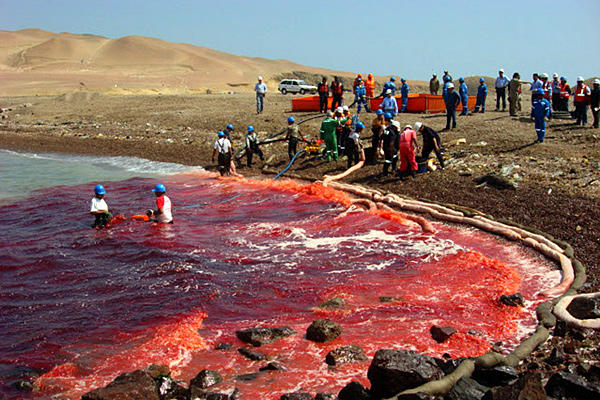
Finally! The Justice Department (PDF) is suing BP and eight other companies over the Gulf oil spill. From the Financial Times
BP faces penalties of $21bn-plus if found fully liable for damages in a lawsuit over the oil accident in the Gulf of Mexico launched by the US government on Wednesday.
Any damages would be on top of the $20bn (£17bn) BP has agreed to pay into a fund to compensate people on the Gulf coast who have suffered financially because of the spill. The final damages figures depend on the US government’s ability to prove gross negligence.
[….]
The US Department of Justice announced that it was suing BP, along with Anadarko of the US and Mitsui of Japan, its partners in the disastrous Macondo well; Transocean, the owner of the Deepwater Horizon drilling rig; and the QBE syndicate 1036 at Lloyd’s of London, which insured the rig.
Eric Holder, the US attorney-general, said: “We intend to prove that these defendants are responsible for government removal costs, economic losses and environmental damages without limitation.”
The lawsuit alleges that safety and operating regulations were violated in the period leading up to April 20.
It says that the defendants failed to keep the Macondo well under control during that period and failed to use the best available and safest drilling technology to monitor the well’s conditions. They also failed to maintain continuous surveillance and failed to maintain equipment and material that were available and necessary to ensure the safety and protection of personnel, equipment, natural resources and the environment, the suit charges.
Before Wednesday, potential class-action lawsuits had been filed in the Gulf oil spill by fishing and seafood interests, the tourism industry, restaurants and clubs, property owners losing vacation renters — even vacationers who claim the spill forced them to cancel and lose a deposit. So far, more than 300 suits have been spawned by the spill and consolidated in federal court in New Orleans.
Specifically, according to the Christian Science Monitor,
The complaint seeks to enforce provisions of the Oil Pollution Act, which government lawyers say provides for open-ended liability for pollution removal costs and other damages.
The lawsuit alleges that the companies failed to take necessary precautions to keep the oil well under control in the period leading up to the explosion. The companies also failed to rely on the best available and safest drilling technology, the suit says.
In addition, the companies are accused of failing to maintain continuous surveillance of the drilling operation and failing to ensure the safety and protection of workers, equipment, natural resources, and the environment.
The suit also seeks civil fines under the Clean Water Act for the oil that poured into the Gulf after the explosion.
The civil suits will be going on at the same time as the Justice Department’s criminal investigation.
The Justice Department is “at a different stage” with its criminal investigation compared with the civil case, Holder said. “We are moving as quickly as we can” on the criminal investigation, said Holder, who didn’t give any timetable for when it might conclude.
The Blog of the Legal Times notes the difficulty posed by running parallel criminal and civil legal actions:
The suit filed today in the U.S. District Court for the Eastern District of Louisiana comes amid an ongoing criminal investigation of the oil spill, which followed an explosion and fire in April that killed 11 workers.
The suit thrusts the government into the sometimes challenging world of parallel criminal and civil proceedings. The Justice Department also said in the complaint it reserves the right to conduct administrative proceedings against the defendants.
“It is difficult to have parallel proceedings going on at the same time,” said Attorney General Eric Holder Jr., addressing reporters this afternoon at Main Justice. “We need to be careful to make sure that we don’t do anything that violates any of the rules that we have to follow on the criminal side while at the same time proceeding on the civil side. It’s been a little tricky.”
Today was the final day to sue for damages caused by the BP oil spill.
The lawsuit makes it possible for the federal government to seek billions of dollars in penalties for polluting the Gulf of Mexico, beaches and wetlands, and reimbursement for its cleanup costs. More than 300 lawsuits filed previously by individuals and businesses, and now consolidated in the New Orleans federal court, include claims for financial losses and compensation for the families of 11 workers killed in the blast.
The judge overseeing those lawsuits had set Wednesday as the deadline to file certain types of complaints, though it was unclear whether the government was bound by that time frame.
“The Justice Department has left its options open to argue that there was gross negligence and therefore should be higher penalties,” said David Uhlmann, a law professor at the University of Michigan who headed up the Justice Department’s environmental crimes section for seven years. “The government has not limited itself in any way with the filing of its civil lawsuit.”
My main question is where will the money go if the suits are successful? Will the people in the Gulf states receive any compensation from damages paid to the government? I certainly hope so.

 peej
peej Carissa
 bostonboomer
 dakinikat
 ecocatwoman
 mablue2
 Mama Lopez
 peggysue22
 quixote
 skydancingguestblogger
 Mona (aka Wonk the Vote)



 Sky Dancing
Recent Comments