
Monday Reads
Posted: December 17, 2012 Filed under: morning reads | Tags: Bobby Jindal, fiscal cliff, Sandy Hook 67 Comments Good Morning!
The embarrassingly, nakedly ambitious pol that is my governor decided that taking a stab at the birth control issue on the front of the WSJ would bring back national attention to him. The man will do anything for attention. So, I covered his suggestion to make birth control over the counter last week. Here’s some feedback from a blogger at kos.
Ah, yes. Because it’s Democrats who run around like headless chickens, screaming and wailing about “religious liberty” and how making birth control affordable and accessible to women is just like 9/11 and Pearl Harbor day . It’s Democrats who’ve said that only sluts use or want birth control. It’s Democrats who’ve said that even married couples should not use birth control because the whole point of marriage is to pop out babies in the name of Jesus.
Oh, no, wait. That’s actually the Republican Party.
But Jindal, who is also head of the Republican Governors’ Association as well as a possible presidential candidate in 2016, thinks it’s high time Republicans stand up for women and their health care because—Nah. Just kidding. In fact, Jindal manages to completely omit any mention of the benefits of birth control for women and their families. But boy, oh boy, does he see an awful lot of political benefits for Republicans if they’d stop giving Democrats such a good reason to criticize them. And that’s apparently reason enough to support the recommendation of the American College of Obstetricians and Gynecologists to make birth control available over the counter.
Oh, and also, Obama sucks. In fact, it’s his fault women don’t have better access to birth control. No, seriously:
Over-the-counter contraception would be easier to obtain if not for some unfortunate aspects of President Obama’s health-care law.
Ah, yes. Who doesn’t remember how Republicans were demanding that the president’s health care law be bigger and better to provide even greater access to, say, reproductive health care?
Oh, and lest you think that “pro-life” Jindal has suddenly turned away from the Every Sperm Is Sacred ideology of his party, don’t worry. He hasn’t:
As an unapologetic pro-life Republican, I also believe that every adult (18 years old and over) who wants contraception should be able to purchase it. But anyone who has a religious objection to contraception should not be forced by government health-care edicts to purchase it for others. And parents who believe, as I do, that their teenage children shouldn’t be involved with sex at all do not deserve ridicule.
This comes on the heels of Jindal’s embarssingly ignorant response to the problem of the fiscal cliff where he demonstrated he has no idea what he’s talking about. Meanwhile, we’re about to suffer yet another blow to higher education and health down here in Louisiana in the name of Peyush’s search for higher office.
Governor Bobby Jindal’s administration announces sweeping state budget cuts totaling $165.5 million.
The mid-year tax cuts will hit the state’s Department of Children and Family Services and those who receive hospice care, the hardest.
Every Saturday, you can listen to Sue May of Cannon Hospice on the radio, trying to counsel families on end of life decisions for their loved ones.
But today, she has bad news for listeners when she hits the radio airwaves.
Governor Jindal’s cuts include hospice care.
“Bobby Jindal and his crew are telling us that if you have a serious illness you can’t receive any further treatment,” says May. “You can get any assistance at end of life care no symptom management, no pain control, no outreach of compassion.”
The cuts to hospice care affect Medicaid patients who are not in nursing homes.
May says thousands of terminally ill patients so often choose to die at home with dignity might no longer have care.
“Medicaid is also for people who struggled through serious illness and who have gone through all of their savings and their funds to get care and are seeking the assistance of the state to help them,” says May. “Last time they made these changes in Medicaid we found out about it on Friday and they came in effect on Monday, we don’t get any huge notification.”
Yes folks! It’s compassionate conservatism with some southern fried curried hospitality thrown in. Jindal is well know for throwing sick people out on the streets. Now, we’re going to be tripping over dying people too.
Rep. Louie Gohmert, a Republican from Texas, says he wishes Dawn Hochsprung, the principal of the Sandy Hook Elementary School, was armed with an M-4 assault rifle when she confronted Adam Lanza, the shooter who killed 20 children.
“I wish to God she had an M-4 in her office locked up so when she heard gunfire she pulls it out and she didn’t have to lunge heroically with nothing in her hands but she takes him out, takes his head off before he can kill those precious kids,” Gohmert said in an interview on “Fox News Sunday.”
Dawn Hochsprung, Sandy Hook’s principal, was reportedly killed when she confronted Lanza after he forced his way into the school.
The M-4 carbine is a smaller version of the M-16 and AR-15 assault rifles. It was developed for urban combat and its semi-automatic version, which is available to civilians, can fire 45 rounds per minute.
Lanza was armed with a semi-automatic M-4 Bushmaster rifle and two semi-automatic handguns, a Glock and a Sig Sauer.
Dr. H. Wayne Carver II, Connecticut’s chief medical examiner, said all of the victims at the school were killed by a “long gun” rifle, suggesting the Bushmaster was the murder weapon.
Ah yes, the answer to a shoot out at the OK Corral is more guns!!!
Here’s a link to the WAPO coverage of the President’s sermon last night.
President Obama’s speech Sunday night at a memorial service for the victims — mostly children — of a mass shooting in Newtown, Connecticut was a forceful assertion that the politics surrounding guns (and gun control) must change.
“We can’t tolerate this anymore,” Obama said. “We are not doing enough and we will have to change.” (Full transcript of speech here.)
Obama noted that this was the fourth time in his presidency that he has had to grieve with a community after an incident of mass murder with a gun. But, his speech in Connecticut Sunday was a significant departure from the other addresses he had given to communities torn apart by shooting sprees.
Speaking in Aurora, Colorado just days after a gunman opened fire in a movie theater this summer, Obama was somber, subdued — and decidedly apolitical. The closest Obama got to making a statement (of any sort) came in the speech’s last line in which he said: “I hope that over the next several days, next several weeks, and next several months, we all reflect on how we can do something about some of the senseless violence that ends up marring this country, but also reflect on all the wonderful people who make this the greatest country on Earth.”
It was a very different Obama who took the stage at the Newtown memorial Sunday, a president not just saddened by the tragedy but fed up with the lack of forward movement in hopes of preventing the next one.
One sentence in Obama’s speech sums up his state of mind. “I’ll use whatever power this office holds…in an effort aimed at preventing more tragedies like this,” he said — a line the incumbent never came close to uttering in Aurora or, before that, in Tucson in 2011.
Speaker Boehner appears to be warming up to the process of negotiating.
House Speaker John A. Boehner has offered to push any fight over the federal debt limit off for a year, a concession that would deprive Republicans of leverage in the budget battle but is breathing new life into stalled talks over the year-end “fiscal cliff.”
The offer came Friday, according to people in both parties familiar with the talks, as part of the latest effort by Boehner (R-Ohio) to strike a deal with President Obama to replace more than $500 billion in painful deficit-reduction measures set to take effect in January.
With the national debt already bumping up against a $16.4 trillion cap set last year, Congress risks a government default unless it acts to raise the debt ceiling in the next few months. Some Republicans had argued that party leaders should use the threat of default to demand additional spending cuts from Obama.
Boehner’s offer signals that he expects a big deal with sufficient savings to meet his demand that any debt limit increase be paired dollar for dollar with spending cuts. That would permit him to keep a key vow to his party — and head off a potentially nasty debt-limit fight — at least until the end of next year.
So, that’s it from me.What’s on your reading and blogging list today?
Many Apologies to Iowa From Louisiana but really, keep Jindal, we don’t want him
Posted: October 7, 2012 Filed under: New Orleans | Tags: ambition, Bobby Jindal, crazy person, NUTTER 10 CommentsI would like to apologize to any Iowans out there for the omnipresence of our ambitious and irritating Governor Bobby Jindal. I feel the need to do this  because he’s going to be with you more than us for the next few years. We can’t do anything more for him and you can. So, he’s your problem now. We’re just glad to be rid of him frankly. Sorry it had to happen to you, but really, we appreciate it.
He’s such a problem that the Des Moines Register has told him to leave Iowa alone. Actually, they told him that he got on the wrong bus.
A thistle to Louisiana Gov. Bobby Jindal for having the temerity to come here to lecture Iowans about their judges. Jindal was on the recent bus tour across the state campaigning to unseat Iowa Supreme Court Justice David Wiggins. This is the governor of a state whose courts have consistently been ranked No. 49 out of the 50 states in the respected state courts survey by the U.S. Chamber of Commerce. Iowa consistently ranks in the top five or 10 states overall in the survey of business lawyers. In Marshalltown, Jindal got a laugh with the remark that “Some of these judges, they actually make the replacement refs in the NFL look like geniuses.” That may be the case in his state: In the 2008 survey, Louisiana’s judges were rated the worst among the 50 states in the area of competence. Maybe Iowa Gov. Terry Branstad should head down to Louisiana and take a bus tour to persuade the good people of that state to reform their system of electing judges.
According to another Lousiana Blogger whose been watching the Jindal Migration and search for the next BIG office, he’s been up to all kinds of things in Iowa. Well, at least he can’t voucherize their educational system into a free for all funding of whacky christofascist cult camps. Bob Mann has been keeping up with Travels with Bobby.
Jindal, as you may recall, recently neglected his gubernatorial duties to spend a day trekking across Iowa, crusading against gay marriage and meddling in a state Supreme Court race.
That prompted a retired hotel clerk from Marion, Iowa, Dave Gregory, to send a letter to the editor of the Baton Rouge Advocate:
Your governor, Bobby Jindal, has traveled from town to town across Iowa crusading against gay marriage. Many suspect he’s already campaigning for the 2016 Iowa Presidential Caucuses.
We Iowans were recently subjected to an endless parade of Republican candidates during the 2012 Presidential Caucuses. We really don’t need Gov. Jindal’s wisdom and advice for the next four years.
Please call back your governor and find something for him to do. Aren’t there any homosexuals to persecute in Louisiana?
Yes, Bobby the guy well known for speaking faster than the speed of light–a well known snake oil salesman attribute–and for participating in the kidnapping and assault of a young women in the guise of “spiritual warefare” is now doing a full frontal assault on Iowa. The aforementioned letter to the editor got a response down here in the Baton Rouge Advocate. Namely, we don’t want him back. He ran unopposed because the Democratic Party in Louisiana basically became nonexistent after Katrina. No one voted in that election and he won by basically being anointed by the few wankers that voted.
In response to Dan Gregory of Marion, Iowa, (Oct. 1) who asked that we take our governor back home so he would stop crusading against gay marriage in Iowa: Bobby Jindal doesn’t have to get personally involved in persecuting homosexuals in Louisiana.
He has the Louisiana Family Forum and Tony Perkins’ Family Research Council to take care of that for him, so he won’t get his hands dirty at home.
Sorry, Iowa, but we don’t want him either.David Neubig
construction
Baton Rouge
Bobby only does things that Bobby thinks will get him the next highest office. Right now, he’s basically doing anything the Teavangelicals want and Louisiana is suffering and hating him for it. Every one hates Jindal’s voucher program and his personal popularity is way way off.
And now a Southern Media and Opinion Research Poll finds Jindal sinking like a stone. It’s no surprise, but 89% of those surveyed don’t like Jindal’s slash and burn of the public Charity Hospitals. More startlingly, Jindal’s prized voucher program is opposed by 54% of Louisianians:
The poll shows Gov. Bobby Jindal with a 51 percent approval rating. That compares with 61 percent last spring and 64 percent a year ago…
Reductions for the LSU-operated charity hospital system are particularly unpopular. Eighty-nine percent said they were concerned by the cuts. Seventy-nine percent said the charity system would not be able to provide the same quality of health care, and 80 percent said Louisiana residents would lose access to health care as a result.
Among the poll’s other findings:
- On the issue of school vouchers, 54 percent were opposed.
- Salaries for state executives and political appointees were a hot button issue with 86 percent saying annual salaries of $175,000 and above are excessive or not justified.
- 47 percent favor eliminating tax exemptions to increase state revenue compared to 35 percent opposed, which tracks with widespread opposition to deeper budget cuts.
- 69 percent said the Legislature should be more independent from the governor
Bad news all around. #Vouchergate isn’t going well for Team Jindal. Nor are his high-priced public employee hires.
And it looks like the tax credit monster is about to bite Jindal back…
Jindal isn’t worried, however. He’s spent the last week campaigning for judges in Iowa, in some fields of dreams.
Jindal knows he can’t run for governor and really doesn’t care from here on out what he does to Louisiana. He’s just building up his ‘conservative’ Republican credentials by railroading the state.
Louisiana is embarking on the nation’s boldest experiment in privatizing public education, with the state preparing to shift tens of millions in tax dollars out of the public schools to pay private industry, businesses owners and church pastors to educate children.
Starting this fall, thousands of poor and middle-class kids will get vouchers covering the full cost of tuition at more than 120 private schools across Louisiana, including small, Bible-based church schools.
The following year, students of any income will be eligible for mini-vouchers that they can use to pay a range of private-sector vendors for classes and apprenticeships not offered in traditional public schools. The money can go to industry trade groups, businesses, online schools and tutors, among others.
Every time a student receives a voucher of either type, his local public school will lose a chunk of state funding.
“We are changing the way we deliver education,” said Governor Bobby Jindal, a Republican who muscled the plan through the legislature this spring over fierce objections from Democrats and teachers unions. “We are letting parents decide what’s best for their children, not government.”
The concept of opening public schools to competition from the private sector has been widely promoted in recent years by well-funded education reform groups.
Of the plans so far put forward, Louisiana’s plan is by far the broadest. This month, eligible families, including those with incomes nearing $60,000 a year, are submitting applications for vouchers to state-approved private schools.
That list includes some of the most prestigious schools in the state, which offer a rich menu of advanced placement courses, college-style seminars and lush grounds. The top schools, however, have just a handful of slots open. The Dunham School in Baton Rouge, for instance, has said it will accept just four voucher students, all kindergartners. As elsewhere, they will be picked in a lottery.
Far more openings are available at smaller, less prestigious religious schools, including some that are just a few years old and others that have struggled to attract tuition-paying students.
The school willing to accept the most voucher students — 314 — is New Living Word in Ruston, which has a top-ranked basketball team but no library. Students spend most of the day watching TVs in bare-bones classrooms. Each lesson consists of an instructional DVD that intersperses Biblical verses with subjects such chemistry or composition.
And of course, who could forget this Jindal “education” initiative?
Jindal has an elite résumé. He was a biology major at my school, Brown University, and a Rhodes scholar. He knows the science, or at least he ought to. But in his rise to prominence in Louisiana, he made a bargain with the religious right and compromised science and science education for the children of his state. In fact, Jindal’s actions at one point persuaded leading scientific organizations, including theSociety for Integrative and Comparative Biology, to cross New Orleans off their list of future meeting sites (PDF).
What did Jindal do to produce a hornet’s nest of “mad scientists,” as Times-Picayune writer James Gill described them? He signed into law, in Gill’s words, the “Louisiana Science Education Act (LSEA), which is named for what it is designed to destroy.” The act allows “supplemental textbooks and other instructional materials” to be brought into classrooms to support the “open and objective discussion” of certain “scientific theories,” including, of course, evolution. As educators who have heard such coded language before quickly realized, the act was intended to promote creationism as science. In April, Kevin Carman, dean of the College of Science at Louisiana State University, testified before the Louisiana Senate’s Education Committee that two top scientists had rejected offers to come to LSU because of the LSEA, and the school may lose more scientists in the future.
And now Jindal is poised to spend millions of dollars of state money to support the teaching of creationism in private schools.
The state of Louisiana has had a problem with evolution for a long, long time. In 1981, it passed a “Balanced Treatment for Creation-Science and Evolution-Science Act,” which required the teaching of creation science alongside “evolution-science” in public schools. The Supreme Court struck it down in 1987 (in Edwards v. Aguillard), finding that creationism is inherently religious, and that the law’s “preeminent religious purpose” placed it in violation of the First Amendment to the U.S. Constitution. Case closed? Not really.
When Jindal stepped into Republican politics in Louisiana, he had a choice to make. He could defend mainstream science, which sees evolution as the powerful, strongly supported, and widely tested theory that it is today. Or he could have joined the doubters and deniers that populate the electorate in his party. Campaigning for the governorship in 2007, Jindal touted his Christian faith, shied away from specific statements about evolution, and emphasized his commitment to local control of education. Louisianans didn’t have to wait long to find out what this meant for science.
Jindal signed the LSEA into law in 2008, endorsing the thinly veiled attempt to allow creationism into the science classrooms of his state. The backers of the law made it clear that material on intelligent design would be high on the list of supplemental materials that local boards and teachers could present to their students.
Please Iowa! Do us a favor! Just keep him there for the rest of his term so he can’t damage us any more! I was kind of hoping Mitt would take him off our hands but it seem not even Mitt is THAT stupid. So, we are so sorry Iowa. Just look at our alligator tears!!!
Friday Reads
Posted: July 6, 2012 Filed under: Banksters, fetus fetishists, Mitt Romney, morning reads, U.S. Politics, VAGINA MItt Romney, War on Women, Women's Rights | Tags: Banksters, Barclay, Bobby Jindal, Libor Rate fixing, Rush Limbaugh 40 Comments Good Morning!!
There are a couple of finance stories that I’ve been following that I’m getting ready to write more bout. One is the story about the manipulation of LIBOR by Barclays with possible involvement of JPM and others. Here’s an article from The Economist to get us started on the topic. Its title includes the word “banksters”. That should be telling.
At present, the scandal rages in one country and around one bank. Barclays has been fined $450m by American and British regulators for its attempts to manipulate LIBOR. The bank’s first attempt to ride out the storm failed miserably; Bob Diamond, Barclays’ chief executive, resigned this week. The British government has ordered a parliamentary review into its banks. The reputation of the City of London, where LIBOR is set by collating estimates of their own borrowing costs from a panel of banks, has been further dented.
But this story stretches far beyond Britain. Barclays is the first bank in the spotlight because it offered to co-operate fully with regulators. It will not be the last. Investigations into the fixing of LIBOR and other rates are also under way in America, Canada and the EU. Between them, these probes cover many of the biggest names in finance: the likes of Citigroup, JPMorgan Chase, UBS, Deutsche Bank and HSBC. Employees, from New York to Tokyo, are implicated (see article).
I’m just delving into the details now. It will take me awhile to get to the point of being able to describe it nontechnically so please be patient. This is huge. It will likely show us why the moves to remove Dodd-Frank and the Volker Rule are as criminal as the intent.
Well, I certainly wouldn’t wish Bobby Jindal on the country but it appears that our Governor has made the short list in the Romney VP stake. Frankly, anything he does is only to further his professional political career having done nothing else. Judging from my LA twitter feed, he might just have fled the state because every one is mad at him over his move to end public education as we know it. The man has a weird personality and he excels at ambition and lying. He’d be perfect for the job, frankly. Romney and Jindal are a matched set of amoral liars. Unfortunately, he won’t quit even if he gets the nod which only puts my state in worse condition than it is since he took over. Ask me about our more than double unemployment rate since he took over. He’s got his eye on 4 years from now.
On readiness for office, conversations with Romney insiders and allies suggest that they have no qualms about Portman or Pawlenty. One of Romney’s biggest complaints about President Obama is that he is in over his head and had “never run anything before.” Pawlenty governed the state of Minnesota for two terms; Portman ran the Office of Management and Budget as well as the Office of the United States Trade Representative. Jindal is in his second term as governor of Louisiana. Paul Ryan, however, falls short in this regard; he was a Capitol Hill staffer and a marketing consultant before becoming a congressman at age 28.
As for chemistry with the candidate, Pawlenty, Portman and Ryan have all campaigned alongside him multiple times. Each endorsed him at critical moments in the primary process and appeared with him on the stump when they did. And each got a turn as his key surrogate on Romney’s June bus tour, which ran through their states. Jindal has not yet campaigned with the presumptive nominee, so look for that to happen soon in a swing state near you.
Does this picture remind you of something from the John Kerry Files? Notice the dressage horses are missing. Romney going one way on the lake. Then, the other  way on the lake … then back again the other way on the lake …
I’ll just say it: I don’t think the political pundit class understands just how toxic the Swiss/Caymans/Bermuda accounts issue is for Romney. Not that they don’t know it’s a liability at all. But I don’t think they realize the extent of it.
Here’s a report just out from ABC News on how Ted Strickland introduced Obama in Ohio …
“Oh, what a contrast, my friends, between these two men who would be president!” Strickland said, standing outside the Wolcott House Museum. “President Obama is betting on America and American workers, and Mitt Romney is betting his resources in the Cayman Islands, in Bermuda, in Switzerland and God only knows where else he is putting his resources.”Fair or not, it just rolls off the tongue. Immediately understandable. And assuming you’re not talking to the deeply ideological committed or hyper-partisans, how exactly do you understand that a man running for president has parked a lot of his money in offshore tax havens?
Whatever harsh message you’re trying to prove — out of touch with lives of ordinary Americans, plays by a different set of rules, isn’t focused on America and American workers — it fits right in.
Set aside all questions of legality. And I think Romney’s probably too smart and close to the vest to break any laws. But how do you explain it? What’s the good explanation?
Do you seek the safe harbor of Romney’s 15% tax rate?
How many of you know any one that hides assets in off shore banking havens? Better yet, how many savvy politicians would do it?
The attacks on Mississipi’s sole abortion clinic seem to be aimed at sending a court case to SCOTUS to test Planned Parenthood v. Casey and Roe v. Wade. Creeping theocracy threatens the health of American women.
Earlier this week a district court issued an eleventh-hour stay to block a Mississippi law designed to shut down the state’s last surviving abortion clinic. It’s the only one that has muscled through a spate of regulations aimed at making Mississippi “abortion-free,” in the words of Gov. Phil Bryant (R).
“The Court has considered the parties’ arguments and finds Plaintiffs satisfy the requirements for temporary injunctive relief to maintain the status quo until the newly framed issues can be more thoroughly examined,” wrote U.S. district judge Daniel P. Jordan III.
Bryant’s intentions are clear: make Mississippi the first state without access to abortion. But that’s a tricky legal proposition as a result of Roe v. Wade and Planned Parenthood v. Casey, the two key Supreme Court rulings that protect abortion rights.
The question before the courts is whether the new state law is legitimate under Roe and Casey. If so, pro-choice advocates fear it would threaten abortion rights protections nationwide
“In this case, Plaintiffs have offered evidence — including quotes from significant legislative and executive officers — that the Act’s purpose is to eliminate abortions in Mississippi,” wrote Jordan. “They likewise submitted evidence that no safety or health concerns motivated its passage. This evidence has not yet been rebutted.”
A hearing is scheduled for July 11 to determine if a preliminary injunction should follow. That’s a reasonably likely scenario since the Bush-appointed Judge Jordan issued the stay on the basis that the plaintiffs have “a substantial likelihood of success on the merits.”
Whether or not the case climbs up to the Supreme Court and puts Roe at risk of being overturned depends on the breadth of the lower courts’ ruling. But neither side is particularly keen on going down that road — at least for now.
“From a pro-choice perspective, the less the current Court does to define Casey, the better. From a pro-life perspective, they want to wait until there’s a clear shot at Roe v. Wade,” said Scott Lemieux, a political science professor at the College of Saint Rose.
Rush Limbaugh has a major problem when it comes to women. In the past, the conservative talk radio host has accused them of being sluts for using birth control and called those who support feminism “feminazis.” (Media Matters has compiled a pretty good list of Limbaugh’s sexist and misogynistic remarks over the years.) Now, the caustic commentator has come up with a new calumny: “When women got the right to vote is when it all went down hill.”
He made the remark on his radio program Tuesday, adding: “Because that’s when votes started being cast with emotion and maternal instincts. …”
That’s right. According to Limbaugh, America messed up big-time when it allowed all of its citizens—not just men—to vote.
I have no idea what makes people vote Republican any more but I don’t think it has anything to do with sanity. What’s on your reading and blogging list today?
A Sad Legacy: Louisiana’s Prison Economy
Posted: May 15, 2012 Filed under: Criminal Justice System, New Orleans | Tags: Angola Prison, Bobby Jindal, Louisiana, prison state, prisoners, Warden Cain 14 Comments This is the stuff that creates documentaries and sad movies. It is the prison state that is Louisiana.
Louisiana is the world’s prison capital. The state imprisons more of its people, per head, than any of its U.S. counterparts. First among Americans means first in the world. Louisiana’s incarceration rate is nearly triple Iran’s, seven times China’s and 10 times Germany’s.
The hidden engine behind the state’s well-oiled prison machine is cold, hard cash. A majority of Louisiana inmates are housed in for-profit facilities, which must be supplied with a constant influx of human beings or a $182 million industry will go bankrupt.
Several homegrown private prison companies command a slice of the market. But in a uniquely Louisiana twist, most prison entrepreneurs are rural sheriffs, who hold tremendous sway in remote parishes like Madison, Avoyelles, East Carroll and Concordia. A good portion of Louisiana law enforcement is financed with dollars legally skimmed off the top of prison operations.
If the inmate count dips, sheriffs bleed money. Their constituents lose jobs. The prison lobby ensures this does not happen by thwarting nearly every reform that could result in fewer people behind bars.
READ THE
ENTIRE SERIES from NOLA.Com.Meanwhile, inmates subsist in bare-bones conditions with few programs to give them a better shot at becoming productive citizens. Each inmate is worth $24.39 a day in state money, and sheriffs trade them like horses, unloading a few extras on a colleague who has openings. A prison system that leased its convicts as plantation labor in the 1800s has come full circle and is again a nexus for profit.
In the past two decades, Louisiana’s prison population has doubled, costing taxpayers billions while New Orleans continues to lead the nation in homicides.

It is a shameful situation. Here are some stories from Angola. It’s probably the most infamous prison in the world. It’s known for its rodeo and its harsh treatment of prisoners who basically are subjected to “Faith-Based Slavery”. It seems that when a state can’t produce real jobs that it produces prisons.
“Unique” is one way Warden Burl Cain likes to describe his prison, and it would be impossible to argue otherwise. With grazing cattle and rolling hills in the distance, it’s hard not to admire its strange, sprawling beauty, even as the towers come into view. The prison itself is absent from my GPS’s “points of interest,” yet Angola’s Prison View Golf Course—the first public golf course on the grounds of a state penitentiary—is not. At Angola’s official museum, opened by Cain in 1998, a retired electric chair and rusty prison contraband are displayed adjacent to a gift shop selling mugs and tote bags reading: “Angola: A Gated Community.”
Angola is the largest maximum security in the country, sitting on 18,000 acres of farmland and home to 5,200 men. Louisiana has the highest incarceration rate of adult prisoners in the United States; thanks to the state’s unforgiving sentencing laws, at least 90 percent of Angola’s prisoners will die there. It’s a large-scale embodiment of a national phenomenon: elderly inmates are the country’s fastest growing prisoner population.
Yet Angola is also lauded as a revolution in corrections, its story told many times: Angola was once the “bloodiest prison in America,” where inmates slept with magazine catalogs strapped to their chests to protect themselves from stabbings. Things began to turn around in the 1970s, when a federal judge ordered a major overhaul. But most of the credit has gone to Warden Cain for imposing order through a new model of incarceration.
Like all of Angola’s wardens, Cain has continued the tradition of hard labor: most inmates work in the fields eight hours a day, five days a week, harvesting hundreds of acres of soybeans, wheat, corn, and cotton—picked by hand and sold by Prison Enterprises, the business arm of the Louisiana Department of Corrections. But unlike his predecessors, Cain, an evangelical Christian, has also made it his mission to bring God to Angola. Inmate ministers tell new prisoners that they can either work on their “moral rehabilitation” or remain a “predator”—“the choice is yours.” The radio station plays gospel music. On the walls leading to the execution chamber are two murals: Elijah ascending to Heaven and Daniel facing the lion. One of Cain’s favorite anecdotes is the execution of Antonio James, a born-again Christian whose hand he held just before giving the go-ahead to end his life. As James lay on the gurney waiting for lethal drugs to enter his veins, Cain said, “Antonio, the chariot is here…you are about to see Jesus.”
You should really read this MJ article to get the full feel of life inside Angola. It’s called “Gods Own Warden”.
Everyone was there except the person I had come to see: Warden Burl Cain, a man with a near-mythical reputation for turning Angola, once known as the bloodiest prison in the South, into a model facility. Among born-again Christians, Cain is revered for delivering hundreds of incarcerated sinners to the Lord—running the nation’s largest maximum-security prison, as one evangelical publication put it, “with an iron fist and an even stronger love for Jesus.” To Cain’s more secular admirers, Angola demonstrates an attractive option for controlling the nation’s booming prison population at a time when the notion of rehabilitation has effectively been abandoned.
What I had heard about Cain, and seen in the plentiful footage of him, led me to expect an affable guy—big gut, pale, jowly face, good-old-boy demeanor. Indeed, former Angola inmates say that prisoners who respond to Cain’s program of “moral rehabilitation” through Christian redemption are rewarded with privileges, humane treatment, and personal attention. Those who displease him, though, can face harsh punishments. Wilbert Rideau, the award-winning former Angolite editor who is probably Angola’s most famous ex-con, says when he first arrived at the prison, Cain tried to enlist him as a snitch, then sought to convert him. When that didn’t work, Rideau says, his magazine became the target of censorship; he says Cain can be “a bully—harsh, unfair, vindictive.”“Cain was like a king, a sole ruler,” Rideau writes in his recent memoir, In the Place of Justice. “He enjoyed being a dictator, and regarded himself as a benevolent one.” When a group of middle school students visited Angola a few years ago, Cain told them that the inmates were there because they “didn’t listen to their parents. They didn’t listen to law enforcement. So when they get here, I become their daddy, and they will either listen to me or make their time here very hard.”
Another former prisoner, John Thompson—who spent 14 years on death row at Angola before being exonerated by previously concealed evidence—told me that Cain runs Angola “with a Bible in one hand and a sword in the other.” And when the chips are down, Thompson said, “he drops the Bible.”
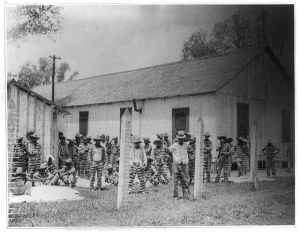 We’ve talked about Angola’s horrible legacy before. Here’s a recent UK Guardian Story on two men that have spent 40 years in solitary confinement. This is the stuff that causes insanity. Every human rights group actively opposes this kind of treatment.
“I can make about four steps forward before I touch the door,” Herman Wallace says as he describes the cell in which he has lived for the past 40 years. “If I turn an about-face, I’m going to bump into something. I’m used to it, and that’s one of the bad things about it.”
On Tuesday, Wallace and his friend Albert Woodfox will mark one of the more unusual, and shameful, anniversaries in American penal history. Forty years ago to the day, they were put into solitary confinement in Louisiana‘s notorious Angola jail. They have been there ever since.
They have spent 23 hours of every one of the past 14,610 days locked in their single-occupancy 9ft-by-6ft cells. Each cell, Amnesty International records, has a toilet, a mattress, sheets, a blanket, pillow and a small bench attached to the wall. Their contact with the world outside the windowless room is limited to the occasional visit and telephone call, “exercise” three times a week in a caged concrete yard, and letters that are opened and read by prison guards.
A new documentary film takes us into that cell, providing rare insight into the personal psychological impact of such prolonged isolation. Herman’s House tracks the experiences and thoughts of Wallace as he reflects on four decades banged away in a box.
Our own Governor wants to turn our Prison Economy into a privatized, money-making scheme for corporate donors. Fortunately, his bill didn’t get very far. But, this is because so many local politicians make money off of renting out prisoners to their own local donor base. They also get to use them for services that would normally go to paid workers. No wonder no one can find these types of jobs unless you are in prison.
A bill strongly backed by Gov. that would have allowed for the sale of the Avoylles Correctional Facility has been abandoned, as support for it was limited, according to the Associated Press. Now, the prison may be run under a new plan. Here is some more information.
* The original bill would have allowed for the Avoyelles Correctional Facility to be sold for $35 million to a private firm that would be responsible for operating it, according to the Town Talk.
* The state would then pay the company that buys it a daily fee to operate it.
* Rep. (R- Haughton) sponsored the bill, House Bill 850.
* Opposition from the privatization of the prison stems from the fact that 296 jobs would be lost in the sale.
* One group, the , made a plea to representatives to vote against the bill, saying that if the prison was run privately, the company could demand an exorbitant amount of money from Louisiana taxpayers to run the prison, and that the sale would actually cost Louisiana residents more.
* The bill was rewritten on Wednesday to allow for a private firm to be contracted to run the facility, but not to buy it.
* The contract would be for 10 years and the approval of the contract would be by the House and Senate budget committees.
* On Wednesday, the House voted 62-43 to pass the new amendment to the bill, according to Gambit.
* The bill was not sent to the Senate for approval, however, as Burns says that he is giving legislators time to look over the new bill, according to the Capitol News Bureau.
* There is still a lot of disapproval of the new bill as well, as opponents still cite the decreased wages for employees that are working for private companies as opposed to wages for state employees as unacceptable.
* Safety is also a concern, as Rep. Robert Johnson cited the lower wages as attracting lower quality workers to guard the prison, which would mean an unsafe environment, according to The Times-Picayune.
* The privatization of Avoyelles is a part of a larger plan by Gov. Jindal to privatize more prisons in Central Louisiana and close the and move those prisoners to Avoyelles, according to the Town Talk.
* Alexandria Mayor Jacques M. Roy has come out against the plan, saying that it would decrease public safety and would not save the state any money.
Any one in Louisiana lives among this prison legacy. Prisoners clean up our roads. They are brought out to shore up levees. They make our license plates. They are visible everywhere doing jobs that would usually be given to parish employees. No place is this more true than in small communities where sheriffs can make a good living off of renting them out to local business. Kinda makes you proud of that old entrepreneurial spirit doesn’t it? Take some time to read the series at the Times Picayune. I think you will find out more about my part of the good ol’ USA than you really would like.
Friday Reads
Posted: April 27, 2012 Filed under: Civil Liberties, Civil Rights, education, morning reads, religious extremists | Tags: ALEC, anti-abortion, austerity fails again, Bobby Jindal, school voucher scam, tax payer religious fanatics 46 Comments Good Morning!
I’ve been livid recently about our Governor’s jihad against public education. Here’s some details on how Bobby Jindal used the ALEC play book to turn the state’s public schools upside down.
Gov. Bobby Jindal has remade the Louisiana public schools system with impressive speed over the past legislative session. Last week, he signed into law a suite of landmark reform bills that will likely change the direction of public education in Louisiana forever. But not all change is good, and critics say both Jindal’s agenda and the strategy to move it come right from the playbook of conservative advocacy group ALEC, in an effort to revive Jindal’s national political profile.
Louisiana is now home to the nation’s most expansive school voucher program. Charter school authorization powers have been broadened. And teacher tenure policies have been radically transformed. Louisiana already had something of a reputation as a radical-reform state, thanks to the post-Katrina educational climate in New Orleans. But not all change is good, and education advocates have deep concerns about the efficacy of Jindal’s overhaul, and the interests that have push it.
ALEC has overrun Louisiana at a time when it’s losing corporate sponsors and cronies in various state legislatures. ALEC still has some steam left, however.
ALEC will survive, of course, kept afloat largely by the billionaire Koch brothers and their corporate allies. But as activists keep up the pressure, they must not lose sight of the worst culprits, who must be identified and targeted: the more than 2,000 legislative members of ALEC. The Center for Media and Democracy maintains a list of lawmakers allied with ALEC at ALECexposed.org. The Progressive Change Campaign Committee has begun to pressure dozens of Democrats involved with the overwhelmingly Republican group to quit. Their exit from ALEC would put the lie to the claim that ALEC is nonpartisan.
Common Cause argues that ALEC has abused its tax-exempt status by lobbying, and Wisconsin State Representative Mark Pocan has introduced a bill requiring ALEC to register as a lobbyist in that state. But especially as November approaches, the Exit ALEC movement must go beyond the group to confront some of the damage it has done. In the past two years, thirty-four states have introduced bills to restrict voting for some 5 million eligible voters; nine have passed voter ID laws; dozens of other states have gotten rid of early voting or tried to hobble voter registration drives. In Florida get-out-the-vote efforts by the League of Women Voters and Rock the Vote have been sabotaged. The most affected are blacks, Latinos and other groups that skew Democratic.
If you haven’t been following CISPA, you really should. Here’s a primer from Truth Dig.
What is CISPA?
CISPA, an abbreviation for the Cyber Intelligence Security and Protection Act, was introduced in the House of Representatives on November 30, 2011 by Mike Rogers (R-MI), as well as 111 co-sponsors. Since then, a number of amendments have been introduced. The House is expected to vote on the bill Friday and its author has said that the latest changes brought the number of supporting Congressmen “well past” the threshold of 218 necessary for the adoption of the legislation. It is therefore very likely that the bill will be passed by the House. However, it’s not all that certain whether the bill will be made into law, especially with the White House’s latest statement that President Obama would be advised to veto the legislation.
What does CISPA entail for internet users?
The act says it is meant to create procedures allowing “elements of the intelligence community to share cyber threat intelligence with private-sector entities and to encourage the sharing of such intelligence.” It also states that a cyber-security provider or a self-protected entity may share “cyber threat information” “with any other entity designated by such protected entity, including… the Federal Government.”
But what does that mean?
Unnecessarily broad definitions are the factor which makes CISPA so controversial with web users.
Experts argue that the bill would give the government the ability to circumvent internet privacy laws and obtain information on user activities from private companies – be it providers, hosting companies or social networks – essentially any company involved in the Internet.
The bill does specifically say that the Federal Government can only use the information obtained for a “cybersecurity purpose” or the “protection of the national security of the United States,” but the broad definitions of the terms could potentially lump an average Internet user sending an encrypted e-mail into the same threat category as a terrorist. Privately owned corporations could, under the pretext of cyber and national security, spy on users and transfer their data to a government agency.
“You will get no accountability for that,” explains David Seaman, host of The DL Show. “If findings are turned against you in the worst possible way, you won’t be able to get a lawyer and sue because of the litigation immunity.”
You can find more analysis and links at Cannonfire. The House has already passed CISPA. No surprises there since these guys are standing in line to monitor US women’s menstrual periods and want to peer into every woman’s uterus. As usual, a few Democrats joined in the effort to expand government’s intrusion into your personal lives. Here’s wishing Obama follows through with his threat to veto.
The final tally was 248-168, enough to pass the measure but not enough to override the threatened veto. Forty-two Democrats broke with the White House to vote for the bill, and 28 Republicans voted against it.
The administration and Democratic critics opposed the bill because of privacy and civil liberties concerns. The other main sticking point was that, unlike a Senate bill by Joe Lieberman (I-Conn.), CISPA would not mandate new security requirements for a critical infrastructure network.
Although those disagreements still exist, House Republicans have now jumped ahead of the Senate in a race to avoid the political fallout in the event of a major cyberattack.
At least some of CISPA’s Democratic supporters weren’t happy with their colleagues’ opposition to the bill, nor with the White House.
After the White House issued the veto threat Wednesday, Rep. Dutch Ruppersberger, Rogers’s chief Democratic ally, launched an all-out lobbying effort to persuade his fellow Democrats to back the bill.
Here’s an article that pretty much outlines my worst nightmares: “How Christian Groups Push Right-Wing Religion With the Help of Your Tax Dollars”;Taxpayer-funded crisis pregnancy centers are using religion to oppose abortion, and many of them only hire Christians.
If you want to help carry out the anti-abortion mission of the taxpayer-funded Care Net Pregnancy Resource Center, you have to be a Christian.
It’s right there on the Rapid City, S.D., center’s volunteer application.
“Do you consider yourself a Christian?” “If yes, how long have you been a Christian?” “As a Christian, what is the basis of your salvation?” “Please provide the following information concerning your local church. Church name … Denomination … Pastor’s name.” “This organization is a Christian pro-life ministry. We believe that our faith in Jesus Christ empowers us, enables us, and motivates us to provide pregnancy services in this community. Please write a brief statement about how your faith would affect your volunteer work at this center.”
But that hasn’t stopped the center from receiving federal funding and other forms of government support.
In 2010, it was awarded a $34,000 “capacity building” grant as part of President Obama’s stimulus bill.
Last year, the nonprofit National Fatherhood Initiative, with “support from the US Department of Health and Human Services’ Office of Family Assistance,” awarded the center $25,000 for capacity building.
And when South Dakota passed a law requiring that women get counseling from a “pregnancy help center” before receiving an abortion, the Rapid City center was quick to sign up — becoming one of three such facilities listed on the state’s official website.
When do we get our country back from these whackos and when do we get to say that they don’t get our money?
I’m sending Hugs out today to Senator AL Franken for this.
What’s on your reading and blogging list today?

 peej
peej Carissa
 bostonboomer
 dakinikat
 ecocatwoman
 mablue2
 Mama Lopez
 peggysue22
 quixote
 skydancingguestblogger
 Mona (aka Wonk the Vote)



 Sky Dancing
Recent Comments