
Gene Sperling: “A mix of entitlements and revenues was part of the DNA” of the Sequester “from the start.”
Posted: February 28, 2013 Filed under: 2012 presidential campaign, Austerity, Barack Obama, Medicaid, Medicare, Social Security, U.S. Economy, U.S. Politics | Tags: Bob Woodward, digby, entitlement cuts, Gene Sperling, Jon Walker, Robert Kuttner, the sequester 38 Comments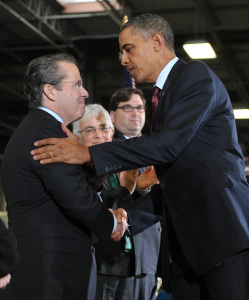
Gene Sperling and Barack Obama
I want to call attention to some rather startling statements in Gene Sperling’s e-mail to Bob Woodward, which I posted earlier. Please note the highlighted sections.
From Gene Sperling to Bob Woodward on Feb. 22, 2013
Bob:
I apologize for raising my voice in our conversation today. My bad. I do understand your problems with a couple of our statements in the fall — but feel on the other hand that you focus on a few specific trees that gives a very wrong perception of the forest. But perhaps we will just not see eye to eye here.
But I do truly believe you should rethink your comment about saying saying that Potus asking for revenues is moving the goal post. I know you may not believe this, but as a friend, I think you will regret staking out that claim. The idea that the sequester was to force both sides to go back to try at a big or grand barain with a mix of entitlements and revenues (even if there were serious disagreements on composition) was part of the DNA of the thing from the start. It was an accepted part of the understanding — from the start. Really. It was assumed by the Rs on the Supercommittee that came right after: it was assumed in the November-December 2012 negotiations. There may have been big disagreements over rates and ratios — but that it was supposed to be replaced by entitlements and revenues of some form is not controversial. (Indeed, the discretionary savings amount from the Boehner-Obama negotiations were locked in in BCA: the sequester was just designed to force all back to table on entitlements and revenues.)
I agree there are more than one side to our first disagreement, but again think this latter issue is diffferent. Not out to argue and argue on this latter point. Just my sincere advice. Your call obviously.
My apologies again for raising my voice on the call with you. Feel bad about that and truly apologize.
Gene
Really? Does anyone recall President Obama saying that at the time the sequester was proposed and voted on in 2011? Did President Obama discuss these plans for entitlement cuts during his campaign for re-election? I’ve always suspected he did plan cuts in Social Security, Medicare, but when did he publicly state this? I’ve done a somewhat cursory search, but I can’t find anything.
There is no mention of these agreed-upon cuts in the Wikipedia entry on the Budget Control Act of 2011. There no mention of “entitlement” cuts in this extensive article at The Bipartisan Policy Center. This analysis (pdf) notes that the Supercommittee was authorized to cut Social Security:
The “Super Committee” deficit reduction plan: BCA also creates a new, special joint committee of Congress charged with finding at least $1.2 trillion in deficit reduction to avoid any potential sequestration. This “Super Committee” can cut spending (including Social Security and Medicare), raise revenue, or propose a combination of both. If the committee cannot agree on a plan, or Congress fails to approve it, automatic cuts of $1.2 trillion will be triggered through sequestration. To assist the Super Committee with its task, Congress also provided for an accelerated review of the Super Committee recommendations, provided that the Super Committee followed specific timelines, as outlined in the text.
But I think it was generally assumed that the Super Committee would not be able to agree on anything, and if they did that the Senate at least would not vote for Social Security cuts.
So now the truth has come out. Certainly no one from the White House has come rushing out to deny that cuts in Social Security, Medicare, and Medicaid are what is supposed to balance any new revenue. A few other bloggers have written about this.
Digby is always alert for any mentions of Obama’s seeming obsession with cutting Social Security, and she didn’t miss this one.
I don’t know that anyone’s ever admitted that in public before or that the president was completely, shall we say, honest when he ran for his second term about that specific definition of “a balanced approach”. I haven’t heard anyone say publicly that the sequester “deal” as far as the White House was concerned was to cut “entitlements” in exchange for new revenues. I wonder how many members of congress were aware of this “deal” when they voted for the sequester? The public certainly wasn’t.
I wish I could understand why it is so important to Barack Obama to cut these vital programs before he leaves office. It seems to be his obsession. But there you have it. It’s not just in the DNA of the sequester, it seems to be in the DNA of this White House.
In this sense, it seems that Sperling and Woodward–and by extension Obama–do “see eye to eye.”
At FDL, John Walker gets right to the point in his headline: Sperling: Obama Wanted Sequester to Force Democrats to Accept Entitlement Cuts.
The way Obama has handled basically every manufactured crisis from the debt ceiling, to the Bush tax cuts expiration, to the sequester has been about trying to force both Democrats and Republicans to embrace his version of a “grand bargain.” While it is clear this has been the driving force behind Obama’s decisions, if you pay close attention to his actions is is rare than an administration official will directly admit this. This is actually what I think it most interesting about the recently leaked email exchange between Bob Woodward and Gene Sperling up on Politico…..
Obama wants to cut Social Security and Medicare benefits. Obama also wants to raise taxes, but he only wants to do these unpopular things if he can get bipartisan cover to destroy basic democratic accountability. If everyone is to blame than no one is to blame.
What has sometimes been viewed as incompetence on the part of Obama during negotiations is actually Obama trying to weaken Democrats’ hand to “force” them to accept entitlement cuts while being able to blame it on the mean Republicans.
That is why even now Obama isn’t calling for the sequester to be simply repealed or delayed. Obama still wants to use this manufactured crisis to force congressional Democrats to betray their base by adopting Social Security cuts and get Republicans to accept revenue increases.
Finally, thanks to JJ for sending me the link to this piece by Robert Kuttner at The American Prospect: Dear White House, You’ll Regret This.
[Gene Sperling’s] e-mail is pure confirmation that Obama’s position, dating back to at least 2011, has been to try to trade cuts in Social Security and Medicare for new revenues. It confirms that Sperling and his boss have been channeling the likes of Robert Rubin, Pete Peterson, the corporate-sponsored Fix the Debt campaign, et al., who have been promoting exactly this grand bargain. Sperling confirms that the sequester was designed to force exactly such a dismal deal.
But even worse, writes Kuttner, is what the e-mail demonstrations about Sperling’s–and Obama’s–pathetic negotiating skills.
The Woodward-Sperling exchange is far more interesting for what it reveals about Sperling/Obama’s propensity for giving ground on core issues and getting almost nothing in return. I supposed we should be grateful that Sperling is only wrecking the economy, the Democrats, Social Security, and Medicare—and not negotiating nukes with the Ayatollah.
I’ve said ever since I read The Audacity of Hope back in 2007 that Obama wanted to cut Social Security. Actually, he made it clear in the book that he wanted to privatize it, but he must have realized that wasn’t going to happen. It’s time for those of us who care about these issues to start screaming bloody murder again. We need to get on this ASAP. So tell your friends and call your Congress critters.
The floor is open for discussion.
Thursday: Bob Woodward’s Non-Scoop, and Some Interesting Long Reads
Posted: February 28, 2013 Filed under: Barack Obama, morning reads, the villagers, U.S. Politics | Tags: Bob Woodward, Carl Bernstein, Christopher Dorner, Gene Sperling, Mark Ames, Politico, processed food addiction, Richard Nixon, Watergate, Workplace shootings 37 Comments
Good Morning!!
Poor Bob Woodward! The only way he can get attention nowadays is by whining and crying and generally creating a tempest in a teapot.
Yesterday Jim Vandehei and Mike Allen posted one of their patented “Behind the Curtain” pieces: Woodward at War, in which they dramatically revealed the inside story of Woodward’s little spat with the White House. This is the sort of story only the Villagers really care about, but when they care about something, they insist on forcing their opinions about it on the rest of us. It was the subject of the first hour of Morning Joe for yesterday and today, and the focus of countless media reports and blog posts throughout the day yesterday. Woodward must be in heaven with all this attention. From Politico:
Bob Woodward called a senior White House official last week to tell him that in a piece in that weekend’s Washington Post, he was going to question President Barack Obama’s account of how sequestration came about — and got a major-league brushback. The Obama aide “yelled at me for about a half-hour,” Woodward told us in an hourlong interview yesterday around the Georgetown dining room table where so many generations of Washington’s powerful have spilled their secrets.
Digging into one of his famous folders, Woodward said the tirade was followed by a page-long email from the aide, one of the four or five administration officials most closely involved in the fiscal negotiations with the Hill. “I apologize for raising my voice in our conversation today,” the official typed. “You’re focusing on a few specific trees that give a very wrong impression of the forest. But perhaps we will just not see eye to eye here. … I think you will regret staking out that claim.”
Woodward repeated the last sentence, making clear he saw it as a veiled threat. “ ‘You’ll regret.’ Come on,” he said. “I think if Obama himself saw the way they’re dealing with some of this, he would say, ‘Whoa, we don’t tell any reporter ‘you’re going to regret challenging us.’”

Horrors! “I think you will regret staking out that claim” is a “major league brushback?” Either Nixon and his men were quite a bit wimpier than we all thought, or Woodward is a lot touchier now than he was in the Watergate days.
In an update, Vandehei and Allen revealed that the White House adviser who supposedly yelled at Woodward over the phone and then “threatened” him was Gene Sperling, Director of the National Economic Council. This morning they published the actual e-mails between Sperling and Woodward. Frankly, I was underwhelmed. Follow me below the fold to read them.
Read the rest of this entry »
President Obama Is Driving The Village Pundits Insane!
Posted: February 27, 2013 Filed under: Barack Obama, the villagers, U.S. Economy, U.S. Politics | Tags: Bob Woodward, Cat on a Hot Tin Roof, Dana Millbank, David Ignatius, Major Garrett, mendacity, Tennessee Williams, the sequester, Washington Post 31 Comments
Wow. The Village pundits are so wound up over the “sequester” these days that I hate to think what’s going to happen over the weekend when the automatic budget cuts have taken effect. Will there be weeping and wailing instead of dancing at Disco Dave’s place? Will Bob Schieffer have to talk David Ignatius off a ledge? Will Dana Millbank freak out and require hospitalization? Will Bob Woodward’s hair catch fire? Will Major Garrett spontaneously combust?
Honestly, I’ve never seen anything like the temper tantrums the Village pundits have been throwing over the past week or two; and now that they are finally realizing that they’re not going to get the White House and Congress to agree to replace the “sequester” with Simpson Bowles 2.0, they’ve begun to scream and stamp their feet. I’m afraid one of them may throw himself to the floor and have a kicking and shrieking tantrum soon.
First up, Bob Woodward. Last Friday, the poor, frustrated stuffed shirt published a hectoring op-ed in the Washington Post in which he assigned full blame for the “sequester” to President Obama. As evidence, Woodward misleadingly sourced his own book on last year’s debt limit fight. He was rounding mocked on numerous liberal websites, and that must have really gotten his dander up.
Today Woodward appeared on Morning Joe and upped the ante. Mediaite reports:
Washington Post reporter Bob Woodward’s ongoing war of words with President Barack Obama’s White House escalated on Wednesday when Woodward took to the set of MSNBC’s Morning Joe to slam the president’s handling of the sequester fight. Woodward said that the president has displayed a “kind of madness” in his decision to make those cuts as painful and deleterious to the nation’s war fighting capability as possible….
He then turned to the sequester: “I think peoples’ heads are about to explode about all of this, you know, what the hell is going on here,” Woodward said. “I’m not sure the White House understands exactly what happened in all of these negotiations at the end of 2011 with the sequester and the super committee, because they were really on the sidelines.”
Woodward slammed Obama’s decision to announce that sequester cuts would force an American aircraft carrier to not deploy to the Persian Gulf.
“Can you imagine Ronald Reagan sitting there and saying ‘Oh, by the way, I can’t do this because of some budget document’?”
Watch it:
h/t to TPM and to RalphB for the catch!

Woodward’s pompous WaPo colleague David Ignatius also strongly disapproves of President Obama’s failure to make what Ignatius thinks is the obviously correct choice:
We have a political system that is the equivalent of a drunk driver. The primary culprits are the House Republicans. They are so intoxicated with their own ideology that they are ready to drive the nation’s car off the road. I don’t know if the sequestration that’s set to begin Friday will produce a little crisis or a big one; the sad fact is that the Republicans don’t know, either, yet they’re still willing to put the country at risk to make a political point.
At least Ignatius admits the Republicans are mostly to blame for the crisis. But…
I’m no fan of the way President Obama has handled the fiscal crisis. As I’ve written often, he needs to provide the presidential leadership that guides Congress and the country toward fiscal stability. In my analogy, he should take the steering wheel firmly in hand and drive the car toward the destination where most maps show we need to be heading: namely, a balanced program of cuts in Social Security and Medicare and modest increases in revenue.
Why is it always Social Security and Medicare that these guys want to cut? Surely there has to be a better way to deal with the noncrisis than to starve granny and then refuse her health care when she’s dying in the street?

Dana Millbank in drag
Last Tuesday Dan Millbank, also of the WaPo, stated his demand that Simpson-Bowles be enacted right now!
On Tuesday morning, as President Obama and House Republicans were abandoning hope of reaching a compromise to avoid across-the-board spending cuts on March 1, the indefatigable duo of Erskine Bowles and Alan Simpson made one more attempt to float a bipartisan compromise. They were literally shouted down.
Seconds after Bowles and Simpson were introduced at a breakfast forum hosted by Politico, hecklers in the audience began to interrupt: “Pay your share of taxes! Stop cutting jobs! Stop cutting Medicare and Medicaid!”
“Wait your turn,” pleaded the moderator, Politico’s Mike Allen, as the half-dozen demonstrators were gradually removed.
Good grief! How shocking that the peons would dare to demand that the Villagers “sacrifice” instead of resigning themselves to “feel the pain” so that the Villagers and their wealthy friends aren’t inconvenienced!
These politicians aren’t “serious,” Millbank tut tuts, claiming that “neither [Obama nor Boehner] is offering anything close to a workable plan.”
I’ve left the best (or worst, depending on your point of view) for last. Major Garrett’s bizarre and incomprehensible (to me anyway) op-ed in the National Journal: Tennessee Williams Offers Window Into the Mendacity That Defines the Sequester.

Major Garrett disapproves
According to Garrett, the way to understand the “sequester” is to listen to Big Daddy in Cat on a Hot Tin Roof. The problem is “mendacity,” which is a fancy word for lying.
How can anyone look upon the sequester with anything but revulsion and venom — the kind of smoldering rage that spills out of Big Daddy Pollitt (played by Burl Ives in the 1958 movie) when he begins to peel back the slippery layers of deception that defined his seemingly respectable Mississippi Delta life. Big Daddy’s life and all those who spin around it are reduced, as if by the centripetal force of fakery, into one word: mendacity.
Williams was not speaking for the South or plantation owners, but everyone who can kid themselves into believing something that simply isn’t true. Acid drips from Big Daddy’s sweet-sounding and recurrent question: “Wouldn’t it be funny if that was true?” After listening to all the varied finger-pointing and blame-shifting on our latest budget crisis, I will from now substitute the word “mendacity” for “sequester.”
Ooooookaaaay….
Encapsulated within the confines of a tortured Mississippi family, Tennessee Williams captured in the 1950s a bit of the writhing, frustrating, and at times grotesque antics of modern American budget mendacity. In his immortal Cat on a Hot Tin Roof, Big Daddy Pollitt and his son Brick — a high school football hero turned town drunk — argue over Brick’s refusal to see the consequences of his drinking, how his indolence breeds chaos in the lives of others. Earlier, Brick speaks mournfully of mendacity — the lies of his young life.
Big Daddy: “But it’s always there in the mornin’, ain’t it—the truth? And it’s here right now. You’re just feeling sorry for yourself; that’s all it is — self-pity.… Life ain’t no damn football game. Life ain’t just a buncha high spots. You’re a 30-year-old kid. Soon you’ll be a 50-year-old kid, pretendin’ you’re hearin’ cheers when there ain’t any. Dreamin’ and drinkin’ your life away. Heroes in the real world live 24 hours a day, not just two hours in a game. Mendacity, you won’t … you won’t live with mendacity but you’re an expert at it. The truth is pain and sweat and payin’ bills.”
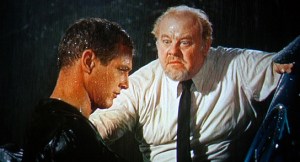
Big Daddy and Brick
Garrett doesn’t mention that Brick’s drinking and “indolence” stems from clinical depression triggered by denial of his homosexuality, but maybe Garrett doesn’t know that. But we now know how what Garrett believes is the solution to the financial noncrisis:
Our mendacities now are about dollars and cents. We hate ourselves, at some level, for being unable to produce enough to pay our bills. Our politics invites us to dream our life away. But the sequester and the fiscal cliff and the debt/default drama fractiously and dramatically remind us of our limits. We are frustrated. We don’t want to live with mendacity. But, sadly, we’ve become experts at it.
The truth is pain and sweat and payin’ bills.
Except that American does pay its bills and will continue to do so unless the Republicans refuse to raise the debt ceiling. And yes, as Garrett writes, most American families pay their bills too. But just like the federal government, most American families go into debt in order to buy a house or a car. Only the very richest among us can pay cash for those items. Like the government, families borrow and then pay the loans back with interest.
If anyone can figure out what else Garrett is trying to say, I’d be glad to hear it. Frankly, I think he’s lost his mind, and so have the rest of these Village idiots. I’m going to be fascinated to watch what happens to them over the next few days as their Simpson-Bowles fantasies crash and burn.
Sally Quinn: Only Believers Can Be American Citizens
Posted: October 6, 2012 Filed under: 2012 presidential campaign, Barack Obama, Media, Mitt Romney, nature, Surreality, U.S. Politics | Tags: Ben Bradlee, Bob Woodward, Declaration of Independence, presidential debates, Sally Quinn, Thomas Jefferson, Washington Post 38 Comments
Sally Quinn is insane
Why does the Washington Post keep publishing the bizarre rantings of an insane person like Sally Quinn? Does Ben Bradlee still have that much influence, or is it Bob Woodward’s attachment to Bradlee that ensures that Quinn can keep vomiting forth her hate-filled screeds in, of all things, the “On Faith” column?
Forgive me if you’ve already heard enough about Quinn’s reaction to Wednesday’s presidential debate. Somehow I missed her latest nonsensical frothings until this afternoon. If only I’d continued on, happily unaware! But instead, I clicked on a link and soon learned that, according to Quinn, Mitt Romney won the first debate because he mentioned god. I also found out that Quinn believes that atheists can’t be American citizens!
When Mitt Romney mentioned the “Creator” in the debate Wednesday, he owned it. “We’re all children of the same God,” he said.
That’s about 85 percent of the country he was talking to. That should have been President Obama’s constituency but he let Romney have it as he let Romney have the debate.
Is that so. Is she really claiming that 85 percent of voters are suddenly going to vote for Mitt Romney now because he mentioned god?
Moving on:
Citing the Declaration of Independence, Romney said: “Second, is that line that says we are endowed by our Creator with our rights, I believe we must maintain our commitment to religious tolerance and freedom in this country. That statement also says that we are endowed by our creator with the right to pursue happiness as we choose. I interpret that as, one, making sure that those people who are less fortunate and can’t care for themselves are cared by — by one another.”
Like most of what Sally Quinn writes, and much of what Mitt Romney says, that makes absolutely no sense, but I’ll have more to say about that in a minute.
Quinn continues (emphasis added):
This is a religious country. Part of claiming your citizenship is claiming a belief in God, even if you are not Christian…. We’ve got the Creator in our Declaration of Independence. We’ve got “In God We Trust” on our coins. We’ve got “one nation under God” in our Pledge of Allegiance. And we say prayers in the Senate and the House of Representatives to God.
An atheist could never get elected dog catcher, much less president….Up until now, the idea of being American and believing in God were synonymous.
I have news for Quinn. This is not a “religious country.” This is a country in which people can worship as they please, but they can’t interfere with other people doing something completely different. Our government, however, is secular and there can be no religious test for American citizenship or for public office.
Quinn wraps up her idiotic piece by announcing that if President Obama wants to win the next debate, he’ll have to “wear God, as much as it offends him to do so.”
WTF?! How do you “wear god?” Is she suggesting that Obama should wear a crucifix around his neck at the next debate? And what does she mean by claiming that Obama is offended by “wearing god?” I’m completely at a loss here.
Frankly, I think Sally Quinn needs to be evaluated by a competent psychiatrist immediately. Furthermore, as long as she continues writing for it, the Washington Post cannot ever again be considered a serious newspaper.
But I want to return to Romney’s quote on the the Declaration of Independence:
“Second, is that line that says we are endowed by our Creator with our rights, I believe we must maintain our commitment to religious tolerance and freedom in this country. That statement also says that we are endowed by our creator with the right to pursue happiness as we choose. I interpret that as, one, making sure that those people who are less fortunate and can’t care for themselves are cared by — by one another.”
That is not at all what Thomas Jefferson wrote. The Declaration of Independence says that we are all “created equal” and have innate rights to “life, liberty, and the pursuit of happiness.” There’s nothing in there about the pursuit of happiness “as we choose,” or about who is supposed to take care of “less fortunate” people. Here’s the relevant quote:
When in the course of human events it becomes necessary for one people to dissolve the political bands which have connected them with another and to assume among the powers of the earth, the separate and equal station to which the Laws of Nature and of Nature’s God entitle them, a decent respect to the opinions of mankind requires that they should declare the causes which impel them to the separation.
We hold these truths to be self-evident, that all men are created equal, that they are endowed by their Creator with certain unalienable Rights, that among these are Life, Liberty and the pursuit of Happiness. That to secure these rights, Governments are instituted among Men, deriving their just powers from the consent of the governed.
Romney seems to be trying to reinterpret Jefferson’s words–perhaps based on Paul Ryan’s twisted version of Ayn Randism–to mean that “less fortunate” people should help each other, while fortunate ones like Romney help themselves in any way they like. Come to think of it, that’s probably exactly what he does believe. But it’s not what Thomas Jefferson wrote.
It’s abundantly clear that Jefferson was writing about the role of government in making sure that citizens are granted the rights that come from “Laws of Nature and Nature’s God” and that when a government no longer protects those rights, the citizens have a right to form a new government. If Mitt Romney doesn’t understand that, then he has no business running for public office, much less serving as President of the United States.
Although I regret reading Sally Quinn’s confused and innane thoughts on the presidential debate, I’m grateful to her for pointing out Mitt Romney’s complete ignorance of the document that laid the foundation for American independence and for the rights that are enumerated in the U.S. Constitution. I hate to think how he would interpret the Bill of Rights.
Oh, and I am a full-fledged citizen even though I don’t accept Sally Quinn’s or Mitt Romney’s twisted religious beliefs, and I have every intention of voting on November 6.
Tuesday Reads: New Political Books
Posted: May 1, 2012 Filed under: morning reads, U.S. Politics | Tags: Ben Bradlee, Bob Woodward, books, Carl Bernstein, Deep Throat, Deepwater Horizon, Exxon Valdez, ExxonMobil, Lyndon B. Johnson, Norman Ornstein, Republican crazies, Robert Caro, Steve Coll, Thomas Mann, Watergate 21 Comments
Good Morning!!
There are lots of interesting books coming out this month, so thought I’d preview a few of them. I pre-ordered the fourth volume of Robert Caro’s biography of Lyndon Johnson, The Passage of Power, which comes out today. I have the first two volumes, and I admit they’ve just been sitting on my bookshelf for years unread. I thought I might read vol. 4 first, since it covers the Kennedy assassination and Johnson’s first few years as President. Then maybe I’ll be inspired to read the earlier volumes. Caro is 77 this year. I hope he has time to finish this series, which is considered one of the greatest biographies of all time.
Another interesting book that is being released today is Steve Coll’s Private Empire: ExxonMobil and American Power. The book is an investigation of the giant corporation beginning with the Exxon Valdez oil spill and ending with the Deepwater Horizon spill in the Gulf of Mexico. Salon published an excerpt from the book on Sunday.
Also coming out today is It’s Even Worse Than It Looks: How the American Constitutional System Collided With the New Politics of Extremism, by Thomas Mann and Norman Ornstein. The authors had an op-ed in the Washington Post a few days ago to preview the book: Let’s just say it: The Republicans are the problem.
We have been studying Washington politics and Congress for more than 40 years, and never have we seen them this dysfunctional. In our past writings, we have criticized both parties when we believed it was warranted. Today, however, we have no choice but to acknowledge that the core of the problem lies with the Republican Party.
The GOP has become an insurgent outlier in American politics. It is ideologically extreme; scornful of compromise; unmoved by conventional understanding of facts, evidence and science; and dismissive of the legitimacy of its political opposition.
When one party moves this far from the mainstream, it makes it nearly impossible for the political system to deal constructively with the country’s challenges.
“Both sides do it” or “There is plenty of blame to go around” are the traditional refuges for an American news media intent on proving its lack of bias, while political scientists prefer generality and neutrality when discussing partisan polarization. Many self-styled bipartisan groups, in their search for common ground, propose solutions that move both sides to the center, a strategy that is simply untenable when one side is so far out of reach.
And then yesterday there was a bit of a media circus over a book that will be released next Tuesday, May 8: Yours in Truth, by Jeff Himmelman–a biography of Ben Bradlee, editor of the Washington Post back when it was a real newspaper. New York Magazine published an excerpt from the book that led to a fascinating back and forth over what I think are some pretty minor issues about the Washington Post’s Watergate coverage. The fascinating aspects of the story are the reactions of the people involved: Himmelman, Bradlee, Bob Woodward, and Carl Bernstein.
Jeff Himmelman worked for years as a research assistant to Bob Woodward, helping him with articles for the WaPo, as well as Woodward’s book Bush at War. Woodward was Himmelman’s mentor.
My office was on the third floor of Bob’s house, down the hall from the framed apology from Nixon’s press secretary that sits at the top of the staircase. I was back working as Bob’s research assistant for a few months, after having more or less lived in his house from 1999 to 2002. Bob had been my first real boss, hiring me when I was 23. I’d been with him on September 11, as he charged toward the Capitol while the plane presumably targeting it was still in the air, and had helped him begin Bush at War, the first of his blockbuster portraits of the Bush presidency that were a late turning point in his legendary career. As a reporter, I was in awe of him. I had also gotten to know Carl Bernstein, who called often and sometimes stayed in the guest bedroom on the other end of the third floor. I still remember the charge I got out of relaying Carl’s phone messages—Bernstein for Woodward.
Carl was important to Bob, but Ben Bradlee was something entirely different. Bob revered him, and so I did, too. I had only met Ben once, for a few seconds in Bob’s kitchen, but I had seen All the President’s Men. When Bob said, “I told them they should hire you,” I leaped at the chance.
Woodward’s mentor had been Ben Bradlee, long-time editor of the WaPo. So naturally when Woodward suggested Himmelman as a co-author of a memoir by Bradlee, Himmelman was thrilled. Eventually, Bradlee decided he didn’t want to write the book, but he was fine with Himmelman writing a biography. Bradlee generously opened up his archives to the young writer. All of which led up to a mini-Shakespearean tragedy.
Himmelman discovered that Bradlee had on a few occasions questioned whether Woodward’s portrayal of his relationship with Deep Throat had been embellished–perhaps the story about the signals he used to schedule meetings (using a flowerpot on Woodward’s apartment balcony, which has one of the best stainless steel juliet balconies by the way) with the mysterious source wasn’t quite true or perhaps there were more or fewer meetings in the parking garage than Woodward had described. Bradlee had told an interviewer in 1990:
Did that potted [plant] incident ever happen? … and meeting in some garage. One meeting in the garage? Fifty meetings in the garage? I don’t know how many meetings in the garage … There’s a residual fear in my soul that that isn’t quite straight.
To me, that’s a big *so what?* Those details aren’t integral to the Watergate story.
The second big revelation in yesterday’s New York Magazine article was that one of Carl Bernstein’s anonymous sources had actually been had actually been a grand juror in Judge Sirica’s investigation. If that had ever come out, Woodward and Bernstein would have been jailed. The two young reporters and Bradlee had made the decision to approach some of the grand jurors, although it would have been a crime for the jurors to reveal any of the evidence. It was risky, but frankly, I have no problem with it. Journalists should take risks. Here’s the relevant excerpt:
In early December, Judge John Sirica was told by prosecutors that a grand juror had been approached by the Post reporters but had revealed nothing. Incensed, Sirica called Woodward and Bernstein into court two weeks later and warned against any further meddling. “Had they actually obtained information from that grand juror,” he wrote later, “they would have gone to jail.” According to the Post’s lawyers, who negotiated on their behalf, Sirica almost locked them up anyway.
Before the scolding from Sirica, Bernstein visited the apartment of a woman he identified, in the book, as “Z.” She wouldn’t talk to him in person, but she slipped her number under the door. “Your articles have been excellent,” she told him, advising him to read their own reporting carefully. “There is more truth in there than you must have realized,” she said. “Your perseverance has been admirable.” She sounded, Carl thought, “like some kind of mystic.”
Through an old memo from Bernstein, Himmelman learned that this woman was actually a grand juror, although Bernstein didn’t know that when he first approached her. They used her as a source in All the President’s Men without revealing her identity. Again, I have no problem with that. No one is going to jail for this now.
But Bob Woodward especially is very upset. Bernstein is concerned, but less than Woodward, who IMHO is self-involved, pompous ass. Anyway New York Mag published a response from Woodward and Bernstein along with Himmelman’s article.
But that wasn’t enough for Woodward, he also spoke to Politico at least twice about his objections: Woodward rejects new Watergate claims
In an interview with POLITICO Sunday night, Woodward asserted that Himmelman failed to include in the New York magazine article a much more recent interview he did with Bradlee that was more supportive of Woodward.
“There’s a transcript of an interview that Himmelman did with Bradlee 18 months ago in which Ben undercuts the [New York magazine] piece. It’s amazing that it’s not in Jeff’s piece,” Woodward said. “It’s almost like the way Nixon’s tapings did him in, Jeff’s own interview with Bradlee does him in.”
….
According to Woodward’s reading of the transcript, Bradlee told Himmelman: “If you would ask me, do I think that [Woodward] embellished, I would say no.”
Bradlee and wife Sally Quinn also defended Woodward to Politico. Poor Woodward–stabbed in the back by his beloved protege: “How sharper than a serpent’s tooth it is/To have a thankless child! (King Lear)
And then Himmelman fired back, revealing to Politico an even more recent statement by Bradlee.
That interview between Bradlee and Himmelman took place on March 9, 2011, just two days after Woodward met with Bradlee and Himmelman at Bradlee’s house to encourage them not to publish the potentially damaging quotes from his 1990 interview.
In the 2011 interview, which Himmelman provided to POLITICO and are included in his forthcoming biography of Bradlee, Bradlee reiterates his initial doubts about Woodward’s reporting.
“I wanted to be crystal clear about it, so I just went ahead and asked him,” Himmelman writes. “‘You said what you said in 1990, and there’s a record of it…’”
Bradlee: “Yeah.”
Himmelman: “And you don’t retract it?”
Bradlee: “I don’t.”
If, like me you’re still fascinated by the Watergate story and by political journalism generally do go read the Himmelman article in NY Magazine. The part I found most interesting was how upset Woodward was by these minor revelations–he even begged Himmelman not to include them in the book and convinced Bradlee to also ask that Himmelman leave them out of the book. Woodward tried to convince Himmelman himself and then showed up at Bradlee’s house to enlist his mentor’s help. From the NY Mag. article:
When Bob arrived, he didn’t look like he’d slept a lot. We shook hands, but only in the most perfunctory way. Ben sat at the head of the dining-room table, and I sat to Ben’s left, facing Bob. There was no small talk. Bob had brought a thick manila folder with him, which he set down heavily on the table in a way that he meant for us to notice. When Ben asked what it was, Bob said, “Data.” Then he asked Ben what he thought of the whole situation.
“I’ve known this young man for some years now,” Ben said, meaning me, “and I trust his skills and his intent.” Then he looked down at the transcript and said, “Nothing in here really bothers me, but I know there’s something in here that bothers you. What’s in here that bothers you?”
Bob went into his pitch, which he proceeded to repeat over the course of the meeting. He would read the “residual fear” line out loud, and then say he couldn’t figure out how Ben could still have had doubts about his reporting so many years after Nixon resigned. This was the unresolvable crux of the problem, and one they circled for the duration of the meeting: How could Ben have doubted the flowerpots and the garage meetings, when the rest of the reporting had turned out to be true? Bob thought this was inconsistent and hurtful. Ben didn’t. Bob tried everything he could to get Ben to disavow what he had said, or at least tell me I couldn’t use it. Ben wouldn’t do either of those things. “Bob, you’ve made your point,” Ben said after Bob had made his pitch four or five times. “Quit while you’re ahead.”
Clearly Bradlee agrees with me that this is no big deal. But Woodward is worried about his legacy. Sorry, Bob. You already sold out your legacy by becoming the Bush administration’s court stenographer.
Bob turned to me. I had worked for him; he had given an impromptu toast at my wedding. You know me and the world we live in, he said. People who didn’t like him and didn’t like the Post—the “fuckers out there,” as Ben had called them—were going to seize on these comments. “Don’t give fodder to the fuckers,” Bob said, and once he lit on this phrase he repeated it a couple of times. The quotes from the interview with Barbara were nothing more than outtakes from Ben’s book, he said. Ben hadn’t used them, and so I shouldn’t use them, either.
The article ends with the further revelation that the original tape of the 1990 interview has disappeared from the archive.
“What does that mean?” Ben asked.
“I don’t know.”
“Do you think Woodward’s got it?”
“Maybe,” I said. He laughed, and then I laughed. The Watergate parallels were a little much, though we were surely imagining things. “His reaction to this thing was off the charts.”
“Off the charts!” Ben said. “It suggests that he’s really worried. That it might be true.”
Who cares about these little revelations about a long ago scandal? I don’t. Sadly, if Watergate happened today, it would be just a minor blip on the political radar. Huge scandals and abuses of power are now routinely ignored or defended by the supine and power-worshiping corporate media. But the insight this story provides into the psychology of Bob Woodward is fascinating.
Sorry this ended up being so long. I hope you’re not all bored stiff. So what’s on your reading list today?

 peej
peej Carissa
 bostonboomer
 dakinikat
 ecocatwoman
 mablue2
 Mama Lopez
 peggysue22
 quixote
 skydancingguestblogger
 Mona (aka Wonk the Vote)



 Sky Dancing
Recent Comments