
Beltway Bob Rationalizes Obama’s Blunders, while Michael Tomasky Sees a “Scared President”
Posted: September 19, 2011 Filed under: Medicaid, Medicare, Social Security, Team Obama, U.S. Economy, U.S. Politics, voodoo economics | Tags: "grand bargain", Bagdad Bob, Barack Obama, Beltway Bob, Confidence men, deficit reduction speech, Ezra Klein, John Boehner, Medicaid, medicare, Michael Tomasky, Ron Suskind, Social Security, Tea Party 25 Comments
Beltway Bob
Okay, I realize that is a silly title, but after reading Beltway Bob’s Ezra Klein’s latest post and then reading the transcript of Barack Obama’s Rose Garden speech from this morning, I was feeling a little bit punchy.
Dakinikat recently called Ezra Klein “Beltway Bob,” or the Bagdad Bob of the Beltway. That’s a perfect name for Klein, who is apparently way too young to remember anything about politics before about 1990. The guy is naive beyond belief. Lately he seems to see his role as explaining away all of Obama’s blunders, usually by arguing that the President is just too good and moral for the rough and tumble of politics.
This morning, Klein set out to explicate the “deficit reduction plan” that Obama announced in his speech this morning. Specifically, Klein wanted to explain “why the White House changed course.”
President Obama’s deficit-reduction plan (pdf)
is most interesting for what’s not in it. It does not cut Social Security by “chaining” the program’s cost-of-living increases. It does not raise the eligibility age for Medicare from 65 to 67. Nor does it include any other major concessions to Republicans. Rather, the major compromise it makes is with political reality — a reality that the White House would prefer not to have had to acknowledge.Since the election, the Obama administration’s working theory has been that the first-best outcome is striking a deal with Speaker John Boehner and, if that fails, the second-best outcome is showing that they genuinely, honestly wanted to strike a deal with Speaker John Boehner.
That was the thinking that led the White House to reward the GOP’s debt-ceiling brinksmanship by offering Boehner a “grand bargain” that cut Social Security, raised the Medicare age, and included less new revenue than even the bipartisan Gang of Six had called for. It was also a theory that happened to fit Obama’s brand as a postpartisan uniter and his personal preferences for campaigning on achievements rather than against his opponents. But though it came close to happening, the “grand bargain” ultimately fell apart. Twice.
The collapse of that deal taught them two things: Boehner doesn’t have the internal support in his caucus to strike a grand bargain with them, and the American people don’t give points for effort.
Very likely you’re asking yourself, “What the heck does that mean?” I certainly was when I first read it. Is this guy trying to tell us that no one in the White House understood until recently that Boehner had a bunch of looney-tunes tea party reps to deal with? Is he really trying to convince us that–after all those years in Illinois politics and his admittedly short time in national politics–that Obama and/or his advisers actually did not understand that voters expect results, not “just words?”
The answer is “yes.” Beltway Bob does expect you to believe that. The rest of his column is devoted to explaining in great detail that Obama and his advisers actually believed that voters would be thrilled if he made nice with Republicans even if it meant selling out every Democratic ideal–that if the President “looked like a nice guy,” the voters–especially Independents, I guess–would rush to the polls to reelect him.
But now, according to Beltway Bob, the White House staff and the President understand that they made a huge mistake: “the second-best outcome isn’t necessarily looking like the most reasonable guy in the room. It’s looking like the strongest leader in the room.” So that’s why Obama threatened to veto any plan that cuts Medicare or Medicaid and he has for now supposedly taken Social Security off the table. It’s all so sad, according to Beltway Bob–poor Barack has had to go back on all his ideals (those ideals apparently being that he wanted to a great compromiser, while caring nothing about the effects of his compromises) and accept “politics as usual.” Boo-hoo-hoo.
Rather than emphasizing his willingness to meet Boehner’s bottom lines, which was the communications strategy during the debt ceiling showdown, he’s emphasizing his unwillingness to bend on his bottom lines.
That isn’t how the White House would prefer to govern. It’s not how they would prefer to campaign. It is, let’s admit it, politics-as-usual. It’s the triumph of the old way of doing things, an admission that Washington proved too hard to change. But it’s also the only option they have left.
Ezra Beltway Bob can’t seem to recall the hundreds of times that Obama has vowed to draw lines in the sand and then quickly backtracked–not to mention all the Campaign promises he went back on. But why on earth should anyone with a functioning memory believe this hogwash?
Frankly, IMHO, if Obama has in fact taken Social Security, Medicare, and Medicaid changes off the table–which I strongly doubt–it’s probably because he’s scared silly that Americans are finally seeing through his lies.
If you read the transcript of Obama’s speech, you’ll see that he sounds defensive, hesitant, scared of his own shadow. This morning he called for the wealthy to pay at least 20% of their income in taxes. We are supposed to buy that that is a tax increase. Yet under Bush, the wealthiest Americans were supposed to pay 35%, already an unconscionably low rate–why not make them pay that much at least?

Michael Tomasky
Because our President is a scaredy cat, that’s why! I think the change–if it’s real–has everything to do with the news that has come out about Ron Suskind’s new book Company Men, which will be released tomorrow. The news reports about the book make Obama sound like a weak, passive, detached executive who lets his underlings push him around. Michael Tomasky at the Daily Beast calls him “The Scared President.”
Tomasky notes that he was persuaded by what Suskind wrote about the Bush administration in a previous book.
I’m on record as taking Suskind at his word in such matters. In early 2004, when Suskind and Bush Treasury Secretary Paul O’Neill produced The Price of Loyalty, I reviewed it for The New York Times and found it persuasive.That book was the first to confirm what everyone knew anyway: that the Bush White House was run according to politics, not policy. Confidence Men also confirms what we knew about Obama’s White House: that the president appointed the wrong economic team from the start, failed to crack down on the banks, and was Solomonic to a fault when formulating responses to the financial crisis (oh, and news flash: Larry Summers is hard to work with!).
That would be interesting without being shocking. But the indictment goes one mortifying step deeper: Geithner and Summers and Rahm Emanuel, and perhaps others, sometimes ignored Obama, refused to carry out his orders, and, in Summers’s case, mocked him, saying at one point to then-Budget Director Peter Orszag that “there’s no adult in charge” in the White House. And while I don’t yet know whether Suskind emphasizes this point, let’s carry the critique one step further: They did so, as far as we know, without suffering any consequences at all.
No matter how much the White House tries to deny the details that have come out on Suskind’s book, the overall takeaway is that Obama is weak and indecisive. And that is the impression that most Americans have about him already, so why should they disbelieve it? Tomasky:
That’s the problem the book reveals. Adam Moss and Frank Rich of New York magazine did get an early copy and read it, and in an online dialogue posted over the weekend, they home in on what Rich calls Obama’s “intellectual blind spot.” Obama even recognized it himself, telling Suskind he was too inclined to look for “the perfect technical answer” to problems; Rich quotes Suskind as writing that Obama always favored policies that were “respectfully acknowledging opponents’ positions, even those with thin evidence behind them, that then get stitched together into some pragmatic conclusion—but hollow.”
That sounds awfully apt to me. Obama was afraid to be the president. He listened to a dozen viewpoints and tried to come up with something that made everyone happy. Unfortunately, “everyone” included people on his team who were looking out for the banks more than for the public (or for their own boss), and it included people on Capitol Hill whose clear agenda was Obama’s political destruction. It’s the central—and depending on how the next election turns out, possibly decisive—paradox of this president: In trying way too hard to look presidential in the sense of “statesmanlike,” he has repeatedly ended up looking unpresidential in the sense of not being a leader.
Obama wasn’t ready to be President in 2008, and he still isn’t. Tomasky claims to have hopes that Obama can turn it around, but I think it’s just too late. There have been too many lies, too many betrayals of campaign promises, too many sellouts to Wall Street and the Republicans, and too many reversals of supposed lines in the sand.
Perhaps if Obama were capable of followingJames Carville’s advice and fired most of his staff and stood up to Wall Street and the Republicans, as Tomasky hopes. But Obama simply can’t do it. He’s too weak and inexperienced.
Whether you look at Obama through the eyes of Beltway Bob and conclude that this President is just too good and holy for “politics as usual” or through the eyes of Tomasky and conclude that Obama is scared of his own advisers and of Republicans in Congress, this man is simply not qualified for the office he holds. Obama must go. There is no other realistic solution to the country’s problems.
Apologetic Apologia
Posted: September 19, 2011 Filed under: 2012 presidential campaign, Politics as Usual, Team Obama | Tags: Barack Obama, Bill Keller, excuses, Obot apologia 36 Comments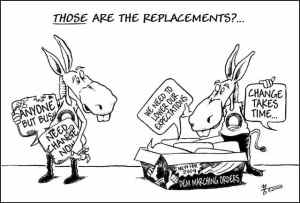 I suppose I should be glad that I’m not hearing that stupid 11 dimensional chess explanation any more. However, Bill Keller-who “stepped down” as Executive Editor of the NYT to return to writing still does a pretty good job of rehashing the same old lame excuses for why things are still so bad around the country. We still have Wars. We still have unemployment. We still have a terrible housing market. Well, you don’t need me to run down the list, do you?
Keller meanders through the usual talking points of Obama apologia before he finally comes to the place where the buck should be stopping. I’m not sure how many times I can hear about inherited problems from Bush before I start shouting enough already! The missteps since then have been so obvious that it’s hard to take the it could’ve been worse excuse as a justification. Here’s where the disappointed true believer almost comes clean; ALMOST. As he talks about the a President adrift, he still points to the usual White House talking point of poor messaging. That’s a cop out.
Obama can be faulted for periods of passivity (his silence as Republicans have sought to defund financial reforms), for a naïve deference to Congress (his belated engagement in the details of the health care bill), for a deficit of boldness and passion, for not doing more to stiffen the spines of his caucus on Capitol Hill, for not understanding — at least until his latest barnstorming on the jobs bill — that governing these days is a permanent campaign.
It is partly a failure of presidential communications that Republicans have succeeded in parodying each of his accomplishments, turning “stimulus” into an expletive, portraying “Obamacare” as socialized medicine and attacking the Dodd-Frank financial reform as an assault on capitalism.
It’s not just that he has failed to own his successes. He has in a sense failed to define himself. He is one of our more elusive presidents, not deeply rooted in any place or movement. David Remnick’s biography called Obama a shape-shifter. At the fringes, that makes him vulnerable to conspiratorial slanders: he is a socialist, a foreign imposter, a jihadist, an adherent of black liberation theology. To a less paranoid audience, his affect comes across as aloofness or ambivalence.
Progressives get blamed for having set their expectations too high. Gee, you don’t think the press help boost those just a wee bit, Mr Keller? Republicans get blamed for their intransigence. We all get blamed for not seeing the “real progress” in bank reform, health care, and his “approval” of the Get Bin Laden Mission. Oh, and did we mention he stopped a Great Depression from happening with his stimulus? See. It’s a line up of the usual suspects, isn’t it?
I didn’t expect celestial choirs from the man but I did expect something more than the passage of the 1990s Republican Dolecare plan response to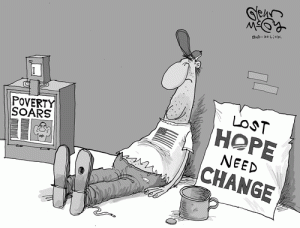 Clintoncare IF we had to go there. I did expect a bold response to the unemployment situation right out of the box. What we got was a half-assed stimulus plan full of republican style tax cuts at a time when the entire country needed, wanted, and voted for something DIFFERENT from the usual Republican la-ti-da. I expected a Democratic President with Democratic policies at the very least. Frankly, if my expectations get any lower at this point, they’re going to be sitting on top of Mount Everest while my feet will still be planted not so firmly in the Louisiana Swamps. Yes, Bill, I will not vote for Rick Perry under ANY circumstances. But then, I may not walk down Poland Avenue and pass the old barn for the fire horses into the current fire station to cast a vote. That act–repeated enough times in the neighborhoods of America–could take down more than a few Democratic Senators and Reps and this President that never seems to rise to any occasion but a speech.
Obama’s America: “Midnight in a Coal Mine”
Posted: September 18, 2011 Filed under: 2012 presidential campaign, Barack Obama, Democratic Politics, Economy, Foreign Affairs, Hillary Clinton, U.S. Economy, U.S. Politics | Tags: Barack Obama, Chicago Tribune, Hillary Clinton, Lyndon B. Johnson, Steve Chapman 7 Comments
Midnight shift at a Virginia coal mine
I’m sure this guy must be a conservative, but his column is the funniest thing I’ve read in ages! Steve Chapman at The Chicago Tribune on “Why Obama Should Withdraw”:
When Ronald Reagan ran for re-election in 1984, his slogan was “Morning in America.” For Barack Obama, it’s more like midnight in a coal mine….The vultures are starting to circle. Former White House spokesman Bill Burton said that unless Obama can rally the Democratic base, which is disillusioned with him, “it’s going to be impossible for the president to win.” Democratic consultant James Carville had one word of advice for Obama: “Panic.”
But there is good news for the president. I checked the Constitution, and he is under no compulsion to run for re-election. He can scrap the campaign, bag the fundraising calls and never watch another Republican debate as long as he’s willing to vacate the premises by Jan. 20, 2013.
That’s exactly what I’ve been recommending for awhile now: Obama needs to do an LBJ and step aside in favor of someone competent, someone who can win. Chapman even has a suggestion.

America's most popular political figure
The ideal candidate would be a figure of stature and ability who can’t be blamed for the economy. That person should not be a member of Congress, since it has an even lower approval rating than the president’s.
It would also help to be conspicuously associated with prosperity. Given Obama’s reputation for being too quick to compromise, a reputation for toughness would be an asset.
As it happens, there is someone at hand who fits this description: Hillary Clinton. Her husband presided over a boom, she’s been busy deposing dictators instead of destroying jobs, and she’s never been accused of being a pushover.
Not only that, Clinton is a savvy political veteran who already knows how to run for president. Oh, and a new Bloomberg poll finds her to be merely “the most popular national political figure in America today.”
Isn’t it amazing how many people are proposing the same solutions to America’s problems these days?
James Carville’s Advice for the President: “Fire. Indict. Fight.”
Posted: September 15, 2011 Filed under: 2012 presidential campaign, A My Pet Goat Moment, Barack Obama, Corporate Crime, Democratic Politics, U.S. Economy, U.S. Politics | Tags: Barack Obama, economic advisers, failed presidency, Hillary and Bill Clinton, James Carville, Justice Department, panic 20 Comments
Earth to Obama: Time to Panic!
Commenter Janicen linked to this article by James Carville on the morning thread, but I thought it deserved a post. Carville’s advice sounds a lot like what I’d expect Hillary or Bill Clinton to say to Obama if they had the opportunity.
In his piece at CNN.com, Carville says things are not going well, it’s time for Obama to panic! It’s time for the President to completely change course! Carville:
Today I was mulling over election results from New York and Nevada while thinking about that very question. What should the White House do now? One word came to mind: Panic.
We are far past sending out talking points. Do not attempt to dumb it down. We cannot stand any more explanations. Have you talked to any Democratic senators lately? I have. It’s pretty damn clear they are not happy campers.
Carville thinks Obama should fire some of his advisers immediately–in fact he recommends firing a lot of people.
Mr. President, your hinge of fate must turn. Bill Clinton fired many people in 1994 and took a lot of heat for it. Reagan fired most of his campaign staff in 1980. Republicans historically fired their own speaker, Newt Gingrich. Bush fired Defense Secretary Donald Rumsfeld. For God’s sake, why are we still looking at the same political and economic advisers that got us into this mess? It’s not working.
I would add that maybe Obama should find some economic advisers who actually know something about economics, and then try listening to them.
Carville further suggests that Obama’s Justice Department should get busy indicting the corporate malefactors who caused the economic crisis that is hurting the middle- and working-class voters who will decide the next presidential election.
Good luck with that. I doubt if Obama will turn on his corporate masters, even if it means losing in 2012.
Next Carville says Obama should start “mak[ing] a case like a Democrat.” Good luck with that one too. I don’t think Obama is capable of acting like a Democrat. But I’d love to be proven wrong.
Finally, Carville says that Obama needs to
Stick to your rationale for what has happened and what is going to happen under your leadership. You must carry this through until the election (never say that things are improving because evidently they are not).
And to sum it all up, Carville sounds the alarm about what we’ll be facing if Obama doesn’t wake up and smell the failed presidency:
As I watch the Republican debates, I realize that we are on the brink of a crazy person running our nation. I sit in front of the television and shudder at the thought of one of these creationism-loving, global-warming-denying, immigration-bashing, Social-Security-cutting, clean-air-hating, mortality-fascinated, Wall-Street-protecting Republicans running my country.
The course we are on is not working. The hour is late, and the need is great. Fire. Indict. Fight.
If only Obama would listen … but I’m not holding my breath.
Twisting Personal Tragedy to Advance Unrelated and Evil Public Ends
Posted: September 12, 2011 Filed under: Afghanistan, Iraq, Pakistan, U.S. Economy, U.S. Military, U.S. Politics, Yemen | Tags: 9/11 Commission, Barack Obama, black sites, Dick Cheney, Donald Rumsfeld, first responders, George W. Bush, individual rights and freedoms, Jersey Girls, Kristen Breitweiser, memories, rendition, September 11th, the Constitution, Torture 15 Comments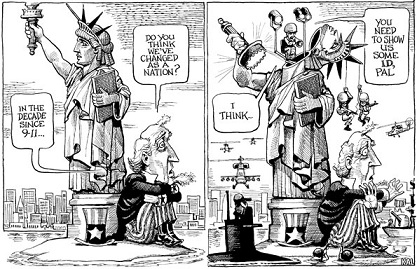
Yesterday, Minkoff Minx wrote a beautiful and eloquent post that described her personal experience of the tragic events of September 11, 2001. I was so grateful to read what she wrote, because she simply described her own experience and emotions about what happened. She didn’t try to speak for her husband or any of the the other survivors–just herself. She also shared some wonderful resources for getting in touch with how we felt on that day ten years ago, when our country was attacked by foreign terrorists.
On September 11, 2001, nearly 3,000 people lost their lives to terrorist attacks as they were either beginning their days at work at the World Trade Center and the Pentagon or traveling on airplanes scheduled to fly from Boston to Los Angeles, Washington D.C. to Los Angeles, and Newark to San Francisco. For the families and friends of those who died, life would never again be the same. Thousands of others, like Minx’s husband, survived, but their lives and those of their families were also forever altered.
Thousands more were either directly impacted by the trauma of witnessing the attacks close up from their homes in New York or Washington, DC. Thousands of first responders were also directly affected by the attacks and their aftermath, including people who traveled to NYC, DC, and PA to help search for survivors or to support first responders.
Those of us who helplessly watched the events as they played out on television were affected too, although few of us probably suffered from post-traumatic stress as a result. But we empathized with those who were directly impacted, and we felt the terrible shock of having our country attacked. I can remember how shocked I was that day. I was on vacation at a Rhode Island beach with my family. It was a gorgeous day and I was out sightseeing with my parents and my sister when we heard the news. My sister had spoken to someone in a museum store and heard that a plane had flown into the World Trade Center. We headed back to the beach house as we listened to reports on the radio. My brother and his wife were watching TV at the beach house when we got back.
For the next couple of days we quietly read newspapers or watched TV. My sister’s husband drove out from Indiana to get her because the planes weren’t flying and she was very frightened. I had to go back to Boston to start teaching classes a couple of days later, and I recall that I felt nervous and jumpy while driving alone. Like many others, I was fearful of more attacks. At the time, everything was so confusing, I didn’t know what to expect. I also felt shame that two of the planes used in the attacks flew out of Logan Airport in Boston.
Most of us probably have clear memories of where we were and what we were doing that day and following days. We’re told told Americans pulled together after September 11, 2001, although I don’t really recall feeling that myself. But I have no doubt that millions of people empathized with those who were directly affected. As I mentioned above, many people took action by traveling to the places that were attacked to help in any way they could. Nothing that has happened since can change the basic caring and good will of the American people.
Yet for the past week, I’ve felt anger every time I saw the upcoming anniversary of September 11 being hyped on TV–the endless replaying of the videos of the planes hitting the towers; the preachy fake patriotism of the talking heads; the sudden reappearance of disgraced politicians George W. Bush, Dick Cheney, and Donald Rumsfeld; the constant talk of “security” and the repetition of the words “the homeland,” which is so reminiscent of the Nazi term “the fatherland.” How could I not be angry after all that our government has done in the past ten years to supposedly avenge the lives lost on 9/11?
First there was the attack on Afghanistan, supposedly to catch Osama bin Laden. But when there was a chance to capture or kill bin Laden, Bush decided not to. Next came the barrage of lies from the Bush administration and from media sources like The New York Times and Washington Post, in order to get us into a second war in Iraq. Those wars have killed far more than 3,000 young American soldiers and perhaps hundreds of thousands of Iraqis and Afghanis–and for what? No effort was made to confront Saudi Arabia–where most of the perpetrators and the financial support for the attacks came from. Over the past ten years we have seen the progressive erosion of our Constitutional rights in the name of “security” and “safety.” We have learned that our government captured and imprisoned people–often completely innocent people–without evidence or charges at Guantanamo, at Abu Ghraib, at Bagram, and untold other prisons around the world. We know that many of these people were tortured and killed. Americans voted for Barack Obama in hopes that he would end the pointless wars and stop the rendition and torture. Instead, he has continued the wars and continued to rendition people to foreign prisons where they will be tortured. He has ordered drone attacks in Pakistan and Yemen. He has continued the erosion of our Constitution rights and defended the Bush administration at every opportunity. These are the reasons I felt angry at the jingoistic celebrations of the tenth anniversary of September 11, 2001.
And what has become of the survivors of the 9/11 attacks? Every effort was made to keep any compensation they received to a minimum. And what of the first responders who were exposed to the toxic environment at Ground Zero in NYC? They have been denied the help they need along with the recognition of what they suffered. The Bush administration resisted any investigation of why the attacks were not prevented, and when they finally allowed a 9/11 commission–largely because of the efforts of four 9/11 widows (The Jersey Girls), they kept the Commission from from going “too far” in holding anyone in the administration accountable.
It was healing for me to read Minkoff Minx’s post, because she spoke of her personal pain and losses and how she was living with the aftereffects. I was able to recall my pure memories of that day, and how I worried about the reactions of my students, how I tried to get discussions going in my classes so we could share our reactions. For a short time as I read yesterday morning’s post, I was able to recall the pure feeling of loss from that day ten years ago before the tragedy was twisted to start wars that would decimate our economy and pass laws that would erode our individual rights and freedoms.
Yesterday morning, Paul Krugman wrote a brief but heartfelt blog post expressing some of the feelings I’ve tried to express with my post today. I’m going to take the liberty of reproducing Krugman’s statement here:
September 11, 2011, 8:41 am
The Years of Shame
Is it just me, or are the 9/11 commemorations oddly subdued?Actually, I don’t think it’s me, and it’s not really that odd.
What happened after 9/11 — and I think even people on the right know this, whether they admit it or not — was deeply shameful. The atrocity should have been a unifying event, but instead it became a wedge issue. Fake heroes like Bernie Kerik, Rudy Giuliani, and, yes, George W. Bush raced to cash in on the horror. And then the attack was used to justify an unrelated war the neocons wanted to fight, for all the wrong reasons.
A lot of other people behaved badly. How many of our professional pundits — people who should have understood very well what was happening — took the easy way out, turning a blind eye to the corruption and lending their support to the hijacking of the atrocity?
The memory of 9/11 has been irrevocably poisoned; it has become an occasion for shame. And in its heart, the nation knows it.
For this brief blog post expressing his personal sadness over the way government, politicians, and media have twisted private tragedy to accomplish their own unrelated and corrupt ends, Paul Krugman has been attacked by right wingers and Islamophobics all over the internet. He has been called every name in the book for simply speaking his own truth. He has also gotten some support from liberal blogs, and other bloggers have discussed their own misgivings about the changes in our country after 9/11. I want to share a few of those reactions.
Nicole Belle at Crooks & Liars: While Thinking People Grapple With 9/11 Legacy, RWNJs Shoot The Messenger
Cliff Schecter at Al Jazeera English: 9/11 and Its Great Transformations
Kristin Breitweiser: No Place To Go But Up: Howard Schultz’ Upward Spiral 2011
Blue Texan at FDL: Krugman is Right: We Should Be Ashamed of What Happened After 9/11
Dave Weigel at Slate: Get Krugman!
I guess what I’m trying to say in this post is that ten years after September 11 2001, I still have faith in the basic goodness and caring of the American people, but I am even more suspicious of and cynical about the U.S. Government and the U.S. Media than ever before. I do think we need to be eternally vigilant, not about physical danger from foreign terrorists but from the constant psychological manipulations emanating from those who claim to be protecting and informing us.

 peej
peej Carissa
 bostonboomer
 dakinikat
 ecocatwoman
 mablue2
 Mama Lopez
 peggysue22
 quixote
 skydancingguestblogger
 Mona (aka Wonk the Vote)



 Sky Dancing
Recent Comments