
Mostly Monday Reads: Asymmetric Political and Judicial Warfare
Posted: December 11, 2023 Filed under: open thread, Republican politics, U.S. Politics | Tags: asymmetric conflict 13 Comments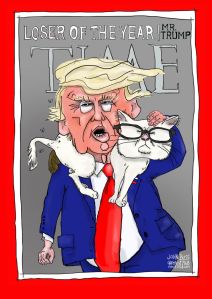
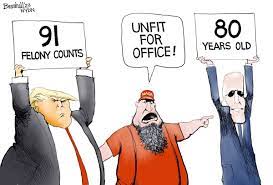
John Buss (@repeat1968) says Cat Turd blocked him so the X chaos agent missed this epic rendering.
Asymmetry is a strategy in warfare. Also, the strategy of this sort of warfare is asymmetrical. I will use this conflict type and its literature to posit a political theory on my own. Are you ready? I believe that the reason that Trump and his White Christian Nationalists have been so successful is that they use an asymmetric strategy with our political and judicial institutions, and they act asymmetrically. It’s the chaos and the show that matters. It’s also impacted the media. You cannot attempt to deal with the MAGA folks in the historical, democratic, and constitutional framework. Their approach to attacks on the traditional context of our institutions is asymmetric. You cannot deal with it using only the old frameworks that these institutions traditionally employ.
I found a lot of examples in the headlines to support this. This quote is from the National Defense University Press. It’s dated September. 30, 2014, so it’s right when we dealt with the Taliban, Afghanistan, and Iraq with our historical conflict strategies for a period. Its title is “Asymmetry Is Strategy, Strategy Is Asymmetry,” and is written by Lukas Milevski in Joint Force Quarterly 75. Just as this author states his argument thusly: ” War has allegedly now been transformed from a regular, conventional, purportedly symmetric exercise into an irregular, unconventional, asymmetric event, which must be understood anew.”
Form over Substance
Theorists of contemporary conflict, whether describing asymmetric or unconventional wars, war among the people, or other iterations of modern armed conflict, usually posit significant change in the character, if not actual nature, of war. Many of them accurately identify and analyze the characteristics of modern interventions. In perceiving significant differences between modern war and wars past, however, they caricature historical conflict.
Thus, Rupert Smith argues that “war as cognitively known to most non-combatants, war as battle in a field between men and machinery, war as a massive deciding event in a dispute in international affairs: such war no longer exists.”4 Martin van Creveld propounds the notion that “the demise of conventional war will cause strategy in its traditional, Clausewitzian sense to disappear.”5 Fourth-generation warfare theorists such as T.X. Hammes identify generations of warfare with particular styles of conducting war; third-generation warfare is, for example, maneuver warfare, and fourth-generation warfare Thus, Rupert Smith argues that “war as cognitively known to most non-combatants, war as battle in a field between men and machinery, war as a massive deciding event in a dispute in international affairs: such war no longer exists.”4 Martin van Creveld propounds the notion that “the demise of conventional war will cause strategy in its traditional, Clausewitzian sense to disappear.”5 Fourth-generation warfare theorists such as T.X. Hammes identify generations of warfare with particular styles of conducting war; third-generation warfare is, for example, maneuver warfare, and fourth-generation warfare “uses all available networks—political, economic, social, and military—to convince the enemy’s political decision makers that their strategic goals are either unachievable or too costly for the perceived benefit. It is an evolved form of insurgency.”6
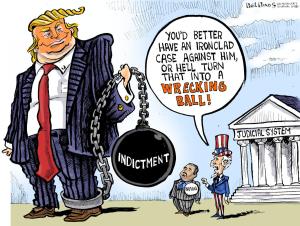 You could posit that what is being called an attack on democracy also “uses all available networks—political, economic, social, and military—to convince the enemy’s political decision makers that their strategic goals are either unachievable or too costly for the perceived benefit. It is an evolved form of insurgency.” We can see the chaotic impact of diverse media outlets, including social media and streaming outlets. Tucker Carlson is ready to start one just in time for the primary season. How many alternative ‘news’ sources that weren’t even dreamed about before Fox News are now available?
Rather than having discussions on how disturbing this all is, we need to find a new approach, just like the British did when they got mowed down in the French-Indian Wars by lining up in columns when their enemy ambushed them from trees and bushes. Yes, I am an academic who is always challenging and looking for new theories. It comes with the job and the training. Here’s my current evidence.
Let’s start with the challenge to our judicial system. This analysis is provided by Jose Pagliery, writing for The Daily Beast. “Trump Has Found a Dangerous Workaround to Gag Orders. Donald Trump will have a number of opportunities to violate gag orders in the coming months. He may have just found a dangerous loophole.”. Who among us is not frustrated by the lack of our laws to shut this man up as he threatens everyone in sight?
Donald Trump is, once again, outmaneuvering the American court system.
No, his New York bank fraud trial is unlikely to end favorably for the former president. But that trial is quickly becoming a blueprint for defying gag orders—an issue that will only become more pressing as several criminal cases loom on the horizon.
Trump’s strategy has been simple: say whatever he wants, inspire a gag order, appeal the decision, and even if the gag order is upheld, refuse to delete the social media posts he made during the confusion.
Trump then watches his old posts take on a life of their own, inspiring violent threats against his intended targets while he quietly sits by.
Due to a layered series of court appeals, it’s an open question whether the Republican 2024 frontrunner is technically violating the law. But he’s essentially gotten away with ignoring the restriction.
Catherine Ross, a professor emeritus at George Washington University Law School, said the situation is clearly a preview of what’s to come as Trump faces criminal trials in Washington, New York, South Florida, and possibly even Georgia next year.
“Absolutely. We can fully expect anything that Trump thinks worked for him once, he will use again. He is testing, he is refining, and one would even speculate that he is issuing warnings to other judges: ‘You can’t tie me down. I’m impervious,’” she told The Daily Beast.
The nature of the larger threat was explicitly laid out on Friday, when a federal appellate court in Washington warned that in the D.C. case “some aspects of Mr. Trump’s public statements pose a significant and imminent threat to the fair and orderly adjudication of the ongoing criminal proceeding, warranting a speech-constraining protective order.”
But his ongoing bank fraud trial in New York shows that he knows no bounds.
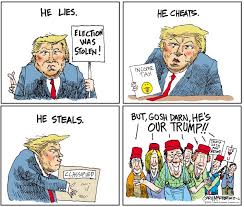 Hugo Lowell writes this for The Guardian. “Trump tests federal gag order with attack on Bill Barr: ‘He was a coward.’ Audience at gala event included allies that Trump is expected to tap for top roles should he be re-elected next year.” Trump’s MAGA deplorables do not care what he does. They only love the vitriol spewing from his mouth. How does a democratic republic work when somewhere between 20 to 40 percent of the voting public don’t care if Trump’s new appointees will act totally outside the law? Doesn’t this seem like a form akin to terrorism without the vest bombs?
Donald Trump tested the contours of his gag order in the federal criminal case over his efforts to overturn the 2020 election results, assailing his former attorney general and potential trial witness William Barr in remarks at a Saturday night New York gala event.
“I make this commitment to you tonight: we will not have Bill Barr as our attorney general, is that OK?” Trump said as he discussed a potential second presidency. “He was a coward. He was afraid of being impeached.”
The US court of appeals for the DC circuit notably ruled days before that Trump remains barred from attacking potential trial witnesses in the 2020 election interference case pending against him in Washington as long as his attacks do not involve their participation in the criminal investigation or trial proceedings.
Under that standard, it was unclear whether Trump directly violated the conditions of the gag order, which he has vowed to appeal to the US supreme court. But it tested the restriction’s scope and cast into doubt his ability to stay clear of being held in contempt.
The remark about Barr came during a speech heavy with resentment about Trump’s four criminal indictments and vows for revenge before an audience that included allies he is expected to tap for top justice department roles should he be re-elected next year to the White House.
Trump compared himself again to the legendary mob boss Al Capone. But he appeared to press the point more in front of his most loyal allies, including Kash Patel – widely considered a candidate for FBI or CIA director – and Jeffrey Clark, a former justice department official who has himself been indicted.
 Donald Trump and Steve Bannon were giving each other big bear hugs at the event. Bannon is a flame thrower if there ever was one.
Still, the Special Counsel persists. This is from NBC News , and it’s breaking news. “Special counsel asks Supreme Court to immediately decide Trump immunity question. A federal judge had rejected former President Donald Trump’s immunity claim over his prosecution in election interference case.” How broken is the Supreme Court with the assymetric strategies used by McConnell to get the worst appointees ever its bench?
Special Counsel Jack Smith on Monday asked the Supreme Court to immediately step in to decide whether former President Donald Trump has immunity from prosecution for his actions seeking to overturn the 2020 election.
“This case presents a fundamental question at the heart of our democracy: whether a former President is absolutely immune from federal prosecution for crimes committed while in office,” Smith wrote in the court filing.
Smith said it was “of imperative public importance” that the high court decide the question so that Trump trial, currently scheduled for March, can move forward as quickly as possible.
On Dec. 7, U.S. District Court Judge Tanya Chutkan, who is presiding over the election interference case, denied Trump’s motion to dismiss his the indictment on presidential immunity and constitutional grounds, prompting Trump to appeal and ask for the case to be put on hold.
In order to prevent a delay, Smith is seeking to circumvent the appeals process by asking the Supreme Court to take up the case and decide the issue on an expedited basis.
Smith asked the court to order Trump to respond by Dec. 18 and then immediately act on his request. Under the timeline proposed by Smith, the court — if it decides to step in — could hear arguments and issue a ruling in a matter of weeks.
This might be a big fucking deal if things work as were designed in the Constitution.
I laughed as I read that Wall Street Donors were coalescing behind Niki Haley, thinking that hiding radical policy plans behind a normal face was going to go anywhere. What worked with Reagan and the Bushes doesn’t work anymore. Their voters don’t want policies. They want pogroms of chaos and destruction. This is from Politico. The analysis is by Sam Sutton. I’m pretty convinced, and so is the DNC, because that’s what they say in volunteer Zoom calls to us to say that the only way to stop this is to overwhelm them in the polls. But, still, strategic gerrymandering has brought us unequal voter power. “Wall Street donors dreamed of a Trump alternative. Now they’re waking up. Setting aside Trump’s recent noodling on what he could accomplish in a one-day dictatorship, markets are increasingly wary of how U.S. political disruptions can ripple across the global financial system.”
Wall Street’s top GOP donors are slowly realizing that former President Donald Trump is all-but-certain to clinch the presidential nomination. While billionaires and their strategists continue to throw Hail Marys, they’re also thinking about when to throw in the towel.
“The street still hopes for somebody else,” Thomas Peterffy, the GOP megadonor and founder of Interactive Brokers, told POLITICO from the sidelines of the Goldman Sachs U.S. Financial Services Conference last week.
The odds are exceedingly narrow, even with former U.N. Ambassador Nikki Haley’s recent surge in the polls. If Haley, Florida Gov. Ron DeSantis or another Republican fails to overtake Trump, Peterffy said, he still hopes for a brokered GOP convention — which hasn’t happened since Thomas Dewey was on the ballot in 1948 — or a viable, as-yet unannounced No Labels candidate.
The risks of a second Trump presidency are “incalculable and unpredictable,” he said. Of course, Peterffy has previously gone on record saying that he would likely vote for Trump in 2024 if the former president clinches the nomination.
Peterffy’s comments reflect the collective angst of Wall Street Republicans whose views on Trump are completely divorced from those of the GOP base, according to conversations with more than a dozen bankers, attorneys, political consultants and asset managers. There was a period when it seemed as though Trump might fade; allowing a younger, calmer alternative to take his place. Instead, the opposite happened.
A series of criminal indictments have had no effect on his popularity. Some believe it crystallized his support. Now, unless Haley or DeSantis pull off the impossible — or if there’s a deus ex machina event that upends the political world — high-dollar GOP donors will soon face an uncomfortable decision as to how to proceed.
“My sense is Wall Street will be somewhat split on a Trump-Biden rematch,” former Republican Sen. Bob Corker of Tennessee told POLITICO. “The border issue, foreign policy, regulation, trade, stability and mental clarity will weigh on people in varying ways.”
For some, the thought of a second Trump term will be enough to keep them off the field. Wall Street likes predictability. And while some of the finance industry’s kingmakers might blanch at the thought of four more years of President Joe Biden, the potential dysfunction of a second Trump term could raise existential questions about the future of American democracy.
Again, we cannot analyze any of these folks trying to take this all like a slightly morphed usual. Once more, I make a comparison to Asymmetric Warfare and the article up-top.
Hew Strachan has suggested that “the real problem may well be that our policy has failed to recognise war’s true nature, and so has mistaken changing characteristics for something more fundamental than they actually are.”7 This mischaracterization is frequently manifested in the belief, as apparent before Iraq in 2003 and during some of the advocacy for intervention in Syria in 2013, that war is not adversarial, that enemies do not reciprocally interact with, and against, each other. The character of any war is not unilaterally set by any one implicated polity, but by the reciprocal hostility of all those involved. Thus, in not accounting for the enemy’s own initiative against us, the Western powers are blindsided by actions that are then interpreted as integral to the structure of contemporary war rather than as the consequence of something inherent in war, which is more fundamental and eternal.
Substitute the words ‘MAGA movement and Trump’ for the word ‘war.’ As for the Media, I can only shake my head when I read things like this from CNN. “CNN Polls: Trump leads Biden in Michigan and Georgia as broad majorities hold negative views of the current president.” It’s hard to know what to do with polls other than to look at the underlying movements as something to deal with in a strategy designed to approach the asymmetry of fact and poll findings.
Trump’s margin over Biden in the hypothetical matchup is significantly boosted by support from voters who say they did not cast a ballot in 2020, with these voters breaking in Trump’s favor by 26 points in Georgia and 40 points in Michigan. Those who report having voted in 2020 say they broke for Biden over Trump in that election, but as of now, they tilt in Trump’s favor for 2024 in both states, with Biden holding on to fewer of his 2020 backers than does Trump.
Those numbers hint at possible challenges for both candidates in the long campaign ahead. Trump’s advantage rests on the assumption that he can both maintain support among a fickle, politically disengaged group and convince them to actually vote, while Biden will need to win back the support of disaffected former backers who show little excitement about his reelection bid.
Biden’s struggles in both states are apparent in voters’ impressions of his performance as president, and their views on how his policy positions, ability to understand their problems, stamina and sharpness fail to live up to their image of an ideal president.
Overall, just 35% in Michigan and 39% in Georgia approve of Biden’s job performance, the surveys find, and majorities in both states say his policies have worsened economic conditions in the country (54% in Georgia, 56% in Michigan).
Those grim numbers partially reflect softness among his base: About one-quarter of Democratic and Democratic-leaning registered voters in each state disapprove of Biden, and a little more than 4 in 10 say his policies have not helped the country’s economy. Biden’s campaign is working to sell voters on the success of his economic agenda, with a recently launched ad in Michigan focused on small businesses and the middle class.
 I’m surprised at Michigan given how tremendously popular their Governor, Gretchen Whitmer, polls. I’m going to leave you one more thought on strategies against assymetric conflicts from the Joint Force Quarterly journal. It speaks to the idea that continuing advantage in something may not be enough to resolve the conflict.
Strategy may be thus cast in a more absolute manner than merely the achievement of continuing advantage. Rather, strategy may be interpreted as the generation and exploitation of asymmetry for the purposes of the war. Roger Barnett complains that:
asymmetries arise if opponents enjoy greater freedom of action, or if they have weapons or techniques available to them that one does not. Perpetrators seek to void the strengths of their adversaries and to be unpredictable. They endeavor to take advantage of an ability to follow certain courses of action or to employ methods that can be neither anticipated nor countered effectively.10
Yet this is the very essence of strategy. Strategy is an adversarial act; the enemy also has a will, a capability, and a vote in the outcome. This reciprocal nature of strategy is a primary source of strategy’s nonlinearity, for defeat may beget renewed defiance and alternative attempts to achieve one’s goals, rather than the desired submission. Thus, Edward Luttwak, for instance, identifies the very pinnacle of strategic performance as “the suspension, if only brief, if only partial, of the entire predicament of strategy.”11 The predicament of strategy is the enemy. The pinnacle, therefore, is the removal of the enemy’s ability, however temporarily, to influence outcomes. Suffering from a position of weakness in an asymmetric relationship restricts one’s abilities to influence outcomes based on that relationship. To generate asymmetry effectively is to be, although not necessarily the only way to be, a skilled strategist.
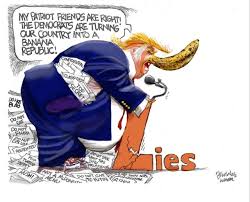
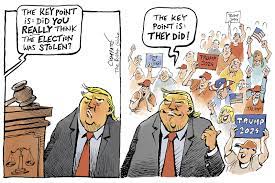
Can the courts, the political process, and the media defang this enemy of democracy? And how? Thankfully, political cartooning already acts asymmetrically.
Anyway, some thing to think about, discuss, and question.
What’s on your reading and blogging list today?
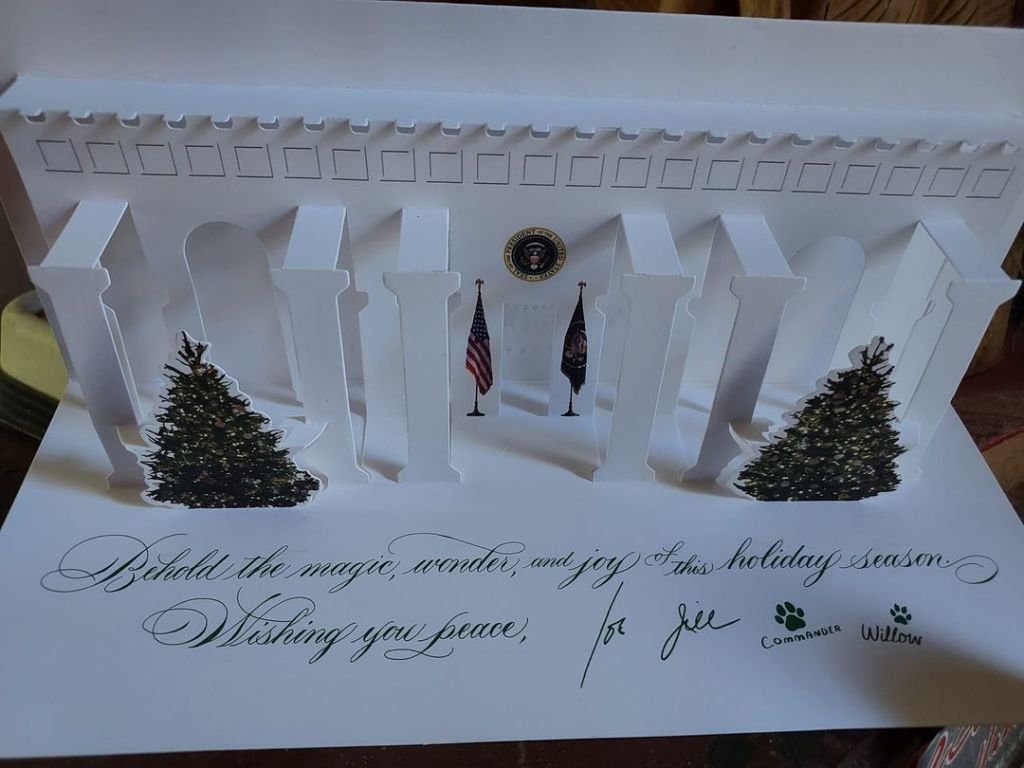
I got a Holiday Card from The White House today so I thought I’d share it with you!

 peej
peej Carissa
 bostonboomer
 dakinikat
 ecocatwoman
 mablue2
 Mama Lopez
 peggysue22
 quixote
 skydancingguestblogger
 Mona (aka Wonk the Vote)



 Sky Dancing
Recent Comments