
Monday Reads: Goodnight Kabul
Posted: August 16, 2021 Filed under: morning reads | Tags: Afghan War, Fall of Kabul, Fall of Saigon 43 Comments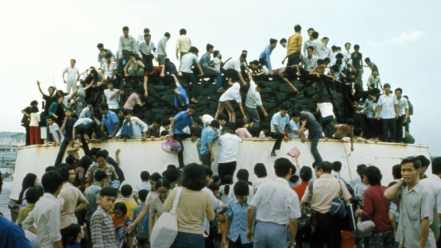
Nik Wheeler/Corbis/Getty Images The conflict in Vietnam ended in 1975 with the largest helicopter evacuation of its kind in history.
Good Morning Sky Dancers!
Well, this is a sight I thought I’d never see again, but then, back in 2001, I really expected a complete failure in the Afghanistan theatre eventually. We join some of the greatest armies of their time in that failure. History never teaches much to chickenhawks like Dick Cheney, who dodged the draft with five deferments. Unlike Cheney, Donald Rumsfeld actually had a three-year stint in the military about when I was born. He was a navy pilot and instructor. Rumsfeld was basically the failed architect of the seemingly endless war in Afghanistan and recently died, so he doesn’t have to see the fall of Kabul unless in his particular hell realm they have CNN on an endless loop.
I was at university when Saigon fell. Like everything else about the Vietnam war, it was televised during your mealtimes. I asked my ex-husband if this meant I could finally burn his draft card. He held onto it for a while before I finally took it and incinerated it in a fired-up grill.
The dulcet tones of “White Christmas” that crackled over Armed Forces Radio airwaves on April 29, 1975, failed to spread cheer across sunbaked Saigon. Instead, the broadcast of the holiday standard after the announcement that “the temperature in Saigon is 105 degrees and rising” instilled fear and panic in all who recognized the coded signal to begin an immediate evacuation of all Americans from Vietnam.
Although the United States had withdrawn its combat forces from Vietnam after the signing of the Paris Peace Accords in 1973, approximately 5,000 Americans—including diplomats, marine guards, contractors and Central Intelligence Agency employees—remained. President Richard Nixon had secretly promised South Vietnam that the United States would “respond with full force” if North Vietnam violated the peace treaty. However, after the Watergate scandal forced Nixon to resign, the North Vietnamese Army felt emboldened to launch a major offensive in March 1975.
“From Hanoi’s point of view, the turmoil leading up to and including Nixon’s resignation was an opportunity to take advantage of a distracted United States,” says Tom Clavin, co-author of Last Men Out: The True Story of America’s Heroic Final Hours in Vietnam. “North Vietnam never intended to abide by the 1973 agreement—its ultimate mission was to unify the country—but the political crisis in America allowed them to move up their timetable.”

Taliban fighters in Kabul, the capital, on Sunday on a Humvee seized from Afghan forces. The speed of the Taliban’s sweep through the country startled American officials. Credit…Jim Huylebroek for The New York Times
The Bodega on the corner is run by a family around my age. There is a grandmother and a grandson. I’ve never really asked the grandmother or the parents about Vietnam, but I know they are part of the large diaspora of South Vietnamese that landed here. My French teacher was in Saigon when it fell. I’ve seen his photos and listened to his stories, although I’m not really sure how he and his Vietnamese bride got out of there. It’s actually getting difficult to find Vietnamese Veterans these days who will share their stories. But they’re out there still.
What will we say about the Fall of Kabul 45 years from now? I’ll not be around for that, but my children and grandchildren will, climate change willing. The Taliban swept through the country and took Kabul on Sunday. From the New York Times: “Kabul’s Sudden Fall to Taliban Ends U.S. Era in Afghanistan. A takeover of the entire country was all but absolute as the Afghan government collapsed and the U.S. rushed through a frenzied evacuation.”
Taliban fighters poured into the Afghan capital on Sunday amid scenes of panic and chaos, bringing a swift and shocking close to the Afghan government and the 20-year American era in the country.
President Ashraf Ghani of Afghanistan fled the country, and a council of Afghan officials, including former President Hamid Karzai, said they would open negotiations with the Taliban over the shape of the insurgency’s takeover. By day’s end, the insurgents had all but officially sealed their control of the entire country.
The speed and violence of the Taliban sweep through the countryside and cities the previous week caught the American military and government flat-footed. Hastily arranged American military helicopter flights evacuated the sprawling American Embassy compound in Kabul, ferrying American diplomats and Afghan Embassy workers to the Kabul military airport. At the civilian airport next door, Afghans wept as they begged airline workers to put their families on outbound commercial flights even as most were grounded in favor of military aircraft.
Amid occasional bursts of gunfire, the whump of American Chinook and Black Hawk helicopters overhead drowned out the thrum of traffic as the frenzied evacuation effort unfolded. Below, Kabul’s streets were jammed with vehicles as panic set off a race to leave the city.
Two decades after American troops invaded Afghanistan to root out Qaeda terrorists who attacked on Sept. 11, 2001, the American nation-building experiment was in ruins — undercut by misguided and often contradictory policies and by a relentless insurgency whose staying power had been profoundly underestimated by U.S. military planners.
More than 2,400 American troops gave their lives and thousands more were wounded in an effort to build a democratic Afghan government. Tens of thousands of civilians died in the fighting, and thousands more were displaced from their homes. In recent days alone, thousands fled to Kabul as the Taliban advanced through other cities at breakneck speed.
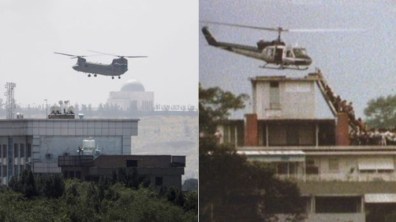
Evacuation of Kabul (Left) and Fall of Saigon (Right). Picture: Collected
This entire 20-year ordeal didn’t have to happen. Much like I still can’t figure out what the hell the point of the Vietnam “conflict’ was about. This New York Times Analysis offers some insight: ” Taliban Sweep in Afghanistan Follows Years of U.S. Miscalculations. An Afghan military that did not believe in itself and a U.S. effort that Mr. Biden, and most Americans, no longer believed in brought an ignoble end to America’s longest war.”
President Biden’s top advisers concede they were stunned by the rapid collapse of the Afghan army in the face of an aggressive, well-planned offensive by the Taliban that now threatens Kabul, Afghanistan’s capital.
The past 20 years show they should not have been.
If there is a consistent theme over two decades of war in Afghanistan, it is the overestimation of the results of the $83 billion the United States has spent since 2001 training and equipping the Afghan security forces and an underestimation of the brutal, wily strategy of the Taliban. The Pentagon had issued dire warnings to Mr. Biden even before he took office about the potential for the Taliban to overrun the Afghan army, but intelligence estimates, now shown to have badly missed the mark, assessed it might happen in 18 months, not weeks.
Commanders did know that the afflictions of the Afghan forces had never been cured: the deep corruption, the failure by the government to pay many Afghan soldiers and police officers for months, the defections, the soldiers sent to the front without adequate food and water, let alone arms. In the past several days, the Afghan forces have steadily collapsed as they battled to defend ever shrinking territory, losing Mazar-i-Sharif, the country’s economic engine, to the Taliban on Saturday.
Mr. Biden’s aides say that the persistence of those problems reinforced his belief that the United States could not prop up the Afghan government and military in perpetuity. In Oval Office meetings this spring, he told aides that staying another year, or even five, would not make a substantial difference and was not worth the risks.
In the end, an Afghan force that did not believe in itself and a U.S. effort that Mr. Biden, and most Americans, no longer believed would alter the course of events combined to bring an ignoble close to America’s longest war. The United States kept forces in Afghanistan far longer than the British did in the 19th century, and twice as long as the Soviets — with roughly the same results.
No matter how much you call it ‘nation-building,’ it still winds up to be colonization. That part of the world has had its history full of that. Please read this thread. I unrolled it here. It documents–in 7 tweets with sources–why it should’ve never happened.
So, there will be a lot more happening, and I’m sure the discussion will be brisk. Please add anything interesting you’ve read on seen or your thoughts, please!
What’s on your reading and blogging list?
Monday Reads
Posted: January 3, 2011 Filed under: Afghanistan, Anti-War, Catfood Commission, Civil Liberties, Foreign Affairs, Human Rights, Iraq, morning reads, Social Security, torture, U.S. Economy, U.S. Politics, Wikileaks | Tags: Afghan War, Attack on Safety Nets, attack on Social Security, Austerity economics, Iraqi War 52 Comments
Good Morning!!
I’m heading back to the Boston area this morning, so this will be brief. I’ll be on the road for two days, but I’ll try to check in when I stop for the night. So let’s see what’s happening out there.
Here’s a hysterically funny story: Former Bush/Cheney mouthpiece Judy Miller says Julian Assange is a “bad journalist.”
A former New York Times reporter assailed for her incorrect reports about Iraq’s purported weapons of mass destruction is criticizing Julian Assange for being a “bad journalist.”
Judith Miller took on the WikiLeaks founder during an appearance on Fox News Watch Saturday, arguing that Assange was a bad journalist “because he didn’t care at all about attempting to verify the information that he was putting out, or determine whether or not it hurt anyone.”
For many critics of the war in Iraq, that claim is likely to set off irony alarms. Miller has become famous for being the author of a 2002 New York Times article — now debunked — suggesting that Saddam Hussein had an active nuclear weapons program.
Miller now writes for Newsmax.
The Air Force has a new surveillance toy, according to the Washington Post.
This winter, the Air Force is set to deploy to Afghanistan what it says is a revolutionary airborne surveillance system called Gorgon Stare, which will be able to transmit live video images of physical movement across an entire town.
The system, made up of nine video cameras mounted on a remotely piloted aircraft, can transmit live images to soldiers on the ground or to analysts tracking enemy movements. It can send up to 65 different images to different users; by contrast, Air Force drones today shoot video from a single camera over a “soda straw” area the size of a building or two.
With the new tool, analysts will no longer have to guess where to point the camera, said Maj. Gen. James O. Poss, the Air Force’s assistant deputy chief of staff for intelligence, surveillance and reconnaissance. “Gorgon Stare will be looking at a whole city, so there will be no way for the adversary to know what we’re looking at, and we can see everything.”
Isn’t it interesting how the government can find the money for exotic military toys, but they need to cut back on the safety net for old and disabled people?
At Antiwar.com, Scott Horton interviewed Bryan Bender of the Boston Globe on
the very high percentage of retired high-ranking US military officers going to work for defense contractors; the Pentagon’s limited oversight on conflicts of interest that seems based on the assumption retired generals have an unshakable code of ethics; how private equity firms – specializing in defense industry investments – give compensation to rent-a-general firms for privileged information about Pentagon contracts; why Eisenhower should have gone with the military-industrial-Congressional complex version of his famous farewell address; and how retired Army Gen. Jack Keane – on behalf of AM General – helped overturn the Army’s decision to repair instead of replace Humvees.
Give it a listen.
Also at Antiwar.com, there’s an article by Kevin Carson on why Bradley Manning is a hero.
Manning, like many young soldiers, joined up in the naive belief that he was defending the freedom of his fellow Americans. When he got to Iraq, he found himself working under orders “to round up and hand over Iraqi civilians to America’s new Iraqi allies, who he could see were then torturing them with electrical drills and other implements.” The people he arrested, and handed over for torture, were guilty of such “crimes” as writing “scholarly critiques” of the U.S. occupation forces and its puppet government. When he expressed his moral reservations to his supervisor, Manning “was told to shut up and get back to herding up Iraqis.”
The people Manning saw tortured, by the way, were frequently the very same people who had been tortured by Saddam: Trade unionists, members of the Iraqi Freedom Congress, and other freedom-loving people who had no more use for Halliburton and Blackwater than they had for the Baath Party.
For exposing his government’s crimes against humanity, Manning has spent seven months in solitary confinement – a torture deliberately calculated to break the human mind.
[….]
He’s impaired the U.S. government’s ability to lie us into wars where thousands of Americans and tens of thousands of foreigners are murdered.
He’s impaired its ability to use such wars – under the guise of promoting “democracy” — to install puppet governments like the Coalition Provisional Authority, that will rubber stamp neoliberal “free trade” agreements (including harsh “intellectual property” provisions written by the proprietary content industries) and cut special deals with American crony capitalists.
[….]
Let’s get something straight. Bradley Manning may be a criminal by the standards of the American state. But by all human standards of morality, the government and its functionaries that Manning exposed to the light of day are criminals. And Manning is a hero of freedom for doing it.
At Corrente, there’s a great post by Letsgetitdone: Fairy Tales of the Coming State of the Union: The Government Is Running Out Of Money
In “All Together Now: There Is No Deficit/Debt Problem,” I warned against the message calling for deficit reduction that the President will probably deliver in his State of the Union Address next month. I argued that there was no deficit/debt problem and that it is essential to reject the President’s framing of the issue and move on cope with the real problems of the economy and American Society. That piece stands alone. But I also think it would be useful to examine each of the specific fairy tales the President is likely to tell in making his case justifying austerity measures which are certain to be counter-productive. This post focuses on one these fairy tales; the narrative that the Government is running out of money.
Check it out.
Finally, Crooks & Liars has the video of Lindsey Graham on Meet the Press threatening to shut down the government until he gets cuts in Social Security.
As Mike Malloy used to say, “have I told you lately how much I hate these people?”
So, what are you reading this morning?

 peej
peej Carissa
 bostonboomer
 dakinikat
 ecocatwoman
 mablue2
 Mama Lopez
 peggysue22
 quixote
 skydancingguestblogger
 Mona (aka Wonk the Vote)



 Sky Dancing
Recent Comments