Posted: December 17, 2025 | Author: bostonboomer | Filed under: just because | Tags: ACA subsidies, Donald Trump, Marjorie Taylor Greene, Moderate House Republicans, Paul Krugman, Russell Vought, Stephen Miller, Susie Wiles, U.S. Economy |
Good Day!!
I haven’t been feeling well for the past several days, and I’ve only been following the news superficially. There is so much going on, but I’ll do my best. Here’s the latest.
Trump is scheduled to give a speech from the White House tonight at 9PM.
AP: Trump is previewing his 2026 agenda in an address to the nation as his popularity wanes.
President Donald Trump intends to preview his agenda for next year and beyond in a live speech from the White House on Wednesday night. His remarks are coming at a crucial time as he tries to rebuild his steadily eroding popularity.
The White House offered few details about what the Republican president intends to emphasize in the 9 p.m. EST speech. Public polling shows most U.S. adults are frustrated with his handling of the economy as inflation picked up after his tariffs raised prices and hiring slowed.
Trump’s mass deportations of immigrants have also proved unpopular even as he is viewed favorably for halting crossings along the U.S. border with Mexico. The public has generally been nonplussed by his income tax cuts and globe-trotting efforts to end conflicts, attack suspected drug boats near Venezuela and attract investment dollars into the United States.
In 2026, Trump and his party face a referendum on their leadership as the nation heads into the midterm elections that will decide control of the House and the Senate.
Trump has said that he thinks more Americans would back him if they simply heard him describe his track record. Administration officials say investment commitments for new factories will reverse the recent decline in manufacturing jobs and that consumer activity will improve dramatically as people receive increased tax refunds next year.
“It has been a great year for our Country, and THE BEST IS YET TO COME!” Trump said in a Tuesday social media post announcing the speech.
Sorry, Grandpa. Your economy sucks because of your idiotic tariffs, your cruel mass deportations, and your general incompetence.
The New York Times: Trump Dangles Cash Payments to Buoy Voters’ Views of the Economy.
Tariffs are unpopular, prices remain stubbornly high and Americans are souring on President Trump’s handling of the economy.
So Mr. Trump has reprised a familiar political strategy: promise people cash.
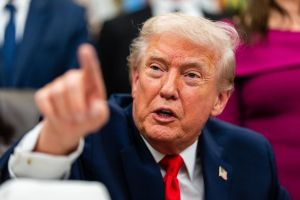
The president has repeatedly floated the idea of sending one-time $2,000 rebate checks to many families.Credit…Eric Lee for The New York Times
The White House is trying to tamp down Americans’ economic anxieties by dangling the prospect of checks and other paydays next year, hoping that the money might assuage voters who blame the president for their rising cost of living.
Mr. Trump, who is set to address the nation on Wednesday night, has repeatedly teased the idea of sending one-time $2,000 rebate checks to many families, funded using money collected from his sweeping global tariffs. But he has not devised a detailed plan for providing the rebates, an expensive policy that Republicans in Congress must approve and one that they have not yet considered.
The president has also begun hyping up the tax refunds that Americans are slated to receive in 2026. For many people, these cash payments are expected to be larger than they were last year, after Republicans adopted a sprawling set of tax cuts in July.
Both Mr. Trump and members of his administration have periodically drawn an equivalence between the supposed tariff rebates and the enacted tax law. They have claimed the money could bolster the economy and alleviate some of the financial strains on families, even at a time when Mr. Trump maintains that much of the talk about affordability is a “hoax.”
“Next year is projected to be the largest tax refund season ever, and we’re going to be giving back refunds out of the tariffs, because we’ve taken in literally trillions of dollars,” Mr. Trump said at a cabinet meeting last week. “And we’re going to be giving a nice dividend to the people, in addition to reducing debt.”
But economists take a dimmer view. Even if Americans were to delight in a series of new government-issued checks, the payments would hardly address the reasons that prices remain so high — including a shortage in housing that has driven up rents and mortgages and the global tariffs that have made imports more expensive. And the money that may soon be sloshing around the economy could end up worsening inflation, undermining Mr. Trump’s own economic goals.
Alex Durante, a senior economist at the Tax Foundation, said that simply “pumping money” into the economy — without any other underlying changes — threatened to “just generate a cycle where you continue to get higher prices.”
Paul Krugman at his Substack: An A+++++ Economy, My A++. Trump made big boasts but he isn’t delivering.
When Politico recently asked Donald Trump to grade the current U.S. economy, he replied “A-plus-plus-plus-plus-plus.” He made this boast at a time when actual economic data were still scarce, a consequence of the government shutdown that stopped or delayed key information about the state of the job market.
Yesterday the report on employment during the month of November finally arrived. And the message of the report on the state of the US economy was clear: A+++++ my A++. While it’s too soon to declare that we’re in a recession, the data are at least pre-recessionary: that is, the numbers are weak enough that we should be seriously worried that a recession is coming. And that’s a state of affairs completely at odds with Trump’s rose-colored — spray-tanned? — picture.
I’ll talk about the reasons the gap between Trump’s big boasts and the glum reality matters in a minute. First, however, let’s talk about what we learned from yesterday’s report.
Most importantly, the data show a weak labor market. Employment isn’t falling off a cliff, but job growth has been weak and hasn’t kept pace with the number of people seeking work. The headline unemployment rate in November was 4.6 percent, up from an average of 4 percent in 2024. That number is close to triggering the Sahm Rule, an economic rule of thumb devised by Claudia Sahm, a former economist at the Board of Governors of the Federal Reserve, that has historically been highly successful at identifying the early stages of a recession.
We can’t do a strict application of the Sahm Rule yet because Sahm’s method is based on the average unemployment rate over the past three months. Unfortunately, the shutdown prevented the Bureau of Labor Statistics from collecting key data in October. But if we do an interpolation of October’s unemployment rate by averaging over September’s rate of 4.4% and November’s rate of 4.6%, we can estimate that October’s unemployment rate was 4.5%. And those 3 months of unemployment numbers bring us within a whisker of the unemployment rise that, according to the Sahm Rule, signals that a recession is on the horizon.
The state of the economy looks even worse if we take a wider view of the labor market. The BLS calculates 6 different measures of unemployment. The most commonly cited number is U-3 — the number of workers who are actively seeking jobs but haven’t found them. But the broadest measure is U-6, which includes underemployed workers stuck in part-time employment and discouraged workers who have temporarily given up job search. And U-6 has risen sharply since January, when Trump took office:

Source: BLS
Further evidence consistent with a poor and deteriorating job market is data showing that the number of job-seekers who are long-term unemployed – that is, have been unemployed for 27 weeks or more – has risen by almost a third (from 1.45 million to 1.91 million) since 2024. This means that the unemployed are finding it harder to find jobs.
Read more details at the Substack link.
Most Americans aren’t stupid. They can see how much prices have gone up on necessities like food and electricity. Trump is losing popularity even with his MAGA base.
Marjorie Taylor Greene: "I think the midterms are gonna be very hard for Republicans. I'm one of the people that's willing to admit the truth and say I don't see Republicans winning the midterms right now, so that doesn't bode well for Mike Johnson."
— Aaron Rupar (@atrupar.com) 2025-12-17T02:20:39.871Z
Marjorie Taylor Greene was once one of Trump’s biggest supporters; now she’s turned on him. Victoria Craw at The Washington Post: Marjorie Taylor Greene says ‘dam is breaking’ within GOP against Trump.
Rep. Marjorie Taylor Greene (R-Georgia) on Tuesday said President Donald Trump has “real problems” within the Republican Party, adding in an interview with CNN that the president is out of touch with voters on key issues such as affordability.
Greene told Kaitlan Collins on “The Source” that the “dam is breaking” in terms of Trump’s hold onsupport within the party and that she expects Republicans to struggle in next year’s midterm elections.
Citingthe backlash to Trump’s comments on the death of director Rob Reiner, the 13 HouseRepublicans who voted with Democrats to overturn Trump’s executive order on collective bargaining and Indiana Republicans’ rejection of the president’s redistricting push, Greene said she expected “pushback” within the party to grow as lawmakers enter the campaign phase for the upcoming elections.
“I think the midterms are going to be very hard for Republicans,” Greene said. “I’m one of the people that’s willing to admit the truth and say I don’t see Republicans winning the midterms right now.” [….]
Greene had carved out a high-profile role as one of Trump’s most vocal allies, first in the “Make America Great Again” movement and then with her support for the “America First” agenda. But after weeks of speaking out against the president on several issues, Greene and Trump had an acrimonious public split last month after she joined with Democrats on a discharge position to compel a House vote calling on the Justice Department to release files related to convicted sex offender Jeffrey Epstein….
Speaking to The Washington Post this week, Greene described herself as a “bellwether” who is closely attuned to Trump’s base. “I say it, and then within four to six months, everybody’s saying the same thing,” she said….
“He’s got real problems with Republicans within the House and the Senate that will be breaking with him on more things to come,” she added.
Greene also said Trump’s supporters “didn’t appreciate” the president’s reaction to the death of Rob Reiner, who was found stabbed to death alongside his wife, photographer Michele Singer Reiner, in their Los Angeles home Sunday. The couple’s son Nick Reiner faces two counts of first-degree murder, among other charges, in their deaths.
Marjorie Taylor Greene: "What I'd like to see from the president is empathy for Americans. Donald Trump is a billionaire and he's the president. When he looks into a camera and says 'affordability is a hoax,' he's talking to Americans that are suffering and have been for many years now."
— Aaron Rupar (@atrupar.com) 2025-12-17T02:17:20.938Z
Moderate Republicans in the House are rebelling against Speaker Mike Johnson and his determination not to extend the ACA subsidies.
Meredith Lee Hill writes at Politico about another sign of Trump’s waning popularity and power: Frustrated GOP moderates join Democrats to force Obamacare extension vote.
Four House Republicans joined Democrats Wednesday to force a House vote on a straight three-year extension of the enhanced Obamacare tax credits that will expire Dec. 31, delivering a sharp rebuke to Speaker Mike Johnson and other GOP leaders.
Reps. Brian Fitzpatrick of Pennsylvania, Mike Lawler of New York, Rob Bresnahan of Pennsylvania and Ryan Mackenzie of Pennsylvania signed the discharge petition filed by House Minority Leader Hakeem Jeffries — hours after House GOP leaders rejected attempts by Fitzpatrick and other Republican moderates to seek a floor vote on extending the subsidies used by more than 20 million Americans.
Fitzpatrick said in a late-night House Rules Committee meeting Tuesday that “the only thing worse than a clean extension … would be expiration, and I would make that decision.” Lawler added that “the only feasible path forward is a discharge petition” if GOP leader reject a floor vote.
Under House rules, a completed discharge petition is subject to a waiting period, meaning no vote could happen until next month — though Johnson could choose to move sooner.
“We have worked for months to craft a two-party solution to address these expiring healthcare credits,” Fitzpatrick said in a statement Wednesday. “Our only request was a Floor vote on this compromise, so that the American People’s voice could be heard on this issue. That request was rejected. … Unfortunately, it is House leadership themselves that have forced this outcome.”
Jeffries told reporters Wednesday his discharge petition is “the most straightforward path to ensuring that tens of millions of Americans don’t have their health care ripped away from them because of the expiration of the Affordable Care Act tax credits.”
"It's idiotic, it's political malpractice," Rep. Mike Lawler (R-N.Y.) told reporters Tuesday of Johnson refusing to give them an ACA extension vote.Lawler, and other moderate Republicans didn't rule out joining Democrats to force a vote on a three-year extension of the subsidies, Axios reported.
— Ken Bazinet (@kenbazinet.bsky.social) 2025-12-16T21:38:46.444Z
Amanda Marcotte writes at Salon about the Republican rebellion: Republicans are quiet quitting on Trump.
Donald Trump is worried that Republicans aren’t as afraid of him as they used to be. Despite his self-billing as a dealmaker, the president has only ever had one tool to control his party: fear. GOP politicians have been afraid of career damage and literal physical harm if they crossed him. Trump is not above reminding elected officials that he has unhinged followers who are known to be violent. But as his approval ratings fall and the 2026 midterm elections inch closer, it seems Republicans are slightly less worried about the president’s wrath.
The first indicator was the House vote on Nov. 18 to release the Epstein files against Trump’s expressed wishes. But the biggest sign that the president’s grip on power is weakening came last week, when a majority of Republicans in the Indiana statehouse struck down a gerrymandering bill Trump had demanded.
As I argued in the latest Standing Room Only newsletter, this context helps explain why Trump responded to the death of beloved director Rob Reiner and his wife Michele with an ugliness that’s shocking — even for this president. Although the Los Angeles Police Department had arrested the couple’s son for the apparent homicide, Trump insinuated on Truth Social that it was one of his own followers who killed the Reiners out of revenge for their anti-Trump activism. He doubled down when asked about it by reporters in the Oval Office on Monday. The message was hard to miss: If you oppose Trump, he wishes you dead.
So far, his escalation doesn’t seem to be intimidating Republicans. Indiana Republicans were subject to an onslaught of death threats and abuse that including text messages sent to the friends of the grandson of one state senator. Most voted against Trump’s gerrymandering bill anyway. While Speaker of the House Mike Johnson, R-La., pretended not to have heard Trump’s response to Reiner’s death, as Salon’s Sophia Tesfaye documented, most right-wing media, including Fox News, actually criticized Trump for his behavior.
These are promising signs, but it’s not worth holding your breath waiting for GOP politicians to openly turn on a president who demands absolute loyalty. Instead of public rebellion, most Republicans seem to be engaged in a form of quiet quitting. They won’t go out of their way to resist Trump, but they are losing enthusiasm for defending him. They’re struggling to hide their frustration or their scheming for a post-Trump world. Overall, the posture is one of lying low, waiting for the old man to be gone so they can begin the project of rebuilding the GOP and their own careers in a post-Trump era.
Read the rest at Salon.
Trump is also becoming noticeably less involved in actually running the government (gift link): The White House Is a Lost Cause.
There is a presidency at work in Washington, but it is not clear that there is a president at work in the Oval Office.
Ask Donald Trump about the goings on of his administration, and there is a good chance he’ll defer to a deputy rather than answer the question. “I don’t know her,” he said when asked about his nominee for surgeon general, Casey Means, earlier this year. “I listened to the recommendation of Bobby,” he said, pointing to Robert F. Kennedy Jr., the secretary of health and human services.
Ask Trump for insight into why his administration made a choice or to explain a particular decision, and he’ll be at a loss for words. Ask him to comment on a scandal? He’ll plead ignorance. “I know nothing about it,” Trump said last week, when asked about the latest tranche of photographs released from the estate of Jeffrey Epstein.
None of this on its own means the president isn’t working or paying attention to the duties of his office. But consider the rest of the evidence. He is by most accounts isolated from the outside world. He does not travel the country and rarely meets with ordinary Americans outside the White House. He is shuttled from one Trump resort to another to play golf and hold court with donors, supporters and hangers-on.
Ronald Reagan took regular meetings with congressional leaders to discuss his legislative agenda; George H.W. Bush spearheaded negotiations with the nation’s allies and led the United States to war in Iraq; and George W. Bush was, for better or worse, “the decider” who performed leadership for the cameras as much as he tried to exercise it from the Oval Office. Trump is a ubiquitous cultural presence, but there is no outward sign that he is an active participant in running the national government. He was mostly absent during discussions of his signature legislation — the One Big, Beautiful Bill Act — and practically AWOL during the monthlong government shutdown.
It is difficult for any president to get a clear read on the state of the nation; it takes work and discipline to clear the distance between the office and the people. But Trump, in his second term, does not seem to care about the disconnect. Abraham Lincoln once remarked that it would “never do for a president to have guards with drawn sabers at his door, as if he fancied he were, or were trying to be, or were assuming to be, an emperor.” A president has to be engaged — attentive to both the government and the public he was elected to serve.
Trump is neither. He is uninterested in anyone except his most devoted fans, and would rather collect gifts from foreign businessmen than take the reins of his administration. “The president doesn’t know and never will,” Susie Wiles, the White House chief of staff, said in an interview with Vanity Fair, commenting on the work of Elon Musk in the first months of the year. “He doesn’t know the details of these smallish agencies.”
A bit more:

Russell Vought
Instead, the work of the White House has been delegated to a handful of high-level advisers. Russell Vought, the director of the Office of Management and Budget, is the de facto shadow president for domestic affairs. As one senior government official told ProPublica, “It feels like we work for Russ Vought. He has centralized decision-making power to an extent that he is the commander in chief.” It was Vought who orchestrated the administration’s assault on the federal bureaucracy, including the wholesale destruction of U.S.A.I.D. It was Vought who either froze or canceled hundreds of billions of dollars in funding for anti-poverty programs, H.I.V. reduction initiatives and research into science, medicine and technology. And it is Vought who has been pushing the boundaries of executive power as he attempts to turn the federal government into little more than an extension of the personal will of the president — as channeled through himself, of course.
If Vought is the nation’s shadow president for domestic policy, then Stephen Miller is its shadow president for internal security. Miller, Trump’s top domestic policy adviser, is using the president’s authority to try to transform the ethnic mix of the country — to make America white again, or at least whiter than it is now. He is the primary force behind the expansion of Immigration and Customs Enforcement and Customs and Border Protection into a roving deportation force. He has pushed both agencies to step up their enforcement operations, targeting schools, restaurants, farms and other work sites and detaining anyone agents can get their hands on, regardless of citizenship or legal status. It is Miller who is behind the militarization of ICE, the use of the National Guard to occupy Democrat-led cities and assist deportation efforts, and the plan to blanket the United States with a network of detention camps for unauthorized immigrants and anyone else caught in his dragnet.
In other words, the Nazis are running White House policy. Use the gift link to read more.
The latest White House mess is the Vanity Fair profile of Chief of Staff Susie Wiles.
Matt Dixon at NBC News: White House scrambles to address Susie Wiles’ explosive Vanity Fair interviews.
Susie Wiles generally helps quietly shape headlines. She is rarely the focus of them.
That changed in dramatic fashion Tuesday after Vanity Fair published a deeply reported profile of the 68-year-old White House chief of staff, whose decades-long career in politics has been defined by a measured, steady-the-ship tone, never one that could be construed as undermining her boss.
In the two-part Vanity Fair piece — which included 11 interviews over nearly a year, with the White House’s cooperation — Wiles comes off as far more candid than her public persona. She not only speaks openly about both President Donald Trump and those who make up the core of his administration, but appears to acknowledge that at times she has been at odds with some of the policies that have been central to Trump’s second term. While not unusual for a chief of staff to disagree with the president they serve, those concerns generally remain part of private conversations.

Susie Wiles
Wiles revealed there had been “huge disagreements” over implementing tariffs, acknowledged that the administration must “look harder” at its process for mass deportation and said she had to “get on board” with Trump’s decision to give blanket pardons to Jan. 6 defendants. She said she initially believed only those who did not commit violent acts should be pardoned.
The profile prompted an all-hands-on-deck pushback from the White House and Trump’s political orbit. The central talking point became that the profile lacked context, and supporters blasted the outlet for being unfair rather than offering any direct refutation of the authenticity of quotes or what was reported.
Wiles herself also offered rare public condemnation.
“Significant context was disregarded and much of what I, and others, said about the team and the President was left out of the story,” she posted on social media. “I assume, after reading it, that this was done to paint an overwhelmingly chaotic and negative narrative about the President and our team.”
In an interview with the New York Post, Trump defended his top staffer.
“I think from what I hear, the facts were wrong, and it was a very misguided interviewer, purposely misguided,”he said.
Trump added “she’s fantastic” when asked if he continues to have full confidence in Wiles.
More interesting stories:
AP: Trump orders blockade of ‘sanctioned oil tankers’ into Venezuela, ramping up pressure on Maduro.
CNN: Second near midair collision reported near Venezuela involving US Air Force tanker.
The Independent: Bari Weiss’ much-hyped CBS News town hall with Erika Kirk was a massive ratings flop.
Jacob Ware at Lawfare: A Terrorism of Vengeance. Understanding incels, school shooters, and the new category of terrorism, “nihilistic violent extremism.”
Politico: Judge lets Trump’s ballroom construction proceed.
That’s it for me today. What’s on your mind?
Did you like this post? Please share it with your friends:
Posted: November 8, 2025 | Author: bostonboomer | Filed under: just because | Tags: ACA subsidies, Broadview ICE facility, Chicago, Donald Trump, government shutdown, ICE, immigration, Inside Trump's Head, Justice Ketanji Brown Jackson, Michael Wolff, SCOTUS, Senator Chuck Schumer, SNAP benefits, Steve Vladeck, Trump polls |
Good Afternoon!!

Raphael Balme, Three cats and wallpaper.
I’m feeling slightly more optimistic after Tuesday’s Democratic sweep of theoff-year elections on Tuesday. According to the polls, Trump is very unpopular, and I have to believe that his efforts to avoid giving food to starving Americans are not going to help him. Democracy is still in danger, but it is beginning look as if there’s still hope for saving it.
Julia Manchester at The Hill: Trump approval drops as Dems show more motivation for midterms: Poll.
President Trump’s approval rating is dropping as Democrats signal more motivation than the GOP ahead of next year’s midterm elections, according to a new Emerson College Polling survey released on Friday.
Forty-one percent of voters said they approved of the job Trump is doing as president, a four-point drop from Trump’s October approval rating of 45 percent. Forty-nine percent of voters said they disapproved of Trump’s job in office, up from 48 percent last month.
Meanwhile, the same poll found that 71 percent of Democratic voters said they were motivated to vote in next year’s midterm elections compared to 60 percent of Republicans. Forty-two percent of Independents said the same.
Fifty-seven percent of all voters said they were more motivated to vote than usual, while 12 percent said they were less motivated. Thirty-one percent said they were motivated as usual ahead of the midterms.
The polling comes after Republicans suffered losses to Democrats in Tuesday’s off-year elections, which were seen as a referendum on the first year of Trump’s second term in office….
The same poll found that 43 percent of voters said their vote in the midterms would be an expression of opposition to Trump, while 29 percent said their vote would be an expression of support.
The Emerson College national poll was conducted Nov. 3-4 among 1,000 active registered voters. The margin of error is plus or minus three percentage points.
Here’s the full report from Emerson College polling.
I’ve been listening to/watching regularly a Daily Beast podcast called Inside Trump’s Head.” The show consists of interviews with journalist Michael Wolff, who has written 3 books about Trump. You can watch it on YouTube. Wolff is not only an expert on Trump (and Jeffrey Epstein), but also has numerous current sources inside the Trump circle. In addition, he is often funny.
Robert Davis at Raw Story: ‘Measure of optimism’: Analyst predicts ‘end of Trump’ after Democratic election wins.
Controversial journalist Michael Wolff made a bold prediction about the future of the second Trump administration on Thursday during a new podcast interview.
Wolff joined The Daily Beast’s Joana Coles on a new episode of “Inside Trump’s Head” that aired on Thursday, where the two discussed what Tuesday’s election results mean for President Donald Trump. Democrats won a spate of key races, including two governor’s offices and a host of statewide offices.

By Timothy Matthews
Trump and Republicans like Speaker Mike Johnson (R-LA) have tried to brush off the Democratic victories. Wolff argued that they reveal a troubling trend for the Trump administration.
“Let’s look at that in the context of we are not today in an autocracy and [with] a measure of optimism, which is that we’ve just spent a year since last Election Day with Trump as this omnipotent figure in politics,” Wolff said. “And while I would not say that today spells in any way the end of Trump, I would say that the end of Trump could well happen.”
Leading up to Tuesday’s election, Trump shared multiple social media posts attempting to help his preferred candidates win. However, Trump-aligned and Trump-backed candidates did not fare well in the election.
“That’s what happens in American politics,” Wolff continued. “That’s one of the great things in American politics. Reversals, landslides. Things that you would not dream of happening, happen.”
“This has been a horrifying year of Trump, and without any sense that anyone could stand in his way,” he continued. “But in American politics, that’s what happens. You think these people are permanent, and it turns out that they are fleeting.”
Late last night, Justice Ketanji Brown Jackson allowed Trump to continue withholding full SNAP benefits to the states after an appeals court ordered the payments to begin immediately.
Jennifer Ludden at NPR: Supreme Court temporarily blocks full SNAP benefits even as they’d started to go out.
The U.S. Supreme Court temporarily granted the Trump administration’s request to block full SNAP food benefits during the government shutdown, even as residents in some states had already begun receiving them.
The Trump administration is appealing a court order to fully restart the country’s largest anti-hunger program. The high court decision late Friday gives a lower court time to consider a more lasting pause.
The move may add to confusion, though, since the government said it was sending states money on Friday to fully fund SNAP at the same time it appealed the order to pay for them.
Shortly after U.S. District Judge John McConnell Jr. issued that decision Thursday afternoon, states started to announce they’d be issuing full SNAP benefits. Some peoplewoke up Friday with the money already on the debit-like EBT cards they use to buy groceries. The number of states kept growing, and included California, Oregon, Wisconsin, Pennsylvania and Connecticut among others.
The Supreme Court’s decision means states must, for now, revert back to the partial payments the Trump administration had earlier instructed them to distribute. While the U.S. Court of Appeals for the First Circuit rejected the administration’s request for an administrative stay, the appeals court said it would consider the request for the stay and intends to issue a decision as quickly as possible.
SCOTUS whisperer Steve Vladeck quickly published an explainer at One First: SNAP WTF?.
Basically, Vladeck thinks that Jackson knew that if she didn’t issue the hold, the 5 right wing justices would go along with Trump’s wish for an administrative hold, and it might take a long time for them to get around to making a final decision on the SNAP payments.
I wanted to put out a very brief post to try to provide a bit of context for Justice Jackson’s single-justice order, handed down shortly after 9 p.m. EST on Friday night, that imposed an “administrative stay” of a district court order that would’ve required the Trump administration to use various contingency funds to pay out critical benefits under the Supplemental Nutrition Assistance Program (SNAP).

Willem den Ouden (NL 1928) Ferry with cat
It may surprise folks that Justice Jackson, who has been one of the most vocal critics of the Court’s behavior on emergency applications from the Trump administration, acquiesced in even a temporary pause of the district court’s ruling in this case. But as I read the order, which says a lot more than a typical “administrative stay” from the Court, Jackson was stuck between a rock and a hard place—given the incredibly compressed timing that was created by the circumstances of the case.
In a world in which Justice Jackson either knew or suspected that at least five of the justices would grant temporary relief to the Trump administration if she didn’t, the way she structured the stay means that she was able to try to control the timing of the Supreme Court’s (forthcoming) review—and to create pressure for it to happen faster than it otherwise might have. In other words, it’s a compromise—one with which not everyone will agree, but which strikes me as eminently defensible under these unique (and, let’s be clear, maddening and entirely f-ing avoidable) circumstances.
Everyone agrees that, among the many increasingly painful results of the government shutdown, the U.S. Department of Agriculture (USDA) can no longer spend the funds Congress appropriated to cover SNAP—a program that helps to fund food purchases for one in eight (42 million!) Americans. Everyone also agrees that there are other sources of appropriated money that the President has the statutory authority to rely upon to at least partially fund SNAP benefits for the month of November. The two questions that have provoked the most legal debate is whether (1) he has the authority to fully fund SNAP; and (2) either way, whether federal courts can order him to use whatever authorities he has.
The dispute in the case that reached the Supreme Court on Friday involves a lawsuit that asked a federal court in Rhode Island to order the USDA first to partially fund SNAP for November, and then, as circumstances unfolded, to fully fund it. Having already ordered the USDA to do the former, yesterday, Judge McConnell issued a TRO ordering it to do the latter (to fully fund SNAP for November)—and to do so by the end of the day today.
I won’t quote any more, but I hope you’ll go read the explanation. Vladeck thinks that Jackson did the right thing under the circumstances, because she wants to make sure that the full court debates the case and makes a decision quickly. Vladeck also notes that Trump could just approve payment of the SNAP benefits. There’s no need of a court order. Democrats should make sure people understand that Trump is willing to starve children and old people in order to get his way on the shutdown and the cruel cuts in his big ugly bill.
Meanwhile, Democrats have offered a new proposal to reopen the government. NBC News: Democrats make a new offer to end the shutdown, but Republicans aren’t buying it.
Senate Democrats made an offer Friday to reopen the government, proposing a one-year extension of expiring Affordable Care Act subsidies alongside a package of funding measures in order to secure their votes.

By Kichisaburou Hirota
The offer, rolled out on the floor by Senate Minority Leader Chuck Schumer, D-N.Y., includes a “clean” continuing resolution, which would reopen the government at current spending levels, and a package of three bipartisan appropriations bills to fund some departments for the full fiscal year.
“After so many failed votes, it’s clear we need to try something different,” Schumer said, calling it “a very simple compromise.”
The short-term health care funding extension would prevent a massive increase in insurance costs for millions of Americans on Obamacare next year. In addition, Democrats proposed creating a bipartisan committee to negotiate a longer-term solution.
“This is a reasonable offer that reopens the government, deals with health care affordability and begins a process of negotiating reforms to the ACA tax credits for the future,” Schumer added. “Now, the ball is in the Republicans’ court. We need Republicans to just say yes.”
Senate Majority Leader John Thune, R-S.D., called the Democratic offer a “nonstarter.”
“The Obamacare extension is the negotiation. That’s what we’re going to negotiate once the government opens up. … We need to vote to open the government — and there is a proposal out there to do that — and then we can have this whole conversation about health care,” he said.
Yeah, no. Republicans can’t be trusted to honor their promises.
Trump has started trying to get Republicans to get rid of the filibuster in order to reopen the government. Theodoric Meyer at The Washington Post: Trump wants to abolish the filibuster. GOP senators aren’t on board.
Senate Republicans have largely backed President Donald Trump’s agenda since he returned to office — but many refuse to support his campaign to scrap the filibuster.
Trump asked Republican senators at a meeting at the White House on Wednesday to end the government shutdown by getting rid of the filibuster and reiterated his demand Thursday at a news conference.

By Tatyana Rodionova
The filibuster, a long-standing Senate rule, allows a single senator to block most legislation unless 60 senators vote to cut off debate. Democrats have used the filibuster to block Republicans’ government funding bill for more than a month despite Republicans’ 53-seat Senate majority.
Some Senate Republicans returned from the White House saying they were open to ending the filibuster. But doing away with the rule would require the support of almost every Republican senator — and Senate Majority Leader John Thune (R-South Dakota) and many other Republicans say they are implacably opposed to it.
“There’s nothing that could move me on the filibuster,” Sen. Thom Tillis (R-North Carolina) told reporters Wednesday after the White House meeting.
Senate Republicans’ unwillingness to scrap the filibuster underscores the limits of Trump’s influence in his second term, during which lawmakers have been reluctant to defy him.
There is quite a bit of immigration news out there today.
NBC News: Judge permanently bars Trump from deploying National Guard troops to Portland in response to immigration protests.
A federal judge in Oregon on Friday issued a permanent injunction barring the Trump administration from deploying the National Guard on the streets of Portland in response to protests against the president’s immigration policies.
“This Court arrives at the necessary conclusion that there was neither ‘a rebellion or danger of a rebellion’ nor was the President ‘unable with the regular forces to execute the laws of the United States’ in Oregon when he ordered the federalization and deployment of the National Guard,” U.S. District Judge Karin J. Immergut, who was appointed by President Donald Trump in his first term, wrote in her ruling.
The Trump administration can appeal the ruling if it wants to.
Oregon Gov. Tina Kotek responded to the ruling Friday, calling Trump’s move to federalize the guard “a gross abuse of power.”
“Oregon National Guard members have been away from their jobs and families for 38 days. The California National Guard has been here for just over one month. Based on this ruling, I am renewing my call to the Trump Administration to send all troops home now,” Kotek said.
California Attorney General Rob Bonta, whose justice department argued in the case objecting over his state’s National Guard’s deployment, called the decision “a win for the rule of law, for the constitutional values that govern our democracy, and for the American people.”
There are a number of immigration stories coming out of the Broadville neighborhood in Chicago where there is a large ICE facility.
Adrian Carrasquillo at The Bulwark: ICE Has Created a ‘Ghost Town’ in the Heart of Chicago.
DHS’S IMMIGRATION ENFORCEMENT ACTIONS continue to land like hammer blows on communities across the United States. Families are being torn apart, protesters are catching pepperballs, businesses are at risk, and, increasingly, entire neighborhood economies in areas with large Latino populations are grinding to a halt.
The worst consequences occur when these different aspects of the Trump administration’s deportation regime overlap. Case in point: Chicago’s food scene, specifically the capital of the Mexican Midwest, Little Village, where I got both a firsthand look at the compounding harms of ICE’s actions and the best gorditas I’ve ever had in my life.

By Cindy Revell
The first sign of how different things are come well before you take a bite of the gordita. It’s when you look around and realize that there is now an eerie emptiness to a once-vibrant place.
As I pulled into Little Village for dinner with some local Chicagoans, we experienced no traffic and had our pick of parking spots. “Traffic used to be bumper to bumper for decades and start blocks away, I’ve never experienced it like this,” Chicago food writer Ximena N. Beltran Quan Kiu told me. In a TikTok about the neighborhood, she noted that Little Village is the second-largest shopping district in the city after Michigan Avenue, which is home of the “Magnificent Mile” of luxury stores.
Our destination that day last month was Carniceria Aguascalientes, which sits on the main thoroughfare of 26th Street. We passed through a glittering Mexican grocery store at the street side to get to the large diner-style restaurant lined with tables and booths. Only two or three of roughly thirty tables were in use when we sat down. As we enjoyed our food, the largely vacant dining room became less and less comprehensible.
When I told our friendly waitress, Michelle Macias, 24, what I do and why I was in town, she was eager to share what had happened to the restaurant. Aguascalientes, a staple of “La Villita,” has welcomed customers for half a century. But lately, its business has plummeted. Sales are down a staggering amount: more than 60 percent compared to last year.
Everything has been turned on its head, Macias explained. While in past years Fridays, Saturdays, and Sundays were bustling, lately Mondays have become the restaurant’s busiest day—perhaps a result of people trying to avoid the usual crowds of the weekend. The restaurant announced this year that it would be closing an hour earlier, a money-saving measure. And as I had noticed, there’s now parking readily available, a fact that shocks longtime patrons accustomed to the gridlock that formerly surrounded the popular eatery.
Everything has been turned on its head, Macias explained. While in past years Fridays, Saturdays, and Sundays were bustling, lately Mondays have become the restaurant’s busiest day—perhaps a result of people trying to avoid the usual crowds of the weekend. The restaurant announced this year that it would be closing an hour earlier, a money-saving measure. And as I had noticed, there’s now parking readily available, a fact that shocks longtime patrons accustomed to the gridlock that formerly surrounded the popular eatery.
The bleak reality facing Carniceria Aguascalientes weighs on its forty employees—especially Macias, whose parents own the restaurant.
As I took it in, I couldn’t help but think back to when Trump’s mass-deportation policy was just getting underway, and the many conversations I had then with Democratic lawmakers who wondered aloud about where we would be in three years. Forget three years: In the Latino enclaves of Little Village, and in Back of the Yards, in Pilsen, and on the North Side, they’re wondering how they will get through the next three weeks.
“Everyone is staying home, everyone is scared,” Macias told me. “There’s so much uncertainty. COVID was bad, but this is way worse.”
It sounds like what happened in Washington DC. Read the whole thing at the Bulwark link.
Charles Thrush at Block Club Chicago: Feds Tell Faith Leaders ‘No More Prayer’ Outside Broadview Facility.
BROADVIEW – Federal authorities told demonstrators Friday that there would be “no more prayer” in front of or inside the Broadview ICE facility, in a move that mystified local leaders and raised legal questions.
A federal representative delivered the news to a huddle of faith leaders and activists standing outside the Immigration and Customs Enforcement facility Friday, speaking after faith leaders were denied entry to the building for the third time Friday.

By Miroslaw Hajnos
Broadview Police Chief Thomas Mills, whose department helped facilitate the phone call, said that he was “trying to figure out” in discussions with Mayor Katrina Thompson and an attorney if a federal agency could legally ban religious gatherings on land owned by the village. Religious groups previously have been allowed to practice outside the facility, he said.
“I’m just a messenger,” an anonymous voice stuttered over the phone to a huddle of faith leaders and activists standing outside the Broadview immigration processing facility on Friday.
During the call, which took place with a Block Club reporter present, the anonymous representative told a group of faith leaders and activists that “There is no more prayer in front of building or inside the building because this is the state and it’s not [of a] religious background.”
“I’m dumbfounded,” the police chief told Block Club. “Every time I talk with [federal officials], it feels like their rules keep changing. We don’t really know what’s happening, I’m sorry I can’t say more. We just want to keep people safe and let them peacefully protest without getting hurt.”
That sounds like a violation of the First Amendment to me.
Chicago Sun-Times: 14 suburban moms arrested in sit-in protest outside Broadview ICE facility.
A group of moms from the western suburbs were arrested Friday morning during a protest against the separation of families outside of the U.S. Immigration and Customs Enforcement facility in Broadview.
Fourteen mothers jumped over the barricades and sat in a circle on Beach Street to “demand an end” to the immigration raids that have swept through the Chicago area since the Trump administration launched “Operation Midway Blitz” in September.
Less than a minute later, the women were arrested by Cook County sheriff’s deputies. The women were charged with obstruction, disorderly conduct and pedestrian walking on highways.
“We want to encourage other people who feel strongly about ICE’s actions to step off the sidelines and take our cities back,” said Teresa Shattuck, a mother from Oak Park. “We want to use our collective power and our white privilege in the way it should be used.”
Meghan Carter, another mother from Oak Park, said the women who were arrested understood the risks when they chose to take a stand, adding their experiences paled in comparison to what the detained immigrants inside the facility were enduring.
Carter said the suburban moms were a group of parents “fed up” with seeing immigration agents “terrorizing” their communities.
One more immigration/deportation story from NBC News: ‘Mega detention centers’: ICE considers buying large warehouses to hold immigrants.
The Trump administration is exploring buying warehouses that were designed for clients like Amazon and retrofitting them as detention facilities for immigrants before they are deported, a move that would vastly expand the government’s detention capacity, according to a Homeland Security Department official and a White House official.

By Timothy Matthews
The precise warehouses that Immigration and Customs Enforcement may buy have not yet been determined, but the agency is looking at locations in the southern U.S. near airports where immigrants are most often deported, the DHS official and the White House official said. Selecting such warehouses would “increase efficiency” in deportations, the DHS official said.
A deal to purchase the warehouses, which on average are more than twice the size of current ICE detention facilities, is past the early stages but not yet final, the DHS official and the White House official said. The DHS official described the warehouses as future “mega detention centers.”
Amazon would not be a part of any deal and would not profit from it as the warehouses were built by developers for Amazon but never used or leased by the company, the officials said.
An Amazon spokesperson said that the company is not involved in any discussions with DHS or ICE about warehouse space and that it leases and does not own the vast majority of its warehouse space.
It was not immediately clear who owns the warehouses that the government may buy and the DHS official and the White House official did not know how much the deals could be worth. The DHS official said some of the warehouses under consideration were built by developers with Amazon in mind but never used.
That’s it for me today. I hope everyone is having a relaxing weekend. I’m working on it.
Did you like this post? Please share it with your friends:


 peej
peej Carissa
 bostonboomer
 dakinikat
 ecocatwoman
 mablue2
 Mama Lopez
 peggysue22
 quixote
 skydancingguestblogger
 Mona (aka Wonk the Vote)



 Sky Dancing
Recent Comments