There are lots more races to be decided. Here’s a fresh thread to discuss them. I’m pretty pooped out, but I’m going to stay up as long as I can–at least I want to know who will be the new Governor of Massachusetts before I hit the sack.
I’ve been looking around for articles to post, but I don’t see much that isn’t depressing. I’ll add more in the comments as I find things, and Dakinikat said she would look around too.
Thanks to all of you for participating tonight. I don’t know what I would have done without you guys!!
Did you like this post? Please share it with your friends:
The map above posted by Vox shows time times polls close in different states. That will help us know when to start looking for election results in our home states and in the key Senate races.
Vox is providing live election updates. They’ve had quite a bit of interesting stuff throughout the day. The New York Times also has a live update page, but so far I like Vox’s better. Plenty of other websites will also be doing this, so if you are following a particularly interesting media live blog, please share the link in the comment thread to this post.
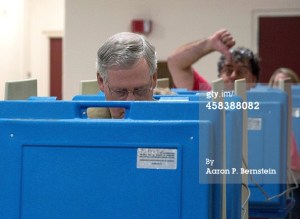
The polls close early in Kentucky–at 6 or 7pm, depending on what part of the state you live in. Of course Kentucky’s Senate race between Alison Grimes and Mitch McConnell is huge. If McConnell wins and Republicans take control of the Senate, he will be the new Majority Leader. What a dreadful prospect! But Kentucky is seeing heavy voter turnout in the cities, which is a good sign for Grimes.
High turnout in Kentucky’s urban areas is buoying Alison Lundergan Grimes’ hopes for a stunning upset over U.S. Senate Minority Leader Mitch McConnell.
At midday, Lynn Zellen, a spokeswoman for the Secretary of State’s office, said turnout has been steady statewide but that it has been high in Louisville and in the Northern Kentucky community of Fort Thomas.
Big turnout in Louisville would appear to help Grimes, said Democratic political consultant Danny Briscoe. “She’s got to come out of here with a huge margin,” he said. “It’s the biggest Democratic area left in Kentucky.”
At about 2:30 p.m., Grimes tweeted “We’re seeing incredible turnout today.”
LOUISVILLE – If Senate Minority Leader Mitch McConnell wins re-election Tuesday, his prize may be a restive Republican caucus with a rebellious would-be presidential candidate who may not support him.
Texas Sen. Ted Cruz, who has worked with other tea-party Republicans to force government crises over spending, budgets and the debt ceiling, said over the weekend in a Washington Post interviewhe is aiming for a GOP-led Senate that is just as confrontational with the White House as the Republican House has been.
Cruz said the Senate under Republicans should begin their work “looking at the abuse of power, the executive abuse, the regulatory abuse, the lawlessness that sadly has pervaded this administration.”
Cruz also told The Post he wanted a Republican Senate to vigorously pursue repeal of the Affordable Care Act.
Significantly, Cruz also would not pledge his support to McConnell as majority leader.
WASHINGTON—In fighting off a tea-party primary challenger and then battling a Democrat who tried to claim the political center, Senate Minority Leader Mitch McConnell had a consistent pitch to Kentucky voters: he was the candidate with the clout to get things done.
That is precisely what he will need if, as expected, he survives the toughest re-election fight of his political career and his party wins control of the Senate. Mr. McConnell, a 30-year veteran, is in line to lead the Senate’s first Republican majority in eight years if his party can net the six seats it needs to claim power….
But even his own win wouldn’t guarantee his spot as majority leader, as several close Senate races will determine whether Republicans secure enough seats to take the majority back from Democrats. The drama is compounded by the reality that it could be weeks before Senate control is known, as close races in Louisiana and Georgia could mean runoff elections in those states.
In many ways, the obstacle course of challenges has been a test of the political skills Mr. McConnell would have to tap in a newly constituted Republican Senate, where he would be expected to try to reach deals on taxes and trade in an effort to end legislative gridlock.
To get to those agreements, Mr. McConnell would have to contend with a pocket of restive conservatives, including some, like Texas Sen. Ted Cruz , who are aiming to sharpen their conservative credentials for potential 2016 presidential bids.
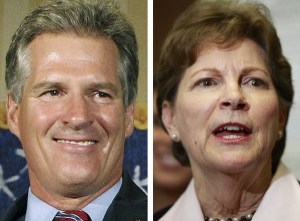
Three Democrats were trying to hold onto their seats in Washington on Tuesday. U.S. Sen. Jeanne Shaheen, a Democrat seeking a second term, faced Republican Scott Brown, who moved to New Hampshire last year after losing his U.S. Senate seat in Massachusetts.
In the 1st District, Democratic U.S. Rep. Carol Shea-Porter was facing a challenge from Republican Frank Guinta. Shea-Porter was first elected in 2006, was ousted by Guinta in 2010 and regained the seat in 2012. In the 2nd District, Democratic U.S. Rep. Annie Kuster was seeking a second term against GOP state Rep. Marilinda Garcia.
The governor’s office and the 424-member Legislature also were up for grabs. Democratic Gov. Maggie Hassan, hoping to win a second term, faced a challenge from Republican Walt Havenstein.
What are you hearing about turnout in your state? Here in Massachusetts, the Secretary of State’s office predicted 53% turnout, 2.26 million voters, and a number of towns are reporting high numbers of voters showing up at the polls. For Martha Coakley to win, we’ll need voters to show up in urban areas like Boston and Worcester.
Voting problems are being reported in several states. We know about the voter suppression in Texas and other states with voter ID laws, but today there have been other serious problems. Things are pretty bad in Virginia, according to Democratic Rep. Scott Rigell.
VIRGINIA BEACH — Officials with Rep. Scott Rigell’s (R-2nd D.) campaign said Tuesday afternoon that the number of precincts experiencing problems with voting machines in the 2nd District increased to 37 locations, nearly double the number the campaign reported earlier in the day.
The majority of the problems were in Virginia Beach where Rigell is up for re-election.
The Virginia Beach locations are Alanton, Arrowhead, Bayside, Birneck, Bonney, Cape Henry, Centerville, Chimney Hill, Colonial, Colony, Courthouse, Culver, Dahlia, Great Neck, Homestead, Hunt, Kingston, Lake Christoper, Larkspur, Linkhorn, London Bridge, Lynnhaven, Manor, North Beach, Ocean Lakes, Pleasant Hall, Rock lack, Rosement Forest, Seatack, Shelton Park, Sherry Park, Sigma, Stratford Chase, Tallwood, Upton and Witchduck.
Officials said there was also a problem at the Lafayette precinct in Norfolk….
On Twitter Tuesday morning, Rigell said there have been “numerous, credible reports of poll machine irregularity at voting precincts in Virginia’s 2nd Congressional District.”
“Every error is going against my campaign and in favor of my challenger,” Rigell said at an 11 a.m. news conference.
The Scott Rigell for Congress campaign has formally demanded that the Virginia Beach Voter Registrar switch to paper ballots after they say several issues have been reported.
They say over 40 precincts in the district have reported that voters who tried to cast a ballot for Rigell were instead counted for his opponent.
“In my more than two decades of being involved in the political process, I have never seen such a systemic failure of our voting machines here in Hampton Roads. Sadly, today marks a first,” says the Rigell campaign.
He is now encouraging voters to check their summary pages on their voting cards before submitting a final vote. They say to make sure that you’re 100% certain that everything you’ve chosen is correct before leaving your polling place.
The Georgia Secretary of State’s office crashed on Tuesday and stayed down for several hours on Tuesday, The New York Times reported.
The site is where people can get information on where their polling site is or register to vote.
The voter protection group, Election Protection, said it received 778 calls before mid day from frustrated voters about the down website.
“It inconvenienced a lot of voters,” Bryan Thomas, the communications director for state Sen. Jason Carter’s (D) gubernatorial campaign told TPM. “We worked really hard to make sure that any voters that reached out to us got proper information about where their polling information is.”
With so many GOP efforts to suppress the vote, every problem like this seems potentially suspicious. Will this hurt Michelle Nunn’s chances?
There have been many problems in Connecticut, where Democratic Gov. Dan Malloy is in a tight reelection race; but a judge has extended some voting hours in Hartford.
A Hartford judge has decided to extend voting hours to 8:30 p.m. at two city polling places hampered by delays and missing registration lists early Tuesday morning.
The extended hours will apply to the Batchelder School at 757 New Britain Avenue and United Methodist Church at 571 Farmington Avenue, according to the judge. Registered voters who are in line at those two polls by 8:30 p.m. will be allowed to vote.
“It was the ruling of electoral officials, either monitors or registrars, that denied people the opportunity to vote in an alternative fashion when the voting lists were not ready at 6 a.m.,” the judge explained, referring to voters who were stalled or turned away while waiting for lists to arrive.
Malloy campaign attorney William Bloss said at least 10 of the city’s 24 polling places opened as late as 7:30 a.m. because voter lists weren’t delivered on time. All Connecticut polls were legally required to open at 6 a.m. Tuesday.
Have you heard of any other voting irregularities?
What will happen after that? Will they actually accomplish something, or will they just keep blocking everything President Obama tries to do? Even more horrifying, we may not know the makeup of the Senate for sure until next year, because two close races–in Georgia and Louisiana–will likely end up in runoffs.
I’m not only thinking about the possibility that two close races — in Louisiana and Georgia — could end up requiring runoffs. If candidates do not get more than 50 percent of the vote because fringe opponents siphon off votes from the pair running neck and neck, Louisiana’s runoff would be in December and Georgia’s not until Jan. 6, 2015.
The uncertainty that’s more intriguing is that even after those runoffs, if they happen, there might be three independent senators who could swing the majority to one party or the other.
One, Vermont’s Bernie Sanders, is a staunch liberal who will certainly cast his lot with the Democrats, as he has in the past. But Maine independent Angus King has not said for sure that he will continue to caucus with Democrats. And Kansas’s Greg Orman, an independent businessman who is locked in a tight race with incumbent Republican Pat Roberts, has steadfastly refused to say which party he would vote with.
Another longer-shot wild card is former Senator Larry Pressler of South Dakota. He is also running has an independent, but his rise in the polls has subsided recently.
One can only imagine what Orman and King will be promised by both sides if one or both become swing votes. Beyond that, there is a Democratic senator in a red state (John Tester in Montana) and even one or two moderate Republicans in a blue state and a swing state (Mark Kirk in Illinois and Susan Collins in Maine) who might be persuaded to flip.
But most of the so-called experts are predicting we’ll ultimately be stuck with a Republican-controlled Congress. Larry Sabato, Kyle Londik, and Geoffrey Skelley write at Politico: Bet on a GOP Senate.
While many races remain close, it’s just getting harder and harder to envision a plausible path for the Democrats to retain control of the Senate. Ultimately, with just a few days to go before the election, the safe bet would be on Republicans eventually taking control of the upper chamber.
Generally speaking, candidates who have leads of three points or more in polling averages are in solid shape to win, but in this election five states—Republican-held Georgia and Kansas, and Democratic-held Iowa, New Hampshire and North Carolina—feature a Senate race where both of the two major polling averages (RealClearPolitics and HuffPost Pollster) show the leading candidate with an edge of smaller than three points.
What makes the Democrats’ situation so precarious is that Republicans have polling leads of more than three points in five other states, all of which are currently held by Democrats: Arkansas, Louisiana, Montana, South Dakota, and West Virginia. Two others, Democratic-held Alaska and Colorado, show Republicans leading in both averages, but by more than three points in just one. (These averages are as of the afternoon of Oct. 29.)
Read it and weep folks. On the other hand, Tarini Parti, also at Politico, points out that this is “[t]he most wide-open Senate election in a decade.”
It’s the largest and most wide-open Senate battlefield in more than a decade: ten races, all neck-and-neck affairs headed into the final days of the campaign.
And it’s not only that there are more competitive races this time around; it’s how close they are that has made the 2014 midterms different from previous cycles. The 10 close contests this year are all separated by 5 points or less, according to RealClearPolitics polling averages as of Tuesday….
Republicans have an edge in more than half of the competitive races, based on RCP averages, and are favored to gain control of the Senate. But many races across the country remain too close — with more contests coming down to the wire than in recent election cycles.
Based on interviews with a dozen operatives on both sides of the state of play, some of these tight races do lean toward one party or the other. Republicans — who need a net gain of six seats to win control of the chamber — are perhaps most confident about their chances in Arkansas, largely dismiss any trouble in Kentucky and remain somewhat nervous about Kansas. After a brief moment of panic in South Dakota, the state, along with West Virginia and Montana, is back to being considered safe for the GOP, as Virginia, Oregon and Michigan are thought to be solid for the Democrats.
At the outset of the cycle, Democrats saw Colorado, Iowa and North Carolina as their firewall against a GOP takeover. Today, those races are neck and neck — and Republicans are even bullish about their chances in New Hampshire. There remains some uncertainty among Republicans about Alaska, despite Republican Dan Sullivan’s edge in polls, because of a superior Democratic ground game and the difficulty of polling the state.
It all adds up to an unusually jumbled puzzle less than a week before Election Day. In 2010, Republicans won just three of the eight tight races — despite their national wave. But in 2006, Democrats won all five of the closest races.
It’s really going to come down to turnout, and Democrats are traditionally better at that. So there’s always a chance. Let’s face it, Republicans have done very well at blocking Obama’s initiatives and appointments throughout his presidency. No matter what happens on Tuesday, we have to elect a Democrat to the White House in 2016.
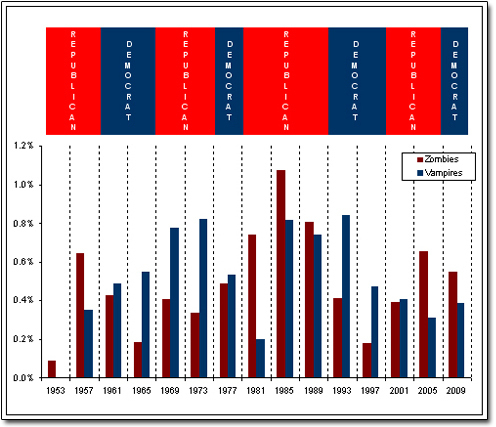
A good friend and colleague of mine recently sent me a link to the Cracked.com article “6 Mind-Blowing Ways Zombies and Vampires Explain America.” Basically, the article looks at the bizarre fact that Zombie movies are more likely to be made under Republican Presidents and Vampire movies are more likely to be made under Democratic Presidents, and argues rather persuasively it’s that each monster represents the cultures fears of the Party in power. Here’s a chart from the original article at Cracked.com.
The Cracked.com articles argument for why Zombies embody the country’s worst fears of Republicans is pretty simple. They’re mindless killing machines (see President George W. Bush). They have a rabid pack mentality leading them to consume (see anyone who seems to believe “The Free Market” and “God” are synonyms). And they’re bent on destroying minorities (the living). Now of course I have absolutely no idea where any of those ideas about Republicans came from, and am frankly shocked that anyone might think those things about our Conservative Opponents.
Cracked.com’s argument for why Vampires pique conservatives fears of Democrats is even simpler. Vampires are murderous immigrants from foreign sounding places like Transylvania (or Mexico). Once they arrive, vampires start seducing everyone pretty much indiscriminately as symbols of carnal lust (you think they tried to impeach Clinton over an affair? Nope, Vampire). And of course, more than anything, Vampires are leeches. Sure Dracula is after your blood and Democrats are after your tax dollars but in the Howard Jarvis Republican Party, I’m pretty sure taxes are scarier than bleeding out.
The author then goes on to identify other parties by the movie monsters they represent: Green Party = Werewolves; The American Independent/Constitution Party = Pod People; Lyndon LaRouche Supporters = The Creature from the Black Lagoon; Libertarians = Mummies.
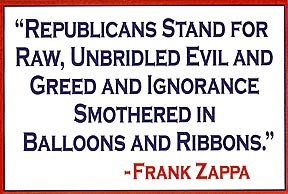
“As for the Republicans—–how can one regard seriously a frightened, greedy, nostalgic huddle of tradesmen and lucky idlers who shut their eyes to history and science, steel their emotions against decent human sympathy, cling to sordid and provincial ideals exalting sheer acquisitiveness and condoning artificial hardship for the non-materially-shrewd, dwell smugly and sentimentally in a distorted dream-cosmos of outmoded phrases and principles and attitudes based on the bygone agricultural-handicraft world, and revel in (consciously or unconsciously) mendacious assumptions (such as the notion that real liberty is synonymous with the single detail of unrestricted economic license or that a rational planning of resource-distribution would contravene some vague and mystical ‘American heritage’…) utterly contrary to fact and without the slightest foundation in human experience? Intellectually, the Republican idea deserves the tolerance and respect one gives to the dead.”
At Slate, Hanna Rosin called attention to something I wondered about while I was watching the video. Where were the white men?
On Tuesday, Slate and everyone else posted a video of a woman who is harassed more than 100 times by men as she walks around New York City for ten hours. More specifically, it’s a video of a young white woman who is harassed by mostly black and Latino men as she walks around New York City for ten hours. The one dude who turns around and says, “Nice,” is white, but the guys who do the most egregious things—like the one who harangues her, “Somebody’s acknowledging you for being beautiful! You should say thank you more,” or the one who follows her down the street too closely for five whole minutes—are not.
This doesn’t mean that the video doesn’t still effectively make its point, that a woman can’t walk down the street lost in her own thoughts, that men feel totally free to demand her attention and get annoyed when she doesn’t respond, that women can’t be at ease in a public space in the same way men can. But the video also unintentionally makes another point, that harassers are mostly black and Latino, and hanging out on the streets in midday in clothes that suggest they are not on their lunch break. As Roxane Gay tweeted, “The racial politics of the video are fucked up. Like, she didn’t walk through any white neighborhoods?”
Here’s the supposed explanation:
The video is a collaboration between Hollaback!, an anti-street harassment organization, and the marketing agency Rob Bliss Creative. At the end they claim the woman experienced 100 plus incidents of harassment “involving people of all backgrounds.” Since that obviously doesn’t show up in the video, Bliss addressed it in a post. He wrote, “we got a fair amount of white guys, but for whatever reason, a lot of what they said was in passing, or off camera” or was ruined by a siren or other noise. The final product, he writes, “is not a perfect representation of everything that happened.” That may be true but if you find yourself editing out all the catcalling white guys, maybe you should try another take.
But Rosin notes that Bliss has had similar issues in the past.
This is not the first time Bliss has been called out for race blindness. In a video to promote Grand Rapids, Michigan, he was criticized for making a city that’s a third minority and a quarter poor look like it was filled with people who have “been reincarnated from those peppy family-style 1970s musical acts from Disney World or Knott’s Berry Farm,” as a local blogger wrote.
Activism is never perfectly executed. We can just conclude that they caught a small slice of catcallers and lots of other men do it too. But if the point of this video is to teach men about the day-to-day reality of women, then this video doesn’t hit its target.
What started as an expose of the harassment women face in public has turned into fodder for death- and rape threats against the woman in the viral video….
“My nonverbal cues were saying, ‘Don’t talk to me.’ No eye contact. No friendly demeanor,” she said. “But they were ignoring my nonverbal cues.”
Roberts said the video is an accurate depiction of what she faces daily. For instance, there was a time when her grandfather died “and someone told me that they liked the way I looked.”
“It is all day long. It is every day,” she said. “That’s a typical day… It doesn’t matter what you wear.”
The 10 hours of footage was edited down to a 1:56 public service announcement for the anti-street harassment group Hollaback! It was shot by filmmaker Rob Bliss, who was wearing a hidden camera in his backpack.
“I have multiple experiences of sexual assault, which is why I wanted to be involved in this project,” Roberts said in a separate interview with HLN.
Also at CNN, Todd Leopold sort of misses the point, and wonders how men should approach women on the street. He quotes a 2010 piece by a woman named Katie Baker:
“There’s a huge difference between harassing a woman and trying to start a conversation,” she wrote. “Here are some tips: talk to her, not at her. Treat her with respect: be aware of her personal space, ask her how she’s doing or what she’s reading instead of commenting on her body parts, look at her face instead of her chest. If she ignores you, drops eye contact, or walks away, back off.
“It wasn’t rude of you to approach her, but she’s not being rude if she doesn’t want to keep talking to you, especially if you initiated conversation while she was running an errand, waiting for the bus, or on her computer at a coffee shop.”
But why do men feel they need to approach strange women at all? What if women did that to men?
Leopold also calls attention to a different kind of street harassment.
On the Reddit thread, which has drawn more than 6,500 comments, one man observed that lack of respect knows no gender.
“As a fat guy who once walked around NYC for a day sightseeing I got so many comments,” he wrote. “‘Lose weight, ass***e!’ ‘Hey fatty want me to buy you a hot dog?’ ‘Hey kill yourself you fat f***’ I would have been happy with just a ‘good morning.’ “
Personally, as I love to say “hello” to strangers out in public. I’m a Midwesterner by birth, and that’s just how we are–friendly and open. Usually they seem to like it, but if people ignore me, I don’t take offense.
So . . . what stories are you following today? Please share your links in the comment thread, and have a nice Thursday and a great Halloween!
Did you like this post? Please share it with your friends:
Extreme rainfall in much of the East and parts of the South is causing major problems, with Florida’s Panhandle and southern Alabama, which got more than 2 feet of rain in 24 hours, bearing the brunt of the onslaught….
In Pensacola, Fla., it was the single rainiest day ever recorded, and people climbed to rooftops or into attics to escape the rising floodwaters. NPR’s Debbie Elliot says Pensacola’s high bluffs over the bay undermined the busy scenic highway there.
“Scores of motorists were stranded as water gushed over roads,” she reports on Morning Edition. “At least one person was killed on a flooded roadway. Some homes are now flooded out, and entire neighborhoods are unnavigable. Boats have floated away from docks and are making landfall elsewhere.” ….
quotes Ben Kitzel, who paddled a kayak with Abby, his black Labrador retriever, on board: “There’s no way this flooding is going away anytime soon,” he told the newspaper.
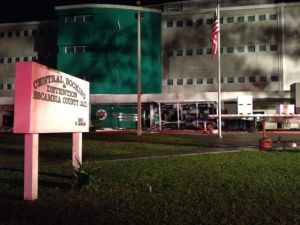
Late last night a gas explosion in a Pensacola, Florida jail killed two people and injured at more than 150 others. The explosion was likely linked to the flooding. ABC News:
Escamela County Jail, Pennsacola, FL
The explosion happened around 11 p.m. at the Escambia County Central Booking and Detention Facility in Pensacola, county spokeswoman Kathleen Dough-Castro said.
There’s no word at this point on whether the victims are inmates or guards, Pensacola Police Officer Maria Landy told ABC News Radio.
The injured – 155 inmates and guards in total – have been taken to area hospitals, most of them with minor injuries. About 600 uninjured prisoners were evacuated by bus and transferred to other detention facilities in the area, Dough-Castro said. No inmates are known to have escaped.
The heaviest rain has ended in the Northeast, but investigators and cleanup crews continue to deal with landslides in two separate states.
The largest of the two happened in Baltimore’s busy Charles Village neighborhood Wednesday, when a retaining buckled on 26th Street, sending cars and mud tumbling 75 feet onto CSX railroad tracks.
No one was injured but homes were evacuated so investigators could assess the area’s stability. Structural engineers placed markers along the road to monitor conditions….
The wet weather is also blamed for a mudslide on Metro-North train tracks in Yonkers, New York.
A street in the Charles Village neighborhood of Baltimore collapsed Wednesday, washing away cars and flooding CSX railroad tracks that run below street level.
Ian Brennan, a spokesman for the Baltimore fire department, said no injuries were reported.
One lane of the East 26th Street between North Charles and St. Paul streets collapsed about 4 p.m. and slid down an embankment leading to the tracks below. The cause of the collapse was unclear, but it came on a day that the region wasexperiencing heavy rainstorms.
Several streets were closed late Wednesday afternoon. St. Paul and Charles are major thoroughfares that are generally crowded during both the morning and evening commutes. The neighborhood is largely residential rowhouses. Traffic was reported to be snarled in the area of the collapse and downtown.
Brennan said no houses were damaged, but fire officials said many residents living along East 26th Street were ordered to leave until building inspectors can assess their properties.
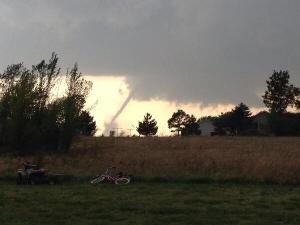
Something strange is happening with tornadoes lately in the United States and it’s baffling meteorologists. It’s either unusually quiet or deadly active.
Until this weekend’s outbreak, the U.S. had by far the quietest start of the year for tornadoes. By the beginning of last week, there had been only 20 significant tornadoes and none of them that big.
There was also a slow start four years ago. And after a busy January, last year was exceptionally quiet until a May outbreak that included a super-sized tornado that killed 24 people in Moore, Okla….
The 12-month period before last May set a record for the fewest significant tornadoes. But two years earlier, the nation also set a record for the most in 12 months.
Read about the possible causes at the link. And at National Geographic, see photos of destruction from recent tornadoes.
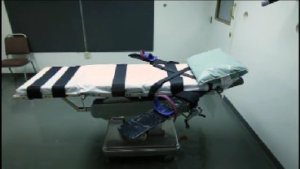
From The National Journal, The ‘Recipe for Failure’ That Led to Oklahoma’s Botched Execution — “Secret suppliers of drugs, changes in lethal-injection protocol, a cavalier attitude among Oklahoma officials, and a national death-penalty system in crisis preceded Tuesday’s failed execution.”
A battle of political wills over Oklahoma’s secretive lethal-injection protocol turned into a gruesome scene of macabre theater Tuesday evening, as the state botched the execution of one inmate and halted that of another scheduled later in the night.
The mishandling reflects the extraordinary and surreptitious lengths a handful of active death-penalty states are now willing to go to in order to continue their executions, capital-punishment opponents say, and represents just the latest episode in a string of disturbing events on Oklahoma’s death row in recent months.
Moreover, Oklahoma’s ongoing morass is a symptom of a national death-penalty system in crisis, a system that is finding it increasingly difficult to procure the drugs necessary to carry out death sentences amid boycotts from European manufacturers and reticence from licensed physicians.
You all know what happened.
Death-penalty opponents are now calling for Oklahoma to suspend all of its executions for the rest of the year to avoid another botched job. Gov. Mary Fallin, a Republican, has so far issued only a 14-day stay for Charles Warner, who was also scheduled to be put to death Tuesday night in the same room as Lockett just two hours later.
“Apparently they can conduct their entire investigation in two weeks,” Madeline Cohen, Warner’s defense attorney, told National Journal sarcastically.
In Oklahoma, as well as other places such as Texas and Missouri, states have turned to compounding pharmacies—where products are chemically crafted to fit an individual person’s needs—to produce the lethal cocktails. But these stores, which are not subject to strict oversight by the Food and Drug Administration, don’t want to be publicly associated with executions. In response, states have granted them anonymity, and their identity remains a mystery even to the attorneys representing the death-row inmates.
The secrecy-shrouded, botched execution in Oklahoma on Tuesday couldn’t happen the same way in California, where state laws and regulations require public disclosure of the drugs used in lethal injections, where they come from and how they are administered.
But the agony of a dying murderer and other death penalty developments underscore the multiple problems besetting capital punishment in California, where executions have been put on hold until courts find no significant prospect of a nightmare like the one that unfolded Tuesday night.
The state, whose Death Row is the nation’s largest, has not executed anyone since 2006 because of federal court rulings arising from executions in which the prisoner appeared to remain conscious longer than expected, and from ill-defined procedures and inadequate staff training. State officials are making their third attempt to rewrite the rules for lethal injections to include safeguards that would satisfy the courts.
Why don’t these folks just give it up? Life imprisonment is cheaper and a bad enough punishment.
With the Republican-led filibuster of a Senate proposal to raise the federal minimum wage to $10.10 on Wednesday, Democrats moved swiftly to frame the vote as an example of the gulf that exists between the two parties on matters of economic fairness and upward mobility.
The question is not just one of money, they said, but of morality. And in doing so the Democrats returned to the themes that were successful for their party and President Obama in 2012 when they convinced swing voters that Democrats were mindful of the best interests of all Americans — not just those who are powerful and wealthy.
Speaking from the White House shortly after the measure was defeated 54 to 42, with 60 votes needed to advance, Mr. Obama admonished Republicans and called on voters to punish them at the polls in November. “If there’s any good news here, it’s that Republicans in Congress don’t get the last word on this issue, or any issue,” Mr. Obama said. “You do, the American people, the voters.”
Despite the Republicans’ efforts to damage the economy and sentence millions of Americans to a lifetime of poverty and struggle, “experts” (meaning Nate Silver) are predicting that the GOP will take control of the Senate in 2014. And other “experts” are arguing with the guy who was almost perfect in 2012. For example,
And AB Stoddard of The Hill says lots of Dem candidates are “on thin ice.”
I’ll tell you how I’m dealing with this controversy. I refuse to read the articles. There nothing I can do about it so why get all upset? It’s the Scarlett O’Hara defense. After all, tomorrow is another day.
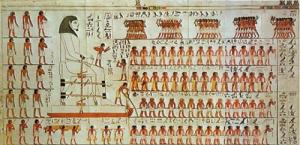
Physicists from the FOM Foundation and the University of Amsterdam have discovered that the ancient Egyptians used a clever trick to make it easier to transport heavy pyramid stones by sledge. The Egyptians moistened the sand over which the sledge moved. By using the right quantity of water they could halve the number of workers needed. The researchers published this discovery online on 29 April 2014 in Physical Review Letters.
For the construction of the pyramids, the ancient Egyptians had to transport heavy blocks of stone and large statues across the desert. The Egyptians therefore placed the heavy objects on a sledge that workers pulled over the sand. Research from the University of Amsterdam has now revealed that the Egyptians probably made the desert sand in front of the sledge wet. Experiments have demonstrated that the correct amount of dampness in the sand halves the pulling force required. The physicists placed a laboratory version of the Egyptian sledge in a tray of sand. They determined both the required pulling force and the stiffness of the sand as a function of the quantity of water in the sand. To determine the stiffness they used a rheometer, which shows how much force is needed to deform a certain volume of sand.
Experiments revealed that the required pulling force decreased proportional to the stiffness of the sand. Capillary bridges arise when water is added to the sand. These are small water droplets that bind the sand grains together. In the presence of the correct quantity of water, wet desert sand is about twice as stiff as dry sand. A sledge glides far more easily over firm desert sand simply because the sand does not pile up in front of the sledge as it does in the case of dry sand.
The Egyptians were probably aware of this handy trick. A wall painting in the tomb of Djehutihotep clearly shows a person standing on the front of the pulled sledge and pouring water over the sand just in front of it.
Now what stories are you following today? Please share your links in the comment thread.
Did you like this post? Please share it with your friends:
The Sky Dancing banner headline uses a snippet from a work by artist Tashi Mannox called 'Rainbow Study'. The work is described as a" study of typical Tibetan rainbow clouds, that feature in Thanka painting, temple decoration and silk brocades". dakinikat was immediately drawn to the image when trying to find stylized Tibetan Clouds to represent Sky Dancing. It is probably because Tashi's practice is similar to her own. His updated take on the clouds that fill the collection of traditional thankas is quite special.
You can find his work at his website by clicking on his logo below. He is also a calligraphy artist that uses important vajrayana syllables. We encourage you to visit his on line studio.










 peej
peej Carissa
 bostonboomer
 dakinikat
 ecocatwoman
 mablue2
 Mama Lopez
 peggysue22
 quixote
 skydancingguestblogger
 Mona (aka Wonk the Vote)



 Sky Dancing
Recent Comments