Geoff Bennett:
So, first, let’s start with a bit of a reality check. How feasible is it for Donald Trump to fundamentally change the autonomy of the Fed and change the relationship between the Federal Reserve and the president if he is reelected?


“Jobs, jobs, Jobs!” John Buss, @johnbuss.bsky.social
Regime changes haven’t happened yet, but businesses are already planning major layoffs, freezes, and price increases. That signals a type of economy we haven’t seen for a while. It’s called stagflation. For those of us who lived through that, you’ll remember the pain that went from the Nixon years to the Reagan years. It includes painful unemployment and rabid inflation. We just have to hope that the plans to take political control of the Fed don’t come to fruition. The current Fed Chair says he will not resign. That doesn’t even include the conversation about the massive removal of Federal workers and the deportation of the migrants that would have a devastating impact on the farm and most service industries.
Did I use enough citations for you? Let’s look at a few of them but I’ll get to the bottom line. Pay off all your debt as much as possible. Don’t take on anything that requires financing. Interest rates will go up as inflation returns. The entire thing is a vicious circle we learned much about in the 1970s. The 1980s taught us that tax cuts for the rich only drive up the deficit. Get ready for a repeat of that on steroids.
Traditional Republicans have always been migrant-friendly. However, that’s back when they were more focused on getting the business donors enriched and less worried about things like “poisoning the blood” and blaming them for statistically nonexistent problems, like crime and eating pets. However, that was before the rise of the Christofascists and the NAZIs ushered in MAGA.
The Brookings Institute reviewed recent peer-reviewed research in economics in September that shows exactly how devastating the cost of these deportations will be. That does not even cover the psychological and emotional trauma to communities forced to witness the round-up of their neighbors to massive concentration camps. This is a must-read. Chloe East is the researcher.
Increased deportation is associated with poorer economic outcomes for US-born workers
Across multiple studies, economists have found that once SC is implemented, the number of foreign-born workers in that county declines and the employment rate among U.S.-born workers also declines. My research with Annie Hines, Philip Luck, Hani Mansour, and Andrea Velásquez finds that when half a million immigrants are removed from the labor market because of enforcement (due to deportations and indirectly due to chilling effects), this reduces the number of U.S.-born people working by 44,000.
Why do deportations hurt the economic outcomes of U.S.-born workers? The prevailing view used to be that foreign-born and U.S.-born workers are substitutes, meaning that when one foreign-born worker takes a job, there is one less job for a U.S.-born worker. But economists have now shown several reasons why the economy is not a zero-sum game: because unauthorized immigrants work in different occupations from the U.S.-born, because they create demand for goods and services, and because they contribute to the long-run fiscal health of the country.
First, unauthorized immigrant workers and U.S.-born workers work in different types of jobs. Figure 1 shows the percentage of unauthorized immigrant workers, authorized immigrant workers, and U.S.-born workers that are in each of the 15 most common occupations among unauthorized immigrants.
It is clear that unauthorized immigrants take low-paying, dangerous and otherwise less attractive jobs more frequently than both U.S.-born workers and authorized immigrant workers. For example, almost 6% of unauthorized immigrants work as housekeepers, construction laborers, or cooks, compared to about 2% of authorized immigrant workers and 1% of U.S.-born workers (See Figure 1).
Occupations common among unauthorized workers, such as construction laborers and cooks, are essential to keep businesses operating. Deporting workers in these jobs affects U.S.-born workers too. For example, when construction companies have a sudden reduction in available laborers, they must reduce the number of construction site managers they hire. Similarly, local restaurants need cooks to stay open and hire for other positions like waiters, which are more likely to be filled by U.S.-born workers.
Caregiving and household service jobs are also common among unauthorized immigrants. The availability and cost of these services in the private market greatly impacts whether people can work outside the home. My research with Andrea Velásquez and new research by Umair Ali, Jessica Brown and Chris Herbst find that Secure Communities impacted the childcare market—the supply of childcare workers fell. This led to a reduction in the number of college-educated mothers with young children working in the formal labor market.
 You’ll notice women bear the brunt of this policy, but it goes nicely into the plan to get women back into the kitchen. Please read about the impact of the deportation in 2008 that happened in South Carolina, called the SC Act or Secure Communities Act. The details are gruesome but here’s the bottom line in a move to deport 400,000 people in a limited area.
While only people who were arrested had their immigration status checked under SC, the policy nonetheless impacted a large portion of immigrants. There were broad “chilling effects” of the policy that meant even people not targeted for deportation became fearful of leaving their house to do routine things like go to work. This is partly because the program did not only target serious criminals—the most serious criminal conviction for 79% of those deported was non-violent, including traffic violations and immigration offenses, and another 17% were not convicted of any crime.
An article that appeared in Mother Jones, also last September, details the devastation that will come if mass deportation happens. Isabela Diaz provides the analysis. “How Trump’s “Mass Deportation” Plan Would Ruin America. It would be brutal, costly, and likely illegal.”
This time around, they plan to invoke an infamous 18th-century wartime law, deploy the National Guard, and build massive detention camps—and intend on reshaping the federal bureaucracy to ensure it happens, drafting executive orders and filling the administration with loyalists who will quickly implement the policies. “No one’s off the table,” said Tom Homan, the former acting director of US Immigration and Customs Enforcement (ICE) under Trump. “If you’re in the country illegally, you are a target.”
If Trump and his allies have it their way, armed troops and out-of-state law enforcement would likely blitz into communities—knocking on doors, searching workplaces and homes, and arbitrarily interrogating and arresting suspected undocumented immigrants. The dragnet would almost certainly ensnare US citizens, too.
The nation’s undocumented immigrants grow and harvest the food we eat, construct our homes, and care for our young and elderly. They pay billions in taxes, start businesses that employ Americans, and help rebuild in the wake of climate disasters.
Not only would Trump’s plan rip families and communities apart, but it also would have devastating effects for years to come, including on US citizens who perhaps have overlooked how integral undocumented immigrants are to their everyday life. Trump frames immigration as an existential threat to the United States. He has said immigrants are “taking our jobs,” are “not people,” and are “poisoning the blood of our country.” The reality is that if his plan were implemented, American life as we know it would be ruined—even for those cheering for mass deportation.
 This will be in the hands of many of the folks who say they’re Christians but miss a major cultural value in both the Old and New Testaments. I was raised Presbyterian, attended my best friend’s Lutheran Church, baptized my girls in the Methodist church, and taught a large number of Sunday School classes. I’m not unfamiliar with the Bible. Matthew was my favorite of all. Whenever you ask me about my favorite verses, I’ll quote the Beatitudes and anything from Matthew or James. Trump is an actor, and his piety display is just an act.
Matthew 25:31-40Jesus says, “I was a stranger, and you welcomed me,” and “Truly, I say to you, as you did it to one of the least of these my brothers, you did it to me.”
Numbers 15:16The Bible says, “I am the Lord, and I consider all people the same, whether they are Israelites or foreigners living among you”.
Here’s a study cited in the Mother Jones article.
According to a 2016 report by the Center for American Progress, deporting 7 million workers would “reduce national employment by an amount similar to that experienced during the Great Recession.” GDP would immediately contract by 1.4 percent, and, eventually, by 2.6 percent. In 20 years, the US economy would shrink nearly 6 percent—or $1.6 trillion. Trump’s plan would lead to a dire shortage of low-wage workers, which would “bring on a recession while reigniting inflation,” predicts Robert J. Shapiro, a former undersecretary of commerce in the Clinton administration.

The costs of mass deportation will be devastating. Here is another study on the costs from The American Immigration Council.
“Using data from the American Community Survey (ACS) along with publicly-available data about the current costs of immigration enforcement, this report aims to provide an estimation of what the fiscal and economic cost to the United States would be should the government deport a population of roughly 11 million people who as of 2022 lacked permanent legal status and faced the possibility of removal. We consider this both in terms of the direct budgetary costs—the expenses associated with arrest, detention, legal processing, and removal—that the federal government would have to pay, and in terms of the impact on the United States economy and tax base should these people be removed from the labor force and consumer market.
In terms of fiscal costs, we also include an estimate of the impact of deporting an additional 2.3 million people who have crossed the U.S. southern border without legal immigration status and were released by the Department of Homeland Security (DHS) from January 2023 through April 2024. We consider these fiscal costs separately because we don’t have more recent ACS data necessary to estimate the total net changes in the undocumented population past 2022, or the larger impact on the economy and tax base of removing those people, an impact that is therefore not reflected in this report.
In total, we find that the cost of a one-time mass deportation operation aimed at both those populations—an estimated total of is at least $315 billion. We wish to emphasize that this figure is a highly conservative estimate. It does not take into account the long-term costs of a sustained mass deportation operation or the incalculable additional costs necessary to acquire the institutional capacity to remove over 13 million people in a short period of time—incalculable because there is simply no reality in which such a singular operation is possible. For one thing, there would be no way to accomplish this mission without mass detention as an interim step. To put the scale of detaining over 13 million undocumented immigrants into context, the entire U.S. prison and jail population in 2022, comprising every person held in local, county, state, and federal prisons and jails, was 1.9 million people.
In order to estimate the costs of a longer-term mass deportation operation, we calculated the cost of a program aiming to arrest, detain, process, and deport one million people per year—paralleling the more conservative proposals made by mass-deportation proponents. Even assuming that 20 percent of the undocumented population would “self-deport” under a yearslong mass-deportation regime, we estimate the ultimate cost of such a longer operation would average out to $88 billion annually, for a total cost of $967.9 billion over the course of more than a decade. This is a much higher sum than the one-time estimate, given the long-term costs of establishing and maintaining detention facilities and temporary camps to eventually be able to detain one million people at a time—costs that could not be modeled in a short-term analysis. This would require the United States to build and maintain 24 times more ICE detention capacity than currently exists. The government would also be required to establish and maintain over 1,000 new immigration courtrooms to process people at such a rate.”
How’s that for dismantling the state and getting rid of Federal Workers? It sounds like a bit of hypocrisy to me.
There’s that stagflation prognosis again. That was the time of the economy in 1980 when I got my first house fixed rate loan at 16.7%, which was only one of three mortgage loans made that month at the largest Savings Loan in the heartland. I worked there so they gave me a discount down to 12%. Let’s see all those young people trying to buy their houses in that environment. My loan now is fixed at 3%. Thank you, Obama!
One of the worst possible things that could happen is allowing politics back into Fed Policy. This was a problem that was fixed by law because obvious presidential interference generally led to low interest rates that brought more inflation. I have purposefully used a conservative-bent economist for this analysis. “The Economic Consequences of Political Pressure on the Federal Reserve.” Elonia is hot for this pogrom. Tell me again, who thinks that Nepobaby is brainy? Again, if you lived through the dread of Nixon’s years, you’ll remember the inflation he brought trying to get the Fed to loosen interest rates during a period of inflation. It wasn’t pretty.
The data on personal interactions by themselves are at best a noisy measure of political interference with the Fed. For example, in a recession the president might be more likely to contact the Fed chair and ask them about their view on the economy. In this instance, personal interactions would increase, but not because they reflect political pressure.
To overcome this identification challenge, I exploit an increase in president–Fed interactions that plausibly took place purely for the purpose of influencing Fed policy and arguably had an impact on the stance of monetary policy. In his desire to be re-elected in 1972, Richard Nixon pressured Arthur Burns to ease monetary policy in 1971. Burns, a Republican and friend to Nixon, reportedly gave in to Nixon’s pressure.
A variety of external evidence corroborates this interpretation of the Nixon–Burns clash, including recordings from the “Nixon tapes” and entries in Arthur Burns’ personal diary. For example, Burns writes in his diary that Nixon urged him “start expanding the money supply and predicting disaster if this didn’t happen.” To support the interpretation that Burns eased policy in response to Nixon’s pressure, I show that Romer and Romer (2004) uncover easing shocks to monetary policy prior to Nixon’s re-election. I also present supporting evidence from the voting behavior of the FOMC.
I exploit the narrative around Nixon’s pressure in a structural vector autoregression (SVAR) that contains the president–Fed interactions as well as standard macro data. I identify a shock to political pressure on the Fed based on narrative sign restrictions. Specifically, I define a political pressure shock as an increase in president-Fed interactions that eases policy in an inflationary way and constitutes the main contributor to the spike in president–Fed interactions in late 1971.
Yes. This is the kind of thing I do for my research. Just go look at the graphs. They speak volumes.
The number of president–Fed interactions displays persistence after the political pressure shock hits, with the IRF reversing to closes 0 after around two years. The shock induces a monetary easing, with a roughly 100 basis points lower interest rate after a few quarters. The price level response to the shock builds up gradually and persistently and reaches a 5% higher price level after four years. These estimates imply that exerting political pressure 50% as much as Nixon did, over a period of six months, permanently increases the US price level by more than 8%.
The responses of real GDP and fiscal variables are not distinguishable from zero. This finding indicates that political pressure primarily induces a price level effect. It turns out that in some subsamples (not shown here), it is possible to detect a significant response of real GDP, but this response is actually negative.

This cartoon is actually from the American Enterprise Institute. This shows you have far Republican Politicians have actually gotten from actual Economics.
That’s a dismal scientist telling you that all hell breaks loose whenever an American President tries to influence the Fed. Nixon wanted to win the reelection and pressured the Fed to drop interest rates, which caused massive inflation. eventually, we got unemployment, and that’s stagflation. That’s what poor Jimmy Carter inherited. The Tax Cuts for the Rich narrative through the Reagan years was even worse. I was studying economics at the time and became an economic analyst for that Savings and Loan that went bankrupt because of that policy. (I surprised them with that data, the first of many times I was the brains of a clueless CEO.) When the Reagan administration pulled off the usury laws, we got a financial crisis in 1984, which later looked mild compared to the one Dubya brought on in 2008, also known as the SubPrime Crisis.
NPR unravels the plan that Trump has to control the Fed. “How Trump’s wish for more Federal Reserve control could impact economy if he’s reelected.”
Geoff Bennett:
So, first, let’s start with a bit of a reality check. How feasible is it for Donald Trump to fundamentally change the autonomy of the Fed and change the relationship between the Federal Reserve and the president if he is reelected?
Krishna Guha:
Well, it’s complicated.
So, first off, for President Trump, if reelected, could certainly let his views on monetary policy be known loudly and including through social media and other nonconventional channels. He could try to do what’s called jawboning, leaning on the Fed in public to take certain actions on interest rates.
Actually changing the institutional independence of the Fed, that’s more challenging. The Fed’s independence is enshrined in the act of Congress the Federal Reserve Act, and that makes the chairman, for instance, removable as generally understood, only for a cause, which would mean something pretty extreme to make him unfit for office.
The president can’t simply appoint additional members to the Federal Reserve Board. He’d have to wait until vacancies became available and those only become available very slowly. So it would be tough. Now, there is one complication, and that is that it is somewhat unsettled as to what the exact legal status of the Fed chair is and whether the president might have some legal grounds for being able to dismiss a Fed chair.
That’s not something that I think any mainstream lawyer or central banker believes is right, but it hasn’t been fully tested in the courts. And so there’s some outside possibility that the president could attempt to assert an authority over the Fed chair that has not been understood to be there.
Geoff Bennett:
If we look to other countries or look back in this country’s own history, what does it tell us? Does a Central Bank that remains independent from political influence, does that yield better monetary policy and better macroeconomic decision-making?
Krishna Guha:
There’s just very, very strong evidence from the U.S. itself and from countries around the world that independent central banks tend to achieve better economic outcomes.
And that ultimately doesn’t just benefit society, doesn’t just benefit the economy. It, in the end, tends to benefit the president as well. And so I think there’s actually a lot of good reason why it would be not to try to assault the independence of the Central Bank.
Geoff Bennett:
Critics have blasted the Fed for being too slow to respond to inflation. And there will certainly be folks who say, why is it such a bad thing to have the Fed accountable to someone, accountable to the executive branch?
Krishna Guha:
So, you raise a really important issue there, Fed accountability.
Now, Fed officials past and present will say, absolutely, the Fed must be accountable. But under our system of government, the Fed is accountable to Congress, not the executive branch. The Fed is a creature of Congress. The Fed chair goes to Congress to testify. He’s grilled by members of the Senate. He’s grilled by members of the House.
That is the way that our system of accountability is set up. And it’s the way that it’s worked very well in recent decades. That doesn’t mean that the Fed is always going to get everything right. Of course not. The issue is simply, would you have more confidence that the Fed would get things about right most of the time if it was more insulated from short-term political pressures, or do you think that political pressures are going to make them do a better job?
I think most people have a pretty intuitive grasp of what the answer to that question would be.
 Again, Powell says he will not resign. That gives us about another year where monetary policy can offset this craziness. This is from CBS. “Fed Chair Jerome Powell says he won’t resign if Donald Trump asks him to step down.”
Federal Reserve Chair Jerome Powell said he won’t step down if President-elect Donald Trump, who has previously criticized Powell’s performance, asks him to resign.
Speaking at a press conference Thursday to discuss the Fed’s move today to cut its benchmark interest rate by 0.25 percentage points, Powell added that it is not permitted under the law for presidents to fire or demote the Fed chair.
When asked if he’d step down if Trump requested it, Powell responded with a one-word answer: “No.”
Powell’s insistence that he’ll remain in his role comes after Trump aired grievances about the Fed’s decision-making during his first presidency and, more recently, on the campaign trial. Trump, who has accused Powell of being “political,” also told Bloomberg Businessweek this summer he would let the economist serve out his term, “especially if I thought he was doing the right thing.”
Yet Trump has also said he thinks the U.S. president should have more influence on Fed decisions.
Are you asleep yet or is your hair on fire like mine? And again, here are the massive layoffs and hiring freezes now planned for 2025. “A running list of companies preparing to raise prices if Trump’s trade plan is enacted.” This is from Business Insider. The analysis is provided by Ayelet Sheffey. It’s from a few days ago.
President-elect Donald Trump proposed broad tariffs on imports, including up to 60% on goods from China.
Economists say his proposals could spike inflation as companies tend to pass costs on to shoppers.
Some companies have already said increased tariffs would lead them to raise prices.
Some executives have warned that price hikes are on the way if President-elect Donald Trump’s trade plans go into effect.
On the campaign trail, Trump proposed a 60% tariff on goods imported from China coupled with a 10% to 20% tariff on goods imported from other countries. While the president-elect could choose not to enact tariffs at that scale once he assumes office, economists and the market have predicted that his proposals would spike inflation and cause the Federal Reserve to raise interest rates.
Several companies have already begun responding to Trump’s election victory and the implications his tariff proposals would have on the costs of their goods. Executives have told analysts on earnings calls that it would be difficult to maintain current prices under Trump’s broad tariffs.
Other companies are still waiting for more information from the president-elect. Tarang Amin, the CEO of ELF Beauty, told Business Insider that the company must first see the policy Trump enacts before making any changes to its pricing and that a new policy wouldn’t affect the business until after its 2025 fiscal year.
“We don’t like tariffs because they are a tax on the American people,” Amin said, adding that the company had been subject to a 25% tariff since 2019 because of policies from Trump’s first term. “And at that time,” he said, “we pulled all the levers available to us to minimize the effects to our company and our community.”
Karoline Leavitt, a Trump-Vance transition spokeswoman, told BI: “In his first term, President Trump instituted tariffs against China that created jobs, spurred investment, and resulted in no inflation.” She added that Trump will “work quickly” to lower taxes and create more American jobs.
Below are the companies that are warning of price increases if Trump’s tariff proposals are implemented.
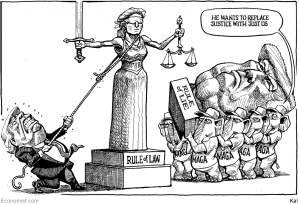 Before I went completely into economics, I was a history major. We’ve done this before. The Smoot-Hawley Tariff Act of 1930 raised import duties on more than 20,000 goods and agricultural imports to protect U.S. businesses and farmers. Hoover signed it into law. It made the Great Depression worse. Don’t these whackadoodle schools teach History and Civics anymore?
Before every major recession we’ve had since 1984, I’ve always found myself running around going what are these idiots smoking? I’ve fled to safety and minimized my losses. Ronald Reagan’s folly basically wiped out my first IRA and my Dad’s retirement portfolio. But, I always did better than everyone else because if you’re just an economics teacher living a normal life and not privy to all the insider muckety muck, you do that. I remember the manager for my Louisiana 403B was amazed I held my losses to a lower percentage than anyone else at the USL. I was not amused. A loss is a loss, and I’m definitely paying for those years now as I was then.
Just buckle up. This is going to be a very chaotic ride. Prepare for the worst. Again, the best thing you can do is pay the debt off and not add any more, if possible. I am also expanding my small food garden and orchard. I’m not sure if Congress is up to the test of its checks and balances, so this is not looking good. Also, remember how long it took to get out of Nixon’s mess. We really didn’t recover completely until the Clinton years.
The two pieces of news we also have today is that Matt Gaetz quit the AG cabinet appointment. He says he’s not going back to Congress. Speculation is that he will still have a political appointment in the administration, just one that doesn’t take Senate approval. Pam Bondi, who he once bribed to stop her from filing a suit against his phony university and who is basically one of his personal attorneys is now the nominee.
What’s on your reading and blogging list today?

Evil clown Trump
I had another sleepless night last night. It seems as if I have insomnia every 2-3 days; then I end up feeling exhausted for a couple of days and having to take naps to make up for the lost sleep. Of course it’s Trump’s fault. I didn’t sleep well during his first term, and now that I know what to expect–chaos, drama, and malevolence–I’m pretty sure my sleep will continue to be disturbed. Anyway, I don’t have much energy today. I just hope I don’t fall asleep on my computer keyboard.
Here’s the latest on Trump’s nightmarish Cabinet picks.
Josh Gerstein at Politico: Vance says Trump is interviewing FBI director replacements.
President-elect Donald Trump’s plans to end business-as-usual at the Justice Department apparently include replacing FBI Director Christopher Wray, Vice President-elect JD Vance indicated in a social media post on Tuesday.
Vance revealed he and the president-elect were conducting interviews for the crucial FBI position in a since-deleted post on X. The post was responding to criticism the vice president-elect received for missing a Monday Senate vote that confirmed one of President Joe Biden’s judicial nominees to the Atlanta-based 11th Circuit Court of Appeals.
“When this 11th Circuit vote happened, I was meeting with President Trump to interview multiple positions for our government, including for FBI Director,” Vance wrote. “I tend to think it’s more important to get an FBI director who will dismantle the deep state than it is for Republicans to lose a vote 49-46 rather than 49-45. But that’s just me.”
Trump nominated former federal prosecutor and Justice Department official Christopher Wray as FBI director in 2017 after abruptly firing his predecessor, James Comey.
However, in recent years, Trump and many in his orbit have soured on Wray, alleging that he hasn’t done enough to root out alleged corruption and political bias at the law enforcement agency. They also fault Wray for allowing his agents to participate in the court-ordered search at Mar-a-Lago in August 2022 that led to Trump’s prosecution on charges of hoarding classified documents and obstruction of justice.
It’s looking like Trump will nominate Kash Patel as FBI director. Patel is the guy who defended Trump in the stolen documents scandal, claiming that Trump could declassify any document by just thinking about it.
Hugo Lowell at The Guardian: Trump loyalist Kash Patel in contention to be named FBI director.
Donald Trump is keeping his controversial adviser Kash Patel in the running to be the next FBI director, according to two people familiar with the matter, as the transition team conducted interviews for the role on Monday night at the president-elect’s Mar-a-Lago club.
The existence of the interviews, made public in a since-deleted post by the vice president-elect JD Vance, underscored the intent to fire the current FBI director, Christopher Wray, years before his current term is up….
Trump has a special interest in the FBI, having fired James Comey as director in 2017 over his refusal to close the investigation into possible collusion between the Trump campaign and Russia, and then complaining about perceived disloyalty from Wray.
Clown Torture by Bruce Nauman
Patel’s continued position as a top candidate for the role makes clear Trump’s determination to install loyalists in key national security and law enforcement positions, as well as the support Patel has built up among key Trump allies.
The push for Patel – who has frequently railed against the “deep state” – has come from some of the longest-serving Trump advisers, notably those close to former Trump strategist Steve Bannon, a faction that got Trump’s personal lawyers picked for top justice department roles.
That faction has also suggested to Trump in recent days that if Patel gets passed over for the director role, he should be given the deputy FBI director position, one of the people said – a powerful job that helps run the bureau day to day and is crucially not subject to Senate confirmation.
Click the link to read more about Patel. Basically, he’s a whack job and utterly loyal to Trump.
As everyone knows Trump has nominated Matt Gaetz for Attorney General. Here’s the current drama over the pick.
NOTUS: Trump Is Calling Senators on Behalf of Matt Gaetz. It’s Not Going Well.
As Republicans circle the wagons around Matt Gaetz and his nomination to be attorney general, Donald Trump and his surrogates have started calling GOP senators to feel them out on the confirmation battle.
The calls are not going well.
According to three sources familiar with the conversations, Trump and his team are receiving an overwhelmingly negative reaction with regard to Gaetz. One of the sources told NOTUS that multiple senators have even told Trump and his team they won’t be voting to confirm.
There has been a healthy amount of skepticism about Gaetz becoming attorney general since the moment Trump announced his nomination. But the recent controversy over an Ethics Committee report that Gaetz dodged by resigning from Congress has only compounded the problems.
“This fake news will age poorly when Matt Gaetz is sworn in as the Attorney General,” said Alex Pfeiffer, a Trump transition spokesperson.
Given the conversations, there’s growing doubt that Gaetz can actually be confirmed — either by the Senate or through a recess appointment.
“Matt Gaetz is toxic among House Republicans. Among Senate Republicans, he is radioactive,” one of the sources told NOTUS.
GOP senators themselves have intimated that Gaetz will have to go through the normal confirmation process and they have expressed that to Trump.
Will Steakin at ABC News: Gaetz sent over $10K in Venmo payments to 2 women who testified in House probe, records suggest.
The House Ethics Committee obtained records, including a check and records of Venmo payments, that appear to show that then-Rep. Matt Gaetz paid more than $10,000 to two women who were later witnesses in sexual misconduct probes conducted by both the House and the Justice Department, according to documents obtained by ABC News.
The Venmo records show that between July 2017 and late January 2019, Gaetz — who was first elected in 2016 — allegedly made 27 Venmo payments totaling $10,224.02 to the two witnesses, who were over the age of 18 at the time.
Scary Clown, by Jennifer Anthony
The payments, which sources said were displayed during closed-door testimony, ranged from $100 to more than $700 each….
ABC News previously reported that House investigators had subpoenaed Venmo for Gaetz’s records and had been showing them to witnesses, asking if they were for sex or drugs. The Venmo records totaling over $10,000 in payments were shown to the witnesses, who testified that some of the payments were from Gaetz and were for sex, a source familiar with the investigation told ABC News.
Gaetz, who was tapped last Wednesday by President-elect Donald Trump to serve as attorney general in the incoming administration, resigned from the House immediately following Trump’s announcement, just days before the House Ethics Committee was to set to consider releasing a report on its investigation into the Florida congressman, according to sources.
Michael Kaplan at CBS News: “Unknown and unauthorized third party” has gained access to Matt Gaetz depositions, source says.
An “unknown and unauthorized third party” has gained access to two dozen depositions of witnesses tied to the various investigations into former Rep. Matt Gaetz of Florida, CBS News has learned.
The leaked materials are part of a civil defamation case filed by Chris Dorworth, a lobbyist who is close to Gaetz. These materials include the sworn deposition of the minor with whom Gaetz allegedly had sex.
According to a source familiar with the matter and an email viewed by CBS News, the person who gained access went by the name “Altam Beezley.” [….]
Gaetz was under investigation by the House Ethics Committee and Justice Department, though federal prosecutors declined to bring charges against him last year. The Ethics panel was looking into allegations the former congressman engaged in sexual misconduct and illicit drug use, among other accusations….
An “unknown and unauthorized third party” has gained access to two dozen depositions of witnesses tied to the various investigations into former Rep. Matt Gaetz of Florida, CBS News has learned.
The leaked materials are part of a civil defamation case filed by Chris Dorworth, a lobbyist who is close to Gaetz. These materials include the sworn deposition of the minor with whom Gaetz allegedly had sex.
According to a source familiar with the matter and an email viewed by CBS News, the person who gained access went by the name “Altam Beezley.” [….]
Gaetz was under investigation by the House Ethics Committee and Justice Department, though federal prosecutors declined to bring charges against him last year. The Ethics panel was looking into allegations the former congressman engaged in sexual misconduct and illicit drug use, among other accusations. But Gaetz resigned his seat in the House last week after President-elect Donald Trump announced he had selected the Florida Republican to serve as his attorney general….
Because Gaetz is no longer a House member, the Ethics Committee’s jurisdiction over him has ended.
At The New York Times, Maggie Haberman and Jonathan Swan have a theory about why Trump is offering so many insane candidates: Gaetz May Not Be Confirmed, Trump Admits. He’s Pushing Him and Others Anyway.
In his private conversations over the past few days, President-elect Donald J. Trump has admitted that his besieged choice for attorney general, Matt Gaetz, has less than even odds of being confirmed by the Senate.
But Mr. Trump has shown no sign of withdrawing the nomination, which speaks volumes about his mind-set as he staffs his second administration. He is making calls on Mr. Gaetz’s behalf, and he remains confident that even if Mr. Gaetz does not make it, the standard for an acceptable candidate will have shifted so much that the Senate may simply approve his other nominees who have appalled much of Washington.
Clown, by Rosy Fernandez-Diaz
Mr. Trump’s choice to lead health and human services has made baseless claims about vaccines. His selection for defense secretary is a former Fox News host whose leadership experience has been questioned. His nominee for the director of national intelligence is a favorite of Russian state media.
Presidents do not normally approach cabinet selections this way. Historically, they work with their teams to figure out in advance what the system will tolerate, eliminating the possibility that skeletons in the closet of a nominee might emerge during Senate hearings.
Mr. Trump largely followed this risk-averse approach at the start of his first term. He appointed people like the four-star general Jim Mattis, who was confirmed with a 98-to-1 bipartisan vote to be Mr. Trump’s first defense secretary.
But this time, emboldened by victory and the submission of the Republican Party, Mr. Trump is innovating. He is using an approach that has been discussed in the past for judicial nominees, which is nominating so many extreme choices that they cannot all be blocked. The strategy has never been used for cabinet picks.
It is possible that enough Republican senators are willing to risk their careers to oppose Mr. Gaetz, although it is unclear what the backup plan would be should Mr. Gaetz falter. Mr. Trump’s personal lawyer and pick for deputy attorney general, Todd Blanche, is seen as a possibility.
For a deep dive on Trump’s plans for the DOJ, check out this post by Liz Dye at Public Notice: Trump’s corruption of the DOJ goes much deeper than Gaetz.
Donald Trump’s nomination of Matt Gaetz as attorney general is a giant middle finger to anyone who believes in the rule of law. But his nominees for other key Justice Department positions may be both more consequential and potentially more dangerous for democracy.
That’s partly because Gaetz is a lazy fool who never tried a federal criminal case and is functionally a “liberal tears” meme made flesh. It’s not that he’s too stupid to be dangerous — he’s clearly going to do his damnedest to prosecute Trump’s enemies. It’s that he’s exactly the kind of venal wastrel who publicly Venmos women for sex. He’s not the type who is going to hunker down and do the hard work of overturning democracy.
Gaetz is the polar opposite of Jeff Sessions and Bill Barr, Trump’s first-term AGs, both of whom felt at least some fealty to civic institutions and the rule of law. Sessions had been a US attorney in Alabama, the Alabama AG, and and US senator. Barr was attorney general in the first Bush administration and a consummate DC insider. They were stalwart Republicans willing to do terrible things, but each man reached a point when their own personal ethics prevented them giving Trump what he demanded — for Sessions it was refusing to recuse himself from the Russia investigation, for Barr it was overturning the 2020 election — and both eventually found themselves exiled from the garden.
Perhaps Gaetz’s fecklessness may protect us in the same way that the institutionalism of Sessions and Barr protected us the last time. It’s hard to imagine someone so internet-pilled having the deftness to bury a special counsel report. But this will certainly not be the case with Trump’s personal lawyers, three of whom have already been named as high-ranking Justice Department officials….
These are men (of course they’re all white men) who have some prosecutorial experience, but not a long career of public service. They understand how institutions work, but lack any interest in ensuring that they continue to do so.
Like Gaetz, their loyalty is to Trump. But unlike Gaetz, these guys are smart enough not to make stupid mistakes.
Read the rest at Public Notice.

Clown Group, 1975, by S.J. Mulak
Trump’s outrageous nominee for Secretary of Defense may be a bridge too far for the Trump gang, after he turned out to have a sordid history with women, including sexual assault.
Nia Prater at New York Magazine’s The Intelligencer: What We Know About the Sexual-Assault Allegation Against Pete Hegseth.
Last week, Donald Trump announced that he had nominated Pete Hegseth, a Fox News commentator and Army National Guard officer, to serve as secretary of Defense in his incoming administration. Hegseth’s selection was immediately met with skepticism with critics pointing to his lack of traditional military-leadership experience as well as his public push for pardoning servicemembers accused of war crimes and against women serving in combat roles.
But in the days since his nomination, it’s emerged that the conservative TV host was accused of sexual assault many years prior. Though Trump appears to be standing by his nomination, the news added another bump to Hegseth’s already rocky path to confirmation. Here’s what we know so far….
Vanity Fair reported last week that the Trump transition team had received word that Hegseth had been accused of sexual misconduct back in 2017. A source told the outlet that Trump attorneys and his newly appointed chief of staff, Susie Wiles, asked Hegseth about the incident, which he characterized as a “he-said, she-said.”
The incident allegedly took place during the 2017 California Federation of Republican Women conference in Monterey, where Hegseth was in attendance. Per the Washington Post, the transition team received a four-page memo detailing an alleged assault by Hegseth of a 30-year-old female staffer for a conservative organization at the hotel, written by a friend of the victim in question. The friend claimed that the woman, whom she only identified as “Jane Doe,” attended the conference with her husband and children, and the woman has since signed a nondisclosure agreement with Hegseth. Adds the Post:
One of [the woman’s] responsibilities at the conference was to make sure Hegseth made it back to his room and left in time the next morning for the 90-minute drive to the airport, the memo said. At some point in the evening, the complaint alleged, Jane Doe received a text from two women at the bar who told her that “Hegseth was getting pushy about his interest in taking them upstairs to his room.” Jane Doe, who was nearby, came over and talked to those two women, and after they left, she “remembered sensing that Hegseth was irritated,” the memo said.
The woman allegedly couldn’t remember everything that happened after that:
According to the memo, Jane Doe “didn’t remember anything until she was in Hegseth’s hotel room and then stumbling to find her hotel room.” The memo said that her memory of six to nine hours “was very hazy,” and that her husband was searching for her and was relieved when she finally showed up. The following day, the woman returned home and “had a moment of hazy memory of being raped the night before, and had a panic attack,” the memo said. The woman then went to the emergency room, where she received a rape-kit examination that “was positive for semen,” the memo said. The woman gave county authorities a statement about what happened, according to the memo sent to the transition team.
In a statement, the City of Monterey confirmed that the local police department investigated an “alleged sexual assault” that occurred in 2017 between 11:59 p.m. on October 7 and 7:00 a.m. on October 8 at 1 Old Golf Course Road, the location of the Hyatt Regency Monterey Hotel.
There’s more at the link, if you can get past the paywall.
And then there is Hegseth’s “Christian Nationalism.”
Kyle Mantyla at Right Wing Watch: Pete Hegseth’s Plan To Create A Christian Nationalist ‘Educational Insurgency.’
When Donald Trump announced his intention to nominate Fox News host Pete Hegseth to serve as Secretary of Defense, concerns were raised immediately about Hegseth’s undisguised Christian nationalism.
Hegseth, who has admitted that his multiple crusader tattoos got him “deemed an extremist” by his own National Guard unit, has deep ties to misogynistic Christian nationalist pastor Douglas Wilson.
Clown, by Bernard Buffet
On Monday, Hegseth appeared on the “CrossPolitic” podcast, which is hosted by Toby Sumpter and Gabe Rench, both of whom are closely tied to Wilson and his church.
During the discussion about Hegseth’s book “Battle For The American Mind,” Hegseth said that he is working to create a system of “classical Christian schools” to provide the recruits for an underground army that will eventually launch an “educational insurgency” to take over the nation.
“I think we need to be thinking in terms of these classical Christian schools are boot camps for winning back America,” said Sumpter.
“That’s what the crop of these classical Christian schools are gonna do in a generation,” Hegseth agreed. “Policy answers like school choice, while they’re great, that’s phase two stuff later on once the foothold has been taken, once the recruits have graduated boot camp.”
“We call it a tactical retreat,” Hegseth continued. “We draw out in the last part of the book what an educational insurgency would look like, because I was a counterinsurgency instructor in Afghanistan and kind of the phases that Mao [Zedong] wrote about. We’re in middle phase one right now, which is effectively a tactical retreat where you regroup, consolidate, and reorganize. And as you do so, you build your army underground with the opportunity later on of taking offensive operations in an overt way.”
Rhian Lubin and Katie Hawkinson at The Independent: Trump transition team ‘quietly’ looking at alternatives to Pete Hegseth after he ‘wasn’t honest’ about past.
Donald Trump’s transition team is said to be “upset” with Pete Hegseth because he “hasn’t been honest” about the sexual misconduct allegation from his past – prompting insiders to consider other options to lead the Pentagon.
Hegseth was tapped last week to become Trump’s defense secretary but now those in the president-elect’s inner circle are “quietly preparing a list of alternative” candidates, Vanity Fair reported.
“It’s becoming a real possibility,” a source told the outlet’s special correspondent Gabriel Sherman.
The source said that the Trump team was taken by surprise after a serious sexual assault allegation against Hegseth came to light, which led Trump’s incoming chief of staff Susie Wiles to question the former Fox News host on a call last week. Hegseth was never charged with a crime and denies the allegations.
“People are upset about the distraction. The general feeling is Pete hasn’t been honest,” a second source told Vanity Fair.
Maybe he can give the job to Kash Patel if he doesn’t get the FBI directorship.
Perhaps the scariest nominee so far is Tulsi Gabbard as Director of National Intelligence. Tulsi is a flat out Russian asset, and she’s also close to Syrian president Bashar al-Assad.
Tom Nichols at The Atlantic: Tulsi Gabbard’s Nomination Is a National-Security Risk.
President-elect Donald Trump has nominated former Representative Tulsi Gabbard as the director of national intelligence. The Office of the Director of National Intelligence was created after 9/11 to remedy what American policy makers believed was a lack of coordination among the various national-intelligence agencies, and the DNI sits atop all of America’s intelligence services, including the CIA.
Gabbard is stunningly unqualified for almost any Cabinet post (as are some of Trump’s other picks), but especially for ODNI. She has no qualifications as an intelligence professional—literally none. (She is a reserve lieutenant colonel who previously served in the Hawaii Army National Guard, with assignments in medical, police, and civil-affairs-support positions. She has won some local elections and also represented Hawaii in Congress.) She has no significant experience directing or managing much of anything.
Scary Clown, Tony Rubino
But leave aside for the moment that she is manifestly unprepared to run any kind of agency. Americans usually accept that presidents reward loyalists with jobs, and Trump has the right to stash Gabbard at some make-work office in the bureaucracy if he feels he owes her. It’s not a pretty tradition, but it’s not unprecedented, either.
To make Tulsi Gabbard the DNI, however, is not merely handing a bouquet to a political gadfly. Her appointment would be a threat to the security of the United States.
Gabbard ran for president as a Democrat in 2020, attempting to position herself as something like a peace candidate. But she’s no peacemaker: She’s been an apologist for both the Syrian dictator Bashar al-Assad and Russia’s Vladimir Putin. Her politics, which are otherwise incoherent, tend to be sympathetic to these two strongmen, painting America as the problem and the dictators as misunderstood. Hawaii voters have long been perplexed by the way she’s positioned herself politically. But Gabbard is a classic case of “horseshoe” politics: Her views can seem both extremely left and extremely right, which is probably why people such as Tucker Carlson—a conservative who has turned into … whatever pro-Russia right-wingers are called now—have taken a liking to the former Democrat (who was previously a Republican and is now again a member of the GOP).
On the Putin connection:
Gabbard’s shilling for Assad is a mystery, but she’s even more dedicated to carrying Putin’s water. Tom Rogan, a conservative writer and hardly a liberal handwringer, summed up her record succinctly in the Washington Examiner today:
She has blamed NATO and the U.S. for Russia’s invasion of Ukraine (again, to the celebration of both Russian and Chinese state media), has repeated Russian propaganda claims that the U.S. has set up secret bioweapons labs in that country, and has argued that the U.S. not Russia is wholly responsible for Putin’s nuclear brinkmanship.
When she appeared on Sean Hannity’s show in 2022, even Hannity blanched at Gabbard floating off in a haze of Kremlin talking points and cheerleading for Russia. When Hannity is trying to shepherd you back toward the air lock before your oxygen runs out, you’ve gone pretty far out there.
A person with Gabbard’s views should not be allowed anywhere near the crown jewels of American intelligence. I have no idea why Trump nominated Gabbard; she’s been a supporter, but she hasn’t been central to his campaign, and he owes her very little. For someone as grubbily transactional as Trump, it’s not an appointment that makes much sense. It’s possible that Trump hates the intelligence community—which he blames for many of his first-term troubles—so much that Gabbard is his revenge. Or maybe he just likes the way she handles herself on television.
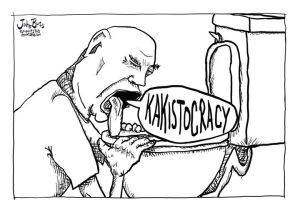
“Whenever I hear or read the word kakistocracy, this immediately comes to mind.” John (repeat1968) Buss
I hope the ACLU and other NGOs will be up for the next version of #DonOld’s Reign of Terror. Get ready for mass deportations by the military. If only they would deport me and my animals to the south of France or even the old family home in Hastings, England, if it’s still standing! For a guy who insists he didn’t know what Project 2025 was about, he is certainly right on top of it! This is from AXIOS. “Trump confirms plans to use military for mass deportations.”
President-elect Trump confirmed Monday that he is planning to declare a national emergency and use the U.S. military to carry out mass deportations.
Why it matters: Trump made his promise to deport millions of undocumented immigrants one of the cornerstones of his 2024 campaign, and his team has already begun strategizing how to carry its plan out.
- A Truth Social post early Monday is the first time the president-elect has confirmed how his administration will execute the controversial plan.
Driving the news: Tom Fitton, the president of the conservative group Judicial Watch, posted on Truth Social earlier this month that Trump was “prepared to declare a national emergency and will use military assets to reverse the Biden invasion through a mass deportation program.”
- Trump reposted Fitton’s comment Monday with the caption, “TRUE!!”
The big picture: There are an estimated 11 million undocumented immigrants living in the U.S. Trump’s mass deportations are expected to impact roughly 20 million families across the country.
- Immigration advocates and lawyers are preparing to counter the plan in court.
- The president-elect’s team is aiming to craft executive orders that can withstand legal challenges to avoid a similar defeat that befell Trump’s Muslim ban in his first term, Politico reported.
- Their plans also include ending the parole program for undocumented immigrants from Cuba, Haiti, Nicaragua and Venezuela, per Politico.
Zoom out: Trump has also already begun filling out his Cabinet positions with immigration hardliners.
- This includes tapping Tom Homan, the former acting head of Immigration and Customs Enforcement (ICE), to serve as his “border czar.”
- In addition, Trump nominated South Dakota Gov. Kristi Noem as his secretary of the Department of Homeland Security (DHS).
Go deeper: How Trump’s plan for mass deportations fits into U.S. history
 I will expand the garden in my side yard and extend it back to the area which has fruit trees and ginger. If the courts don’t block this, I’m betting on higher food prices by the next harvest. Also, I don’t know how anyone in a state like mine, affected by hurricanes and damage, will be getting their homes fixed and cleaned. We’d have never recovered without the workers from South of our border. However, that will be only one of the problems this regime change will bring.
David Nir, writing for Public Notice, has this information on the possibility of recess appointments for the basket of unqualified deplorable he’s chosen for his cabinet. “How Johnson could make Trump’s recess appointments a reality. Talk of cutting out Dems — and GOP dissenters — is more than just idle rhetoric.” Surely, no one believes that what comes out of his anus-looking mouth is just idle rhetoric at this point!
Donald Trump’s plan to stock his cabinet with the most appalling MAGA nihilists hinges on the obeisance of one man in particular: House Speaker Mike Johnson. And given Johnson’s track record of cowardice, Trump may indeed get what he wants — and demolish a pillar of democracy along the way.
The crescendo of increasingly nightmarish picks like Tulsi Gabbard, Matt Gaetz, and Robert F. Kennedy Jr. almost makes Liz Dye’s take here at Public Notice — that Trump is trying to install the crowd at the Star Wars cantina — seem too kind.
So beyond the pale are Trump’s worst choices that even some Republicans in the Senate are balking. And it’s worth remembering that many Trump nominees during his first term in office withdrew from consideration in the face of GOP inaction or hostility.
But whether or not Republican senators are inclined to revert to subservience and greenlight these nominations, Trump is already armed with a plan to bypass the confirmation process entirely. He wants to fill vacancies without a confirmation vote by making so-called recess appointments when the Senate is not in session — a power granted to him by the Constitution. And he has a path to do it.
A will and a way
For many years, Congress has not actually taken a formal recess, precisely to deny presidents the ability to side-step lawmakers. Trump, though, has demanded that the Senate resume the practice of adjourning itself so that he can ram his picks through without any oversight.
The GOP’s new majority leader, John Thune, replied submissively to Trump’s demand, saying on Fox News last week that “all options are on the table.” And Johnson echoed that sentiment on Fox News Sunday yesterday, saying of recess appointments that “there may be a function for that.” (Watch below.)
It turns out that, even for a legislative body that often convenes for just three days a week, it’s surprisingly difficult for the Senate to take a proper, on-the-books break. Such an adjournment requires a majority vote, which even Thune acknowledged might be “a problem” for some Republican senators.
But even if Senate Republicans could muster a majority, a motion to recess can be amended, as Semafor’s Burgess Everett notes. That means Democrats could hold up such a motion indefinitely, unless Republicans were to unilaterally change Senate rules regarding recesses — a move Everett calls “a smaller-scale version of the ‘nuclear option'” that might also have a hard time garnering 50 votes.
 The alt-media has been doing an excellent job tackling this garbage in and out of motivation and action. Politico has stated that the Ethics Committee in the House will discuss the report on Gaetz and his sex adventures with underage girls, also known as statutory rape. I firmly believe that if they don’t release it, someone will leak it. “House Ethics panel to meet Wednesday as Gaetz question looms. Members rescheduled the Wednesday meeting from one last week where lawmakers were widely expected to vote on whether to release the report.”
The House Ethics panel will meet Wednesday and potentially vote to release a report probing sexual misconduct allegations against former Rep. Matt Gaetz (R-Fla.), who Donald Trump tapped to be his attorney general, according to two people familiar with the discussion.
The meeting comes as Gaetz’s confirmation is in question, with some Republican senators wary of the controversial Florida Republican serving as the nation’s top law enforcement officer.
Speaker Mike Johnson is putting pressure on members of the Ethics Committee to keep the report under wraps, saying on Friday that he is “going to strongly request” the report isn’t released because “that is not the way we do things in the House, and I think that would be a terrible precedent to set.”
Johnson furthered that stance in interviews on the Sunday shows and threw his support behind Gaetz to be attorney general.
Members rescheduled the Wednesday meeting from one last week where lawmakers were widely expected to vote on whether to release the report.
Whether or not to release the report, which some senators have said would be essential in deciding whether or not to confirm Gaetz, is placing intense pressure on the historically bipartisan Ethics Committee. Republican Sen. Markwayne Mullin on Sunday told “Meet The Press” that the Senate should “absolutely” be able to see the report, but he said that doesn’t necessarily mean it should become public.
Gaetz, a fierce and loyal supporter of Trump’s, has a tough road to confirmation in the Senate. GOP Sen. Lisa Murkowski (R-Alaska) said she doesn’t “think it’s a serious nomination.” And fellow swing-vote Republican Sen. Susan Collins of Maine said she was “shocked” by the choice.
Republicans will hold 53 Senate seats in the next Congress, meaning they can only afford three defectors in the confirmation process.
As I mentioned, Trump’s lies about not knowing about Project 2025 are becoming more disprovable. This is also from Politico. “Playbook: Heritage comes out of the bunker.” Natalie Allison has the lede.
But now, with Trump as president-elect, Heritage is peeking back out from its metaphorical bunker.
Two of Heritage’s visiting fellows — TOM HOMAN and JOHN RATCLIFFE, who were contributors to Project 2025 — have already been named to top Trump administration posts. That book from Roberts that was supposed to come out in September? It was released last week. The think tank even marked its reemergence with an event this past week welcoming back the Washington cocktail circuit to the group’s Massachusetts Avenue headquarters on Capitol Hill. It was a D.C. coming back out party, of sorts, for an organization that is easing its way back into influence in what’s soon to be Trump’s Washington once again.
“We’re so back,” the Heritage official told Playbook, with a nervous laugh, while a crowd in the packed but modest-sized room milled around during a book party Thursday night for Roberts.
As GOP members of Congress — Playbook spotted Reps. RALPH NORMAN (R-S.C.), BRIAN BABIN (R-Texas), ERIC BURLISON (R-Mo.) and JOSH BRECHEEN (R-Okla.) there — sipped wine and grabbed hors d’oeuvres with a smattering of ambassadors, conservative staffers and reporters on Thursday, Roberts noted that he has lost a number of his “liberal friends” this year over “that larger book we’re famous for.”
But Heritage’s stint as a social pariah due to Project 2025 is effectively over.
“The entire political spectrum in the West is represented here,” Roberts said of the crowd he had assembled Thursday. “I won’t call anyone out, but those of you who are not exactly excited about everything that Heritage does — I’m very, very grateful that you’re here, and you’re here out of friendship.”Roberts spoke about the need for conservatives to “have a certain humility” in order to continue growing the historic coalition that’s returning Trump to the White House — while still trying to fully convert new faces in the movement to a robust conservative ideology more closely resembling his own.
“What the conservative movement did for a generation — I was guilty of this, sometimes I’m still tempted to be guilty of this — is to say, ‘Oh, I’m not going to talk to you,’” Roberts said. He recalled scoffing the first time someone suggested that influential “populist conservatives” like himself should form a “political alliance with the tech bros.”
“I said, ‘What are you talking about? That’s crazy.’ Guess who was wrong? I was.”
Roberts, flanked on each side by panels quoting book endorsements from VP-elect JD VANCE and TUCKER CARLSON, noted that there are stark differences between his worldview and of some of the GOP’s newcomers, name-checking ELON MUSK and ROBERT F. KENNEDY JR., who had been announced as Trump’s nominee for secretary of Health and Human Services just hours earlier.
“I can be very grateful to Elon Musk for revitalizing free speech for the world, while also saying — very respectfully, civilly, maybe even with a smile on my face — it’s crazy to want to put microchips in the brain,” Roberts said.
And he intends to have what he said will also be a “civil” conversation with Kennedy on their differences on abortion rights. “We might agree to disagree,” Roberts said, “but we’re going to work on whatever we can that we agree on, and I will hold out hope that maybe I can change his mind.”
Roberts is sounding pretty optimistic again about the role of Heritage in Washington, about his own improving standing in Trump world, and, yes — about the likelihood of Project 2025’s much-maligned proposals getting closer to implementation. His organization, meanwhile, has prepared for the Trump administration a database of nearly 20,000 names of people who could fill jobs in the president-elect’s new federal government, a Heritage official told Playbook.
 Elon Musk’s idea of free speech is anything that doesn’t personally attack him or his ideals, so let’s get rid of that notion. The Tech Bros funded this crazy train. This is from Oliver Darcy, who writes for Status. “The Verge Editor-In-Chief Nilay Patel breathes fire on Elon Musk and Donald Trump’s Big Tech enablers. “All of these men are now hopelessly trapped in a problem their own platforms and algorithms created.”” This is from Oliver’s interview with Patel.
What do you make of Elon Musk’s alliance with Donald Trump and what worries you the most about him playing such an outsized role in the Trump administration?
America now has an unelected defense contractor sitting in the White House doing ketamine and twiddling the algorithmic knobs of an influential right-wing echo chamber while fulminating against traditional standards-based journalism, threatening to revoke network broadcast licenses, and suing advertisers who don’t want to spend their money on his dwindling user base. What could go wrong?
On top of that, Trump’s most likely FCC Chairman is Brendan Carr, who was tasked in the first Trump government to crack down on platform moderation by taking control of Section 230, literally wrote the Project 2025 chapter laying out a plan to do so, and is now begging to punish NBC for having Kamala Harris on “SNL.”
To be as clear as I can be, the second Trump administration with Elon Musk embedded within it represents the most direct and sustained threat to the First Amendment and the freedom of the press any of us will ever experience. If you’re a media executive or editorial leader and you haven’t met with your legal team to understand the current landscape of First Amendment threats, let alone the ones to come, you’re already behind. Get on it.
In the wake of Trump’s victory, other Big Tech leaders (Mark Zuckerberg, Jeff Bezos, Sundar Pichai, etcetera) posted congratulatory messages on X. It struck me as much different to how Silicon Valley responded to Trump’s first election. Why do you think that is?
All of these men are now hopelessly trapped in a problem their own platforms and algorithms created: they have to manipulate Trump’s narcissism to secure tariff exceptions and regulatory largesse, while knowing that the vast majority of their employees and half of their customers will see any engagement as moral bankruptcy. There’s a reason Apple and Google would not confirm the calls Donald Trump claimed Tim Cook and Sundar Pichai made to him before the election — they didn’t want to be associated with him.
Now they have no choice. Tim Cook had been quietly setting the stage to retire — but he’s stuck kissing the ring and hosting fake factory openings for another four years to avoid disastrous tariffs on Apple products. Zuck is spending billions on Nvidia H100s manufactured in Taiwan in order to dominate A.I., but all that money comes from advertising for products made overseas — a double whammy of tariff issues. (And the entire influencer economy is built on Shein sponcon — that’s about to fall off a cliff.) Elon, Marc Andreessen, and J.D. Vance all think that Google should be crushed to bits with antitrust law — Vance has specifically said that he think Lina Khan is doing a good job.
Jeff Bezos? All that money for yachts and rockets comes from Amazon’s huge ecosystem of alphabet soup dropshipping companies. I hope Lauren likes having dinner at Mar-a-Lago.
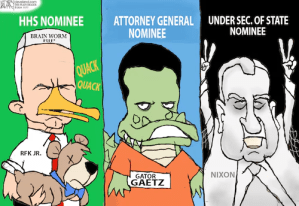 Here’s more on the FCC cabinet pick who edited Project 2025. This is from the AP. “Trump names Brendan Carr, senior GOP leader at FCC, to lead the agency.” Demons all the way down.
President-elect Donald Trump on Sunday named Brendan Carr, the senior Republican on the Federal Communications Commission, as the new chairman of the agency tasked with regulating broadcasting, telecommunications and broadband.
Carr is a longtime member of the commission and served previously as the FCC’s general counsel. He has been unanimously confirmed by the Senate three times and was nominated by both Trump and President Joe Biden to the commission.
The FCC is an independent agency that is overseen by Congress, but Trump has suggested he wanted to bring it under tighter White House control, in part to use the agency to punish TV networks that cover him in a way he doesn’t like.
Carr has of late embraced Trump’s ideas about social media and tech. Carr wrote a section devoted to the FCC in “ Project 2025,” a sweeping blueprint for gutting the federal workforce and dismantling federal agencies in a second Trump administration produced by the conservative Heritage Foundation.
Every federal worker is going to need a lawyer at this point. Get ready for that Class Action lawsuit. This in-depth look at the weirdo that will head defense is not pleasant. But, he’s the guy who would work with whatever Generals remain in all parts of the country, sniffing out undocumented workers. Judd Legume and his team sniffed him out for Popular Information. “13 things everyone should know about Pete Hegseth. Just looking at him gives me the willies.
Hegseth is a military veteran who served in Iraq and Afghanistan and received a Bronze Star and other commendations. He also served in the National Guard. But the largest organization that Hegseth has previously run is Concerned Veterans for America, a Koch-funded right-wing advocacy organization, where he served as Executive Director from 2012 to 2016. Concerned Veterans for America had a few dozen employees and a budget of around $15 million during his tenure. In that role, Hegseth hired his younger brother, who had just graduated college, to a well-compensated media relations position at the CVA. Hegseth founded a small PAC in his native Minnesota to support conservative candidates. It managed to raise about $15,000 over several years. One-third of the raised funds were “spent on two Christmas parties and reimbursements to Hegseth.”
Even Trump’s most loyal supporters acknowledge Hegseth’s lack of relevant experience. Steve Bannon, Trump’s chief strategist during his first term, said that Hegseth has “never run a big organization” and is “kind of a madman.”
But while Hegseth has limited management experience, he has spent many years in the public eye and has a long record of punditry. Here are 13 things everyone should know about the man Trump wants to put in charge of the nation’s military.
 His top priority is getting women out of the military.
“I’m straight up just saying we should not have women in combat roles,” Hegseth said in a media interview on November 10, 2024. According to Hegseth, “[e]verything about men and women serving together makes the situation more complicated, and complication in combat, means casualties are worse.”
“Dads push us to take risks. Moms put the training wheels on our bikes,” Hegseth wrote in his 2024 book The War on Warriors. “We need moms. But not in the military, and especially not in combat units.”
“There aren’t enough lesbians in San Francisco to staff the 82nd Airborne like you need, you need the boys in Kentucky and Texas and North Carolina and Wisconsin,” Hegseth said in a podcast earlier this year.
Women have formally been allowed to serve in combat roles since 2013 and have been involved in combat operations for decades. Even the conservative Wall Street Journal editorial page suggested Hegseth’s position is misguided because “women have shown they can perform well in many roles” in the military.
It gets worse from there if you want to read it. And I think that it’s horrifying for all of us for now. Be aware of all the places where havoc will reign. The stock market has already been rebooted. It’s nose-dived since the cabinet officers were announced. Big Pharma and anyone in the processed food business were particularly hard hit. This is the headline today from Stock Market Watch. “Stock Market Today: Dow flat, S&P 500 attempts bounce after worst week in over 2 months. It’s not like I didn’t warn y’all. Just get ready to hunker down like an Okie during the Dust Bowl. I have mad skills, having survived post-Katrina with the lessons my Nana and Dad taught me. This is not going to be an easy time for any of us.
What’s on your reading and blogging list today?
Songs for dwelling on Trump and his appointments

By Katrina Pallon
I don’t think I’ve fully come to terms with the fact that we are once again faced with Donald Trump as “president.” Of course we really don’t know what is going to happen to our country or to us as its citizens, but we know it’s going to be bad.
The first Trump term was horrific, and that was when he believed he needed to listen to his advisers. He appointed somewhat competent people to top positions in his administration, and he occasionally listened to them. There were so-called “adults in the room” who were able to partially control his worst impulses, or sometimes just work around his demands.
This time will be different. He is nominating people who are loyal to him personally but have no expertise in the positions they have been chosen for. They have been picked to destroy the bureaucracies they will control.
Trump knows that some of these people could be rejected by the Senate, so he is demanding the power to use “recess appointments.” He wants the Senate and the House to be in recess after his inauguration so that he can install these loyal incompetents without involving the Senate’s “advise and consent” role. He also plans to grant security clearances to his chosen sycophants without FBI background checks. He means to destroy the independence of the Department of Justice, including the CIA and FBI. He also plans to take full control of the military and enforce loyalty to him, and not to the Constitution.
Thanks to the right wing Supreme Court, he may be able to accomplish these things. They have granted him immunity for anything he does in his role president, including crimes.
During his first term, Trump often praised foreign dictators. He expressed admiration for China’s Xi Jinping’s takeover in China, Turkey’s Recep Tayyip Erdogan, Hungary’s Viktor Orbán, and North Korea’s Kim Jong Un. He praised Xi for making himself president for life. He admires Erdoğan for ending democracy in his country and taking power for the long term. He repeatedly said he would like “my people” to behave obediently like Kim John Un’s audiences–by mindlessly applauding everything he says or does. And of course everyone knows that Trump admires and fears Russia’s Vladimir Putin. We now know that Trump even praised Adolf Hitler during his time in the White House. We have a very good idea of what Trump hopes to do to this country.
Why should we expect that Trump will now behave like any other U.S. president? Why should we be so sure that there will be meaningful elections in 2026 and 2028? The leaders that Trump has praised have made sure that any elections held in their countries are–to use Trump’s term–rigged? Putin, Xi, Erdogan, and Orban are still in control of their countries. North Korea, of course, is a family dictatorship. Perhaps Trump hopes to pass on control of the U.S. to one of his children. We need to be aware of what he may be planning–not imagine that we live in the previous U.S. in which laws and norms protected us from a wannabe dictator.
After the announcement that Trump would forgo background checks on his appointees, investigative journalist Dave Troy wrote (on Twitter, I won’t link to it)
Let me be clear: the country is gone. You may still think you have one, but it’s like phantom limb syndrome. Don’t look yet. It’s too painful. But when you’re ready, gaze upon it. For all its volume and noise and mass… it is but an illusion. What comes next is hell, and chaos.
We had a chance. But today, I think, is the day we lost it. The day the free world fell. We will go through motions and react and laugh, or not laugh, we will be serious and joking and call each other horrible things. But this was the day when the last bulwark fell.

By Lucy Almey Bird
I have to agree with him. Trump fantasizes about being president for life like Putin, Xi, and Orban. We are in serious danger of becoming another Hungary.
I hope I’m overreacting. Maybe PTSD is making me more fearful than I need to be. I know my sleep has been even more disturbed than usual lately. But I’d rather face what Trump is really up to than act like the Democrats, who seem to just assume that politics as usual will be restored after free and fair elections in 2026 and 2028.
I am an optimist at heart, and I still have hope for the future. I hope that everything I’ve written above is wrong. But I’ll have to see it happen in order to truly believe it.
Here are some reads to check out today:
Yesterday, Dakinikat wrote about the term Kakistocracy. This article by Italian journalist Beppe Severgnini in The Atlantic explores the idea: American Kakistocracy. Italy knows a thing or two about what the United States faces—but there are key differences between the two countries’ experiences.
Why is a regular guy attracted to a billionaire candidate? It’s simple: Because the candidate can play to people’s fantasies. The man knows his television, loves girls, hates rules, knows how to make a deal, tells jokes, uses bad language, and is convivial to a fault. He is loud, vain, cheeky. He has a troubled relationship with his age and his hair. He has managed to survive embarrassment, marital misadventures, legal troubles, political about-faces. He’s entangled in conflicts of interest, but he couldn’t care less. His party? A monument to himself.
He thinks God is his publicist, and twists religion to suit his own ends. He may not be like us, but he makes sure there’s something about him that different people can relate to personally. He is, above all, a man of enormous intuition. He is aware of this gift and uses it ruthlessly. He knows how to read human beings, their desires and their weaknesses. He doesn’t tell you what to do; he forgives you, period.
Here in Italy, he loomed over our politics—and our lives—for 30 years. He created his own party in 1994 (Forza Italia, a sort of Make Italy Great Again), and a few months later, he became Italy’s prime minister for the first time. He didn’t last long, but he climbed back into government in 2001, and then again in 2008. Three years later, he resigned amid sex scandals and crumbling public finances, but he managed to remain a power broker until he died last year.
Silvio Berlusconi, like Donald Trump, was a right-wing leader capable of attracting the most disappointed and least informed voters, who historically had chosen the left. He chased them, understood them, pampered them, spoiled them with television and soccer. He introduced the insidious dictatorship of sympathy.
By Steve Danielson
But Silvio Berlusconi is not Donald Trump.
Berlusconi respected alliances and was loyal to his international partners. He loved both Europe and America. He believed in free trade. And he accepted defeat. His appointments were at times bizarre but seldom outrageous. He tried hard to please everybody and to portray himself as a reliable, good-hearted man. Trump, as we know, doesn’t even try.
Berlusconi may have invented a format, but Trump adopted and twisted it. Trump’s victory on November 5 is clear and instructive, and it gives the whole world a signal as to where America is headed.
he scent of winners is irresistible for some people. The desire to cheer Trump’s victory clouds their view. They don’t see, or perhaps don’t take seriously, the danger signs. Reliability and coherence, until recently a must for a political leader, have taken a back seat. Showing oneself as virtuous risks being counterproductive: It could alienate voters, who would feel belittled.
American journalism—what is left of it, anyway—meticulously chronicled Trump’s deceitfulness. It made no difference, though. On the contrary, it seems to have helped him. Trump’s deputy, J. D. Vance, explained calmly in an interview that misleading people—maybe even lying to them—is sometimes necessary to overcome the hostility of the media.
Here’s a gift link if you’d like to read the rest at The Atlantic.
Adam Jentelson at The New York Times: When Will Democrats Learn to Say No?
When Donald Trump held a rally in the Bronx in May, critics scoffed that there was no way he could win New York State. Yet as a strategic matter, asking the question “What would it take for a Republican to win New York?” leads to the answer, “It would take overperforming with Black, Hispanic and working-class voters.”
Mr. Trump didn’t win New York, of course, but his gains with nonwhite voters helped him sweep all seven battleground states.
Unlike Democrats, Mr. Trump engaged in what I call supermajority thinking: envisioning what it would take to achieve an electoral realignment and working from there.
Supermajority thinking is urgently needed at this moment. We have been conditioned to think of our era of polarization as a stable arrangement of rough parity between the parties that will last indefinitely, but history teaches us that such periods usually give way to electoral realignments. Last week, Mr. Trump showed us what a conservative realignment can look like. Unless Democrats want to be consigned to minority status and be locked out of the Senate for the foreseeable future, they need to counter by building a supermajority of their own.
That starts with picking an ambitious electoral goal — say, the 365 electoral votes Barack Obama won in 2008 — and thinking clearly about what Democrats need to do to achieve it.
Democrats cannot do this as long as they remain crippled by a fetish for putting coalition management over a real desire for power. Whereas Mr. Trump has crafted an image as a different kind of Republican by routinely making claims that break with the party line on issues ranging from protecting Social Security and Medicare to mandating insurance coverage of in vitro fertilization, Democrats remain stuck trying to please all of their interest groups while watching voters of all races desert them over the very stances that these groups impose on the party.
Achieving a supermajority means declaring independence from liberal and progressive interest groups that prevent Democrats from thinking clearly about how to win. Collectively, these groups impose the rigid mores and vocabulary of college-educated elites, placing a hard ceiling on Democrats’ appeal and fatally wounding them in the places they need to win not just to take back the White House, but to have a prayer in the Senate.
More at the NYT link.
Reid J. Epstein and Lisa Lerer at The New York Times: Democrats Draw Up an Entirely New Anti-Trump Battle Plan.
Locked out of power next year, Democrats are hatching plans to oppose President-elect Donald J. Trump that look nothing like the liberal “resistance” of 2017.
Gone are the pink knit caps and homemade signs from the huge protest that convulsed blue America that year, as exhausted liberals seem more inclined to tune out Mr. Trump than fight.
By Lucy Olivieri
Washington is far different, too. The Republicans who stymied some of Mr. Trump’s first-term agenda are now dead, retired or Democrats. And the Supreme Court, with three justices appointed by the former president, has proved how far it will go in bending to his will.
As they face this tough political landscape, Democratic officials, activists and ambitious politicians are seeking to build their second wave of opposition to Mr. Trump from the places that they still control: deep-blue states.
Democrats envision flexing their power in these states to partly block the Trump administration’s policies — for example, by refusing to enforce immigration laws — and to push forward their vision of governance by passing state laws enshrining abortion rights, funding paid leave and putting in place a laundry list of other party priorities.
Some of the planning in blue states began in 2023 as a potential backstop if Mr. Trump won, according to multiple Democrats involved in different efforts. The preparations were largely kept quiet to avoid projecting public doubts about Democrats’ ability to win the election.
“States in our system have a lot of power — we’re entrusted with protecting people, and we’re going to do it,” said Keith Ellison, the attorney general of Minnesota, who said his office had been preparing for Mr. Trump’s potential return to power for more than a year. “They can expect that we’re going to show up every single time when they try to run over the American people.”
The Democratic effort will rely on the work of hundreds of lawyers, who are being recruited to combat Trump administration policies on a range of Democratic priorities. Already, advocacy groups have begun workshopping cases and recruiting potential plaintiffs to challenge expected regulations, laws and administrative actions starting on Day 1.
More at the link.
NBC News: John Fetterman says Democrats need to stop ‘freaking out’ over everything Trump does.
In the closing weeks of the presidential campaign, Sen. John Fetterman did something different than other Democrats.
He went on Joe Rogan’s podcast, a show Democrats had been urging Vice President Kamala Harris to do — and the kind of appearance Democrats feel their candidates need to get more comfortable making in the current media environment.
By Katrina Pallon
But Fetterman, who built a blunt, says-what-he-means brand, said Democratic setbacks in 2024 had more to do with unpopular positions progressives promoted than any lack of communication from the party’s center-left establishment.
“It’s not even what you might say as a candidate,” Fetterman said in an interview, adding “all of the very hard-left, kind of ‘woke’ things” Republicans used in advertising this year “are unloaded on the backs of all of us in purple states, and we’re paying for all of the things that our colleagues might say in these hard blue kinds of districts.”
That’s part of Fetterman’s broader post-election message for his party. Moving forward, he says, Democrats can’t get wrapped up in “freaking out” over every controversial move Trump makes, adding that has proven to be a losing formula for the party and its brand. He was speaking after Trump selected former Rep. Matt Gaetz, R-Fla., for attorney general and just before he tapped Robert F. Kennedy Jr. as his pick to run the Department of Health and Human Services.
“I’ve said this before, it’s like, clutch those pearls harder and scold louder — that’s not going to win,” Fetterman, D-Pa., said. “And that’s been demonstrated in this cycle.”
In the interview, Fetterman detailed his thoughts on this month’s election, how he’s readying for his party’s life in the wilderness and whether he has interest in seeking the presidency in 2028.
Read the interview at the NBC link.
Anna Gifty at Public Notice: Kamala Harris’s hidden barrier. Her rise and fall illustrates the Glass Cliff.
Black women have long had to navigate being twice as good to get half the amount of credit. Kamala Harris’s presidential run was evidence of this.
Despite the stark difference in the tenor of each candidate’s campaign and the the quality of their policy proposals, many still questioned whether they could trust Harris’s leadership and opted for her opponent. Ultimately, an overwhelming majority of white voters voted Republican.
National exit polls showed that for white voters, their choice was largely a product educational attainment. Fifty-seven percent of college-educated white women voted for Harris, while 63 percent of non-college white women voted for Donald Trump. For white men, regardless of educational level, a majority voted for Trump. Contrast that with the 77 percent of Black men and 91 percent of Black women who voted for Kamala Harris.
The majority of the Black electorate, regardless of educational level, voted for Harris. But it wasn’t enough. The outcome reminded me of the Glass Cliff and the double standards for Black leaders that come along with it.
In my own experience as a Black woman studying economics and policy at Harvard, I’ve seen how leadership roles for women of color, especially Black women, come with a unique set of risks and pressures, especially when taken on during challenging times.
For instance, early this year, Claudine Gay, the former president of my university, resigned after just six months on the job amid a concerted effort by right-wing culture-warriors to force her out. Gay was more than qualified for her job, but she wasn’t given the benefit of the doubt when she was accused of plagiarism and her tenure as the first Black person to lead Harvard ended up being the shortest in history.
By Marcella Cooper
The Glass Cliff refers to situations where women from marginalized groups are promoted into leadership during times of crisis and/or when the risk of failure is high. For example, back in 2021, Yogananda Pittman became the first Black person and first woman to lead the Capitol Police as it faced criticism for its handling of January 6. Minorities and women getting promotions often face impossible circumstances. And if they succeed, the person who gave them the opportunity gets credit.
When Biden dropped out of the race in July, he left Kamala Harris with a challenge that no modern presidential candidate has faced. Biden was losing in the polls, Democrats were divided over his presidency and refusal to get out of the race earlier, and Harris had to compete against a man who not only had been running for president for years, but is also a seasoned purveyor of racism and sexism.
While pundits have busied themselves over the past 10 days nitpicking Harris’s campaign, one thing is abundantly clear: She was held to the highest standards of leadership while Trump was held to no standard at all. Where Harris was pressed to present concrete, detailed policy stances, Trump skated by with crude bigotry and mere “concepts of plans”.
Read more at Public Notice.
The New Republic: Trump Picks Man Who Helped Him Get Away With Crimes to Run the Courts.
Donald Trump has nominated his attorney D. John Sauer, whom you may remember as the lawyer who argued that the president should be able to kill his political rivals with impunity, to be the country’s next solicitor general.
Earlier this year, Sauer helped Trump win his presidential immunity case before the Supreme Court, which undermined other federal legal battles against Trump, like the time he tried to overturn the government after losing the 2020 election. Now Sauer will oversee all federal lawsuits.
In a statement Thursday, Trump lauded Sauer as the “lead counsel representing me in the Supreme Court in Trump v. United States, winning a Historic Victory on Presidential Immunity, which was key to defeating the unConstitutional campaign of Lawfare against me and the entire MAGA movement.”
While representing Trump, Sauer argued that if the president ordered an assassination on his political enemies, he could not be indicted unless he had first been impeached.
When Justice Sonia Sotomayor drilled him about immunity in the case of assassinating political rivals, he replied, “It would depend on the hypothetical but we can see that would well be an official act.” When she asked if the same rule existed if the president executed people for “personal gain,” Sauer said that immunity still stood.
One more, from Politico: Biden’s White House stares down a Trump takeover.
The White House is finalizing plans to spend Joe Biden’s last months in office putting the finishing touches on his legacy — even as it welcomes a successor determined to tear it all down.
By Marcella Cooper
Senior Biden aides mapping out the remaining 65 days are prioritizing efforts to cement key pillars of the president’s agenda by accelerating manufacturing and infrastructure investments. They’re placing fresh emphasis on the major health and energy policies most at risk of repeal, while coordinating a Senate sprint to fill judicial vacancies. And in a move that could mark the last gasp of tangible American support for Ukraine, officials are rushing out $6 billion of remaining aid and preparing a final round of sanctions against Russia.
New measures targeting the nation’s lucrative energy industry are among the sanctions under consideration, a White House official granted anonymity to describe internal deliberations said, now that the administration is freed from pre-election anxieties over the potential impact on domestic gas prices.
The final flurry of work has provided a renewed sense of purpose within a White House unmoored by Donald Trump’s pending return to power, according to interviews with more than a half-dozen administration officials and outside advisers. Yet there’s also open acknowledgment that for all the activity, little they do in the next two months may matter after Inauguration Day.
Trump is poised to take a sledgehammer to much of what the administration leaves behind — and no amount of tending to Biden’s own reputation can stop it.
“The bottom line,” said Ivo Daalder, a foreign policy expert close to senior Biden officials, “is there just isn’t anything Biden can do today that isn’t reversible in 10 weeks.”
Those are my recommended reads for today. The good news is that the worst hasn’t happened yet. We are still living in a sort of democracy.
Take care, everyone.

“Make America Garbage Again,” John Buss, @repeat1968
After sleeping through last week, I have finally decided that PTSD has kicked in, and I’m in survival mode. At least I woke up to find the word that best describes what we’re watching unfold. From the Merriam-Webster Dictionary:
*kakistocracy noun
kak·is·toc·ra·cy ˌkakə̇ˈstäkrəsē
plural kakistocracies
:government by the worst people
Greek kakistos (superlative of kakos bad) + English -cracy
The Cambridge Dictionary is more blunt. It evidently was coined sometime in the 17th century. Now we know how far we’re going to fall back.
A government that is ruled by the least suitable, able, or experienced people in a state or country:Who rules in a kakistocracy?
Fewer examples:
- Kakistocracies are governments ruled by the stupid and ignorant.
- What we have here is the world’s only kakistocracy.
- The total lack of integrity of the administration is proof that we now live in a kakistocracy.
 This is what we will have after January 20,2025, which is, ironically enough, not only the inauguration of the first felon to ever hold office but also the holiday celebrating Martin Luther King. Somewhere, the Greek Muses have entered the realm of Greek Tragedy. All we need is a chorus.
I turned to some TV news last night to watch the faces of the political class chatter about the proposed cabinet members with the look of teenagers stuck in a summer camp horror film. Yes, this all does feel like a very bad movie or dream that you want to be over when you awaken. However, it is more like the idea of the tyranny of the masses that Alexis de Tocqueville dreamed of while writing his book Democracy in America. He was very afraid of the unwashed masses, and now we know why.
The greatest danger Tocqueville saw was that public opinion would become an all-powerful force, and that the majority could tyrannize unpopular minorities and marginal individuals. In Volume 1, Part 2, Chapter 7, “Of the Omnipotence of the Majority in the United States and Its Effects,” he lays out his argument with a variety of well-chosen constitutional, historical, and sociological examples.
I love that last part because it comes from the National Endowment for the Humanities and is a history class curriculum prepared for teachers on the topic. Quick, go read it or get your copy of the book before both are banned and defunded. It’s an independent agency, like the Fed, and we’ll see how long into the kakistocracy that remains to be true for both. I imagine I would never get grants to be funded as I did in 1982 to bring Kate Millet and Betty Friedan to Omaha and funds to expand our Women’s Festival to include black women presenters. That was even during the Reagan years. He must have been damned woke or completely asleep, drooling on the Resolute desk to miss that opportunity.
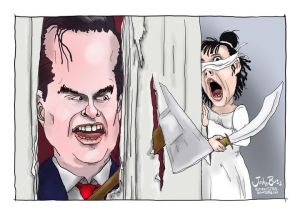
“Matt is the man selected to hide all the criming, appropriate.” John Buss, @repeat1968
Okay, so let me really depress you now with some headlines. This is from Public Notice‘s Lisa Needham. “Trump moves to burn down the rule of law. His cabinet nominations are obscene and augur dark days to come.” And you thought I was being a bummer!
When the sordid history of the second Trump administration is written, should we all survive that long, it will be difficult to sort out which of his early cabinet picks were the most atrocious. And while handing over control of the military to a weekend Fox News host or putting an anti-vax creep in charge of America’s top public health agency are really bad, it will be hard to sink lower than Matt Gaetz being nominated as the nation’s top law enforcement official.
Let’s pretend, for just a moment, that Gaetz isn’t just being given this job because he’s a lib-triggering Trump crony and evaluate him on the merits. Gaetz’s legal experience, such as it is, seems to consist of a stint at a small firm in Florida, Anchors Garden, where he worked after graduating from law school in 2007. The firm currently has only nine attorneys, and Gaetz devotes precisely one line to the experience in his self-servingly weird House bio, saying, “Prior to serving in Congress, Matt worked as an attorney in Northwest Florida with the Keefe, Anchors & Gordon law firm, where he advocated for a more open and transparent government.”
Advocating for a more open and transparent government sounds pretty important, right? But while the firm does have a government affairs and public records practice, when Mother Jones did a deep dive into Gaetz’s experience there, what they turned up instead was that he working on things like debt collection and representing a homeowners’ association over a dispute about a beach volleyball net. It isn’t even entirely clear when Gaetz stopped working at the firm. His House bio skips ahead to his 2010 election to the Florida House, and his legal work is never mentioned again.
This is not the biography of someone you would hire to be an assistant district attorney in a mid-size American city, much less the head of the entire Department of Justice.
Compare Gaetz to Jeff Sessions, Trump’s first attorney general pick during his previous term. Sure, Sessions was so racist that he couldn’t get confirmed as a judge. But he also spent 12 years as the US Attorney for the Southern District of Alabama and two years as the Alabama attorney general before being elected to four consecutive Senate terms. During his time in the Senate, he served on the Senate Judiciary Committee, becoming its ranking member in 2009. Sessions was a repulsive and retrograde choice for AG, but he wasn’t a demonstrably unqualified one.
 That’s a sunny note to start your weekend on. Wait, there’s more! If you want to see real pearl-clutching, you must go to WAPO or NYT. But they’re a little too late for me. Here’s something from The Bulwark. I’ve suddenly gone all in for the alt-press like I did in 1970 when I started writing for Omaha’s underground Newspaper, The Aardvark, to write terrible things about Richard Nixon. “Gaetz Begins Lobbying Lawmakers, Hoping He Hasn’t Burned All the Bridges/ The congressman and his team are trying to convince Senators to overlook a potentially damning ethics report and his history of political histrionics.” This analysis is coauthored by Mark Caputo and Joe Perticone.
Though Trump has made a slew of controversial picks (the latest being Thursday’s nomination of anti-vaccine activist Robert Kennedy Jr. to lead the Department of Health and Human Services), Gaetz stands out as a singularly polarizing figure because of the investigations into his conduct, the accusations against him, and his strained personal relationship with fellow Republican members of Congress he has torched, including allies of former House Speaker Kevin McCarthy, whose ouster he masterminded.
“We have 53 senators and we might not have 50 votes to confirm right now. It’s really up in the air,” said a member of Trump’s team briefed on its preliminary vote-counting. “Gaetz can be a real asshole. But he can be a great guy. The senators need to see the great guy and kind of hear the asshole apologize and tell them why all this stuff about sex crimes isn’t true.”
The push to confirm Gaetz is the latest test of his ability to survive crises that would have ruined any other politician. It also will provide an early indication of Trump’s ability to bend the Senate to his will. The president-elect has quickly moved to force votes on high-profile nominees that no other person in his position would have dared put forward. And as a fallback, he is pressuring incoming Senate Majority Leader John Thune into giving him the right to bypass the Senate to make temporary appointments.
Doing so would get Trump’s cabinet in place. But it could come at a political cost if it perceived that the president is jamming through highly-controversial nominees. On Thursday, ABC reported that the woman at the center of the sex-crimes case had told House investigators that Gaetz had paid to have sex with her in 2017 when she was a minor. Gaetz was also allegedly implicated in paying other women for sex, which he has denied, and in illicit drug use.
The succession of nominations and reporting left Republican senators in an uncomfortable spot. Some, including those on the Senate Judiciary Committee—which would first vote on Gaetz’s nomination—said they wanted to see the House ethics report into Gaetz.
 A quick look at several of the appointments finds quite a few rapists and serial adulterers. Trump obviously wants mini-mes. The BBC has this list up to date and is waiting for more. “Who has joined Trump’s team so far?” Some of the appointees are not getting sanguine coverage.’
This article is specific to Gaetz and was written by North American Correspondent Anthony Zurcher. “Trump picking Gaetz to head justice sends shockwaves – and a strong message.”
Donald Trump’s nomination of congressman Matt Gaetz to be his attorney general has arrived like a thunderclap in Washington.
Of all the president-elect’s picks for his administration so far, this is easily the most controversial – and sends a clear message that Trump intends to shake up the establishment when he returns to power.
The shockwaves were still being felt on Thursday morning as focus shifted to a looming fight in the Senate over his nomination.
Trump is assembling his team before he begins his term on 20 January, and his choice of defence secretary, Fox News host Pete Hegseth, and intelligence chief, former Democratic congresswoman Tulsi Gabbard, have also raised eyebrows.
But it is Gaetz making most headlines. The Florida firebrand is perhaps best known for spearheading the effort to unseat then-Republican Speaker of the House Kevin McCarthy last year. But he has a history of being a flamethrower in the staid halls of Congress.
In 2018, he brought a right-wing Holocaust denier to the State of the Union, and later tried to expel two fathers who lost children in a mass shooting from a hearing after they objected to a claim he made about gun control.
His bombastic approach means he has no shortage of enemies, including within his own party. And so Trump’s choice of Gaetz for this crucial role is a signal to those Republicans, too – his second administration will be staffed by loyalists who he trusts to enact his agenda, conventional political opinion be damned.
Gasps were heard during a meeting of Republican lawmakers when the nomination for America’s top US prosecutor was announced, Axios reported, citing sources in the room.
Republican congressman Mike Simpson of Idaho reportedly responded with an expletive.
“I don’t think it’s a serious nomination for the attorney general,” Alaska Republican Senator Lisa Murkowski said. “This one was not on my bingo card.”
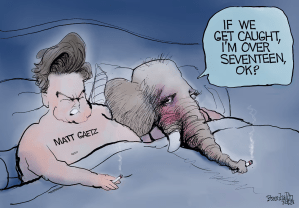 Gaetz is playing Rocky and is already running up and down the Capitol stairs trying to find the few people that like him. But even the New York Post is taking on the RFK appointment to HHS. I know, I can’t believe I’m doing this. It’s even it’s Editorial Board. “Putting RFK Jr. in charge of health breaks the first rule of medicine.”
The overriding rule of medicine is: First, do no harm.
We’re certain installing Robert F. Kennedy Jr. to head Health and Human Services breaks this rule.
Maybe he’s sworn to focus narrowly on areas where he clearly can help — inspiring Americans to embrace healthier diets and more exercise, etc.
I wonder where eating roadkill and fish laded with mercury comes into that equation?
But wait! There are reasons to question every one of his appointments. This is from The Guardian. “Trump defense secretary nominee involved in 2017 sexual assault investigation, no charges filed – report.”
Fox News host Pete Hegseth, who Donald Trump nominated to be defense secretary, was involved in a sexual assault investigation in California seven years ago, but no charges were filed against him, the San Francisco Chronicle reports.
The incident happened in 2017 at a hotel and golf course in the city of Monterey, but there were few details of how Hegseth was involved, or what happened. Here’s more, from the Chronicle:
In a brief statement late Thursday, the city manager’s office in Monterey confirmed the sexual assault investigation, but provided few details.
The city said the incident was reported to have happened between almost midnight on Oct. 7, 2017, and 7 a.m. the next morning at the Hyatt Regency Monterey Hotel and Spa on Del Monte Golf Course, less than a mile from Monterey Bay and across Highway 1 from the Naval Postgraduate School.
“The Monterey Police Department investigated an alleged sexual assault at 1 Old Golf Course Road,” the city said. It said the victim’s name was confidential and that the alleged assault was reported on Oct. 12, 2017. The city said no weapons were involved, but that there was a report of “contusions to right thigh.”
The city declined to release the police report, saying it was exempt from public disclosure, and said it would not make any further remarks on the probe.
The Monterey County District Attorney’s Office did not reply to a request for comment late Thursday, but an online database indicated no criminal charges had been filed against Hegseth in that county.
Vanity Fair reports that news of the allegation sent Trump’s transition team scrambling over the past few days:
Donald Trump’s transition team scrambled Thursday after Trump’s incoming chief of staff Susie Wiles was presented with an allegation that former Fox & Friends cohost Pete Hegseth, Trump’s nominee to be Defense Secretary, had engaged in sexual misconduct. According to two sources, Wiles was briefed Wednesday night about an allegation that Hegseth had acted inappropriately with a woman. One of the sources said the alleged incident took place in Monterey, California in 2017.
According to the transition source, the allegation is serious enough that Wiles and Trump’s lawyers spoke to Hegseth about it on Thursday. A source with knowledge of the meeting said that Hegseth said the allegation stemmed from a consensual encounter and characterized the episode as he-said, she-said.
On Thursday evening, Hegseth’s lawyer Timothy Parlatore said: “This allegation was already investigated by the Monterey police department and they found no evidence for it.”
Trump’s communications director Steven Cheung said: “President Trump is nominating high-caliber and extremely qualified candidates to serve in his Administration. Mr. Hegseth has vigorously denied any and all accusations, and no charges were filed. We look forward to his confirmation as United States Secretary of Defense so he can get started on Day One to Make America Safe and Great Again.”
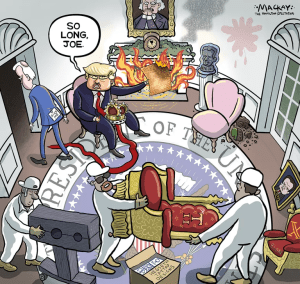 That guy puts the sleaze in sleazy. Plus, he was investigated for war crimes and would be in charge of dealing with war criminals. This is from Time Magazine. “Pete Hegseth’s Role in Trump’s Controversial Pardons of Men Accused of War Crimes.”
President-elect Donald Trump’s announcement that he would nominate Fox News host Pete Hegseth to lead the Department of Defense in his second term has already stirred controversy.
Hegseth, a military veteran, staunch defender of Trump’s “America First” agenda, and an outspoken critic of what he calls the military’s “woke” culture, has built a career around challenging the military establishment. He held an influential role in advocating for Trump to intervene on behalf of service members in three cases involving war crime accusations in 2019—cases that divided the military and ignited fierce debates over the limits of executive power and military accountability.
Now, if he is confirmed as the next Secretary of Defense, Hegseth will oversee 1.3 million active-duty service members and manage military strategy at a time of global instability, raising questions about how his past approach towards accused war criminals will impact his military leadership and discipline.
During Trump’s first term in office, Hegseth lobbied for the pardons of Army Lieutenant Clint Lorance and Army Major Mathew Golsteyn, and pushed to support Navy SEAL Edward Gallagher, each of whom were facing charges or convictions related to alleged war crimes committed in Iraq and Afghanistan. Hegseth’s advocacy on behalf of the three service members appeared to pay off: in Nov. 2019, Trump granted pardons to Lorance and Golsteyn, and reversed a demotion of Gallagher, citing Hegseth and Fox News when he tweeted about his decision to review one of the cases.
Hegseth’s vocal defense of these men as victims of overzealous prosecution raised eyebrows in the military community, where such interventions by civilians are seen by some as a threat to the integrity of the justice system. “These are men who went into the most dangerous places on earth with a job to defend us and made tough calls on a moment’s notice,” Hegseth said on Fox & Friends in May 2019. “They’re not war criminals, they’re warriors.”
Lorance had been convicted by a military court in 2013 for the murder of two Afghan men during a military operation in 2012 in which he ordered his soldiers to open fire on a group of unarmed Afghan civilians he suspected of being insurgents. Lorance served six years of a 19-year sentence before Trump, after lobbying from Hegseth and others, granted him a pardon in Nov. 2019, arguing that he was unfairly targeted by military prosecutors and that his actions were justified in a combat environment where split-second decisions were often necessary for survival.
 This is from Military.com. ‘He’s Going to Have to Explain It’: Surprise Defense Secretary Pick’s History Takes Center Stage.”
He has repeatedly called to ban women from serving in combat roles in the military.
He advocated extensively to gain pardons for troops accused and convicted of war crimes.
And he was one of a dozen troops turned away from serving on the National Guard mission to defend the Capitol, allegedly over tattoos that are popular with neo-Nazi and far-right groups.
Pete Hegseth, President-elect Donald Trump’s surprise pick to be the next defense secretary, has an extensive history of combat in the culture wars that have been brewing over the military for the past decade.
Prior to Trump’s announcement Tuesday evening that he was nominating Hegseth, the National Guard veteran was most known as a co-host on the weekend edition of “Fox and Friends,” one of Trump’s favorite TV shows. But in choosing Hegseth, Trump landed on a defense secretary nominee with a record of public statements that line up with the promises Trump made on the campaign trail to root out alleged “wokeness” within the military.
Senators from both parties tasked with considering his nomination responded Wednesday by saying that they have a lot of questions about Hegseth’s history and those past statements, but broadly insisted they were reserving judgment.
“I’m going to have to visit with him about those remarks,” Sen. Joni Ernst, R-Iowa, the Senate’s first female combat veteran who was rumored to be in the running for Trump’s defense secretary, told reporters Wednesday when asked about Hegseth’s opposition to women in combat.
“Even a staff member of mine, she is an infantry officer. She’s back in Iowa now. She is a tumble. So he’s going to have to explain it,” Ernst added, though she did not answer when Military.com asked whether she would vote against Hegseth over the issue.
So, this is basically a band of misfits and less than mediocre wipipo. But I’ll just let Muse tell it like it is. Yes, there are a lot of f-bombs in the lyrics!
What’s on your reading and blogging list today?
 peej
peej Carissa
 bostonboomer
 dakinikat
 ecocatwoman
 mablue2
 Mama Lopez
 peggysue22
 quixote
 skydancingguestblogger
 Mona (aka Wonk the Vote)
 Memeorandum Crooks and Liars Democracy NOW The UK Guardian
The Sky Dancing banner headline uses a snippet from a work by artist Tashi Mannox called 'Rainbow Study'. The work is described as a" study of typical Tibetan rainbow clouds, that feature in Thanka painting, temple decoration and silk brocades". dakinikat was immediately drawn to the image when trying to find stylized Tibetan Clouds to represent Sky Dancing. It is probably because Tashi's practice is similar to her own. His updated take on the clouds that fill the collection of traditional thankas is quite special.
You can find his work at his website by clicking on his logo below. He is also a calligraphy artist that uses important vajrayana syllables. We encourage you to visit his on line studio.












 Sky Dancing
Recent Comments