Trump is gone from the national stage, but the misinformation he promoted is still with us. Thanks to the Trumpists, we may never achieve herd immunity in the U.S.
Even as we accelerate vaccinations, an immovable force stands in the way of achieving community immunity: Millions of Americans who are simply saying “No way.”
As of mid-April, both Florida and Michigan were hot spots for the more severe B.1.1.7 Covid-19 variant that originated in the U.K. and that is now the dominant strain nationwide. This variant is also sending younger, previously healthy people into our hospitals. With the coronavirus mutating to become more contagious and possibly more lethal, vaccination is more important than ever.
Yet, vaccine refusal — not reluctance, not “maybe later,” but flat-out rejection — could prevent us from reaching the threshold when epidemiologists say we can safely and responsibly fully reopen all aspects of society. Recent surveys like this one from CNN put that number at around one in four people. In rural, overwhelmingly white places like rural western Michigan, these are the folks who stagger into the Emergency Room, sick and struggling to breathe, yet still tell nurses and doctors that neither Covid-19, masks and vaccines are real.
Davidson and Ashby write that Black and Hispanic Americans have responded to efforts to educate people about vaccine safety and efficacy.
But though Black and Hispanic Americans are now increasingly rolling up their sleeves, one group continues to refuse vaccinations: White, evangelical and rural Americans.
We heard one rural Michigan patient call vaccines a form of government control. Another repeated the unfounded claim that Covid-19 was a Chinese bioweapons plot. One patient refused to get vaccinated despite getting Covid-19 twice, a rare reinfection. Rural white people scoffed at vaccines, citing microchips and infertility, or Fox News disinformation slandering health experts for lying about vaccine efficacy data and calling vaccines a tool for social control. We heard patients accuse hospital workers of being highly paid actors maintaining the pandemic charade.
Vaccines have struck conservative Republican leaders with a kind of stubborn anosognosia, an inability to line themselves up with reality.
Paul Wonner, Model Drinking Coffee, 1964
The answer, say the authors must come from community leaders.
In Michigan, GOP legislative leaders are undermining vaccinations in word and in deed, including holding millions of dollars in federal vaccination funds hostage. The conservative base, however, says it would rather listen to doctors than politicians anyway. If the only information — or misinformation — about the pandemic is from Fox News and OANN, then the antidote is information from a source who understands the science, the medicine and most importantly, the community.
In the case of rural conservative communities, that source would be rural conservative family physicians who go to the same churches, fish the same stretch of river and volunteer every Friday night at local high school football games. These are the doctors who care for every stage of a family’s life. Births, broken arms, deliveries, disease management and deaths. They aren’t just trusted, they’re family —minus the birthright of blood. Most importantly, they know how vaccines and medicine work.
For years, scientists and doctors have treated vaccine skepticism as a knowledge problem. If patients were hesitant to get vaccinated, the thinking went, they simply needed more information.
But as public health officials now work to convince Americans to get Covid-19 vaccines as quickly as possible, new social science research suggests that a set of deeply held beliefs is at the heart of many people’s resistance, complicating efforts to bring the coronavirus pandemic under control….
About a third of American adults are still resisting vaccines. Polling shows that Republicans make up a substantial part of that group. Given how deeply the country is divided by politics, it is perhaps not surprising that they have dug in, particularly with a Democrat in the White House. But political polarization is only part of the story.
In recent years, epidemiologists have teamed up with social psychologists to look more deeply into the “why” behind vaccine hesitancy. They wanted to find out whether there was anything that vaccine skeptics had in common, in order to better understand how to persuade them.
They borrowed a concept from social psychology — the idea that a small set of moral intuitions forms the foundations upon which complex moral worldviews are constructed — and applied it to their study of vaccine skepticism.
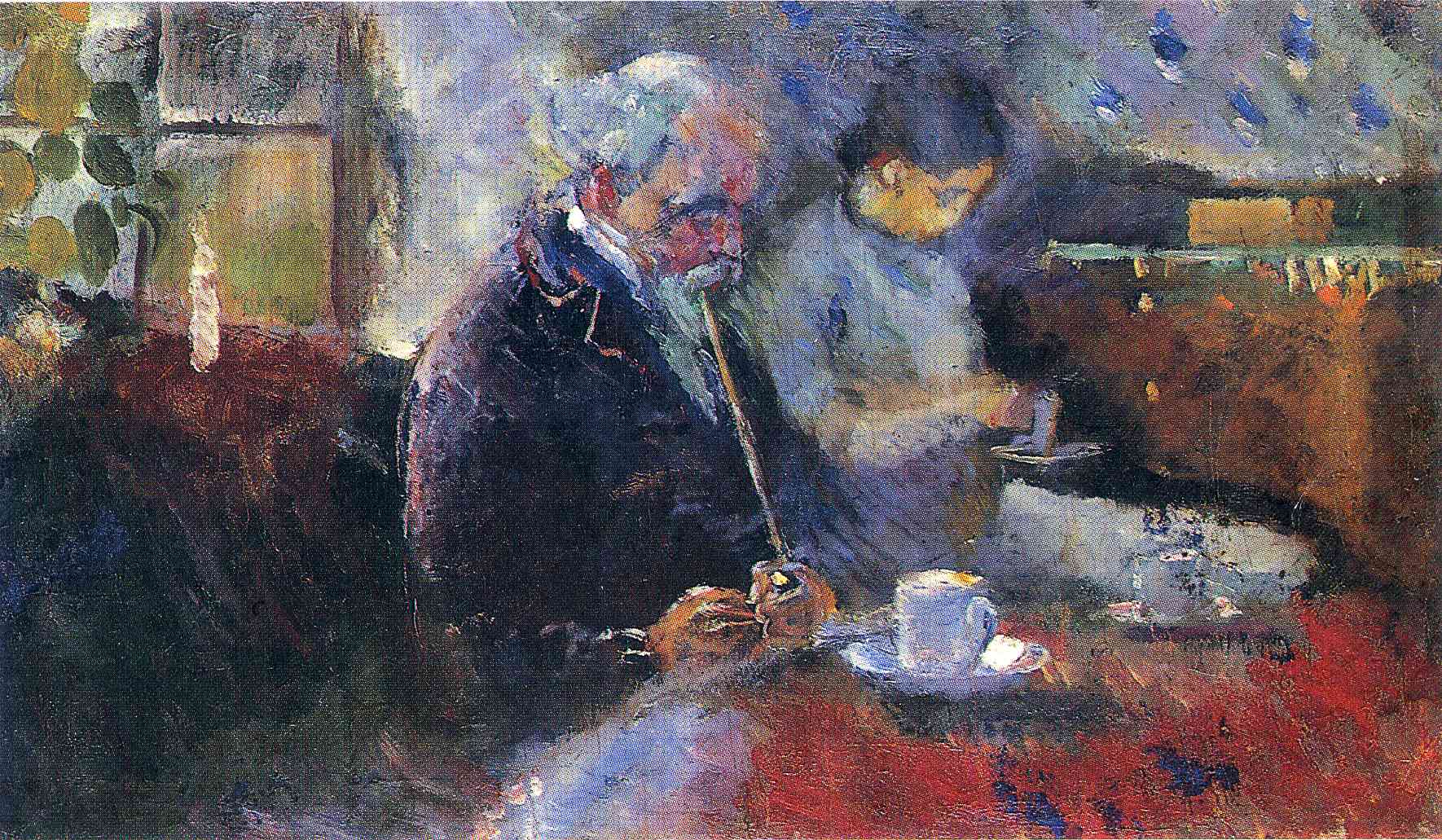
Edvard Munch, At The Coffee Table, 1883, Munch Museum, Oslo
What they discovered was a clear set of psychological traits offering a new lens through which to understand skepticism — and potentially new tools for public health officials scrambling to try to persuade people to get vaccinated.
Dr. Omer and a team of scientists found that skeptics were much more likely than nonskeptics to have a highly developed sensitivity for liberty — the rights of individuals — and to have less deference to those in positions of power.
Skeptics were also twice as likely to care a lot about the “purity” of their bodies and their minds. They disapprove of things they consider disgusting, and the mind-set defies neat categorization: It could be religious — halal or kosher — or entirely secular, like people who care deeply about toxins in foods or in the environment….
“At the root are these moral intuitions — these gut feelings — and they are very strong,” said Jeff Huntsinger, a social psychologist at Loyola University Chicago who studies emotion and decision-making and collaborated with Dr. Omer’s team. “It’s very hard to override them with facts and information. You can’t reason with them in that way.”
These qualities tend to predominate among conservatives but they are present among liberals too. They are also present among people with no politics at all.
What are they thinking, these vaccine-hesitant, vaccine-resistant, and COVID-apathetic? I wanted to know. So I posted an invitation on Twitter for anybody who wasn’t planning to get vaccinated to email me and explain why. In the past few days, I spoke or corresponded with more than a dozen such people. I told them that I was staunchly pro-vaccine, but this wouldn’t be a takedown piece. I wanted to produce an ethnography of a position I didn’t really understand.
The people I spoke with were all under 50. A few of them self-identified as Republican, and none of them claimed the modern Democratic Party as their political home. Most said they weren’t against all vaccines; they were just a “no” on thisvaccine. They were COVID-19 no-vaxxers, not overall anti-vaxxers.
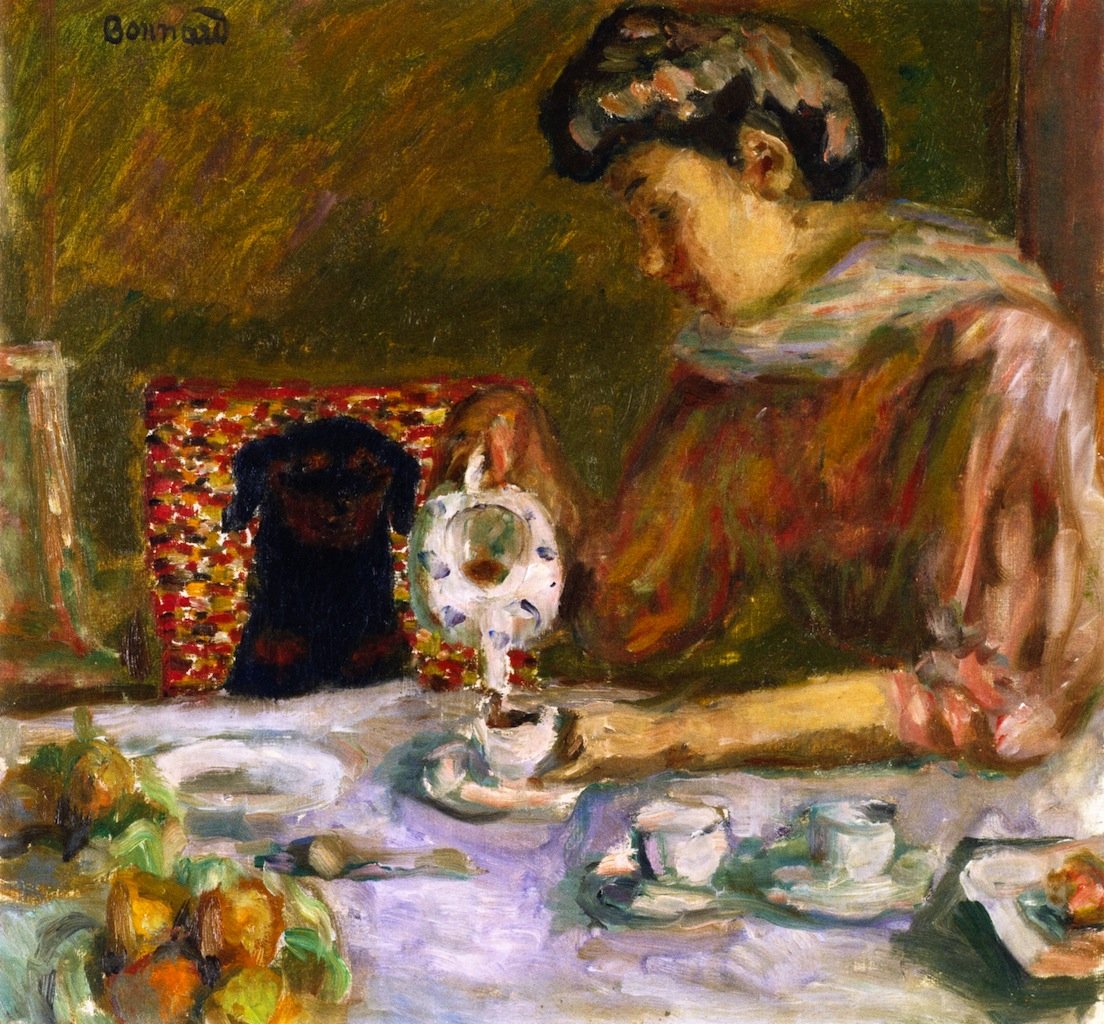
Pierre Bonnard, Coffee, 1907
Many people I spoke with said they trusted their immune system to protect them. “Nobody ever looks at it from the perspective of a guy who’s like me,” Bradley Baca, a 39-year-old truck driver in Colorado, told me. “As an essential worker, my life was never going to change in the pandemic, and I knew I was going to get COVID no matter what. Now I think I’ve got the antibodies, so why would I take a risk on the vaccine?”
Some had already recovered from COVID-19 and considered the vaccine unnecessary. “In December 2020 I tested positive and experienced many symptoms,” said Derek Perrin, a 31-year-old service technician in Connecticut. “Since I have already survived one recorded bout with this virus, I see no reason to take a vaccine that has only been approved for emergency use. I trust my immune system more than this current experiment.”
Others were worried that the vaccines might have long-term side effects. “As a Black American descendant of slavery, I am bottom caste, in terms of finances,” Georgette Russell, a 40-year-old resident of New Jersey, told me. “The fact that there is no way to sue the government or the pharmaceutical company if I have any adverse reactions is highly problematic to me.”
Many people said they had read up on the risk of COVID-19 to people under 50 and felt that the pandemic didn’t pose a particularly grave threat. “The chances of me dying from a car accident are higher than my dying of COVID,” said Michael Searle, a 36-year-old who owns a consulting firm in Austin, Texas. “But it’s not like I don’t get in my car.”
And many others said that perceived liberal overreach had pushed them to the right. “Before March 2020, I was a solid progressive Democrat,” Jenin Younes, a 37-year-old attorney, said. “I am so disturbed by the Democrats’ failure to recognize the importance of civil liberties. I’ll vote for anyone who takes a strong stand for civil liberties and doesn’t permit the erosion of our fundamental rights that we are seeing now.” Baca, the Colorado truck driver, also told me he didn’t vote much before the pandemic, but the perception of liberal overreach had a strong politicizing effect. “When COVID hit, I saw rights being taken away. So in 2020, I voted for the first time in my life, and I voted all the way Republican down the ballot.”
Thompson’s interpretation of his findings:
My view of the vaccines begins with my view of the pandemic. I really don’t want to get COVID-19. Not only do I want to avoid an illness with uncertain long-term implications, but I also don’t want to pass it along to somebody in a high-risk category, such as my grandmother or an immunocompromised stranger. For more than a year, I radically changed my life to avoid infection. So I was thrilled to hear that the vaccines were effective at blocking severe illness and transmission. I eagerly signed up to take both my shots, even after reading all about the side effects.
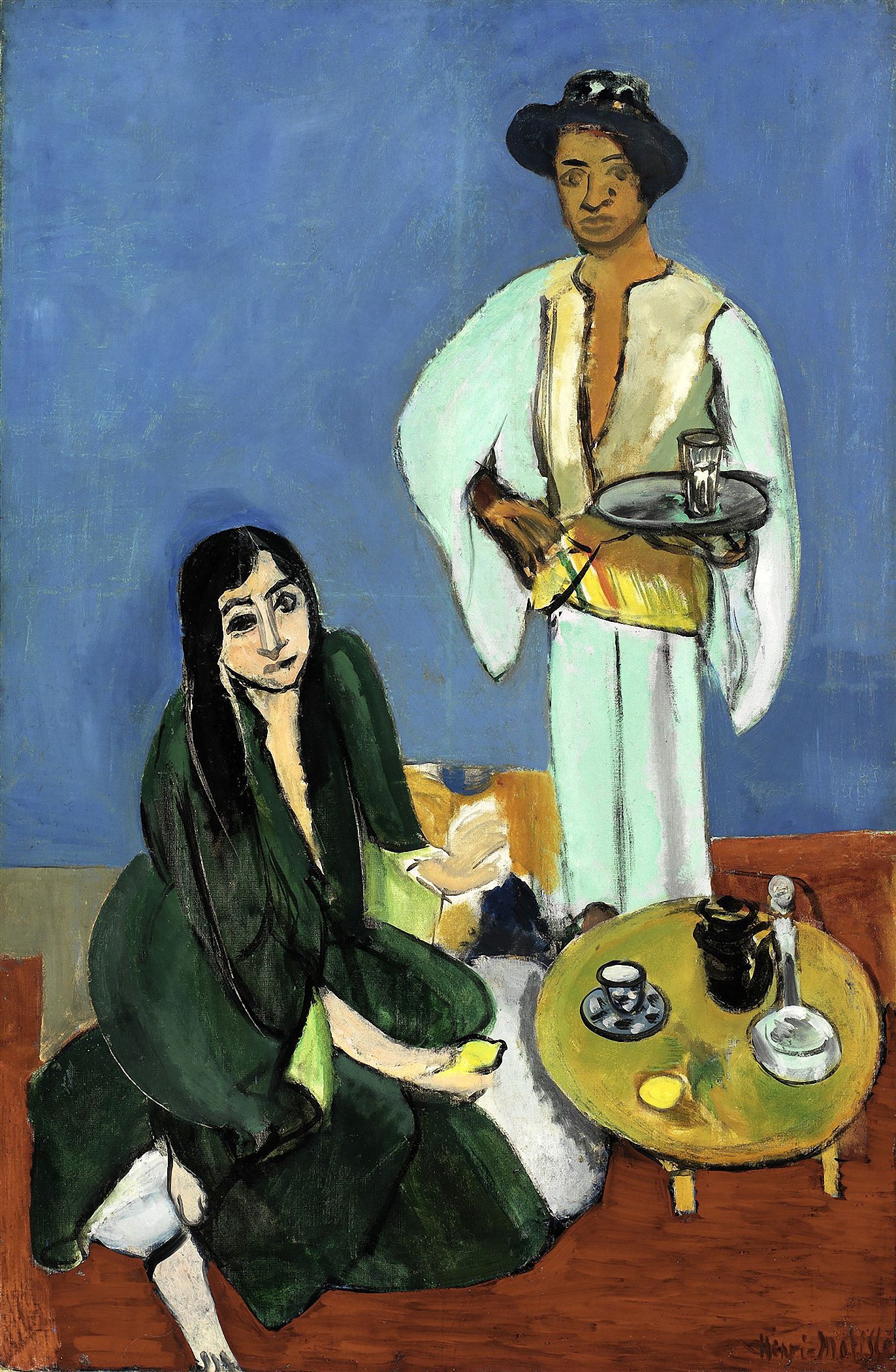
Henri Matisse, Coffee, 1916, Detroit Institute of Arts
The under-50 no-vaxxers’ deep story has a very different starting place. It begins like this:
“The coronavirus is a wildly overrated threat. Yes, it’s appropriate and good to protect old and vulnerable people. But I’m not old or vulnerable. If I get it, I’ll be fine. In fact, maybe I have gotten it, and I am fine. I don’t know why I should consider this disease more dangerous than driving a car, a risky thing I do every day without a moment’s worry. Liberals, Democrats, and public-health elites have been so wrong so often, we’d be better off doing the opposite of almost everything they say.”
Just as my COVID-19 story shapes my vaccine eagerness, this group’s COVID-19 story shapes their vaccine skepticism. Again and again, I heard variations on this theme:
“I don’t need some novel pharmaceutical product to give me permission to do the things I’m already doing. This isn’t even an FDA-approved vaccine; it’s authorized for an emergency. Well, I don’t consider COVID-19 a personal emergency. So why would I sign up to be an early guinea pig for a therapy that I don’t need, whose long-term effects we don’t understand? I’d rather bet on my immune system than on Big Pharma.”
For both yes-vaxxers like me and the no-vaxxers I spoke with, feelings about the vaccine are intertwined with feelings about the pandemic.
There’s much more at The Atlantic link.
So maybe my notion that vaccine refusal/hesitancy comes from Trump propaganda is wrong? I still think that’s a significant element of the problem. But clearly there are other psychological and sociological explanations. Is there a solution?
Ker-Xavier Roussel Reading the Newspaper, 1893, Private Collection Édouard Vuillard
Happy World Press Freedom Day Sky Dancers!
A Free Press is enshrined in our Constitution here in the United States. It’s always been a hallmark of open, democratic societies. So, how is the press doing in this day of increasing right-wing authoritarianism?
The world of journalism faces “drastic losses”, the UN has warned, as it highlights the importance of ‘information as a public good’ on World Press Freedom day.
The intergovernmental organisation says the current coronavirus crisis has forced closures and job cuts within the industry, while other media outlets are facing “political capture”.
The result is more “creeping news deserts” in countries where journalists are unable to get accurate information out to the public.
You may read country descriptions based on the Press Freedom Index on the challenges faced by journalists.
A grim reminder: Turkey is still one of the world's biggest jailers of journalists. Since 2016, at least 180 media outlets have been shut down in Turkey and scores of journalists have been imprisoned.#FreeTurkeyMedia#PostForThePresspic.twitter.com/BJ81Sy4gtb
We may be going back towards normalcy with the White House recognizing the role of a free press today. You may remember that we spent the last four years hearing how the press was the enemy of the people unless it presented stories that flattered and backed-up the delusional rantings of the previous guy. It is also high time the Saudis pay for killing one of our journalists. This is just one of the atrocities the previous guy ignored.
Will Biden stand up to the Saudis for the Prince’s murder of Jamal Khashoggi? This is from NBC.
The Biden administration earlier this year released a U.S. intelligence report implicating the crown prince in the 2018 murder of Saudi journalist Jamal Khashoggi but spared him any direct punishment. The prince denies any involvement.
On World Press Freedom Day – Remember those who've lost their lives, been jailed, been beaten and been threatened for trying to get the word out. #PostForThePress Justice for Jamal Khashoggi.#JamalKhashoggi@POTUS Free jailed reporters across the Globe.@RSF_enpic.twitter.com/bvC1zq8cPK
We have impeached judges before. Is this the decade of taking out the trash dumped in our justice system? Perhaps we could at least develop and enforce standards of ethical behavior for judges?
A lot of hand-wringing has accompanied Supreme Court Justice Amy Coney Barrett’s$2 million book deal (including from those of us who wish we had a $2 million book deal). While there’s always reason to worry when big piles of money land on the court, and Coney Barrett has wasted little time monetizing her new job, some larger points are getting lost in all of this.
After all, Coney Barrett isn’t the first justice to reel in a big book deal. Justice Sonia Sotomayor collected an advance of more than $3 million for her memoir, and Justice Clarence Thomas got $1.5 million for his. Justice Neil Gorsuch was paid $225,000 for a book about the Constitution. Here’s the rub: Federal ethics guidelines mandate that justices can’t accept more than about $30,000 annually in outside pay. However, book income — which can reliably bring in much larger sums than the relatively modest pay justices receive for teaching gigs — is exempt from the guidelines.
When these deals arise, concerns are often voiced about justices being compromised by pocketing money from publishers who might have free speech and other issues affecting them before the court. But books are only a small part of a bigger problem: The Supreme Court’s conflicts of interest and financial disclosure rules remain ragged and outdated.
Unlike every other member of state and federal judiciaries, the court’s nine justices aren’t subject to an ethical code of conduct. That mirrors the latitude given the presidency, which also isn’t beholden to most guidelines circumscribing financial and professional practices of people in lower-ranking government jobs. Former President Donald Trump’s tenure, marked by flagrant financial conflicts of interest, is a reminder of how ineffective self-regulating ethics are when someone isn’t really interested in self-regulation.
Woman with a newspaper, Richard Diebenkorn
The danger of right-wing propaganda to our Democracy has been an ongoing issue in the last several centuries. It has always skirted the First Amendment in terms of substance and motivation. We depend on an educated populace to search out the truth among many sources. The role it has played in putting public health issues into the realm of political cosplay is beyond the pale. Derek Thomas writes this for The Atlantic: “Millions Are Saying No to the Vaccines. What Are They Thinking? Feelings about the vaccine are intertwined with feelings about the pandemic.” It’s also intertwined with politics and right-wing news media falsehoods.
What are they thinking, these vaccine-hesitant, vaccine-resistant, and COVID-apathetic? I wanted to know. So I posted an invitation on Twitter for anybody who wasn’t planning to get vaccinated to email me and explain why. In the past few days, I spoke or corresponded with more than a dozen such people. I told them that I was staunchly pro-vaccine, but this wouldn’t be a takedown piece. I wanted to produce an ethnography of a position I didn’t really understand.
The people I spoke with were all under 50. A few of them self-identified as Republican, and none of them claimed the modern Democratic Party as their political home. Most said they weren’t against all vaccines; they were just a “no” on thisvaccine. They were COVID-19 no-vaxxers, not overall anti-vaxxers.
Many people I spoke with said they trusted their immune system to protect them. “Nobody ever looks at it from the perspective of a guy who’s like me,” Bradley Baca, a 39-year-old truck driver in Colorado, told me. “As an essential worker, my life was never going to change in the pandemic, and I knew I was going to get COVID no matter what. Now I think I’ve got the antibodies, so why would I take a risk on the vaccine?”
Some had already recovered from COVID-19 and considered the vaccine unnecessary. “In December 2020 I tested positive and experienced many symptoms,” said Derek Perrin, a 31-year-old service technician in Connecticut. “Since I have already survived one recorded bout with this virus, I see no reason to take a vaccine that has only been approved for emergency use. I trust my immune system more than this current experiment.”
Others were worried that the vaccines might have long-term side effects. “As a Black American descendant of slavery, I am bottom caste, in terms of finances,” Georgette Russell, a 40-year-old resident of New Jersey, told me. “The fact that there is no way to sue the government or the pharmaceutical company if I have any adverse reactions is highly problematic to me.”
Many people said they had read up on the risk of COVID-19 to people under 50 and felt that the pandemic didn’t pose a particularly grave threat. “The chances of me dying from a car accident are higher than my dying of COVID,” said Michael Searle, a 36-year-old who owns a consulting firm in Austin, Texas. “But it’s not like I don’t get in my car.”
And many others said that perceived liberal overreach had pushed them to the right. “Before March 2020, I was a solid progressive Democrat,” Jenin Younes, a 37-year-old attorney, said. “I am so disturbed by the Democrats’ failure to recognize the importance of civil liberties. I’ll vote for anyone who takes a strong stand for civil liberties and doesn’t permit the erosion of our fundamental rights that we are seeing now.” Baca, the Colorado truck driver, also told me he didn’t vote much before the pandemic, but the perception of liberal overreach had a strong politicizing effect. “When COVID hit, I saw rights being taken away. So in 2020, I voted for the first time in my life, and I voted all the way Republican down the ballot.”
In many ways, the 2020 election was basically like every recent Americanpresidentialelection: The Republican candidate won the white vote (54 percent to 44 percent, per CES), and the Democratic candidate won the overwhelming majority of the Black (90 percent to 8 percent), Asian American (66 percent to 31 percent) and Hispanic (64 percent to 33 percent) vote. Like in 2016, there was a huge difference among non-Hispanic white voters by education, as those with at least a four-year college degree favored Biden (55 percent to 42 percent), while those without degrees (63 to 35) favored Trump. (There wasn’t a huge education split among voters of color.)1
Othersurveystell the same general story: Trump won white voters overall by a margin in the double digits and won whites without four-year degrees by even more; Trump lost among whites with at least a four-year college degree, lost by a big margin with Asian American and Latino voters and lost by an enormous margin among African Americans.
So the main reason that Trump nearly won a second term was not his increased support among Latinos, who are only about 10 percent of American voters and are a group he lost by more than 20 points. Trump’s main strength was his huge advantage among non-Hispanic white voters without college degrees, who are about 45 percent of American voters. His second biggest bloc of support was among non-Hispanic white Americans with degrees, who are about 30 percent of all voters. According to the CES, over 80 percent of Trump’s voters were non-Hispanic white voters, with or without a college degree. In contrast, around 70 percent of nonwhite voters supported Biden, and they made up close to 40 percent of his supporters. So it is very much still the case that the Republicans are an overwhelmingly white party and that the Democratic coalition is much more racially diverse.
Speaker One: "Don't amplify!"
Speaker Two: "I hear you, but sometimes we have to!"
The story began when Chalmette State Representative Raymond Garofalo proposed a bill where-in he wanted to ban “critical race theory” from being taught, a complex subject that conservatives have been using as a talking point recently to score political points. He said that he, in fact, wanted to “teach the good, the bad, and the ugly” about slavery. To which Hilferty replied, “There’s nothing good about slavery” to laughter.
Garofalo corrected himself, saying that, “You’re right. I didn’t mean to imply that. I don’t believe that, and I know that’s the case. But I’m using the term, ‘the good, bad, and ugly as a generic way of saying that you can teach any facts, factually based on anything.”
Both Hilferty and Garofalo have spoken directly to the media about the incident. Garofalo has tried to clarify his words, explain the terminology “good, bad, and ugly” was meant “generically,” and Hilferty claimed he was, “…talking about the good in slavery.”
Whether Garofalo meant that there were good aspects to slavery or whether he was speaking “generically,” Huckaby repeatedly came to his defense, and to the defense of slavery itself. The above was not her only post related to slavery and Garofalo. She also wrote in another post, “Slavery goes all they [sic] way back to biblical times, and if you’ve read your Bible, you would know that many of the slaves loved their masters, and their masters loved them, and took very good care of them, and their families.”
In addition, she indicated that, “Stephanie (Hilferty) has been indoctrinated by leftis [sic] marxisum [sic] education.”
So, hmm, I’m a communist troll in her eyes. So bet it! At this point, I’ll take any moniker that doesn’t include what she’s all about.
Anyway, you’ll have a good week! What’s on your reading and blogging list today?
Did you like this post? Please share it with your friends:
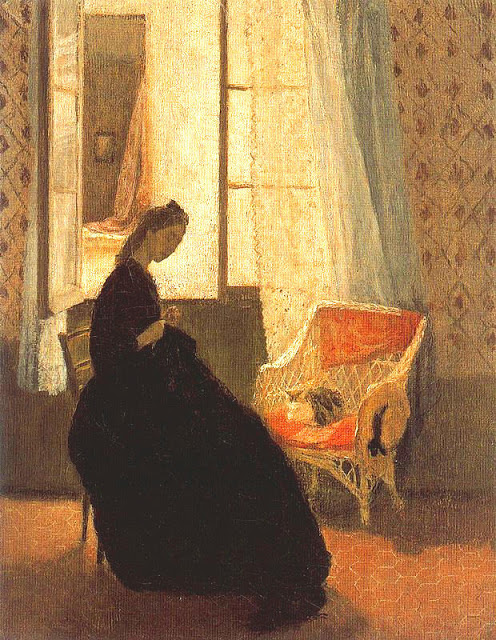
Gwen John (British painter, 1876-1939) Interior with Woman Sewing at Window and Cat
Good Afternoon!!
It’s the weekend, and we should be having fun even though we’re in the midst of a global pandemic with wars raging around the world and our democracy still in danger because one of our political parties has turned into a suicidal cult obsessed with conspiracy theories, led by a pathetic huckster who is rapidly sinking into dementia. So before I start on the news of the day, here’s a fun read at The New Yorker:
The article is long and involved, so there’s no way to summarize it with excerpts, but here’s just a taste:
The government may not have been in regular touch with exotic civilizations, but it had been keeping something from its citizens. By 2017, [Leslie] Kean was the author of a best-selling U.F.O. book and was known for what she has termed, borrowing from the political scientist Alexander Wendt, a “militantly agnostic” approach to the phenomenon. On December 16th of that year, in a front-page story in the Times, Kean, together with two Times journalists, revealed that the Pentagon had been running a surreptitious U.F.O. program for ten years. The article included two videos, recorded by the Navy, of what were being described in official channels as “unidentified aerial phenomena,” or U.A.P. In blogs and on podcasts, ufologists began referring to “December, 2017” as shorthand for the moment the taboo began to lift. Joe Rogan, the popular podcast host, has often mentioned the article, praising Kean’s work as having precipitated a cultural shift. “It’s a dangerous subject for someone, because you’re open to ridicule,” he said, in an episode this spring. But now “you could say, ‘Listen, this is not something to be mocked anymore—there’s something to this.’ ”
Since then, high-level officials have publicly conceded their bewilderment about U.A.P. without shame or apology. Last July, Senator Marco Rubio, the former acting chairman of the Select Committee on Intelligence, spoke on CBS News about mysterious flying objects in restricted airspace. “We don’t know what it is,” he said, “and it isn’t ours.” In December, in a video interview with the economist Tyler Cowen, the former C.I.A. director John Brennan admitted, somewhat tortuously, that he didn’t quite know what to think: “Some of the phenomena we’re going to be seeing continues to be unexplained and might, in fact, be some type of phenomenon that is the result of something that we don’t yet understand and that could involve some type of activity that some might say constitutes a different form of life.”
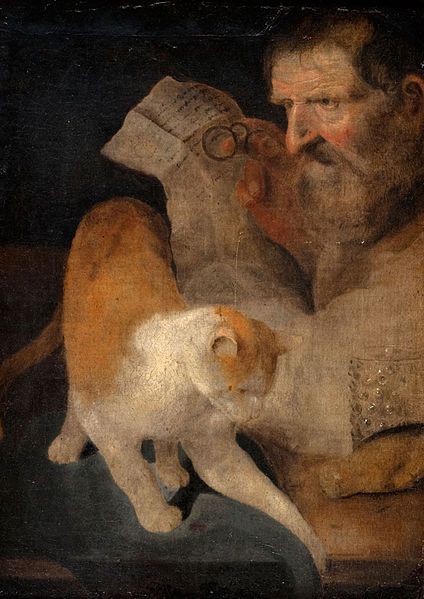
Mann mit Katze. Christoph Paudiss 1618 Private Collection
Last summer, David Norquist, the Deputy Secretary of Defense, announced the formal existence of the Unidentified Aerial Phenomena Task Force. The 2021 Intelligence Authorization Act, signed this past December, stipulated that the government had a hundred and eighty days to gather and analyze data from disparate agencies. Its report is expected in June….
Leslie Kean is a self-possessed woman with a sensible demeanor and a nimbus of curly graying hair. She lives alone in a light-filled corner apartment near the northern extreme of Manhattan, where, on the wall behind her desk, there is a framed black-and-white image that looks like a sonogram of a Frisbee. The photograph was given to her, along with chain-of-custody documentation, by contacts in the Costa Rican government; in her estimation, it is the finest image of a U.F.O. ever made public. The first time I visited, she wore a black blazer over a T-shirt advertising “The Phenomenon,” a documentary from 2020 with strikingly high production values in a genre known for grainy footage of dubious provenance. Kean is
stubborn but unassuming, and she tends to speak of the impact of “the Times story,” and the new cycle of U.F.O. attention it has inaugurated, as if she had not been its principal instigator. She told me, “When the New York Times story came out, there was this sense of ‘This is what the U.F.O. people have wanted forever.’ ”
Kean is always assiduously polite toward the “U.F.O. people,” although she stands apart from the ufological mainstream.
India posted a record daily rise of 401,993 new coronavirus cases on Saturday as the country opened up its massive vaccination drive to all adults, although several states warned of acute shortages.
It was the first time India’s daily case count had topped 400,000 after 10 consecutive days over 300,000. Deaths from Covid-19 jumped by 3,523 over the past 24 hours, taking the total toll in India to 211,853, according to official data.
The world’s biggest producer of Covid-19 vaccines has a limited number of shots available, worsening a grim second wave of infections that has overwhelmed hospitals and morgues while families scramble for scarce medicines and oxygen.
Hundreds of people were seen queuing to be vaccinated across Ahmedabad, the main commercial city in Prime Minister Narendra Modi’s home state of Gujarat, on Saturday.
Blaze at an Indian hospital Covid-19 ward kills 18
Eighteen people are dead after a fire broke out at a Covid-19 hospital ward in India’s Gujarat state in the early hours of Saturday.
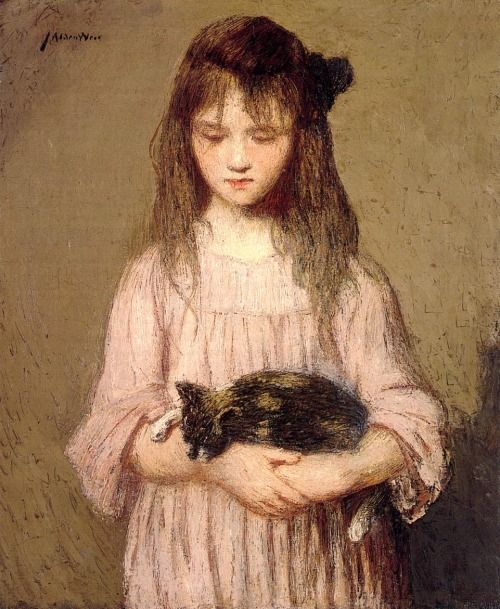
Lillian Lancaster c. 1887-1973, The Boy and the Cat; Grundy Art Gallery
The fire broke out in the intensive care unit of the Welfare Hospital in the western state’s Bharuch district, according to Dr. MD Modiya, a senior district official.
According to Modiya, 16 of the dead were patients. Two were staff members.
Nearly 60 patients were in the hospital at the time of the fire, which broke out around 1 a.m. local time, he said. The remaining patients have been moved to nearby hospitals.
The cause of the fire is yet to be determined but initial investigations suggest a short circuit, according to Dr Modiya.
In a tweet on Saturday, Gujarat’s chief minister, Vijay Rupani, said two senior officers from the Indian Administrative Service have been dispatched to Bharuch to investigate the fire. The state government will open a judicial inquiry into the fire, he added.
In an earlier post, Rupani offered his condolences to the patients and staff at Welfare Hospital and offered $5,398 in compensation to the families of each of the victims.
Indian Prime Minister Narendra Modi also tweeted his condolences.
“Pained by the loss of lives due to a fire at a hospital in Bharuch,” he said. “Condolences to the bereaved families.”
Vaccine shortage halts rollout across two more Indian states
India’s southern states Telangana and Andhra Pradesh have become the latest to postpone Saturday’s planned national Covid-19 vaccination rollout, citing shortages of shots.
On Friday, Telangana’s Director of Public Health, Dr. G. Srinavasa Rao, tweeted that the state wouldn’t be vaccinating people over the weekend as it hadn’t received doses.
In neighboring Andhra Pradesh, officials have acknowledged that it was not “practically possible” to start vaccinating those over the age 18 due to limited stocks.
“If we need to fulfil the commitment to the former age group batch, it is definitely going to take all of May,” Anil Kumar Singhal, Andhra Pradesh’s Principal Health Secretary, told reporters on Friday.
At least seven states and territories are facing shortages that are impacting the planned vaccine rollout.
New Delhi — The first shipment of emergency medical aid supplies from the United States arrived in India on Friday as the country continued battling an explosion of coronavirus cases that has strained its health care system to breaking point. A U.S. military transport plane carrying more than 400 oxygen cylinders, nearly one million rapid coronavirus test kits and other supplies landed in Delhi on Friday morning.
But as mass vaccination centers were forced to close without any doses to stick in arms, and people continued to die without oxygen at jam-packed hospitals, the aid from the U.S. and other countries that’s started to pour in is like a Band-Aid for a severed leg….
“The United States stands with India as we fight the COVID-19 pandemic together,” said the U.S. Embassy in India in a tweet.
India’s External Affairs Ministry thanked the U.S. for the contributions, which were the first step toward fulfilling President Joe Biden’s pledge earlier this week to support India in its “time of need… Just as India sent assistance to the United States as our hospitals were strained early in the pandemic.”
Victims of India’s devastating COVID-19 surge are being cremated in parking lots, with one crematorium so overwhelmed that it has launched a ticketing system.
In the past two weeks, the number of new daily COVID-19 cases in India has repeatedly broken global records, with the country recording thousands of new deaths every day.
The staff at the Seemapuri crematorium in New Delhi recently erected several extra burning platforms in the parking lot to keep up with the staggering demand, CNN reported.
Cremation is the standard death rite in Hinduism, India’s dominant religion, and crematoriums are under intense pressure.
“Before the pandemic, we used to cremate eight to 10 people” a day, Jitender Singh Shunty, the head of the Seemapuri crematorium, told CNN. “Now, we are cremating 100 to 120 a day.”
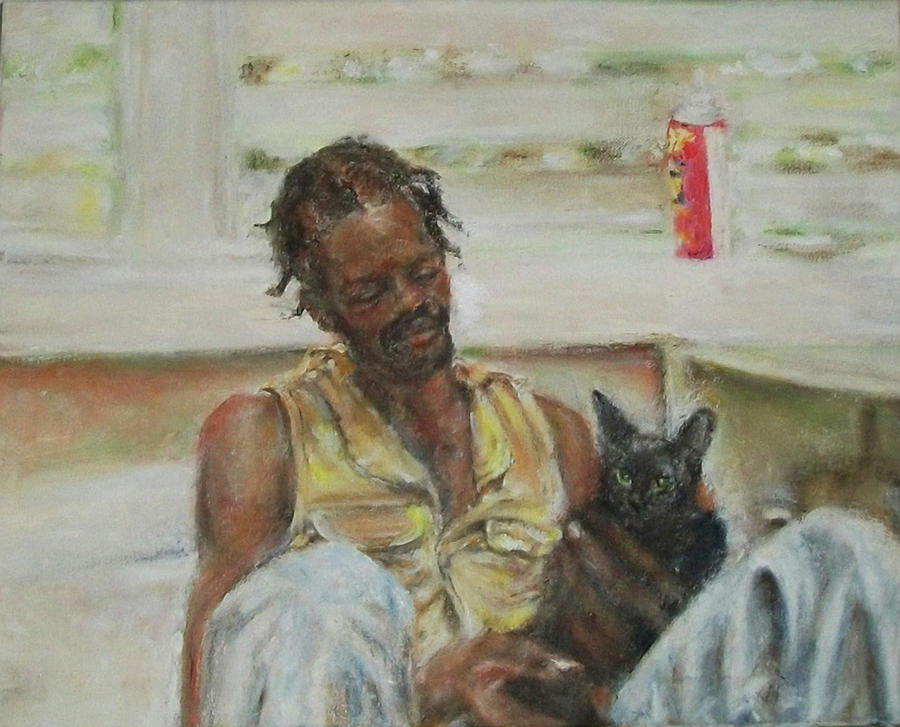
Man with Cat, Candace Hunt
Madhukar Pai and Manu Prakash at The Washington Post: Opinion: India’s covid-19 crisis is a dire warning for all countries.
The covid-19 crisis in India is a massive setback for the entire world. The scale of the nation’s surge is a warning not only for its neighboring countries, which are also experiencing sharp increases in cases, but also for countries around the globe. If we do not heed this warning and work on vaccine equity, we risk a forever pandemic with long-term cycles of lockdowns, economic damage and constant fear.
India is reporting more than 380,000 cases and 3,500 deaths daily. Both are underestimates. The Indian health-care system is completely overwhelmed. It is impossible to find hospital beds. Supplies such as oxygen are incredibly scarce, and there is a huge backlog with diagnostic testing. Many people with sick family members and friends in India — including us — are checking in on them. This time around, younger people are sick and, as is always the case, the poor are hit the hardest.
India has 95,000 intensive care beds and 48,000 ventilators. By mid-May, it is projected that the country will need 340,000 beds and more than 700,000 ventilators. Rural India has few of these and is already hit hard. India needs the global community’s support to survive this crisis.
The devastating second wave in India is the result of a perfect storm: a failure to plan for a second wave; premature relaxation of public health measures; large gatherings; insufficient vaccination coverage; and newer variants such as B.1.1.7 and B.1.617 that are highly transmissible and potentially more severe.\India has 95,000 intensive care beds and 48,000 ventilators. By mid-May, it is projected that the country will need 340,000 beds and more than 700,000 ventilators. Rural India has few of these and is already hit hard. India needs the global community’s support to survive this crisis.\Even as India struggles to get the second wave under control, cases are surging among India’s neighbors, including Nepal, Pakistan, Bangladesh and Sri Lanka. While the exact variant driving the new surges among India’s neighbors is unclear, the B.1.617 variant has already spread to more than 18 countries….
India has 95,000 intensive care beds and 48,000 ventilators. By mid-May, it is projected that the country will need 340,000 beds and more than 700,000 ventilators. Rural India has few of these and is already hit hard. India needs the global community’s support to survive this crisis.
Even as India struggles to get the second wave under control, cases are surging among India’s neighbors, including Nepal, Pakistan, Bangladesh and Sri Lanka. While the exact variant driving the new surges among India’s neighbors is unclear, the B.1.617 variant has already spread to more than 18 countries.
Other countries in South Asia have far less resources and medical infrastructure compared with India. Nepal, for example, has 1,486 ICU beds and 634 ventilators , and Nepal’s health ministry is anticipating a need to treat 15,000 ICU patients by July. Bangladesh, home to 163 million people, has only 1,134 covid-19 ICU beds. Pakistan, the fifth-largest country in the world, has fewer than 4,000 ventilators. India’s neighbors can ill afford the kind of devastation India is experiencing.
Read the rest at the WaPo.
I’m running out of space, but I’ll end with some links to the latest on the huge–but fun for us–Rudy Giuliani story:
One of the recurrent themes in the headlines these days is the long uneven road to American Justice. We got a brief respite a few weeks ago with the Chauvin trial which quickly dispensed with a murdering cop once the system was put to work in the proper way. This was a state case handled by the Minnesota AG Keith Ellison, the former Minnesota Congressman.
We’re beginning to see the Department of Justice work in the proper way too. Many of the key appointments are focused on both ridding the corruption of the Trumpist regime and moving forward to ensure we live up to our Constitutional promise, our rule of law, and our inspirational founding with many coming together to make one.
Attorney General Bill Barr played a central role in the Trump administration’s most high-profile controversies, from undermining the Russia investigation to intervening in the cases of indicted Trump associates to ordering the forcible clearing of protesters in Lafayette Square Park.
The Biden/Garland Justice Department will play a central role in restoring rule of law and enacting many of the Biden/Harris Justice priorities.
DOJ’s broad authority also overlaps with many of the issues at the top of President Biden’s agenda, including restoring faith in government, promoting racial justice and police reform, and curbing gun violence.
Here are just a few of the actions taken to date.
The Justice Department also announcedon Wednesday that three Georgia men were charged with federal hate crimes in the shooting of Ahmaud Arbery, whose death was a rallying cry during last year’s racial-justice protests.
In Michigan, a superseding indictment was filed against five men accused of plotting last year to kidnap Gov. Gretchen Whitmer, with prosecutors referring to the alleged crimes as “domestic terrorism” for the first time.
That shift comes amid new developments in the investigation of the Jan. 6 Capitol riot, which has been described as the most complex probe in DOJ history. Garland, who played a leading role in the prosecution of the 1995 Oklahoma City bombing, has vowed to make prosecuting the Capitol rioters his “first priority.”
Other major steps taken in Garland’s first 50 days include:
“Pattern or practice” investigations into the Minneapolis and Louisville police departments, following the deaths last year of George Floyd and Breonna Taylor.
A 30-day “expedited review” into how DOJ can better prosecute and track hate crimes amid a surge in violence against Asian Americans.
The revocation of a Trump-era policy that restricted federal funding for “sanctuary cities.”
Responsibility for five of the sixexecutive actions on gun control ordered by Biden.
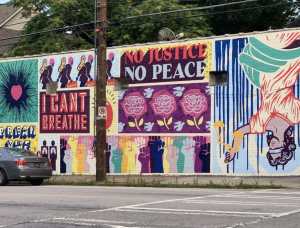
ABV Gallery (abvatl.com) artists Tommy Bronx and Ash “Wolfdog” Hayner installed a new mural at the intersection of Irwin and Randolph Streets in the heart of the Old Fourth Ward.
The biggest headline grabbers at the moment are the supoenas served on Rudy Guilliani and the stories of sex trafficking and child rape coming out of the Matt Gaetz investigation. Both of these are sordid in their own way and full court press is to be expected. However, the work going on to prosecute the insurrectionists as well the additional addition of federal hate crime charges to the murder of unarmed black men by police and others is significant. The new addition of Covid-19 based hate crimes against those of Asian descent will likely be in the headlines shortly.
So how did Garland get tapped to be Biden’s attorney general? The most cynical interpretation of Biden’s choice is sheer pragmatism. Nominating Garland all but assured a smooth path to confirmation through the Senate, no matter who controlled it. (Biden nevertheless waited until the outcome of the Georgia runoffs was clear before making the Garland pick public.) Garland’s nomination also freed up a seat on the D.C. Circuit Court of Appeals, which is usually considered the second most powerful court in the nation and a warm-up spot for future Supreme Court nominees. There is even perhaps a dash of sympathy in the choice: Garland’s nomination gives him a chance to not be remembered as the would-be high court justice who was blithely snubbed by the U.S. Senate.
Nominating Garland, however, also fits well with the vision of governance that Biden had offered voters on the campaign trail. He is neither an ideologue like Sessions nor a partisan like Barr, partly because of his judicial oath and partly because of his temperament. Garland’s own sister toldThe New York Timesin 2016 that she didn’t know her brother’s party affiliation. In more than two decades on the D.C. Circuit, Garland carved out a reputation as a consensus-builder. From his elevation to the appellate bench in 1997 to his nomination to the Supreme Court in 2016, Garland wrote just 11 dissenting opinions—a testament to his ability to bring colleagues of all stripes together.
“He was not a hands-off, let-the-clerks-just-do-their-thing kind of judge,” Jessica Bulman-Pozen, a Columbia University law professor who clerked for Garland from 2007 to 2008, told me. “He was himself totally steeped in every case. He knew all the details. He knew the record.” Garland is often described as a centrist or a moderate, because he does not fit neatly into any particular ideological box. That description, however, is less revealing than it seems. “I don’t want to say he’d be sort of moderate in the sense of waiting or restraint in addressing [things],” Bulman-Pozen said, “but I think moderate perhaps in the sense of being careful, conscientious, thorough.”
Welp, it looks like Florida Rep. Matt Gaetz better start working out so that he can fight off attackers in prison because he’s about to lose his job and go straight to the pokey if anything in his former friend’s letter is true.
Joel Greenberg, a longtime associate of Gaetz, admitted in a letter that he and Gaetz paid for sex–including sex with an underaged girl.
According to a scathing report in the Daily Beast, Greenberg reportedly wrote a handwritten confession letter claiming that he and Gaetz were “involved in sexual activities” with a girl who was 17 at the time.
“From time to time, gas money or gifts, rent or partial tuition payments were made to several of these girls, including the individual who was not yet 18,” he wrote.
“I did see the acts occur firsthand and Venmo transactions, Cash App or other payments were made to these girls on behalf of the Congressman.”
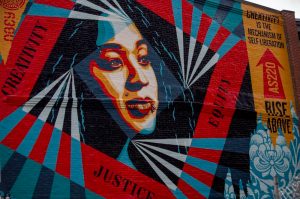
Shepard Fairey’s one-hundredth mural on the Founder’s League building on Clemence Street in Providence. (Jesse Costa/WBUR)
Speaking of badly behaved and nasty Trust Fund babies, Tucker Carlson tried to give Rudy Guiliani a platform. The SDNY probably hopes old Rudy will keep going on TV to blabber away at this rate. However, let’s turn to the NYT version today. “Firing of U.S. Ambassador Is at Center of Giuliani Investigation“. I really would be thrilled if former Ambassador Marie L. Yovanovitch got the last word on this as a witness.
It was a Pyrrhic victory. Mr. Giuliani’s push to oust the ambassador, Marie L. Yovanovitch, not only became a focus of President Donald J. Trump’s first impeachment trial, but it has now landed Mr. Giuliani in the cross hairs of a federal criminal investigation into whether he broke lobbying laws, according to people with knowledge of the matter.
In particular, the federal authorities were expected to scour the electronic devices for communications between Mr. Giuliani and Trump administration officials about the ambassador before she was recalled in April 2019, one of the people added.
The warrant also sought his communications with Ukrainian officials who had butted heads with Ms. Yovanovitch, including some of the same people who at the time were helping Mr. Giuliani seek damaging information about President Biden, who was then a candidate, and his family, the people said.
At issue for investigators is a key question: Did Mr. Giuliani go after Ms. Yovanovitch solely on behalf of Mr. Trump, who was his client at the time? Or was he also doing so on behalf of the Ukrainian officials, who wanted her removed for their own reasons?
It is a violation of federal law to lobby the United States government on behalf of foreign officials without registering with the Justice Department, and Mr. Giuliani never did so.
Even if the Ukrainians did not pay Mr. Giuliani, prosecutors could pursue the theory that they provided assistance by collecting information on the Bidens in exchange for her removal.
There’s a lot of Trumpist folks gonna lose their freedom. I’m pulling that Gaetz and Guiliani lose everything they’ve got. Get those January 6 insurrectionists too!!!
Meanwhile, I’m going to be watching the return of our Department of Justice. Have a great weekend!
What’s on your reading and blogging list today?
Did you like this post? Please share it with your friends:
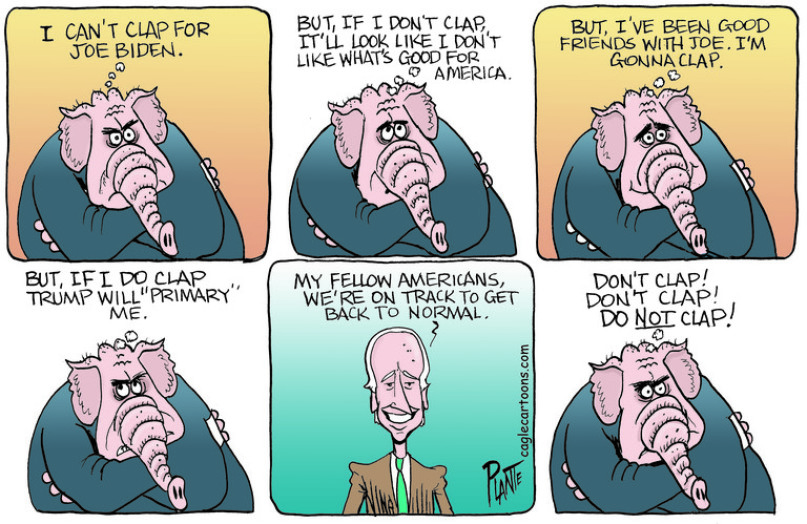
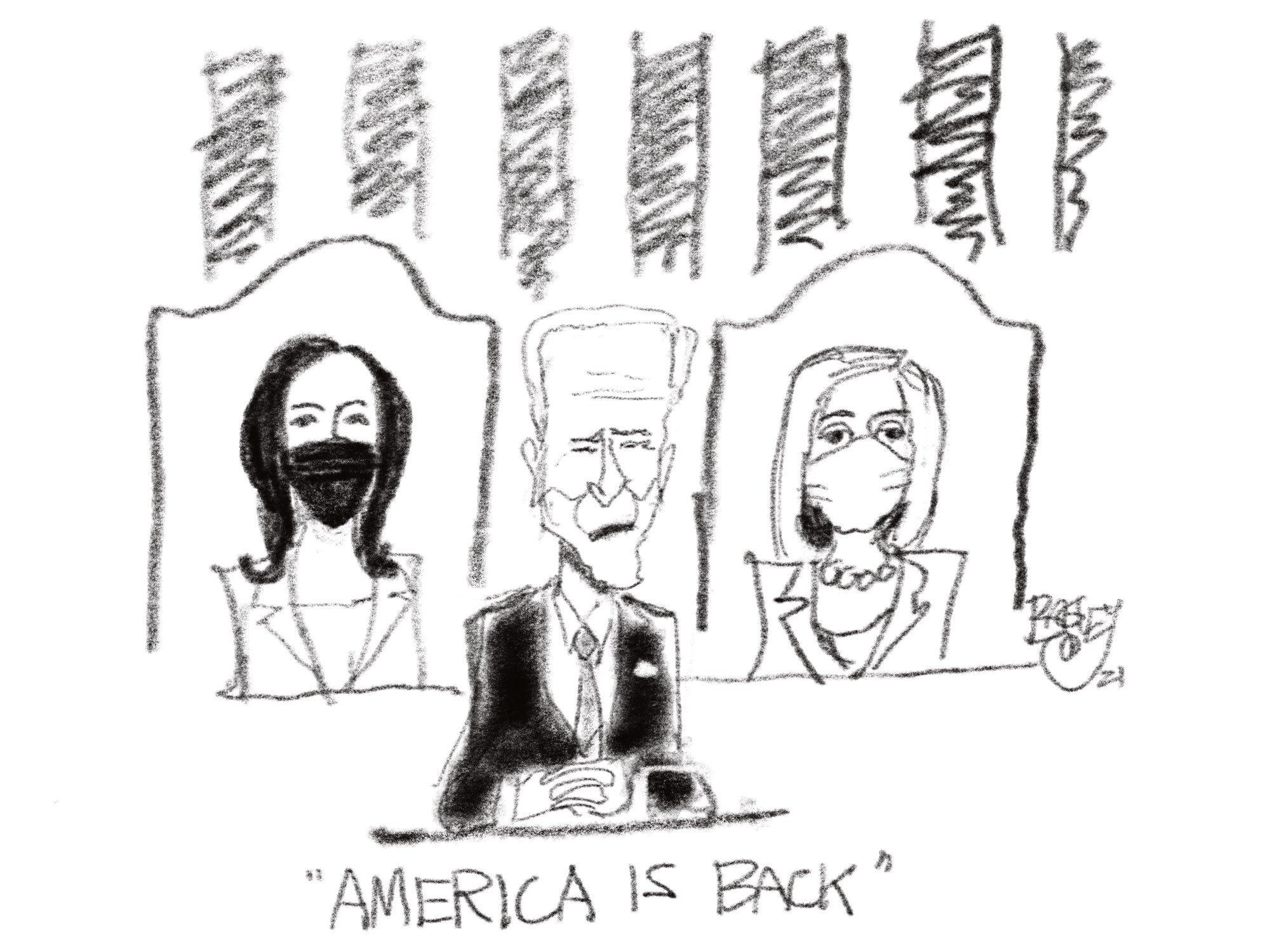
Last night President Biden gave his first speech to a joint session of Congress. For the first time, two women sat behind the president, Vice President Kamala Harris and Speaker of the House Nancy Pelosi. A couple of reactions to the speech:
There were two moments during President Biden’s address to the nation on Wednesday in which he obviously, if only indirectly, referred to the man who preceded him in his position.
The first came near the beginning.
“America is rising anew,” Biden said, “choosing hope over fear, truth over lies, and light over darkness.”
Only the second of those three pairings is immediately and obviously about Donald Trump; the former president’s indifference to accuracy is unparalleled. But by stringing the three together, Biden was similarly positioning Trump as the target of the other pejoratives. America under Trump, he’s saying, was a place of fear, dishonesty and darkness. That tracks with Biden’s past rhetoric and, frankly, Trump’s own: Biden warned the country last autumn that a dark winter was coming because of the pandemic (and Trump’s leadership failures), and Trump himself made fear a central part of his reelection bid.\But now, Biden argued on Wednesday night, all of that was swept aside.
“After 100 days of rescue and renewal, America is ready for takeoff, in my view,” he said. “We’re working again, dreaming again, discovering again and leading the world again. We have shown each other and the world that there’s no quit in America.”
From there, Biden turned his attention to an exhaustive list of policy priorities, one that, in its own way, differentiated his speech from any of Trump’s. Not only were his proposals robust and detailed in a way that was never Trump’s style, they were also progressive in a way that no Republican’s would be. It was an obvious difference and, of course, the most important one in terms of governance.
But it was also a reminder that Biden always ran on being a president who just sort of quietly went about presidenting, a promise that he has fulfilled in spades.
President Joe Biden’s address to a joint session Congress was the most ambitious ideological statement made by any Democratic president in decades—couched in language that made it sound as if he wasn’t making an ideological argument at all.
Make no mistake that he was. He called for trillions in new spending in a robust expansion of government’s role in multiple arenas of American life in ways that would have been impossible to contemplate in Barack Obama’s presidency. He plunged into subjects—racial and class inequities, immigration, gun violence—that were rubbed raw until bleeding in Donald Trump’s.
Usually these issues are framed with a question: Which side are you on? Though rarely described as gifted orator, Biden’s speech was a remarkable performance in part because it didn’t soar and largely didn’t even try to. In plain-spoken language, he depicted a breathtakingly large agenda as plain common sense. Instead of imploring partisans to take sides, he projected bewilderment that any practical-minded person of any persuasion could be opposed.
Under a pose of guilelessness, Biden’s speech was in fact infused with political guile. The agenda he promoted to expand both free pre-school and community college, to subsidize the shift to a low-carbon economy, to fund a massive way of new public works construction by taxing the very wealthy, represented years of pent-up demand by progressives. But much of the money would be spent in ways designed to break up the Trump coalition, which was powered heavily by middle- and lower-middle class whites who do not have college degrees with contempt for many parts of the progressive agenda.
Referring to his infrastructure proposal, Biden argued: “Nearly 90 percent of the infrastructure jobs created in the American Jobs Plan do not require a college degree. Seventy-five percent don’t require an associate’s degree. The American Jobs Plan is a blue-collar blueprint to build America.”
The bet is that material gains—i.e., a recovery that produces lots of working class jobs, and allows families to more easily educate their children—can trump the cultural grievances that sent many of these people into the conservative movement over the past two generations, beginning with George Wallace’s hardhat supporters and later becoming a flood of “Reagan Democrats.”
About half of Americans who watched President Joe Biden’s address to Congress had a very positive reaction to the speech, and 71% said they walked away feeling more optimistic about the country’s direction, according to a CNN Poll conducted by SSRS.
By a wide margin, speech-watchers said that Biden’s policy proposals would move the country in the right direction (73%) rather than the wrong direction (27%). In a survey conducted before the speech, the same people were a bit less bullish that Biden would lead in the right direction (67% right direction, 33% wrong direction), and that movement came from the independents and Republicans who watched the speech. Among Republicans, the share saying Biden’s policies would move the country in the right direction grew from 13% pre-speech to 27% post-speech, while among independents, that percentage rose from 61% to 73%.
That perception carries through to the major issues covered in the speech. More than 8 in 10 said Biden’s proposals on the coronavirus pandemic would move in the right direction (86%), and 74% said the same about racial injustice. Around 7 in 10 said the President’s policies on the economy (72%), gun laws (70%) and taxes (70%) were steps in the right direction. Slightly fewer said the same about immigration (65%).
And Biden’s focus on those issues appeared to hit the right mark for speech-watchers. Overall, 68% said Biden has had the right priorities so far as president, while 32% said he has not paid enough attention to the most important problems.
Federal investigators searched Rudy Giuliani’s home and office in Manhattan on Wednesday, executing search warrants as part of an investigation into his business dealings in Ukraine, reports The New York Times.
The former New York City mayor and personal lawyer to former President Donald Trump is being investigated over possible illegal lobbying on behalf of Ukrainian officials and his efforts to dig up dirt on Trump’s political rivals. “Executing a search warrant is an extraordinary move for prosecutors to take against a lawyer, let alone a lawyer for a former president,” writes the Times. “While the warrants are not an explicit accusation of wrongdoing against Mr. Giuliani, it shows that the investigation has entered an aggressive new phase.”
Experts agreed the search represented very serious stakes for Giuliani. Former U.S. attorney Harry Litman wrote that “this means that a magistrate judge has found probable cause to believe that [Giuliani’s actions in Ukraine] were criminal.” As the Times writes, “to obtain a search warrant, investigators need to persuade a judge they have sufficient reason to believe that a crime was committed and that the search would turn up evidence of the crime.”
Federal prosecutor and legal analyst Shanlon Wu called the search an “extraordinary step,” and wrote that “no amount of hot air and ranting is going to help Rudy Giuliani now.”
Litman continued: “I don’t know offhand the percentage of people whose [apartments] are searched by warrant who are then indicted … but it’s high, and given Giuliani’s profile, it has to be higher [because] they would be more careful and get lots of approvals.”
The search warrant was reportedly a long time coming, and politics may have slowed it down. The process was delayed for the presidential election so as not to sway voters, and Trump appointees at the DOJ reportedly managed to temporarily block the warrant while Trump was still in office.
I spoke with Preet Bharara, who served as the U.S. Attorney for the district from 2009 to 2017 — and whose podcast, Stay Tuned, was recently acquired by Vox Media — about Giuliani’s predicament and where the investigation might go next.
How significant is this move by the Feds from your perspective? How much legal danger does Giuliani face here? I think it’s extremely significant. I’m not one to say that when routine subpoenas are issued or interviews are conducted, but here you have a very prominent person — not just the former lawyer to the president of the United States but also the former U.S. Attorney of the office that’s involved in the investigation. The fact that you execute a warrant on someone’s residence does not necessarily mean there will be a charge, but given the circumstances, given the identity of Mr. Giuliani, given what you have to show to get a judge to authorize the warrant and the search — that’s a sign that he’s in deep trouble. We saw this play out with respect to Michael Cohen and to Paul Manafort. Very prominent targets, very sensitive cases. Both of those men were charged.
The two people you just cited also both went to prison. Is that where this could be going?
I used to head that office, and there are search warrants that get executed on people’s premises and their offices, and no charges follow. That happens, and Giuliani is presumed to be innocent. But what’s likely is that there has already been substantial investigation. The reporting was that they tried to execute these searches when Trump was in office, and they were stymied by higher-ups in the Justice Department. Bear in mind, they’re probably far along, given what showing they have to make of probable cause to do these searches in the first place. They likely already have a lot of Rudy Giuliani’s communications. You don’t need to have his devices in your possession to have email records; those are obtained from third parties, and they probably have all of that. It’s anyone’s guess what the charges will be and when they will come. But in my experience, when you do something like this, that you know will have a reputational effect on the subject, you’re usually thinking there’s a good likelihood of a charge.
It hasn’t been as widely reported, but it’s also significant that the Feds searched the home of another Trump-associated attorney, Victoria Toensing. Nicholas Reimann at Forbes: Feds Search Giuliani’s, Toensing’s Properties As Part Of Ukraine Investigation.
Federal investigators searched Rudy Giuliani’s Manhattan apartment on Wednesday and later searched the home of attorney Victoria Toensing as part of a probe into whether Giuliani acted on behalf of Ukrainian oligarchs to illegally lobby the Trump Administration, according to multiplereports, with investigators said to have seized electronic devices.
Hold the phone — FBI now at Victoria Toensing's house. Lawyer, wife and partner of Joseph DiGenova, same circles as Rudy and Trump. This has the hallmarks of a bigger day at DOJ. And she's probably not expecting it, unlike Rudy
F.B.I. agents also executed a search warrant on Wednesday morning at the Washington-area home of Victoria Toensing, a lawyer close to Mr. Giuliani who had dealings with several Ukrainians involved in the hunt for information on the Bidens, according to people with knowledge of that warrant. The warrant was for her cellphone.
Ms. Toensing, a former Justice Department official, has also represented Dmitry Firtash, a Ukrainian oligarch under indictment in the United States whose help Mr. Giuliani sought.
The Sky Dancing banner headline uses a snippet from a work by artist Tashi Mannox called 'Rainbow Study'. The work is described as a" study of typical Tibetan rainbow clouds, that feature in Thanka painting, temple decoration and silk brocades". dakinikat was immediately drawn to the image when trying to find stylized Tibetan Clouds to represent Sky Dancing. It is probably because Tashi's practice is similar to her own. His updated take on the clouds that fill the collection of traditional thankas is quite special.
You can find his work at his website by clicking on his logo below. He is also a calligraphy artist that uses important vajrayana syllables. We encourage you to visit his on line studio.









 India has 95,000 intensive care beds and 48,000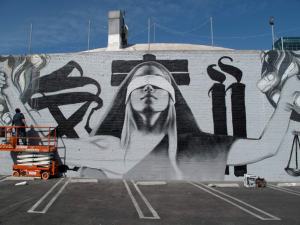

 Make no mistake that he was. He called for trillions in new spending in a robust expansion of government’s role in multiple arenas of American life in ways that would have been impossible to contemplate in Barack Obama’s presidency. He plunged into subjects—racial and class inequities, immigration, gun violence—that were rubbed raw until bleeding in Donald Trump’s.
 By a wide margin, speech-watchers said that Biden’s policy proposals would move the country in the right direction (73%) rather than the wrong direction (27%). In a survey conducted before the speech, the same people were a bit less bullish that Biden would lead in the right direction (67% right direction, 33% wrong direction), and that movement came from the independents and Republicans who watched the speech. Among Republicans, the share saying Biden’s policies would move the country in the right direction grew from 13% pre-speech to 27% post-speech, while among independents, that percentage rose from 61% to 73%.
 Experts agreed the search represented very serious stakes for Giuliani. Former U.S. attorney Harry Litman
 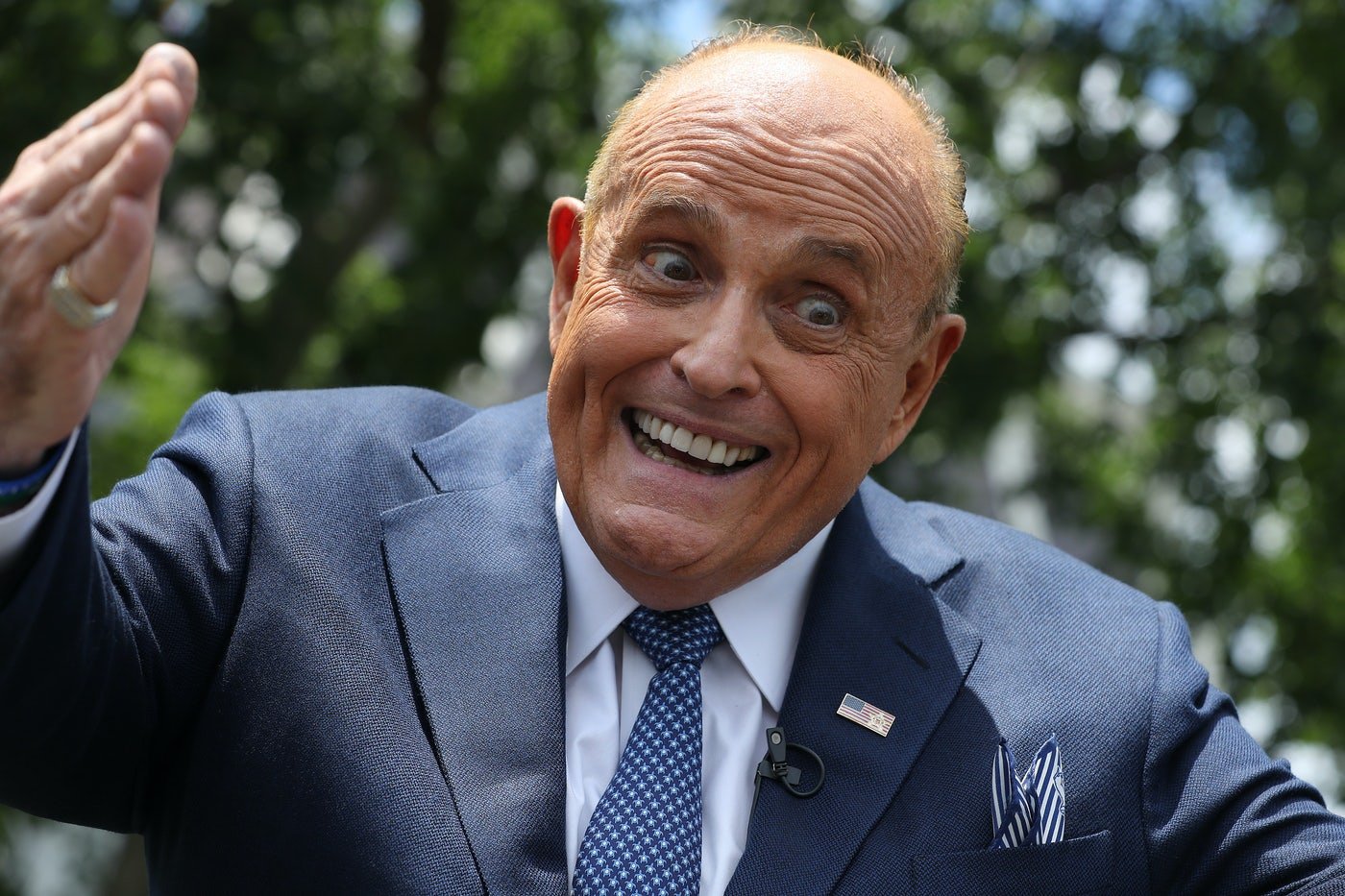 How significant is this move by the Feds from your perspective? How much legal danger does Giuliani face here?
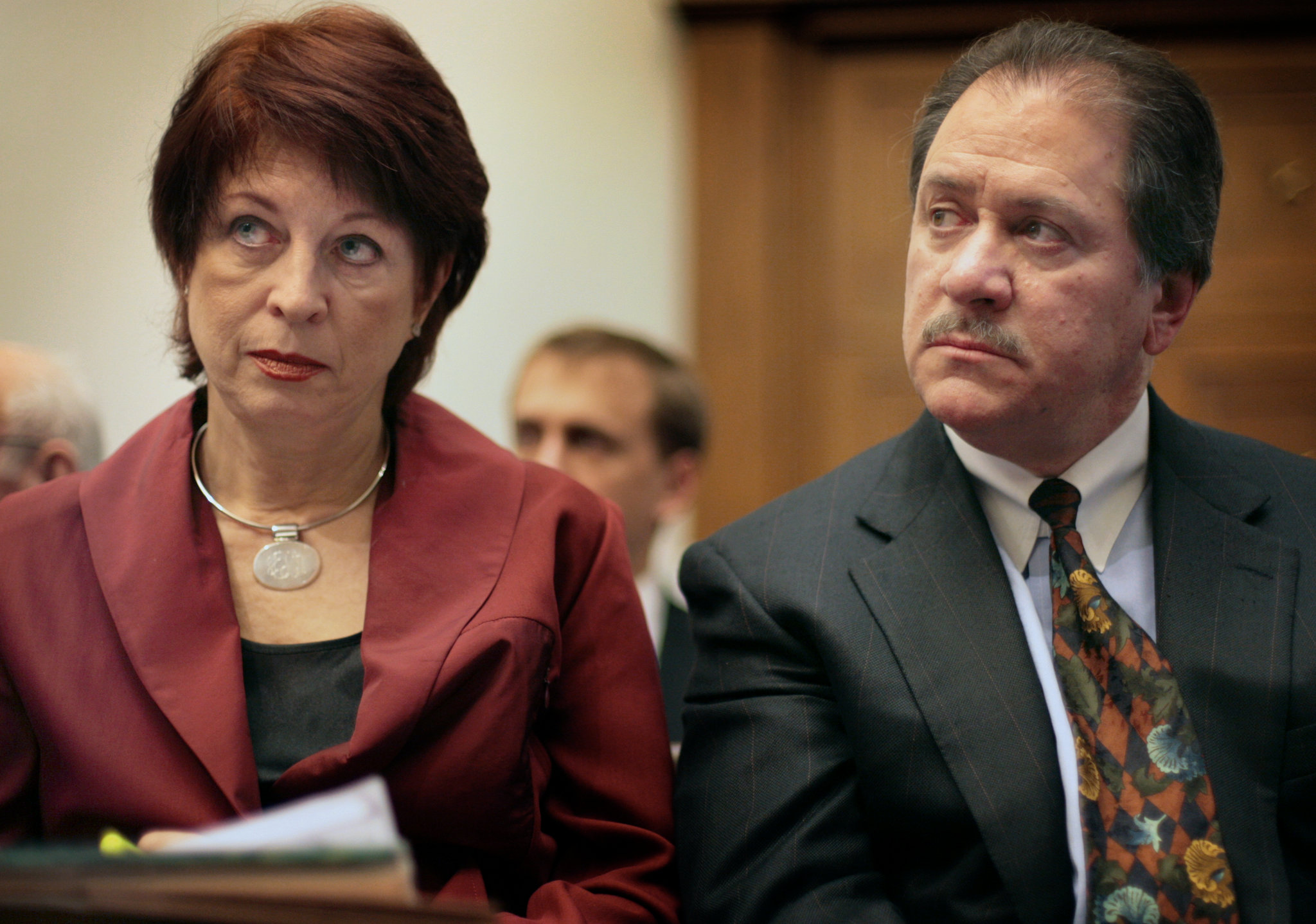 F.B.I. agents also executed a search warrant on Wednesday morning at the Washington-area home of Victoria Toensing, a lawyer close to Mr. Giuliani who had dealings with several Ukrainians involved in the hunt for information on the Bidens, according to people with knowledge of that warrant. The warrant was for her cellphone.
 peej
peej Carissa
 bostonboomer
 dakinikat
 ecocatwoman
 mablue2
 Mama Lopez
 peggysue22
 quixote
 skydancingguestblogger
 Mona (aka Wonk the Vote)



 Sky Dancing
Recent Comments