Andreas Jawlensky “Flower Still Life, Door Wing,” German Expressionism, Blue Rider (Blaue Reiter) 1924
Good Day Sky Dancers!
I’ve been trying to find things to give us–well me–a bit of a pick me up because my last few trips to the doctor’s office keep reminding me that my body is not what it used to be at all. The headlines these days are bipolar. Even state and local news seems dependent on whether you live in the counterfactual reality of the Republicans or the pragmatic problem solving reality of independents and Democratic governments.
In the Matrix, taking the red pill means you’re willing to learn some unsettling truths. Taking the red path in the United States means you have to deny science, history, economics, and just about every intellectual endeavor known to mankind since we left the Dark Ages.
We had to take a lot of American History in my school district and at my university. This all occurred in Nebraska so I have no idea why entire swaths of people have forgotten a lot of its lessons. The frothy one–with the public voice of a nincompoop granted at CNN–has forgotten the entire American experience with indigenous peoples.
— Dr. Kat PhD. … not your kiddo, buddy🇺🇦🌻 (@Dakinikat) April 26, 2021
Moscow I (Red Square), 1916, Wassily Kandinsky
I was fortunate that my mother had a particular sensitivity to this and expected my sister and me to get a really good appreciation of the role genocide played in wiping out a lot of native culture. The missionaries and their schools played a huge role in that. The Trail of Tears played an even bigger role. Then there was the continuing westward movement that eventually started shrinking the number of safe, promised places granted to Indigenous nations. But, I would like to also offer this up. The Iroquois–one of the so-called ‘civilized’ tribes were quite influential on the actual “birth” of the nation. Even the use of the word “birth of a nation” is offensive. It’s not often you find such a prime example of racist slights to both indigenous and black Americans in one sentence.
I guess it’s just not any kind of thing worth recognizing unless a white guy does it. Plus, even if he doesn’t do it, he’ll take and get credit for it anyway.
On the surface, the Republican effort to roll back voting rights in Michigan looks similar to what’s happening in states around the country: after Donald Trump narrowly lost a key battleground state where there was record turnout, Republicans are moving swiftly to implement sweeping restrictions to curtail access to the ballot box.
But the effort is raising unique concerns. Even though the Michigan governor, Gretchen Whitmer, a Democrat, is likely to veto a package of dozens of pending bills to curb voter access, Republicans are already hinting they will use a loophole to implement the measures anyway. They can take advantage of a quirk in Michigan’s law allowing voters to send a bill to the legislature if just over 340,000 voters sign a petition asking them to take it up. These kinds of bills cannot be vetoed by the governor.
“This effort is particularly anti-democratic, not just in substance, but in procedure,” said the Michigan secretary of state, Jocelyn Benson, a Democrat who serves as the state’s top election official.
The proposals include measures that are breathtakingly restrictive, even when held up in comparison to other measures states are considering. One bill bans Michigan’s secretary of state not only from mailing out absentee ballot applications to all voters, but also blocks her from even providing a link on a state website to a mail-in ballot application. Another proposal does not allow voters to use absentee ballot drop boxes after 5pm the day before election day. A different measure would require voters to make a photocopy of their ID and mail it in to vote by mail.
The effort is being closely monitored in a state known for razor-thin elections and where Donald Trump and allies tried to overturn the result in 2020. Republicans are moving aggressively to put the new voting restrictions in place ahead of the 2022 elections, when there are races for governor, attorney general and secretary of state. Michigan also has several key swing congressional districts that will help determine who controls the US House of Representatives in Washington.
The radicalization manifests in myriad ways, most notably in Trump’s enduring popularity among Republicans. Trump’s loyalists have launched ferocious attacks against Republican lawmakers who voted to impeach him for his role in the insurrection, even as national Republicans eagerly position themselves as his heir. Right-wing media display growing fanaticism, while public-opinion polls show GOP voters embracing Trump’s lie that the election was stolen from him. The Republican Party’s illiberalism, its barely disguised nativism, and its white identity politics are resonating with extremist groups. Slate’s Will Saletan, in an article cataloging recent developments, summarized things this way: “The Republican base is thoroughly infected with sympathies for the insurrection.”
To better grasp what’s happening among 2020 Trump voters, I spoke with Sarah Longwell, a lifelong conservative and political strategist who is now the publisher of The Bulwark, a news and opinion website that is home to anti-Trump conservatives. She is also the founder of Republican Voters Against Trump, now the Republican Accountability Project.
Since 2018, Longwell has spent hundreds of hours speaking with and listening to Trump voters. From 2018 to 2020, she concentrated her attention on people who voted for Trump in 2016 but whose support was not locked in for 2020—many of them college-educated, suburban voters, mostly women who rated Trump’s performance as bad to very bad. Since Trump left office, she’s been using her focus groups to understand how his supporters’ views are changing.
Longwell has discovered that these voters, including many in Georgia who cast their ballots for Trump in November, have since grown more “Q curious”—she’s hearing more people talk positively about QAnon, a conspiracy theory that, among other things, posits the existence of a satanic pedophile cult run by top Democrats.
Prior to November 3, 2020, Longwell told me, “I almost never heard QAnon come up, except in a way that was derisive.” But postelection she’s had people “lean in and say, ‘I’m not saying I believe everything about Q. I’m not saying that the JFK-Jr.-is-alive stuff is real, but the deep-state pedophile ring is real.’” (The QAnon theory is that John F. Kennedy Jr. faked his own death to become the group’s leader.) In Longwell’s words, “The deep-state/conspiracy/Hollywood pedophile ring, that is in there. I’m hearing that plenty.” She added, “It’s actually pretty Marjorie Taylor Greene–like.” (Greene, who represents Georgia’s Fourteenth District, has praised the conspiracy theory and subscribes to a number of its beliefs.)
As Longwell explained it to me, Trump supporters already believed that a “deep state”—an alleged secret network of nonelected government officials, a kind of hidden government within the legitimately elected government—has been working against Trump since before he was elected. “That’s already baked into the narrative,” she said. So it’s relatively easy for them to make the jump from believing that the deep state was behind the “Russia hoax” to thinking that in 2016 Hillary Clinton was involved in a child-sex-trafficking ring operating out of a Washington, D.C., pizza restaurant.
In Oklahoma and Florida, Republicans have passed new laws making it legal for motorists to run over protesters, so long as they claim that they felt afraid of a “riot.” The laws are clearly meant to give cover to people who attack anti-racist protesters, a trend that started with Fields murdering Heyer but has spread rapidly on the right. Over the Black Lives Matter protests last summer, there were a whopping 104 incidents — including 8 by police — of motorists hitting protesters with cars. The 2017 video of Fields slamming his car into a crowd was a genuine shock, but similar images became sadly common in 2020. Now Republicans want to make it legal.
Such laws are part of a larger push to use violence and threats to silence anti-racism.
Meanwhile, on earth one, the focus is on the first 100 Days of the Biden/Harris administration and the upcoming speech before the nation and Congress. Most of the nation appears satisfied.
Biden's approval among Dems (90%) is 6 pts higher than Trump's among GOP (a smaller, shrunken party) 4 yrs ago. Biden's approval among indies, the largest group of voters, is 9 points higher than Trump 4 yrs ago.
Biden’s advantage is that he’s not just nice; he’s also tedious. He is relentlessly enacting an ambitious domestic agenda — signing legislation that could cut child poverty by more than half, expanding Obamacare, and injecting the economy with a stimulus more than twice the size of what Obama’s Congress passed in 2009 — while arousing hardly any controversy. There’s nothing in Biden’s vanilla-ice-cream bromides for his critics to hook on to. Republicans can’t stop Biden because he is boring them to death.
Biden’s strategy of boringness is a fascinating counterpoint to a career spent trying desperately to be interesting. Biden used to overshare, with frequently disastrous results that led him to accurately self-diagnose as a “gaffe machine.” Whether his advanced age has slowed him down or made him wiser, he has finally given up his attention-seeking impulse and embraced the opposite objective. Biden’s success is a product of the crucial yet little-appreciated insight that substantive advances don’t require massive public fights. The drama of inspiration and conflict is not only unnecessary to promote change but even, in certain circumstances, outright counterproductive.
This method runs contrary to the DNA of the political-activism industry and the news media, which look at politics as a war and judge each side by how well it mobilizes its troops for combat. It especially offends the sensibility of many progressives, who see popular mobilization as the highest form of political organization.
This moon gets its name from the pink early springtime blooms of the Phlox subulata plant, also called “moss pink.” It’s native to eastern North America.
Native American tribes across the United States have their own names for the moon, according to the Western Washington University Planetarium. Many of those names are also associated with springtime signs,including the melting of snow andthe return of geese after their journey south for winter. The Cherokee tribe of the East Coast calls it the “kawohni” or “flower moon,” and the Creek tribe of the Southeast refers to it as “tasahcee-rakko” or “big spring moon.”
You’ll get a good view of it tonight! Have a good week!
What’s on your reading and blogging list today??
Did you like this post? Please share it with your friends:
Things have been looking up for the U.S. now than we have a responsible, knowledgeable president with competent advisers. But we we’re still in danger as long as the worldwide pandemic rages in other countries. Right now India isin the spotlight. We also need to deal with the anti-vaxxers and the Trumpists who refuse to accept vaccines. We’re also still learning about the long-term effects of Covid-19 as well as how the disease is transmitted.
A surge in deaths from the Covid-19 pandemic created the largest gap between the actual and expected death rate in 2020 — what epidemiologists call “excess deaths,” or deaths above normal.
Aside from fatalities directly attributed to Covid-19, some excess deaths last year were most likely undercounts of the virus or misdiagnoses, or indirectly related to the pandemic otherwise. Preliminary federal data show that overdose deaths have also surged during the pandemic.
A New York Times analysis of U.S. death patterns for the past century shows how much 2020 deviated from the norm….
Since the 1918 pandemic, the country’s death rate has fallen steadily. But last year, the Covid-19 pandemic interrupted that trend, in spite of a century of improvements in medicine and public health.
Marcel Dyf Jeune Fille Avec Chaton The Kitten
In the first half of the 20th century, deaths were mainly dominated by infectious diseases. As medical advancements increased life expectancy, death rates also started to smooth out in the 1950s, and the mortality rate in recent decades — driven largely by chronic diseases — had continued to decline.
In 2020, however, the United States saw the largest single-year surge in the death rate since federal statistics became available. The rate increased 16 percent from 2019, even more than the 12 percent jump during the 1918 flu pandemic….
Combined with deaths in the first few months of this year, Covid-19 has now claimed more than half a million lives in the United States. The total number of Covid-19 deaths so far is on track to surpass the toll of the 1918 pandemic, which killed an estimated 675,000 nationwide.
According to the Centers for Disease Control and Prevention, about 10 percent of the deaths last year can be directly attributed to Covid-19, which overtook other leading causes of death — like chronic lower respiratory diseases and unintentional injuries, such as car accidents and overdose deaths — to become the third biggest killer, after heart disease and cancer.
There have been fewer influenza cases in the United States this flu season than in any on record. About 2,000 cases have been recorded since late September, according to data from the Centers for Disease Control and Prevention. In recent years, the average number of cases over the same period was about 206,000.
As measures to stop the spread of the coronavirus were implemented around the country in March 2020, influenza quickly disappeared, and it still has not returned. The latest flu season, which normally would have run until next month, essentially never happened.
After fears that a “twindemic” could batter the country, the absence of the flu was a much needed reprieve that eased the burden on an overwhelmed health care system. But the lack of exposure to the flu could also make the population more susceptible to the virus when it returns — and experts say its return is certain….
Experts are less certain about what will happen when the flu does return. In the coming months — as millions of people return to public transit, restaurants, schools and offices — influenza outbreaks could be more widespread than normal, they say, or could occur at unusual times of the year. But it’s also possible that the virus that returns is less dangerous, having not had the opportunity to evolve while it was on hiatus.
“We don’t really have a clue,” said Richard Webby, a virologist at the St. Jude Children’s Research Hospital in Memphis. “We’re in uncharted territory. We haven’t had an influenza season this low, I think as long as we’ve been measuring it. So what the potential implications are is a bit unclear.”
The health effects of Covid-19 not only can stretch for months but appear to increase the risk of death and chronic medical conditions, even in people who were never sick enough to be hospitalized, a large new study finds.
In the study, published Thursday in the journal Nature, researchers looked at medical records of more than 73,000 people across the United States whose coronavirus infections did not require hospitalization. Between one and six months after becoming infected, those patients had a significantly greater risk of death — 60 percent higher — than people who had not been infected with the virus.
The research, based on records of patients in the Department of Veterans Affairs health system, also found that nonhospitalized Covid survivors had a 20 percent greater chance of needing outpatient medical care over those six months than people who had not contracted the coronavirus.
The Covid survivors experienced a vast array of long-term medical problems that they had never had before — not just lung issues from the respiratory effects of the virus, but symptoms that could affect virtually any organ system or part of the body, from neurological to cardiovascular to gastrointestinal. They were also at greater risk of mental health problems, including anxiety and sleep disorders.
Click the link to read more about the study results.
The risk of being exposed to Covid-19 indoors is as great at 60 feet as it is at 6 feet — even when wearing a mask, according to a new study by Massachusetts Institute of Technology researchers who challenge social distancing guidelines adopted across the world.
MIT professors Martin Z. Bazant, who teaches chemical engineering and applied mathematics, and John W.M. Bush, who teaches applied mathematics, developed a method of calculating exposure risk to Covid-19 in an indoor setting that factors in a variety of issues that could affect transmission, including the amount of time spent inside, air filtration and circulation, immunization, variant strains, mask use, and even respiratory activity such as breathing, eating, speaking or singing.
Bazant and Bush question long-held Covid-19 guidelines from the Centers for Disease Control and Prevention and the World Health Organization in a peer-reviewed study published earlier this week in Proceedings of the National Academy of Science of the United States of America.
“We argue there really isn’t much of a benefit to the 6-foot rule, especially when people are wearing masks,” Bazant said in an interview. “It really has no physical basis because the air a person is breathing while wearing a mask tends to rise and comes down elsewhere in the room so you’re more exposed to the average background than you are to a person at a distance.”
Early Portrait of the Artist’s Daughter, 1893-4, by Thomas Wilmer Dewing (1851-1938)
The important variable the CDC and the WHO have overlooked is the amount of time spent indoors, Bazant said. The longer someone is inside with an infected person, the greater the chance of transmission, he said.
Opening windows or installing new fans to keep the air moving could also be just as effective or more effective than spending large amounts of money on a new filtration system, he said.
Bazant also says that guidelines enforcing indoor occupancy caps are flawed. He said 20 people gathered inside for 1 minute is probably fine, but not over the course of several hours, he said.
“What our analysis continues to show is that many spaces that have been shut down in fact don’t need to be. Often times the space is large enough, the ventilation is good enough, the amount of time people spend together is such that those spaces can be safely operated even at full capacity and the scientific support for reduced capacity in those spaces is really not very good,” Bazant said. “I think if you run the numbers, even right now for many types of spaces you’d find that there is not a need for occupancy restrictions.”
Clearly, we have a lot to learn about how the virus is spread.
India’s daily coronavirus death toll passed a new record Saturday as the government battled to get oxygen supplies to hospitals overwhelmed by the hundreds of thousands of new daily cases.
Queues of Covid-19 patients and their fearful relatives are building up outside hospitals in major cities across India, the new world pandemic hotspot, which has reported nearly a million new cases in three days.
Another 2,624 deaths, a new daily record, were reported in 24 hours, taking the official toll to nearly 190,000 since the pandemic started.
More than 340,000 new cases were also reported, taking India’s total to 16.5 million, second only to the United States.
But many experts are predicting the current wave will not peak for at least three weeks and that the real death and case numbers are much higher.
India reported 346,786 new cases of Covid-19 on Saturday — the third day in a row the country has set a world record for infections during the coronavirus pandemic, according to government and scientific tallies.
The related death toll for the previous 24 hours hit 2,624 — also a daily record for India — for 189,544 total fatalities.
The sky-rocketing Covid-19 infections are devastating India’s communities and hospitals. Everything is in short supply — intensive care unit beds, medicine, oxygen and ventilators. Bodies are piling up in morgues and crematoriums.
Indira Baldano, naive art Индира Балдано живопись
Twenty critically ill patients died at a Delhi hospital Friday night after its supply of oxygen was delayed by seven hours, according to Dr. DK Baluja, medical director at the Jaipur Golden Hospital.
“That happened last night. Everything we had was exhausted. The oxygen was not supplied on time. It was supposed to come in at 5 p.m. but it came around midnight. People who were critically ill needed oxygen,” said Baluja.
The hospital is currently scrambling to arrange more oxygen but has not received a fresh supply all Saturday morning. “We have only 15-20 minutes of oxygen left now. It may take hours to get another tanker,” Baluja told CNN.
Delhi hospitals have been facing a severe oxygen shortage as the number of Covid-19 cases have soared in the national capital in the past two weeks….
Delhi recorded 24,331 new cases Friday, including 348 deaths, according to the Covid-19 health bulletin issued by the Delhi government.
Countrywide, India has now recorded more than 16.6 million cases since the start of the pandemic, a CNN tally of figures from the Indian Ministry of Health reveals.
As the pandemic took hold last year, travel restrictions quickly proliferated — they were the second-most-common policy governments adopted to combat Covid-19. According to one review, never in recorded history has global travel been curbed in “such an extreme manner”: a reduction of approximately 65 percent in the first half of 2020. More than a year later, as countries experiment with vaccine passports, travel bubbles, and a new round of measures to keep virus variants at bay, a maze of confusing, ever-changing restrictions remains firmly in place.
But few countries have gone as far as Vietnam, a one-party communist state with a GDP per capita of $2,700. The Haiphong checkpoints timed for Tet were the equivalent of closing off Los Angeles to Americans ahead of Thanksgiving — within a country that was already nearly hermetically sealed. Last March, the government canceled all inbound commercial flights for months on end, making it almost impossible to fly in, even for Vietnamese residents.
Today, flights are limited to select groups, like businesspeople or experts, from a few low-risk countries. Everybody who enters needs special government permission and must complete up to 21 days of state-monitored quarantine with PCR tests. (Positive cases are immediately isolated in hospitals, regardless of disease severity.)
This strict approach to travel, global health experts say, is directly connected to Vietnam’s seeming defeat of Covid-19. Thirty-five people have reportedly died in total, and a little more than 2,700 have been infected with the virus during three small waves that have all been quickly quashed. Even on the worst days of the pandemic, the country of 97 million has never recorded more than 110 new cases — a tiny fraction of the 68,000 daily case high in the United Kingdom, which has a population one-third smaller than Vietnam, or the record 300,000-plus cases per day only the US and India managed to tally.
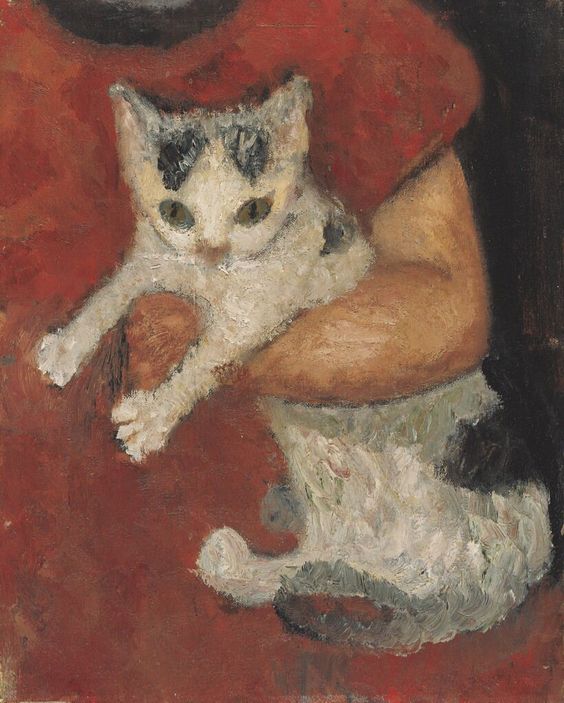
Paula Modersohn-Becker (German, 1876 – 1907) Cat held by a child
Starting in mid-January, several social media channels and websites emerged as hubs for stories, generated by admins and users pulling together snippets from across the internet and crafting them into cohesive narratives and brief posts, linking reported deaths to COVID vaccinations. Several of these platforms have grown notably, and become more formalized, in recent weeks. Unsurprisingly, given the robust safety profile of the vaccines in use in the United States, they rarely detail how a vaccination supposedly caused a given death.
The Centers for Disease Control and Prevention (CDC) has not found a causal connection between COVID vaccines and virtually any post-vaccination deaths—although the agency recently announced it isinvestigating three deaths linked to a rare blood-clotting disorder a few individuals developed after receiving the Johnson & Johnson vaccine. Medical authorities shelved that vaccine temporarily because sensitive monitoring systems picked up on this issue quickly. However, anti-vaxxers often take this less as a sign that safety systems are working and more as a sign that they were right all along and many more dangers must remain hidden.
But even if the narratives these hubs string together are weak and not supported by extant research on vaccine risks, some evidence suggests seeing these sorts of stories repeated ad nauseam may turn otherwise open people away from vaccines. This is a problem, as experts warn that skeptics, especially in far-right strongholds, are holding us back from herd immunity.
And death-hunting hubs are overflowing with dubious stories about vaccine death.
“People from all over the world send us the leads,” Brian A. Wilkins, a freelance writer who runs a site called The COVID Blog, which publishes pandemic misinformation and conspiracy theories, told The Daily Beast. (The blog has a “Vaccine Deaths” category, but Wilkins insists he only uses the term “for SEO purposes”; he, like many skeptics, falsely insists coronavirus vaccines are not real vaccines, and should properly be called experimental genetic therapies.) “I cannot even keep up,” he added. “I’m at least 70 stories behind.”
Some of these “leads” are local media reports that provocatively note someone got vaccinated and died days or weeks later—but never establish a firm causal link between the two. Others are social media posts describing people getting vaccinated, then dying suddenly or after an illness, either right after getting their shots or weeks later. Some are little more than loose digital chatter and speculation.
Read much more about these wackos at The Daily Beast.
So . . . What do you think? What else is on your mind? As always, this is an open thread.
Did you like this post? Please share it with your friends:
This is not the post I intended to write today. I figured I would have to take a look at the US re-entering the Climate Change Agreement or the Putin Pull out or some other kind of change we get since we got rid of the Previous Guy. Instead, I got treated to an entirely huge number of wipipo who really don’t need any sort of media attention at all.
In fact, they need to take their little whiny white asses back to whatever miserable enclave they sprang from to whack off to black and white TV from the 50s and leave the rest of us safely unaware of their existence. They do not have economic angst. They have a bad case of fascism, racism, and misogyny all wrapped up in a desire to replace democracy with white nationalism. It’s all so they can feel safe and good about themselves.
So, this bigoted idiot from Las Vegas was given print space by the Orlando Sentinel. He argues that Disneyland and Disneyworld should be there to give him his fantasy of white smeared with THAT sort’ve christian hegemony. He expects the entire organization should just exist only to humor his white supremacist fantasies just because he spends money there. The most distasteful thing in the article wasn’t the headline on how Disney Corp’s wokeness was ruining his good times. It was that he expected every one else to just go ahead and playact whatever offensive stereotype generations of their family try to escape from. Poor little white toad. “I love Disney World, but wokeness is ruining the experience | Commentary”. I just hope he stays away from New Orleans.
That spell is broken when the immersive experience is shattered by the real world. And boy, has Disney been breaking the immersion.
Recently, Disney announced that cast members are now permitted to display tattoos, wear inclusive uniforms and display inclusive haircuts. Disney did all of this in the name of allowing cast members to express themselves.
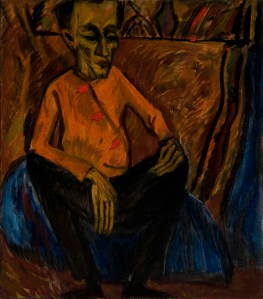
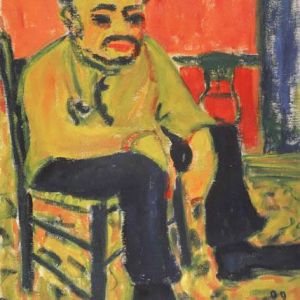
Man in Brown, Erich Heckel, 1912
His favorite thing to do first was the Pirates ride where he was regaled with kidnapped women in chains crying while guys yell “Marry a wench”. White Toad misses him some slavery. Then, there’s the entire longing for the Song of the South and the guide on the African river tour. I’ll leave it to your imagination about how he misses his black friends on those rides.
Go read it and go look at the face of the ugly American tourist that every one in the world–and around here where you have to deal with them–wants a cattle prod and the ability to stuff their asses on a plane and send them back to Stupidlandia. There’s some unwokeness for you! I’m tired of them thinking we’re all here to affirm there ignorant bigoted ass and superstitions. Take your damn money! Visit Hitler’s birthplace! Get it out of your system!
Which brings me to the next phase of the Covid 19 Crisis. This is where we spend tons of money telling those same ignorant asses to go get their ignorant asses to the nearest place they can GET a vaccination. Then, roll up a sleeve and take it like an American! Do it for your country! Do it so you do not kill other people! The shot is not going to turn you into some woke liberal! Believe me on that one! Education was already wasted on you!
And of course, twitter responds:
Disney World, Song of the South, Pirates of the Caribbean and Jungle Cruise are all trending right now. Good grief. pic.twitter.com/uL646JoCIG
In an interview with conservative Wisconsin radio host Vicki McKenna, herself a vocal coronavirus vaccine skeptic, Johnson launched into a condemnation of “vaccine passports,” a credential that would allow businesses to verify vaccination status.
But Johnson also went a step further, declaring he sees “no reason to be pushing vaccines on people,” arguing their distribution should be “limited” to those most vulnerable to coronavirus, and asking, “if you have a vaccine, quite honestly, what do you care if your neighbor has one or not?”
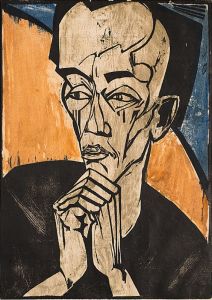
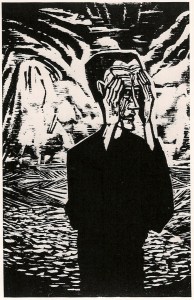
Erich Heckel, Man on a Plain, 1917
Which brings me to FaceBook and their idea of wokeness. I’ve had a comment censored for “bullying” because I refer to these people as Plague Rats. Believe, me I have sympathy for that rats who had no idea they were spreading the Bubonic plague. However, these human beings should know better. My doctor daughter told me I had to realize these people don’t have access to good information and they are surrounded by the same kinds of people.
However, their so-called leaders like Ron Johnson, Ted Cruz, Tucker Carlson, John Neeley Kennedy, and the like are the Pied Pipers of spreading ignorance. They are either idiots themselves like Johnson. But worst, they play at idiocy because they can fleece idiots for power and money. Why does any one actively choose counterfactuality? Are facts that threatening to them? I frankly think they just like to be told they’re right and go do whatever the fuck they want no matter how hateful or destructive or life threatening it is.
And, just when we haven’t got enough if attention and money starve reality tv show personalities going doing the politics road we get this from Axios: “Scoop: Caitlyn Jenner makes it official for California governor’. Dear wisdom beings haven’t we suffered enough?
Jenner said in a statement that “Sacramento needs an honest leader with a clear vision” and that “for the past decade, we have seen the glimmer of the Golden State reduced by one-party rule that places politics over progress and special interests over people.”
The statement decries California’s taxes as “too high” and criticizes an “over-restrictive lockdown” response to the COVID pandemic including on in-person schooling.
“This is Gavin Newsom’s California, where he orders us to stay home but goes out to dinner with his lobbyist friends.”
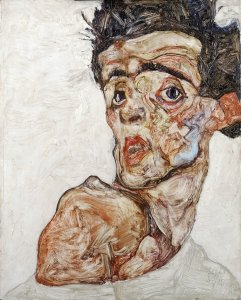
“Self-Portrait With Raised Bare Shoulder,” by Egon Schiele,
During an appearance on the Today show, co-hosted by his daughter Jenna Bush Hager, the previous Texas governor turned president said: “I read that about Matthew, yeah… I tell you this, it`s a tough business” when asked about the 51-year-old actor’s chance of winning in the 2022 race
At least Texas Governors don’t do as much as the usual state governor does.
One year ago today, President Donald .Trump took to the White House briefing room and encouraged his top health officials to study the injection of bleach into the human body as a means of fighting Covid. It was a watershed moment, soon to become iconic in the annals of presidential briefings. It arguably changed the course of political history.
Some ex-Trump aides say they don’t even think about that day as the wildest they experienced — with the conceit that there were simply too many others. But for those there, it was instantly shocking, even by Trump standards. It quickly came to symbolize the chaotic essence of his presidency and his handling of the pandemic. Twelve months later, with the pandemic still lingering and a U.S. death toll nearing 570,000, it still does.
For weeks, Trump had been giving winding, stream-of-consciousness updates on the state of the Covid fight as it clearly worsened. So when he got up from the Oval Office to brief reporters gathered in the The James S. Brady Press Briefing Room on April 23, there was no expectation that the day’s proceedings would be any different than usual.
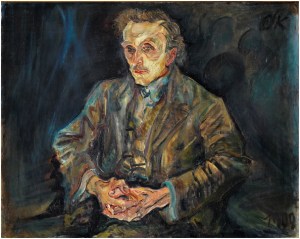
Oskar Kokoschka (1908)
So, there are tons of folks with “vaccine hesitancy” and I’ve bumped into a few. I ask why and just sit back and listen. I eventually just say that I couldn’t live with myself if I was responsible for some one’s death and move on. But here’s a bit from VOX if you’re interested. It sums up some survey data.
The share of adults surveyed who are vaccinated or are willing to be vaccinated has grown from 72 percent to 77 percent from January through the end of February, a rise that reflects the increased availability of vaccines. However, the share of unvaccinated adults who are hesitant to get a vaccine has remained constant, at around 23 percent. It is this group that poses the greatest challenge to health care officials hoping to vaccinate the population to the point of herd immunity to stop the spread of coronavirus.
Some respondents hesitant about vaccination indicated general health concerns. Forty-five percent of those who said they definitely would not get the vaccine feared side effects, and 40 percent said they wanted to wait to see if vaccines were safe. (The vaccines have been shown to be safe and have generally mild side effects under clinical trials.) Others cited more conspiratorial reasons, with 29 percent of people not wanting the vaccine saying they didn’t trust vaccines and 27 percent saying they didn’t trust the government. Meanwhile, 20 percent said they didn’t think the vaccines work. People could select multiple reasons for not wanting a vaccine.
The vaccine rollout has been marred by misinformation, especially on social media. Some of the top narratives around the vaccine on social media include mentions of coronavirus conspiracy theories involving microchips and Bill Gates, according to new data from media insights company Zignal Labs. There’s also a conspiracy theory known as “the Great Reset,” the debunked idea that the coronavirus was created by the government to take control of the global economy.
Facebook, which has long been a bastion for the anti-vaccine movement, helped Carnegie Mellon survey its users for the report and is hoping to lead a large inoculation information campaign. After trying for years to crack down on vaccine misinformation, Facebook finally banned users from sharing anti-vaccine content in February. But vaccine misinformation can still be found on the site. A recent Washington Post report by Elizabeth Dwoskin examined internal documents at Facebook that suggest QAnon-supporting groups and a relatively small number of influential people are responsible for a significant share of vaccine skepticism on the site.
Self-Portrait with Chinese Lantern Plant | Egon Schiele 1912
It’s still pretty obvious by the way the Republicans keep acting, what they keep saying, and the fanatical way they are trying to stop POC from voting that they are still not beyond the previous guy. We will not get pass Covid-19 until they get pass the previous guy. We’re going to spend time in a lot of states stopping anti-democracy legislature . We will be watching a lot of bad court decisions come out of courts too.
From out of the recently Trumpified Supreme Court came yet another decision that murdered precedent. Delivering the death blow was Justice Brett Kavanaugh. This was a major flex for the carceral state and a major hit to criminal justice reform. It not only closed off future improvements in that regard, but also undercut what few accomplishments already exist.
The case was Jones v. Mississippi. Over the years, the courts began to look askance at the idea of handing juveniles sentences of life without parole, essentially warehousing individuals for decades in the horrors of the American penal system for crimes they committed as minors. Twice since 2012, the Supreme Court has decided that such sentences were in violation of the Eighth Amendment’s prohibition against cruel and unusual punishment. With a single decision, Kavanaugh, good Jesuit-educated lad that he is, and six of his colleagues decided that, instead, such sentences were both just and commonplace. It is yet another example of the current majority’s enthusiasm for gutting precedent while pretending that it’s not, and it is a monstrous legal offense against humanity.
By those two precedents, judges had to conduct separate proceedings before sentencing juveniles to life without parole and to provide a public explanation for those decisions. The 6-3 decision on Thursday for which Kavanaugh wrote the lead opinion effectively wipes out those two requirements which, in tandem, had reduced radically the number of juvenile convicts doing life without parole. And, in keeping with how that new conservative majority on the Court operates, Kavanaugh argues that he is keeping faith with those decisions he is obviously eviscerating. In his concurrence, Justice Clarence Thomas at least acknowledged that the Court was overturning precedents set in cases he considered wrongly decided.
I’m really beginning to understand why Buddhists want to deconstruct egos and Abstract expressionists deconstruct the human image. To borrow something old testament … All is vanity.
With this, I end with an appropriate song. Sing it Pete! (See he does more than provide background music for car ads)
What’s on your reading and blogging list today?
Did you like this post? Please share it with your friends:
In case you missed it, Louisiana Sen. John N. Kennedy made a fool of himself again yesterday when he made the mistake of trying to put one over on Stacey Abrams. He asked her to explain what is so racist about the Georgia voter suppression law.
Stacey Abrams continued her crusade against Georgia’s new voting law this week by supplying lawmakers with a laundry list of reasons why she finds the changes both restrictive and racist.
The Democratic voting rights activist has been an outspoken critic of the law, arguing it will have a disproportionate effect on voters of color. At a Senate Judiciary Committee hearing Tuesday, she came prepared to make her case.
When Sen. John Kennedy (R-La.) asked Abrams to clarify which provisions of Georgia’s new voting law she opposed, she didn’t hold back.
Another lesser blowhard, John Cornyn of Texas, also tried it.
At another point during the four-hour meeting, Abrams got into a tense exchange with Sen. John Cornyn (R-Texas), who suggested states controlled by Democrats with similar voting laws hadn’t been subjected to the same criticism as Georgia.
Cornyn pointed to New York and Connecticut, which require that voters provide an accepted excuse ― such as being away from home or having a disability ― to be able to vote by mail, whereas Georgia has no such provision. Noting that laws in many states “need to be improved,” Abrams stated that she believed it was how laws target certain communities that make them racist.“The intent always matters, sir, and that is the point of this conversation,” she said. “That is the point of the Jim Crow narrative. That Jim Crow did not simply look at the activities, it looked at the intent. It looked at the behaviors and it targeted behaviors that were disproportionately used by people of color.”
But getting back to fake good ol’ boy John N. Kennedy, I came across this great 2019 piece at NOLA.com: Who said it: Sen. John Kennedy or Foghorn Leghorn? It’s includes a quiz where you have to guess which blowhard uttered a colorful descriptive phrase.
John Neely Kennedy is the junior U.S. senator from Louisiana who was a key member of Gov. Buddy Roemer’s staff before being elected to five terms as the state treasurer.
Foghorn J. Leghorn is an animated chicken who appeared as a featured character in Looney Tunes and Merrie Melodies cartoons for Warner Bros. Pictures.
Kennedy graduated magna cum laude in political science, philosophy, and economics from Vanderbilt, where he was president of his senior class and elected to Phi Beta Kappa. He received his law degree from the University of Virginia and his Bachelor of Civil Law degree from Oxford University in England where he was a First Class Honors graduate.
Leghorn starred in 29 cartoons from 1946 to 1964 in what is considered the Golden Age of American Animation, usually tormenting a dog named Dawg while fending off attacks from a feisty young chicken hawk named Henery Hawk.
There is practically no way to get the two confused … unless you are just reading what they have said. Then, it gets a little tricky.
Some sample questions:
“He’s about as sharp as a bowling ball.”
“That’s as subtle as a hand grenade in a bowl of oatmeal.”
“She has a billygoat brain and a mocking bird mouth.”
I urge you to take the quiz and see how you do.
While we’re talking about blowhards making fools of themselves, have you seen any of the tweets about Tucker Carlson’s show lately? The guy seems to have gone off the deep end.
Tucker Carlson had a complete meltdown tonight in response to a former New York corrections officer who criticized Derek Chauvin for using excessive force on George Floyd. Here's how the interview (abruptly) ended. pic.twitter.com/mBOxrsbhaJ
Fox News host Tucker Carlson cackled at, then dismissed the opinions of a New York City law enforcement veteran who strayed from the far right-wing pundit’s narrative on Tuesday’s murder conviction of Minneapolis police officer Derek Chauvin.
Carlson’s interview with Former New York City Deputy Sheriff Ed Gavin began with the host leading Gavin with the question “Who’s going to become a cop going forward, do you think?”\Gavin didn’t appear to see police officers as the victims in the killing of George Floyd, where video showed Chauvin kneeling on the victim’s neck for nearly 9½ minutes.
“Well, I think people will still become police officers,” Gavin said. “This really is a learning experience for everyone. Let’s face it, what we saw in that video was pure savagery.”
Carlson crunched his eyebrows as Gavin said that based on his experiences, the “emotionally disturbed” Floyd had been successfully contained — and more — during the “excessive” May 2020 traffic stop that cost him his life. Gavin also said he’d like to see more training for police.
“I’ve used force on literally over 500 people in my 21-year career in the New York City Department of Corrections, and in the New York City Sheriff’s Department,” Gavin said. “I’ve never had anybody go unconscious. That was truly an excessive, unjustified use of force.”
After a bit more of this, Carlson flipped out and claimed that American cities are locked down and boarded up because of nonviolent Black Lives Matter protests.
“Well, yeah, but the guy that did it looks like he’s going to spend the rest of his life in prison so I’m kind of more worried about the rest of the country, which thanks to police inaction, in case you haven’t noticed, is, like, boarded up,” Carlson complained before letting loose a shrill, maniacal laugh.
“So that’s more my concern. But I appreciate it, Gavin, thank you,” Carlson quickly added.
The flummoxed officer tried to further illustrate his point, but Carlson ended the segment.
“Nope, done!” the host exclaimed before moving on to his next guest — an author who’d penned a book called “The War on Cops.”
Greg Sargent wrote about Carlson’s weird fantasy about America being shut down by the protests: Opinion: The disturbing link between Tucker Carlson and Marjorie Taylor Greene.
It was hard not to notice that Tucker Carlson and Rep. Marjorie Taylor Greene (R-Ga.) had an oddly similar reaction to the conviction of Derek Chauvin. Both responded with extraordinarily unhinged hyperbole about the violence they imagine is gripping urban America right now — or pretend to imagine, anyway.
What shared instinct would cause them both to gravitate to precisely this same imaginary place?
Carlson’s reaction came amid a spectacular meltdown in response to a former law enforcement official who argued that Chauvin’s use of force was excessive. Carlson dismissed the point, saying: “I’m kind of more worried about the rest of the country, which, thanks to police inaction, in case you hadn’t noticed, is, like, boarded up.”
The implication was that, because of protests against police brutality, police are too closely scrutinized to sufficiently keep order, tipping the country into civil collapse.
Of course, you probably haven’t noticed that the “rest of the country” is “boarded up,” because, well, it isn’t.
Carlson hammered away at the wildly exaggerated idea that police under scrutiny were allowing the country to succumb to chaos throughout the 2020 Black Lives Matter protests. His new innovation is that a jury holding a police officer accountable for the brutal murder of someone already in his captivity is what’s causing this.
DC is completely dead tonight. People stayed in and were scared to go out because of fear of riots.
Police are everywhere and have riot gear.#BLM is the strongest terrorist threat in our county.
Greene and Carlson agree that Armageddon is gripping U.S. cities and that protests against police brutality are causing it.
Yet Greene’s depiction, too, is false. As Philip Bump demonstrates, Tuesday in D.C. was generally normal despite people feeling tense over the coming verdict, and any police presence in D.C. is a holdover from the threat of right-wing violence after Jan. 6.
Appearing on Fox News’ The Ingraham Angle on Wednesday night, Dershowitz—who is currently advising pro-Trump pillow magnate Mike Lindell as he faces a billion-dollar defamation lawsuit from Dominion Voting Systems—first took issue with the White House saying that the “bar for convicting officers is far too high” and reform is still needed.
“We need to apply the same standard to police and ordinary citizens except we have to understand that ordinary citizens have no obligation to risk their lives to prevent an ongoing crime,” he said, adding: “So the rules have to defer and understand and recognize the risks that police take. When it comes to the elements of actual crimes, you can’t bury them. You can’t raise the bar for certain groups of people over other groups of people.”
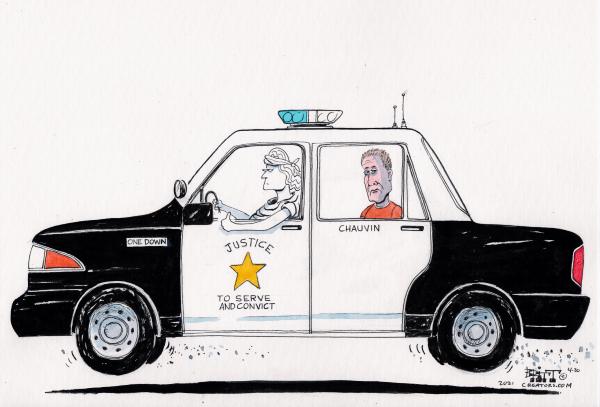
Host Laura Ingraham then turned to Chauvin, expressing concern that it’s been reported that he’s currently in solitary confinement while also wondering aloud why he’s even in prison.
Acknowledging that “different states have different rules” when it comes to bail for convicted murderers, Dershowitz said that the judge provided “good appellate issues” to the defense.
“He should be released on bail,” Dershowitz declared. “There is no reason why he should be remanded. He’s not going to flee. He wants to have an appeal. He’s not going to endanger anybody. His face is well known.”
How many people who have been convicted of murder get out on bail pending appeals? Is that a regular practice?
People who actually had to deal with Chauvin in the past feel differently, according to this piece from Reuters, via Yahoo News: ‘No sympathy’ for Chauvin, say those who had run-ins before Floyd.
MINNEAPOLIS (Reuters) – For some of those who encountered Derek Chauvin’s policing or witnessed his use of force as an officer there is no sympathy for the man convicted of killing George Floyd.
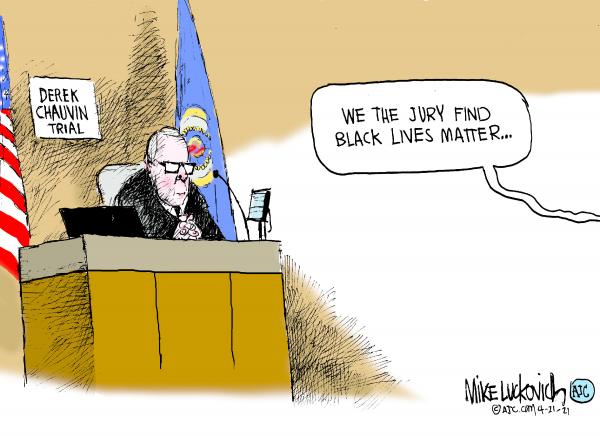
Chauvin was the subject of at least 17 complaints during his career, according to police records, but only one led to discipline. Prosecutors sought permission to introduce eight prior use-of-force incidents, but the judge would only allow two. In the end the jury heard none.
Eric Nelson, Chauvin’s lawyer, has defended his client’s use of force as appropriate in potentially dangerous situations.
“I don’t have no sympathy for him. I think he got what he deserved,” Julian Hernandez, 38, a carpenter now working in Pennsylvania, told Reuters.
Hernandez said he never heard anything from the Minneapolis police after submitting a complaint about Chauvin, who he said “choked him out” during an encounter in a Minneapolis night club in 2015. A spokesman for the Minneapolis Police Department declined to comment.
According to Chauvin’s police report, Hernandez failed to follow orders and resisted arrest when Chauvin, who was working as an off-duty security guard, tried to escort him out of a night club. Chauvin’s report said this prompted him to apply “pressure toward his Lingual Artery” to subdue Hernandez.
Hernandez said Chauvin picked him out of the crowd for no reason and quickly escalated to violence. He said Chauvin should have been removed from the police force.
Read more examples at the link.
Sorry this is such an unserious post. That’s just the mood I’m in today, I guess. As always, this is an open thread.
Did you like this post? Please share it with your friends:
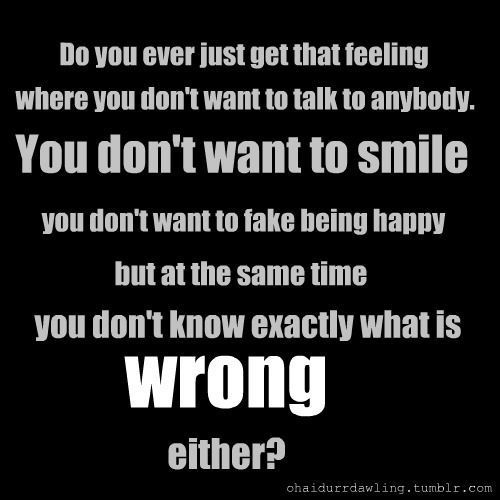
I’ve been really dragging lately–partly because of health problems, but very likely also because of the exhausting events of the past year. Am I “languishing”? Are you?
At first, I didn’t recognize the symptoms that we all had in common. Friends mentioned that they were having trouble concentrating. Colleagues reported that even with vaccines on the horizon, they weren’t excited about 2021. A family member was staying up late to watch “National Treasure” again even though she knows the movie by heart. And instead of bouncing out of bed at 6 a.m., I was lying there until 7, playing Words with Friends.
It wasn’t burnout — we still had energy. It wasn’t depression — we didn’t feel hopeless. We just felt somewhat joyless and aimless. It turns out there’s a name for that: languishing.
Languishing is a sense of stagnation and emptiness. It feels as if you’re muddling through your days, looking at your life through a foggy windshield. And it might be the dominant emotion of 2021.
As scientists and physicians work to treat and cure the physical symptoms of long-haul Covid, many people are struggling with the emotional long-haul of the pandemic. It hit some of us unprepared as the intense fear and grief of last year faded.
That sounds familiar. Of course I was already completely exhausted by the horror of 2016 and three years of Trump insanity when the pandemic hit. I’ve also been dealing with an autoimmune disorder called polymyalgia rheumatica. Despite seeing a Rheumatologist and taking multiple medications over the past year, I’m still struggling with chronic joint pain and stiffness. That has added to my sense of emotional exhaustion. I know I’m not alone in feeling overwhelmed by everything that’s been happening.
More from Adam Grant on “languishing:”
In the early, uncertain days of the pandemic, it’s likely that your brain’s threat detection system — called the amygdala — was on high alert for fight-or-flight. As you learned that masks helped protect us — but package-scrubbing didn’t — you probably developed routines that eased your sense of dread. But the pandemic has dragged on, and the acute state of anguish has given way to a chronic condition of languish.
In psychology, we think about mental health on a spectrum from depression to flourishing. Flourishing is the peak of well-being: You have a strong sense of meaning, mastery and mattering to others. Depression is the valley of ill-being: You feel despondent, drained and worthless.
Languishing is the neglected middle child of mental health. It’s the void between depression and flourishing — the absence of well-being. You don’t have symptoms of mental illness, but you’re not the picture of mental health either. You’re not functioning at full capacity. Languishing dulls your motivation, disrupts your ability to focus, and triples the odds that you’ll cut back on work. It appears to be more common than major depression — and in some ways it may be a bigger risk factor for mental illness.
The term was coined by a sociologist named Corey Keyes, who was struck that many people who weren’t depressed also weren’t thriving. His research suggests that the people most likely to experience major depression and anxiety disorders in the next decade aren’t the ones with those symptoms today. They’re the people who are languishing right now. And new evidence from pandemic health care workers in Italy shows that those who were languishing in the spring of 2020 were three times more likely than their peers to be diagnosed with post-traumatic stress disorder.
Part of the danger is that when you’re languishing, you might not notice the dulling of delight or the dwindling of drive. You don’t catch yourself slipping slowly into solitude; you’re indifferent to your indifference. When you can’t see your own suffering, you don’t seek help or even do much to help yourself.
Read the whole thing at the NYT and see what you think.
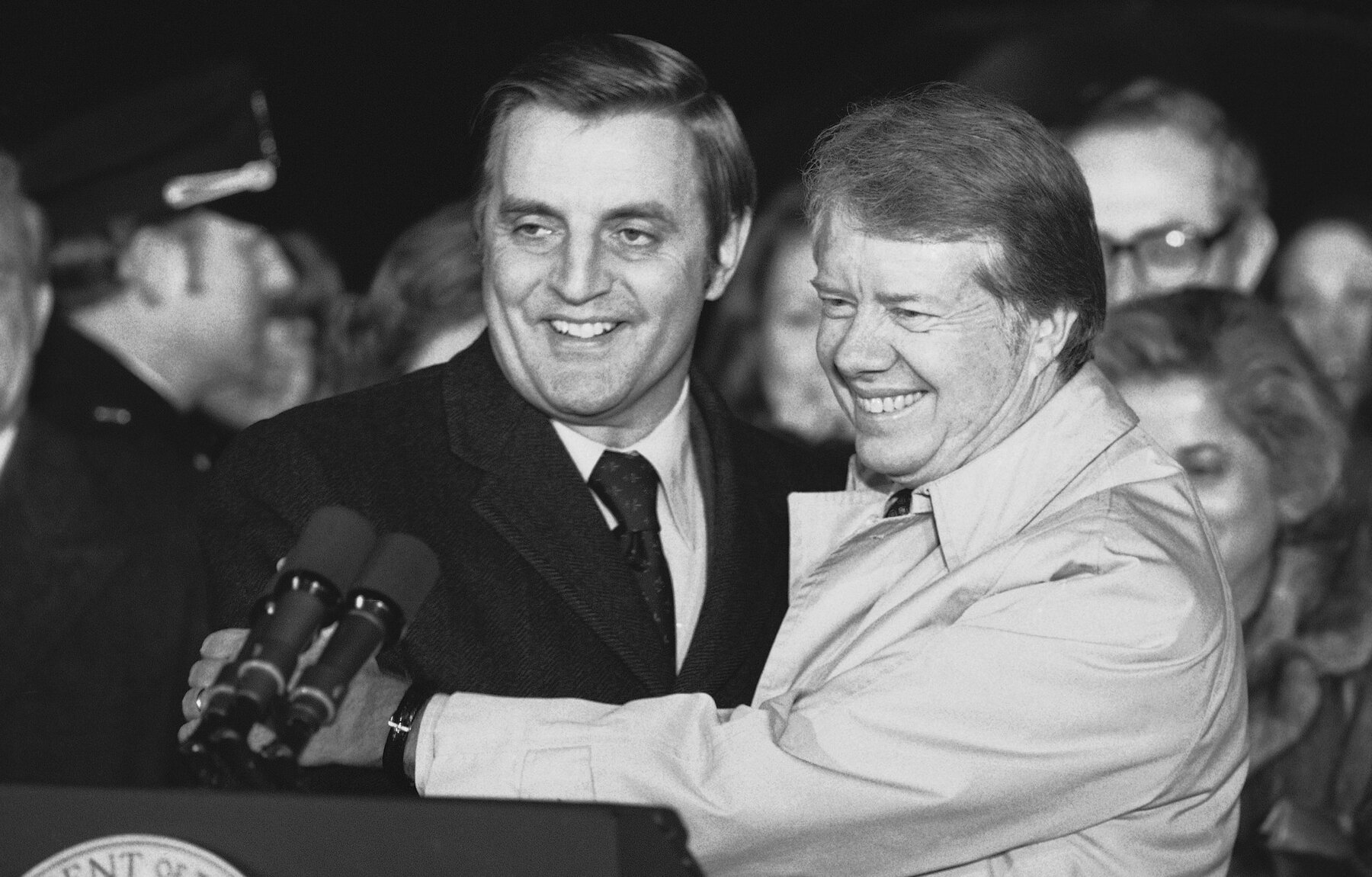
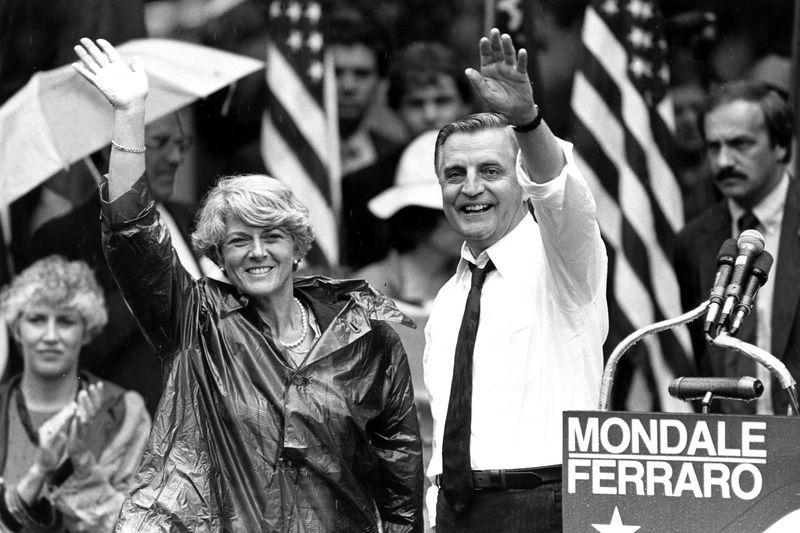
Walter F. Mondale, a preacher’s son from southern Minnesota who climbed to the pinnacle of U.S. politics as an influential senator, vice president and Democratic nominee for president, died on Monday. He was 93.
Known as “Fritz” to family, friends and voters alike, Mondale died in Minneapolis, according to a statement from his family.
“As proud as we were of him leading the presidential ticket for Democrats in 1984, we know that our father’s public policy legacy is so much more than that,” read the Mondale family statement.
Former President Jimmy Carter, who chose Mondale as his running mate in 1976, called his friend “the best vice president in our country’s history.”
“He was an invaluable partner and an able servant of the people of Minnesota, the United States and the world,” Carter said in a statement. “Fritz Mondale provided us all with a model for public service and private behavior.”
After serving four years under Carter, Mondale was the Democratic nominee for president in 1984. He lost to the incumbent, President Ronald Reagan, in a historic landslide.
“A night like that is hard on you,” Mondale wrote in his 2010 memoir, “The Good Fight.”
Even in defeat, Mondale made history by choosing as his running mate Geraldine Ferraro, the first woman to run for vice president on a major-party ticket. It followed a series of political landmarks in a public career that spanned seven decades.
A protégé of Hubert H. Humphrey, another Minnesota politician who rose to the vice presidency and lost a presidential election, Mondale served as a U.S. senator from Minnesota for a dozen years. He played a lead role in the passage of social programs, civil rights laws and environmental protections that defined President Lyndon B. Johnson’s “Great Society.”
As vice president from 1977 to 1981, Mondale transformed the office from what had historically been a punchline into what both he and Carter called a true governing partnership. Mondale’s role as chief adviser and troubleshooter, working from a West Wing office near the Oval Office, became a model for successors including George H.W. Bush, Al Gore, Dick Cheney and Joe Biden.
“The first person I called was Fritz,” Biden once said about the time President Barack Obama offered him the No. 2 position.
At The Washington Post, Karen Tumulty wrote about how Mondale changed the vice presidency: Opinion: Walter Mondale reinvented the vice presidency. Both Biden and Harris should thank him for it.
[Mondale’s] most enduring contribution may well have been the invention of the modern vice presidency, and his creation of a template that has been followed to some degree ever since. Mondale’s activist model as an all-purpose adviser and troubleshooter is one for which President Biden, a former vice president, and Kamala D. Harris, the current occupant of the office, should be grateful.
Before Mondale, the vice president was largely a figurehead….
But Jimmy Carter, coming to Washington in 1977 with a contingent of fellow Georgians and no real sense of how the place operated, had recognized that he needed a true governing partner with the experience Mondale had honed in 12 years as a well-regarded senator from Minnesota.
Mondale was the first vice president to have an office in the West Wing, steps from the president’s own, rather than being sidelined in the Old Executive Office Building, and a weekly lunch scheduled with the president. Carter also made it clear that their two staffs were to be considered one; Mondale’s chief of staff Richard Moe was given the additional title “assistant to the president.”
“We felt that Fritz’s long experience in Washington and the fact that for the first time he was being integrated into the Presidency itself was a compensating factor for the ignorance among the Georgia group concerning Washington,” Carter said, referring to Mondale, in a 1982 oral history moderated by the University of Virginia’s Miller Center.
Prosecutors treat closing arguments as an opportunity to make things simple for the jury and to keep them focused on the critical issues. Thus we heard state prosecutor Steve Schleicher’s mantra to the jury to “believe your eyes,” and his repeated references to the video evidence as well as his use of visual aids through which Schleicher listed and then checked off each legal element of each offense as he reminded the jury of the evidence proving them. This was a very effective technique, giving jurors who walked into the jury room inclined to vote to convict some ammunition to use in convincing more reluctant fellow jurors.
Defense Attorney Eric Nelson and Derek Chauvin
Defense lawyers have a different checklist, and Chauvin’s lawyer Eric Nelson hit all of his marks. Defense lawyers use closings to distract the jurors, to pull them away from the focus encouraged by prosecutors, and to provide as many reasons as they can muster as to why the prosecutors’ theory of the case fails.
Nelson embraced this tactic, spending almost an hour showing body camera footage of and arguing about the period before Chauvin restrained Floyd, a time when other officers were trying to cram a resisting Floyd into the squad car, while virtually ignoring most of the 9 minutes and 29 seconds that Chauvin knelt on Floyd’s neck. Nelson then tossed out all of the alternate causation theories he had cultivated throughout the trial — Floyd’s preexisting heart condition, his consumption of fentanyl and methamphetamine, the paraganglioma tumor, and possible carbon monoxide poisoning — claiming that with all of these possibilities out there, prosecutors couldn’t possibly prove causation beyond a reasonable doubt.
Jurors would be forgiven if their heads were spinning a bit from this rapid fire of legal theories — and that is exactly what the defense was aiming for.
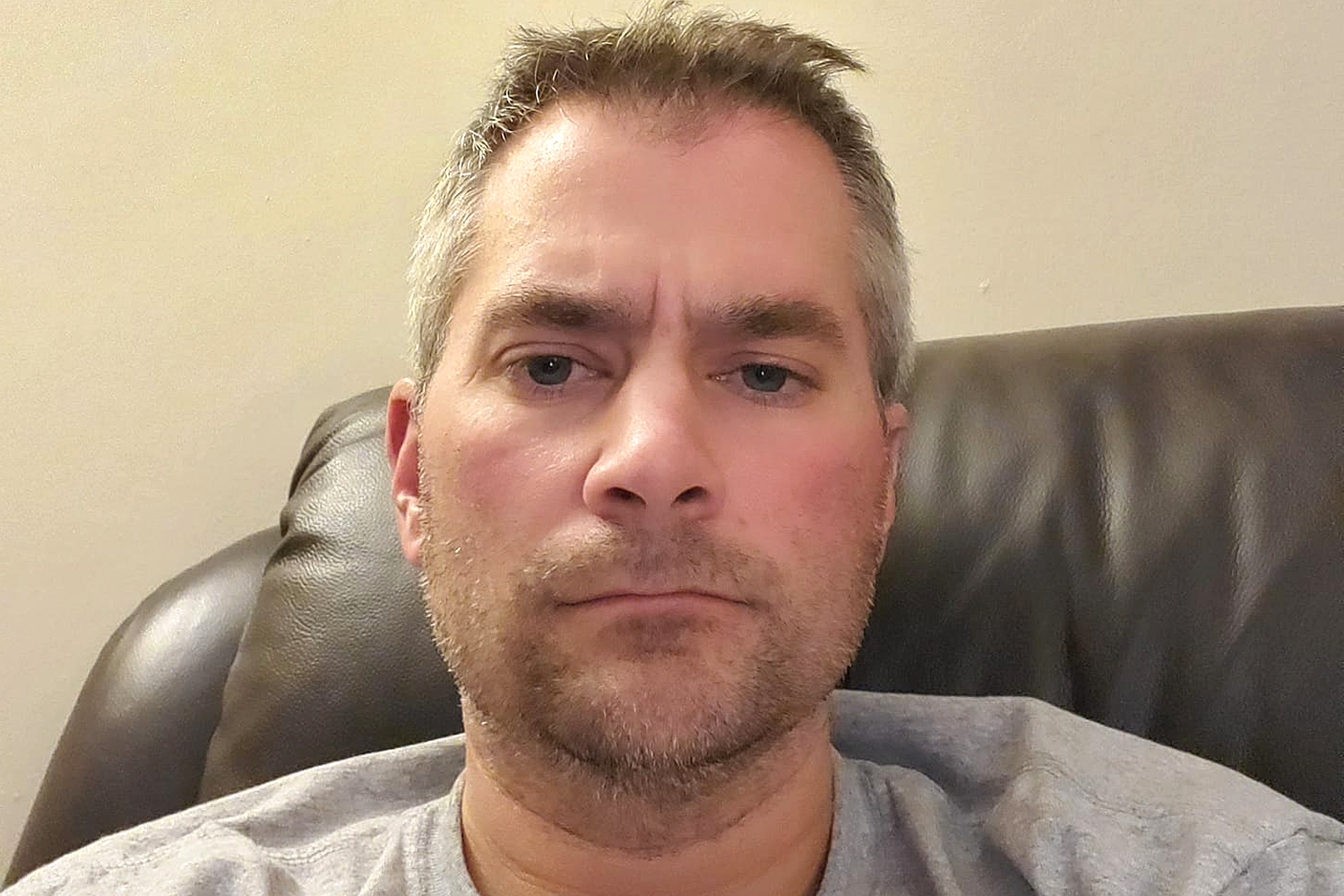
Capitol Police officer Brian D. Sicknick suffered two strokes and died of natural causes a day after he confronted rioters at the Jan. 6 insurrection, the District’s chief medical examiner has ruled.
The ruling, released Monday, will make it difficult for prosecutors to pursue homicide charges in the officer’s death. Two men are accused of assaulting Sicknick by spraying a powerful chemical irritant at him during the siege, but prosecutors have not tied that exposure to Sicknick’s death.
In an interview with The Washington Post, Francisco J. Diaz, the medical examiner, said the autopsy found no evidence the 42-year-old officer suffered an allergic reaction to chemical irritants, which Diaz said would have caused Sicknick’s throat to quickly seize. Diaz also said there was no evidence of internal or external injuries.
While there’s apparently no proof, it’s difficult to believe that a man in his early 40s who was involved in a violent insurrection and probably was hit with bear spray suddenly had two spontaneous strokes. But that’s where things stand.
Brian Sicknick
Christopher Macchiaroli, a former federal prosecutor who handled violent crime cases before grand juries in D.C. Superior Court and U.S. District Court, said a ruling of a death by natural causes “does make it more difficult to bring a homicide prosecution.”
Macchiaroli said additional evidence of some conduct by rioters could emerge independently, which prosecutors could argue contributed to the strokes. But he said that “any defense attorney . . . would use the medical examiner’s conclusions as clear-cut evidence of reasonable doubt.”
In explaining the decision, the medical examiner’s office provided an updated timeline leading up to Sicknick’s death. A statement says Sicknick collapsed 7 hours and 40 minutes after he was sprayed, and then died nearly 24 hours after that.
Sicknick was among hundreds of officers who confronted the violent mob that took over the Capitol, seeking to overturn the election Donald Trump had lost. Nearly 140 officers were assaulted, authorities said, facing some rioters armed with ax handles, bats, metal batons, wooden poles, hockey sticks and other weapons.
So . . . what’s on your mind today? As always, this is an open thread.
Did you like this post? Please share it with your friends:
The Sky Dancing banner headline uses a snippet from a work by artist Tashi Mannox called 'Rainbow Study'. The work is described as a" study of typical Tibetan rainbow clouds, that feature in Thanka painting, temple decoration and silk brocades". dakinikat was immediately drawn to the image when trying to find stylized Tibetan Clouds to represent Sky Dancing. It is probably because Tashi's practice is similar to her own. His updated take on the clouds that fill the collection of traditional thankas is quite special.
You can find his work at his website by clicking on his logo below. He is also a calligraphy artist that uses important vajrayana syllables. We encourage you to visit his on line studio.












 But getting back to fake good ol’ boy John N. Kennedy, I came across this great 2019 piece at NOLA.com:
 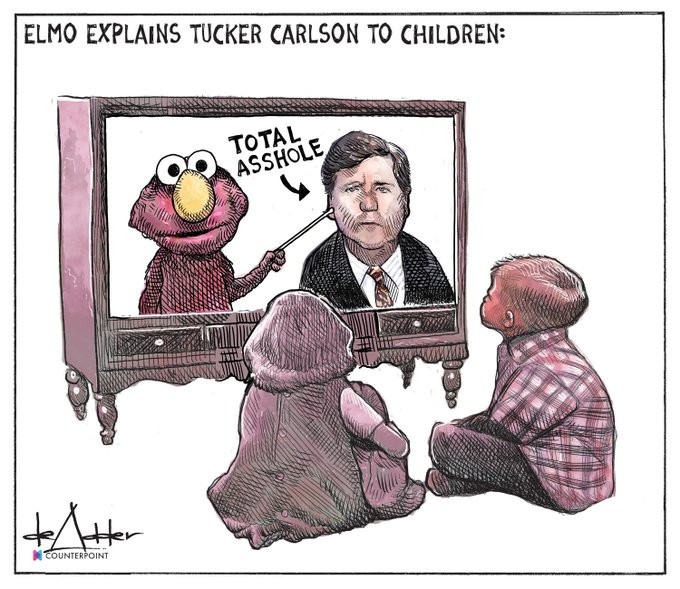 Greg Sargent wrote about Carlson’s weird fantasy about America being shut down by the protests:
  “We need to apply the same standard to police and ordinary citizens except we have to understand that ordinary citizens have no obligation to risk their lives to prevent an ongoing crime,” he said, adding: “So the rules have to defer and understand and recognize the risks that police take. When it comes to the elements of actual crimes, you can’t bury them. You can’t raise the bar for certain groups of people over other groups of people.”
 Eric Nelson, Chauvin’s lawyer, has defended his client’s use of force as appropriate in potentially dangerous situations.
  I’ve been really dragging lately–partly because of health problems, but very likely also because of the exhausting events of the past year. Am I “languishing”? Are you?
 In psychology, we think about mental health on a spectrum from depression to flourishing. Flourishing is the peak of well-being: You have a strong sense of meaning, mastery and mattering to others. Depression is the valley of ill-being: You feel despondent, drained and worthless.
 “He was an invaluable partner and an able servant of the people of Minnesota, the United States and the world,” Carter said in a statement. “Fritz Mondale provided us all with a model for public service and private behavior.”
 But Jimmy Carter, coming to Washington in 1977 with a contingent of fellow Georgians and no real sense of how the place operated, had recognized that he needed a true governing partner with the experience Mondale had honed in 12 years as a well-regarded senator from Minnesota.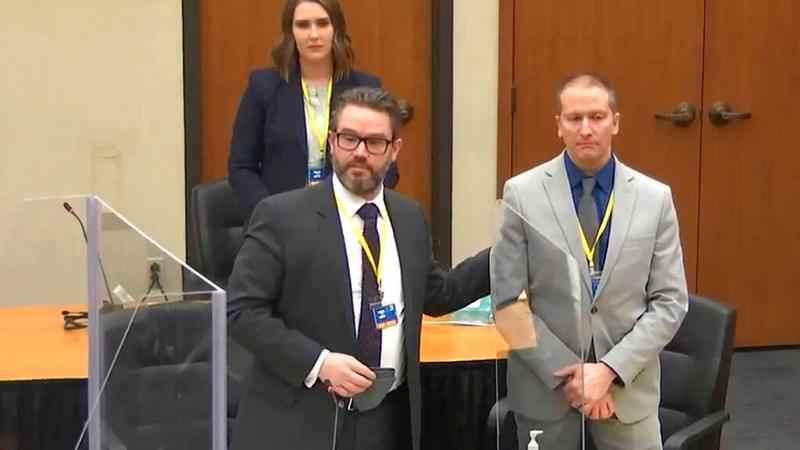

 peej
peej Carissa
 bostonboomer
 dakinikat
 ecocatwoman
 mablue2
 Mama Lopez
 peggysue22
 quixote
 skydancingguestblogger
 Mona (aka Wonk the Vote)



 Sky Dancing
Recent Comments