I wish I could stop reading and writing about Donald Trump; but I can’t, because he continues to be a serious threat to U.S. Democracy. Yesterday was the six-month anniversary of the Capitol insurrection that Trump incited. Republicans are pretending it was no big deal, and Trump is moving toward celebrating it as a patriotic exercise.
Hitler "did a lot of good things," the ex-president told then-White House Chief of Staff John Kelly. https://t.co/LHIQwZbeq6
Over the weekend, Trump began demanding the name of the officer who shot Ashli Babbitt and defending her actions on January 6. From Philip Bump at The Washington Post:
The man who shot Babbitt has become a target of fury as Babbitt has increasingly been cast as something of a martyr for the day’s cause. Because that cause was Trumpism, Trump himself has spoken of Babbitt more and more often.
At a rally in Florida over the weekend, he demanded to make public the name of the person who had fired the bullet.
“People know the name. People know where he came from,” he said. “Now if that were on the other side” — meaning, not on Trump’s side — “the person who did the shooting would be strung up and hung.”
“The person that shot Ashli Babbitt — boom, right through the head,” Trump said. “Just, boom. … They’ve already written it off. They said that case is closed. If that were the opposite, that case would be going on for years and years, and it would not be pretty.”
(Babbitt was not shot in the head. She was shot in the neck.)
Importantly, Trump also said that there was “no reason” for Babbitt’s having been shot. When protesters were outside the White House in May 2020, crossing the fence would have meant being mauled by dogs or otherwise being “really badly hurt, at least.” But a member of a huge, violent mob surging into a secure area of the Capitol that tried to press forward toward evacuating legislators? No reason for law enforcement to use deadly force.
This, at its heart, is Trump’s view of justice. Those on his side are exempt from accountability for their actions. Those on the other side, however, most be dealt with harshly — more harshly than the law allows.
One week after former president Donald Trump visited Florida and questioned why so many accused Capitol rioters are still in jail, his supporters in the Sunshine State will gather on Saturday to call for the release of “political prisoners” charged in the Jan. 6 insurrection.
Florida has more people charged in the insurrection than any other state, including the most defendants connected to right-wing groups the Oath Keepers and Proud Boys, according to Creative Loafing Tampa Bay.
Saturday’s “Free Our Patriots Rally in Tally” outside the state Capitol will call on Republican Gov. Ron Desantis “to demand immediate release of the incarcerated patriots and to use all the power and leverage at his disposal to make this happen.”
The event is being organized in part by Luis Miguel, a far-right candidate who is challenging Republican Sen. Marco Rubio in the GOP primary.
“Folks, The patriots who have been hunted down by the corrupt, communist FBI are suffering,” Miguel wrote on Twitter. “Many of them are veterans who fought for this nation. Let’s do our part to ensure they’re liberated. We can’t allow this in America. Be there at the Florida Capitol July 10.”
Another organizer of the rally is Angel Harrelson, the wife of former Army Sgt. Kenneth Troy Harrelson, an admitted member of the Oath Keepers who remains behind bars after being charged in the insurrection.
Angel Harrelson told a YouTube radio program this week that among other things, she plans to play a recording of her husband and other alleged insurrectionists singing the national anthem over the phone from jail.
Jonathan Chait at New York Magazine: The Chilling Message of Trump’s Embrace of Ashli Babbitt Martyrdom.
Babbitt’s death, while tragic, occurred for a very good reason. The Air Force veteran, who had been fully converted into the most dangerous and fantastical pro-Trump conspiracy theories, had joined the aggressive vanguard of the January 6 insurrection. Babbitt died trying to squeeze through the smashed window of a barricaded door that led to the inner sanctum where members of Congress were hiding from the mob.
Talia Lavin’s profile of Babbitt, in the current issue of the magazine, notes her emergence as a martyr on the far right. As Lavin points out, Babbitt is not the only Trump supporter who lost her life during the insurrection. Rosanne Boyland also died, but the manner of her death — trampling by the mob — does not serve the same propagandistic purpose. The whole point of Babbitt’s centrality is that she was leading the mob violently forward toward its goal of threatening or killing officials who refused to cooperate with their objective of overturning the election result.
It is revealing that Trump has only taken up Babbitt’s cause now, six months after the insurrection. In the immediate aftermath of the riot, Republicans were briefly furious enough to contemplate writing Trump out of the party and even voting to impeach him. Then they decided not to expunge him, and to hope the ugly events simply faded from memory. A few months later, they decided to purge Liz Cheney, allegedly because she refused to let go of the insurrection. Shortly after that, the party voted to block a bipartisan investigation of the insurrection.
All the political momentum is on Trump’s side. He has slowly turned January 6 from a black mark that threatened to expunge him from Republican politics, to a regrettable episode that his allies preferred to leave behind, to a glorious uprising behind which he could rally his adherents….
By throwing himself behind this message, Trump is endorsing the most radical interpretation of his presidency. January 6 was not a minor misstep after a successful era, as fans like Mike Pence and Lindsey Graham now say. It was the heroic culmination of a righteous uprising.
Babbitt was one of thousands of Trump supporters who decided to join the violent insurrection on Jan. 6 and overrun the U.S. Capitol in hopes of canceling a free and fair election. She was shot by a Capitol police officer while climbing through a broken window on a door that led to the Speaker’s Lobby. She died while wearing a Trump flag as a cape.
The pointless death of the 35-year-old Air Force veteran came in the service of Trump’s Big Lie, but his party has shown no contrition. Rather, Republicans are cynically exploiting her death to fuel their dangerous quest for power at all costs.
In April, the police officer who fatally shot Babbitt was cleared of criminal wrongdoing. His identity has not been released due to death threats that inevitably increased after Trump released a one-line statement last week asking “Who Shot Ashli Babbit?” That echoed Rep. Paul Gosar, an ally of avowed white supremacists, who accused the police officer of supposedly “lying in wait” to “execute” Babbitt….
The pointless death of the 35-year-old Air Force veteran came in the service of Trump’s Big Lie, but his party has shown no contrition. Rather, Republicans are cynically exploiting her death to fuel their dangerous quest for power at all costs….
The goal is to keep enraging and confusing their base, convince them of a far-reaching “Deep State” conspiracy committed to depriving them of power and glory and “replacing” them, and deflect from the Jan. 6 investigations that will further document the extremist elements embedded within the GOP and conservative movement.
Ali argues that Babbitt is the perfect martyr for Trump’s and the GOP’s purposes.
Babbitt—a woman, a wife, an Air Force veteran, and a true believer for Trump who, according to them, was “assassinated” by the “Deep State”—is an ideal character to glorify in death for a conservative movement that has turned into a racket and cult, a “victim” who can no longer speak for herself and can thus embody whatever fiction and grievance they want to promote.
On right-wing social media platforms she is being called “the first victim of the second Civil War” and a “freedom fighter.” Until last week, Sears and Kmart were selling “Ashli Babbitt American Patriot” T-shirts on their websites. Even Vladimir Putin is getting in on the action to deflect from his own abuses of power. When asked by NBC News’ Keir Simmons if he ordered the assassination of political dissident Alexei Navalny, Putin hit back, “Did you order the assassination of the woman who walked into the Congress and who was shot and killed by a policeman?”
How comforting to know that Putin shares the same script and talking points as Trump, Gosar, and right-wing media personalities.
Ultimately, the purpose of anointing Ashli Babbitt, and demonizing the officer who shot her in the process, is to justify the GOP’s goal of attacking our democratic institutions to ensure minority rule. If the base believes that they are being prosecuted, oppressed and even “assassinated” like Babbitt, then they will justify any and all means to reject Democratic rule and future elections that deprive them of power.
There’s no legal avenue for Trump to reverse the 2020 results. But a half-dozen scholars who study democracy and election laws told NBC News they are increasingly worried that 2024 could be a repeat of 2020, only with a party further remade in the former president’s image and better equipped to sow disorder during the process and even potentially overturn the results.
“Obviously the insurrection was horrific in its violence and assault on democracy, but it didn’t disrupt the true winner of the election,” said Edward B. Foley, a professor at Moritz College of Law at Ohio State University who researches election law. “What you don’t want is it to have been a rehearsal.”
Nightmare scenarios include local or state officials refusing to certify votes, governors and state legislatures submitting electoral votes that disagree with each other or overrule the apparent vote counts, fights over the legitimacy of judges overseeing the process and the House and Senate disagreeing on the winner. A chaotic transition could create an opening for further violence, either from extremists attempting to disrupt the process again or mass unrest if the winner is viewed as illegitimate.
“We should not pretend these dangers are fantastical or that these are absurd hypotheticals,” Rick Hasen, a law professor at the University of California, Irvine. “Given what we saw Trump actually do in 2020, these things are now within the realm of possibility and need to be legislated against and organized against so we have a fair election process going forward.”
A bit more:
New and proposed laws in states like Georgia and Arizona have sought to wrest power from state and local election officials, some of whom played a role in resisting the former president’s demands last election.
Republicans face significant pressure from their base to make these types of systemic changes — and potentially go much further. Lee Drutman, a senior fellow at the New America foundation, released survey data last month that found 46 percent of Republicans supported empowering state legislatures to overturn election results in states President Joe Biden won, as Trump demanded they do in 2020….
Some observers worry the party’s increased willingness to even entertain these scenarios could create perverse incentives in which state or local officials try to boost the odds of a poorly administered election that would give partisan leaders more flexibility to intervene….
In 2020, every governor and state legislature accepted the election results, but the midterms could reshuffle the landscape. Trump has sought to punish Republican incumbents like Georgia Gov. Brian Kemp and Secretary of State Brad Raffensperger with primary challenges. Trump has also lashed out at otherwise supportive Republican legislators in states like Wisconsin and Michigan who have affirmed the results.
“The fact that it held in 2020 doesn’t guarantee it will hold in 2024,” Omar Wasow, an assistant professor of politics at Princeton University, said. “You need ethical people in these jobs, and we’re seeing a lot of ethical people leaving in part because they’ve been threatened or attacked by partisans or because the level of vitriol they’ve been subject to is not worth the effort.”
The whole article is well worth reading.
That’s it for me today. Please let me know what you think. As always, this is an open thread.
Did you like this post? Please share it with your friends:
Over the long Fourth of July weekend, many Americans celebrated as if the pandemic is in the rear view mirror. Unfortunately that’s not the case. The Delta variant of Covid-19 is establishing itself around the country, especially in the places where people have resisted getting vaccinated. And now there’s a new strain of the virus, the Lambda variant, which originated in Peru and is now appearing in Europe.
Actually, though things are pretty good, they are far from back to normal. In fact, COVID is once again going in the wrong direction in Massachusetts, according to the state’s numbers. While infections remain extremely low, they are suddenly on the upswing – very slightly.
From June 23 to June 27, the state confirmed 291 COVID cases. In the following five days, tests confirmed 376 cases. That was an increase of about 29%. And there’s something troubling behind the numbers.
Dr. Richard Ellison, an infectious disease specialist at UMass Memorial Medical Center in Worcester said, across New England, about a quarter of the new cases have been traced to the highly transmissible Delta variant.
“So, Delta is here and there is an opportunity for it to increase,” Dr. Ellison said. “So New England’s the safest part of the country, but we’re going to have to watch it.”
Health care workers in southwest Missouri are sounding the alarm over a wave of young, unvaccinated COVID-19 patients who are now filling hospital beds.
Leanne Handle, an assistant nurse manager of a medical surgical COVID-19 unit at CoxHealth in Springfield, Missouri, said she and her staff have seen the patient population over the past year go from elderly people who are immunocompromised or have multiple other conditions to, more recently, younger individuals who “don’t think COVID is real” and haven’t been vaccinated against the disease….
Outsized, Overwhelming Impact of COVID-19
“So, what we’re seeing now are the patients who are coming in who don’t think that they’re going to get sick from it, who aren’t mentally prepared to make life and death decisions of do they want to be intubated, do you want CPR if your heart should stop,” she added. “We have very few patients who have been admitted that have been vaccinated. So it has been proven to keep you at least out of the hospital, and from severe disease.”
Handle also noted a “scary trend” among younger patients with the spread of the so-called delta variant, a highly contagious strain of the virus that was first identified in India and has since been detected in more than 80 countries around the world as well as dozens of U.S. states, including Missouri.
“With the new variant in our area, these patients are getting sicker quicker,” she said. “They are progressing through this spectrum very, very quickly.”
The hospital executives at the lectern called her a hero, and the struggle that had earned Emily Boucher that distinction showed on her face: in the pallor acquired over 12-hour shifts in the intensive care unit, the rings beneath eyes that watched almost every day as covid-19 patients gasped for their final breaths.
The pandemic had hit late but hard in the Appalachian highlands — the mountainous region that includes Southwest Virginia and Northeast Tennessee — and over the winter many of its victims had ended up on ventilators tended by Boucher and her fellow nurses at Johnston Memorial Hospital.\They were enduring the traumas known to ICU workers across the world: days filled with death, nights ruined by dreams in which they found themselves at infected patients’ bedsides without masks. But they were also enduring a trauma that many doctors and nurses elsewhere were not: the suspicion and derision of those they risked their lives to protect.
Conspiracy theories about the pandemic and lies recited on social media — or at White House news conferences — had penetrated deep into their community. When refrigerated trailers were brought in to relieve local hospitals’ overflowing morgues, people said they were stage props. Agitated and unmasked relatives stood outside the ICU insisting that their intubated relatives only had the flu. Many believed the doctors and nurses hailed elsewhere for their sacrifices were conspiring to make money by falsifying covid-19 diagnoses.
Boucher and her colleagues were pained by those attacks — and infuriated by them.Unlike their exhaustion, that anger rarely showed on their faces, but it was often there: as they scrolled Facebook to see local ministers saying God was greater than any virus, or stood in line with unmasked grocery shoppers who joked loudly about the covid hoax.
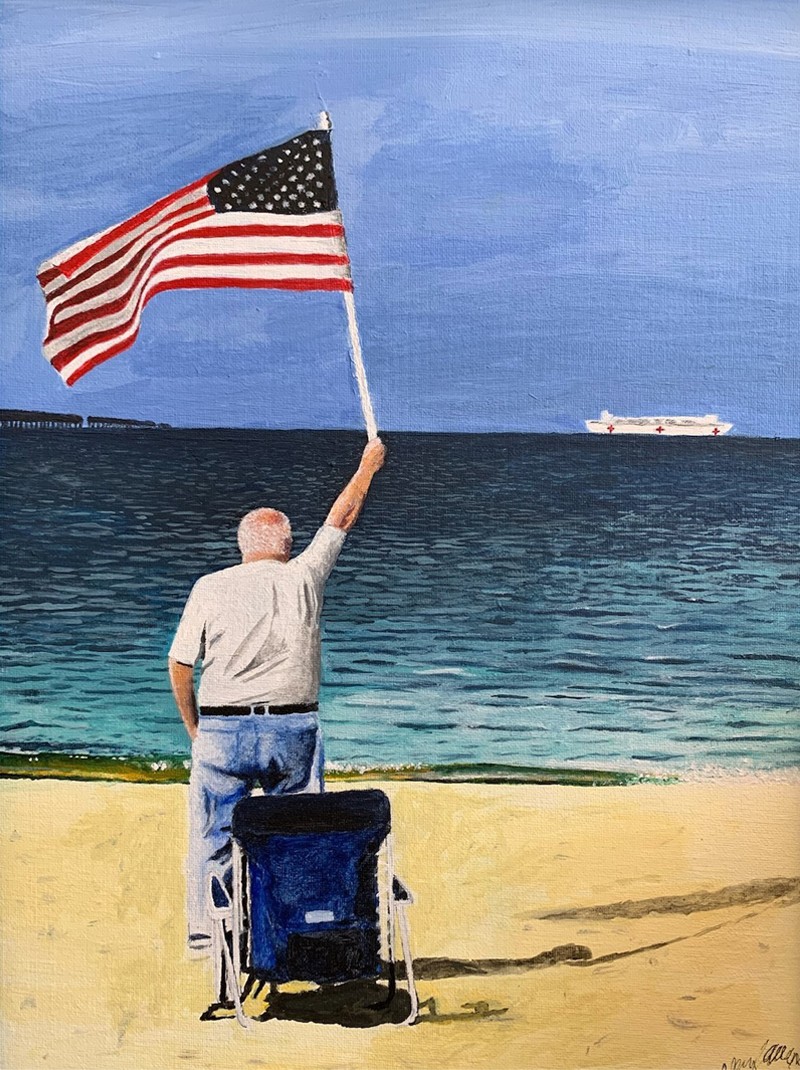
Hope, by Alexander Allen. Man on beach with U.S. Naval Ship Comfort in the distance
Out of the Covid-19 pandemic, two Americas are emerging: One protected by vaccines and the other still vulnerable to infection — and experts say progress made across the entire US is being threatened by low-vaccinated regions.
“We’re already starting to see places with low vaccination rates starting to have relatively big spikes from the Delta variant. We’ve seen this in Arkansas, Missouri, Wyoming … those are the places where we’re going to see more hospitalizations and deaths as well, unfortunately,” Dean of the Brown University School of Public Health, Dr. Ashish Jha, told CNN.
“And any time you have large outbreaks, it does become a breeding ground for potentially more variants.”
Parts of the South, Southwest and Midwest are starting to see spikes in cases, and many of those states — like Alabama, Arkansas, Louisiana and Mississippi — are among those with the lowest rates of vaccination, according to the US Centers for Disease Control and Prevention. Recent Covid-19 case rates are an average of three times higher in states that have vaccinated a smaller share of their residents than the United States overall, CDC data shows.
If there is another surge, Dr. Megan Ranney, associate professor of emergency medicine at Brown University, said young unvaccinated adults could be a big part of the problem.
“We’ve already seen that the highest number of infections over the past few months have been in those younger adults,” Ranney said. “These are the people that thought they were invincible.”
“The Delta variant will likely become the dominant strain in the U.S. by the end of the summer,” Lawrence Gostin, a Georgetown University global health expert, told The Daily Beast. “It is entirely foreseeable that the U.S. will experience surges, particularly in states with relatively low vaccination coverage.”
Thanks to its sprawling pharmaceutical industry and carefully worded contracts between the vaccine-makers and the federal government, the United States is one of the few countries where supply of vaccine far exceeds willing recipients.
Virtually anyone in the U.S. can get vaccinated, for free, at any time. So far, 54 percent of all Americans have taken advantage of that rare privilege and have gotten at least one dose. But vaccination rates are uneven across U.S. states and, unsurprisingly in this polarized era, map fairly neatly on political alignment.
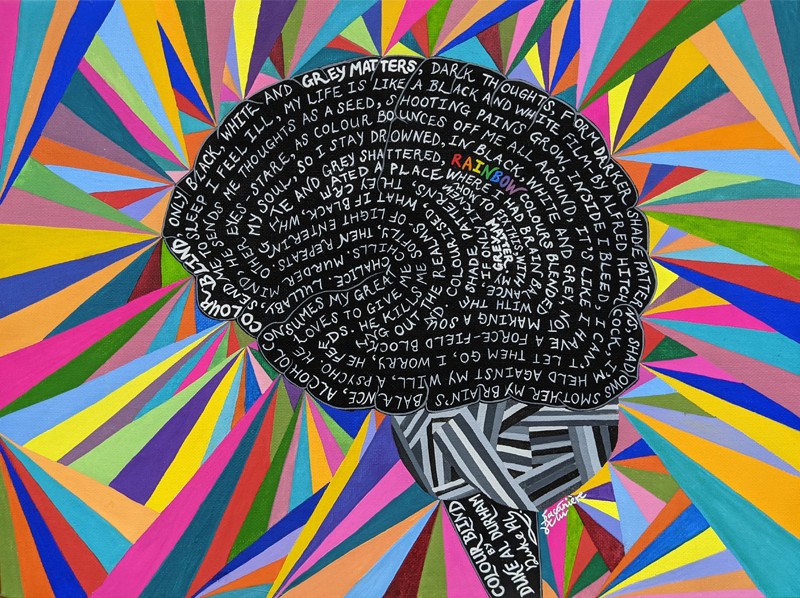
Colour Blind, by Sarah Racaniere, a poem by Duke Al Durham
Vaccine uptake is high in states governed by Democrats. Consider California, where 61 percent of the population is at least partially vaccinated. In Republican states, uptake is generally low. Just 36 percent of Mississippi residents have gotten their first shot.
There’s a politically charged vaccination disparity in the United States, and the Delta lineage is taking advantage of it.
The new variant now accounts for around a quarter of all new infections in the U.S.. But it’s not evenly distributed. Five states where Delta is prevalent—Arkansas, Missouri, Nevada, Utah and Wyoming—are all seeing significant increases in new COVID cases, even though case rates are probably still flat on the national level.
Not surprisingly, those are the states where vaccination rates are lowest.
“When you have such a low level of vaccination superimposed upon a variant that has a high degree of efficiency of spread, what you are going to see among undervaccinated regions, be that states, cities or counties, you’re going to see these individual types of blips,” Anthony Fauci, head of the U.S. National Institute of Allergy and Infectious Diseases, told CNN.
“It’s almost like it’s going to be two Americas,” Fauci added.
Chris Beyrer, an epidemiologist at the Johns Hopkins Bloomberg School of Public Health, said he’s especially worried about Southern states. “The Deep South is a real concern, where political leadership was much too slow to endorse the science, and scientific literacy is lower than in many parts of the country,” Beyrer told The Daily Beast. “The more infectious variants, like Delta, will exploit these vulnerabilities. That’s what viruses do.”
The latest variant to be highlighted by the World Health Organization, named Lambda, has now been found in at least 27 different countries.
It is especially widespread across South America, having first appeared in Peru in August last year, and is accounting for more and more cases in these countries.
Pipetting The Sample by Ali Al-Nasser
Having found its way to Europe, where there is already an ongoing battle against the Delta variant, due to lack of study it is still unclear how major a cause of concern it might be.
The latest variant to be highlighted by the World Health Organization, named Lambda, has now been found in at least 27 different countries.
It is especially widespread across South America, having first appeared in Peru in August last year, and is accounting for more and more cases in these countries.
Having found its way to Europe, where there is already an ongoing battle against the Delta variant, due to lack of study it is still unclear how major a cause of concern it might be.
It is not yet listed as a ‘variant of concern’, rather a ‘variant of interest’ by the WHO, meaning it has been identified as causing transmission or detected in multiple countries.
Read more at the link.
We’ve learned that we will be affected by what is happening with the virus in other countries. Therefore, I want to call your attention to two longer articles–one about Russia and one about India.
MOSCOW—As I write this, Russia is firmly in the grip of the third wave of the COVID-19 pandemic. Every day, there are about 22,000 reported new infections—twice as many as during the peak of the first wave in May 2020—and more than 600 deaths. The new Delta variant of the virus, which Moscow Mayor Sergey Sobyanin says is responsible for 90 per cent of new infections in the Russian capital, has caught Russia almost completely unawares. Despite having access to the brain power and resources of one of the most technologically advanced nations in the world, Russian authorities have repeatedly squandered almost every chance to beat the pandemic. Their massive, bloated propaganda apparatus failed to do the one job it was designed for: Get the message out. Instead, the pandemic has exacerbated the crisis of trust between the Russian government and citizens. Now, the campaign for parliamentary elections in September could make fighting the pandemic even harder, since the ruling United Russia party may be even more reluctant to impose unpopular measures such as lockdowns.
Russian independent observers and journalists—including me and my colleagues at Meduza—already knew something was terribly off with Russia’s handling of the pandemic in late spring of 2020. We had looked at the numbers and recognized that COVID-19 deaths were being underreported in many regions of Russia. According to the official statistics at the time, tens of thousands of Russians were dying in 2020 of a mysterious pneumonia epidemic unrelated to COVID-19. This was hardly plausible. The more likely explanation: Russian regional authorities were writing off the majority of COVID-19 cases as “community-acquired pneumonia.”
There is no evidence of a cover-up ordered from the top. More likely, regional governorates were simply being discreet to avoid being the bearer of bad news to the Kremlin. Underreporting COVID-19 cases in the early stages of the pandemic plausibly made many Russians question the existence of the virus or lulled them into a false sense of security, although there is no poll data to back this up. What’s certain is that by November 2020, according to independent polling institute Levada, the majority of Russians did not trust their government’s COVID-19 figures: 33 percent thought them too low, while 28 percent believed they were exaggerated.
Sounds familiar, doesn’t it? Read the rest at Foreign Policy.
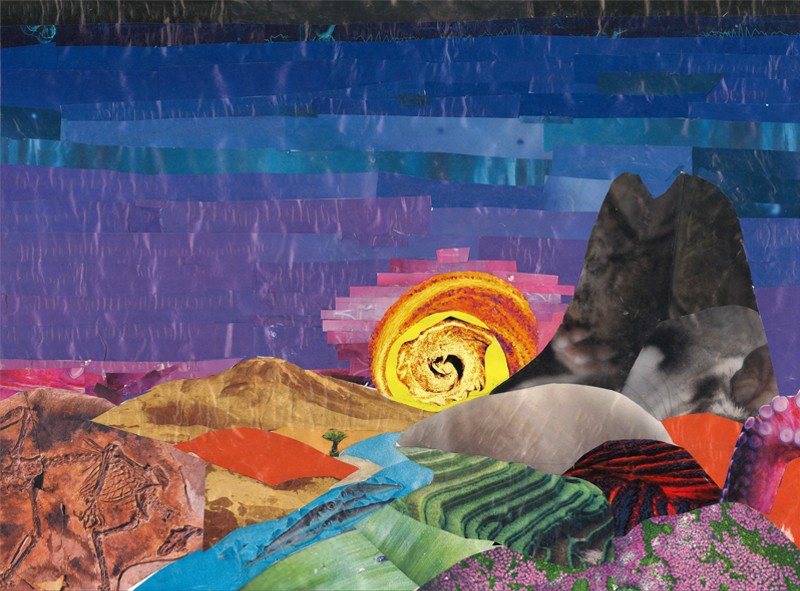
Naturarte by Angela Araujo, Sunsuet collage made from cuts from Nature covers
America may seem to be approaching the end of the pandemic, but covid-19 remains a surging catastrophe in India, with more than 30 million people infected and more than 400,000 deaths—official figures that many believe are far below the real numbers. A more likely scenario, the New York Times reported on May 25, is that 539 million people have been infected and more than 1.6 million are dead. On June 27, the Wall Street Journal published figures from the University of Washington’s Institute for Health Metrics and Evaluation, whose modeling also suggests that India is undercounting. The institute estimates the death toll at over 1.1 million, or three times the official figure.
But the crisis was not an unavoidable tragedy. Even the new delta variant discovered to be sweeping through the country was not some terrible random error. Instead, the catastrophe that has struck millions of Indians is the direct outcome of the government’s failures: its failure to plan ahead by increasing hospital capacity and acquiring medicines; its failure to figure out contact tracing, collect adequate data, and purchase vaccines. Even after it became clear that a second wave was inevitable, the government went ahead with superspreader events that served its own political purposes—and gave the virus a new opportunity. And at the center of the crisis—paying little attention to science, seemingly refusing to heed good advice, and appearing concerned primarily with holding on to power at any cost—stands India’s Prime Minister Narendra Modi, a Hindu nationalist whose arrogance and underpreparedness have cost the country an incalculable amount.
“Summer Night, Hanabi (Fireworks)” by Kasamatsu Shiro, woodblock print
Good Day Sky Dancers!
I’m way out of it today, having lived through–at least–two scenes of Apocalypse Now! I didn’t quite experience the smell of napalm in the morning. It was more like that nasty smell of sulfur that comes with the use of way too much gun powder. I didn’t get to listen to Ride of the Valkyries either. It was more a thunka thunka type of rave music which seems to come with white Gen Xers and millennials as they move into your hood. It totally erased the sound of Corey Henry and his band coming from the more traditional New Orleans 4th of July and Vaughn’s.
I can’t really leave the house anymore on any holiday because of all of this. Temple can’t take it at all. She tries to crawl under me and is only okay when she’s basically glued to me. This year, Dinah my oldest cat was freaked. She’s my old girl and has been through enough that you’d think it wouldn’t bother her. It was that bad this year. Last year, I had shells raining down on my roof from the bar down the street that constantly ignores our ban on fireworks here in Orleans Parish. Those were so loud it shook my windows.
These huge swaths of fireworks zones also take their toll on a huge number of veterans. The last 4th of July my father saw included him believing that the Germans were attacking his base and that he had been taken captive at what was actually his group senior care home. He was especially freaked out by the Rumanian accented mother of the owners. I hear tales of many, many battle veterans of all wars dealing with PTSD for which these massive neighborhood blast zones create a living hell. I was told that the freedom to fire off these things should not be pitted against dog ownership and to just drug the dog with Xanax. I was not amused. I’ll tell my friend to just drug her husband. That way he won’t have to impinge on the rights of pyros and noise junkies.
The city couldn’t afford the big fireworks display, so Will Smith ponied up $100k to pay for it. It used to be the big display on the river was enough for folks. Not any more. I spent most of my young life with a box of sparklers and a ride to the big fireworks displays in my small Iowa town. We got a blanket and a picnic by the Lake at the Country Club and most of the city was at the picnic zones scattered around the lake. I later watched the big Country Club in Omaha’s fireworks from my front yard with my neighbors and sparklers. Bottle rockets were about the worst you ever saw and heard and all of it was short-lived. These freaking stands sell arsenals now. I’ve been glad the last two early Julys have included downpours and that everything is quite drenched.
By the way, thank you to Will Smith, but, sheesh, your movie production is getting up to $25 million in tax payer’s money, which we taxpayers eat about 80% of the giveaway so next time, let’s endow a few professors or provide some scholarships to our historically black colleges or perhaps give a few grants out to the culture bearers?
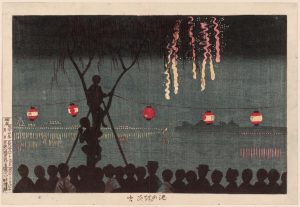
Kobayashi Kiyochika, Fireworks at Ike-no-hata
Anyway, I’m not sure it’s the Covid-19 experience or the former guy’s exit and path to prison, but wow, the last two days have been warzone-like. But there has always been wars of one kind or another on American soil. We’ve always known that the forced assimilation, enslavement, and genocide of indigenous Americans have stained the entire history of the United States. We don’t quite cover it up, but we don’t quite speak about it. It’s like we acknowledge our history with the kidnapping and enslavement of Africans, which turned into over a hundred years of literal ownership of people.
At times it was the Royal Canadian Mounted Police who came for them. Other times, it was a school van. However it happened, for generations, Indigenous families in Canada had no choice but to send their children to church-run residential schools established by the government to erode their culture and languages, and to assimilate them.
A national Truth and Reconciliation Commission declared in 2015 that the schools, which operated from 1883 to 1996, were a form of “cultural genocide.”
But the profound damage inflicted by the schools didn’t stop there. The commission cataloged extensive physical, sexual and emotional abuse at the schools, which were often overcrowded, understaffed and underfunded. Disease, fire and malnourishment all brought death and suffering.
Now, the national shame of the schools is again dominating the conversation in Canada.
Since May, new technology has enabled the discovery of human remains, mostly of children, in many hundreds of unmarked graves on the grounds of three former schools in Canada — two in British Columbia and one in Saskatchewan. Who they were, how they died or even when they died may never be fully known.
Takahashi Hiroaki (Shôtei),The Pine Tree of Success on the Sumida River, 1936 ca.
Donald Trump’s family has cut off Rudy Giuliani, and the former president has been irked that the lawyer asked to be paid for his work challenging Trump’s loss in the 2020 election, a new book says.
On Sunday, The Times of London published an excerpt from “Landslide: The Final Days of the Trump Presidency,” the coming book on the Trump presidency from the author Michael Wolff.
In the extract, Wolff delves into Trump’s postpresidential life at his Mar-a-Lago resort and describes Trump as frustrated by the lack of progress in his quest to overturn the 2020 election result.
“Trump is annoyed that he tried to get paid for his election challenge work,” Wolff wrote, per The Times.
The excerpt said Giuliani had “gotten only the cold shoulder” while seeking payment from Trump amid the prospect of expensive legal battles of his own.
Trump’s family has “cast out, cut off” Giuliani, the excerpt said, without specifying which members of the clan.
President Donald Trump’s daughter Ivanka Trump is in about as much trouble as Allen Weisselberg is, according to biographer Michael D’Antonio.
Speaking to CNN’s Jim Acosta on Sunday, D’Antonio explained that the kinds of things that Weisselberg is accused of are similar to things that Ivanka Trump also did while working for the Trump Organization.
“You know, he really is acting as if he is going to go down with the ship,” said D’Antonio of Weisselberg. “I think this is astounding given Michael Cohen’s example. But there’s another thing that I notice in the president’s — or former president’s complaints. And his idea that, ‘Well, they’re going after really good people, and they would only be going after me because of political motivations.’ Well, the big problem for him is that he invited all of this. He ran for president in the first place as a publicity stunt. He wanted to amp up his visibility and increase his bottom line. He never intended to be elected president, and then when he became president, journalists started digging into the facts of his wealth, which has always been in doubt, and then people that he really hurt, that he steamrollered offer the years leaked documents to The New York Times that gave the truth about his taxes for the world to see. Faced with all of that, the prosecutions had no choice but to go after him. So, the idea this is political is crazy. He brought it on himself. These are practices that have been going on for more than a dozen years, and he’s getting what he deserves.”
D’Antonio explained that the way of doing business for Trump associates is something that has happened for years. It resembles more of an organized crime operation than an ordinary corporation.
“The other person who I think is in peril is Ivanka Trump,” D’Antonio also said. “One of the things that Allen Weisselberg is in trouble for is taking money as a contractor and then claiming self-employed status so that he can get some of the retirement benefits that the tax code allows for self-employed people. Well, we know that Ivanka Trump got quite significant sums paid to her as nonemployee compensation. That freed the Trump Organization from paying part of her taxes, and it put her in a status that I think the IRS would have lots of questions about. So, these folks don’t know how to play the game straight. I think everything they do is crooked.”
Well, even I might set off loud fireworks if the entire Trump Crime Syndicate winds up in prison! Have a good week! And remember, there were no military tanks abused in the making of this year’s 4th of July on the Mall.
What’s on your reading and blogging list today?
Did you like this post? Please share it with your friends:
It has been a strange couple of weeks here in Massachusetts. I don’t usually write much about local news; I hope you won’t mind me doing so today.
Last week we had a heat wave with temps in the high 90s and even hitting 100 last Wednesday. Hours later, intense thunderstorms blew through, taking down trees and knocking out power for thousands of households; and the temperatures dropped into the 60s. Rain has continued for days and yesterday and today temperatures have been in the 50s!
And it wasn’t just the weather. We had two apparent hate crimes
Suffolk County District Attorney Rachael Rollins, who identified the suspected gunman as 28-year-old Nathan Allen, said during a press conference on Sunday that investigators found “antisemitic and racist statements against Black individuals.”
“There was hate in this man’s heart,” she told reporters Monday.
Allen was killed by police officers on Saturday afternoon shortly after stealing a plumber’s truck, crashing it into a house and shooting two Black bystanders multiple times in Winthrop, just outside Boston, according to Winthrop Police Chief Terence Delehanty.
The slain bystanders, who were both Black, were identified as David Green, 58, a retired Massachusetts State Police officer; and Ramona Cooper, 60, an Air Force veteran who still worked with the military, according to Rollins. Allen shot Green four times in the head and three in the torso, and Cooper three times in the back.
“He walked by several people that were not Black and they are alive. They were not harmed,” she said. “They are alive and these two visible people of color are not.”
Rabbi Shlomo Noginski of the Shaloh House, who was stabbed in Boston’s Brighton neighborhood Thursday, used judo training to divert the violent attack out of sight from children, according to his colleague.
“The stabbing happened right here, where you stand,” said Rabbi Dan Rodkin, executive director of the Shaloh House, a Chabad center that runs a school, camp and more. He was speaking to a swath of elected officials, Jewish leaders and community members who gathered in a show of support Friday in Brighton Common, the scene of the stabbing.
Noginski was stabbed eight times in the arm and shoulder just outside of the Jewish Day School on Chestnut Hill Avenue Thursday afternoon. His accused attacker, Khaled Awad, appeared in court Friday, where prosecutors said that the incident began with Awad holding a gun and demanding that Noginski give him the keys to a van.
Police were investigating whether the attack was a hate crime, though many of the speakers at the vigil argued the stabbing was an act of hate.
Noginski’s wife told NBC10 Boston he remained very weak but was happy to be out of the hospital and was looking forward to getting back to work as soon as possible.
A black belt in judo, Noginski used his expertise to defend himself and save children from the traumatic event, Rodkin said. The school told parents that it went into lockdown, but all the children were safe.
“We are here to send a message to everyone — that we, Boston, are not going to sit back,” Rodkin said. “We will fight back. We will bring goodness to the world. We’ll make sure that we will become better people and we will send a strong message — that evil has no place in America.”
Today we saw another unusual event in our state. There was an armed standoff just north of me in Wakefield, MA early this morning. State police were forced to shut down a stretch of I-95 and people in the town were told to shelter in place. This story actually hit the top of Memeorandum this morning.
Massachusetts state police said nine suspects have been taken into custody following an hourslong standoff that prompted the partial closure of Interstate 95….
The standoff shut down a portion of I-95 for much of the morning, causing major traffic problems during the Fourth of July holiday weekend.
Authorities said the southbound interstate reopened, but northbound lanes remain closed.
In Massachusetts, Interstate 95 runs from the Rhode Island line, around Boston to the New Hampshire line. Wakefield is just east of where Interstate 95 and 93 meet north of Boston.
The standoff began around 2 a.m. when police noticed two cars pulled over on I-95 with hazard lights on after they had apparently run out of fuel, authorities said at a Saturday press briefing.
Between eight to 10 men were clad in military-style gear with long guns and pistols, Mass State Police Col. Christopher Mason said. He added that they were headed to Maine from Rhode Island for “training.”
The men refused to put down their weapons or comply with authorities’ orders, claiming to be from a group “that does not recognize our laws” before taking off into a wooded area, police said.
The bizarre incident played out Saturday morning after a state trooper saw a group of eight to 10 men in military-style uniforms refueling their vehicle on the side of 1-95 around 1:30 a.m. in Wakefield, about 10 miles north of Boston.
The men — who carried tactical gear like body cameras and helmets and had long guns slung over their shoulders — told the trooper they were on their way to Maine from Rhode Island for “training.”
During the traffic stop, two arrests were made. The rest of the group, identifying themselves as “Moorish American Arms,” fled into a wooded area. All were detained by 10:45 a.m. local time, police said….
Massachusetts officials said the group claimed it “does not recognize our laws.” ABC News is asking federal officials whether or not this group is known for extremism.
The Southern Poverty Law Center identifies the Moorish sovereign citizen movement as “collection of independent organizations and lone individuals” that “espouse an interpretation of sovereign doctrine that African Americans constitute an elite class within American society with special rights and privileges that convey on them a sovereign immunity placing them beyond federal and state authority.” [….]
“Members of the Moorish sovereigns, called Moors, have come into conflict with federal and state authorities over their refusal to obey laws and government regulations. Recently, Moorish sovereign citizens have engaged in violent confrontations with law enforcement,” according to the SPLC.
On Wednesday, two dozen House Republicans flocked to Texas to show their support for Donald Trump. They joined the state’s Republican governor, Greg Abbott, in applauding the former president as he toured the border, denounced the U.S. government, and repeated the lie that he had been removed from office illegally. “Biden is destroying our country, and it all started with a fake election,” Trump declared as the lawmakers looked on in silence or approval. He accused the United States of “phony elections,” called it a “sick country,” and bragged that as president, he had seized military funds—against the will of Congress, and in defiance of the Constitution—to fund his border wall.
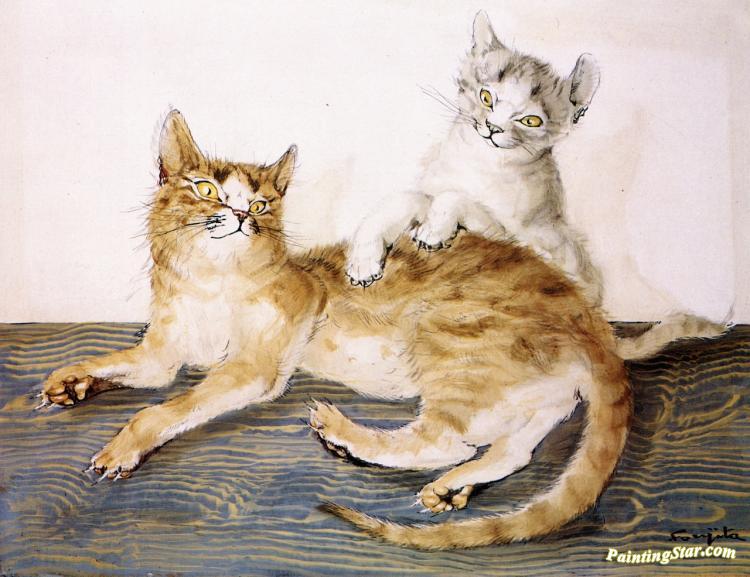
Two Cats Playing, by Tsuguharu Foujita
For many Americans, Trump’s disappearance from Facebook, Twitter, and the mainstream media has left the impression that he has gone away. That impression is false and dangerous. Trump has tightened his grip on the GOP, and he has escalated his campaign to undermine American institutions. His authoritarian movement is a direct challenge not just to President Joe Biden but to the larger alliance of democracies. The fundamental political conflict in our country is no longer between Democrats and Republicans. It’s between people who believe in a democratic republic and people who don’t….
The authoritarian menace extends into our country. In his inaugural address, Biden noted that he was taking office “just days after a riotous mob thought they could use violence to silence the will of the people, to stop the work of our democracy.” He described his inauguration, in the wake of the Jan. 6 insurrection, as “the triumph not of a candidate, but of a cause: the cause of democracy.” A month later, in a conference with European allies, Biden implicitly connected Putin’s propaganda to Trump’s attacks on NATO and the American electoral system. “Russian leaders want people to think that our system is more corrupt or as corrupt as theirs,” said Biden.
Trump is working to spread that message of American corruption and to destabilize the U.S. government. In rallies, interviews, and emails to his supporters, the former president rejects the 2020 election as “fake,” a “hoax,” and a “crime.” He calls Biden’s government “illegitimate” and “unconstitutionally elected.” In May, he said his supporters were right to call him “the true President,” and he essentially demanded to be restored to office, arguing, “If a thief robs a jewelry store of all of its diamonds (the 2020 Presidential Election), the diamonds must be returned.” Republican leaders, far from repudiating Trump’s role in the Jan. 6 attack, blocked his conviction in a Senate trial, thwarted a proposed commission to investigate the attack, and reaffirmed their allegiance to him. On Thursday, House Minority Leader Kevin McCarthy was asked twice whether Trump was “accountable in some way” for “the events leading up to Jan. 6.” McCarthy refused to answer.
Please read the rest at the link. It’s frightening, but true. Yesterday the Arizona Republic broke the news (behind a paywall) that Trump tried to overturn election results in the state–like he did in Georgia. The New York Times: Trump Is Said to Have Called Arizona Official After Election Loss.
President Donald J. Trump twice sought to talk on the phone with the Republican leader of Arizona’s most populous county last winter as the Trump campaign and its allies tried unsuccessfully to reverse Joseph R. Biden Jr.’s narrow victory in the state’s presidential contest, according to the Republican official and records obtained by The Arizona Republic, a Phoenix newspaper.
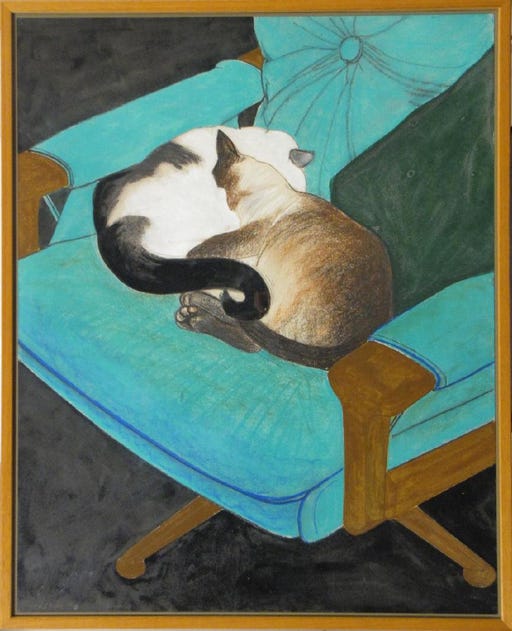
Two Cats, by Wendy Webber
But the leader, Clint Hickman, then the chairman of the Maricopa County Board of Supervisors, said in an interview on Friday that he let the calls — made in late December and early January — go to voice mail and did not return them. “I told people, ‘Please don’t have the president call me,’” he said….
The Arizona Republic obtained the records of the phone calls from Mr. Trump and Mr. Giuliani after a Freedom of Information Act request.
The Arizona Republic reported that the calls came as the state Republican chairwoman, Kelli Ward, sought to connect Mr. Hickman and other county officials to Mr. Trump and his allies so they could discuss purported irregularities in the county’s election.
Ms. Ward first told Mr. Hickman on Nov. 13, the day after the Maricopa vote count sealed Mr. Biden’s victory in Arizona, that the president would probably call him. But the first call did not come until New Year’s Eve, when Mr. Hickman said the White House operator dialed him as he was dining with his wife.
Mr. Hickman said the switchboard operator left a voice mail message saying Mr. Trump wished to speak with him and asking him to call back. He didn’t….
Four nights later, the White House switchboard operator called Mr. Hickman again, he said. By then, Mr. Hickman recalled, he had read a transcript of Mr. Trump’s call with Brad Raffensperger, the Georgia secretary of state whom Mr. Trump pressured to “find more votes” to reverse his defeat in the state.
“I had seen what occurred in Georgia and I was like, ‘I want no part of this madness and the only way I enter into this is I call the president back,’” Mr. Hickman said.
If the facts alleged in yesterday’s indictment are true, the Trump Organization and its longtime chief financial officer, Allen Weisselberg, have engaged in blatant tax evasion for more than a decade.
Early reports characterized the crime in question as involving “fringe benefits.” This gives entirely the wrong impression. The Trump Organization and Weisselberg aren’t being charged with tripping over some hyper-technical provision on the margins of the tax system. They are being charged with blatantly violating basic tax-law requirements—and bilking New York State and New York City out of hundreds of thousands of dollars along the way.
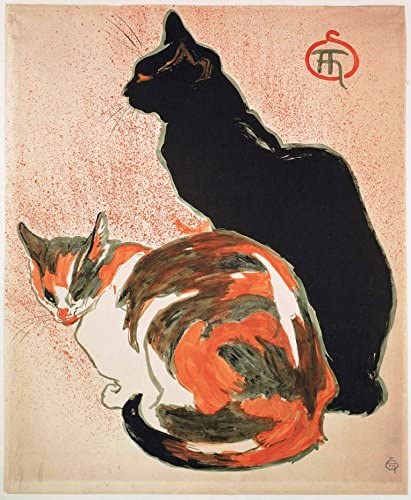
Two Cats, by Tony Woods
Probably the strongest allegation relates to an apartment on Riverside Boulevard in Manhattan where Weisselberg lives with his wife. According to the indictment, the Trump Corporation—one of the Trump Organization’s many business entities—paid roughly $100,000 a year in rent, utility bills, and garage expenses for this apartment starting in 2005. The Trump Corporation allegedly didn’t report those payments as compensation on Weisselberg’s W-2 forms, and Weisselberg allegedly didn’t include those amounts in income on his own tax returns.
But the Trump Organization did, according to the indictment, maintain a separate set of books that accounted for the payments as part of Weisselberg’s compensation. Notably, when the Trump Corporation paid Weisselberg’s rent, according to the indictment, the Trump Organization reduced Weisselberg’s salary by a corresponding amount. (Both Weisselberg and the Trump Organization pleaded not guilty yesterday.)
One can describe this as a “fringe benefit”—a tax-law term for any payment for services that is not part of stated compensation—but it’s also plain old tax fraud. Under federal and New York State tax law, lodging provided by an employer to an employee is part of the employee’s gross income. There are limited exceptions to this rule—for example, if the employee is required to live on the employer’s business premises as part of the job, or if the employer is a religious institution and the employee is a clergy member. But Weisselberg wasn’t living on Trump Organization premises because of some business need (and Trumpism is only metaphorically a religion). And if the Trump Organization was keeping a separate set of books recording compensation that it didn’t report to tax authorities, then this was no unintentional oversight.
Read more at The Atlantic. I don’t dare to get my hopes up at this point, but I’m watching and waiting. Maybe this time Trump will actually pay a real price for his behavior.
I hope you all are having a nice Fourth of July weekend. Remember the Delta variant is out there and fully vaccinated people have caught it–so stay safe and wear a mask if you’re around a lot of people indoors. I worry about all the folks who will crowded together even outdoors watching fireworks displays.
Did you like this post? Please share it with your friends:
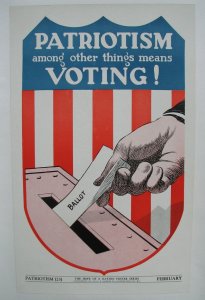
The Democratic Congress Critters have abandoned hope for any sort of Voting Rights Act just as we continue to see the Republicans chip away at voting access and the Roberts Court continue to ensure that. I keep wondering what exactly Chief Justice Roberts has against ensuring all citizens have access to their constitutional right to vote.
At times, Chief Justice John G. Roberts Jr. has labored to maintain the Supreme Court’s legitimacy against the gale-force pressures of partisan acrimony and social division. When it comes to voting rights, he has pushed in the opposite direction, presiding over the court’s systematic dismantling of the Voting Rights Act, overriding Congress’s clear intentions and gravely injuring U.S. democracy.
The first major blow came in 2013, when the court eviscerated the act’s Section 5, which required states with a history of racial discrimination to preclear changes to voting rules with the Justice Department. The decision left in place a backstop, Section 2, which allows legal challenges to discriminatory election rules after they have been enacted. On Thursday, the Roberts court sharply limited that provision as well.
The court upheld two Arizona election rules the Democratic National Committee claimed discourage minority voting. The legitimacy of Arizona’s policies could be debated, and the court could have struck them down without indulging in dangerous overreach. But in its reasoning and guidance for future cases, the six justices in the majority, including the chief, flashed a green light to state lawmakers eager to erect new barriers to voting.
The majority imposed stipulations on applying Section 2 that “all cut in one direction — toward limiting liability for race-based voting inequalities,” Justice Elena Kagan pointed out in a dissent. This new list of restrictions, Justice Kagan continued, “stacks the deck against minority citizens’ voting rights. Never mind that Congress drafted a statute to protect those rights.”
The majority invites states to argue that unnecessarily strict voting rules impose no more than mild burdens on casting ballots, despite the fact that the Voting Rights Act was meant to eliminate obvious as well as subtle forms of voting discrimination. What may appear to be mere inconveniences or seemingly race-neutral rules can in practice reduce minority voting. Some of that is fine, the court said. While admitting that one of the Arizona laws in question disproportionately affects Black, Latino and Native American voters, the majority declared that the difference was too small to matter. Yet elections are often decided by fractions of percentage points, and every vote should be seen as precious.
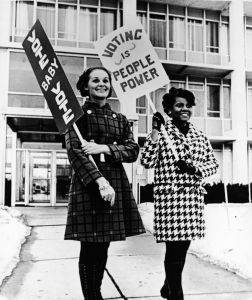
This reminds me of how the’ve been chipping away at Abortion and other privacy-related rights. It also reminds me of how they keep enabling dark money in elections. What’s with Justice Roberts any way? I mean we know that Republican politicians know they’re increasingly a rump party. They also know that gerrymandering and voting restrictions are the only way to slow down the tsunami of voters not in their narrow demographics. Joan Biskupic, CNN Legal Analyst, put it this way: “John Roberts takes aim at the Voting Rights Act and political money disclosures, again.”
The Supreme Court under Chief Justice John Roberts has hollowed out the historic Voting Rights Act, curtailed regulation of big political donors and limited challenges to partisan gerrymandering.
The final two decisions of the court session on Thursday continued this trend of Roberts’ stewardship that cuts to the heart of democracy and generally benefits conservatives over liberals, Republican voters over Democratic voters.
The pattern on voting rights traces to Roberts’ early years serving in the Ronald Reagan administration when the young GOP lawyer opposed racial remedies and argued for a constricted interpretation of the 1965 Voting Rights Act.
The Supreme Court under Chief Justice John Roberts has hollowed out the historic Voting Rights Act, curtailed regulation of big political donors and limited challenges to partisan gerrymandering.
The final two decisions of the court session on Thursday continued this trend of Roberts’ stewardship that cuts to the heart of democracy and generally benefits conservatives over liberals, Republican voters over Democratic voters.
The pattern on voting rights traces to Roberts’ early years serving in the Ronald Reagan administration when the young GOP lawyer opposed racial remedies and argued for a constricted interpretation of the 1965 Voting Rights Act.
That emphasis reemerged again Thursday, just as Attorney General Merrick Garland has pointed to a “dramatic rise in state legislative actions that will make it harder for millions of citizens to cast a vote that counts.” Dissenting liberal justices on Thursday observed that “efforts to suppress the minority vote continue” yet “no one would know this from reading the majority opinion.”
Voting rights advocate Lucy Nicolar Poolaw of the Penobscot Nation casts the first Native American vote allowed on a reservation in Maine, 1955.
Thanks to the six right-wing justices on the Supreme Court, our country has just become less democratic. In twin rulings issued Thursday, they said that states can make it harder for people to vote and they made it easier for big donors to sway elections in secrecy
You wonder if July 1, 2021, might come to be known as Oligarchy Day.
It should certainly be the day when advocates of democracy and equal rights rip off their blinders and stop pretending that the court’s conservative majority is in any way impartial or nonpartisan. The decisions in both cases could have been written by the Republican National Committee, attorneys for the Koch brothers and advocates of voter suppression.
In a much-anticipated case on voting rights, the court let stand Arizona laws requiring election officials to discard ballots cast in the wrong precincts and prohibiting campaign workers, community activists and others from collecting ballots.
The larger implication: The ruling in Brnovich, Attorney General of Arizona v. Democratic National Committee will weaken Section 2 of the Voting Rights Act, the most important part of the law left standing after the court’s 2013 decision gutting Section 5 of the law. That part had required Justice Department pre-clearance of voting rules changes in places that had a history of racial discrimination.
In an eloquent dissent rooted in fact, history and a respect for Congress’s right to legislate under the 15th Amendment, Justice Elena Kagan demolished the majority’s crabbed view of democracy. She noted that the Voting Rights Act “confronted one of this country’s most enduring wrongs” and “pledged to give every American, of every race, an equal chance to participate in our democracy.”
She concluded: “That law, of all laws, deserves the sweep and power Congress gave it. That law, of all laws, should not be diminished by this Court.”
But it was.
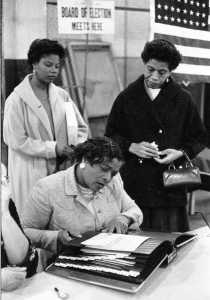
Three African American women at a polling place, one looking at a book of registered voters on November 5, 1957, in New York City or Newark, New Jersey] / TOH, Library of Congress
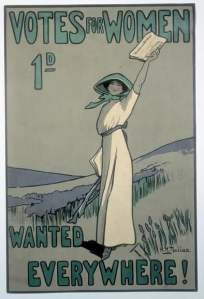
It took the better part of a century to pass a law saying American women had the right to vote. It took even longer to deliver this right to Indigenous women — which really short-changed all Native Americans.
For the longest time, the word “suffrage” has been aligned with the historic passage of the 19th Amendment, a decree ratified a century ago, this week, outlawing discrimination of voters on the basis of their sex. But in reality, such shorthand, couched in twentieth-century white feminism, was exclusionary. The right to vote in Indian Country tells another side of this struggle in which Indigenous women were on the frontlines from the start.
While the 19th Amendment represents a cornerstone of gender equality in America, few know about the way the vote was won or the limitations it imposed on people of color. Public school curriculum often portrays this history of the suffrage movement through the important advocacy of notable white women, Elizabeth Cady Stanton and Susan B. Anthony.
Leading up to the ratification of the 19th Amendment on Aug. 18, 1920, these Native women participated in suffrage parades, made compelling speeches, and wrote commentary that would likely have gone viral, today. But more intriguing, Indigenous women were the source of inspiration for the movement’s lead organizers, Stanton and Matilda Joslyn Gage.
The women, two New Yorkers who lived on the colonized homelands of the Iroquois Confederacy, wrote how they grew motivated to make lasting voting rights change after recognizing the roles women played in the tribes. Then as now, the Confederacy’s six nations of the Onondaga, Mohawk, Seneca, Cayuga, Oneida, and Tuscarora functioned as a government based on female authority in which Haudenosaunee women maintained authority over their subsistence economy.
They also had final authority over land transfers and decisions about engaging in war. And they practiced a structure of political power shared equally among all clan families and their members — a pure democracy — what also inspired the birth of the United States.
When the 19th Amendment became law on August 26, 1920, 26 million adult female Americans were nominally eligible to vote. But full electoral equality was still decades away for many women of color who counted among that number. The federal suffrage amendment prohibited discrimination on the basis of sex, but it did not address other kinds of discrimination that many American women faced: women from marginalized communities were excluded on the basis of gender and race. Native American, Asian American, Latinx and African American suffragists had to fight for their own enfranchisement long after the 19th Amendment was ratified. Only over successive years did each of those groups gain access to the ballot.
In 1920, Native Americans weren’t allowed to be United States citizens, so the federal amendment did not give them the right to vote. The first generation of white suffragists had studied Native communities to learn from a model of government that included women as equal democratic actors. But the suffragists did not advocate for indigenous women. Nonetheless, Native American activists like Zitkála-Šá continued to organize and advocate with white mainstream suffragists. With the passage of the Snyder Act in 1924, American-born Native women gained citizenship. But until as late as 1962, individual states still prevented them from voting on contrived grounds, such as literacy tests, poll taxes and claims that residence on a reservation meant one wasn’t also a resident of that state.
Native-born Asian Americans already had U.S. citizenship in 1920, but first generation Asian Americans did not. Asian American immigrant women were therefore excluded from voting until the Immigration and Nationality Act of 1952 allowed them to gain citizenship more than three decades after the 19th Amendment. Despite being barred from citizenship and from voting, Asian American suffragists such as Dr. Mabel Ping-Hua Lee worked alongside white Native-born women in the years leading up to 1920; Ping-Hua Lee and others advocated within their communities and even marched in suffrage parades.
Latinx women contributed to the success of the suffrage movement at both the state and federal levels, particularly with their efforts to reach out to Spanish-speaking women. And in Puerto Rico, suffragists like Luisa Capetillo worked to attain women’s voting rights, which were first given to literate women in 1929 and all Puerto Rican women in 1935. Yet literacy tests remained an effective means of keeping some Hispanic and other women of color from voting long after the federal amendment was passed. It took a 1975 extension of the Voting Rights Act, prohibitingdiscrimination against language minority citizens, to expand voting access to women who rely heavily on languages other than English.
Some African American suffragists in the north were able, with the 19th Amendment, to realize the rewards of their activism, but throughout much of the country the same voter suppression tactics that kept black men from the polls kept black women from voting, too. Literacy tests, poll taxes, voter ID requirements and intimidation and threats and acts of violence were all obstacles. The struggle for suffrage, which began for black women in the early 1800s, continued until activists such as Fannie Lou Hamer and Diane Nash won the passage of the Voting Rights Act of 1965, 200 years later.
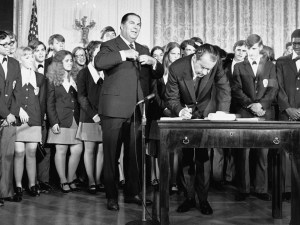
Nixon signs the 26th amendment lowering the voting age from 21 to 18 on July 5, 1971.
There is an interactive display at the link along with some photos of suffragettes of color.
The court’s ruling follows a report finding that as of mid-June, 17 states had passed 28 laws making it harder for constituents to vote in 2021, according to the Brennan Center for Justice at New York University’s School of Law. The report notes that the last year a similar number of laws passed restricting access to the ballot was 2011 – when 14 states had enacted 19 such measures by October.
Eliza Sweren-Becker, a voting rights and elections counsel at the Brennan Center, called the new wave of voting laws “an unprecedented assault on voting rights” as well as “a voter suppression effort we haven’t seen since the likes of Jim Crow.”
The nation’s high court previously gutted a key provision of the Voting Rights Act in 2013, when Chief Justice John Roberts wrote a majority opinion arguing that jurisdictions with a history of racial discrimination in voting should no longer be subject to oversight from the Department of Justice before effecting changes to their voting laws.
The Brennan Center report attributes this year’s batch of restrictive voting laws to “racist voter fraud allegations behind the Big Lie (a reference to former President Donald Trump’s repeated false claims of a rigged election) and a desire to prevent future elections from achieving the historic turnout seen in 2020.”
Commenting on the former president’s claims of mass voter fraud, Sweren-Becker says, “We know that’s false, but we have officials at the state level passing these laws making it harder for people to vote.”
Some of the specific provisions in these laws that can have a negative impact on voter turnout according to the Brennan Center include restrictions on voting by mail – some 63.9 million ballots had been sent as of Election Day 2020, data from the U.S. Elections Project indicated – challenges to in-person voting, and limitations on the number of mail ballot drop boxes in precincts.
Republicans during a U.S. House Judiciary panel hearing on Tuesday argued that a bill that would reinstate a preclearance section of the 1965 Voting Rights Act is unnecessary because there is no discrimination in voting.
The top Republican on the panel, Rep. Mike Johnson, (R-La.), said that the legislation is not needed and that the federal government should not be telling states how to run their electoral processes.
He added that recently voting bills passed by Republicans in Georgia and Florida are meant to “enhance election integrity and increase the public’s waning confidence in our election process.”
“It is outrageous to see the federal government fighting back against these common sense reforms, such as the latest lawsuit filed by the Department of Justice against Georgia over its election law,” Johnson said. The Justice Department announced last week that the agency is suing Georgia in an attempt to overturn the state’s sweeping elections law passed in March.
The comments from the GOP came as Democrats again attempt some type of federal action on elections laws, after a massive legislative package by Democrats known as H.R. 1 was blocked in the U.S. Senate by Republicans. Democrats say the GOP state laws broadly disenfranchise many voters, including those of color, rural residents and people with disabilities.
Rep. Steve Cohen, the Tennessee Democrat who held the House hearing as the chair of the Subcommittee on the Constitution, Civil Rights, and Civil Liberties, contended it is necessary for Congress to pass H.R. 4, the John Lewis Voting Rights Act.
Republicans seem intent on chipping away the rights of ordinary Americans. It is time to stand up against their continued attempts to maintain and expand all vestiges of white nationalism, white male patriarchy, and a dominist christianist oligarchy. The song below sustained me through our fight for the ERA. I got to see and sing this with her in our first Women’s Festival in 1982. I tried desperately to create a festival in 1983 with participation and leadership of black women in the Urban League. We had a successful Festival that follwed Maya Angelou speaking at Equality. Our main speakers were Betty Friedan and Kate Millet. Equal rights and voting rights is important to all our rights in all the various way we participate in American Communities.
Whats on your reading and blogging list today?
Did you like this post? Please share it with your friends:
The Sky Dancing banner headline uses a snippet from a work by artist Tashi Mannox called 'Rainbow Study'. The work is described as a" study of typical Tibetan rainbow clouds, that feature in Thanka painting, temple decoration and silk brocades". dakinikat was immediately drawn to the image when trying to find stylized Tibetan Clouds to represent Sky Dancing. It is probably because Tashi's practice is similar to her own. His updated take on the clouds that fill the collection of traditional thankas is quite special.
You can find his work at his website by clicking on his logo below. He is also a calligraphy artist that uses important vajrayana syllables. We encourage you to visit his on line studio.








 Good Day Sky Dancers!
 This reminds me of how the’ve been chipping away at Abortion and other privacy-related rights. It also reminds me of how they keep enabling dark money in elections. What’s with Justice Roberts any way? I mean we know that Republican politicians know they’re increasingly a rump party. They also know that gerrymandering and voting restrictions are the only way to slow down the tsunami of voters not in their narrow demographics. Joan Biskupic, CNN Legal Analyst, put it this way: “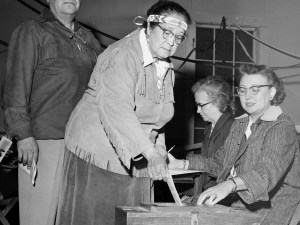
 As of now, The John Lewis Voting Rights Act is stalled.
 peej
peej Carissa
 bostonboomer
 dakinikat
 ecocatwoman
 mablue2
 Mama Lopez
 peggysue22
 quixote
 skydancingguestblogger
 Mona (aka Wonk the Vote)



 Sky Dancing
Recent Comments