




The U.K. has slapped targeted economic sanctions on five Russian banks and three wealthy individuals following President Vladimir Putin’s decision to send troops into eastern Ukraine.
Addressing lawmakers on Tuesday in the House of Commons, Prime Minister Boris Johnson said the first tranche of sanctions would target Rossiya, IS Bank, General Bank, Promsvyazbank and the Black Sea Bank.
The measures would also sanction three “very high net worth” individuals: Gennady Timchenko, Boris Rotenberg and Igor Rotenberg.
The individuals concerned will see their U.K. assets frozen and be banned from traveling to the country, Johnson said. All U.K. individuals and entities will also be barred from having dealings with them, he added.
Johnson said the move to sanction Russia had arisen despite himself and several other world leaders giving Putin “every opportunity” to pursue his aims via diplomacy….
He added, “This the first tranche, the first barrage of what we are prepared to do and we hold further sanctions at readiness to be deployed alongside the United States and the European Union if the situation escalates still further.”
Friday Reads: The Honorable Judge Ketanji Brown Jackson gets the Nod!
Posted: February 25, 2022 Filed under: Russia, SCOTUS, Ukraine 27 Comments
Mariia Pryimachenko: Animals Visiting the Lion (1963).
It’s Friday Sky Dancers!
We need to recognize every step to inclusion in our and other democracies around the world today as every democratic government has experienced increasing threats from a radical and violent right-wing insurgency. I’m continuing BB’s sharing the work of Ukrainian artists today with more offerings. The majority of the world stands with Ukraine and its nascent democracy as Russian forces invade its borders.
First things first! We now have Biden’s first nomination to the Supreme Court! It’s the Honorable Judge Ketanji Brown Jackson who was always the clear favorite. It will be so exciting to see a Black woman bring her experience and knowledge to this bench. Let’s hope the Republicans on the Judiciary don’t continue to harass nominations that don’t represent their idea of proper demographics.
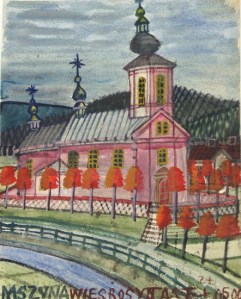
Nykyfor: Church in Mushyna.
This is from The Washington Post and includes live updates: “Biden calls Jackson ‘one of our nation’s brightest legal minds’ as he announces intent to nominate her to Supreme Court.”
Here’s what to know
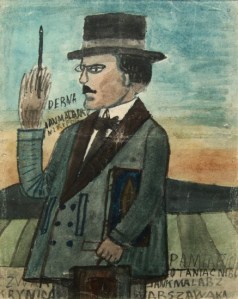
Nykyfor: Portrait of a Man.
This is from Katie Rogers writing for The New York Times: “Biden Chooses Ketanji Brown Jackson for Supreme Court.”
President Biden has selected Judge Ketanji Brown Jackson as his nominee to the Supreme Court, the administration said Friday, choosing a well-regarded federal appeals court judge who if confirmed would make history by becoming the first Black woman to serve as a justice.
Mr. Biden’s decision, made after a monthlong search, fulfilled a campaign vow to nominate a Black woman to the bench, and set into motion a confirmation battle that will play out in an evenly divided Senate.
One of several statements sent by the Republican National Committee this morning seeks to paint Judge Jackson as an elitist. The group said her past as a director of the Harvard Alumni Association raised “questions about her judgment,” in part because of a trip the group had planned to make to North Korea that was canceled during her tenure on the group’s board. Prospective participants were advised to “show respect” to Kim Jong Il, the North Korean leader at the time, if they made the trip. It’s not clear whether Judge Jackson was involved in any way in planning the trip. Even so, it is a curious line of criticism, given the effusive public comments former President Donald J. Trump has frequently made about Kim Jong Un, the current North Korean leader and son of Kim Jong Il: “We fell in love,” Mr. Trump said of the younger Mr. Kim in 2018.

Kateryna Bilokur: Field on Collective Farm (1948-49).
The worst of the Republican trolling appears to come from Lady Lindsey who is pearl-clutching at her Harvard Credentials. He didn’t seem to mind her the last time she was up for her current position He also didn’t complain about Kavanaugh or Gorsuch’s Ivy League credentials when they were quickly shuffled to the High Court. But, here he is! This is from the New Civil Rights Movement:” ‘Absolute BS’: ‘Gaslighting’ Lindsey Graham Blasted for Denouncing Biden SCOTUS Pick as Proof ‘Radical Left Has Won’. It’s written by David Badash.
Judge Jackson has more experience on the bench than the combined experience of Chief Justice John Roberts, and Justices Amy Coney Barrett, Elena Kagan, and Clarence Thomas when they were confirmed, as University of Texas Law law professor Steve Vladeck noted.
Regardless of Judge Jackson’s excellent qualifications (the White House has already published a microsite on her background) Senator Graham was furious – and is being roundly condemned for that outrage.
“If media reports are accurate, and Judge Jackson has been chosen as the Supreme Court nominee to replace Justice Breyer, it means the radical Left has won President Biden over yet again,” Graham, who sits on the Judiciary Committee tweeted.Many social media users noted Graham voted to confirm Judge Jackson twice, including as recently as June, so his outrage seems highly suspect.
Give them hell Your Honor!

Mariia Pryimachenko: The Autumn Riding on a Horse (1984).
Here are some of the latest headlines from the Russian Invasion of Ukraine.
Council of Europe suspends Russia’s rights of representation — In line with the Statute of the Council of Europe, the Committee of Ministers has today decided to suspend the Russian Federation from its rights of representation in the Committee of Ministers and in the Parliamentary Assembly
From Philip Pullella at Reuters:Departing from protocol, pope goes to Russian embassy over Ukraine … Pope Francis went to the Russian embassy to the Holy See on Friday to relay his concern over Russia’s invasion of Ukraine to Moscow’s ambassador, in an unprecedented departure from diplomatic protocol.
From Barak Ravid at Axios: Zelensky to EU leaders: “This might be the last time you see me alive” — Ukrainian President Volodymyr Zelensky told EU leaders “this might be the last time you see me alive” during a video conference on Thursday night, two European sources briefed on the call tell Axios.
Another great mid- 20th century actress has passed on.
The last few years have made me feel quite old. I feel like the Post World War 1 and 2 eras have gone full cycle.
Take care of yourselves and each other! We love you here and are glad we, as a community, can share all of this.
What’s on you reading and blogging list today?
Thursday Reads: And So It Begins…
Posted: February 24, 2022 Filed under: morning reads | Tags: Act of War, GOP, Joe Biden, NATO, Russia attacks Ukraine, Ukraine, Ukrainian artists, United Nations, Vladimir Putin 49 Comments
Tenderness, by Ivan Marchuk
Good Morning!!
The images in this post are by famous Ukrainian artists. You can read more about them at this Odessa Journal link.
Well it really happened last night. Russia attacked multiple Ukrainian cities. There is a massive amount of reporting and commentary; I can only offer a sampling.
Politico: Battles flare across Ukraine after Putin declares war.
After his declaration of war just before 6 a.m. Moscow-time, the Ukrainian government reported airstrikes at military facilities in the cities of Kyiv, Kharkiv and Dnipro, as well as artillery fire on the border. The authorities in Kyiv reported a pincer movement attack on its troops from Belarus to the north, potentially attempting an encirclement of Kyiv, and from Crimea to the south. Russia insisted it was destroying military bases and airfields, not civilian targets.
Ukraine warned that Moscow was turning to propaganda tricks by suggesting that Russian troops were not meeting resistance and by exhorting Ukrainians to lay down their weapons. Kyiv insisted that its troops were locked in heavy fighting, had shot down seven warplanes, destroyed dozens of armored vehicles and killed dozens of enemy soldiers. Fighting has drawn very close to Kyiv and Kharkiv.
Adviser to the Ukrainian presidential office Oleksiy Arestovych vowed that the Russian forces would not reach the capital. “Fierce battles will be waiting for them there, we will stop them,” he was quoted as saying by local media.
In a sign of the desperate straits Ukraine is facing against a stronger adversary, however, Ukrainian President Volodymyr Zelenskiy called for a general mobilization. The country also put out an appeal for blood donors as news began to filter in of dozens of Ukrainian casualties across the country.
By Kateryna Primachenko
U.S. President Joe Biden vowed a united response against the Russian attack by Washington and its allies, while U.N. Secretary-General António Guterres said: “President Putin, in the name of humanity, bring your troops back to Russia. This conflict must stop now.” Later on Thursday, the EU is set to agree a sanctions package intended to weaken Putin’s ability to wage war, though there was no immediate sign that it would touch all-important energy revenues.
Earlier on Thursday, Zelenskiy imposed martial law and said he had contacted Biden to co-ordinate an international response. “Today we need calm from each of you. Stay at home if possible. We are working, the army is working, the whole security apparatus of Ukraine is working.” Foreign Minister Dmytro Kuleba called for “devastating” sanctions on Russia and for weapons’ deliveries to the Ukrainian military.
Vitaly Klitschko, mayor of Kyiv and former heavyweight boxing champion, told people to have an emergency suitcase ready in case they needed to get to shelNAter.
At Just Security, Maria Popova and Oxana Shevel argue: Russia’s New Assault On Ukraine Is Not Entirely – Maybe Not Even Largely — About NATO.
In his Feb. 15 Just Security article “Ukraine: Unleashing the Rhetorical Dogs of War,” Barry Posen argued that NATO and Ukraine should have cut a deal with Russia because the Ukrainian military would surely be defeated by Russia without direct U.S./Western military participation and U.S. offers of equipment were only encouraging a potential Ukrainian insurgency against Russian occupation that would be as bloody as it would be futile. The prescription depends entirely on Posen’s assumption that to satisfy Russia, all Ukraine would have had to do would be “to swallow the bitter pill of accepting armed neutrality between NATO and Russia, rather than NATO membership.”
This assumption contradicts events of recent months and the historical record. While Vladimir Putin has claimed that his goal is keeping Ukraine out of NATO, he also insisted that he was just conducting military exercises. Instead, he is invading Ukraine again. He likewise insisted in 2014 that he wasn’t capturing Crimea, despite the presence of his unidentified “Little Green Men” and his subsequent annexation of the peninsula, or that he was not fighting in Ukraine’s Donbas area in the east all these years, despite all evidence to the contrary. There is no reason to take Putin at his word. His Feb. 21 diatribe conferring Russian recognition of independence for the two eastern Ukrainian regions of Donetsk and Luhansk and his order for Russian troops to move in as ostensible “peacekeepers” shows clearly his disdain for diplomatic resolutions.
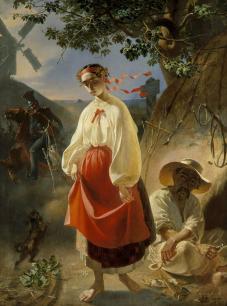
Katerina, by Taras Grigorievich Shevchenko, 1842
Moreover, this is not even primarily about NATO.
NATO’s eastward expansion may have played a role in straining the relationship between Russia and the West, but mainly because, for Russia, seeing former satellites eagerly abandon it for the greener pastures of Euro-Atlantic integration stung. However, Putin’s rhetoric and actions over almost two decades reveal that his goals extend beyond imposing neutrality on Ukraine or even staving off further NATO expansion. The larger objective is to re-establish Russian political and cultural dominance over a nation that Putin sees as one with Russia, and then follow up by undoing the European rules-based order and security architecture established in the aftermath of World War II. Given these goals, Ukrainian neutrality is a woefully insufficient concession for Putin.
Read much more at the link.
AP News: The Latest: UN chief warns Russian actions could devastate.
UNITED NATIONS — U.N. Secretary-General Antonio Guterres says Russia’s attack on Ukraine — as he appealed for President Vladimir Putin to stop his troops — was “the saddest moment” of his five-year tenure.
The U.N. chief opened the emergency Security Council meeting late Wednesday by urgently appealing to Putin: “In the name of humanity, bring your troops back to Russia.”
But during the meeting, Putin announced that he was launching a “special military operation” in eastern Ukraine.
Guterres later urged the Russian president to withdraw his troops and added: “In the name of humanity do not allow to start in Europe what could be the worst war since the beginning of the century, with consequences not only devastating for Ukraine, not only tragic for the Russian Federation, but with an impact we cannot even foresee in relation to the consequences for the global economy.”
A war would cause deaths and displacement and people will lose hope in the future, Guterres said, adding Russia’s actions would harm the global economy.
“What is clear for me is that this war doesn’t make any sense,” Guterres said, stressing that it violates the U.N. Charter and will cause a level of suffering if it doesn’t stop that Europe hasn’t know since at least the 1990s Balkans crisis.
CNN: Biden to impose additional sanctions on Russia now that Ukraine assault is underway.
President Joe Biden, vowing the world will “hold Russia accountable” for the attack underway in Ukraine, will spell out a set of sanctions on Thursday once meant to deter such an assault.
Set to address the nation Thursday afternoon, Biden is expected to unveil new measures that could cut off Russia from advanced technology, announce new restrictions on large financial institutions and slap sanctions on additional members of the inner circle of Russian President Vladimir Putin.
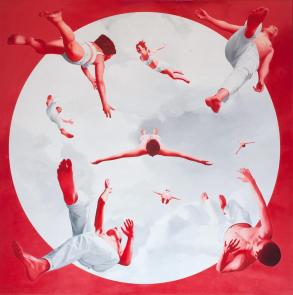
Victor Sidorenko, Expiration Levitation Series
The planned sanctions, the latest US reprisals against Moscow this week, had been reserved as Biden hoped to maintain some leverage in dissuading Putin from a full-scale invasion. But so far, Western threats of economic punishment, as well as Biden’s strategy of revealing what the US knew about Putin’s buildup of forces to try to make the Russian leader second-guess himself, have proven ineffective.
After months of predictions and warnings, Russian forces began their attack on Ukraine Thursday morning local time, with reports of troops crossing the border to the north and south, explosions in multiple cities including the capital Kyiv, and warnings from Putin of future bloodshed unless Ukrainian forces lay down their arms.
Biden’s sanctions are now meant to punish Putin’s actions, rather than prevent them, by going after Russia’s economy, its military capabilities and those closest to the Russian President. How much they can alter Putin’s decision-making going forward, however, remains an open question.
Before he speaks, Biden is planning to confer with the leaders from the Group of 7 industrialized nations about which sanctions they plan to impose, hoping to coordinate a response that projects unity among Western allies. US and European officials spoke by phone overnight into Thursday to coordinate their responses.
Gideon Rachman at Financial Times: Putin’s war will shake the world.
The phoney war is over. The real war has begun. For several weeks, the US and British governments have believed that Vladimir Putin was intent on a full-scale invasion of Ukraine. That is now happening.
The precise targets of the Russian military are still emerging. But it is already clear that this is not a limited attack, confined to the disputed regions of eastern Ukraine. Explosions have been heard in the Ukrainian capital, Kyiv. And there are reports of Russian troops crossing the border from Belarus — which is the shortest and most direct route to Kyiv.
Western security services, which have accurately predicted the course of events up until now, believe that Putin intends to overthrow the Ukrainian government and install a puppet regime in its place. This “decapitation” strategy will take in not only the central government, but also regional and local governments. Lists have been drawn up of Ukrainian officials who will be arrested or killed.
By Kateryna Bilokur
The military tactics that Russia uses are likely to be extremely brutal — “the kind of thing we saw in Syria and Chechnya”, according to one US official. The deployment of Russian artillery and its air force would mean heavy military and civilian casualties on the Ukrainian side. Some western sources have spoken of 50,000 deaths within a week.
The Ukrainian military is determined to fight back. But it is likely to find itself heavily outgunned. The Russian goal may be to surround Kyiv and force the collapse or resignation of the Ukrainian government, led by Volodymyr Zelensky.
The Russians will not want to get involved in urban warfare, if they can avoid it. They are also determined to keep the west out of this conflict. In his speech, announcing the invasion, Putin warned outsiders tempted to interfere that there would be “consequences you have never encountered in your history” — a thinly veiled reference to nuclear war.
This is a terrifying article that concludes by asking whether Western states could end up getting involved.
Western governments are also actively debating how to help a Ukrainian insurgency — if and when it emerges — to fight a Russian occupation. Supporters of this plan of action believe that it will be both a moral duty and a strategic imperative to allow Ukrainians to continue the fight. Others worry that supporting an insurgency could turn Ukraine into a new Syria on the borders of Europe.
This is interesting from Anton Troianovski at The New York Times: Many Russians Feel a Deep Unease Over Going to War.
MOSCOW — Waiting for her friends on Moscow’s primly landscaped Boulevard Ring earlier this week, Svetlana Kozakova admitted that she’d had a sleepless night. She kept checking the news on her phone after President Vladimir V. Putin’s aggrieved speech to the nation on Monday that all but threatened Ukraine with war.
“Things are going to be very, very uncertain,” she said, “and, most likely, very sad.”
For months, Russians of all political stripes tuned out American warnings that their country could soon invade Ukraine, dismissing them as an outlandish concoction in the West’s disinformation war with the Kremlin. But this week, after several television appearances by Mr. Putin stunned and scared some longtime observers, that sense of casual disregard turned to a deep unease.
You’re My Space, by Evgeniya Gapchinskaya, 2019
Early Thursday morning, any remaining skepticism that their country would invade was put to rest, when Mr. Putin declared a “special military operation” in Ukraine.
Pollsters said that most Russians probably supported Mr. Putin’s formal recognition of the Russian-backed territories in eastern Ukraine this week, especially because they had no choice in the matter and because no significant political force inside the country has advocated against it.
War is a different matter altogether, though; in recent days, Russia has not seen any of the jubilation that accompanied the annexation of Crimea in 2014.
Going to war is one of Russians’ greatest fears, according to the Levada Center, an independent pollster. And after Mr. Putin’s angry speech and his cryptic televised meeting with his Security Council on Monday, Russians realized that possibility was lurching closer toward becoming reality.
Read the rest at the NYT.
At Mother Jones, David Corn asks why Republicans are rooting for Putin: Is It Amnesia or Hypocrisy That Fuels the GOP’s Crazy Response to Putin?
In the midst of an international crisis created by Russia that could potentially trigger a war in Europe, Republicans and right-wingers on and off Fox News have pledged allegiance to…Vladimir Putin. At the least, they are siding with the Russian autocrat and trash-talking President Joe Biden’s effort to block his aggression. But there’s nothing surprising about the ongoing romance between conservatives and the democracy-crushing thug-leader of Russia, who has invaded Ukraine and violated international law. Anyone shocked by this has forgotten one of the key facts of the 21st century: Putin waged war on the United States, and Donald Trump and his party aided, abetted, and benefitted from that attack.
In recent days, as Putin has threatened a conflagration, top conservatives and GOP officials have practically pinned “I’m-with-Vlad buttons” onto their lapels. One example: Mike Pompeo, Trump’s final secretary of state and before that his CIA director, had only praise for the corrupt Russian autocrat, describing him as “talented” and “savvy.” Donald Trump, speaking to a conservative podcaster on Tuesday, hailed Putin’s moves in Ukraine as “genius.” Referring to Putin’s invasion of eastern Ukraine, Trump said, “Putin declares a big portion of…of Ukraine. Putin declares it as independent. Oh, that’s wonderful…I said, ‘How smart is that?’ And he’s gonna go in and be a peacekeeper…Here’s a guy who’s very savvy.” Later in the interview, Trump continued to gush: “I knew Putin very well. I got along with him great. He liked me. I liked him. I mean, you know, he’s a tough cookie, got a lot of the great charm and a lot of pride. But the way he—and he loves his country, you know? He loves his country.”
No condemnation. No call for opposing Putin’s illegal and provocative maneuvers. Just one big bear hug from Trump for the tyrant. Putin may spread repression by force but he sure “loves his country.” (Remember, Trump’s crush on Putin stretches back to 2013 when he tweeted: “Do you think Putin will be going to The Miss Universe Pageant in November in Moscow—if so, will he become my new best friend?”)
Eve, by Ivan Marchuk
Conservatives have also boosted Putin by pooh-poohing the invasion of Ukraine as no big deal. In his usual too-clever-by-half way, Tucker Carlson on Tuesday night dismissed outrage over Putin’s aggression:
What is this really about? Why do I hate Putin so much? Has Putin ever called me a racist? Has he threatened to get me fired for disagreeing with him? Has he shipped every middle-class job in my town to Russia? Did he manufacture a worldwide pandemic that wrecked my business and kept me indoors for two years? Is he teaching my children to embrace racial discrimination? Is he making fentanyl? Is he trying to snuff out Christianity? Does he eat dogs?
It seemed as if Carlson was quasi-defending Putin because the Russian leader does not advocate critical race theory and is not the leader of China. He ridiculed concerns over Putin’s threat to world peace and stability and asserted Americans are being “trained to hate” the Russian leader. In other words, there’s no reason to fret about Putin’s militarism—and if you do worry, you’re just a brainwashed sheep.
Read the rest at Mother Jones.
So here we are. I have no idea what’s coming, but I’m very worried. After four years of Trump, and two years of a deadly pandemic, we don’t need any more calamities.
I’ll try to post updates in the comment thread today. I have difficulty looking at the computer screen for very long these days, but I’ll do my best. I hope you all will post comments and links too. Take care everyone!
Tuesday Reads
Posted: February 22, 2022 Filed under: morning reads | Tags: Germany, Joe Biden, NATO, Nordstream 2, Russia, Ukraine, Vladimir Putin 20 CommentsGood Morning!!
Yesterday, Vladimir Putin finally ordered Russian troops to invade Ukraine, while trying to put the blame on the U.S., NATO, and the Ukraine government. Putin claimed the troops were for “peacekeeping” purposes, to protect ethnic Russians in two parts of Eastern Ukraine.
At first the Biden administration debated whether to call this an “invasion,” but as of this morning that has changed. Newsweek: Biden Administration Backtracks, Is Now Calling Russia’s Attack on Ukraine an Invasion.
President Joe Biden‘s administration has called Russian troops entering Ukraine an “invasion” for the first time on Tuesday morning after members of Congress from both parties used the term and called for tough sanctions.
The Biden administration had not previously referred to the Russian military action in eastern Ukraine as an “invasion” but White House officials have said a further response will be forthcoming and is likely to include more sanctions.
Deputy National Security Adviser Jon Finer called Russian military action in eastern Ukraine an “invasion” in remarks to CNN on Tuesday.
Russian President Vladimir Putin signed decrees on Monday recognizing the self-proclaimed Donetsk People’s Republic (DNR) and Luhansk People’s Republic (LNR) in Ukraine’s east as independent states and ordered Russian troops into those regions.
“We think this is, yes, the beginning of an invasion, Russia’s latest invasion into Ukraine,” Finer said.
“I think ‘latest’ is important here,” Finer said.
“An invasion is an invasion, and that is what is underway, but Russia has been invading Ukraine since 2014,” he said.
Russia annexed the Crimean peninsula from Ukraine in 2014. There has also been a Russian presence in Donetsk and Luhansk since 2014.
Follow the latest developments at CNN: Live Updates: The latest on the Ukraine-Russia crisis. or at The New York Times Ukraine live updates.
Western nations have begun sanctioning Russia for it’s illegal aggression:
The New York Times: Germany puts a stop to Nord Stream 2, a key Russian natural gas pipeline.
Chancellor Olaf Scholz said on Tuesday that Germany would halt certification of the Nord Stream 2 natural gas pipeline that would link his country with Russia, one of the strongest moves yet by the West to punish the Kremlin for recognizing two separatist regions in Ukraine.
The German leader’s announcement came hours after President Vladimir V. Putin of Russia ordered armed forces to the separatist regions, the so-called Donetsk and Luhansk People’s Republics.
Germany’s allies in Europe and the United States had been pressing Mr. Scholz for weeks to state publicly that the $11 billion pipeline, which was completed late last year and runs from Russia’s coast to northern Germany under the Baltic Sea, would be at risk of being blocked in the event of a Russian move against Ukraine.
“The situation today is fundamentally different,” Mr. Scholz told reporters in Berlin. “That is why we must re-evaluate this situation, in view of the latest developments. By the way, that includes Nord Stream 2.”
CBS News: U.S. imposes sanctions after Putin recognizes breakaway Ukraine regions.
President Biden signed an executive order Monday imposing sanctions that target two Russia-backed breakaway republics in eastern Ukraine in a swift response to Russian President Vladimir Putin’s decision to recognize the regions as independent.
The order bars “new investment, trade and financing by U.S. persons to, from, or in” the so-called Donetsk People’s Republic and Luhansk People’s Republic, located in Ukraine’s eastern Donbas region, White House press secretary Jen Psaki said in a statement.
The order also provides authority to impose sanctions on “any person determined to operate in those areas of Ukraine,” Psaki said, adding the administration will later “announce additional measures related to today’s blatant violation of Russia’s international commitments.”
CNBC: UK announces first tranche of Russia sanctions, targets banks and wealthy individuals.
Russian stocks plunged and the ruble slid closer to a record low on Tuesday as investors reacted to President Vladimir Putin’s decision to order troops into eastern Ukraine.
Moscow’s MOEX stock index dropped 1.5% after shedding more than 10% on Monday, bringing losses so far this year to about 20%. Shares in Russian oil company Rosneft were hardest hit Tuesday, dropping 7.5%. In total, more than $30 billion has been wiped off the value of Russian stocks this week alone.
The ruble fell toward 81 versus the US dollar on Tuesday, its weakest level in more than a year and close to its record low. The moves prompted Russia’s central bank to announce measures to support banks, including a provision that will allow them to use last Friday’s prices for stocks and bonds when reporting their financial positions.
More pain could be on the way.
“We expect further declines near-term in the Russian stock market,” analysts at JPMorgan Chase wrote in a note to clients on Tuesday. The Wall Street bank downgraded Russian equities to “neutral” from “overweight.”
Damage to Russia’s markets and economy would be limited if its troops do not advance beyond the parts of eastern Ukraine that Putin recognized as independent on Monday, according to analysts. But Russia would pay a higher price if further aggression causes the West to respond with punishing sanctions that could cut the country’s banks off from the global financial system and make it difficult to export oil and natural gas.
Analyses of the Ukraine situation:
At The Atlantic, Tom Nichols reacted to the insane speech Putin gave yesterday: Putin Chooses a Forever War.
Russian President Vladimir Putin, in a long speech full of heavy sighs and dark grievances, made clear today that he has chosen war. He went to war against Ukraine in 2014; now he has declared war against the international order of the past 30 years.
Putin’s slumped posture and deadened affect led me to suspect that he is not as stable as we would hope. He had the presence not of a confident president, but of a surly adolescent caught in a misadventure, rolling his eyes at the stupid adults who do not understand how cruel the world has been to him. Teenagers, of course, do not have hundreds of thousands of troops and nuclear weapons.
Even discounting Putin’s delivery, the speech was, in many places, simply unhinged. Putin began with a history lesson about how and why Ukraine even exists. For all his Soviet nostalgia, the Russian president is right that his Soviet predecessors intentionally created a demographic nightmare when drawing the internal borders of the U.S.S.R., a subject I’ve explained at length here.
But Putin’s point wasn’t that the former subjects of the Soviet Union needed to iron out their differences. Rather, he was suggesting that none of the new states that emerged from the Soviet collapse—except for Russia—were real countries. “As a result of Bolshevik policy,” Putin intoned, “Soviet Ukraine arose, which even today can with good reason be called ‘Vladimir Ilyich Lenin’s Ukraine’. He is its author and architect.”
It is true that Soviet leaders created the 1991 borders. That is also true of what we now call the Russian Federation. Putin, however, went even further back in history: “Ukraine never had a tradition of genuine statehood.”
By that kind of historical reasoning, few nations in Europe, or anywhere else, are safe. Putin’s foray into history was nothing less than a demand that only Moscow—and only the Kremlin’s supreme leader—has the right to judge what is or is not a sovereign state (as I recently discussed here). Putin’s claims are hardly different from Saddam Hussein’s rewriting of Middle East history when Iraq tried to erase Kuwait from the map.
Read the rest at the Atlantic link. Nichols is genuine expert on Russia.
Another Russia expert, Julia Davis, wrote about the reaction of Ukrainian citizens yesterday at The Daily Beast: Kremlin TV Asks ‘Where’s the Champagne?’ as Ukraine’s Kids Are Prepped for War.
Russian President Vladimir Putin stunned the world on Monday when he unilaterally recognized two Kremlin-backed separatist regions in Ukraine, Luhansk and Donetsk, as independent states and ordered Russian troops to conduct so-called “peacekeeping operations” there. The move has sparked widespread condemnation from global leaders who have accused Putin of violating international law and expressed concerns that the latest escalation may soon morph into a full-scale Russian invasion of its neighbor.
In Ukraine, Putin’s decision has only exacerbated the pain and anguish caused by years of bloody conflict, fueled and funded by the Kremlin. Parents across the country have been doing whatever they can to prepare their families for a potential Russian onslaught. “If you want to know how Ukrainians react to Putin’s speech, here’s a glimpse: moms on Facebook discuss putting stickers on their children’s clothes, when they go to school, indicating their blood type,” journalist Olga Tokariuk tweeted on Monday. “Make no mistake: this speech was perceived as a declaration of war on Ukraine.”
For some, the new developments have only deepened their resolve to fight back. “With his speech alone Putin consolidated Ukrainians like no-one else here could. My friends are talking about joining the territorial defense,” Ukrainian reporter Iryna Matviyishyn wrote. “And currently the Kremlin’s madman is the most hated person in Ukraine.”
In contrast, there was joy and laughter on Russia’s state television.
On Monday, RT’s editor-in-chief Margarita Simonyan appeared on The Evening with Vladimir Soloviev ready for a major celebration. “First of all, I don’t understand why there isn’t champagne in the studio,” she said. Beaming ear-to-ear, Simonyan described feeling “an overwhelming sense of euphoria” and added: “I’ve been waiting for 8 years for this… It finally happened. This is true happiness.” Claiming to speak on behalf of the “Donbas’ people,” Simonyan exclaimed: “Thank you, Mother Russia!”
David Ignatius at The Washington Post: Opinion: Surprising cracks, if small ones, appear in Kremlin support for Putin on Ukraine.
President Vladimir Putin presented a theatrical justification for war with Ukraine on Monday, but initial Russian military actions along the border were limited — and there seemed to be a few small cracks in Kremlin support for Putin’s obsession with regaining Russian dominion in Kyiv.
Read more at the WaPo.
The New York Times on Biden’s strategy: Wooing Allies, Publicizing Putin’s Plans: Inside Biden’s Race to Prevent War.
In a series of top-secret meetings last October, President Biden’s national security team presented grim intelligence that would soon trigger a fierce effort to prevent what could become the largest armed conflict in Europe since World War II.
Vladimir V. Putin, the Russian president, was preparing to invade Ukraine, top intelligence and military officials told Mr. Biden. Gathering each morning in the Oval Office for the global threat assessment known as the President’s Daily Brief, they described satellite images of Russian forces methodically advancing toward Ukraine’s border.
Not only did the United States have images of troops moving into position, it also had the Russian military’s plans for a campaign against Ukraine — elements of which had already begun. At one of the morning meetings, Mr. Biden dispatched William J. Burns, the C.I.A. director, to Moscow with a message for Mr. Putin:
We know what you’re planning to do.
Stopping him would be a challenge. Many of America’s closest allies were skeptical that Mr. Putin — a master of disinformation — would actually invade. The use of U.S. military force against Russia was off the table, so the allies would have to threaten Mr. Putin with economic pain so severe it would also have consequences in Europe and the United States. And it was far from certain that Republicans in Congress would back whatever the administration did….
The White House acknowledged from the start that its campaign to stop Mr. Putin might not actually prevent Russia from invading Ukraine. But at the very least, White House officials say, Mr. Biden exposed Mr. Putin and his true intentions, which helped unite, at least for now, the at-times fractious NATO alliance.
Over the course of three and a half months, Mr. Biden made three critical decisions about how to handle Russia’s provocations, according to interviews with more than a dozen senior administration officials and others who requested anonymity to discuss confidential meetings. Early on, the president approved a recommendation to share intelligence far more broadly with allies than was typical, officials said. The idea was to avoid disagreements about tough economic sanctions by ensuring that everyone knew what the United States knew about Mr. Putin’s actions.
Mr. Biden also gave the green light for an unprecedented public information campaign against Mr. Putin. With the support of his top intelligence officials — and with a promise to protect the intelligence agencies’ “sources and methods” — the president allowed a wave of public releases aimed at preventing Mr. Putin from employing his usual denials to divide his adversaries.
Read more details at the NYT link.
So that’s where things stand this morning. I’m sure there will be more developments throughout the day today. What are your thoughts on this? What other stories are you following?
Monday Reads: To War or Not to War, That is the Question
Posted: February 21, 2022 Filed under: just because | Tags: President's Day, Russia attacks on Ukraine 26 Comments
Good Day Sky Dancers!
Today is President’s Day which is basically the day we celebrate the myths of the men holding the position. While I intend to focus on the Ukraine situation, I did trip across this article in Politico that made me wonder if we should just call the entire holiday off. It’s like Colombus day which basically celebrates the invasion of a mass murderer, enslaver, and rapist so evil that his royal funders refused to pay him on his return. I shudder at the thought of celebrating a holiday that includes that orange monster that we can’t seem to get rid of and then the other racists and mass murderers that need a good bit of daylight to show who they were and what they did. Andrew Jackson–the mass murderer and originator of the Trail of Tears–comes to mind. Then, there the huge number of slave owners we have white washed and basically say it was okay for them to own people including their own children.
“It’s Time To Cancel Presidents Day. By elevating myth over reality, the holiday does a disservice to history.” The article is printed in Politico and penned by John F Harris.
Long-forgotten lives, like the dozens of people killed in the Tulsa race massacre, are being vaulted into public consciousness. More controversially, people who long enjoyed revered status in the national story are being dethroned as national heroes.
Historical reappraisal has been especially vigorous in a particular arena: the U.S. presidency. Woodrow Wilson, a president whose reputation among many historians placed him in the ranks of “near-great” leaders, has in recent years become toxic because of new attention to his deeply prejudiced racial views.
On the other hand, it is still treacherous to take on presidents of Rushmore-sized stature. Liberal San Francisco voters recently evicted school board members whom they judged too preoccupied with left-wing advocacy, including efforts to rename public schools honoring George Washington, Thomas Jefferson and Abraham Lincoln.
The presidency itself, like so many aspects of American culture, is now in the middle of ideological crossfire between left and right. Is there a way that the center can find its voice in arguments about the presidency?
Yes, there is. A good way to start would be to cancel the day we mark today: “Presidents Day.”
One hastens to add: The aim is not to “cancel,” in the contemporary sense of the word, any particular president. Lincoln and Washington — the two presidents most closely linked with Presidents Day — face stiff challenges when judged by contemporary standards, but they aren’t the targets here. Instead, it is the notion of Presidents Day — an inane name for a dubious concept that is less a show of genuine respect for American history than an insult to it.
The problems with Presidents Day are intertwined with a basic challenge of how Americans think about their history — or, really, how the people of any country think about their national story. There are two conceptions of what it means to learn history — always in tension with each other, and sometimes in flat contradiction.
The other conception of history is something quite different — a disciplined effort to reconstruct the past as it actually happened. This enterprise relies on evidence that is always fragmentary and on interpretive arguments that are never settled with finality. This brand of history aims to liberate its audience from national mythologies, and its characters are not marble heroes. They can suffer from bad tempers, diarrhea, self-doubt — the last entirely justified, given that, unlike people who will later study their histories, they have no idea what’s about to happen next, or how their decisions will look in hindsight.
So while one style of history studies the past in search of moral clarity, the other is attuned to moral ambiguity. One kind of history aims to create national heroes. The other kind — even when it is not expressly aimed at demolishing heroes — can’t help but dismantle the reputations of presidents and other outsize figures, revealing all manner of unheroic traits.
A brand of history that embraces reality over myth, and ambiguity over sharp moral judgments over heroes and villains, ultimately offers far more useful lessons for a democracy.

ABRAHAM LINCOLN
By Emma, Age 12, She choose to draw him because he was a president and helped abolish slavery.
The author goes on to deconstruct the relevancy of Abraham Lincoln’s speeches in the modern world. It seems that a large number of people prefer propaganda and myth to history. The current kerfuffle over Critical Race theory is just one of the attempts by people that lack critical thinking skills to cover up the sins of their fathers. Here’s a brief introduction to the topic from last May’s EducationWeek. Laws banning this in Louisiana are currently being hyped in our Lege.
Critical race theory is an academic concept that is more than 40 years old. The core idea is that race is a social construct, and that racism is not merely the product of individual bias or prejudice, but also something embedded in legal systems and policies.
The basic tenets of critical race theory, or CRT, emerged out of a framework for legal analysis in the late 1970s and early 1980s created by legal scholars Derrick Bell, Kimberlé Crenshaw, and Richard Delgado, among others.
A good example is when, in the 1930s, government officials literally drew lines around areas deemed poor financial risks, often explicitly due to the racial composition of inhabitants. Banks subsequently refused to offer mortgages to Black people in those areas.
I have no idea what’s threatening about this. I have said this many times, that I am really fortunate to have a mother who was a history buff and put us in the station wagon to discover the reality of American History. This included the Trail of Tears and where I was born in Oklahoma on the Cherokee strip and the mass murder and theft of Native lands that all ensued. When she was doing our family genealogy in the 1970s she made it clear that there were slave owners in the family and would bring the copies of the original documents to show me. She was always clear that our family’s Civil war Soldiers stood firmly with the Union but one after another shocking relative was not whitewashed including the one that signed the Constitution and wrote the Fugitive slave act. My Harvard-educated uncle helped write and defend the policy of Japanese-American internment and as a kid, I witnessed my Public school-educated father ask him how on earth he could do that. My dinner table and vacations were always deep dives into American history and I never suffered any complex at all from knowing the truths even at a very tender age. It just made me aware of the reality to choose good actions over evil. Then–if you can–work to unroot all the evil from the system.
I chose him because he was brave and didn’t care about what people said about him. I hope to be like him one day.” -Glory Gezaei, fifth grade, Blessed Sacrament School, Washington, D.C. 2022
So, now the choice is yet another war in Europe and the role NATO will play in restraining or punishing Putin of Russia. BBC News newly reports that “Ukraine-Russia: Putin mulls recognising independence of breakaway regions.”
Russia will decide today whether to recognise the independence of two breakaway regions in eastern Ukraine, President Vladimir Putin has said.The Donetsk and Luhansk regions have been contested by Ukraine and Russia-backed rebels for years, with regular violence despite a ceasefire agreement.
Leaders of both regions asked Russia to recognise their independence on Monday.
But Western powers fear such a move could be used as a pretext for Russia to invade its neighbour
Since 2019, Russia has issued large numbers of passports to people living in the two regions.
Analysts say that if the two regions were recognised as independent, Russia might send troops into Ukraine’s east under the guise of protecting its citizens.
Russia has built up more than 150,000 troops on Ukraine’s borders, a move which has widely been seen by Western nations as preparation for an imminent invasion. Russia denies any such plans.
“The objective of our meeting today is to listen to colleagues and decide on our next steps in this area,” Mr Putin said.
“I mean both the appeal to Russia made by the heads of the Donetsk People’s Republic and the Luhansk People’s Republic for the recognition of their sovereignty,” he added.Several officials at the council meeting spoke up in favour of the move, and the Russian parliament has already asked Mr Putin to recognise their independence.
But the Russian President did not indicate his final decision, saying it would be made later Monday.
This quote is from the Harwood tweet above from CNN.
“Ultimately Putin wants some kind of deal,” Hill said. “They think Biden is the kind of president who could actually make a deal. Trump never could.”
So far, Biden has held NATO allies together in rejecting Russia’s core demands, bolstering their forces in Europe and threatening punishing sanctions even though they guarantee domestic economic blowback. Steeped in decades of bipartisan foreign policy consensus, the Democratic President has also drawn support from top Republicans such as Senate Minority Leader Mitch McConnell who have shunned Trump’s embrace of Putin.
That demonstration of resolve has at minimum made Putin stop and think. Biden has warned for weeks that Russia could launch a new invasion of Ukraine at any time. It hasn’t yet.
“They might have thought we were going to crumble, and we didn’t,” said Hill, who became an American citizen twenty years ago. “It might have deterred a full-scale invasion. Now (Putin) is basically recalibrating, recalculating.”
But durable success for Biden and European allies will depend on staying power. Even if Russian tanks don’t roll across the border, Hill envisions an extended “boa constrictor” siege in which Putin applies escalating pressure in hopes of bending Ukraine to Russia’s will.
“The real challenge is keeping everyone together for a considerable period,” Hill concluded. “It’s going to go on a long time.”
The Guardian reports a different view from the Defense Secretary of the UK.
The defence secretary, Ben Wallace, has warned of continued provocation operations orchestrated by the Kremlin, describing them as a ‘strong cause for concern that President Putin is still committed to an invasion’. Speaking to MPs in the House of Commons, Wallace said Russia continues to be ready to attack Ukraine and has increased troop numbers in the region
The next few days of news on the subject should further clarify our risk for a ground war in Europe.
Hope your week goes well!
What’s on your reading and blogging list today?
Lazy Caturday Reads
Posted: February 19, 2022 Filed under: morning reads | Tags: caturday, Donald Trump, Fiona Hill, January 6 insurrection, Joe Biden, Kamala Harris, Oath Keepers, Stuart Rhodes, Ukraine, Vladimir Putin, Why Cats Paint 17 CommentsGood Morning and Happy Caturday!!
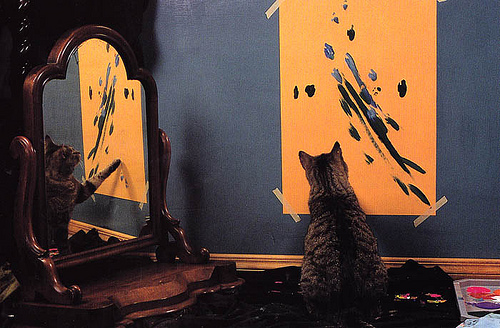
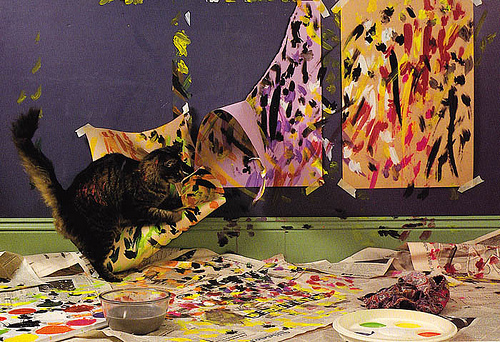
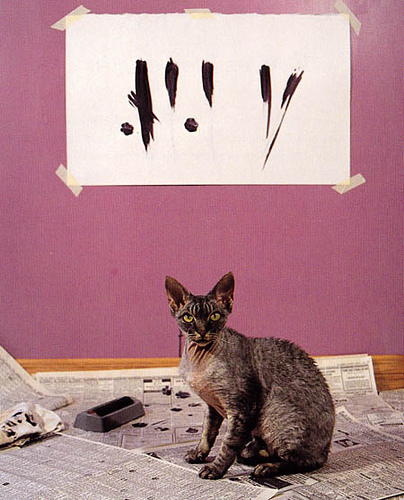
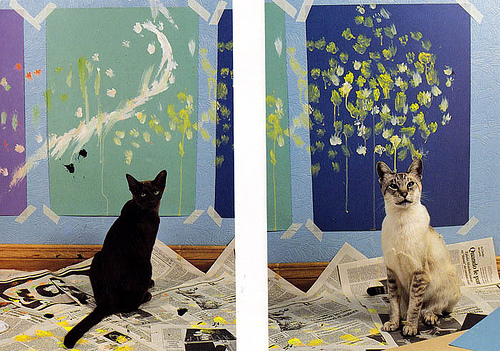
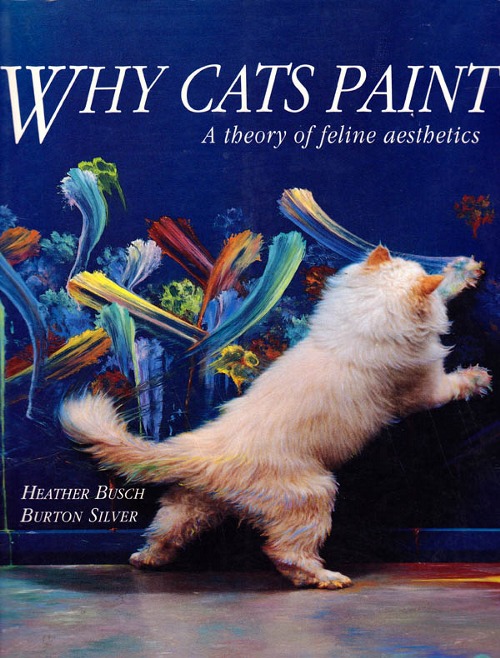 Today’s images are from the book Why Cats Paint: A Theory of Feline Aesthetics, by Heather Busch and Burton Silver. It’s a delightfully tongue-in-cheek discussion of “cat artists” that is really fun to read. Here’s some commentary on the book at Goodreads.
Today’s news is full of Ukraine stories. It’s looking as if Putin really plans to go through with an invasion. Here’s the latest:
President Joe Biden on Friday said he is now convinced Russian President Vladimir Putin has made the decision to invade Ukraine, but emphasized that room for diplomacy remains.
“As of this moment, I am convinced he’s made the decision,” Biden said during remarks at the White House.
The President also said the US believes Russian forces intend to attack Ukraine “in the coming week” or sooner, and that an attack will target the Ukrainian capital of Kyiv.
US Defense Secretary Lloyd Austin on Saturday said Russia was “moving into the right positions to conduct an attack,” echoing Biden’s assertion that Putin had made up his mind on invading.
“They’re uncoiling and now poised to strike,” Austin said, speaking from Vilnius, Lithuania. Austin said the US would pursue a diplomatic solution “until the very last minute, until it’s not possible.”
Biden plans to spend the weekend monitoring the ongoing Ukraine crisis from the White House as he meets with his national security team and remains in close contact with world leaders, multiple officials say. Biden had considered traveling to Delaware, as he typically does, but decided to remain in Washington.
Vice President Kamala Harris is in Germany today for the Munich Security Conference. Reuters: West puts up united front as Russia begins nuclear exercises.
MUNICH, Feb 19 (Reuters) – Russia must not attempt to move Ukraine’s borders by force, Western leaders warned on Saturday, saying they would be ready to respond even if Russia created a pretext for an invasion by accusing Ukraine of aggression.
Charlie the peripheral realist
U.S. Vice President Kamala Harris said the United States would reinforce NATO’s eastern flank to act as a further deterrent to any Russian military action in addition to the threat of sanctions.
“National borders should not be changed by force,” Harris said at the Munich Security Conference.
“We have prepared economic measures that will be swift, severe, and united,” she said. “We will target Russia’s financial institutions and key industries.”
Western leaders were meeting in Munich amid reports of explosions just inside Russian territory to Ukraine’s east and in the parts of eastern Ukraine that are controlled by Moscow-backed rebels.
But most also added that diplomacy had not yet run its course.
“History has not yet been written: there is an exit that the Russian government can choose at any time,” said German Foreign Minister Annalena Baerbock after a meeting of Western foreign ministers.
“Our common message to them is very clear: Don’t make this fatal mistake. Withdraw your troops … Let’s talk.”
But she warned against being misled by misinformation coming from separatist regions , saying Ukraine had done nothing to give the separatist leaders a reason for the evacuations they ordered on Friday.
Read more about the Munich meeting at The Washington Post: Harris, Blinken navigate Munich Security Conference as Europe holds its breath.
NBC News: Russian-backed separatists in Ukraine call to mobilize as Putin oversees nuclear drill.
Pro-Russian separatist leaders in eastern Ukraine ordered a full military mobilization Saturday, amid a spike in violence that has heightened fears that Moscow is planning to use an escalation in the conflictas a pretext to invade.
Pepper’s self-portrait
The announcements came ahead of planned large-scale drills involving Russian nuclear forces, overseen by President Vladimir Putin, offering a timely reminder of the country’s nuclear might, as Europe faces its gravest security crisis since the Cold War. Ballistic and cruise missiles were launched from land, air and sea the Kremlin said in a statement Saturday.
In eastern Ukraine, where the Moscow-supported separatists have been fighting government forces since 2014, Denis Pushilin, the head of the self-proclaimed “Donetsk People’s Republic,” urged reservists to show up at military enlistment offices in a video released on the chat app Telegram on Saturday.
In neighboring Luhansk, Leonid Pasechnik, leader of the self-proclaimed “Luhansk People’s Republic,” also signed a decree calling for “full combat readiness.”
The separatists control an enclave about the size of New Jersey, where it’s population of around 2 million speak Russian use the Russian ruble and hundreds of thousands have Russian passports.
Their statements came as the evacuation of civilians from the rebel-held territories in those regions to neighboring Russia continued.
The New York Times interviewed Russia expert Fiona Hill about Putin’s motives: Explaining Putin’s Decades-Long Obsession With Ukraine. Here’s the beginning of the interview:
How would you evaluate the administration’s handling of this crisis so far? What’s worked and what hasn’t?
I think they’re handling it as well as they can be, given the circumstances. Writ large, what the administration is doing right now is certainly what I would recommend doing. But I don’t know whether we can say if it’s going to work or not. The real test is going to be over a long period of time. I don’t think this is going to be a short, sharp crisis.
Tiger the spontaneous reductionist
What do you mean?
Putin’s been trying to get a grip on Ukraine for years now. They cut off the gas to Ukraine in 2006. He’s been in power for 22 years, and the whole of that time, he’s had Ukraine in the cross hairs one way or another, and it’s intensified over time. Putin wants to be the person who, on his watch, in his presidency, pulls Ukraine back into Russia’s orbit. And he could be president until 2036, in terms of what’s possible for him.
Is this fundamentally ideological for him, or geopolitical?
It’s about him personally — his legacy, his view of himself, his view of Russian history. Putin clearly sees himself as a protagonist in Russian history, and is putting himself in the place of previous Russian leaders who’ve tried to gather in what he sees as the Russian land. Ukraine is the outlier, the one that got away that he’s got to bring back.
Head over to the NYT to read the rest.
Back in the USA, we continue to learn more about Donald Trump’s many crimes.
The Washington Post: National Archives confirms classified material was in boxes at Trump’s Mar-a-Lago residence.

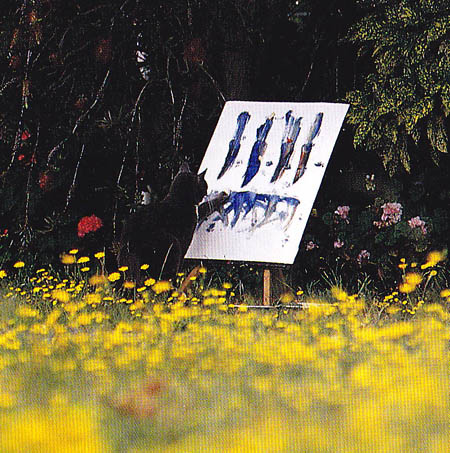

 peej
peej Carissa
 bostonboomer
 dakinikat
 ecocatwoman
 mablue2
 Mama Lopez
 peggysue22
 quixote
 skydancingguestblogger
 Mona (aka Wonk the Vote)



 Sky Dancing
Recent Comments