The likelihood of a criminal investigation and charges against Donald Trump are rising due to allegations by a House panel of a “criminal conspiracy” involving his aggressive drive to overturn the 2020 election results, coupled with a justice department (DoJ) inquiry of a “false electors” scheme Trump loyalists devised to block Joe Biden’s election.
Former federal prosecutors say evidence is mounting of criminal conduct by Trump that may yield charges against the ex- president for obstructing an official proceeding of Congress on 6 January or defrauding the US government, stemming from his weeks-long drive with top allies to thwart Biden’s election by pushing false claims of fraud.
A 2 March court filing by the House January 6 panel implicated Trump in a “criminal conspiracy” to block Congress from certifying Biden’s win, and Trump faces legal threats from justice department investigations under way into a “false electors” ploy, and seditious conspiracy charges filed against Oath Keepers who attacked the Capitol, say department veterans.
The filing by the House panel investigating the 6 January assault on the Capitol by a mob of pro-Trump supporters stated that it has “a good-faith basis for concluding that the president and members of his campaign engaged in a criminal conspiracy to defraud the United States”.
The panel’s hard-hitting findings about Trump’s criminal schemes were contained in a federal court filing involving top Trump lawyer John Eastman, who has fought on attorney client privilege grounds turning over a large cache of documents including emails sought by the committee.
Back in January, the deputy attorney general, Lisa Monaco, also revealed a criminal investigation was being launched into a far reaching scheme in seven states that Biden won which was reportedly overseen by Trump’s ex-lawyer Rudy Giuliani to replace legitimate electors with false ones pledged to Trump.
But the House panel’s blockbuster allegations that Trump broke laws to overturn the election have prompted some ex-prosecutors to call on the justice department to quickly accelerate its investigations to focus on the multiple avenues that Trump used to nullify the election results in tandem with top allies like Giuliani.
“The compelling evidence of criminal activity by Trump revealed by the committee in its recent 61-page court filing should spur DoJ to act expeditiously,” Paul Pelletier, a former acting chief of DoJ’s fraud section, told the Guardian.
“Given the gravity of the revelations, the department should consider a strike force or even a special counsel to coalesce sufficient resources to focus on these criminal attacks that strike at the heart of our democracy,” Pelletier added. “There is no time to waste now that the House committee has provided the clearest view yet into how Trump and his campaign apparently schemed to upend our democracy.”
The latest peek into questions around the money that might have helped fuel the attack arrived with the Republican National Committee suing to thwart a subpoena from the committee.
The filing reveals that the Democratic-led panel quietly subpoenaed an RNC vendor, San Francisco-based Salesforce, last month.
After the suit became public, the committee quickly defended the effort, saying it was looking into a new push led by former President Trump asking for donations after he lost his 2020 bid for re-election.
“Ever since Watergate, one of the central adages in… congressional investigations of presidential wrongdoing has been follow the money,” said Norm Eisen, a former House lawyer in Trump’s first impeachment case. “The 1/6 committee investigation has been sweeping in all of its dimensions, and this is no exception.”
The committee’s Feb. 23 subpoena of Salesforce emphasized its interest in the company’s hosting of Trump emails asking for new donations that included false claims of election fraud.
It’s part of a central question the panel hopes to answer: Did Trump find new ways to keep the money coming in after his loss by shifting from a presidential campaign to a “Stop the Steal” effort?
“I think the level of grift that was involved with the Trump campaign and people close to the former president, how the January Six efforts were for many of them, this is what they were doing to make money,” said California Democratic Rep. Pete Aguilar, a member of the Jan. 6 panel. “We are looking into that.”
The committee’s investigators are broken down into highly skilled teams with core areas of focus, including one that’s on the money.
Aguilar says each team has been making “significant progress,” with regular presentations to the full committee on its findings. Each has been charged with devising a strategy for depositions and hearings.
“The committee has not tipped its hand of everything they have,” Eisen said. “They dedicated significant resources to the money trails. And I’m certain that in the hearings and in the final report, there’s going to be much more evidence revealed.”
This spring, the committee hopes to hold its first hearings illustrating the findings so far and issue an interim report by the summer with a final report this fall.
Spring Has Come, Victor Zaretsky, 1988
Let’s hope the arms of justice are getting ready to throttle the Trump Family Crime Syndicate. Lock him up!
What’s really making me see red these days is the relentless media chatter about inflation and how it will blow back on the Democratic Party come November. There really are a bunch of clueless people reporting on the economy. Every time I read one of these articles I scream. I usually admire Catherine Rampell but this headline is just clickbait: “Opinion: Americans are unhappy with the economy. Many on the left don’t want to hear it.” It’s on the Op-Ed page of The Washington Post.
I’ve spent hours this week being mansplained and dogmasplained things that are just are not true and the media is not helping by actually elucidating the situation. We had a demand shock, now the economy is growing gangbusters and that and a few other things that are market-oriented have created inflation. It’s not really anything you can nail on to the folks on the fiscal side of economic policy. This is the Fed’s bailiwick. It should cool down within 6 months but the Russian Invasion of Ukraine has created a lot of uncertainty. All bets are off on predictions of economic factors when they are based on history and theory and can’t predict the number of black swans we’ve had recently which include the invasion, Covid-19, and 4 years of an insane, criminal US President.
Inflation is spiking, and Democrats — who, rightly or wrongly,are poised to take the blame this November — appear to be in denial about it.
Consumer prices rose 7.9 percent in February from a year earlier, the Bureau of Labor Statistics reported Thursday. This was, yet again, the fastest pace of price growth in four decades. The increases were broad-based, affecting food, fuel, airfares, shelter, and more. Meanwhile, worker paychecks fell further behind, as overall inflation outpaced average wage growth.
These data were collected largely before the Russia-related run-up in global energy prices. Which suggests that next month’s overall inflation reading could be worse.
Given these trends, Americans are unhappy with the economy. But many on the left don’t wantto hear it.
In recent months, many Democrats and their allies have approached the (political) problem of inflation by either denying any serious issue exists; or acknowledging it exists but demagoguing about its cause.
Some lefty politicians and commentators have argued that inflation is not that big of a deal. Americans have been tricked into thinking things are bad mostly because the media (and/or Republicans) keeptelling them things are bad, this argument goes. Articles such as this one, drawing attention to inflation, are to blame.
I actually agree that much of the economic coverage has fallen short. For example: Contrary to recent headlines, gas prices aren’t really at all-time highs, at least not when adjusted for the changing value of the dollar. And there has been much more emphasis on soaring prices (bad news, boo) than on dwindling unemployment (good news, yay!).
Yet, it’s delusional to think that ordinary people wouldn’t care much about inflation if only the media stopped discussing it. People notice when they pay more for groceries, rent, gasoline, pet food, diapers. It is painful. It is unsettling. And inflation affects a broader swath of people than does a change in the unemployment rate, so more people are going to complain.
Corporate greed. The cancellation of an oil pipeline that didn’t yet exist. A secret plot to cancel Halloween.
Every time I think the inflation discourse can’t get dumber, I’m proven wrong.
To be fair: The forces behind inflation, like many economic problems, are complicated. Economists can’t fully explain what determines current pricing behavior and inflation expectations in the real world, much less precisely predict where prices will land in a few months. New waves in the pandemic aren’t helping, either.
Most inflation predictions that top forecasters made in the spring turned out to be much too low. Elite academic economists, when surveyed about the risks of prolonged inflation, candidly acknowledge a lot of uncertainty.
All of which means there’s a lot of room for reasonable error on this issue, even among experts. But lately partisan factions have concocted new, unreasonable sources of error, too. Some of this rhetoric has been impressively creative; it’s basically like inflation fan fiction.
We economists really don’t assign pejorative terms to the actions of economic agents but I can tell you, huge oligopolies are going to take advantage of the situation and get whatever they can out of it. Let’s look at this.
— Dr. Kat PhD. … not your kiddo, buddy🇺🇦🌻 (@Dakinikat) March 10, 2022
There are three factors driving oil prices right now. None can be controlled by a President. First, the bounceback in demand due to increased driving now that Covid-19 shutdowns have slowed down and people are going back to work and school. Second, the uncertainty around the Russian invasion of Ukraine since Russia is an OPEC member. Third, Oil companies are using the run-up to do what profit and bonus loving companies always can do when there are few producers (oligopoly) and no real ability for a government to regulate a world market.
There are lots of leases and permits out there for any US oil company to Drill Baby Drill. Biden has even increased their availability. They are not exercising them. They’re happy with the high prices coming back. Or, as Jen eloquently put it to Dumbo Doucy:
Psaki: What additional permits do they need? The leases are there. The permits are there. I don’t think they need an embroidered invitation to drill. That is their oil company. pic.twitter.com/xpWoJsPllv
I suppose I shouldn’t mention here that I think he’s just a sub looking for the right Dom but he asks these stupid questions over and over.
And look to my tweet for what they are doing which is exactly what the Trump tax cuts and the Bush tax cuts incented them to do. You make more money doing Wall Street tricks than you do when you actually do your business. Nowhere is this more true than any extraction business.
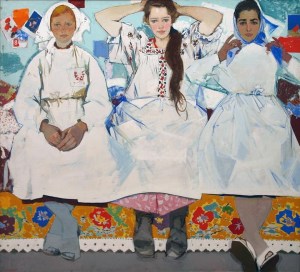
Girls Victor Ivanovich Zaretsky, 1962
From the Financial Times: “Big Oil on course for near-record $38bn in share buybacks. Seven majors set for supercharged stock purchasing on top of estimated $50bn of dividends” This is all going on while Biden is scrambling to find any OPEC member that will release the gushers and opening the country’s reserves. Read on and pay particular attention to what I highlighted.
Western energy majors are on course to buy back shares at near-record levels this year as soaring oil and gas prices enable them to deliver bumper profits and boost returns for investors. The seven supermajors — including BP, Shell, ExxonMobil and Chevron — are poised to return $38bn to shareholders through buyback programmes this year, according to data from Bernstein Research. Investment bank RBC Capital Markets put the total figure higher, at $41bn. That would be almost double the $21bn in buybacks completed in 2014 — when oil last traded above $100 a barrel — and the biggest total since 2008. The plans underscored the strength of companies that are reaping the rewards of a resurgence in energy demand as pandemic lockdown restrictions are rolled back. Gas prices are at record levels and oil is trading at a seven-year high of more than $90 a barrel, resulting in big profits for the supermajor group rounded out by TotalEnergies, Eni and Equinor.
Banks including Goldman Sachs expect Brent crude to trade at more than $100 this year, with some predicting that if Russia invades Ukraine it will trigger a sharper spike in energy costs.
Biraj Borkhataria at RBC Capital Markets said: “The sector is in the best shape it’s been in for a long time. Now the question is the duration of the cycle.” The underperformance of the companies’ shares during the pandemic meant that management teams felt their shares were undervalued and that buybacks were cheap, he added
Shell is set to lead the pack in 2022, buying back more than $12bn of its own shares, according to RBC and Bernstein. At least $8.5bn of those buybacks will be completed in the first half of the year, Shell said this month, including $5.5bn from the sale of its assets in the US Permian basin.
Chevron bought back shares worth $1.4bn in 2021 and has said it will spend $3bn to $5bn on buybacks this year.
If you were a CEO sitting on top of stock bonuses, etc what on earth would you do given “The sector is in the best shape it’s been in for a long time.” They’re rational actors after all. And wtf can President Biden do about any of this? The entire energy sector is in great shape. What incentives do they have to change?
So, that’s an explanation you can tell folks if you need to. The biggest thing that would bring prices down would be for Putin to stop his madness in Ukraine and the entire free world is working on that.
But, for some reason, Americans think they’re entitled to low gas prices and need large vehicles. They forget the last cycles that have been recurrent since the 70s which basically all point back to OPEC which is a cartel that colludes to keep prices high until someone cheats and it falls apart and prices go down. That’s economics 101 stuff. I know this because I was in Economics 101 when the first Opec oil embargo hit. I even had a chance to listen to a panel of top Economists talk about it and got brave enough to ask a question.
EU Commission President Ursula von der Leyen said on Friday that Ukraine is “part of the European family” and that a fourth package of sanctions for Russia is coming along with a plan to wean the EU off Russian fuel sources by 2027. US President Joe Biden also announced plans to revoke Russia’s “most favored nation” trade status and ban key Russian goods like seafood, vodka and diamonds. Meanwhile, explosions were reported on Friday in Lutsk, near the Polish border, in Dnipro, a major stronghold in central-eastern Ukraine, and in Ivano-Frankivsk, in the south-west, Ukrainian authorities say.
So long Beluga caviar and Stolichnaya Vodka rich Americans! Suck it up for Ukraine while the rest of us worry about gas and energy prices. And then there’s this piece of good news that sends me back to the research role in monetary and trade unions.
Ukraine’s membership application is an expression of their will and their right to choose their own destiny.
Today we have opened the pathway towards us for Ukraine.
Mara, Slavic goddess of winter’s end, by Margo Kai
Good Afternoon!!
Putin’s war on Ukraine continues unabated. Each day he commits more atrocities. It’s getting very difficult for me to understand the U.S. and NATO’s refusal to get more involved in the conflict. Obviously I’m no expert and I do think President Biden has handled this unmanageable situation very well. Every day I’m thankful that Trump is no longer in charge. But surely we can find a way to do more? After Russia’s deliberate bombing of a children’s and maternity hospital, don’t we have to consider further actions? As I said, I’m no expert, but today I’m going to post some articles that present some alternative views of the events in Ukraine.
Bombing a maternity hospital is an atrocity, by definition. The only possible reason for it happening might be that it was collateral damage, or accidentally perpetrated. But the Russians have another story.
The Russian foreign minister, Sergei Lavrov, told a press conference that the Russians deliberately targeted it – because it was not being used as a maternity unit at all, whatever the western journalists claim. Lavrov explained to a disbelieving world that, contrary to the pictures carried by responsible media outlets, this wasn’t a hospital but was in fact a military installation, taken over by the Ukrainian Azov Battalion and “other ultra-right”, “radical” groups.
Lavrov explained that the mothers had already been “driven out” by these extremists. Hence what Lavrov called the “pathetic outcries concerning so-called atrocities” and the biased media coverage. You may think that what you saw was a heavily pregnant woman being carried away on a stretcher, but the foreign minister of the Russian Federation is telling you that she’s a neo-Nazi renegade, or possibly an actor, or else a human shield (which is no justification for the attack anyway). Lavrov invites the world to draw its own conclusions.
That’s Russia’s side of the story, an atrocity against the truth itself, the ultimate in gaslighting. If you’re going to lie, I suppose you might as well go big. But the world has already drawn its conclusions about what it can see, not just in Mariupol but in many other places across Ukraine – just like the previous atrocities and war crimes committed by Russians and Russian stooges in Syria, Georgia and Chechnya.
Still Life with Cups, by Lena Vylusk, 2018
O’Grady argues that the U.S. has appeased Putin going back to Obama’s failure to defend his “red line” in Syria and Trump’s disgraceful defense of Putin in Helsinki.
Biden and every western European power gave Putin due notice that they would not fight for Ukraine, and wouldn’t do much more than slap the usual token sanctions on him. They let him have Crimea with not much more than some modest barriers to trade with Russia and some eloquent indignation from Obama.
What was Putin supposed to think about the west after a decade and a half of empty threats? He prodded his bayonet at us and never found the hard steel of a credible military response. What would the west really do if he invaded Ukraine?
What indeed. Not even the atrocity in Mariupol will provoke western intervention. Not even a single rattly old MiG jet will be lent to the Ukrainians so they can defend their citizens against the next atrocity.
So, because of that, there will certainly be more atrocities. There is disturbing talk about the use of chemical weapons – the red line that Obama laid down in Syria and then forgot about. Maybe they’ll go for battlefield nuclear weapons next, or organise a surrogate Russian militia to plant a dirty bomb in Maidan Square. Whatever happens, Putin may be sure that he will face no retaliation and no direct military action.
Let’s step back for a moment from the awful human tragedy in Ukraine as the Russian army targets civilians. There is an even bigger issue here. And until we come up with an answer it’s going to continue to plague the world.
It’s an issue that Americans, more than anyone else, should understand. Yet based on all the news and commentary I’ve been reading since the Russian buildup began almost a year ago, this overarching issue is not even on the table.
The bigger issue is that there is no way to stop a nuclear power from invading a non-nuclear power, as America did 18 years ago this month when it took down the dictatorship in Iraq.
Three years ago I spent a week in Ukraine. Every person to whom I spoke, whether in a formal interview or casual conversation, said that Putin was going to invade their country.
Putin, whose words I have carefully read for two decades, doesn’t plan to stop with Ukraine. He has called the collapse of the old Soviet Union the worst geopolitical disaster of the 20th century and has said he is determined to put it back together. His words:
“Above all, we should acknowledge that the collapse of the Soviet Union was a major geopolitical disaster of the century. As for the Russian nation, it became a genuine drama. Tens of millions of our co-citizens and co-patriots found themselves outside Russian territory.
“Moreover, the epidemic of disintegration infected Russia itself.”
As I said, this is a long read, and I can’t give you the full flavor with brief excerpts. I’ll just add that Johnston writes that the same fear of invasion by Russia is common in Estonia, Latvia and Lithuania as well. If you’re interested in what’s happening in Ukraine, I recommend reading the whole thing.
The clear issue at the center of the war in Ukraine is Russia’s unprovoked invasion and intended occupation of a sovereign nation. This crude reality explains the world’s united opposition to Vladimir Putin’s invasion.
Citizens in free countries everywhere recognize that if Russia wins, a principle of invasion and occupation that World War II was fought to reverse will be re-established. Plausibly, a strategy of unprovoked invasion and occupation will be repeated by China against Taiwan, North Korea against South Korea and Iran against Israel or its neighbors in the Middle East.
It is conventional wisdom that if Mr. Putin takes Ukraine, eventually he will similarly pressure the Baltic states or Poland. Sweden and Finland already operate civilian-based defense plans on this assumption.
Forest Fairy, by Ivan Marchuk
But while the world’s people recognize this invasion can’t stand, they don’t know how to stop it.
The North Atlantic Treaty Organization has rejected the no-fly zone requested by Ukrainian President Volodymyr Zelensky as likely to start a war between nuclear-armed Russia and the West. The effectiveness of sanctions on Russian oil is uncertain.
The West’s policy of mounting a stand-off defense of Ukraine likely means we are rolling toward a world in which invasion and occupation become normalized, bringing a succession of trips to the nuclear brink with China, North Korea and surely Iran.
Henninger’s recommendation:
At the end of World War II, Germany was divided into zones of occupation by the victorious armies. Though the capital of Berlin was in the Soviet-occupied east, the Western allies refused to let Berlin be absorbed into Stalin’s communist bloc. Berlin was divided into sectors, with West Berlin protected by the U.S., Britain and France, and East Berlin by the Russians….
Just as the three major Allied powers occupied the western sector of Berlin then, NATO—which was created during the Berlin blockade—should assert and establish control in western Ukraine of Lviv, its airport, the perimeter, and transport connections to nearby NATO members Poland, Slovakia, Hungary and Romania.
As long as Lviv remains free, Mr. Putin will never “occupy” Ukraine. A free Lviv would stand as a counter-symbol to Russian invasion and occupation.
Read the rest at the link. The WSJ has opened it’s Ukraine coverage to everyone.
A Silicon Valley employee and her children are the subjects of photos so devastating that they shocked the world: a Ukrainian family lying dead on the pavement, killed by Russian mortar fire while trying to flee the conflict.
Oleksandr Balbyshev, Flower Face
The images of Ukrainian soldiers tending to the bloodied bodies of a woman, her teenage son and young daughter, and their friend ran on the front page of the New York Times this week, along with online videos of the unprovoked attack on civilians. They stirred international outrage and a pledge from Ukrainian President Volodymyr Zelenskyy to punish the perpetrators. “There will be no quiet place on Earth for you,” Zelenskyy said. “Except for the grave.”
Palo Alto startup SE Ranking confirmed Wednesday that the photo depicts its chief accountant, Tatiana Perebeinis, 43, along with her daughter, Alise, 9, and son, Nikita, 18, who were killed by Russian forces as they tried to flee the town of Irpin, a suburb about 15 minutes from Kyiv. They had just dashed across a partially destroyed bridge over the Irpin River into Kyiv when a mortar hit.
“For me as her colleague it’s a tragedy to see those pictures,” Ksenia Khirvonina, the company’s spokeswoman, told The Chronicle. “They show that it’s real. On the other hand, they prove that (the) Russian army and Putin himself are monsters who deserve no mercy for their doings.”
On his first anniversary as attorney general, Merrick Garland said he’s committed to unraveling the conspiracy behind the storming of the U.S. Capitol, in what he calls “the most urgent investigation in the history of the Justice Department.”
Members of the House committee investigating the Jan. 6 riot have asserted former President Trump could be charged with conspiracy and obstruction for his actions. But Democrats in Congress and even some of Garland’s friends have worried he’ll shy away from the political firestorm that would result from charging a former commander-in-chief with a crime.
“We are not avoiding cases that are political or cases that are controversial or sensitive,” the attorney general said in an exclusive interview with NPR. “What we are avoiding is making decisions on a political basis, on a partisan basis.”
Victor Onyshchenko, Autumn in Synevar Glade
This week, prosecutors won their first convictions in federal court in a Jan. 6 case against former Texas oil worker Guy Reffitt. That followed a guilty plea to seditious conspiracy by an Alabama man affiliated with the far-right Oath Keepers militia.
“We begin with the cases that are right in front of us with the overt actions and then we build from there,” Garland said. “And that is a process that we will continue to build until we hold everyone accountable who committed criminal acts with respect to January 6.”
Garland discussed his wide remit, where the priorities range from price-fixing in the chicken industry to Russian oligarchs financing the war in Ukraine with ill-gotten gains.
Listen to the interview or read highlights at the NPR link.
The war in Ukraine continues to be the top story in the news, but there are plenty of other things happening, so I hope you’ll forgive me if also I highlight non-Ukraine stories today.
Russia/Ukraine News
Major General Vitaliy Gerasimov, the chief of staff with Russia’s 41st Combined Arms Army, has been eliminated by Ukraine's military intelligence operators. I still don’t get it what Russians are hoping for in this war. pic.twitter.com/LBWPYpAFMN
— Illia Ponomarenko 🇺🇦 (@IAPonomarenko) March 7, 2022
CONSTANTA, Romania — When it comes to war, generals say that “mass matters.”
But nearly two weeks into President Vladimir V. Putin’s invasion of Ukraine — Europe’s largest land war since 1945 — the image of a Russian military as one that other countries should fear, let alone emulate, has been shattered.
Ukraine’s military, which is dwarfed by the Russian force in most ways, has somehow managed to stymie its opponent. Ukrainian soldiers have killed more than 3,000 Russian troops, according to conservative estimates by American officials.
Ukraine has shot down military transport planes carrying Russian paratroopers, downed helicopters and blown holes in Russia’s convoys using American anti-tank missiles and armed drones supplied by Turkey, these officials said, citing confidential U.S. intelligence assessments.
The Russian soldiers have been plagued by poor morale as well as fuel and food shortages. Some troops have crossed the border with MREs (meals ready to eat) that expired in 2002, U.S. and other Western officials said, and others have surrendered and sabotaged their own vehicles to avoid fighting.
To be sure, most military experts say that Russia will eventually subdue Ukraine’s army. Russia’s military, at 900,000 active duty troops and two million reservists, is eight times the size of Ukraine’s. Russia has advanced fighter planes, a formidable navy and marines capable of multiple amphibious landings, as they proved early in the invasion when they launched from the Black Sea and headed toward the city of Mariupol.
And the Western governments that have spoken openly about Russia’s military failings are eager to spread the word to help damage Russian morale and bolster the Ukrainians.
But with each day that Ukrainian President Volodymyr Zelensky holds out, the scenes of a frustrated Russia pounding, but not managing to finish off, a smaller opponent dominate screens around the world.
The result: Militaries in Europe that once feared Russia say they are not as intimidated by Russian ground forces as they were in the past.
Read all about it at the NYT.
Morgan Stanley projects a Russian default by mid-April.
Putin rose to power on the economic rubble of the 1998 default and promised to bring stability and prosperity to the Russian people. He's traded it away…for what?https://t.co/Ggdc5erIqh
The odds of Russia making its foreign debt payments are diminishing as bond prices fall, recession in the nation looms and various payment restrictions pile up after the invasion of Ukraine, according to Morgan Stanley & Co.
“We see a default as the most likely scenario,” Simon Waever, the firm’s global head of emerging-market sovereign credit strategy, wrote in a Monday note. “In case of default, it is unlikely to be like a normal one, with Venezuela instead perhaps the most relevant comparison.”
The default may come as soon as April 15, which will mark the end of a 30-day grace period on coupon payments the Russian government owes on dollar bonds due in 2023 and 2043, he said.
Indicative pricing show investors value the 2023 bonds at around 29 cents on the U.S. dollar, the lowest ever, according to data collected by Bloomberg, though there appears to have been no trades at that level. In the days before Russia invaded Ukraine last month, the debt was trading above par.
While it is rare for sovereign debt to tumble to the single digits, Morgan Stanley said Russia’s bonds “could get close.” Lebanon and Venezuela are the only recent examples of a country’s debt slipping so low…..
JPMorgan Chase & Co. said on Monday it will remove Russian bonds from all of its widely-tracked indexes, further isolating the nation’s assets from global investors. Venezuela’s dollar bonds were also removed from the bank’s benchmark indexes in 2019 after sanctions curbed trading.
– Analysts are projecting Russia’s GDP to drop at least 11% due to sanctions. – The ruble has plunged to a record low against the dollar. – Russian stocks are nearly worthless. – Russia may default on its debt payments.
The united states reported more deaths from COVID-19 last Friday than deaths from Hurricane Katrina, more on any two recent weekdays than deaths during the 9/11 terrorist attacks, more last month than deaths from flu in a bad season, and more in two years than deaths from HIV during the four decades of the AIDS epidemic. At least 953,000 Americans have died from COVID, and the true toll is likely even higher because many deathswent uncounted. COVID is now the third leading cause of death in the U.S., after only heart disease and cancer, which are both catchall terms for many distinct diseases. The sheer scale of the tragedy strains the moral imagination. On May 24, 2020, as the United States passed 100,000 recorded deaths, TheNew York Timesfilled its front page with the names of the dead, describing their loss as “incalculable.” Now the nation hurtles toward a milestone of 1 million. What is 10 times incalculable?
Many countries have been pummeled by the coronavirus, but few have fared as poorly as the U.S. Its death rate surpassed that of any other large, wealthy nation—especially during the recent Omicron surge. The Biden administration placed all its bets on a vaccine-focused strategy, rather than the multilayered protections that many experts called for, even as America lagged behind other wealthy countries in vaccinating (and boosting) its citizens—especially elderly people, who are most vulnerable to the virus. In a study of 29 high-income countries, the U.S. experienced the largest decline in life expectancy in 2020 and, unlike much of Europe, did not bounce back in 2021. It was also the only country whose lowered life span was driven mainly by deaths among people under 60. Dying from COVID robbed each American of, on average, nine years of life at the lowest end of estimates and 17 at the highest. As a whole, U.S. life expectancy fell by two years—the largest such decline in almost a century. Neither World War II nor any of the flu pandemics that followed it dented American longevity so badly.
Every American who died of COVID left an average of nine close relatives bereaved. Roughly 9 million people—3 percent of the population—now have a permanent hole in their world that was once filled by a parent, child, sibling, spouse, or grandparent. An estimated 149,000 children have lost a parent or caregiver. Many people were denied the familiar rituals of mourning—bedside goodbyes, in-person funerals. Others are grieving raw and recent losses, their grief trampled amid the stampede toward normal. “I’ve known multiple people who didn’t get to bury their parents or be with their families, and now are expected to go back to the grind of work,” says Steven Thrasher, a journalist and the author of The Viral Underclass, which looks at the interplay between inequalities and infectious diseases. “We’re not giving people the space individually or societally to mourn this huge thing that’s happened.
The Senate on Monday unanimously passed legislation that would make lynching a federal hate crime, in a historic first that comes after more than a century of failed efforts to pass such a measure.
The Emmett Till Antilynching Act, which was introduced by Rep. Bobby L. Rush (D-Ill.) in the House and Sens. Cory Booker (D-N.J.) and Tim Scott (R-S.C.) in the Senate, now goes to President Biden for his signature.
Booker said in a tweet Monday night that he was “overjoyed” by the legislation’s passage.
“The time is past due to reckon with this dark chapter in our history and I’m proud of the bipartisan support to pass this important piece of legislation,” he said.
In a statement, Rush called lynching “a long-standing and uniquely American weapon of racial terror that has for decades been used to maintain the white hierarchy.”
“Perpetrators of lynching got away with murder time and time again — in most cases, they were never even brought to trial. … Today, we correct this historic and abhorrent injustice,” he said.
The legislation would amend the U.S. Code to designate lynching a hate crime punishable by up to 30 years in prison. More than 4,000 people, mostly African Americans, were reported lynched in the United States from 1882 to 1968, in all but a handful of states. Ninety-nine percent of perpetrators escaped state or local punishment, according to Rush’s office.
The Supreme Court Just Came Perilously Close to Blowing Up Federal Elections | By Mark Joseph Stern https://t.co/9A5Z7Mb1xg
The Supreme Court will not overturn a century of pro-democracy precedent and two centuries of historical practice to give state legislatures unlimited power over elections—yet.
That’s the upshot of the court’s orders on Monday in two huge redistricting cases out of Pennsylvania and North Carolina. The court refused to block new congressional maps drawn by the high court of each state, declining—for now—to embrace a radical theory rejecting state courts’ authority over election law. In the process, however, four justices did endorse this theory, and three attempted to blow up North Carolina’s upcoming election in a dissent with terrifying implications for democracy. The court stepped back from the abyss, but the ensuing reprieve may not last for long.
Both of Monday’s orders involve this year’s redrawing of congressional maps. In Pennsylvania, the Republican-controlled legislature drew a GOP gerrymander, which the Democratic governor vetoed. Because of this impasse, the Pennsylvania Supreme Court stepped in to draw new, fairer districts. In North Carolina, the Republican-controlled legislature drew a GOP gerrymander, which the Democratic governor could not veto under state law. Voters challenged the map under the state constitution, and in February, the state Supreme Court struck it down. The legislature drew a new map, which a trial court rejected and replaced with its own, fairer version.
Republicans appealed both court-draw maps to SCOTUS. They claimed that these plans violated the U.S. Constitution’s elections clause, which says that the “manner” of federal elections “shall be prescribed” by the “legislature.” For at least a century, SCOTUS has read this language to give other organs of state government a say in election law. But conservative scholars have devised a theory known as the “independent state legislature doctrine” that would give legislatures complete control over elections, including voting rules and redistricting. Under this theory, state constitutional provisions governing elections would be null and void, and state courts would have no power to intervene in election disputes. The legislature alone would set the rules—and, in extreme versions of the theory, even dictate the outcome of an election.
The Supreme Court has never endorsed this doctrine, and has explicitly rejected it as recently as 2015. There is a good reason why: It contradicts the original meaning of the elections clause as well as historical practice reaching back to the early days of the republic. A mountain of evidence proves that framers never intended to give states lone authority over federal elections, and instead expected state constitutions to impose substantive limits on election law. Exhaustive research demonstrates that—aside from a few opportunistic arguments raised by congressional partisans in the 19th century—state legislatures, state courts, federal courts, and Congress have all rejected the doctrine for more than two centuries.
And yet, for nearly two decades, the conservative legal movement, working alongside Republican politicians, has pushed relentlessly to enshrine this theory into law.
The invasive 3-inch Joro spider is resilient to cold, had a population boom last year, stow away readily, and could soon dominate the Eastern Seaboard. https://t.co/bGkuhMntqF via @sciam
New research, published Feb. 17 in the journal Physiological Entomology, suggests that the palm-sized Joro spider, which swarmed North Georgia by the millions last September, has a special resilience to the cold.
This has led scientists to suggest that the 3-inch (7.6 centimeters) bright-yellow-striped spiders — whose hatchlings disperse by fashioning web parachutes to fly as far as 100 miles (161 kilometers) — could soon dominate the Eastern Seaboard.
“People should try to learn to live with them,” lead author Andy Davis, a research scientist at the University of Georgia, said in a statement. “If they‘re literally in your way, I can see taking a web down and moving them to the side, but they‘re just going to be back next year.”
Since the spider hitchhiked its way to the northeast of Atlanta, Georgia, inside a shipping container in 2014, its numbers and range have expanded steadily across Georgia, culminating in an astonishing population boom last year that saw millions of the arachnids drape porches, power lines, mailboxes and vegetable patches across more than 25 state counties with webs as thick as 10 feet (3 meters) deep, Live Science previously reported.
Common to China, Taiwan, Japan and Korea, the Joro spider is part of a group of spiders known as “orb weavers” because of their highly symmetrical, circular webs. The spider gets its name from Jorōgumo, a Japanese spirit, or Yōkai, that is said to disguise itself as a beautiful woman to prey upon gullible men.
True to its mythical reputation, the Joro spider is stunning to look at, with a large, round, jet-black body cut across with bright yellow stripes, and flecked on its underside with intense red markings. But despite its threatening appearance and its fearsome standing in folklore, the Joro spider‘s bite is rarely strong enough to break through the skin, and its venom poses no threat to humans, dogs or cats unless they are allergic.
Well, that’s a relief. Read more at Scientific American.
That’s a sampling of today’s news. Have a nice Tuesday, Sky Dancers!
Did you like this post? Please share it with your friends:
I feel as though I’ve become addicted to War Porn. I usually do not watch TV at all over the weekend but I couldn’t help but check the news. I spent yesterday talking to Alex several times asking about his 8-year-old daughter who is now with her mother in a town near Moldova with papers and passports ready should they need to cross the border. The schools are gone so she is learning English online. His elderly mother refuses to leave and is determined to fight. He’s ready to defend his country on whatever level he can. We get interrupted a few times as he tells me and our other friends from all over the world with similar concerns that the sirens have gone off again. Yesterday, he says, the Russians took out their airport and schools. I haven’t heard from a friend in Hungary all weekend. Refugees are fleeing What next?
I think what next is the question of this decade. Yesterday, as I watched Russian artillary kill a young mother and her two small children while their dog screamed out I was stunned and out of it for hours. The NYT photojournalist Lynsey Addario’s “security advisor (e.g. mercenary) runs and screams medic for a helpful family friend who still had a heart beat while the children and mother lie in the street pale and lifeless. I can’t imagine ever forgetting that image.
These are war crimes, captured as they occur on TV. They are not the grainy black and white film we have as Holocaust survivors appear after being liberated by US and allied troops years but we see these years after the crimes themselves. It’s not the film of Soviet Tanks running over Czechlosavkia, Hungary, or Poland in short snippets during the 6 p.m. news carefully scripted and edited by news editors. This is real-time and we continue to see it. There was the slaughter of the Kurds at the hands of the Turks as Donald Trump abandons them. The flood of refugees trying to flee Afghanistan with their Taliban overlords ready to blow them up. The flattening impact of Russian bombs during the attack on Aleppo. Our shock and awe attack on Baghdad instigated by Cheney and Bush. Over and over we see these things. We see reporters lining up to get their wartime credentials but this time I sense Ukraine has made them shell-shocked early and less enwrapt in the image.
Spies in Russia’s infamous security apparatus were kept in the dark about President Putin’s plan to invade Ukraine, according to a whistleblower who described the war as a “total failure” that could be compared only to the collapse of Nazi Germany.
A report thought to be by an analyst in the FSB, the successor agency to the KGB, said that the Russian dead could already number 10,000. The Russian defence ministry has acknowledged the deaths of only 498 of its soldiers in Ukraine.
The report said the FSB was being blamed for the failure of the invasion but had been given no warning of it and was unprepared to deal with the effects of crippling sanctions.
The whistleblower added that no one in the government knew the true figure of the dead because “we have lost contact with major divisions”.
FSB officers had been ordered to assess the effects of western sanctions, they said, but were told that it was a hypothetical box-ticking exercise. “You have to write the analysis in a way that makes Russia the victor . . . otherwise you get questioned for not doing good work,” they wrote. “Suddenly it happens and everything comes down to your completely groundless analysis.
“[We are] acting intuitively, on emotion . . . our stakes will have to be raised ever higher with the hope that suddenly something might come through for us.
“By and large, though, Russia has no way out. There are no options for a possible victory, only defeat.”
The letter said that Ramzan Kadyrov, the Chechen leader and an ally of Putin, was on the verge of outright conflict with the Russians after his “hit squad”, sent to kill President Zelensky, was destroyed by Ukrainian forces.
Even if Zelensky were killed, the report said, Russia would have no hope of occupying Ukraine. “Even with minimum resistance from the Ukrainians we’d need over 500,000 people, not including supply and logistics workers.”
Well, that doesn’t sound good does it?
How can I save my little boy from Oppenheimer’s deadly toy? There is no monopoly on common sense On either side of the political fence We share the same biology, regardless of ideology Believe me when I say to you I hope the Russians love their children too
Viktor Zaretsky, The night arrest, 1962. Ukrainian Unofficial.
Secretary of State Antony Blinken on Monday said NATO is looking at more permanent troop deployments in the Baltic region as Russia continues its invasion of Ukraine.
Asked if the U.S. will send troops to the Baltic region permanently to protect NATO countries, Blinken told reporters that the alliance is “looking at questions of more permanent deployments.”
“We’re continuously reviewing within NATO our defense posture, including looking at questions of extending the deployment of forces, looking at questions of more permanent deployments,” Blinken said during a joint press conference with Lithuanian Foreign Minister Gabrielius Landsbergis in Lithuania.
“All of that is under regular review, and we’re engaged with NATO Allies in doing just that,” he added.
The secretary emphasized that “When it comes to NATO, the line is very clear,” pointing to article five of the North Atlantic Treaty.
“If there is any aggression anywhere on NATO territory, on NATO countries, we the United States, all of our allies and partners, will take action to defend every inch of NATO territory,” Blinken said. “It’s as clear and direct as that.”
It’s good they’re still trying to talk but so far the Russians can’t even deliver safe corridors for the women, children, and elderly fleeing the war zones.
Ukrainian officials say Russia’s proposal to open "humanitarian corridors" for cities in Ukraine is not a genuine offer because it offers to evacuate civilians only to Belarus and Russia. https://t.co/kGwuG9EPmYpic.twitter.com/KOp7QOBPFL
I had a friend here in New Orleans who now refers to looking for updates on Ukrainia as “doom-scrolling”. That seems an apt description. However, this has me thinking about little 8-year-old Vera with her mother. From The Washington Post by Chico Harlan: “After Putin’s invasion of Ukraine, Moldova worries it might be next”. Moldova maintains permanent neutrality per its constitution.
There have been no air raid sirens in Moldova, no explosions and no casualties, but already some of the turbulence and anxiety of war is starting to build.
People trade jittery messages on social media as Russian troops move through neighboring Ukraine. Some Moldovans are stockpiling foreign currency and drawing up plans to flee. Many, seeing how abruptly lives collapsed in Ukraine, say they fear the potential for catastrophe in their own country: All it takes is for Russian President Vladimir Putin to expand his ambitions.
“You never know what is in the mind of a crazy person,” said Evgheni Liuft, 32, who lives in Moldova’s capital of Chisinau.
Ten days into a conflict that is shifting alliances and upending the world order, the repercussions are hitting most directly in countries such as Moldova — post-Soviet nations that balanced for years between East and West, and are now realizing the middle ground is untenable.
In Moldova, the war has accelerated the drive to align fully with Europe. On Thursday, the country signed an application to join the European Union, in what its prime minister described as a vote for “freedom.” Moldova has also strained to accommodate more than 250,000 Ukrainian refugees who have crossed its borders, the prime minister noted. In a visit Sunday to Moldova’s capital, U.S. Secretary of State Antony Blinken called the country a “powerful” example of a democracy moving forward, not backward.
Irina Karkabi
Despite calls for a no-fly zone over Ukraine Airspace, people in the know say it’s ” War with Russia by Another Name”. This is from Crisis Group: Some current and former officials, including Ukrainian President Volodymyr Zelenskyy, call for Western powers to establish a no-fly zone over Ukraine. This Q&A explains what a no-fly zone would entail, where similar zones have been established before and the dangers of that option in Ukraine.
Those advocating for a no-fly zone over Ukraine have not clarified the precise contours of such a military operation, including whether it would be limited to excluding Russian aircraft from Ukrainian airspace or, as occurred in Libya with different actors, also entail attacks against Russian ground forces. In any event, a no-fly zone would likely require not merely the threat of the use of force, but actual U.S. and/or allied attacks on Russian forces. To be very clear, a U.S. no-fly zone over Ukraine would necessitate a direct military confrontation with Russia, and as noted above, President Putin has said he would regard this as bringing the U.S. into the conflict.
Yevgenia Albats, who serves as editor-in-chief of the independent The New Times magazine, says Russian President Vladimir Putin “wants to have the kind of international order that Stalin agreed to have with Roosevelt and Churchill,” at the end of World War II.
“That’s what he wants, he wants to think himself as a nowadays Stalin.”
Albats says she believes Putin decided to invade Ukraine months ago, “when he realised that he was unable to force the West to provide him with the kind of world – international arrangements – that he wanted, that is to say that he wanted to divide the world into spheres of influence and assign Russia all the former Soviet Republics … he decided to start the war”.
On UpFront, Yevgenia Albats, a journalist and author; Stefanie Babst, the former deputy assistant secretary-general of NATO; and Agnia Grigas, an author and Atlantic Council senior fellow, join Marc Lamont Hill for a roundtable discussion looking at Putin’s possible reasons for launching the invasion of Ukraine and the likely consequences of his war – not just for Ukrainians, but for Russian citizens as well.
Well, this is another mess you’ve gotten us into Vlad the Mad Bomber! I’m going to read something and quit doom-scrolling for a while. The artists featured are all Ukrainian.
What’s on your reading and blogging list!?
Did you like this post? Please share it with your friends:
We all know that Fox “News” has seemingly brainwashed many Americans into believing things that simply aren’t true, like Trump’s claims that he actually won the presidential election in 2020. But Russian media is even worse than Fox, and most Russians don’t have alternate news sources readily available. The Russian government is lying to it’s people about what is happening in Ukraine, and many Russians completely buy into the false narratives.
Oleksandra and her four rescue dogs have been sheltering in the bathroom of her flat in Kharkiv since the shelling began.
“When I heard the first explosions, I ran out of the house to get my dogs from their enclosures outside. People were panicking, abandoning their cars. I was so scared,” she says.
The 25-year-old has been speaking regularly to her mother, who lives in Moscow. But in these conversations, and even after sending videos from her heavily bombarded hometown, Oleksandra is unable to convince her mother about the danger she is in.
“I didn’t want to scare my parents, but I started telling them directly that civilians and children are dying,” she says.
Painting by Francine Van Hove
“But even though they worry about me, they still say it probably happens only by accident, that the Russian army would never target civilians. That it’s Ukrainians who’re killing their own people.”
It’s common for Ukrainians to have family across the border in Russia. But for some, like Oleksandra, their Russian relatives have a contrasting understanding of the conflict. She believes it’s down to the stories they are told by the tightly-controlled Russian media.
Oleksandra says her mother just repeats the narratives of what she hears on Russian state TV channels.
“It really scared me when my mum exactly quoted Russian TV. They are just brainwashing people. And people trust them,” says Oleksandra.
“My parents understand that some military action is happening here. But they say: ‘Russians came to liberate you. They won’t ruin anything, they won’t touch you. They’re only targeting military bases’.”
A majority of Russians get their news from broadcast television, which is fully controlled by the state. “This is largely a country of older people and poor people,” Lev Gudkov told me. Gudkov is the director of the Levada Center, which was once Russia’s leading public-opinion-research organization and which the state has now branded a “foreign agent.” There are more Russians over the age of forty-five than there are between the ages of fifteen and forty-four. Even those who get their news online are still unlikely to encounter a narrative that differs from what broadcast television offers. The state continues to ratchet up
pressure on the few surviving independent media outlets, blocking access to their Web sites, requiring them to preface their content with a disclaimer that it was created by a “foreign agent,” and, ultimately, forcing them to close. On Thursday, the radio station Echo of Moscow and the Web-based television channel TV Rain, both of which had had their sites blocked earlier in the week, decided to stop operations. What the vast majority of Russians see, Gudkov said, are “lies and hatred on a fantastical scale.”
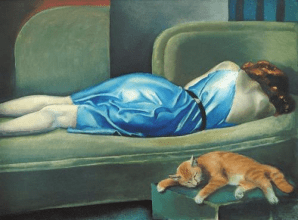
Woman and Cat by Lucian Bernhard
State television varies little, aesthetically and narratively, from channel to channel. Aside from President Vladimir Putin interrupting regular programming in the early hours of February 24th to announce a “special military operation” in Ukraine, the picture has changed little since before the war. There is no ongoing live coverage, no acknowledgment that what’s happening is extraordinary, even as Russian bombs fall on Ukraine’s residential areas and the Russian economy enters a tailspin. The news lineup, too, changes little day to day. On Thursday, the 7 a.m. newscast on Channel One lasted six minutes and contained six stories: a new round of Russian-Ukrainian peace talks in which Russia was eager to seek “common ground”; the “shelling of the Donetsk People’s Republic by the Ukrainian armed forces,” from which “twenty-five civilians have died.” A segue: “And now let’s look at footage from the Chernigov region, an area that is now controlled by the Russian armed forces. . . . Civilians continue driving around on their regular business.” (There were no civilians in the footage shown, only an endless sequence of armored vehicles.) Then: “Russia has prepared more than ten and a half thousand tons of humanitarian aid for the people of Ukraine”; “The West is pumping Ukraine full of offensive weapons”; “Aeroflot is organizing charter flights to return Russian citizens stranded in Europe.” Then the young male host announced, “The next scheduled program is ‘Good Morning.’ ” There was no mention of Kharkiv or Kyiv, which had been bombed the day before. Most remarkably, there was no mention of Russian military casualties, even though on Wednesday the defense ministry had acknowledged four hundred and ninety-eight deaths. (Ukraine has put Russian military losses at more than ten times that number.) The government has banned the use of the words “war,” “aggression,” and “invasion” to describe its “special military operation” in Ukraine. Media outlets that violate these bans face fines and closure. On Friday, the upper chamber of parliament passed a bill making the dissemination of “false information” about the conflict punishable by up to fifteen years in prison. The bill was responsible for TV Rain deciding to stop broadcasting on YouTube: the risks of calling things what they are have become too high—and the cost of trying to walk a fine line, as TV Rain had been doing, was morally unsustainable. Novaya Gazeta, the newspaper edited by Dmitry Muratov, a winner of the Nobel Peace Prize, took a vote among people it calls its “co-conspirators”—those who support the paper through private donations. Sixty-four hundred and twenty people have voted; about ninety-four per cent of them asked the paper to submit to the censorship requirements and continue publishing.
Several Western media organizations moved on Friday to suspend their journalistic operations in Russia in the wake of a harsh new crackdown on news and free speech by President Vladimir V. Putin’s government.
Bloomberg News and the BBC said their correspondents in Russia could no longer freely report because of the new censorship law signed by Mr. Putin on Friday, which effectively criminalized independent journalism on the invasion of Ukraine. Under the legislation, which could take effect as early as Saturday, journalists who simply describe the war as a “war” could be sentenced to prison.
Cat Nap, by Donna Hillman-Walsh
“The change to the criminal code, which seems designed to turn any independent reporter into a criminal purely by association, makes it impossible to continue any semblance of normal journalism inside the country,” Bloomberg’s editor in chief, John Micklethwait, wrote in a note to staff.
CNN International, the global arm of CNN, said it had stopped airing in Russia, and ABC News said that it would not broadcast from the country on Friday. “We will continue to assess the situation and determine what this means for the safety of our teams on the ground,” ABC News, which is based in New York, said in a statement.
News organizations are not necessarily asking their correspondents to leave Russia, at least not yet.
“We are not pulling out BBC News journalists from Moscow,” Jonathan Munro, the interim director of BBC News, wrote on Twitter. “We cannot use their reporting for the time being but they remain valued members of our teams and we hope to get them back on our output as soon as possible.”
Ivan Kolpakov, editor in chief of Meduza, one of Russia’s most popular independent media outlets, had been expecting the government to block the public’s access to his website every day since the war with Ukraine began.
On Friday morning it finally happened. But then Russia’s parliament went further, passing a law banning what it considers “fake” news about the military, including any rhetoric that calls the invasion of Ukraine an “invasion” — the preferred language is “special military operation” — with a potential 15-year prison sentence. Putin signed it into law hours later.
By Francine Van Hove
“Our sources say they are likely to use this against journalists,” said Kolpakov, speaking from a location he would not disclose. “They can use it against journalists, and why wouldn’t they? They decided to destroy the industry entirely.”
Kolpakov, whose website is based in Latvia, began what he called “an urgent evacuation” of his Russian staff.
Similar scenarios are playing out at countless independent media outlets across Russia, a nation that has never had a fully welcoming attitude toward a free press.
While several Western news organizations say they have temporarily curtailed their activities in Russia while they assess the impact of Putin’s new policy, it is Russia’s homegrown media that is bearing the brunt. Many outlets are closing their doors, and journalists are fleeing the country.
The result is a silencing of the media voices that provided the Russian public with information that differed from the government’s official spin on domestic and world affairs, as presented by state-owned media.
Russia was most recently ranked 150th out of 180 nations on the World Press Freedom Index compiled by the nonprofit Reporters Without Borders, and the government has often pushed restrictions on independent media during times of military conflict, according to Gulnoza Said, coordinator for Europe and Central Asia programs for the Committee to Protect Journalists. But the latest crackdown is unprecedented.
As President Vladimir V. Putin wages war against Ukraine, he is fighting a parallel battle on the home front, dismantling the last vestiges of a Russian free press.
On Thursday, the pillars of Russia’s independent broadcast media collapsed under pressure from the state. Echo of Moscow, the freewheeling radio station founded by Soviet dissidents in 1990 and that symbolized Russia’s new freedoms, was “liquidated” by its board. TV Rain, the youthful independent television station that calls itself “the optimistic channel” said it would suspend operations indefinitely.
By Belinda Del Pesco
And Dmitri A. Muratov, the journalist who shared the Nobel Peace Prize last year, said that his newspaper Novaya Gazeta, which survived the murders of six of its journalists, could be on the verge of shutting down as well.
“Everything that’s not propaganda is being eliminated,” Mr. Muratov said.
Precipitating the outlets’ demise were plans by the Russian Parliament to take up legislation on Friday that would make news considered “fakes” about Russia’s war in Ukraine punishable by yearslong prison terms. The Russian authorities have already made it clear that the very act of calling it a “war” — the Kremlin prefers the term “special military operation” — is considered disinformation.
“We’re going to punish those who spread panic using fakes by up to 15 years,” a senior lawmaker, Sholban Kara-ool, said on Thursday. During World War II, he said, such people “were shot on the spot.”
The crackdown on independent journalists — many of whom fled the country this week, fearing that even worse repressions were to come — added to the sense of crisis in Russia. The economy continued to reel from Western sanctions as airlines canceled more international flights and more companies suspended operations — including Ikea, the Swedish furniture retailer, a totem for Russia’s middle class and the employer of some 15,000 Russians.
And we thought Fox News propaganda was bad. I’ll post more news links in the comment thread. Have a great weekend, Sky Dancers!
Did you like this post? Please share it with your friends:
The Sky Dancing banner headline uses a snippet from a work by artist Tashi Mannox called 'Rainbow Study'. The work is described as a" study of typical Tibetan rainbow clouds, that feature in Thanka painting, temple decoration and silk brocades". dakinikat was immediately drawn to the image when trying to find stylized Tibetan Clouds to represent Sky Dancing. It is probably because Tashi's practice is similar to her own. His updated take on the clouds that fill the collection of traditional thankas is quite special.
You can find his work at his website by clicking on his logo below. He is also a calligraphy artist that uses important vajrayana syllables. We encourage you to visit his on line studio.





















 peej
peej Carissa
 bostonboomer
 dakinikat
 ecocatwoman
 mablue2
 Mama Lopez
 peggysue22
 quixote
 skydancingguestblogger
 Mona (aka Wonk the Vote)



 Sky Dancing
Recent Comments