Well, thanks to Daylight Savings Time I have now fallen back an hour behind Standard Time and 2 hours behind what is the time now. So, my poor confused body has me back at breakfast time when it’s past lunch now. Wow! There are so many headlines demanding attention. It’s hard to know where to start.
Central Lviv now. Strollers put on March 18, representing the number of children killed in Russia's war against Ukraine #StopRussia#NoFlyZone#StandWithUkraine
There are several stories today on Putin’s requests for help from China and India. Is China more reluctant to help Putin than Putin likely expected? President Biden had a video call with China’s leader. From the AP: “In video call, Biden presses China’s Xi on Russia support”.
Key figures for a war half a world away, President Joe Biden and China’s Xi Jinping spoke for nearly two hours on Friday as the White House looked to deter Beijing from providing military or economic assistance for Russia’s invasion of Ukraine.
China’s Foreign Ministry was the first to issue a readout of the video conversation, deploring “conflict and confrontation” as “not in anyone’s interest,” without assigning any blame to Russia.
Ahead of the call, White House press secretary Jen Psaki said Biden would question Xi about Beijing’s “rhetorical support” of Putin and an “absence of denunciation” of Russia’s invasion.
Foreign Ministry spokesperson Hua Chunying pushed back, calling the U..S. administration’s suggestions that China risks falling on the wrong side of history “overbearing.”
Planning for the leaders’ discussion had been in the works since Biden and Xi held a virtual summit in November, but differences between Washington and Beijing over Russian President Vladimir Putin’s prosecution of his three-week-old war against Ukraine were expected to be at the center of the call.
China on Friday also sought to highlight its calls for negotiations and its donations of humanitarian aid, while accusing the U.S. of provoking Russia and fueling the conflict by shipping arms to Ukraine. Xi also renewed China’s criticism of sanctions imposed on Russia over the invasion, according to Chinese State Media. As in past, Xi did not use the terms war or invasion to describe Russia’s actions.
“As leaders of major countries, we need to consider properly resolving global hotspot issues, and more importantly, global stability and the production and life of billions of people,” he was quoted as saying.
In an attempt to show international support for China’s position, state broadcaster CCTV said Xi also discussed Ukraine in phone calls with South African President Cyril Ramaphosa and Cambodian Prime Minister Hun Sen, contending the leaders’ views were “extremely close.”
“EU leaders have very reliable evidence that China is considering providing military aid to Russia. All the leaders are very aware of what’s going on,” the senior EU official said on condition of anonymity as he was not authorized to speak publicly about confidential information.
He did not say what kind of assistance Moscow had requested.
“We are concerned about the fact that China is flirting with the Russians,” he added. The EU will “impose trade barriers against China” should Beijing proceed with Russia’s request, he said, as “this is the only language Beijing understands.”
The EU-China summit, scheduled for April 1 with President Xi Jinping, will go on as scheduled, as confirmed in a meeting with all EU countries’ top representatives in Brussels on Friday.
The deepening Ukraine crisis is seen as a test to the strength of the Russia-China relations. Beijing has repeatedly dismissed U.S. reports about its involvement in the Ukraine crisis as “disinformation.
India forged a relationship with the Soviet Union during the Cold War. That has carried over into the present day because of mutual interest and nostalgia, but the biggest reason might be defense. India’s arsenal is largely Soviet- or Russian-made; various analysts put the amount anywhere between 60 percent and 85 percent. And India needs its military to counter what it sees as the biggest threat in its neighborhood: China’s rise.
China’s rise is also the reason India and the United States have deepened their partnership in recent years; India is a member of the “Quad” (along with the US, Australia, and Japan), an informal alliance that came about years ago but which both the Trump and Biden administrations have sought to strengthen. The Quad doesn’t explicitly say it exists as a counterweight to Beijing; it’s a grouping of democracies focused on regional cooperation and other issues. But everyone — including China — gets it.
The antagonism between Washington and Moscow, made worse by Ukraine, puts India in an uncomfortable bind. Except India is used to this. In the Cold War, India practiced nonalignment, where it sought to avoid becoming entangled in the superpower conflicts and maintain its sovereignty. Although that policy has evolved in the decades since, the idea of autonomy still undergirds how India sees its foreign policy.
India “can really silo off relationships,” said Derek Grossman, senior defense analyst at the RAND Corporation, focusing on national security and the Indo-Pacific region. “The relationship they have with Russia should have no bearing whatsoever on their relationships with China, the US, or anybody else.”
It is why India has walked a careful tightrope since Russia launched its war. Prime Minister Modi spoke to both Russian President Vladimir Putin and Ukrainian President Volodymyr Zelenskyy shortly after the invasion, reportedly saying in these calls that he wished for an end to hostilities and a return to dialogue. Modi has had to work with both governments over efforts to evacuate thousands of Indian citizens stranded in Ukraine. (At least one Indian student was killed in the siege on Kharkiv.)
Defense Intelligence Agency chief offers a grim assessment
Russia may ‘rely on its nuclear deterrent’ to signal strength
President Vladimir Putin can be expected to brandish threats to use nuclear weapons against the West if stiff Ukrainian resistance to Russia’s invasion continues, draining conventional manpower and equipment, according to a new assessment by the Pentagon’s Defense Intelligence Agency.
“Protracted occupation of parts of Ukrainian territory threatens to sap Russian military manpower and reduce their modernized weapons arsenal, while consequent economic sanctions will probably throw Russia into prolonged economic depression and diplomatic isolation,” Lieutenant General Scott Berrier, director of the Defense Intelligence Agency, said in its new 67-page summary of worldwide threats.
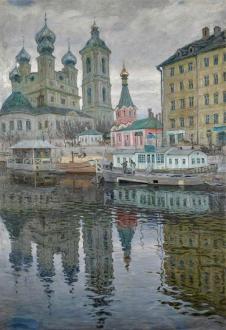
Ukrainian Landscape with Huts by Vladimir Makovsky
Where precisely was Mike Pence while a mob descended on the Capitol on Jan. 6, 2021?
A defendant set to face just the second trial in the nearly 15 months since the attack intends to make that question the centerpiece of his defense Monday. And the judge in the case just gave him the green light to grill the Secret Service about it.
Couy Griffin, the leader of Cowboys for Trump, says Pence’s evacuation to a secure location took him off of Capitol grounds — and outside a Secret Service perimeter established to protect Pence while lawmakers counted Electoral College votes, the last step to certify the 2020 presidential election.
Prosecutors, who have charged Griffin with breaching a Secret Service-protected zone, say the argument is nonsense. Not only was Pence within the Capitol complex for the duration of the riot, they say, but it wouldn’t matter if he left, since the trespassing law he’s charged with only requires that Pence intended to return.
Griffin’s case has become an important test for the Justice Department, with potential ramifications for hundreds of those charged with “entering and remaining in a restricted building or grounds” on Jan. 6, a misdemeanor that carries a one-year maximum jail sentence. If U.S. District Court Judge Trevor McFadden decides Pence’s precise location matters, it could echo across many of the nearly 800 cases stemming from the insurrection.
Prosecutors have repeatedly emphasized that the law only requires that Pence was or “would be” returning to the Secret Service zone to prove Griffin’s crime. They recently amended the language of the charges to emphasize that point.
Ukrainian President Volodymyr Zelensky got a hero’s welcome from the US Congress this week, with Republicans joining Democrats in applauding for the embattled leader of a country that is resisting a brutal Russian invasion. But a lot of the people who were applauding failed Zelensky and the Ukrainian cause when it might have mattered most. That was when former President Donald Trump was impeached and tried for seeking to blackmail Zelensky for political purposes.
The political pendulum swings so fast these days that it is easy to forget what was happening barely two months ago, let alone two years ago. But in late 2019 and early 2020, Ukraine was at the center of a national debate about Trump’s lawless presidency, and his political extortion of Zelensky.
Rupert Murdoch for years has enjoyed a Trump-like ability to avoid responsibility for the avalanche of lies he promotes. That all may be changing thanks to a pair of billion-dollar defamation lawsuits surrounding Trump’s Big Lie campaign — Murdoch appears powerless to stop the looming legal reckoning.
This week, Justice David Cohen of State Supreme Court in Manhattan issued a stinging rebuke of Fox News. Denying the network’s attempt to dismiss a $2.7 billion lawsuit filed by Smartmatic, the election technology company that Fox smeared as part of Trump’s Big Lie offensive following the 2020 campaign, Cohen waved off Murdoch’s attorneys.
“Even assuming that Fox News did not intentionally allow this false narrative to be broadcasted, there is a substantial basis for plaintiffs’ claim that, at a minimum, Fox News turned a blind eye to a litany of outrageous claims about plaintiffs, unprecedented in the history of American elections, so inherently improbable that it evinced a reckless disregard for the truth,” Cohen wrote in his 61-page opinion. The judge repeatedly signaled that the lawsuit can proceed because there’s a reasonable chance that a jury would find Fox guilty of defamation.
So, that’s a lot for us to think about and discuss. I hope your weekend is restful. Turn off the TV. I find that helps.
What’s on your blogging and reading list today?
Did you like this post? Please share it with your friends:
I’ve been in emotional protection mode for the past few days. Following the Ukraine coverage is so exhausting. I can’t begin to imagine what it must be like for the people who are living through the nightmare of Putin’s deliberate horrific attacks on civilians in Ukrainian cities.
Here are two stories about the horrors happening in Mariupol. After that I’ll try to focus on more positive news.
MARIUPOL, Ukraine (AP) — The bodies of the children all lie here, dumped into this narrow trench hastily dug into the frozen earth of Mariupol to the constant drumbeat of shelling.
There’s 18-month-old Kirill, whose shrapnel wound to the head proved too much for his little toddler’s body. There’s 16-year-old Iliya, whose legs were blown up in an explosion during a soccer game at a school field. There’s the girl no older than 6 who wore the pajamas with cartoon unicorns, among the first of Mariupol’s children to die from a Russian shell.
They are stacked together with dozens of others in this mass grave on the outskirts of the city. A man covered in a bright blue tarp, weighed down by stones at the crumbling curb. A woman wrapped in a red and gold bedsheet, her legs neatly bound at the ankles with a scrap of white fabric. Workers toss the bodies in as fast as they can, because the less time they spend in the open, the better their own chances of survival.
“The only thing (I want) is for this to be finished,” raged worker Volodymyr Bykovskyi, pulling crinkling black body bags from a truck. “Damn them all, those people who started this!”
More bodies will come, from streets where they are everywhere and from the hospital basement where adults and children are laid out awaiting someone to pick them up. The youngest still has an umbilical stump attached.
Each airstrike and shell that relentlessly pounds Mariupol — about one a minute at times — drives home the curse of a geography that has put the city squarely in the path of Russia’s domination of Ukraine. This southern seaport of 430,000 has become a symbol of Russian President Vladimir Putin’s drive to crush democratic Ukraine — but also of a fierce resistance on the ground.
Yesterday, Russia deliberately bombed a theater where hundreds of civilians, including many women and children, were sheltering. The location was clearly marked as such.
I think the words "children" may have inspired the Russians to bomb the theater. This is what I mean my genocide. They want to wipe out Ukraine's future. https://t.co/MQI3HEyz87
Authorities in the besieged southern Ukrainian city of Mariupol are clearing the rubble of a theatre hit by a Russian airstrike to search for people who had been sheltering in the basement.
According to local officials, hundreds of people were hiding beneath the theatre, which was designated as a shelter for displaced civilians, including children and elderly people, when it was struck on Wednesday.
The shelter withstood the strike and some people managed to escape, said the former governor of the Donetsk region, Sergiy Taruta, who did not provide details.
Pavlo Kyrylenko, the head of the Donetsk regional administration, said on Telegram that the number of casualties was unclear.
A satellite photograph from Monday, released on Wednesday by Maxar Technologies, showed the word “children” in large Russian script painted on the ground outside the red-roofed theatre building.
A photo released by Mariupol’s city council showed a section of the three-storey theatre had collapsed, with rubble burying the entrance to the shelter inside.
There’s more:
Kyrylenko said Russian airstrikes also hit a municipal swimming pool complex in Mariupol, where civilians had been sheltering. “Now there are pregnant women and women with children under the rubble there,” he wrote. The number of casualties was not immediately known.
A witness who posted a video of the aftermath of the attack said the pool had been destroyed and efforts were under way to rescue a pregnant woman trapped in the rubble.
Moscow denies targeting civilians, and Russia’s defence ministry denied bombing the theatre or anywhere else in Mariupol on Wednesday.
The Russians have prevented humanitarian aid from reaching the city and people are running out of food and melting snow for water.
They will not spare your children, they will target them first. Syrians have lived through 8 years of this already.
VOZNESENSK, Ukraine—A Kalashnikov rifle slung over his shoulder, Voznesensk’s funeral director, Mykhailo Sokurenko, spent this Tuesday driving through fields and forests, picking up dead Russian soldiers and taking them to a freezer railway car piled with Russian bodies—the casualties of one of the most comprehensive routs President Vladimir Putin’s forces have suffered since he ordered the invasion of Ukraine.
A rapid Russian advance into the strategic southern town of 35,000 people, a gateway to a Ukrainian nuclear power station and pathway to attack Odessa from the back, would have showcased the Russian military’s abilities and severed Ukraine’s key communications lines.
By Eugenia Capchinska
Instead, the two-day battle of Voznesensk, details of which are only now emerging, turned decisively against the Russians. Judging from the destroyed and abandoned armor, Ukrainian forces, which comprised local volunteers and the professional military, eliminated most of a Russian battalion tactical group on March 2 and 3.
The Ukrainian defenders’ performance against a much-better-armed enemy in an overwhelmingly Russian-speaking region was successful in part because of widespread popular support for the Ukrainian cause—one reason the Russian invasion across the country has failed to achieve its principal goals so far. Ukraine on Wednesday said it was launching a counteroffensive on several fronts.
“Everyone is united against the common enemy,” said Voznesensk’s 32-year-old mayor, Yevheni Velichko, a former real-estate developer turned wartime commander, who, like other local officials, moves around with a gun. “We are defending our own land. We are at home.” [….]
Russian survivors of the Voznesensk battle left behind nearly 30 of their 43 vehicles—tanks, armored personnel carriers, multiple-rocket launchers, trucks—as well as a downed Mi-24 attack helicopter, according to Ukrainian officials in the city. The helicopter’s remnants and some pieces of burned-out Russian armor were still scattered around Voznesensk on Tuesday.
Russian forces retreated more than 40 miles to the southeast, where other Ukrainian units have continued pounding them. Some dispersed in nearby forests, where local officials said 10 soldiers have been captured.
— Mavi Lopez-Martine🇪🇸🇪🇸🇪🇸🇪🇺🇪🇺🇬🇧 (@MartineMavi) March 17, 2022
An 11-year-old boy who braved the 600-mile journey from southeastern Ukraine to the Slovakian border by himself has been reunited with his mother.
Hassan Pisecká crossed the country with only a plastic bag, passport, and telephone number scribbled on his hand, in a story that won the hearts of people from around the world.
His mother Júlia Pisecká, a widow, remained in their hometown of Zaporizhzhia, where Russian troops struck a nuclear power plant in early March, to continue caring for her elderly and immobile mother who was unable to flee.
On reaching the border, Hassan’s ‘smile, fearlessness and determination’ won over officials who helped him cross into Slovakia. They contacted his relatives in the country using the phone number and a note that was tied to his waist.
He was reunited with his mother, grandmother and dog in Slovakia this week as the family wanted ‘to thank everyone from my heart’ for their help getting the family, who fled the war in Syria several years ago, back together.
Júlia said the train ride out of Ukraine ‘was very difficult’ but ‘we had to escape so our family could be back together’ as she admitted ‘we have to start from scratch. We lost everything we’ve had but we’re healthy.’
In 36 days of fighting on Iwo Jima during World War II, nearly 7,000 Marines were killed. Now, 20 days after President Vladimir V. Putin of Russia invaded Ukraine, his military has already lost more soldiers, according to American intelligence estimates.
The conservative side of the estimate, at more than 7,000 Russian troop deaths, is greater than the number of American troops killed over 20 years in Iraq and Afghanistan combined.
By Eugenia Gapchinska
It is a staggering number amassed in just three weeks of fighting, American officials say, with implications for the combat effectiveness of Russian units, including soldiers in tank formations. Pentagon officials say a 10 percent casualty rate, including dead and wounded, for a single unit renders it unable to carry out combat-related tasks.
With more than 150,000 Russian troops now involved in the war in Ukraine, Russian casualties, when including the estimated 14,000 to 21,000 injured, are near that level. And the Russian military has also lost at least three generals in the fight, according to Ukrainian, NATO and Russian officials.
Pentagon officials say that a high, and rising, number of war dead can destroy the will to continue fighting. The result, they say, has shown up in intelligence reports that senior officials in the Biden administration read every day: One recent report focused on low morale among Russian troops and described soldiers just parking their vehicles and walking off into the woods.
The Biden administration will provide Ukraine with additional high-tech defensive weapons that are easily portable and require little training to use against Russian tanks, armored vehicles and aircraft, according to U.S. and European officials.
In remarks on Wednesday, President Biden announced $800 million in new military aid for Ukraine, including 800 additional Stinger antiaircraft missiles, 9,000 antitank weapons, 100 tactical drones and a range of small arms including machine guns and grenade launchers.
U.S. and European officials want to send more equipment that is easy to use by small teams, and that has technology that can overcome Russian defenses or exploit weaknesses — rather than offensive weapons like tanks and warplanes that require significant logistical support….
By Eugenia Gapchinska
As part of the package, the Biden administration will provide Switchblade drones, according to people briefed on the plans. Military officials call the weapon, which is carried in a backpack, the “kamikaze drone” because it can be flown directly at a tank or a group of troops, and is destroyed when it hits the target and explodes.
“These were designed for U.S. Special Operations Command and are exactly the type of weapons systems that can have an immediate impact on the battlefield,” said Mick Mulroy, a former deputy assistant secretary of defense.
Bigger, armed drones, like U.S.-made Predators or Reapers, would be difficult for Ukrainians to fly and would be easily destroyed by Russian fighter planes. But former officials said small, portable kamikaze drones could prove to be a cost-effective way to destroy Russian armored convoys.
Have a peaceful Thursday everyone. I’m going to focus on self-care today as much as I can. I won’t be able to tear myself away from the Ukraine news entirely, but I’m going to take breaks.
Did you like this post? Please share it with your friends:
Ukraine continues to dominate the news as Putin levels cities with brutal attacks on civilians. How much longer will western government allow these war crimes to continue? President Voldymyr Zelenskyy continues to reach ask them for help. This morning he addressed the Canadian Parliament and once again begged for a no fly zone. Tomorrow he will speak to the U.S. Congress.
Today the leaders of three NATO countries are traveling to Ukraine to meet with Zelenskyy.
The prime ministers of Poland, the Czech Republic and Slovenia are travelling to meet Volodymyr Zelenskiy in Kyiv even as pre-dawn Russian shelling killed more civilians in an apartment building in Ukraine’s capital.
In statements from their respective capitals, the three leaders said they would be offering their support to Ukraine’s president as representatives of the other 24 EU heads of state and government.
The move by Poland’s Mateusz Morawiecki, his Czech counterpart, Petr Fiala, and Slovenia’s Janez Janša was said to be an attempt to bolster Ukraine in its fight for its sovereignty. They will also meet the Ukrainian prime minister, Denys Shmyhal.
Fiala tweeted: “The aim of the visit is to express the European Union’s unequivocal support for Ukraine and its freedom and independence.
“At the same time, we will present a broad package of support for Ukraine and its citizens during the visit. The international community has also been informed of this visit by international organisations, including the United Nations.”
The announcement came as the emergency services in Kyiv said said two people had died in an attack on a 15-storey apartment building shortly before dawn on Tuesday.
The situation in Southern Ukraine is getting increasingly desperate.
In the more than two weeks that it has been cut off from the outside world, Mariupol, the southern Ukrainian port city, has become synonymous with the horror of the Russian invasion.
It is a place of overflowing morgues, newly dug mass graves and bodies in some cases buried under rubble or left in the streets where they fell.
Painting by Alexander Roitburd
On Monday a convoy of more than 160 cars escaped Mariupol, the city council said on its Telegram channel. It was the first successful attempt to set up a “humanitarian corridor” out of the city, which at one time was home to as many as 400,000 people. But much needed aid was blocked Monday from getting in by Russian forces, Ukrainian officials said.
As conditions in the city have grown more dire and the death count has surged, word of the humanitarian catastrophe has leaked out through intermittent phone calls, shakily shot videos and testimony from the handful of aid groups still working in the city.
“People in Mariupol have endured a weeks-long life-and-death nightmare,” said Peter Maurer, president of the International Committee of the Red Cross, whose staff was trapped in the city. ICRC officials warned that time was running out for the civilians who remain there.
“In the city center, it’s a real meat grinder: This land is soaked in blood, bitterness and despair,” one Mariupol citizen said in a video posted online Sunday. The video showed empty streets, blocks of broken windows and stores stripped of food by starving citizens. It lingered over men cooking their dinner over a campfire in a city that has endured subzero temperatures and nearly two weeks without heat or water.
“The world doesn’t know what’s happening here,” the narrator said as he navigated past blown out buildings. “It’s terrible.”
Read the rest and see photos of the carnage at the WaPo link.
Russian soldiers patrol the streets of Berdyansk in cars and armoured vehicles marked with the “Z” symbol that denotes the Russian occupying force.
Local government officials in this city in southern Ukraine, which has been controlled by Russian troops for the past two weeks, have been kicked out of their offices, and the local radio station plays Soviet ballads and Russian pop songs, interspersed with excerpts from Vladimir Putin’s speeches and news items about Ukraine being “liberated from Nazis.”
“We feel like we’re living a nightmare, and we don’t know when this awful dream will end,” said one local councillor in the city, who asked to remain anonymous, citing security fears. “We still can’t believe that this could have happened.”
Spring, by Marie Bashkirtseff
As international focus remains on Kharkiv, Mariupol and other Ukrainian cities that have come under heavy Russian bombardment, there is a less violent but no less important battle for Ukraine’s future going on in a stretch of southern Ukraine that came under Russian control in the first days of the war, without major fighting.
Between Mariupol and Mykolaiv, both of which have come under Russian air attack, there are a number of sizable Ukrainian towns currently under Russian occupation.
In Berdyansk, a port city to the west of Mariupol with a population of a little over 100,000, the majority of city councillors have remained loyal to Ukraine. They continue to run the city, in defiance of the Russian occupation. However, the Russians may be about to transition to more violent methods.
In nearby Melitopol, the similarly defiant mayor was reportedly kidnapped by Russian soldiers on Friday night, marched from his office with a bag over his head, and has not been heard from since.
Russian President Vladimir Putin has two options at this point, says Ukrainian diplomat Olexander Scherba: Either he destroys Ukraine and takes its cities and then withdraws, or “he withdraws without doing that because he cannot accomplish anything here.”
Putin may not realize it, but “everyone outside this very close circle around Putin understands that this campaign is going down the drain,” Scherba adds on this episode The New Abnormal. “The [Ukrainian] soldiers are ready to fight until the last drop of blood here and Russian soldiers increasingly are clueless about what they’re doing here.”
Not only are they clueless, but they’re simply refusing to fight, Scherba, who is currently in western Ukraine, tells co-host Molly-Jong-Fast. He shares that soldiers in Crimea refused to be deployed when they discovered they were ordered to take Odessa, and intercepts of communication between soldiers in Ukrainian cities and their parents indicate that they’re spooked by how many of their own have died.
But we should still “assume the worst,” he says, sharing his opinion on the one thing that Ukraine needs from the U.S. to win.
The Russian journalist who held up an anti-war sign during a state-run news broadcast in Russia appeared in court on Tuesday to be tried on a misdemeanor charge.
Marina Ovsyannikova, an editor at the news broadcast service Channel One, appeared in court with her lawyer, according to a series of tweets from Max Seddon, a Financial Times reporter in Moscow.
Ovsyannikova faces up to 10 days in jail, Seddon said, because she is not being charged under the “Fake News” law the Russian parliament passed after the invasion of Ukraine, which can carry a sentence of up to 15 years in prison….
Russia has enforced strict laws that prohibits news services from even calling the conflict in Ukraine a war, instead publications and channels must refer to it as a “special operation.”
Ukrainian President Volodymyr Zelensky on Monday expressed gratitude for Ovsyannikova’s protest, saying he was “grateful to those Russians who do not stop trying to convey the truth.”
Yakov Kronrod went back to Russia to care for his mother months before the invasion of Ukraine, so he was on the ground watching as a Channel One editor took the bold move to stage a protest on live television….
By Victor Zaretsky
According to Kronrod, even pro-Putin outlets have reported on the story, he said, delivering her message even farther to more people.
“It sends shock waves through all of Russian society. Yandex News had a story about it, and they rarely have anything that’s against the main narrative,” said Kronrod. “Her Facebook page was getting thousands of people commenting every minute. Literally, it exploded. Everyone was texting each other, calling each other saying, did you see? Did you see what happened? And many of the human rights activists that I’m talking to feel this may very well be the start of the wave to see someone like that Channel 1 has 250 million viewers, it’s the number one watched station by most common Russians. For a lot of Russians, this was the first time they saw any dissenting voice.”
Watch Konrad’s interview with CNN’s Anderson Cooper at the Raw Story link.
In the surreal world of Russian state television, Russia is about to prevail in its war against Ukraine, which is being presented as a battle against the United States and NATO. According to top Kremlin propagandists, it’s only a matter of time before the West admits its defeat and pays reparations to Moscow or risks a devastating nuclear strike….
In recent days, Russian state television regressed from Orwellian lies to Kafkaesque nightmares, as pundits started to promote the idea of executing Ukrainians resisting Putin’s war of aggression by hanging. They noted that the so-called “constitution” of the rogue “republics” created in Ukraine by Russian forces conveniently allows for the death penalty. Last Thursday on The Evening With Vladimir Soloviev, after listening to other pundits and experts endorse the idea of executing Ukrainian citizens by hanging, doctor of political sciences Elena G. Ponomareva argued: “Never let morality prevent you from undertaking correct actions. I understand the importance of a humanitarian component… but morality shouldn’t get in the way.”
Sunday’s Vesti Nedeli hosted by Dmitry Kiselyov continued the theme of public hangings, broadcasting the scenes from the public execution of German Nazi soldiers on Kyiv’s Independence Square in 1946. The segment was entitled “Denazification of Ukraine—the new opportunities for growth” and appeared to serve as a tool to desensitize the Russian population for the grotesque war trials and executions the Kremlin is reportedly planning to conduct in Ukraine, perhaps in the same public square captured in the historical video.
Bloomberg previously reported that, according to an unnamed European intelligence official, Russia’s intelligence agency, the Federal Security Service, has drafted plans for public executions in Ukraine after cities are captured. Russian state media appears to be laying the groundwork to normalize such an idea, in order to make it seem acceptable to average Russians.
A document found by federal prosecutors in the possession of a far-right leader contained a detailed plan to surveil and storm government buildings around the Capitol on Jan. 6 last year, people familiar with the document said on Monday.
The document, titled “1776 Returns,” was cited by prosecutors last week in charging the far-right leader, Enrique Tarrio, the former head of the Proud Boys extremist group, with conspiracy. The indictment of Mr. Tarrio described the document in general terms, but the people familiar with it added substantial new details about the scope and complexity of the plan it set out for directing an effort to occupy six House and Senate office buildings and the Supreme Court last Jan. 6.
The document does not specifically mention an attack on the Capitol building itself. But in targeting high-profile government buildings in the immediate area and in the detailed timeline it set out, the plan closely resembles what actually unfolded when the Capitol was stormed by a pro-Trump mob intent on disrupting congressional certification of President Biden’s Electoral College victory.
Many questions remain about the document, including who wrote it and how it made its way to Mr. Tarrio, according to prosecutors, on Dec. 30, 2020, as President Donald J. Trump was engaged in a series of overlapping schemes to keep himself in power. The people familiar with the document said other evidence the government has gathered suggests that it may have been provided to Mr. Tarrio by one of his girlfriends at the time.
Prosecutors have not accused Mr. Tarrio of using the document to guide the actions of the Proud Boys who played a central role in the Capitol attack. Nor do the charges against him offer any evidence that he shared the document with his five co-defendants: Ethan Nordean, Joseph Biggs, Zachary Rehl, Charles Donohoe and Dominic Pezzola.
But the document could help explain why prosecutors chose to charge Mr. Tarrio with conspiracy, even though he was not at the Capitol during the attack. And it appears to be the first time that prosecutors have sought to use evidence of a specific written plan to storm and occupy government buildings in their wide-ranging investigation into the attack and what ledTh up to it.
Read the rest at the NYT.
That’s it for me today. What stories are you following?
Did you like this post? Please share it with your friends:
I used to spend nearly every weekend traveling between Council Bluffs, Iowa, and Kansas City. Both my grandparents lived there as well as my mother’s brother and sister and their families. I used to love the season when Kansas sunflowers bloomed. Goodland is the Sunflower Capitol there. It was a treat to see the endless fields of Sunflowers, the state flower of Kansas.
After the Hiroshima, Fukushima, and Chernobyl nuclear disasters, fields of sunflowers were planted across the affected landscapes to help absorb toxic metals and radiation from the soil. New research now suggests that sunflowers (Helianthus) might be as good for the environment as they are pretty to look at.
Sunflowers are what environmental scientists call hyperaccumulators– plants that have the ability to take up high concentrations of toxic materials in their tissues. Like all land-based plants, flowers have root systems that evolved as extremely efficient mechanisms for pulling nutrients, water, and minerals out of the ground, among them: zinc, copper, and other radioactive elements that are then stored in their stems and leaves.
While the sunflower-radiation link would seem like a slow-gestating cure-all for modern environmental disasters, the research is still inconclusive as to the efficacy of all sunflower varieties to help stave off environmental pollution. Post-tsunami clean-up efforts in Fukashima, however, demonstrate a promising application of this discovery.
One of the early successes in sunflower research came almost a decade ago when a phytoremediation company called Edenspace Systems completed a successful cleanup of a lead-laced plot in land in Detroit. (Phytoremediation is a technique for using plants to clean up contamination.)
‘Take these seeds and put them in your pockets so at least sunflowers will grow when you all lie down here,’ said the Ukrainian lady. ‘Put the sunflower seeds in your pockets, please. You will lie down here with the seeds. You came to my land. Do you understand? You are occupiers. You are enemies.’
Artists around the world have been posting sunflower art with hashtags including #sunflowersforukraine to show solidarity with civilians in a powerful display of artistic expression. Meanwhile, Twitter and Instagram users have been adding sunflower emojis to their usernames as a subtle nod of support as Russia continues its devastating war on Ukraine.
In America, First Lady Jill Biden showed her support for Ukraine by wearing a face mask embroidered with a sunflower during an event at The White House, while in City Plaza in Reno, Nevada, residents gathered to add sunflowers to a ‘Believe’ sculpture to express their support for the country.
Meanwhile, over in the UK, Prince Charles and Camilla placed sunflowers on the altar during a visit to the Ukrainian Catholic Cathedral in London with Ukraine’s Ambassador to the UK, Vadym Prystaiko.
And at demonstrations in the city, supporters have been draped in the blue and yellow national flag of Ukraine, carrying sunflowers and wearing sunflower crowns in protests against Russian President Vladimir Putin.
This isn’t the first time the sunflower has been used as a symbol of peace. Back in June 1966, US, Russian and Ukrainian defence ministers planted sunflowers in a ceremony at Ukraine’s Pervomaysk missile base to mark Ukraine giving up nuclear weapons.
Sunflowers have been grown in Ukraine since the 1700s (the country is also the world’s major supplier of sunflower oil). According to historical records, the sunflower became deeply embedded in the Ukrainian culture when the church didn’t ban its oil during Lent — a time of abstinence. Since then, sunflower oil has become an important aspect of daily life in Ukraine, with many civilians growing the golden flowers in their gardens and eating their seeds as a snack.
And yes, today’s post is resplendent with artists of Ukraine and their take on their precious Sunflowers. Some of the works of contemporary artists are for sale. Buying art would be a great way to support Ukraine and continue its cultural contribution in arts!
I also am going to gratuitously use the infamous LBJ Daisy Ad from 1964 followed by the Mother and Child Ad. That year I was 8 and was getting quite good and the duck and dive exercises. I was hoping never to relive that kind of weirdness but here I am in my dotage, worrying about a mad man again. Will he bury us?
What is most frustrating is watching Putin escalate the war by committing war crimes like this from the AP: “Pregnant woman, baby die after Russia bombed maternity ward.” I do not understand what this does other than terrorize a peaceful nation and cement world determination to rid the world of the Russian Despot.
Burns is a former U.S. ambassador to Moscow who has met with Putin many times. He told lawmakers in response to a question about the Russian president’s mental state that he did not believe Putin was crazy.
“I think Putin is angry and frustrated right now,” he said. “He’s likely to double down and try to grind down the Ukrainian military with no regard for civilian casualties.”
Russia’s recent unsupported claims that the U.S. is helping Ukraine develop chemical or biological weapons suggest that Putin may himself be prepared to deploy those weapons in a “false flag” operation, Burns said.
There’s no apparent path to ending the war. It is nearly inconceivable that Ukrainian President Volodymyr Zelenskyy, who has won admiration around the world for leading his country’s resistance, would suddenly recognize Russia’s annexation of Crimea or support granting new autonomy to Russian-friendly parts of eastern Ukraine. And even if he captures Kyiv and deposes Zelenskyy, Putin would have to account for an insurgency supported by the West in a country of more than 40 million.
“He has no sustainable political end-game in the face of what is going to continue to be fierce resistance from Ukrainians,” Burns said.
European leaders are still trying to maintain dialogue with Putin. Prime Minister Xavier Bettel of Luxembourg spoke Monday with Putin and “pleaded for an immediate ceasefire,” according to Bettel’s tweet. A spokesperson said Bettel was encouraged to contact Putin by other leaders who “wanted to make sure Putin would continue talking with them.” Bettel also spoke with Zelenskyy.
Avril Haines, President Joe Biden’s director of national intelligence, said Putin “perceives this as a war he cannot afford to lose. But what he might be willing to accept as a victory may change over time given the significant costs he is incurring.”
Intelligence analysts think Putin’s recent raising of Russia’s nuclear alert level was “probably intended to deter the West from providing additional support to Ukraine,” she said.
In hopeful news, a real freedom convey of 160 cars filled with civilians left the besieged city of Mariupol. Ukrainian families begin their life as refugees throughout Europe. Ted Cruz and those truckers driving circles around the District need to get a life.
— 🦎₵Ⱨ₳₥ɆⱠɆØ₦🦎 (Photoshop Artist For Hire) (@bewarchameleon) March 14, 2022
#UPDATE The number of refugees who have fled Ukraine since the Russian invasion began on February 24 has topped 2.8 million, the United Nations said Mondayhttps://t.co/08FD4ppQZT
Maria Primachenko, May I Give This Ukrainian Bread to All People in This Big Wide World Maria Primachenko Original Title: Дарую українську паляницю всім людям на землі Date: 1982
“Ripeness is all,” noted Edgar in Shakespeare’s King Lear. When it comes to negotiations to limit or end international conflicts, he is right: agreements emerge only when the leading protagonists are willing to compromise and are then able to commit their respective governments to implement the accord.
This truth is highly relevant to any attempt to end the war between Russia and Ukraine through diplomacy. Ukrainian President Volodymyr Zelensky has any number of reasons to end a conflict that has already killed thousands of his citizens, destroyed large parts of several major cities, rendered millions homeless, and devastated Ukraine’s economy. And his standing has grown by the hour, giving him the political strength to make peace – not at any price, but at some price.
Already, there are signs he might be willing to compromise on NATO membership. He would not recognize Crimea as being part of Russia, but it might be possible for him to accept that the two governments agree to disagree on its status, much as the United States and China have done for a half-century concerning Taiwan. Similarly, he would not recognize the independence of the Donetsk and Luhansk “people’s republics,” but he could sign on to their being given significant autonomy.
The question is whether even this would be enough for Russian President Vladimir Putin, who has demanded the “de-Nazification” of Ukraine, a phrase that seems to call for regime change, as well as the country’s total demilitarization. Given that he has questioned whether Ukraine is a “real” country, it is hard to avoid the conclusion that he remains uninterested in coexisting with a legitimate government of a sovereign, independent state. So far, Putin has demonstrated he is more interested in making a point than in making a deal.
What could change this? What could make the situation riper for a negotiated solution? That is actually the purpose of the West’s policy: to raise the military and economic costs of prosecuting the war so high that Putin will decide that it is in his interest (he clearly cares little about the interests of Russia) to negotiate a ceasefire and accept terms that would bring peace. Again, this seems unlikely, if only because Putin almost certainly fears it would be interpreted as a sign of weakness, encouraging resistance to his continued rule.
Alternatively, he could be pressured to negotiate. In principle such pressure could come from below – a Russian version of “people power” in which the security services are overwhelmed, much as they were in Iran in the late 1970s. Or pressure could come from the side, from the few others who wield power in today’s Russia and could decide that they must act before Putin destroys more of Russia’s future than he already has. The former does not seem to be in the offing, given mass arrests and control of information, and there is simply no way of knowing if the latter might happen until it does.
There are more situations discussed at the link.
Well, that’s it for me! I’m going to go plant some sunflowers to hide the back fence! It’s always fun to watch them follow the sun!
What’s on your reading and blogging list today?
Did you like this post? Please share it with your friends:
The war in Ukraine continues, and although the Ukrainian military is fighting valiantly and the Russians are struggling, the bad guys are likely to win in the end. IMHO, the U.S. and NATO need to do more to help Ukraine. I’ll offer some serious reads on the situation, but first a little furry break from the madness.
Cat cafes are a purrfect way to enjoy the company of felines while you sip a tasty drink. The beloved Cat Cafe Lviv is no exception. It’s been open for six years and the small team in Lviv, Ukraine, is devoted to its 20 furry residents. So devoted, in fact, that owner Serhii Oliinyk is choosing to stay at the cafe despite the Russian invasion in his country.
“Our cats have been living in [the] cat cafe since the age of 4 months,” Oliinyk explained. “They are like family. We realized that we would never leave our country, that this was the only place where we could see ourselves in the future.”
Cat Cafe Lviv is open (according to its Facebook page) and is dedicated to providing a safe space for people to stop by and see the kitties who reside there. Hopefully, the cats’ presence and purrs offer a momentary reprieve to the stark realities of what’s going on just beyond the walls.
“We currently have fewer regular visitors, but there are people who have come from other cities and need hot food and positive emotions,” Oliinyk said. “There are three large rooms in our cafe, two of which are located in the basement, so in case of an air raid warning, there is a safe shelter for our guests and cats.”
Alongside images of destruction and resistance, the visual story of Russia’s invasion of Ukraine has included a fair bit of cats and dogs. The Albanian Times shared a story of Ukrainian soldiers taking in a puppy left in the cold. Facebook posts tout soldiers cuddling cats and show families refusing to leave their pets behind as they flee. Famed Twitter Maine coon Lorenzo the Cat shared the story of Aleksandra Polischuk, a breeder of sphinx cats who was killed when her home was destroyed. And of course, Twitter couldn’t help but go aww at the photos of Ukrainian President Volodymyr Zelensky and his dogs.
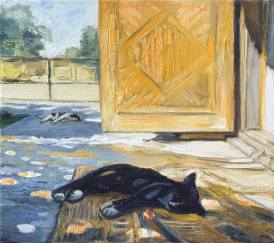
Kateryna Zavadska, Cool cat
It would be easy to position cat and dog content in a warzone as contradictory to conflict. But pet and animal content aren’t the opposite of war—they’re a part of it. Every pet image coming out of Ukraine right now shows a human impacted by the war in some way. In the above-listed examples, every story of a rescued dog or a cuddling cat was bookended by the actions of people.
Animals remind us of our own humanity, and they can be stark reminders of the human face of geopolitical strife. These cat and dog images coming out of Ukraine remind us, paradoxically, that there are real, individual people on the frontlines. There are real, individual people whose lives are forever changed by this aggression. These aren’t just images of animals in conflict, but reminders of the humans who take care of them and fight on the ground.
It is no accident that we flock to cat content online. It is also not a coincidence that these stories of pets and animal in war circulate widely on the internet. The internet is an ideal space for this type of sharing, as pet and animal images help keep digital spaces lighthearted and fun. Pet and animal images are often the opposite to “doomscrolling,” or the endless scrolling through negative, serious, and depressing news online. Right now, as we doomscroll through a war, cute pet and animal content provides relief, but in conjunction with the war photos themselves, reminds us of the human cost of conflict.
There’s also another side to this phenomenon. Read about it at Slate.
Now back to the news of the day.
At the New Yorker, an interview with Russia scholar that is getting a lot of attention: The Weakness of the Despot. An expert on Stalin discusses Putin, Russia, and the West, by David Remnick
Stephen Kotkin is one of our most profound and prodigious scholars of Russian history. His masterwork is a biography of Josef Stalin. So far he has published two volumes––“Paradoxes of Power, 1878-1928,” which was a finalist for the Pulitzer Prize, and “Waiting for Hitler, 1929-1941.” A third volume will take the story through the Second World War; Stalin’s death, in 1953; and the totalitarian legacy that shaped the remainder of the Soviet experience….
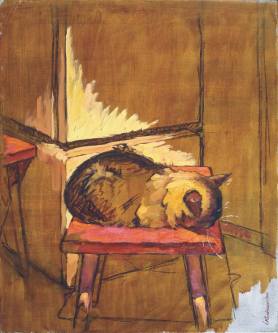
Olena Kamenetska-Ostapchuk, Siesta
Kotkin has a distinguished reputation in academic circles. He is a professor of history at Princeton University and a senior fellow at the Hoover Institution, at Stanford University. He has myriad sources in various realms of contemporary Russia: government, business, culture….
Earlier this week, I spoke with Kotkin about Putin, the invasion of Ukraine, the American and European response, and what comes next, including the possibility of a palace coup in Moscow.
You’ll need to go to The New Yorker to read the whole interview, but here’s an excerpt.
What is Putinism? It’s not the same as Stalinism. It’s certainly not the same as Xi Jinping’s China or the regime in Iran. What are its special characteristics, and why would those special characteristics lead it to want to invade Ukraine, which seems a singularly stupid, let alone brutal, act?
Yes, well, war usually is a miscalculation. It’s based upon assumptions that don’t pan out, things that you believe to be true or want to be true. Of course, this isn’t the same regime as Stalin’s or the tsar’s, either. There’s been tremendous change: urbanization, higher levels of education. The world outside has been transformed. And that’s the shock. The shock is that so much has changed, and yet we’re still seeing this pattern that they can’t escape from.
You have an autocrat in power—or even now a despot—making decisions completely by himself. Does he get input from others? Perhaps. We don’t know what the inside looks like. Does he pay attention? We don’t know. Do they bring him information that he doesn’t want to hear? That seems unlikely. Does he think he knows better than everybody else? That seems highly likely. Does he believe his own propaganda or his own conspiratorial view of the world? That also seems likely. These are surmises. Very few people talk to Putin, either Russians on the inside or foreigners.
Anastasiia Atamanchuk, Fuji Cats
And so we think, but we don’t know, that he is not getting the full gamut of information. He’s getting what he wants to hear. In any case, he believes that he’s superior and smarter. This is the problem of despotism. It’s why despotism, or even just authoritarianism, is all-powerful and brittle at the same time. Despotism creates the circumstances of its own undermining. The information gets worse. The sycophants get greater in number. The corrective mechanisms become fewer. And the mistakes become much more consequential.
Putin believed, it seems, that Ukraine is not a real country, and that the Ukrainian people are not a real people, that they are one people with the Russians. He believed that the Ukrainian government was a pushover. He believed what he was told or wanted to believe about his own military, that it had been modernized to the point where it could organize not a military invasion but a lightning coup, to take Kyiv in a few days and either install a puppet government or force the current government and President to sign some paperwork.
I haven’t read the whole piece yet, but I plan to read the rest–even though some of it is over my head. There’s also a video of the entire interview at the New Yorker link.
In describing Vladimir Putin and his inner circle, I have often thought of a remark by John Maynard Keynes about Georges Clemenceau, French prime minister during the first world war: that he was an utterly disillusioned individual who “had one illusion — France”.
Something similar could be said of Russia’s governing elite, and helps to explain the appallingly risky collective gamble they have taken by invading Ukraine. Ruthless, greedy and cynical they may be — but they are not cynical about the idea of Russian greatness.
The western media employ the term “oligarch” to describe super-wealthy Russians in general, including those now wholly or largely resident in the west. The term gained traction in the 1990s, and has long been seriously misused. In the time of President Boris Yeltsin, a small group of wealthy businessmen did indeed dominate the state, which they plundered in collaboration with senior officials. This group was, however, broken by Putin during his first years in power.
Ivan Kolisnyk, A Fly
Three of the top seven “oligarchs” tried to defy Putin politically. Boris Berezovsky and Vladimir Gusinsky were driven abroad, and Mikhail Khodorkovsky was jailed and then exiled. The others, and their numerous lesser equivalents, were allowed to keep their businesses within Russia in return for unconditional public subservience to Putin. When Putin met (by video link) leading Russian businessmen after launching the invasion of Ukraine, there was no question of who was giving the orders.
The force that broke the oligarchs was the former KGB, reorganised in its various successor services. Putin himself, of course, came from the KGB, and a large majority of the top elite under Putin are from the KGB or associated state backgrounds (though not the armed forces).
This group have remained remarkably stable and homogenous under Putin, and are (or used to be) close to him personally. Under his leadership, they have plundered their country (though unlike the previous oligarchs, they have kept most of their wealth within Russia) and have participated or acquiesced in his crimes, including the greatest of them all, the invasion of Ukraine. They have echoed both Putin’s vicious propaganda against Ukraine and his denunciations of western decadence.
The Biden administration, under pressure to expand the arsenal of weapons that Ukraine has in its conflict with Russia, is working with European allies to expedite more sophisticated air-defense systems and other armaments into the war zone, U.S. officials said Friday.
Discussions were ongoing ahead of Defense Secretary Lloyd Austin’s planned trip next week to meet with NATO allies in Brussels and Slovakia, which along with Poland and Romania has indicated a willingness to transfer military aid to its embattled neighbor. Slovakia also possesses the S-300 surface-to-air missile system, which is used to shoot down enemy aircraft and is familiar to the Ukrainians.
Pentagon spokesman John Kirby told reporters that the United States is committed to arming the government in Kyiv with “the kinds of capabilities that we know the Ukrainians need and are using very well.” He declined to specify what types of weapons could be included in the next wave of shipments.
“Some of that material we have and are providing. Some of that material we don’t have but we know others have, and we’re helping coordinate that as well,” Kirby said.
The administration is facing backlash over its decision earlier this week to scuttle Poland’s proposal that would have sent a number of its MiG-29 fighter jets to Ukraine via a transfer “free of charge” to the United States. Washington, citing concerns that Russia would view the move as a provocation, said the offer from Warsaw was not “tenable.”
American officials are examining the ownership of a $700 million superyacht currently in a dry dock at an Italian seacoast town, and believe it could be associated with President Vladimir V. Putin of Russia, according to multiple people briefed on the information.
United States intelligence agencies have made no final conclusions about the ownership of the superyacht — called the Scheherazade — but American officials said they had found initial indications that it was linked to Mr. Putin. The information from the U.S. officials came after The New York Times reported on Tuesday that Italian authorities were looking into the 459-foot long vessel’s ownership and that a former crew member said it was for the use of Mr. Putin….
American officials said Mr. Putin kept little of his wealth in his own name. Instead he uses homes and boats nominally owned by Russian oligarchs. Still, it is possible that through various shell companies, Mr. Putin could have more direct control of the Scheherazade.
Both the Treasury Department’s Office of Intelligence and Analysis and the Navy’s Office of Naval Intelligence are investigating the ownership of superyachts associated with Russian oligarchs. A spokesman for the Navy and a spokeswoman for the Treasury both declined to comment.
The Justice Department has set up a task force to go after the assets of sanctioned Russian oligarchs. In a discussion with reporters on Friday, a Justice Department official said the task force would be investigating individuals who help sanctioned Russian officials or oligarchs hide their assets. Those individuals could face charges related to sanctions violations or international money laundering charges.
Head over to the NYT to read details about the yacht and how it and other Russian oligarch-owned super yachts could be seized.
There are lots of serious articles on the Ukraine crisis today. Here are a few more to check out:
I’m getting exhausted emotionally by the war news. I want to read more today, but I guess I need to pace myself. I hope you all are taking good care of yourselves amid all the scary news.
Did you like this post? Please share it with your friends:
The Sky Dancing banner headline uses a snippet from a work by artist Tashi Mannox called 'Rainbow Study'. The work is described as a" study of typical Tibetan rainbow clouds, that feature in Thanka painting, temple decoration and silk brocades". dakinikat was immediately drawn to the image when trying to find stylized Tibetan Clouds to represent Sky Dancing. It is probably because Tashi's practice is similar to her own. His updated take on the clouds that fill the collection of traditional thankas is quite special.
You can find his work at his website by clicking on his logo below. He is also a calligraphy artist that uses important vajrayana syllables. We encourage you to visit his on line studio.























 peej
peej Carissa
 bostonboomer
 dakinikat
 ecocatwoman
 mablue2
 Mama Lopez
 peggysue22
 quixote
 skydancingguestblogger
 Mona (aka Wonk the Vote)



 Sky Dancing
Recent Comments