






First, Democrats should stress that voters need to know before the election whether Trump committed crimes—and this is due to them as a matter of right. Second, Trump is seeking these delays to end all prosecutions of himself if he regains the White House—to corruptly place himself above the law by pardoning himself or having his handpicked lickspittle attorney general do it. Democrats must say clearly that if the court helps delay the trial until after the election, it will be enabling him to do that.
Monday Reads: Broken Institutions Edition
Posted: March 4, 2024 Filed under: just because | Tags: 2024 Supreme Court Rulings, The Donnie Dotard Club House, US most dysfunctional Advanced democracy 9 Comments Good Day, Sky Dancers!
The big news is that after taking its sweet time, the Supreme Court unanimously decided that states cannot remove Trump from their ballots even though they may have their own version of the 14th Amendment. “Supreme Court keeps Trump on ballot, rejects Colorado voter challenge. While the decision was unanimous, the liberal justices wrote a sharp concurrence that accused the conservative majority of going further than needed.” This is from the Washington Post and reported by Ann E. Marimow.
The Supreme Court on Monday unanimously sided with Donald Trump, allowing the former president to remain on the election ballot and reversing a Colorado ruling that disqualified him from returning to office because of his conduct around the Jan. 6, 2021, attack on the U.S. Capitol.
The justices said the Constitution does not permit a single state to disqualify a presidential candidate from national office, declaring that such responsibility “rests with Congress and not the states.” The court warned of disruption and chaos if a candidate for nationwide office could be declared ineligible in some states, but not others, based on the same conduct.
“Nothing in the Constitution requires that we endure such chaos — arriving at any time or different times, up to and perhaps beyond the inauguration,” the court said in an unsigned, 13-page opinion.
While the decision was unanimous, the court’s three liberal justices also wrote separately, saying the conservative majority went further than necessary in the ruling and decided an issue that was not before the court in an attempt to insulate itself and Trump from “future controversy.”
The court’s decision to keep Trump on the ballot leaves him as the leading candidate for the Republican nomination and for now removes the Supreme Court from directly determining the path of the 2024 presidential election. The justices fast-tracked the challenge from voters in Colorado and issued their decision one day before Super Tuesday, when that state and more than a dozen others hold nominating contests. The ruling applies to other states with similar challenges to Trump’s candidacy.
In a sign of the high court’s awareness of the election calendar, the justices took the unusual step of announcing the opinion on the Supreme Court’s website on a day when the court is not in session, instead of issuing it from the bench later this month.
 I think the high court’s awareness was more based on the intense criticism they are getting right now for slowing down the process of getting Trump into the Federal Court to face charges. Maybe this is a sign of hope that we’ll hear their take on “Presidential Immunity.” Plus, Clarence Thomas is facing denunciation for his absolute refusal to recuse himself from participating in cases where he has apparent conflicts of interest. Liz Dye at Public Interest makes it even more pronounced. “The Supreme Court saves Trump’s bacon.”
The Supreme Court sparked general outrage last week when it agreed to hear Donald Trump’s claim of absolute presidential immunity in his election interference case, with commentators predicting the end of democracy as we know it if the Court rules that a president is immune for crimes committed while in office.
Histrionics serve no one, however, and so it bears speaking plainly: The Supreme Court is not going to find that Donald Trump is immune from prosecution for crimes committed in office. That’s ridiculous.
But the Court’s right-wing majority is going to run exactly the same playbook they did in 2020, when they gifted the then-president almost two years of delay in turning over his financial documents to prosecutors in New York and investigators in Congress. By the time Trump wound up having to comply, he was already out of office.
This time, the consequences of delay will be even more profound. Thanks to the Supreme Court, Trump will now be able to stand for election again without facing trial for his attempts to overturn the last one.
The Supreme Court has joined the House of Representatives in becoming a dysfunctional, political, conflicted institution. The Washington Diplomat had this blunt headline last month. “US political dysfunction a threat to world stability: report.” We can no longer be trusted to behave like a developed, functioning democracy. This loss cannot be overstated in historical terms or ramifications. They refer to the US as the world’s most “dysfunctional advanced democracy.”
Many in the United States look beyond their borders and see a dangerous world with raging wars, surging violence and deepening instability.
But a new report by the Eurasia Group, a leading political risk firm, suggests that Americans would be well advised to look in the mirror and recognize that political dysfunction and threats of violence in the United States are frightening people around the world and constitute a serious threat to international stability.
“Fully one-third of the global population will go to the polls this year, but an unprecedentedly dysfunctional U.S. election will be by far the most consequential for the world’s security, stability, and economic outlook,” the Top Risks 2024 report argues.
“The outcome will affect the fate of 8 billion people, and only 160 million Americans will have a say in it, with the winner to be decided by just tens of thousands of voters in a handful of swing states… The world’s most powerful country faces critical challenges to its core political institutions: free and fair elections, the peaceful transfer of power, and the checks and balances provided by the separation of powers.”
The Eurasia Group, which was created in 1998 by political scientist and entrepreneur Ian Bremmer, analyzes global affairs through the prism of political developments and risks. Bremmer, the president of the Eurasia Group, and Cliff Kupchan, its chairman, are the authors of this year’s report, which outlines the 10 top risks the world faces. The report also discusses several issues that are less serious than they appear.
“Three wars will dominate world affairs: Russia vs. Ukraine, now in its third year; Israel vs. Hamas, now in its third month; and the United States vs. itself, ready to kick off at any moment,” the report says.
Political polarization and social disarray in the United States are seen in the report as the most serious global risk. It predicts that this year’s presidential election “will worsen the country’s political division, testing American democracy to a degree the nation hasn’t experienced in 150 years and undermining U.S. credibility on the global stage.”

“Undecided” November 4, 1944. Man in voting booth w/newspaper. by Norman Rockwell
In a June 2023 article at The Atlantic, Peter Turchin writes “America Is Headed Toward Collapse. History suggests how to stave it off.”
How has America slid into its current age of discord? Why has our trust in institutions collapsed, and why have our democratic norms unraveled?
All human societies experience recurrent waves of political crisis, such as the one we face today. My research team built a database of hundreds of societies across 10,000 yearsto try to find out what causes them. We examined dozens of variables, including population numbers, measures of well-being, forms of governance, and the frequency with which rulers are overthrown. We found that the precise mix of events that leads to crisis varies, but two drivers of instability loom large. The first is popular immiseration—when the economic fortunes of broad swaths of a population decline. The second, and more significant, is elite overproduction—when a society produces too many superrich and ultra-educated people, and not enough elite positions to satisfy their ambitions.
This is a long read but worth your time. Several events point to the shift in power due to our dysfunctional federal institutions. NATO is just one of the institutions that a return of Trump will endanger. This is from The Guardian. “Norway, Sweden, and Finland host NATO military exercises. Nordic Response aims to strengthen cooperation between countries and bolster alliance’s ability to defend region.”
Trump complains that NATO nations are slackers. The Europeans more than understand the current threat from Putin’s Russia. NATO must stand united with its most significant military defender of democracy in place for the continent to be safe. Miranda Bryant reports on the event.
A first-of-its-kind training exercise involving more than 20,000 soldiers from 13 countries has launched across northern Norway, Sweden and Finland as the region prepares to become a fully Nato territory within days.
The joint defence exercise, which runs until 14 March, was previously known as Cold Response and held in northern Norway, a founding Nato member, every other year. In recognition of Finland’s recent membership of the western military alliance, and with Sweden expected to join imminently, this year it is being designated Nordic Response for the first time.
The training exercise across air, land and sea – which will also include soldiers from the UK, US, Denmark, France, Germany, Italy, Spain, the Netherlands, Belgium and Canada – will incorporate a cross-border operations exercise in the Arctic Circle.
The Norwegian military said the exercise was intended to demonstrate “a unique level of cooperation and interoperability as they cross borders on land, sea and air”.
Nordic Response is part of an ongoing series of Nato exercises, Steadfast Defender, involving 90,000 soldiers. It is also closely aligned with the UK-led naval exercise Joint Warrior, which ran between Scotland, Norway and Iceland last week.
The latest exercise, which started on Sunday, will involve more than 50 submarines, frigates, corvettes, aircraft carriers and amphibious vessels at sea, over 100 combat, maritime surveillance and transport aircraft, and thousands of soldiers on the ground using artillery systems, tanks and tracked vehicles.
Most of the activity will be centred on northern Troms county and the west of Finnmark county in Norway, but there will also be maritime activity along the coast of the north of the country and exercises across borders in northern Finland and Sweden.
The newly elected Finnish president, Alexander Stubb, the Norwegian prime minister, Jonas Gahr Støre, and the Swedish crown princess Victoria are all scheduled to visit.

November 1940, illustrated by Dorothea Cooke.
There are many headlines today about how Trump is more trusted than Biden and rated as better at handling all kinds of things, including the economy. Then there’s the Biden is ‘too old’ headlines (”Biden’s mental acuity is doubted by 6 in 10 Americans, AP-NORC survey finds” via the AP) concurrent with headlines like this one from The Independent. Trump crowd goes silent as he confuses Biden and Obama again.”
They’re both too damn old, frankly Plus, some wonderful people aren’t stale old white men out there. But please, Biden is sane and moral. Trump has the worst personality disorders possible and definitely has dementia. Plus, Trump cheats at everything and lies about it! Here’s the latest on the Trump Team’s campaign of deceit. And yes, it’s yet another headline from across the pond. They are old buddies, the Brits. The BBC reports that “Trump supporters target black voters with faked AI images.” This is on top of Russia outwardly influencing Republican Congress members!
Donald Trump supporters have been creating and sharing AI-generated fake images of black voters to encourage African Americans to vote Republican.
BBC Panorama discovered dozens of deepfakes portraying black people as supporting the former president.
Mr Trump has openly courted black voters, who were key to Joe Biden’s election win in 2020.
But there’s no evidence directly linking these images to Mr Trump’s campaign.
The co-founder of Black Voters Matter, a group which encourages black people to vote, said the manipulated images were pushing a “strategic narrative” designed to show Mr Trump as popular in the black community.
A creator of one of the images told the BBC: “I’m not claiming it’s accurate.”
The fake images of black Trump supporters, generated by artificial intelligence (AI), are one of the emerging disinformation trends ahead of the US presidential election in November.
Unlike in 2016, when there was evidence of foreign influence campaigns, the AI-generated images found by the BBC appear to have been made and shared by US voters themselves.
One of them was Mark Kaye and his team at a conservative radio show in Florida.
They created an image of Mr Trump smiling with his arms around a group of black women at a party and shared it on Facebook, where Mr Kaye has more than one million followers.
How do people not see this man’s severe Personality Disorders? I will end here with a political analysis from the Washington Post by Philip Bump. “The institutions of government aren’t going to protect democracy.” This is why it is up to ‘We the People’ to fucking VOTE! If I can hold my nose to vote for Biden twice, you certainly can, too!
The effort to reframe Trump’s actions as understandable, if not acceptable, has been broadly successful. It is not only the case that most Republicans think that Biden’s election was illegitimate, it is also the case that traditional media outlets have at times treated as controversial not the question of whether Trump met the unclear standard of “insurrection” but even whether he tried to subvert the election results. Other Republicans have internalized the idea that the way in which Trump responded to his loss was within the bounds of acceptability — not only by petulantly refusing to concede defeat but by treating the relentless, norm- and law-bending effort to wring victory from defeat as part of the process of winning power.
Because there has been no accountability for Trump.
On Monday morning, the Supreme Court offered its assessment of a state Supreme Court decision in Colorado barring Trump from the ballot. Unsurprisingly — given the ideological constitution of the court — it declined to endorse the idea that Trump was ineligible to hold the presidency. But the decision was unanimous.
“Responsibility for enforcing Section 3 against federal officeholders and candidates rests with Congress and not the States,” the decision read. “The judgment of the Colorado Supreme Court therefore cannot stand. All nine Members of the Court agree with that result.”
Justice Amy Coney Barrett emphasized that latter point again in a concurrence.
“All nine Justices agree on the outcome of this case,” the Trump appointee wrote. “That is the message Americans should take home.”
But several liberal members of the court added some nuance, arguing that the conservative majority also decided “novel constitutional questions to insulate this Court and petitioner” — that is, Trump — “from future controversy.”
“Today, the majority goes beyond the necessities of this case to limit how Section 3 can bar an oathbreaking insurrectionist from becoming President,” Justices Sonia Sotomayor, Elena Kagan and Ketanji Brown Jackson write. “Although we agree that Colorado cannot enforce Section 3, we protest the majority’s effort to use this case to define the limits of federal enforcement of that provision.”
The superficial agreement on the decision erodes in the details, which isn’t uncommon. The result, though, is that the institution of the Supreme Court has decided that the institution of Congress is the only element of the American system that can apply the 14th Amendment to a candidate. And Congress, very obviously, won’t do so for Trump.
One would assume that a democratic system predicated on checks and balances would have some process in place to enforce punitive measures when democracy itself was threatened or undermined, but it does not. It has decisions from motivated actors, enough of whom agree politically or ideologically with Trump that his specific actions are waved away. Instead of a defense of democracy, we are repeatedly asked to believe that anything short of Trump retaining power doesn’t count as a substantive challenge to democracy and, therefore, that his participation in the democratic process should be defended.
Had he retained power after Jan. 20, 2021? Then, perhaps, his efforts to do so would have been considered a legitimate threat. And by then, the system that we would assume might hold him to account would already be destroyed.
What’s on your reading and blogging list today?
Lazy Caturday Reads
Posted: March 2, 2024 Filed under: "presidential immunity", cat art, caturday, Corrupt and Political SCOTUS, Donald Trump, just because, SCOTUS | Tags: Charlie Kirk, Clarence Thomas, Crystal Clanton, Fani Willis, Gini Thomas, January 6 cases, Turning Point, Ukraine 3 CommentsHappy Caturday!!

Camilla Dickerson, Christabel with Cat
I have mostly legal news for you today. I’ll begin with some reactions to the Fani Willis witch hunt down in Georgia.
George Chidi at The Guardian: Is appearance of impropriety enough to oust Fani Willis from Trump case?
Is the appearance of impropriety enough to change the trajectory of the Donald Trump trial in Georgia?
That’s one legal question Scott McAfee, the Fulton county superior court judge, will wrestle with as he contemplates whether to throw the Fulton county district attorney Fani Willis and special prosecutor Nathan Wade off the trial of the former president and co-defendants in the sprawling racketeering and election interference case.
The stakes are high. If Willis is disqualified, it will plunge the prosecution against Trump, and others, into chaos, likely triggering delays that could go beyond the November election. If Willis remains, the prosecution of the former US president for seeking to undermine Georgia’s 2020 election will continue – though it will be badly damaged in terms of political optics.
Defense attorneys argued early in the hearing Friday on the defense motion to remove Willis and her office from the case that the standard for disqualifying Willis requires only that the defense prove the appearance of conflict of interest.
“She is supposed to be disinterested under the sixth amendment, and she has been anything but that,” argued attorney John Merchant, who is representing Michael Roman, a former Trump campaign official and co-defendant in the trial. “If this court allows this kind of behavior to go on … public confidence in the system will be shot.”
Willis’s team countered that the legal standard isn’t an appearance of a conflict, but an actual conflict, and that it’s a high burden that the defense hasn’t met. If Willis had concocted a scheme of self-enrichment with Wade, she would not have approached two other people to lead the prosecution first, nor would she have been pushing for the earliest-possible date to begin the trial, said Adam Abbate, an assistant district attorney for Fulton County.
McAfee expressed a sense of ambiguity in case law related to prosecutorial disqualification, noting that there was no clear-cut previous example resembling the issue before him.
“There are a number of cases that appear to exclusively rely on an appearance of impropriety,” McAfee said. “They acknowledge that there is some ambiguity here.”
Click the link for more discussion of the case. This whole “scandal” seems so silly to me. And why is a defendant in the case given so much credence by the justice system? I question whether this would be happening if Fani Willis were a white man.
At Esquire, Charles Pierce writes: The Fani Willis Evidentiary Hearing Was a Joke.
Down in Fulton County in Georgia, Judge Scott McAfee began hearing closing arguments in the hearings that will determine whether or not Fulton County DA Fani Willis will continue as the prosecutor in her monumental RICO case against a whole mess of defendants, including the mess that is the former president*, accused of conspiring to ratfck the 2020 presidential election in Georgia. Judge McAfee already has said he will need at least two weeks to render the decision. And the stall-ball strategy reaches another judicial arena. Christ, I’d hate to be waiting for some of these judges to make our lunch order. We’d starve.
By Vincenzo Calli
The case is a joke. It literally is a product of one of the people under indictment, a career Republican operative named Michael Roman. It tangled the case all up in Willis’s romance with prosecutor Nathan Wade, which, in turn, tangled the case up in Wade’s divorce proceedings. From the Guardian:
“This was a disqualification hearing that quickly denigrated into a daytime soap opera,” said J Tom Morgan, a former district attorney in DeKalb county, a Fulton county neighbor. “Have they proven a conflict of interest, where this all started, absolutely not.”…It’s not exactly clear what the standard Scott McAfee, the judge overseeing the case, will use to determine whether Willis should be disqualified. Georgia law allows for a prosecutor to be disqualified if there is an actual conflict of interest. Experts say state law has long established this high bar to clear and the defendants in the case have not done so. But McAfee has suggested that defense lawyers may not need to prove an actual conflict, but merely the appearance of one. “I think it’s clear that disqualification can occur if evidence is produced demonstrating an actual conflict or the appearance of one,” he said at a recent hearing.
Oh, I love the sound of that. Judge McAfee needs two weeks to decide whether he feels like Willis has a conflict of interest? Between this, and the Supreme Court’s punting the can down the road and into the Potomac, and Judge Aileen Cannon down in Florida slow-talking everything in the purloined documents case, it is now my considered opinion that the American judicial system needs a damn shot clock.
Now here’s a real legal scandal for you.
Jane Mayer at The New Yorker: The Scandal of Clarence Thomas’s New Clerk.
Last week, Supreme Court Justice Clarence Thomas shocked the legal community when the news broke that one of his new law clerks will be Crystal Clanton—who became notorious in 2015 for apparently sending texts that said, “I HATE BLACK PEOPLE. Like fuck them all . . . I hate blacks. End of story.” For most young lawyers, sending such a text would indeed have been the “end of story.” Instead, Clanton is on the cusp of clinching one of the most coveted prizes in the American legal system. In the past several years, as Clanton has risen through the ranks of conservative legal circles, the story of her alleged racist outburst has been curiously transformed into a tale of victimhood. The new narrative is that Clanton was somehow framed by an unnamed enemy who—for motives that remain unclear—fabricated the racist texts to defame her.
This new account has been greeted with suspicion by many. If the revised story is a lie, then it threatens to implicate not just Justice Thomas, who has endorsed it, but several lower-court federal judges and the leader of a major political group aligned with former President Donald Trump. Indeed, the whole affair may prove one of the most shopworn axioms of political reporting—that the coverup is worse than the crime.
Loe Saalborn Woman with a Cat 1950
When the vile texts were sent, Clanton was the second-in-command and field director of the hard-right youth group Turning Point USA. The organization, a nonprofit advocacy group closely allied with Donald Trump’s Presidential aspirations in 2024, is well known for poisonous rhetoric: its leader, Charlie Kirk, has recently denigrated Martin Luther King, Jr., as “awful,” questioned whether Black pilots are capable of flying planes, and argued that televised public executions, perhaps by guillotine, should be held in America, with young people watching. Yet, even within Turning Point, colleagues were so shocked by the bluntness of Clanton’s alleged texts that they preserved screenshots of the messages, which were shared in 2017 with The New Yorker. At the time, multiple Turning Point employees told me that Clanton was the author of the messages.
In 2017, Clanton told me, via e-mail, that she didn’t recall sending the texts, and that they seemed out of character. But when she was asked directly if she denied sending them she declined to answer. The screenshots of the messages bore her cell-phone number. Another former Turning Point employee, John Ryan O’Rourke, who was the recipient of the texts, said at the time that he preferred not to discuss them. Several other Turning Point colleagues had also seen and circulated the screenshots. And there was more evidence. In addition to the racist comments, the screenshots show Clanton asking, “Can I come to Starbucks in 5?”; she showed up at one, on cue, a few minutes later. (In 2018, the online platform Mediaite revealed another offensive statement by Clanton, sent on Snapchat. The post featured a photograph of a man who appeared to be Arab, accompanied by a caption that she had added: “Just thinking about ways to do another 9/11.”)
Clanton was kicked out Turning Point because of the texts. The Gini Thomas came to the rescue.
The story would likely be long forgotten, were it not for an extremely strange plot twist. After the texting scandal, Ginni Thomas, the lobbyist and politically active wife of Clarence Thomas, who had worked closely with Clanton as an adviser to Turning Point, unofficially adopted Clanton as the couple’s protégée. The Thomases harbor deep anger at the mainstream media, stemming in part from the Justice’s embattled 1991 confirmation hearing, and evidently saw in Clanton a fellow-victim. Soon after leaving Turning Point, Clanton started working for Ginni Thomas. Remarkably, the Thomases then invited Clanton to live with them at their home in exurban Virginia, for the better part of the next year. The couple encouraged Clanton to go to law school, and Justice Thomas himself recommended her when she successfully applied to the Antonin Scalia Law School, at George Mason University. Justice Thomas also helped Clanton, who graduated in 2022, line up a prestigious judicial clerkship with Chief Judge William H. Pryor, Jr., of the U.S. Court of Appeals for the Eleventh Circuit. Pryor is one of the most conservative members of the federal bench, and a well-known “feeder” of clerks to Justice Thomas’s chambers.
Supreme Court clerkships, which last for a year, are extremely valuable in both professional and financial terms. It’s common for former clerks to receive half-a-million-dollar bonuses when they sign on for their first law-firm jobs, and the credential eases the path to coveted academic and political positions. An extraordinary number of Thomas clerks—twenty-two, according to the Associated Press in 2018—populated the high ranks of the Trump Administration or were nominated by Trump for judgeships; others have fanned out across the nation to other prominent posts.
There’s much more at the New Yorker link.
And then there’s the Supreme Court, which appears to be trying to help Trump postpone his federal criminal cases.
Sonja West at Slate: SCOTUS Is Slow-Walking for Trump.
On Wednesday, the Supreme Court announced that it would hear the case in which former President Donald Trump claims a virtually king-like right of absolute immunity from criminal prosecution. The court’s two-paragraph statement grants the case and sets the argument date at the end of April, without explanation. The announcement came with little fanfare, appearing on the court’s website (if you knew where to look) under the yawn-inducing heading of “Miscellaneous Order.”
But while the justices may be attempting to disguise their decision as the normal workings of a court of law, we need to be clear: This was an extraordinarily political act. They had before them a menu of options on how to handle this unprecedented case, and from those options, they chose one of the most beneficial for Trump’s chances of reelection. This is a big deal, and the court should not be allowed to hide its deliberate decisionmaking behind a smokescreen of generic legal maneuvering.
Berény Róbert (Budapest, 1887 – Budapest, 1953)
In fact, at every point in this process, the court has acted exactly as Trump’s legal team wished they would. First, the justices denied a mid-December request to take the question on an expedited basis, forcing it instead to go through a burdensome and predictably meaningless hearing in a lower court. Once the case returned to them, they then stayed silent for a bewildering two weeks before eventually announcing they would take the case. And, finally, they once again refused to act quickly and instead scheduled the oral argument a full seven weeks away, in late April. While technically they could have stalled even longer and refused to hear the case until next fall (and for all we know the late-April date was some sort of compromise position), the result of their judicial foot-dragging is the same: It very likely delays Trump’s election obstruction trial until after the election.
By camouflaging their actions in the banality of court procedure, the justices are obscuring the extent of the power they are exercising. Scholars and journalists who cover the court are left struggling over how to explain to the public the momentousness of what is really happening. “The thing that I find most challenging about covering this Supreme Court is that I have a ‘this is an exceptionally alarming decision’ voice that I try to use very sparingly, so as not to diminish its effectiveness with overuse,” Vox Supreme Court correspondent Ian Millhiser wrote on Threads following the court’s decision on Wednesday. “But I don’t know how to accurately convey what happens in this Court without using it often….
…[S]pecial prosecutor Jack Smith suspected the justices would want the final say on the question, so in mid-December he asked them to please bypass federal appellate court review and instead take the case as quickly as possible. Resolving this issue speedily, Smith told the justices, was of “imperative public importance.” Indeed, public polling shows that whether Trump is charged criminally for these events is one of the things that voters have said would affect their decision in November.
Yet the court refused this request, sending the case to the U.S. Court of Appeals for the D.C. Circuit, where a panel of judges did expedite their review and unanimously upheld Chutkan’s ruling. Trump immediately appealed to the Supreme Court, and Smith once again asked the court to either uphold the lower court’s ruling or decide the case as soon as possible.
More at the link.
David Rothkopf at The Daily Beast: Supreme Court Picks Up Where the Jan. 6 Mob Left Off.
I don’t think most Americans realize how close we are to losing everything we most value about our system of government.
It is not just that the leader of one of our two political parties has declared that if reelected he will assume the powers of a dictator. It is not just that he and his followers actively support enemies of the United States. It is not just that he and members of his party in the U.S. Congress seek to strip away more fundamental rights from American women and men, or that they have already demonstrated they are willing to tolerate egregious abuses of presidential power, or that they will abet efforts to steal election results with which they disagree.
It is all these things. But as we saw again this week, while opponents of fundamental American values control the House of Representatives, have a significant voice in the U.S. Senate, and aspire to reclaim the White House, the branch of government that has been most corrupted by the American right remains the United States Supreme Court.
The Court—through its decision to hear the ludicrous, anti-constitutional arguments of Donald Trump’s lawyers that his actions to steal a presidential election were protected by so-called “presidential immunity”—reminded us that throughout this century the right wing on the court has done grave damage to our country and the judicial system whose oversight has been entrusted to them.
By Joan Barber
Cases like Citizens United (granting the rich more influence in elections), Shelby County (undermining voting rights), Heller (expanding gun rights), Bruen (striking down sensible gun controls), Dobbs (overturning Roe v. Wade), and Students for Fair Admissions (gutting affirmative action) are just a few of the notable examples of their service to their benefactors and their political agenda.
The Court’s decision to hear the Trump immunity case was outrageous, legally indefensible, and handled procedurally in a way that made it clear they were no longer acting as a court, but rather as the judicial arm of the Republican Party.
They took a case they should not have accepted, agreeing to hear arguments that were already rejected in an expertly argued appeals court decision. Just as damagingly, they did so in a way that—regardless of their final ruling—would mean American voters would likely not hear a verdict before November’s election.
It is a dark irony. They have chosen to hear the Department of Justice’s case against Donald Trump for election interference in a way that is itself election interference.
Read the rest at The Daily Beast.
The DC appeals court has upended a large number of January 6 cases that have already been decided.
The Washington Post: Appeals court ruling means over 100 Jan. 6 rioters may be resentenced.
More than 100 people convicted of participation in the Jan. 6, 2021, riot at the Capitol may have to be resentenced after a federal appeals court Friday overturned a sentencing enhancement used to help determine their punishments.
The decision from the U.S. Court of Appeals for the D.C. Circuit came in the case of retired Air Force Lt. Col. Larry R. Brock Jr., who had appealed his felony conviction of obstructing the work of Congress that day. Former president Donald Trump faces the same charge.
The court, a panel of three Democratic appointees, did not overturn the conviction. But it said that a lower court judge erred in deciding that Brock should face a stiffer sentence for “substantial interference with the administration of justice,” ruling that the penalty does not apply to crimes committed at the Capitol.
At least 100 people convicted in connection with the Jan. 6 attack have had their punishments shaped by that enhancement, and they could now ask to be sentenced anew. That does not mean they would necessarily face lighter terms. Sentencing enhancements raise the suggested range of prison time that a judge must consider. But in D.C., judges have generally imposed penalties below those recommended ranges, and they have often said their punishments would be the same regardless of what enhancements they applied.
Resentencing can also be dangerous for defendants. One participant in the riot who succeeded in undoing his 60-day misdemeanor sentence on technical grounds was given another 60 days behind bars by a judge who cited the man’s lack of remorse. (That ruling is now on appeal.)
Still, many will surely ask for lower punishments. Edward Ungvarsky, a defense attorney involved in several Jan. 6 cases, said there is “great potential” for some defendants to win earlier release. “Even if a judge suggested their sentence would be the same regardless of application of any enhancements,” he said, that judge “still has to meaningfully reconsider that sentence.” The ruling could also have an impact in plea negotiations, eliminating a bargaining chip used by prosecutors to encourage defendants to plead guilty without a trial.
Read more at the WaPo.
Finally, I want to recommend this piece by Anne Applebaum at The Atlantic: Why Is Trump Trying to Make Ukraine Lose? The former president isn’t in office—but is still dictating U.S. policy.
Nearly half a year has passed since the White House asked Congress for another round of American aid for Ukraine. Since that time, at least three different legislative efforts to provide weapons, ammunition, and support for the Ukrainian army have failed.
Kevin McCarthy, the former House speaker, was supposed to make sure that the money was made available. But in the course of trying, he lost his job.
BySuzanne Clements
The Senate negotiated a border compromise (including measures border guards said were urgently needed) that was supposed to pass alongside aid to Ukraine. But Senate Republicans who had supported that effort suddenly changed their minds and blocked the legislation.
Finally, the Senate passed another bill, including aid for Ukraine, Taiwan, Israel, and the civilians of Gaza, and sent it to the House. But in order to avoid having to vote on that legislation, the current House speaker, Mike Johnson, sent the House on vacation for two weeks. That bill still hangs in limbo. A majority is prepared to pass it, and would do so if a vote were held. Johnson is maneuvering to prevent that from happening.
Maybe the extraordinary nature of the current moment is hard to see from inside the United States, where so many other stories are competing for attention. But from the outside—from Warsaw, where I live part-time; from Munich, where I attended a major annual security conference earlier this month; from London, Berlin, and other allied capitals—nobody doubts that these circumstances are unprecedented. Donald Trump, who is not the president, is using a minority of Republicans to block aid to Ukraine, to undermine the actual president’s foreign policy, and to weaken American power and credibility.
For outsiders, this reality is mind-boggling, difficult to comprehend and impossible to understand. In the week that the border compromise failed, I happened to meet a senior European Union official visiting Washington. He asked me if congressional Republicans realized that a Russian victory in Ukraine would discredit the United States, weaken American alliances in Europe and Asia, embolden China, encourage Iran, and increase the likelihood of invasions of South Korea or Taiwan. Don’t they realize? Yes, I told him, they realize. Johnson himself said, in February 2022, that a failure to respond to the Russian invasion of Ukraine “empowers other dictators, other terrorists and tyrants around the world … If they perceive that America is weak or unable to act decisively, then it invites aggression in many different ways.” But now the speaker is so frightened by Trump that he no longer cares. Or perhaps he is so afraid of losing his seat that he can’t afford to care. My European colleague shook his head, not because he didn’t believe me, but because it was so hard for him to hear.
Since then, I’ve had a version of that conversation with many other Europeans, in Munich and elsewhere, and indeed many Americans. Intellectually, they understand that the Republican minority is blocking this money on behalf of Trump. They watched first McCarthy, then Johnson, fly to Mar-a-Lago to take instructions. They know that Senator Lindsey Graham, a prominent figure at the Munich Security Conference for decades, backed out abruptly this year after talking with Trump. They see that Donald Trump Jr. routinely attacks legislators who vote for aid to Ukraine, suggesting that they be primaried. The ex-president’s son has also said the U.S. should “cut off the money” to Ukrainians, because “it’s the only way to get them to the table.” In other words, it’s the only way to make Ukraine lose.
Read the rest at The Atlantic. It’s not that long. There is a paywall, but you can usually get one free article.
That’s it for me today. What do think? What other stories have captured your interest?
Finally, Friday Reads: Justice Delayed is Justice Denied
Posted: March 1, 2024 Filed under: just because | Tags: @repeat1968, DeadbeatDon, John Buss, presidential immunity, Presidential Impunity, SCOTUS, Signs of a failed democracy 3 Comments Good Day, Sky Dancers!
It’s been a week! At least New York State is going after #DeadbeatDon and his millions of dollars owed. However, the Trump Syndicate’s stall tactics are making it more unlikely we will see any kind of federal trial before the election season in the stolen documents or insurrection trials. The weirdest news on all the Trump trials is today’s headline about the Georgia Courts having a hacker ransom on the Election Interference Case. This headline is from Business Insider. “Hackers threaten to release Trump documents from Georgia case if they don’t get a ransom by Thursday.” This looks like there is likely more interference from Russia with Trump Chaos Love. Jacob Shamsian reports on what details we have at the moment.
The hacking group responsible for taking down Fulton County’s websites in Georgia is threatening to publish documents from the state’s court system — including ones related to the criminal case against Donald Trump — unless it gets paid a ransom.
In a message posted online Saturday, in both English and Russian, the hacking group called LockBit said the stolen documents “contain a lot of interesting things and Donald Trump’s court cases that could affect the upcoming US election.”
Initially, LockBit set a Saturday, March 2, deadline for the payment, according to the cybersecurity reporter Brian Krebs.
It has since moved up that deadline to 8:49 a.m. ET on Thursday, February 29, LockBit’s restored website shows.
It’s not clear how much money the group is demanding. The hacking group’s demands are often negotiated in private, Dan Schiappa, the chief product officer at the cybersecurity firm Arctic Wolf, said.
The group — led by a hacker using the pseudonym LockBitSupp — appeared to become operational again over the weekend after a February 20 law-enforcement raid. A group of agencies, including the FBI and the United Kingdom’s National Crime Agency, took down 34 of its servers and changed its website to a series of messages bragging about the law-enforcement operation. The same day, the US Department of Justice unsealed an indictment accusing two Russian nationals of being involved in the group’s hacking operations.
By Saturday, LockBit was back.
On a new website, the group posted a message claiming it had backup copies of documents taken from the Fulton County government’s website. It also renewed its ransom demands.
The post claimed that the FBI acted quickly because the leak of documents in Trump’s criminal case could affect the 2024 presidential election — although court documents show that the FBI’s investigation into LockBit and coordination with international law-enforcement agencies has been ongoing for years. It characterized LockBit’s relationship with the FBI as a sort of romantic rivalry and promised that the group would hack more government websites in the future.
“Personally I will vote for Trump because the situation on the border with Mexico is some kind of nightmare, Biden should retire, he is a puppet,” the message said.
 Joyce Vance provided this depressing analysis on her Substack Civil Discourse. “We’re Going To Need More Coffee.”
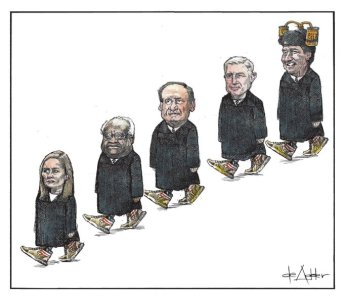
The legal landscape in three of the four criminal cases against Trump continues to shift in his favor this week, following the Supreme Court’s decision to hear the presidential immunity appeal in the D.C. election interference case, creating at least a two-month delay for Trump. Today, requests for trial dates emerged in the Mar-a-Lago case, giving rise to concerns that the scheduling Trump requested, if adopted by Judge Aileen Cannon, would effectively block the D.C. case from going to trial before the election, even if the Supreme Court rules against Trump.
That’s only one of the important things that happened today. E. Jean Carroll filed a stinging response to Donald Trump’s efforts to get out of filing an appeal bond, pointing out that his appeal to the court to trust him was worth about as much as a promise to pay up written on a paper napkin. A transcript released of Hunter Biden’s testimony on the Hill yesterday shows him sparring with Matt Gaetz, suggesting that Gaetz wasn’t the right person to lay into Biden about drug use. A federal judge in Texas halted enforcement of a new state law that would allow Texas police to arrest people suspected of illegally crossing the border because immigration enforcement is the job of the federal government under the Constitution’s Supremacy Clause. In other words, it wasn’t exactly a slow news day. But we’ll focus tonight on the scheduling issues in the Mar-a-Lago case.
Today, Donald Trump, “on behalf of all of the defendants,” filed a proposed schedule for the Mar-a-Lago case. He led with the claim that, “As the leading candidate in the 2024 election, President Trump strongly asserts that a fair trial cannot be conducted this year in a manner consistent with the Constitution, which affords President Trump a Sixth Amendment right to be present and to participate in these proceedings as well as, inter alia, a First Amendment right that he shares with the American people to engage in campaign speech.”
But his lawyers note that since the Judge wants them to propose a trial schedule, they will, although it’s clear that their real request is for a trial after the election. Trump and his co-defendant Carlos De Oliveira propose an August 12 trial date, which means jury selection will start that day, and trial commences after the jury has been seated. Interestingly, their co-defendant Walt Nauta doesn’t want the trial to start until September 9. This is likely because his trial counsel is unavailable between August 5 and August 23, 2024, for “personal reasons.” It’s not unheard of for a judge to direct lawyers to change their vacation plans, if that’s what’s going on here. But if the government wants to try all defendants together and the Judge doesn’t intervene, then this is really a request for trial to start September 9 at best but really, never.
The government’s counterproposal, also filed today, was for a July 8 start. That seems to suggest that Jack Smith believes the Supreme Court won’t be sending the D.C. case back to Judge Chutkan in time for a trial in July or perhaps even in August.
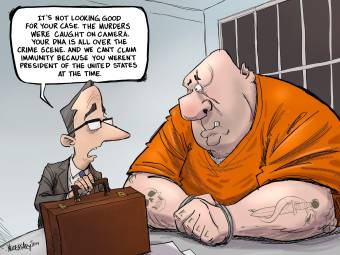 Former Wyoming Congresswoman Liz Cheney had this to say at The New Republic. As reported by Greg Sargent. “Liz Cheney Nukes the Supreme Court Over Trump Delay—and Hands Dems a Weapon. What percentage of voters know that Trump can cancel prosecutions of himself if he wins back the White House?”
In the wake of the Supreme Court agreeing to hear Donald Trump’s demand for absolute immunity from prosecution—potentially delaying his insurrection-related trial until after the election—Democrats should take careful note of Liz Cheney’s response to the decision:
The court’s decision is terrible news, to be sure, but it gives Democrats an opportunity to clarify a few crucial points, and they should seize it.
As many have noted, the Supreme Court didn’t have to agree to review an appeals court ruling against Trump, who is demanding immunity from prosecution for conspiring to obstruct the official electoral count and defraud the United States, among other charges. The high court could have simply let the lower court ruling stand, given that Republican-appointed and Democratic-appointed judges unanimously ruled that Trump’s efforts to overturn the election don’t constitute official acts—and thus don’t get immunity—a clear-cut legal case.
“This is not a difficult legal question,” Maryland Representative Jamie Raskin, a constitutional law professor, told me. “All the Supreme Court has done is to introduce several months of gratuitous delay right before the presidential election.”
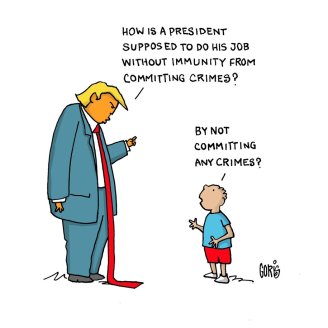
 Speculation is rampant about that “gratuitous delay.” I don’t care much for Nikki Haley and her endless head fakes, but I agree. This is from NBC News. “Nikki Haley calls for all Trump legal cases to be ‘dealt with’ before November. The Republican presidential candidate’s comments came in an interview with NBC News’ “Meet the Press” moderator Kristen Welker in Virginia. I’m not a big fan of Kristen Welker, but at least there was a discussion.
Republican presidential candidate Nikki Haley said that all of former President Donald Trump‘s legal cases should be “dealt with” before the presidential election.
“I think all of the cases should be dealt with before November,” she said Thursday in an interview with NBC News’ “Meet the Press” moderator Kristen Welker in Falls Church, Virginia, where voters will cast their primary ballots Tuesday.
“We need to know what’s going to happen before it, before the presidency happens, because after that, should he become president, I don’t think any of it’s going to get heard,” she continued.
Haley spoke a day after the Supreme Court agreed to decide whether Trump could claim presidential immunity in response to criminal charges. It could take months for the high court to reach a decision, pushing back the potential timeline for his election interference trial.
“I just think a president has to live according to the laws, too. You don’t get complete immunity,” she said, addressing the Supreme Court’s decision to take the case. She added that presidents should not get “free rein to do whatever they want to do.”
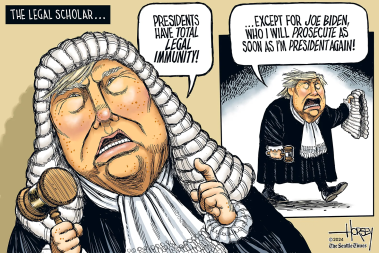
 This headline from The Rolling Stone says it all. “Trump’s Team’ Literally Popping Champagne’ Over Supreme Court Taking Up Immunity Claim. The former president is unlikely to stand trial in the Justice Department’s election interference case before November.”
Various Trump advisers and sources close to the former president and 2024 GOP frontrunner were jubilant about the Supreme Court’s decision, with all of them now viewing it as highly unlikely that a federal election interference trial will happen before Election Day. Though a Trump criminal trial in New York is expected to begin next month, the former president’s team had long viewed a Jan. 6-related trial as more politically damaging. For months, Trump’s lawyers expected the federal trial to start this summer, and they have actively prepared for that scenario. Now, they likely don’t have to worry about that timeline.
The Trump 2024 campaign was fundraising off the court’s latest move hours after it happened. “BREAKING FROM TRUMP: My case is going to the SUPREME COURT!” the campaign texted supporters. “Presidents NEED IMMUNITY.” (This is, however, a position that Trump doesn’t actually hold when it comes to President Joe Biden, who he wants prosecuted.)
Trump has long been campaigning on the idea that presidents, particularly himself, should have free rein to commit crimes while in office — including crimes that “cross the line,” as he wrote on Truth Social in January.
Yes, Trump is doing his usual KKK rally speech wherever he goes. This time, it was at the US/Mexico border. This is from Raw Story. “‘
Trump’s visit to Eagle Pass, Texas, was capped with a press conference to discuss U.S. border patrol policies likely to be at the heart of the 2024 presidential campaign.
“Nobody can explain to me how allowing millions of people from places unknown, from countries unknown, who don’t speak languages,” Trump said in a fragment sentence. “They’re truly foreign languages — nobody speaks them.”
 Meanwhile, Chris Hayes had this to say on Threads.
I feel like I’m losing my mind, but it’s…pretty wild for SCOTUS to just not have issued an opinion on the Colorado ballot case with the actual voting happening on Tuesday. I know the Colorado Supreme Court decision is stayed and he’s on the ballot. And we all know they’re gonna find a way to over rule the CO SC but still seems like you should issue the opinion before the voting in question actually happens.
Colorado votes on March 5th. I really feel that we’ve already lost our democracy in so many ways that something significant needs to be done NOW. At least the Democratic Majority in the Senate is trying to legislate. Today, Senators Durbin, Warnock, Schumer, Booker, Blumenthal, and Butler reintroduce the John R. Lewis Voting Rights Advancement Act. This bill would update and restore critical safeguards of the original Voting Rights Act. Another necessary action to Stop the Runaway Supreme Court. Don’t even get me started on all this hoopla on the border when Ayatollah Mike is blocking a bi-partisan bill led by a Conservative Republican Senator that would pass. This is from the Brookings Institute. William A Galston writes, “The collapse of bipartisan immigration reform: A guide for the perplexed.
Last October, Senate Republicans made it clear that they would not back additional aid for Ukraine without a bill that would help secure the southern border of the United States. With the blessing of both Senator Chuck Schumer, the Majority Leader, and Senator Mitch McConnell, the Minority Leader, a bipartisan team of senators began negotiations to produce a bill that enough members of both parties could accept to overwhelm objections from progressive Democrats and America First Republicans.
The team negotiated for four months to produce this bill. It took less than four days for its support among Republicans to collapse. Why?
The easiest explanation is that Republicans in both the House and Senate yielded to objections from their all-but-certain presidential nominee, former president Donald Trump. Once the House Speaker stated publicly that he would not allow the Senate bill to reach the House floor for a vote, Republican senators were unwilling to run the political risk of supporting a measure that would not become law.
However, there are deeper reasons for the deadlock over immigration. The last comprehensive immigration reform was enacted almost four decades ago, during Ronald Reagan’s presidency. This bill represented a grand bargain between elected officials who sought to extend legal protection to millions of migrants who had entered the U.S. illegally and officials who were most concerned about stemming the flow of such migrants. The bill accomplished the former but had no discernible impact on the latter, leading many conservatives to denounce it as an “amnesty” bill.
This failure to launch legislation, along with the complete inability to pass a budget for a fiscal year about half-gone, is misgovernance on the part of the MAGA cult.
So, this has been a rough week. I hope we can relax some this weekend. It just kills me that so many of our institutions have given Trump impunity. That’s more appropriate than this entire fakery of presidential immunity. The Constitution says no one is above the law. You don’t need a fancy schmancy law degree to know that. You should learn it in Civics class sometime in your secondary education. No one should be able to walk away from the rule of law in this country.
What’s on your reading and blogging list today?
Wednesday Reads
Posted: February 28, 2024 Filed under: 2024 Elections, 2024 presidential Campaign, Donald Trump, Joe Biden | Tags: 2024 Michigan primaries, Alabama IVF ruling, Birth Control, Gaza, low quality polls, Niki Haley, polls, separation of church and state, Simon Rosenberg, uncommitted voters, voters concerned about extremism 20 CommentsGood Morning!!

Henri Matisse, Three Sisters
I’m going to get this out of the way before I get to the real news. Last night President Biden won 81.1 percent of the votes in the Michigan Democratic primary, but it isn’t easy to find that out from the press reports. All of the focus is on the uncommitted votes, which got 13.3 percent. Here is one representative sample:
The Washington Post: Biden wins Michigan primary but faces notable showing by ‘uncommitted.’
President Biden won Michigan’s Democratic primary on Tuesday but faced a notable challenge from voters selecting “uncommitted” to protest his handling of Israel’s military campaign in Gaza, a potential sign of vulnerability for Biden among rank-and-file Democrats.
manager and sister of Rep. Rashida Tlaib (D-Mich.), said in a statement Tuesday. “Tens of thousands of Michigan Democrats, many of whom who voted for Biden in 2020, are uncommitted to his re-election due to the war in Gaza.”
She added: “We don’t want a Trump presidency, but Biden has put [Israeli Prime Minister Benjamin] Netanyahu ahead of American democracy. We cannot afford to pay the bill for disregarding Palestinian lives should it come due in November.”
They don’t want a Trump presidency, but they plan to try to enable one anyway, in the process ending American democracy. But here’s some history on uncommitted votes in Michigan:
Biden campaign officials, however, said the group’s goal of 10,000 votes was artificially low, as 20,000 people have voted uncommitted in each of Michigan’s past three Democratic presidential primaries, even without any organized effort urging them to do so. The president’s allies also cited comments by some of those who threw their support behind the campaign that despite their anger at Biden’s policies, they plan to vote for him in November. A campaign official also noted that there were several “uncommitted” delegates for Barack Obama in 2012, coming from North Carolina, Maryland, Alabama and Kentucky.

Family group reading, by Mary Cassatt
I don’t know any Democrat who doesn’t want a cease fire in the brutal Israel-Hamas war, including President Biden. But Biden can’t magically force either Netanyahu or Hamas to agree to one. Negotiations take place behind closed doors; making them public would defeat their purpose.
Other mainstream news sources also emphasize the uncommitted vote against Biden, but there is little attention to the fact that Trump underperformed the polls, just as he did in New Hampshire and North Carolina. He got only 68 percent of the vote in Michigan, while Niki Haley won nearly 27 percent, once again demonstrating that close to 30 percent of Republicans don’t want Trump as their nominee.
From Simon Rosenberg at Hopium Chronicles: Trump Is Not Strong, Or Winning – No Red Waving 2024 Please.
It Is Wrong To Say Trump Is Winning The Election, Or Is Somehow Favored. He Is Weak, Not Strong – In 2022 a narrative developed about the election – that a red wave was coming – that commentators just couldn’t shake even though there was plenty of data suggesting the election could end up being a close competitive one. I feel like that we are beginning to enter a similar moment in 2024 with the various assertions of Trump’s strengths. The “red wave” over estimated Republican strength and intensity, discounted clear signs of Democratic strength and intensity and was it would be ridiculous, given what happened in 2022, for us to do this all over again this year.
Let me say it plainly – Donald Trump is not ahead in the 2024 election. He is not beating Joe Biden. He is not in a strong position. Signs of Trumpian and broader GOP weakness is all out there for folks to see – if they want to see it. Let’s dive in a bit:
Trump is not leading in current polling – For Trump to be “ahead” all polls would have be showing that. They aren’t. The last NYT poll had Biden up 2, the new Quinnipiac poll has Biden up 4.
Given the spike in both junky, low quality polls and GOP-aligned polls the averages can no longer be relied on – this was a major lesson of 2022. Remember using the averages Real Clear Politics predicted that Republicans would end up with 54 seats. They have 49.
Stripping out GOP aligned polls, and less reliable polling, we find the race clearly within margin of error, which means the election is close and competitive. In a recent analysis, “Trump’s lead over Biden may be smaller than it looks,” The Economist broke down recent polling by pollster quality and found the race dead even among the highest quality pollsters [click the link to see the chart]….
Asserting that somehow Trump leads is pushing data beyond what it can tell you. With margin of error a 1-2 point lead is not an actual lead – it signifies a close, competitive election.
It is also early, and Democrats have not had a competitive primary. Lots of folks are not engaged. Look at this chart from Morning Consult. If the Democratic coalition starts coming home as Biden ramps up and Trump becomes the R nominee he will jump ahead by a few points….
We learned in 2022 that centering our understanding of American politics around wobbly polling and polling averages was risky. No reason we should be doing it again this cycle. Lots of other things we can throw into the strategic blender to understand where we are.
Read the rest at Hopium Chronicles. It’s quite interesting.
The mainstream press seems to want another Trump presidency, because that will make them more money. Biden is competent and doing a good job, but that’s so boring. They want the chaos back again–never mind that Trump would likely prosecute journalists in a second term.

Rene Magritte, The Subjugated reader
Apparently, Trump is a bit nervous about how many votes Niki Haley is getting in the Republican primaries.
Adam Wren at Politico: Trump tried to ignore Haley. He barely lasted a day.
For a full 24 hours on Saturday, Donald Trump did not mention Nikki Haley by name, ignoring her both in a freewheeling address to the Conservative Political Action Conference and after he won the primary in South Carolina.
His campaign said they were turning the page, focusing squarely on the general election. One aide, when asked about the absence of Haley, quipped: “Who?”
By Sunday, that strategic restraint was gone.
In a torrent of posts on Truth Social, just weeks before he is expected to clinch the nomination, Trump had no appetite for comity, blasting Haley as “BRAINDEAD” and “BIRDBRAIN.” He relished the news that Americans for Prosperity would stop spending on Haley’s presidential campaign. He touted a polling lead in Michigan’s primary. “When will Nikki realize,” he posted, “that she is just a bad candidate?”
Maybe when she stops getting 30 percent of the Republican primary votes?
This was not a magnanimous candidate looking to mend the intraparty fracture on full display in exit polls from each of the early electoral contests. This was not a competitor looking to pivot to going after President Joe Biden.
This was a former president entering the general election actively exacerbating divisions within the GOP — at a time when some Republicans are openly warning about the risk of alienating even a small segment of the Republican electorate. Trump has every rational incentive to make overtures to Haley and her supporters, who delivered her roughly 40 percent of the vote in New Hampshire and South Carolina and who are the kind of voters Trump will need to turn out in Michigan and Pennsylvania in November. But he refused to do so — or, perhaps, was incapable of it — despite making head feints in that direction.
“In the exit polls in the three early states, roughly 20 percent are saying they’re not going to vote for Trump,” said Christine Matthews, a Republican pollster and president of Bellwether Research and Consulting. “If that’s true, you need to have like 85 to 90 percent of your base. I do think that he’ll have some problems consolidating, particularly your well-educated, suburban Republicans.”
This is interesting, from Reuters: Exclusive: Extremism is US voters’ greatest worry, Reuters/Ipsos poll finds.
Worries about political extremism or threats to democracy have emerged as a top concern for U.S. voters and an issue where President Joe Biden has a slight advantage over Donald Trump ahead of the November election, a new Reuters/Ipsos poll showed.
Some 21% of respondents in the three-day poll, which closed on Sunday, said “political extremism or threats to democracy” was the biggest problem facing the U.S., a share that was marginally higher than those who picked the economy – 19% – and immigration – 18%.
Biden’s Democrats considered extremism by far the No. 1 issue while Trump’s Republicans overwhelmingly chose immigration.
Extremism was independents’ top concern, cited by almost a third of independent respondents, followed by immigration, cited by about one in five. The economy ranked third.
During and since his presidency, Trump has kept up a steady drumbeat of criticism of U.S. institutions, claiming the four criminal prosecutions he faces are politically motivated and holding to his false claims that his 2020 election defeat was the result of widespread fraud.
That rhetoric was central to his message to supporters ahead of their Jan. 6, 2021, assault on the U.S. Capitol.
Overall, 34% of respondents said Biden had a better approach for handling extremism, compared to 31% who said Trump, the frontrunner for the Republican presidential nomination.
The poll helps show the extent to which Biden’s re-election bid could rely on voters being motivated by their opposition to Trump rather than enthusiasm over Biden’s candidacy.
The fallout from the Alabama IVF ruling is still in the news.
Lisa Neeham at Public Notice: They’re coming for birth control next.
In brief, the reason the Alabama Supreme Court’s opinion implicates and outlaws IVF is that the state has a Wrongful Death of a Minor statute, and the court decided this applies to “all unborn children, without limitation.” But there’s no language in the statute that says this. Rather, it’s just that over the last 15 years, the Alabama Supreme Court has issued a series of rulings saying that the undefined term “minor child” in the statute can be stretched to “unborn children” regardless of what state of development the embryo is at. Once the court created such an expansive definition, the decision that frozen embryos are people was inescapable.
By Utagawa Kuniyoshi
To be fair, though, the Alabama Supreme Court is entirely made up of conservative Republicans, they were a bit hamstrung in their decision. Alabama’s state constitution states that “it is the public policy of this state to ensure the protection of the rights of the unborn child in all manners and measures lawful and appropriate.” But that doesn’t necessarily mean the court was required to, as it did here, extend that “unborn child” definition to what it calls “extrauterine children” — embryos frozen by people pursuing IVF….
For people not saddled with the misguided anti-choice belief that a tiny clump of cells is the same as a person, this is a non-controversial process. It enhances the chance of pregnancy and allows people to plan for future children without undergoing multiple invasive egg retrieval cycles. But if one subscribes to the notion of fetal personhood — that a fetus is quite literally a person, with all the attendant privileges that confers — then those frozen embryos are the same as babies.
This is, of course, a religious, not scientific belief. Chief Justice Parker, in his concurring opinion, made clear that his vote, at least, stems directly from his religious beliefs rather than being grounded in the law. Citing Augustine, Thomas Aquinas, John Calvin, the Ten Commandments, and the King James Bible, Parker concludes that “even before birth, all human beings bear the image of God, and their lives cannot be destroyed without effacing his glory.”
Notably, none of those things are legal precedent. Indeed, in a country founded on the separation of church and state, they shouldn’t inform a court holding. However, since religious conservatives dominate the US Supreme Court, that separation has largely collapsed. This has emboldened conservative litigants and conservative state and federal judges to take ever more anti-choice stances.

A bit more:
Reproductive health activists have been sounding the alarm about the anti-choice attacks on IVF for years, particularly in the wake of the Dobbs decision overturning Roe v. Wade. At least two prominent anti-choice groups, Americans United for Life and Students for Life, have railed against IVF. The chief legal officer for Americans United for Life, Steve Aden, called IVF “eugenics” and said that IVF created “embryonic human beings” that were destroyed in the process. Students for Life called IVF “damaging and destructive.”
These same anti-choice groups also hate birth control, and the Dobbs decision paved the way for them to mount a theocratic attack on it too. Christopher Rufo, who ginned up a panic over benign diversity initiatives and helped force out the first Black president of Harvard, Claudine Gay, has already telegraphed that this is his next attack.
Over on Elon Musk’s increasingly Nazi-fied social media site, X, Rufo is spewing rhetoric about how “the family structure disintegrated precisely as access to birth control proliferated” and that recreational sex is bad and leads to single-mother households.
Rufo isn’t alone. The Heritage Foundation, which is also busy with a blueprint for a second Trump presidency that would destroy the administrative state and whose leader is still pushing the big lie that Trump won the 2020 election, has also called for the end of birth control. Also over on X, Heritage’s official account posted last year that “a good place to start would be a feminist movement against the pill and … returning the consequentiality to sex” [….]
And there you have it. Religious conservatives are calling for a return to a world where sex isn’t recreational or for pleasure but is instead fraught with consequences — namely, pregnancies that can’t be terminated even when the pregnant person’s life is in danger. To do this, however, they would need to succeed in getting the Supreme Court to overturn Griswold v. Connecticut, the 1965 case that invalidated restrictions on birth control.
There’s more at the link.
Sarah Lipton-Lubet at Slate: Republicans’ Absurdist Reproductive Policies Are Coming for Us All.
Nearly two years ago, late into the night on a Monday, I had the terrifying realization that I needed to move my embryos. Immediately.
A few hours earlier—just as I was starting to wrap up work for the day—my phone had lit up in what felt like one long, continuous stream of alerts. Politico had just obtained a leaked copy of the Supreme Court’s draft Dobbs opinion overturning Roe v. Wade. As a reproductive rights attorney leading a Supreme Court reform organization, I knew my immediate next steps. Conference call. Media statement. Email to our supporters. I’d been preparing for this moment since Donald Trump was elected.
I am a child, by Gustav Adolph Hennig
But what I had spent less time thinking about was how this would affect me personally. I wasn’t at all prepared for what to do about my embryos. After years of miscarriages and egg retrievals, I did not have a baby. But I had my embryos. Sitting in nitrogen tanks. In a red state—a red state that had recently passed a draconian anti-abortion bill that, among other things, granted “an unborn child at every stage of development, all rights, privileges and immunities available to other persons.”
That legislation was being challenged in federal court, but now Roe would be gone by the end of June. Amid a swirl of unknowns (What would happen with the litigation? How would that law impact IVF? Would I somehow be prohibited from moving my embryos in the future?) I knew one thing with absolute certainty: If I wanted to control what happened to my embryos, I had to get them the heck out of Arizona, and fast.
Unfortunately, the clinics I called in my attempt to find a new home for the embryos didn’t seem to match my urgency. They couldn’t understand why we would move the embryos at all. Their pace and paperwork was business as usual. Even some of my like-minded friends understood my concern, but not my level of panic, and action. I’ll admit, I had momentary doubts about whether my alarm was misplaced.
Needless to say, the recent Alabama Supreme Court decision—effectively outlawing IVF by declaring that embryos are, legally speaking, children—put to rest any lingering questions about whether I was right to be concerned. As Mark Joseph Stern reported, embryo shipping services have already said they will no longer ship to or from Alabama.
And isn’t that the story of reproductive freedom in America in a nutshell? Time and again, advocates sound the alarm only to be told that we are being hysterical. Then we watch in horror as our worst fears materialize.

Read the rest at Slate.
One more on this topic, from Politico: Senate GOP poised to block IVF protection bill.
Senate conservatives are signaling they’ll block Wednesday’s planned Democratic bid to enshrine protections for in-vitro fertilization into federal law – and they’re calling IVF a states-rights issue.
Sen. Tammy Duckworth (D-Ill.) is planning to seek unanimous consent to pass her proposal to federally protect IVF, which means any one senator can easily block its passage. This isn’t the first time she’s brought up her bill — Sen. Cindy Hyde-Smith (R-Miss.) objected when Duckworth tried to pass it unanimously in 2022.
But Duckworth’s bill is surging back to the forefront as Republicans face uncomfortable questions about an Alabama Supreme Court ruling restricting IVF.
Hyde-Smith’s office did not respond when asked if she would object again to Duckworth’s bill, and the GOP senator ignored Capitol hallway questions from reporters, as is her usual practice. Other Republicans are already expressing reservations about the bill, though – meaning its chances at slipping through the chamber are slim, at best.
“I don’t see any need to regulate it at the federal level,” said Sen. Roger Marshall (R-Kan.), an OB-GYN by trade, who would not say whether he’d block the bill. “I think the Dobbs decision puts this issue back at the state level, and I would encourage your state legislations to protect in-vitro fertilization.”
“It’s idiotic for us to take the bait,” said Sen. J.D. Vance (R-Ohio), who clarified he was referring not to Duckworth’s bill on its face but to Democrats’ attempts to use the proposal as an IVF messaging tool. Vance said he’s not yet reviewed the actual bill.
Regardless, Republicans’ hesitation over the IVF protection bill highlights their election-year jam: Democrats will continue trying to tie them to the Alabama ruling, which has shut down IVF facilities in the state.
And GOP statements supporting IVF — as the Senate Republican campaign arm and several candidates put out last week — might fall flat with voters if Democrats can point to specific instances when their opponents failed to protect the procedure. Exhibit A: Speaker Mike Johnson, who recently issued a statement supporting IVF but has previously supported legislation that could restrict access to the fertility tech.
That’s all I have for you today. What do you think? What other stories have captured your interest?
Mostly Monday Reads: Surrealistic Wallow
Posted: February 26, 2024 Filed under: just because | Tags: fetus fetishists, IVF, Ruth Marten, Tracking Fascist Trump Policies, Trump Donation Scams, War against Women, White Christian Nationalists 5 Comments
Good Day, Sky Dancers!
It’s difficult to check the headlines these days. It’s like living in an alternate America where bizarro rules apply. But hey, it’s what a small minority of White Nationalist Christians want, and they’ve worked hard to get elected officials at all levels to turn us into everything we were warned about in The Handmaid’s Tale and by Hillary Clinton. We’ve talked a lot about it here, but David French provides some elucidation in his opinion piece in today’s New York Times. ” I suppose it only gets serious attention when a man writes about it. I watched Rob Reiner’s interview with Ari Melber last week. Now I feel I should definitely see this film.
The problem with Christian nationalism isn’t with Christian participation in politics but rather the belief that there should be Christian primacy in politics and law. It can manifest itself through ideology, identity and emotion. And if it were to take hold, it would both upend our Constitution and fracture our society.
The sociologists Samuel Perry and Andrew Whitehead define Christian nationalism as a “cultural framework that blurs distinctions between Christian identity and American identity, viewing the two as closely related and seeking to enhance and preserve their union.” The author and pastor Matthew McCullough defines Christian nationalism as “an understanding of American identity and significance held by Christians wherein the nation is a central actor in the world-historical purposes of the Christian God.” Both definitions are excellent, but what does ideological Christian nationalism look like in practice?
In 2022, a coalition of right-wing writers and leaders published a document called “National Conservatism: A Statement of Principles.” Its section on God and public religion states: “Where a Christian majority exists, public life should be rooted in Christianity and its moral vision, which should be honored by the state and other institutions both public and private.” That’s an extraordinary — and ominous — ideological statement, one that would immediately relegate non-Christians to second-class status. It’s utterly contrary to the First Amendment and would impose a form of compelled deference to Christianity on both religious minorities and the nonreligious.
But Christian nationalism isn’t just rooted in ideology; it’s also deeply rooted in identity, the belief that Christians should rule. This is the heart of the Seven Mountain Mandate, a dominionist movement emerging from American Pentecostalism that is, put bluntly, Christian identity politics on steroids. Paula White, Donald Trump’s closest spiritual adviser, is an adherent, and so is the chief justice of the Alabama Supreme Court, Tom Parker, who wrote a concurring opinion in the court’s recent I.V.F. decision. The movement holds that Christians are called to rule seven key societal institutions: the family, the church, education, the media, the arts, business and the government.
One doesn’t have to go all the way into Seven Mountain theology, though, to find examples of Christian identity politics. The use of Christianity as an unofficial but necessary qualification for office is a routine part of politics in the most churchgoing parts of America. Moreover, one of the common red-America arguments for Trump is that he might not be devout himself, but he’ll place lots of Christians in government.

Ruth Marten
The thing that struck me about this, having never and still not being a fan of French, is that I’m really tired of people defending a religion whose roots have never been benign. Its roots were all so the reason many folks came here to escape whatever brand of it was most toxic at that point in history. It’s worth getting everyone to know about what kind of danger lurks in this current version of fascism. It’s also tiring to hear “not everybody …”.
It’s also worth noticing that Mike Johnson may not be able to get much done, but he’s working diligently on getting fertilized more rights than living, breathing women. This is from the Washington Post. “Republicans who say they support IVF backed a bill protecting life ‘at conception’, The antiabortion bill in the House has no provisions for processes like in vitro fertilization.” The story is reported by Mariana Alfaro.
Prominent congressional Republicans are coming out in support of in vitro fertilization days after the Alabama state Supreme Court ruled that frozen embryos are people and therefore that someone can be held liable for destroying them.
But many of the same Republicans who are saying Americans should have access to IVF have co-sponsored legislation that employs an argument similar to the one the Alabama Supreme Court used in its ruling.
The congressional proposal, known as the Life at Conception Act, defines a “human being” to “include each member of the species homo sapiens at all stages of life, including the moment of fertilization or cloning, or other moment at which an individual member of the human species comes into being.” The bill would also provide equal protection under the 14th Amendment “for the right to life of each born and preborn human person.”
I’ve been watching the back-and-forth between Hillary and Lady Lindsey on Threads and Twitter.
We need to win these rights permanently before we lose them forever.

Ruth Marten
Here’s a fascinating article from ProPublica. “Inside the Internal Debates of a Hospital Abortion Committee. In states that banned abortion, doctors are forced to wrestle with tough decisions about high-risk pregnancy care. “I don’t want to have a patient die and be responsible for it,” one Tennessee doctor said. This report is written by
Sitting at her computer one day in late December, Dr. Sarah Osmundson mustered her best argument to approve an abortion for a suffering patient.
The woman was 14 weeks pregnant when she learned her fetus was developing without a skull. This increased the likelihood of a severe buildup of amniotic fluid, which could cause her uterus to rupture and possibly kill her. Osmundson, a maternal-fetal medicine specialist at Vanderbilt University Medical Center who helps patients navigate high-risk pregnancies, knew that outcome was uncommon, but she had seen it happen.
She drafted an email to her colleagues on the Nashville hospital’s abortion committee, arguing that the risk was significant enough to meet the slim exception to Tennessee’s strict abortion ban, which allows termination only when “necessary to prevent the death of the pregnant woman or to prevent serious risk of substantial and irreversible impairment of a major bodily function.” She pleaded with her fellow doctors to spare this woman the gamble when her baby wasn’t even viable.
Then came the replies.
One doctor wasn’t “brave enough.”

Ruth Marten
We’ve finally got some folks in the media noticing that Trump is a drooling idiot these days. It’s Salon today. Maybe tomorrow, some of the East Coast rags will pull it together. “Trump’s CPAC speech showed clear signs of major cognitive decline — yet MAGA cheered. A confused Donald Trump kept up his threats of retribution during this weekend’s conservative confab. This is written by Chauncey DeVega.
Donald Trump was in his full glory over the weekend at the annual Conservative Political Action Committee (CPAC) conference. For his MAGA people, Republicans, and other neofascists and followers, Trump is like a father figure, preacher, teacher, confessor, lover, and god messiah prophet all in one person. In that way, CPAC is Donald Trump’s “church family” – only the church is full of fascism, hatred, wickedness, cruelty, and other anti-human values, beliefs, and behavior. Trump masterfully wields and conducts this energy.
Donald Trump’s speech at this year’s CPAC was truly awesome. As used here, “awesome” does not mean good, but instead draws on the word’s origins as in “inspiring awe or dread.” In his keynote speech on Saturday, Trump said that America is on a “fast track to hell” under President Biden and the Democrats and that “If crooked Joe Biden and his thugs win in 2024, the worst is yet to come. Our country will sink to levels that are unimaginable.”
He continued with his Hitler-like threats of an apocalyptic end-times battle between good and evil and that the country would be destroyed if he is not installed in the White House. Of course, Trump continued to amplify the Big Lie about the 2020 election being “stolen” from him and the MAGA people. He also made great use of the classic propaganda technique, as though he learned it personally from Nazi Minister of Propaganda Joseph Goebbels: Accuse your opposition of that which you are guilty of.
If you want some really frightening things from Trump and his White Christian Nationalists/Fascists, check out Just Security. “American Autocracy Threat TrackerA Comprehensive Catalog Based on Donald Trump and His Associates’ Plans, Promises, and Propositions.”
Former President Donald Trump has said he will be a dictator on “day one.” He and his advisors and associates have publicly discussed hundreds of actions to be taken during a second Trump presidency that directly threaten democracy. These vary from Trump breaking the law and abusing power in areas like immigration roundups and energy extraction; to summarily and baselessly firing tens of thousands of civil servants whom he perceives as adversaries; to prosecuting his political opponents for personal gain and even hinting at executing some of them. We track all of these promises, plans, and pronouncements here and we will continue to update them in real time.
We assess there is a significant risk of autocracy should Trump regain the presidency. Trump has said he would deploy the military against civilian protestors and his advisors have developed plans for using the Insurrection Act, said he would invoke the Alien Enemies Act to conduct deportations of non-citizens, continued to threaten legally-established abortion rights, and even had his lawyers argue that a president should be immune from prosecution if he directed SEAL Team Six to assassinate his political enemies. Trump also seeks the power to protect his personal wealth as he faces staggering civil fines, and to bolster his immunity as he faces 91 criminal charges in prosecutions in different parts of the country.
While Trump has claimed he will be a dictator for only the first day of his administration, his promise to do so–even for 24 hours–is antithetical to American democracy. History teaches us that dictatorial powers, once assumed, are rarely relinquished. Moreover, Trump cannot possibly achieve his stated goals for the use of that power (in immigration and energy policy) in one day, meaning that his “dictatorship” would of necessity likely last much longer.
Trump’s former advisors—those with the most experience watching him govern behind the scenes—believe he is a danger to the country. John Bolton, Trump’s former National Security Advisor, said, “I think Trump will cause significant damage in a second term, damage that in some cases will be irreparable.” Alyssa Farah Griffin, former Trump White House Director of Strategic Communications, noted, “Fundamentally, a second Trump term could mean the end of American democracy as we know it, and I don’t say that lightly.”
Trump’s dictatorial aspirations are complemented by an extensive pre-election plan to fundamentally alter the nature of American government: the Heritage Foundation’s 2025 Presidential Transition Project (Project 2025). Created by Trump allies and staffed by those including his past and likely future administration appointees, it is in the words of Heritage Foundation president Kevin Roberts, a plan for “institutionalizing Trumpism.” Trump has returned the compliment, saying of Roberts (and Heritage) that he’s “doing an unbelievable job, he’s bringing it back to levels we’ve never seen … thank you Kevin.”
 This is your bedtime reading if you want nightmares.
I hope no one has their inheritance in the hands of a Trump Cult Member. Who would trust their money to anything Trump-related? Well, CNBC has some answers. “Trump and his favorite fundraising platform both face donor problems.” Of course, they do. This is reported by Brian Schwartz.
Every so often, Matthew Hurtt receives concerning emails. The subject lines are each slightly different: “Stop charging my account,” “Urgent!” and “Donation not approved,” but the people who send them all want the same thing: to halt the Republican political contribution platform WinRed from making any more automatic, recurring withdrawals from their accounts.
Hurtt is chairman of the Virginia-based Arlington County Republican Committee and says he’s reviewed a “few dozen” of these types of emails since the 2020 election. When WinRed processes a contribution to a Republican campaign, the charge shows up on the donor’s credit card or bank statement as a payment to “WINRED http://www.GOP.com, Arlington VA,” according to a statement provided by Hurtt and reviewed by CNBC.
As a result, people often mistakenly believe their money went to the Arlington County Republican Party, he said.
“Cancel account and stop billing my credit card,” Oklahoma resident Samie Elliot wrote in a January email that landed in Hurtt’s inbox. She later explained to him that neither she nor her husband, who are both retired, recalled ever signing up for recurring monthly political donations and that these charges have been occurring for at least a year.
Federal Election Commission records, however, paint a very different picture of the Elliots. According to campaign finance reports, WinRed processed $14,300 in political contributions from Elliot and her husband, Orin Elliot, between 2020 and the end of 2023.
These donations all appear to have been small, recurring contributions. Exactly the kind that Elliot said they did not recall signing up for. Samie Elliot did not respond to requests for comment.
“Every one of them has told me a similar story: elderly, sometimes dementia, and don’t remember donating month after month,” said Hurtt, who shared nine email exchanges with CNBC for this story.
“As a county committee chairman who struggles to raise money, it infuriates me,” he said.
WinRed did not respond to requests for comment.
I was going to try to find something cheery and not frightening today, but it is what it is. I’ve left some easter eggs in the links to the artist Ruth Marten, whose surrealistic art is featured today. Enjoy!
What’s on your reading and blogging list today?

 peej
peej Carissa
 bostonboomer
 dakinikat
 ecocatwoman
 mablue2
 Mama Lopez
 peggysue22
 quixote
 skydancingguestblogger
 Mona (aka Wonk the Vote)



 Sky Dancing
Recent Comments