Sky Dancing

a place to discuss real issues

  • Some key retirements today.  As expected, Obama will get a chance to appoint the next judge to SCOTUS.  Glenn Greenwald profile’s one possible appointment here at Salon, Elena Kagan.

    The danger that we won’t have such a status-quo-maintaining selection is three-fold:  (1) Kagan, from her time at Harvard, is renowned for accommodating and incorporating conservative views, the kind of “post-ideological” attribute Obama finds so attractive; (2) for both political and substantive reasons, the Obama White House tends to avoid (with a few exceptions) any appointees to vital posts who are viewed as “liberal” or friendly to the Left; the temptation to avoid that kind of nominee heading into the 2010 midterm elections will be substantial (indeed, The New York Times‘ Peter Baker wrote last month of the candidates he said would be favored by the Left:  “insiders doubt Mr. Obama would pick any of them now“); and (3) Kagan has already proven herself to be a steadfast Obama loyalist with her work as his Solicitor General, and the desire to have on the Court someone who has demonstrated fealty to Obama’s broad claims of executive authority is likely to be great.

    Matthew Ygleisas has some Outside the Box suggestions for Potus.

    What motivated Bart Stupak to retire? via Marc Ambinder.

    Rep. Bart Stupak (D-MI) plans to announce his retirement today, Democrats briefed on his decision said. Stupak, the leader of a pro-life faction within his party, had received death threats and was under intense political pressure after he agreed to support the Democratic health care reform legislation even though pro-life groups insisted that it would allow federal funds to be used for abortion.

    Do you suppose we could encourage Ben Nelson of Nebraska to consider announcing his retirement next?  I’d also like to see Bobby Jindal retire but no such luck.

    Nate Silver takes about the chances of a Red Christmas here.

    The point is not necessarily that these are the most likely scenarios — we certainly ought not to formulate a judgment based on Rasmussen polls alone, as the jury is still out on whether the substantial house effect they’ve displayed this cycle is a feature or a bug. But these sorts of scenarios are frankly on the table. If Democrats were to lose 50, 60, 70 or even more House seats, it would not totally shock me. Nor would it shock me if they merely lost 15, or 20. But their downside case could be very far down.

  • If we lived in a perfect world of either perfect market capitalism or perfect government planning, there’s a lot of things that wouldn’t exist. There would be no corruption, no hidden information, no excesses or shortages, and absolutely no need for banks, insurance companies, and stock, real estate, or insurance brokers. That’s right. The entire FIRE lobby wouldn’t exist. Not only would we not need lobbyists, but we wouldn’t need the industries they represent. The Financial Markets exist because we don’t have any perfectly beneficent centrally planned governments or any form of real capitalism with perfect markets. They can’t exist. They are theoretical models period.

    We have blended economies. They’re mishmashes of government intervention and mess-ups and failing markets and limping-along-as-best-they-can-markets. Nearly every economic transaction in the real world is fraught with some kind of chance for a misfire. You hire a real estate broker who you hope you can trust to guide you through the treacherous process of buying and selling the biggest asset most folks will ever have. You don’t know what’s a fair price, you don’t know where the buyers or sellers are and if either are honest or hiding The Money Pit from you, and you certainly don’t know who is a good or bad mortgage loan lender and lawyer to help ensure that you get a loan and a title free of bad encumbrances. That process is the same when you have a baby and you need a doctor and a hospital and you trust your insurance company to get a good deal for you. It’s the same when you look to save up for your pension or your kid’s college. The entire FIRE industry is there to help you navigate a bunch of imperfect markets with a lot of imperfect information. They’re supposed to be the experts who will help you navigate moral hazard and hidden information for you.

    Except when they don’t.

    Then, their government regulators are there to protect you and them from the bad eggs in the business. No one should be protected from their own stupidity, but these markets are so fraught with hazards and problems, that anything can happen. Bernie Maddoffs happen despite everything. So, do Goldman Sachs’ untoward influence in the NY Fed and the Treasury and financial panics. The key to these markets is middle-path economics. Yes, I’m a Buddhist and a Financial economist so I have to use the don’t tune the string too tight or it breaks, or tune the string to loose or it won’t play metaphor. It’s a balancing act. The financial markets play a unique role in a mixed market economy. The way we treat them must be unique also.

    I got drug back from the bliss of the first few days of spring break where the last thing I should be thinking about is the financial markets (not teaching) but the only thing I should be thinking about is the financial markets (researching) by an email by the petulant clown. Did I want to handle or look at the discussion here? It’s a thread at FDL started out with a nod to the WAPO editorial here by Simon Johnson and James Kwak then a retort at the NYT by Paul Krugman here. The central question is financial reform. The specific question is should we break up big banks? Johnson and Kwak join ex-Fed Chair Volcker and say yes. Krugman says no, just toughen their regulation. My bottom line is all of the above. Break them up AND toughen the regulation.

    (more…)

  • *Well, one of them is Michelle Bachmann.

    Having lived in the middle of the country all of my life in the biggest cities in large states with geographically huge rural areas, I’m more than aware of the urban v. rural dilemma of where you raise taxes and where you spend them.  All of these states are also bright red for the most part.  Iowa and Minnesota occasionally go blue these days.

    One of the biggest disparities always comes with distribution of highway taxes. In Nebraska, as example a huge amount of tax dollars for taxes are raised by Lincoln and Omaha, but the majority of the highway dollars are spent on maintaining and building roads to almost no where. Visiting Cherry County Nebraska is a trip to nowhere. It’s a beautiful part of the state, it’s the state’s biggest county.  It’s basically the Nebraska outback and there are more cows and buffalo than people.  According to Wiki,  Cherry County ‘had a population of 6,148 at the 2000 census“.

    According to the U.S. Census Bureau, the county has a total area of 6,010 square miles (15,565 km²). 5,961 square miles (15,438 km²) of it is land and 49 square miles (127 km²) of it (0.82%) is water. It is by far the largest county in land area in Nebraska and larger than the states of Connecticut, Delaware, or Rhode Island.

    My friends from other countries–especially from Europe–or friends from the NE do not really understand the idea of starting a drive on the east side of a state and taking all day to get to the other.  A drive across states like North or South Dakota,  Montana or Wyoming is where you get the real feel of the term the American Outback.  Even on the interstate, you see more antelope and cows then you ever see people.  You can actually go miles before you get even get a rest stop.  It’s that vast.

    So, I was born in the town that is home to the Pioneer Woman Museum.  That’s the little town of Ponca City, Oklahoma. My great grandmother’s maiden name was Chisholm.  Yes, that Chisholm.  I come from a long line of Pioneer women.  I went to the same University as Willa Cather and I celebrated the centennial of Nebraska in 4th grade by spending some time with our school in a mock up of a pioneer school.  We wore bloomers and long dresses and bonnets. We sat our benches and wrote on our own little chalk boards.  I have to admit, the first set of books I read all the way through was the Little House on the Prairie series.  My father’s side of the family is a wonderful blend of German and Irish immigrants and Native Americans.  Yes, My Antonia is one of my favorite books. It’s about the Great Nebraskan Outbook.   I remember the uproar when the Poppers presented their “Buffalo Commons” idea.  It was a major controversy.

    The Buffalo Commons is a conceptual proposal to create a vast nature preserve by returning 139,000 square miles (360,000 km2) of the drier portion of the Great Plains to native prairie, and by reintroducing the buffalo, or American Bison, that once grazed the shortgrass prairie. The proposal would affect ten Western U.S. states (Montana, North Dakota, Wyoming, South Dakota, Colorado, Nebraska, Kansas, Oklahoma, New Mexico, and Texas).

    Some of the Buffalo Commons idea has evolved naturally.  Ted Turner actually owns a lot of the Nebraskan outback and has turned his land into Buffalo Ranches.  He’s done this in several Western States including Montana. In the 80s, I worked as a consultant to the State’s Department of Economic Development and as a consultant to many small towns trying to keep the only industry in the county.  I consulted with chicken slaughtering plants, plants making parts of bombs, plants making parts for cars, plants making taco chips, and all kinds of things.  With that much territory and that few people, it’s hard to get a tax base to support roads, schools, government, parks, libraries, and all the things that folks on the east and west coast take for granted.  When you come from pioneer stock or the Native American tribes in the region, you really do relish a sense of self reliance in a very big land.  Yet, like many of the myths of the Old West, the New West is a lot more swagger than reality.  Native American tribes may do it on their own, but the sons and daughters of pioneers have their own special welfare state going.

    However, that sense of rugged independence is belied by the facts.  Ah, yes, we’ve finally gotten to the purpose of all my romanticizing of childhood on the edge of nowhere that I really would’ve traded for Manhattan. We subsidize the Prairie Dream hugely.  They don’t like to admit it in the list of states proposed as locations for a great huge nature preserve, but they are welfare queens.

    Jeff Frankel took a lot of numbers and came up with the graph and results in Red States, Blue States and the Distribution of Federal Spending.  I’ve never lived in a state that has paid more in federal taxes than it receives.  That’s the big lie in this part of the country.  We need the very blue states that most of the folks despise. We’ve talked about this before, but Frankel’s Weblog has the numbers.

    The accompanying chart contains 50 data points, one for each state.  The data are from 2005, the most recent year available.  One axis ranks states by the ratio of income received by that state from the federal government, per dollar of tax revenue paid to the federal government.   Personally, I think the “red state / blue state” distinction is overdone.  But to capture the widely felt tension between the heartland and the coastal urban centers, I have put on the other axis the ratio of votes for the Republican candidate versus the Democratic candidate in the most recent presidential election.

    It will come as a surprise to some, but not to others, that there is a fairly strong statistical relationship, but that the direction is the opposite from what you would think if you were listening to rhetoric from Republican conservatives:   The red states (those that vote Republican) generally receive more subsidies from the federal government than they pay in taxes; in other words they are further to the right in the graph.  It is the other way around with the blue states (those that vote Democratic).

    One reason is that the red states on average have lower population; thus their two Senators give them higher per capita representation in Washington than the blue states get, which translates into more federal handouts.    The top ten feeders at the federal trough in 2005 were: New Mexico, Mississippi, Alaska, Louisiana, West Virginia, North Dakota, Alabama, South Dakota, Kentucky and Virginia.   (Sarah Palin’s home state of Alaska ranks number one if measured in terms of federal spending per capita.  Alabama Senator Shelby evidently gets goodies for his state, ranked 7, by indiscriminately holding up votes on administration appointments.)  The top ten milk cows were: New Jersey, Nevada, Connecticut, Minnesota, Illinois, Delaware, California, New York, and Colorado.

    Perhaps in determining how the federal government redistributes income across states one should view its role more expansively than is captured in the budget numbers.     In the western states there are federal water projects that subsidize water for farmers, artificially low grazing fees for ranchers, and leases for hard rock mining and oil drilling on federal lands that have historically charged artificially low prices.   Perhaps the biggest federal redistribution program of all is massive agricultural subsidies.  The four congressional districts that receive the most in farm subsidies are all represented by “conservative” Republicans, located in Nebraska, Kansas, Iowa, and Texas.  (Michele Bachmann’s family farm apparently received $250,000 in such farm payments between 1995 and 2006.)

    The most commonly ignored area of geographical redistribution is the federal government’s permanent policy of “universal service” in postal delivery, phone service and other utilities (electricity; perhaps now broadband…).  Universal service means subsidizing those who choose to live in remote places like Alaska, where the cost of supplying these services is much higher than in the coastal cities.   Perhaps they should move…

    It’s nice to see that some one is setting the record straight.  The transfer of taxpayer wealth is going to places that aren’t the memes of either the tea party, the Republican Party, screamers like Glenn Beck, or fuzzy thinkers like Michelle Bachmann.  The true welfare state recipients are the ones that scream the loudest about the welfare state. This hardly fits in with their message of doing it without the help of big government.

  • I have to admit to believing the central right of all rights is control over your own body.  It is a defining right for me.  Up until this election, I stopped voting for candidates who described themselves as anti-choice because to me it indicated the inability to draw a line in the sand on what is and isn’t the business of government.  I’m that way about sex between consenting adults also.  To me, it’s a matter of none of your damned business, let alone a government law.    I know that many men in the Republican party choose the anti-choice stand simply because it is the path of least resistance.  You get a lot of resistance when you choose to be a pro-choice activist.  You risk your life and your family too.  Most of them just aren’t that willing to put their stuff on the line for women.  They know when they get enough money, the can buy a slightly better class of second class citizenship for their wives and daughters.  That includes a trip to an abortion clinic in New York City if need be.

    There’s an interesting letter out on Feminists Choosing Life of New York . (h/t to the diary of debbierlus on The Seminal/FDL.) The organization claims–contrary to others’ opinions–that it is not an “organization of foaming-at-the –mouth anti-abortion loons whose only goal is to see Roe v Wade overturned using whatever means necessary”.  They list these achievements to promote feminist causes.

    While it is true that FCLNY works to educate the public on the exploitative nature of abortion (efforts we do not apologize for), abortion is not our only concern because it is not the only concern of women. Throughout our history, we have worked on many different fronts to help improve life for women and their children. FCL has worked to oppose capital punishment, war and domestic violence. We have worked to raise the minimum wage, increase funds for quality childcare and advocate for Unborn Victims of Violence legislation. We have protested against over-the-counter availability of emergency contraception for minors, given our support to adoption agencies and have sponsored young women athletes in their quests to be champions. FCL has worked to oppose the use of taxpayer funds for embryonic stem cell research and now leads the fight against compensation of women for their eggs to be used in this research-a dangerous and painful procedure that exploits young women.

    Since the Democratic party seems completely unable at the moment to fully support the right to choose and continues to ignore the rights of women in general, is it possible to find ways to work with organizations like these to further women’s rights?

    Like I said, the entire anti-choice movement has been anathema to me on a very visceral level. For me to even ask this question goes against much of what I fought for as a young woman and a young mother.  However, if the Democratic Party continues to backtrack on commitments to furthering women’s rights, how much of choose do we have but to seek other allies in other key causes?

    Given that we’ve all been put further into second class citizenship by a Democratic President and a Democratic Congress, is it time to find a feminist bipartisanship?

    Can we join together to fight Jane Crow?

    (You can consider this an open thread if you’d like.)

  • Disequilibrium is an interesting concept that has roots in many disciplines. Of course, in physiology it just simply means something’s off balance. You can have an inner ear infection, become dizzy, and feel miserable as well as fall because you become unsteady on your feet. That’s the kind of disequilibrium associated with vertigo. There’s linkage disequilibrium which is a term used in population genetics which causes diseases like cystic fibrosis when there are “non-random association of alleles at two or more loci, not necessarily on the same chromosome.” Something’s off balance there too, although I frankly can’t explain it at all.

    In economics, disequilibrium is a state where a market can’t achieve that place where forces reach a state of balance in terms of supply and demand. You don’t achieve the magical market clearing status called equilibrium where you get this mutually agreed upon price level and quantity so things usually stay at a place where you get excesses or shortages and the society really wastes a lot of communal resources. Wasting resources is a big welfare inhibitor in this situation because you’re preventing a state where a lot more mutually beneficial transactions could occur. We’re looking for optimality, for efficiency, for correct allocation of resources and none will happen.

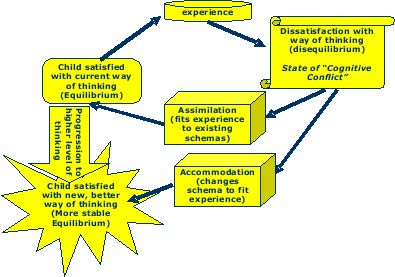
    I’m not a psychologist but I’ve had more than a few psychology courses and I do love the idea of disequilibrium in this discipline. I studied cognitive dissonance a lot when I got a teaching certificate and had to endure quite a few hours in educational psychology and psychology. You just can’t avoid the work of Jean Piaget and disequilibrium in cognitive development. It is one of his big things. I was so impressed with his work that both my children went to Montessori schools which is an offshoot of his studies on human development. You can ask BostonBoomer the details because that’s her thing, not mine. Mine is General Equilibrium of the economic sort but it operates in markets instead of the minds of children.

    I’ve put the nifty graphic in there which shows you the basic Piaget model. In all the processes of disequilibrium, the cognitive one included, something is off-balance. It just isn’t right. When you get a sense of cognitive dissonance your supposed to get an uncomfortable feeling because you’re holding two logically inconsistent viewpoints in your mind and it upsets your balance. That’s the state of Cognitive Conflict. You react noticeably as you try to reconcile the two distinct beliefs or states. In psychology this can lead to what they call confirmation bias where your mind starts blocking out evidence so that you can feel better about the situation by ignoring the disconfirming evidence altogether. It’s basically an ego defense mechanism.

    So, back to economics now where our model is out of whack because something is in the way of the market reaching equilibrium. Either supply or demand has been fettered by something. This something can come from the government in the form of quotas, tariffs or price controls. It also can come from the market. Something can slow the process to equilibrium like “sticky downward’ or rigid wages which is a Keynesian concept related to people not particularly liking their incomes and budgets messed with regardless of what’s going on with prices in the broader economy. This is a economics example of cognitive dissonance, although most economists will completely run the other way whenever you try to equate their sacred science with something that resembles ‘psycho-babble’ and not their model of the rational, need driven householder.

    So, why am I babbling on about this like the weird and wonky academic with a lot of background in social science research that I have? Because, I sense a huge macro-disequilibrium in the United States right now in a much more multi-discliplined way than most social scientists or scientists sense and study.

    Something doesn’t feel right and I can’t solve the equation. It’s a disequilibrium in that touch- feely cognitive dissonance sort’ve way that I believe is coming from one of the root sources of economic disequilibrium. That would be perverse incentives. The government can put a market perpetually out of equilibrium by taxing or rewarding behaviors that make one side benefit and the other side lose. This is what happens when they use Tobin Taxes (so-called sin taxes) or quotas for imports or quantity restrictions to prop up businesses, or some other kind of price controls. The result is measurable in a market. It creates what we call a deadweight loss. This is a situation where there is no Pareto optimality, ever, which is that state of equilibrium where supply equals demand, the right price is achieved and an optimum quantity becomes available to the market. Deadweight loss is an excess burden which reflects the loss to society of not having the Pareto or optimal outcome. We lose something. We transfer benefit from one group to another or from both groups to the government for one reason or another. Sometimes, we do this for seemingly quite good and innocuous reasons, but it still creates disequilibrium. Usually, it’s perverse incentives. We try to correct some problem and just wind up creating a bigger problem, like New York City did with Rent Controls in the 1970s.

    What’s been going on recently is just one set of circumstances that’s throwing off the balance of one thing after another and it’s transferring the benefit from one group to another. It’s like some perverse set of incentives is causing us to self-destruct in a way that makes us all feel this massive group cognitive dissonance. Something just doesn’t feel right and we can’t use the evidence that exists to find equilibrium because we can’t get there from here without throwing out some of the evidence just to get rid of that off feeling.

    So, the deal is, in Psychology, some people are able to throw out evidence. They will convince themselves that up is down and right is wrong to maintain a sense of equilibrium even when evidence suggests equilibrium cannot be achieved under this conflicting evidence or under these perverse incentives. That, for all the good that it does, explains why some folks can believe that this mess of a health policy will solve ills and achieve goals when it is likely to create a massive wealth transfer and a huge deadweight loss to society. It makes them feel better to believe that this is a circumstance where the lightbringer will deliver their pony. It justifies their decision to support him at all costs. Others, will go batshit crazy and vote Republican. It completely depends on which evidence you throw out. Some of us will just sit here trying to resolve our sense of unease unsuccessfully.

    I’ve never been very good at inducing a state of denial, and I assume that most of you here aren’t either, so where does it leave us?

    My answer is simply in that we are in state of cognitive vertigo together. Maybe, at the moment, that’s the best we can do.