““No Mortal Man is Above the Law,” sayeth the Supremes. Enjoy your Independence Day; if the Conflicted Convicted Felon is elected, it’ll be our last.” John Buss, Repeat 1968
Good Day, Sky Dancers!
Independence Day has always been my favorite holiday, and it’s my youngest daughter’s too. When we lived in the Quarter, we would always walk our 2 blonde labs to the Mississippi River Bank and watch the left and east bank boats launch a huge fireworks display. Down here in the Bywater, it’s still the same short walk to the riverbank, but the Poland Avenue Wharf or the newest Crescent Park are the favorite places to go. Cars always turn to our local NPR station for patriotic music and blast it loud. You can tell when it’s time for the display because all the bars and houses empty into the streets and head south to the banks of the Mississippi River. I have always wondered what past celebrations were like, but that’s a rabbit hole for another day.
I spent the pre-show hours with friends listening to his industrial band livestream their efforts while sitting in their driveway patio. It seemed like a normal fourth. While everyone headed to the river, I headed home to Temple to let her dig a burrow under me to hide from the noise. No displays for me in the last 10 years. Just time at home in bed comforting Temple. The weird thing this year was the fireworks didn’t seem to bother her, and she spent most of the time spooning me. Maybe she sensed that my fear was far greater than hers today. It’s a thought.
Twilight’s last gleaming from last night at my neighbor’s driveway patio.
The swiftboating of the democratic candidate season has begun. My friend who owns the bar on the corner told me she’s hearing from others besides me who are looking for places to become expats. Given the Le Pen elections, I’m researching the south of France right now, although they may soon have their counter-revolution. Russia is happy about that one. I’m sure they have high hopes for us.
If you haven’t seen this little speech, you really should. “Leader of the pro-Trump Project 2025 suggests there will be a new American Revolution. Kevin Roberts said the revolution will be bloodless “if the left allows it to be.” This is from the AP but sourced at Politico.
The leader of a conservative think tank orchestrating plans for a massive overhaul of the federal government in the event of a Republican presidential win said that the country is in the midst of a “second American Revolution” that will be bloodless “if the left allows it to be.”
Heritage Foundation President Kevin Roberts made the comments Tuesday on Steve Bannon’s “War Room” podcast, adding that Republicans are “in the process of taking this country back.”
Democrats are “apoplectic right now” because the right is winning, Roberts told former U.S. Rep. Dave Brat, one of the podcast’s guest hosts as Bannon is serving a four-month prison term. “And so I come full circle on this response and just want to encourage you with some substance that we are in the process of the second American Revolution, which will remain bloodless if the left allows it to be.”
Roberts’ remarks shed light on how a group that promises to have significant influence over a possible second term for former President Donald Trump is thinking about this moment in American politics. The Heritage Foundation is spearheading Project 2025, a sweeping road map for a new GOP administration that includes plans for dismantling aspects of the federal government and ousting thousands of civil servants in favor of Trump loyalists who will carry out a hard-right agenda without complaint.
His call for revolution and vague reference to violence also unnerved some Democrats who interpreted it as threatening.
“This is chilling,” former Democratic presidential candidate Marianne Williamson wrote on the social platform X. “Their idea of a second American Revolution is to undo the first one.”
James Singer, a spokesperson for President Joe Biden’s reelection campaign, pointed to this week’s Fourth of July holiday in an emailed statement.
“248 years ago tomorrow America declared independence from a tyrannical king, and now Donald Trump and his allies want to make him one at our expense,” Singer said, adding that Trump and his allies are ”dreaming of a violent revolution to destroy the very idea of America.”
Roberts, whose name Bannon recently floated to The New York Times as a potential chief of staff option for Trump, also said on the podcast that Republicans should be encouraged by the Supreme Court’s recent immunity ruling.
Bannon is in jail right now, serving time for contempt of Congress. The New Republic‘s Parker Malloy has a good point here. “Why Does the Media Insist on Helping Steve Bannon Act the Martyr? NBC and ABC snagged pre-prison interviews with the far-right globalist. But to what end? They became tools in his propaganda machine.” The press just falls right in line by normalizing this behavior.
NBC News’s Vaughn Hillyard and ABC News’s Jonathan Karl recently made a journalistic misstep by interviewing Steve Bannon right before he reported to prison. This move, which might seem innocuous at first glance, actually elevates Bannon’s “political prisoner” narrative, a misleading storyline that does little but bolster the War Room host’s victim complex.
By interviewing Bannon just before he heads to prison, both NBC and ABC are essentially giving him a platform to paint himself as a martyr.
It allows Bannon to control the narrative. This plays directly into the hands of Bannon and his supporters, who are eager to cast any legal action against them as part of a broader conspiracy to silence dissent. It’s a classic tactic: position yourself as a victim to garner sympathy and rally support.
But Bannon is not going to prison for his political beliefs or his support for Donald Trump. He’s going to prison because he defied a congressional subpoena. By allowing Bannon to put some focus on his claims of political persecution, these interviews shift attention away from his actual misconduct and the legal consequences of that misconduct. This undermines the rule of law and gives credence to the idea that powerful individuals can evade accountability by crying foul.
Beyond that, it normalizes extremist rhetoric. In his interview with Karl, Bannon doubled down on his inflammatory language, discussing “retribution” and the need for investigations and potential imprisonments of political figures. Bannon listed former FBI Director James Comey, FBI Deputy Director Andrew McCabe, former Defense Secretary Mark Esper, former Joint Chiefs Chairman Mark Milley, Attorney General Merrick Garland, and former Attorney General Bill Barr as people who should be “very worried” about prosecution under a second Trump administration. Bannon defended his use of the slogan “Victory or Death!” at the recent Turning Point Action convention and rolled his eyes at Karl for even asking him about his 2020 comments about beheading Dr. Anthony Fauci and FBI Director Christopher Wray.
Mark Robinson, the extremist GOP nominee for governor in North Carolina, appeared to endorse political violence in a bizarre and extended rant he delivered on June 30 in a small-town church.
“Some folks need killing!” Robinson, the state’s lieutenant governor, shouted during a roughly half-hour-long speech in Lake Church in the tiny town of White Lake, in the southeast corner of the state. “It’s time for somebody to say it. It’s not a matter of vengeance. It’s not a matter of being mean or spiteful. It’s a matter of necessity!”
Robinson’s call for the “killing” of “some folks” came during an extended diatribe in which he attacked an extraordinary assortment of enemies. These ranged from “people who have evil intent” to “wicked people” to those doing things like “torturing and murdering and raping” to socialists and Communists. He also invoked those supposedly undermining America’s founding ideals and leftists allegedly persecuting conservatives by canceling them and doxxing them online.
In all this, Robinson appeared to endorse lethal violence against these unnamed enemies, particularly on the left, though he wasn’t exactly clear on which “folks” are the ones who “need killing.”
Robinson, a self-described “MAGA Republican,” has a long history of wildly radical and unhinged moments. He has linked homosexuality to pedophilia, called for the arrest of trans women, pushed hallucinogenic antisemitic conspiracy theories, endorsed the vile “birther” conspiracy about Barack Obama, described Michelle Obama as a man, hinted at the need to violently oppose federal law enforcement and the government, and posted memes mocking and denying the brutal, violent assault on Nancy Pelosi’s husband, among many other things.
President Joe Biden will hold a rally Friday in Wisconsin and then sit for his first televised interview since his disastrous debate performance last week, events could be crucial in determining whether he can salvage his embattled candidacy.
The interview with anchor George Stephanopoulos of ABC News is shaping up to be one of the most high-stakes moments for a president or a candidate in many years. Democratic elected officials, donors and voters will be closely watching to see whether he can still deliver in an adversarial setting and turn in a performance worthy of being the party’s nominee to defeat Donald Trump this fall.
The interview will “air in its entirety as a primetime special” at 8 p.m. ET Friday, ABC said, adding that a “transcript of the unedited interview will be made available the same day.”
Before that, Biden is expected to speak this afternoon at a campaign rally in Madison, Wisconsin. At the rally, Biden will “underscore the stakes of this election for our democracy, our rights and freedoms, and our economy,” a campaign official said. Also speaking will be Gov. Tony Evers, a Democrat, and Rep. Mark Pocan, D-Wis., among others.
The White House said the interview team from ABC “will be with us all day in Wisconsin” and able to cover the rally event and to observe the president as he participates in his schedule, and said it has “some flexibility” around the length of the sit-down but “no exact estimate” of the duration of the conversation.
Read the next paragraph, which I will not print here, and try not to bang your head against your desk, wall, or coffee table. Law Professor Richard W. Painter is floating a Constitutional Amendment on X.
Const. Amend. 28: “The President and the judges of the United States courts including the Supreme Court, shall be bound by the criminal laws of the United States and also by financial disclosure and conflict of interest laws enacted by Congress.” So who votes against?
So, I have to share this one from the New York Times even though I’m about to cancel my subscription. “Biden Tells Governors He Needs More Sleep and Less Work at Night. The president’s opening remark to a group of key Democratic leaders — that he was in the race to stay — chilled any talk of his withdrawal, participants said.” The usual suspects, Reid J. Epstein and Maggie Haberman, reported it.
President Biden told a gathering of Democratic governors that he needs to get more sleep and work fewer hours, including curtailing events after 8 p.m., according to two people who participated in the meeting and several others briefed on his comments.
The remarks on Wednesday were a stark acknowledgment of fatigue from the 81-year-old president during a meeting intended to reassure more than two dozen of his most important supporters that he is still in command of his job and capable of mounting a robust campaign against former President Donald J. Trump.
But Mr. Biden told the governors, some of whom were at the White House while others participated virtually, that he was staying in the race.
He described his extensive foreign travel in the weeks before the debate, something that the White House and his allies have in recent days cited as the reason for his halting performance during the debate. Initially, Mr. Biden’s campaign blamed a cold, putting out word about midway through the debate amid a series of social media posts questioning why Mr. Biden was struggling.
Mr. Biden said that he told his staff he needed to get more sleep, multiple people familiar with what took place in the meeting said. He repeatedly referenced pushing too hard and not listening to his team about his schedule, and said he needed to work fewer hours and avoid events scheduled after 8 p.m., according to one of the people familiar with what took place at the meeting.
After Gov. Josh Green of Hawaii, a physician, asked Mr. Biden questions about the status of his health, Mr. Biden replied that his health was fine. “It’s just my brain,” he added, according to three people familiar with what took place — a remark that some in the room took as a joke, including Gov. Kathy Hochul of New York, according to a person close to her. But at least one governor did not, and was puzzled by it.
Jen O’Malley Dillon, Mr. Biden’s campaign chair, who attended the meeting, said in a statement that he had said, “All kidding aside,” a recollection confirmed by another person briefed on the meeting. Ms. O’Malley Dillon added: “He was clearly making a joke.”
So, I fully admit to being depressed and worried. I know that BB stopped her NYT subscription. I hope John Buss doesn’t mind. I shared this bit he posted to his FaceBook about canceling his. I seriously worry about him in North Carolina, too. None of us in the old Confederate States are safe right now.
This is from a poll taken in April and reported by the AP on May 1. “Half of US adults mistrust media coverage of 2024 elections, a poll finds. About half of Americans say they are extremely or very concerned that news organizations will report inaccuracies or misinformation during the election. According to a poll, 42% express worry that news outlets will use generative artificial intelligence to create stories. (AP Video: Serkan Gurbuz)”
I think it’s likely that if they redid that this month, they’d find a statistically significant increase in the number of people saying that. However, I admit that I live in the Southern City that promptly surrendered when Captain David Farragut of the Union Navy bombed two forts and arrived at the port. We are a haven for the GLBT community. We also have a strong Jewish presence and are well known for being a place of refuge for many diasporas. Our new governor hates us and wants to take away our city charter, which is the legal means by which we don’t become the rest of the state. You have to wonder how many cities like ours will come under direct attack if MAGA either gets its way or doesn’t.
The only way out of this is to VOTE and get everyone you know to VOTE because our lives depend on it.
I really hope you got to enjoy a little celebration on Independence Day. I’m still on board with ensuring liberty and justice for all. I am also standing by the Biden/Harris ticket. Again, you realize that I have had a lot of gripes in the past about Biden and what happened to Anita Hill. It is somewhat karmic that what is going on now is somewhat built in by the bad decision he, Teddy Kennedy, and John Kerry made about Clarence Thomas. Forty-eight percent of the Senate was against his confirmation. He should’ve been Borked. That, unfortunately, is toxic water under the bridge of democracy, but we have what we have now, and it is what it is. Remember the words of Benjamin Franklin and fight for it. The Roberts Supreme Court just took down the republic.
“A republic, if you can keep it.”
–Benjamin Franklin’s response to Elizabeth Willing Powel’s question: “Well, Doctor, what have we got, a republic or a monarchy?”
What’s on your reading and blogging list today?
I’m sentimental, if you know what I mean I love the country but I can’t stand the scene And I’m neither left or right I’m just staying home tonight Getting lost in that hopeless little screen But I’m stubborn as those garbage bags That time cannot decay I’m junk but I’m still holding up This little wild bouquet Democracy is coming to the U.S.A
Did you like this post? Please share it with your friends:
I don’t know how much I can post today. I’m exhausted and overwhelmed by the events of the past week or so. How much worse can things get in this country? As Democrats, we are dealing with assaults from the corrupt Supreme Court as well as MAGA Republicans, the media pundit class, and cowardly members of our own party. Biden had a bad debate, yes; but so did Trump. He did nothing but spew lies. He didn’t address one policy issue, because he is too stupid and lazy to even understand policy. But all we hear from the DC pundits is that Biden should step down.
Folks, the way we choose presidents since 1972 is through primaries, and Joe Biden won all the primaries. He holds most of the delegates. His campaign has collected millions in donations that can’t be transferred to another candidate. It’s possible the money could go to Kamala Harris, but the DC/NY pundits don’t want her.
Biden is on the ballot in many states; if another candidate runs in his place, voters would have to write in his/her name. With four months left before the election, there just isn’t time for a new candidate to raise money, hire staff, set up campaign offices around the country, and become known to low information voters. That candidate would also have to deal with the anger and resentment of people who voted for Biden/Harris–especially the African American and women voters who are essential to Democrats winning elections.
Finally, an open convention–which some pundits are calling for–would be an insane shit show that would tear the party apart. Push for this if you really want King Trump in the White House–this time with no guardrails from so-called adults in the room.
If you want more details on why replacing our nominee would be a horrible idea, here is a long Twitter thread by Dana Houle that spells out the challenges that would be faced by a candidate who replaced Biden. WordPress won’t let me post the tweets, but I’ll copy some of them here.
1/ Democrats cannot nominate anyone except Joe Biden or Kamala Harris. It’s impossible. If the Biden candidacy ends, so does the Biden campaign. It’s not transferable. Anyone else other than possibly Kamala Harris would have to start from nothing. That’s can’t be done.
2/It’s possible I’m missing something, but I don’t think so. Here’s why the Democrats can nominate Joe Biden, or possibly Kamala Harris, but nobody else. There’s only one candidate with a 2024 presidential campaign committee registered with the Federal Election Commission.
3/Some of the “stuff” of the Biden campaign can probably be transferred to the DNC (and maybe state parties), but most of it can’t. Another candidate can’t just take over Biden’s campaign. So, think about it. A new nominee would not have a campaign. Like, not a tax ID…
4/Not a bank account, not a website or address. There would be nothing. They would start out largely paralyzed for weeks. First and most obviously, there would be no staff. And there would be no HR process for hiring staff, no payroll process. So a new campaign trying to…
5/…rapidly expand would have to focus on staffing. They could probably hire people from the Biden campaign, but not all would want to work for the new candidate. Among the first people needed would be compliance and legal staff, because a new campaign would be immediately…
6/…challenged on ballot access and all kinds of other stuff. Compliance would be needed to deal with the massive influx of immediate cash and to be sure everything meets FEC rules. But to get cash they’d need banking/accounting as well. So that needs to be set up…
7/And since most of the money would come in online, they’d need to immediately set up a web operation robust enough to handle to load, and secure enough to handle the obvious cyberattacks that would happen. So they’d need contracts for servers, support staff, etc…
8/This new campaign would also be immediately inundated with calls and emails from press, potential volunteers and donors, other campaigns/party orgs, orgs inviting the candidate to events, etc.. So they would immediately need staff for press, scheduling, political, etc
9/Some of these people could probably slide over from the DNC or state parties. But that leaves holes at the DNC and state parties. But let’s say they could immediately staff up. Where does everyone work? Office leases prob can’t be automatically transferred to the…
10/…new campaign, so all of those would need to be renegotiated, and some may not be available to the new campaign. They’d also have to deal with utilities. Then, how does everyone communicate? As we know from 2016, security breeches can be fatal. So it’s not something…
11/…that can be tossed together in a day or so. But let’s say all the staff and infrastructure can be conjured from the ether. What about the data? Some could probably be transferred, but some of the lists would probably need to be purchased at fair market value from…
12/…Biden/Harris 2024. The new campaign would be starting out with no email lists, no volunteer lists, no fundraising lists, etc. They’d also be starting with no contracts with vendors. All those contracts would have to be negotiated
There is much more to this thread. I recommend reading it if you’re thinking Biden should step down or you want to inform other people who think that.
The New York Times editorial board and seemingly every columnist at the paper called on Biden to withdraw from the race in pieces with headlines like, “President Biden, I’ve seen enough.” So did the Chicago Tribune editorial board and New Yorker editor David Remnick. MSNBC’s Joe Scarborough, co-host of Biden’s favorite morning show, urged the president to at last consider stepping aside. And Pod Save America’s response to the debate was so apoplectic that it prompted the Biden campaign to take a shot at “self-important Podcasters.”
The Sea, by Frederick Childe Hassam
The feeding frenzy/panic is to some extent understandable and inevitable. Biden wanted the debate early in order to put to rest fears about his age and to end the conversation about whether he would drop off the ticket. Instead, he sounded confused, and his lifelong stutter was more prominent than it ever has been in his decades-long career. Media figures licking their chops about the incendiary conflicts and clicks of a contested convention started to salivate a river. Democrats nervous about Biden’s ability to wage a forceful campaign became outright fearful.
But amidst all the tearing of garments and vultures circling, the fact is that we’re still pretty much where we were pre-debate. There are two questions: Is Biden fit to serve? And, would Democrats benefit by forcing him off the ticket? The answers remain “he is” and “probably not.”
There’s little evidence Biden is actually in mental decline.
The debate about Biden’s debate performance has largely focused on his appearance, suggesting he’s unelectable and finessing the question of whether he’s actually unfit. Some outlets, though, openly asserted that Biden is in cognitive decline, arguing that laypeople watching a debate can instantly assess someone’s mental fitness.
The Chicago Tribune, for example, argued Biden “should announce that he will be a single-term president who now has seen the light when it comes to his own capabilities in the face of the singular demands of being the president of the United States.” They added, “Everyone sees that now.”
But you can’t actually just “see” whether someone is in cognitive decline. Yes, people are often convinced that signs of physical illness or hesitation reflect mental hesitation; that’s why there’s so much prejudice against stutterers. But editorial boards and people with a public platform have a responsibility to inform readers, not just mirror popular prejudices.
What we know about aging, and about Biden, has not changed since the debate. In May, the Washington Post consulted with experts about the aging process and how likely aging is to affect the decision-making abilities of Biden and Republican challenger Donald Trump, who’s no spring chicken himself.
Those experts uniformly “rejected any suggestion that there should be an upper age limit for the presidency.” They also argued that there were many advantages to older candidates, who were likely to have better judgement and more emotional stability. According to Earl Miller, a professor of neuroscience at MIT, “Knowledge and experience count for a lot, and that can more than make up for slight losses of memory as a result of aging.”
Experts also pointed out that articulation problems, mixing up words, or using the wrong word were common problems as people aged, but none of them indicate cognitive decline overall. Stutters can also worsen and improve sporadically over a lifetime, but that doesn’t mean someone is impaired.
Also, again, experts insist that you can’t diagnose cognitive decline by watching TV clips, or even by watching a debate.
Following Biden’s poor debate performance against Donald Trump, we’re releasing the full and unedited 21-minute interview we conducted with President Joe Biden nine days before his interview with Special Counsel Robert K. Hur.
In the wake of President Joe Biden’s poor debate performance, his opponents and most major media organizations have pointed out that he has done few interviews that give the public an opportunity to hear him speak without a script or teleprompters.
ProPublica obtained a rare interview with Biden on Sept. 29, nine days before the Hur interviews began. We released the video, which was assembled from footage shot by five cameras, on Oct. 1. We edited out less than a minute of crosstalk and exchanges with the camera people, as is customary in such interviews.
Today, we are releasing the full, 21-minute interview, unedited as seen from the view of the single camera focused on Biden. We understand that this video captures a moment in time nine months ago and that it will not settle the ongoing arguments about the president’s acuity today. Still, we believe it is worth giving the public another chance to see one of Biden’s infrequent conversations with a reporter.
Conducting the interview was veteran journalist and former CNN White House correspondent John Harwood, who requested it and then worked with ProPublica to film and produce it.
He did not send questions to the White House ahead of time, nor did he get approval for the topics to be discussed during the interview.
Recording began as soon as Biden was miked and sitting in the chair that Friday at 2:50 p.m. Earlier that day, Biden’s press staff had said the president would have only 10 minutes for the interview, instead of the previously agreed upon 20 minutes. We requested that the interview go the full 20 minutes. You can hear during the unedited interview a couple of moments when White House staff interrupted to signal that the interview should come to a close. Biden seemed eager to continue talking.
Read and watch the interview at ProPublica.
What’s truly amazing to me is that the media is focused on getting rid of Biden instead of the recent decision by the corrupt Supreme Court that granted king-like powers to Trump if he is elected. The media is doing to Biden what they did to Hillary Clinton and Al Gore–focusing on minutia and in doing so, supporting a dangerous candidate who will do untold damage to the country. George W. Bush was bad enough; a Trump presidency would mean the end of our democracy. He would pull us out of NATO and ally the U.S. with Russia, China, Hungary, Turkey, and North Korea. He has announced his plan to deport millions of immigrants, who will be put in camps until he can figure out how to get rid of them. Is that what we want? I know I don’t.
Last week, finding himself furious at the court’s per curiamdecision to hold off on deciding a big abortion case about the kinds of miscarriage care states may withhold from pregnant women in emergency rooms, Justice Samuel Alito excoriated his colleagues for punting. In his view, as he put it—in an opinion joined by Justices Clarence Thomas and Neil Gorsuch—the court’s “about-face” on taking, then running away from, the EMTALA abortion case was “baffling” because “nothing legally relevant has occurred” since the court granted an emergency stay in January and plonked itself into a dispute before it went through the appeals process. It was an easy case, he sniffed. Many amicus briefs had been filed, he huffed. Why had the court balked at the last minute? Thinking. Thinking. Then: “Apparently,” he hypothesized, “the Court has simply lost the will to decide the easy but emotional and highly politicized question that the case presents.”
That’s right. The majority of the court (and all of its females) found the issue too “emotional” to do the hard work of denying women in acute medical emergencies abortion care.
Fairfield Porter, On the Porch, 1961
Had he given his word choice 10 seconds’ further thought (or even conferred with his wife, who is by all accounts “fond of flags”), Alito might have taken out that “emotional” crack before attacking Amy Coney Barrett’s defection in this matter, in the time between the accidental release of the draft decision and its final publication the next day. He did not.
It’s gross, but not unexpected, that often when the court fractures along gender lines, as it has frequently this term, you will hear a whole lot of the jovial “Calm down, little missy” talk that you might recall from 1950s sitcoms.
Last week, finding himself furious at the court’s per curiamdecision to hold off on deciding a big abortion case about the kinds of miscarriage care states may withhold from pregnant women in emergency rooms, Justice Samuel Alito excoriated his colleagues for punting. In his view, as he put it—in an opinion joined by Justices Clarence Thomas and Neil Gorsuch—the court’s “about-face” on taking, then running away from, the EMTALA abortion case was “baffling” because “nothing legally relevant has occurred” since the court granted an emergency stay in January and plonked itself into a dispute before it went through the appeals process. It was an easy case, he sniffed. Many amicus briefs had been filed, he huffed. Why had the court balked at the last minute? Thinking. Thinking. Then: “Apparently,” he hypothesized, “the Court has simply lost the will to decide the easy but emotional and highly politicized question that the case presents.”minal law.’ ”
“Our dissenting colleagues exude an impressive infallibility,” writes Roberts, like a girls soccer coach. “While their confidence may be inspiring, the Court adheres to time-tested practices instead—deciding what is required to dispose of this case.” Hate the player, change the game.
In brushing past the district court opinion written by Judge Tanya Chutkan and the thorough, 57-page appellate opinion joined by Judges Karen LeCraft Henderson, Florence Pan, and J. Michelle Childs, the chief justice manages to malign their work product too: “Despite the unprecedented nature of this case, and the very significant constitutional questions that it raises, the lower courts rendered their decisions on a highly expedited basis.” Shorter Roberts? Really hard to find good help these days.
On CNN, Donald Trump’s former White House counsel Ty Cobb coughed up the same critique of Sotomayor. “Her dissent was a little hysterical, and it really offered no analysis,” he said. “A lot of screaming, no analysis. And I think that was unfortunate.”
Screaming. Insubstantial. Hysterical. What men call banshees, women call prophecy. And of course if there are any sitting justices on the Roberts court whose entire jurisprudence can be reduced to a soggy skein of hurt feelings and self-pity, they are not females.
We women thought we had made progress, but it’s not looking that way these days. There’s quite a bit more to read at Slate. Lithwick has reached the end of her patience. Here’s what she wrote on Twitter on Monday evening:
As an official representative of the legal commentariat I want to suggest that tonight’s a good news cycle to talk to the fascism and authoritarianism experts. This is their inning now…
Forget Donald Trump. Forget Joe Biden. Think instead about the Constitution. What does this document, the supreme law of our land, actually say about lawsuits against ex-presidents?
Nothing remotely resembling what Chief Justice John Roberts and five associate justices declared in yesterday’s disappointing Trump v. United States decision. The Court’s curious and convoluted majority opinion turns the Constitution’s text and structure inside out and upside down, saying things that are flatly contradicted by the document’s unambiguous letter and obvious spirit.
Imagine a simple hypothetical designed to highlight the key constitutional clauses that should have been the Court’s starting point: In the year 2050, when Trump and Biden are presumably long gone, David Dealer commits serious drug crimes and then bribes President Jane Jones to pardon him.
Is Jones acting as president, in her official capacity, when she pardons Dealer? Of course. She is pardoning qua president. No one else can issue such a pardon. The Constitution expressly vests this power in the president: “The President … shall have Power to grant Reprieves and Pardons for Offenses against the United States.”
Wind from the Sea, by Andrew Wyeth
But the Constitution also contains express language that a president who takes a bribe can be impeached for bribery and then booted from office: “The President … shall be removed from Office on Impeachment for, and Conviction of, Treason, Bribery, or other High Crimes and Misdemeanors.” And once our hypothetical President Jones has been thus removed and is now ex-President Jones, the Constitution’s plain text says that she is subject to ordinary criminal prosecution, just like anyone else: “In cases of Impeachment … the Party convicted shall … be liable and subject to Indictment, Trial, Judgment and Punishment, according to Law.”
Obviously, in Jones’s impeachment trial in the Senate, all sorts of evidence is admissible to prove not just that she issued the pardon but also why she did this—to prove that she had an unconstitutional motive, to prove that she pardoned Dealer because she was bribed to do so. Just as obviously, in the ensuing criminal case, all of this evidence surely must be allowed to come in.
But the Trump majority opinion, written by Roberts, says otherwise, proclaiming that “courts may not inquire into the President’s motives.” In a later footnote all about bribery, the Roberts opinion says that criminal-trial courts are not allowed to “admit testimony or private records of the President or his advisers probing the official act itself. Allowing that sort of evidence would invite the jury to inspect the President’s motivations for his official actions and to second-guess their propriety.”
But such an inspection is exactly what the Constitution itself plainly calls for. An impeachment court and, later, a criminal court would have to determine whether Jones pardoned Dealer because she thought he was innocent, or because she thought he had already suffered enough, or because he put money in her pocket for the very purpose of procuring the pardon. The smoking gun may well be in Jones’s diary—her “private records”—or in a recorded Oval Office conversation with Jones’s “advisers,” as was the case in the Watergate scandal. Essentially, the Court in Trump v. United States is declaring the Constitution itself unconstitutional. Instead of properly starting with the Constitution’s text and structure, the Court has ended up repealing them.
There’s more at the link, but I’ve given you the gist.
In her dissent to Monday’s Supreme Court ruling, Justice Sonia Sotomayor painted a grim portrait of a commander-in-chief now “immune, immune, immune” from criminal liability and free to exploit official presidential power against political opponents.
“Orders the Navy’s Seal Team 6 to assassinate a political rival?” she wrote. “Immune.”
As extraordinary as that prospect might sound, constitutional law experts say she’s right: The court’s decision in Trump v. United States really does appear to immunize a hypothetical president who directed the military to commit murder, though a president might be hard-pressed to find someone to carry out such an order
Young woman relaxing, by Francesco Masriera
The crux of the issue, legal scholars said, is that the decision granted total immunity for any actions a president takes using the “core powers” that the Constitution bestows on the office. One such power is the authority to command the military.
“The language of the Supreme Court’s decision seems to suggest that because this is a core function of the president, that there is absolute immunity from criminal prosecution,” said Cheryl Bader, a criminal law professor at Fordham Law School and a former federal prosecutor. “If Trump, as commander in chief, ordered his troops to assassinate somebody or stage a coup, that would seem to fall within the absolute immunity provision of the court’s decision.”
The hypothetical about a president deploying the Navy SEALs to assassinate a political opponent has come up before — including during a lower-court hearing on Trump’s immunity litigation and during the Supreme Court’s own oral arguments in the case. It was raised as an absurdity to illustrate that the most sweeping version of Trump’s immunity theory could not possibly be right. In fact, when Justice Samuel Alito broached the scenario during oral arguments, he drew laughter in the courtroom.
So the fact that Chief Justice John Roberts’ majority opinion on Monday did not attempt to directly carve out such extreme examples immediately raised alarm among some experts. Roberts’ opinion appeared to address the matter only obliquely.
Is it possible that Roberts doesn’t understand that Trump wants to use violence? I have no doubt that is if he is elected, he will order the military to fire live rounds at protesters.
KEVIN ROBERTS (HERITAGE FOUNDATION PRESIDENT): In spite of all this nonsense from the left, we are going to win. We’re in the process of taking this country back. No one in the audience should be despairing.
No one should be discouraged. We ought to be really encouraged by what happened yesterday. And in spite of all of the injustice, which, of course, friends and audience of this show, of our friend Steve know, we are going to prevail.
Number two, to the point of the clips and, of course, your preview of the fact that I am an early American historian and love the Constitution. That Supreme Court ruling yesterday on immunity is vital, and it’s vital for a lot of reasons. But I would go to Federalist No. 70.
If people in the audience are looking for something to read over Independence Day weekend, in addition to rereading the Declaration of Independence, read Hamilton’s No. 70 because there, along with some other essays, in some other essays, he talks about the importance of a vigorous executive.
You know, former congressman, the importance of Congress doing its job, but we also know the importance of the executive being able to do his job. And can you imagine, Dave Brat, any president, put politics off to the side, any president having to second guess, triple guess every decision they’re making in their official capacity, you couldn’t have the republic that you just described.
But number three, let me speak about the radical left. You and I have both been parts of faculties and faculty senates and understand that the left has taken over our institutions. The reason that they are apoplectic right now, the reason that so many anchors on MSNBC, for example, are losing their minds daily is because our side is winning.
And so I come full circle on this response and just want to encourage you with some substance that we are in the process of the second American Revolution, which will remain bloodless if the left allows it to be.
That’s all I have for you today. I’ve included some relaxing paintings to counteract the horror.
Did you like this post? Please share it with your friends:
“The compromised Supreme Court has created a monster.” John Buss, @repeat1968
Good Day, Sky Dancers!
It certainly isn’t morning in America by any usual standards. The Roberts Court continues its attack on precedent. The first line of Justice Sotomayer’s dissent is chilling. Today, I am crying in my office with her.
“With fear for our democracy, I dissent.” – Justice Sotomayor.
This is her warning.
“When [the president] uses his official powers in any way, under the majority’s reasoning, he now will be insulated from criminal prosecution. Orders the Navy’s Seal Team 6 to assassinate a political rival? Immune. Organizes a military coup to hold onto power? Immune. Takes a bribe in exchange for a pardon? Immune. Immune, immune, immune.”
Notably, Judge Sotomayor does not use the adverb “respectfully” before she closes her dissent. She’s appropriately disgusted with the majority opinion.
“The nature of Presidential power entitles a former President to absolute immunity from criminal prosecution for actions within his conclusive and preclusive constitutional authority; he is also entitled to at least presumptive immunity from prosecution for all his official acts; there is no immunity for unofficial acts.”
“Bottom line: This case is not going to trial any time soon. There is the possibility of additional appeals as Judge Chutkan makes some of the decisions about official versus private conduct, etc. It’s a mess.”
As we finally reach the end of another harrowing US Supreme Court term, one overarching theme has emerged: this Court doesn’t believe in the separation of powers.
Three decisions from last week highlight the remarkable success of the right-wing justices in accruing control, drastically shifting power away from the executive and legislative branches.
Think of the separation of powers as having two layers. One is the power of each branch: the legislative branch makes the laws, the executive branch enforces the law, and the judicial branch interprets the law. The other layer is the checks and balances part. Congress passes laws, but that power is checked by the president’s ability to veto them and the judiciary’s ability to invalidate unconstitutional ones. The president’s ability to appoint a cabinet requires the approval of Congress, and the executive branch’s authority to enact regulations and executive actions can be invalidated by the courts.
And then there’s the courts. Where the courts can interpret and invalidate both laws and regulations, there is no similar power to undo a court ruling absent significant friction. In theory, the check from the executive is that the president has the power to nominate judges, and the check from Congress is that it can approve or reject those appointees. You’ll note that neither of those checks allows the legislative or executive branch to easily unwind a specific court decision, but instead only to commit to a long-range course of action of nomination and approval to slowly change the composition of the judiciary.
Another check is that Congress could pass laws that alter the power and composition of the federal courts, such as expanding the courts by creating new courts and increasing the number of judges. Again, however, that’s a long-range plan that requires massive effort and the agreement of the executive branch.
Meanwhile, six unelected right-wing justices, all of whom have a lifetime position, have pulled off what is likely the biggest power grab in American history, knowing full well there’s no way that the other two branches can get it together enough to stop them.
The Leonard Leo Six will certainly get their gratuities this summer. They’ve essentially crippled Federal Agencies. I say this as I sit through my 3rd consecutive year of record-setting temperatures while watching two record-setting hurricanes take aim at the Gulf. NPR’s Nina Totenberg has just posted this analysis on the Absolute immunity debacle. “Supreme Court says Trump has absolute immunity for core acts only.” Was Trump ever doing official acts? That’s my first question.
The U.S. Supreme Court, in a 6-3 decision along ideological lines, ruled that a former president has absolute immunity for his core constitutional powers — and is entitled to a presumption of immunity for his official acts, but lacks immunity for unofficial acts. But at the same time, the court sent the case back to the trial judge to determine which, if any of Trump’s actions, were part of his official duties and thus were protected from prosecution.
That part of the court’s decision likely ensures that the case against Trump won’t be tried before the election, and then only if he is not reelected. If he is reelected, Trump could order the Justice Department to drop the charges against him, or he might try to pardon himself in the two pending federal cases.
Chief Justice John Roberts wrote the court’s decision, joined by his fellow conservatives. Dissenting were the three liberals, Justices Elena Kagan, Sonia Sotomayor and Ketanji Brown Jackson.
Monday’s decision to send the case back to trial Judge Tanya Chutkan all but guarantees that there will be no Trump trial on the election interference charges for months. Even before the immunity case, Judge Chutkan indicated that trial preparations would likely take three months. Now, she will also have to decide which of the charges in the Trump indictment should remain and which involve official acts that under the Supreme Court ruling are protected from prosecution.
Even after Judge Chutkan separates the constitutional wheat from the chaff, Trump could seek further delays, as immunity questions are among the very few that may be appealed prior to trial.
Monday’s Supreme Court decision came months after the court agreed to hear the case Feb. 28 and scheduled arguments for two months later. Court critics have noted that the justices could have considered the case as early as in December, when Justice Department special counsel Jack Smith unsuccessfully sought review of the same questions later put forward by Trump.
Mere hours after the Supreme Court sharply curbed the power of federal agencies, conservatives and corporate lobbyists began plotting how to harness the favorable ruling in a redoubled quest to whittle down climate, finance, health, labor and technology regulations in Washington.
The early strategizing underscored the magnitude of the justices’ landmark decision, which rattled the nation’s capital and now appears poised to touch off years of lawsuits that could redefine the U.S. government’s role in modern American life.
The legal bombshell arrived Friday, when the six conservatives on the Supreme Court invalidated a decades-old legal precedent that federal judges should defer to regulatory agencies in cases where the law is ambiguous or Congress fails to specify its intentions. Writing for the majority, Chief Justice John G. Roberts Jr. described the framework as “unworkable,” at one point arguing in his opinion that it “prevents judges from judging.”
Many conservatives and businesses long had chafed over the legal doctrine, known as Chevron deference after a case involving the oil giant in the 1980s. They had encouraged the Supreme Court over the past year to dismantle the precedent in a flood of legal filings, then rejoiced when the nation’s highest judicial panel sided with them this week — paving the way for industry to commence a renewed assault against the power and reach of the executive branch.
“This means that agencies are going to have a hard time defending their legal positions,” said Daryl Joseffer, the executive vice president and chief counsel at the U.S. Chamber of Commerce Litigation Center, which filed an amicus brief in the case. “That means it will be easier to challenge some regulations than it used to be. That obviously has a real impact on whether it’s worth bringing some cases.”
We are truly fucked. Independence Day has been overturned. We should spend the 4th of July wondering what we did to give away the promise of our country’s founding and its continual forward march to giving all of us liberty and Justice. Corporations now have more power. SCOTUS has more power. Donald will be hypercharged with power if he is re-elected. This power grab needs to stop. There is no way that Alito and Thomas should decide anything concerning January 6th, given that their wives are deeply caught up in the treason. I look forward to the response from both the President and Senator Sheldon Whitehouse.
What’s on your reading and blogging list today?
Did you like this post? Please share it with your friends:
I was really depressed on Thursday night after the “debate.” I couldn’t stop scrolling Twitter and obsessing on the horrible CNN “moderators,” who might as well have been replaced with cards with their idiotic questions on them. But it never occurred to me that Biden should step down and be replaced by “someone else.”
I had a mostly sleepless night, but by morning I had calmed down quite a bit; and after I watched Biden’s energetic speech in South Carolina, I felt much better. Here’s the way he ended that speech:
RALEIGH, N.C. — President Joe Biden tried to turn his disappointing debate performance into a rallying cry for his supporters at an event on Friday, painting himself as down but not out as some in his party whisper about replacing him atop the ticket.
“I know I’m not a young man. I don’t walk as easy as I used to. I don’t speak as smoothly as I used to. I don’t debate as well as I used to, but I know what I do know — I know how to tell the truth!” an energetic Biden said, nodding at the criticism he received following Thursday night’s debate while contrasting it with assessments about the accuracy of several statements by former President Donald Trump.
“When you get knocked down, you get back up,” Biden yelled, to a cheering crowd
“I intend to win this state in November,” Biden said about North Carolina. “We win here, we win the election.”
The campaign event, in a state that hasn’t voted Democrat for a presidential candidate since Barack Obama in 2008, comes after what many political observers and some Democrats have said was a poor debate performance by Biden Thursday night against former President Donald Trump.
About last night, Biden said on Friday, “I spent 90 minutes on the stage and debated the guy who has the morals of an alley cat.”
Though he coughed at times during Friday’s remarks, Biden’s demeanor was more lively, delivering attack lines and riling up the crowd.
A small child reading to a cat by Emile Munier
Biden said that when he thought about Trump’s 34 felony convictions, his sexual assault on E. Jean Carroll, and being fined millions of dollars for business fraud, “I thought to myself, Donald Trump isn’t just a convicted felon — Donald Trump is a one-man crime wave.”
A senior Biden adviser said the campaign team worked closely with the president Friday morning to draft his closing remarks in Raleigh about the debate. It was not, the adviser said, a response to negative coverage or the calls growing in the party for him to consider stepping aside. Biden, the adviser said, knows full well he didn’t deliver the performance he needed to last night and knew he needed to directly address it Friday.
This is what Barack Obama tweeted yesterday:
Bad debate nights happen. Trust me, I know. But this election is still a choice between someone who has fought for ordinary folks his entire life and someone who only cares about himself. Between someone who tells the truth; who knows right from wrong and will give it to the American people straight — and someone who lies through his teeth for his own benefit. Last night didn’t change that, and it’s why so much is at stake in November. http://joebiden.com
Biden’s performance in the debate was dreadful, but it was just one night; and as Lawrence O’Donnell pointed out on MSNBC last night, very few people actually watched it. Probably most of the people who watched were political junkies like us.
This morning I see that lots of pundits are still calling on Biden to step down. Most of the young white men who are calling for a replacement (e.g. Ezra Klein, Greg Sargent) have no good suggestions for how this would happen and how that person would get on the state ballots and raise millions in donations to fund his/her campaign. They mostly want to pass over Kamala Harris too. Can you imagine the turmoil that would cause in the Democratic base, which is dominated by African Americans and women?
The last time the Democrats replaced a presumptive nominee was in 1968. Ezra Klein probably isn’t old enough to remember what happened then. Click below to watch a sample video of the Chicago riots.
There was a “police riot” outside and chaos on the Convention floor. Hubert Humphrey was chosen, even though he didn’t enter a single primary. He went on to lose to Richard Nixon, and the rest is painful history. And this year the Democratic Convention is once again in Chicago!
I didn’t realize that the new rules that George McGovern pushed through in 1972 changed the nomination process so much that replacing a nominee would much harder now than in 1968. Political scientist Rachel Bitecofer explains on Twitter:
[O]nce the direct primary evolved from the McGovern-Fraser commission after the 1968 shitshow the conventions really lost their institutional role. It is an officiating ceremony that *could* get disrupted given the rules but which neither party could ever really do bc so much of the state level infrastructure runs way ahead of the formal moment of nomination. Thus it would guarantee destruction to broker a convention. If Election Twitter had bothered to get academic training I have, they would understand that too. Military ballots mail months ahead of the election. It’d be like nuking ourselves trying to change him out. Even if he wanted us to.
In my opinion, we have to keep ridin’ with Biden.
A couple more examples of pushback on the “he should step down” crowd:
President Joe Biden’s campaign hit back after a widely-panned debate performance by listing a whopping 50 “lies” ex-President Donald Trump “told from the debate stage.”
President Biden and Trump finally went head-to-head at CNN’s debate Thursday night in the earliest general election presidential matchup ever, and the reviews are in. After some deadly early stumbles, President Biden’s performance improved, but not enough to ward off abject panic from some Democrats, and calls for him to drop out.
Vice President Kamala Harrismade the rounds after the debate, including during CNN’s Debate Night in Americacoverage to defend Biden’s “slow start” and to assail Trump over his many falsehoods.
And shortly after midnight, Biden-Harris 2024 released a memo listing 50 of them:
All 50 of Trump’s Lies
16 More Lies Than Felonies, 48 More Lies than Impeachments
Here it is. Every single lie Donald Trump told on the debate stage.
He lied about the economy. He lied about foreign policy. He lied about his record. He lied about his crimes. He lied about women’s rights. He lied about immigration. He lied about his lies. He lied about our soldiers he disrespected. He lied about law enforcement attacked by his supporters. He lied about who he has had sex with. He lied about his racism. He lied about our country.
That is what the substance of this debate was about: Donald Trump, a liar and a felon vs. Joe Biden, a fighter for our families.
“I refuse to join the Democratic vultures on Biden’s shoulder after the debate. No one knows more than me that a rough debate is not the sum total of the person and their record,” Fetterman said Friday on X, formerly Twitter.
Fetterman, who is 54, suffered a stroke while running for Senate in 2022 but later went on to debate his Republican opponent Mehmet Oz. It didn’t go well. He struggled to complete sentences, stumbling over words and pausing altogether as a result of the auditory processing disorder he suffered from the stroke.
Some Democrats expressed similar alarm at the time and wondered whether deciding to the debate had tanked Fetterman’s odds of winning the seat.
“Morning-after thermonuclear beat downs from my race from the debate and polling geniuses like 538 predicted l’d lose by 2. And what happened? The only seat to flip and won by a historic margin (+5),” Fetterman added. “Chill the fuck out.”
Before I get to more of today’s news, here is a review of Rachel Bitcofer’s (quoted above) book, Hit ‘Em Where It Hurts: How to Save Democracy by Beating Republicans at Their Own Game.
America’s future — as a multiracial democracy or an ethno-nationalist authoritarian state — is very much on the ballot this year, as a wide range of observers have noted. But you’d be hard-pressed to see that reality reflected in the mainstream media, much less from the mouths of the randomly-selected potential voters interviewed on the ground, the folks who will supposedly determine the outcome in November. It’s a dire situation that political scientist turned election strategist Rachel Bitecofer tackles head-on in her new book, “Hit ‘Em Where It Hurts: How to Save Democracy by Beating Republicans at Their Own Game.” She describes it as “a battle-tested self-help book for America’s fragile democracy.”
Back in 2019 I first noted Bitecofer’s acumen for election predictions, shown in her forecast of Democrats’ big 2017 gains in the Virginia legislature and then her spot-on prediction of the 2018 blue wave, based on fundamental voter demographics and her perception of partisan polarization and negative partisanship, rather than following the polls. In 2021, I interviewed Bitecofer about her evolution from academic into brand messenger, as she put those methods to work in fighting to counter the expected “red tsunami” of 2022. The Supreme Court’s Dobbs decision and its aftermath helped shift a substantial number of campaigns along the lines she predicted, as she lays out in the book, drawing on insights from decades of political science research.
Bitecofer’s most basic point is simple: Democrats as a whole — despite their “reality-based” self-image — have been unable or unwilling “to accept that the American voter is, at best, rough clay,” and to work with it accordingly. On the other hand, she writes, “Republicans have long understood this and have built an electioneering system that shapes the electorate and meets voters where they actually are.” The point of “Hit ‘Em Where It Hurts” is to convince Democrats to change their strategic approach while there’s still time to rescue democracy, and to focus relentlessly on the threat posed by Republicans in terms that hit voters where they are.
The good news is that some Democrats have already made that shift, while others are groping their way towards it. But to be effective, this needs to be comprehensive, bottom-to-top systemic change, Bitecofer believes, and that hasn’t happened yet. She also discusses the effects of the right-wing media ecosystem, and the think-tank and donor infrastructures that underlie it, to paint a fuller picture of America’s perilous political situation. But in fact, she argues, Democrats and their allies can turn the tide by focusing on low-hanging fruit — the things that are easiest to change. Salon interviewed her with a particular focus on those most immediate concerns and the 2024 election. This interview has been edited for clarity and length.
The signal failure of the American media during the Trump era has been the refusal to hold Donald Trump accountable for his behavior – and, in particular, his endless lies.
That has never been more obvious than it was at Thursday night’s presidential debate.
The CNN moderators who should have corrected Trump’s outrageous and easily disproved assertions – about immigration, abortion, Covid, Jan. 6, NATO, you name it – instead thanked him obsequiously.
Girl reading with a cat, by Merle Keller
The result was a debate where performance meant everything, and substance meant nothing.
Biden’s performance was stumbling and inept – highly concerning to anyone who fears a Trump victory.
But Trump’s incessant lying, refusal to answer direct questions, and general lunacy would have been the other major takeaway from the debate if the moderators had done their jobs instead of acting like polite potted plants.
They even let him know ahead of time that they wouldn’t do live fact-checking – an obvious and colossal mistake that I decried earlier this week. That gave Trump the green light to let loose without consequences.
Twitter (I still call it that) is not a reliable forum for much of anything these days, but it was alive and well Thursday night as people I follow realized, in real time, what a debacle CNN’s no-fact-checking rule had become.
Richard Stengel wrote: “A debate where one candidate flagrantly lies again and again without a mechanism for correction is not a debate.”
David Rothkopf wrote: “The lack of challenges from moderators has the effect of making it appear that the lies flowing from Trump’s mouth are the same as the facts in which Biden is dealing.”
Jessica Valenti wrote: “I’m sorry, but Trump just claimed that Democrats allow ‘after birth’ abortion and the moderators’ only response was ‘thank you’???”
Ruth Ben-Ghiat wrote: “The debate is about information warfare for Trump. As I said earlier today, you don’t let a proven propagandist on stage without stopping him when he lies. Instant refutation is key. Have we learned nothing in the last 9 years?”
Will Bunch wrote: “CNN’s lack of fact checking and wooden questions are just as bad for democracy as everything else that’s happening.”
MAGA loyalist Steve Bannon is dreading his soon-to-be-reality of being housed alongside sex offenders and violent criminals when he reports to prison in Connecticut on Monday, a source close to him told The Daily Beast on Friday.
Bannon, 70, was told to face the music on Friday when the nation’s highest court declined to indulge his pleas for a last-minute reprieve. With a one-sentence ruling, the Supreme Court ordered that he could no longer delay his sentence while he appeals the conviction.
Woman reading, by Will Barnet
Bannon is set to spend four months at FCI Danbury—a low-level prison in Connecticut where he’ll be housed alongside people convicted of sexual and violent crimes. The source said that’s something Bannon is “quite concerned with.”
His charges stem from him blowing off a subpoena from the House committee investigating the Capitol riot. He has spent two years since then trying every avenue of appeal, arguing that he was only following the advice of his lawyer, who told him then-President Donald Trump had evoked executive privilege. (Multiple courts ruled that there was no executive privilege since Trump had already left office.)
Bannon, however, insists publicly that he has no regrets and will only benefit from a prison sentence, according to ABC.
“I’m a political prisoner… It won’t change me. It will not suppress my voice. My voice will not be suppressed when I’m there,” he told This Week co-anchor Jonathan Karl.
“If it took me going to prison to finally get the House to start to move, to start to delegitimize the illegitimate J6 committee, then, hey, guess what, my going to prison is worth it,” he said.
These days, it’s a race to the bottom to see who can move more slowly to decide important issues related to the former president that are in front of them: Judge Aileen Cannon or the Supreme Court. It is a tense moment in our history, abetted by a slow-moving federal judiciary.
The Supreme Court has yet to decide whether Donald Trump will be cloaked in presidential immunity for his efforts to steal an election he lost. That’s something that seems completely nonsensical when you try to write it out in a sentence. But it has apparently kept the Court, or at least some of the Justices, tied up in knots for months now.
Hugo Lowell at the Guardian reported today that DOJ still holds out a slender hope that, depending on how the Supreme Court decides the case and whether it sends it back to the Court of Appeals or to Judge Chutkan, there could be a very narrow potential trial window in September. The sun, moon, and stars would have to all align for that to happen now. But, it didn’t have to be this way. We are here because this Supreme Court didn’t act expeditiously like the Court did with President Nixon or in Bush v. Gore.
Judge Cannon, too, is allergic to ruling on matters before her when it comes to Donald Trump. Earlier this week, she heard argument from the lawyers on the Special Counsel’s motion to change Trump’s conditions of pre-trial release—the government wants the Judge to prohibit him from continuing to say the FBI was out to assassinate him when they executed the search warrant at Mar-a-Lago. That’s something that even his own lawyer was forced to concede isn’t true in court.
Elizabeth Allan Fraser, Seated Reading with a Cat, by Patrick Allan Fraser
Rather than making a decision (which would be immediately appealed by the losing party to the Eleventh Circuit Court of Appeals), Judge Cannon has ordered another go-round of briefing by the lawyers with a due date on July 5….
Judge Cannon is also going to reconsider the decision made by Judge Beryl Howell, in Washington, D.C., that the government is entitled, because of the crime-fraud exception to the attorney-client privilege, to use notes kept by one of Trump’s attorneys to prove the former president’s intent to obstruct the investigation into his retention of classified material. The hearing before Judge Howell was detailed and Trump was provided with the opportunity to make all of the same arguments he will raise again before Cannon. It’s surprising to see a judge relitigate an issue between the same parties that a court previously decided, but Judge Cannon wrote that because the first decision took place before Trump was indicted, she is entitled to revisit the issue. This issue has been pending for some time and Judge Cannon seems to be in no hurry to rule.
A Judge’s job is, literally, to make decisions. We see precious little of that going on in the Southern District of Florida. Delay. Delay. Delay.
This slow-walking of the cases essential to holding the former president accountable came to a crescendo just as Trump and Biden took to the debate stage in Atlanta. Trump lied shamelessly. With no fact-checking, it sounded a lot like a typical Trump stump speech. For instance, Trump lied and said he was responsible for lowering Insulin prices. That’s a bald-faced lie—it was done by Biden. But it went unchecked. President Biden’s performance was off; his raspy voice sounded like he was coming down with something, and especially early on, he didn’t convey the same State of the Union speech energy people hoped to see tonight.
The U.S. Supreme Court’s decision to give cities broader latitude to punish people for sleeping in public when they have no other options will likely result in municipalities taking more aggressive action to remove encampments, including throwing away more of homeless people’s property, advocates and legal experts said.
In its 6-3 decision on Friday, the conservative majority upheld Grants Pass, Oregon’s ban on camping, finding laws that criminalize sleeping in public spaces do not violate the Eighth Amendment’s protections against cruel and unusual punishment.
Writing for the majority, Justice Neil Gorsuch said that the nation’s policy on homelessness shouldn’t be dictated by federal judges, rather such decisions should be left to state and local leaders. “Homelessness is complex,” Gorsuch wrote. “Its causes are many. So may be the public policy responses required to address it.”
“At bottom, the question this case presents is whether the Eighth Amendment grants federal judges primary responsibility for assessing those causes and devising those responses. It does not,” he wrote.
A lower court ruling that prevented cities from criminalizing the conduct of people who are “involuntarily homeless” forced the U.S. Court of Appeals for the 9th Circuit to confront what it means to be homeless with no place to go and what shelter a city must provide, Gorsuch wrote. “Those unavoidable questions have plunged courts and cities across the Ninth Circuit into waves of litigation,” he wrote.
In a dissenting opinion, Justice Sonia Sotomayor wrote that, for some people, sleeping outside is a “biological necessity” and it’s possible to balance issues facing local governments with constitutional principles and the humanity of homeless people. “Instead, the majority focuses almost exclusively on the needs of local governments and leaves the most vulnerable in our society with an impossible choice: Either stay awake or be arrested,” she wrote.
Criminalizing homelessness can “cause a destabilizing cascade of harm,” Sotomayor added. When a person is arrested or separated from their belongings, the items that are frequently destroyed include important documents needed for accessing jobs and housing or items required for work such as uniforms and bicycles, Sotomayor wrote.
Brandi Buchman at Law and Crime: The Trump Docket: SCOTUS hands victory to Jan. 6 rioters, but Trump should hold off on celebrating.
With the Supreme Court handing down its ruling in Fischer v. United States, there are many convicted Jan. 6 rioters who have something to celebrate this weekend — but whether the same can be said for Donald Trump isn’t so clear.
Undoubtedly, the Fischer ruling is a win for Trump politically speaking: Now he can hit the campaign trail and cite the high court’s opinion that federal prosecutors misapplied their efforts when charging some of his supporters.
But no matter what he says — or how he may or may not distort the legally-complex decision itself — there’s still the problem of his own case for alleged crimes connected to Jan. 6. The high court said Friday that its last opinions for the term will be released on Monday and by all expectations, that means that the question of whether Trump has so-called “total immunity” from his Jan. 6 case is imminent.
The way the justices in Fischer linked prosecution of the statute to documents and records, specifically, matters because this is part of what underlies Trump’s prosecution in Washington, D.C.: Prosecutors argue he acted corruptly and arranged a set of shadow electoral slates, using falsified records in seven states, to certify him as the winner. In his original indictment for the Jan. 6 prosecution, Smith wrote that Trump was “attempting to mimic the procedures that the legitimate electors were supposed to follow under the Constitution and other federal and state laws.”
“I’ve got the real debate covered, so you can watch baseball this debate night. Here it is in one screenshot. You’re welcome.” John Buss, @Repeat1968
Good Day, Sky Dancing!
The last thing I remember about the debate last night was Donald spewing the usual christofascist lies about abortion. At some point, I refilled my wine glass, turned it all off, and fell asleep looking at real estate in Mexico. I even tried to comment at the start, but it became too shocking for me to continue with that at some point. I didn’t get a live thread up last night. I woke up at 5 a.m., unable to process what I had seen.
I remember why I never watch CNN anymore, and I’m more firmly committed to that decision. Here’s the best they could do this morning. It’s a healthy dose of bothsiderism. “Fact-checking the CNN presidential debate — Both President Joe Biden and former President Donald Trump made false and misleading claims during CNN’s presidential debate on Thursday – but Trump did so far more than Biden, just like in their debates in 2020. — Trump made more than 30 false claims at the Thursday debate.”
The American people lost the debate last night, and it was more painful than usual to watch the parade of platitudes and evasions that worked in the debate format run by CNN. The network’s glossy pundit-moderators started by ignoring the elephants in the room – that one of the two men standing at the podiums was a convicted felon, the leader of a coup attempt, an alleged thief of national security documents who was earlier this year found liable in a civil court for rape, and has promised to usher in a vengeful authoritarian regime if he returns to office.
Instead they launched the debate with the dead horse they love to beat in election years, the deficit and taxes. Throughout the excruciating evening, Joe Biden in a hoarse voice said diligent things that were reasonably true and definitely sincere; Donald Trump in a booming voice said lurid things that were flamboyantly untrue. The grim spectacle was a reminder that this is a style over substance game.
Debates are a rite in which not truth but showmanship wins the day, and in which participants get judged as though it was a sporting event – which it pretty much is, in high school and college debate events. Before 2016, presidential debates were relatively decorous events in which the participants slammed each other, but more or less within the parameters of the true and the real with maybe a little distortion and exaggeration.
Then came Trump. You cannot win a debate with a shameless liar, because what you’re supposed to be debating are facts and positions. A lie is a kind of poison; once it’s in the room it makes an impression that is hard to undo, and trying to undo it only amplifies it.
Trump’s positions on anything and everything shift and slide at will, and he lies about his own past with pathological confidence – in this debate he both denied that he had sex with Stormy Daniels and that he praised the white supremacists who stormed Charlottesville in 2017. More substantively he lied – unchallenged, except by Biden – about his role in the January 6 coup attempt, and the CNN pundits did not trouble him further about his crimes. Trump talked about whatever he wanted – asked about the opiates crisis, he reverted to the lurid stories about sex crimes and open borders that obsess him and inflame his followers.
Most outrageous of all, and of course utterly unchecked, was one of the falsehoods Trump has been pushing for years – the claim that abortion continues on into infanticide, that doctors and new mothers are murdering babies at birth. That one candidate has long supported reproductive rights and the other has led the attack on them was not something you would learn from this debate.
I will also share this analysis by Historian Heather Cox Richardson from her substack Letters from an American.
Tonight was the first debate between President Joe Biden and presumptive Republican presidential nominee Donald Trump, and by far the most striking thing about the debate was the overwhelming focus among pundits immediately afterward about Biden’s appearance and soft, hoarse voice as he rattled off statistics and events. Virtually unmentioned was the fact that Trump lied and rambled incoherently, ignored questions to say whatever he wanted; refused to acknowledge the events of January 6, 2021; and refused to commit to accepting the result of the 2024 presidential election, finally saying he would accept it only if it met his standards for fairness.
Immediately after the debate, there were calls for Biden to drop out of the race, but aside from the fact that the only time a presidential candidate has ever done that—in 1968—it threw the race into utter confusion and the president’s party lost, Biden needed to demonstrate that his mental capacity is strong in order to push back on the Republicans’ insistence that he is incapable of being president. That, he did, thoroughly. Biden began with a weak start but hit his stride as the evening wore on. Indeed, he covered his bases too thoroughly, listing the many accomplishments of his administration in such a hurry that he was sometimes hard to understand.
In contrast, Trump came out strong but faded and became less coherent over time. His entire performance was either lies or rambling non-sequiturs. He lied so incessantly throughout the evening that it took CNN fact-checker Daniel Dale almost three minutes, speaking quickly, to get through the list.
Trump said that some Democratic states allow people to execute babies after they’re born and that every legal scholar wanted Roe v. Wade overturned—both fantastical lies. He said that the deficit is at its highest level ever and that the U.S. trade deficit is at its highest ever: both of those things happened during his administration. He lied that there were no terrorist attacks during his presidency; there were many. He said that Biden wants to quadruple people’s taxes—this is “pure fiction,” according to Dale—and lied that his tax cuts paid for themselves; they have, in fact, added trillions of dollars to the national debt.
Dale went on: Trump lied that the U.S. has provided more aid to Ukraine than Europe has when it’s the other way around, and he was off by close to $100 billion when he named the amount the U.S. has provided to Ukraine. He was off by millions when he talked about how many migrants have crossed the border under Biden, and falsely claimed that some of Biden’s policies—like funding historically Black colleges and universities (HBCUs) and reducing the price of insulin to $35 a month—were his own accomplishments.
I refuse to listen to calls for Joe to quit. Me, the nagging naysayer about Joe’s days in the Senate.
The Supreme Court on Friday curtailed the power of federal government agencies to regulate vast swaths of American life, overturning a 40-year-old legal precedent long targeted by conservatives who say the government gives unaccountable bureaucrats too much authority.
Writing for the majority in the 6-3 ruling, Chief Justice John G. Roberts Jr. said that framework has proved “unworkable” and allowed federal agencies to change course even without direction from Congress.
The court is finally ending “our 40-year misadventure with Chevron deference,” Roberts said, reading parts of his opinion from the bench.
The court’s three liberal justices — Sonia Sotomayor, Elena Kagan and Ketanji Brown Jackson — dissented, with Kagan writing that the majority has turned itself into “the country’s administrative czar,” taking power away from Congress and regulatory agencies.
“A rule of judicial humility gives way to a rule of judicial hubris,” she said, reading part of her dissent from the bench.
The precedent, established in 1984, gave federal agencies flexibility to determine how to implement legislation passed by Congress. The framework has been used extensively by the U.S. government to defend regulations designed to protect the environment, financial markets, consumers and the workplace.
Federal prosecutors improperly charged hundreds of Jan. 6 defendants with obstruction, a divided Supreme Court ruled on Friday, upending many cases against rioters who disrupted the certification of the 2020 presidential election.
After the Jan. 6, 2021 attack on the Capitol, federal prosecutors charged more than 350 participants in the pro-Trump mob with obstructing or impeding an official proceeding. The charge carries a 20-year maximum penalty and is part of a law enacted after the exposure of massive fraud andshredding of documents during the collapse of the energy giant Enron.
Writing for the majority, Chief Justice John G. Roberts Jr. said the government’s broad reading of the statute would give prosecutors too much discretion to seek a 20-year maximum sentence “for acts Congress saw fit to punish only with far shorter terms of imprisonment.”
The first question about January 6 was asked at minute 41.
Donald Trump replied with a barrage of crazy lies, ending by seeming to blame Nancy Pelosi’s documentarian daughter.
Then, just to be fair, CNN moderator Jake Tapper followed up with a question to President Joe Biden. Did he really mean to imply that Trump’s voters were a danger to democracy?
Biden fumbled the answer, as he fumbled so many other answers. The octogenarian president delivered a fiasco of a performance on the Atlanta debate stage. But the fiasco was not his alone.
Everything about the event was designed to blur the choice before Americans. Both candidates—the serving president and the convicted felon—were addressed as “President.” The questions treated an attempted coup d’état as one issue out of many. The candidates were left to police or fail to police the truth of each other’s statements; it was nobody else’s business.
Today, CNN is hinting a producer thinks it was just terrific. But as Frum states, this is not a choice between Colgate and Crest, which is basically how the Nixon-Kennedy debate was presented back in the days of real Don Drapers. David Kurtz of Talking Points Memohas a similar analysis. How can you present a debate highlighting a sociopath with a proven performance of madness as just another presidential choice regardless of the presumed issues with President Biden?
I’m going to the dentist this afternoon. It’s a nice, mundane thing to walk down the street, head into the office, and sit in the waiting room with everyone else. Not my favorite mundane thing, but mundane none the less. I’m going to try escapism again like retired Lt. General Honore. I’m not sure what the form will be, but I enjoyed seeing all those nice little houses in Mexico.
What’s on your reading and blogging list today?
Did you like this post? Please share it with your friends:
The Sky Dancing banner headline uses a snippet from a work by artist Tashi Mannox called 'Rainbow Study'. The work is described as a" study of typical Tibetan rainbow clouds, that feature in Thanka painting, temple decoration and silk brocades". dakinikat was immediately drawn to the image when trying to find stylized Tibetan Clouds to represent Sky Dancing. It is probably because Tashi's practice is similar to her own. His updated take on the clouds that fill the collection of traditional thankas is quite special.
You can find his work at his website by clicking on his logo below. He is also a calligraphy artist that uses important vajrayana syllables. We encourage you to visit his on line studio.



 Bannon is in jail right now, serving time for contempt of Congress.
 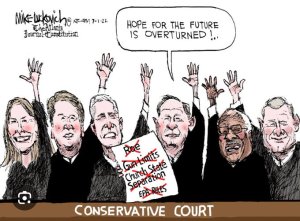 Also, from TNR is this headline about the black man running for governor on the insanity platform.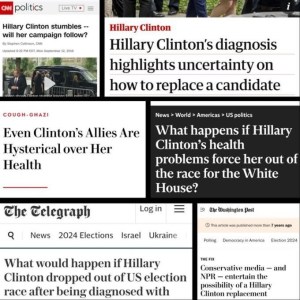
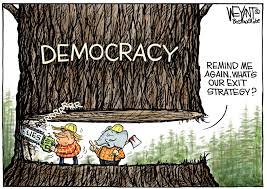 If you want a real shock, go see The Economist Cover Picture today with the heading “No way to Run a Country.”
 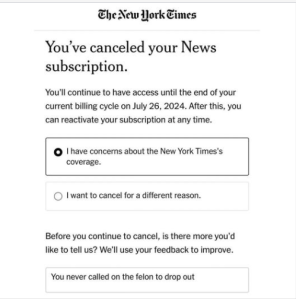 So, I fully admit to being depressed and worried. I know that BB stopped her NYT subscription. I hope John Buss doesn’t mind. I shared this bit he posted to his FaceBook about canceling his. I seriously worry about him in North Carolina, too. None of us in the old Confederate States are safe right now.






 Lisa Needham sums up the court’s disastrous year with this headline in Public Notice.
  The Leonard Leo Six will certainly get their gratuities this summer. They’ve essentially crippled Federal Agencies. I say this as I sit through my 3rd consecutive year of record-setting temperatures while watching two record-setting hurricanes take aim at the Gulf. NPR’s Nina Totenberg has just posted this analysis on the Absolute immunity debacle.
  Tony Romm of the Washington Post writes that the Corporate Overlords are already busy forming laws suits with the Chevron decision.





 A lower court ruling that prevented cities from criminalizing the conduct of people who are “involuntarily homeless” forced the U.S. Court of Appeals for the 9th Circuit to confront what it means to be homeless with no place to go and what shelter a city must provide, Gorsuch wrote. “Those unavoidable questions have plunged courts and cities across the Ninth Circuit into waves of litigation,” he wrote.


 I will also share this analysis by Historian Heather Cox Richardson from her substack
 I refuse to listen to calls for Joe to quit. Me, the nagging naysayer about Joe’s days in the Senate.
 The second decision announced today was an Appeal from one of the January 6th rioters. This is from the Washington Post.
 One last debate thought from David Frum’s article today for the Atlantic.
 peej
peej Carissa
 bostonboomer
 dakinikat
 ecocatwoman
 mablue2
 Mama Lopez
 peggysue22
 quixote
 skydancingguestblogger
 Mona (aka Wonk the Vote)



 Sky Dancing
Recent Comments