
Monday Reads
Posted: June 3, 2013 Filed under: health, morning reads, U.S. Economy, U.S. Politics, War on Women, Women's Rights | Tags: Bernie Sanders, David Axelrod, HPV virus, Michael Douglas, Rep. Marsha Blackburn, slavery, States Rights, throat cancer 24 Comments Good Morning!
Well it’s my turn for a sinus infection I guess! I’ve been trying to fight it with sleep and the usual but it just got the better of me yesterday. Let me share a few quick links with you.
This one is a little out there but according to Michael Douglas, the HPV virus gave him his cancer. He believes oral sex was the root cause.
The cause of Douglas’s cancer had long been assumed to be related to his tobacco habit, coupled with enthusiastic boozing. In 1992, he was hospitalised for an addiction which some at the time claimed to be sex. Douglas himself denied this and said he was in rehab for alcohol abuse. He has also spoken of recreational drug use.
HPV, the sexually transmitted virus best known as a cause of cervical and anal cancer and genital warts, is thought to be responsible for an increasing proportion of oral cancers.
Some suggest that changes in sexual behaviour – a rise in oral sex in particular – are responsible. Such changes might be cultural, but could also be linked to fears about the safety of penetrative sex in the wake of the Aids epidemic.
Mahesh Kumar, a consultant head and neck surgeon in London, confirmed that the last decade has seen a dramatic rise in this form of cancer, particularly among younger sufferers. Recent studies of 1,316 patients with oral cancer found that 57% of them were HPV-16 positive.
“It has been established beyond reasonable doubt that the HPV type 16 is the causative agent in oropharyngeal cancer,” said Kumar, who also testified to increased recovery rates among this kind of cancer sufferer. This would help explain why Douglas was given an 80% chance of survival, despite the advanced stage of his illness.
But Kumar expressed scepticism that Douglas’s cancer was caused solely by HPV, and surprise at Douglas’s assertion that cunnilingus could also help cure the condition. “Maybe he thinks that more exposure to the virus will boost his immune system. But medically, that just doesn’t make sense.”
So, anyway, something to read more on if that’s the case.
A new Republican Woman politician has stepped into the role played by Sarah Palin and Michelle Bachman. It’s called let’s sell out women! Congresswoman Rep. Marsha Blackburn (R-TN) opposes Pay Equity Laws saying that women ‘Don’t want the decisions made in Washington’.
Blackburn’s comments came during a round table on Meet the Press. The panel was discussing women’s increasing roles as the primary breadwinners in American families, and women’s general rise in the corporate and political arenas. After she asserted that companies — and her own Republican Party — had to do a better job of incorporating females into the workplace, former White House adviser David Axelrod asked Blackburn whether paycheck fairness laws would bolster women’s chances of achieving success. She responded by saying that Washington should stay out of the matter:
AXELROD: How about pay equity laws to ensure that women are treated fairly in the workplace?
BLACKBURN: I think that more important than that is making certain that women are recognized by those companies. You know, I’ve always said that I didn’t want to be given a job because I was a female, I wanted it because I was the most well-qualified person for the job. And making certain that companies are going to move forward in that vein — that is what women want. They don’t want the decisions made in Washington. They want to be able to have the power and the control and the ability to make those decisions for themselves.
But as the panel pointed out immediately before the exchange, companies are already “recognizing” and hiring more and more women. Women are now the primary breadwinners for 40 percent of all American families — a four-fold increase from 50 years ago.
The problem is that many of those women aren’t placed on equal footing with their male counterparts once they’re hired. Contrary to Blackburn’s insinuation, paycheck and workplace equity legislation isn’t about affirmative action — it’s about making sure that employers don’t discriminate against their workers on the basis of gender. Women in full-time, year-round jobs only make 77 cents for every dollar a man makes for the same level of work.
After all, who wants civil rights and liberty?
I’ve often thought that basic idea of ‘state’s rights’ and of the right wing’s extreme distrust in the government was hooked historically to maintaining the institution of slavery in the south. Guess I am not the only one.
Over the last several decades, the Right also built an imposing vertically integrated media machine that meshes the written word in newspapers, magazines and books with the spoken (or shouted) word on TV and talk radio. This giant echo chamber, resonating with sophisticated propaganda including revisionist (or neo-Confederate) history, has convinced millions of poorly informed Americans that the framers of the Constitution hated a strong central government and were all for “states’ rights” – when nearly the opposite was true as Madison, Washington and Hamilton rejected the Articles of Confederation and drafted the Constitution to enhance federal power.
Further, the Right’s hijacking of Revolutionary War symbols, like yellow “Don’t Tread on Me” flags, confuses the Tea Party rank-and-file by equating the founding era’s resistance against an overseas monarchy to today’s hatred of an elected U.S. government.
Amid this muck of muddled history, the biggest secret withheld from the American people is that today’s Right is actually promoting a set of anti-government positions that originally arose to justify and protect the South’s institution of slavery. The calls of “liberty” then covered the cries of suffering from human bondage, just as today’s shouts of outrage reflect resentment over the first African-American president.
Senator Bernie Saunders has written an excellent piece in the UK Guardian saying that we can not except the status quo as the “new normal.” The worsening gap income inequality and wealth should not be acceptable.
The front pages of American newspapers are filled with stories about how the US economy is recovering. There is some truth to that. Since President George W Bush left office in 2009, significant progress has been made in moving our economy out of the abyss of the worst economic downturn since the Great Depression of the 1930s. But in the midst of this slow recovery, we must not accept a “new normal”.
We must not be content with an economic reality in which the middle class of this country continues to disappear, poverty is near an all-time high and the gap between the very rich and everyone else grows wider and wider.
The good news is that instead of losing more than 700,000 jobs a month as we were five years ago, we’ve been gaining almost 200,000 jobs a month since January. The bad news is that, in addition to those job numbers being much too low, nearly 60% of the jobs gained since the “recovery” are low-wage jobs that pay less than $14 an hour, while most of the jobs lost during the recession were decent-paying middle-class jobs.
The good news is that the official unemployment rate has gone down from 10% in October of 2009 to 7.5% in April. The bad news is that 20 million Americans still are looking for work and the real unemployment rate – counting those who have given up looking for work and those working part time when they need full time jobs – is 13.9% The very bad news is that youth and minority unemployment is far higher than that and, with the decline in factory jobs, income for poorly educated men has shrunk by nearly two-thirds over the past four decades.
I know this is a little short, but I hope you’ll understand. I just don’t to seem to have much energy. So, what’s on your reading and blogging list today?
Another Military “Assault Prevention” Officer Investigated for Sexual Assault
Posted: May 14, 2013 Filed under: Crime, U.S. Politics, Violence against women, War on Women, Women's Rights | Tags: Air Force, Army, Ft. Hood assault prevention coordinator, Military sexual assault, prostitution, rape 16 Comments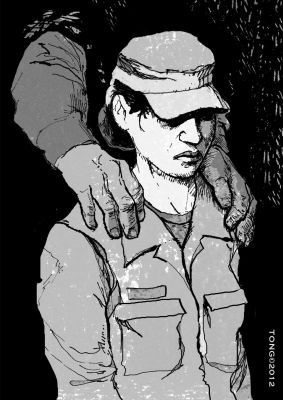
This is a breaking news story.
First it was the Air Force sexual assault prevention office, now it’s the Army. From USA Today: Fort Hood assault prevention officer under investigation
WASHINGTON — A sergeant in charge of sexual assault prevention at Fort Hood is under investigation for sexual assault, the Pentagon announced Tuesday night.
The soldier, whose name has not been released, is being investigated for abusive sexual contact, pandering, assault and maltreatment of subordinates.
The soldier has been relieved of his duties and no charges have yet been filed, according to the Pentagon. He oversaw the program at the battalion level, a unit of about 800 soldiers.
The solider is being investigated for among other things forcing a subordinate into prostitution and sexually assaulting two others, according to a Capitol Hill staffer who has been briefed on the case and spoke about it on condition of anonymity.
“Forcing a subordinate into prostitution?” And this guy is in charge of preventing sexual assaults?! Wait, it gets worse.
Two senior Pentagon officials, who spoke on condition of anonymity because the case is under investigation, also confirmed that the sergeant is being investigated for running a prostitution ring.
The Army said a sergeant first class, whose name was not released, is accused of pandering, abusive sexual contact, assault and maltreatment of subordinates.
He had been assigned as an equal opportunity adviser and coordinator of a sexual harassment-assault prevention program at the Army’s 3rd Corps headquarters at Fort Hood when the allegation arose.
I’ll update in the comment thread if I get more information. Meanwhile, use this as an open thread.
Friday Reads: Why Media Must Examine Record of Cleveland Police Dept. in Violence Against Women Cases
Posted: May 10, 2013 Filed under: misogyny, morning reads, Violence against women, War on Women, Women's Rights | Tags: Amanda Berry, Amanda Marcotte, Angel Cordero, Anthony Sowell, Ariel Castro, Charles Ramsey, Cleveland Police Department, Department of Justice, Elizabeth Loftus, false memories, FBI, Gina DeJesus, Michelle Knight, rape, serial murder, Slate Magazine 43 Comments
People gather to remember Michelle Knight and release balloons in her honor in a field on Scranton Ave. at Mentor St. on Thurs, May 8, 2013. (Thomas Ondrey/The Plain Dealer)
Good Morning!!
Yesterday I read something that infuriated me. I usually admire Amanda Marcotte’s writing on women’s issues, but I have real problems with her take on the neighbors of Ariel Castro who claim they called 911 over the years to report suspicious activity at his house on Seymour Avenue in Cleveland. Marcotte can’t believe that the Cleveland police would ignore such reports especially “considering Castro’s frightening history of domestic violence and child abuse.” She even provides links in the opening paragraph to a post at Slate in which she suggests that Castro’s neighbors must be “creating false memories”
As more details emerge from the bizarre kidnapping case in Cleveland, people are beginning to wonder how Ariel Castro could have kept women locked up in his house for a decade without anyone actually noticing that something strange was going on. Enter the neighbors,some of whom are telling the press that they did, in fact, see all sorts of weird behavior—and that they called the police, who did nothing about it. The police, however, are denying these reports, saying that the two visits made to the house in the decade were unrelated to any suspicious activities. Considering Castro’s frightening history of domestic violence and child abuse, it’s hard to imagine the police would just ignore it if the neighbors kept complaining about him doing things like dragging naked women around on leashes in his yard.
So what’s going on? Are all these people lying? Are the cops? Or is this a case of lost records or unrecorded police calls? One possible explanation is that the neighbors are simply caught up in the excitement over a national story unfolding in their backyard, and they’re misremembering their pasts because of it. False memories, particularly regarding incredibly emotional situations, are easier to develop than many realize.
This makes no sense to Marcotte, so she dredges up Elizabeth Loftus’ research on the unreliability of eyewitness testimony and the human ability to create “false memories.” For Amanda Marcotte, who seems to really care about the treatment of women who have been raped and otherwise abused, to excuse the Cleveland PD on this basis is a terrible mistake, in my opinion. Doesn’t she realize that Loftus is an expert witness who testifies almost exclusively for defendants accused of sexual abuse and assault? Couldn’t Marcotte at least look at the history of the Cleveland PD before dismissing accusations against them?
But no, she assumes that surely the Cleveland police department did the best they could, so any neighbor who worried about something being wrong at Castro’s house with it’s high fences, boarded up and trash-bag-covered windows must be “inadvertently” making up past concerns in order to alleviate their guilt or make themselves seem more important. I won’t go into a long essay on the problems with applying Loftus’ research in this case; I’ll just agree that anything is possible. But we need to ask ourselves: what is the most likely explanation in this particular case?
In another post at Slate, Justin Peters “explains” why he thinks the Cleveland PD “did everything they could and it still wasn’t enough.”

Amanda Berry with her arms around her sister and daughter after her escape
No. No, they didn’t. Let’s keep in mind that the Cleveland PD didn’t in fact find Michelle Knight, Amanda Berry, and Gina DeJesus. What happened is that
Berry noticed the front door of the home was unlocked but the outer storm door remained bolted. She was reluctant to attempt an escape because Castro was known to test the women by leaving doors in the house unlocked. He would beat them if they attempted to leave the unlocked rooms, police sources said. Berry made the decision to try to break through the storm door after seeing people on a neighbor’s porch. She gained the attention of neighbors such as Charles Ramsey, and they helped her and her 6-year-old child get out. She called 9-1-1 from a nearby home. [Ramsey was aided by another neighbor Angel Cordero, who wasn’t as good an interview as Ramsey]
When Berry called 911, she got an operator who tried his best to blow her off by saying
Dispatcher: We’re going to send them as soon as we get a car open.
It took Berry’s continued urging to get him to act immediately. Even Charles Ramsey said in his interview with Anderson Cooper, “Bro, this is Cleveland,” seemingly calling attention to the fact that in Cleveland missing women don’t get found in neighborhoods like his. This is a fact that all of Cleveland is aware of, which is why there is a lot of anger toward police in the city right now.
This is a morning reads post, so I’m not going to rant on and on about this. Instead I’ll give you some links to articles that support what I’m saying. But first let me ask a rhetorical question for Slate and Amanda Marcotte: Were the women who claimed they were attacked by now convicted Cleveland serial rapist and murderer Anthony Sowell “creating false memories” when they call 911 and were ignored? Were the neighbors who reported the smell of rotting corpses emanating from Sowell’s house and yard “creating false memories?” What about the thousands of rape kits that Cleveland PD never had tested? Why is the Cleveland Police Department currently under investigation by the U.S. Justice Department?
Violence against women is huge problem in this country, and the Cleveland PD is not alone in treating it as a lower priority than other crimes. IMHO, it’s very important not to forget that. Not ever.
Now I’ll end my rant and give you some links to click on. I know this is a distasteful subject, a painful subject, and I understand why no one really wants to read all the gory details. But sometimes gory details are necessary to wake people up to the reality of what happens to women in this country every fucking day–especially poor women, drug-addicted women, sex workers, and others whom society sometimes sees as “disposable.”
I’ll begin with a video from Democracy Now–an interview with Cleveland reporter Eric Sandy.
Here is Sandy’s article, The Long History of Ariel Castro, Cleveland Kidnapper and Monster. Please note that Castro did come in contact with law enforcement over the years because of his horrific abuse of his wife and children. None of his violent behavior was really taken seriously or adequately dealt with. I apologize for this long excerpt:
Once again, Tomba’s words at the Tuesday morning press conference hang in the air: “Every single lead was followed up no matter how small,” he said. Unavoidable thoughts hearkening back to Anthony Sowell’s 2011 serial murder convictions hang in the air, as well. The rescue at the Seymour Avenue house will bear out a legacy on the backs of all involved, much like Cleveland’s other high-profile crimes.
Stories revolving around Castro’s work as a bus driver and his interactions with family members fill out characteristics about the man – elements of his personality that may have led to both the kidnapping and to his evasion from law enforcement.
In 1993 and 2005, Castro was accused of domestic violence from his one-time wife. The former charges were reduced to mere disorderly conduct, while the latter incident offered grisly imagery of a fractured marriage still capable of wreaking havoc. Castro broke his ex-wife’s nose and ribs, dislocated her shoulders, knocked out one of her teeth and battered her so hard that a blood clot formed on her brain, according to filings in court. In an interview with investigators after the fact, Castro denied ever being abusive toward her.
That filing effectively killed Castro’s chances at even partial custody of his children. Nevertheless, as sources familiar with the man report, his penchant for manipulation pulled Emily and Arlene back into his gravitational pull at times.
Several years after the gross sexual imposition conviction of Colon blew over, Emily Castro gave birth to a girl. It’s unclear who the father was – though speculation points to either a former boyfriend who now lives in Cleveland or, according to the private investigator, something much more untoward, evil, and incestuous.
Emily was living in Fort Wayne, Ind., where she attempted to murder her 11-month-old daughter by slashing her throat four times in 2007. She was later convicted of attempted murder and sentenced to 25 years in prison.
“It is certainly a mystery as to how this happened or why this happened,” Allen Superior Court Judge John Surbeck told The Journal Gazette at the time.
It is indeed a mystery that may yet hold more clues as to who Ariel Castro has been all these years. Any answers that lay within may illuminate a gap in local law enforcement’s own investigations.

Gina DeJesus
More articles to ponder:
Alternet: Why Cops Bust Down Doors of Medical Pot Growers, But Ignore Men Who Keep Naked Girls on Leashes
Note the padlocked door in the background of the photos, which were taken in 2001–before the abductions of Knight, Berry, and DeJesus took place. Who or what was in those locked rooms at that time?
Daily Telegraph: ‘Ariel Castro locked my sister in a box and beat her’
CNN on the similarities with the Anthony Sowell case: Cleveland abductions a chilling reminder of ‘House of Horrors’
19 Action News: “Note of admission” written by Ariel Castro in 2004
KNYC.com: Police Report
Joan Walsh on the media sliming of Charles Ramsey: Charles Ramsey is still a hero
Plain Dealer: FBI previously investigated stepfather of Ariel Castro’s children in DeJesus and Berry cases.
Note that the stepfather tried to get police and FBI to investigate Ariel Castro in the disappearances. They ignored his pleas, and Castro was used as a source against the stepfather and allowed to testify against him–even with his history of domestic abuse! Did you know that Castro repeatedly abducted his own daughters?
The Daily Beast: My Neighbor the Monster
Doug Parker owns the home next to Cleveland suspect Ariel Castro. In his first interview, he recalls 20 years of confrontations, a bitter court case, and more red flags….
Parker says the police have been to the house more than they claim. For one, he says, he called the police in May 1996 when Castro pulled fence posts out of the ground and rolled up a chain link fence that ran between the two properties.
“He did it while I was at work, so I couldn’t stop him,” Parker says.The posts had been buried 18 inches, leaving holes that DeaAna, 6 years old at the time, tripped over while playing and injured herself. “The cops came, we talked, and one of them suggested I go to court on this,” Parker says. “And that’s what I did.”He was awarded $900 in damages and Castro was ordered to put the fence back up.
I guess those court records must have gone missing…
The Daily Beast: Cleveland Kidnapping, Anthony Sowell Case Linked by Indifferent Police
If you are stunned that three Cleveland women could be held captive for a decadewithout being discovered, then you are unacquainted with the case of Anthony Sowell, also known as the Cleveland Strangler.
Sowell was a registered sex offender who remained at liberty despite a series of sexual-assault complaints against him, until the police finally acted and discovered the bodies of 11 murdered women in his house and backyard.
At least some of those murders and rapes could have been prevented if the police had not reacted so indifferently when a distraught woman called them in September 2008, after being repeatedly raped, beaten, and choked by Sowell. She had at one point sought refuge in a bathroom, where she saw a headless body wrapped in plastic and positioned in a sitting position in the bathtub.
After managing to get away, the woman had stumbled as far as a bus stop before she could go no further. She would later testify: “I couldn’t walk no more. I was tore up. My body was tore up … My face, my female parts, my butt.”
She called the police. “They told me I had to come in and make a report,” she would testify. She further testified that she asked the dispatcher, “How do I get there?” The dispatcher told her: “Come in and make a report. We can’t take a report over the phone.”
She told the court that after the call, “I felt less than human. I didn’t know who to turn to.”

Michelle Knight before her disappearance
Plain Dealer: Michelle Knight, held captive since 2002, removed by Cleveland police from FBI database 15 months after disappearance
Cleveland police removed Michelle Knight’s missing person entry from an FBI database 15 months after she was reported missing in 2002 — and nearly a decade before she was rescued from her captor’s home on Cleveland’s West Side.
City spokeswoman Maureen Harper said Thursday that police followed proper procedures by removing Knight’s name from the database in November 2003 because they were unable to contact Knight’s mother by telephone to verify that her then-22-year-old daughter still was missing.
However, the police department’s written policy on investigating missing adults, at the time of Knight’s disappearance on Aug. 23, 2002, describes a different verification process. It states that an officer must go and see that a missing person has been found, then inform the FBI within two hours for removal from the National Crime Information Center database.
Kym Pasqualini, a national advocate for missing adults, said in an interview Thursday that the removal of Knight’s name and description from the database helped the case fall through the cracks.
NY Daily News: Cleveland captive Michelle Knight was gang-raped while in junior high.
She got pregnant from the rape and that victimization probably set her up to be revictimized when she learned her son was to be taken away from her. Sadly, she left home angry and upset and Ariel Castro offered her a ride.
NY Daily News: Michelle Knight’s twin brother talks about their history and his happy reunion with her.
This one is heartbreaking but speaks beautifully to me about human nature and our need for connection.
I guess this is enough for now. I’ll provide other links in the comment thread. If you made it this far, thanks for reading.
As always, this is an open thread and you are welcome post links on any topic in the comments.
Again, I understand this is a painful and distasteful subject. But please be aware that violence against women is truly endemic in the U.S. and it still isn’t treated with the necessary seriousness by law enforcement, the courts, or the media.
California Teenager Who Committed Suicide After Rape and Bullying Marched at President Obama’s 2008 Inauguration
Posted: April 14, 2013 Filed under: Barack Obama, Crime, Violence against women, War on Women, Women's Rights | Tags: Audrie Pott, gang rape, michelle obama, Rehtaeh Parsons, Suicide 4 Comments
Audrie Pott
Another poignant detail has come out about Audrie Pott, the Saratoga, CA teenager who committed suicide after being gang raped by three boys at a house party while she was unconscious. The perpetrators took pictures of themselves sexually abusing Audrie and later posted them on-line and circulated them among her classmates.
A 15-year-old Saratoga girl who killed herself after photos circulated of her alleged sexual assault was “tormented” and “tortured” in the days before her death, her family’s attorney said Friday.
On Thursday, authorities announced three 16-year-old boys had been arrested on suspicion of sexually battering Audrie Pott, a Saratoga Union High School sophomore, according to reports.
An attorney representing Pott’s family told The Times the alleged attack occurred at what the teenager thought would be a “small little gathering” at a friend’s house last fall. The friend’s parents were out of town, attorney Robert Allard said, and the girls started drinking some sort of alcohol mixed with Gatorade. Soon, Allard said, “word spread there was a party at this house.”
Pott had gone upstairs early to sleep, but when she woke up the next day, she “recognized immediately that something terrible had happened,” Allard said.
At least one picture depicting the sexual assault was circulated among her peers, Allard said. Pott later posted on Facebook that “the whole school knows” and “my life is like ruined now,” Allard said.
Pott killed herself in September, about a week after the alleged attack.
Yesterday, Michael Daly reported at The Daily Beast that at age 11, Audrie marched in President Obama’s first inauguration parade with her middle school band.
“The President’s young daughters waved and cheered loudest for [this] group as all the other performers were so much older,” says a Pott family online posting about the Redwood Middle School’s moment in history.
At fifteen, Audrie committed suicide, eight days after a group of boys she thought were her friends allegedly gang raped her while she was unconscious and distributed at least one photo from the attack online.
“My life is like ruined now,” Audrie announced to the internet prior to hanging herself.
That was last September, four months before a 15-year-old from Chicago named Hadiya Pendleton performed as a majorette with her high school at Obama’s second inauguration. She was killed a week later, when a teen fired wildly in the direction of her and a group of her friends, mistakenly believing they were associated with a rival gang.
With the deaths of these two 15-year-olds, each of whom had played a part in an inauguration, a challenge now marches past the Capitol and the White House and every place on past in this country where laws are made, along with every school and home. The challenge for us all is to find better ways to protect our kids, be it from gun violence or from sexual violence.
Police took their sweet time getting around to arresting the monsters who tormented this beautiful young girl, and now her family and supporters are worried that they may have destroyed evidence of their crimes over the months it took law enforcement to “investigate.”

Rehtaeh Parsons
You have to wonder why these arrests followed so closely on the shocking reports of a similar gang rape in Halifax, Nova Scotia followed by bullying and the suicide of victim Rehtaeh Parsons–as well as the Steubenville rape case. It certainly appears that police only acted after the media picked up the story and public outrage ensued.
Michael Daly is right. President Obama and First Lady Michelle Obama should lead the way in raising consciousness of rape culture along with their fight to prevent gun violence. These two young girls were driven to their deaths by the cruelty and inhumanity that surrounded them.
What is wrong with our society when young girls can be treated as objects to be used and thrown away and when the law enforcement and school authorities who are supposed to protect children choose to protect the perpetrators of these horrible crimes instead of the victims? Nothing will change until women are seen as full human beings with feelings and dreams and their own goals for the future–and the right to pursue happiness in their own way. The anti-abortion movement has a lot to do with perpetuating the notion that girls and women should not be able to make their own choice about their bodies and their lives.
Tuesday Reads: Margaret Thatcher’s “Dark Legacy,” Death of a Feminist Revolutionary, and Mitch McConnell’s Ugly Plans
Posted: April 9, 2013 Filed under: morning reads, U.S. Politics, War on Women, Women's Rights | Tags: Andrew Sullivan, Ashley Judd, austerity, David Corn, feminist history, Margaret Thatcher, Mitch McConnell, Poverty, Shulamith Firestone, Susan Faludi 33 Comments
Good Morning!!
The death of Margaret Thatcher is still dominating the news this morning. It seems she was one of those public figures that inspired varied but passionate reactions–you either loved her or hated her.
Andrew Sullivan loved her it seems.
I was a teenage Thatcherite, an uber-politics nerd who loved her for her utter lack of apology for who she was. I sensed in her, as others did, a final rebuke to the collectivist, egalitarian oppression of the individual produced by socialism and the stultifying privileges and caste identities of the class system. And part of that identity – the part no one ever truly gave her credit for – was her gender. She came from a small grocer’s shop in a northern town and went on to educate herself in chemistry at Oxford, and then law. To put it mildly, those were not traditional decisions for a young woman with few means in the 1950s. She married a smart businessman, reared two children and forged a political career from scratch in the most male-dominated institution imaginable: the Tory party.
She relished this individualist feminism and wielded it – coining a new and very transitive verb, handbagging, to describe her evisceration of ill-prepared ministers or clueless interviewers. Perhaps in Toynbee’s defense, Thatcher was not a feminist in the left-liberal sense: she never truly reflected on her pioneering role as a female leader; she never appointed a single other woman to her cabinet over eleven years; she was contemptuous toward identity politics; and the only tears she ever deployed (unlike Hillary Clinton) were as she departed from office, ousted by an internal coup, undefeated in any election she had ever run in as party leader.
Her policies “inspired” the revolutionary reactions that created a “cultural transformation.”
Thatcher’s economic liberalization came to culturally transform Britain. Women were empowered by new opportunities; immigrants, especially from South Asia, became engineers of growth; millions owned homes for the first time; the media broke free from union chains and fractured and multiplied in subversive and dynamic ways. Her very draconian posture provoked a punk radicalism in the popular culture that changed a generation. The seeds of today’s multicultural, global London – epitomized by that Olympic ceremony – were sown by Thatcher’s will-power.
And that was why she ultimately failed, as every politician always ultimately does. She wanted to return Britain to the tradition of her thrifty, traditional father; instead she turned it into a country for the likes of her son, a wayward, money-making opportunist. The ripple effect of new money, a new middle class, a new individualism meant that Blair’s re-branded Britain – cool Britannia, with its rave subculture, its fashionistas, its new cuisine, its gay explosion, its street-art, its pop music – was in fact something Blair inherited from Thatcher.
Of course Sullivan no longer lives in Great Britain, and he has the means to avoid the worst effects of the elite’s austerity policies regardless of where he lives. Others aren’t so fortunate.
The Guardian reports: Margaret Thatcher’s death greeted with street parties in Brixton and Glasgow; Crowds shout ‘Maggie Maggie Maggie, dead dead dead’ during impromptu events.
Several hundred people gathered in south London on Monday evening to celebrate Margaret Thatcher‘s death with cans of beer, pints of milk and an impromptu street disco playing the soundtrack to her years in power.
Young and old descended on Brixton, a suburb which weathered two outbreaks of rioting during the Thatcher years. Many expressed jubilation that the leader they loved to hate was no more; others spoke of frustration that her legacy lived on.
To cheers of “Maggie Maggie Maggie, dead dead dead,” posters of Thatcher were held aloft as reggae basslines pounded.
Clive Barger, a 62-year-old adult education tutor, said he had turned out to mark the passing of “one of the vilest abominations of social and economic history”.
He said: “It is a moment to remember. She embodied everything that was so elitist in terms of repressing people who had nothing. She presided over a class war.”
Builder Phil Lewis, 47, a veteran of the 1990 poll tax riots, said he had turned out to recall the political struggles the Thatcher years had embroiled him in. “She ripped the arsehole out of this country and we are still suffering the consequences.”
Just as Ronald Reagan did to the U.S.–and we’re still suffering the consequences.
Here’s a video from Brixton.
Hugo Young, Thatcher biographer, writes in The Guardian: Margaret Thatcher left a dark legacy that has still not disappeared. For Young, a positive was Thatcher’s indifference to her popularity with the public.
I think by far her greatest virtue, in retrospect, is how little she cared if people liked her. She wanted to win, but did not put much faith in the quick smile. She needed followers, as long as they went in her frequently unpopular directions. This is a political style, an aesthetic even, that has disappeared from view. The machinery of modern political management – polls, consulting, focus groups – is deployed mainly to discover what will make a party and politician better liked, or worse, disliked. Though the Thatcher years could also be called the Saatchi years, reaching a new level of presentational sophistication in the annals of British politics, they weren’t about getting the leader liked. Respected, viewed with awe, a conviction politician, but if liking came into it, that was an accident.
But this attitude “didn’t come without a price” and “Thatcher left a dark legacy…”
What happened at the hands of this woman’s indifference to sentiment and good sense in the early 1980s brought unnecessary calamity to the lives of several million people who lost their jobs. It led to riots that nobody needed. More insidiously, it fathered a mood of tolerated harshness. Materialistic individualism was blessed as a virtue, the driver of national success. Everything was justified as long as it made money – and this, too, is still with us.
Thatcherism failed to destroy the welfare state. The lady was too shrewd to try that, and barely succeeded in reducing the share of the national income taken by the public sector. But the sense of community evaporated. There turned out to be no such thing as society, at least in the sense we used to understand it. Whether pushing each other off the road, barging past social rivals, beating up rival soccer fans, or idolising wealth as the only measure of virtue, Brits became more unpleasant to be with. This regrettable transformation was blessed by a leader who probably did not know it was happening because she didn’t care if it happened or not. But it did, and the consequences seem impossible to reverse….
[I]t’s now easier to see the scale of the setback she inflicted on Britain’s idea of its own future. Nations need to know the big picture of where they belong and, coinciding with the Thatcher appearance at the top, clarity had apparently broken through the clouds of historic ambivalence.
At least the British media isn’t trying to canonize Thatcher as the corporate media in the U.S. did to Reagan.
A Less Remarked Upon Death: Shulamith Firestone
At The New Yorker, Susan Faludi pays tribute to a feminist icon of the 1970s, “Death of a Revolutionary: Shulamith Firestone helped to create a new society. But she couldn’t live in it.”
When Shulamith Firestone’s body was found late last August, in her studio apartment on the fifth floor of a tenement walkup on East Tenth Street, she had been dead for some days. She was sixty-seven, and she had battled schizophrenia for decades, surviving on public assistance. There was no food in the apartment, and one theory is that Firestone starved, though no autopsy was conducted, by preference of her Orthodox Jewish family. Such a solitary demise would have been unimaginable to anyone who knew Firestone in the late nineteen-sixties, when she was at the epicenter of the radical-feminist movement, surrounded by some of the same women who, a month after her death, gathered in St. Mark’s Church In-the-Bowery, to pay their respects.
The memorial service verged on radical-feminist revival. Women distributed flyers on consciousness-raising, and displayed copies of texts published by the Redstockings, a New York group that Firestone co-founded. The WBAI radio host Fran Luck called for the Tenth Street studio to be named the Shulamith Firestone Memorial Apartment, and rented “in perpetuity” to “an older and meaningful feminist.” Kathie Sarachild, who had pioneered consciousness-raising and coined the slogan “Sisterhood Is Powerful,” in 1968, proposed convening a Shulamith Firestone Women’s Liberation Memorial Conference on What Is to Be Done. After several calls from the dais to “seize the moment” and “keep it going,” a dozen women decamped to an organizing meeting at Sarachild’s apartment.
I well remember reading Firestone’s book, The Dialectic of Sex: The Case for Feminist Revolution. It was mind-blowing stuff in those days.
In the late nineteen-sixties, Firestone and a small cadre of her “sisters” were at the radical edge of a movement that profoundly changed American society. At the time, women held almost no major elected positions, nearly every prestigious profession was a male preserve, homemaking was women’s highest calling, abortion was virtually illegal, and rape was a stigma to be borne in silence. Feminism had been in the doldrums ever since the first wave of the American women’s movement won the vote, in 1920, and lost the struggle for greater emancipation. Feminist energy was first co-opted by Jazz Age consumerism, then buried in decades of economic depression and war, until the dissatisfactions of postwar women, famously described by Betty Friedan in “The Feminine Mystique” (1963), gave rise to a “second wave” of feminism. The radical feminists emerged alongside a more moderate women’s movement, forged by such groups as the National Organization for Women, founded in 1966 by Friedan, Aileen Hernandez, and others, and championed by such publications as Ms., founded in 1972 by Gloria Steinem and Letty Cottin Pogrebin. That movement sought, as now’s statement of purpose put it, “to bring women into full participation in the mainstream of American society,” largely by means of equal pay and equal representation. The radical feminists, by contrast, wanted to reconceive public life and private life entirely.
What a brilliant tribute by Faludi. It’s well worth the read.
Mother Jones’s David Corn has gotten his hands on a tape of “a private meeting between the Senate GOP leader and campaign aides reveals how far they were willing to go to defeat” Ashley Judd.
On February 2, Mitch McConnell, the Republican leader in the US Senate, opened up his 2014 reelection campaign headquarters in Louisville, Kentucky, and in front of several dozen supporters vowed to “point out” the weaknesses of any opponent fielded by the Democrats. “They want to fight? We’re ready,” he declared. McConnell was serious: Later that day, he was huddling with aides in a private meeting to discuss how to attack his possible Democratic foes, including actor/activist Ashley Judd, who was then contemplating challenging the minority leader. During this strategy session—a recording of which was obtained by Mother Jones—McConnell and his aides considered assaulting Judd for her past struggles with depression and for her religious views….
For much of the Judd discussion, McConnell was silent as aides reviewed the initial oppo research they had collected on Judd and weighed all the ways they could pummel her. The recording was provided to Mother Jones last week by a source who requested anonymity. (The recording can be found here; a transcript is here.) McConnell’s Senate office and his campaign office did not respond to requests for comment.
The aide who led the meeting began his presentation with a touch of glee: “I refer to [Judd] as sort of the oppo research situation where there’s a haystack of needles, just because truly, there’s such a wealth of material.” He ran through the obvious: Judd was a prominent supporter of President Barack Obama, Obamacare, abortion rights, gay marriage, and climate change action. He pointed out that she is “anti-coal.”
But the McConnell gang explored going far beyond Judd’s politics and policy preferences. This included her mental health. The meeting leader noted:
She’s clearly, this sounds extreme, but she is emotionally unbalanced. I mean it’s been documented. Jesse can go in chapter and verse from her autobiography about, you know, she’s suffered some suicidal tendencies. She was hospitalized for 42 days when she had a mental breakdown in the ’90s.
So what? Mitch McConnell is a sick, closeted, hateful old freak who appears to lack any semblance of human feelings.

 peej
peej Carissa
 bostonboomer
 dakinikat
 ecocatwoman
 jjlo
jjlo mablue2
 Mama Lopez
 peggysue22
 quixote
 skydancingguestblogger
 Mona (aka Wonk the Vote)



 Sky Dancing
Recent Comments