
WikiLeaks and the Monsanto GMO Cable
Posted: December 24, 2010 Filed under: Farming, Wikileaks | Tags: Bacillus thuringiensis, Craig Stapleton, European corn borer, GMO, Monsanto MON0810 Bt corn seed, Wikileaks cables 25 CommentsIn amongst the cables released to WikiLeaks is one from 2007, in which Craig Stapleton, then U.S. Ambassador to France, suggested a “plan of retaliation” against the EU, and France in particular, unless the European nations agreed to purchase and plant Monsanto’s MON-810 Bt corn seed. The Ambassador lamented,
“In our view, Europe is moving backwards not forwards on this issue with France playing a leading role, along with Austria, Italy and even the Commission. In France, the “Grenelle”environment process is being implemented to circumvent science-based decisions in favor of an assessment of the “common interest.””
Well, now, we can’t have all these governments giving way to the “common interest”, can we? Never mind that the European food manufacturers themselves, other than feedlots, were already refusing to use GMO-based products due to proclaimed customer preferences. Not to mention, why the particular favoritism toward Monsanto, when Novartis Seeds, Mycogen Seeds and DEKALB Genetics also are major producers of Bt corn? Finally, why is an ambassador involved in promoting American food products? The USDA has highly competent staff in key locations around the world ready to assist U.S. food companies in making favorable contacts to increase offshore sales. I know, because I’ve dealt with them, and the staffers are excellent.
But let’s back up a bit and review the European corn borer, GMOs and Bt.
European Corn Borer
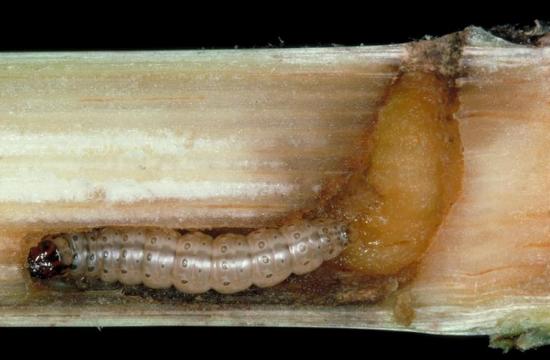
Tunneling European corn borer image courtesy of Iowa State University
The European corn borer is an introduced pest, meaning it is not native to the U.S. Scientists believe that it may have been brought to this country in the early 1900s in broom corn, imported from Hungary and Italy, used to manufacture brooms. During its early history, the borer only produced one generation per year; today, only the most northern states and Canada can expect to see one generation per year. In the central U.S.—the main area of corn growing—there are two generations per year, while the South and its border states can expect three generations per year. In the Deep South, growers can be looking at four generations per year. Clearly, insect management of this pest can be time consuming and expensive. Also, in spite of its name, the borer attacks sorghum, cotton and many vegetables.

Field damage from European corn borer image courtesy of Iowa State University
There are at least half a dozen serious insect pests of corn (or maize, as it’s known scientifically), although the extent of pest infiltration can vary by geographic region, but the European corn borer is one of the most prevalent. As with all insects, climate conditions can affect populations from year to year. An eight year study in southern Minnesota, from 1988-1995, showed five years with low corn borer populations and three years with high populations. During the peak outbreak years, GMO corn fared much better than corn treated with insecticides. The Minnesota study indicated substantial economic benefit to farmers using GMOs during the peak infestation years. Unfortunately, scientists haven’t yet developed a method to determine pest populations in advance of the growing season, in order to allow farmers to make an economically effective seed purchasing decision. Additionally, cultural practices can affect borer populations. Fields grown to corn are rarely disked (plowed under) in the fall anymore, since agricultural entomologists have shown that exposure of the stalks to winter weather and foraging animals significantly reduces the number of potential pests the following spring.
There are cultural practices and biological predators that can be used to tackle the European corn borer as part of an integrated pest management program, but these take knowledge, time and long term planning, not to mention money. For further reading, I highly recommend this publication by Iowa State University.
GMOs
GMO is the acronym for Genetically Modified Organism. In truth, very few farms in the U.S. or Europe don’t use some form of genetically modified seeds: those seeds are called hybrids, and they’ve been around for a long time, both in horticultural and agricultural production. Hybrids are responsible for super-sweet corn, for grass that doesn’t need to be mowed more than once a month, for carrots that are extra sweet so that baby food manufacturers don’t have to add unnecessary sugar, and for virtually every annual geranium that can be grown from seed. Hybridization has been used to improve vigor, productivity and natural resistance to pests. In other words, plant breeders have achieved some significant improvements in the plants we grow, helping to meet the increased food needs of a growing world population. Today, breeders are working to develop strains that can be grown in less agriculturally friendly environments, so that African farmers, for example, will need far less water to grow their crops. These are all the positives of genetically modified seeds.
What are some of the negatives? Well, unlike open-pollinated seeds, hybrid seed is only good for one generation. In other words, if you want to grow the very same corn next year, for example, you have to buy new seed; seed collected from the plants themselves will not be true to type. For a big farm co-op, or even for an individual farmer in developed countries, this is simply part of the cost of doing business. But if you’re a subsistence farmer in the developing world, even though the hybrid might drastically improve your yields, if you can’t afford the more expensive seed to begin with, its benefits don’t matter much. There is also concern with GMO cross-pollination, in those species that are not self-fertile. Again, to a large co-op, with a monoculture crop, that has removed every twig or blade of grass within miles of its farms, there isn’t much worry about cross-pollination. There’s also little concern about perimeter weeds that can serve as vectors for disease. However, there is also no location where natural predators can thrive and breed, so these large co-ops become captives to chemical pest control.
Then we come to the newest hybrids, known as GMOs. These are not simply hybrids of the healthiest or tastiest stock, these are creations designed to incorporate chemicals into the gene coding of the seed in order to resist pests or broad spectrum herbicide applications, which may be why their use in food production has led to the derogatory term, “Frankenfoods”. There are a number of different GMOs, but I’m only going to focus on those that incorporate Bt.
Bacillus thuringiensis (Bt)
Bt is a naturally occurring bacterium primarily found in soil. It was first registered as an insecticide in 1961 and re-registered in 1998. As measured by its oral LD50 (the amount of substance that will kill 50% of the tested population), it is extremely safe. Bt can cause skin rashes, and while some claim to be allergic to the insecticide, it is more likely that dermal exposure to the powder creates the negative reaction. There is almost no movement of Bt within soil, so run-off into water systems isn’t a particular danger. Bt has a half-life of about two weeks, although it can be degraded more rapidly by sunlight. It is not toxic to fish, birds, or any other non-caterpillar insect. Human volunteers have actually consumed 1 gram of Bt per day for 5 days straight with no ill effects.
Bt has several different strains and is insect specific. For example, Bacillus thuringiensis israelensis is used to kill mosquito larvae, while Bacillus thuringiensis kurstaki is the most effective against caterpillars (larvae) of moths. Bt forms crystal proteins (Cry proteins), that, once ingested, latch onto receptors in the insect’s digestive system and release a toxin that causes death within a matter of days. Bt must be ingested to be effective, and it can only be used against the larval stage of the insect (the most active feeding time anyway during the insect’s lifecycle). It is most often used as a powder application for best plant coverage, although it also comes in a suspension form.
Since Bt is an organism, and not a chemical, it is generally recognized as acceptable for use by organic grower certification societies around the world. (There are no national standards for organic production yet, so most organic growers rely on certification guidelines issued by the various organizations to indicate the agricultural practices they follow.) So if Bt is so safe, why are those pesky Europeans complaining about GMO corn? Let’s look at some of the reasons that Europeans might not want Monsanto’s MON-810 foisted on them:
1. All the manufacturers of Bt corn seed are U.S. companies.
In spite of supposedly being a global economy, nationalistic pride remains a factor in trade decisions. The rest of the world isn’t necessarily keen to have the U.S. dominate agricultural markets.
2. Economics
Bt corn seed is more expensive than traditional hybrids or open-pollinated seed. Although it can be argued that Bt corn is more economical in years of high borer infestation, as the Minnesota study showed, if only three out of eight years resulted in severe population outbreaks, is it worth spending the extra money year after year?
3. Untested effects of Bt corn
Traditionally, Bt has only been applied when larvae are active. In those circumstances, Bt’s limited half-life means minimal exposure for humans. However, in GMOs, Bt is constantly present in the plant itself. Further, geneticists specifically designed Bt corn to produce much higher levels of Bt Cry proteins than those found in the traditionally applied insecticide. Does more Bt enter the food chain this way? And what about effects on reproductive and developmental systems? The EPA, which regulates insecticide use, doesn’t require this type of testing on insecticides that otherwise show no significant adverse health effects in mandatory disease and toxicity studies.
4. Insect resistance to Bt
Insects are incredibly adaptable. Over time, they can develop resistance to any consistently applied or available substance that interferes with their feeding opportunities. That’s why any sound integrated pest management program requires insecticide rotation. A constantly available supply of Bt is a real risk in resistance development by the European corn borer. The EPA and GMO manufacturers are aware of this problem, and the EPA now requires any land planted to GMOs to maintain a “refuge” where at least 20%-30% of the insect population will not be subject to Bt. The current management strategy for Bt corn resistance is a) hope that the higher levels of Bt in the GMO seed will kill off resistant larvae that can later develop into mating adults, and b) hope that non-resistant moths living in the refuge will mate with any resistant moths that should survive the Bt in the maize crop in order to prevent development of a totally Bt-resistant insect.
There is another risk to development of Bt resistance, and that is the risk to organic growers. Bt is really the primary line of defense for organic growers. Among the other insecticides listed for use on European corn borer, only permethrin, a synthetic chemical that combines the natural insecticides of the pyrethroids (members of the chrysanthemum family), has such low toxicity that it can be applied from 0-1 day prior to harvest. However, since permethrin is not totally natural, organic certification societies may not allow this insecticide to be used.
5. Cross-pollination issues
Corn pollen is fairly large and doesn’t travel very far on the wind. It also degrades on the ground within 1-2 hours on sunny days. Nevertheless, in order to avoid possible outcrosses, scientists recommend distancing GMO corn from other plants by a distance of 660 feet if the GMO planting is greater than 20 acres and from 165-660 feet if the planting is less than 20 acres. These distances may be achievable in the U.S., where land is plentiful, or even in countries such as Australia, but, for European farms, or even smaller American farms, 660 feet may be too significant an amount of non-productive land to offset the GMO benefits.
6. Particular characteristics of MON-810
Without getting too technical, MON-810 is designed to have Bt present in all parts of the plant, while some other GMOs only have Bt present in the leaves. In other words, MON-810 is a very aggressive approach to European corn borer management.
In summary, there are many reasons why Europeans, and other nations, might legitimately object to GMO corn being planted in their countries. The memo from Ambassador Stapleton strikes me as appallingly rude, ignorant and bullying, and I’m grateful to have this kind of undiplomatic behavior exposed.
Wikileaks and Bangladesh
Posted: December 22, 2010 Filed under: Diplomacy Nightmares, Foreign Affairs, Wikileaks | Tags: Bangladesh, death squads, the Phulbari mines, Wikileaks 13 CommentsWell, it certainly is becoming more obvious as to why both the US and the UK want Wikileaks shut down. The latest cable releases from the disc carried out of the State Department by an anonymous source details some horrendous behavior in the small, developing nation of Bangladesh. The more I dig into the details of what’s going on in developing nations due to our greed and their lack of justice systems and laws just about has me weeping on my computer keys.
For one, we learn that the US pushed for reopening a mine that was the subject of protests by residents of the area.
US diplomats privately pressurised the Bangladeshi government into reinstating a controversial coal mine which had been closed following violent protests, a leaked diplomatic cable shows.
The US ambassador to Dhaka, James Moriarty, last year held talks with the country’s chief energy adviser, urging him to approve plans by the British company Global Coal Management (GCM) to begin open-cast coal mining in the country’s Phulbari area, in the west of Bangladesh.
GCM were forced to shut down operations in the country in 2006 after a grassroots demonstration turned violent. Three people were killed as soldiers fired at protesters, and several hundred were injured.
But the company has continued to maintain a strong presence in the country and has continued to lobby for rights to operate the coal mine ever since. Earlier this month, Steve Bywater, GCM’s chairman, said that a Bangladeshi parliamentary standing committee had recommended that the country moves towards extracting coal reserves using open-cut mining methods.
The Phulbari Coal project was supposed to turn the country into a coal-exporter by 2007. I found some information on the project and lo and behold, JP Morgan has financial interests. As you know, what’s good for the nation’s investment bankers is good for the country.
Major Institutional Shareholders (Over 3%)
- RAB Capital Special Situations
- LLP Framlington Investment Management Limited
- L-R Global Partners
- LP L-R Global Fund Limited
- Morgan Stanley Securities Limited
- Cambrian Mining Plc
There’s also some start up investment involvement with Barclay’s Capital. Some geologist is going to have to look at most of those slides in the presentation, but the financial interests and the start up project is right up my alley. A good place to start investigating the value to the country of the project is a site called the International Accountability Project.
In the Phulbari area of Northwest Bangladesh, communities have come together to raise their voices against the proposed Phulbari Coal Project–which threatens to turn this fertile agricultural region into an open-pit coal mine. If implemented, the mine would have devastating environmental impacts and ultimately displace up to 130,000 people.

Old Strip Mines in Florida: Landscape forever changed.
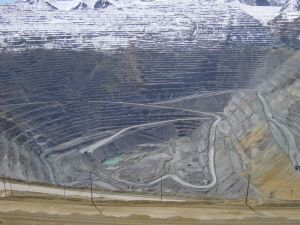
Well, now we know why there were riots and if you look at the financials in that presentation, you can see why a few grubby folks want to go wreck the environment there. You may want to check the presentation slides for this little item. The mine life is only 30 years. The strip ratio is expected to be 6.1 waste bcm per tonne of coal. I took one course in geology as an undergraduate and mostly identified rocks and strata soI had go look up the exact implication of a strip ratio. I found a short explanation from Ernest & Young First, a low strip ratio is good because that means less has to be stripped out. Stripping costs seem to be the major cost for coal mines. You can see from the presentation that the type of mining employed is Opencast with Truck and Shovel.
Open cast coal mining recovers a greater proportion of the coal deposit than underground methods, as more of the coal seams in the strata may be exploited. Large Open Cast mines can cover an area of many square kilometers and use very large pieces of equipment. This equipment can include the following: Draglines which operate by removing the overburden, power shovels, large trucks in which transport overburden and coal, bucket wheel excavators, and conveyors. In this mining method, explosives are first used in order to break through the surface of the mining area. The coal is then removed by draglines or by shovel and truck. Once the coal seam is exposed, it is drilled, fractured and thoroughly mined in strips. The coal is then loaded on to large trucks or conveyors for transport to either the coal preparation plant or directly to where it will be used
As such, the process is very destructive to the surrounding environment. The region involved is now full of farmers in a country where food insecurity is still an issue. From the IAP:
The Phulbari coal mine would use 5,933 hectares (around 60 sq. km.) of land, 80 percent of which is used for agriculture. It would physically displace as many as 130,000 people, mostly farming and indigenous households. This uprooting and resettlement of entire villages is being planned in one of the world’s most densely populated countries. Project plans clearly state that agricultural land and other vital resources including fish ponds, timber, and bamboo trees, would not be replaced. In short, the lives and livelihoods of tens of thousands of people would be irrevocably disrupted by a mining operation that would transform productive farmers into landless people with no clear prospects for other livelihoods or employment.
Going back to the cable leaked from the Wikileaks:
In a cable posted by WikiLeaks which was sent in July last year, Moriarty says he had urged Tawfiq Elahi
Open pit mine in Colorado
Chowdhury, the prime minister’s energy adviser, to authorise coal mining, saying that “open-pit mining seemed the best way forward”.
Later on in the cable, Moriarty privately noted: “Asia Energy, the company behind the Phulbari project, has sixty percent US investment. Asia Energy officials told the Ambassador they were cautiously optimistic that the project would win government approval in the coming months.”
However, in the cable Moriarty also notes that Chowdhury admitted the coal mine was “politically sensitive in the light of the impoverished, historically oppressed tribal community residing on the land”. Chowdhury, according to the cable, then agrees to build support for the project through the parliamentary process.
Well, that’s what our delightful government is doing in its spare time; protecting the investments of JP Morgan and ruining the lives of tens of thousands of indigenous Bangladeshis. But what about our cousins the Brits? This is from MSNBC.
The British government has trained a paramilitary force accused of hundreds of killings in Bangladesh, according to leaked U.S. embassy cables.
The Guardian newspaper said the cables described training for members of the Rapid Action Battalion as being in “investigative interviewing techniques” and “rules of engagement.”
One cable notes that U.S. training for the battalion in counterterrorism would be illegal under U.S. law because of human rights violations.
The newspaper said the battalion has been accused by human rights activists of being a “death squad” responsible for more than 1,000 extra-judicial killings since it was established in 2004. In March, the battalion’s leader said it had killed 622 people in “crossfire.”
The RAB’s use of torture has also been exhaustively documented by human rights groups, the Guardian said. In addition, officers from the paramilitary force are alleged to have been involved in kidnap and extortion, and are frequently accused of taking large bribes in return for carrying out killings.
However, the cables reveal that British and Americans officials favor bolstering the force to strengthen counter-terrorism operations in Bangladesh. One cable describes U.S. Ambassador James Moriarty as saying the battalion is the “enforcement organization best positioned to one day become a Bangladeshi version of the U.S. Federal Bureau of Investigation.”
The British training began three years ago, The Guardian said, quoting the cables.
There is also this report from Democracy Now if you’d like to watch more coverage of the item. There’s your taxes at works folks!! Making friends around the world!!
No wonder they want to shut down the Wikileaks and jail its founder.
The United Nations is investigating a complaint on behalf of Bradley Manning that he is being mistreated while held since May in US Marine Corps custody pending trial. The army private is charged with the unauthorised use and disclosure of classified information, material related to the WikiLeaks, and faces a court martial sometime in 2011.
The office of Manfred Nowak, special rapporteur on torture based in Geneva, received the complaint from a Manning supporter; his office confirmed that it was being looked into. Manning’s supporters say that he is in solitary confinement for 23 hours a day; this could be construed as a form of torture. This month visitors reported that his mental and physical health was deteriorating.
The Pentagon denies the former intelligence analyst is mistreated, saying he is treated the same as other prisoners at Quantico, Virginia, is able to exercise, and has access to newspapers and visitors.
He was charged in July with leaking classified material including video posted by WikiLeaks of a 2007 US attack in Baghdad by a Apache helicopter that killed a Reuters news photographer and his driver.
Wikileaks, Julian Assange, and Allegations of Sex Crimes
Posted: December 22, 2010 Filed under: Feminists, U.S. Politics, Violence against women, Wikileaks, Women's Rights | Tags: Julian Assange, power elites, rape, safe sex 95 Comments
For the past three days, I’ve been reading as much as I could about the claims and counterclaims about Julian Assange and his alleged sexual misconduct during a visit to Sweden in August, 2010.
I have to be honest: when I first heard about the charges, I thought they were extremely convenient for the governments and corporations who want Assange and his organization silenced.
It should go without saying that I do not approve of Assange’s behavior if the allegations against him are true. Nevertheless, I still believe the allegations are very convenient for the powers that be. The elites who control our government and the powerful multinational corporations that have been “victims” of Wikileaks couldn’t care less whether Assange committed sex crimes in Sweden. All they care about is stopping publication of leaks that so far have revealed and/or substantiated suspicions about some pretty shocking behavior by governments around the world.
Furthermore, now that we have at least some information (filtered by Swedish police and prosecutors and journalists) about the basis for the allegations of sexual assault, I think that reactions by conservative Swedish politicians and the media in the U.S. and Great Britain have been far out of proportion to the usual government and media responses to allegations like the ones described by the Guardian.
In fact, according to Amnesty International, Sweden usually is terrible at prosecuting and convicting accused rapists (h/t Dakinikat for the link).
…an Amnesty International report on rape in the Nordic Countries took Sweden to task last autumn for what the human rights organization saw as an abysmally low conviction rate for rape cases.
Released in September 2008, the Amnesty report – Case Closed – examines issues surrounding rape and human rights in Sweden, Norway, Denmark and Finland.
Despite Sweden’s considerable emphasis on women’s rights, currently ranking an impressive 3rd place in the UN global gender-related development index, instances of reported violence against women are showing no signs of abating.
[….]
Amnesty’s most damning criticism of Sweden relates to the considerable disparity between the number of rapes reported and the conviction rate.
Case Closed highlights the damning evidence that, despite the number of rapes reported to the police quadrupling over the past 20 years, the percentage of reported rapes ending in conviction is markedly lower today than it was in 1965.
There’s a lot more information at the link. BTW, anyone who has read The Girl with the Dragon Tattoo and the two sequel might have suspected that Sweden isn’t that good at dealing with violence against women.
Knowing Sweden’s usual treatment of rape allegations, are we really supposed to believe that suddenly Sweden is so deeply concerned about two women who had consensual sex with the same man followed by unwanted sexual behavior, that they asked Interpol to issue a red alert to find this guy?
Are we to believe that it is SOP for Great Britain, without being asked to do so by Sweden, arrests and imprisons the man before releasing him on hundreds of thousands of dollars cash bail based solely on these accusations by two women?
A number of self-described feminist bloggers (for some background, see this post by Valhalla at Corrente) are outraged that Assange has not voluntarily returned to Sweden–not to face charges, because there aren’t any yet–but to talk to a prosecutor who allegedly had refused to meet with him for the five weeks that Assange spent in Sweden waiting for the meeting to happen.
Where were these feminists in November when a young woman was violently raped in her high school Muncie, Indiana and school officials refused to even report it to police and allowed the perpetrator to leave school and go home and clean up and change clothing? What other rapes of powerless young women have these bloggers highlighted in the past couple of months? Maybe they’ve been busy doing this, I don’t know. But I’ve searched for blog links to the case in Muncie and haven’t found any posts by the bloggers who are now so outraged about Julian Assange.
I think the allegations against Assange and the effects they may have on Wikileaks itself are worth discussing. Personally, I’m not absolutely sure how I feel about all of it yet. But I’ll share my thoughts so far.
First, I think Julian Assange and Wikileaks have revealed a great deal of important information that has struck fear in the hearts of governments and powerful corporations. I see that as a good thing.
Second, I think Julian Assange is probably a very arrogant, egotistical man who is very likely lacking in social skills. I base that on what I’ve read about his childhood as well as quotes from people who have known him. I won’t go into that in detail here–I’ll just stipulate that he is probably difficult for other people to get along with. He may even be a complete a$$hole, for all I know. But he has accomplished something that I consider valuable.
Third, from what I know of the two women who accused Assange, they appear to be strong, powerful women who are capable of standing up for themselves. I realize that rape is traumatic for anyone. I’m just saying that these women are not poverty-stricken, homeless sixteen-year-olds like the woman who was raped in Muncie. These two women have good attorneys and they have powerful supporters, including a Swedish government official. I think it is a shame that they have been bashed on the internet and reportedly threatened by anonymous people. Unfortunately, women who report sex crimes against famous people often get treated pretty badly by the public and the media. But I’ll be willing to bet these two women knew that before they even got involved with Assange. If these allegations are true, then I hope they will both get up in court and testify against Assange. At the same time, Assange has the right to defend himself against their allegations. That’s how it works.
Fourth, as I said at the beginning of this post, these events are playing into the hands of both the power elites. The arguments in the media and on the internet about sex crimes charges is overwhelming the information coming out of Wikileaks to the point that I have seen a number of people actually claiming that nothing of importance has been revealed!
Fifth, the bloggers who are arguing so vehemently that Assange is a vicious rapist and must return to Sweden are also playing into Assange’s hands. He himself claims that the publicity over these charges has only helped him and his organization.
Finally, I think Julian Assange is right to fight extradition to Sweden, and I hope he continues to do so. I think it is highly likely that if he does return to Sweden, the Swedish government will hand him over to the U.S. Officials in the U.S., including Vice President Biden, that have deliberately referred to Assange as a “terrorist.” A number of U.S. politicians have state publicly that Assange should be assassinated. The President of the U.S. claims the right to detain indefinitely and even assassinate anyone from any country whom he designates as a “terrorist.” Therefore, if I were Julian Assange, I would fight tooth and nail to stay out of the hands of the U.S. government.
Those are my initial reactions after spending much of my time for a few days reading everything I could about these issues. Let’s talk about it here at Sky Dancing. Maybe we can manage to look at more than one side of these issues and draw some reasonable conclusions.
Before we get started, please watch these two videos from Democracy Now. They consist of a debate between Naomi Wolf and Jaclyn Friedman, two self-described feminists with different points of view on Assange and the sex crime allegations.
Democracy Now interview with Naomi Wolf and Jaclyn Friedman, part 1
Democracy Now interview with Naomi Wolf and Jaclyn Friedman, part 2
Have at it! What do you think?
Wikileaks on Big Pharma
Posted: December 21, 2010 Filed under: Big Pharma, Wikileaks | Tags: Big PHarma deals death, BOA, Nigeria, PFizer, Wikileaks 53 Comments Wikileaks has been the source of a lot of important whistle blower information which is why there seems to be a crusade against the organization’s most visible representative, Julian Assange. Wikileaks was founded in 2006 as a place where–among others–Chinese dissidents would be allowed to get important information to the public. Wikileaks’ stated purpose is to give assistance to all peoples that seek to “reveal unethical behaviour in their governments and corporations”.
Its first released documents dealt with government plots to assassinate people. It also has exposed bizarre documents from the Church of Scientology. During the financial crisis, Wikileaks released a report about a serious nuclear accident in Iran, problems at banks like the Kaupthing Bank of Iceland and Barclay’s, and a toxic dumping incident in the Ivory Coast. They have dumped data on corrupt governments and corrupt corporations so there is absolutely no shock that the powers that be all over the world are trying anything they can to discredit Wikileaks and every one associated with it. Wikileaks is bigger than one man and his foibles.
I’ve been finding more and more horrible things about Big Pharma and their experimentation on poor and helpless people in developing nations. This cover up trail–as with some others associated with horrible drug testing practices–leads to Wikileaks. Wikileaks has acted as our pharma watch dogs and released documents that provide more information on an ongoing story that exposed fatal drug tests on Nigerian children. Here is a summary of the situation from Democracy Now. You can watch Amy Goodman’s story in video at the same link. WAPO actually did a lot of the original investigative journalism back at the time this came to light in the late 1990s.
Diplomatic cables released by WikiLeaks show the pharmaceutical giant Pfizer hired investigators to find evidence of corruption against the Nigerian attorney general to pressure him to drop a $6 billion lawsuit over fraudulent drug tests on Nigerian children. Researchers did not obtain signed consent forms, and medical personnel said Pfizer did not tell parents their children were getting the experimental drug. Eleven children died, and others suffered disabling injuries including deafness, muteness, paralysis, brain damage, loss of sight, slurred speech. We speak to Washington Post reporter Joe Stephens, who helped break the story in 2000, and Musikilu Mojeed, a Nigerian journalist who has worked on this story for the NEXT newspaper in Lagos.
The story is 14 years old, but the Wikileaks information is new. In 1995, Pfzier was trying to get a new antibiotic–Trovan— to market. You may know this drug as Zithromax. It was supposed to be a big drug breakthrough and they wanted to test the drug on children. This is a complex and difficult undertaking in the US so they headed to Nigeria for their Clinical Trials. This is Amy Goodman’s explanation from a transcript of the show.
AMY GOODMAN: In 1996, Pfizer’s researchers selected 200 children at an epidemic hospital in Nigeria for an experimental drug trial. About a hundred of the kids were given an untested oral version of the antibiotic Trovan. Researchers did not obtain signed consent forms, and medical personnel said Pfizer did not tell their parents their children were getting the experimental drug. Eleven children died. Others suffered disabling injuries including deafness, muteness, paralysis, brain damage, loss of sight, slurred speech.
The details of the case were first exposed in 2000 in an investigative series in the Washington Post. In 2007, Nigerian officials brought criminal and civil charges against Pfizer in a multi-billion-dollar lawsuit.
Wikileaks has exposed an important link between Pfizer and the Nigerian law suit.
JUAN GONZALEZ: A State Department cable from 2009 details a meeting between Pfizer’s country manager, Enrico Liggeri, and U.S. officials in Abuja. The cable reads, “According to Liggeri, Pfizer had hired investigators to uncover corruption links to Federal Attorney General Michael Aondoakaa to expose him and put pressure on him to drop the federal cases.” A few months later, Nigeria settled with Pfizer for just $75 million.
Nigerian journalists consider Assange and Wikileaks to be heroes for exposing this connection. Here’s something just written by PMNews Nigeria outlining the importance of this information. You see an article there written by a Nigerian lawyer that explains the importance of the Wikileaks. The author has disabled the option to quote his work so I’ll respect this and just give you the link.
Additional information on Pfizer has come to light through the documents released by WikiLeaks. A lot of this information is being reported by Democracy Now–an advertising free media outlet–that has followed this story extensively. Pfizer extensively lobbied against a New Zealand Free trade agreement because New Zealand has drug buying rules similar to Canada. Big Pharma just hates it when countries negotiate prices.
In other WikiLeaks news, newly released cables have shed more light on the pharmaceutical giant Pfizer. Last week on Democracy Now! we reported how Pfizer hired investigators to find evidence of corruption against the Nigerian attorney general to pressure him to drop legal action over fatal drug tests on Nigerian children. Now Pfizer’s actions in New Zealand have been exposed by WikiLeaks. Newly released cables show the pharmaceutical company lobbied against New Zealand getting a free trade agreement with the United States because it objected to New Zealand’s restrictive drug buying rules. In addition, cables show drug companies tried to get rid of New Zealand’s former health minister.
Democracy NOW also reports that the Big Pharma has become the biggest defrauder of the Federal Government. They are bigger than even the military industrial complex with its giants like GE.
A new study by the watchdog group Public Citizen has found that the pharmaceutical drug industry has become the biggest defrauder of the federal government, surpassing the defense industry. Public Citizen found that the drug industry paid out nearly $20 billion in penalties over the past two decades for violations of the False Claim Act. More than half of the industry’s fines were paid by just four companies: GlaxoSmithKline, Pfizer, Eli Lilly and Schering-Plough.
If you read the show’s transcript, you’ll see further evidence and concerns about clinical trials happening on poor people in poor countries. The person I will quote is guest “Dr. Sidney Wolfe, the Director of Public Citizen’s Health Research Group and co-author of the new report, Rapidly Increasing Criminal and Civil Monetary Penalties Against the Pharmaceutical Industry: 1991 to 2010.”
I’d just like to add something to what James Steele said, which is, we call this industry the human experimentation corporations. The biggest human experimentation corporation is right here in the United States. It’s called Quintiles. They do experiments for drug companies as quickly as they possibly can all over the world. We found an ad from Quintiles that sells to the drug industry: “We help you recruit drug-naive subjects in many developing countries.” So this industry, in terms of exporting human experiments—and it really is a business—in terms of criminal violations—off-label marketing, illegal—in terms of False Claims Act, is really at the forefront. They parade themselves—and they do some good things; they do develop some good drugs. Is it really necessary for them to engage in criminal behavior, in civil violations and in very unethical human experimentations around the world? We think the answer is no.
A top lawyer at the FDA has recently said, “The only way we’re going to stop this industry from violating these laws, endangering people, is to start putting people in jail.” No one has ever gone to jail from one of these drug companies for these criminal violations. The size of the penalties is miniscule compared with the profits. Two companies, as mentioned—Glaxo and Pfizer alone—have paid $7 billion or $8 billion in the last 20 years. In one year, those two companies make about $15 billion or $16 billion in profits. So, until they are adequately assessed penalties that compare with the amount of money they’ve made off of these various drugs, until people are put in jail, if appropriate, this industry is going to keep running away.
And one other thing that was alluded to by James Steele is, this industry directly finances the FDA through cash payments. This year, between $700 million and $800 million in cash goes directly from the drug industry to the FDA. It pays for about two-thirds of all the review of drugs. So, in addition to the lobbying, the $200 million that James Steele talked about, there are direct cash payments, under a 1992 law that the Congress unwisely passed. So we have lots of problems with this industry. It does a lot of good things, but it is increasingly a menace in this country and abroad. As part of globalization, we’ve globalized human experimentation, and it’s a pretty nasty business.
There are several things that are becoming abundantly clear to me as I continue my search for Big Pharma’s role in the deathes of many people–babies and children included–through reckless experimentation and profit-seeking. The first is the importance of Wikileaks and the realization that the sideshow going on right now over Assange’s behavior in Sweden detracts from the essential role that Wikleaks plays in releasing important information. The second is how the majority of real data that I find comes from either sources not aligned with advertising interests or over seas media.
Democracy NOW and public interest groups like WikiLeaks rely on small donations and are not held hostage by government bullies and corporate revenues. Without media and free press outlets like Wikileaks and Democracy NOW and these investigative reports done by Public Interest Groups, we would NEVER get this information. We should be actively funding their ventures and supporting their right to expose the corruption and immoral behaviors of all governments and huge corporations.
The rich and powerful are banding together to prevent this information from coming to the surface. JUST a few minutes ago, this came to my attention: Apple Explains Why They Banned The Wikileaks App. MasterCard, Bank of America, and Pay Pal have moved to stop the flow of money to Wikileaks. BOA is said to be one of the next data drops from Wikileaks so I hardly find that move surprising. As corporate and western European/American government interests move to strangle this outlet of free speech, we’re beginning to see more people–people with questionable intellect and morals–distracted by the Assange Rape Accusation Side Show. Isn’t a little bit odd that all this is taking place in light of more and more whistle blowing documents showing up in places where there is only accountability to free speech and not to the profit motive and geopolitical power?
Against this backdrop, Julian Assange, the 39-year-old globetrotting Australian who is the driving force behind WikiLeaks, is battling extradition from England to Sweden for questioning about rape allegations. He was released on bail in London on Thursday.
Speaking Saturday outside a supporter’s mansion in eastern England, Assange called the case in Sweden a “travesty.” He also claimed he and others working for WikiLeaks face significant risks.
“There is a threat to my life. There is a threat to my staff. There are significant risks facing us,” he said, without offering details of the purported threats.
In an interview with CNBC on Friday, Assange said his organization plans to soon release information about banks, and he told Forbes magazine last month that the data would show “unethical practices.”
Assange told Computerworld magazine in 2009 that his organization had a trove of files on Bank of America. “At the moment, for example, we are sitting on 5GB from Bank of America, one of the executive’s hard drives. Now how do we present that? It’s a difficult problem,” he was quoted as telling the magazine.
Stay tuned. There will be more. The more you dig into stuff, the more twisted it gets. My guess is that Karl Rove is over on a mission there in Sweden to stop something that must either endanger Cheney, Bush, or himself. Why is Karl Rove helping to persecute Julian Assange? But, my friends, that is another story.
update: The BBC News has a Transcript of The Assange interview on its site.
Julian Assange Out of Jail
Posted: December 16, 2010 Filed under: Diplomacy Nightmares, Foreign Affairs, Wikileaks | Tags: Holder prosecution, Julian Assange, out on bail 24 CommentsIn the weirdest set of moves yet, the U.S. government is trying to build a legal case against Assange. I’ve rightly heard this compared to jailing Carl Bernstein for “the Deep Throat” leaks. Carl Bernstein was at least an American.
Justice Department officials are trying to find out whether Mr. Assange encouraged or even helped the analyst, Pfc. Bradley Manning, to extract classified military and State Department files from a government computer system. If he did so, they believe they could charge him as a conspirator in the leak, not just as a passive recipient of the documents who then published them.
Among materials prosecutors are studying is an online chat log in which Private Manning is said to claim that he had been directly communicating with Mr. Assange using an encrypted Internet conferencing service as the soldier was downloading government files. Private Manning is also said to have claimed that Mr. Assange gave him access to a dedicated server for uploading some of them to WikiLeaks.
Adrian Lamo, an ex-hacker in whom Private Manning confided and who eventually turned him in, said Private Manning detailed those interactions in instant-message conversations with him.
For some reason, Eric Holder is taking a bigger interest in this than he did in our breaking the Geneva Convention agreements on torture and the West Wing’s orders to assassinate a U.S. citizen abroad. What a warped sense of Justice  we’ve developed in this country!
Every one from Sweden to the Crown Prosecution service have argued against bail for Assange. Sweden was not allowed to make any arguments or offer any evidence as is custom in British Courts.
There was an early sign that the day would go in Assange’s favour when Ouseley said: “The history of the way it [the case] has been dealt with by the Swedish prosecutors would give Mr Assange some basis that he might be acquitted following a trial.”
American legal action could further complicate the situation. As you hear in the video above, Assange vowed to continue his work. Here’s one interesting result from the leaks of some of the cables. CNN reports that Zimbabwe’s first lady is suing because it was leaked she had dealings in illegal diamonds. You may recall the blood diamond issue from the movie with Leonardo DiCaprio.
The cables in question, from the U.S. Embassy in Harare, claimed that Zimbabwe’s first lady was among the senior Zanu-PF and government officials who were gaining huge profits from the smuggling of diamonds in the eastern part of Zimbabwe.
“The diamonds that are sold to regime members and elites are sold for freshly printed Zimbabwean notes issued by the RBZ (Reserve Bank of Zimbabwe),” the paper quoted a 2008 cable as saying.
“The cables suggested that (the head of the bank, Gideon) Gono kept the money printing press running to finance the purchase of diamonds and this could have accelerated hyperinflation, which eventually rendered the Zimbabwe dollar worthless,” the newspaper charged.
Grace Mugabe said in the suit that the report published Sunday by The Standard was “false, scandalous, malicious and bent on damaging (her) reputation.”
The documents said the newspaper wrongly suggested that Grace Mugabe had “used her position as the First Lady to access diamonds clandestinely, enriching herself in circumstances in which the country was facing serious foreign currency shortages, which amounts should have been channeled to the fiscus.
Yet, as CNN’s Jeffrey Toobin pointed out earlier this month, the law no more shields journalists than anybody else from prosecution for the dissemination of classified information. For instance, in the case decided by the Supreme Court regarding the New York Times’ decision to publish the Pentagon Papers leaked by Ellsberg, the court held only that the government did not have the right to keep the Times from publishing the papers, but the government still had the right to prosecute the Times after classified information from the papers was published in its pages. So, why try to make a distinction, however polemical?
“The law they’re using makes no distinction between journalists, the press — it applies to readers of the New York Times, just as well as to the publishers, the journalists and the leakers,” Ellsberg explained. “The language of that law makes no distinction. Now, that’s why they’ve been reluctant to use it — because it’s so broad, that it’s almost clearly unconstitutional.”
“They have tried to use the law — mostly unsuccessfully — but they’ve tried to use the law against leakers,” Ellsberg continued. “They’ve never tried to use it against a publisher. So this would be a first.”
In other words, if the Justice Department can successfully brand Assange as something other than a journalist or a publisher, it would not appear to be violating the perception of freedom of expression held by most Americans.
Exactly. We’re talking freedom of the Press here. The Republicans continue to shake their fists and spew weird diatribes at Assange. The weirdest to date was the P Woman accusing Assange of being “un-American” which is some weird word salad given Assange is an Aussie. Fred Thompson has been twittering up a storm on Michael Moore’s contributions to Assange’s bail. Something about Democrats not understanding real patriotism. Same old Republican jingoism! It does seems odd to me that a Democratic Attorney General would be following their lead, but hey, these appear to be strange times for Democrats in deed. To quote John Lennon: “Most peculiar Mama!”
Update: Since more Republican memes about Assange appear to be showing up in unlikely places–Remember, what they tried to do to Daniel Ellsberg?– I’m putting up some of the honors Assange has earned from the International Community.
Assange founded the WikiLeaks website in 2006 and serves on its advisory board. He has been involved in publishing material about extrajudicial killings in Kenya, for which he won the 2009 Amnesty International Media Award. He has also published material about toxic waste dumping in Africa, Church of Scientology manuals, Guantanamo Bay procedures, and banks such as Kaupthing and Julius Baer.[11] In 2010, he published classified details about US involvement in the wars in Afghanistan and Iraq. Then, on 28 November 2010, WikiLeaks and its five media partners began publishing secret US diplomatic cables.[12] The White House has called Assange’s release of the diplomatic cables “reckless and dangerous”.[13]
For his work with WikiLeaks, Assange received the 2008 Economist Freedom of Expression Award and the 2010 Sam Adams Award. Utne Reader named him as one of the “25 Visionaries Who Are Changing Your World”. In 2010, New Statesman ranked Assange number 23 among the “The World’s 50 Most Influential Figures”.

 peej
peej Carissa
 bostonboomer
 dakinikat
 ecocatwoman
 mablue2
 Mama Lopez
 peggysue22
 quixote
 skydancingguestblogger
 Mona (aka Wonk the Vote)



 Sky Dancing
Recent Comments