
Who ya Gonna Call?
Posted: September 14, 2011 Filed under: jobs, unemployment, voodoo economics | Tags: jobs, Martin Wolf, Obama American Jobs Act, Robert Reich, unemployment 5 Comments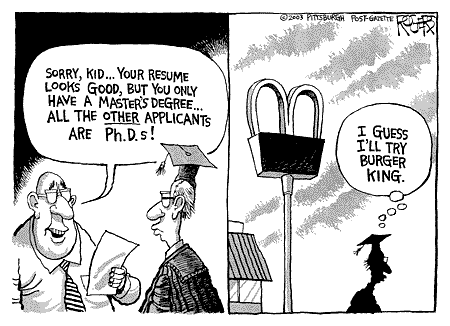 Evidently, the new Jobs Plan is a Jobs Bust in the eyes of the electorate. A few villagers may have gotten those tingly leg sensations, but the public is much more skeptical. Try this one on for size!
A majority of Americans don’t believe President Barack Obama’s $447 billion jobs plan will help lower the unemployment rate, skepticism he must overcome as he presses Congress for action and positions himself for re- election.
The downbeat assessment of the American Jobs Act reflects a growing and broad sense of dissatisfaction with the president. Americans disapprove of his handling of the economy by 62 percent to 33 percent, a Bloomberg National Poll conducted Sept. 9-12 shows. The disapproval number represents a nine point increase from six months ago.
The president’s job approval rating also stands at the lowest of his presidency — 45 percent. That rating is driven down in part by a majority of independents, 53 percent, who disapprove of his performance.
“I don’t think he’s done as good a job as I think he could have,” said Paul Kaplan, 58, an unemployed Democrat from Philadelphia. “We were hopeful that things would improve in the economy and they’ve only gotten worse. People in Washington just don’t seem to want to cooperate with each other and work for the people.”
The poll hands Obama new lows in each of the categories that measures his performance on the economy: only 36 percent of respondents approve of his efforts to create jobs, 30 percent approve of how he’s tackled the budget deficit and 39 percent approve of his handling of health care.
I still have to think that some of this has to do with the fact that we all were glad to be rid of Dubya and his horrible policies and now we realize it’s just more of the same!
By a margin of 51 percent to 40 percent, Americans doubt the package of tax cuts and spending proposals intended to jumpstart job creation that Obama submitted to Congress this week will bring down the 9.1 percent jobless rate. That sentiment undermines one of the core arguments the president is making on the job act’s behalf in a nationwide campaign to build public support.
Compounding Obama’s challenge is that 56 percent of independents, whom the president won in 2008 and will need to win in 2012, are skeptical it will work.
Even members of the Democratic Party in Congress are skeptical. Notice that the bottom line is still all about the politics instead of the people.
President Barack Obama’s new jobs plan is hitting some unexpected turbulence in the halls of Congress: lawmakers from his own party.
As he demands Congress quickly approve his ambitious proposal aimed at reviving the sagging economy, many Democrats on Capitol Hill appear far from sold that the president has the right antidote to spur major job growth and turn around their party’s political fortunes.
“Terrible,” Sen. Jim Webb (D-Va.) told POLITICO when asked about the president’s ideas for how to pay for the $450 billion price tag. “We shouldn’t increase taxes on ordinary income. … There are other ways to get there.”
“That offset is not going to fly, and he should know that,” said Democratic Sen. Mary Landrieu from the energy-producing Louisiana, referring to Obama’s elimination of oil and gas subsidies. “Maybe it’s just for his election, which I hope isn’t the case.”
“I think the best jobs bill that can be passed is a comprehensive long-term deficit-reduction plan,” said Sen. Tom Carper (D-Del.), discussing proposals to slash the debt by $4 trillion by overhauling entitlement programs and raising revenue through tax reforms. “That’s better than everything else the president is talking about — combined.”
And those are just the moderates in the party. Some liberals also have concerns.
“There is serious discomfort with potentially setting up Social Security as a fall guy because you’re taking this contribution out,” said Rep. Raul Grijalva of Arizona, referring to Obama’s proposal to further slash payroll taxes.
Democrats in large numbers will still back the president’s overall jobs package, and when the plan heads for House and Senate consideration, some of these same skeptics will very likely vote to advance the measure. But as details of the plan began to be vetted on Capitol Hill on Tuesday, it was clear that the White House needed to redouble its sales job — or tweak its plan — to force Democrats to fall in line at a pivotal point in Obama’s presidency.
Wow! I’d like to think it’s all those economists–like Robert Reich and Martin Wolf and the IMF–getting out there and explaining that austerity is killing middle class incomes, the basic problem is a lack of aggregate demand and that tax cuts are kind’ve worthless right now that’s moving the people. I actually believe that most people have a lot more common sense when it comes to economics than beltway-disabled politicians. You can see the contrast right up there in all those quotes from people v. politicians.
The centerpiece of the proposal — and the plank that Republicans have said they are most willing to consider — is a cut in payroll taxes, which cover the first $106,800 in earnings and are evenly split between employers and employees.
Respondents are evenly split at 45 percent on this approach, which would cost $240 billion to the U.S. Treasury. Independents oppose it 47 percent versus 43 percent who favor it.
Think about it. We’ve had 11 years of deregulation of financial markets and banks, tax cuts, bail outs for failing businesses, government largess to corporations, and your basic Republican Voodoo economics and what do we have to show for it? Higher Poverty rates. Lower median incomes. Huge long term joblessness. High unemployment. What rational person thinks that more of the same is going to do anything? You don’t need an economics degree to see that none of this stuff has worked in the past. But, thankfully, you do have some economists out there backing up our gut feeling with solid economic theory. Here’s something from Martin Wolf at FT just as a reminder.
Contrary to conventional wisdom, fiscal policy is not exhausted. This is what Christine Lagarde, new managing director of the International Monetary Fund, argued at the Jackson Hole monetary conference last month. The need is to combine borrowing of cheap funds now with credible curbs on spending in the longer term. The need is no less for surplus countries with the ability to expand demand to do so.
It is becoming ever clearer that the developed world is making Japan’s mistake of premature retrenchment during a balance-sheet depression, but on a more dangerous – far more global – scale. Conventional wisdom is that fiscal retrenchment will lead to resurgent investment and growth. An alternative wisdom is that suffering is good. The former is foolish. The latter is immoral.
Reconsidering fiscal policy is not all that is needed. Monetary policy still has an important role. So, too, do supply-side reforms, particularly changes in taxation that promote investment. So, not least, does global rebalancing. Yet now, in a world of excess saving, the last thing we need is for creditworthy governments to slash their borrowings. Markets are loudly saying exactly this. So listen.
Here’s Robert Reich showing his chops on what the real problem is in our economy. If only Obama, would find out the real problem from real economists and stop it with the political pandering to the Republican Party.
We don’t need a Texas Economy.
States don’t have their own monetary policies so they can’t lower interest rates to spur job growth. They can’t spur demand through fiscal policies because state budgets are small, and 49 out of 50 are barred by their constitutions from running deficits.
States can cut corporate taxes and regulations, and dole out corporate welfare, in efforts to improve the states’ “business climate.” But studies show these strategies have little or no effect on where companies locate. Location decisions are driven by much larger factors — where customers are, transportation links, and energy costs.
If governors try hard enough, though, they can create lots of lousy jobs. They can drive out unions, attract low-wage immigrants, and turn a blind eye to businesses that fail to protect worker health and safety.
Rick Perry seems to have done exactly this. While Texas leads the nation in job growth, a majority of Texas’s workforce is paid hourly wages rather than salaries. And the median hourly wage there was $11.20, compared to the national median of $12.50 an hour.
Texas has also been specializing in minimum-wage jobs. From 2007 to 2010, the number of minimum wage workers there rose from 221,000 to 550,000 – that’s an increase of nearly 150 percent. And 9.5 percent of Texas workers earn the minimum wage or below – compared to about 6 percent for the rest of the nation, according to the Bureau of Labor Statistics. The state also has the highest percentage of workers without health insurance. Texas schools rank 44th in the nation in per-pupil spending.
The Perry model of creating more jobs through low wages seems to be catching on around America.
According to a report out today from the Commerce Department, the median income of U.S. households fell 2.3 percent last year – to the lowest level in fifteen years (adjusted for inflation). That’s the third straight year of declining household incomes. Part of this is loss of jobs. Part is loss of earnings.
More and more Americans are retaining their jobs by settling for lower wages and benefits, or going without cost-of-living increases. Or they’ve lost a higher-paying job and have taken one that pays less. Or they’ve joined the great army of contingent workers, self-employed “consultants,” temps, and contract workers – without healthcare benefits, without pensions, without job security, without decent wages.
It’s no great feat to create lots of lousy jobs.
We just don’t need no stinkin’ jobs. We need real jobs. For that, it takes a lot more than tax cuts, rhetoric, and political pandering. So, I’m not calling Rick Perry or Barrack Obama any time soon. It’s real jobs or bust for me.
The “Jobs” Speech: Aftermath
Posted: September 8, 2011 Filed under: Barack Obama, U.S. Economy, U.S. Politics, unemployment, voodoo economics, We are so F'd | Tags: live blog, Obama jobs speech 14 Comments
Desperation Time
Reuters has a summary of the “key elements” of President Obama’s speech. Mainly he proposed a payroll tax holiday for employees and employers.
EMPLOYEE PAYROLL TAX HOLIDAY
Obama is proposing a $175 billion one-year extension and expansion of the employee payroll tax holiday that would halve the tax rate to 3.1 percent in 2012.
EMPLOYER PAYROLL TAX HOLIDAY
Obama is seeking $65 billion to encourage small businesses to hire more workers. This includes halving employer payroll taxes to 3.1 percent for the first $5 million of a company’s wage bill in 2012, which the administration says will reach 98 percent of small businesses. He also wants a complete payroll tax holiday for increasing the size of the payroll by up to $50 million above the prior year, either by hiring new workers or raising the salaries of the existing labor force.
That would help the people who still have jobs, I guess, but it hasn’t done much to create new jobs so far.
In addition to that:
He proposes to help homeowners, and says he’ll have a plan in the next couple of weeks–no specifics.
$5 billion to provide 100% tax deductions for businesses that spend money on new plants and equipment. Of course, as Dakinikat has repeatedly told us, that won’t create jobs as long as consumers can’t spend.
$85 billion for state and local governments, which would be good if the Republicans would allow it through. This would include money for improving schools, helping keep teachers and other public employees in their jobs, improving already foreclosed homes, and money for young people.
$50 billion for transportation infrastructure. Hasn’t this one been around for awhile? I don’t think the Republicans will go along.
A one-year extension of unemployment benefits and tax credits for the long-term unemployed.
So what do you think? What are you hearing in the media?
Personally, I think it’s time for Obama to give a speech like this one.
It’s still the jobs, stupid
Posted: August 29, 2011 Filed under: Economy, jobs, unemployment, voodoo economics | Tags: Alan Krueger, Dean Baker, Economists, jobs policy, labor market, Mark Thoma, unemployment 17 Comments In what I hope is not some symbolic hype, Alan Krueger–an actual economist and a labor one at that–was nominated by President Obama today to head the Council of Economic Advisors. He will replace Austin Goolsbee.
As the Wall Street Journal noted, Krueger’s scholarship suggests he will “likely provide a voice inside the administration for more-aggressive government action to bring down unemployment and, particularly, to address long-term joblessness.”
If his name sounds familiar, it’s because Krueger’s academic work has frequently played a valuable role in the political discourse. When congressional Republicans blatantly lied about the costs of a cap-and-trade plan, it was Krueger who set the record straight. When conservatives said in 2009 that slashing the minimum wage would boost the economy, Krueger explained why the opposite is true.
The economist also brings relevant experience to the table.
I’m hoping this finally brings the correct policy priorities and prescriptions to the table. We’ve had nearly three years of confused messages and results and the economy is clearly the worse for it. There’s an article up at The Guardian by economist Dean Baker that pretty much sums up all of my economic posts for the past few years. Obama never seemed to understand that high unemployment is a problem and never instituted any kind of policy to target the problem directly. He says he gets it now, but I’d just like to remind every one that he said he got it after the election that delivered the House of Representatives to the Tea Party terrorists and still has shown no sign that he understands that people expect bold fiscal policy in the face of low economic growth. All we keep getting is tax breaks for rich people and opposites day fiscal policy.
President Obama has discovered how serious the recession is. That’s what he told an audience in Chicago last week. To be fair, he was referring to revised data from the commerce department showing that the falloff in GDP was larger than originally reported.
But ridicule is appropriate. He and we knew all along how many people were out of work. The employment numbers told us the size of the hole and the desperate need for government action.
This sort of ridiculous comment, and President Obama’s weak response to the recession over the first two and a half years of his presidency, explains the tidal wave of scepticism facing his widely hyped upcoming speech on jobs after the Labor Day weekend. The list of remedies leaked ahead of time does little to inspire hope.
At the top of the list of job-creating measures is extending the 2 percentage-point reduction in the social security payroll tax. This provides no boost to the economy, since it just keeps in place a tax cut that was already there, but if the cut is allowed to end at the start of 2012, it will be a drag on growth.
As it stands, the social security programme is being fully reimbursed for the lost tax revenue, but there is always the possibility that Republicans will use this as a basis for attacking the programme. Given President Obama’s willingness to support cuts to social security, it is understandable that this part of his jobs agenda doesn’t generate much enthusiasm.
Baker goes on to call for a new CCC and explains why trade agreements, tax cuts to business yet again that undermine social security, and all the rest of the “jobs” agenda touted by the President aren’t going to do much of anything. Economist Nancy Folbre has a great piece of analysis up at the NYT explaining why letting this high level of unemployment go on for a period of time has an increasingly negative impact on the entire economy because things multiply over time. However, a new study covered by Folber shows that the unemployed just don’t sit around and act like they are on vacation. They create value by doing unpaid work. The same folks that think that the unemployed just lie around are the same ones that push the meme that homemakers spend their days eating bon bons and watching soap operas.
The overall increase in non-market work implies that household consumption among the unemployed fell less than market income, but it’s hard to put a dollar value on the unpaid work. When people make a voluntary decision to substitute time for money, we can infer something about the relative value they place on it.
But most unemployment is involuntary, and some unpaid work probably represents an effort to stay busy more than a significant contribution to household living standards.
The authors emphasize the relatively large impact of unemployment on unpaid work, in part because this is a new finding, and in part because it counters the wrong impression that, as Professor Hurst put it, the Great Recession was a Great Vacation.
But it is also important to note that most of the unemployed can’t allocate more of the free time they gain to productive uses, even if they want to. They lack the capital, land, tools and skills needed to flexibly shift from wage employment to production for their own use. Even when they can make a partial shift, their productivity is likely to be lower in unpaid work than paid work.
That’s why involuntary unemployment represents such a waste of human capabilities and loss of productive output for the economy as a whole.
So, what can Alan Krueger bring to the White House if the President will listen to this economist? This is economist Mark Thoma’s take on the appointee.
His most well known research is on the minimum wage and immigration, The work is somewhat controversial in that the results show small negative effects from raising the minimum wage and from increasing immigration. In my view that is a sign of an economist who is willing to let the evidence do the talking, and that is a good trait to have in this job.
He has also worked in many other areas, including occupational licensing, the economics of terrorism, and more recently on job search in periods when unemployment is high, including how job search is affected by things such as unemployment insurance. But that is just a small taste of the large amount of research he has done.
Krueger’s been working at the Treasury so maybe that will give him access that many of the other Obama economic advisers seemed without. Time is running out for policy to help the unemployed in any meaningful way. I say this because as we get closer to the election, it will make the Republicans more surly and less likely to do anything to help a Democratic administration. They’ve already been rewarded for hostage-taking behavior. Then, there’s the policy lags. Things like infrastructure banks take a lot of time to set up. Ideas like patent reform are laughable as job creation tools. I have no idea why the Obama administration won’t embrace things that worked in the past, but that doesn’t appear to be their MO. They seemed to get their jobs mojo from reheating failed Republican canards and presenting them as the higher, middle ground. I continue to be discouraged.
Finally, but is it for real?
Posted: August 25, 2011 Filed under: 2012 presidential campaign, Economy, unemployment, voodoo economics | Tags: bad economy, joblessness, lousy poll numbers, Obama 10 Comments When Obama swept into office, there was an ongoing, left-over Bush program in place to rescue the financial system which focused on getting banks recapitalized through the Fed. Despite worsening unemployment and rising bankruptcies, a stimulus that was top heavy in worthless tax cuts was hurried to congress and a program–that was more of a plea to banks than an actual program–was pasted together to focus on refinancing underwater mortgage holders. The stimulus may have changed the momentum of GDP growth and the FED program definitely stabilized the banking system, but the programs for homeowners and the unemployed were less-than-successful. The President was itching to put something together on health care to prove that he could do something that hadn’t been achieved by the Clintons. It looks now like his primary economic advisers were warning him that just feeding tax breaks to choice businesses and and cheap loans to banks was not going to solve a major financial crisis. Obama’s focus never really appeared to be on things that mattered at the time. As a result, serious improvement in key areas of the economy never materialized.
It’s not a surprise to any of us around here that Obama’s handling of the US economy is souring voters. James Carville’s mantra–it’s the economy stupid–has never been more relevant to the vast majority of Americans who have been made worse off by the policies of the last ten years.
Americans’ views on the economy have dimmed this summer. But so far, the growing pessimism doesn’t seem to be taking a toll on President Barack Obama’s re-election prospects.
More people now believe the country is headed in the wrong direction, a new Associated Press-GfK poll shows, and confidence in Obama’s handling of the economy has slipped from just a few months ago, notably among fellow Democrats.
The survey found that 86 percent of adults see the economy as “poor,” up from 80 percent in June. About half — 49 percent — said it worsened just in the past month. Only 27 percent responded that way in the June survey.
That can’t be good news for a president revving up his re-election campaign.
There’s a good chance that GDP–now growing at a miserably slow rate–may go into negative territories shortly, forcing the NBER to date the  start of yet another recession when the recovery from this one has not really taken hold. There’s indications in the market that another crash could be on the horizon. After all, businesses can only wring so much profit out of restructuring debt to take advantage of cheap interest rates and cutting costs primarily by dumping workers. Here’s some really frightening news on reinsurance on banks which is also causing weird stuff in the CDS market. That’s the same damned market that messed up the economies of Europe and US the last time around which really needs some restructuring, standardization, and reform that has not been done despite Dodd-Frank and similar efforts on the other side of the pond. Bankers have fought new regulation and we’re likely to see the same problems revisit us in a different sector of the same market for the same kinds of vehicles.
Insurance on the debt of several major European banks has now hit historic levels, higher even than those recorded during financial crisis caused by the US financial group’s implosion nearly three years ago.
Credit default swaps on the bonds of Royal Bank of Scotland, BNP Paribas, Deutsche Bank and Intesa Sanpaolo, among others, flashed warning signals on Wednesday. Credit default swaps (CDS) on RBS were trading at 343.54 basis points, meaning the annual cost to insure £10m of the state-backed lender’s bonds against default is now £343,540.
The cost of insuring RBS bonds is now higher than before the taxpayer was forced to step in and rescue the bank in October 2008, and shows the recent dramatic downturn in sentiment among credit investors towards banks.
“The problem is a shortage of liquidity – that is what is causing the problems with the banks. It feels exactly as it felt in 2008,” said one senior London-based bank executive.
“I think we are heading for a market shock in September or October that will match anything we have ever seen before,” said a senior credit banker at a major European bank.
While Obama is on vacation, White House gnomes are pasting together two programs for the poll-beleaguered President to announce when Congress gets back into session. The first is a “jobs” package. The second is a plan for massive mortgage refinancing. This is something that should’ve been on the front burner years ago so now I’m actually wondering if it’s going to work in time to stymy the right wing nut jobs coming up through the Republican primary process or it’s actually going to be serious rather than some lame ass attempt at some neoReaganesque policy that will move farther right when Republicans start saying no to clearly Republican policy.
Here’s the “Contours of Obama jobs package” via Reuters.
The president is widely expected to repeat his calls for an extension of a payroll tax cut, push for patent reform and bilateral free trade deals, and suggest an infrastructure bank to upgrade the country’s roads, airports and other facilities.
Retrofitting schools with energy efficient technology would allow the government to directly hire for labor-intensive work and also give a boost to the clean energy sector that Obama has said could be an important U.S. economic motor.
Other measures being considered, according to economists who have advised the White House, include tax credits for firms hiring more workers, funds for local governments to hire teachers, and retraining help for the long-term unemployed. Steps to boost the ailing housing market are also under review.
“What’s going to be included in this plan are some reasonable ideas that could have a tangible impact on improving our economy and creating jobs … the kinds of things that Republicans should be able to support,” Earnest said. “These are bipartisan ideas that the president is going to offer up.”
Republicans have made it perfectly clear that their only priority is to make Obama a one term president. So, in yet another attempt at trying to look above the fray instead of fighting for what is right, we’re going to see another lukewarm policy that won’t have any immediate effect and will undoubtedly be pushed further to the right and further into the ineffective zone. Plus, it will probably just be offset by other spending cuts in key areas which are likely to have stronger recessionary multiplier effects attached than any positive multiplier effect of the new legislation. I still can’t figure out what the obsession is with tax cuts for new employees. The big cost of new employees is health insurance for one and you can avoid that cost by going any where in the developed and developing world BUT the US. Plus, no business is going to hire any one when the have no customers. I feel like a broke record on the number of repeats on that one. Having spent my life doing strategic planning and budgeting for corporations and having one of my PhD field areas in corporate finance, I can tell you that the US looks like one of those offshore tax havens right now for most major corporations. Also, more ‘free trade’ deals are likely to have just the opposite effect on unemployment anyway as prices tend to equilibriate in the countries involved and we’re the cheap capital market, not the cheap labor market part of that equation. (Hence, in our country, incomes to capital go up and incomes to labor go down as the market goes towards price parity for our country.)
So, the second program is no a way for the US to back mortgage refinancing. This is also something that should’ve been done years ago.
One proposal would allow millions of homeowners with government-backed mortgages to refinance them at today’s lower interest rates, about 4 percent, according to two people briefed on the administration’s discussions who asked not to be identified because they were not allowed to talk about the information.
A wave of refinancing could be a strong stimulus to the economy, because it would lower consumers’ mortgage bills right away and allow them to spend elsewhere. But such a sweeping change could face opposition from the regulator who oversees Fannie Mae and Freddie Mac, and from investors in government-backed mortgage bonds.
Administration officials said on Wednesday that they were weighing a range of proposals, including changes to its previous refinancing programs to increase the number of homeowners taking part. They are also working on a home rental program that would try to shore up housing prices by preventing hundreds of thousands of foreclosed homes from flooding the market. That program is further along — the administration requested ideas for execution from the private sector earlier this month.
But refinancing could have far greater breadth, saving homeowners, by one estimate, $85 billion a year. Despite record low interest rates, many homeowners have been unable to refinance their loans either because they owe more than their houses are now worth or because their credit is tarnished.
I’ve already looked into refinancing my FHA/VA loan from 7% to 4%. I have good credit and my loan balance is about one half of what my house is worth–even with the recent decrease in home prices–because I’ve owned it for 11 years. I didn’t follow through because the points charged by Wells Fargo–who processes my mortgage at the moment–were ridiculous. They’d have to pick up the fees or points to intrigue me, frankly. The people with the worst problems are the ones that are now strategically defaulting because they are underwater. Interesting enough, I’m set to discuss just that topic this fall in the Denver FMA meetings using this Philadelphia FED working paper. Their findings suggest that people have the ability to pay these mortgages but they are defaulting anyway because they are underwater. The weird thing is they are defaulting on first mortgages while keeping their second liens current. This means they are ‘strategically’ defaulting to get rid of the house because it’s a stupid investment for them. Any plan that doesn’t deal directly with underwater mortgage holders specifically will not work. Banks really don’t have any incentive to work with them now because they get more fee income from processing defaults than they do from renegotiating the mortgage. The incentives on both sides of the market are totally warped at this point in time. Again, quoting from the NYT article, this isn’t in the plan.
A broader criticism of a refinancing expansion is that it would not do enough to address the two main drivers of foreclosures: homes worth less than their mortgages, and a sudden loss of income, like unemployment. American homeowners currently owe some $700 billion more than their homes are worth.
I don’t see how the issues in the housing market are going to be solved until you solve this problem. Dumping houses on the market is going to continually depress prices and cause this problem to regenerate.
So, this gets back to sort’ve my main point about both these big ideas. First, they are a little too little and way too late. The inside and outside lags on these kinds of fiscal policy measures are long and getting them through congress and into fruition is likely to lag-filled. We’re also likely to get a lecture and ransom demand from the austerity demons. So, is this a real effort or a symbolic effort? Second, the policy prescriptions are anemic. Neither of them focus on the real problems or the known solutions. So, again, is this a real effort or symbolic effort? Third, these aren’t very aggressive policies nor or they what you would call traditionally Democratic policies so who are they really aimed at? Again, it seems like a symbolic offering to voters. If you’re getting the impression that I’m not impressed at all with this, you’re right. I suppose this is all to make the confidence fairy come home to roost. It still seems to me that she’s on her honey moon with the high priest of voodoo economics. Imaginary beings are symbolic too.
Monday Reads
Posted: August 22, 2011 Filed under: education, Foreign Affairs, Libya, morning reads, religion, religious extremists, The Bonus Class, U.S. Economy, U.S. Politics, unemployment, voodoo economics | Tags: asteroids, Barack Obama, Christianity, Creationism, David Koch, DNA, education, gold, Karen Bass, Laura Richardson, Libyan Rebels, Martha's Vineyard, Maxine Waters, meteorites, Mitt Romney, Muammar Gaddafi, National Transitional Council, oil, oil prices, Stock Market, Tripoli, unemployment, Valerie Jarrett, Warren Buffet 18 Comments
Good Morning!! Yesterday was an exciting day for the Libyan rebels, who have taken over the capital city, Tripoli. From the NYT:
Col. Muammar el-Qaddafi’s grip on power dissolved with astonishing speed on Monday as rebels marched into the capital and arrested two of his sons, while residents raucously celebrated the prospective end of his four-decade-old rule.
In the city’s central Green Square, the site of many manufactured rallies in support of Colonel Qaddafi, jubilant Libyans tore down green flags and posters of Colonel Qaddafi and stomped on them. The leadership announced that the elite presidential guard protecting the Libyan leader had surrendered and that they controlled many parts of the city, but not Colonel Qaddafi’s leadership compound.
The National Transitional Council, the rebel governing body, issued a mass text message saying, “We congratulate the Libyan people for the fall of Muammar Qaddafi and call on the Libyan people to go into the street to protect the public property. Long live free Libya.”
Officials loyal to Colonel Qaddafi insisted that the fight was not over, and there were clashes between rebels and government troops early on Monday morning. But NATO and American officials said that the Qaddafi government’s control of Tripoli, which had been its final stronghold, was now in doubt.
We’ll have to wait and see what happens next. I hope it will mean the U.S. pulling out of there, but that’s probably a vain hope. After all, Libya has oil and gold.
Business Insider: AFTER QADDAFI: Oil Prices Will Tank, Stock Prices Will Soar
Watch what happens to oil prices if and when the Qaddafis lose and leave.
In short order, Libyan oil production will ramp up. As it does, oil prices in world markets will fall and oil futures markets will reflect the expected increase in production of oil from Libya. The key prices to watch are those trading in Europe, like Brent. US oil prices (WTI) are no longer the leading indicator of world prices intersecting with world supply/demand. Excess inventory at Cushing, OK is complicating the pricing structure.
We expect oil prices to fall when highly desirable, sweet Libyan crude production is fully resumed and enters the pipeline. Maybe, they are going to fall by a lot. This will come as a much-needed boost to the US economy and to others in the world.
Remember: the oil price acts like a sales tax on consumption. To clarify this relationship we convert crude oil prices to gasoline prices and then estimate what a change in gas price will mean for the American consumer. Roughly, a penny drop in the gas price per gallon gives Americans 1.4 billion more dollars a year to spend on other than gasoline. That is a huge stimulant to the economy. The ratio is different in Europe because the gas taxes are so much higher there. Nevertheless, it is still significant.
In other news, President Obama is still on vacation, and unemployment is still soaring. From the SF Chronicle: Obama keeps full vacation day after Libya briefing
In between briefings on Libya, President Barack Obama packed golf, beach time, a stop at a seafood restaurant and a visit to a wealthy friend’s seaside compound into his Martha’s Vineyard vacation Sunday….
Then Obama and his family headed to dinner at the house where White House adviser Valerie Jarrett is staying.
Earlier, Obama spent about an hour at the home of Comcast chief executive Brian Roberts after playing golf with some buddies. The golf foursome included Obama’s Chicago pal Eric Whitaker, UBS America executive Robert Wolf and a White House aide. Obama spent the morning at the beach with his wife, Michelle, and daughters Sasha and Malia.
From the LA Times: Congresswomen hear economic, unemployment woes at Inglewood event
…hundreds of people from Los Angeles-area communities…gathered Saturday to share their stories of hardship and to urge local members of Congress to push corporations to help fix the economy and devise ways to put people back to work. Three Democratic U.S. representatives attended the event: Maxine Waters and Karen Bass of Los Angeles and Laura Richardson of Long Beach….
The recession has slammed Los Angeles County, where 1 in 4 workers are jobless or underemployed, according to Good Jobs LA. This summer, L.A. businesses announced 5,700 layoffs, the jobs advocacy group said.At the same time, corporations are hoarding almost $2 trillion in cash but failing to invest in jobs, the advocacy group said. The group also cited skyrocketing bonuses for many chief executives and big tax breaks for some of the nation’s largest companies.
Warren Buffet recently asked President Obama to raise taxes on the rich for the good of all. Another multi-billionaire, David Koch, disagrees with Buffet that rich Americans should sacrifice anything for their country.
America’s current tax system forces people making $50,000 a year to pay a higher rate than hedge fund managers making $2.4 million an hour. Warren Buffett penned an op-ed last week declaring that America’s super-rich have been “coddled long enough by a billionaire-friendly Congress.” Lamenting the numerous tax loopholes and special breaks afforded to billionaire investors, Buffett noted that in his entire career, even when capital gains rates were as high as 39.9 percent, he never saw anyone “shy away from a sensible investment because of the tax rate on the potential gain.”
Charles Koch, head of the massive petrochemical, manufacturing, and commodity speculating Koch Industries corporation, has responded to Warren’s call for shared sacrifice: “No Thanks.” In a statement to right-wing media, Koch states:
Much of what the government spends money on does more harm than good; this is particularly true over the past several years with the massive uncontrolled increase in government spending. I believe my business and non-profit investments are much more beneficial to societal well-being than sending more money to Washington.
Yeah, like supporting wingnuts like Scott Walker and Paul Ryan is good for our country. I’d like to see Koch’s fortune confiscated. Maybe we need to bring back the guillotine?

Romney's home in La Jolla, CA
Speaking of rich A$$holes, Mitt Romney has decided that his $12 million mansion in La Jolla must be enlarged–he wants the already huge house to be four times as big.
LA JOLLA — GOP presidential contender Mitt Romney, scheduled to attend a series of fundraisers this weekend in San Diego, is also working on plans to nearly quadruple the size of his $12 million oceanfront manse in La Jolla.
Romney has filed an application with the city to bulldoze his 3,009-square-foot, single-story home at 311 Dunemere Dr. and replace it with a two-story, 11,062-square-foot structure. No date has been set to consider the proposed coastal development and site development permits, which must be approved by the city.
The former governor of Massachusetts purchased the home three years ago. According to a description from the listing agent, the Spanish-style residence at the end of a quiet cul-de-sac is sophisticated and understated in its décor, “offering complete privacy and unsurpassed elegance.”
Tentative plans call for new retaining walls and a relocated driveway, but would retain the existing lap pool and spa.
Just how many homes does this man own anyway? Slate Magazine says “just” two. He had a huge house in Massachusetts, not too far from where I live, but he sold it in 2009 for $3.5 million.
I guess after he used (screwed) our state to set up his run for President, he decided to clear out and move his con man act to California. He also sold a “$5.25 million, 9,500-square-foot ski villa in Deer Valley, Utah,” according to Slate. Time calls that “the new frugality.” He’s hanging onto a home in New Hampshire apparently. Where’s that guillotine?
In science news, from Clive Cookson at the Financial Times: Life on earth came from space
The existence of amino acids in space has already been proved by the analysis of meteorites that have struck earth, and comet samples collected in space during Nasa’s Stardust mission. It has been harder to prove that traces of nucleobases found in meteorites were not the result of contamination after they arrived – but the new study seems to do so, while showing that nucleobases reach earth from space in greater diversity and quantity than scientists had thought.
The Nasa team analysed samples of 12 carbon-rich meteorites, including nine found in Antarctica (a rich collecting ground), and detected guanine and adenine, two of the four nucleobases that make up DNA. They also found three related molecules known as nucleobase analogues, a discovery which provides confirmation that the organic compounds in meteorites come from space.
“You would not expect to see these nucleobase analogues if contamination from terrestrial life was the source, because they’re not used in biology,” says Michael Callahan, lead author of the study, which appears in Proceedings of the National Academy of Sciences. “However, if asteroids are cranking out prebiotic material, you would expect them to produce many variants of nucleobases, not just the biological ones, because of the wide variety of ingredients and conditions in each asteroid.”
Further confirmation came from an analysis of Antarctic ice, taken from near where the meteorites were collected, which showed no trace of the compounds.
Wait…. you mean life didn’t originate in the Garden of Eden?
In related news, a court has ruled that a teacher who made fun of creationism and Christianity cannot be sued for expressing her opinions.
A federal appeals court ruled Friday that a California teacher could not be sued for criticizing Christianity and Creationism during a college-level European history course.
“This was a really important ruling for academic freedom,” University of California constitutional scholar Erwin Chemerinsky, who took on the case pro bono, told The Orange County Register. “There has never been a precedent set for something like this before. Teachers should be able to criticize religion just like they can criticize government, business and similar groups without the fear of being sued.”
A three-judge panel of the 9th U.S. Circuit Court of Appeals tossed out a lower court’s decision, which held that teacher James Corbett violated a student’s First Amendment rights by making comments during class that were hostile to religion in general, and to Christianity in particular….
Corbett said during his class that serfs opposed social, political and economic [sic] that were in their best interest because of religion, compared Creationism to “magic,” and made twenty other comments that then-sophomore Chad Farnan alleged were disparaging to Christians.
Oh, did I mention this was a college course? Good grief!!
That’s all I have for today. What are you reading and blogging about?

 peej
peej Carissa
 bostonboomer
 dakinikat
 ecocatwoman
 mablue2
 Mama Lopez
 peggysue22
 quixote
 skydancingguestblogger
 Mona (aka Wonk the Vote)



 Sky Dancing
Recent Comments