
Economics in a Nutshell
Posted: March 3, 2012 Filed under: Economy, voodoo economics | Tags: austerity, confidence fairy, economic myths, joseph stiglitz, Trickle Down Economics, voodoo economics 4 CommentsJoseph Stiglitz is one of my favorite economists. He has that rare ability to put the results of theory, models, and empirical research into pithy common sense statements. He has shown–with tons of peer-reviewed research–how  frictions that exist in all markets distort results. There is no real world example of a perfect market. In fact, he has a Nobel Prize for it. Markets are not these efficient, well-oiled, rational deal makers that many Republicans, Libertarians, and Rich People would like you to believe simply because they really really want to believe in it. They can click their red ruby Hayek slippers as much as they want but decades of study over the results of market have left us with lots of succinct lessons that a lot of 21st century policy makers appear to have unlearned. In a recent speech and interview, Stiglitz manages to hit all the main ones in short order. Here’s what the evidence has taught us. First, it’s really not good for any economy to have income inequality.
Inequality is bad for growth, stability and efficiency. … Inequality peaked both before the Great Depression and before the Great Recession, and it’s not an accident. So basically, when we have a lot of inequality, demand goes down. … All this inequality was offset by creating a bubble. The bubble allowed people to consume more. Now we have the inequality but we don’t have a bubble, and that means that we will have persistent, weak demand, and therefore unless we create another bubble it’s going to be very difficult for us to get back to full employment.
A lot of the inequality that we have in the United States is created by distortions – excessive financial sector, monopolies like Microsoft … giving the oil companies, mining companies resources at a discount. … These things distort the economy, while they create wealth at the top. So it’s not wealth creation – it’s wealth redistribution, which makes the size of the pie smaller.
Second, a lot of government policy and just things inherent to some markets can create distortions that make markets very inefficient. Government actually creates a lot of distortions by trying to put businesses on steroids. Our recent tax policies that give special treatment to capital gains over income earned from labor are an example. They have created horrible distortions that have drained resources away from useful things and into parasite markets and gambling activities.
And the loopholes, the distortions, the giveaways. … When you tax capital gains at half the rate of others, you encourage speculation. And so you divert resources to speculative activity, including the best brains at Columbia, into speculation rather than into creative activities.
Stiglitz also has his three top Economic Memes and Tropes that are absolutely killing this country’s economy because they have absolutely no basis in any evidence or reality. He’s actually been tweeting them all morning as the top three Myths. The first myth is the one about the confidence fairy. The second and third are part and parcel of trickle down economics. This is the horrible Republican kneejerk response that we have to appease “job creators” at all costs even when we have evidence they are more job destroyers than creators. Economists have been hypothesizing these things for decades and every bit of evidence from policies meant to achieve these results from Reagan to Bush have shown them to be seriously untrue. However, they persist in the minds of many policy makers and they are killing our future.
The first is that reducing the budget deficit would stimulate the economy by restoring confidence, which you hear over and over again. No evidence that has ever worked. You might call it the austerity myth – that’s the most serious one.
The second one is that raising taxes on upper-income individuals will lead them to save less, invest less, will have adverse supply-side effects. Again, no evidence of that.
The third is that lowering [the] corporate income tax rate across the board will stimulate investment in the United States. No evidence of that. … If you want to encourage investment, what you do is lower taxes on firms that invest and you raise taxes on firms that don’t invest. You can restructure the taxes to provide incentives to invest.
I’m not certain what it will take to end the impact of these harmful myths. However, given that harmful myths–notably the ones that come from any religion not based on evidence and reality–have kept us in Dark Ages before and are likely to continue to do so. For many people, science fiction still holds a broader appeal than science fact.
Occupy Philly and Independence Hall
Posted: November 30, 2011 Filed under: #Occupy and We are the 99 percent!, Banksters, Corporate Crime, corruption, Economy, financial institutions, income inequality, jobs, U.S. Economy, U.S. Politics, unemployment, voodoo economics | Tags: 2011: days of revolt, Financial Crisis, U.S. Economy, unemployment 16 CommentsBlack Friday, Philadelphia, Pa.
My first look at Occupy Philly was after a free ride on the 9:52 Media Local, The Santa Train. This was not by plan but a matter of sheer coincidence. I should have guessed;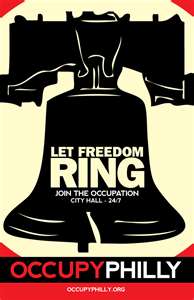 I was the only one standing on the Morton platform without a small child in tow. But shortly after boarding, it was all too clear. The elves came first, wailing Jingle Bells and Wish You a Merry Christmas. They were followed by out-of-season Mummers dressed in holiday garb, belting out another round of X-mas cheer, complete with accordion, banjo and sax. Mrs. Claus assured the children that Santa was busy, busy at the North Pole, making sure all their wishes [even though edited to economic realities] would come true. And then, there was the free candy and balloon animals.
The magic of childhood! Where we can believe everything and anything. When the world appears kind and right and true.
An out-of-stater now, I deliberately got off at Suburban Station, my old work stop. Also, the stop at which I’ve frequently disembarked to attend exhibits at the Franklin Institute, the Museum of Natural History or the Philadelphia Museum of Art, a brisk walk west up the Parkway, past the Rodin Museum and the soon-to-open home for the controversy-laden Barne’s collection.
But not today.
This morning I headed east, winding through the underground towards City Hall and the Occupy Philly encampment. Later, I would team up with a friend and hoof down to the historic district. But right now, I had a different historical event in mind.
I no sooner hit the outside doors than the vivid blue of plastic tarps and tent tops were visible. A strange sight. Normally, I would have walked through the West arch at City Hall, stood for a few moments googling at the city’s Christmas tree. But this year was different. So different.
The western entrance to the City Hall complex was barricaded. ‘For Restoration’ the signs said. No towering tree this year. Instead, the Occupy tents decorated Dilworth Plaza, a strange but fascinating sprawl of makeshift living quarters and standard issue camping gear. The area was quiet and still, the air crisp. I circled around the entire plaza. No sight of my friend, so I headed back towards the encampment, spotted the medical and information tents, as well as a petition table outlining the dangers of in-state fracking by over-zealous gas drilling companies.
At the Information Tent there was an array of literature on upcoming actions, the November issue of the Occupy Wall Street Journal and several people discussing Mayor Nutter’s deadline to dismantle the encampment within 48 hours. Two of the occupiers said almost in unison: ‘It was never about the tents.’
So what is it about? It’s a question I read constantly on the blogs and in newspapers, even hear from family and friends.
Here’s what I learned in the morning hours I spent on the Plaza:
- In the 53 days of Occupy Philly, 26,000 local citizens signed on expressing support.
- At the height of the encampment, City Hall was encircled with tents, sleeping bags and a variety of makeshift living accommodations.
- Active supporters numbered around 200-300, some living on-site, others coming in to protest, march and rally during the day.
- Local Unions support the effort. In fact, the Trades Union offered to assist the protestors in the original plan to move off Dilworth to an encampment across the street. The Union needs those ‘renovation’ jobs. That idea was scrapped because permits were denied.
- The area was clean. No needles, drug paraphernalia or trash scattered about as the MSM would have readers/viewers believe taints all encampments. Talking to several encampment members, I was told a goodly portion of each day is spent ‘cleaning up.’
- The encampment/protest was peaceful. There was a sense of community and the overriding sentiment was to voice anger and dissent over the widening income inequality in the US and the corporate capture of all facets of government.
- I heard no political posturing or Obama shilling. Simply stated, the system is broken for the 99%.
- Forty to fifty of the encampment members were homeless. They joined for the free food and the safety of numbers.
- The police presence, even on this Friday morning, was unusually large but basically stationed within the confines of the City Hall plaza.
- Though Mayor Nutter had leveled a 48-hour deadline, there was no sense of panic or great urgency the morning I arrived. I later learned that the majority of the encampment was dismantled voluntarily Sunday evening and the homeless were moved elsewhere for their own safety.
- This morning [Wednesday 11/30 at 1:20 am, according to the Associated Press], the Philly police department began tearing down the remaining tents.
But as the protesters I spoke with said: It was never about the tents. It has always been about visibility—the eyesore of inequality, injustice and corruption.
I left Dilworth Plaza, and then headed down to Independence Mall. A surreal juxtaposition. In a matter of a few blocks, my friend and I walked from the current protest to the historical marker of the Mother of All Protests. Philadelphia is the birthplace of the Declaration of Independence and the US Constitution. We strolled through the portrait gallery installed in the Second Bank of the United States and the faces of those earlier protesters, that grand collection of merchants and farmers, philosophers and scientists, lawyers and bankers stared back. What would they be thinking? I wondered.
We went on to Carpenter’s Hall, where Benjamin Franklin reportedly had secret meetings with like-minded citizens prior to the Revolution. Years later, on leaving the Constitutional Convention, a woman reportedly asked Franklin what sort of government he and the others had designed. Franklin’s terse reply: ‘A Republic, Ma’am. If you can keep it.’
Our final stop was Independence Hall, which was originally the Pennsylvania State House. This was where the Second Continental Congress met, the Declaration of Independence was adopted and where the Constitutional Convention met to draft, debate, and then sign the US Constitution in 1787.
We’re a long way from who and what we were in 1787. But Franklin’s words have a haunting edge to them: ‘A Republic, Ma’am. If you can keep it.’ Another quote that’s perhaps equally pertinent is:
‘We must hang together, gentleman, or assuredly we will all hang separately.’
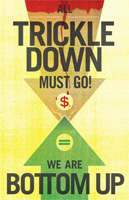 For me at least, this is what the Occupy Movement has been and is still about. In an age where corporations have been awarded the distinction of personhood, when free speech is equated to money and The Rule of Law is applied in an unjust and inequitable fashion then we, ordinary citizens, have a duty to support and join one another in protest. To hang together, if you will.
Oh, and that Tea Party, the real one in Boston that got everything rolling?
We all recall the ‘taxation without representation’ line from our school years, stemming from the passage of the Stamp Act in the 1760s and later the Tea Act in 1773. King George had debts to pay off—a Seven Year’s War among other things. And the East India Company’s tea pitched into the Boston Harbor? East India was basically provided a monopoly on tea shipped into the colonies. The company [and its aristocratic shareholders] were none too happy about their profits pinched and drowned in the harbor and helped push [lobby] the King to pass the Coercive Acts, aka The Intolerable Acts. The colonists were generally peeved at the British Parliament for taxing them without their consent and then adding insult to injury, giving the East India Co. a cushy, duty-free export to undercut colonial merchants. But they were beyond peeved when punitive measures were leveled. They demanded that Parliament end its corrupt economic policies with and stop the bailout of that era’s own TBTF East India Company.
Sound vaguely familiar? Whatever’s old is new again. Of course, no one age can be accurately compared to another. Context is everything. To quote Barbara Kingsolver from the November issue of The Occupy Wall Street Journal:
“Every system on earth has its limits. We have never been here before, not right here exactly, you and me together in the golden and gritty places all at once, on deadline, no fooling around this time, no longer walking politely around the dire colossus, the so-called American Way of consecrated corporate profits and crushed public compassion. There is another American Way. This is the right place, we found it. On State of Franklin, we yelled until our throats hurt that we were the 99% because that’s just it. We are.”
As I’ve said elsewhere, I support Occupy until I don’t. The ‘don’t’ for me is if the Movement becomes another co-opted arm of one corrupt political party or another. Our existing two-party system is thoroughly compromised; a shipload of bleach and scrub brushes couldn’t clean it up. I support Occupy because I hate the idea of leaving my kids and future grandbabies with a broken, twisted Republic, one dedicated to piranha-school profits, the amassing of criminal wealth by a callous, irresponsible few at the expense of the many. I support the Occupiers because of those sweet-faced kids on the Santa train; they deserve the best we have. But I also support what I saw on Dilworth Plaza because of what I saw and recalled inside Independence Hall, what we owe to all those who sacrificed and struggled, dreamed and achieved, lived, loved and died over the last 200+ years. We stand on the shoulders of so many.
That’s something we should never forget because our past, our history is no small thing. But our future, that other American Way? That’s all about what we do now.
Thursday Reads
Posted: November 17, 2011 Filed under: #Occupy and We are the 99 percent!, China, Foreign Affairs, Global Financial Crisis, morning reads, Psychopaths in charge, The Media SUCKS, U.S. Economy, U.S. Military, U.S. Politics, voodoo economics | Tags: assassination jokes, australia, China, crime, European Central Bank, European debt crisis, Karl Rove, Lauren Pierce, Maxine Waters, Nobel Peace Prize, occupy Wall Street, Oscar Ramiro Ortega-Hernandez, University of Texas Austin 18 Comments
Good Morning!
You know the Occupy Movement is having an effect when the propaganda patrol starts trying to pin the “TERRORIST” label on them. From Politico:
If confirmed, this will likely be a much, much bigger image problem than the reports of crime in Occupy encampments:
Authorities suspect [Oscar Ramiro] Ortega-Hernandez] had been in the area for weeks, coming back and forth to the Washington Mall. Before the shooting, he was detained by local police at an abandoned house. U.S. Park Police say Ortega-Hernandez may have spent time with Occupy D.C. protesters.
Ooops! In an update, Politico has to take it back–it turns out authorities couldn’t find a connection. But you just know they’re going to keep trying. And ABC News reported it. Lots of people will take that as gospel and never hear that it wasn’t true.
However a GOP campus leader at the University of Texas Austin responded on Twitter to the news of shots fired at the White House.
Hours after Pennsylvania State Police arrested a 21-year-old Idaho man for allegedly firing a semi-automatic rifle at the White House, the top student official for the College Republicans at the University of Texas tweeted that the idea of assassinating President Obama was “tempting.”
At 2:29 p.m. ET, UT’s Lauren E. Pierce wrote: “Y’all as tempting as it may be, don’t shoot Obama. We need him to go down in history as the WORST president we’ve EVER had! #2012.”
Pierce, the president of the College Republicans at UT Austin, told ABC News the comment was a “joke” and that the “whole [shooting incident] was stupid.” Giggling, she said that an attempted assassination would “only make the situation worse.”
Tee hee hee… this is the future of the GOP?
Maxine Waters is still number one voice of reason in Washington DC. When the propaganda merchants tried to get her to say something disparaging about OWS, here’s how she handled it.
When asked to comment Wednesday about the deaths and crimes that have occurred around Occupy protests being held across the country, Rep. Maxine Waters said “that’s life and it happens.”
“That’s a distraction from the goals of the protesters,” Waters, who says she supports the Occupy movement, told CNSNews.com after an event at the Capitol sponsored by the Congressional Progressive Caucus.
I love that woman!
“Let me just say this: Anytime you have a gathering, homeless people are going to show up,” said Waters. “They will find some comfort in having some other people out on the streets with them. They’re looking for food. Often times, the criminal element will invade. That’s life and it happens, whether it’s with protesters or other efforts that go on in this country.
“So I’m not deterred in my support for them because of these negative kinds of things,” said Waters. “I just want them to work at doing the best job that they can do to bring attention to this economic crisis and the unfairness of the system at this time.”
Way to go, Maxine!
In contrast, Republican ratf^^ker Karl Rove isn’t quite so mature. He really lost his cool on Tuesday night when he was targeted by Occupy protesters and ended up acting pretty childish.
Former Bush political adviser Karl Rove seemed a bit flustered Tuesday night after his speech to Johns Hopkins University was interrupted by a group of about 15 protesters connected to “Occupy Baltimore,” who got under his skin enough to get him cursing.
As he spoke about public debt and attempted to pin America’s economic pain on the Obama administration, a woman shouted out, “Mic check?”
A chorus of voices replied, “Mic check!”
“Karl Rove! Is the architect!” they shouted. “The architect of Occupy Iraq! The architect of Occupy Afghanistan!”
“Here’s the deal,” he replied. “If you believe in free speech then you had a chance to show it.”
“If you believe in right of the First Amendment to free speech then you demonstrate it by shutting up and waiting until the Q & A session right after,” Rove trailed off as supporters applauded.
“You can go ahead and stand in line and have the courage to ask any damn question you want, or you can continue to show that you are a buffoon…” he said, as the group of protesters descended into random shouting. One woman called him a “murderer, ” while others chanted, “We are the 99 percent!”
“No you’re not!” Rove replied, chanting it back at them. “No you’re not! No you’re not! No you’re not!”
Gee, that was fun to watch.
Not that any of the European elites will listen, but Brad Plummer at Wonkbook talked to a number of experts and came to the conclusion that the whole story about it not being legal for the ECB to rescue the European financial system is a bunch of hooey.
European officials keep insisting that the ECB isn’t legally allowed to play savior. On Tuesday, the head of Germany’s Bundesbank called it a violation of European law. The Wall Street Journal argued Wednesday that the European Union’s founding treaty would need to be revamped before the ECB could act as a lender of last resort to countries like Italy. So is this true? Could Europe really melt down because of a few legal niceties?
Not really, say experts. It’s true that the Treaty of Lisbon expressly forbids the European Central Bank from buying up debt instruments directly from countries like Italy and Spain. But, says Richard Portes of the London Business School, there’s nothing to prevent the central bank from buying up Italian and Spanish bonds on the secondary market from other investors.
“If that’s illegal, then officials should already be in jail,” says Portes. “Because they’ve been doing it sporadically since May of 2010.” The problem is that the bank’s current erratic purchases only seem to be creating more uncertainty in the market. “Right now,” says Portes, “nobody’s buying in that market except the ECB.”
Instead, what many experts want the European Central Bank to do is to pledge, loudly and clearly, that it will buy up bonds on the secondary market until, say, Italy’s borrowing costs come down to manageable levels. In theory, says Portes, the central bank wouldn’t even have to make many purchases after that, because expectations would shift and become self-fulfilling. In the near term, investors would stop worrying about whether they’d be repaid for loaning money to countries like Italy, and Italy’s borrowing costs would drop — giving it room to figure out its debt woes. (Granted, that latter step is a daunting task.)
But as Dakinikat wrote a couple of days ago, we’ll probably just have to wait and see what happens when the psychopaths in charge do exactly the opposite of what they should do.
The New York Times has a story this morning about Obama’s commitment of troops to Australia: U.S. Expands Military Ties to Australia, Irritating China.
CANBERRA, Australia — President Obama announced Wednesday that the United States planned to deploy 2,500 Marines in Australia to shore up alliances in Asia, but the move prompted a sharp response from Beijing, which accused Mr. Obama of escalating military tensions in the region.
The agreement with Australia amounts to the first long-term expansion of the American military’s presence in the Pacific since the end of the Vietnam War. It comes despite budget cuts facing the Pentagon and an increasingly worried reaction from Chinese leaders, who have argued that the United States is seeking to encircle China militarily and economically.
“It may not be quite appropriate to intensify and expand military alliances and may not be in the interest of countries within this region,” Liu Weimin, a Foreign Ministry spokesman, said in response to the announcement by Mr. Obama and Prime Minister Julia Gillard of Australia.
Attention Nobel committee: Isn’t it about time to rescind that Peace Prize?
OK, that’s it for me. What are you reading and blogging about today?
Mitt Romney Celebrates Veterans Day by Proposing Privatization of VA
Posted: November 11, 2011 Filed under: 2012 presidential campaign, U.S. Economy, U.S. Military, U.S. Politics, voodoo economics | Tags: 2012 presidential election, medicare, Mitt Romney, Veterans Administration, Veterans benefits, Veterans of Foreign Wars 5 Comments
Mitt Romney meets some veterans
Mitt Romney was in South Carolina today to lunch with some veterans who told him about their struggles with getting health problems dealt with quickly and efficiently by the VA.
From the NYT Caucus Blog:
After listening to several men talk about problems they had encountered with their Veterans Affairs benefits and health care, Mr. Romney mused that it sounded like some free-market competition might help.
“When you work in the private sector and you have a competitor, you know if you don’t treat this customer right, they’re going to leave me and go somewhere else, so I’d better treat them right,” he said. “Whereas if you’re the government, they know there’s nowhere else you guys can go. You’re stuck.”
He added, “Sometimes you wonder if there would be some way to introduce some kind of private sector competition, somebody else who could come in and say, you know, each soldier gets X thousands of dollars attributed to them, and then they can choose whether they want to go with the government’s system or a private system.”
The idea is similar to Romney’s plan for Medicare, which wold allow recipients to choose a private plan instead of the classic government-run health care structure.
The plan did not go over well with one veteran among the 12 discussing the VA with Romney. Auston Thompson, a veteran of the Iraq War and former Marine, told TPM after the session that though the idea of the plan was sound to his fiscally conservative ear, the implementation would likely lead to problems.
“Eventually it would become too much of a nuisance,” Thompson said. He doubted a voucher system would cover the benefits like the existing VA system does. “Private health care is already so expensive, you’d need some kind of health care reform to make it work.”
Jerry Newberry, a spokesman for Veterans Of Foreign Wars, told TPM his group has long opposed policies along the lines of Romney’s proposal.
Nice timing, Mitt. Instead of trying to find new ways to give more of our national treasure to Wall Street, maybe he should come up with some ways to actually create jobs. As for the VA, how about cancelling a couple of Defense Department boondoggle contracts and giving spending the money on health care for vets?
Beltway Bob Rationalizes Obama’s Blunders, while Michael Tomasky Sees a “Scared President”
Posted: September 19, 2011 Filed under: Medicaid, Medicare, Social Security, Team Obama, U.S. Economy, U.S. Politics, voodoo economics | Tags: "grand bargain", Bagdad Bob, Barack Obama, Beltway Bob, Confidence men, deficit reduction speech, Ezra Klein, John Boehner, Medicaid, medicare, Michael Tomasky, Ron Suskind, Social Security, Tea Party 25 Comments
Beltway Bob
Okay, I realize that is a silly title, but after reading Beltway Bob’s Ezra Klein’s latest post and then reading the transcript of Barack Obama’s Rose Garden speech from this morning, I was feeling a little bit punchy.
Dakinikat recently called Ezra Klein “Beltway Bob,” or the Bagdad Bob of the Beltway. That’s a perfect name for Klein, who is apparently way too young to remember anything about politics before about 1990. The guy is naive beyond belief. Lately he seems to see his role as explaining away all of Obama’s blunders, usually by arguing that the President is just too good and moral for the rough and tumble of politics.
This morning, Klein set out to explicate the “deficit reduction plan” that Obama announced in his speech this morning. Specifically, Klein wanted to explain “why the White House changed course.”
President Obama’s deficit-reduction plan (pdf)
is most interesting for what’s not in it. It does not cut Social Security by “chaining” the program’s cost-of-living increases. It does not raise the eligibility age for Medicare from 65 to 67. Nor does it include any other major concessions to Republicans. Rather, the major compromise it makes is with political reality — a reality that the White House would prefer not to have had to acknowledge.Since the election, the Obama administration’s working theory has been that the first-best outcome is striking a deal with Speaker John Boehner and, if that fails, the second-best outcome is showing that they genuinely, honestly wanted to strike a deal with Speaker John Boehner.
That was the thinking that led the White House to reward the GOP’s debt-ceiling brinksmanship by offering Boehner a “grand bargain” that cut Social Security, raised the Medicare age, and included less new revenue than even the bipartisan Gang of Six had called for. It was also a theory that happened to fit Obama’s brand as a postpartisan uniter and his personal preferences for campaigning on achievements rather than against his opponents. But though it came close to happening, the “grand bargain” ultimately fell apart. Twice.
The collapse of that deal taught them two things: Boehner doesn’t have the internal support in his caucus to strike a grand bargain with them, and the American people don’t give points for effort.
Very likely you’re asking yourself, “What the heck does that mean?” I certainly was when I first read it. Is this guy trying to tell us that no one in the White House understood until recently that Boehner had a bunch of looney-tunes tea party reps to deal with? Is he really trying to convince us that–after all those years in Illinois politics and his admittedly short time in national politics–that Obama and/or his advisers actually did not understand that voters expect results, not “just words?”
The answer is “yes.” Beltway Bob does expect you to believe that. The rest of his column is devoted to explaining in great detail that Obama and his advisers actually believed that voters would be thrilled if he made nice with Republicans even if it meant selling out every Democratic ideal–that if the President “looked like a nice guy,” the voters–especially Independents, I guess–would rush to the polls to reelect him.
But now, according to Beltway Bob, the White House staff and the President understand that they made a huge mistake: “the second-best outcome isn’t necessarily looking like the most reasonable guy in the room. It’s looking like the strongest leader in the room.” So that’s why Obama threatened to veto any plan that cuts Medicare or Medicaid and he has for now supposedly taken Social Security off the table. It’s all so sad, according to Beltway Bob–poor Barack has had to go back on all his ideals (those ideals apparently being that he wanted to a great compromiser, while caring nothing about the effects of his compromises) and accept “politics as usual.” Boo-hoo-hoo.
Rather than emphasizing his willingness to meet Boehner’s bottom lines, which was the communications strategy during the debt ceiling showdown, he’s emphasizing his unwillingness to bend on his bottom lines.
That isn’t how the White House would prefer to govern. It’s not how they would prefer to campaign. It is, let’s admit it, politics-as-usual. It’s the triumph of the old way of doing things, an admission that Washington proved too hard to change. But it’s also the only option they have left.
Ezra Beltway Bob can’t seem to recall the hundreds of times that Obama has vowed to draw lines in the sand and then quickly backtracked–not to mention all the Campaign promises he went back on. But why on earth should anyone with a functioning memory believe this hogwash?
Frankly, IMHO, if Obama has in fact taken Social Security, Medicare, and Medicaid changes off the table–which I strongly doubt–it’s probably because he’s scared silly that Americans are finally seeing through his lies.
If you read the transcript of Obama’s speech, you’ll see that he sounds defensive, hesitant, scared of his own shadow. This morning he called for the wealthy to pay at least 20% of their income in taxes. We are supposed to buy that that is a tax increase. Yet under Bush, the wealthiest Americans were supposed to pay 35%, already an unconscionably low rate–why not make them pay that much at least?

Michael Tomasky
Because our President is a scaredy cat, that’s why! I think the change–if it’s real–has everything to do with the news that has come out about Ron Suskind’s new book Company Men, which will be released tomorrow. The news reports about the book make Obama sound like a weak, passive, detached executive who lets his underlings push him around. Michael Tomasky at the Daily Beast calls him “The Scared President.”
Tomasky notes that he was persuaded by what Suskind wrote about the Bush administration in a previous book.
I’m on record as taking Suskind at his word in such matters. In early 2004, when Suskind and Bush Treasury Secretary Paul O’Neill produced The Price of Loyalty, I reviewed it for The New York Times and found it persuasive.That book was the first to confirm what everyone knew anyway: that the Bush White House was run according to politics, not policy. Confidence Men also confirms what we knew about Obama’s White House: that the president appointed the wrong economic team from the start, failed to crack down on the banks, and was Solomonic to a fault when formulating responses to the financial crisis (oh, and news flash: Larry Summers is hard to work with!).
That would be interesting without being shocking. But the indictment goes one mortifying step deeper: Geithner and Summers and Rahm Emanuel, and perhaps others, sometimes ignored Obama, refused to carry out his orders, and, in Summers’s case, mocked him, saying at one point to then-Budget Director Peter Orszag that “there’s no adult in charge” in the White House. And while I don’t yet know whether Suskind emphasizes this point, let’s carry the critique one step further: They did so, as far as we know, without suffering any consequences at all.
No matter how much the White House tries to deny the details that have come out on Suskind’s book, the overall takeaway is that Obama is weak and indecisive. And that is the impression that most Americans have about him already, so why should they disbelieve it? Tomasky:
That’s the problem the book reveals. Adam Moss and Frank Rich of New York magazine did get an early copy and read it, and in an online dialogue posted over the weekend, they home in on what Rich calls Obama’s “intellectual blind spot.” Obama even recognized it himself, telling Suskind he was too inclined to look for “the perfect technical answer” to problems; Rich quotes Suskind as writing that Obama always favored policies that were “respectfully acknowledging opponents’ positions, even those with thin evidence behind them, that then get stitched together into some pragmatic conclusion—but hollow.”
That sounds awfully apt to me. Obama was afraid to be the president. He listened to a dozen viewpoints and tried to come up with something that made everyone happy. Unfortunately, “everyone” included people on his team who were looking out for the banks more than for the public (or for their own boss), and it included people on Capitol Hill whose clear agenda was Obama’s political destruction. It’s the central—and depending on how the next election turns out, possibly decisive—paradox of this president: In trying way too hard to look presidential in the sense of “statesmanlike,” he has repeatedly ended up looking unpresidential in the sense of not being a leader.
Obama wasn’t ready to be President in 2008, and he still isn’t. Tomasky claims to have hopes that Obama can turn it around, but I think it’s just too late. There have been too many lies, too many betrayals of campaign promises, too many sellouts to Wall Street and the Republicans, and too many reversals of supposed lines in the sand.
Perhaps if Obama were capable of followingJames Carville’s advice and fired most of his staff and stood up to Wall Street and the Republicans, as Tomasky hopes. But Obama simply can’t do it. He’s too weak and inexperienced.
Whether you look at Obama through the eyes of Beltway Bob and conclude that this President is just too good and holy for “politics as usual” or through the eyes of Tomasky and conclude that Obama is scared of his own advisers and of Republicans in Congress, this man is simply not qualified for the office he holds. Obama must go. There is no other realistic solution to the country’s problems.

 peej
peej Carissa
 bostonboomer
 dakinikat
 ecocatwoman
 mablue2
 Mama Lopez
 peggysue22
 quixote
 skydancingguestblogger
 Mona (aka Wonk the Vote)



 Sky Dancing
Recent Comments