
Thursday Reads: Romney’s Lies, Debt Ceiling Showdown, and Dimonfreude
Posted: May 17, 2012 Filed under: Barack Obama, Corporate Crime, corporate greed, Economy, House of Representatives, Mitt Romney, morning reads, Surreality, The Media SUCKS, U.S. Economy, U.S. Politics, unemployment, voodoo economics, Voter Ignorance | Tags: Bill Clinton, Bill Moyers, economics, J.P. Morgan, Jamie Dimon, Mary Kennedy, Peter G. Peterson, Robert F. Kennedy Jr., Romney's lies, Simon Johnson 22 Comments
Good Morning!
On Tuesday night I wrote a brief post about the bizarre speech Mitt Romney gave in Des Moines, Iowa earlier that day. I was struck by Romney’s childish effort to get at President Obama by talking about Bill Clinton’s economic policies and claiming that Obama must have ignored those policies because he has some kind of grudge against both Clintons. It was so strange and off key that I thought Romney sounded like a crotchety old busybody gossiping over the backyard fence.
I didn’t really even go into the many baldfaced lies Romney told in the speech–I guess I’ve become so accustomed to his total refusal to confine himself to reality as it is that I almost don’t notice it anymore. Basically, Romney attacked Obama the deficit that was primarily created by Bush, and made his usual claims that he (Romney) will be able to cut taxes by 20 percent, increase defense spending, and at the same time magically balance the budget and dramatically reduce unemployment. Only a moron would buy what he’s selling.
Yesterday, a number of bloggers commented on that speech, so I thought I’d share some of those reactions in this morning’s reads.
Steve Benen at Maddowblog: A peek into an alternate reality.
Mitt Romney delivered a curious speech in Iowa yesterday, presenting his thoughts on the budget deficit, the debt and debt reduction, which is worth reading if you missed it. We often talk about the problem of the left and right working from entirely different sets of facts, and how the discourse breaks down when there’s no shared foundation of reality, and the Republican’s remarks offered a timely peek into an alternate reality where facts have no meaning.
Even the topic itself is a strange choice for Romney. If the former governor is elected, he’ll inherit a $1 trillion deficit and a $15 [trillion] debt, which he’ll respond to by approving massive new tax cuts and increasing Pentagon spending. How will he pay for this? No one has the foggiest idea.
In other words, the guy who intends to add trillions to the debt gave a speech yesterday on the dangers of adding trillions to the debt.
Benen says he doesn’t believe Romney is “stupid,” but he must be “operating from the assumption that voters are stupid.” I’d say that’s true. I think Romney believes that he’s much smarter and more worthy than just about anyone and that poor and middle-class people are beneath contempt.
Jonathan Cohn at The New Republic: Romney’s Make-Believe Story on the Economy. Cohn writes about Romney’s claims that Obama’s failure to reduce the deficit is the cause of the “tepid recovery,” unemployment, and the struggles of seniors to get by on fixed incomes.
Note the way Romney establishes cause and effect here: Obama’s contribution to higher deficits are the reason more people can’t get work and more seniors can’t make ends meet right now. This is an audacious claim and, while I’m no economist, I’m pretty sure it places Romney on the outer edges of the debate among mainstream scholars.
I know of serious conservatives who think the Recovery Act, which has increased deficits temporarily, didn’t ultimately do much to create jobs in the near term. And I know of serious conservatives who think that creating jobs now wasn’t worth the long-term downside of adding to the federal debt, however incrementally. Both viewpoints seem to represent minority views, if a recent University of Chicago survey of leading economists is indicative. But the arguments have at least some logic to them.
But Romney’s suggestion that unemployment today is a consequence of Obama’s contribution to the deficit (real or imagined) requires further leaps of logic. You’d have to argue, for example, that extensions of unemployment benefits have reduced incentives to work (despite research to the contrary) and that such negative effects substantially outweigh the positive effects of traditional stimulus measures. It’s not impossible to make this case. I think Casey Mulligan, also of the University of Chicago, has written things along these lines for the New York Times. But, unless I’m missing something, that argument is even more marginal than suggestions the Recovery Act didn’t help at all.
I suspect that even Cohn’s effort to make sense of Romney’s fantasy economic theory will have Dr. Dakinikat pulling her hair out.
Jonathan Chait at New York Magazine: Romney’s Budget Fairy Tale.
In the real world, the following things are true: The budget deficit was projected to top $1 trillion even before President Obama took office, and that was when forecasters were still radically underestimating the depth of the 2008 crash. Obama did propose temporary deficit-increasing measures, an economic approach endorsed in its general contours, if not its particulars, by Romney’s economists. These measures contributed a relatively small proportion to the deficit, and their effect is short-lived. Obama instead focused on longer-term measures to reduce the deficit, including comprehensive health-care reform projected to reduce deficits by a trillion dollars in its second decade. Obama put forward a budget plan that would stabilize the debt as a percentage of the economy. Obama has hoped to achieve deeper long-term deficit reduction by striking bipartisan deals with Congress, and he has tried to achieve this goal by openly endorsing a bipartisan deficit plan in the Senate and privately agreeing to a more conservative plan with John Boehner, both of which were killed by Republican opposition to any higher revenue.
But Romney doesn’t seem to live in the real world, and Chait suggests that Romney either doesn’t understand how deficits work or doesn’t care if what he says makes any sense at all.
In Romney’s telling, the terms debt and spending are essentially interchangeable. When presented with Obama’s position — that the solution to the debt ought to include both higher taxes and lower spending — he rejects it out of hand. Naturally, Romney has admitted before that his budget plan “can’t be scored.” It’s an expression of conservative moral beliefs about the role of government. While loosely couched in budgetary terms, Romney is expressing an analysis that resides outside of, and completely at odds with, mainstream macroeconomic forecasting and scoring assumptions.
At the Plum Line, Greg Sargent discusses How Mitt Romney gets away with his lying.
If you scan through all the media attention Romney’s speech received, you are hard-pressed to find any news accounts that tell readers the following rather relevant points:
1) Nonpartisan experts believe Romney’s plans would increase the deficit far more than Obama’s would.
2) George W. Bush’s policies arguably are more responsible for increasing the deficit than Obama’s are.
Oh, sure, many of the news accounts contain the Obama campaign’s response to Romney’s speech; the Obama campaign put out a widely-reprinted statement arguing that Romney’s plans would increase the deficit and that he’d return to policies that created it in the first place.
But this shouldn’t be a matter of partisan opinion. On the first point, independent experts think an actual set of facts exists that can be used to determine what the impact of Romney’s policies on the deficit would be. And according to those experts, based on what we know now, Romney’s policies would explode the deficit far more than Obama’s would.
Obviously, the problem is the obsequious corporate media. But the Romney campaign makes it impossible for even the few remaining serious reporters to question his policies by keeping the candidate completely insulated from the press except for occasional appearances on Fox News and lightweight network morning shows like Good Morning America. Yesterday, Politico reprinted tweets from several reporters who were “physically” blocked from talking to Romney on a rope line.
Speaking of Republican ignorance of basic economics, House Republicans are gearing up for another pitched battle on increasing the debt ceiling. Speaker John Boehner met with President Obama at the White House today and they “clash[ed] over” increasing the debt limit, according to The Hill.
The president convened the meeting of the bipartisan congressional leadership to discuss his “to-do list” for Congress, but an aide to the Speaker said the bulk of the meeting was spent on other issues, including a pile-up of expiring tax provisions and the next increase in the federal debt limit.
Boehner asked Obama if he was proposing that Congress increase the debt limit without corresponding spending cuts, according to a readout of the meeting from the Speaker’s office. The president replied, “Yes.” At that point, Boehner told Obama, “As long as I’m around here, I’m not going to allow a debt-ceiling increase without doing something serious about the debt.”
Shortly after the meeting, White House press secretary Jay Carney told reporters that the president warned the leadership that he would not allow a repeat of last August’s debt-ceiling “debacle,” which led to a downgrade in the U.S. credit rating.
Sigh……
In a related story, there’s this piece at Wonkblog about the Pete Peterson summit and how Democrats talked long-windedly about cutting “entitlements,” and Republican refused to talk about tax increases. Read it and weep. I’m not even going to quote from it, because it’s too damn depressing.
So far Jamie Dimon seems to have survived the $2 billion loss recently suffered by J.P. Morgan.
The CEO of JPMorgan Chase survived a shareholder push Tuesday to strip him of the title of chairman of the board, five days after he disclosed a $2 billion trading loss by the bank.
CEO Jamie Dimon also won a shareholder endorsement of his pay package from last year, which totaled $23 million, according to an Associated Press analysis of regulatory filings.
Dimon, unusually subdued, told shareholders at the JPMorgan annual meeting that the company’s mistakes were “self-inflicted.” Speaking with reporters later, he added: “The buck always stops with me.”
Yeah, right. The buck will stop with the taxpayers if Dimon’s bank ultimately crashes and burns. Bill Moyers asked economist Simon Johnson about that.
Moyers: I was just looking at an interview I did with you in February of 2009, soon after the collapse of 2008 and you said, and I’m quoting, “The signs that I see… the body language, the words, the op-eds, the testimony, the way these bankers are treated by certain congressional committees, it makes me feel very worried. I have a feeling in my stomach that is what I had in other countries, much poorer countries, countries that were headed into really difficult economic situations. When there’s a small group of people who got you into a disaster and who are still powerful, you know you need to come in and break that power and you can’t. You’re stuck.” How do you feel about that insight now?
Johnson: I’m still nervous, and I think that the losses that JPMorgan reported — that CEO Jamie Dimon reported — and the way in which they’re presented, the fact that they’re surprised by it and the fact that they didn’t know they were taking these kinds of risks, the fact that they lost so much money in a relatively benign moment compared to what we’ve seen in the past and what we’re likely to see in the future — all of this suggests that we are absolutely on the path towards another financial crisis of the same order of magnitude as the last one.
A number of shareholders have sued Dimon over the losses, according to Bloomberg (via the SF Chroncle). And of course lots of people are gloating over Dimon’s getting temporarily knocked off his pedestal. Jena McGregor writes in the WaPo:
It’s being called Dimonfreude.
There are barely disguised smirks emanating from the canyons of Wall Street and the business press over the fact that Jamie Dimon has had to admit a mistake — and a whale of one, for that matter.
For years, the JPMorgan CEO (and America’s least-hated banker, as he was known) has worn a halo over those pinstripes. Dimon has been called President Obama’s “favorite banker”. Institutional Investor magazine has called him the country’s best CEO for two years running. And his actions during the financial crisis have been painted in patriotic terms: Press reports said he “answered the call” from then-FDIC chairman Sheila Bair to buy Washington Mutual, one of two banks he scooped up during the financial meltdown, and he has cited a patriotic duty to a country in crisis as why he took in $25 billion in government aid.
Yet now, Dimon is in the hot seat as JPMorgan confronts a $2 billion trading loss and the early stages of a criminal probe by the Justice Department.
Finally, some sad news: Estranged Wife of Robert F. Kennedy Jr. Is Found Dead at Home in Westchester
Mary R. Kennedy, the estranged wife of Robert F. Kennedy Jr., was found dead on Wednesday at the family’s home in Bedford, N.Y. She was 52.
Ms. Kennedy’s death was confirmed in a statement from her family, who did not comment on the circumstances. The Bedford Police Department said only that it had investigated a “possible unattended death” in an outbuilding at the home.
Her lawyer, Kerry A. Lawrence, would not say whether foul play was suspected. Kieran O’Leary, a spokesman for Westchester County, said an autopsy was scheduled for Thursday morning.
Born Mary Richardson, Ms. Kennedy joined one of America’s foremost political families in 1994, in a marriage ceremony aboard a boat on the Hudson River, near Stony Point, N.Y. At the time, she was an architectural designer at Parish-Hadley Associates in New York.
Those are my suggested reads for today. What are you reading and blogging about?
Catholic Republicans to Catholic Bishops: STFU
Posted: April 19, 2012 Filed under: poverty, religion, Religious Conscience, Republican politics, social justice, U.S. Economy, U.S. Politics, voodoo economics | Tags: Eric Cantor, food stamps, John Boehner, Paul Ryan, taxes 15 Comments
Ryan to Catholic Bishops: "Are you talking to me?"
On Tuesday I wrote a post about Paul Ryan’s claim that his Catholic faith informed his budget plan.
The Conference of Catholic Bishops responded to this outrageous claim by sending letters to every Congressional Committee affected by the Ryan Budget explaining that Catholic doctrine does not support starving children and elderly people to death in order to give tax cuts to rich people and buy more weapons of war for the Pentagon.
Today Paul Ryan responded to the Bishops’ criticism.
House Budget Committee Chairman Paul Ryan (R-WI) on Thursday dismissed criticism from the U.S. Conference of Catholic Bishops (USCCB), falsely claiming the group did not represent all Catholic bishops.
Referencing Matthew 25, the USCCB called on Congress to put the poor first in budget priorities and rethink cuts to programs that benefited the least among us.
“These are not all the Catholic bishops, and we just respectfully disagree,” he said on Fox News after being questioned about the bishops criticism of his budget plan.
Later the Bishops responded to Ryan’s statement by explaining to The Hill:
USCCB spokesman Don Clemmer told The Hill that the letters do represent all Catholic bishops, as they were penned by members of the church that were elected to represent the bishops on policy matters at the national level.
“Bishops who chair USCCB committees are elected by their fellow bishops to represent all of the U.S. bishops on key issues at the national level,” Clemmer said. “The letters on the budget were written by bishops serving in this capacity.”
Yesterday, fellow Catholic John Boehner weighed in in support of his budget hit-man:
“I want them to take a bigger look,” Boehner said at a Wednesday press conference. “And the bigger look is, if we don’t make decisions, these programs won’t exist, and then they’ll really have something to worry about.”
Hmmmm…that sounds like a threat.
Boehner, a Catholic, acknowledged that the bishops had a moral argument in pushing to preserve aspects of the budget that provide aid to the poor, but said if the United States can’t get its finances in order, those programs would be completely eliminated through a fiscal crisis.
“There won’t be these programs, and I don’t know how often some of us have to talk about the fact that you can’t spend $1.3 trillion more than what you bring in — that’s what’s going to happen this year, $5 trillion worth of debt over the last five years — and think that this can continue,” Boehner said.
It seems that the opinion of Conference of Catholic Bishops is to be respected on abortion and birth control, but not on economic and social justice issues. I guess Ryan and Boehner are only “cafeteria Catholics.” Just look how Ryan responded last year when a fellow Catholic offered him a Bible so he could read about Jesus’ teachings.
Not a Catholic, but apparently not wanting to look less of a soulless, evil skinflint than Ryan and Boehner, Eric Cantor suggested the solution to the country’s economic problems is raising taxes on the poorest of the poor.
The GOP has repeatedly made the claim that the poorest Americans need more “skin in the game.” Today, response to a question by ABC’s Jon Karl, Cantor made it clear that Republicans are interested in raising taxes on the poor while lowering tax rates for everyone else as part of any comprehensive tax reform plan:
CANTOR: We also know that over 45 percent of the people in this country don’t pay income taxes at all, and we have to question whether that’s fair. And should we broaden the base in a way that we can lower the rates for everybody that pays taxes. […]
KARL: Just wondering, what do you do about that? Are you saying we need to have a tax increase on the 45 percent who right now pay no federal income tax?
CANTOR: I’m saying that, just in a macro way of looking at it, you’ve got to discuss that issue. … How do you deal with a shrinking pie and number of people and entities that support the operations of government, and how do you go about continuing to milk them more, if that’s what some want to do, but preserve their ability to provide the growth engine? … I’ve never believed that you go raise taxes on those that have been successful that are paying in, taking away from them, so that you just hand out and give to someone else.
As Think Progress points out, most of the people who don’t pay income taxes are students, elderly people receiving lower amounts of social security, or people so desperately poor that they don’t earn enough to pay taxes. These people are, however, subject to many taxes, such as gas taxes, property taxes, and federal payroll taxes if they are working.
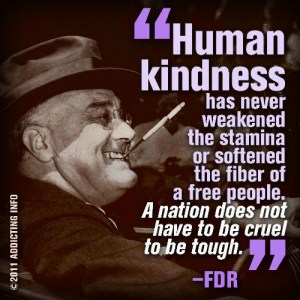
I wonder what FDR would say about all this?
Paul Ryan Claims Jesus Supported Small Government; Catholic Bishops Disagree
Posted: April 17, 2012 Filed under: hunger, poverty, religion, Republican politics, U.S. Economy, U.S. Politics, voodoo economics | Tags: Catholic Bishops, morality, Paul Ryan 10 Comments
Paul Ryan's God?
Yesterday, NPR’s Morning Edition reported on a “debate among Christians” about whether Jesus believed in helping the poor.
After the House passed its budget last month, liberal religious leaders said the Republican plan, which lowered taxes and cut services to the poor, was an affront to the Gospel — and particularly Jesus’ command to care for the poor.
Not so, says Wisconsin Republican Rep. Paul Ryan, who chairs the House Budget Committee. He told Christian Broadcasting Network last week that it was his Catholic faith that helped shape the budget plan. In his view, the Catholic principle of subsidiarity suggests the government should have little role in helping the poor.
“Through our civic organizations, through our churches, through our charities — through all of our different groups where we interact with people as a community — that’s how we advance the common good,” Ryan said.
The best thing that government can do, he said, is get out of the way.
Can you believe NPR’s religion reporter actually pretended there is a legitimate “debate” about this?
Today the Catholic Bishops indicated they think Jesus believed in helping actual living people–not just zygotes, embryos, and fetuses.
The Hill reports that the Bishops have so far sent letters to the House Agriculture and Ways and Means Committees and they also plan to send letters to other House committees as well, because they believe the budget “disproportionately cut[s] programs that ‘serve poor and vulnerable people.'”
The Bishops are particularly concerned about the budget’s draconian cuts in food stamps and child tax credits for immigrants–programs that help needy families stave off starvation. According to The Hill, the letters appear to be in response to recent comments made by Paul Ryan, who claims to be a Catholic.
“A person’s faith is central to how they conduct themselves in public and in private,” Ryan, the chairman of the House Budget Committee, told the Christian Broadcasting Network.
“So to me, using my Catholic faith, we call it the social magisterium, which is how do you apply the doctrine of your teaching into your everyday life as a lay person,” Ryan said.
Ryan made a moral case for his budget, saying that the government shouldn’t be responsible for lifting its citizens out of poverty — rather, that it’s the obligation of the citizens themselves to be society’s caretakers.
“Those principles are very, very important,” Ryan said. “And the preferential option for the poor, which is one of the primary tenants of Catholic social teaching, means don’t keep people poor, don’t make people dependent on government so that they stay stuck at their station in life, help people get out of poverty, out into a life of independence.”
Maybe Ryan should try reading the New Testament instead of Atlas Shrugged. Here’s one quote from Jesus:
Luke 6:20-21 Then he looked up at his disciples and said: ‘Blessed are you who are poor, for yours is the kingdom of God.
‘Blessed are you who are hungry now, for you will be filled. ‘Blessed are you who weep now, for you will laugh.
I couldn’t find any quotes from Jesus about small government and pulling yourself up by your own bootstraps. Anyone know any of those?
Paul Ryan in La La Lie Land
Posted: March 20, 2012 Filed under: 2012 elections, Economy, voodoo economics | Tags: Paul Ryan budget 12 Comments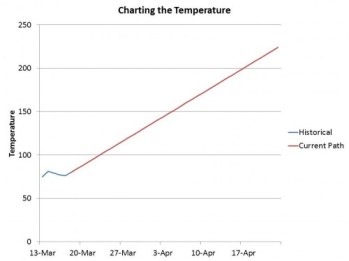
Economist Aaron Carroll forecast the trend in temperature for Indianapolis based on the last two days. Scared yet?
Lying with statistics is one of those things you watch out for when you work with numbers. It’s one of the reasons there’s peer review for journal submissions. Mistakes in methodology ruin academic careers and reputations. However, loosey goosey methodology is the hallmark of advocacy research. Paul Ryan’s chart–published today in the WSJ–is going to be a hallmark of Stats Gone Wild. Finding a trend in an economic variable is a standard practice for analyzing time series. It’s taught to undergraduates in their first stat class and doctoral students continually in econometrics. Results are dependent on a lot of things you can do while running the analysis. The first thing you teach to your undergrads is there has to be a certain number of observations. Then, you start looking for other things that could cause problems. Forecasts are only as good as the assumptions. We’ve seen this problem before when Ryan’s number crunching. Paul Ryan’s new little chart takes the cake. Ryan’s assumptions continually fail the reality test. They also are extreme in their result.
Ryan’s assumptions and programs are summed up by Ezra Klein this way.
Ryan’s budget funds trillions of dollars in tax cuts, defense spending and deficit reduction by cutting deeply into health-care programs and income supports for the poor.
Yes, folks, the poor are going to pay if Paul Ryan gets his way. All of this based on ideology and the same baseless assumptions he always makes. Tax cuts more than pay for themselves. Privatization always saves money. Health care costs only increase by the rate of inflation. Giving money to the rich will grease the wheels of manufacturing and hiring. We might as well assume that the Treasury can hire a few alchemists to turn hay bushels into gold.
Ryan tells CBO to assume his tax plan will raise revenues to 19 percent of GDP and then hold them there. He tells them to assume his Medicare plan will hold cost growth in Medicare to GDP+0.5 percentage points. He tells them to assume that spending on Medicaid and the Children’s Health Insurance Program won’t grow any faster than inflation. He tells them to assume that all federal spending aside from Medicare, Medicaid and Social Security will fall from 12.5 percent of GDP in 2011 to 3.75 percent of GDP in 2050.
Oh, there’s more of that Republican wishful thinking. Or as I like to call it, big fat ol’ lies. Lies and ideology in. Ideology and Lies and Pain out.
At the end of his initial release, Ryan posts a table comparing his budget to the president’s budget. The single largest difference is in the tax section: Ryan raises $2 trillion less in revenue than the White House does. In the president’s budget, those revenues come mostly from increasing taxes on the wealthy. So that’s the first big gap between the two proposals: Under Ryan’s budget, revenue would be lower, and the distribution of taxes more regressive, than under Obama’s budget.
On the spending side, Ryan’s biggest cuts come from health-care programs. He eliminates the $1.5 trillion that the Affordable Care Act uses to purchase health insurance for 30 million Americans. Then he cuts Medicaid and related health programs by $770 billion — which is to say, by about a third. Medicare takes $200 billion in cuts on top of that.
Yes. All of us will be held hostage to Insurance Companies in Paul Ryan’s world. Ryan thinks he’s doing us all a favor. Here’s some more thoughts from Matthew Yglesias who reminds us that all of Paul Ryan’s analysis comes from the bad fiction of Ayn Rand.
What Ryan is talking about here is Medicaid which offers health care coverage to the poor, to the disabled, and to an important class of elderly people. Currently the money for Medicaid comes from both the states and the federal government. States have to meet a lot of minimum coverage standards and get federal financial assistance for doing so, and in addition states have the option of securing additional federal monies for additional coverage if they’re willing to kick in extra money of their own. Because health care is proejcted to grow more expensive over the next fifty years, the cost of this program is projected to go up substantially. One way of preventing that from happening is to just refuse to pony up the money, and make Medicaid beneficiaries get by with less health care. And that’s what Ryan’s plan does. On the one hand, it excuses states from their minimum coverage responsibilities. On the other hand, it reduces the amount of money that’s available to give people coverage. Which is all about what you’d expect from a tax cutting Ayn Rand fan. Keep the money in the hands of the job creators who earned it rather than handing it out to the moochers and looters looking for a little free medicine.
But please God almighty can we avoid referring to this as a measure that “strengthens the safety net” by empowering states to “tailor assistance to their specific populations”? Ryan doesn’t like taxing the wealthy to give resources to the poor and disabled, so he proposes to give fewer resources to the poor and disabled.
Every time I read something that comes out of Paul Ryan I end up wondering what is seriously wrong with this man. He’s like the master of doublespeak. We’ve seen this before and it’s still called voodoo economics in my book. There is no evidence that giving excessive tax cuts to rich people creates jobs. There is plenty of evidence that our health care delivery system is the worst and most expensive of all the development nations. Paul Ryan wants to continue life support to the sick system we have now. The one that was put into place by the Dubya Bush administration that’s delivered endless, expensive wars, poor job creation and economic growth, huge deficits, and a global financial crisis. Why does he keep playing the scratched-up record? My hope is that all the political activism and outrage brought about by Scott Walker in Wisconsin will hand Paul Ryan a pink slip in the fall. The nation cannot afford any more lies, distorted statistics, and voodoo economics. How can congress ever negotiate a budget in good faith when at least one of the major players appears to be delusional?
What The Irish Can Teach Us
Posted: March 18, 2012 Filed under: Barbara Ehrenreich, Charles Murray, corporatism, Economy, financial institutions, free market ideology, hunger, income inequality, The Great Hunger, U.S. Economy, unemployment, voodoo economics, worker rights 12 CommentsNow that we’ve all been Irish for a day–donning the green, marching or watching parades and downing those pints at the local bar, we might ask ourselves [whether we’re from Irish American backgrounds or not]: Is there anything more the Irish can teach us?
Running across an essay by Barbara Ehrenreich on American poverty, specifically the lingering, depressing notion of the ‘culture of poverty’ and

Dublin's Famine Memorial
having listened to Charles Murray on Book TV discuss his recent book, “Coming Apart: The State of White America, 1960-2012,” I think the answer is a resounding ‘yes.’
As Ehrenreich reminds us, the idea that poor people are inherently different than the affluent and in fact, need to be changed, corrected, put right has been an enduring theme of the conservative right. The inequality between the poor and the rich is not a matter of jobs or opportunity, education or money, so the theory goes. It’s about the poor being substantially flawed. They lack core values: ambition, get-up-and-go, faith, and the ability to plan for the future. The poor are impulsive, promiscuous, prone to addiction and crime and, as Ehrenreich points out, theorists all contend that the poor ‘certainly cannot be trusted with money.’
Charles Murray’s presentation picks up on the ‘culture of poverty’ theory and runs with it like a champion of reason and rightness. The American Project, Murray contends, the continuation of a civil society is threatened because the working class and upper-middle class are of a different kind altogether. The unraveling of America has nothing to do with the inequality of income but the inequality of culture.
Murray uses two ‘symbolic’ communities to illustrate his thesis: Belmont and Fishtown though both communities actually exist—Belmont, an affluent neighborhood outside Boston and Fishtown, a working class neighborhood of Philadelphia. Murray goes on to compare the two communities in four main areas: marriage, industriousness, honesty, and religiosity. And surprise, surprise. Fishtown gets a failing grade on all scores.
What does this have to do with the Irish? I suggest a quick trip back in time, say to the mid-19th century during what became known as the Great Hunger.
Ireland was heavily populated with subsistence/tenant farmers, generally in debt to their English landlords. Most have heard of the ‘great potato blight’ of 1845-1849 when over 1 million Irish died of starvation. What many may not know is that the the affluent English landlords were exporting an abundance of grain, meat and dairy for profit as the Irish poor starved. And the conservative government response? Their policy was one of laissez faire, leave well enough alone. As the Assistant Secretary of Ireland reportedly said at the time: to give the people something for nothing, ‘would have the country on us for an indefinite time.’ The fear of dependency was greater than watching the population starve. Free market policies and workhouses became popular. But still people died. In droves. The fields of once blighted potatoes became graveyards.
How were the Irish viewed by ‘polite’ English society? The Irish were considered brutish, lazy, devious, promiscuous, prone to crime and heavy drinking. Worse yet—they were Catholic.
The point is that this warped view on poverty is not new. Nor are the political responses. Even when a population was starving to death en masse, the response in Ireland was an ideological one: people had to work to be fed, even when they were too weak and sick to stand upright.
The Irish know this. They remembered it well and passed the bleak stories down to their descendants. The impoverished Irish immigrants, those who came to America [if they survived the ocean crossing], found the same weary stereotypes waiting on another shore. Anyone with Irish American grandparents or other family oldsters have likely heard the tales of blatant bigotry while growing up—the ‘no dogs or Irish’ signs in shop windows.
 Still I found it amazing that Murray could say the main problem threatening the Nation today is not income inequality but cultural inequality. Minx wrote a very effective piece last week on the growing poverty in the US. Cited in her post was a statement by Tavis Smiley, who is pushing to have the issue of exploding poverty included in the 2012 election:
Women are much more likely to be poor than men, and more than a million children have fallen into poverty, and more than 500,000 have fallen into extreme poverty” — that is, living on less than $2 a day — “since 2010.” Recent census data shows that the number of children who live in extreme poverty has doubled from 1996 to 2011, from 1.4 million to 2.8 million.
And yet, as Minx pointed out a number of states: Kansas, Utah and Nebraska have initiated policies to cut food stamps to needy children.
Well here’s a factoid that turns the whole cultural argument on its head: the fastest growing segment of the newly poor are in suburban neighborhoods.

Warrensville Heights, Cleveland suburb, photo:dustin franz,NYT
Some of this is due to changing demographics but the larger percentage has to do with long-term unemployment, stagnate wages, off-shoring, the housing debacle, etc., etc. Here’s a chilling study from the same link:
Mark Rank, a social welfare professor at Washington University in St. Louis, has written extensively about shifts in U.S. poverty since the 1960s, and finds that Americans today are more likely to face poverty than in the past. According to Rank’s data, 24 percent of people who were in their 20s in the 1970s were likely to experience poverty at some point in their lives. That number rose to 31 percent in the 1980s and 37 percent in the 1990s. Today a majority of Americans-51.4 percent, according to the Urban Institute-will experience poverty by the time they’re 65.
Are we to believe that this sudden shift to poverty or expectation of poverty is all about lost moral/cultural compasses? Charles Murray would say, ‘yes.’ He suggests that the upper-middle class reach out, reintegrate and reeducate the working classes in the four pillars of civil society: marriage, industriousness, honesty and religiosity. Note that Murray’s study just happens to begin at the soon-to-be turbulent 1960s. Ahhh, if only we could go back to those Father Knows Best days.
In contrast, Barbara Ehrenreich pointedly says:
. . . a new discovery of poverty is long overdue. This time, we’ll have to take account not only of stereotypical Skid Row residents and Appalachians, but of foreclosed-upon suburbanites, laid-off tech workers, and America’s ever-growing army of the “working poor.” And if we look closely enough, we’ll have to conclude that poverty is not, after all, a cultural aberration or a character flaw. Poverty is a shortage of money.
My suggestion? Find yourself an Irish grandmother, the older the better. She’ll give you an earful. Generational memory is a powerful thing!

 peej
peej Carissa
 bostonboomer
 dakinikat
 ecocatwoman
 mablue2
 Mama Lopez
 peggysue22
 quixote
 skydancingguestblogger
 Mona (aka Wonk the Vote)



 Sky Dancing
Recent Comments