
Thursday Reads: Crisis in Cyprus, The End of the “Creative Class” Dream, the Grand Betrayal, and Other News
Posted: March 21, 2013 Filed under: Barack Obama, Foreign Affairs, morning reads, the blogosphere, U.S. Economy, U.S. Politics, Violence against women | Tags: "grand bargain", chris bowers, Cyprus crisis, Dick Durbin, eurozone crisis, Joe Weisenthal, Richard Florida, the Great Betrayal 41 Comments
Good Morning!!
There’s quite a bit of news on the Cyprus crisis this morning. But first, last night Joe Weisenthal posted this assessment of how bad things had already gotten: In Just Days A Modern Economy Has Been Set Back 50 Years, And It May Never Be The Same Again. That’s a quote from Ciaran O’Hagan of Société Générale in Paris. Weisenthal writes:
According to reports, Cyprus will try again tomorrow to cobble together some kind of bank bailout bill that can pass parliament.
Cyprus needs to raise another 5.8 billion euros, which it could do from some combination of deposit taxes, Russian money, and pension nationalization.
None of the options are good, but until it’s done, banks will likely have to remain closed, a situation that can’t go on much longer.
This is a stunning turn of events for a modern Eurozone nation.
This morning, the news broke that the European Central Bank (ECB) has given Cyprus an ultimatum. Bloomberg reports:
The European Central Bank said it will cut Cypriot banks off from emergency funds after March 25 unless the Mediterranean island agrees on a bailout with the European Union and International Monetary Fund.
“The Governing Council of the European Central Bank decided to maintain the current level of Emergency Liquidity Assistance, ELA, until Monday, 25 March 2013,” the Frankfurt- based ECB said in an e-mailed statement today. “Thereafter, ELA could only be considered if an EU/IMF program is in place that would ensure the solvency of the concerned banks.”
The Cypriot parliament this week rejected a proposed levy on bank deposits to raise 5.8 billion euros ($7.5 billion), which euro-area finance ministers backed as a condition for the country’s bailout. A bank holiday in Cyprus has been extended to March 25, giving policy makers until Monday to find a compromise to prevent a collapse of the country’s banks.
“With this statement, the ECB put even more pressure on European finance ministers and the Cypriot government to come up with a deal,” said Juergen Michels, chief euro-area economist at Citigroup Inc. in London. “But we’ll have to see whether they’ll actually follow through with their threat if there’s no deal by Monday and policy makers decide to further extend the bank holiday.”
Tuesday Reads: SCOTUS and Voting Rights, Iraq War Buildup, and Reno Saccoccia
Posted: March 19, 2013 Filed under: morning reads, U.S. Politics, Violence against women | Tags: Ahmed Chalabi, Anthony Kennedy, Antonin Scalia, Christopher Hitchens, David Frum, Dick Cheney, George W. Bush, Iraq War, Reno Saccoccia, Sonya Sotomayor, Steubenville rape case, voting rights 35 Comments
Good Morning!!
There’s a great big sloppy white mess outside my house this morning–something like 6 or 7 inches of heavy, wet snow. I’m not sure how I’ll get out of here; I may have to try to hire someone to dig me out. Anyway, I’m resigned to being stuck in the house for today at least.
Soooo… let’s see what happening in the news.
I’m going to start out with some news from the Supreme Court. Yesterday the court debated another voting rights case, and once again Sonya Sotomayor went toe-to-toe with right-wing judicial activist Antonin Scalia. This time it was a case from Arizona over whether a state can require proof of citizenship beyond what is required by federal voter registration forms. Here’s some background from Spencer Overton at HuffPo:
The latest case involves the simple question of whether Arizona can refuse to accept a federal voter registration form. But the stakes are much higher. A victory for Arizona could accelerate a nationwide trend of political operatives attempting to manipulate election rules for political gain, and could undermine the power of Congress to protect voting rights.
The National Voter Registration Act requires that all states “accept and use” a single, uniform voter registration form for federal elections. States can still use their own registration forms, but they must also accept and use the Federal Form. The purpose of the Federal Form is to increase participation by preventing states from erecting barriers to voter registration.
The Federal Form requires that prospective voters check a box and sign the form affirming they are U.S. citizens under penalty of perjury. Arizona, however, adopted a state law requiring “satisfactory proof” of U.S. citizenship to register, such as a birth certificate, U.S. passport, or state driver’s license that shows citizenship.
As a result, Arizona initially rejected over 31,000 voter registration applications — including citizens who registered using the Federal Form. Community-based registration drives were hit especially hard, because they rely on approaching individuals who may not be carrying a birth certificate or similar documentation (or unwilling to give a photocopy of these sensitive documents to a registration-drive volunteer). For example, community-based registration drives in Arizona’s largest county — Maricopa County — dropped 44%.

Obviously, if Arizona wins the case, other red states would pass similar laws that would trump federal voting regulations. Yesterday, Sotomayor and Scalia “clashed” over the Arizona law. Talking Points Memo:
Much as they did weeks ago during arguments over the constitutionality of the Voting Rights Act, the two justices on Monday each led the charge on opposite sides of the case — Scalia for less federal involvement in states’ ability to set their voting laws, and Sotomayor for broad national authority to protect citizens’ right to vote.
Sotomayor’s opening volley began immediately after Arizona Attorney General Thomas C. Horne stepped up to defend his state’s law. She fired off a series of questions, which she would continue asking in different flavors throughout his argument, about inconsistencies between Arizona’s Prop 200 and the NVRA.
“If I see the purpose of the NVRA to simplify registration, how are Arizona’s provisions consistent with that objective and purpose, given that … many people don’t have the documents that Arizona requires?” Sotomayor said. She asked Horne why he thinks Congress would have required states to accept a voter registration form if states can then turn around and require additional information like a passport or birth certificate.
“Why isn’t that just creating another form?” she demanded. Arizona, she said, may object to the fact that proof of citizenship isn’t required, but “that’s what Congress decided.”
As for Scalia:
The conservative jurist wasn’t convinced requiring people to attest under oath was sufficient.
“So it’s under oath — big deal,” Scalia said. “If you’re willing to violate the voting laws, I suppose you’re willing to violate the perjury laws.” He posited that only “a very low number” of voters would be harmed by a requirement to submit proof of citizenship.
Well that makes sense–not. Why bother having witnesses swear to tell the truth in court cases then?
Of course Anthony Kennedy was his usual waffling self. Again from TPM:
At one point, Kennedy wrestled with whether Arizona’s proof-of-citizenship requirement crosses a line. He asked the state’s attorney general, who was defending the law, whether states may also require proof of one’s address or date of birth when registering to vote. If so, he posited, then the federal requirement “is not worth very much.”
At another point, he launched a defense of Arizona’s actions in principle and took issue with some of the reasoning by the Ninth Circuit Court of Appeals, which ruled against Arizona.
“The state has a very strong and vital interest in the integrity of its elections,” Kennedy said, “even when those, and perhaps especially when those are elections of federal officials. And it seems to me the Ninth Circuit’s new test did not give sufficient weight to that interest.”
Roberts is apparently “leaning slightly” toward Arizona’s point of view. It’s really frightening that voting rights are in the hands of this conservative court. Thank goodness for Sotomayor’s willingness to be vocal in her arguments. Here are couple more interesting tidbits:
“Let me give you this example,” Alito said. “A person rides up to a place to register on a bicycle and gets out and hands in the federal form. This boy looks like he is 13 years old and he is carrying school books, he is wearing a middle school t-shirt, but he has filled out the form properly. Are they required to register him?”
Retired Justice Sandra Day O’Connor, a native Arizonan who in 2010 ruled against her statein this case from a lower court on which she occasionally sits, was present in the chamber.
In the final moments, Scalia warned the Obama administration’s lawyer, who was arguing against Arizona, that if the constitutionality of the NVRA form is challenged in broader terms, “You’re going to be in bad shape — the government’s going to be.”
There was a little bit of good news from the Court yesterday, according to HuffPo: Supreme Court Refuses To Hear Goldman Sachs’ Appeal To Financial Crisis Lawsuit.
Goldman Sachs Group Inc suffered a defeat on Monday as the U.S. Supreme Court let stand a decision forcing it to defend against claims it misled investors about mortgage securities that lost value during the 2008 financial crisis.
Without comment, the court refused to consider Goldman’s appeal of a September 2012 decision by the 2nd U.S. Circuit Court of Appeals in New York. Goldman shares sank more than 2 percent.
That court let the NECA-IBEW Health & Welfare Fund, which owned some mortgage-backed certificates underwritten by Goldman, sue on behalf of investors in certificates it did not own, but which were backed by mortgages from the same lenders.
Goldman and other banks have faced thousands of lawsuits by investors seeking to recoup losses on mortgage securities.
The bank has said that letting the 2nd Circuit decision stand could cost Wall Street tens of billions of dollars.
{{applause}}
David Frum posted a fascinating article at The Daily Beast late yesterday on the lead-up to the Iraq War. Frum was a speechwriter for George W. Bush at the time. You should read the whole thing, but I’ll just quote this one intriguing portion:
The first time I met Ahmed Chalabi was a year or two before the war, in Christopher Hitchens’s apartment. Chalabi was seated regally at one end of Hitchens’s living room. A crowd of nervous, shuffling Iraqis crowded together at the opposite end. One by one, they humbly stepped forward to ask him questions or favors in Arabic, then respectfully stepped backward again. After the Iraqis departed, Chalabi rose from his chair and joined an engaged, open discussion of Iraq’s future democratic possibilities.
The last time I saw Chalabi was in his London apartment, on the very eve of war. My little group arrived past midnight. Chalabi was listening to the evocative strains of Sufi music. He showed me a black-and-white photograph of seven men, wearing the clothes of the 1940s. They were the board of directors of a company his father had founded: a mixed group of Sunni, Shiite, and Christian, and even a Jew. Chalabi remarked that this picture was taken while Europe was tearing itself apart in genocidal violence. He didn’t add that it was taken shortly after British forces defeated a pro-Axis coup in Baghdad—but failed to prevent a murderous pogrom against Baghdad’s Jewish population.
I was less impressed by Chalabi than were some others in the Bush administration. However, since one of those “others” was Vice President Cheney, it didn’t matter what I thought. In 2002, Chalabi joined the annual summer retreat of the American Enterprise Institute near Vail, Colorado. He and Cheney spent long hours together, contemplating the possibilities of a Western-oriented Iraq: an additional source of oil, an alternative to U.S. dependency on an unstable-looking Saudi Arabia.
You might imagine that an administration preparing for a war of choice would be gripped by self-questioning and hot debate. There was certainly plenty to discuss: unlike the 1991 Gulf War, there was no immediate crisis demanding a rapid response; unlike Vietnam, the U.S. entered the war fully aware that it was commencing a major commitment.
Yet that discussion never really happened, not the way that most people would have imagined anyway. For a long time, war with Iraq was discussed inside the Bush administration as something that would be decided at some point in the future; then, somewhere along the way, war with Iraq was discussed as something that had already been decided long ago in the past.
I’m running out of space, so I’ll leave you with this follow-up to the Steubenville rape trial.

From Deadspin: Fire This Asshole: Why Does Steubenville’s Football Coach Still Have His Job?
Reno Saccoccia is a local legend, in the way that 30-year coaches of football powerhouses in economically depressed Ohio Valley towns tend to be legends. He’s in the Ohio Coaches Hall of Fame. He’s won three state titles. When Saccoccia won his 300th game last year, a sellout crowd of more than 10,000 people packed Harding Stadium—christened “Reno Field” in 2007—and chanted “Reno, Reno, Reno” as he left the field.
He breakfasts regularly with the sheriff. His sister-in-law works in the county’s juvenile court, where he is licensed as a mediator. He “molds young boys into men.” So how did Saccoccia react when he got word that two of his young boys were accused of raping a passed-out student?
On the night of the assault, a Steubenville student recorded this video joking about it. Off-camera, someone says “Trent and Ma’lik raped someone.” Among the text messages released at the trial of Trent Mays and Ma’lik Richmond, one sent by Mays indicated that Saccoccia had seen the video:
Deleate that off You-tube. Coach Sac knows about it. Seriously delete it.
Saccoccia would later claim he was unaware of the social media evidence, angrily telling a reporter that he didn’t “do the internet.” But a flurry of texts sent on August 13, the day after the incident, indicated that Saccoccia had heard what had happened.
Even as all of Steubenville gradually heard the rumors, even after a local blogger alerted the country to what had happened in Steubenville, those involved in posting and sharing the photos and videos continued to play. They were only suspended eight games into the season, more than two months after the assault and arrests.
Less than a month later, Saccoccia testified on behalf of Mays and Richmond in a hearing to determine whether they would be tried as adults.
As we all know, the “boys” were tried as juveniles and got off easy. Seriously, this asshole has to go!
I have some more stories to share, but I’ll put them in the comments . . . What are you reading and blogging about today? I’m stuck in the house, so I have all the time in the world to click on your links and read!
Steubenville Rape Trial Descends into the Slut-Slamming Hell Realm: Lessons in Toxic Masculinity
Posted: March 16, 2013 Filed under: Violence against women, War on Women, Women's Healthcare, Women's Rights | Tags: Ohio. Slut Slamming, rape, Steubenville Rape Trial, Toxic Masculinity 19 Comments I’m really trying to enjoy the perfect New Orleans weather and the Saint Patrick’s Day festivities. However, it’s hard to avoid the twitter streams on two really horrible reminders of the darker side of American Life. CPAC continues to reach new bottoms every year. That, however, is not the worst thing to watch at the moment.
The Steubenville Rape Trial is currently streaming live and the Defense Closing argument is a good example of everything that is wrong with how men view rape. The defense attorney just basically said the victim threw herself at “that child” and gee, she drank a lot of vodka so probably said “yes” and forgot about it. ABC News just stated that the rape victim “made plan to meet” attacker and characterized it as “incriminating.” The defense strategy is that “date rape” doesn’t exist. So, basically all of our young women that go on dates have just automatically placed themselves in the position of saying yes to whatever their date wants. Looks like we may have to bring back chaperones if this guy’s arguments succeed.
The defense stayed quiet with its date-rape-doesn’t-exist strategy, even as many of those following the case so closely finally saw the two accused high-school football players for the first time.
“There will be challenges for everybody in this case,” Special Prosecutor Marianne Hemmeter told Judge Tom Lipps during a packed session at Jefferson County juvenile court, with a silent protest from Occupy Steubenville carrying on outside. “Holding these two responsible for what they did — that will be the easiest you will make.” Hemmeter’s opening salvo was unflinching — she named the victim as a courtroom video feed sent it around the Internet, she repeated the word “degradation,” and she spared no details about how suspects Trent Mays and Ma’lik Richmond “repeatedly violated” the victim (who will likely not be named by the media, as is custom with alleged victims of sexual assault).
As we reported in our in-depth trial preview earlier on Wednesday, Hemmeter and her fellow prosecutor have been silent in the press and about the investigation, even as hackers tried to piece together clues. But within the first 30 minutes of the trial picking up in earnest after an hour-long recess, Hemmeter introduced evidence beyond what a rapt nation has seen on Instagram (above) and YouTube: she submitted as evidence and projected onto the courtroom wall two naked pictures of the victim, one allegedly taken and sent from the phone of Mays, the suspect facing multiple charges. “The person ushering her [to the bathroom] was Trent Mays,” said Hemmeter, insisting that the Steubenville High quarterback was present when the alleged victim realized she was inebriated beyond control. There is also a blanket with the alleged victim’s DNA.
Hemmeter also reiterated the controversial pre-trial testimony from three Steubenville High athletes who said that the alleged victim was not conscious while being attacked. Hemmeter said, rather graphically:
You heard the testimony that in the car, Trent Mays unzipped her shorts and slipped his finger into her vagina … They [witnesses] will tell you that Trent Mays tried to put his penis in her mouth and you’ll hear that Ma’lik Richmond was down by her feet and inserted two fingers into her vagina while she lay motionless.
So it’s now finally clear that the prosecution will rely on the pre-trial testimony and on social-media evidence we haven’t yet scene, all in an effort to discount the increasingly strong — if increasingly vile — strategy from the defense for Mays and Richmond. The defense was granted a last-minute appeal on Tuesday night to subpoena three of the alleged victim’s friends who apparently made incriminating statements to police that she had made plans to meet up with Mays and that she “was completely fine” the morning after. That would seem to give the defense its own trio of star witnesses from West Virginia, testifying against their “best friend,” to counter the prosecution’s three star athletes, who appear to be doing the same.
Rape will never be treated the way it should be until men in this country learn about and rebuke “Toxic Masculinity”.
Toxic masculinity has its fingerprints all over the Steubenville case. The violence done to the victim was born out of the boys’ belief that a) sexually dominating a helpless girl’s body made them powerful and cool, and b) there would be no consequences for them because of their status as star athletes (If you want to see stomach-churning first-hand evidence of this, check out this video of one of their friends gleefully talking about how “raped” and “dead” the victim was). The defense is basing their entire case on it, arguing that this near- (and sometimes totally) unconscious girl’s body was the boys’ to use because “she didn’t affirmatively say no.” The football community’s response—by which I mean not just the coaches, school, and players, but the entire community of fans—is steeped in the assumptions of toxic masculinity, treating the athletes and the game as more important than some silly girl’s right to both bodily autonomy and justice. Steubenville residents have been quick to rally around the team, suggesting that the victim “put herself in a position to be violated” and refusing to talk to police investigating the assault. The two players who cooperated with police were suspended from the football team, while the players accused of the rape have been allowed to play. The coach even went so far as to threaten a New York Times reporter asking questions about the case. (No surprise there: When it comes to male-dominated sports, toxic masculinity is the rule, not the exception.)
But sports is hardly the only breeding ground for toxic masculinity. Witness the recent, vicious bullying of Zerlina Maxwell by fans of Fox News. Last week, Maxwell was on Hannity and dared to opine that the best rape prevention isn’t about what women can do to protect themselves, but instead focuses on raising men who don’t rape. She also personally identified herself as a survivor of rape. What followed was a nearly inconceivable onslaught of misogynist and racist attacks, including repeated threats of rape and death. All because a black woman insisted that the work of stopping rape—“women’s work” if there ever was such a thing—requires men’s labor. Under the influence of toxic masculinity, the logical response to a man being forced or even encouraged to do something coded “female” is always violence.
An expert testifying for the defense today said a teen girl reportedly raped by two Steubenville football players could have had an alcohol-induced blackout after drinking last August, but still could have made the decision to leave a party with the athletes.
However, a prosecutor said the expert had not been shown all the evidence, pointing out that the person had not seen three photos in which the girl appears to be passed out.
Kim Fromme, a professor of clinical psychology at University of Texas, who conducts research on the effects of alcohol, said her analysis shows the girl might have no memory of the night, but based on her evidence the girl was still moving, walking and talking, and could have consented to leave a party with the two defendants.
“It seems pretty clear she made a voluntary decision to leave with (the 17-year-old defendant),” Fromme said.
Much of her testimony focused on the difference between a blackout and being passed out. Fromme said the brain essentially shuts down if a person is passed out. However, a person experiencing a blackout from drinking can still function, but will have little or no memory of what they did. She said people have performed surgery or flown a plane while experiencing a blackout.
She said if the girl was doing things such as voluntarily walking unassisted down stairs, she was capable of engaging in voluntary decisions.
On cross-examination, prosecutor Marianne Hemmeter showed Fromme a picture of the teen girl apparently passed out and being carried by the defendants. Fromme said she had not seen the picture. Fromme also had not seen pictures of the girl laying naked on a couch and on the floor of a basement.
Hemmeter said testimony from other witnesses that Fromme had not heard indicate the girl might have drank more than Fromme’s evidence indicated. Fromme estimated the girl’s blood-alcohol level at between .18 to .25, based on witnesses who saw the girl drinking. (Motorists in Ohio are considered under the influence of alcohol if they have an 0.08 blood-alchohol level.)
“So if she was sexually assaulted during that blackout, she wouldn’t remember, right?” Hemmeter asked.
“Yes … nor would she remember if she consented,” Fromme said.
Fromme appeared as a witness for lawyer Walter Madison, who represents the 16-year-old defendant.
It’s a damned shame that things are going down like this. I have no idea–at this point–if the young victim will see justice but I do believe that this will discourage reporting.
Monday Reads
Posted: March 4, 2013 Filed under: Austerity, misogyny, morning reads, New Orleans, Violence against women, Women's Rights | Tags: Austerity economics, bywater, Flash Dance, gentrification, Musicals, Richard the Lionheart, violence against women 49 CommentsGood Morning!
A friend of mine of 30 years visited me the last few days so we did some things that I rarely do. This included seeing a Broadway play. We saw  Flashdance the Musical, let me say, in terms of entertainment and music, those are three hours I will never get back, I’m afraid. I even went to the bar during the intermission and got a very large gin and tonic to see me through the second act. It really didn’t help as much as I’d hoped. Some things are better left as chintzy 80s movies. The supplemental songs were completely forgettable! I was trying to forget them as they were being sung. I actually think the last composer worth anything on Broadway was Steven Sondheim and whoever wrote these songs proved me right again.
All the musicals these days have everything but singable songs, I swear! Maybe it’s because I had just seen Bernadette Peters sing Rogers and Hammerstein, Sondheim, and Irvin Berlin songs that still make my heart strings go zing!!! But not even all these splashy dance numbers and a few old 80s hits could juice this show. I’d have gone out to play Angry Birds in the Lobby if I wasn’t sitting in the middle of the row and would’ve rudely awakened my seat prisoners. “Gloria” was included. It’s not an ice skating scene, however, it’s now a tawdry stripper club dance number. The song had to be the worst arranged version I’d ever heard of anything Plus, the Michael Nouri character got morphed into some goody two shoes white male trust fund baby that rescued all the womminz, the blax, and the real working men. Not funny. Skip it if it flashdances into a town near you.
So, I’m getting caught up with things that do intrigue me. That means this post is going to be weird, so sit tight. First up–and you know it was coming–is about the remains of Richard the Lionheart. A group of forensic scientist had at them.
When the English monarch, nicknamed Richard the Lionheart, died in 1199 his heart was embalmed and buried separately from the rest of his body.
Its condition was too poor to reveal the cause of death, but the team was able to rule out a theory that he had been killed by a poisoned arrow. The researchers were also able to find out more about the methods used to preserve his organ. The study is published in the journal Scientific Reports.
The medieval king became known as Richard the Lionheart because of his reputation as a courageous military leader.
He was central to the Third Crusade, fighting against the Muslim leader Saladin. Although he ruled England, he spent much of his time in France, and was killed there after being hit by a crossbow bolt during a siege on a castle.
Richard I’s remains were divided after he died – his heart was buried in a tomb in Rouen. After his death, his body was divided up – a common practice for aristocracy during the Middle Ages. His entrails were buried in Chalus, which is close to Limoges in central France. The rest of his body was entombed further north, in Fontevraud Abbey, but his heart was embalmed and buried in the cathedral of Notre Dame in Rouen.
The remains of his heart – now a grey-brown powder – were locked away in a small lead box, and discovered in the 19th Century during an excavation. But until now, they had not been studied in detail. To find out more, a team of forensic specialists and historians performed a biological analysis
We have been strangling the economic recovery through economic incompetence — and worse is in store because President Obama continues to embrace (1) the self-inflicted wound of austerity, (2) austerity primarily through cuts in vital social programs that are already under-funded, and (3) attacking the safety net by reducing Social Security and Medicare benefits. The latest insanity is the sequester — the fourth act of austerity in the last 20 months. The August 2011 budget deal caused large cuts to social spending. The January 2013 “fiscal cliff” deal increased taxes on the wealthy and ended the moratorium on collecting the full payroll tax. The sequester will be the fourth assault on our already weak economic recovery. We have a jobs crisis in America — not a government spending crisis and the cumulative effect of these four acts of austerity has caused a certainty of weak growth and a serious risk that we will throw our economy back into recession. The Eurozone’s recession — caused by austerity — greatly adds to the risk to our economy because Europe remains our leading trading partner.
President Obama and a host of administration spokespersons have condemned the sequestration, explaining how it will cause catastrophic damage to hundreds of vital government services. Those of us who teach economics, however, always stress “revealed preferences” — it’s not what you say that matters, it’s what you do that matters. Obama has revealed his preference by refusing to sponsor, or even support, a clean bill that would kill the sequestration threat to our nation. Instead, he has nominated Jacob Lew, the author of the sequestration provision, as his principal economic advisor. Lew is one of the strongest proponents of austerity and what he and Obama call the “Grand Bargain” — which would inflict large cuts in social programs and the safety net and some increases in revenues. Obama has made clear that he hopes this Grand Betrayal (my phrase) will be his legacy. Obama and Lew do not want to remove the sequester because they view it as creating the leverage — over progressives — essential to induce them to vote for the Grand Betrayal.
Yes. Grand Betrayal. But, it is what he was planning all along, yes? It’s not like he hasn’t written or talked about it. So, we may not lose what we paid for but it certainly is going to be much watered down by the time the Beltway is done.
I’ve been meaning to read this much discussed article by Ruth Rosen. I’m doing it now and making sure that you didn’t miss it. It was published in Slate last week and is titled: Women’s rights is the longest revolution . It highlights many things in the women’s movement but focuses on one thing that we should never put at the end of our lists of demands; the end to violence against women.
As an activist and historian, I’m still shocked that women activists (myself included) didn’t add violence against women to those three demands back in 1970. Fear of male violence was such a normal part of our lives that it didn’t occur to us to highlight it — not until feminists began, during the 1970s, to publicize the wife-beating that took place behind closed doors and to reveal how many women were raped by strangers, the men they dated, or even their husbands.
Nor did we see how any laws could end it. As Rebecca Solnit wrote in a powerful essay recently, one in five women will be raped during her lifetime and gang rape is pandemic around the world. There are now laws against rape and violence toward women. There is even a U.N. international resolution on the subject. In 1993, the World Conference on Human Rights in Vienna declared that violence against girls and women violated their human rights. After much debate, member nations ratified the resolution and dared to begin calling supposedly time-honored “customs” — wife beating, honor killings, dowry deaths, genital mutilation — what they really are: brutal and gruesome crimes. Now, the nations of the world had a new moral compass for judging one another’s cultures. In this instance, the demands made by global feminists trumped cultural relativism, at least when it involved violence against women.
Still, little enough has changed. Such violence continues to keep women from walking in public spaces. Rape, as feminists have always argued, is a form of social control, meant to make women invisible and shut them in their homes, out of public sight. That’s why activists created “take back the night” protests in the late 1970s. They sought to reclaim the right to public space without fear of rape.
The daytime brutal rape and killing of a 23-year-old in India in early January 2013 prompted the first international protest around violence against women. Maybe that will raise the consciousness of some men. But it’s hard to feel optimistic when you realize how many rapes are still regularly being committed globally.
So, any of you that know me closely know that I’ve been screaming about ‘new’ neighbors and wondering what’s up with my neighborhood. Here’s a great article on my New Orleans Bywater Neighborhood: Gentrification and its Discontents: Notes from New Orleans. The house prices in my neighborhood have skyrocketed. We are now have multiple eateries where arrugala, kale, and things that totally confused my Omaha friend are on the menus. The article really explains what’s been going on around me as we’ve been taken over from by Class 4 hipsters. Here’s the bit about how a neighborhood ‘gentrifies’. You can read more about my neighborhood in particular at the link.
The frontiers of gentrification are “pioneered” by certain social cohorts who settle sequentially, usually over a period of five to
twenty years. The four-phase cycle often begins with—forgive my tongue-in-cheek use of vernacular stereotypes: (1) “gutter punks” (their term), young transients with troubled backgrounds who bitterly reject societal norms and settle, squatter-like, in the roughest neighborhoods bordering bohemian or tourist districts, where they busk or beg in tattered attire.
On their unshod heels come (2) hipsters, who, also fixated upon dissing the mainstream but better educated and obsessively self-aware, see these punk-infused neighborhoods as bastions of coolness.
Their presence generates a certain funky vibe that appeals to the third phase of the gentrification sequence: (3) “bourgeois bohemians,” to use David Brooks’ term. Free-spirited but well-educated and willing to strike a bargain with middle-class normalcy, this group is skillfully employed, buys old houses and lovingly restores them, engages tirelessly in civic affairs, and can reliably be found at the Saturday morning farmers’ market. Usually childless, they often convert doubles to singles, which removes rentable housing stock from the neighborhood even as property values rise and lower-class renters find themselves priced out their own neighborhoods. (Gentrification in New Orleans tends to be more house-based than in northeastern cities, where renovated industrial or commercial buildings dominate the transformation).
After the area attains full-blown “revived” status, the final cohort arrives: (4) bona fide gentry, including lawyers, doctors, moneyed retirees, and alpha-professionals from places like Manhattan or San Francisco. Real estate agents and developers are involved at every phase transition, sometimes leading, sometimes following, always profiting.
Native tenants fare the worst in the process, often finding themselves unable to afford the rising rent and facing eviction. Those who own, however, might experience a windfall, their abodes now worth ten to fifty times more than their grandparents paid. Of the four-phase process, a neighborhood like St. Roch is currently between phases 1 and 2; the Irish Channel is 3-to-4 in the blocks closer to Magazine and 2-to-3 closer to Tchoupitoulas; Bywater is swiftly moving from 2 to 3 to 4; Marigny is nearing 4; and the French Quarter is post-4.
I just refer to them as the barbarian hordes of yupsters, but I guess that’s not the academic term for it. On a bright note, I could never afford my house now and can sell it for a huge amount of money. Actually, I’m not so sure that’s a bright note because now my new neighbors do not like the charm of my slightly run down green house or the fact I prefer low up keep weeds to grass in the alley. Oh, well … I still miss the old coterie of merchant seamen that were drag queens when they got back home, hippies thrown out of the quarter, old people left over from the old days, and section 8 rental denizens. After all, what’s a few seedy people among friends if they’ve got character and a good story to tell over a beer?
So, there’s a little this and that to get you started on a Monday Morning. I didn’t want to depress you with the Sunday Presskateers so, you will just have to hit the Charles Pierce link for that. What’s on your reading and blogging list today?
Open Thread: Happy V-Day
Posted: February 14, 2013 Filed under: Vagina, Violence against women, War on Women, Women's Healthcare, Women's Rights | Tags: V Day 8 Comments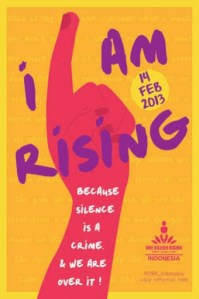 Let’s all RISE in support of V-Day and against violence, rape, and abuse of women and girls.
Today, the ongoing video series entitled “I Am Rising…” debuts featuring short videos by local activists, artists, actors, and thinkers from around the world. The series coincides with a weeklong print and online video series breaking in London’s The Guardian newspaper featuring an exclusive commentary piece by Eve and video testimony from Jane Fonda, Rosario Dawson, Robert Redford, Fatou Bensouda, Ai-jen Poo, Jane Mukuninwa, MP Stella Creasy, Nicola Adams and Ruby Wax, with the aim of inspiring women and men around the world to join ONE BILLION RISING.
V-Day is all about protesting and bringing awareness to the vast number of women world wide–approximately 1 in 3–whose lives have been directly impacted by rape, incest, physical abuse, and violence.
One Billion Rising is a call to action for 1 billion women and men throughout the world to strike and dance today in order to call attention to the horrifying statistic that one in three women, that’s one billion, will be beaten or raped during her lifetime. The campaign has been run all year by Eve Ensler’s now 15-year-old organisation, V-Day, which is most famous for activating people’s feminist imagination through Ensler’s groundbreaking play, The Vagina Monologues.
Ensler’s audacity is less surprising when one considers what V-Day has accomplished. Together with their dedicated local organisers, they have raised more than $85 million, funded over 13,000 community-based anti-violence programmes and educated millions. The organisation reports that 86 cents to the dollar goes directly into ending violence against women and girls, largely due to their model, which relies most heavily on impassioned local volunteers and keeps the organisation itself small and virtual. In 2012, alone, there were over 5,800 V-Day benefit events.
There are actions and events scheduled all over the world. You can watch them live from your home or find one in your neighborhood and join in!!
The action began at dawn with indigenous women in Papua New Guinea. It is sweeping through Australia, Asia, Africa and Europe to the Americas. The Prime Minister of Australia and the President of Croatia are rising. Migrant workers, domestic workers, nurses, doctors, even the Dalai Lama. Solidarity pledges have come in from movie stars and Dalit women and the president of the United Steelworkers.
By this time tomorrow, what will OBR have achieved? It’s not like some Mayan Calendar prediction of world transformation overnight. Some organizers have taken advantage of the rising to give momentum to legislation. In the US, in Washington, the One Billion Rising Rising will be calling for the reauthorization of the Violence Against Women Act. In London, Stella Creasy MP, has introduced a bill to demand more comprehensive sex education—and she’s calling it the One Billion Rising Act.
But OBR’s greatest impact may have to do with borders. Not only has the mobilization brought women from all over the world together into an organizing effort that puts a whole new spin on internationalism, but it has also shone a spotlight on the intersections between so-called “social” and “economic ” issues.
It’s all about social and economic justice for the world’s women and girls!!!

 peej
peej Carissa
 bostonboomer
 dakinikat
 ecocatwoman
 mablue2
 Mama Lopez
 peggysue22
 quixote
 skydancingguestblogger
 Mona (aka Wonk the Vote)



 Sky Dancing
Recent Comments