
Women Front and Center in MENA Protests
Posted: December 22, 2011 Filed under: Bahrain, Egypt, Foreign Affairs, Tunisia, Violence against women, Women's Rights | Tags: women fighting fundamentalist religions, women in democracy protests, Women's Rights 4 Comments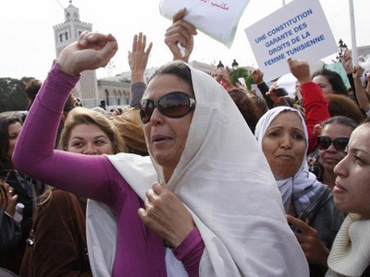 Many cultures in the MENA region are well-known for their horrible treatment of women. We see practices like honor killings, genital mutilation, and taking child brides. One of the offshoots of the Arab Spring has been the central role of women looking for broader participation in their countries.
Just as we in the United States are experiencing a political/fundamentalist Christian backlash that has turned into a war on the rights of women, the protests movements associated with the Jasmine Revolutions and their related political change have brought out a wave of political/fundamentalist Muslim backlash. There are several signs of hope in a region experiencing lots of social unrest. First, we’ve become aware of a large number of feminist leaders. Second, we’ve seen that many women are putting their lives on the line to ensure that the social change includes improving the lives and status of women. While oppression of women is frequently attached to fundamentalist religious followers, the roles of traditional tribal cultures and their dominance in places that are underdeveloped and rural–like Alabama or Uganda–cannot be underestimated. Here’s some stories that have made headlines recently that show the global struggle for women’s rights–like the US struggle for women’s rights–is still an uphill battle.
In response, thousands of women — and men — marched Tuesday in Cairo’s Tahrir Square. Observers say it was the largest demonstration of women in Egypt in decades. Not since 1919, when women mobilized under the leadership of feminist Hoda Sha’rawi in anti-colonial demonstrations against the British have so many Egyptian women taken to the streets. (After representing Egyptian women at the International Women Suffrage Alliance in Rome in 1923, Sha’rawi returned to Cairo and very publicly removed her veil.)
Women have played an important role in Egypt’s modern revolution but have struggled to translate their activism into a political role in the new, emerging system. They have been excluded from important decision-making bodies, and the military leadership declined to continue a Mubarak-era quota for women that ensured them at least 64 seats in parliament. Based on early election results, it appears that few women will win a place in the new government.
Nevertheless, one intrepid woman, Bothaina Kamel, is breaking ground with her candidacy for president. The campaign of Kamel, a well-known television presenter, at first was shocking, and certainly quixotic, with polls indicating her support is less than 1%. But her persistence has gained her credibility. While she has little chance of winning, she is helping to normalize the idea of women in politics — an idea that is deeply contested in Egyptian society. Leaders of Salafi parties, which gained a surprising 20% of the vote in the first rounds of elections, have spoken out against women running for office.
The recent women’s protest may breathe life into a movement that desperately needs new energy. In the early weeks of the revolution, women activists tried to bring attention to women’s issues but never succeeded in getting the masses behind them.
Tunisian women are also concerned about women’s rights since the country’s recent elections. The picture up top is from that country. Newly elected leaders have had to promise to recommit their country to modernization and democratic principals that include increased roles of women.
“We are all the women of Tunisia,” stated Professor Khalid Kshir of Tunis University in conversation with the author of this article. Professor Kshir is a member of the Democratic Modernist Pole, a coalition of leftist parties. He fears that the Ennahda party will push the country back instead of moving it forward.
Just a year ago, literally weeks before the start of the uprising in the country, Tunisians had joked that theirs was a country of free women and happy men. No other Arab nation had ever granted so many rights to women, fixed de jure and de facto, than Tunisia. That was something of which Tunisians were proud, and even boasted about. Today, many people in Tunisia fear that the country’s achievements on the road to becoming a modern society will be brought to nought.
”We need to focus all our efforts in the sphere of politics and culture on women’s rights, because women form half of our society and any infringement on their rights will be harmful to all of us,” Professor Kshir went on to say.
Strange as it may seem, the issue of women’s rights was also on the agenda of a conference on promoting tourism which took place in Tunisia early in November, shortly before the final election results were announced. The conference was organized by the Ennahda party, which decided not to wait for the National Constituent Assembly to convene and the government to be formed before holding a series of meetings with representatives of Tunisia’s major industries in order to lay out the priorities for getting the national economy out of its post-revolution stupor. The discussion on the prospects for yourism was among the first meetings to be held, along with a conference on the financial market, co-sponsored by Tunisia’s Brokers’ Association.
…
The party leader’s comforting assurance came in response to concerns expressed by travel agencies, tour operators, hoteliers and bankers at the meeting, who voiced questions such as, “What will be Tunisia’s international image following your electoral victory? What will happen to women’s rights? How will European tourists feel in Tunisia, and do they have a reason to fear Islamists?”
What started as a discussion on the prospects of tourism eventually escalated into a broader deliberation on Tunisia’s prospective path of development. There are strong reasons for such an interconnection: tourism accounts for six per cent of Tunisia’s GDP and makes up 60 per cent of the national trade deficit. The industry employs 12 per cent of the country’s working population, while one in eight Tunisian families live off tourism, one way or another. During the revolutionary turmoil which rocked the country between January and September 2011, tourism revenues in Tunisia plunged by 38.5 per cent compared to a similar period in 2010, while the overall number of tourists coming to Tunisia sank by 34.4 per cent.
That is why at present Ennahda is ready for dialogue and compromise. “We guarantee freedom in food, drink and clothes,” Hamadi Jebali said.
He emphasized that his party would respect democratic principles and that Tunisian society would retain its progressive nature. According to Jebali, the revolution took place in the name of improving the lives of Tunisian citizens and moving the country forward rather than hindering its development.
Many of those present at the conference believed the words of the Ennahda leader – or said that they did. “I believe Jebali. I am an optimist but only on condition that the rights of women won’t be violated and if we don’t follow the path of Saudi Arabia where a woman can do business but is forbidden to drive a car,” Sihem Zaiem, a member of the Federation of Tourist Agencies, said after the conference.
Delegates applauded her when she demanded that the Ennahda secretary-general explain Tunisia’s true face to the world as soon as possible, and demonstrate Islamists’ attitude to women’s rights. Jebali promised that nothing would change in the arena of women’s rights. His speech was very convincing.
A mother in Bahrain has gone to jail for playing revolutionary music and participating in protests.
Fadhila Al Mubarak, a 38-year-old mother of a 9-year-old boy, is still in jail after she was sentenced in an unfair military trial for charges related directly to exercising her right to freedom of expression and peaceful assembly. She was detained and prosecuted in a military court for playing revolutionary music in her car, trying to save her son and nieces, participating in peaceful protests in Pearl Roundabout and writing a poem to her son about the revolution, freedom and fighting for his future. The information available on the conditions of her detention is very worrying and her family has raised concerns over her health.
Fadhila, who was living with her husband and her son in the area of Aali, was arrested on 27 March 2011, just a few days after the National Safety Law was imposed on 15 March 2011. She was arrested at a checkpoint because there was an audio recording of revolutionary songs playing in her car. She was asked to pull over her car and step out. They insulted her, called her names and cursed her. While security officers at the checkpoint were talking to her, a man in civilian clothing tried to get into her car. In fear over the safety of the children, her son (9), nieces (14 – 15), she pulled him away thinking he was a thug who would kidnap or hurt them. Later, she found out he was a police officer.
Her family asked about her at police stations close to the checkpoint where she was arrested only to find out after four days that she was held in Riffa police station. She was later transferred to Isa Town women’s prison. During the period of her detention, her family had no contact with her and was not allowed to visit or talk to her over phone. Family members tried to appoint her a lawyer, a request that was rejected by the military court.
Women in the region can take heart from the post revolutionary experience of Indonesia’s women who have managed to get many advances since their repression by former president Soeharto following a 1965 tragedy. Indonesia is the world’s largest Muslim majority democracy. As with all countries, religious fundamentalists obsessed with old testament prohibitions continue to seek repression of women. However, Indonesian laws continue to reflect the country’s will to improve conditions for women. The current president seems to be backsliding on reforms gained during the tenure of Indonesia’s previous PM.
Of course, like the feminists have suggested, the Reform Era in 1998 has given women opportunities to revive the real spirit of Kartini. However, as Mariana suggested, the Reform Era was nothing but “a short-term honeymoon” moment for women’s movement.
When the late former president Abdurrahman Wahid changed the name of the ministry of women affairs into the ministry of women’s empowerment, for example, feminists felt very confident about their cause. In addition to that, the National Commission on Violence Against Women (Komnas Perempuan) was given full support to continue its investigation into the May 1998 tragedy, where many Chinese women were sexually abused.
“During Megawati’s era, we were more enthusiastic because the first woman was finally installed as a president amid opposition from some religious leaders,” Mariana said. “Megawati then also succeeded in passing the law on domestic violence.”
Celebrating women’s achievement even more, she added, was the policy of granting women a 30 percent quota of seats in the Parliament.
However, this celebration of women’s movement had to end in 2005, when Susilo Bambang Yu-dhoyono won his first presidential term.
“The year marked the introduction of the pornography bill, which was mentioned by President SBY during his first [presidential] speech,” said Mariana. “He even took the opportunity to comment about women’s belly buttons!”
And from that moment on, she went on, the women’s movement in Indonesia started to lose its ground. While battling against the criminalization of women, feminists have been labeled as “Western devilish agents”, gaining a bad reputation in society.
It seems that vigilance of women over their rights in all democracies is important. That is why it is important that women officials with high public profiles–like US SOS Hillary Clinton–continue to keep their focus on the rights of women and also GLBT rights aound the world. The world’s religious fundamentalists continue to press for backsliding. Religious fanatics push for edicts that can run the gambit from defining an egg as a person to hold women’s bodies hostage to narrow religious views of ‘life’ as in seen in Arkansas recently. There are also the many Sub-Saharan African nations–like Nigeria and Uganda–where laws ignore or encourage violence against GLBT because of both Muslim and Christian extremists in the regions. The latter example has been funded for and encouraged by US fundamentalist Christians which is even a more outrageous intervention than just resurrecting or perpetuating native tribal traditions like the child bride tradition which is also a problem in places like highly Christian Guatemala as well as Western African countries.
SOS Clinton strongly condemned the treatment of women protestors by Egyptian security forces this week. It is heartening to see her speak out for women’s full participation in democratic movements and governance.
In unusually strong language, the US secretary of state accused Egypt’s new leaders of mistreatment of women both on the street and in politics since the street revolt nearly a year ago that overthrew leader Hosni Mubarak.
“This systematic degradation of Egyptian women dishonours the revolution, disgraces the state and its uniform and is not worthy of a great people,” Mrs Clinton said in a speech at Georgetown University.
In images widely seen over YouTube, helmeted troops were shown beating a veiled woman after having ripped her clothes off to reveal her bra and stomach.
Other pictures circulating on social media networks that have enraged protesters include one of a military policeman looming over a sobbing elderly woman with his truncheon.
“Recent events in Egypt have been particularly shocking. Women are being beaten and humiliated in the same streets where they risked their lives for the revolution only a few short months ago,” Mrs Clinton said.
Here is the PBS NEWSHOUR coverage of the Egyptian Women’s protests and an interview with participant May Nabil. It has some interesting narrative of the march in that many woman spontaneously joined the march and weren’t just drawn to it via internet. Additionally, there were many supportive Egyptian men in attendance.
Gloria Cain Says Her Husband “Totally Respects Women.”
Posted: November 13, 2011 Filed under: 2012 presidential campaign, Republican presidential politics, U.S. Politics, Violence against women | Tags: Fox News, Gloria Cain, Greta van Susteren, Herman Cain, sexual assault, Sexual harassment 11 Comments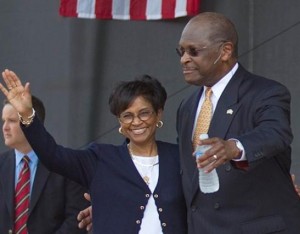
Gloria and Herman Cain
Fox News has released a couple of teaser quotes from Gloria Cain’s interview with Greta van Susteren, scheduled to air tomorrow night. The couple both participated, unfortunately. I was hoping the appearance would be sans Herman. Asked about the accusations of sexual harassment against her husband, Mrs. Cain said the following:
“…you hear the graphic allegations and we know that would have been something that’s totally disrespectful of her as a woman. And I know the type of person he is. He totally respects women.”
Right. I guess that’s why he joked about Anita Hill and called Nancy Pelosi “Princess Nancy.” And his respect for women is probably why Cain allowed a group of his supporters to refer to one of his accusers as an “ugly bitch.”
At another point she added, “I’m thinking he would have to have a split personality to do the things that were said.”
Hmmmm…maybe he has dissociative identity disorder (multiple personalities). That would explain why he didn’t remember any of the incidents of harassment or the fact that two women were compensated with $35,000 and $45,000 respectively.
A former spokesperson for Cain, Ellen Carmichael,
said on Twitter that the interview marks “the first time I’ve heard Gloria Cain, even after working for Herman for more than a year.”
Cain’s wife, who is said by friends to be a quiet woman, and who is a registered Democrat according to her husband, has steered clear of the spotlight and has not assumed the traditional role of candidate’s wife. Cain has said that his wife has been outraged by the claims against her husband. When Gloria Cain watched accuser Sharon Bialek’s news conference last Monday, she told her husband that the man that Bialek described sounded nothing like the man she’s known for 45 years.
“The things that that woman described, she said, that doesn’t even sound like you, and I’ve known you for 45 years,” Cain recalled his wife saying to him after she watched the press conference from Atlanta. “My own wife said that I wouldn’t do anything as silly as what that lady was talking about.”
That lady? It’s hard to believe that Cain is a baby boomer. He missed out on the consciousness raising part of the ’60s and’70s, that’s for sure.
Monday Reads
Posted: November 7, 2011 Filed under: #Occupy and We are the 99 percent!, abortion rights, Banksters, Environment, morning reads, religious extremists, Reproductive Health, Violence against women, We are so F'd, Women's Rights | Tags: Financial Crisis, Herman Cain, Keystone Pipe Line, Occupy, Protests, sexual abuse, Sexual assault of Journalists 45 Comments Good Morning!
It hardly seems possible that the first week of November has passed already. There seems to be a lot of unhappiness and unrest around the world right now. Ordinary people are continuing to express their discontent with their governments who ignore the rights of the many to support the wealth of the few.
Jineth Bedoya Lima is a Colombian journalist who is trying to use her own abuse as a way to end sexual assault of women’s journalists. She also wants to highlight the inaction of Colombia in pursing cases for women that have been brutalized.
As a journalist who was kidnapped, tortured, and violently gang-raped 11 years ago, when she was 26, Bedoya had finally gotten the chance she’d been waiting for, one that most women who’ve endured what she has will never get. After 11 years of her case lying motionless at Colombia’s attorney general’s office, she has the prospect of seeing some justice at the international level.
During a morning visit to Bogota’s maximum-security La Modelo prison in May 2000, as part of a newspaper investigation into alleged arms trafficking involving state officials and members of the right-wing paramilitary group United Self-Defense Forces of Colombia (AUC), she was grabbed, drugged, and driven hours away. Three men repeatedly raped her and left her bound in a garbage dump at the side of a road, where a taxi driver discovered her that evening.
Later Bedoya told the news media how her kidnappers had gripped her hair and told her to “pay attention” as they tortured her. “We are sending a message to the press in Colombia,” they said.
After so many years of waiting on the Colombian justice system to investigate her attack, Bedoya is in D.C. to advance her case at the Inter-American Commission. The Pan-American human rights body will take up a case when all options have been exhausted on the country level or when a country has failed to bring justice in a reasonable amount of time. Bedoya and her lawyers appear to have banked and won on the latter.
All the inaction has taken its toll. When I asked after the hearing whether the look she’s had on her face all morning is anger, Bedoya answered quickly: “No, what you see is an expression of deep pain.”
Support for Republican Herman Cain has waned since the public discovery of settlements for sexual harassment. The polls indicate a definite gender gap. Women are well aware of how prevalent sexual harassment is and they are also aware of Cain’s evolving explanations.
The poll showed the percentage of Republicans who view Cain favorably dropped 9 percentage points, to 57 percent from 66 percent a week ago.
Among all registered voters, Cain’s favorability declined 5 percentage points, to 32 percent from 37 percent.
The survey represents the first evidence that sexual harassment claims dating from Cain’s time as head of the National Restaurant Association have taken a toll on his presidential campaign.
A majority of respondents, 53 percent, believe sexual harassment allegations against Cain are true despite his denials. Republicans were less likely to believe they are true, with 39 percent thinking they are accurate.
“The most striking thing is that Herman Cain is actually seeing a fairly substantial decline in favorability ratings toward him particularly among Republicans,” said Ipsos pollster Chris Jackson.
A major story on sexual predation broke over the weekend. Two Penn State officials have been charged with covering up sexual abuse allegations against a coach.
In a development that strikes very close to Joe Paterno’s storied football program, Pennsylvania State University athletic director Tim Curley and another university official were charged Saturday with perjury related to a child sexual abuse investigation of longtime Nittany Lions assistant coach Jerry Sandusky.
The Pennsylvania Attorney General’s Office said Curley, 57, and Gary Schultz, 62, Penn State’s senior vice president for finance and business, also were charged with failure to report, a summary offense. The perjury count is a third-degree felony punishable by up to seven years in prison and a $15,000 fine.
The protest was organized by the Natural Resources Defence Council, a U.S. environmental group. Spokeswoman Susan Casey-Lefkowitz told CBC News many Americans are concerned with the potential environmental impact of the pipeline.
“Tarsands expansion, climate change and particularly this pipeline is a major concern for many, many Americans,” she said, “and the numbers are growing every day.
“You know, for the president, it’s about making sure he holds true to the promises he made to fight climate change,” she said. “And to the other candidates, it’s about calling them out when they act like climate change is not real, which of course it is.”
Mississippi votes tomorrow to enact or reject a radical definition of human ‘life’. Every one interested in the health of women will be watching the southern state that’s best know for being at the bottom of every list of good things in the country. Colorado has voted on a similar initiative but it was rejected by voters.
Opponents said the definition is too broad and, in addition to outlawing abortion, could have effects on in vitro fertilization and birth control methods.
Stan Flint, a consultant for Mississippians for Healthy Families — a group that opposes the measure — said the group has tried to educate voters that they can be against abortion and vote against the initiative.
“Hopefully, everyone in Mississippi will understand this is a dangerously flawed vehicle,” Flint said. “It’s an extreme government intrusion.”
Here’s a really disturbing video from Occupy Oakland of some one being shot at by a rubber bullet by riot police while filming them. Kind’ve makes you wonder about which countries are police states, doesn’t it?
Barry Ritholz continues to make certain that the causes of the financial crisis can’t be white washed by politicians seeking political donations from Wall Street. He writes on the “big lie” at WAPO.
Why are people trying to rewrite the history of the crisis? Some are simply trying to save face. Interest groups who advocate for deregulation of the finance sector would prefer that deregulation not receive any blame for the crisis.
Some stand to profit from the status quo: Banks present a systemic risk to the economy, and reducing that risk by lowering their leverage and increasing capital requirements also lowers profitability. Others are hired guns, doing the bidding of bosses on Wall Street.
They all suffer cognitive dissonance — the intellectual crisis that occurs when a failed belief system or philosophy is confronted with proof of its implausibility.
Be sure to check the list that follows this quote. He has a really good step by step explanation of how Allan Greenspan’s low interest rates led to banks looking for high profits in all the wrong places. They have no one to blame but themselves. So, why are people like Mayor Bloomberg the blaming poor home owners?
So, that will get us started this morning. What’s on your reading and blogging list?
TGIFriday Reads
Posted: October 28, 2011 Filed under: Barack Obama, Mitt Romney, morning reads, PLUB Pro-Life-Until-Birth, religious extremists, Reproductive Health, Reproductive Rights, Republican presidential politics, U.S. Economy, U.S. Politics, Violence against women, Women's Rights | Tags: 2012 presidential election, abortion, Ayn Rand, bundlers, Herman Cain, Libertarianism, Lobbyists, minimum wage, Mitt Romney, objectivism, Omar Sharif, personhood amendment to the Constitution, Republican debates, Republican nomination, Rick Perry, Rick Santorum, Ron Paul, wild turkeys 11 Comments
I live in Northwest Greater Boston in a town that is far from rural. However we do encounter wildlife in my neighborhood–skunks, opossums and racoons, for example. But yesterday afternoon, as I drove down the small road where I live, I had to brake suddenly for a large, imposing bird like the one in the photo. It was casually standing right in the middle of the road. I looked to my left and saw good sized flock of these birds, and suddenly realized they were wild turkeys. They were walking around in front of someone’s house. I was amazed.
It turns out that wild turkeys have been making a comeback in Massachusetts and have been invading a number of cities and towns around here. From The Boston Globe:
On a recent afternoon, Kettly Jean-Felix parked her car on Beacon Street in Brookline, fed the parking meter, wheeled around to go to the optician and came face to face with a wild turkey.
The turkey eyed Jean-Felix. Jean-Felix eyed the turkey. It gobbled. She gasped. Then the turkey proceeded to follow the Dorchester woman over the Green Line train tracks, across the street, through traffic, and all the way down the block, pecking at her backside as she went.
“This is so scary,” Jean-Felix said, finally taking refuge inside Cambridge Eye Doctors in Brookline’s bustling Washington Square. “I cannot explain it.”
Notify the neighbors: The turkeys are spreading through suburbia. Wild turkeys, once eliminated in Massachusetts, are flourishing from Plymouth to Concord and – to the surprise of some wildlife officials – making forays into densely populated suburban and urban areas, including parts of Boston, Cambridge and, most recently, Brookline.
In Winchester, a woman was “held captive” by a wild turkey.
On Tuesday evening, around 6 p.m., a Swan Road resident was pulling into her car [sic] when a wild turkey jumped at her and started to attack her vehicle as she was trying to drive it into the garage.
The woman said that this turkey did the same thing last week, and she didn’t call the police because she thought the animal had left.
“It kept attacking the woman at her house,” said Winchester Animal Control Officer, Jerry Smith of the 17-pound turkey. “It’s been doing it for a couple of days. We can’t have animals attacking people around town.”
According to the police report, she was able to close the garage door, but ended up being trapped, unable to get to her house, because the turkey refused to leave her property.
After 15 minutes “of being held captive” the woman called the Winchester Police Department to help her get into the house.
The responding officer saw that the turkey was still on the property. He got out of his cruiser and took a shotgun with him. As soon as the turkey noticed him, it charged and the officer shot and killed it.
Yikes! I hope those turkeys don’t start hanging around in my yard. In even more bizarre news, there is snow outside my house. Apparently, I got home just in time for winter.
Remember Omar Sharif? He starred in Dr. Zhivago back in 1965. The aging movie star recently slapped a female fan while he was on the red carpet at the Tribeca Film Festival.
The actor, who was nominated for his role in 1962’s “Lawrence of Arabia,” appeared to have lost his cool when a female fan interrupted him while he was posing for photographers.
The incident, captured by a TMZ camera, shows Sharif slapping and mildly pushing the woman, then spewing venomous disapproval at having been disturbed.
“My dear!” Sharif exclaimed in Arabic, as translated by the Washington Post. “I told you I’d get to you afterwards! I just said that and you’re standing here. Put something in your brain!”
In slightly more serious news, the Republican presidential candidates are still demonstrating their stupidity on a daily basis. Some examples follow.
Mitt Romney
It isn’t enough that Mitt Romney has crazy Robert Bork advising him on the Constitution. Now he has appointed another adviser who belonged to a violent Lebanese militia in the 1980s.
Walid Phares, the recently announced co-chair of GOP presidential candidate Mitt Romney’s Middle East advisory group, has a long résumé. College professor. Author. Political pundit. Counterterrorism expert. But there’s one chapter of his life that you won’t find on his CV: He was a high ranking political official in a sectarian religious militia responsible for massacres during Lebanon’s brutal, 15-year civil war.
During the 1980s, Phares, a Maronite Christian, trained Lebanese militants in ideological beliefs justifying the war against Lebanon’s Muslim and Druze factions, according to former colleagues. Phares, they say, advocated the hard-line view that Lebanon’s Christians should work toward creating a separate, independent Christian enclave. A photo obtained by Mother Jones shows him conducting a press conference in 1986 for the Lebanese Forces, an umbrella group of Christian militias that has been accused of committing atrocities. He was also a close adviser to Samir Geagea, a Lebanese warlord who rose from leading hit squads to running the Lebanese Forces.
Romney has also clearly stated his willingness to sacrifice the lives of women to save fertilized eggs. In the Guardian, Tresa Edmunds, a Mormon, writes: If Mitt Romney’s anti-abortion crowd get their way, it could kill me
Mississippi is the latest state to support a “personhood” amendment – a law that defines life as beginning at conception and giving full legal rights to a fertilised egg. On a recent political talk show, Mitt Romney affirmed that he would “absolutely” support such an amendment to the federal constitution. Such a conservative law would have far-reaching consequences, rendering many forms of birth control, the morning-after pill and aspects of in-vitro fertilisation illegal, as well as eliminating abortion as an option even when deemed medically necessary.
This trend is also seen in the ironically named Protect Life Act, recently passed by the House of Representatives, which gives hospitals the right to refuse to perform abortions, even at the cost of a woman’s life. It is a terrifying time to have a uterus, but especially a mysteriously malfunctioning one such as mine.
My son was born weighing 2lb 4oz, at 28 weeks gestation. My pregnancy – which had been much longed for – was proceeding normally until all of a sudden a pain that turned out to be organ failure brought me to the emergency room. There, I was diagnosed with HELLP syndrome. My blood pressure was rocketing, my red blood cells were disintegrating and my platelet count was dropping. If I had managed to make it through organ failure, stroke or heart attack, I would have bled to death in delivery. Thanks to the tremendous care and expertise of talented doctors and nurses, my son and I are here to tell the harrowing story but, if things had gone differently, the only way I would be alive is if they had removed my son’s body from my womb in pieces.
Comments such as Romney’s casually tossed off “absolutely” make me shake with rage. When politicians are so concerned about the people they see as allegedly using abortion as birth control that they would let me die, I can’t help but wonder how they can dare say they care about the sanctity of life.
Edmunds is confused. Romney and the other Republican candidates care deeply only about “human life.” They obviously do not consider women to be humans.
Rick Perry
As everyone knows, Governor Goodhair hasn’t done very well in the Republican debates so far. Now it appears he is going to wimp out of future debates.
After a series of poor debate performances in the early months of his presidential campaign, Texas Gov. Rick Perry is backing off the upcoming GOP debate schedule, committing to just one of the next three events between now and Nov. 15.
Perry has struggled in the five debates he has attended since he joined the race in mid-August. At one, he fumbled an attempt to cast rival Mitt Romney as a flip-flopper. At another, bickering between Romney and Perry drew criticism that the candidates were acting juvenile.
Perry hinted at his frustration with the debates earlier this week when he told Fox News that participating in them was a “mistake.”
“These debates are set up for nothing more than to tear down the candidates,” Perry said. “…All they’re interested in is stirring it up between the candidates.”
Um… yeah. So? If Perry can’t take the heat, maybe he should get out of the kitchen. BTW, has he produced his birth certificate yet? I heard he was born in Mexico. /s
Herman Cain
At Huffpo, Dave Jamieson details Herman Cain’s long, enthusiastic battle against the minimum wage.
In his plan for economic “Opportunity Zones,” Cain offers a slate of proposals aimed at revitalizing depressed pockets of the country, including zero capital gains and payroll taxes within qualifying areas. Although it doesn’t say so explicitly, the Cain campaign’s primer on opportunity zones also suggests the possibility of rolling back minimum-wage laws in impoverished areas.
“Minimum wage laws prevent many unskilled and inexperienced workers (i.e. teens) from getting their first job and prices them out of the market,” the plan says, listing a number of potential “solutions” to urban poverty. Cain’s campaign did not immediately comment on his stance on minimum wage laws.
Minimum-wage protections are an issue Cain knows intimately. In his work as the CEO of Godfather’s Pizza and later as president of the National Restaurant Association, Cain worked diligently in Washington and in the media to see that low-wage restaurant workers could legally be paid as little as possible, as In These Times has noted. In fact, Cain’s time in the restaurant business was marked by a long and largely successful battle against minimum-wage increases, and even today, some 15 years later, many of the nation’s waiters and waitresses have Cain and the restaurant lobby to thank for a federal minimum wage of $2.13 for tipped workers.
By 1995, when Cain was at the helm of Godfather’s, the federal minimum wage had already lost much of its purchasing power since the 1960s and 70s, and it hadn’t seen a bump in five years. When then-President Bill Clinton and Labor Secretary Robert Reich proposed raising it from $4.25 to $5.15, Cain emerged as one of the leading opponents of the pay boost.
Rick Santorum
Is he really still running for president? Apparently so. He has released a new ad targeting Herman Cain’s accidental pro-choice position on abortion. The content of the ad suggests that Santorum believes that aborted embryos and fetuses can “think.”
Ron Paul
Ron Paul isn’t really an objectivist or a libertarian, even though he claims to be a follower of Ayn Rand. He can’t be, because he wants the government to get involved in policing women’s bodies. But here’s an interesting post by Gary Weiss, the author of a new book about Ayn Rand’s influence on American culture that sounds like a fascinating, if disturbing, read.
Ayn Rand’s spirit hangs over the 2012 presidential race like the aftermath of a bad meal that, for some reason, we’ve all forgotten that we’ve eaten. In the run-up to the financial crisis the markets became a kind of Fifth Estate, the ultimate arbiters of American society. This was not a Republican disease; some of the most voracious deregulation took place during the Clinton Administration. It was as if a moral choice had been made, substituting the “wisdom of the markets” for admittedly flawed and sometimes grossly inept regulators. It made perfect sense, especially in an era in which the stock market averages rose by as much as 40% in one year, but today we know, or should know, that untrammeled capitalism doesn’t work.
But you’d never know any of this when listening to the Republican candidates for president, especially the one who most overtly embodies Rand’s philosophy: Ron Paul.
Paul is by no means a card-carrying Objectivist—his embrace of religion, and his views on foreign policy, makes him anathema to Randian true believers. But his embrace of the most primitive, extreme forms of free-market, almost-zero-government capitalism comes closest to Rand’s belief system of any in the Republican field.
What’s remarkable about Paul is how effective he is at putting forward his views, extreme as they are. Indeed, the unyielding, unwavering non-flip-flopping character of his opinions is perhaps his greatest asset. He is the best friend free-market capitalism has at present, as can be seen by his recent debate performances and especially his recent triumphant appearance at Jon Stewart’s Daily Show. The man exudes small-town charm while at the same advocating positions that would make life into hell for the great majority of his followers and listeners.
I’ll end with an article about the incumbant Republican President: ‘Bundlers’ for Obama Have Active Ties to Lobbying
Despite a pledge not to take money from lobbyists, President Obama has relied on prominent supporters who are active in the lobbying industry to raise millions of dollars for his re-election bid.
At least 15 of Mr. Obama’s “bundlers” — supporters who contribute their own money to his campaign and solicit it from others — are involved in lobbying for Washington consulting shops or private companies. They have raised more than $5 million so far for the campaign.
Because the bundlers are not registered as lobbyists with the Senate, the Obama campaign has managed to avoid running afoul of its self-imposed ban on taking money from lobbyists.
But registered or not, the bundlers are in many ways indistinguishable from people who fit the technical definition of a lobbyist. They glide easily through the corridors of power in Washington, with a number of them hosting Mr. Obama at fund-raisers while also visiting the White House on policy matters and official business.
{Yawn…} Another Obama lie…so what else is new? That’s all the links I’ve got.
What are you reading and blogging about today?
A Nobel Peace Prize for Women
Posted: October 7, 2011 Filed under: Violence against women, Women's Rights | Tags: Ellen Johnson Sirleaf, Leymah Gbowee, Nobel Peace Prize, Tawakkul Karman 4 Comments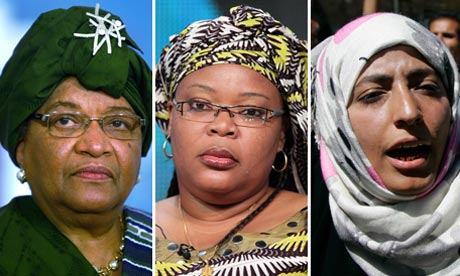
Ellen Johnson Sirleaf, Leymah Gbowee and Tawakul Karman. Photograph: Alex Wong/Getty, Frederick M Brown/Getty, Khaled Abdullah/Reuters
The 2011 Nobel Peace Prize has been awarded to Ellen Johnson Sirleaf, Leymah Gbowee and Tawakkul Karman for their work for women’s rights.
Liberia’s Ellen Johnson Sirleaf is Africa’s first democratic elected female president. Leymah Gbowee has worked to mobilize women across ethnic and religious dividing lines to bring end to the long war in Liberia.
Tawakkul Karman has played a leading role in the struggle for women’s rights and democracy in Yemen.
We’ve been covering a lot of news about women around the world here for as long as we’ve had a voice. It’s perhaps a natural offshoot of our roots in feminism and our roots as Hillary supporters. There has been a lot of major unrest in the world recently. Women and children have suffered tremendously. Women have been the victims of mass rape as a war weapon. Children have been recruited into armies. Women have been forced into early marriage, denied the right to participate in government and even to do the simple task of driving a car in major countries who we support, arm, and enrich. Our President is currently in the process of loosening punishment by our country for the use of children soldiers. That is hardly the act of a Nobel Peace Prize winner. The winning women are outstanding choices that do more than just symbolize the struggle of women to achieve independence, dignity, safety, and autonomy around the world.
These three women have campaigned for peace and democracy in Liberia and Yemen and are more than just symbols of the aspiration for peace. They have put their lives on the line for it in countries riddled with problems that we can barely imagine here. Sirleaf has been a personal hero of mine for some time since she is an economist as well as a leader. She spent time in prison and is the first woman president on the African Continent. She is a small woman with the heart of a lion. I look forward to learning more about the other two women. Here’s a few things to get his started!!!Here are some profiles of the winners from the UK Guardian.
The Liberian president, Ellen Johnson Sirleaf, and Leymah Gbowee, a social worker turned peace campaigner from the same country, will share the 10m kronor (£950,000) prize with Tawakul Karman, a journalist and pro-democracy activist in Yemen who has been a leading figure in the protests against President Ali Abdullah Saleh since January.
The Nobel committee said the three had been chosen “for their non-violent struggle for the safety of women and for women’s rights to full participation in peace-building work”.
“We cannot achieve democracy and lasting peace in the world unless women obtain the same opportunities as men to influence developments at all levels of society,” the committee said in a statement. They are the first women to be awarded the prize since 2004 when the committee honoured Wangari Muta Maathai, the Kenyan environmentalist who died last month, and bring the tally of female winners to 15, compared with 85 men.
Sirleaf, 72, is a Harvard-trained economist who became Africa’s first democratically elected female president in 2005, two years after the country achieved a fragile peace after decades of civil war. The committee said she had “contributed to securing peace in Liberia, to promoting economic and social development, and to strengthening the position of women”.
Seen as a reformer and peacemaker in Liberia when she first took office, Sirleaf declared a zero-tolerance policy against corruption and has made education compulsory and free for all primary-age children. She is currently running for re-election, with a vote to be held on Tuesday.
Gbowee, 39, was instrumental in helping bring Liberia to peace in the early 2000s, leading a movement of women who dressed in white to protest against the use of rape and child soldiers in the war. During the 2003 peace talks, she and hundreds of women surrounded the hall where the discussions were being held, refusing to let delegates leave until they had signed the treaty. The committee said she had “mobilised and organised women across ethnic and religious dividing lines to bring an end to the long war in Liberia, and to ensure women’s participation in elections”.
Since 2004, Gbowee has served as a commissioner on Liberia’s truth and reconciliation commission, and she is now executive director of the Women in Peace and Security Network, an organisation that works with women in Liberia, Ivory Coast, Nigeria and Sierra Leone to promote peace, literacy and political involvement.
“In the most trying circumstances, both before and during the Arab spring, Tawakul Karman has played a leading part in the struggle for women’s rights and for democracy and peace in Yemen,” the Nobel committee said of the third winner. Karman, 32, is a mother of three who in 2005 founded the group Women Journalists Without Chains.
She has been a key figure among youth activists in Yemen since they began occupying a square in central Sana’a in February demanding the end of the Saleh regime, and has often been the voice of activists on Arabic television, giving on-the-ground reports of the situation in the square outside Sana’a University, where dozens of activists have been shot dead by government forces.
She called her award “a victory for the Yemeni people, for the Yemeni revolution and all the Arab revolutions”.
“This is a message that the era of Arab dictatorships is over. This is a message to this regime and all the despotic regimes that no voice can drown out the voice of freedom and dignity. This is a victory for the Arab spring in Tunis, Egypt, Libya, Syria and Yemen. Our peaceful revolution will continue until we topple Saleh and establish a civilian state.”
More information can be found at BBC News as well. In some ways, I feel that this prize reflects Hilary Clinton’s priorities as she has made the rights of women and children and their oppression by strict and violent patriarchal regimes has been a focus of her work. I’m going to close this thread with a quote from then-First Lady Hillary Clinton that seems very appropriate.
Women have always been the primary victims of war. Women lose their husbands, their fathers, their sons in combat. Women often have to flee from the only homes they have ever known. Women are often the refugees from conflict and sometimes, more frequently in today’s warfare, victims. Women are often left with the responsibility, alone, of raising the children.
from a speech given at the Conference on domestic violence in San Salvador, El Salvador (17 November 1998)
Congratulations to these outstanding women whose quest for peace has come at great personal danger and sacrifice!!!!

 peej
peej Carissa
 bostonboomer
 dakinikat
 ecocatwoman
 mablue2
 Mama Lopez
 peggysue22
 quixote
 skydancingguestblogger
 Mona (aka Wonk the Vote)



 Sky Dancing
Recent Comments