
Downgrade
Posted: August 5, 2011 Filed under: Economy, U.S. Economy, U.S. Politics | Tags: Standard&Poor's downgrade 28 CommentsRating agency Standard & Poor’s downgraded US debt from AAA to AA+. Additionally, the company warned of more possible downgrades in  the future because of political and economic uncertainty. This basically means that I have to tell students to draw big red lines through all of their asset pricing formulas that tell them to use US treasuries as the world’s base risk free rate. I can only imagine that when the FMA meets in Denver in October that the big discussion will be should Australia, Canada or France now be considered the rate upon which all else is based?
The downgrade and negative outlook came late on Friday night, after news surfaced of a furious rearguard attempt by the White House to convince S&P that its calculations were flawed.
The move shifts long-term US government debt into the same level as Britain, Japan and other countries, but below that of Canada, Australia and France. As a rule, a lower credit rating means higher borrowing costs for debtor nations. But because of the size of the US and its deep capital markets, it remians to be seen what impact the move will have when financial markets reopen on Monday.
Republicans were quick to highlight the downgrade – the first in modern US history – as a humiliation for President Obama. But S&P’s statement explaining the move blamed both parties for the US fiscal mess – and had harsh words for the Republican party for ruling out any taxes increases.
“We have changed our assumption … because the majority of Republicans in Congress continue to resist any measure that would raise revenues,” S&P said.
S&P also said the budget savings agreed by Congress at the start of the week were too feeble, and blamed political weakness and instability for triggering the downgrade:
More broadly, the downgrade reflects our view that the effectiveness, stability, and predictability of American policymaking and political institutions have weakened at a time of ongoing fiscal and economic challenges to a degree more than we envisioned when we assigned a negative outlook to the rating on April 18, 2011.
Since then, we have changed our view of the difficulties in bridging the gulf between the political parties over fiscal policy, which makes us pessimistic about the capacity of Congress and the Administration to be able to leverage their agreement this week into a broader fiscal consolidation plan that stabilizes the government’s debt dynamics any time soon.
The credit rating agency also said the outlook on its long-term rating was negative, warning that it could lower the long-term further rating to AA within the next two years “if we see that less reduction in spending than agreed to, higher interest rates, or new fiscal pressures during the period result in a higher general government debt trajectory than we currently assume”.
Standard & Poor’s has suffered a good deal of confidence downgrade since its ratings of Credit Default Swaps in the mortgage meltdown proved less than stellar. Other raters are still considering a similar move.
U.S. Treasury bonds, once undisputedly seen as the safest security in the world, are now rated lower than bonds issued by countries such as Britain, Germany, France or Canada.
The outlook on the new U.S. credit rating is “negative”, S&P said in a statement, a sign that another downgrade is possible in the next 12 to 18 months.
The impact of S&P’s move was tempered by a decision from Moody’s Investors Service earlier this week that confirmed, for now, the U.S. Aaa rating. Fitch Ratings said it is still reviewing the rating and will issue its opinion by the end of the month.
“It’s not entirely unexpected. I believe it has already been partly priced into the dollar. We expect some further pressure on the U.S. dollar, but a sharp sell-off is in our view unlikely,” said Vassili Serebriakov, currency strategist at Wells Fargo in New York.
“One of the reasons we don’t really think foreign investors will start selling U.S. Treasuries aggressively is because there are still few alternatives to the U.S. Treasury market in terms of depth and liquidity,” Serebriakov added.
S&P’s move is also likely to concern foreign creditors especially China, which holds more than $1 trillion of U.S. debt. Beijing has repeatedly urged Washington to protect its U.S. dollar investments by addressing its budget problem.
The downgrade could add up to 0.7 of a percentage point to U.S. Treasuries’ yields over time, increasing funding costs for public debt by some $100 billion, according to SIFMA, a U.S. securities industry trade group.
This move could send a signal to the market to increase interest rates that may trigger the Fed to act in some way. Given that monetary policy is already at the zero bound and serious attention needs to be paid to fiscal policy based in reality, I’m not sure at this point if a QE3 from Helicopter Ben would even help at this point. Most corporations are profitable and liquid now. If anything, higher interest rates will further stymy consumer spending and borrowing.
Some folks believe that the S&P move was meant to pressure the Obama administration into reconsidering new regulations that will impact rating agencies. Again, rating agencies were part of the collapse of the financial system in and around 2007-2008 when they inappropriately rated many exotic instruments to be highly safe.
Welcome to the new reality in the age of the decline of the American Empire. Hold on to your seats. It’s going to be a bumpy ride.
All Talk, No Action on Jobs
Posted: August 4, 2011 Filed under: jobs, Stock Market, U.S. Economy, U.S. Politics, unemployment, voodoo economics | Tags: Barack Obama, confidence fairy, Dylan Ratigan, free trade agreements, homework, Jake Tapper, Jay Carney, jobs, Newt Gingrich, patent reform, pharmaceutical companies, Tim Geithner, Wall Street 17 Comments
Disappoint Mints*
A couple of days ago Newt Gingrich made the bizarre claim that
President Barack Obama’s tenure in the White House “is a Paul Krugman presidency.”
Of course we know that Obama cannot stand Paul Krugman, because Krugman has been criticizing Obama since the back in 2008. No, Obama’s is not “a Krugman presidency.” It’s “a ‘the dog ate my homework'” presidency. It’s a “smoke and mirrors” presidency. Or maybe a “confidence fairy” presidency.
In the morning post today, I quoted both White House Press Secretary Jay Carney and Treasury Secretary Tim Geither holding forth on what Digby calls “the confidence fairy.”
Spokesman Jay Carney says there is no question that economic growth and job creation have slowed over the past half year.
But, Carney told a White House briefing, “We do not believe that there is a threat of a double-dip recession.”
Really? And how do you know this, Jay?
He blamed the earthquake and tsunami in Japan, higher energy prices, default worries in Europe and recently resolved uncertainty over raising America’s borrowing limit. Carney said, “We believe the economy will continue to grow.”
Uh huh. But what’s that based on? Where is your evidence? Carney never produced any.
Now here’s Tim Geithner on the dramatic spending cuts included in the debt ceiling bill:
GEORGE STEPHANOPOULOS: So this won’t cost us jobs?
TIM GEITHNER: No, it will not. Now … if we put this behind us then we can turn back to the important challenge of trying to find ways to make sure that we do everything we can to get more people back to work, strengthen our growth. And we’ll have more ability to do that now with people more confident and we can start to get our arms around the long-term problems.
Leaving aside the fact that no one I know is “more confident,” and Wall Street sure doesn’t seem “confident,” how will “confidence” translate into jobs? Especially now that there are caps on domestic spending that will prevent the government from helping create jobs?
Thursday Reads: A Poverty Tour, Confidence Fairies, A-Rod, D.B. Cooper, and Wingnut Censors
Posted: August 4, 2011 Filed under: 2012 presidential campaign, Barack Obama, Crime, Democratic Politics, poverty, religion, Republican politics, Surreality, Team Obama, U.S. Economy, U.S. Politics, voodoo economics | Tags: Alex Rodriguez, Barack Obama, bible, censorship, confidence fairy, Cornel West, D.B. Cooper, FBI, Jay Carney, Keith Olbermann, Newt Gingrich, Paul Krugman, Poverty Tour, ratings agencies, Slaughterhouse Five, Tavis Smiley, Tim Geithner, Twenty Boy Summer, U.S. Economy 27 Comments
Good Morning!! Let me get a sip of my breakfast tea, and then I’ll share what I found in the news today.
After doing his level best to wreck the U.S. economy, President Obama headed to Chicago to celebrate his birthday and rake in some campaign donations.
Taking a brief hometown respite Wednesday night, President Barack Obama used a 50th birthday bash in Uptown to raise re-election money from a friendly crowd as he sought to recharge a presidency showing signs of scars from Washington’s partisan battles.
The president told supporters at the Aragon Entertainment Center that the nation doesn’t have time to “play these partisan games.”
“I hope we can avoid another self-inflicted wound like we saw over the last couple weeks,” Obama said of the recent debt-ceiling gridlock.
Although Obama doesn’t turn 50 until Thursday, his visit symbolized presidentially and politically a need to turn the corner following weeks of bruising debate over raising the nation’s debt ceiling and cutting the country’s deficit.
Awww, poor guy. Screwing the poor, the elderly, baby boomers, and the working- and middle-classes must be really exhausting.
Meanwhile, Tavis Smiley and Cornel West are heading up a “poverty tour”
to highlight what they see as deficiencies in the Obama’s administration and to force the president and Congress to pay more attention to poor people who have been hit hardest by the recession.
Smiley called the legislation, signed by the president, “a declaration of war on the poor.”
“I don’t understand how the president could agree to a deal that does not extend unemployment benefits, does not close a single corporate loophole and doesn’t raise the taxes on the rich,” said Smiley. “The poor are being rendered more and more invisible in this country. Nobody, not the president, not the Republicans in Congress, is speaking to the truth of the suffering of everyday people.”
Paul Krugman was on Keith Olbermann’s show last night. I keep forgetting to watch that! Krugman discussed a number of things related to the debt ceiling bill, including Newt Gingrich’s remark that the Obama’s is “the Krugman Presidency.” It is to laugh!
Vodpod videos no longer available.Today, Obama’s press secretary Jay Carney said there won’t be a double-dip recession and the economy is going to grow.
He blamed the earthquake and tsunami in Japan, higher energy prices, default worries in Europe and recently resolved uncertainty over raising America’s borrowing limit. Carney said, “We believe the economy will continue to grow.”
Al-righty then! I guess we have nothing to worry about.
At his blog, Krugman responded that “hope is not a plan.”
Of course there’s a threat. Larry Summers puts the odds at one in three; I might be slightly more optimistic, but the risk is very real. Who, exactly, is at the White House who knows better?
And think about the politics here. For two years the White House has been determinedly cheerful, always declaring that the recovery was on track, that its policies were working fine. And all it did was squander its credibility. Maybe admitting the truth, saying that in fact we hadn’t done nearly enough, would not have helped get useful legislation through Congress. But at least it would have conveyed the message that the WH was living in the same reality as ordinary workers.
Now they’re doing it again. To what purpose? Do they think the markets will be reassured? Do they think consumers will be reassured? At this point, after the “summer of recovery” came and went a whole year ago?
Apparently, that is what they think. Via Digby, Tim Geithner, who seems to be the person Obama listens to most on economic issues, strongly believes in the “confidence fairy.” He must also be the source of Jay Carney’s belief that we won’t have another recession, because that’s what Geithner told George Stepanopoulos a couple of days ago.
GEORGE STEPHANOPOULOS: But don’t you think that any deficit reduction now will — will hurt the attempts of the economy to recover?
TIM GEITHNER: You know, I think the — basic reality we live with and, you know, part of governing is recognize we live with — we don’t have unlimited resources, and we inherited and are left with unsustainable deficits long term. And the president understands that for the sake of the economy long-term it’s very important we demonstrate to the American people, to people around the world that we can get our arms around this and start go back to living’ within our means.
Now, we want to do that very carefully so we create room for the economy to grow and we have the resources necessary to invest in things that are going to be very important to the future like education, like infrastructure, like incentives for private investment. And to do that, it is absolutely essential to lock in these long term savings. Now — the president was very strong on this and made sure that we were not going to accept spending cuts that would damage the prospects for near term recovery. Now, with this behind us, and we get this —
GEORGE STEPHANOPOULOS: So this won’t cost us jobs?
TIM GEITHNER: No, it will not. Now … if we put this behind us then we can turn back to the important challenge of trying to find ways to make sure that we do everything we can to get more people back to work, strengthen our growth. And we’ll have more ability to do that now with people more confident and we can start to get our arms around the long-term problems.
WTF?! Is this guy for real? As Krugman said, “hope is not a plan,” but they don’t seem to have anything else.
At The Nation, George Zornick asks a very good question: Is it time to downgrade the ratings agencies?
…by almost all accounts inside the beltway, a downgrade in the federal government’s credit rating would be catastrophic. But a closer look at who issues these ratings, how they do it, and the real-world impact of these ratings tells a different story.
The first clue that these ratings might not be highly calibrated, serious indicators of creditworthiness can be found in the 2008 economic collapse. The financial products created by Wall Street that were full of toxic mortgage securities were all blessed with gold-star ratings as safe investments from the country’s three main credit ratings agencies, Moody’s, Fitch and Standard and Poor’s.
These products were so awful as to destroy Lehman Brothers, threaten many other trading firms, and plunge the economy into recession, but the ratings agencies consistently told investors they were safe. As William Greider has noted here, this essentially made the rating agencies “unindicted co-conspirators” in the collapse.
Were these agencies just bad at their jobs? Maybe, but Greider offers another more sinister theory: since the banks pay the rating agencies to examine their financial products, a harmful rating would persuade the banks to just shop elsewhere for a more favorable outcome. “This is an outrageous conflict of interest at the very heart of the financial system,” Greider writes.
Overpaid New York Yankee Alex Rodriguez is in trouble again, this time for illegal gambling. Baseball officials opened an investigation after
Star Magazine reported that Rodriguez “played in an underground, illegal poker game where cocaine was openly used, and even organized his own high-stakes game, which ended with thugs threatening players.”
Under the rules that govern baseball players, Rodriguez will have to truthfully answer baseball’s questions. If he acknowledges that he played in underground games or if officials uncover evidence that he did so, he could face a suspension.
The report Wednesday came a month after Major League Baseball opened its own investigation into Rodriguez’s ties to gambling. The investigation was prompted by a Star Magazine report in June that said Rodriguez had participated in a high-stakes illegal poker game with the actors Tobey Maguire, Leonardo DiCaprio, Ben Affleck and Matt Damon.
Hmmm…he was playing with Red Sox fans Affleck and Damon. I wonder who talked to Star Mag? I also learned on Google that A-Rod is dating actress Cameron Diaz. Boy is she making a big mistake.
Here’s an update on the D.B Cooper story I wrote about in the Tuesday Reads: My uncle was D.B. Cooper, Oklahoma woman claims It sounds crazy, but apparently the FBI believe this woman’s story.
To Marla Cooper of Oklahoma, her uncle was D.B. Cooper — except she knew him as Uncle L.D. She believes he died in 1999.
“I saw my uncle plotting a scheme,” Cooper told CNN’s Brooke Baldwin of what she said she remembers witnessing as an eight-year-old girl four decades ago.
Cooper said she was with two uncles at her grandma’s house around Thanksgiving time.
“I was with them while they were plotting it. I didn’t really know what was going on,” Cooper said. “Afterwards on Thanksgiving Day, I saw them return and I heard them discussing what they had done with my father. I have very vivid memories of it.”
Her claim might be cause for healthy speculation, especially 40 years after the fact, but two sources close to the investigation have told CNN that Marla Cooper’s tip led to the FBI reviving the case and for the past year the agency has been actively working the lead.
She says her uncle returned home badly injured and was treated at a VA hospital. Then he disappeared and she never saw him again. Her family made her swear she would never talk about what had happened.
Finally, from Think Progress, here’s an update from the annals of wingnut craziness: MO High School Bans ‘SlaughterHouse Five’ From Curriculum, Library Because Its Principles Are Contrary To The Bible
On Monday at the Republic, MO school board meeting, four Republic School Board members reviewed a year-old complaint that three books are inappropriate reading material for high school children. In a 4-0 vote, the members decided to ax two of the three books from the high school curriculum and the library shelves: Twenty Boy Summer by Sarah Ockler and Slaughterhouse-Five by Kurt Vonnegut. Speak by Laurie Halse Anderson was spared. The resident who filed the original complaint targeted these three books because “they teach principles contrary to the Bible”
Wesley Scroggins, a Republic resident, challenged the use of the books and lesson plans in Republic schools, arguing they teach principles contrary to the Bible.
“I congratulate them for doing what’s right and removing the two books,” said Scroggins, who didn’t attend the board meeting. “It’s unfortunate they chose to keep the other book.”
Horrors! Contrary to the Bible? We can’t have that! You know, sometimes I’m very grateful to live in a relatively civilized place like Boston. This is one of those times.
On that note, I’m going to get another cup of tea and then check out what you all are reading and blogging about. Please post your links in the comments.
Balanced Budget Amendments are Bad Policy
Posted: August 3, 2011 Filed under: U.S. Economy, U.S. Politics, voodoo economics | Tags: balanced budget amendments, business cycles, Debt, deficits, Federal Deficit, fiscal rules, GDP, John Maynard Keynes, macroeconomics, Michele Bachmann, recessions, social services, taxes, US Congress 9 Comments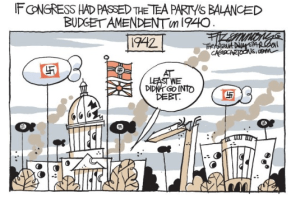 I always have to cover this topic in any introductory macroeconomics class I teach because usually one nutjob or another running for office always brings this up and people fall for it. The arguments are usually based on complete fallacies and misunderstanding of the math of economics, but hey, for some reason balanced budgets sound ‘reasonable’ when they are anything but.
I used to talk theoretically about how balanced budget amendments will kill state economies when the next real recession hits. Well, it hit a few years ago and we’re there. States continue to make their own economies worse day in and day out but there’s still those people that insist that if a family has to balance its budget, then so should the country. That’s even stupid considering most families have mortgages and car payments and probably student loans. Take Michele Bachmann as an example. She’s got all of the above plus farm subsidies and government grants. Even the President is guilty of that false equivalency. No person or family exists in perpetuity. No person or family can print money. No person or family has the power of taxation. Because of these three things, you cannot compare government to a family. Nor can you compare government to a business. Businesses exist to make a profit. Government exists to provide services and goods that the private sector will not provide or provides at an outrageous cost. It exists to administer justice and ensure level playing fields and fair play exists. Everything about a government is unique and is no way comparable to either businesses or households.
Macroeconomists know from years of study that the federal government can influence the economy at large. It does so through its spending and taxing priorities and policies. This is called fiscal policy. We have found several economic laws that guide the relationship between taxes and government spending and the behavior of Gross Domestic Product (GDP) which roughly measures all the legal and reported spending by households, governments, foreigners, and businesses. In our economy, household spending comprises about 68% of all GDP.
Investment or purchases by businesses is the smallest and most erratic component of GDP. Keynes said that it is easily spooked and subject to animistic spirits. Because it’s an unreliable source of growth, Keynes argued that in down turns, government should use its power to spend. Business investment usually only does fine in good economies. Please note, Keynes said deficit spend in recessions. Keynes’ prescription also said that Federal governments should run balanced budgets during times when the economy is fully employed and surpluses during bubble or boom times to relieve inflationary pressure. As usual, conservative politicians completely lie about the nature of Keynes and his highly proven and credible theories on fiscal policy. A lot of what we know about Monetary Policy comes from Milton Friedman, however, that is not the subject today. What I want to emphasize is that both men spent a lot of time analyzing panics and the Great Depression and are very much at the heart of accepted theory. We are seeing a classical lack of aggregate demand today. It is what’s driving the budget deficit. It is what’s driving the joblessness. It is what’s driving the slow recovery. Government must and will by automatic stabilizers be in a deficit position during downturns. It is simple math. More revenues come in during good times than bad. More safety net spending increases during bad times than good. We naturally run towards deficit in bad economies and towards surplus in good.
However, show me an economy that’s booming with high revenues and lower safety net spending and I will show you a group of politicians spending wildly. This tends to create inflation and can lead to bubbles. However, you never hear them complain at that point in time. That’s because it should be relatively easy to balance a budget then, but they do not do so or if they do its by expanding programs that cannot be sustained without borrowing during bad economies.
With that short explanation, let me cite you some folks that tell you why balanced budget amendments are bad policy. This first quote is from Simon Johnson who is the former chief economist for the IMF. He asks us to keep in mind that GDP is a measurement that is fraught with problems. He also mentions the fact that a balanced budget amendment makes the government make recessions worse.
Second and more seriously, imagine that this constitutional amendment were in place and that federal spending were roughly at its limit relative to the size of the economy. Then, what happens should the financial sector blow up again — either through no fault of its own (which, believe it or not, is the current prevailing myth on Wall Street about 2007-9) or because of some toxic combination of malfeasance and malpractice (the current predominant view of 2007-9 among many other people)?
The blame game is irrelevant when G.D.P. drops 10 percent; the issue is how to prevent a Great Depression. But note that with such a decline in G.D.P., a level of nominal spending that was 18 percent of G.D.P. is suddenly 20 percent, and now a constitutional crisis awaits – even before we get to the question of whether tax cuts or other forms of stimulus might be appropriate.
It makes no sense to take aim, as a matter of constitutional process, at two numbers that are both outcomes of deeper economic processes.
And to be frank, sometimes it makes a great deal of sense to apply an economic stimulus to an economy in free fall. One such moment was 1930 (and 1931 and 1932), when no stimulus was applied. Other moments were 2008 and 2009; both President Bush and President Obama initiated stimulus packages. When credit for and confidence in the private sector evaporates, do you really want the government sector to be forced to make quick cuts — or to raise taxes?
James Ledbetter at Reuters argues that even conservatives should oppose a balanced budget amendment (BBA). His reasons are more pragmatic. He argues that it won’t work.
Historically, conservatives have opposed extending government authority in places where it is not effective. You can find all the evidence you need to conclude that balanced budget requirements are useless by simply investigating the oft-repeated claim that 49 states have laws requiring a balanced budget. Leave aside the falsity of the claim and just consider the logic: if so many states are required to balance their budgets, why are so many states in the red?
The answer is that requiring state governments to annually balance their books simply encourages them to find clever ways to disguise debt and deficits. For example: California has both a Constitutional and a statutory requirement that its budgets be balanced. Would any sane person maintain that the state’s books have been anything resembling healthy for at least a decade? This year, after some brutal spending cuts, the governor’s office found that the state still had a short-term deficit of more than $9 billion and $35 billion in long-term debt. The governor’s budget report noted that California’s “massive budget deficits for most of the past decade…have been largely the result of a reliance on one-time solutions, borrowing, accounting maneuvers, and cuts or revenues that were illusory and therefore did not materialize.”
If that sounds familiar, it may be because, as Richard Quest pointed out on CNN Sunday evening, we’ve witnessed numerous Congressional attempts in recent decades to rein in federal deficits—including Gramm-Rudman in 1985 and the Budget Enforcement Act of 1990—all of which fell victim to legislative legerdemain. Why would a federal balanced budget amendment be any different?
Here’s something from The Economist on “Fiscal Rules”. Some fiscal rule–rather than a balanced budget amendment–would better stop congress from spending during booms and full employment cycles rather than balancing its budget via a BBA. This would be a rule that attaches the spending mandates to what’s going on in the economy. But again, I doubt they’d follow it since they’ve ignored a good portion of the Keynesian prescription for years any way.
It is difficult for Congress to tie its own hands. Any law that can pass Congress can later be undone or changed. In the rare cases that Congress puts together a near-perfect piece of legislation, that’s a bad thing. In the vastly more common occurrence that Congress passes highly imperfect legislation in need of significant future tweaks, that’s a very good thing. Support for an amendment to the constitution is a spectacular vote of confidence in the ability of a legislature to design near-perfect legislation, because the only thing rarer than an amendment to the constitution is a subsequent amendment undoing or clarifying a previous amendment.
I see the argument for a well-designed, over-the-business-cycle balanced-budget amendment. But the idea of enshrining this Congress’ pathologies into the constitution is terrifying. Let’s see Congress design some quality fiscal rules using the normal legislative process first, and then we can talk about adding those to the constitution.
Bruce Bartlett has some excellent analysis up for the current go round of balanced budget amendments. Mark Thoma explains how a BBA is a very bad idea. His analysis includes looking at the destabilizing effects that states’ BBAs have had on their economies. There’s a nifty graph that I did not include here if you’d like to go view it.
I’ve argued on many occasions that one of the big lessons we need to learn from this recession is that state-level balanced budget requirements are highly destabilizing. When a recession hits, spending goes up for social services and taxes fall as income, sales, property values, and other sources of revenue for state and local governments decline.
The result is a big hole in state and local government budgets, and that forces either increases in taxes or cuts in spending both of which make things even worse. And though some state and local governments were an exception to this, far and away the choice is to cut spending. We can see this in the state and local government employment statistics:
That’s not what we want to have happening when we are trying to recover from a recession. It would be much better if states had rainy day funds to rely upon, and if the rainy day funds fall short, the federal government could backfill the budget holes to prevent the destabilizing downsizing.
So have we learned the lesson? Nope, at least not if you are a Republican. They’d like to impose the same destabilizing rules on the federal government:
You really would have to search high and low for an economist that actually supports a BBA. The more conservative ones go for the fiscal rule that attaches spending to business cycles but even they believe that it would be unenforceable and easy to avoid. Can you imagine some District Judge trying to look over a complex macroeconomic model and figure out if the government forecast was correct or not?
A group of leading economists, including five Nobel Laureates in economics, today publicly released a letter to President Obama and Congress opposing a constitutional balanced budget amendment. The letter outlines the reasons why writing a balanced budget requirement into the Constitution would be “very unsound policy” that would adversely affect the economy. Adding arbitrary caps on federal expenditures would make the balanced budget amendment even more problematic, the letter says. The Economic Policy Institute and the Center on Budget and Policy Priorities organized the letter.
“A balanced budget amendment would mandate perverse actions in the face of recessions,” the letter notes. By requiring large budget cuts when the economy is weakest, the amendment “would aggravate recessions.”
The signatories of the letter are Nobel Laureates Kenneth Arrow, Peter Diamond, Eric Maskin, Charles Schultze, William Sharpe and Robert Solow; Alan Blinder, former Vice Chair of the Federal Reserve System’s Board of Governors and former member of the Council of Economic Advisors; and Laura Tyson, former Chair of the Council of Economic Advisors and former Director of the National Economic Council.
I’ll let former Reagan economist Bruce Bartlett have the last word here. He looks at the recent debate in Congress on the BBA.
Next week, House Republicans plan to debate a balanced budget amendment to the Constitution. Although polls show overwhelming public support, it is doubtful that many Americans realize that the measure to be debated is not, in fact, a workable blueprint to enforce a balanced budget. In fact, it’s just more political theater designed to delight the Tea Party.
We really need improved economic literacy in this country. I genuinely can’t get over what some of the morons in congress can get away with saying. Economists call them on it but it appears no one every listens.

 peej
peej Carissa
 bostonboomer
 dakinikat
 ecocatwoman
 mablue2
 Mama Lopez
 peggysue22
 quixote
 skydancingguestblogger
 Mona (aka Wonk the Vote)



 Sky Dancing
Recent Comments