
Thursday Reads
Posted: September 15, 2011 Filed under: morning reads, U.S. Economy, U.S. Politics | Tags: al Qaeda, Ali H. Soufan, Clint Eastwood, deadbeat dad, Dean Baker, Dick Cheney, Donald Rumsfeld, Douglass Rushkoff, Fareed Zakaria, FBI, Gay Marriage, George W. Bush, IRAQ, Rep. Joe Walsh, Torture 29 Comments
Good Morning!! I have a few interesting reads for you today. There isn’t a lot to be happy about in the news these days, but I hope that some of my picks will bring a smile to your face.
Maybe this will do it: Clint Eastwood: ‘I don’t give a f*ck’ if gays marry. The superstar actor and director told GQ Magazine that he considers himself an Eisenhower Republican, and he doesn’t sound too happy with the people running the party these days.
“These people who are making a big deal out of gay marriage?” Eastwood opined. “I don’t give a fuck about who wants to get married to anybody else! Why not?! We’re making a big deal out of things we shouldn’t be making a deal out of.”
“They go on and on with all this bullshit about ‘sanctity’ — don’t give me that sanctity crap! Just give everybody the chance to have the life they want.”
[….]
“I was an Eisenhower Republican when I started out at 21, because he promised to get us out of the Korean War,” he told GQ. “And over the years, I realized there was a Republican philosophy that I liked. And then they lost it. And libertarians had more of it. Because what I really believe is, let’s spend a little more time leaving everybody alone.”
Go ahead, make my day, Clint.
This story is a few days old, but it made me smile: Zakaria destroys Rumsfeld’s Iraq war talking points. Zakaria interviewed Rumsfeld on September 11, and the old goat still tried to claim that al Qaeda was in Iraq before the U.S. invaded.
“There’s no question that al Qaeda and Zarqawi and people were in Iraq,” Rumsfeld argued. “They aggregated there.”
“If we hadn’t invaded, they wouldn’t have been there,” Zakaria pointed out.
“We don’t know that,” Rumsfeld insisted. “You don’t know that. I don’t know that.”
“But they went in to fight us. So since we weren’t there, why would they have gone into Iraq?” Zakaria countered.
“Why have they gone into Yemen and Somalia?” Rumsfeld asked. “Why do al Qaeda go anywhere? They go where it’s hospitable.”
“Right, and Iraq hadn’t been hospitable,” Zakaria said.
ROFLOL! Why is this joke of a man able to get a book contract? Why does anyone want to put him on TV? He’s a complete loon.
Speaking of deserving people getting their comeuppance, deadbeat dad and Tea Party Rep. Joe Walsh was “scolded” by a Chicago judge yesterday for failing to support his children.
A Chicago judge issued a preliminary ruling Wednesday against U.S. Rep. Joe Walsh (R-Ill.) in his child-support dispute with his ex-wife, ordering the Tea Party favorite to explain why he appears to be $100,000 behind in child-support payments.
Vega did issue a “rule to show cause” — which means Walsh has to tell the court why he shouldn’t be held in contempt for falling so far behind in child support over the past five years.
Laura Walsh argues her ex-husband owes more than $100,000, a number the congressman disputes. But Vega’s ruling means that the burden is now on the congressman to prove that he doesn’t owe the money, attorneys for both Walshes agree.
Laura Walsh has gone into court on numerous occasions since filing for divorce in 2002, seeking court orders to have her ex-husband meet his court-ordered child-support obligations.
What a slug that guy Walsh is!
I came across this fascinating piece by Sarah Jaffe at Alternet: Are Jobs on Their Way to Becoming Obsolete? And Is That a Good Thing? It’s a long read, but I highly recommend you take the time. Here’s just a sample:
Media theorist and author of Life, Inc.: How the World Became a Corporation and How to Take it Back Douglas Rushkoff ruffled some feathers this week when he dared, at CNN.com of all places, to ask that question. It seemed, perhaps, gloriously insensitive to the plight of unemployed workers, of union workers at the U.S. Postal Service, who are struggling like so many others to stay afloat in an uncertain economy while they’re demonized in the press as greedy for wanting a decent job.
[….]
He argues that perhaps we’re going about it backward when we call for jobs, that maybe it’s not a bad thing that technology is replacing workers, and points out that actually, we do produce enough food and “stuff” to support the country and even the world—that, in fact, we produce too much “stuff.”
He alternately harkens back to a past before jobs, when many people worked for themselves on a subsistence level, and forward to a future where we are all busy making games and books and communicating with one another from behind computer screens, with the hours we have to work dwindling.
Rushkoff’s ideas really resonated with me. I haven’t worked a full-time job since 1986, and although I don’t have a lot of money, I have never regretted my decision to quit my 9-5 job and find some meaning in my life by doing things that made me happy. I did find that meaning, first by working on my own problems and issues and then by helping and being a caregiver for my elderly ex-mother-in-law in return for a place to live.
Because my expenses were low, I was able to return to college and get a bachelor’s degree, then go on to graduate school and earn an MA and a PhD. During graduate school and after, I have worked as a teaching assistant and have taught a number of courses. But now that I’m finished with my education, I’ve been reluctant to search for a full-time teaching job.
Lately I’ve survived mostly on my Social Security and selling my huge accumulation of books on the internet with a few teaching jobs thrown in. I will also have another small source of retirement income from my days as a full-time office worker when I choose to take it. I’m enjoying the time I’ve had to follow politics closely and blog about it. I’ve never been all that ambitious. I went to school simply for the joy of learning. I do want to find ways to give back, but I don’t care that much about making piles of money. I might have to check out Rushkoff’s book.
At Truthout, I learned that liberal economist Dean Baker has also written a book, and you can even download it free! The book is called “The End of Loser Liberalism: Making Markets Progressive. From the Truthout article by Keane Bhatt, Dean Baker: Why Didn’t We Make These Guys Run Around Naked With Their Underpants Over Their Heads?
KB: Your book argues that financial crises don’t have to lead to “lost decades” of massive pain and suffering and, even more importantly, that the US never even experienced a true financial crisis.
DB: There’s a lot of real sloppy thinking here. The main promulgators of this view are Kenneth Rogoff and Carmen Reinhart and they say that they look back over 600 years of history and find that in almost all these cases, countries took over a decade to recover. It’s painful, because I’d like to think – and one would expect that they’d like to think – that we know more economics than we did 600 years ago. If we don’t – and we really haven’t learned anything – why do you guys get paid high salaries? I say that only partially facetiously. If we were to look back through time, a very high percentage – probably the majority – of newborn babies didn’t survive to age 5. You’d be an idiot to say that the past trend holds today – we have modern medicine, so we have a very good reason to expect that the overwhelming majority of children will survive to age 5. We have learned something in economics over six centuries, so it’s not some curse, they’re concrete problems.
Finance gets very mysterious and complicated. There are instruments that are hard for people to understand; they’re hard for me to understand. The basic story is not complicated: we need demand. As I say in the book, there’s very little about the financial crisis that explains where we are today. People who want to buy homes have no problem getting credit – you can’t go 0% down, but someone who, say, 15 years ago was able to get a home mortgage can expect to get a home mortgage today. In terms of businesses, the US, unlike Japan, has a very large capital market where firms can directly access capital through commercial paper and bond financing. The current rates are extraordinarily low in both nominal and real terms. So the idea that the banks being crippled would impede the economy doesn’t follow when hundreds of the largest firms can go straight to the market and get financing.
Let’s imagine that the big firms can get credit but the small ones can’t. That would create a situation in which the big firms are running wild, grabbing market share at the expense of smaller competitors crippled by lack of access to capital. This is not happening.
There’s a survey that the National Federation of Independent Business has done for a quarter century that asks businesses what are the biggest problems to expanding. And currently, almost no one mentions finance – either access or cost. So clearly the problem is not finance.
Read the whole interview if you can–it’s well worth it.
I’m going to end with a story that won’t necessarily make you smile, but it’s a story that puts the lie to the Bush/Cheney claims that torture helped make us safer. I think that’s a good thing. In fact, author and former FBI interrogator Ali H. Soufan argues that the opposite is true, and that in fact 9/11 could have been prevented with traditional interrogation methods. Watch his interview with Keith Olbermann:
So…what are you reading and blogging about today?
46.2 Million Americans (1 in 6) Now Living in Poverty
Posted: September 13, 2011 Filed under: Barack Obama, income inequality, poverty, U.S. Economy, U.S. Politics, unemployment | Tags: Census Bureau, Income Inequality, jobs, median income, Poverty, unemployment 10 Comments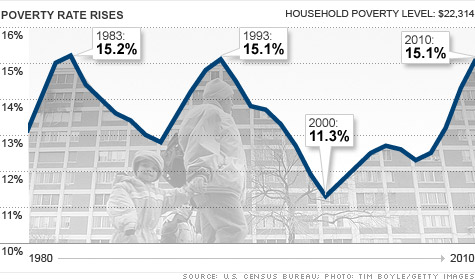
Chart courtesy of CNN Money
As of 2010, 1 in 6 Americans was living in poverty, according to a report from the Census Bureau today. The poverty rate was 15.1%, the highest number of Americans living below the poverty rate since the number has been examined. From the New York Times:
An additional 2.6 million people slipped below the poverty line in 2010, census officials said, making 46.2 million people in poverty in the United States, the highest number in the 52 years the Census Bureau has been tracking it, said Trudi Renwick, chief of the Poverty Statistic Branch at the Census Bureau.
That figure represented 15.1 percent of the country.
The poverty line in 2010 was at $22,113 for a family of four.
“It was a surprising large increase in the overall poverty rate,” said Arloc Sherman, senior researcher at the Center on Budget and Policy Priorities. “We see record numbers and percentages of Americans in deep poverty.”
The middle class has also lost ground in terms of yearly income.
And
…real median household incomes declined by 2.3 percent in 2010 from the previous year, to $49,400. That was 7 percent less than the peak in 1999 of $53,252.
“A full year into recovery, there were no signs of it affecting the well being of a typical American family,” said Lawrence Katz, an economics professor at Harvard. “We are well below where incomes were in the late 1990s.”
According to the census figures, the median annual income for a male full-time, year-round worker in 2010 — $47,715 — was virtually unchanged from its level in 1973, when the level was $49,065, in 2010 dollars, said Sheldon H. Danziger, professor of public policy at the University of Michigan.
As we all know, the rich have gotten much much richer and are continuing to get richer still because of the Bush/Obama economic policies. From CNN Money:
For middle-class families, income fell in 2010. The median household income was $49,445, down slightly from $49,777 the year before.
Median income has changed very little over the last 30 years. Adjusted for inflation, the middle-income family only earned 11% more in 2010 than they did in 1980, while the richest 5% in America saw their incomes surge 42%.
“Over that period of time, it’s not that the American economy has necessarily performed badly,” Osterman said. “As a country we’re richer over that period, but there’s been this real shift in where the income has gone, and it’s to the top.”
Amplifying that trend, the bottom 60% of households saw their income fall last year, while households making $100,000 or more enjoyed a rise in income.
CNN has a chart that shows the poverty level in each state, so you can check to see how people are doing in your neck of the woods. In general, the South is the worst off, and Louisiana and Mississippi have the highest percentages of people living below the poverty line.
I hope someone is showing this data to President Obama, because he needs to either do something about jobs and income inequality or follow LBJ’s example and get out of the way so we can find candidate who is able to show some leadership.
Tuesday Reads: Romney vs. Perry, 9/11 Revelations, and Hormonal Effects of Fatherhood
Posted: September 13, 2011 Filed under: morning reads, U.S. Economy, U.S. Politics | Tags: 9/11 investigations, Bob Graham, evolutionary biology, fatherhood and testosterone levels, Mitt Romney, Paul Krugman, Republican Tea Party Debate, Rick Perry 16 Comments
Good Morning!! Let’s see if there’s any news out there. I didn’t see much of the Tea Party debate, because I was watching the New England Patriots crush the Miami Dolphins. That was soooo much better than watching Wolf Blitzer and the crazy people. Thanks so much to those of your who watched and documented the insanity so I didn’t have to.
According to Alexander Burns at Politico, Mitt Romney turned into an attack dog and lit into Rick Perry.
Mitt Romney went on the attack against Rick Perry at the first possible opportunity Monday night, challenging the Texas governor on whether he “continues to believe that Social Security should not be a federal program … or does he retreat from that view.”
[….]
Romney jumped in with a hit against Perry’s book, “Fed Up!” – the tome that Perry used to describe Social Security as a program that violated constitutional principles.
“Gov. Perry pointed out that in his view, Social Security is not constitutional,” Romney said.
And so on, with Perry giving weak responses. It’ll be interesting to see Romney challenge Obama on Social Security during the general election. Talk about role reversal!
Unfortunately, the latest CNN poll shows Perry still leading the rest of the Republicans in terms of electability.
Hours before the start of the first-ever CNN/Tea Party Republican debate, a new national survey indicates that Texas Gov. Rick Perry is maintaining his lead in the race for the GOP presidential nomination.
And according to a CNN/ORC International Poll, what appears to be Perry’s greatest strength – the perception among Republicans that he is the candidate with the best chance to beat President Barack Obama in 2012 – seems to be exactly what the GOP rank and file are looking for.
Paul Krugman wrote an addendum to his recent “controversial” blog post about the September 11 anniversary.
The fact is that the two years or so after 9/11 were a terrible time in America – a time of political exploitation and intimidation, culminating in the deliberate misleading of the nation into the invasion of Iraq. It’s probably worth pointing out that I’m not saying anything now that I wasn’t saying in real time back then, when Bush had a sky-high approval rating and any criticism was denounced as treason. And there’s nothing I’ve done in my life of which I’m more proud.
[….]
Now, I should have said that the American people behaved remarkably well in the weeks and months after 9/11: There was very little panic, and much more tolerance than one might have feared. Muslims weren’t lynched, and neither were dissenters, and that was something of which we can all be proud.
But the memory of how the atrocity was abused is and remains a painful one. And it’s a story that I, at least, can neither forget nor forgive.
Good for him for sticking to his guns.
Former Senator Bob Graham today called for another 9/11 investigation, because of a new report that the FBI knew of connections between the hijackers and Saudis living in Florida and never revealed those finding to Congress of the 9/11 Commission.
Ten years after the deadliest attack of terrorism on U.S. soil, new information has emerged that shows the FBI found troubling ties between the hijackers and residents in the upscale community in southwest Florida, but the investigation wasn’t reported to Congress or mentioned in the 9/11 Commission Report.
Former U.S. Sen. Bob Graham, the Florida Democrat who cochaired the bipartisan congressional Joint Inquiry into the attacks, said he should have been told about the findings, saying it “opens the door to a new chapter of investigation as to the depth of the Saudi role in 9/11. … No information relative to the named people in Sarasota was disclosed.”
The U.S. Justice Department, the lead agency that investigated the attacks, refused to comment, saying it will discuss only information already released.
The results of a new study suggest that when men become fathers, their testosterone levels go down. The researchers looked at testosterone levels in a large sample of men before they married and had children and again a few years after their children were born. According to TheManlyZone.com, lower levels of testosterone could be nature’s way of making men less interested in other partners and more interested in caring for their families.
Experts say the research has implications for understanding the biology of fatherhood, hormone roles in men and even health issues like prostate cancer.
“The real take-home message,” said Peter Ellison, a professor of human evolutionary biology at Harvard who was not involved in the study, is that “male parental care is important. It’s important enough that it’s actually shaped the physiology of men.”
“Unfortunately,” Dr. Ellison added, “I think American males have been brainwashed” to believe lower testosterone means that “maybe you’re a wimp, that it’s because you’re not really a man.
“My hope would be that this kind of research has an impact on the American male. It would make them realize that we’re meant to be active fathers and participate in the care of our offspring.”
That’s all I’ve got for today. What are you reading and blogging about?
Twisting Personal Tragedy to Advance Unrelated and Evil Public Ends
Posted: September 12, 2011 Filed under: Afghanistan, Iraq, Pakistan, U.S. Economy, U.S. Military, U.S. Politics, Yemen | Tags: 9/11 Commission, Barack Obama, black sites, Dick Cheney, Donald Rumsfeld, first responders, George W. Bush, individual rights and freedoms, Jersey Girls, Kristen Breitweiser, memories, rendition, September 11th, the Constitution, Torture 15 Comments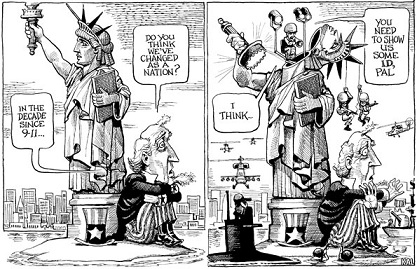
Yesterday, Minkoff Minx wrote a beautiful and eloquent post that described her personal experience of the tragic events of September 11, 2001. I was so grateful to read what she wrote, because she simply described her own experience and emotions about what happened. She didn’t try to speak for her husband or any of the the other survivors–just herself. She also shared some wonderful resources for getting in touch with how we felt on that day ten years ago, when our country was attacked by foreign terrorists.
On September 11, 2001, nearly 3,000 people lost their lives to terrorist attacks as they were either beginning their days at work at the World Trade Center and the Pentagon or traveling on airplanes scheduled to fly from Boston to Los Angeles, Washington D.C. to Los Angeles, and Newark to San Francisco. For the families and friends of those who died, life would never again be the same. Thousands of others, like Minx’s husband, survived, but their lives and those of their families were also forever altered.
Thousands more were either directly impacted by the trauma of witnessing the attacks close up from their homes in New York or Washington, DC. Thousands of first responders were also directly affected by the attacks and their aftermath, including people who traveled to NYC, DC, and PA to help search for survivors or to support first responders.
Those of us who helplessly watched the events as they played out on television were affected too, although few of us probably suffered from post-traumatic stress as a result. But we empathized with those who were directly impacted, and we felt the terrible shock of having our country attacked. I can remember how shocked I was that day. I was on vacation at a Rhode Island beach with my family. It was a gorgeous day and I was out sightseeing with my parents and my sister when we heard the news. My sister had spoken to someone in a museum store and heard that a plane had flown into the World Trade Center. We headed back to the beach house as we listened to reports on the radio. My brother and his wife were watching TV at the beach house when we got back.
For the next couple of days we quietly read newspapers or watched TV. My sister’s husband drove out from Indiana to get her because the planes weren’t flying and she was very frightened. I had to go back to Boston to start teaching classes a couple of days later, and I recall that I felt nervous and jumpy while driving alone. Like many others, I was fearful of more attacks. At the time, everything was so confusing, I didn’t know what to expect. I also felt shame that two of the planes used in the attacks flew out of Logan Airport in Boston.
Most of us probably have clear memories of where we were and what we were doing that day and following days. We’re told told Americans pulled together after September 11, 2001, although I don’t really recall feeling that myself. But I have no doubt that millions of people empathized with those who were directly affected. As I mentioned above, many people took action by traveling to the places that were attacked to help in any way they could. Nothing that has happened since can change the basic caring and good will of the American people.
Yet for the past week, I’ve felt anger every time I saw the upcoming anniversary of September 11 being hyped on TV–the endless replaying of the videos of the planes hitting the towers; the preachy fake patriotism of the talking heads; the sudden reappearance of disgraced politicians George W. Bush, Dick Cheney, and Donald Rumsfeld; the constant talk of “security” and the repetition of the words “the homeland,” which is so reminiscent of the Nazi term “the fatherland.” How could I not be angry after all that our government has done in the past ten years to supposedly avenge the lives lost on 9/11?
First there was the attack on Afghanistan, supposedly to catch Osama bin Laden. But when there was a chance to capture or kill bin Laden, Bush decided not to. Next came the barrage of lies from the Bush administration and from media sources like The New York Times and Washington Post, in order to get us into a second war in Iraq. Those wars have killed far more than 3,000 young American soldiers and perhaps hundreds of thousands of Iraqis and Afghanis–and for what? No effort was made to confront Saudi Arabia–where most of the perpetrators and the financial support for the attacks came from. Over the past ten years we have seen the progressive erosion of our Constitutional rights in the name of “security” and “safety.” We have learned that our government captured and imprisoned people–often completely innocent people–without evidence or charges at Guantanamo, at Abu Ghraib, at Bagram, and untold other prisons around the world. We know that many of these people were tortured and killed. Americans voted for Barack Obama in hopes that he would end the pointless wars and stop the rendition and torture. Instead, he has continued the wars and continued to rendition people to foreign prisons where they will be tortured. He has ordered drone attacks in Pakistan and Yemen. He has continued the erosion of our Constitution rights and defended the Bush administration at every opportunity. These are the reasons I felt angry at the jingoistic celebrations of the tenth anniversary of September 11, 2001.
And what has become of the survivors of the 9/11 attacks? Every effort was made to keep any compensation they received to a minimum. And what of the first responders who were exposed to the toxic environment at Ground Zero in NYC? They have been denied the help they need along with the recognition of what they suffered. The Bush administration resisted any investigation of why the attacks were not prevented, and when they finally allowed a 9/11 commission–largely because of the efforts of four 9/11 widows (The Jersey Girls), they kept the Commission from from going “too far” in holding anyone in the administration accountable.
It was healing for me to read Minkoff Minx’s post, because she spoke of her personal pain and losses and how she was living with the aftereffects. I was able to recall my pure memories of that day, and how I worried about the reactions of my students, how I tried to get discussions going in my classes so we could share our reactions. For a short time as I read yesterday morning’s post, I was able to recall the pure feeling of loss from that day ten years ago before the tragedy was twisted to start wars that would decimate our economy and pass laws that would erode our individual rights and freedoms.
Yesterday morning, Paul Krugman wrote a brief but heartfelt blog post expressing some of the feelings I’ve tried to express with my post today. I’m going to take the liberty of reproducing Krugman’s statement here:
September 11, 2011, 8:41 am
The Years of Shame
Is it just me, or are the 9/11 commemorations oddly subdued?Actually, I don’t think it’s me, and it’s not really that odd.
What happened after 9/11 — and I think even people on the right know this, whether they admit it or not — was deeply shameful. The atrocity should have been a unifying event, but instead it became a wedge issue. Fake heroes like Bernie Kerik, Rudy Giuliani, and, yes, George W. Bush raced to cash in on the horror. And then the attack was used to justify an unrelated war the neocons wanted to fight, for all the wrong reasons.
A lot of other people behaved badly. How many of our professional pundits — people who should have understood very well what was happening — took the easy way out, turning a blind eye to the corruption and lending their support to the hijacking of the atrocity?
The memory of 9/11 has been irrevocably poisoned; it has become an occasion for shame. And in its heart, the nation knows it.
For this brief blog post expressing his personal sadness over the way government, politicians, and media have twisted private tragedy to accomplish their own unrelated and corrupt ends, Paul Krugman has been attacked by right wingers and Islamophobics all over the internet. He has been called every name in the book for simply speaking his own truth. He has also gotten some support from liberal blogs, and other bloggers have discussed their own misgivings about the changes in our country after 9/11. I want to share a few of those reactions.
Nicole Belle at Crooks & Liars: While Thinking People Grapple With 9/11 Legacy, RWNJs Shoot The Messenger
Cliff Schecter at Al Jazeera English: 9/11 and Its Great Transformations
Kristin Breitweiser: No Place To Go But Up: Howard Schultz’ Upward Spiral 2011
Blue Texan at FDL: Krugman is Right: We Should Be Ashamed of What Happened After 9/11
Dave Weigel at Slate: Get Krugman!
I guess what I’m trying to say in this post is that ten years after September 11 2001, I still have faith in the basic goodness and caring of the American people, but I am even more suspicious of and cynical about the U.S. Government and the U.S. Media than ever before. I do think we need to be eternally vigilant, not about physical danger from foreign terrorists but from the constant psychological manipulations emanating from those who claim to be protecting and informing us.
Saturday Reads: Obama’s War on Old People, Solyndra-gate, and Violent Protest in Cairo
Posted: September 10, 2011 Filed under: Egypt, FBI raids, Federal Budget and Budget deficit, Foreign Affairs, MENA, morning reads, U.S. Economy, U.S. Politics | Tags: Egypt, green energy, Medicaid, medicare, Social Security, solar energy, Solyndra 13 Comments
Good Morning!!
Things are getting so bad for President Obama that I almost feel sorry for him. The reactions to his speech last night are still coming in, and they aren’t all that great. Sure Krugman tried to sound a little enthusiastic, but he ended up damning Obama’s jobs plan with faint praise.
O.K., about the Obama plan: It calls for about $200 billion in new spending — much of it on things we need in any case, like school repair, transportation networks, and avoiding teacher layoffs — and $240 billion in tax cuts. That may sound like a lot, but it actually isn’t. The lingering effects of the housing bust and the overhang of household debt from the bubble years are creating a roughly $1 trillion per year hole in the U.S. economy, and this plan — which wouldn’t deliver all its benefits in the first year — would fill only part of that hole. And it’s unclear, in particular, how effective the tax cuts would be at boosting spending.
Still, the plan would be a lot better than nothing, and some of its measures, which are specifically aimed at providing incentives for hiring, might produce relatively a large employment bang for the buck. As I said, it’s much bolder and better than I expected. President Obama’s hair may not be on fire, but it’s definitely smoking; clearly and gratifyingly, he does grasp how desperate the jobs situation is.
But his plan isn’t likely to become law, thanks to Republican opposition.
Robert Reich applauded the President’s “passion,” but not the plan itself. Reich’s reaction to the Jobs plan:
$450 billion sounds like a lot – and is more than I expected — but some of this merely extends current spending (unemployment benefits) and tax cuts (in Social Security taxes), so it doesn’t add to aggregate demand.
The net new boost to the economy is closer to $300 billion. That doesn’t approach even half the gap between what the economy is now producing and what it could produce at or near full employment.
And much that $300 billion is in the form of temporary tax cuts to individuals and companies. Some of these make sense — enlarging the Social Security tax cut, extending it to employers, and giving small businesses a tax holiday for new hires.
But temporary tax cuts haven’t proven to be particularly effective in stimulating new spending in times of economic stress. People tend to use them to pay off debts or increase savings. Companies use them to reduce costs, but they won’t make additional hires unless they expect additional sales – which won’t occur unless consumers increase their spending.
That leaves some $140 billion for infrastructure – improving outworn school buildings, roads, bridges, ports, and so on. And $35 billion to help cash-starved states avoid more layoffs teachers. Both good and important but still small relative to the overall need.
Just exactly what Dakinikat has been telling us forever. And when The New York Times talked to employers about the plan, most said the tax cuts and credits would be welcome but would not stimulate new hiring until there is consumer demand for their goods and services. Again, exactly what we’ve been hearing from Dakinikat all along.
The saddest article I have seen about Obama’s jobs speech is Dana Millbank’s column from yesterday: The irrelevancy of the Obama presidency. According to Millbank, Congressional Republicans treated the speech as “a big, fat joke.”
“You should pass this jobs plan right away!” Obama exhorted. Sens. Bob Corker (R-Tenn.) and Lindsey Graham (R-S.C.) chuckled.
“Warren Buffett pays a lower tax rate than his secretary — an outrage he has asked us to fix,” Obama went on. Widespread laughter broke out on the GOP side of the aisle.
“This isn’t political grandstanding,” Obama said. Rep. Paul Ryan (R-Wis.) guffawed.
“This isn’t class warfare,” Obama said. More hysterics on the right.
“We’ve identified over 500 [regulatory] reforms, which will save billions of dollars,” the president claimed. House Majority Leader Eric Cantor (R-Va.) and Whip Kevin McCarthy (R-Calif.) giggled.
And according to Millbank, Democrats weren’t all that thrilled either.
In fact, the empty seats were on the Democratic side. Democrats lumbered to their feet to give the president several standing ovations, but they struggled at times to demonstrate enthusiasm. When Obama proposed payroll tax cuts for small businesses, three Democrats stood to applaud. Summer jobs for disadvantaged youth brought six Democrats to their feet, and a tax credit for hiring the long-term unemployed produced 11 standees….Rep. Jesse Jackson (D-Ill.) stared at the ceiling. Rep. Peter Welch (D-Vt.) scanned the gallery. Rep. Jim Moran (D-Va.) was seen reading a newspaper.
Before the speech, Joe Biden actually discussed golf with John Boehner! I really think this President is done. I suppose a miracle could happen and something could stop the train wreck, but I can’t imagine what it would be.
Maybe Obama should read Joe Conason’s article about how Rick Perry tried to privatize Medicaid in Texas and ended up “wasting millions and enriching lobbyists and hedge funds. Oh wait — maybe not. I think that’s probably what Obama wants to do with Social Security and Medicare.
Another problem facing Obama is the Solyndra Energy bankruptcy and investigation. As I wrote a few days ago, Solyndra is a solar energy company which received $535 million in federal loans from Obama’s stimulus plan. Many observers, including the CBO, questioned whether the loan was too risky, but the White House may have intervened to make sure it happened. One of Obama’s biggest donors, George Kaiser owns more than 30% of Solyndra. For some time, Republicans in the House have been asking for an investigation of the circumstances surrounding the loan, especially since the company went bankrupt last week. Now, in a new development the FBI raided Solyndra’s headquarters and today visited the homes of its corporate officers.
An FBI raid on Solyndra Inc., a solar-panel maker that failed after receiving a $535 million loan guarantee from the U.S. Energy Department, may signal the escalation of a probe into the Obama administration’s clean- energy program.
Agents for Energy Department Inspector General Gregory Friedman, who has called the department’s clean-energy loan program lacking in “transparency and accountability,” joined in the search yesterday at the Fremont, California, headquarters of Solyndra, which filed for bankruptcy protection on Sept. 6.
Republicans critical of the program stepped up their attacks following the raid, and two House Democrats questioned the integrity of the company, indicating a potential political crisis for the president. A foundation headed by an Obama campaign contributor was a principal investor in Solyndra….
Friedman, a watchdog within the Energy Department, said in a March report that a lack of adequate documentation for loans “leaves the department open to criticism that it may have exposed the taxpayers to unacceptable risks associated with these borrowers.”
The Federal Bureau of Investigation continued its probe into solar-panel maker Solyndra LLC on Friday by visiting the homes of President and Chief Executive Brian Harrison, as well as former executives and co-founders Chris Gronet and J. Kelly Truman, according to two people familiar with the situation.
Solyndra, which filed for bankruptcy earlier this week, is the target of an investigation into whether executives knowingly misled the Department of Energy to secure a $527 million loan guarantee, The Wall Street Journal reported. On Thursday, the FBI seized documents and computers from Solyndra’s headquarters in Fremont, Calif.
Harrison’s home wasn’t searched on Friday, but he was questioned, according to one person with knowledge of the matter. Harrison, who joined the company in 2010, after the loan was awarded, didn’t respond to a request for comment.
Gronet, Solyndra’s former CEO, didn’t respond to requests for comment. Truman, a former senior vice president at Solyndra, is currently president and chief executive of energy storage developer Deeya Energy. A person answering the phone at Deeya said, “He is not taking phone calls.”
I guess it’s a good thing for Obama that we suddenly heard about a terror threat yesterday, huh?
In other, completely unrelated news, a protest by thousands of people in Cairo “turned violent” yesterday.
A demonstration that brought tens of thousands to this city’s central Tahrir Square turned violent on Friday, when thousands of people — led by a heavy contingent of soccer fans — tore down a protective wall around the Israeli Embassy, while others defaced the headquarters of the Egyptian Interior Ministry.
About 200 people were injured in clashes with the police at the Israeli Embassy and 31 were injured near the Interior Ministry, the Ministry of Health said late Friday night. Protesters apparently had scaled the walls of the Israeli Embassy to tear down its flag.
Mustafa el Sayed, 28, said he had been among about 20 protesters who broke into the embassy. He showed a reporter video from a cellphone, of protesters rummaging through papers and ransacking an office, and he said they had briefly beaten up an Israeli employee they found inside, before Egyptian soldiers stopped them. He said the soldiers removed the protesters from the building, but let them go free.
By 11:30 p.m., about 50 trucks had arrived with Egyptian riot police officers, who filled the surrounding streets with tear gas. Witnesses said that protesters had set a kiosk on fire in front of a security building near the embassy, and that the police had fired rubber bullets to disperse the crowd from both buildings. In addition, a fire broke out in the basement of the Interior Ministry, but it appeared to have been started from the inside and not by the protesters surrounding the building. The fire was in a room believed to store criminal records.

 peej
peej Carissa
 bostonboomer
 dakinikat
 ecocatwoman
 jjlo
jjlo mablue2
 Mama Lopez
 peggysue22
 quixote
 skydancingguestblogger
 Mona (aka Wonk the Vote)





Recent Comments