
Today’s Successful Economies
Posted: September 30, 2011 Filed under: Economic Develpment, Economy, U.S. Economy, We are so F'd | Tags: globalization, Jeffrey Sachs, neoconfederates on the rise, US global standings 6 Comments
Swedes are happier and more globally competitive than the US. Is this the real secret of blondes having more fun?
I wrote a blog post a while back about heaven having fjords. I’m very much interested in economics from a development standpoint so it’s always worthwhile checking out the top performers in the world for lessons. It is also quite apparent when you do that Libertarian and Republican memes fail and fail badly. It’s probably why we never hear these things in corporate media.
Societies are better when the pull together instead of pull apart. The best performing countries in economics are the same countries that have a high commitment to public education and society at large. The high performers–in economics, in health, and in education–are the Scandavian countries with their highly progressive tax rates, intense regulation of commerce and harmful activities and emphasis on making sure the rising tide rises all the boats rather than sinking a huge number of them to the benefit of the mega yachts. These are also countries with parliamentary systems which makes them highly democratic. They’ve been winning consistently with the advent of the global economy. The US has lost its position as leader of the developed nations and is moving way down into the losing positions below still developing nations. We could learn some lessons from Scandinavia.
Here’s Jeffrey Sachs at Project Syndicate with some things to think about in that vein. He has written a new book called The Price of Civilization which basically outlines the missteps that we’ve taken that were primarily started as a result of the election of Ronald Reagan. For some reason, many Americans don’t want to pay for some very simple modern facilities like roads, electric grids, airports, and railways. They prefer to buy junk from China they probably don’t need in search of happiness in the form of hoarding and consuming.
Rather than respond to globalization with more government spending on education, infrastructure, and technology, Ronald Reagan won the presidency in 1980 by pledging to slash government spending and cut taxes.
For 30 years, the US has been going in the wrong direction, cutting the role of government in the domestic economy rather than promoting the investments needed to modernize the economy and workforce. The rich have benefited in the short run, by getting massive tax breaks. The poor have suffered from job losses and cuts in government services. Economic inequality has reached a high not seen since the Great Depression.
These adverse trends have been exacerbated by domestic politics. The rich have used their wealth to strengthen their grip on power. They pay for the expensive campaigns of presidents and congressmen, so presidents and congressmen help the rich – often at the expense of the rest of society. The same syndrome – in which the rich have gained control of the political system (or strengthened their control of it) – now afflicts many other countries.
Sweden–as an example other than Norway who can use their oil to leverage their improvements–has been called an economic miracle. After feeling the global recession, they are now growing GDP at rates that are twice to three times the averages of most industrial countries. They are growing 5 times fasting than the US. So, look at their numbers there on the CIA Factbook and marvel where under the poverty rate comes the label: not applicable. Sweden blends capitalism with a social democracy in a way that makes the swedes the 6th most prosperous country on the planet. They are above the US who is number 10. They are behind Norway, Denmark, Finland, Australia and New Zealand. They are number 23 in GDP per capita The US is number 11. They are also highly globally competitive ranking #3 in Global Competitiveness Index after Finland and Switzerland. The US is number 1o.
The Swedes are number 9 on the human development index. We are number 4. Norway is number 1. Sweden has high marginal tax rates (sometimes over 70%), very powerful unions, immigrants, and generous vacations and work weeks. Under Republican fairy tales, Sweden and Norway should be worse off than Haiti. Rather than looking at countries that are achieving great things and leaving us in the dust, we are grasping at a rigid ideology that is designed to tank us.
I haven’t read the Sachs book but I’m definitely putting it on my reading list. You may recall that this is also something Fareed Zakaria examines in his TV show, in books, and at TIME magazine. Here’s a good summary from a recent Time article.
The following rankings come from various lists, but they all tell the same story. According to the Organisation for Economic Co-operation and Development (OECD), our 15-year-olds rank 17th in the world in science and 25th in math. We rank 12th among developed countries in college graduation (down from No. 1 for decades). We come in 79th in elementary-school enrollment. Our infrastructure is ranked 23rd in the world, well behind that of every other major advanced economy. American health numbers are stunning for a rich country: based on studies by the OECD and the World Health Organization, we’re 27th in life expectancy, 18th in diabetes and first in obesity. Only a few decades ago, the U.S. stood tall in such rankings. No more. There are some areas in which we are still clearly No. 1, but they’re not ones we usually brag about. We have the most guns. We have the most crime among rich countries. And, of course, we have by far the largest amount of debt in the world.
We’re in the process of watching the Cat Food Commission Redux set our priorities for our future and its basically an agenda meant to downsize the American Dream for every one except the Mega Wealthy. I hope that the Cheddar Revolution and the Occupy Wall Street movement turn into an American Spring Movement. We have to regain the positive momentum towards modernity before the powers that be force us all back into a pre-civil war paradigm of laws, economic servitude, and society.
Meanwhile, as I write about these healthy economies, 90% of US citizens say our economy stinks and they are pretty unhappy about it. Its time to look at some best practices of other countries and dump the ideologues that keeping making the wrong decisions for us.
Thursday Reads: Obama and CBC, Judging Protesters, Net Neutrality, SCOTUS, and Sly Stone
Posted: September 29, 2011 Filed under: Barack Obama, Black Agenda Report, Health care reform, Human Rights, Media, morning reads, net-neutrality, SCOTUS, the blogosphere, The Media SUCKS, U.S. Economy, U.S. Politics, Violence against women | Tags: Congressional Black Caucus, FCC, individual mandate, net neutrality, occupy Wall Street, progressives, Sly and the Family Stone, Sly Stone, U.S. Supreme Court 23 Comments
Good Morning!! Let’s start out with a little fire and brimstone. Glen Ford had a rousing rant at the Black Agenda Report about Obama’s disgusting treatment of the CBC last weekend. Here’s just a sample:
…in the same week that he bowed down to Israeli Prime Minister Benjamin Netanyahu before the assembled nations of the world, in New York City, Obama took his church voice to the Congressional Black Caucus annual awards dinner to very pointedly demand that Blacks stop bugging their president about the economic catastrophe that has befallen them, and his own role in it. “Take off your bedroom slippers. Put on your marching shoes,” Obama hectored. “Shake it off. Stop complainin’. Stop grumblin’. Stop cryin’. We are going to press on. We have work to do.”
Black Caucus chairman Rep. Emanuel Cleaver had earlier told reporters, “If Bill Clinton had been in the White House and had failed to address this [Black unemployment] problem, we probably would be marching on the White House.” But Obama came to lay down the law: any marching that you might do will be for my re-election.
The well-oiled crowd cheered….
The Black Caucus, as a body, meekly murmured and mumbled as the administration transferred the equivalent of the U.S. gross domestic product to the banks while Black America disintegrated. Now, with Obama’s numbers falling, he has very publicly commanded them to shut up and perform what he believes is their only legitimate function: to get him re-elected. In the looming contest, he will again resort to Black-baiting whenever it is useful to shore up white support. In that – as with his foreign and domestic policies – Obama is no different than white corporate politicians. His one great distinction, is to have a core constituency that cares more for his security and dignity, than their own.
Sad but true.
In yesterday’s morning post, Minx highlighted the way so many “progressives” are criticizing Occupy Wall Street for all kinds of irrelevant reasons. Glenn Greenwald wrote a very good piece about it: What’s behind the scorn for the Wall Street protests? But I especially liked Kevin Gosztola’s piece at FDL.
Traditional media have characterized the plurality of voices and the number of issues the occupation is seeking to challenge as a weakness. Establishment media has been openly condescending. Ginia Bellafante’s report in the New York Times has generated significant attention for her focus on the fact that some “half-naked woman” who looks like Joni Mitchell to her is the leader of this movement of “rightly frustrated young people.” Bellafante accuses the protesters of lacking “cohesion” and “pantomiming progressivism rather than practice it knowledgeably.” NPR reiterated NYT’s focus on the “scattered nature of the movement” in its coverage of the occupation (and tellingly used a photo of a man holding a sign that reads “Satan Controls Wall St”). Local press have treated the occupiers as if they are a tribe or a group of nomads focusing on occupiers’ behavior instead of trying to understand the real reason why people are in the park.
Liberals have shown scorn, too, suggesting the occupation is not a “Main Street production” or that the protesters aren’t dressed properly and should wear suits cause the civil rights movement would not have won if they hadn’t worn decent clothing.
The latest show of contempt from a liberal comes from Mother Jones magazine. Lauren Ellis claims that the action, which “says it stands for the 99 percent of us,” lacks traction. She outlines why she thinks Zuccotti Park isn’t America’s Tahrir Square. She chastises them for failing to have one demand. She claims without a unified message police brutality has stolen the spotlight. She suggests the presence of members of Anonymous is holding the organizers back writing, “It’s hard to be taken seriously as accountability-seeking populists when you’re donning Guy Fawkes masks.” And, she concludes as a result of failing to get a cross-section of America to come out in the streets, this movement has been for “dreamers,” not “middle class American trying to make ends meet.”
First off, nobody in the last week can claim to be reporting on Occupy Wall Street and genuinely claim it isn’t gaining traction. Ellis conveniently leaves out the fact that Occupy Wall Street is inspiring other cities to get organized and hold similar assemblies/occupations. Second, if the protesters did have one demand, does Ellis really think that would improve media coverage? Wouldn’t pundits then be casting doubt on whether the one demand was the appropriate singular demand to be making? Third, so-called members of Anonymous are citizens like Ellis and have a right to participate in the protest. It is elitist for Ellis to suggest Occupy Wall Street should not be all-inclusive. And, finally, there is no evidence that just “dreamers” are getting involved. A union at the City University of New York, the Industrial Workers of the World, construction workers, 9/11 responders and now a postal workers and teachers union have shown interest in the occupation.
Gosztola is a young guy who replaced Emptywheel after she left FDL. He focuses on human rights issues, and he does a nice job.
It’s interesting that the progs keep comparing the Occupy Wall Street protesters to those in Civil Rights Movement of the ’50s and ’60s, claiming that protesters should wear suits! Obviously these “very serious” yuppie bloggers don’t recall the ’60s anti-war movement. I can just imagine their shock at some of the outfits we wore in those days.
The New York Times published an odd interpretation of the world-wide protest phenomenon that minimized demonstrations: As Scorn for Vote Grows, Protests Surge Around Globe, by Nicholas Kulish. Kulish explains the protests as disillusionment with voting. And why shouldn’t we all be turned off by voting when it gets us nothing but a bunch of corrupt, greedy a$$holes who stab taxpayers in the back repeatedly and suck up to the top 1%?
Not surprisingly, there is only one reference to the anti-Wall Street protests, and the organizers, Occupy Wall Street aren’t mentioned at all. Also not mentioned are the supportive protests beginning in other U.S. cities. And Kulish never mentioned Wisconsin at all!
Last week the FCC announced new net neutrality rules, and now lawsuits from both sides of the issue are starting.
Verizon and Metro PCS, both wireless carriers, had already made clear their intention to sue and were widely expected to be the first to do so. Instead, they were beaten to court by the activist group Free Press—one of the strongest supporters of network neutrality.
Free Press has asked a federal appeals court to review the FCC’s rules—not because it finds them too strong, but because it finds them too weak. The group particularly objects to the way in which wireless companies are exempted from most of the meaningful anti-discrimination policies in the rules. While wireless operators can’t block Internet sites outright, and can’t simply ban apps that compete with their own services, they can do just about anything else; wired operators can’t.
Free Press complains about the “decision to adopt one set of rules for broadband access via mobile platforms and a different set of rules for broadband access via fixed platforms.” The distinction, it says, is “arbitrary and capricious” and it violates the law.
In a statement, Free Press Policy Director Matt Wood said, “Our challenge will show that there is no evidence in the record to justify this arbitrary distinction between wired and wireless Internet access. The disparity that the FCC’s rules create is unjust and unjustified. And it’s especially problematic because of the increasing popularity of wireless, along with its increasing importance for younger demographics and diverse populations who rely on mobile devices as their primary means for getting online.
Here is a summary of the final FCC rules, from Connected Planet:
The FCC highlighted a total of four rules, which specify that:
— A person engaged in the provision of broadband Internet access service shall publicly disclose accurate information regarding the network management practices, performance and commercial terms of its broadband Internet access services sufficient for consumers to make informed choice regarding use of such services and for content, application, service and device providers to develop, market and maintain Internet offerings
— A person engaged in the provision of fixed broadband Internet access service . . . shall not block lawful content, applications, services or non-harmful devices, subject to reasonable network management.
— A person engaged in the provision of fixed broadband Internet access service . . . shall not unreasonably discriminate in transmitting lawful network traffic over a consumer’s broadband Internet access service.
— A person engaged in the provision of mobile broadband Internet access service, insofar as such person is so engaged, shall not block consumers from accessing lawful websites, subject to reasonable network management; nor shall such person block applications that compete with the provider’s voice or video telephony services, subject to reasonable network management.
A DIY glass partition designs is taking into account of the particular architecture and technology of the future service.” Furthermore, if you’re interested to know the seo site architecture guide, visit templatemonster.com
I’m sure you’ve heard that the Justice Department has asked the Supreme Court to rule on the health care law ASAP. Dalia Lithwick at Slate had an interesting article on the case: The Supreme Court is less interested in ruling on Obama’s health care law than you think.
Apparently the Obama administration believes that 2012 will not be crazy enough already. That would explain why it has decided not to appeal a ruling from a three-judge panel of the 11th Circuit Court of Appeals striking down the individual mandate at the heart of its health reform law. Instead of asking the full, 11-member court to hear the case, the administration has voluntarily cleared the path toward the Supreme Court as early as this spring. That means there could be a ruling by the end of June, just a few months before the election.
Right now the individual mandate has been upheld, by a 2-1 margin by the Sixth Circuit and struck down 2-1 at the 11th Circuit, while the Virginia lawsuit challenging the act was dismissed on procedural grounds at the Fourth Circuit. This split between the federal appeals courts almost demands that the high court agree to hear the case, as does the fact that it’s the Justice Department filing the appeal.
Lithwick discusses the opinions of other writers on why the administration is doing this now. Then she offers her own assessment:
I remain unsure that there just are five justices at the high court eager to have the court itself become an election-year issue. I don’t think Chief Justice John Roberts wants to borrow that kind of partisan trouble again so soon after Citizens United, the campaign-finance case that turned into an Obama talking point. And I am not certain that the short-term gain of striking down some or part of the ACA (embarrassing President Obama even to the point of affecting the election) is the kind of judicial end-game this court really cares about. Certainly there are one or two justices who might see striking down the ACA as a historic blow for freedom. But the long game at the court is measured in decades of slow doctrinal progress—as witnessed in the fight over handguns and the Second Amendment—and not in reviving the stalled federalism revolution just to score a point.
That’s why I suspect that even if there are five justices who believe the individual mandate is unconstitutional, there probably aren’t five votes to decide that question in this instant. Lyle Denniston over at Scotusblog reminds us that the court has a lot of options to forestall a showdown with the president. If the justices opt to consider the technical question raised at the Fourth Circuit—about who has legal standing to challenge the mandate in the first place—the court could dodge the constitutional question altogether until 2015, when the first penalties will be paid. It’s not so much a matter of the court having to decide whether to bring a gavel to a knife fight. It’s just that this isn’t really this court’s knife fight in the first place.
Roman Polanski is back in the news, because he supposedly “apologized” to the woman he raped when she was only 13.
In a documentary about his life, the Oscar-winning director, 78, admitted Samantha Geimer had been left scarred by his exploitation three decades ago. The Polish-French film maker publicly apologised for the first time for his “mistakes” that included the sexual attack on Mrs Geimer, now 47.
The director of Rosemary’s Baby and Chinatown admitted she was a “double victim” after being caught up in the subsequent media storm, forcing her to move to Hawaii for privacy.
The married mother-of-three successfully sued him and accepted a private apology in 2009, saying she had been left more traumatised by ensuing legal battles to bring him to justice than the assault itself.
Finally, here’s another celebrity story: According to the New York Post, 1960s rock star Sly Stone is homeless, living in a van in L.A.
Today, Sly Stone — one of the greatest figures in soul-music history — is homeless, his fortune stolen by a lethal combination of excess, substance abuse and financial mismanagement. He lays his head inside a white camper van ironically stamped with the words “Pleasure Way” on the side. The van is parked on a residential street in Crenshaw, the rough Los Angeles neighborhood where “Boyz n the Hood” was set. A retired couple makes sure he eats once a day, and Stone showers at their house. The couple’s son serves as his assistant and driver.
Inside the van, the former mastermind of Sly & the Family Stone, now 68, continues to record music with the help of a laptop computer.
“I like my small camper,” he says, his voice raspy with age and years of hard living. “I just do not want to return to a fixed home. I cannot stand being in one place. I must keep moving.”
It’s a pretty nice van, BTW. But the LA Times says if Stone is homeless, it’s his own choice.
If Sly Stone is homeless, it’s by choice and not necessity, according to sources close to the funk legend.
Stone’s attorney Robert Alan has supposedly rented a four-bedroom home in Woodland Hills for his client, one unnamed source told Showbiz411 exclusively. “He’s too paranoid to come inside,” another source told writer Roger Friedman. That person was described as a friend of the singer.
Though Alan wouldn’t comment on the rental house, Friedman said, the lawyer confirmed that Sly Stone documentarian Willem Alkema had paid the singer $5,000 upfront for a recent interview. (An additional $2,000, source unknown, was reportedly paid when the story was picked up.) Alkema, whom Friedman says is trying relaunch his documentary and could benefit from the publicity, co-wrote Sunday’s “Sly Stone Is Homeless and Living in a Van” article for the New York Post.
That’s not to say Stone hadn’t admitted struggling with drugs, nor that he isn’t in financial trouble of the maybe-a-$50-million-lawsuit-will-fix-it variety — he sued former manager Jerry Goldstein in early 2010, alleging fraud and the diversion of $20 million to $30 million in royalties.
I’m just glad to know that Sly is still with us. What a great band he had. I remember seeing Sly and the Family Stone at an outdoor concert at Harvard Stadium–I think it was in 1969. It was fabulous! So in honor of Sly and nostalgia…
So…. what are you reading and blogging about today?
Late Night: Texas Refuses to Allow Chef to Provide Last Meals to Death Row Inmates
Posted: September 27, 2011 Filed under: Crime, Psychopaths in charge, U.S. Economy, U.S. Politics | Tags: All Things Considered, Brian D. Price, cruelty, death row, last meals, Meals to Die For, NPR, psychopaths, Texas 12 Comments
Execution chamber in Texas
While I was out in the car today, I heard a story on NPR about the recent banning of special last meals for people about to be executed in Texas.
Lawrence Russell Brewer, who was executed Wednesday for the hate crime slaying of James Byrd Jr. more than a decade ago, asked for two chicken fried steaks, a triple-meat bacon cheeseburger, fried okra, a pound of barbecue, three fajitas, a meat lover’s pizza, a pint of ice cream and a slab of peanut butter fudge with crushed peanuts. Prison officials said Brewer didn’t eat any of it.
“It is extremely inappropriate to give a person sentenced to death such a privilege,” Sen. John Whitmire, chairman of the Senate Criminal Justice Committee, wrote in a letter Thursday to Brad Livingston, the executive director of the Texas Department of Criminal Justice.
Within hours, Livingston said the senator’s concerns were valid and the practice of allowing death row offenders to choose their final meal was history.
Whitmire claims to be a Democrat.
Today on NPR’s All Things Considered, there was an interview with Brian D. Price, a former prison inmate who served for years as a death row chef and wrote a book called Meals to Die For. Price is now out of prison and owns a restaurant in East Texas.
In his interview with NPR’s Melissa Block, Price said he had offered to pay for and prepare the requested last meals, since Texas is too cruel and stingy to do so. But he was turned down. In addition, Price revealed that in fact the “special meals” have never been what those about to die actually requested. For example, if the inmate requested lobster, he or she would get whatever piece of fish was available. So Brewer never actually got all that food he requested–the fantasy meal that caused Whitmire to throw a tantrum.
Price argued that Texas’s elimination of last meals is inhumane.
Price made the case that “as a civilized society and a Christian nation … why not … show that softer, more compassionate side?”
Granted, Price said, most murderers don’t offer their victims last meals. “But … are we going to lower ourselves to that same level as that crime that was committed and be so cold and heartless?”
I agree with the sentiment if not the “Christian nation” characterization. Here’s a little more from the UK Guardian, which is published in a country that views the death penalty as uncivilized.
Since Texas resumed carrying out executions in 1982, the state correction agency’s practice has been to fill a condemned inmate’s request as long as the items, or food similar to what was requested, were readily available from the prison kitchen supplies.
The exact request was rarely fulfilled, Price said. He noted that when one condemned inmate asked for two T-bone steaks, the prisoner got a hamburger steak instead.
Price made 220 final meals, from 1991 until his parole in 2003, while serving 14 years in the Texas department of criminal justice Huntsville unit for a pair of convictions related to the abduction of his brother-in-law and a sexual assault on his ex-wife.
We are living through one of the worst economic crises in our country’s history. Millions of people have lost their jobs, their homes, and their faith in our political system. That a Texas legislator saw fit to make a fuss about people being given a choice of meal before they are strapped to a gurney and killed is a sure sign that this country is doomed. The psychopaths are in charge–and I don’t mean the ones in prison.
Tuesday Reads
Posted: September 27, 2011 Filed under: 2012 presidential campaign, Barack Obama, Democratic Politics, U.S. Economy, U.S. Military, U.S. Politics | Tags: Arch West, civil right violations, Dead Sea Scrolls, Deputy Inspector Anthony V. Bologna, Doritos, Gallup poll, government shutdown, jobs, LBJ, NYPD, occupy Wall Street, Paul Street, pepper spray, police brutality 21 Comments
Good Morning!! I’ve got a bit of a potpourri of news reads for you this morning. First, a followup to my post from Sunday night on the Occupy Wall Street protests in New York City.
The police officer who so enjoyed pepper spraying young women at the protest has been identified.
Saturday’s peaceful Occupy Wall Street protests in New York City were marred by what appears to be excessive use of force by several police officers, as video shows, and one officer who calmly walked up to police-fenced protesters and pepper-sprayed them, point blank, has been identified as Deputy inspector Anthony V. Bologna, of NYPD Patrol Borough Manhattan South, according to Common Dreams.
In response to the video (embedded in this article), the Police Department’s chief spokesman, Paul Browne, said the officer used pepper spray “appropriately,” according to the New York Times. “Pepper spray was used once,” he said, adding “after individuals confronted officers and tried to prevent them from deploying a mesh barrier, something
that was edited out or otherwise not captured in the video.”
I don’t buy that argument, and I doubt if many reasonable people will. Why was the mesh barrier even necessary in the first place? The Common Dreams link above has information on where to send complaints about Bologna’s behavior.
According to the UK Guardian, Bologna was accused of civil rights violations previously:
The Guardian has learned that the officer, named by activists as deputy inspector Anthony Bologna, stands accused of false arrest and civil rights violations in a claim brought by a protester involved in the 2004 demonstrations at the Republican national convention.
Then, 1,800 people were arrested during protests against the Iraq war and the policies of president George W Bush.
Alan Levine, a civil rights lawyer representing Post A Posr, a protester at the 2004 event, told the Guardian that he filed an action against Bologna and another officer, Tulio Camejo, in 2007. The case, filed at the New York Southern District Court, is expected to be heard next year.
Levine said that when he heard about the pepper spray incident “a bunch of us were wondering if any of the same guys were involved”.
You can read the details at the Guardian link.
You probably heard that the Senate has passed a “stopgap” bill that is designed to prevent a government shutdown by Republican America haters. From the Wall Street Journal:
The Senate, on a 79-12 vote, approved a bill late Monday to fund the government through Nov. 18. The vote came after the main sticking point in negotiations between the two parties was resolved.
Lawmakers had been in a standoff over Republicans’ demands for new budget cuts as a condition for sending additional money to the Federal Emergency Management Agency to aid victims of natural disasters through the end of the fiscal year on Friday.
But that dispute vanished Monday when FEMA announced that it may not run out of money before then—giving it more breathing room than expected. FEMA’s new statement about its finances cleared the way for Congress to put in place a funding mechanism for at least the start of the fiscal year that begins Saturday….
Under the compromise struck Monday night, the Senate approved two bills. One would keep the government running through Nov. 18, which the House is expected to pass when it returns from a recess next week. But to keep the government afloat until the House returns, a second measure was approved for funding through Oct. 4. That is expected to clear the House by voice vote before week’s end.
Apparently Boehner has given the bill his blessing. So I guess we can relax now and look forward to another squabble over keeping the government going in November.
Yesterday, Gallup reported that Americans are really disgusted with the U.S. government–and in “historic” numbers.
A record-high 81% of Americans are dissatisfied with the way the country is being governed, adding to negativity that has been building over the past 10 years.
Majorities of Democrats (65%) and Republicans (92%) are dissatisfied with the nation’s governance. This perhaps reflects the shared political power arrangement in the nation’s capital, with Democrats controlling the White House and U.S. Senate, and Republicans controlling the House of Representatives. Partisans on both sides can thus find fault with government without necessarily blaming their own party.

There’s a lot more at the link. Obama must be delusional if he thinks he’s going to be reelected just on the basis of some “inspiring” speeches. He’d better get busy, stay off the golf course and basketball court, and actually do something about jobs pretty soon or he’s a goner.
I learned from Dakinikat yesterday that Paul Street, who has authored two books about Obama, agrees with me that it’s time for this President to do an LBJ.
What does Obama have to look forward to in the future if he insists on trying for a second term? The stalled profits system seems ready to double dip back into full technical recession (the human recession never stopped beneath the mild statistical recovery), fitting him with the same fatal yoke of economic powerlessness that deep-sixed Herbert Hoover, Jimmy Carter and the first George (H.W) Bush’s hopes for second term. Unemployment remains sky high, contributing to a recent low in American history: the largest number U.S. citizens (46 million) ever recorded below the federal government’s notoriously inadequate poverty level. Obama’s job approval is at an all time low (43 percent), 7 points under his disapproval rating (50 percent). A preponderant majority of Americans say that the country is “on the wrong track.”
Four months after his empty, politically calculated execution and sea-dumping of Osama bin-Laden., Obama is widely perceived as weak and ineffective, as too eager to compromise with – and as incapable of standing up to – his (supposed) right-wing enemies. His party has recently lost two special House elections and one of those defeats came in a district Democrats had previously held for 88 years in a row. He has staked his future prospects on a highly flawed jobs bill – legislation that may well not pass the House and that is scaring off many conservative Democratic legislators. Most Americans think the bill won’t work.
The president is starting to look like the potential victim of a landslide in November of 2012. The Democratic base is widely disillusioned with him. Even many among his fake-progressive pseudo-liberal dead-end defenders sometimes squawk about his conservative corporatism and unwillingness to govern in accord with his idealistic campaign promises. Liberal and progressive Democratic elected officials in the House and Senate have been grumbling about his center-right proclivities for some time now. It is one thing to rightwardly triangulate on the backs of welfare mothers and declining unions in the mode of Bill Clinton; it is another thing to do so at the expense of the broadly popular programs Social Security and Medicare, all while passing on hyper-regressive Republican tax cuts for the obscenely rich and powerful.
And so on. If you haven’t read the whole thing yet, please do. Especially this part:
If he cared about his party, Obama would step down and give the nomination to Hillary Clinton, determined by a recent Bloomberg poll to be “the most popular national political figure in America today.” Ms. Clinton has distinct advantages over Obama in running against Perry or Mitt Romney in 2012. She is not a member of Congress, which has even lower popular approval than Obama. She is associated with economic prosperity thanks to the long neoliberal Clinton boom of the 1990s. And she carries a reputation for toughness, quite different from Obama’s emerging legacy as a 98-pound weakling who gets kicked around on the policy beach by bullies like John Boehner, Sean Hannity, and Eric Cantor. (For those of us on the radical left, a Hillary Clinton presidency might have the benefit of inducing at least some less confusion and tepidness among progressives than “the first black president.”)
Of course Obama doesn’t care about his party, but maybe he’ll care about his own reputation after a few more humiliating defeats by the Republicans. One can only hope.
In other news, Arch West, the inventor of Doritos, has died.
When Arch West, the man credited with inventing Doritos, is buried on Oct. 1, he will be joined by a sprinkling of the bright orange chips that have become a cheesy, tangy, American institution.
His daughter, Jana Hacker of Allen, Texas, told the Dallas Morning News that the family plans on “tossing Doritos chips in before they put the dirt over the urn.”
West, who was 97 when he died of natural causes last week, was a former Frito-Lay executive. He reportedly came up with the idea of Doritos when he was on vacation with his family in Mexico and came upon a snack shack selling fried tortilla chips.
The Dallas Morning News reports that Frito-Lay officials were not too impressed with the idea, but they rolled out the chips after consumer testing proved positive. Doritos were first introduced in Southern California in 1964, according to a Frito-Lay spokesperson; Doritos Toasted Corn launched nationally in 1967.
Finally, I was very excited to learn that the Dead Sea Scrolls can now be viewed on line.
High-quality digitized images of five of the 950 manuscripts were posted for free online for the first time this week by Google and the Israel Museum in Jerusalem, where the scrolls are housed. The post includes an English translation and a search feature to one of the texts, the Great Isaiah Scroll.
The scroll, one of seven animal skin parchments discovered in 1947 a cave in Wadi Qumran in the West Bqnk, is the largest and best preserved in the collection.
“Some of these images are appearing for the first time in Google — what no one has seen for 2,000 years and no scholar since the Dead Sea Scrolls were found,” says James Charlesworth, director and editor of the Princeton Dead Sea Scrolls Project, who is one of the few who has handled the ancient pieces of parchment. “Now images and letters that were never found are appearing in Google.”
Charlesworth said the new images allow him to decipher in 30 minutes fragments of documents that once took 14 hours to analyze. The digital project will preserve documents that were eaten by worms and so fragile they’re turning to dust or rotting away.
Here’s some more information on the project from the Google blog.
That’s all I’ve got for today. What are you reading and blogging about?
Late Night: Obama’s Condescending Speech to the CBC
Posted: September 26, 2011 Filed under: 2012 presidential campaign, Barack Obama, Congress, Democratic Politics, U.S. Economy, U.S. Politics | Tags: African American experience, Barack Obama, Civil Rights Movement, condescension, Congressional Black Caucus 33 Comments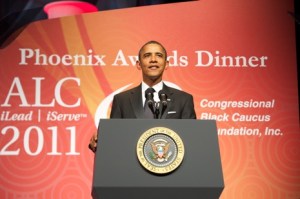
I know this was discussed on the morning post, but I thought I’d write a little more about Obama’s speech to the Congressional Black Caucus (CBC) on Saturday. If it hadn’t been for the ending, it would have been a good speech. The CBC members probably would have been OK with it, even though Obama isn’t really “attacking the cycle of poverty” and making it easier for kids to go to college, and all the other claims he made. He managed to make it sound like he’s done a lot for the economy when he’s really just tinkered with things around the edges. So why did Obama have to patronize his black audience like this?
So I don’t know about you, CBC, but the future rewards those who press on. (Applause.) With patient and firm determination, I am going to press on for jobs. (Applause.) I’m going to press on for equality. (Applause.) I’m going to press on for the sake of our children. (Applause.) I’m going to press on for the sake of all those families who are struggling right now. I don’t have time to feel sorry for myself. I don’t have time to complain. I am going to press on. (Applause.)
I expect all of you to march with me and press on. (Applause.) Take off your bedroom slippers, put on your marching shoes. Shake it off. (Applause.) Stop complaining, stop grumbling, stop crying. We are going to press on. We’ve got work to do, CBC. (Applause.)
WTF?! How tone deaf is that? I think it’s incredibly insulting. In the previous paragraphs, Obama was talking about how hard people in the audience had fought for advancement for African Americans:
Throughout our history, change has often come slowly. Progress often takes time. We take a step forward, sometimes we take two steps back. Sometimes we get two steps forward and one step back. But it’s never a straight line. It’s never easy. And I never promised easy. Easy has never been promised to us. But we’ve had faith. We have had faith. We’ve had that good kind of crazy that says, you can’t stop marching. (Applause.)
Even when folks are hitting you over the head, you can’t stop marching. Even when they’re turning the hoses on you, you can’t stop. (Applause.) Even when somebody fires you for speaking out, you can’t stop. (Applause.) Even when it looks like there’s no way, you find a way — you can’t stop. (Applause.) Through the mud and the muck and the driving rain, we don’t stop. Because we know the rightness of our cause — widening the circle of opportunity, standing up for everybody’s opportunities, increasing each other’s prosperity. We know our cause is just. It’s a righteous cause.
So in the face of troopers and teargas, folks stood unafraid. Led somebody like John Lewis to wake up after getting beaten within an inch of his life on Sunday — he wakes up on Monday: We’re going to go march. (Applause.)
Dr. King once said: “Before we reach the majestic shores of the Promised Land, there is a frustrating and bewildering wilderness ahead. We must still face prodigious hilltops of opposition and gigantic mountains of resistance. But with patient and firm determination we will press on.” (Applause.)
But then Obama follows this with the “bedroom slippers” and “complaining” and “crying” accusations. This kind of thing gives me the sense that Obama is clueless when it comes to the black experience in America. It honestly makes me wonder if he unconsciously looks down on ordinary African Americans.
Of course Obama didn’t have the same experiences as many of the people he was talking to on Saturday. He attended only private schools and didn’t experience the kind of discrimination that most of them did. But he has read about the the Civil Rights era and he often speaks about it. Presumably, he has talked directly to some poor African Americans while campaigning. Why would he expect these people to like the tone of those final paragraphs in his speech?
Well there have been some negative reactions. As she has a couple of times recently, Maxine Waters took the lead.
“I don’t know who he was talking to, because we’re certainly not complaining,” said Waters, who has been critical of Obama in the past. “We are working. We support him and we are protecting that base because we want people to be enthusiastic about him when that election rolls around.” ….
Waters said she found some of the language Obama used “not appropriate” and said it “surprised me a little bit.”
“I found that language a bit curious because the president spoke to the Hispanic Caucus and certainly they are pushing him on immigration and despite the fact that he’s appointed [Justice Sonia] Sotomayor to the Supreme Court, he has an office for excellence in Hispanic education right in the White House, they’re still pushing him and he certainly didn’t tell them to stop complaining,” she said.
“And he never would say that to the gay and lesbian community who really pushed him on Don’t Ask, Don’t Tell. Or even in a speech to AIPAC, he would never say to the Jewish community ‘stop complaining’ about Israel.”
…other members of the CBC, including its chairman, Missouri Rep. Emanuel Cleaver (D), have had different reactions to the speech, which they defended as a rallying call to African American voters, whose large turnout in 2008 helped fuel Obama’s election, and whose 2012 turnout could be pivotal to the president’s reelection effort.
“The Congressional Black Caucus supports the president; we intend to be as strongly pushing his reelection as anybody in the country,” Cleaver said Monday morning on MSNBC.
“I was like most of the crowd there — incredibly enthusiastic by the fighting spirit the president was showing. I think the president is right-on-message,” Maryland Rep. Donna Edwards (D), another CBC member, said in a separate appearance on MSNBC. “I think it’s incredibly clear, the difference, like night and day, between Republicans, who want to give special breaks to the wealthiest in this country, and the president of the United States. And it’s important that we reelect him because we have to really get this country back…the president was on that message, and we’re going to be on that message, too, for 2012.”
Frankly, I’m also offended by the way the President takes on the tone of a preacher when he speaks to black audiences. But since I’m not black, I can’t speak to whether the audiences find it patronizing. To me it seems condescending.
There have been other times when I thought Obama was incredibly tone deaf when talking to African Americans; for example, the time he lectured Black fathers who don’t support their children.
Saying that too many black fathers are “missing from too many lives and too many homes,” Obama said these men “have abandoned their responsibilities, acting like boys instead of men. And the foundations of our families are weaker because of it.”
Speaking at Chicago’s Apostolic Church of God, with his wife and two daughters in the audience, Obama said that more police on the street and job training programs are essential for a safe and sound society, “But we also need families to raise our children.”
The phenomenon of absentee fathers and single mothers certainly isn’t limited to African American families. Plenty of white men are deadbeat dads and worse.
I guess I just have a problem with stereotyping in general, and I’m particularly turned off by people in power who speak condescendingly to the rest of us. Again, I can’t speak for the CBC members, but I have to wonder if a lot of them didn’t feel like Maxine Waters did and feel a little bit resentful.

 peej
peej Carissa
 bostonboomer
 dakinikat
 ecocatwoman
 jjlo
jjlo mablue2
 Mama Lopez
 peggysue22
 quixote
 skydancingguestblogger
 Mona (aka Wonk the Vote)





Recent Comments