
William Black Goes Ballistic
Posted: February 1, 2012 Filed under: 2012 elections, Bailout Blues, Banksters, corruption, Crime, Democratic Politics, double-speak, financial institutions, investment banking, The Great Recession, U.S. Economy, We are so F'd | Tags: 2012 presidential election, Barack Obama, Financial Crisis, George W. Bush, U.S. Economy 6 CommentsI’ve been reading William Black’s essays and posts, watching his video interviews and You Tube presentations, ever since I saw him on Bill 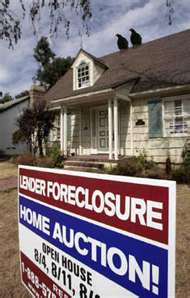 Moyers Journal speaking frankly, no holds barred, about how the financial industry had brought the country to its knees and gotten away with it. He spoke frankly again during his Congressional testimony last year when he came right out and called the mortgage debacle that nearly finished the US economy . . . fraud. Yes he used the ‘f’ word! This was unlike other ‘experts’ who insisted there was no inkling of trouble on the horizon, that the financial meltdown was ‘an act of the economic gods,’ a huge surprise, the product of overly optimistic financial predictions.
No, Black said. It was fraud. It was criminal. In case you missed that testimony, you can watch below. It’s worth a second go-around.
Too bad Black’s comments were basically ignored, caught up in the razzle-dazzle of excuses, half-truths and political posturing that’s become all too familiar to anyone paying attention. Business as usual is still the acceptable mantra. In case, you’ve forgotten [time flies when we’re having so much fun], William Black headed Poppy Bush’s forensic audit team during the S&L scandal, which ultimately led to 1000 elite felony convictions.
Black’s investigative team wasn’t kidding around.
William Black came out yesterday morning with his own take on President Obama’s SOTU announcement of a Task Force [The Let’s Try It Again Task Force], quoting POTUS:
And tonight, I am asking my Attorney General to create a special unit of federal prosecutors and leading state attorneys general to expand our investigations into the abusive lending and packaging of risky mortgages that led to the housing crisis. This new unit will hold accountable those who broke the law, speed assistance to homeowners, and help turn the page on an era of recklessness that hurt so many Americans.
Black suggests we look at the wording, the avoidance of using the ‘f’ or ‘c’ word. That would be fraud and criminal. His response to this and Eric Holder’s follow up memorandum:
The working group will not “investigate … abusive lending” and it will not “hold accountable those who broke the law … [by defrauding] homeowners.” It will not “speed assistance to homeowners.” It will not “turn the page on an era of recklessness” – and fraud, not “recklessness” is what prosecutors should prosecute. The name of the working group makes its crippling limitations clear: the Residential Mortgage-Backed Securities Working Group. Attorney General Holder’s memorandum about the working group makes clear that the name is not misleading. The working group will deal only with mortgage-backed securities (MBS) – not the fraudulent mortgage origination that drove the crisis (the only exception is federally insured mortgages).
Clearly, he’s not impressed. No, instead he’s disgusted and enraged. In fact, the essay nearly jumps off the page with genuine anger. He goes on to say:
The working group is a symbolic political gesture designed to neutralize criticism of the administration’s continuing failure to hold accountable the elite frauds that drove the crisis. Neither the Bush nor the Obama administration has convicted a single elite fraud that drove the crisis. This is a national disgrace and represents the triumph of crony capitalism. Remember that the FBI warned in September 2004 that there was an “epidemic” of mortgage fraud and predicted that it would cause a financial “crisis.” There are no valid excuses for the Bush and Obama administrations’ failures. The media have begun to pummel the Obama administration for its failure to prosecute. The administration could not answer this criticism with substance because it has nothing substantive to offer in prosecuting elite mortgage origination frauds. The ugly truth is that we are three full years into his presidency and Holder could not find a single indictment to bring that Obama could brag about in his SOTU address. Who doubts that Holder and Obama would have done so if they had anything in the prosecutorial pipeline? Why do Holder and Obama have nothing in the pipeline?
One of the other things that deeply disturbs Black is President Obama’s willingness to play politics in this matter, float the gambit of the Task Force /Working Group and the reputation of Eric Schneiderman to create the appearance of a genuine hands-on effort. But this move is not genuine as far as Black is concerned and contradicts the very essence of President Obama’s SOTU address, conjuring up the Seal Team that took out Osama Bin Laden—a team effort, concentrating on the mission.
This is no more than vulgar propaganda, Black claims.
He also refers to a disclosure made by Scot Paltrow for Rueters 10 days ago, revealing that US Attorney General Eric Holder and Lanny Breuer, heading the DOJs criminal division [also a co-chair of the ‘Let’s Try It Again Task Force], had been partners at Covington and Burling, a well-established and well-heeled law firm that represented many of the largest banks, providing cover for their clients through key arguments on the MERS debacle.
Conflict of interest anyone?
The state Attorney Generals? They were lobbyied, leaned on, even offered [as was the case of AG Kamala Harris, CA] $8 billion to assist damaged California homeowners in a bid to agree to the original deal, which would have offered the big banks immunity from liability. All so the President could announce ‘a deal’ in his State of the Union address, even though homeowners would be left out to dry and bank executives, who led deliberate “accounting control frauds,” could continue their conduct with absolute impunity.
This is ugly, made all the uglier in that it was sanctioned through and by the White House. Black suggests that Eric Schneiderman recognized the leverage he had, agreed to join the Task Force as a co-chair with the stipulation that the original deal be modified, specifically concerning civil liability in mortgage origination fraud.
This might explain Jamie Dimon’s whine last Friday, pouting and claiming bankers are the objects of unfair discrimination. Really? Here’s the average American’s response:
Of course, you would think that this mess would be a window of opportunity for Republicans in an election year. What an incredible club to use on President Obama to win the WH, maybe the House and the Senate by gargantuan majorities.
No fear there because for every compromised Democrat there is an equally compromised Republican. Both the Democrats and Republicans rely heavily on campaign contributions from the financial sector. Neither side is willing to cut their bankers [crooked or not] off at the knees.
What to do? What better reason to support any and all actions to get money out of the political arena. Until we do? The world belongs to the highest bidder.
Falling Out of Love with . . . Eric Schneiderman
Posted: January 29, 2012 Filed under: investment banking, U.S. Economy, U.S. Politics | Tags: bait and switch, Barack Obama, Eric Schneiderman, mortgage fraud investigation, U.S. attorneys 28 Comments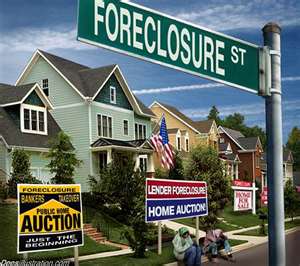 When I first heard about NY State Attorney General Eric Schneiderman standing up and pushing back against DC’s rush to settle with Wall St bankers and mortgage servicers over the foreclosure debacle, I cheered. In fact, I did more than cheer. I wrote to Schneiderman and thanked him for having the courage and integrity to stand with American homeowners, those who had been abused by unfair [and illegal] business practices, and then further compromised by mortgage modifications and refinancing schemes that turned into a giant con game.
The stories were always the same, particularly with the mod and refi angle. Homeowners called their lending representatives. They were encouraged to fill out mountains of paperwork, pay a particular monthly amount, and then [months later] once they fulfilled their obligation? They were told they did not qualify, would be required to pay ‘x’ amount of dollars upfront or the local sheriff would be knocking at the door. And not for a friendly ‘hello.’
The bait and switch games have been cruel, destructive and predatory. The idea that these same financial institutions–unable to produce proper and legal paperwork on many of these properties, the whole robosigning/MERS debacle—were being offered a sweetheart deal including immunity from civil and criminal prosecution was nothing short of outrageous.
Schneiderman stood up first and said, ‘No.’ He was later joined by five additional state attorney generals: Beau Biden [DE], Martha Coakley 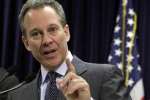 [MA], Catherine Cortez Masto [NV], Kamala Harris [CA] and Lisa Madigan [IL]. Each has pledged to independently investigate the malfeasance and fraud in the mortgage industry and seek prosecution where warranted.
However, during his State of the Union Address, President Obama announced the creation of a Federal Mortgage Fraud Task Force. To my dismay and that of many others, it was subsequently announced the aggressively independent Schneiderman was joining the DC team.
The immediate question [and I’m glad I’m not alone in this]: Will Eric Scneiderman be sucked into the Washington Borg, be used for window dressing by the Administration or remain staunchly on the side of ordinary Americans, who have been abused and sucker-punched enough.
Though I’m generally an optimist, I have to admit—it does not look good.
As an article at Yves Smith’s site pointed out, the very fact that negotiations with the TBTFs proceed uninterrupted sends up a red flag. Why proceed with negotiations, offering the banks a back door exit, if you’re running an investigation into fraud? The composition of the Task Force is also troubling, composed as it is with people from the original Task Force that has done very little. Consider Eric Holder, for instance—not exactly the poster child of a justice fighter.
Additionally, indications are that a miniscule fraction of FBI agents [10] have been assigned to the Task Force in comparison to William Black’s forensic team [1000] to tackle the S&L scandal. Matt Stoller stated that the current investigation is on the order of 40x the magnitude and complexity although I actually heard Bill Black say the magnitude was in the 70-80x range.
In the same article, Stoller quotes Eric Holder, who seems to truly believe [or at least wants everyone else to believe] that the Administration and the DOJ have been dedicated to rooting out corruption:
On Tuesday night, the President referenced this initiative, asking us to, “hold accountable those who broke the law, speed assistance to homeowners, and help turn the page on an era of recklessness that hurt so many Americans.”
That is precisely what we intend to do. And the good news is that we aren’t starting from scratch.
Over the past three years, we have been aggressively investigating the causes of the financial crisis. And we have learned that much of the conduct that led to the crisis was – as the President has said – unethical, and, in many instances, extremely reckless. We also have learned that behavior that is unethical or reckless may not necessarily be criminal. When we find evidence of criminal wrongdoing, we bring criminal prosecutions. When we don’t, we endeavor to use other tools available to us – such as civil sanctions – to seek justice. My number one to commitment to the American people is that we will continue to devote significant resources to combating financial fraud and be as aggressive and creative as we can be in holding accountable those who, in violating the law, contributed to the financial crisis.
For example, in just the last six months, the Department has achieved prison sentences of 60, 45, 30, and 20 years in a variety of financial fraud cases charging securities fraud, bank fraud, and investment fraud. And, just last month, I announced the largest fair lending settlement in history, resolving allegations that Countrywide Financial Corporation and its subsidiaries engaged in a widespread pattern or practice of discrimination against minority borrowers from 2004 through 2008.
Either the Administration and DOJ have done a very poor job of keeping the public abreast of their multiple investigations/prosecutions or the average layperson would refer to this claim as: Don’t trust your lying eyes.
Schneiderman has reportedly stated that if the investigation is not on the up and up, he will publicly step away. He has insisted that the investigative work will be rigorous and unrelenting.
I hope he means it. I hope the queasy sense I have in my gut is wrong because false champions have become the disheartening rule.
Though I’m more likely to see the glass half full than half empty, I and many others have witnessed the same repetitive pattern: promising, good-intentioned men and women go to DC, only to be chewed up in the machine. Or irreparably compromised. And though I’ve always believed Barack Obama inept in leadership qualities, he does have an uncanny ability to disable and defang his opponents. David Dayen wrote a convincing essay to the same effect.
I want to be wrong about this. I hope the naysayers are wrong, too.
Breaking up is hard to do.
Greedy Bastards
Posted: January 26, 2012 Filed under: Banksters, commercial banking, Corporate Crime, corruption, financial institutions, Global Financial Crisis, investment banking, lobbyists, U.S. Economy, U.S. Politics | Tags: Dylan Ratigan, extractionism vs capitalism, Greedy Bastards 15 CommentsNo, I am not making an editorial comment.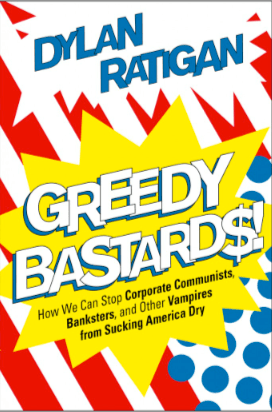
But after nonstop blathering served up by the GOP, only to be followed by President Obama’s Teddy Roosevelt impersonation [although I have to admit—the State of the Union was a surprisingly good speech], I thought a moment of palate cleansing might be in order. In this case Dylan Ratigan offers up the sorbet.
Ratigan is someone willing to call out the shysters, the casino players and shakedown artists, including their political handmaidens for what they truly are, and ‘Greedy Bastards’ is the title of his newly released book. The author’s name may ring a bell because Dylan Ratigan has a public platform on MSNBC, an hour-long show Monday through Friday. The program airs at 4:00 pm, EST, in my neck of the woods.
Ratigan’s slant focuses on the collision of worlds, that of finance and politics, how the incestuous relationship is literally squeezing the life out of the United States. His take is not an indictment of capitalism. Rather it is an indictment of what is posing as capitalism, a system he refers to as ‘extractionism.’
Ratigan is not a newcomer or a pundit simply reading a script. He worked the financial beat with Bloomberg News, serving as Global Managing Editor to Corporate Finance until 2003. He’s also the former anchor and co-creator of CNBC’s Fast Money. He has launched and anchored a number of financially-related broadcasts over the years but decided to leave Fast Money after the 2008 financial meltdown. Ratigan has publicly stated that he was personally disgusted by the Wall Street banking sector’s shakedown of the American public. The Dylan Ratigan Show was launched to provide discussion and analysis of the financial/government intersection, a system that has acquiesced to the wanton theft of the Nation’s wealth and resources by . . . Greedy Bastards, of course.
Though the show has been on air for three years, Ratigan has admitted that his voice was finally heard after an infamous meltdown last August. It was an on-air rant that would have made Patty Chayefesky proud, a Howard Beale moment.
That woke people up! It also led to Ratigan’s Get the Money Out [of politics] Movement, working towards a Constitutional Amendment to remove the corrosive element of money in the political sphere. And then, there’s the book.
One thing I liked about Ratigan’s approach is that instead of pointing out one segment of the population for public pillorying, his title basically refers to a state of mind and the all too frequent way of doing business and politics in the 21st century.
For instance, in the case of capitalism, Ratigan uses the example of venture capital, a subject that has come up in reference to Romney’s connection to Bain & Company, specifically Bain Capital. From Chapter 1:
If I start a venture capital firm that lends out money to drug researchers trying to find new cures for disease, and I get rich doing it, then I made my money by investing in the productive future of the country. I used my money in a way that facilitated scientific innovation and a cure. I’m what the director of the Havas Media Lab Umair Haque a ‘capitalist who makes.’ But instead, if I take the same money and use it to lobby for changes in government regulation—changes that help me trick a union into investing its retirement savings in flawed investments so that I can collect the commissions—then I may move as many dollars into my bank account as someone who funded cures for diseases, but I haven’t made anything. I’m a ‘capitalist who takes,’ exploiting my power to influence the government for my own private gain, no matter the harm to anyone else. I’m a greedy bastard.
The latter example, taking money from others without providing anything of value is, according to Ratigan, the opposite of capitalism. An extractionist system loses increasing value over time until there’s nothing left. Call it the vampire or vulture model. A system based on the extractionist principle, provides no incentive for people to make good deals, where both sides benefit. Instead, it rewards those who take and give nothing in return.
Sound familiar?
Ratigan covers the areas that have pushed the extractionist model to the max: banking, education, healthcare, energy, trade negotiations and the unholy alliance of government and big money fueling the feeding frenzy of the Nation’s resources and our future. But unlike many gloom and doom tomes, Ratigan offers solutions and brings an optimism to the subject, namely that we have the ideas, the people and yes, even the money to solve what at times seems insolvable. He concludes in a rather convincing way that what is needed is a realignment between investment and the needs of capable, innovative people. If loans and investments offered the highest returns when they provided the highest value as opposed to simply taking the highest risk, then prevailing attitudes and business practices would shift and win/win deals would be created.
 Sound like pie in the sky? I don’t think so. Yes, it’s a matter of will, public pressure to exact the necessary changes but this realignment idea is possible by citing the goals first, and then targeting the resources to get there. Ratigan refers to this as hotspotting—zeroing in on the problem, determining what methodology provides the best results, and then aiming resources to match those needs.
Though some critics have dismissed this idea, it is very attuned to what Bill Clinton recently suggested in his Esquire interview about highlighting the successes and needs across the country, and then linking them, matching them up. Just another turn on the realignment idea:
. . . the two best things you could do are the infrastructure bank and a simple SBA-like loan guarantee for all building retrofits, where the contractor or the energy-service company guarantees the savings. So that allows the bank to loan money to let a school or a college or a hospital or a museum or a commercial building or factories for lease unencumbered by debt to loan it on terms that are longer, so you can pay it back only from your utility savings. You could create a million jobs doing that because of the home models that are out there now.
There are these two guys on Long Island who started a little home-repair deal. They got thirty-five employees now, and they’re — they can go in, tell you how much they’ll save you. There’s an operation in Nebraska that’s in and out in a day, and they’re averaging more than 20 percent savings, and conservative Republican Nebraska is the only state in the country that has 100 percent publicly owned power.
And,
You’ve got Orlando with those one hundred computer-simulation companies. They got into computer simulation because you have the Disney and Universal theme parks, and Electronic Arts’ video-games division. And the Pentagon and NASA desperately need simulation, for different reasons. So there you’ve got the University of Central Florida, the biggest unknown university in America, fifty-six thousand students, changing curriculum, at least once a year, if not more often, to make sure they’re meeting whatever their needs are, and they’re recruiting more and more professors to do this kind of research that will lead to technology transfers to the companies. You’ve got Pittsburgh actually becoming a real hotbed of nanotechnology research. You’ve got San Diego, where there are more Nobel-prize-winning scientists living than any other city in America. You’ve got the University of California San Diego and other schools there training people to do genomic work. Qualcomm is headquartered there, and there are now seven hundred other telecom companies there, and you’ve got a big private foundation investing in this as well as the government, and nobody knows who’s a Republican or who’s a Democrat, they’re just building this networking.
We have fabulously innovative, creative people working on all kinds of things. Our true wealth is in our people; our true value is . . . us.
Ratigan is now on a 30-million jobs tour showcasing business enterprises that are, in fact, answering a need, offering value to their communities, providing jobs and in the best capitalist tradition—making a profit.
The endnote is that the country hasn’t lost its edge. We’ve lost the path that works, the one that values quality and integrity. Greedy Bastards will always exist, those hoping to make a quick buck [or trillions of bucks] off the backs of others. They have no shame. The goal is to make them and their thievery the exception, not the rule.
Btw, Ratigan’s book is highly readable, written for the layperson. No economic degrees required. If you’ve been following the financial blowout and/or Ratigan’s show, this will be a fast review. If you’re just starting to pay attention, consider the book a primer—what the country underwent and where we need to go. The sooner, the better. Ratigan encourages us to reclaim our voice, demanding that our people and country come first.
It’s a worthy message. Read the book. Get the word out.
Live Blog: SOTU 2012
Posted: January 24, 2012 Filed under: 2012 presidential campaign, Barack Obama, U.S. Economy, U.S. Military, U.S. Politics | Tags: 2012 State of the Union Speech, Economic Fairness 179 Comments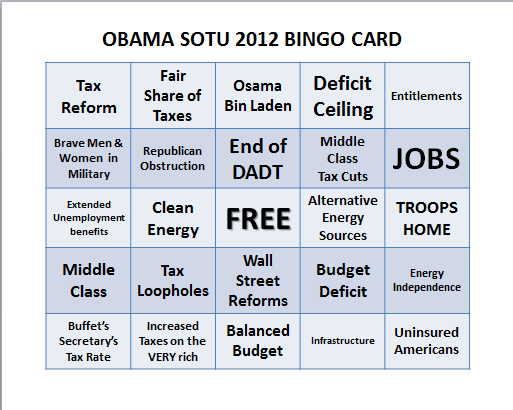
Here’s your SOTU Bingo Card! Print it out and play along. As soon as one square has been said once, you have to take a drink for every mention after that! Those are the House Rules!
I decided against plugging in the “THEME” of the night. Obama is still channeling Teddy Roosevelt with the idea of Economic Fairness.
President Barack Obama will call economic fairness “the defining issue of our time” in his State of the Union address Tuesday night as he vows to keep fighting for working Americans.
“It’s time to apply the same rules from top to bottom: No bailouts, no handouts, and no copouts. An America built to last insists on responsibility from everybody,” Obama will say, according to excerpts released by the White House ahead of his speech in the House chamber to a joint session of Congress. “Let’s never forget: Millions of Americans who work hard and play by the rules every day deserve a government and a financial system that does the same.”
The election-year address gives Obama a high-profile platform to counter the GOP presidential candidates who have been pummeling him, virtually unanswered, for months. He will expand on the vision he described in a pivotal December speech in Osawatomie, Kan., that channeled Teddy Roosevelt’s square deal slogan of economic equality.
Obama will lay down markers Tuesday night aimed at making that vision a reality.
That’s always been the deal, hasn’t it? Obama is very good at stealing another leader’s vision and making it seem like he owns it. The problem is that he negotiates it away to the right wing and his words never come out as detailed plans. Will this be the billion dollar fund raising speech it needs to be? The SOTU will be lived simulcast via the White House Home Page.
EVENT ACTION Obama says “Folks” Poke a hole in the bottom of a can of PBR, put it up to your mouth, open the tab and chug Obama says he created 3.2 million jobs Take 3.2 sips Obama mentions the 8.5% unemployment rate Drink 8.5% of a bottle of Jack Daniels (no more, you’re probably unemployed and Jack ain’t cheap) Only Republicans applaud Obama must have tripped or something. Consolation shot for Barry Only Democrats applaud Have a glass of water. This will happen a lot and you need to hydrate. Camera pans to Michelle Obama Drink, but then eat something organic Obama mentions “Occupy” or the 99% Do one shot and tweet something @ellenbarkin Obama mentions “Wall Street” or the 1% Pour yourself a glass of 50-year old single malt scotch, throw the glass out, then pour another glass. You have plenty
So, what are some of the Villager’s tweeting?
Instructions on how to get to Beltway Bob’s SOTUS (the cheerleader edition) here:
ezraklein Ezra Klein
You can follow Wonkblog’s liveblogging/tweeting of SOTU here: wapo.st/Ai7QpE
The anti-Beltway Bob antidote (or is that anecdote?)will be here:
YourAnonNews Anonymous
Four things that will not be brought up at #SOTU: #SOPA, #PIPA, #ACTA and #NDAA. Google and read about them all!
Our hero:
SenatorSanders Bernie Sanders
The wealthiest 400 people in America now own more wealth than the bottom 150 million Americans. #SOTU
Looks like somebody got an advanced copy:
KeithOlbermann Keith Olbermann
POTUS SOTU Conclusion: “An America built to last insists on responsibility from everybody.”Keith Olbermann
KeithOlbermann Keith Olbermann
POTUS SOTU: It’s time to apply the same rules from top to bottom: No bailouts, no handouts, and no copouts…
A suggestion only Bobby Brady Jindal (The governor/exorcist) would love.
mattyglesias mattyglesias
Texas Governor Rick Perry whose state leads the nation in job creation would be an ideal SOTU responder were he not a national joke.
This goes down at 9 p.m. EST.
Tuesday Morning Reads
Posted: January 24, 2012 Filed under: 2012 presidential campaign, Barack Obama, morning reads, Teddy Roosevelt, U.S. Economy, U.S. Politics, We are so F'd | Tags: Larry Summers Memo, Obama stimulus, State of the Union Address 40 CommentsGoo d Morning!
I’m tired of Republican Party Dysfunction. Let’s switch to the Democratic Party Brand for awhile. This year’s State of the Union address will be interesting. Will it turn out to be the first major Obama campaign speech of 2102?
Mr. Obama plans, in part, to deliver a “vision” speech. He told campaign supporters over the weekend that he’ll use his speech to discuss “the central mission we have as a country, and my central focus as president.”
“And that’s rebuilding an economy where hard work pays off and responsibility is rewarded – and an America where everybody gets a fair shot, everyone does their fair share, and everybody plays by the same set of rules,” he said.
If that sound familiar, it’s a refrain of remarks Mr. Obama delivered December 6th in Osawatomie, Kansas. Both the president and aides characterize the State of the Union as a “bookend” to the Kansas speech. It was a delineation of the political philosophy Mr. Obama brings to the job and is willing to defend against whichever Republican ends up as his rival later in the year.
Economic programs and objectives will dominate his speech. “I’m going to lay out a blueprint for an American economy that’s built to last,” said the president in a video email Saturday to campaign supporters. And Mr. Obama will cite the “four pillars” on which his blueprint for America will rest: manufacturing, engineering, worker skills and American values.
- MANUFACTURING: According to “talking points” sent by the White House to its political defenders and surrogates, the president will call for “a new era of American manufacturing with more good jobs and more products stamped Made in the USA.
- ENERGY: He will propose “a new era” for energy in the US – “fueled by homegrown & alternative energy sources.
- WORKER SKILLS: He’ll put forward “new ideas” for education and training to take on “jobs of today and tomorrow.”
- AMERICAN VALUES: The president will call for “a return to American Values of fairness for all and responsibility from all.”
We’ll be live blogging the SOTU tonight. I’m suggesting we pitch nerf balls at the TV for every Teddy Roosevelt reference and drink on references to Republican belligerence. What say you?
Here’s some pretty good indications of why the economy has been so slow and pokey recently. Check out The New Yorker and “The Obama Memos”. It’s getting more pundit play than Suskind’s “Confidence Men”. Pay close attention to the whacked advice from Larry Summers who suggested Obama not go very big on the first stimulus because they could just do more later. Let’s just hope a rumored World Bank Presidency stays just that. Imagine this man turned on the developing world. However, there’s a lot more tidbits in there worth chewing on. Like this one.
Neera Tanden was the policy director for Clinton’s campaign. When Clinton lost the Democratic race, Tanden became the director of domestic policy for Obama’s general-election campaign, and then a senior official working on health care in his Administration. She is now the president of the liberal Center for American Progress, perhaps the most important institution in Democratic politics. “It was a character attack,” Tanden said recently, speaking about the Obama campaign against Clinton. “I went over to Obama, I’m a big supporter of the President, but their campaign was entirely a character attack on Hillary as a liar and untrustworthy. It wasn’t an ‘issue contrast,’ it was entirely personal.” And, of course, it worked.
But back to La La Summers.
There was an obvious tension between the warning about the extent of the financial crisis, which would require large-scale spending, and the warning about the looming federal budget deficits, which would require fiscal restraint. The tension reflected the competing concerns of two of Obama’s advisers. Christina Romer, the incoming chairman of the Council of Economic Advisers, drafted the stimulus material. A Berkeley economist, she was new to government. She believed that she had persuaded Summers to raise the stimulus recommendation above the initial estimate, six hundred billion dollars, to something closer to eight hundred billion dollars, but she was frustrated that she wasn’t allowed to present an even larger option. When she had done so in earlier meetings, the incoming chief of staff, Rahm Emanuel, asked her, “What are you smoking?” She was warned that her credibility as an adviser would be damaged if she pushed beyond the consensus recommendation.
Peter Orszag, the incoming budget director, was a relentless advocate of fiscal restraint. He was well known in Washington policy circles as a deficit hawk. Orszag insisted that there were mechanical limits to how much money the government could spend effectively in two years. In the Summers memo, he contributed sections about historic deficits and the need to scale back campaign promises. The Romer-Orszag divide was the start of a rift inside the Administration that continued for the next two years.
Since 2009, some economists have insisted that the stimulus was too small. White House defenders have responded that a larger stimulus would not have moved through Congress. But the Summers memo barely mentioned Congress, noting only that his recommendation of a stimulus above six hundred billion dollars was “an economic judgment that would need to be combined with political judgments about what is feasible.”
He offered the President four illustrative stimulus plans: $550 billion, $665 billion, $810 billion, and $890 billion. Obama was never offered the option of a stimulus package commensurate with the size of the hole in the economy––known by economists as the “output gap”––which was estimated at two trillion dollars during 2009 and 2010. Summers advised the President that a larger stimulus could actually make things worse. “An excessive recovery package could spook markets or the public and be counterproductive,” he wrote, and added that none of his recommendations “returns the unemployment rate to its normal, pre-recession level. To accomplish a more significant reduction in the output gap would require stimulus of well over $1 trillion based on purely mechanical assumptions—which would likely not accomplish the goal because of the impact it would have on markets.”
Paul Krugman, a Times columnist and a Nobel Prize-winning economist who persistently supported a larger stimulus, told me that Summers’s assertion about market fears was a “bang my head on the table” argument. “He’s invoking the invisible bond vigilantes, basically saying that investors would be scared and drive up interest rates. That’s a major economic misjudgment.” Since the beginning of the crisis, the U.S. has borrowed more than five trillion dollars, and the interest rate on the ten-year Treasury bills is under two per cent. The markets that Summers warned Obama about have been calm.
I know this is an add source for me, but the AEI has “Eleven stunning revelations from Larry Summers” has a list of quotes from the actual memo. That’s what I’m going to use here. First, stimulus projects were not picked based on their impact on the economy but on their ability to fulfill campaign promises.
The short-run economic imperative was to identify as many campaign promises or high priority items that would spend out quickly and be inherently temporary. … The stimulus package is a key tool for advancing clean energy goals and fulfilling a number of campaign commitments.
Another stunner was this quote which blames banking regulators. I suppose Wall Street was an innocent in all of this?
A significant cause of the current crisis lies in the failure of regulators to exercise vigorously the authority they already have.
Krugman had this to say about the memo in a post called “Larry and the Invisibles”.
The key thing I took away from the memo is that it does not read at all like the current story the administration gives for the inadequate size of the stimulus, which is that they knew it should be larger but had to face political reality.
Instead, the memo argues that a bigger stimulus would be counterproductive in economic terms, because of the “market reaction”. That is, Summers et al were afraid of the invisible bond vigilantes.
And to the extent that there is a political judgment, it’s all in the opposite direction: if the stimulus is too big, we’ll have trouble scaling it back, but if it’s too small, we can always go back to Congress for more. That was deeply naive — and I said so in real time.
Now, you can still argue that politics made a bigger stimulus impossible. But that’s not at all the argument being made internally within the administration at the time.
At this point, the shrill one goes all mushy and says that Obama has “toughened” up since then. I guess we’ll see.
Right now, I’d say the country is between a Barrack and a hard right place. What’s a voter to do with such a Hobson’s choice?
So, that’s what I’ve got to offer this morning. What’s on your reading and blogging list today?

 peej
peej Carissa
 bostonboomer
 dakinikat
 ecocatwoman
 jjlo
jjlo mablue2
 Mama Lopez
 peggysue22
 quixote
 skydancingguestblogger
 Mona (aka Wonk the Vote)





Recent Comments