
Thursday Reads
Posted: April 12, 2012 Filed under: 2012 presidential campaign, Crime, morning reads, U.S. Economy, U.S. Politics, War on Women | Tags: Africanized bees, Angela Corey, anti-trust lawsuit, Apple, Barack Obama, Buffet rule, Carole King, Eric Holder, George Zimmerman, killer bees, Mitt Romney, Reince Priebus, Ronald Reagan, Seminole County Jail, Terry Gross, the Shirelles, Trayvon Martin, US Justice Department, war on caterpillars 33 Comments
Good Morning!
Last night, George Zimmerman, the man who shot unarmed teenager Trayvon Martin and triggered nationwide outrage was booked on second degree murder charges and is now in Seminole County jail. He will appear before a judge this morning.
George Zimmerman arrived at the Seminole County Jail this evening, about two hours after officials announced that he will face a second-degree murder charge in the death of 17-year-old Trayvon Martin.
Special Prosecutor Angela Corey announced the second-degree murder charge at the State Attorney’s Office in Jacksonville tonight, more than six weeks after Trayvon and Zimmerman’s fatal encounter.
If convicted, Zimmerman would face up to life in prison on the first-degree felony charge. He arrived at the Seminole County jail about 8:30 p.m. tonight, greeted by a throng of reporters shouting questions.
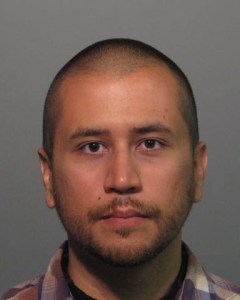
George Zimmerman's booking photo
I’m not a doctor, but I’ve seen broken noses before. Zimmerman’s doesn’t look like the ones I’ve seen, but as I said, I’m not a doctor.
I just have a few more links related to this story. Trayvon Martin’s parents have behaved with dignity and grace during a time that for them can only have been nightmarish. Via Raw Story, yesterday, they reacted to the arrest and charging of the man who killed their son in an interview with the AP. When asked what they would do if they had an opportunity to talk with George Zimmerman.
“I would probably give him the opportunity to apologize,” said Sybrina Fulton, Travyon Martin’s mother. I would probably ask him if there was another way he could have helped settle the confrontation that he had with Trayvon, other than the way it ended, with Trayvon being shot.”
Tracy Martin, the boy’s father, said he would ask Zimmerman what his motive was.
“Why was he patrolling the neighborhood with a 9mm gun?” he said. “What was it about my son that made him suspicious? What made him decide to disobey the dispatcher, who is trained to handle 911 calls? Why does he feel his life is so altered and does he understand that he altered his own life by refusing to stay in his vehicle? Was it really worth it? Was it really worth taking an innocent child’s life?”
The right wing site the Daily Caller, which has had access to Zimmerman family members reported that George Zimmerman used the My Space handle “datniggytb.”
George Zimmerman, the Hispanic Floridian who killed black teenager Trayvon Martin on Feb. 26, had a MySpace account whose username was “datniggytb,” The Daily Caller has learned.
According to a family member whose identity The Daily Caller has agreed not to reveal for safety reasons, the “datniggytb” name is not a racial slur, but a friendly nickname that referred to George himself.
“That was an old nickname his black friends gave him,” the Zimmerman family member said. “He didn’t have an issue with the profile name.”
The family member at first denied that George had a My Space account, and later came up with the “black friends” explanation. I hope someone in the Justice Department reads The Daily Caller.
In other news, the US Justice Department has filed an anti-trust lawsuit against Apple and three publishers for conspiring to fix the price of e-books in order to force Amazon to charge higher prices.
The announcement, made in Washington by Attorney General Eric H. Holder Jr. and Sharis A. Pozen, the acting assistant attorney general of the Justice Department’s antitrust division, capped a long investigation. The inquiry hinged on the question of whether publishers, at the urging of Steven P. Jobs, then Apple’s chief executive, agreed to adopt a new policy in 2010 that in essence coordinated the price of newly released e-books at the price offered in Apple’s iBookstore — typically between $12.99 and $14.99.
At the time, Apple with its blockbuster iPad was trying to challenge Amazon’s hold on the e-book market. Amazon, the online retail giant, had become a kind of Walmart for the e-book business by lowering the price of most new and best-selling e-books to $9.99 — a price meant to stimulate sales of its own e-reading device, the Kindle.
Publishers, looking for leverage against Amazon, saw Apple as their white knight. The Justice Department complaint, using language that could have been inspired by a best-selling white-collar crime novel, describes how executives from the publishing companies met to discuss business matters “in private rooms for dinner in upscale Manhattan restaurants,” tried to hide their communications by issuing instructions to “double-delete” e-mails, all the time complaining of Amazon’s increasing influence over the e-book market.
Ultimately, the Justice Department charges, the publishers and Apple conspired to limit e-book price competition, increasing Amazon’s e-book retail prices and causing “consumers to pay tens of millions of dollars more for e-books than they otherwise would have paid.”
Three publishers have already settled with the Justice Department. As a Kindle owner, I’ve long hoped this would happen. Steve Jobs made me pay more for books, and I strongly resent it.
Yesterday, while promoting “the Buffet rule,” President Obama used the sainted Ronald Reagan as a stick to beat Republicans with. From Raw Story:
He described for the audience the actions of one of his predecessors in the Oval Office, a president who “gave a speech where he talked about a letter he had received from a wealthy executive who paid lower tax rates than his secretary, and wanted to come to Washington and tell Congress why that was wrong. So this president gave another speech where he said it was ‘crazy’—that’s a quote—that certain tax loopholes make it possible for multimillionaires to pay nothing, while a bus driver was paying 10 percent of his salary.”
“That wild-eyed, socialist, tax-hiking class warrior,” he said, “was Ronald Reagan.”
Mitt Romney is still struggling to convince women that He and other Republicans aren’t waging war on them. He’s trying to do this by accusing the Obama administration of a war on women, but he can’t articulate how that war works, according to Talking Points Memo.
The campaign faced a number of questions in [a] press call as to just how Obama’s supposed “War on Women” worked, none of which produced a direct answer. Asked by TPM on the call to explain how another president taking office in January 2009 might have affected the gender gap in job growth, Romney adviser Lanhee Chen only said that the pattern was unusual compared with other recessions and that he believed a president like Romney would have gotten different results….
Chen was pressed again by another reporter to explain why women were disproportionately affected and what “difference in policy” would have changed the equation.
“The president’s policies in general, whether it’s Obamacare or Dodd-Frank or any of the policies they have pursued have really hurt both men and women,” he said. “This president has demonstrated that he’s doing everything in his power to scare away job creators and that’s had a disproportionate impact on women. That’s just a statistical fact.”
Asked a third time to explain the origins of this gender divide and how Romney would tackle the ratio of job losses specifically, Chen again said “it is a fact” that women have suffered disproportionately but offered no specific answer.
“[Romney] would undo the damage that President Obama has done,” he said. “He would take the economy in a very different direction and, as a result of that, produce very substantial job gains and growth for men and women.”
Al-righty-then.
Dakinikat covered that story really well yesterday, so if you haven’t read her post yet, be sure to check it out.
RNC chairman Reince Priebus announced yesterday that he isn’t backing down on his comparison of the notion of a Republican war on women to a war on caterpillars. Politico:
Reince Priebus said Wednesday he has no intention of taking back his “war on caterpillars” comment that landed him at the center of criticism last week — in fact, the chairman of the Republican National Committee vowed he’d gladly “double down” on the remark.
“I’m not going to walk back — I’ll double down on it,” Priebus said on MSNBC when asked whether he wanted to walk back or clarify his choice of words. “This war of women is a fiction that the Democrats have created, and the real war on women is the war that this president has put forward on the American people by not following through on his promises, by having women disproportionately affected by the Obama economy.”
He continued, “Go read Anita Dunn’s book if you want to go read about a war on women in the workplace — go read that book and you’ll see what the White House’s record is on women.”
Yes, Obama treated women working in the White House like shit. I read Confidence Men. So because Obama is a dick, Priebus wants us to vote for the party of personhood bills, vaginal probes, and birth control bans? A plague on both their houses.
Remember “killer bees?” A beekeeper in East Tennessee was stung 30 times by “partially Africanized bees” AKA “killer bees.”

Africanized bee swarm
A swarm of as many as 100,000 bees attacked a Tennessee beekeeper last month, and genetic testing of the angry critters has now revealed that they were partially Africanized bees. This is the first time that Africanized bees have been found in Tennessee.
Africanized bees, often referred to as “killer bees,” are a hybrid cross between the bee species normally found in America and African honey bees (Apis mellifera scutellata), which were originally introduced to the Americas as a productive source of honey. But the African honey bees take over hives wherever they spread, killing the hives’ original queens and hybridizing with resident populations. The hybridized Africanized bees are significantly more aggressive than other bees and more likely to attack in massive swarms when defending their nests. Their stings are no worse than those of other bees, but the sheer number of them can create more life-threatening situations, especially in anyone who is allergic to bee stings.
According to the Tennessee Department of Agriculture, genetic tests on the recent swarm found that the bees were less than 17 percent Africanized, which is why they are considered “partially Africanized.” The U.S. Department of Agriculture considers truly Africanized bees to have 50 percent African genetics.
Eeeeeek!
In related news, Africanized bees are suspected in a recent Texas swarm that attacked three people and a horse. The horse, which was observed almost completely covered in bees, later died from allergic reactions to the stings.
Finally, Connie from Orlando (AKA ecocatwoman) sent me a link to an interview that Terry Gross conducted yesterday with singer/songwriter Carole King. I grew up listening to Goffin-King songs, so I plan to listen to it ASAP. The occasion for the interview was her memoir A Natural Woman.
King, a member of the Songwriters Hall of Fame, has written for everyone from Little Eva to Aretha Franklin to James Taylor. Her 1971 solo album Tapestry spent 15 weeks at the top of the charts, and stayed on the charts for more than six years.
But King was just 15 when she and three classmates formed a vocal quartet called the Co-Sines at James Madison High School. At night, she attended disc jockey Alan Freed’s concerts — a veritable “who’s who” of rock ‘n’ roll performers — and later set up a meeting with Freed, an internationally known rock promoter she thought could help her break into the songwriting business. Freed told her to look up the names of record companies in the phone book.
She recounts the story in her new memoir, A Natural Woman, explaining that she called Atlantic Records and arranged a meeting. Soon after, she wrote her first big hit — the Shirelles number, “Will You Love Me Tomorrow?” — with Gerry Goffin, who would later become her husband.
So in honor of the woman who helped to create the soundtrack to my pre-teen and teenage years:
Now what’s on your reading and listening list today?
Tuesday Reads
Posted: April 10, 2012 Filed under: morning reads, Team Obama, U.S. Economy, U.S. Politics, unemployment, War on Women, Women's Healthcare | Tags: Alvin Watts, Barack Obama, black unemployment, Daily Caller, George Zimmerman, hatred of poor people, Jake England, John Derbyshire, Mark Judge, National Review, OK shootings, racal profiling, Racism, Rich Lowry, Rick Warren, Scott Walker, Sexism, Trayvon Martin, Tulsa 49 Comments
Good Morning!
It is just me, or is racism coming to the surface with a vengeance after the Trayvon Martin shooting? Maybe it’s just that the media is covering it more. But when it comes to the right wingers, it seem to me that they’ve be somehow inspired by, rather than shocked by, George Zimmerman’s horrific act. I’ll give you some examples, but I don’t want to link to the winger sites. I’ll give you enough info so you can google them.
You’ve probably heard about the National Review’s firing of writer John Derbyshire after he wrote a blatantly racist piece in response to the Martin/Zimmerman case. Amy Davidson at the New Yorker:
Rich Lowry, the editor of National Review, announced over the weekend that he was ending the magazine’s association with John Derbyshire because of a post he published in Taki’s Magazine….Lowry said that the column, “The Talk: Non-Black Version,” was “nasty and indefensible.” Given its conceit—Derbyshire explaining to his children that black people are generally dumber than they are and dangerous and should, on the whole, be avoided—it might also be described as racist. (Josh Barro, at Forbes.com, called it “kind of unbelievably racist.”) In firing “Derb,” Lowry directed readers to his “delightful first novel” but said, in effect, that “Derb” had become bad for the NR brand:
We never would have published it, but the main reason that people noticed it is that it is by a National Review writer. Derb is effectively using our name to get more oxygen for views with which we’d never associate ourselves otherwise. So there has to be a parting of the ways. Derb has long danced around the line on these issues, but this column is so outlandish it constitutes a kind of letter of resignation.
Except as Davidson points out, barely disguised racism is hardly foreign to the National Review. Why should we believe Lowry is so shocked by it? More likely he acted because the column was getting so much negative attention.
And yesterday another right wing racist–some guy named Mark Judge–came out of the closet in a post at Tucker Carlson’s site The Daily Caller (google it to read the whole miserable thing) writes that he’s thrown off the chains of his “white guilt.” Why? Because his bike was stolen and he’s sure the thief must have been black–even though he has no idea who actually stole the bike.
First Judge establishes his “poor me-ness” by explaining that he really loved that bike, and his doctor recommended exercise to deal with the aftereffects of chemotherapy for non-Hodgkins lymphoma. AND he was at church on Good Friday when the must-have-been-black-guy stole his bike. AND he never went on disability during his chemo treatments. Break out the violins and handkerchiefs!
Next he claims
“a liberal friend gave me a lecture about profiling and told me to just forget about the bike. ‘That person needs our prayers and help,’ she said. ‘They haven’t had the advantages we have.’”
“They?” So this “liberal” also assumed the thief was black?
That’s when I lost it. I had been carefully educated by liberal parents that we are all, black and white, the same. My favorite movie growing up was “In the Heat of the Night.” Yet that often meant not treating everyone the same. It meant treating blacks with a mixture of patronizing condescension and obsequious genuflecting to their Absolute Moral Authority gained from centuries of suffering. It meant not treating everyone the same.
It meant leaving valuable things like a bike in a vulnerable position in a black part of town because you didn’t want to admit that the crime is worse in poor black neighborhoods.
And get this–Judge’s favorite movie used to be In the Heat of the Night. So he couldn’t possibly be a racist, right? Really, go read the post. The pretzel logic is beyond belief.
The news has been filled with reports of African Americans getting shot by white people. I don’t know if there’s been an uptick in race-related shootings or if they are just getting more coverage at the moment. This terrible case in Tulsa, Oklahoma, for example. The two shooters have now confessed.
The explanation for a shooting rampage that terrorized Tulsa’s black neighborhood and left three people dead may lie in a killing that took place more than two years ago.
Carl England, whose son is accused in the weekend shooting spree, was fatally shot in 2010 by a man who had threatened his daughter and tried to kick in the door of her home.
The man was black, and police say England’s son may have been seeking vengeance when he and his roommate shot five black people last week.
Police documents filed Monday in court say the two suspects have both confessed. According to an affidavit, 19-year-old Jake England admitted shooting three people and 32-year-old Alvin Watts confessed to shooting two.
So what was Watts’ motive then? It’s very sad that England’s father was killed, and the case does sound troubling
Back in 2010, Carl England had responded to his daughter’s call for help and with her boyfriend tracked down the man who tried to break in. A fight broke out, and the man took out a gun and fired at England.
The man who pulled the trigger, Pernell Jefferson, was not charged with homicide because an investigation determined he acted in self-defense.
Nevertheless, deciding that other innocent black people have to die because of what Jefferson did is still racist.
And then there’s right wingers and their hatred of poor people. That’s not news, but when a preacher unashamedly advertises it on Easter Sunday… Good grief! Kevin Drum: Helping the Poor is Now Apparently Anti-Bible.
I see that fellow Orange Countian Rick Warren — he of Saddleback megachurch and Purpose Driven Life fame — is in the news again. He was on ABC’s This Week yesterday, and Jake Tapper asked him what he thought about President Obama’s suggestion that God tells us to care for those less fortunate than ourselves:
Well certainly the Bible says we are to care about the poor….But there’s a fundamental question on the meaning of “fairness.” Does fairness mean everybody makes the same amount of money? Or does fairness mean everybody gets the opportunity to make the same amount of money? I do not believe in wealth redistribution, I believe in wealth creation.
The only way to get people out of poverty is J-O-B-S. Create jobs. To create wealth, not to subsidize wealth. When you subsidize people, you create the dependency. You — you rob them of dignity.
These people have completely removed Jesus from “christianity.”
Via The Minority Report at The Washington Free Beacon, It looks like the Obama Campaign needs to work a lot hard on diversity in hiring.
On Monday, Buzzfeed posted some photos of Obama campaign staff, and if there are any black faces in them, I can’t see them. Take a look at that Minority Report piece if you can. Here’s part of it:
In August 2011, Obama signed an executive order requiring federal agencies to develop plans for improving workforce diversity.
The apparent lack of racial diversity at the Obama campaign headquarters comes at a time when the national black unemployment rate is nearly double the rate for whites.
According to the most recent report from the Bureau of Labor Statistics (BLS), 14 percent of blacks are currently unemployed, compared with 7.3 percent of whites….
In Illinois, the black unemployment rate—as high as 28 percent, according to the Illinois Department of Employment Security—far exceeds the national average.
What a hypocrite!
And check out this one on “Obama’s war on women” too.
Jeeze, where can we turn? Obviously, the Repubs are even worse. In case you missed it, Scott Walker recently surreptitiously signed anti-abortion and anti-birth control bills at the same time he repealed Wisconsin’s equal pay for women act.
I’ll end there, but in case you missed my evening post last night, please be sure to read Joseph Cannon’s important post on electronic spying by Progressive Insurance. Your car insurance company may be following suit soon.
What stories do you recommend this morning?
Tuesday Reads
Posted: March 27, 2012 Filed under: Crime, racism, Republican presidential politics, U.S. Economy, U.S. Politics | Tags: "stand your ground" laws, 2012 apocalypse, Ben Bernanke, Craig Sonner, George Zimmerman, hippies, interest rates, Joe Oliver, Miami Dade School police, murder, Noah's Ark, Rick Santorum, Sanford FL, Sanford police leaks, smear campaigns, Trayvon Martin, Wall Street 27 Comments
Good Morning!!
I know some people are probably tired of hearing about the Trayvon Martin murder, but IMHO this case is every bit as important as the Supreme Court hearing arguments about the health care bill.
We live in a country in which suspicion still falls on African Americans even when they are just walking on the sidewalk or driving down the street. We live in a country in which the police can beat and kill and rape and and get away with it. We live in the land of “the new Jim Crow” in which “the mass incarceration of African American men” is the latest state weapon in our nation’s long and bloody history of vicious racial violence.
How far have we really come when a young boy can be shot in cold blood and the shooter isn’t arrested or even tested for drugs and alcohol?
Over the weekend, the second stage of the Trayvon Martin media circus kicked into gear. That’s the part where various interested parties use the media to defend George Zimmerman–the man who thought a skinny 140-pound 17-year old boy walking home from the store looked “up to no good” and “like he’s on drugs,” and so chose to stalk and then kill the boy in cold blood. The Zimmerman rehabilitation campaign has consisted mostly of smearing the unarmed teenager who can no longer defend himself because he’s dead.
For the past three days, there has been a deliberate campaign to paint Trayvon Martin as a terrifying aggressor who deserved to die and George Zimmerman as a victim who was in terror of Martin and was forced to shoot him at point-blank range. Minx summarized much of the smear campaign in her evening reads last night. But here are a couple of things she didn’t mention:
Mail Online: Anonymous witness claims Martin attacked Zimmerman before the fatal shooting
The witness told FOX 35 in Orlando that he saw evidence of a fight between Martin and Zimmerman, which could lend credence to the gunman’s claim that he was acting in self-defence.
‘The guy on the bottom who had a red sweater on was yelling to me: “Help, help… and I told him to stop and I was calling 911,’ he said.Zimmerman was wearing a red sweater; Martin was in a grey hoodie.
He added: ‘When I got upstairs and looked down, the guy who was on top beating up the
Really? And did this witness call 911? If so, we haven’t heard the tape of it yet. Furthermore, this “new witness” isn’t even new. These same quotes were reported by Fox Orlando on February 27. But never mind, the quotes are helpful to Zimmerman, so they’re being reported as “new.”
An attorney, Craig Sonner, who says he is “advising” Zimmerman, but doesn’t yet “represent” him, has been making the rounds of the TV talk shows along with Joe Oliver, a former (maybe present?) TV news reporter, who says he is a close friend of Zimmerman’s and has known him for six years (actually Oliver’s wife is a friend of Zimmerman’s mother-in-law; it’s not clear how well Oliver knew Zimmerman before the shooting).
Sonner has been telling anyone who will listen that Trayvon broke George’s nose and cut open the back of his head, but yesterday we learned that Trayvon supposedly sucker-punched George in the nose, knocked him to the ground and then bashed his head against the sidewalk repeatedly. None of this was in the official police report.
Oliver says that George “couldn’t stop crying” for days after the shooting and he is now being treated for PTSD. Oliver says that George is very remorseful. He doesn’t say why George hasn’t contacted Trayvon’s parents to tell them he’s sorry about killing their son. In fact, Oliver even claims that if George hadn’t shot Trayvon, Trayvon would have killed George. Even though Trayvon was armed only with Skittles and iced tea.
Oh, and BTW, Oliver is an African American man. Therefore his close friend George Zimmerman could not possibly have been responding to racial stereotypes on the night of the shooting. AND, Oliver thinks calling someone a “fucking coon” is something to be proud of. And you don’t buy that, maybe Zimmerman was saying “fucking goons,” which is a “term of endearment” according to Oliver’s daughter.
All I can say is, I need to see pictures of Zimmerman’s injuries. I also need to have someone explain to me why Trayvon didn’t have a right to “stand his ground” and defend himself against an imposing 250-pound stranger who was stalking him with a gun.
Yesterday, the Zimmerman defense/smear campaign really doubled down, as the Sanford Police leaked information designed to smear the dead boy. Not to be outdone, the Miami/Dade School Police leaked selected portions of Trayvon’s private school records. Nothing about Trayvon acting violently, but hey–that will probably come out today, right? And all these leaks, along with the Sonner-Oliver media tour, are designed to make us forget that Trayvon Martin is DEAD at the hands of George Zimmerman.
I think this is a pretty good summary of the Zimmerman defense:
My client George Zimmerman is a very vulnerable individual weighing only 250 pounds. Fragile and delicate like a petite, gamine ballet dancer. His assailant Trayvon Martin was over 100 pounds lighter — making him much more agile and dangerous. Furthermore Trayvon Martin was armed with a bag of Skittles AND an iced tea. These are lethal weapons. It is no wonder that my client felt so threatened. And quite understandably felt that his life was in danger.
Read the rest of the “Monty Python twinkie defense” at Huffpo.
There were two witnesses who did some media appearances in support of Trayvon Martin–Mary Cutcher and Selma Lamilla, but their efforts were mostly drowned out by the Zimmerman defense/smear campaign.
Cutcher and her roommate, Selma Lamilla, say they went outside when they heard the gunshot and saw Zimmerman standing over Martin.
“We both saw him straddling the body, basically, a foot on both sides of Trayvon’s body and his hands pressed on his back,” Cutcher said.
Cutcher says Zimmerman told her and her roommate to call the police.
“Zimmerman never turned him over or tried to help him or CPR or anything,” Cutcher said.
Lamilla said that after the shot was fired Zimmerman appeared to be pacing.
“He started walking back and forth like three times with his hand on the head and kind of, he was walking like kind of confused,” she said.
Lamilla said he was touching his head like “he was in shock.”
Police who responded to the scene noted that Zimmerman had injuries to his face and head.
When Lamilla was able to see who had been shot, she was stunned.
“And for me was a shock to see, ‘Oh my God, that it’s a kid. So skinny, no more than 20- years- old. So skinny, like baby faced,” Lamilla said.
Cutcher also told various media outlets that she had a really hard time getting the Sanford Police to listen to her story or even return her phone calls.
I’ve got a few more headlines to share. The first one is somewhat related to the Martin case. Another black teenager has been shot and killed by civilian neighborhood security guards, this time in Georgia. The two men, Curtis Scott and Gary Jackson have been arrested, but only for impersonating police officers so far.
Scott and Jackson, security guards for the apartment complex, were checking out a suspicious vehicle and had detained four women. They told the women they were police officers….the investigation shows that’s when the guards heard gunshots from a nearby residence. Around the same time, Ervin Jefferson, 18, pulled up to the scene.
The guards told police Jefferson approached them “aggressively and possibly even threatened to kill them.” ….that’s when Scott fired his gun at Jefferson, striking him once. The guard called 911.
Jefferson’s mother says she then saw the security guards hit her son with their car and drive over him. Police claim that Jefferson crawled under the car. Jefferson was declared dead at the hospital.
Ben Bernanke signaled yesterday that interest rates will remain low, because of the need to stimulate more job growth. Of course he means interest rates for the banksters, not regular people’s credit card or student loan rates. On the strength of that news, Wall Street surged.
Wall Street’s addiction to free money is on full display today.
The Dow Jones Industrial Average was up more than 100 points at lunchtime on the East Coast, while the Nasdaq was up more than one percent and the S&P 500 was up nearly one percent.
The primary reason? Federal Reserve Chairman Ben Bernanke made some notably downbeat comments about the economy today, seeming to put the kibosh on market expectations that the Fed could raise interest rates sooner rather than later.
Bernanke’s dedication to low rates also means the Fed is still capable of launching its third round of quantitative easing — buying up every bond that’s not nailed down in an effort to pump more cash into the economy. Pimco chief Bill Gross tweeted today that he thinks the Fed will hint at more QE, or “QE3,” in April. Of course, Gross stands to gain by cheerleading investors into thinking the Fed will buy more bonds, because Pimco has been buying bonds in a heavy bet on QE3, Reuters notes.
No word on when anyone in DC will do anything for us “small people.”
France has charged Dominique Strauss-Kahn in connection with a prostitution ring.
Former International Monetary Fund chief Dominique Strauss-Kahn was charged in France on Monday with “aggravated pimping” for his alleged participation in a prostitution ring, prosecutors said.
He is not allowed to have contact with other people involved in the investigation, nor is he permitted to talk to the media about the case. Strauss-Kahn was released under a 100,000-euro bail, according to prosecutors.
Rick Santorum kind of lost it yesterday: Rick Santorum’s nice-guy persona is turning a bit testy lately
For a while, it had seemed that Rick Santorum’s crabby days were behind him. Gone were the sarcastic potshots at reporters and peevish outbursts aimed at his political opponents. He had transformed into the Mr. Rogers of the presidential race: good-natured, self-deprecating and downright likable.
But that nice-guy image has gone down the drain lately, with a series of provocative remarks and testy exchanges that have coincided with his slipping presidential fortunes. He may have hit a low point Sunday, when he uttered an expletive in response to a question from a New York Times reporter.
Asked what he meant when he said in a speech that rival Mitt Romney was the “worst Republican in the country” to go up against President Obama, Santorum lashed back at reporter Jeff Zeleny in an exchange that was captured by CBS.
“Stop lying!” he responded. “I said he was the worst Republican to run on the issue of Obamacare. And that’s what I was talking about!” In case there was any doubt that he meant it, he suggested that if he saw such a statement in print, it would amount to “bull—-.”
Finally, I got a kick out of this story in The Independent: Hippies head for Noah’s Ark: Queue here for rescue aboard alien spaceship
A rapidly increasing stream of New Age believers – or esoterics, as locals call them – have descended in their camper van-loads on the usually picturesque and tranquil Pyrenean village of Bugarach. They believe that when apocalypse strikes on 21 December this year, the aliens waiting in their spacecraft inside Pic de Bugarach will save all the humans near by and beam them off to the next age.
As the cataclysmic date – which, according to eschatological beliefs and predicted astrological alignments, concludes a 5,125-year cycle in the Mesoamerican Long Count calendar – nears, the goings-on around the peak have become more bizarre and ritualistic.
For decades, there has been a belief that Pic de Bugarach, which, at 1,230 metres, is the highest in the Corbières mountain range, possesses an eery power. Often called the “upside-down mountain” – geologists think that it exploded after its formation and the top landed the wrong way up – it is thought to have inspired Jules Verne’s Journey to the Centre of the Earth and Steven Spielberg’s Close Encounters of the Third Kind. Since the 1960s, it has attracted New Agers, who insist that it emits special magnetic waves.
Further, rumours persist that the country’s late president François Mitterrand was transported by helicopter on to the peak, while the Nazis, and, later, Israel’s Mossad, performed mysterious digs there. Now the nearby village is awash with New Agers, who have boosted the local economy, though their naked group climbs up to the peak have raised concerns as well as eyebrows. Among other oddities, some hikers have been spotted scaling the mountain carrying a ball with a golden ring, strung together by a single thread.
Soooooo…. what are you reading and blogging about today?
Occupy 2.0
Posted: March 21, 2012 Filed under: #Occupy and We are the 99 percent!, 2012 elections, Action Memo, Anti-War, Austerity, Banksters, Civil Liberties, corporate greed, corporatism, corruption, Economy, Global Financial Crisis, income inequality, social justice, U.S. Economy, U.S. Politics 12 CommentsUntil this past weekend, the Occupy Movement was flying under the radar, percolating beyond public view. But members returned to Zucotti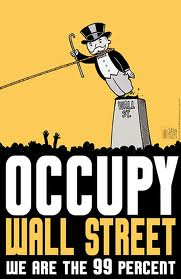 Park on St. Pat’s Day to celebrate the Movement’s six-month anniversary. From on the ground reports, the demonstration was peaceful. Until the NYPD arrived. Then there was trouble—a number of arrests and one woman reportedly had a seizure after she was thrown to the ground and handcuffed. Several participants said it took 17 minutes for the police to react, after which an ambulance was called.
For naysayers, the Occupy Wall St. Movement [OWS], their members and reasons for being were summarily dismissed before they began. Who is the leader of this motley group? journalists and pundits asked repeatedly. What do these people want?
Surprisingly, there is a leader or so I’ve read, someone well known to Occupy organizers but deliberately kept out of public view. As far as what they want? The answer seemed perfectly clear to me at the start because I think it’s what most Americans want or if they don’t want it, they expect it: an end to the gross inequality in the country, for which Wall St. and Government collusion holds the lion’s share of responsibility and an end to ‘bought’ elections, where the 1% and corporate interests routinely choose our leaders, shape policy and control the message, known in polite circles as ‘perception management.’
All of this transcends parties, btw. We’re talking Republican and Democratic parties alike, regardless of how many times we enter the ‘lesser than two evils’ spin.
You don’t need to be a psychic to ‘get’ the OWS message. You don’t even need to be a member of Occupy. All that’s needed is a modicum of alertness, a shaking-off of the trance-inducing distraction and deflection of pundits, media hounds and political operators.
So, what has OWS managed to accomplish, thus far? According to the critics—not a damn thing. But is that really the case?
Last summer, the headlines were ripe with talk of deficits, crushing debt and woe is me. We need a Grand Bargain, wisemen crooned [translation: we need to cut public services]. Somehow, we always have money for foreign adventures, national security, weapons and surveillance equipment. For instance, how many drones will be in American skies by 2020? Hummm. Try 30,000. That’s the Federal Aviation Administration’s rough estimate. The ever popular ‘shop ‘til you drop’ hee-haw isn’t working either, even with the news that ‘average’ Americans are flocking back to restaurant dining. Despite a stumbling economy there is money for weapons and drones and assorted homeland security gear. When it comes to education, infrastructure, home mortgage write downs, decent healthcare, aide to our poor, disabled and elderly? We’re just stone-broke and need to be put on an austerity diet. See Paul Ryan’s reiteration on social program slashes and numbers that don’t add up. It’s a nice set piece that will contrast with the soon-to-come kinder and gentler Democratic version.
One could call the dialogue change a bizarre coincidence but public conversation pivoted after Occupy came on the scene. We went from Oooooo, we need to slash Medicare, Medicaid and refigure Social Security to why is Wall St. getting bailed out on the backs of the taxpayer? Why do we have a system where the profits go to the top income bracket, while risk is carried by Main Street? Why have the wages of middle-class workers[if they’re fortunate enough to still have a job] barely kept pace with inflation, while the top 1% has had a 275% increase in income?
Uncomfortable questions, the sort that make politicians squirm.
OWS has also focused attention on home foreclosures, working with foreclosed families to save their homes. The Movement rallied the public in a Change Your Bank Day strategy that is estimated to cost TBTFs a $185 billion in transfers to community banks and credit unions. Religious organizations have joined the effort. According to Think Progress, The New Bottom Line, a coalition of faith groups has pledged to remove $1 billion from the major banks this year alone. OWS also pushed against the ATM fee-increase proposal; the banks pulled back. In late February, Occupy the SEC submitted a 300+ page document, urging regulators to resist the financial sector’s desire to water down the Volker Rule, part of the Dodd-Frank Wall St. reform. The group that put the document together was comprised of former Wall St. workers. OWS members also stood with private landowners, Tea Party members and environmentalists protesting the Keystone XL pipeline, a project that the President has expressed a new-found love for.
Not too shabby for six months activism. Yet still the critics howl. Where is the direction, what are the goals?
The Movement is young and still developing but you cannot fault it for sitting on its hands. More importantly, the Occupy spirit is global in nature because many activists are ‘graduates without a future’—young, educated and fed up. Paul Mason documented this facet of the worldwide

Arundhati Roy
social/political movements in his book, “Why It’s Kicking Off Everywhere,” and Arundhati Roy wrote this in a recent essay: “Capitalism, A Ghost Story”:
As Gush-Up concentrates wealth on to the tip of a shining pin on which our billionaires pirouette, tidal waves of money crash through the institutions of democracy—the courts, Parliament as well as the media, seriously compromising their ability to function in the ways they are meant to. The noisier the carnival around elections, the less sure we are that democracy really exists.
Sound familiar? The neoliberal model, the gross inequality that rewards the few at the expense of the many has circled the globe, creating universal discontent and misery.
So, what’s coming up for 2012? What will Occupy 2.0 look like?
I’d suggest checking the OWS page here for an updated list of scheduled actions. OWS plans to be in Chicago in mid-May to protest the NATO Summit although the city is throwing up barriers to prevent demonstrations. Somehow, I don’t think the protest will be stopped.
May 1 will be a National Action, the day traditionally known as International Worker’s Day. This year OWS is calling for a General Strike across the country. From the Occupy site:
We are calling on everyone who supports the cause of economic justice and true democracy to take part: No Work, No School, No Housework, No Shopping, No Banking – and most importantly, TAKE THE STREETS!
This Saturday, March 24, a Disrupt Dirty Power protest has been called in NYC to jumpstart a month-long action until Earth Day, April 22. More information here.
Sunday, March 25, Occupy Town Square IV will focus on public parks and other public spaces in NYC. More info here.
If you’re interested in local actions in particular states, towns, cities or countries, info can be found at the Occupy Together site here.
And if you want to eliminate the idea of ‘a failed movement’ from your brain. Check out the participation map here. The scope is massive.
The essay I mentioned by Arundhati Roy is well worth a read—highly informative, even shocking about vulture capitalism’s impact on India. Be prepared, it’s long. As Roy moves into her concluding paragraphs, she writes this:
Capitalism is in crisis. Trickledown failed. Now Gush-Up is in trouble too. The international financial meltdown is closing in. India’s growth rate has plummeted to 6.9 per cent. Foreign investment is pulling out. Major international corporations are sitting on huge piles of money, not sure where to invest it, not sure how the financial crisis will play out. This is a major, structural crack in the juggernaut of global capital.
Capitalism’s real “grave-diggers” may end up being its own delusional Cardinals, who have turned ideology into faith. Despite their strategic brilliance, they seem to have trouble grasping a simple fact: Capitalism is destroying the planet. The two old tricks that dug it out of past crises—War and Shopping—simply will not work.
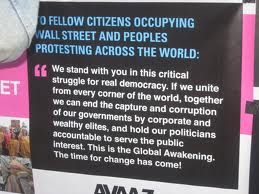
Disaster capitalism has certainly lived up to its name, be it continuous war, environmental degradation or exploding poverty. What is Occupy about? Speaking for myself, Occupy is about a break of faith with a global economic system that serves no one but an elite minority, where infinite money and power is the only morality. The movement is a massive rejection of the ongoing mantra: there’s no other way. Occupy challenges that static position, calls on us to envision something else, something better than the consensus mind. It dares us to shake off the old and embrace a sense of possibility. It demands we wake up, now.
What The Irish Can Teach Us
Posted: March 18, 2012 Filed under: Barbara Ehrenreich, Charles Murray, corporatism, Economy, financial institutions, free market ideology, hunger, income inequality, The Great Hunger, U.S. Economy, unemployment, voodoo economics, worker rights 12 CommentsNow that we’ve all been Irish for a day–donning the green, marching or watching parades and downing those pints at the local bar, we might ask ourselves [whether we’re from Irish American backgrounds or not]: Is there anything more the Irish can teach us?
Running across an essay by Barbara Ehrenreich on American poverty, specifically the lingering, depressing notion of the ‘culture of poverty’ and
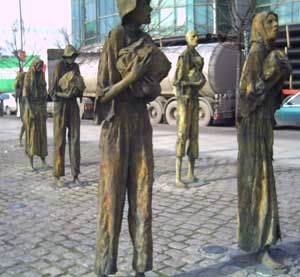
Dublin's Famine Memorial
having listened to Charles Murray on Book TV discuss his recent book, “Coming Apart: The State of White America, 1960-2012,” I think the answer is a resounding ‘yes.’
As Ehrenreich reminds us, the idea that poor people are inherently different than the affluent and in fact, need to be changed, corrected, put right has been an enduring theme of the conservative right. The inequality between the poor and the rich is not a matter of jobs or opportunity, education or money, so the theory goes. It’s about the poor being substantially flawed. They lack core values: ambition, get-up-and-go, faith, and the ability to plan for the future. The poor are impulsive, promiscuous, prone to addiction and crime and, as Ehrenreich points out, theorists all contend that the poor ‘certainly cannot be trusted with money.’
Charles Murray’s presentation picks up on the ‘culture of poverty’ theory and runs with it like a champion of reason and rightness. The American Project, Murray contends, the continuation of a civil society is threatened because the working class and upper-middle class are of a different kind altogether. The unraveling of America has nothing to do with the inequality of income but the inequality of culture.
Murray uses two ‘symbolic’ communities to illustrate his thesis: Belmont and Fishtown though both communities actually exist—Belmont, an affluent neighborhood outside Boston and Fishtown, a working class neighborhood of Philadelphia. Murray goes on to compare the two communities in four main areas: marriage, industriousness, honesty, and religiosity. And surprise, surprise. Fishtown gets a failing grade on all scores.
What does this have to do with the Irish? I suggest a quick trip back in time, say to the mid-19th century during what became known as the Great Hunger.
Ireland was heavily populated with subsistence/tenant farmers, generally in debt to their English landlords. Most have heard of the ‘great potato blight’ of 1845-1849 when over 1 million Irish died of starvation. What many may not know is that the the affluent English landlords were exporting an abundance of grain, meat and dairy for profit as the Irish poor starved. And the conservative government response? Their policy was one of laissez faire, leave well enough alone. As the Assistant Secretary of Ireland reportedly said at the time: to give the people something for nothing, ‘would have the country on us for an indefinite time.’ The fear of dependency was greater than watching the population starve. Free market policies and workhouses became popular. But still people died. In droves. The fields of once blighted potatoes became graveyards.
How were the Irish viewed by ‘polite’ English society? The Irish were considered brutish, lazy, devious, promiscuous, prone to crime and heavy drinking. Worse yet—they were Catholic.
The point is that this warped view on poverty is not new. Nor are the political responses. Even when a population was starving to death en masse, the response in Ireland was an ideological one: people had to work to be fed, even when they were too weak and sick to stand upright.
The Irish know this. They remembered it well and passed the bleak stories down to their descendants. The impoverished Irish immigrants, those who came to America [if they survived the ocean crossing], found the same weary stereotypes waiting on another shore. Anyone with Irish American grandparents or other family oldsters have likely heard the tales of blatant bigotry while growing up—the ‘no dogs or Irish’ signs in shop windows.
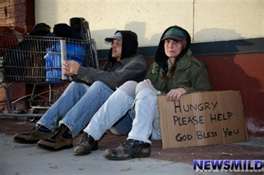 Still I found it amazing that Murray could say the main problem threatening the Nation today is not income inequality but cultural inequality. Minx wrote a very effective piece last week on the growing poverty in the US. Cited in her post was a statement by Tavis Smiley, who is pushing to have the issue of exploding poverty included in the 2012 election:
Women are much more likely to be poor than men, and more than a million children have fallen into poverty, and more than 500,000 have fallen into extreme poverty” — that is, living on less than $2 a day — “since 2010.” Recent census data shows that the number of children who live in extreme poverty has doubled from 1996 to 2011, from 1.4 million to 2.8 million.
And yet, as Minx pointed out a number of states: Kansas, Utah and Nebraska have initiated policies to cut food stamps to needy children.
Well here’s a factoid that turns the whole cultural argument on its head: the fastest growing segment of the newly poor are in suburban neighborhoods.

Warrensville Heights, Cleveland suburb, photo:dustin franz,NYT
Some of this is due to changing demographics but the larger percentage has to do with long-term unemployment, stagnate wages, off-shoring, the housing debacle, etc., etc. Here’s a chilling study from the same link:
Mark Rank, a social welfare professor at Washington University in St. Louis, has written extensively about shifts in U.S. poverty since the 1960s, and finds that Americans today are more likely to face poverty than in the past. According to Rank’s data, 24 percent of people who were in their 20s in the 1970s were likely to experience poverty at some point in their lives. That number rose to 31 percent in the 1980s and 37 percent in the 1990s. Today a majority of Americans-51.4 percent, according to the Urban Institute-will experience poverty by the time they’re 65.
Are we to believe that this sudden shift to poverty or expectation of poverty is all about lost moral/cultural compasses? Charles Murray would say, ‘yes.’ He suggests that the upper-middle class reach out, reintegrate and reeducate the working classes in the four pillars of civil society: marriage, industriousness, honesty and religiosity. Note that Murray’s study just happens to begin at the soon-to-be turbulent 1960s. Ahhh, if only we could go back to those Father Knows Best days.
In contrast, Barbara Ehrenreich pointedly says:
. . . a new discovery of poverty is long overdue. This time, we’ll have to take account not only of stereotypical Skid Row residents and Appalachians, but of foreclosed-upon suburbanites, laid-off tech workers, and America’s ever-growing army of the “working poor.” And if we look closely enough, we’ll have to conclude that poverty is not, after all, a cultural aberration or a character flaw. Poverty is a shortage of money.
My suggestion? Find yourself an Irish grandmother, the older the better. She’ll give you an earful. Generational memory is a powerful thing!

 peej
peej Carissa
 bostonboomer
 dakinikat
 ecocatwoman
 jjlo
jjlo mablue2
 Mama Lopez
 peggysue22
 quixote
 skydancingguestblogger
 Mona (aka Wonk the Vote)





Recent Comments