
We have NOT come a long way, baby
Posted: July 30, 2008 Filed under: Hillary Clinton: Her Campaign for All of Us, U.S. Economy, Uncategorized, Women's Rights | Tags: Equal Pay for Equal Work, Hillary Clinton, The Paycheck Fairness Act, Women's Rights Comments Off on We have NOT come a long way, baby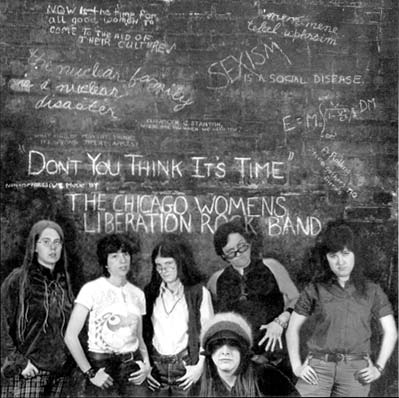 I’m the stereotypical PUMA. I came of age in the 70s and joined the UWAG (University Women’s Action Group) while at the University of Nebraska working on the first of several degrees. I remember fighting hard to get tougher rape laws in place including getting officers assigned to rape cases out of the Property Crimes Department and lobbying for laws that would let raped wives charge their husbands with rape. This was not possible at that time. We’ve made considerable progress on that front. We now don’t need two to three people to witness rapes in order to get rapists prosecuted. We also can charge our husbands with rape. Violet crimes against women are no longer consider property crimes.
I also worked hard for the ERA. That failed to pass although I travelled to both Missouri and Oklahoma to try to get the last few states to pass it. I also was trying to fight Nebraska’s attempt to take back it’s pro-ERA vote sponsored by my local state senator who was also a neighbor and father to two of the least popular guys in my high school. I always thought he’d sponsor the bill because neither of his sons had much luck getting dates back in the day. He was mad that women could actually support themselves and therefor not have to marry the first thing that comes along to survive their adult lives.
I’m now an economist, and perhaps Equal Pay for Equal Work is the subject that is nearest and dearest too me. We have another chance to right this problem. What amazes me is that the current pay gap faced by my young daughters today –one being 25 and in her last year of med school and the other 18 and heading to university–is the same pay gap I faced at their age. This is one legacy I’d rather not leave to them. Women still earn 77 cents to men’s $1 for the same job with the same qualifications. There is not one state in the country where women have gained traction on men’s pay. There is an act now in Congress seeking to right this wrong once in for all, it is called the Paycheck Fairness Act.
The Paycheck Fairness Act would “close loopholes that have allowed employers to avoid responsibility for discriminatory pay” and strengthen accountability in the workplace. The legislation increases penalties for sex discrimination in pay unless the company has a business-related reason for the inequality in wages. The PFA puts gender discrimination sanctions on equal footing with other forms of wage discrimination such as those based on race, disability, or age, allowing women to file lawsuits for compensatory and punitive damages. The bill also prohibits employers retaliating against employees who share salary information with their co-workers. The legislation also strengthens opportunities for women. The Act requires that the Department of Labor “improve outreach and training efforts to work with employers in order to eliminate pay disparities” and “creates a new grant program to help strengthen the negotiation skills of girls and women.”
Source: From the Progress Reporthttp://pr.thinkprogress.org/
So think about which Senators would be most likely fighting for gender equality that would be the sponsors of the bill? Yup, it’s our Hillary again. Sen. Hillary Clinton (D-NY) and Rep. Rosa DeLauro (D-CT) put this bill into play
The Institute of Women’s Policy Research found that this wage disparity will cost women anywhere from $400,000 to $2 million over a lifetime in lost wages. An April Senate report found that in contrast to previous slowdowns, the current economic downturn “is hitting women harder than men. They are suffering more job losses and larger reductions in wages than the general population.”
I, like any parent, want to leave my children in a better position in life. Just by having daughters instead of sons, I know they will suffer the same paycheck inequality that I have endured throughout my adult life. This is yet another reason to thank Hillary and to write your Senators and Congress to support this Bill.
The senators that are sponsoring this bill:
The Paycheck Fairness Act is co-sponsored by Senators Joseph Biden (D-DE), Barbara Boxer (D-CA), Sherrod Brown (D-OH), Maria Cantwell (D-WA), Christopher Dodd (D-CT), Russell Feingold (D-WI), Tom Harkin (D-IA), Edward Kennedy (D-MA), John Kerry (D-MA), Amy Klobuchar (D-MN), Frank Lautenberg (D-NJ), Patrick Leahy (D-VT), Robert Menendez (D-NJ), Barbara Mikulski (D-MD), Patty Murray (D-WA), Jack Reed (D-RI), Harry Reid (D-NV), Charles Schumer (D-NY), and Bernard Sanders (I-VT).
Also, NOTICE who’s name is missing?
For more information please go to Senator Clintons site:
http://clinton.senate.gov/news/statements/details.cfm?id=272301&&
In Other News … There’s an Environmental Disaster in My Back Yard
Posted: July 25, 2008 Filed under: New Orleans, U.S. Economy | Tags: Environmental disaster, Mississippi Oil Spill, New Orleans Oil Spill 6 Comments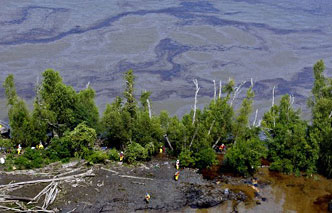 While the East Coast-centric press is following the very junior senator’s campaign to look presidential and world leaderly, there’s a major oil spill in my back yard. I live about three blocks from the Mississippi river in New Orleans and for the last three days, my home and my neighborhood have smelled like diesel. My nose is burning and I have a headache. About 9,000 barrels or 400,000 gallons of nasty, unrefined, sludgy oil spilled in the river that is the life blood of America’s trade–we’re loosing about $275 million in trade every day that it’s closed. That’s not a good thing for an economy teetering on recession.
There are a variety of issues going on with this huge spill and the coverage by the national media has been pathetic. The West Bank area of New Orleans along with two downriver parishes are in a state of water emergency. Their water purification facilities have had to close access to the water coming from the Mississippi and they’re about to run out of potable water. These two parishes were some of the hardest hit by Hurricane Katrina and the small towns scattered around the parishes are still experiencing problems even three years after the devastating storm. Just when these folks thought they were winding down their stormy relationship with FEMA, they’re now depending on the agency again. This time for drinking water and the oil washing up on their levees and coastlines.
Here we go again.
http://www.incidentnews.gov/incident/7861
There was an article in today’s NY Times on the devastating spill. We have yet to see the full environmental impact, but I think it’s safe to say, if you like to give baths to birds and swamp critters, we’re going to need you down here shortly as this putrid puddle is making its way down river to the environmentally sensitive wetlands and swamps. These same areas protect New Orleans from any hurricanes this year. The swamp grasses slow down hurricanes as they move on shore.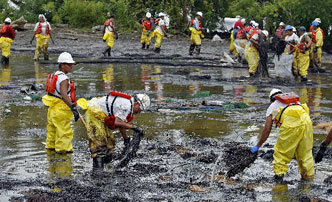
July 25, 2008
Oil Spill on Nearly 100 Miles of Mississippi River By ADAM NOSSITER
NEW ORLEANS — A sheen of oil coated the Mississippi River for nearly 100 miles from the center of this city to the Gulf of Mexico on Thursday following the worst oil spill here in nearly a decade. The fuel-laden barge that collided with a heavy tanker on Wednesday was still leaking.
The thick industrial fuel pouring from the barge could be smelled for miles in city neighborhoods up and down the river, even as hundreds of cleanup workers struggled to contain the hundreds of thousands of gallons. Some environmentalists worried about reports of fish and bird kills in sensitive marsh areas downstream, though officials said they had so far heard of only a handful of oil-covered birds. Booms to protect areas richest in wildlife, at the river’s mouth, were being deployed, officials said.
The Mississippi remained closed to all boat traffic, stranding about 65 vessels. The effect on the area’s economy was thought to be significant, with this city’s port estimating a loss of at least $100,000 a day and probably more as the river remained closed, and petrochemical facilities dependent on it for shipping were threatened with a bottleneck, the Coast Guard said. Some suburbs stopped drawing drinking water from the river.
“We’ve had a number of large spills in the New Orleans area, but this is a heavy, nasty product, problematic in the cleanup,” said Lt. Cmdr. Cheri Ben-Iesau of the Coast Guard, adding that it is of the sort normally used to fire up boilers at power plants.
“It’s a significant spill, if for nothing else because of its impact on the water supply,” Commander Ben-Iesau said. “We’ve got a lot of commerce dependent on this water supply, so we’re scrambling to get it cleaned up.”
On Thursday afternoon, the picturesque walk along the Mississippi at the French Quarter, normally full of tourists and pedestrians, was nearly deserted as a pungent chemical stench wafted up from the oil- covered water. A few skimmer boats, deployed to suck up the oil, constituted the only traffic on the nearly half-mile-wide river; a plastic boom to contain the fuel hugged the rocky shoreline, and the seagulls had disappeared.
“It’s going to take a good couple of weeks to get it all off,” said Petty Officer Jesse Kavanaugh of the Coast Guard, surveying the oily muck. Officials were unable to predict how long the river might remain closed, however. “We’re hoping days, not weeks,” Commander Ben- Iesau said.
The 61-foot barge that has been leaking heavy fuel oil for nearly two days could be seen underneath the mammoth Crescent City Connection bridge. It was carrying 419,000 gallons of the heavy fuel it had just picked up from an oil distributor when it collided with a 600-foot tanker ship around 1:30 a.m., just off this city’s Uptown neighborhoods. The tanker did not leak.
Coast Guard officials said the tugboat operator pushing the barge, from the local DRD Towing Company, was improperly licensed, possessing only the equivalent of an apprentice certificate. They said the incident was being closely investigated, though no blame had yet been assigned.
Oil continued to leak from the barge Thursday afternoon, and the Coast Guard was deploying a diver to check the flow.
Mayor C. Ray Nagin told residents of the city’s neighborhoods on the east bank of the Mississippi that they could safely drink the tap water, though he was more cautious about water in the one neighborhood on the west bank, Algiers. Meanwhile, water intake facilities in the neighboring parishes of St. Bernard and Plaquemines remained closed. There were no respiratory risks, officials said, despite the sometimes heavy odor.
As the oil slick moved downstream, officials remained concerned about the impact on the Delta National Wildlife Refuge, at the mouth of the Mississippi, and they were scrambling to place booms around it. Tens of thousands of feet of the plastic booms had already been put in place Thursday. If the oil flows through the main pass, or outlet, and on into the Gulf of Mexico, the effect will be limited; but if it seeps into the secondary passes, there is a more serious risk to the environment, they said.
“I’m very concerned, but I don’t think it’s a calamity of the proportions of Exxon Valdez,” said Robert A. Thomas, director of the Center for Environmental Communication at Loyola University. “Here, you’re talking about an enormous amount of oil, but it’s in a river that averages about 450,000 thousand cubic feet per second of flow,” he said.
“It’s going to flush this stuff out,” Mr. Thomas said.
Officials were generally guarded about the possible effects on fish, plants and wildlife in these rivers of grass and marshlands, but some in the state’s environmental community were not.
“When it goes down to the area where there are no longer levees, it gets into the swamp,” said Wilma Subra of the Louisiana Environmental Action Network. “It’s going to contaminate the marsh.”
Ms. Subra said she had heard reports of dead fish and birds, and of people vomiting, but officials and the local Sierra Club could not confirm these reports.
source:
http://www.nytimes.com/2008/07/25/us/25spill.html
Is it just me or is this a HUGE story that deserves front page coverage? Shouldn’t it be the lead story in TV News? We’re not talking chump change or small problem here.
Fasten your seltbelts, it’s going to be a bumpy night
Posted: July 15, 2008 Filed under: U.S. Economy | Tags: Add new tag, Bail out of Fannie Mae and Freddie Mac, bernanke, paulso 2 CommentsGet rid of your variable rate loans quickly and hold on to your jobs. The Fed’s about to raise rates. Bernanke and Paulson continue the tango to deal with the economy. Today’s news brought a record, whopping exchange rate for the Euro against the dollar and at the moment the Dow Jones Average is down triple digits. If I thought my morning coffee and blogging was going to be quiet, I was wrong. What’s going on in the financial markets right now is to economists as Hurricane Katrina was to meteorologists. This is as big as it gets. So here’s the most interesting of all my MarketWatch updates this morning.
source: http://www.marketwatch.com/ (This is site is affliated with the WSJ)
WASHINGTON (MarketWatch) – The potential for runaway price hikes is the top concern of Federal Reserve policymakers, according to testimony by Fed chairman Ben Bernanke and the accompanying report on the economic outlook of his colleagues on the central bank released Tuesday. FOMC members were more uncomfortable about the inflation outlook in June than they had been at any point in the year, according to the Fed’s monetary report to Congress. The Fed is worried that high oil prices, combined with the weak dollar, will increase business costs and prices. At the same time, it could make workers demand higher compensation because of the more expensive cost of living. As a result, most Fed members viewed the possibility that inflation could come in higher than expected in coming months.
I’ve been telling my students for months that interest rate drops were going to stop. I was rather suprised by the last one. However, problems in the housing market were trumping the higher inflation rates indicated by the CPI and the Fed’s preferred measure the CPE. Evidently, the Fed has decided that rising prices are more of a danger than a recession and have just announced in a big way there will be no more rate drops. My guess is they will quietly and slowly start pulling money out of the economy. Usually this is done with a series of open market sales of treasury bills by the fed. As the increased demand for the bonds/bills drives bond prices down, it will drive interest rates up.
So this market watch bulletin was followed by two other ones pretty quickly. One stated that GM was suspending dividends–something highly unusual for this type of stock. Also, it is cutting 20% of salary costs to boost it’s liquidity. This undoubtedly means either a hiring freeze or more layoffs. It’s possible it could be elimination of bonuses or salary cuts. Either way, it’s more bad news for the Michigan.
Then there was this next big of information. Did i mention my email box was full of MarketWatches today?
June retail sales fizzle despite stimulus
WASHINGTON (MarketWatch) – U.S. retail sales rose a disappointing 0.1% in June despite nearly $50 billion in stimulus checks for consumers, Commerce Department data released Tuesday revealed. Sales were boosted by higher prices for gasoline, food and other consumer goods. The figures are seasonally adjusted but are not adjusted for inflation. It was the weakest sales since February’s 0.2% decline. Sales in June were held back by the biggest drop in auto sales in more than two years. By contrast, sales at the malls and shopping centers were relatively healthy, stimulated by the tax rebate checks, Excluding the 3.3% drop in auto sales, sales rose 0.8%, the slowest in three months.
That didn’t surprise me at all. Rebates are usually the worst way to stimulate the economy. Most of them wind up paying off already purchased items. How many of you used the checks to pay down a credit card?
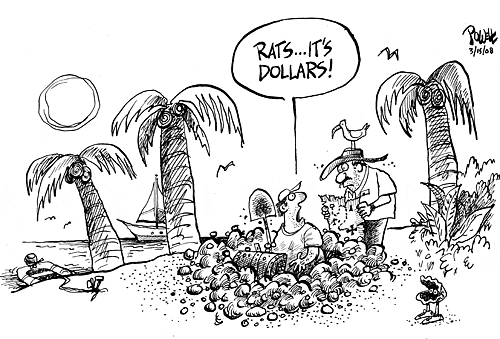
What continues to amaze me in all of this is the topics in political debate. The candidates are not getting that it’s the economy stupid! Obama is giving a ‘major’ speech on Iraq. McCain was out speaking to the Latino vote on immigration yesterday. Somebody needs to put these two through some freshmen economics courses and quick! Their lack of interest and knowledge is glaring and gives the appearance they really don’t care. Economic news of this sort is becoming a daily event. Their responses have been to send out their talking heads. Let’s face it, their economic advisers doing their thing on CNN and Fox, is not the same as the candidates showing some grasp of the problems. Frankly, I think they’re afraid of taking questions and looking ignorant. Obama is only effective on the teleprompter and McCain when he talks off the cuff. Any real dialogue would just emphasize their vacuity on the subject.
The Real Whiners and Losers
Posted: July 14, 2008 Filed under: U.S. Economy | Tags: Bail out of Fannie Mae and Freddie Mac, Financial Crisis, Mortgage Crisis 6 CommentsIf there are whiners in the U.S. economy, it has to be the American Investor who is never satisfied with a normal rate of return. These investors frequently ‘rent-seek’. In Financial Economics, this is akin to finding some way around the market by gaining power over market regulators or lawmakers, or decision makers. It is best understood as a form of political bribery or executive extortion. The majority of investors and businesses are looking for monopoly profits and ways to earn them. They really don’t want to be part of a competitive market and true market capitalism. They are simply seeking monopoly and the extraordinary profits that come from having monopoly control of a market.
Monopoly profits are way beyond the ability of the normal investment and are usually due to some kind of manipulation, control, or problem (which we call friction) in a market. It is due to something other than a market behaving as Adam’s Smith’s invisible hand would suggest. It is a form of winning from something other than fair play. Frequently, it is due to capturing regulators or gaining advantage by forcing some kind of law using lawmakers eager to support business but ignorant of economics.
No group is more guilty of this than investors in Financial Markets. In the theoretical realm, most financial markets would not exist if everything were perfect in markets. This is especially true of banks. They exist because of imperfect information. They make profits by taking advantage of weaknesses in markets. However, many are not satisfied with skimming a small fee for providing information and some services that make life easier for the financially ill-equipped. They want to make WHOPPING FEES. The greed goes up and down Wall Street. Their enablers are both Democrat and Republican Senators and Congressman that allow them to operate without restriction, give them tax breaks for any whim, and turn a back when they engage in grossly speculative behavior but seek bail out at the slightest turn of the market.
My Market Watch Newsletter hit my email even before the markets could open in the U.S. and well after the Asian markets reacted badly. As well, they should. Government should NEVER allow businesses to gamble when it comes to house loans or folks’ life savings. They’re bailing out the predators. Now, will they help the prey?
WASHINGTON (MarketWatch) — The implicit government guarantee of Fannie Mae and Freddie Mac is now explicitThe Senate passed its version of the legislation last week and sent it back to the House of another vote. It is expected to get to President Bush for his signature before Congress leaves town for its summer recess at the beginning of August.It would be logical to attach the lifeboat for Fannie and Freddie to the housing rescue measure.It is not clear how Congress will react to Paulson’s request. The Treasury secretary said he has been in close contact with the Congressional leadership over the weekend, so his request will not come as a surprise to lawmakers.That would be a bitter pill for Fannie and Freddie, which have been at loggerheads with the central bank over the capital issue for years.
In a dramatic statement released Sunday, the White House and Federal Reserve moved to give the mortgage giants the capital they need to survive the depression in the housing market and turmoil in financial markets that had left them dangling over a cliff.Of most immediate importance, the Fed’s board of governors voted to open up its emergency discount window to Fannie and Freddie.In addition, Treasury Secretary Henry Paulson announced that he will seek Congressional authorization to by stock in the two companies and increase the government’s credit line.At the moment, each company may borrow only $2.25 billion.In return for the capital, Paulson said that the Bush administration would ask Congress to grant the Fed a “consultative” role in the capital standards of the companies.The housing rescue package that is nearing final approval by Congress would put in place a strong independent regulator for the companies is slowly moving through Congress. Paulson says he wants a new provision allowing the Fed to work hand-in-hand with the new agency.
Both of these agencies are chartered by Congress but owned by private stockholders. In a continuing melodrama where investors insist on unrealistic REAL returns, CEOs and CFOs buy special treatment in Washinton and seek surreptitious ways to circumvent regulatory responsibility as well as responsibilities to the customers they serve. Financial Institutions serve a special role in the economy. They not only return profits to investors, they are the keyholders to the American Dream. They hold funding for college, for homes, and for a secure and stress-free retirement. If they do not live up to both their fiduciary responsibilities as well as their responsibilities to function as proper underwriters, they deserve to be nationalized and to have their for profit status stripped from them.
I know this is a somewhat radical view. However, this is hardly the first time this sort of thing has happened. We have lived through the excesses of the period leading to the great depression. We have lived also, through the period of greed known as the 80s with its financial excesses and the dot.com bubble. If executive officers are not rewarded by investors for taking prudent and long run view points to their investments, perhaps they should be nonprofits when the stakes are so high they will fall to the taxpayer when bad management prevails.
We can not afford investors that wish to profiteer extraordinarily from the least among us. Nor can we afford, as a citizenry, to tolerate management that will cave to pressure to produce above market rates of return from investments that should NOT perform thusly. High rates of returns come from high risk assets which frequently tank. High risk usually comes from uncredit worthy or highly speculative investments. If we learned anything from the Great Depression, it is that some management decisions can not be left to the weak minded and ill-informed asset manager who makes fees based on volume and return. They can leave with their profits. The duped borrower becomes homeless or pensionless. Bad underwriting leaves a mess that taxpayer cleans up one way or the other.
I ask Barney Frank, Ben Bernanke, and all those with regulatory responsibilities to ask themselves this question. When is it that certain financial decisions, when made by the market, are so incredibly hurtful that they can not be allowed? After all, this is not the market for beer, or jeans, or some kind of stinky perfume. When it involves the financial devastation of ordinary Americans seeking homes, college educations, and secure retirements, is NOT their interest as important as the profits of the risk takers? It is TIME for regulation to catch up with the twists and turns of these new derivatives markets and of the investors who ask for more profit than they are entitled. It is one thing to make a profit from competitive advantage or from creating a better mouse trap, it is nothing but chicanery to make a profit from stealing from information asymmetries which is the souped up way that we financial economists say the customers are generally uninformed and vulnerable.
It is time to QUIT bailing out the managers and the investors and time to start protecting the customers and borrowers. When lenders turn making loans into a game of charades, the borrower cannot be blamed for misreading the signals. When lawmakers turn their back to one side of the market and are complicent with the other, they are as bad as the perpetrator of the fraud.
McCainonomics: Red faces, voters who Whine, and Blue homeowners
Posted: July 11, 2008 Filed under: U.S. Economy | Tags: Economic policy, energy policy, global economics, Gramm, mccain, whining US Voters 9 CommentsWhile John McCain is calling the U.S. economy a shambles, Economic Adviser Phil Gram says buck up  America and quit whining. He says it’s ALL in our head.
So which of these guys has the correct answer? Well, on the one hand there’s this guy trying to get elected president, so what else is he going to say? Then on the other hand, we’re really not technically in a recession yet so Phil has a point. They are both right and they are both wrong which is something only an economist could say and I couldn’t resist living up to the old joke. Okay, I’ll break it down into a few more stylized facts.
Our growth rates is somewhere between 0 and 1, our unemployment rate is pretty much where it should be, and most of the economic indicators are mixed, at best. We’re in a very slugglish growth period, but there still some major economic indicators that are showing neutral or positive. That doesn’t mean that all of us are living the same reality, however. The real answer to the question depends on WHO you are and WHERE you live. The economy is stagnant at the moment, and we’re in for a period of time where Americans are going to have to get use to making some tough choices and not seeing forward momentum. We’re basically all working and staying pretty much in the same place. Our clothing is costing us a lot less. We’ve got electronic gadgets galore and they are all really cheap. Have you priced computers, dvd players, or stereos recently? They’re all pretty cheap and just about any one can get to them. However, health care, driving, and eating are going from cheap to pricey.
The question of high energy prices and the segments of America that aren’t doing so well come mostly from globalization of the world economy that brings both good developments and bad. This is not going to reverse. As the economy adjusts, all buyers will win from global trade but those whose jobs go abroad will loose, and some will loose big time. We buy cheap stuff from the Chinese, they turn around and buy cars and they want gas. This increased demand for gas means higher gas prices. The Chinese also take jobs away from the manufacturing sector because Chinese labor comes extremely cheap and doesn’t require a pension or health plan. Those folks working for those companies that are outsourcing to other countries are miserable. While the USA has a relatively low unemployment rate of around 5%, places like Michigan and Pennsylvania have 10% unemployment rates. They are suffering. So, if you’re in the medical sector, you’re going to be happy as a clam. If you’re in manufacturing, prepare for a new career. Also, the government has grants out there to retrain folks loosing jobs from NAFTA. If you can prove it’s from NAFTA, go get it now!
438,000 jobs have been lost bringing unemployment to 5.5 percent. This is not a bad situation now, but if it continues, chances are we will be looking more like recession. Economists consider this rate to be close to the rate that represents what it should be if we are operating at capacity. The big question is: WILL IT GO UP?
So what about the financial crisis? How widespread is the mortgage problem? The housing crunch is wrecking the construction industry in places like Miami, Las Vegas, and Los Angeles. However, down here in New Orleans, the construction industry can’t find enough workers and is booming like never before. So Housing Foreclosures are a major problem in places like California, Nevada, and Florida. Many of these foreclosures are for house flippers. These folks are speculators and can whine all they want but that’s business and that’s what you get when the market moves against you. However, folks that were suckered into bad loans by mortgage brokers are a different matter. These folks are loosing their homes for banks that were looking for high fee income and basically put people into mortgages they couldn’t handle. Government regulation and help is required here. We’re not likely to get that as long as Dubya is in office. He’s threatening to veto the current bill. (All of the sudden our prez (the BIG spender) goes fiscally responsible on us!) I’m waiting for both McCain or Obama to come up with specific plans here. Hillary Clinton was the only one who spoke to this situation and her answer was a moratorium on rates. I think we’re going to need some federal bonds to fund some of these folks. It’s something similiar to what we did during the Great Depression to keep families in their homes and off the street.
So there are several markets that are a huge mess. The automobile industry and some sectors of manufacturing and the financial industry which has spilled into the housing industry, But again, most of the impact from these sectors is hitting some states hard and other states not so much at all.
Unfortunately, a lot of the higher prices are due to those high food and gas prices which are not a function of a bad U.S. economy, they are a function of problems in the global economy. There is also a continuing pattern since the 1980s that has left the rich getting richer and the poor and middle class getting poorer. The income inequality problem is worsening in this country and it looks as though it will continue. This is why it is essential that everyone has access to quality education at all levels. We should consider allowing more students attend university on the taxpayer’s dollar. Aid should definitely be mean income tested. It is much cheaper to send a teenager to school than it is to house him in a jail for the rest of his life.
These are some steps we can take to solve some of these things. First, as long as U.S. business has to pick up the tab for worker’s health insurance, the U.S. worker will not be competitive. We need universal health care paid for by individuals/taxpayers on an ability-to-pay basis. Second, all agriculture price supports, set aside programs, and subsidies, especially to ethanol, should be halted. Third, we all need to conserve energy and switch to other fuels sources (with the exception of ethanol made from things that are food). If we are making biofuels, then we need to use garbage or chicken fat or some byproduct, not food itself.
So, which of the candidates are up to the challenge? I don’t think either of them are, but I’m waiting.

 peej
peej Carissa
 bostonboomer
 dakinikat
 ecocatwoman
 mablue2
 Mama Lopez
 peggysue22
 quixote
 skydancingguestblogger
 Mona (aka Wonk the Vote)



 Sky Dancing
Recent Comments