
New Year’s Day Reads: The Lousy Deal
Posted: January 1, 2013 Filed under: Fiscal Cliff, morning reads, U.S. Economy, U.S. Politics | Tags: 2013, Barack Obama, Joe Biden, John Boehner, Mitch McConnell, The Lousy Deal 35 Comments
First Night fireworks against the Boston skyline
Good Morning and Happy New Year!!!
Sorry to be late with this post. I got so discouraged last night with our dysfunctional government that I went to bed completely disgusted. After a good night’s sleep, I’m feeling slightly more optimistic, if not truly hopeful. If I have any hope, it’s that perhaps the American people will rise up and let the president and Congress know what a horrible job they are doing.
So, what’s happening this morning? We officially went over the fiscal cliff at midnight even though the Senate approved a half-baked, crappy “deal.” Politico reports:
Congress lost a mad, New Year’s Eve dash to beat the fiscal cliff deadline, cinching a deal with President Barack Obama to raise taxes on the wealthy and temporarily freeze deep spending cuts but failing to get it through both chambers before midnight.
So over the cliff the country went — though perhaps for only a day or two and, assuming no snags, without incurring the double whammy of another recession and higher unemployment.The measure, which would raise tax rates for families making more than $450,000 and delay deep across-the-board spending cuts for two months, cleared the Senate by an overwhelming 89-8 vote shortly after 2 a.m. The Republican-controlled House could take up the pact in a rare New Year’s Day session, though the timing of that chamber’s vote was not clear.
The $620 billion agreement was a major breakthrough in a partisan standoff that has dragged on for months, spooking Wall Street and threatening to hobble the economic recovery. It turned back the GOP’s two-decade-long refusal to raise tax rates, delivering a major win for the president.
The bill also canceled pay raises for members of Congress and averted an expected hike in the price of milk by extending expiring dairy policy.
Wow, they cancelled their own pay raises? That was big of them–not. They probably did that out of fear of an angry populace. And of course, we still have to watch the shameful spectacle of the tea party House wrangling over a deal that basically give them everything they wanted and more than they ever dreamed of.
From TPM, the Senators who voted against the deal:
The eight senators voting no were Michael Bennet (D-CO), Tom Carper (D-DE), Charles Grassley (R-IA), Tom Harkin (D-IA), Mike Lee (R-UT), Rand Paul (R-KY), Marco Rubio (R-FL), and Richard Shelby (R-AL).
Robert Reich calls it “A Lousy Deal on the Edge of the Fiscal Cliff.” I’m thinking that could be the new logo for this administration–“The Lousy Deal” as opposed to Roosevelt’s “New Deal.” Reich writes:
Details of the agreement reached by the president and congressional Republicans are still forthcoming, but from the look of it, Obama gave ground where he need not have.
What else is new?
Yes, the deal finally gets Republicans to accept a tax increase on the wealthy, but this is an inside-the-Beltway symbolic victory. If anyone believes this will make the GOP more amenable to future tax increases, they don’t know how rabidly extremist the GOP has become.
The deal also extends unemployment insurance for more than 2 million long-term unemployed. That’s important.
But I can’t help believe the president could have done better than this. After all, public opinion is overwhelmingly on his side. Republicans would have been blamed had no deal been achieved.
More importantly, the fiscal cliff is on the president’s side as well. If we go over it, he and the Democrats in the next Congress that starts later this week can quickly offer legislation that grants a middle-class tax cut and restores most military spending. Even rabid Republicans would be hard-pressed not to sign on.
I hate to say it, but it really looks like Obama pushed for this so he could give more away that he would have had to if we had just gone over the cliff without all the fake deal making.
Noam Scheiber writes at The New Republic: Democrats’ Cliff Compromise Is Bad; But the Strategic Consequences Are Disastrous.
I think the president made a huge mistake by negotiating over what he’d previously said was non-negotiable (namely, the expiration of the Bush tax cuts on income over $250,000). Then the White House compounded that mistake by sending Biden to “close” the deal when Harry Reid appeared to give up on it. As a practical matter, this signaled to Republicans that the White House wouldn’t walk away from the bargaining table, allowing the GOP to keep extracting concessions into the absolute final hours before the deadline….
I think a reasonable person can defend the bill on its own terms. The fact is that nudging up the tax threshold to $450,000 only sacrifices $100-200 billion in revenue over the next decade (against the $700-800 billion the administration would have secured with its original threshold), while allowing unemployment benefits to lapse would cause real pain to both the 2 million people directly affected and, indirectly, to the economy. Yes, Obama could have gotten the latter without giving up the former had he just waited another few days—at which point what the GOP considers a tax increase suddenly becomes a tax cut. But these things are always easier to pull the trigger on when you, er, don’t actually have to pull the trigger. I can’t begrudge Obama his wanting to avoid some downside risk for only a marginally better deal.
My far bigger gripe with the whole fiscal-cliff exercise has always been the strategic dimension—how it affects the next showdown with the GOP, and the one after that. Coming into the negotiation, Obama had two big problems: First, no matter how tough he talked, Republicans always assumed he’d blink in the end, for the simple reason that he pretty much always had. (This is one of the major themes of my book about his first term.) Second, despite the results of the most recent election, in which Obama won a fairly commanding victory on a platform of raising taxes on wealthy people, the GOP continued to believe that public opinion was mostly on its side. House Republicans cited the preservation of their majority—never mind that their own candidates received fewer total votes than House Democratic candidates—and polls showing most Americans still think government is too big.
No kidding. And I disagree that we shouldn’t begrudge Obama for not sticking to his promise to hold the line at $250,000. As I’ve written previously, Obama should not be involved in negotiations, because he either wants to lose to the Republicans or his need to please the people who hate him is just too strong. I don’t know which is the real problem, and it really doesn’t matter for practical purposes. He’s just a horrible negotiator, period. Now we have to watch another repulsive display of childish squabbling in a couple of months. Is this going to be the extent of what happens in Obama’s second term? With this incompetent, useless Congress, it’s entirely possible.
And of course we still have to wait and see what Boehner and his gang do.
In a joint statement late Monday, House GOP leaders promised to keep their commitment to act on the measure if it passes the Senate. But they say they won’t decide whether to accept the measure or to amend it and send it back to the Senate until lawmakers and their constituents have a chance to review the legislation.
Give me a frickin’ break! I’m going to end here, because there doesn’t seem to be much other news. What are you reading today. I look forward to clicking on your links.
Whatever else happens, I hope everyone has a great day today and a very happy new year in spite of the idiocy in Washington DC!!
Thursday Reads: Fiscal Cliff Crashes into Debt Ceiling, Villagers Blame Old People….And Other News
Posted: December 27, 2012 Filed under: 2012 presidential campaign, Barack Obama, Fiscal Cliff, morning reads, Surreality, U.S. Economy, U.S. Politics, We are so F'd | Tags: Chained CPI, Charles Pierce, Debt Ceiling, fiscal cliff, John Boehner, Mitt Romney, Piers Morgan, Social Security, Tagg Romney, Tim Geithner 26 Comments
Good Morning!!
The storm has moved into New England, but it’s mostly rain up here–very hard, windy, noisy rain. I’m very grateful it isn’t snow, but I feel for all the people down south of me who are getting hit harder. Take care, everyone!!
Yesterday Tim Geithner announced that the U.S. will hit the debt ceiling on December 31. He sent a letter (pdf) (also posted on the Treasury Department website)to Harry Reid with cc’s to other Congresscritters informing them that the Treasury can fiddle around and keep things going for at the most two months before the U.S. defaults on its debts for the first time in history.
Meanwhile, no negotiations on the “fiscal cliff” took place yesterday. John Boehner appears to have abdicated all responsibility and has announced that it’s up the the Senate to act; but Senators are in no hurry to rush back to Washington DC and clean up the House Republicans’ mess.
U.S. House of Representatives Speaker John Boehner on Wednesday urged the Senate to pass its version of legislation to avert the “fiscal cliff,” in a sign that congressional efforts to avoid a budget crisis are coming back to life days ahead of the year-end deadline.
In a statement issued by Boehner and his top lieutenants, the Republican leadership team said “the Senate must act first” to revive efforts to avert the $600 billion in automatic tax hikes and spending cuts due to be triggered on Jan. 1.
They promised that the House would weigh whatever legislation the Senate produced.
What are we paying these incompetent idiots for anyway? But of course no one is talking about cutting Congresspeople’s salaries–the pressure is all on Social Security recipients. Yesterday, Ruth Markus wrote a column in support of cutting benefits because seniors and disabled people (including disabled veterans) are getting too much money (the average SS check is $1,200 per month). She thinks everyone should gratefully embrace the Chained CPI.
Here’s how the CPI works. When taxes are being calculated, brackets, standard deductions, personal exemptions and the like are ratcheted up with inflation, protecting taxpayers from being forced to pay higher taxes for what is essentially the same amount of income they had previously.
Benefits — everything from Social Security to veterans’ benefits to federal pensions — are similarly adjusted upward to protect beneficiaries’ buying power from being relentlessly eroded.
Such indexing makes eminent sense. The difficulty — and the money-saving opportunity — arises because, in the view of most economists, the current method of calculating changes in the CPI overstates the inflation rate.
It fails to account for what economists call upper-level substitution bias, and what my mother would call plain common sense: If the price rises for a certain commodity in the basket of goods used to measure inflation, consumers will choose a cheaper alternative. In my house, when the price of beef soars, we substitute chicken.
The CPI doesn’t and, as a result, taxpayers are undercharged and beneficiaries are overpaid — a lot. The overestimate is small — less than 0.3 percentage points annually but, much like compound interest, it adds up over time.
What Marcus doesn’t seem to understand is that when your income is that low, beef and chicken are are both too expensive and you substitute peanut butter and dried beans. Except that peanut butter prices have skyrocketed–what’s the next step down, cat food?
Two economists responded to Markus. Dean Baker at the CEPR: Ruth Marcus Is Outraged by Overly Generous Social Security Checks.
Well, who can blame her? After all, we have tens of millions of seniors living high on Social Security checks averaging a bit over $1,200 a month at a time when folks like the CEOs in the Campaign to Fix the Debt are supposed to subsist on paychecks that typically come to $10 million to $20 million a year.
Anyhow, her main trick for cutting benefits is to adopt the chained consumer price index as the basis for the annual cost of living adjustment. This would have the effect of reducing benefits by 0.3 percentage points for each year of retirement. This means a beneficiary would see a 3 percent cut in benefits after 10 years, a 6 percent cut after 20 years and a 9 percent cut after 30 years. This is real money. Since Social Security is more than half the income for almost 70 percent of retirees and more than 90 percent of the income for 40 percent of retirees, the hit to the affected population would be considerably larger than the hit to the top 2 percent from ending the Bush era tax cuts.
But Marcus insists this cut must be done first and foremost in the name of accuracy, since the chained CPI is supposed to provide a better measure of the cost of living. She notes but quickly dismisses the evidence from the Bureau of Labor Statistics (BLS) consumer price index for the elderly (CPI-E), which shows that the rate of inflation seen by the elderly is somewhat higher than the overall rate of inflation.
Read Baker’s upteenth explanation of why the Chained CPI doesn’t accurately reflect spending for seniors at the link. He argues for continuing development of a CPI that takes into account that seniors spend greater proportions of their income on health care and basic necessities that can’t necessarily be replaced with cheaper substitutes.
Next, Jared Bernstein says he’s “convinced the Chained CPI is coming” and it is a benefit cut. He agrees with Baker that an elderly CPI would be a good thing, but says that Markus’ argument we should cut benefits now and deal with the injustices later makes no sense.
…as Dean notes, it would make a lot of sense to invest in a chained-weighted CPI that accounts for the notably different buying patterns of the elderly. Ruth Marcus critiques this point today but for reasons that don’t make sense to me. For example, she criticizes an elderly price index that would more heavily weight health care spending because “the burden of higher health costs falls unevenly among the elderly. Average costs are skewed upward by a minority who face very high out-of-pocket expenses…”
But a) all the commonly used price indexes use average costs and are thus “skewed” up and down when the underlying distribution is uneven, and b) there’s little question that the ‘old’ elderly—the ones most hurt by the switch to the chain-weighted measure—face high out-of-pocket medical costs.
Marcus goes on to endorse, as do we at CBPP, [immediately switching to the Chained CPI but protecting “vulnerable people from the impact”] and this is clearly the administration’s view as well—in fact, they’ve built in offsetting benefits to the poor, old elderly into their plan. That’s very important and salutary and one reason why I nervously support the switch.
But I’m more concerned than Ruth appears to be with the possibility that the current politics get us the chained CPI without the necessary protections.
It certainly looks like President Obama will go down in history as the Democrat who cut the New Deal off at the knees unless he suddenly realizes his legacy matters to him. Remember way back when Social Security was “off the table” because it doesn’t contribute to the deficit? Oh wait–that was only two weeks ago.
Tuesday Reads: Daniel Inouye, Richard Engel, and Fiscal Slope Trial Balloons and Lead Balloons
Posted: December 18, 2012 Filed under: Barack Obama, Fiscal Cliff, Medicaid, Medicare, morning reads, Social Security, U.S. Economy, U.S. Politics, unemployment | Tags: Bureau of Labor Statistics, Chained CPI, Daniel Inouye, Dean Baker, digby, experimental elderly index (CPI-E), Ezra Klein, inflation, Iran-Contra, Japanese-Americans, payroll tax holiday, Richard Engle, unemployment insurance, Watergate, World War II 57 Comments
Sen. Dan Inouye reads with children
Good Morning!!
Senator Dan Inouye, who died yesterday at age 88 was a Japanese American who fought for the U.S. in World War II. From Time Magazine:
On Dec. 7, 1941, high school senior Daniel Inouye knew he and other Japanese-Americans would face trouble when he saw Japanese dive bombers, torpedo planes and fighters on their way to bomb Pearl Harbor and other Oahu military bases.
He and other Japanese-Americans had wanted desperately to be accepted, he said, and that meant going to war.
“I felt that there was a need for us to demonstrate that we’re just as good as anybody else,” Inouye, who eventually went on to serve 50 years as a U.S. Senate from Hawaii, once said. “The price was bloody and expensive, but I felt we succeeded.”
Inouye had wanted to become a surgeon, but he lost his right arm in a firefight during the war. He was elected to the House in 1959 after Hawaii became a state. Inouye became well known nationally as a member of the Senate Watergate Committee and later as chairman of the Congressional committee that investigated the Iran Contra scandal.
In one of the most memorable exchanges of the Watergate proceedings, an attorney for two of Nixon’s closest advisers, John Ehrlichman and Bob Haldeman, referred to Inouye as a “little Jap.”
The attorney, John J. Wilson, later apologized. Inouye accepted the apology, noting that the slur came after he had muttered “what a liar” into a microphone that he thought had been turned off following Ehrlichman’s testimony.
Inouye achieved celebrity status when he served as chairman of the congressional panel investigating the Iran-Contra affair in 1987. That committee held lengthy hearings into allegations that top Reagan administration officials had facilitated the sale of weapons to Iran, in violation of a congressional arms embargo, in hopes of winning the release of American hostages in Iran and to raise money to help support anti-communist fighters in Nicaragua….
The panel sharply criticized Reagan for what it considered laxity in handling his duties as president. “We were fair,” Inouye said. “Not because we wanted to be fair but because we had to be fair.”
NBC foreign correspondent Richard Engel and his production team have been released after five days in captivity in Syria. The Guardian reports:
The group disappeared shortly after crossing into north-west Syria from Turkey last Thursday (13 December). NBC had no contact with the kidnappers and asked for a news blackout about the incident, which was observed by mainstream news outlets.
There was no request for a ransom during the time Engel and his crew were missing.
After being abducted they were put into the back of a truck and blindfolded before being transported to an unknown location, believed to be near the small town of Ma’arrat Misrin.
Throughout their captivity they were blindfolded and bound, but otherwise not physically harmed, said the network.
Read more at the link.
According to Beltway Bob (AKA Ezra Klein), a deal between President Obama and Speaker Boehner is in the offing, and it isn’t a good deal for old ladies who are trying to survive on Social Security.
Boehner offered to let tax rates rise for income over $1 million. The White House wanted to let tax rates rise for income over $250,000. The compromise will likely be somewhere in between. More revenue will come from limiting deductions, likely using some variant of the White House’s oft-proposed, oft-rejected idea for limiting itemized deductions to 28 percent. The total revenue raised by the two policies will likely be a bit north of $1 trillion. Congress will get instructions to use this new baseline to embark on tax reform next year. Importantly, if tax reform never happens, the revenue will already be locked in.
On the spending side, the Democrats’ headline concession will be accepting chained-CPI, which is to say, accepting a cut to Social Security benefits. Beyond that, the negotiators will agree to targets for spending cuts. Expect the final number here, too, to be in the neighborhood of $1 trillion, but also expect it to lack many specifics. Whether the cuts come from Medicare or Medicaid, whether they include raising the Medicare age, and many of the other contentious issues in the talks will be left up to Congress.
Now how is that a win for Democrats? If we go over the cliff, Republicans are going to be blamed, and taxes will go up on everyone until Republicans give in to public outcry in early January. But Social Security, Medicare, and Medicaid cuts will inevitably be blamed on Democrats, who are supposed to fight for the social safety net. Then in 2014, Republicans will attack them for those cuts, and it will work–just as it did when Romney and Ryan falsely accused Obama of cutting Medicare benefits in the recent presidential campaign. Back to Beltway Bob:
The deal will lift the spending sequester, but it will be backed up by, yes, another sequester-like policy. I’m told that the details on this next sequester haven’t been worked out yet, but the governing theory is that it should be more reasonable than the current sequester. That is to say, if the two parties can’t agree on something better, then this should be a policy they’re willing to live with.
On stimulus, unemployment insurance will be extended, as will the refundable tax credits. Some amount of infrastructure spending is likely. Perversely, the payroll tax cut, one of the most stimulative policies in the fiscal cliff, will likely be allowed to lapse, which will deal a big blow to the economy.
Again, that doesn’t sound like a win for Obama at all. Let’s hope Beltway Bob is wrong again.
Dean Baker on the chained CPI: He argues that the chained CPI is not really applicable to seniors.
The Bureau of Labor Statistics (BLS) has constructed an experimental elderly index (CPI-E) which reflects the consumption patterns of people over age 62. This index has shown a rate of inflation that averages 0.2-0.3 percentage points higher than the CPI-W.
The main reason for the higher rate of inflation is that the elderly devote a larger share of their income to health care, which has generally risen more rapidly in price than other items. It is also likely that the elderly are less able to substitute between goods, both due to the nature of the items they consume and their limited mobility, so the substitutions assumed in the chained CPI might be especially inappropriate for the elderly population.
Baker explains for the umpteenth time that it is wrong to use Social Security cuts to lower the deficit.
It is important to remember that under the law Social Security is supposed to be treated as a separate program that is financed by its own stream of designated revenue. This means that it cannot contribute to the budget deficit under the law, because it is only allowed to spend money from the Social Security trust fund.
This is not just a rhetorical point. There is no commitment to finance Social Security out of general revenue. The projections from the Social Security trustees show the program first facing a shortfall in 2033 after which point it will only be able to pay a bit more than 75 percent of scheduled benefits. While this date is still fairly far in the future, at some point it will likely be necessary to address a shortfall.
It is reasonable to expect that the changes needed to keep the program fully funded will involve some mix of revenue increases and benefit cuts. However if the chained CPI is adopted as part of a budget deal unconnected to any larger plan for Social Security then it effectively means that there will have been a substantial cut to Social Security benefits without any quid pro quo in terms of increased revenue. This hardly seems like a good negotiating move from the standpoint of those looking to preserve and strengthen the program.
There is much much more at the link. Digby has been writing about this issue for months, and she had another good post on it yesterday.
There has always been some fantasy, mostly held by people who are about to be fleeced by Wall Street sharpies, that this country should be run like a cash business. It cannot and should not be done that way. (Ask Mitt Romney about the role of debt in a modern economy.) The problem is that this focus on debt is making it impossible to do the things we need to do to spur economic growth in the short term, which would close the deficit, and apparently the only way anyone in Washington can see to get around that is to sell off the future security of American citizens as some sort of human sacrifice for no good reason. It simply is not necessary, as Krugman shows.
John Boehner came up with a new “offer” this week-end to raise the rates on those who make a million or more each year and also agreed to take the debt ceiling off the table for the next year. Krugman thinks this is a bad deal which Obama has no good reason to take — and I would agree with him if I didn’t still see a very dangerous possibility that the administration wants to pursue some unacceptable spending cuts in order to deliver on that “balanced approach.” A looming debt ceiling fight is a very good excuse for them to do that. If kicking the can down the road another year will stop them from cutting more spending, then I’m inclined to say take the deal.
Obviously, this whole thing is ridiculous. They should get rid of this idiotic debt ceiling vote altogether: after all once they appropriate the funds they’ve agreed to pay for them whether through taxation or borrowing. This yearly vote allows them to get credit for the goodies and then later refuse to pick up the tab. But unless they are willing to give it up completely, I’d be glad to at least see it be delayed until the White House stops talking about cutting vital programs.
And yes, the taxes should go up for all income over $250,000. They can afford it. But not if the price is changing to the Chained CPI which will take the food out of the mouths of 90 year old women and squeeze veterans and disabled people who can’t afford it. In other words, the devil is in the details. If Obama hangs tough as Krugman prescribes and wins on all these points without giving up the store (also known as “making tough choices ” his own base “won’t like”) then I say go for it. I’m just not sure I have much faith that’s the game plan. If it isn’t, then maybe he should take Boehner’s offer, repeal the sequester and put this to bed for the time being. There’s been more than enough cutting already to drag this economy down. Let’s see what happens if we stop the austerity insanity for a while.
Dr. Dakinikat would probably agree with that.
Meanwhile, most Americans disapprove of the the proposed cuts to safety net programs, so maybe this will turn out to be another trial balloon that goes over like a lead balloon.
Most Americans want President Obama and congressional Republicans to compromise on a budget agreement, though they, too, are unhappy about the options that would avert the “fiscal cliff,” according to a new Washington Post-ABC News poll.
The strong support for compromise belies widespread public opposition to big spending cuts that are likely to be part of any deal.
Most Americans oppose slashing spending on Medicaid and the military, as well as raising the age for Medicare eligibility and slowing the increase of Social Security benefits, all of which appear to be on the table in negotiations. Majorities call each of these items “unacceptable.”
Wow. I’m running out of space already? Suddenly, a week before Xmas there’s more happening in the news. We’ll have to discuss other items in in the comments. So what’s on your reading list today?
Where’s the Beef?
Posted: December 13, 2012 Filed under: 2012 elections, Fiscal Cliff, U.S. Economy, U.S. Politics | Tags: Economists, fiscal cliff, Paul Krugman 54 Comments
Yup, Clara’s question is still germane.
I have a more earthy version of this having do to with lies and morons when I continue to watch the media cover the “fiscal cliff”. The coverage is singularly lacking substance and Media Matters shows us why in a study that shows that “Economists – And Economics – Absent From Media Coverage Of Debt Debate”. Journalists continue to bring politicians in to discuss the politics of the fiscal cliff in a complete vacuum of facts, data, economic theory, and reality or economic perspective. Why are economists absent from the discussion?
A Media Matters study found that economists have been strangely absent from discussions on budget negotiations, following a typical pattern of the media’s inability to host experts to discuss complex issues. This lack of expert analysis has steered the debate toward politics and away from core economic concerns.
In a recently published study of news segments discussing current budget negotiations, Media Matters found that the presence of economists was sorely lacking – out of 503 total guests in the 337 segments analyzed, only 22 were economists. The lack of appearances by economists is spread across all networks …
I’ve watched a lot of the coverage and there are a lot of things coming out of the mouths of people making these decisions that would never come out of the mouth of an economist whatever their voter affiliation. But let me start with one thing that strikes me as really, really, really obscene. The Republican mantra of “Increased Taxes Kill Jobs” is old school Keynes. I mean REAL old school Keynesian economics because the old Keynes model shows us that increasing taxes or decreasing government spending is contractionary fiscal policy. So, why hasn’t any moderator of bloviating pols mentioned this or asked about this as Republicans rant on about the evilness of Keynesian economics?
NeoKeynesians have discovered a lot about the subtleties of the impact of changes in tax rates or government spending since that first bit of insight came from the Keynesian models back in the day. Those subtleties are present in the studies you read that show that changing tax rates for the rich has a different impact that changing tax rates for others. It also has been determined that some government spending is more effective in a variety of ways than others. However, the point remains. That Republican talking point is actually quite old school Keynesian so why doesn’t one Media person ask them why they hate Keynes and say that continually? Is it because they’ve bought into the idea that tax cuts only should be discussed in terms of the republicans adherence to the dismissed Laffer Curve and hypothesis? Where are the economists that can actually ask these questions? There’s plenty of us out there writing, tweeting, blogging, and facebooking? Why not ask one of us?
Previous studies by Media Matters have noted that the lack of economists’ input helps spread conservative misinformation, leaving a substantial impact on public opinion. The most recent study, however, shows that keeping economists out of the debate also eliminates any discussion of economic issues.
One such issue is the so-called “fiscal cliff,” a combination of automatic tax hikes and spending cuts that, according to the Congressional Budget Office, could plunge the U.S. economy into recession in 2013.
However, of the 337 segments analyzed, 209 — 62 percent — failed to address the macroeconomic implications of either tax increases or spending cuts. While some microeconomic issues were discussed (such as the potential impact on healthcare costs), most of the segments were focused on largely non-economic issues, such as political leverage in negotiations, the Grover Norquist pledge, or concessions made by the two parties.
Meanwhile, economists have not been silent on the economic consequences of current budget negotiations. A recent International Monetary Fund study found that for every dollar decrease in government spending, the U.S. would experience as much as a $1.80 decrease in output. Conversely, the Congressional Budget Office noted that if Bush-era tax rates expired for high-income earners, negative effects on economic output would be negligible.
Given the fact that cutting spending and raising taxes are both large components of the so-called “fiscal cliff,” highlighting these findings when discussing budget negotiations would help inform viewers of the real economic stakes. Instead, the media have taken the economics out of a largely economic issue.
Not even Greg Mankiw would risk his reputation in the academic community spreading the lies that get put out there about the economy by Republican Politicians. Chief among the lies are the kinda crap we saw coming from the Republicans. There are all these completely untrue economic lies running around out there. It’s all surrounding ideological things the Republicans are still trying to accomplish. Social Security has nothing to do with the Federal deficit. It’s not going bankrupt. Raising the age of social security and medicare does not solve any economic problems and does not save money. It just costs shifts things to different programs and sectors of government. Higher marginal tax rates on the rich does not kill jobs. Lower marginal tax rates on the rich does not create jobs. Special tax treatment for speculative investment behavior destabilizes financial markets. Regulation of Financial Markets improves their outcomes. There is not a structural deficit problem. There is a cyclical problem that would be solved if real stimulus of the economy occurred. I could go on and on and on and have written extensively on this citing study after study and economic expert after economic expert.
Nobel prize winning Paul Krugman’s facts get attacked as polemics by a political operative on Sunday TV. This is the reality of our public discussion on the most important issues of our time. Krugman is frequently out there on his own. He’s always trying to argue from a fact based, scientific method based, reality gets to argue with pols. Why can’t the media bring on more economists and let us see a real discussion of facts and theories? We have so much obvious data sitting right in front of us. The UK’s recession is a great example. The UK with its conservatives and austerity package has the worst economy in the west right now. It’s due to those policies the Republicans want to enact here being enacted by Tories there. Both Europe and the US are in much better situations–albeit still stale because of the lack of true fiscal stimulus–because they’ve not completely done the austerity thing. He points out that Ben Bernanke and the overly conservative Fed appears to be the only grown up institution in the beltway these days.
Along with its new policy pronouncement, the Fed released its economic projections (pdf). What struck me is that the Fed expects the unemployment rate to be well above its long-run level even in the fourth quarter of 2015, which is as far as its projections go.
This means that the Fed is projecting elevated unemployment nine full years after the Great Recession started. And, of course, the Fed has been consistently over-optimistic.
This is an awesome failure of policy — not solely at the Fed, of course.When I wax caustic about Very Serious People, bear this in mind. Faced with an economic crisis where textbook macroeconomics told us exactly how to respond, people of influence chose instead to obsess over budget deficits and generally punt on employment; and the result has been a huge economic and human disaster.
So much of this is disheartening to me. However, the most disheartening thing is waking up every day for the last 4 years or so realizing that an entire political organization–one of the two in our duopoly–doesn’t care about anything but getting its way. Every day it becomes more obvious that Republicans are not about our country, our country’s economy, or our people. That kind of psychopathy should be punished severely. Over and over they’ve shown they will absolutely tank our economy for their donor base.
But, again, how will the majority of people know this if they’re only allowed political discussion that continually presents lies, ideology, and out and out crap as an ‘alternative’ viewpoint?
Saturday Reads: Austerity, Medicare, and Punishing the Baby Boomers
Posted: December 8, 2012 Filed under: Fiscal Cliff, The Media SUCKS, U.S. Economy, U.S. Military, U.S. Politics, unemployment, We are so F'd | Tags: Charlie Crist, Fox News, Jonathan Chait, Medicaid, medicare, Monica Crowley, Social Security 62 Comments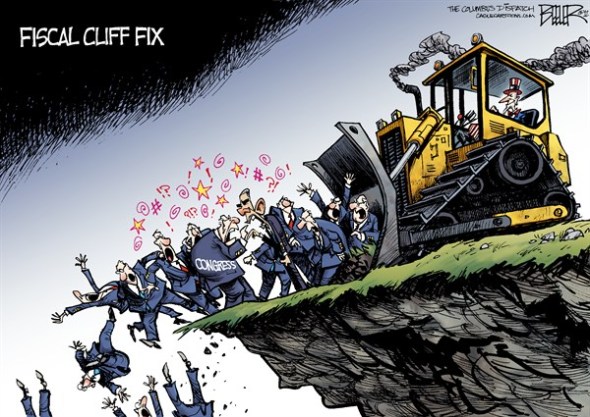
Good Morning!!
Following on Dakinikat’s post last night, The Austerity Plot, here are some more links about Jonathan Chait’s very very bad recommendation that Obama should cave on raising the Medicare enrollment age.
David Dayen’s reaction was immediate and shrill: Jon Chait’s Miserable Endorsement of Raising the Medicare Eligibility Age.
Let’s look at Chait’s reasoning. I would probably start with the fact that he’s not 64 or 65. My parents are, and until my dad reached Medicare in November, they were paying $2,500 a month on the private market for health insurance. So I’ll be happy to provide him with their phone number so he can tell them how it’s “tolerable” for them to spend two years more than they expected doing that.
But soft! Here are his actual reasons. One, Democrats have to accept concessions (that’s always a good strategic place from which to begin a negotiation!), and the scolds seem to like raising the eligibility age. So let’s give ‘em what they want. This is a bizarrely content-free assertion. The phrase “If Alan Simpson and Erskine Bowles wanted you to jump off the Brooklyn Bridge, would you do it?” springs to mind. Second, he thinks that Republicans will somehow forget that this only raises $100 billion, at most, over 10 years, and will then drop any demands to hit a particular number in the negotiations….
The one thing we know will be a side effect of increasing the Medicare eligibility age is that insurance premiums will skyrocket. It will make Medicare more expensive because they lose relatively healthy 65 and 66 year-olds from their risk pool, and it will make private insurance more expensive because they add relatively sick 65 and 66 year-olds to their risk pool. Insurers hate the idea for just this reason. As a result, everyone’s premiums will rise, and cost-shifting will ensue from the government to its citizens.
The original Shrill One, was even more shrill than usual.
…why on earth would Obama be selling Medicare away to raise top tax rates when he gets a big rate rise on January 1 just by doing nothing? And no, vague promises about closing loopholes won’t do it: a rate rise is the real deal, no questions, and should not be traded away for who knows what.
So this looks crazy to me; it looks like a deal that makes no sense either substantively or in terms of the actual bargaining strength of the parties. And if it does happen, the disillusionment on the Democratic side would be huge. All that effort to reelect Obama, and the first thing he does is give away two years of Medicare? How’s that going to play in future attempts to get out the vote?
As Dakinikat wrote, Beltway Bob immediately accepted Chait’s assessment of the likely “deal,” even though he explained very clearly last night as host of the Rachel Maddow Show that doing this would be insane and counterproductive.
I do think it’s kind of important that progressives allow each other a bit of liberty in discussions about big fiscal issues: after all, even the Right-Wing Noise Machine is in a bit of disarray on the subject at the moment. I know some people think resisting anything that affects Social Security or Medicare benefits is the ultimate Red Line that cannot be crossed. Personally, my own fear is that in defending that Red Line, congressional Democrats will wind up making concessions on Medicaid and other low-income programs that in my opinion are more morally compelling than keeping Medicare precisely the way it is today.
Maybe my fears are misguided, or maybe I just don’t share the obsession of some liberals in keeping Medicare pristine as a potential model for a universal single-payer health care system somewhere in the distant future, even if that means today’s poor folks have to suffer as a lower priority.
Apparently, Kilgore doesn’t understand that millions of poverty stricken elders are on Medicare and that millions of middle class Americans rely on Medicaid for nursing home care in addition to Medicare. It’s not an either/or thing.
Atrios gave Chait the Wanker of the Day Award, and yesterday evening, Chait issued an “acceptance speech” that doubled down on his recommendations for Medicare cuts in a post that I personally found offensive–but then I’m one of those loser 65-year-olds, so what do I know?
I, along with millions of other losers, committed the horrendous crime of being born after WWII ended and thus became part of the despised population bomb called the “baby boom.” Never mind that we didn’t ask to be born when we were and that public officials have known about our huge numbers ever since 1960 at least, the problem is all our fault. Supposedly, Ronald Reagan fixed the problem by having us pay more into the system so that Social Security and Medicare would be there when we got old, but now that is all forgotten because the superrich need more money to sock away in foreign tax havens.

Kenneth Baer and Jeffrey Liebman wrote about it in a NYT op-ed yesterday:
For decades we have known that the retirement of the baby boomers would be a monumental event for the economy. But now that it’s happening, many fiscal policy makers are acting as if the boomers are eternal teenagers and are turning a blind eye to how the boomers’ aging changes how we should approach economic policy. And this affects two of the central issues of the negotiations: how much the government should spend and how we can cut unemployment.
Consider the debate over spending. The Congressional Budget Office projects that if current policies continue, total federal spending will rise to 24 percent of gross domestic product in 2022. Republicans and Washington deficit hawks argue that this means spending is out of control, since over the past 40 years government spending has averaged 21 percent.
Their proposed solution is a cap on government spending as a percentage of the economy. Mitt Romney wanted to cap spending at 20 percent of G.D.P. Senator Bob Corker, Republican of Tennessee, has proposed a cap of 20.6 percent with Senator Claire McCaskill, a Democrat from Missouri. Just this week, Gov. Bobby Jindal of Louisiana, a 2016 Republican presidential aspirant, suggested an 18 percent cap.
These plans ignore the simple fact that you cannot repeal the aging of the boomers. The main reason expenditures are rising this decade is that spending on Social Security, Medicare and Medicaid is increasing by a whopping 3.7 percent of G.D.P. as the baby boomers age and retire. This demographic fact also has been driving increases in disability insurance payments as more knees give way and backs give out.
In addition, policy-makers need to be looking at unemployment differently, according to Baer and Liebman, but are they capable of doing that? Not likely. Read more about it at the link.
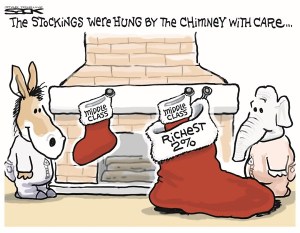
In other “news,” on Thursday, Fox News’ Monica Crowley (did you know she has a Ph.D.?!) claimed that Americans committed “national suicide” by re-electing Obama, because now the rich will have to pay more taxes.
“From a conservative perspective, November 6 was a national suicide,” Crowley asserted. “There is a very thin, fine, red line between us and total destruction of the American idea. That thin, red line was the Republican Party. If this party also commits suicide, this will be catastrophic.”
Raw Story (http://s.tt/1wd0V)
Charlie Crist has officially become a Democrat.
Former Republican Governor Charlie Crist announced his official switch from independent to the Democratic Party with a beaming Twitter post Friday night after a Christmas event at the White House.
Posing in a photo with an unidentified woman holding the official Florida voter registration papers, Crist tweeted he was “proud and honored to join the Democratic Party in the home of President @BarackObama!”
I wonder if he’s going to get a job in the administration? Or will he run for governor against Rick Scott?
Finally, Susie Madrak has a must-read post at Crooks and Liars: Obama Cheaps Out On Sandy Recovery to Prop Up Austerity Sham. It’s a quick read, so please go read it at the link.
That’s all I have for today. Now it’s your turn. What’s on your reading list?

 peej
peej Carissa
 bostonboomer
 dakinikat
 ecocatwoman
 mablue2
 Mama Lopez
 peggysue22
 quixote
 skydancingguestblogger
 Mona (aka Wonk the Vote)



 Sky Dancing
Recent Comments